• 10 Reasons to Remember…
  • A Brief Word About…
  • About
  • For One Week Only
  • Happy Birthday
  • Monthly Roundup
  • Old-Time Crime
  • Other Posts
  • Poster of the Week
  • Question of the Week
  • Reviews
  • Trailers

thedullwoodexperiment

~ Viewing movies in a different light

thedullwoodexperiment

Tag Archives: Shailene Woodley

Snowden (2016)

27 Sunday Nov 2016

Posted by dullwood68 in Movies

≈ 3 Comments

Tags

CIA, Drama, Eavesdropping, Edward Snowden, Hong Kong, Joseph-Gordon-Levitt, Laura Poitras, Melissa Leo, NSA, Oliver Stone, Review, Rhys Ifans, Shailene Woodley, Thriller, Tom Wilkinson, True story, Whistleblower, Zachary Quinto

snowden-movie-2016-poster

D: Oliver Stone / 134m

Cast: Joseph Gordon-Levitt, Shailene Woodley, Rhys Ifans, Melissa Leo, Zachary Quinto, Tom Wilkinson, Joely Richardson, Timothy Olyphant, Ben Schnetzer, Scott Eastwood, Lakeith Stanfield, Logan Marshall-Green, Ben Chaplin, Nicolas Cage

By now, most of us have heard of Edward Joseph Snowden (Gordon-Levitt), the NSA whistleblower who revealed the extent of the US’s surveillance programme both at home and abroad. In June 2013, Snowden flew to Hong Kong to meet with documentary movie maker Laura Poitras (Leo), and Guardian journalists Glenn Greenwald (Quinto) and Ewen MacAskill (Wilkinson). There, at the Hotel Mira, Snowden explained his reasons for disclosing the documents he appropriated from NSA data banks, and why he felt that the extent of the US’s “eavesdropping” was both inappropriate and damaging to the integrity of the US and its intelligence-gathering agencies. Following the publication of the files Snowden provided, he was charged with offences under the 1917 Espionage Act*, and though he tried to reach South America via Russia and Cuba, his passport was revoked while he was en route to Russia, and he was forced to remain in the transit area of Moscow’s Sheremetyevo Airport. And Moscow – though not the airport – has been his home ever since.

Snowden’s story is one that seems tailor-made for an Oliver Stone movie. Anyone who’s seen his documentary series The Untold History of the United States (2012-13), or read the accompanying book, will know that Stone is largely unimpressed with the way in which his country has become a land run by self-serving neo-conservatives for whom “by any means necessary” is a proud motto. And while you could argue that this has been the status quo in America for a lot longer than the last fifty years, what is without doubt is the extent to which the intelligence agencies have abused their remits post-911 to eavesdrop not just on suspected terrorists but everyone. But with all this now out in the open, and Snowden’s place in history assured – and already explored in Laura Poitras’s excellent, Oscar-winning documentary CITIZENFOUR (2014) – what is there left for Stone to bring to the screen that hasn’t already been explored? Unfortunately, the answer is not much.

snowden_movie_review_002-1200x675-c

Watching Snowden is a somewhat dispiriting experience. Stone does what he does best over two and a quarter hours: exposing the clandestine activities of several branches of the US government, highlighting the insidious effects these activities are having on an individual’s human rights, and revealing how those same human rights aren’t even protected by the courts (who seem to be bypassed at every opportunity). But Stone’s usual passion and sense of outrage seems to be muted here. This is like watching a movie made by someone who’s intellectually aggrieved by what the NSA has been up to, but doesn’t quite feel the need to get emotional about it as well. This is Oliver Stone in restrained, almost reflective mode – and it doesn’t feel right.

What all this means is that Snowden feels like objective reportage for much of its running time, with scenes placed and set up to impart relevant information, allowing Stone and co-screenwriter Kieran Fitzgerald to give audiences all they need to know about Snowden himself and the secret world he was a part of. But it’s this matter-of-fact way in which Stone has decided to present both the man and that world that curtails any tension, and thereby lessens the drama. The scene where Snowden downloads a mass of files right from the heart of the NSA’s base in Hawaii, a scene that many directors could have made into a nerve-shredding exercise in trepidation and anxiety, lacks all those elements and plays out with a minimum of fuss and bother.

snowdenshailenejosephgordonlevitt

Watching as Snowden becomes increasingly aware of the extent of his country’s malfeasance – and the ways in which he’s unwittingly contributed to that malfeasance – Stone shows Snowden’s baffled disbelief, and his somewhat naïve demeanour, but there’s a distance between the viewer and the beleaguered whistleblower that stops any real sympathy or connection from forming. As Joseph Gordon-Levitt goes about the process of making Snowden’s initial commitment to the NSA appear noble and necessary, he can’t quite overcome a lack of personality that keeps the man from registering as more than a name most people will recognise, but few outside the US will truly care about. This is partly due to the script, which, instead of showing the man behind the name through his commitment to the truth, attempts to do so through his relationship with his girlfriend, Lindsay Mills (Woodley). Would that these scenes had more of an impact, but there’s a pedantic, going-through-the-motions feel to them that Stone can’t quite shake off. There are times where they also border on soap opera, as Mills’s frustration with Snowden’s work leads to several moments where she invokes the whole “it’s me or the job” ultimatum.

Elsewhere, the movie plods along, only occasionally engaging with the material in a way that appears earnest or committed, but doing enough to keep interested viewers interested, while not doing enough to keep viewers new to Snowden’s story on board for the duration. It’s not that Stone is doing anything particularly wrong – he still has a strong visual sense (bolstered by crisp, insistent cinematography from Anthony Dod Mantle), and the movie is expertly edited by Alex Marquez and Lee Percy – but somewhere along the way, any sense of urgency about the subject and its ramifications seems to have been lost. Perhaps it’s due to the time that’s passed since Snowden blew the whistle; in today’s need-to-know-now society is his story relevant anymore?

19543332_303

There are good performances all round, but mostly amongst the supporting turns, with Ifans a standout as Snowden’s mentor and über-spook Corbin O’Brien. Its also good to see Nicolas Cage, albeit in a minor role, deliver the kind of performance that we know he’s capable of. Spare a thought though for the trio of Leo, Quinto and Wilkinson, stranded in a hotel room in Hong Kong and not really given much to do except listen and look amazed/appalled/astounded as appropriate (it makes the scene where Greenwald barks orders at his editor (Richardson) all the more striking – and out of place). Woodley is hamstrung by a role that requires her to be unsupportive and selfish for the most part, and which is left hanging by a script that doesn’t explain why she’s now living with Snowden in Moscow. And as Snowden, Gordon-Levitt gives a diffident, constrained portrayal of a man who made a momentous personal and professional decision, and the actor carries the gravitas of that with aplomb. If only he didn’t sound like Keanu Reeves…

Rating: 6/10 – Stone adds another American life to his list of movie subjects, but in doing so seems more like a director for hire than the tirelessly challenging agent provocateur he usually is; what hampers Snowden is a sense that its story is no longer important, and that the movie is aware of this, which stops it from being the impassioned, thought-provoking movie it should be.


*The 1917 Espionage Act is a particularly apt (and predictable) piece of legislation for Snowden to be charged under. Such is the loose nature of the Act, if Snowden were to return to the US and be put on trial, he wouldn’t be able to use any information relating to the offence as evidence that he wasn’t guilty; because of the nature of the information he released, it would still be regarded as classified and therefore not admissible, and the jury wouldn’t be privy to it. And that’s without the cost of the defense itself: anywhere between $1 million and $3 million.

Share this:

  • Click to share on X (Opens in new window) X
  • Click to share on Facebook (Opens in new window) Facebook
  • More
  • Click to print (Opens in new window) Print
  • Click to email a link to a friend (Opens in new window) Email
Like Loading...

Allegiant (2016)

03 Sunday Apr 2016

Posted by dullwood68 in Movies

≈ 1 Comment

Tags

Ansel Elgort, Bureau of Genetic Welfare, Chicago, Divergent Series, Drama, Jeff Daniels, Literary adaptation, Miles Teller, Naomi Watts, Providence, Review, Robert Schwentke, Sci-fi, Sequel, Shailene Woodley, Theo James, Thriller, Veronica Roth

Allegiant

D: Robert Schwentke / 120m

Cast: Shailene Woodley, Theo James, Naomi Watts, Octavia Spencer, Jeff Daniels, Zoë Kravitz, Ansel Elgort, Miles Teller, Keiynan Lonsdale, Daniel Dae Kim, Maggie Q, Bill Skarsgård, Jonny Weston, Ray Stevenson, Mekhi Phifer, Ashley Judd

And so Jeanine is dead, killed by Four’s mother, Evelyn (Watts). Everything’s okay and peace has been restored. Except that Evelyn is making sure it comes at a further price: everyone who was on Erudite’s side has to be put on trial and their “crimes” answered for. This means executions on a wide scale, and although Tris (Woodley) has disowned her brother, Caleb (Elgort), he faces the same fate. With the message from outside Chicago still indicating that there are more answers to be found outside the city than in, Tris and Four (James) opt to breach the wall and go in search of those answers. Four decides to help Caleb escape, and the trio are joined by Christina (Kravitz), Tori (Maggie Q), and Peter (Teller). Despite an attempt to stop them by Evelyn’s lieutenant, Edgar (Weston), they climb over the wall and down to the other side.

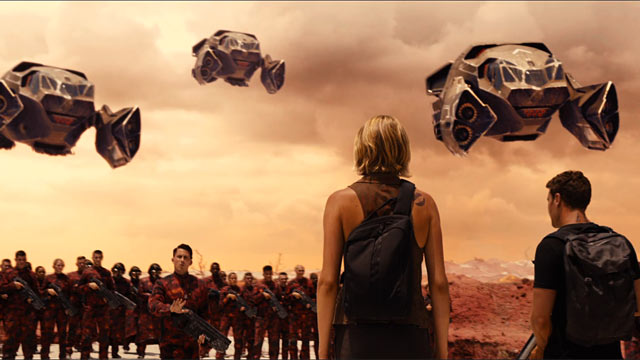
There they find a toxic wasteland, where the earth is a scorch blasted red. Having been followed by Edgar, the group are relieved when they reach a force field that opens to reveal an armed force. This group protects Tris and her friends from Edgar, and with his threat neutralised, they take Tris and company to their base far out in the wasteland, the so-called Bureau of Genetic Welfare, where Tris in particular is welcomed by the Bureau’s director, David (Daniels). With Tris being the fruit of an experiment to right a wrong perpetrated long ago, David is keen to run tests on her, while keeping Four and the others occupied and away from her as much as possible. But Four is quick to suspect that David isn’t as honest as he makes out, but Tris doesn’t see it.

Allegiant - scene2

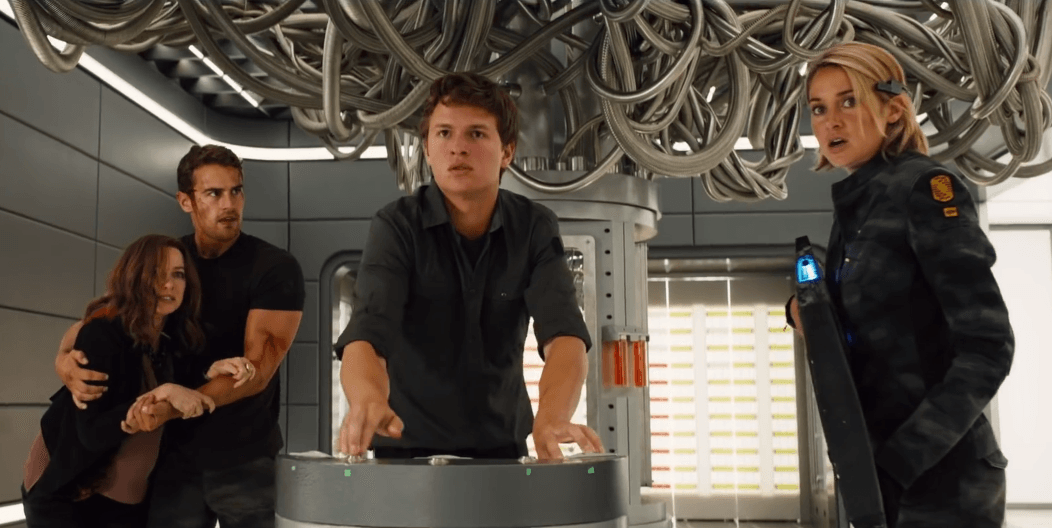
Meanwhile, back in Chicago, Johanna (Spencer) has formed a group she calls Allegiant, and who are at odds with Evelyn’s way of running things. Another war of attrition is about to take place between the two factions, and though Tris wants David to intervene – after all, he has been monitoring Chicago for a long time because of the experiment – but instead of doing so, he sends Peter back with a nerve gas that will render everyone who comes into contact with it, unable to remember anything that happened to them before they were exposed. And while David takes Tris to meet the Council who ultimately decide everyone’s fate, Four discovers what the gas has been used for in the wasteland. And when Tris finally becomes aware of David’s duplicity, she and Four, along with Christina and Caleb, return to Chicago to stop Evelyn from using the gas on Allegiant.

Three movies in and the Divergent series is showing serious signs that it’s running out of ideas. Allegiant is superficially entertaining, but in comparison with parts one and two, it lacks anything fresh to entertain either fans or newcomers. It’s also the first time that the series gives up on Tris as an independent, strong-minded female, and instead hands over leadership duties to Four – which wouldn’t be such a bad idea if he wasn’t written as a bit of a pompous told-you-so kind of character. (Throughout the series, Four has been the gloomiest character of them all, unable to smile or express his feelings about anything without a frown.) And with Tris relegated to a secondary role, there’s only Daniels left to pick up the slack, as everyone else (James excepted) is afforded only enough screen time to either provide any relevant exposition, or keep the plot ticking over (Spencer and Watts are wasted, while Judd is brought back yet again to add some more of her character’s turgid back story).

Allegiant - scene1

The problem with the movie is twofold: one, it’s the first half of the third book in the series, and as such, doesn’t have a credible ending, just another narrowly avoided cliffhanger that leaves things open for part four (or should that be part three-point-five?); and two, the action seems more than usually contrived once Tris et al leave Chicago. The wasteland is less than threatening, and the Bureau is predictably shiny on the surface (and in David’s “office”), while the barracks Four and Christina are assigned to are remarkably similar to those inhabited by Dauntless in the first movie. It’s all brightly lit and commendably shot by esteemed DoP Florian Ballhaus (returning from Insurgent (2015) and already hired for the next instalment), but it’s becoming hard to care what happens to anyone.

At its heart, the Divergent series is about DNA profiling and the perils that can follow on from it. It’s a concept that’s been there in the first two movies, but which hasn’t been addressed directly. But now that it has, and through the medium of video no less, the truth behind the use of Chicago as a test ground, and the true meaning of being Divergent, all sounds quite dull and unexciting. The movie fails to make Tris’s nature important to its own story, and instead opts for being yet another race-against-time thriller, abandoning the ethical and moral debate it wants to engage in and relying on tried and trusted action movie clichés to wind up its narrative.

Allegiant - scene3

It’s no surprise that the movie has underperformed at the box office (leading to the final movie, Ascendant, due next year, having its budget cut), because even though Tris makes it out of Chicago, once she does, the movie doesn’t know what to do with her, and for a character as intriguing and interesting as Tris, that’s a terrible decision to make on any level. And it doesn’t help that your central villain is ultimately a harried bureaucrat, a futuristic pen-pusher if you will. That’s another stumble, and especially bad after having Kate Winslet fill the villain’s shoes for the first two movies. It all adds up to a movie that coasts on the success of its predecessors, and feels and looks like a stopgap before the real conclusion in part four.

Rating: 5/10 – another series instalment that will have newcomers wondering what all the fuss has been about, Allegiant is a movie that has little to offer in terms of its characters’ development, or in terms of expanding the wider narrative; Woodley – this series’ biggest asset – is sidelined for much of the movie, and though James is a competent enough actor, he doesn’t have his co-star’s presence on screen, which makes large chunks of the movie something of a chore to sit through.

Share this:

  • Click to share on X (Opens in new window) X
  • Click to share on Facebook (Opens in new window) Facebook
  • More
  • Click to print (Opens in new window) Print
  • Click to email a link to a friend (Opens in new window) Email
Like Loading...

Insurgent (2015)

08 Wednesday Apr 2015

Posted by dullwood68 in Movies

≈ 1 Comment

Tags

Abnegation, Action, Amity, Ansel Elgort, Candor, Dauntless, Drama, Erudite, Kate Winslet, Literary adaptation, Naomi Watts, Review, Robert Schwentke, Sci-fi, Sequel, Shailene Woodley, Theo James, Thriller, Veronica Roth

Insurgent

D: Robert Schwentke / 119m

Cast: Shailene Woodley, Theo James, Kate Winslet, Ansel Elgort, Miles Teller, Naomi Watts, Octavia Spencer, Jai Courtney, Mekhi Phifer, Zoë Kravitz, Maggie Q, Daniel Dae Kim, Jonny Weston, Ashley Judd, Ray Stevenson, Tony Goldwyn, Janet McTeer

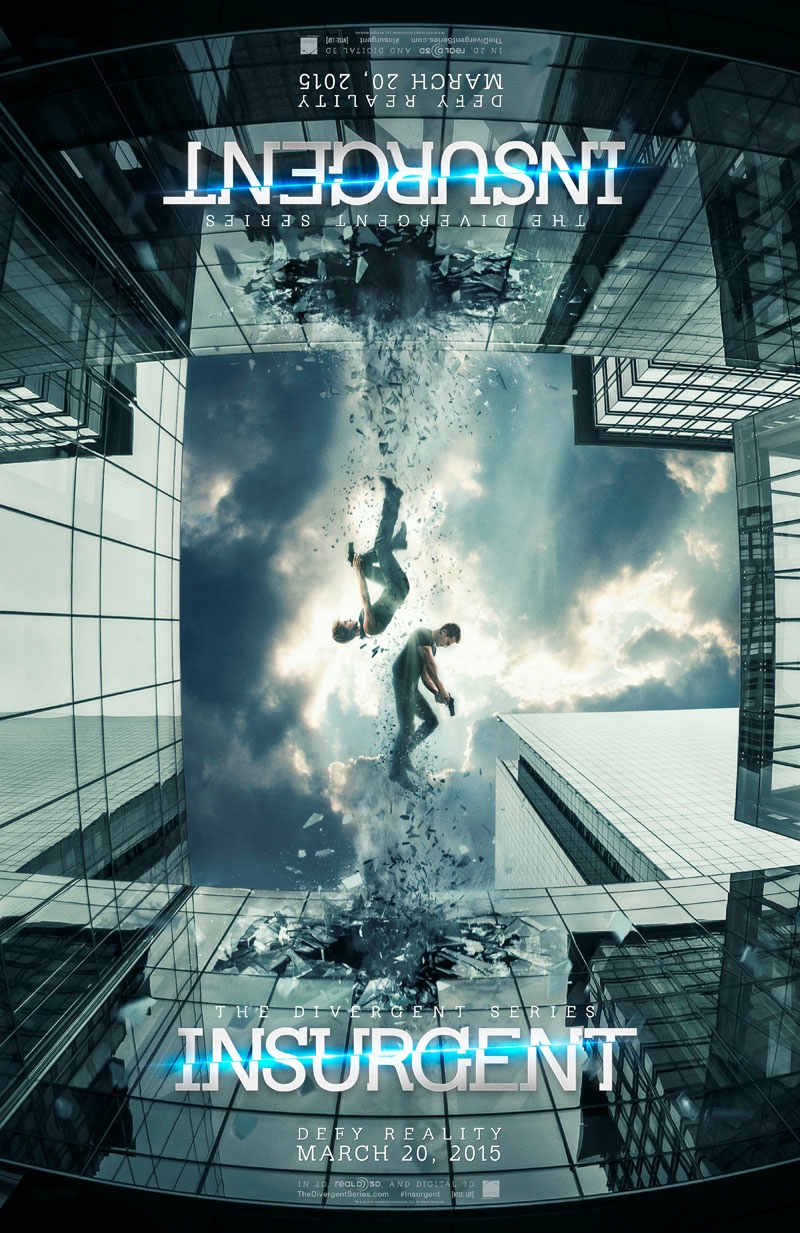
In the aftermath of the attack on Abnegation, a search reveals a box that contains all the faction symbols. It’s taken to Erudite where Jeanine (Winslet) reveals it holds a message from the city’s elders, but only a Divergent can open it; this leads Jeanine to order that all Divergents are rounded up. Meanwhile, Tris (Woodley), Four (James), Caleb (Elgort) and Peter (Teller) are hiding out in Amity, under the protection of their leader Johanna (Spencer). Tris is all for returning to Erudite and killing Jeanine but Four warns against acting so hastily: they need to be a stronger force before they can attack the ruling faction.

Matters are brought to a head when Dauntless leader Max (Phifer) arrives to look for any Divergents. Peter reveals their presence but Tris, Four and Caleb manage to escape on a train that takes them into Factionless territory. There they meet Evelyn (Watts), the Factionless leader who, it turns out, is Four’s mother. She advocates a coalition between Factionless and the remainder of Dauntless. The next day, Tris, Four and Caleb leave to visit Candor, where the remainder of Dauntless have taken refuge. On the way, Caleb tells Tris he can’t go with them and they part. In Candor, their leader, Jack (Dae Kim) arranges a trial to determine the truth of Four’s insistence that Jeanine is lying to the other factions. A raid by Max and Eric (Courtney) leads to Tris being tested and found to be 100% Divergent. The raid is unsuccessful though and Tris is rescued by Four and Candor. At Erudite, Peter tells Jeanine the best way in which she can trap Tris. With the lives of all in Candor at risk because of Tris’s presence there, she determines to turn herself in.

At Erudite, Tris is apprehended and taken in front of Jeanine. She explains about the box and has Tris hooked up to it. In order to open it, Tris has to pass each Faction test, something none of the other Divergents abducted by Jeanine has managed. With Caleb having rejoined Erudite, and Peter also on their side, Tris can only hope that whatever message the box holds, that she will survive the ordeal long enough to learn what it is, and what it means for the city.

Insurgent - scene

After the prolonged set up and introduction of each Faction and the world they support that made up most of Divergent (2014), you’d think Insurgent would be less reliant on large chunks of awkward exposition. But it’s not the case, as this instalment introduces new characters and broadens the original’s scope. This leads to more explanations for everyone’s behaviour and more occasions where the not-exactly-complicated story has to be explained every step of the way (as if the audience wouldn’t be able to keep up). Which is a shame, as this time around, Tris’s newfound place in her world is much more interesting and exciting to be a part of.

Weighed down by the expectations that come with cinema’s version of “middle child syndrome” (and even though Allegiant will be released in two parts – damn you Harry Potter!), Insurgent gets a lot right. It ups the action content, makes the heroes more heroic, the villains more villainous, and ends with the news that we’ve all been waiting to hear: next time we go outside the wall. The movie couldn’t be more designed to please its audience, both existing and new. And that’s another factor that makes the movie work: you don’t have to have seen Divergent to work out what’s going on. Such is the care that’s been taken with the adaptation of the book, that even though there are huge chunks that are missing (including whole storylines), it’s a tribute to screenwriters Brian Duffield, Akiva Goldsman and Mark Bomback that this is a well constructed, and surprisingly streamlined version that holds its own and isn’t reliant on the first movie.

It also moves the characters forward in unexpected ways. Tris is hell-bent on killing Jeanine which isn’t the usual approach in a YA movie (you’d never expect to hear Katniss Everdeen sound so vehement about President Snow as Tris is about Jeanine). It’s refreshing to see someone be that blunt and not harbour any deep-seated guilt or reservations about the rights or wrongs of such a thing; Tris is resigned and more importantly, she can’t wait to do it. As for her love interest, the taciturn Four, we get to see him deal with a greater authority than Eric or Max, or even his dad: his mother, presumed dead all these years and as determined to get Jeanine almost as much as Tris. While he wrestles with his emotional scars, Tris gets down to the task of taking out Jeanine; it’s like he’s not even supporting her anymore.

Of course, true love overcomes any dispute or disagreement and Tris and Four leave their differences behind when it comes to overthrowing Erudite, and although the message in the box is one that only readers of the novel will have seen coming, it’s still a treat to see it revealed in such a dramatic, world-upsetting way. It’s yet another way in which new director Schwentke keeps things interesting and the viewer on their toes. He makes judicious use of the new cast members, with even Watts (who has Big Villain written all over her) required to keep it simple and not detract from the main storyline, that of Tris learning to forgive herself for the deaths of her parents and the turncoat Will. Woodley, still the best thing in both movies, shades her emotions with ease and presents a version of Tris that is still learning but who’s also streets ahead of her rebellious companions (but then she is Divergent).

The rest of the cast offer and provide excellent support, with special mention going to Courtney, Spencer, Watts and Teller, though Elgort is still stuck with possibly the blandest character in the whole series, and suffers as a result; he just can’t make him interesting. Winslet is icy and controlling and strangely attractive because of all that, and steals each scene she’s in. The final scene robs us of a major character and is a great way to end this movie and set up some of the dramatics of the next, but it also feels like a bit of a cheap shot at the audience’s expense. What, do we ask, does that mean for Tris and Four and all the rest? Well, to find out, tune in next year!

Rating: 7/10 – better than Divergent, and better assembled, Insurgent shows the franchise gaining in confidence and moving ahead in the right direction; not without its flaws – Peter is still an annoyingly underwritten character – the movie packs a lot in and, on the whole, makes it all work with a great deal of panache.

Share this:

  • Click to share on X (Opens in new window) X
  • Click to share on Facebook (Opens in new window) Facebook
  • More
  • Click to print (Opens in new window) Print
  • Click to email a link to a friend (Opens in new window) Email
Like Loading...

The Fault in Our Stars (2014)

24 Wednesday Dec 2014

Posted by dullwood68 in Movies

≈ 2 Comments

Tags

Amsterdam, Ansel Elgort, Cancer, Drama, John Green, Josh Boone, Laura Dern, Literary adaptation, Review, Romance, Shailene Woodley, Willem Dafoe

Fault in Our Stars, The

D: Josh Boone / 126m

Cast: Shailene Woodley, Ansel Elgort, Laura Dern, Sam Trammell, Nat Wolff, Willem Dafoe, Lotte Verbeek, Ana Dela Cruz, Mike Birbiglia

Teenager Hazel Grace Lancaster (Woodley) is suffering from stage 4 thyroid cancer; she is on oxygen 24/7. While attending a support group she meets Augustus ‘Gus’ Waters (Elgort), who is in remission after losing his right leg to osteosarcoma. Gus and Hazel hit it off and soon they’re hanging out together and swapping life stories. At one point, Hazel tells Gus about her favourite book, “An Imperial Affliction”, a story about a young girl suffering from leukaemia. Gus reads it and is surprised to find the novel ends in mid-sentence; like Hazel he wants to know what happened next. Hazel tells him she’s written to the author on several occasions but he’s never replied to her.

A few days later, Gus announces he’s found the book’s author and has had an e-mail from him. Hazel is amazed and follows this up; she too receives a reply, one that includes an invitation to visit him in Amsterdam, where he lives. Hazel is overjoyed and tells her mother, Frannie (Dern), but the financial reality is that her parents aren’t able to afford the trip. Gus comes to the rescue when he arranges for the Genies (a make-a-wish organisation) to cover the costs. Hazel, Gus and Frannie travel to Amsterdam and the two teenagers meet the novel’s author, Peter Van Houten (Dafoe). However, their excitement is soon tempered by Van Houten’s behaviour towards them, which is boorish and rude. When they leave, Hazel is angry and upset, but they are followed by Van Houten’s personal assistant, Lidewij (Verbeek) who takes them to the Anne Frank museum. There, Gus and Hazel share their first kiss. With their relationship deepening, everything is looking positive, but before they return home, one of them has some bad news…

Fault in Our Stars, The - scene

A teen version of Love Story (1970), but with less angst and more of a sweet-natured approach, The Fault in Our Stars is a movie with so many good intentions it’s almost overwhelming. First there’s Gus’s unremitting refusal to be anything other than upbeat, a reasonable enough reaction given what he’s gone through personally, but there are times when you wonder if anyone would be like that. Then there’s Hazel’s determination to ignore the limitations her cancer is putting on her, as in the scene where she doggedly climbs to the top floor of Anne Frank’s house, her breathing getting more and more laboured as she ascends. These are two incredibly determined individuals, aware of their circumstances but doing their best (Gus, especially) not to let it interfere with their daily lives and their burgeoning relationship.

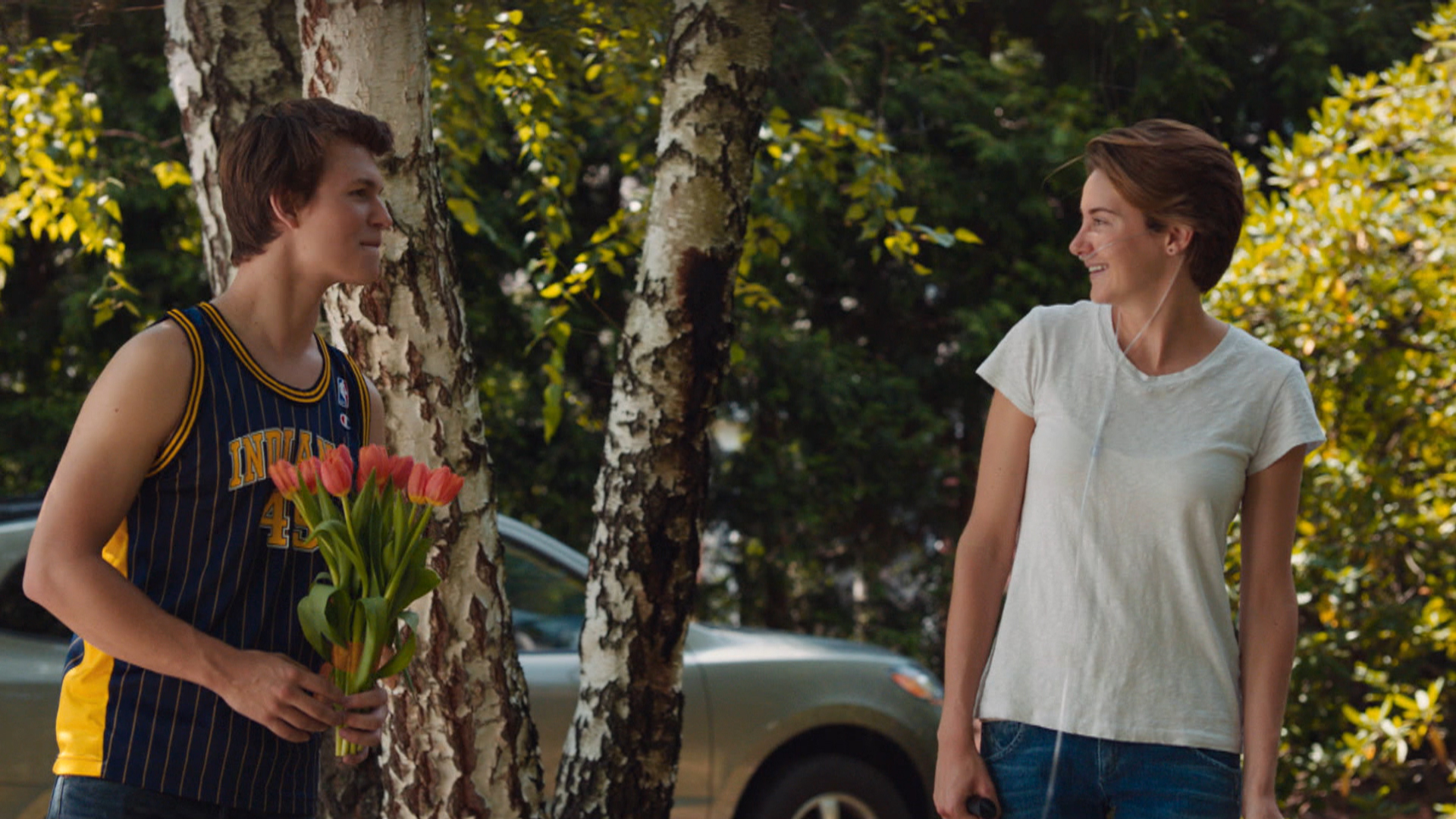
This leaves the movie feeling for the most part like a teen romance with “issues”, and ones that threaten to overwhelm the narrative at times. As cancer sufferers, both Hazel and Gus are plucky “survivors”, both of them putting on a brave face while unable to stop doubt and fear from eating away at them on the inside. While the issue of cancer is never very far away – Hazel wears a cannula in her nose for pretty much the entire movie – at the outset it’s treated more as an inconvenience than a life-threatening condition (which it is for both of them). This allows the movie to avoid being too heavy-handed or depressing, but leads to the suspicion that what we’re seeing is two young people who are so well adjusted to the vagaries of their respective diseases that the chance for real drama is going to be avoided as well.

That this doesn’t prove to be the case is, naturally, to be expected, but the movie takes a long time in getting there, and its continual positivity begins to wear as it progresses, with Hazel suffering the kind of occasional setback that happens, is shrugged off, and appears to have no toll associated with it at all. If this is a relatively true depiction of dealing with cancer, then full marks to those dealing with it on a daily basis, but in terms of the movie it’s like a tick-box exercise. Leaving notions of personal courage aside, what The Fault in Our Stars is telling us is, don’t let any disease stop you from living as full a life as possible.

While this is entirely commendable, what it isn’t is fodder for a movie that wants to be as “relevant” as The Fault in Our Stars wants (or tries) to be. If the movie is about anything it’s about the need for reassurance where very little can be given, and in circumstances where each day has be taken as it comes. Hazel and Gus’s meeting with Van Houten highlights this perfectly, his refusal to answer their questions or validate their concerns is the one moment in the movie where their attitudes around cancer are challenged. It’s an abrupt change in both pace and tone, and one that the movie badly needs as it staves off full saccharine overload. The repercussions from the meeting help the narrative immensely in the movie’s final third, and there’s a rewarding pay off at the end that would have seemed false otherwise.

As the embattled teens, Woodley and Elgort are a good match, clearly enjoying their roles and shading them more effectively than the script by Scott Neustadter and Michael H. Weber actually allows. Woodley is as good as you’d expect, investing Hazel with a strained insecurity that keeps her apart from others, including at times her parents. Elgort has the more outgoing role, and while he’s occasionally annoying he makes up for it by balancing Gus’s good nature with an underlying pathos. As Hazel’s mother, Dern does concerned and protective with ease, Wolff cements his reputation as a young actor to watch as fellow cancer victim Isaac, and Dafoe gives the movie a much needed shot in the arm as the truculent Van Houten.

Fault in Our Stars, The - scene2

The movie has humour aplenty in its opening scenes, and its gradual descent into full-fledged drama is handled with consistent surety by director Josh Boone, keeping a tight grip on the script’s more overly sentimental moments and grounding the emotional content without recourse to too much melodrama. The movie is lensed to good effect by Ben Richardson, and there’s a low-key score from Mike Mogis and Nate Walcott that underpins the various elements in an unfussy, often touching way.

Rating: 7/10 – bolstered by good performances and confident direction, The Fault in Our Stars avoids movie-of-the-week mediocrity by approaching John Green’s original novel with an appreciation for its attempt to do something a little different; funny and affecting in equal measure, fans of the book won’t be disappointed, while newcomers should be won over nevertheless.

Share this:

  • Click to share on X (Opens in new window) X
  • Click to share on Facebook (Opens in new window) Facebook
  • More
  • Click to print (Opens in new window) Print
  • Click to email a link to a friend (Opens in new window) Email
Like Loading...

Divergent (2014)

20 Sunday Apr 2014

Posted by dullwood68 in Movies

≈ 3 Comments

Tags

Abnegation, Dauntless, Erudite, Factions, Kate Winslet, Neil Burger, Review, Sci-fi, Shailene Woodley, Simulation serum, Theo James, Veronica Roth

Divergent

D: Neil Burger / 139m

Cast: Shailene Woodley, Theo James, Ashley Judd, Kate Winslet, Jai Courtney, Ray Stevenson, Zoë Kravitz, Miles Teller, Tony Goldwyn, Ansel Elgort, Maggie Q, Mekhi Phifer

The first of four movies adapted from the novels by Veronica Roth, Divergent is yet another dystopian vision of the future as seen through the eyes of a young adult, this time, Beatrice Prior (Woodley).  Beatrice lives in a partly desolate version of Chicago that has seen its social structure reorganised so that people live in factions.  These factions determine the kind of life they lead and their social responsibilities.  Beatrice and her family, father Andrew (Goldwyn), mother Natalie (Judd) and brother Caleb (Elgort), live in the Abnegation faction.  Abnegation is about being selfless and helping others including giving food to the factionless (or the homeless); they are also the ruling government.  At sixteen, Beatrice and Caleb have to decide if they want to stay with Abnegation, or join one of the other factions: Erudite (science and teaching), Candor (unable to lie, often lawyers), Amity (farmers, nurses, artists who also favour peace), and Dauntless (brave and fearless and despite the apparent lack of crime, the city’s peacekeepers if needed).

Beatrice undergoes a test to see which faction she would most fit in with, but it is inconclusive.  At the choosing ceremony, Caleb opts for Erudite, and Beatrice for Dauntless (this also means neither of them can see their parents again).  Beatrice begins her training with Dauntless, and meets instructors Eric (Courtney), and Four (James).  At first, she struggles to make the first cut, but with Four’s support and encouragement she makes it through.  As time goes on, Beatrice – now calling herself Tris – learns that her test being inconclusive means she is ‘divergent’, someone who is able to encompass the traits of each faction and effectively “think for themselves”.  Divergents are viewed as a threat to society and are disposed of when discovered.  With the second stage of her training highlighting Tris’s abilities more and more, it becomes increasingly difficult for her to avoid detection, but with Four’s help, she passes the final test.

Throughout there have been rumours of a government takeover by Erudite, who view Abnegation as untrustworthy and duplicitous.  Erudite’s leader, Jeanine Matthews (Winslet), has co-opted the Dauntless leadership into her plan; she’s also created a serum that will dupe the Dauntless into believing they are taking part in a simulation exercise when in fact they’ll be killing the members of Abnegation.  Being immune to the serum, Tris – with Four’s help – has to find a way to stop the coming massacre.

Divergent - scene

From the start, Divergent falters by staying faithful to the novel’s vision of Chicago’s new social order.  The factions are a ridiculous concept, ill-thought out and impossible to justify both thematically and dramatically.  The idea that restricting free will and promoting conformity within such narrow confines, as well as rejecting the nuclear family, is so strained and untenable it’s to the movie’s credit that it doesn’t seek to explain or endorse it.  Instead, though, the concept sits there throughout, reminding us at every turn just how unlikely it all is.  (Though if ever a social order needed tearing down, this one fits the bill completely.)

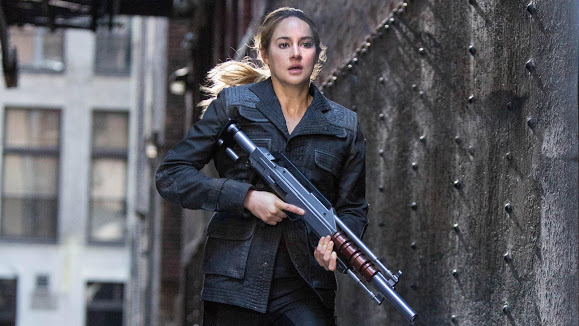
With such a huge obstacle to try and overcome, Divergent never really gets off the ground, either as dystopian fable or cautionary science fiction.  Tris is a sympathetic main character, and without her the movie would be hard to watch, as most of the other characters operate almost independently of both the plot and each other.  Motivations are rote, and behaviours change largely without explanation – look out for Peter (Teller), a villain for ninety-five per cent of the movie, right until one of the final shots – while Tris’s family are used more as a plot device than as an emotional focal point.  There’s also the budding romance between Tris and Four, played out with so little deviation from formula that you could cut and paste them into any number of other movies and not notice the difference.

Where the movie does score points is in its creation of the world that Tris inhabits, with convincing differences between the locations of the factions – Abnegation is grey and nondescript, Erudite is futuristic and glamorous – and the semi-ravaged Chicago environs hinting at a more recent, more low-key war (a visit to a ruined fairground is a highlight).  There’s a pleasing mix of high and low-tech weaponry, and the various fight scenes are unfussy and effective (though Tris does seem to master things almost overnight once the plot needs her to).  Overall, Divergent is a movie with a strong visual style and the photography by Alwin H. Küchler is surprisingly fluid and well-framed for a movie with so many static, dialogue-heavy moments.  Neil Burger’s direction can’t quite keep a grip on the pace of the movie and the last thirty minutes feel rushed in comparison to what has gone before, but otherwise it’s a solid piece of work given the limitations of the material.

However, this is Woodley’s movie, pure and simple, a star-making turn that takes the promise she showed in The Descendants (2011) and validates that promise completely.  Wrestling with an awkwardly motivated character, Woodley takes Tris in hand and makes her truly ‘divergent’, displaying a range that fleshes out the character with unassuming ease.  (Tris does remain under-developed however, and it will be interesting where Woodley is able to take her – and how effectively – in the sequels.)  Woodley is a confident young actress and she deals persuasively with what is as much a physically demanding role as an emotional one.

Sadly, the rest of the cast don’t fare as well, with only James given more than a passing nod towards a fully-fledged character.  Courtney, Stevenson and Teller are wasted, while Judd and Goldwyn provide a minimum of parental guidance (and plot exposition) before being sidelined.   Kravitz and Elgort create new shades of bland (though to be fair, that’s largely down to the characters, and not them as actors), and even Winslet – usually convincing in whatever role she takes on – fails to add any depth to her character and is here reduced to the kind of sub-standard villain you’d expect in a cheap James Bond knock-off.

Rating: 5/10 – a bizarre hotchpotch of ideas about social programming, Divergent never overcomes the faults of its source material; fans of The Hunger Games looking for an interim fix before Mockingjay Part 1 will be disappointed, while newcomers who haven’t read the book will wonder what all the fuss is about.

Share this:

  • Click to share on X (Opens in new window) X
  • Click to share on Facebook (Opens in new window) Facebook
  • More
  • Click to print (Opens in new window) Print
  • Click to email a link to a friend (Opens in new window) Email
Like Loading...

Blog Stats

  • 486,528 hits

Recent Posts

  • 10 Reasons to Remember Bibi Andersson (1935-2019)
  • Fantasia (1940)
  • Dances With Wolves (1990) – The Special Edition
  • Kiss of the Spider Woman (1985)
  • The Three Musketeers (1973)

Top Posts & Pages

  • Lost for Life (2013) - Another Look
    Lost for Life (2013) - Another Look
  • Lost for Life (2013)
    Lost for Life (2013)
  • About
    About
  • Mr. Topaze (1961)
    Mr. Topaze (1961)
  • Winter's Tale (2014)
    Winter's Tale (2014)
  • Billy Lynn's Long Halftime Walk (2016)
    Billy Lynn's Long Halftime Walk (2016)
  • The Hitman's Bodyguard (2017)
    The Hitman's Bodyguard (2017)
  • Shock and Awe (2017)
    Shock and Awe (2017)
  • 5 Famous Movie Roles That Nearly Went to Someone Else
    5 Famous Movie Roles That Nearly Went to Someone Else
  • The Layover (2017)
    The Layover (2017)
Follow thedullwoodexperiment on WordPress.com

Blogs I Follow

  • Rubbish Talk
  • Film 4 Fan
  • Fast Film Reviews
  • The Film Blog
  • All Things Movies UK
  • Interpreting the Stars
  • Let's Go To The Movies
  • Movie Reviews 101
  • TMI News
  • Dan the Man's Movie Reviews
  • Film History
  • Jordan and Eddie (The Movie Guys)

Archives

  • April 2019 (13)
  • March 2019 (28)
  • February 2019 (28)
  • January 2019 (32)
  • December 2018 (28)
  • November 2018 (30)
  • October 2018 (29)
  • September 2018 (29)
  • August 2018 (29)
  • July 2018 (30)
  • June 2018 (28)
  • May 2018 (24)
  • April 2018 (21)
  • March 2018 (31)
  • February 2018 (25)
  • January 2018 (30)
  • December 2017 (30)
  • November 2017 (27)
  • October 2017 (27)
  • September 2017 (26)
  • August 2017 (32)
  • July 2017 (32)
  • June 2017 (30)
  • May 2017 (29)
  • April 2017 (29)
  • March 2017 (30)
  • February 2017 (27)
  • January 2017 (32)
  • December 2016 (30)
  • November 2016 (28)
  • October 2016 (30)
  • September 2016 (27)
  • August 2016 (30)
  • July 2016 (30)
  • June 2016 (31)
  • May 2016 (34)
  • April 2016 (30)
  • March 2016 (30)
  • February 2016 (28)
  • January 2016 (35)
  • December 2015 (34)
  • November 2015 (31)
  • October 2015 (31)
  • September 2015 (34)
  • August 2015 (31)
  • July 2015 (33)
  • June 2015 (12)
  • May 2015 (31)
  • April 2015 (32)
  • March 2015 (30)
  • February 2015 (37)
  • January 2015 (39)
  • December 2014 (34)
  • November 2014 (34)
  • October 2014 (36)
  • September 2014 (25)
  • August 2014 (29)
  • July 2014 (29)
  • June 2014 (28)
  • May 2014 (23)
  • April 2014 (21)
  • March 2014 (42)
  • February 2014 (38)
  • January 2014 (29)
  • December 2013 (28)
  • November 2013 (34)
  • October 2013 (4)

Blog at WordPress.com.

Rubbish Talk

Film 4 Fan

A Movie Blog

Fast Film Reviews

The Film Blog

The official blog of everything in film

All Things Movies UK

Movie Reviews and Original Articles

Interpreting the Stars

Dave Examines Movies

Let's Go To The Movies

Film and Theatre Lover!

Movie Reviews 101

Daily Movie Reviews

TMI News

Latest weather, crime and breaking news

Dan the Man's Movie Reviews

All my aimless thoughts, ideas, and ramblings, all packed into one site!

Film History

Telling the story of film

Jordan and Eddie (The Movie Guys)

Movie Reviews & Ramblings from an Australian Based Film Fan

Privacy & Cookies: This site uses cookies. By continuing to use this website, you agree to their use.
To find out more, including how to control cookies, see here: Cookie Policy
  • Subscribe Subscribed
    • thedullwoodexperiment
    • Join 481 other subscribers
    • Already have a WordPress.com account? Log in now.
    • thedullwoodexperiment
    • Subscribe Subscribed
    • Sign up
    • Log in
    • Report this content
    • View site in Reader
    • Manage subscriptions
    • Collapse this bar
 

Loading Comments...
 

    %d