• 10 Reasons to Remember…
  • A Brief Word About…
  • About
  • For One Week Only
  • Happy Birthday
  • Monthly Roundup
  • Old-Time Crime
  • Other Posts
  • Poster of the Week
  • Question of the Week
  • Reviews
  • Trailers

thedullwoodexperiment

~ Viewing movies in a different light

thedullwoodexperiment

Tag Archives: Shamim Sarif

I Can’t Think Straight (2008)

18 Wednesday Apr 2018

Posted by dullwood68 in Movies

≈ Leave a comment

Tags

Drama, LGBTQ+, Lisa Ray, Literary adaptation, Review, Romance, Sexuality, Shamim Sarif, Sheetal Sheth, Wedding

D: Shamim Sarif / 79m

Cast: Lisa Ray, Sheetal Sheth, Antonia Frering, Dalip Tahil, Nina Wadia, Ernest Ignatius, Siddiqua Akhtar, Amber Rose Revah, Anya Lahiri, Kimberly Jaraj, Sam Vicenti, Rez Kempton, Darwin Shaw

The daughter of wealthy Christian Palestinians (Frering, Tahil), Tala (Ray) is preparing to get married. Hani (Shaw) is a handsome young businessman, and her fourth fiancé. The wedding is due to take place in Jordan, but Tala lives and works in London. There she meets Leyla (Sheth), the girlfriend of Ali (Kempton), one of Tala’s old college friends. There’s an instant attraction between the two, and soon they are finding excuses to spend time together. A trip to Oxford with one of Tala’s sisters, Lamia (Lahiri), leads to Leyla and Tala sleeping together. But where this emboldens Leyla to acknowledge and embrace her sexuality, Tala cites her family and cultural traditions as reasons why she can’t commit to a relationship with Leyla, and this causes a wedge between them. They go their separate ways, with Tala preparing to enter into a marriage that isn’t what she wants, and Leyla choosing to make a life-changing decision. Time passes, but though both women retain their feelings for each other, it takes one more life-changing decision to allow them the chance of being happy together…

A lighter, less dramatic (and contemporary) version of Sarif’s previous movie, The World Unseen, I Can’t Think Straight is also another adaptation by Sarif of one of her novels. It’s a semi-autobiographical tale where Leyla represents Sarif, and reunites Ray and Sheth in similar roles from The World Unseen. It’s a breezy effort, more concerned with applying humour to events than focusing on the drama, and making the romance between Tala and Leyla more predictable. It’s a movie where the outcome can be guessed within the first ten minutes, and where each character fits neatly into a prescribed stereotype, particularly both sets of parents, with the mothers portrayed as controlling, and resistant to truly supporting their daughters’ happiness, while the fathers are entirely accepting and sympathetic. With the majority of the characters being so agreeable, Sarif has to work hard to make Tala and Leyla’s burgeoning relationship the source of any conflict. And when she does, the same issue that hampers the script elsewhere also comes to the fore: it’s all too inevitable to be completely convincing.

Along the way we’re treated to picture postcard shots of London and Oxford, a battery of supporting characters who are all painted in broad brush strokes, and a polo match where Tala’s hair and make up are immaculate – after she’s taken part (the script does acknowledge this, but even so…). But what really doesn’t help is the dialogue. Clunky and awkward, and often proving the better of the cast – including Ray and Sheth – Sarif and co-screenwriter Kelly Moss have concocted some truly cringeworthy lines that  call attention to themselves when they’re uttered. It’s not helpful either that the script is peppered with lumbering references to the Israeli-Palestinian divide, and Tala’s mother voices as many anti-Semitic remarks as she can manage in any given scene. Thankfully, Ray and Sheth manage to make more of Tala and Leyla than is on the page, though the rest of the performances remain perfunctory throughout. As that commonplace conundrum, the difficult second movie, I Can’t Think Straight lacks the persuasiveness and focus of Sarif’s first movie, and suffers accordingly. It’s lightweight and somewhat superficial, and unsure if it’s a rom-com or a rom-dram. In the end it’s an ungainly combination of the two, and though there are occasional moments where the script does work, there aren’t enough of them to make this anything more than disappointing.

Rating: 4/10 – a movie that betrays its low budget production values, and gives the impression its script needed more of a polish, I Can’t Think Straight tells its lesbian love story like it was a meringue, i.e. light and insubstantial; Sarif does her own novel a minimum of justice, and there’s a complacency to the material that hampers it further, making this something of a curio and nothing more.
Share this:

  • Click to share on X (Opens in new window) X
  • Click to share on Facebook (Opens in new window) Facebook
  • More
  • Click to print (Opens in new window) Print
  • Click to email a link to a friend (Opens in new window) Email
Like Loading...

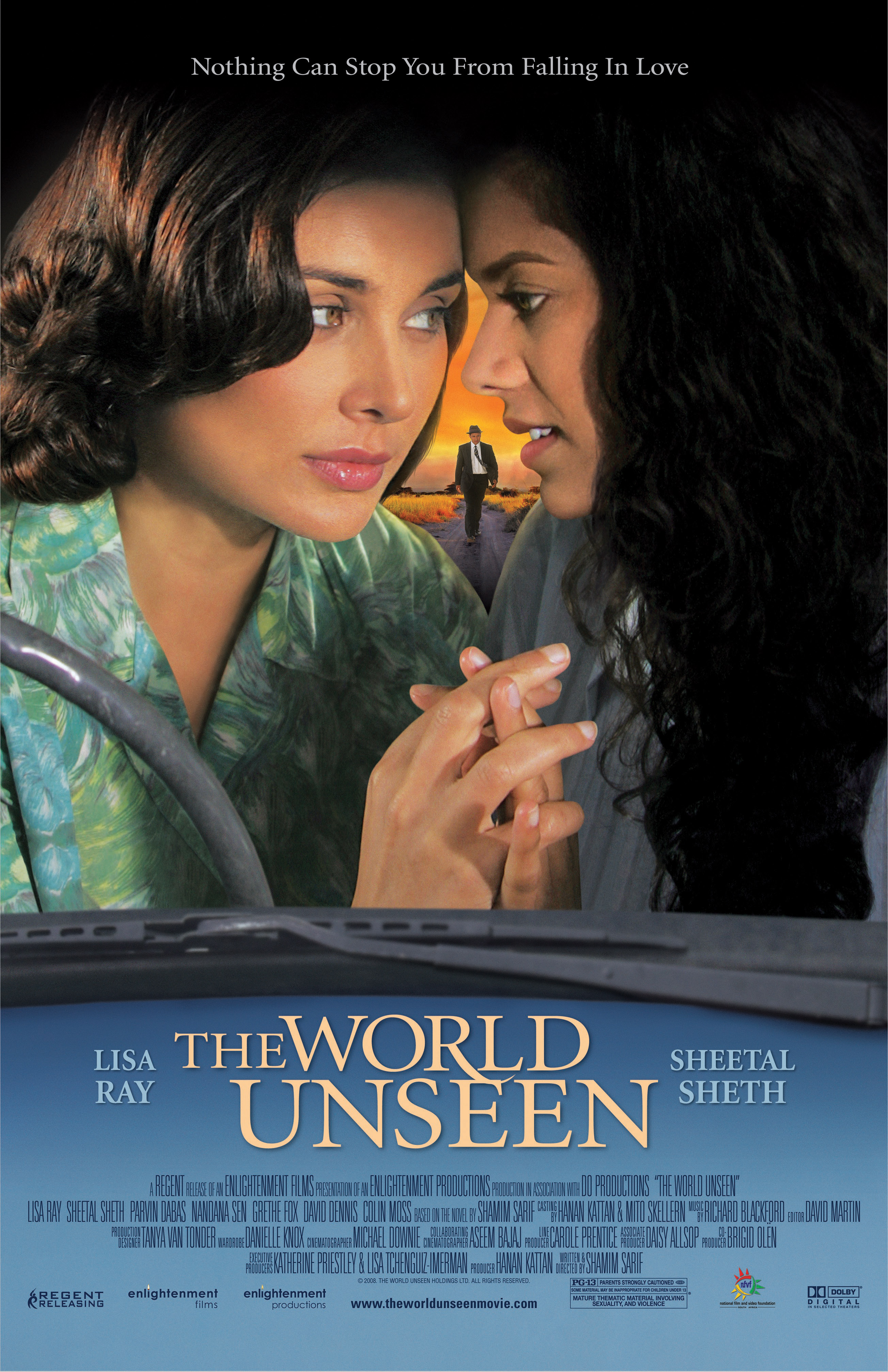
The World Unseen (2007)

12 Thursday Apr 2018

Posted by dullwood68 in Movies

≈ 1 Comment

Tags

Apartheid, Cape Town, Drama, LGBTQ+, Lisa Ray, Literary adaptation, Location Cafe, Parvin Dabas, Review, Romance, Shamim Sarif, Sheetal Sheth

D: Shamim Sarif / 90m

Cast: Lisa Ray, Sheetal Sheth, Parvin Dabas, Nandana Sen, David Dennis, Grethe Fox, Colin Moss, Natalie Becker, Rajesh Gopie, Bernard White, Avantika Akerkar

Cape Town, 1952. Amina (Sheth) is a young Indian woman who owns and runs the Location Cafe, a haven for both the local Indian community and the blacks. Miriam (Ray) is an Indian housewife and mother of three who visits the cafe and finds herself fascinated by Amina’s seemingly carefree, yet proud attitude. Her husband, Omar (Dabas), opens a general store on the outskirts of the city, and for a while, things progress as expected. Omar’s sister, though, puts them in danger when she comes to visit from Paris with her white husband. The police discover their presence, and Omar’s sister, Rehmat (Sen), is only saved from arrest by Amina’s hiding her. This helps to build Amina and Miriam’s friendship, something that is aided by Omar’s decision to hire Amina to create a vegetable garden behind the store. The two women spend more and more time together, and their friendship deepens until each begins to acknowledge the attraction they have for each other. But how can their love flourish when they have to contend with the social, sexual, cultural and political milieu they’re a part of?

A romantic drama set in a time and place that would have heavily condemned the sexual love of two women for each other, The World Unseen is a carefully paced, judiciously mounted movie that isn’t too interested in putting its central characters in too much jeopardy, while it explores themes related to the racism and homophobia of the period. Adapted from writer-director Sarif’s own novel, her tale of fledgling love amidst the trials and tribulations of apartheid South Africa is a low-key affair, telling its story simply and with due care and attention to the characters of Amina and Miriam. Thanks to Sarif’s script and the performances of Ray and Sheth, both women are sharply drawn, and their thoughts and feelings expertly expressed through covert looks, cautious body language, and coded language. The slow reveal of their feelings for each other is hidden behind a veil of subterfuge, and Sarif shows the mounting tension between Amina’s longing for Miriam and Miriam’s hesitancy over what it will mean to her marriage and her children, in such a way that the sincerity of their emotions is never in doubt.

With the movie’s central relationship locked in, Sarif is free to build around it, adding sub-plots and minor incidents to help flesh out the running time. Sadly, not all of these sub-plots are as successful as they could have been, and though they don’t do anything to hurt the pace of the movie – Sarif’s measured direction ensures everything proceeds at an even pace – there are too many that feel as if they’ve been lifted from a soap opera. Amina’s silent partner in the cafe, Jacob (Dennis), has a predictably short relationship with a white postmistress (Fox), Omar has a secret that Miriam has no choice but to tolerate (at first), and Amina’s grandmother tries to push her into an arranged marriage. Most of these elements end as quietly as they began, and lack any appreciable impact, but thanks to the engaging quality of the material as a whole, the movie doesn’t suffer as dramatically as it might have done. The rest of the performances are adequate (though Moss’s permanently aggressive policeman is particularly one-note), and the visual style is consistently muted in terms of colour and light, something that robs it of any further appeal, but overall this is a quietly persuasive movie that does very well by its central characters.

Rating: 7/10 – with its well conceived romance, and passive recreation of the time period it’s set in, The World Unseen is exemplary when focusing on its central characters’ hopes and dreams, but less so when the focus switches elsewhere; Sarif’s first outing as a writer and a director shows promise, and there’s a clear message about female empowerment, but in the end, there’s too much that feels perfunctory instead of important.

Share this:

  • Click to share on X (Opens in new window) X
  • Click to share on Facebook (Opens in new window) Facebook
  • More
  • Click to print (Opens in new window) Print
  • Click to email a link to a friend (Opens in new window) Email
Like Loading...

Despite the Falling Snow (2016)

08 Tuesday Nov 2016

Posted by dullwood68 in Movies

≈ Leave a comment

Tags

Antje Traue, Charles Dance, Cold War, Defection, Drama, Espionage, Literary adaptation, Moscow, Rebecca Ferguson, Review, Romance, Russia, Sam Reid, Shamim Sarif, Spying

despite-the-falling-snow-poster

D: Shamim Sarif / 93m

Cast: Rebecca Ferguson, Sam Reid, Charles Dance, Antje Traue, Oliver Jackson-Cohen, Thure Lindhardt, Anthony Head

One of the things that never happened in the Golden Age of Cinema was an author being given the opportunity to make a movie of one of their novels or stories. Some were employed to adapt their novels and stories, but none were ever allowed to step behind the camera as well and actually direct the movie. Nowadays, this isn’t so unusual, but it’s also still not very prevalent. So step forward Shamim Sarif, author and movie maker, who has been making movies from her novels from the very beginning. She is possibly unique in this way, and has gained a very good reputation from working on both sides of the creative arena. Despite the Falling Snow is the third movie she’s made from one of her novels, and while she may be well regarded in some quarters as the perfect person to adapt her work – after all, who knows it better than she? – the finished product here isn’t quite the testament to her talents as a director.

The movie begins in New York in 1961 with the defection of a Russian government official called Sasha (Reid). As he’s helped to escape from his Russian handlers, he asks about his wife, Katya (Ferguson). She’s back in Moscow, but his new, US handlers have no idea where she is or what has happened to her. Fast forward thirty years and Sasha (Dance) is a successful restaurateur who has a niece, Lauren (also Ferguson) who is the spitting image of Katya, and who wants to travel to Moscow to try and find out what happened to her aunt. Sasha refuses to go with her, though, so Lauren, who’s lucky enough to be an artist who’s been asked to mount an exhibition in Moscow, heads off by herself.

day-17-2-881x588

While Lauren’s story plays out in 1991, Katya’s story plays out in tandem from 1959 to 1961. Katya is a teaching assistant who’s also helping her friend and government official Misha (Jackson-Cohen) steal secrets and pass them on to the Americans. At a party she meets Sasha but is unimpressed by him. It’s only when Misha persuades her to get close to Sasha because of his position in the Kremlin that she finds herself falling in love with him. Meanwhile, in 1991, Lauren meets and befriends a journalist called Marina (Traue) who helps her in finding out about Katya. Marina learns that Misha (Head) is still alive, and they make plans to visit him. When they do they find he’s become an embittered, angry old man who wants nothing to do with them.

Back in 1961, Katya and Sasha wed, but she agonises over whether she should tell him she’s a spy. In 1991, Marina’s behaviour becomes suspicious, and the unexpected arrival of Sasha in Moscow prompts a revelation. Katya’s decision to tell Sasha leads to his agreeing to defect, but thirty years on only Misha holds the key to what happened to her.

mv5bmtq1ndu0mjmyov5bml5banbnxkftztgwnzqxotkznje-_v1_sx640_sy720_

A romantic drama set – partly – during a period of intense political and social upheaval, namely the early Sixties, Despite the Falling Snow has such a generic feel to it that it could have been made about any couple in any country at any time, and still have made the same kind of impact. This is thanks to Sarif’s uninspired, pedestrian direction, and a visual style that never rises above formulaic. It’s as if Sarif has forgotten to add the drama needed to make the narrative more than just a succession of events and scenes that show how two people came together and then were separated by fate in the form of expediency. Even when suspicion falls on the officials in the Kremlin, including Sasha and Misha, it’s a moment where real terror at being found out translates instead as a mild concern. Misha is almost fatalistic about the whole thing, a reaction that not even the talented Jackson-Cohen can make convincing; this man should be even more scared than he’s been already.

But if the steady stream of narrative downplaying that infuses the scenes in early Sixties Russia also makes those scenes feel awkward and inconsistent, then spare a thought for those set in 1991. Sarif makes reference to the Berlin Wall having come down two years earlier, but her new Moscow is an uneasy mix of contemporary US stylings and Russian forebearance, as evidenced by Marina’s designer clothing and old Misha’s tower block abode. The juxtaposition jars, and adds to the overall feeling that Sarif wants her characters to look glamorous against the concrete backdrop of post-Stalinist Russia (Katya seems never to be without her red lipstick). The visual conceit is highlighted by Sarif’s decision to have Katya and Sasha, and Lauren and Marina, walk along the same snow-laden stretch of riverside pavement at different times, but instead of creating an echo of past events, it appears to be more of a budgetary deference than a creative decision.

despite_the_falling_snow-15

Elsewhere, narrative developments that appear out of nowhere are treated as if they are absolutely necessary to the overall plot, and that includes a left-field decision to have Lauren and Marina begin a sexual relationship. Old Sasha’s willingness to stay home out of harm’s way is overturned by the contents of a fax, while Old Misha’s decision to spill the beans about what happened to Katya is spurred on by feelings of guilt, and that old chestnut, a terminal illness. And when the viewer does find out what happened to Katya, Sarif handles it in such a hamfisted way that any emotional weight the scene might – or should – have engendered with said viewer, is lost before the scene’s even begun.

A lacklustre movie then, one that doesn’t even aim particularly high, but which does feature another of Charles Dance’s supporting roles (is he semi-retired now, is that what’s going on?) and a level of political naïvete that further dilutes the drama that isn’t really there. On the performance side, Ferguson is unable to make much of either role, as Sarif never allows the viewer to engage with them as anything other than under-developed non-characters. Reid is earnest but treading in a pool so shallow it’s practically evaporated, while Traue is allowed to look moody and resentful in equal measure even when she’s kissing Ferguson. Dance and Head bring a degree of old-time gravitas to the proceedings, but even they can’t avoid the pitfalls that are inherent in the script. On this showing, Sarif needs some more time to clarify her goals in making such a movie, and maybe next time, getting someone else to direct.

Rating: 4/10 – Sixties Moscow never looked cleaner, quieter, or more family friendly than it does in this movie, and that’s despite several efforts to make it look as if it’s not brand new; as a drama it never gets started, despite the best efforts of its cast, and by the end you’ll only want to know what happened to Katya just so that you can move on in (roughly) the same way everyone else does: without too much fuss.

Share this:

  • Click to share on X (Opens in new window) X
  • Click to share on Facebook (Opens in new window) Facebook
  • More
  • Click to print (Opens in new window) Print
  • Click to email a link to a friend (Opens in new window) Email
Like Loading...

Blog Stats

  • 486,528 hits

Recent Posts

  • 10 Reasons to Remember Bibi Andersson (1935-2019)
  • Fantasia (1940)
  • Dances With Wolves (1990) – The Special Edition
  • Kiss of the Spider Woman (1985)
  • The Three Musketeers (1973)

Top Posts & Pages

  • Lost for Life (2013) - Another Look
    Lost for Life (2013) - Another Look
  • Lost for Life (2013)
    Lost for Life (2013)
  • About
    About
  • Mr. Topaze (1961)
    Mr. Topaze (1961)
  • Billy Lynn's Long Halftime Walk (2016)
    Billy Lynn's Long Halftime Walk (2016)
  • Winter's Tale (2014)
    Winter's Tale (2014)
  • The Hitman's Bodyguard (2017)
    The Hitman's Bodyguard (2017)
  • 5 Famous Movie Roles That Nearly Went to Someone Else
    5 Famous Movie Roles That Nearly Went to Someone Else
  • The Layover (2017)
    The Layover (2017)
  • Transcendence (2014)
    Transcendence (2014)
Follow thedullwoodexperiment on WordPress.com

Blogs I Follow

  • Rubbish Talk
  • Film 4 Fan
  • Fast Film Reviews
  • The Film Blog
  • All Things Movies UK
  • Interpreting the Stars
  • Let's Go To The Movies
  • Movie Reviews 101
  • TMI News
  • Dan the Man's Movie Reviews
  • Film History
  • Jordan and Eddie (The Movie Guys)

Archives

  • April 2019 (13)
  • March 2019 (28)
  • February 2019 (28)
  • January 2019 (32)
  • December 2018 (28)
  • November 2018 (30)
  • October 2018 (29)
  • September 2018 (29)
  • August 2018 (29)
  • July 2018 (30)
  • June 2018 (28)
  • May 2018 (24)
  • April 2018 (21)
  • March 2018 (31)
  • February 2018 (25)
  • January 2018 (30)
  • December 2017 (30)
  • November 2017 (27)
  • October 2017 (27)
  • September 2017 (26)
  • August 2017 (32)
  • July 2017 (32)
  • June 2017 (30)
  • May 2017 (29)
  • April 2017 (29)
  • March 2017 (30)
  • February 2017 (27)
  • January 2017 (32)
  • December 2016 (30)
  • November 2016 (28)
  • October 2016 (30)
  • September 2016 (27)
  • August 2016 (30)
  • July 2016 (30)
  • June 2016 (31)
  • May 2016 (34)
  • April 2016 (30)
  • March 2016 (30)
  • February 2016 (28)
  • January 2016 (35)
  • December 2015 (34)
  • November 2015 (31)
  • October 2015 (31)
  • September 2015 (34)
  • August 2015 (31)
  • July 2015 (33)
  • June 2015 (12)
  • May 2015 (31)
  • April 2015 (32)
  • March 2015 (30)
  • February 2015 (37)
  • January 2015 (39)
  • December 2014 (34)
  • November 2014 (34)
  • October 2014 (36)
  • September 2014 (25)
  • August 2014 (29)
  • July 2014 (29)
  • June 2014 (28)
  • May 2014 (23)
  • April 2014 (21)
  • March 2014 (42)
  • February 2014 (38)
  • January 2014 (29)
  • December 2013 (28)
  • November 2013 (34)
  • October 2013 (4)

Blog at WordPress.com.

Rubbish Talk

Film 4 Fan

A Movie Blog

Fast Film Reviews

The Film Blog

The official blog of everything in film

All Things Movies UK

Movie Reviews and Original Articles

Interpreting the Stars

Dave Examines Movies

Let's Go To The Movies

Film and Theatre Lover!

Movie Reviews 101

Daily Movie Reviews

TMI News

Latest weather, crime and breaking news

Dan the Man's Movie Reviews

All my aimless thoughts, ideas, and ramblings, all packed into one site!

Film History

Telling the story of film

Jordan and Eddie (The Movie Guys)

Movie Reviews & Ramblings from an Australian Based Film Fan

Privacy & Cookies: This site uses cookies. By continuing to use this website, you agree to their use.
To find out more, including how to control cookies, see here: Cookie Policy
  • Subscribe Subscribed
    • thedullwoodexperiment
    • Join 481 other subscribers
    • Already have a WordPress.com account? Log in now.
    • thedullwoodexperiment
    • Subscribe Subscribed
    • Sign up
    • Log in
    • Report this content
    • View site in Reader
    • Manage subscriptions
    • Collapse this bar
 

Loading Comments...
 

    %d