• 10 Reasons to Remember…
  • A Brief Word About…
  • About
  • For One Week Only
  • Happy Birthday
  • Monthly Roundup
  • Old-Time Crime
  • Other Posts
  • Poster of the Week
  • Question of the Week
  • Reviews
  • Trailers

thedullwoodexperiment

~ Viewing movies in a different light

thedullwoodexperiment

Tag Archives: Silent film

Hypocrites (1915)

01 Tuesday Jul 2014

Posted by dullwood68 in Movies

≈ 1 Comment

Tags

Courtenay Foote, Gabriel the Ascetic, Hypocrisy, Lois Weber, Nude, Religion, Silent film, Statue, Truth

Hypocrites

D: Lois Weber / 54m

Cast: Courtenay Foote, Myrtle Stedman, Herbert Standing, Adele Farrington, Margaret Edwards

The present day: the Reverend Gabriel (Foote) is preaching a sermon on hypocrisy to a congregation who are by turns, disinterested, bored, or unable to see that his sermon has any relevance to themselves.  Even one of his own assistants is seen reading a Sunday newspaper.  Seeing this, Gabriel rounds on everyone there and focuses the message of the sermon on them.  With the service concluded, several of the congregation gather outside the church and plot to have Gabriel removed.  Back inside, one of his female assistants (Stedman), clearly enamoured of the cleric, attempts to speak with him but he is so lost in thought she that she passes up the opportunity.  When everyone is gone, Gabriel slumps in a chair, the offending newspaper in hand, his thoughts continuing to reach out to God.

He falls into a reverie.  In it he finds himself dressed in medieval robes, ascending a steep hill.  His parishioners pass by on the road below; some see Gabriel and others climbing the trail, but fail to follow him for various selfish or thoughtless reasons.  Two women make the climb with him (including the woman who is fond of him), but they fall by the wayside, leaving Gabriel at the summit, alone and beseeching God for a better understanding of his flock’s lack of moral probity.

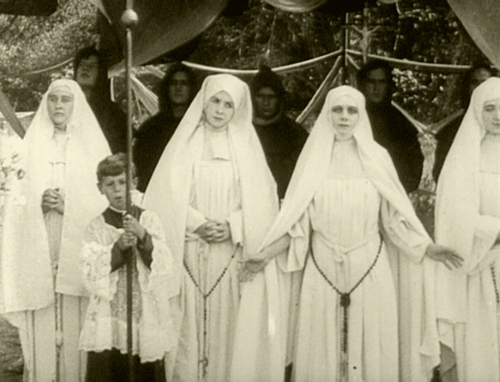
The past: Gabriel is a monk living in a monastery where the other monks are shown having what looks like a feast.  Gabriel is working on a statue, a gift for the monastery and the people of the town where it’s located.  He works in secrecy until the day his work is ready to be shown.  The monks arrange a celebration to go with the unveiling, but when the statue is uncovered there is shock and uproar: the statue is of a naked woman, whom Gabriel calls Truth.  Gabriel is seized by a mob and killed.  Back in the present day, his body is found by his parishioners, the newspaper still in his hand; a later headline reveals their shock at his being found in such circumstances.
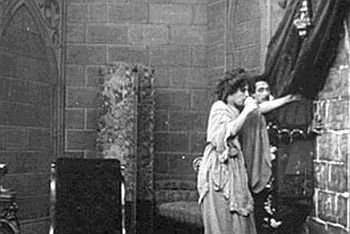
Hypocrites - scene

Hypocrites is a movie that has gained quite a good reputation over the years, and it’s easy to see why.  Though its moralising is a little heavy-handed by today’s standards, it’s still an effective piece, the use of the same actors in both time periods serving to highlight how little Man has changed over the centuries, his selfish, irreligious behaviour leading him further and further away from the path to true enlightenment and happiness.  Viewed like this it’s no surprise that the modern day congregation reacts in the way it does, seeking to oust someone who holds a mirror up to their vain, self-serving posturing.  This is further explored in an extended sequence where Truth (Edwards) – depicted as a naked young woman – shows Gabriel various examples of the hypocrisy his congregation indulges in, e.g. the politician whose banner reads “My platform is honesty” but who is then seen taking bribes (businessmen, lovers by convenience, and the clergy also come under fire).

The decision to portray Truth as a naked woman caused a degree of uproar at the time of the movie’s release, despite being passed by the National Board of Censorship.  Hypocrites was banned in Ohio, there were riots in New York (strange to think now that a movie could provoke that violent a reaction), and reputedly the mayor of Boston wanted each frame including Truth to be hand-painted to cover her nakedness.  In the movie itself, the depiction of Truth is achieved via the use of double exposure, thus curtailing the level of detail that can be seen (and Edwards holds an arm across her breasts for the most part), and her appearance is in no way salacious.  That the movie received such an unfavourable welcome in places must have been the best thing the filmmakers could have wished for.

As a piece of propaganda for the morality brigade, the movie is expertly handled by Weber whose background before entering the film industry was as a street-corner evangelist.  In this sense, her mastery of the material is to be expected, and she offers convincing portraits of moral backsliding, the cast of familiar (if uncredited) faces cranking back on the declamatory style of acting usually found in movies of the period (though Foote more than makes up for any shortfall).  Indeed, it’s refreshing to see a wealth of what audiences today would call more naturalistic performances.  Weber also displays a technical mastery of the medium, her use of the camera and location photography combining to bring an absorbing, fresh approach at a time when movies were still largely set bound and with the camera employed as a fixed observer.  The pace of the movie is well maintained also, and each scene is constructed to accommodate and/or support the fullest expression of the moral laxity it’s presenting.  It all makes for an impressive feat of moviemaking.

Rating: 9/10 – as relevant now as it was in 1915, Hypocrites depicts Man at his most shamelessly self-interested and duplicitous; a classic of silent cinema and clear evidence that Lois Weber was as talented – if not more so – than many of her peers.
Share this:

  • Click to share on X (Opens in new window) X
  • Click to share on Facebook (Opens in new window) Facebook
  • More
  • Click to print (Opens in new window) Print
  • Click to email a link to a friend (Opens in new window) Email
Like Loading...

D. W. Griffith Triple Bill: The Sealed Room (1909) / The Golden Louis (1909) / Politician’s Love Story (1909)

07 Saturday Jun 2014

Posted by dullwood68 in Movies

≈ Leave a comment

Tags

Adele DeGarde, Arthur V. Johnson, Beggar girl, Billy Bitzer, Cartoonist, Cask of Amontillado, Crooked politician, D.W. Griffith, Edgar Allan Poe, Gambler, Lovers, Mack Sennett, Marion Leonard, Period film, Silent film

NOTE: All three movies were viewed courtesy of http://www.archive.org – go check it out!

The Sealed Room (1909)

Sealed Room, The

D: D.W. Griffith / 11m

Cast: Arhur V. Johnson, Marion Leonard, Henry B. Walthall

Based on “The Cask of Amontillado” by Edgar Allan Poe, The Sealed Room is a period piece involving a count (Johnson), his wife (Leonard), and her minstrel lover (Walthall).  The count is madly in love with his wife, and while she returns his affections in public, in private she has eyes only for the lute-playing minstrel.  When the count arranges for a room in his apartments to be sealed – apart from one of the doors – so that only he and his wife can have access to it, he doesn’t envisage his wife and the minstrel using it themselves for some “alone” time.  He discovers them in mid-tryst, and in a fit of rage, has the remaining doorway blocked up, sealing them inside.

Using just two adjoining sets, Griffith populates the outer room with as many people as he can while foregrounding the main characters.  It’s here that his background in the theatre is most obvious, with his attention to blocking and everyone having something to do (Walthall’s facial expressions, combined with his lute playing while the count and his wife hug and kiss, are an unexpected viewing bonus.)  The cod-theatrical acting style, all declamatory arm-waving and brash physical posturing, is all present and correct, and while Griffith does very little to rein in the hysterics, he still manages to elicit good performances from his leading actors (bearing in mind the acting style of the times).

There are some lapses – the lovers fail to hear the doorway being sealed up, and when it’s done the count is clearly enjoying listening to their cries of horror – but The Sealed Room is an entertaining, if overly dramatic, movie that makes the most of its two-camera set up and basic structure.

Rating: 7/10 – straightforward adaptation of the Poe tale and told with plenty of enthusiasm; a lively endeavour with Griffith’s direction providing much of the movie’s flair.

The Golden Louis (1909)

Golden Louis, The

D: D.W. Griffith / 6m

Cast: Adele DeGarde, Charles Inslee, Owen Moore, Anita Hendrie

A young girl (DeGarde) is begging in the snow-covered streets but she is so frail and underfed she only manages to make it as far as some nearby steps before collapsing.  While she sleeps a passing stranger (Moore) sees her and, taking pity on her plight, places a gold coin in the shoe she’s been using as a collection plate.  Nearby, a gambler (Inslee) is having bad luck at the tables.  Leaving the gambling den he spies the coin and, convinced his finding it is providential, takes it and returns to the gambling den.  There the coin does indeed prove a godsend, and he wins a lot of money.

While the gambler congratulates himself, the young girl wakes.  She returns to where she first began begging.  Meanwhile, the gambler, wanting to repay the young girl for her unwitting kindness, returns to the steps and finds her missing.  He looks for her, while the girl, still having no luck with her begging, retraces her steps and collapses again on the steps.  The gambler eventually finds her and takes her up in his arms (thereby, presumably saving her).

The Golden Louis shows Griffith working again in a studio, but using the usual static camera placements in such a way that there’s a sense of space and depth to the images throughout.  As usual, Griffith’s compositional skills are highly effective, and the set dressing makes it look convincingly cold.  The acting is less histrionic than usual, and the editing complements the action more judiciously than many of Griffith’s other works from the same year.  There’s even room for some social commentary in the plight of the young girl, a theme that Griffith would return to often in his career.  On the downside, the girl’s waking and wandering off, while adding an element of tension to the story, is undermined by her returning to the very same spot (and by the gambler searching in the same circular manner).

Rating: 8/10 – some contrivance at the end aside, The Golden Louis entertains throughout and shows Griffith making better use of the physical aspects of the production; ultimately redemptive, the movie succeeds on more than one level, and is a must-see for silent movie fans.

Politician’s Love Story (1909)

Politician's Love Story

D: D.W. Griffith / 6m

Cast: Mack Sennett, Marion Leonard, Herbert Prior, Arthur V. Johnson

When crooked politician Boss Crogan (Sennett) is shown a satirical caricature of himself in the newspaper, his outrage is such that he grabs a gun and races to the newspaper’s offices to shoot the cartoonist, called Peter.  After threatening what seems like half the newsroom he is directed to Peter’s Corner, only to find the cartoonist is a woman (Leonard).  Shocked by this unexpected turn of events, Crogan refrains from shooting her, and instead becomes besotted by her.  He tries to get her to go out with him but she refuses his offer.

Crogan returns home but finds himself restless.  This time leaving his gun behind he goes back out, and ends up at a nearby park.  He sits down on a bench and looking lost and forlorn, watches as a succession of loving couples walk past.  In time he gets up and is leaving the park when he spies “Peter”.  As he approaches, “Peter” is stopped by another man.  Crogan warns the man off, and finds “Peter” grateful for his intervention.  They walk back into the park, and the previously rebuffed politician gets a kiss.

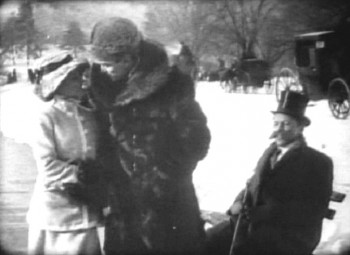
Half filmed in the studio and half on location, Politician’s Love Story sees Griffith try his hand at an early romantic comedy, with mixed results.  The comic elements – which consist largely of Sennett waving a gun around the newsroom and having the staff all duck down repeatedly – are heavy-handed and suffer from the repetition.  The romantic elements are too fleeting, and the parade of lovestruck couples in the park serves only to pad out the running time; it’s clear Crogan is a sad figure at this point (it also gives Griffith a chance to appear on screen as well – he and Dorothy West are the first couple to pass Crogan).  “Peter”‘s change of heart is a little too sudden also.

That said, the wintry location photography, credited to regulars Billy Bitzer and Arthur Marvin, is a bonus, and gives Griffith a chance to spread his wings beyond the confines of the studio.  His positioning of the camera in these shots though is slightly tentative, and as expected there’s no attempt to break away from the standard medium shot that characterised Griffith – and many other silent film directors’ – approach during this period.  But as a possible experiment, the movie retains some interest.

Rating: 4/10 – minor Griffith, and indicative of the perils associated with making one hundred and forty-nine short films in the same year; one for completists only.

Share this:

  • Click to share on X (Opens in new window) X
  • Click to share on Facebook (Opens in new window) Facebook
  • More
  • Click to print (Opens in new window) Print
  • Click to email a link to a friend (Opens in new window) Email
Like Loading...

My Top 10 Movies – Part Nine

18 Tuesday Feb 2014

Posted by dullwood68 in Movies

≈ Leave a comment

Tags

American Civil War, Buster Keaton, Clyde Bruckman, Comedy, Kevin Brownlow, Marion Mack, National Film Theatre, Review, Silent film, The General (1926)

The General (1926)

General, The

D: Clyde Bruckman, Buster Keaton / 75m

Cast: Buster Keaton, Marion Mack, Glen Cavender, Jim Farley, Frederick Vroom, Charles Henry Smith, Frank Barnes

A lot of my earliest movie memories are of watching silent comedians such as Charlie Chaplin, Roscoe “Fatty” Arbuckle, Harold Lloyd, and Laurel and Hardy.  When I was growing up, their movies  were a major part of the programming during the mornings on the UK’s BBC 2 channel, along with the Flash Gordon serials, Tarzan movies, and later, Charlie Chan features.  Silent short films were often included in the schedules as filler, but for me they were more welcome than most of the feature length, talking pictures that were shown.  The Tarzan movies starring Johnny Weissmuller seemed interchangeable after a while, and when Andy Hardy and Dr. Kildare entered the fray, their small-town dramatics quickly felt repetitive.  No, it was Chaplin et al. who were my preferred choice, and I did my best to make sure I didn’t miss any that were shown (this was before the advent of video).

At first, it was the antics of Laurel and Hardy that I liked most.  Then, I saw a short called The Haunted House (1921), followed (a few days later) by One Week (1920).  Now I was asking myself, Who is this Buster Keaton?  (And why don’t the BBC show more of his movies?)  I kept checking the schedules for any more Keaton movies, eventually seeing only a half dozen or so more.  It was frustrating, especially as I now knew he’d made feature length movies as well; where were they when a budding cineaste needed them?

Here my memory becomes a little less reliable.  I know that College (1927) was the first of his features that I saw, but when The General came along, that moment is lost in the mists of early onset Alzheimers.  But it was a pivotal moment, because like the true aficionado of silent film that I believed I was – I wasn’t Kevin Brownlow, but as a self-taught teenager, I didn’t think I was doing too badly – when I saw The General I knew I was watching Keaton’s masterpiece, the movie he will always be remembered for above all his other movies.

General, The - scene

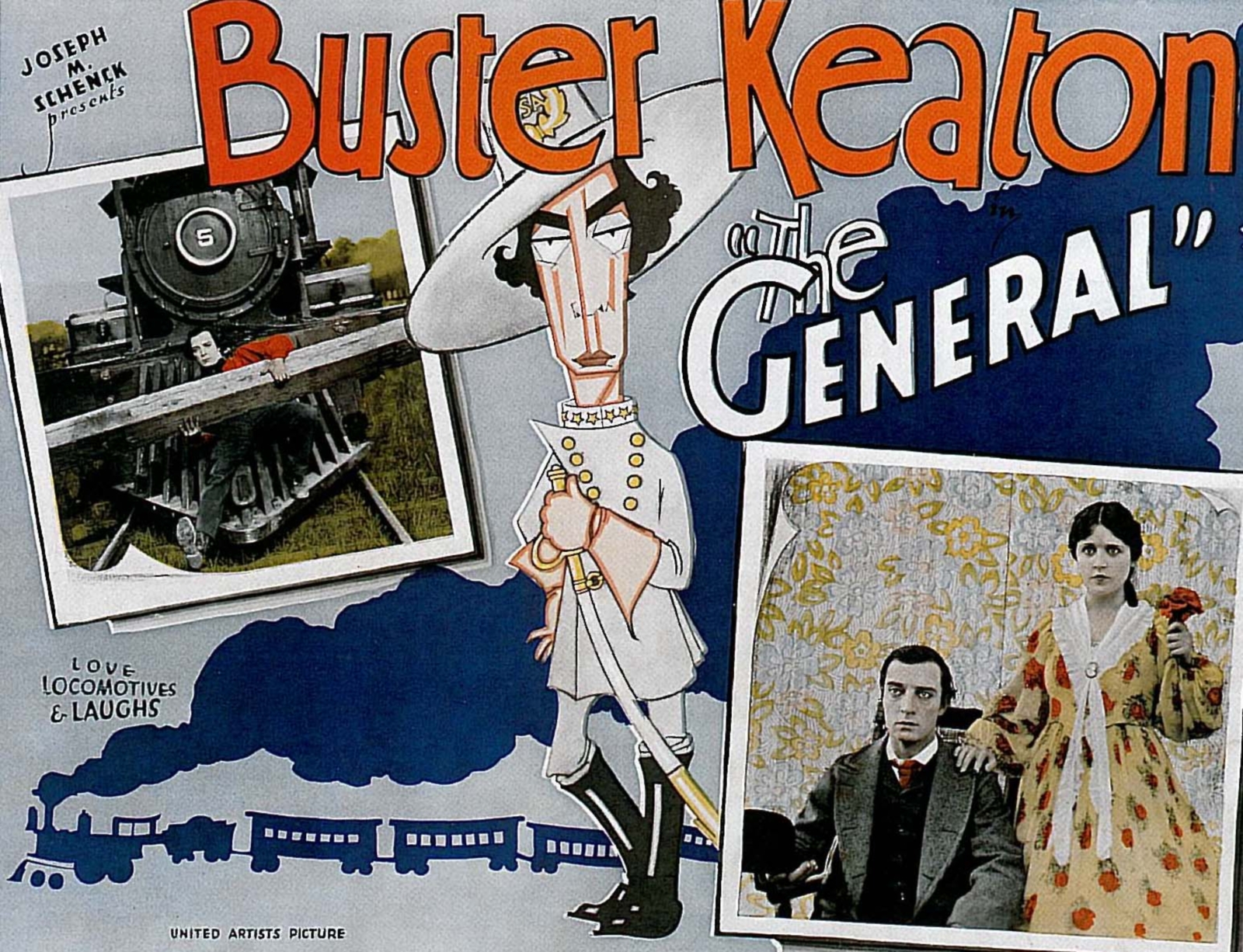
What I liked straight away was the level of detail, the lengths that Keaton and his co-director, the (for me) much underrated Clyde Bruckman had gone to in order to recreate the American Civil War, and to re-enact a famous event from that period.  So often comedy exists in its own little “bubble”, a place where a joke or a gag can have the most effect.  But here, Keaton uses the War as the grounding for all the jokes to come, all the visual gags and physical stunts, so that when you’re watching them they don’t seem as far-fetched as they would do if they were presented purely by themselves.  For me, there will never be a greater physical stunt/gag than when he sits on the train’s cowcatcher and flips railroad ties out of the way of the approaching General; knowing this was done for real with no camera trickery involved just makes it all the more impressive (and frightening if it had gone wrong).

There’s a subtlety to The General, as well, a sense that Keaton was aiming higher by making the comic elements arise organically from the overall mise-en-scène, along with the romantic and action elements.  Having taken an event from the War that a lot of people would either still remember or be well aware of, he takes what was, ultimately, a tragic tale, and elevates it.  In the process he provides us with an uplifting, surprisingly emotional experience that makes us laugh and urge him on, and it’s all done with a seeming effortlessness that we know can’t have been the case.  And I don’t think Keaton’s stoic features have ever been used to better effect than here.  He’s often accused of being expressionless, but in The General you’re never in any doubt as to how he’s feeling, or what he’s thinking.  Again, it’s the subtlety that makes this so fascinating to watch.

A few years ago, I took a friend to see The General at London’s National Film Theatre. It was having what they like to call an Extended Run, playing several times a day for around six weeks.  My friend has a passion for movies but he’s very much a “modern day” moviegoer; he likes the sturm und drang of today’s multiplex fare.  With this in mind I thought it would be a great idea to take him to see The General.  He had some reservations, not least because it was a silent movie, but because it was so far out of his comfort zone (even the fact that it was “only” seventy-five minutes long didn’t entirely persuade him he would be fine).  And while we waited for the movie to start he was visibly nervous (I wish I’d been able to video this).  When the movie ended, he turned to me and said, “That was incredible.  I can’t believe how incredible that was.”  Vindicated, and feeling on top of the world for seeing the movie for the first time on the big screen, I couldn’t help but feel that here was the true strength of Keaton’s masterpiece: that it can captivate and envelop anyone who comes to it.

Rating: 9/10 – not just a comedy, The General works on so many levels it’s almost embarrassing; one of the finest silent movies ever made, and as breathtaking today for its perfection as it was back in 1926.

Share this:

  • Click to share on X (Opens in new window) X
  • Click to share on Facebook (Opens in new window) Facebook
  • More
  • Click to print (Opens in new window) Print
  • Click to email a link to a friend (Opens in new window) Email
Like Loading...

My Top 10 Movies – Part Two

18 Wednesday Dec 2013

Posted by dullwood68 in Movies

≈ Leave a comment

Tags

Abel Gance, Albert Dieudonné, Drama, French movie, History, Kevin Brownlow, Napoleon, Review, Silent film, Triptych, True story

Napoléon (1927)

Napoleon

D: Abel Gance / 330m

Cast: Albert Dieudonné, Vladimir Roudenko, Edmond Van Daële, Gina Manès, Antonin Artaud, Alexandre Koubitzky, Marguerite Gance, Yvette Dieudonné, Philippe Hériat, Abel Gance

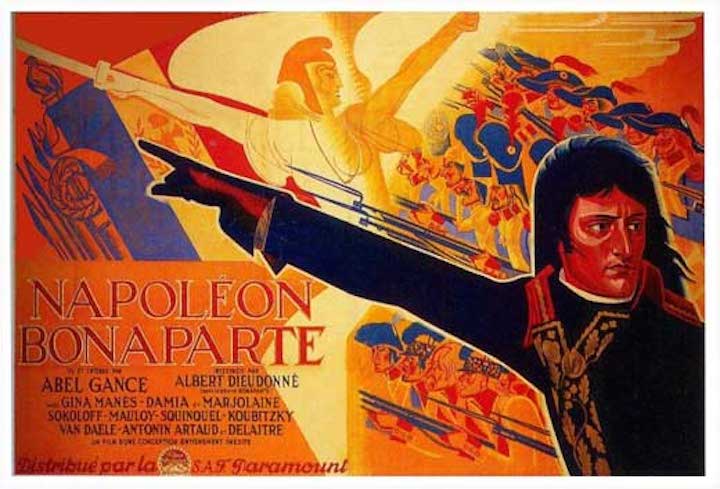
A five and a half hour silent movie?  One that’s unavailable in any home video format, and is unlikely to be for the very foreseeable future?  A rich visual spectacle that impresses from its opening snow fight sequence to its stunning triptych finale?  I have only one word as my answer: Absolutely!

Before I saw Napoléon, my exposure to silent movies had been restricted largely to comedies featuring the likes of Charlie Chaplin, Buster Keaton, Larry Semon etc.  The Keystone Kops were a favourite, and Harold Lloyd impressed me even more when I discovered he’d lost his right thumb and forefinger in an accident involving a bomb prop (I know, it’s a bit shallow, but in mitigation I was around nine or ten).  I remember seeing most of The Iron Horse (1924) on TV, and it had the effect of making me realise that silent movies could last longer than twenty minutes, but UK TV wasn’t in the habit of showing anything other than the short films already mentioned.  When Napoléon was shown as part of a nationwide tour in 1980 at my local arts theatre – with live piano accompaniment – I saw the advert for it and took out my trusty copy of Halliwell’s Film Guide to find out more about it.

It was the length of the movie that intrigued me.  At that time – and my memory is a bit hazy on this – the available print ran to just over five hours.  The idea of sitting in a theatre for that length of time, plus interval, was daunting, but equally an attractive one.  It’s a little shallow (again) but I wanted to see if I could “stay the course” and be able to say – if anyone I knew had even cared! – that I had seen, all the way through, the five hour plus silent movie set during the French Revolution and beyond.  It was like having a badge of honour.

Napoleon - scene

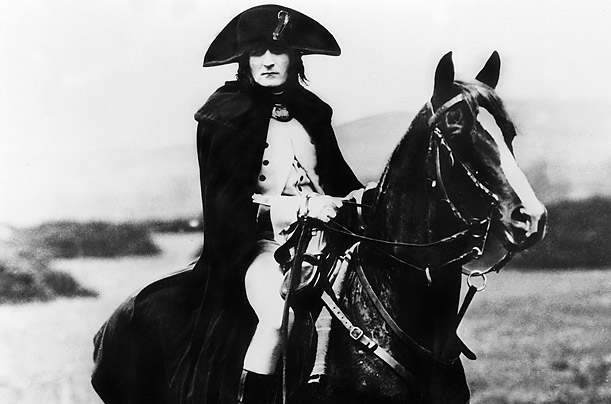
Imagine my surprise (and delight) when the movie began and I found myself swept up by the depth and breadth of Gance’s technical mastery of the silent medium.  By the intensity of the performances, the sweep of the narrative, the visual panache of the battle scenes – Gance put his camera in the middle of the action, unheard of up until then – and the effectiveness of the quieter moments against the stirring swirl of historical events.  Those five hours flew by.  At the interval, I can remember coming out of the auditorium (and into the light) and feeling overwhelmed.  Aside from 2001: A Space Odyssey (1968), I’d never been affected as much by a movie, and definitely not by a silent movie.  I was seeing techniques and a visual language that were truly amazing; this was breathtaking stuff and I couldn’t wait to go back in and see if the rest of the movie was as incredible.  And, of course, it was.

Since then I’ve seen Napoléon four more times.  (Sadly, I was out of the country for its most recent UK screening, on 30 November 2013.)  Each time I’ve revelled in its complexity and the sheer joy it provides, and each time I’ve come away wanting someone, anyone – but preferably Kevin Brownlow – to come along and say, “We’ve found all the missing footage, and will be presenting the original premiere version of Napoléon in just a few months’ time”.  I know this is unlikely, and Brownlow has said himself that the current version is probably the longest it will be for some time to come.  (But, what’s the world without a little hope, eh?)  Perhaps the best screening was the premiere of Carl Davis’s score for the movie shown at the Royal Festival Hall on London’s south bank.  The addition of an orchestra made the whole event even more wonderful and fulfilling.

Napoléon was the first movie that really engaged my heart and my mind and wouldn’t let go.  It holds a special place for me as the one movie that remains an event each time I see it.  In these days of instant streaming and fast downloads and blu ray discs, the notion of only being able to see a film at a cinema or a concert hall is somehow reassuring, that we haven’t lost that true element of spectacle that we take now for granted.  This was how audiences were first exposed to movies, not with ads for the latest trainers or holiday destinations, but with a sense of scale and excitement, a palpable tension at being swept away by what was unfolding on screen.  The language of cinema was being created by these movies, and it’s this aspect that shouldn’t be overlooked or forgotten.  Without trailblazers such as Gance, a lot of what we take for granted about movies today (or don’t even notice), would be missing.  That we’ve lost some of that grandeur is simply disappointing.

Sadly, it will be some time before Napoléon will be seen again on the big screen.  But when it is, you can rest assured that I’ll be there (if it’s in the UK), and ready to be enthralled and transported and amazed all over again.

Share this:

  • Click to share on X (Opens in new window) X
  • Click to share on Facebook (Opens in new window) Facebook
  • More
  • Click to print (Opens in new window) Print
  • Click to email a link to a friend (Opens in new window) Email
Like Loading...

An Arcadian Maid (1910)

12 Tuesday Nov 2013

Posted by dullwood68 in Movies

≈ Leave a comment

Tags

D.W. Griffith, Drama, Gambling, Mack Sennett, Mary Pickford, Peddler, Review, Romance, Silent film, Stolen money

Arcadian Maid, An

D: D.W. Griffith / 16m

Cast: Mary Pickford, Mack Sennett, George Nichols, Kate Bruce

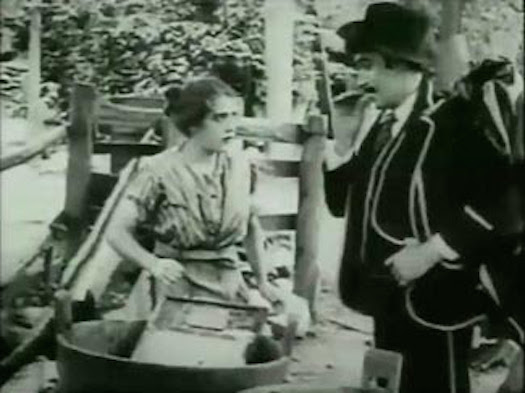
An engaging tale of romantic deception, An Arcadian Maid sees Priscilla (Pickford) finding work on a farm run by a farmer (Nichols) and his wife (Bruce). Shortly after, Priscilla is approached by a peddler (Sennett) who pays attention to her before showing his wares to the farmer’s wife. Unable to make a sale, the peddler speaks again to Priscilla. Before he takes his leave he gives her a ring, and declares them betrothed. Later, in town, the peddler loses what money he has in a gambling den. Aware that the farmer and his wife are in possession of a large sum of money, and determined to clear his gambling debts, the peddler persuades Priscilla to steal the money for him.

An Arcadian Maid was one of 96 short films D.W. Griffith made in 1910 – that’s one movie nearly every four days – and it plays simply and effectively. Pickford may throw her arms in the air a few times to show agitation, and Sennett play with the ends of his moustache a little too often, but this is a pretty straightforward tale of petty larceny and shattered romantic dreams. The pleasure to be had from a lot of movies of this period is the very brevity that forced filmmakers to focus on what was necessary and important to the storyline (here the work of Stanner E.V. Taylor); it wouldn’t be unfair to say this is as lean a piece of filmmaking as you’re likely to see under any circumstances. Griffith marshals his cast to good effect, and keeps a tight grip on proceedings.  G.W. Bitzer’s photography is sharp and well-lit (not always the case with movies of this period), while the two leads work well together, lending an air of credibility that, as with the photography, wasn’t always the case.

Arcadian Maid, An - scene

The ending rounds off proceedings satisfactorily, with the villain punished and the heroine redeemed. Griffith’s strengths as a director are in evidence: the affecting nature of the peddler’s wooing of the naive Priscilla; the tension created when Priscilla steals the couples’ money; the peddler’s dramatic comeuppance; and Priscilla’s redemption thanks to the intervention of Fate. Griffith was a very “proper” director, even for the time, and his moral fables were popular; An Arcadian Maid gives a good indication why.

Rating: 8/10 – an involving and rewarding tale that cements Pickford’s rising stardom, and also gives a clue as to why Sennett moved into the production side of things; a small, rarely seen gem that bolsters the importance of the silent short film.

Share this:

  • Click to share on X (Opens in new window) X
  • Click to share on Facebook (Opens in new window) Facebook
  • More
  • Click to print (Opens in new window) Print
  • Click to email a link to a friend (Opens in new window) Email
Like Loading...

Jack and the Beanstalk (1902)

05 Tuesday Nov 2013

Posted by dullwood68 in Movies

≈ Leave a comment

Tags

Drama, Edwin Stanton Porter, Fairy godmother, Fairy tale, Giant, Golden eggs, Jack and the Beanstalk, Literary adaptation, Magic beans, Pantomime cow, Review, Silent film, Thomas White

D: Edwin Porter / 10m

Cast: Thomas White

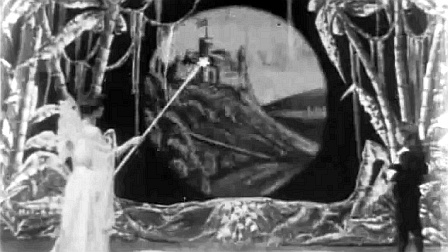
The first screen adaptation of the British fairy tale, Jack and the Beanstalk is a charming retelling presented in nine scenes and one tableau.  There is a pantomime cow that Jack (White) sells for the magic beans – at one point it butts the farmer selling it – his mother’s disappointment at Jack’s trade, the growing of the beanstalk, Jack’s ascent, his encounter with the giant (actually a tall man in comparison to Jack), his descent, and the hacking of the beanstalk thus causing the giant’s demise.

Jack and the Beanstalk - scene

For its time, Jack and the Beanstalk must have been quite impressive.  Films were rarely this long, and the idea of a developed narrative was some years away.  There were other adaptations of literary stories but this one is superior in many ways, not least because of its length, and despite its painted backdrops and stage bound production.  The special effects are similar to those imagined and developed by Georges Méliès – not unusual as Porter had been pirating his work for some time – and while the giant isn’t as fearsome as perhaps he should have been, Porter still manages to instil a real sense of menace when Jack hides from him.  There’s also a nice element of dubious morality, as this adaptation shies away from any condemnation of Jack for stealing the golden eggs and causing the giant’s death; in effect he gets away with it, and all with help from some kind of approving fairy godmother.

Many of the techniques used in Jack and the Beanstalk were still being perfected, and as a glimpse back to a time when cinema was finding its feet and beginning to realise its potential as more than just a passing fancy, an “opium for the masses”, this movie is invaluable at showing just how advanced movies had become in such a short space of time.

Rating: 8/10 – far more than an historical curio, this is an entertaining and instructive movie that still resonates today as a simple tale – for the most part – simply told.

Share this:

  • Click to share on X (Opens in new window) X
  • Click to share on Facebook (Opens in new window) Facebook
  • More
  • Click to print (Opens in new window) Print
  • Click to email a link to a friend (Opens in new window) Email
Like Loading...

Blog Stats

  • 486,528 hits

Recent Posts

  • 10 Reasons to Remember Bibi Andersson (1935-2019)
  • Fantasia (1940)
  • Dances With Wolves (1990) – The Special Edition
  • Kiss of the Spider Woman (1985)
  • The Three Musketeers (1973)

Top Posts & Pages

  • Lost for Life (2013) - Another Look
    Lost for Life (2013) - Another Look
  • Lost for Life (2013)
    Lost for Life (2013)
  • About
    About
  • Mr. Topaze (1961)
    Mr. Topaze (1961)
  • Billy Lynn's Long Halftime Walk (2016)
    Billy Lynn's Long Halftime Walk (2016)
  • Winter's Tale (2014)
    Winter's Tale (2014)
  • The Hitman's Bodyguard (2017)
    The Hitman's Bodyguard (2017)
  • 5 Famous Movie Roles That Nearly Went to Someone Else
    5 Famous Movie Roles That Nearly Went to Someone Else
  • The Layover (2017)
    The Layover (2017)
  • Transcendence (2014)
    Transcendence (2014)
Follow thedullwoodexperiment on WordPress.com

Blogs I Follow

  • Rubbish Talk
  • Film 4 Fan
  • Fast Film Reviews
  • The Film Blog
  • All Things Movies UK
  • Interpreting the Stars
  • Let's Go To The Movies
  • Movie Reviews 101
  • TMI News
  • Dan the Man's Movie Reviews
  • Film History
  • Jordan and Eddie (The Movie Guys)

Archives

  • April 2019 (13)
  • March 2019 (28)
  • February 2019 (28)
  • January 2019 (32)
  • December 2018 (28)
  • November 2018 (30)
  • October 2018 (29)
  • September 2018 (29)
  • August 2018 (29)
  • July 2018 (30)
  • June 2018 (28)
  • May 2018 (24)
  • April 2018 (21)
  • March 2018 (31)
  • February 2018 (25)
  • January 2018 (30)
  • December 2017 (30)
  • November 2017 (27)
  • October 2017 (27)
  • September 2017 (26)
  • August 2017 (32)
  • July 2017 (32)
  • June 2017 (30)
  • May 2017 (29)
  • April 2017 (29)
  • March 2017 (30)
  • February 2017 (27)
  • January 2017 (32)
  • December 2016 (30)
  • November 2016 (28)
  • October 2016 (30)
  • September 2016 (27)
  • August 2016 (30)
  • July 2016 (30)
  • June 2016 (31)
  • May 2016 (34)
  • April 2016 (30)
  • March 2016 (30)
  • February 2016 (28)
  • January 2016 (35)
  • December 2015 (34)
  • November 2015 (31)
  • October 2015 (31)
  • September 2015 (34)
  • August 2015 (31)
  • July 2015 (33)
  • June 2015 (12)
  • May 2015 (31)
  • April 2015 (32)
  • March 2015 (30)
  • February 2015 (37)
  • January 2015 (39)
  • December 2014 (34)
  • November 2014 (34)
  • October 2014 (36)
  • September 2014 (25)
  • August 2014 (29)
  • July 2014 (29)
  • June 2014 (28)
  • May 2014 (23)
  • April 2014 (21)
  • March 2014 (42)
  • February 2014 (38)
  • January 2014 (29)
  • December 2013 (28)
  • November 2013 (34)
  • October 2013 (4)

Create a free website or blog at WordPress.com.

Rubbish Talk

Film 4 Fan

A Movie Blog

Fast Film Reviews

The Film Blog

The official blog of everything in film

All Things Movies UK

Movie Reviews and Original Articles

Interpreting the Stars

Dave Examines Movies

Let's Go To The Movies

Film and Theatre Lover!

Movie Reviews 101

Daily Movie Reviews

TMI News

Latest weather, crime and breaking news

Dan the Man's Movie Reviews

All my aimless thoughts, ideas, and ramblings, all packed into one site!

Film History

Telling the story of film

Jordan and Eddie (The Movie Guys)

Movie Reviews & Ramblings from an Australian Based Film Fan

Privacy & Cookies: This site uses cookies. By continuing to use this website, you agree to their use.
To find out more, including how to control cookies, see here: Cookie Policy
  • Subscribe Subscribed
    • thedullwoodexperiment
    • Join 481 other subscribers
    • Already have a WordPress.com account? Log in now.
    • thedullwoodexperiment
    • Subscribe Subscribed
    • Sign up
    • Log in
    • Report this content
    • View site in Reader
    • Manage subscriptions
    • Collapse this bar
 

Loading Comments...
 

    %d