• 10 Reasons to Remember…
  • A Brief Word About…
  • About
  • For One Week Only
  • Happy Birthday
  • Monthly Roundup
  • Old-Time Crime
  • Other Posts
  • Poster of the Week
  • Question of the Week
  • Reviews
  • Trailers

thedullwoodexperiment

~ Viewing movies in a different light

thedullwoodexperiment

Tag Archives: Slavery

The Birth of a Nation (2016)

11 Sunday Dec 2016

Posted by dullwood68 in Movies

≈ 1 Comment

Tags

1831, Armie Hammer, Drama, Historical drama, Jackie Earle Haley, Nat Turner, Nate Parker, Penelope Ann Miller, Rebellion, Review, Slavery, Southampton County, True story

birth_of_a_nation

D: Nate Parker / 120m

Cast: Nate Parker, Armie Hammer, Penelope Ann Miller, Jackie Earle Haley, Mark Boone Jr, Colman Domingo, Aunjanue Ellis, Dwight Henry, Aja Naomi King, Esther Scott, Roger Guenveur Smith, Gabrielle Union

The Birth of a Nation reaches our screens trailing controversy and dismay by being an historical movie focusing on certain direct issues, but having to deal with other indirect issues as well (but more of these later). A retelling of the Southampton County, Virginia rebellion led by Nat Turner in 1831, in which a slave uprising started by Turner led to the deaths of around sixty-five white people – men, women and children – and over two hundred and fifty black people. Turner managed to recruit around seventy slaves and free men to his cause, but the rebellion was quashed after a couple of days. Turner avoided capture for over two months before he was discovered hiding in a field. He was convicted at trial and sentenced to be hanged.

Those are the bare bones of a tale that director/writer/actor Nate Parker has chosen to make into The Birth of a Nation. For anyone unaware of the Southampton County rebellion, this movie will likely prove illuminating on a basic level, but Parker has chosen to make his own version of the rebellion, ignoring certain facts and events in order to make a more dramatic movie (as if a rebellion wasn’t dramatic enough). So, this isn’t an historically accurate movie, it’s an interpretation of the events that took place in Southampton County up to and including the rebellion. It’s important to make this point, “up front” as it were, because in doing so, Parker has actually managed to make a movie that lacks the impact the rebellion must have had at the time.

34314359_max

We see Nat first as a child. He’s taken by his mother (Ellis) to a tribe of blacks living in the woods. They tell him that the birthmark he has means he’s destined to be a prophet. This sets the tone of the movie: that Nat will grow up into an adult whose destiny is to change… well, actually, we never know, because Parker never gets around to telling us. Of course, he’ll eventually fight for freedom and seek to overturn injustice, but as a young child he’s encouraged to read by his owner’s mother (Miller), and is treated with all appropriate fairness for the time and the place he’s a part of. Young Nat takes to the Bible, and from there we see him grow into a young man who is a credit to both himself and the family who remain his owners, and who are now embodied by his childhood friend, Samuel Turner (Hammer).

So for the best part of an hour, Nat is well respected and regarded by Samuel and everyone around him, and life is good, despite the obvious limitations such as needing a written pass to travel outside the grounds of the Turner estate, and being struck repeatedly for offering a kindness to a white woman. He gains a reputation as a preacher, persuades Samuel to purchase a young woman, Cherry (King), who later becomes his wife, and manages to avoid raising the ire of local slave catcher, Cobb (Haley). But although Nat is well aware of the position that he and his fellow slaves are in, and the various ways that things can go wrong for them all, he lacks any will to do anything about it.

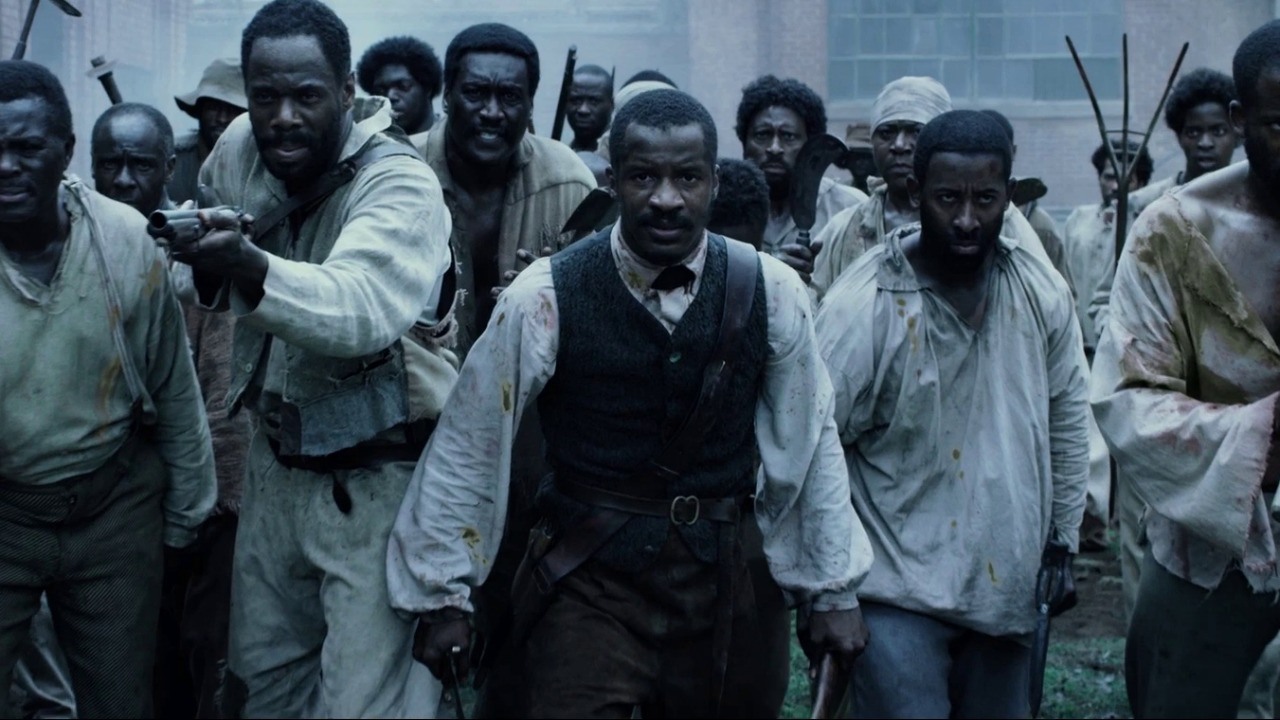
It’s only when Nat is hired out as a preacher, and begins to see just how bad things are at other plantations, that he begins to rethink things. One particular incident, followed by the brutal assault of his wife by Cobb and his men, leads Nat to anger, and a desire for revenge against “the white man”. He gathers a number of other slaves, and they begin their rebellion by attacking Samuel and his household before heading to other parts of the county, killing indiscriminately as they go. It’s not long before they come face to face with Cobb and his men, and a fight to the death ensues. Nat manages to escape and goes into hiding.
FILM-HORNADAY

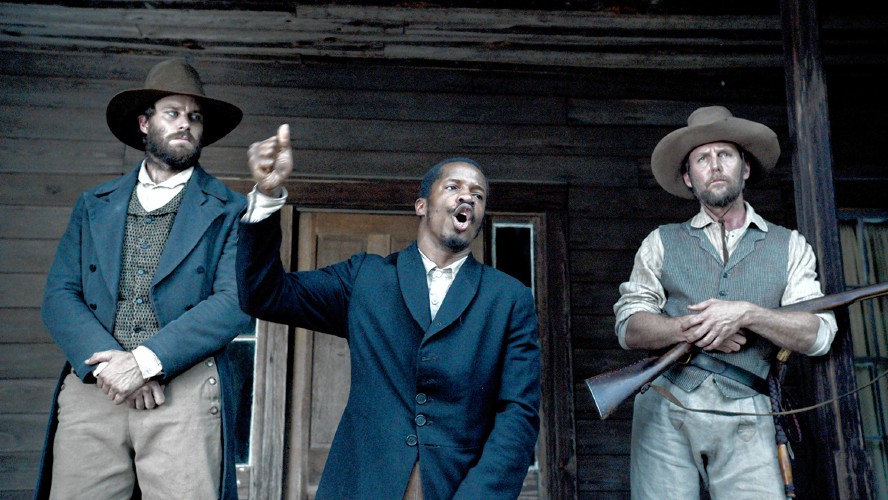
All this is pretty standard fare, with Parker portraying Turner as a man who turns his back on the society that’s treated him well enough until he begins to question that society more closely. Which actually makes the small matter of motivation a bit of a problem, because Parker the screenwriter doesn’t give Parker the actor anything to work with, other than a handful of Bible passages that he gets to deliver in an angry fashion, or, when he’s confronted by Cobb, as a defiant call to arms. Parker struggles in all departments to show us the anger and the passion behind Nat’s decision to rebel, or why he would descend so quickly and easily into violence. Yes, there’s the appalling treatment of slaves, yes, there’s the institutionalised racism of the times, and yes, there’s the personal injuries done to him and Cherry, but in Parker’s hands none of this adds up to Nat being the instigator of a rebellion. The change comes about too quickly, and as with many movies, this change appears to come about solely because the movie needs to move on.

Against other movies such as 12 Years a Slave (2013) or A House Divided: Denmark Vesey’s Rebellion (1982), The Birth of a Nation – a title that doesn’t mean anything in the context of what happens in the movie itself – is too restrained in its approach to be entirely effective. Aside from one very disturbing scene involving a slave being force fed, Parker keeps everything on an even dramatic keel, with plot and story developments coming along when required, and all played out in a way that keeps the viewer at a distance. The look and feel of the movie owes a lot to the style and structure of Roots (1977), but without that series’ attention to character, or its narrative drive. Here, by the time Nat gets around to starting his rebellion, the average viewer will be glad to have gotten through all the sub-par dramatics that have gone before, and will be looking forward to the movie gaining some forward momentum.
birththumb-1460743741317_1280w

Performance-wise, it’s Parker’s movie, with the likes of Hammer (subdued surliness), Boone Jr (straggle-haired insouciance), Miller (pained resignation), Haley (gnarly aggression), and King (unfaltering sweetness) reduced to minor roles, and having the barest amount of depth or characterisation to work with. But it’s also Parker’s movie in terms of direction, and here he’s found wanting. And like so many other directors working from their own scripts, he’s not able to find solutions to the problems that one provides for the other. There are jarring moments where continuity is derailed (one involving Samuel will have audiences shaking their heads in confusion), moments where the pace of the movie slows to a crawl, and moments where Parker’s inexperience as a director leaves the movie avoiding any complexity in the story he’s telling.

In the right hands, Nat Turner’s story could have been a powerful, impassioned examination of an event that had far-reaching effects on how slavery was regulated, and which could be said to have made things far worse for the slaves of the antebellum South. But for now we’ll have to make do with Nate Parker’s version of events, which strives to make a hero out of an ordinary man who advocated wholesale bloodshed as the drive for his rebellion, and who was found hiding in a hole covered by fence rails rather than nobly giving himself up as Parker shows here. And Parker, whose past has distracted too many people from focusing in the right direction, has made a movie that ultimately lacks cohesion, and in doing so, has possibly done a greater disservice to Turner’s legacy than anyone since those tumultuous days in Southampton County, Virginia.

Rating: 4/10 – a broad, uninspired approach to an important moment in black history, The Birth of a Nation lacks finesse, complexity, and energy; Parker’s attempts at multi-tasking do the movie no favours, and there’s a stale air of tiredness about the whole thing that transmits itself to the viewer, all of which makes the movie a bit of a chore to sit through.
Share this:

  • Click to share on X (Opens in new window) X
  • Click to share on Facebook (Opens in new window) Facebook
  • More
  • Click to print (Opens in new window) Print
  • Click to email a link to a friend (Opens in new window) Email
Like Loading...

Belle (2013)

20 Friday Jun 2014

Posted by dullwood68 in Movies

≈ 3 Comments

Tags

Amma Asante, British history, Captain John Lindsay, Dido Elizabeth Belle, Emily Watson, Gugu Mbatha-Raw, Lord Chief Justice, Lord Mansfield, Racism, Review, Slavery, Tom Wilkinson, True story, Zong

Belle

D: Amma Asante / 104m

Cast: Gugu Mbatha-Raw, Tom Wilkinson, Emily Watson, Sam Reid, Sarah Gadon, Penelope Wilton, Miranda Richardson, James Norton, Tom Felton, Matthew Goode

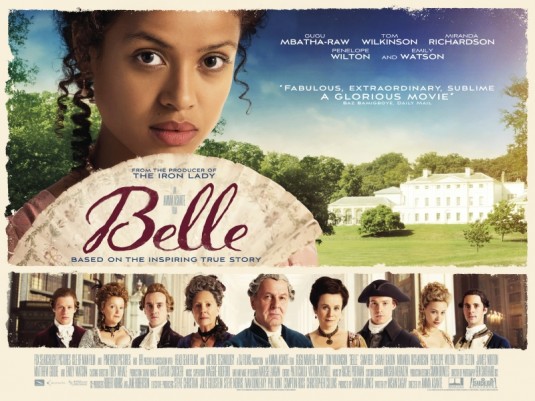
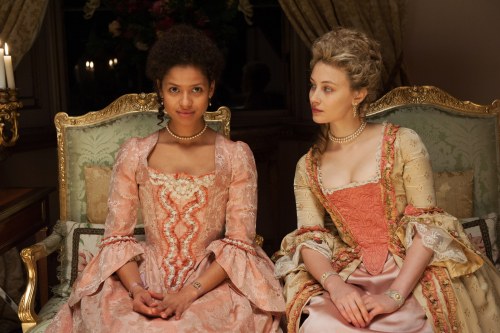
The illegitimate offspring of Royal Navy captain John Lindsay (Goode) and an African slave woman named Maria Bell, young Dido Elizabeth Belle is sent to live with his uncle, Lord Mansfield (Wilkinson) and his wife (Watson) at Kenwood House.  Despite her mixed race heritage, Dido is brought up as one of the family though some social – or possibly, household – conventions are upheld: Dido is unable to take part in dinner parties but is allowed to take coffee with guests afterwards.  She grows up in the company of her cousin, Elizabeth, who is also a ward of Lord Mansfield.  When both girls become of age, Dido (Mbatha-Raw) and Elizabeth (Gadon) expect to “come out” and find a husband.  However, Lord Mansfield has other ideas: with Dido having received a substantial inheritance upon the death of her father, he feels that her financial independence would only frighten off any potential suitors; he wants her to stay on at Kenwood and run the household.

While Elizabeth attracts the attention of James Ashford (Felton), it is his brother, Oliver (Norton) who finds himself drawn to Dido.  Unfortunately for Oliver, Dido has affections for John Davinier (Reid), a headstrong young lawyer-in-training who Lord Mansfield takes under his wing.  When the two men fall out over a ruling Lord Mansfield has to give – he’s the Lord Chief Justice – on the matter of the Zong slave ship (where slaves were cast deliberately overboard to drown), Dido endeavours to help Davinier as much as she can.  While the Mansfield household resides in London in their efforts to secure a husband for Elizabeth, Dido secretly meets with Davinier and his pro-abolitionist comrades and supplies them with as much information as she can about the case.  As the time approaches for Lord Mansfield to give his ruling, Dido’s involvement is revealed and Oliver Ashford proposes marriage.  With her future happiness hanging in the balance, Dido must decide if the life she requires will be dictated to her by social expectations or by her own desires.

Gugu Mbatha-Raw Sarah Gadon

Based – very, very, very loosely – on a true story, Belle is a handsomely mounted, beautifully lensed movie that tackles its subject matter with intelligence and a keen eye for the vagaries of the social hierarchy of Britain in the late 1700s.  The ingrained racism of the times is depicted far more subtly than expected, and is best expressed in the actions and thoughts of Lord Mansfield as he displays public disgust over the concept and practice of slavery, but in the privacy of his own home, represses Dido with his notions of correct social etiquette (and that’s without mentioning the implicit sexism of his position as well).  With the crusading Davinier to root for, and his “colour blindness”, the movie gives the viewer someone to help navigate the maze of 18th century politics, and just as Dido herself has an awakening in this matter, it’s one of the strengths of Misan Sagay’s heartfelt screenplay that matters become as clear as they do.

With the racism and the politics and the social niceties of the period so well rendered, it’s disappointing that the romantic aspects of the movie aren’t as strongly defined or developed.  Elizabeth is the trusting young hopeful, an almost stock character of the period whose lack of experience with men is redeemed by her telling Dido, “We are but their property”.  Against this, Dido is necessarily more confident and aware of the pitfalls of relationships though her confidence is established too easily, and there are times when the movie’s need for her to be a support for Elizabeth becomes irritating (Elizabeth isn’t exactly vapid but she is unremittingly naive).  Davinier’s ardent pursuit of Dido is too avid at times, and his passion for both the cause of abolition and Dido’s freedom from social strictures, as written, leaves the character looking almost (but not quite) insufferable.

In the title role, Mbatha-Raw gives a perceptive, masterful performance that is both emotionally honest and fiercely intelligent, and she is skilfully supported by Wilkinson and Watson, the former imbuing a cleverly written and yet difficult character with sincerity and charm.  Reid is earnest and declamatory (thanks to the script), and Gadon’s coquettish take on Elizabeth is occasionally affecting but she too is hindered by the restrictions of the script.  Wilton, Richardson and Norton flesh out their roles to good effect but Felton is stifled by a character who is never allowed to be anything more than the stock villain (not only is he an outspoken racist but he assaults Dido as well, as if his odiousness was in some way in doubt).

In the director’s chair, Asante shows an assured and substantial understanding of the issues being examined, and is particularly impressive when exploring the curious anomalies of Dido’s life at Kenwood House.  Under her committed and often powerful guidance, Belle overcomes its romantic Georgian soap opera elements to become a potent, articulate condemnation of a period in British history when endemic racism and the commerce of slavery was beginning to be challenged both socially and in law.

Rating: 8/10 – the aforementioned romantic elements and Rachel Portman’s often intrusive score aside, Belle is a vivid, impassioned look at the often complex life of a woman whose social position meant she was too low to eat with her family and at the same time, too high to eat with servants; a powerful, accomplished movie from a powerful, accomplished director.

Share this:

  • Click to share on X (Opens in new window) X
  • Click to share on Facebook (Opens in new window) Facebook
  • More
  • Click to print (Opens in new window) Print
  • Click to email a link to a friend (Opens in new window) Email
Like Loading...

12 Years a Slave (2013)

10 Friday Jan 2014

Posted by dullwood68 in Movies

≈ 1 Comment

Tags

Benedict Cumberbatch, Chiwetel Ejiofor, Edwin Epps, Lupita Nyong'o, Michael Fassbender, Patsey, Paul Dano, Plantation, Review, Sarah Paulson, Slavery, Solomon Northup, Steve McQueen, True story, US history, Whipping

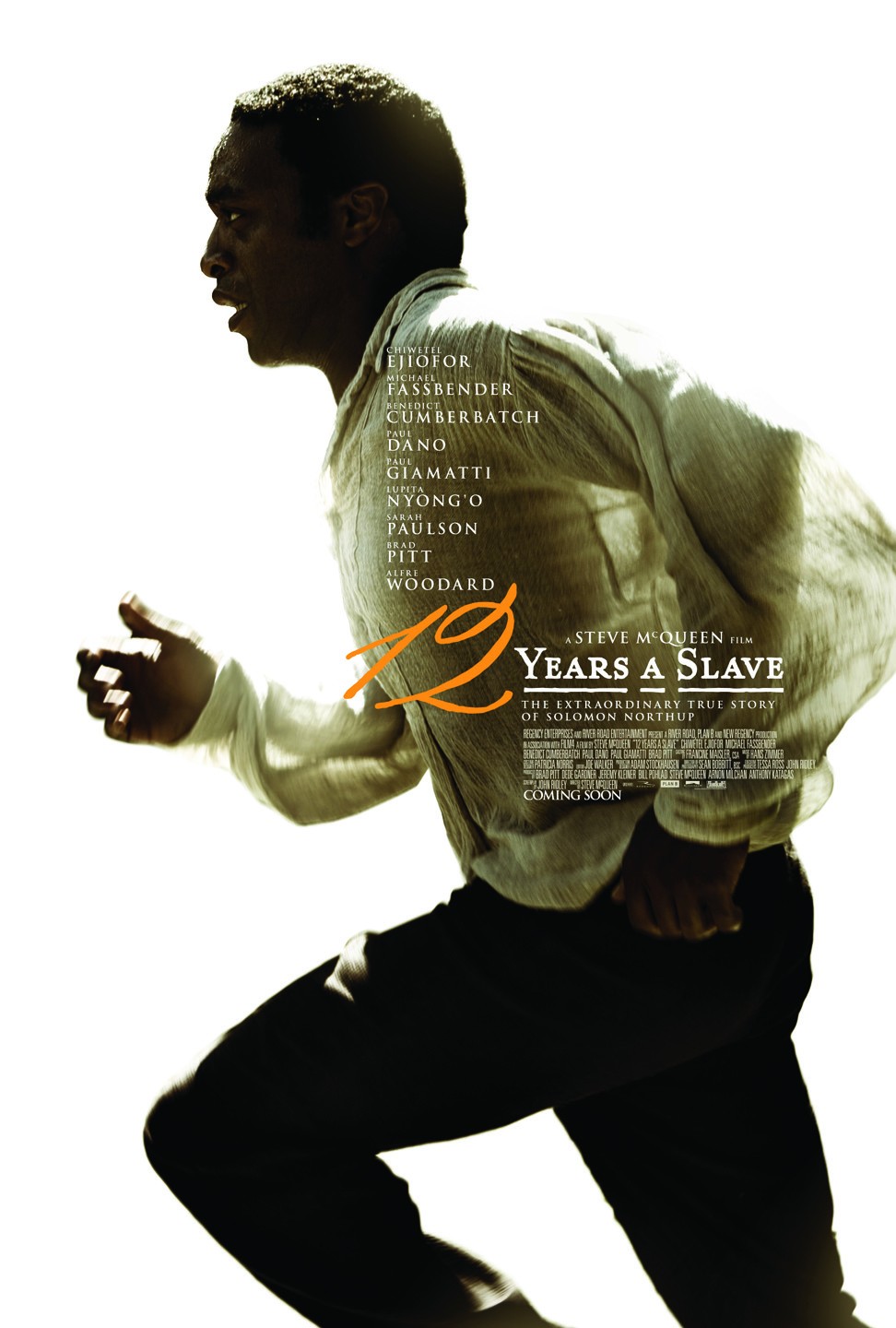
12 Years a Slave

D: Steve McQueen / 134m

Cast: Chiwetel Ejiofor, Michael Fassbender, Lupita Nyong’o, Benedict Cumberbatch, Paul Dano, Sarah Paulson, Adepero Oduye, Paul Giamatti, Garret Dillahunt, Brad Pitt, Alfre Woodard, Scoot McNairy, Taran Killam

In 2013 the movie that drew most people to the cinema was the third solo outing for Marvel’s high-tech reboot of the Tin Man, Iron Man 3. That movie was fun, a well-made piece of confectionery that was hyped, trailed and previewed to within an inch of its life. Enjoyable as it was though, it was still the equivalent of a Big Mac and fries, offering a quick fix for the Geek Squads and providing little or no nourishment for anyone not au fait with Marvel’s plan for Cinematic World Domination. But if 2013 is to be remembered as the year a man in a can was seen by more people than any other movie, what of that other way of remembering any given year: by the movie that was easily the best the year had to offer.

In some years, that “choice” has been easy. In 1930, All Quiet on the Western Front. In 1945, Les enfants du paradis. In 1962, Lawrence of Arabia. In 1974, The Godfather Part II. In 1993, Schindler’s List. And in 2013…a movie most of us won’t see until 2014. A movie called 12 Years a Slave.

Directed by McQueen from the account written by Solomon Northup, a free man living in New York with his wife and two children in 1841, 12 Years a Slave is a devastating account of one man’s abduction into slavery, and his subsequent experiences on the plantations of Louisiana. Northup is an accomplished musician, well-respected, and flattered when two members of a circus troupe approach him to join their company.  He journeys from New York to Washington with them only to wake up after a night’s drinking to find himself in chains and told he is now a slave; his name is also denied him and he is told he is to answer to Platt.  At first he finds himself at the mercy of (the ironically named) slave trader Freeman (Giamatti), until he is sold, along with a woman called Eliza (Oduye), to plantation owner Mr Ford (Cumberbatch).  Ford is in the process of adding extra buildings to his land, and has a master carpenter Tibeats (Dano) who oversees the construction. Northup impresses Ford with his engineering skills but soon makes an enemy of Tibeats.  Before long, Tibeats pushes Northup too far and Northup beats him with his own whip. Tibeats swears revenge against Northup and returns with two men; they proceed to hang Northup but are stopped by Ford’s overseer, Chapin (J.D. Evermore).  Although Chapin stops Northup from being killed, he leaves him hanging from the tree with his toes barely touching the ground to save himself from being strangled; it’s only when Ford returns at the end of the day that he is cut down.  But Ford’s leniency comes at a price: he must sell Northup on in order to save his plantation from Tibeats’ wrath.

Where Ford has been a considerate and compassionate man, Northup’s new owner, Edwin Epps is anything but.  He has his slaves  whipped if they don’t make the daily quota for picking cotton, and when his wife complains that he is paying too much attention to one of the female slaves, Patsey (Nyong’o), he tells her coldly that he will see the back of her before he will rid himself of Patsey.  Northup becomes Patsey’s confidante, and he does his best to keep Epps from bothering her, but it doesn’t always work.  It’s only when a carpenter named Bass (Pitt) comes to work on the plantation, and speaks of equality, that Northup takes courage and explains his situation.  Bass agrees to help him, and some time later, Northup is freed and reunited with his family.

12 Years a Slave - scene

From the outset, 12 Years a Slave grabs the attention and keeps its audience riveted.  The topic of slavery is one that has been only fitfully addressed in cinema, and while movies such as Amistad (1997), and Amazing Grace (2006) have taken a political approach to the issue, there hasn’t been a movie that has looked at it from both the financial side of things, and the actual day-to-day living experience.  Throughout the movie it’s made clear that slavery is a business, and a lucrative one for people such as the trader Freeman, and for the plantation owners who invest in slaves as a means of reaping huge profits.  Against this wellspring of money, a slave’s life is worth nothing at all, and the movie delivers this message on several occasions.  When Northup is on tiptoe trying not to hang, it’s heartbreaking to see the other slaves carry on with their tasks as if he isn’t there; only by going about their business can they add value to their lives.

12 Years a Slave is also quite graphic in its depiction of the violence endemic in slavery, with one on-screen whipping being truly horrifying, and its the casual nature of it all that the movie depicts so well, along with the hateful racism that fuelled so much of it.  Early on, before Northup is placed with Freeman, he is beaten with a paddle.  The scene is shocking both for what happens to Northup, and for the sustained nature of the beating.  Epps’s wife throws a decanter in Patsey’s face, her racism mixed with jealousy and injured pride.  There are other moments where violence escalates from nothing, and there is a palpable sense of the violent undercurrents that were prevalent during this period.  If the movie presents these aspects unflinchingly, then it is to show the full horror of the constant threat of injury or death that slaves experienced.  (And to anyone who feels these scenes were unnecessary or uncomfortable to watch, then you are missing the point.  The life of a slave was far worse than anything depicted here, and by showing us the things that we do see, the movie reinforces the fact that, so far removed from both those times and those circumstances as we are in our daily lives, we can easily fail to realise how terrible slavery actually was.)

Thankfully, in amongst the brutal violence and the despair there are quiet moments of hope to offset the horror.  Northup’s relationship with Patsey is affecting and desperately sad at the same time, and shows how two people can still retain a measure of their humanity despite existing under appalling conditions.  Thanks to both Ejiofor and Nyong’o, their scenes together are both emotionally charged and riveting viewing.

The heart of the film is Ejiofor’s towering performance, a career best that is breathtaking to watch as he depicts a man who somehow retains his dignity and his sense of self through twelve years of degradation and terror.  Ejiofor holds the attention in every scene he’s in, deflecting focus even from Fassbender, whose performance as Epps is mesmerising in its intensity.  The audience is drawn to Ejiofor as their moral compass and guide; without him, the movie would be a series of vignettes without a central point of reference.  He displays a clear understanding of the emotions that governed Northup’s reactions and response to his situation: the despair, the anger, the resignation to his plight, the fear, the barely acknowledged hope of regaining his freedom, the sadness, the sense of loss, and most effective of all, the will to survive.  It’s a magnificent achievement.

As already mentioned, Fassbender is on brilliant form as the tortured, torturing Epps, adding layers to a character who could have been portrayed more matter-of-factly and with less attention to nuance and interpretation.  His performance is mercurial, adding a sense of uncertainty to Epps that makes his unpredictable nature more dangerous.  His scenes with Ejiofor are akin to an acting masterclass.  In the various supporting roles, Dano stands out as the mealy-mouthed, insecure Tibeats, all puffed-up pride and coiled hostility, while Cumberbatch continues to impress as the fair-minded, socially conscious Ford.  Paulson also impresses as Mistress Epps, her eyes never once betraying any emotion other than disgust.  And making her feature debut, Nyong’o is superb as the object of Epps’s lust, imbuing Patsey with an inner strength and determination that offsets the cruelty she receives at the hands of Epps and his wife.

This is McQueen’s third feature – after Hunger (2008) and Shame (2011) – and serves to reinforce how talented a director he is.  His control of the material is confident and assured, and he elicits strong performances from everyone in the cast.  In conjunction with cinematographer Sean Bobbitt, McQueen places the camera in exactly the right place in each scene, framing the action expertly and with close attention to the physical and emotional requirements of each set-up.  His decision to make 12 Years a Slave has proved to be a wise one, and the way in which he’s overcome the difficulties inherent in telling such a complex story is compelling.

12 Years a Slave is a harrowing, disturbing look at a shameful period in US history, and while some people might say that we don’t need to see the barbarity of the times to know it was evil, a reminder as powerful as this one is should always be welcome.  With stand-out performances, an insightful, intricate script courtesy of John Ridley, and a score by Hans Zimmer that perfectly supports the emotional and dramatic moments in the film, 12 Years a Slave is a movie deserving of everyone’s attention.

Rating: 9/10 – a modern masterpiece, with much to say about the nature of evil as the will to survive it; an engrossing, deeply moving account of one man’s journey through a contemporary hell and his eventual salvation.

Share this:

  • Click to share on X (Opens in new window) X
  • Click to share on Facebook (Opens in new window) Facebook
  • More
  • Click to print (Opens in new window) Print
  • Click to email a link to a friend (Opens in new window) Email
Like Loading...

Blog Stats

  • 486,528 hits

Recent Posts

  • 10 Reasons to Remember Bibi Andersson (1935-2019)
  • Fantasia (1940)
  • Dances With Wolves (1990) – The Special Edition
  • Kiss of the Spider Woman (1985)
  • The Three Musketeers (1973)

Top Posts & Pages

  • Lost for Life (2013) - Another Look
    Lost for Life (2013) - Another Look
  • Lost for Life (2013)
    Lost for Life (2013)
  • About
    About
  • Mr. Topaze (1961)
    Mr. Topaze (1961)
  • Winter's Tale (2014)
    Winter's Tale (2014)
  • Billy Lynn's Long Halftime Walk (2016)
    Billy Lynn's Long Halftime Walk (2016)
  • The Hitman's Bodyguard (2017)
    The Hitman's Bodyguard (2017)
  • Shock and Awe (2017)
    Shock and Awe (2017)
  • 5 Famous Movie Roles That Nearly Went to Someone Else
    5 Famous Movie Roles That Nearly Went to Someone Else
  • The Layover (2017)
    The Layover (2017)
Follow thedullwoodexperiment on WordPress.com

Blogs I Follow

  • Rubbish Talk
  • Film 4 Fan
  • Fast Film Reviews
  • The Film Blog
  • All Things Movies UK
  • Interpreting the Stars
  • Let's Go To The Movies
  • Movie Reviews 101
  • TMI News
  • Dan the Man's Movie Reviews
  • Film History
  • Jordan and Eddie (The Movie Guys)

Archives

  • April 2019 (13)
  • March 2019 (28)
  • February 2019 (28)
  • January 2019 (32)
  • December 2018 (28)
  • November 2018 (30)
  • October 2018 (29)
  • September 2018 (29)
  • August 2018 (29)
  • July 2018 (30)
  • June 2018 (28)
  • May 2018 (24)
  • April 2018 (21)
  • March 2018 (31)
  • February 2018 (25)
  • January 2018 (30)
  • December 2017 (30)
  • November 2017 (27)
  • October 2017 (27)
  • September 2017 (26)
  • August 2017 (32)
  • July 2017 (32)
  • June 2017 (30)
  • May 2017 (29)
  • April 2017 (29)
  • March 2017 (30)
  • February 2017 (27)
  • January 2017 (32)
  • December 2016 (30)
  • November 2016 (28)
  • October 2016 (30)
  • September 2016 (27)
  • August 2016 (30)
  • July 2016 (30)
  • June 2016 (31)
  • May 2016 (34)
  • April 2016 (30)
  • March 2016 (30)
  • February 2016 (28)
  • January 2016 (35)
  • December 2015 (34)
  • November 2015 (31)
  • October 2015 (31)
  • September 2015 (34)
  • August 2015 (31)
  • July 2015 (33)
  • June 2015 (12)
  • May 2015 (31)
  • April 2015 (32)
  • March 2015 (30)
  • February 2015 (37)
  • January 2015 (39)
  • December 2014 (34)
  • November 2014 (34)
  • October 2014 (36)
  • September 2014 (25)
  • August 2014 (29)
  • July 2014 (29)
  • June 2014 (28)
  • May 2014 (23)
  • April 2014 (21)
  • March 2014 (42)
  • February 2014 (38)
  • January 2014 (29)
  • December 2013 (28)
  • November 2013 (34)
  • October 2013 (4)

Create a free website or blog at WordPress.com.

Rubbish Talk

Film 4 Fan

A Movie Blog

Fast Film Reviews

The Film Blog

The official blog of everything in film

All Things Movies UK

Movie Reviews and Original Articles

Interpreting the Stars

Dave Examines Movies

Let's Go To The Movies

Film and Theatre Lover!

Movie Reviews 101

Daily Movie Reviews

TMI News

Latest weather, crime and breaking news

Dan the Man's Movie Reviews

All my aimless thoughts, ideas, and ramblings, all packed into one site!

Film History

Telling the story of film

Jordan and Eddie (The Movie Guys)

Movie Reviews & Ramblings from an Australian Based Film Fan

Privacy & Cookies: This site uses cookies. By continuing to use this website, you agree to their use.
To find out more, including how to control cookies, see here: Cookie Policy
  • Subscribe Subscribed
    • thedullwoodexperiment
    • Join 481 other subscribers
    • Already have a WordPress.com account? Log in now.
    • thedullwoodexperiment
    • Subscribe Subscribed
    • Sign up
    • Log in
    • Report this content
    • View site in Reader
    • Manage subscriptions
    • Collapse this bar
 

Loading Comments...
 

    %d