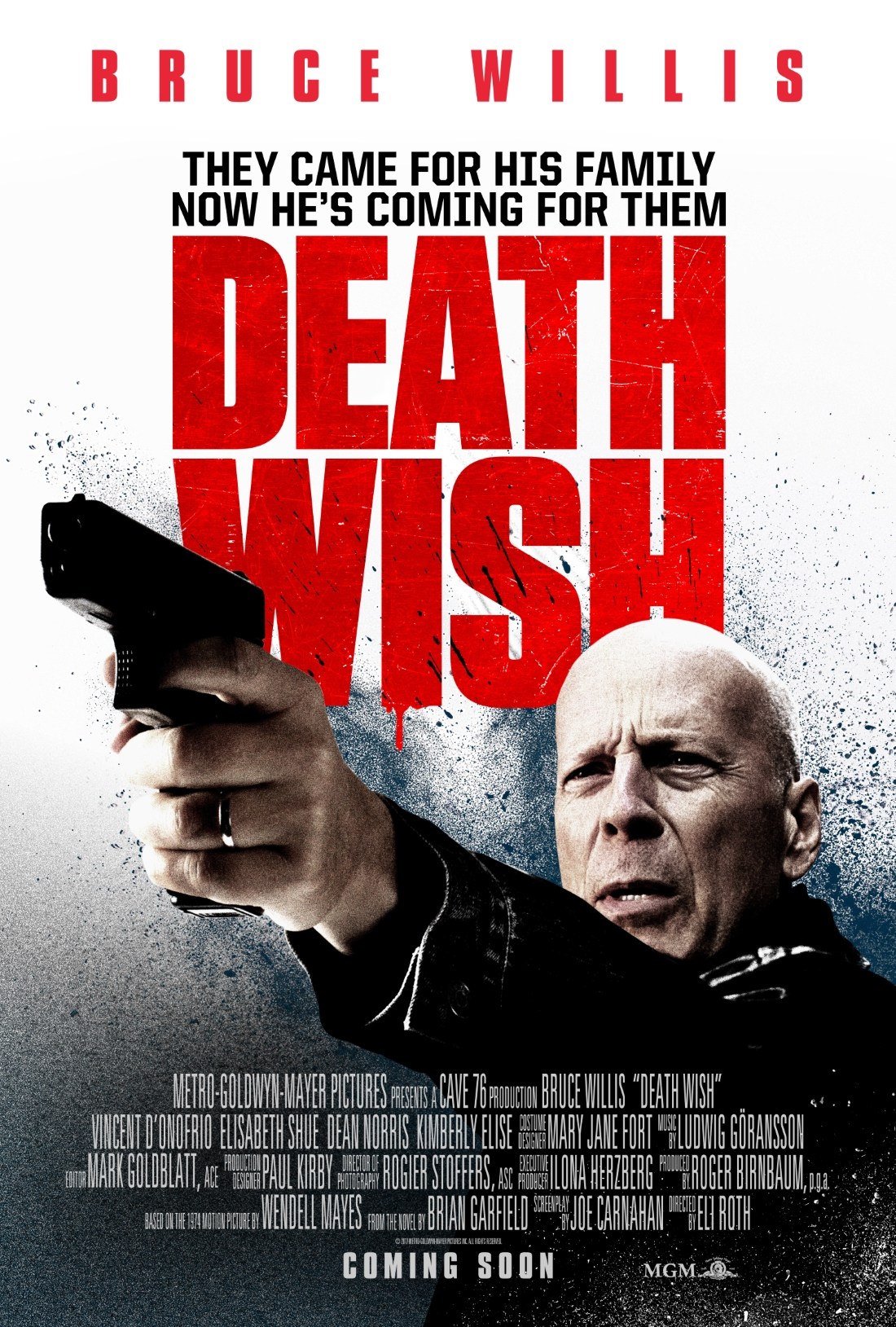
Cast: Bruce Willis, Vincent D’Onofrio, Elisabeth Shue, Camila Morrone, Dean Norris, Beau Knapp, Kimberly Elise, Len Cariou, Jack Kesy, Ronnie Gene Blevins
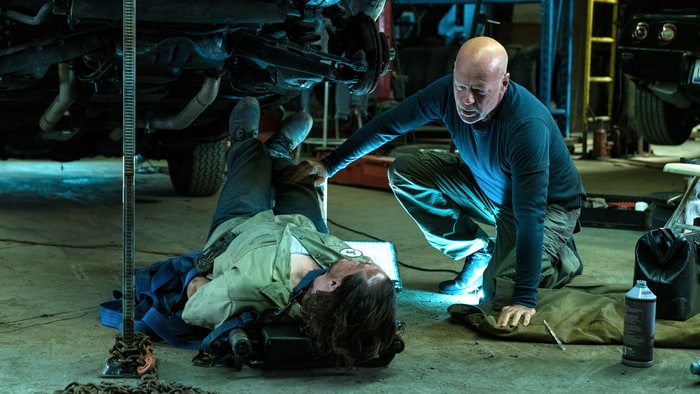
Paul Kersey (Willis) is a trauma surgeon working at a Chicago hospital. He has a wife, Lucy (Shue), and a teenage daughter, Jordan (Morrone), who is about to go off to college. One night, while Kersey is working, three burglars break into his home while everyone is out, but Lucy and Jordan return while they’re still there. Lucy is killed, and Jordan suffers a skull fracture that leaves her in a coma. The police, represented by Detective Kevin Raines (Norris) and Detective Leonore Jackson (Elise), offer hope that they’ll catch the men responsible, but with no leads, time passes and Kersey begins to wonder if he’ll ever have justice for his family. Angry at the police’s inability to protect people, Kersey becomes a vigilante, and earns the soubriquet The Grim Reaper. When a gunshot victim is admitted to the ER and is wearing one of Kersey’s stolen watches, it provides him with enough information to begin tracking down the men the police can’t find. But as he hunts them down, Raines and Jackson become suspicious of his actions, and the leader of the men (Knapp) targets him directly…
The idea of a remake of Michael Winner’s exploitation “classic” has been mooted for a while now (since 2006 when Sylvester Stallone was set to direct and star). There have been a few stops and starts along the way, and now we have the combination of Eli Roth and Bruce Willis, and a movie that has all the charm and appeal of applying haemorrhoid cream. There’s no other way of putting it: this incarnation of Death Wish is appalling, a right-wing political tract that lacks the courage of its own convictions, and strives for relevance in a day and age where violence is a sad, every day occurrence in the good old US of A. While talking heads debate the merits of having a vigilante on the streets of Chicago, Willis’s monotone Kersey goes on a journey of violent wish-fulfillment that screams “under-developed!” For a surgeon with no previous experience of handling a gun even, he’s able to act with impunity (he takes out a drug dealer on the street – in daylight – without being shot at by anyone), and even when he takes on the burglars, he leaves no evidence of his involvement.
So while Kersey gets away with murder, the police amble through proceedings like unwitting sleepwalkers at a narcolepsy convention (they even have time to joke about their investigation with their boss). It’s laughable, and something of an insult to the talent and skill of Joe Carnahan, the sole credited writer of this farrago, whose original script was re-written once Roth came on board. With a plethora of poorly written characters (D’Onofrio plays Kersey’s brother, but why he’s even there is impossible to work out), dialogue that sounds like a deaf person’s idea of dialogue, and Kersey’s motivations remaining murky at best, this is further sabotaged by Roth’s inability to maintain a consistent tone or invest proceedings with any appreciable energy. Willis continues to look bored out of his skull (a too common occurrence these days), the bad guys are straight out of generic villain central casting, and the action scenes are the nearest the movie comes to waking up. It has all the hallmarks of a movie that was rushed into production before the rights ran out, or worse, was rushed into production without anyone having a clear idea of what they were doing. So they truly did have a death wish…
Rating: 3/10 – abandoning any notion of moral ambiguity from the outset, Death Wish – Roth’s exploitation-free remake – is as dull as they come, and as ineptly handled as you’d expect; if you need any proof, just watch the early scene where Kersey “consoles” a cop whose partner has just died – and then hang your head in dismay.
Cast: Matilda Anna Ingrid Lutz, Alex Roe, Johnny Galecki, Vincent D’Onofrio, Aimee Teegarden, Bonnie Morgan
Inevitability. In the world of franchise horror, the word is a touchstone for movie makers everywhere. Where there is one horror movie that’s been successful (even moderately so), chances are that someone will come along and make another. And another. And another, until the law of diminishing returns – financial, not artistic – brings an end to the whole terrible enterprise. For a while.
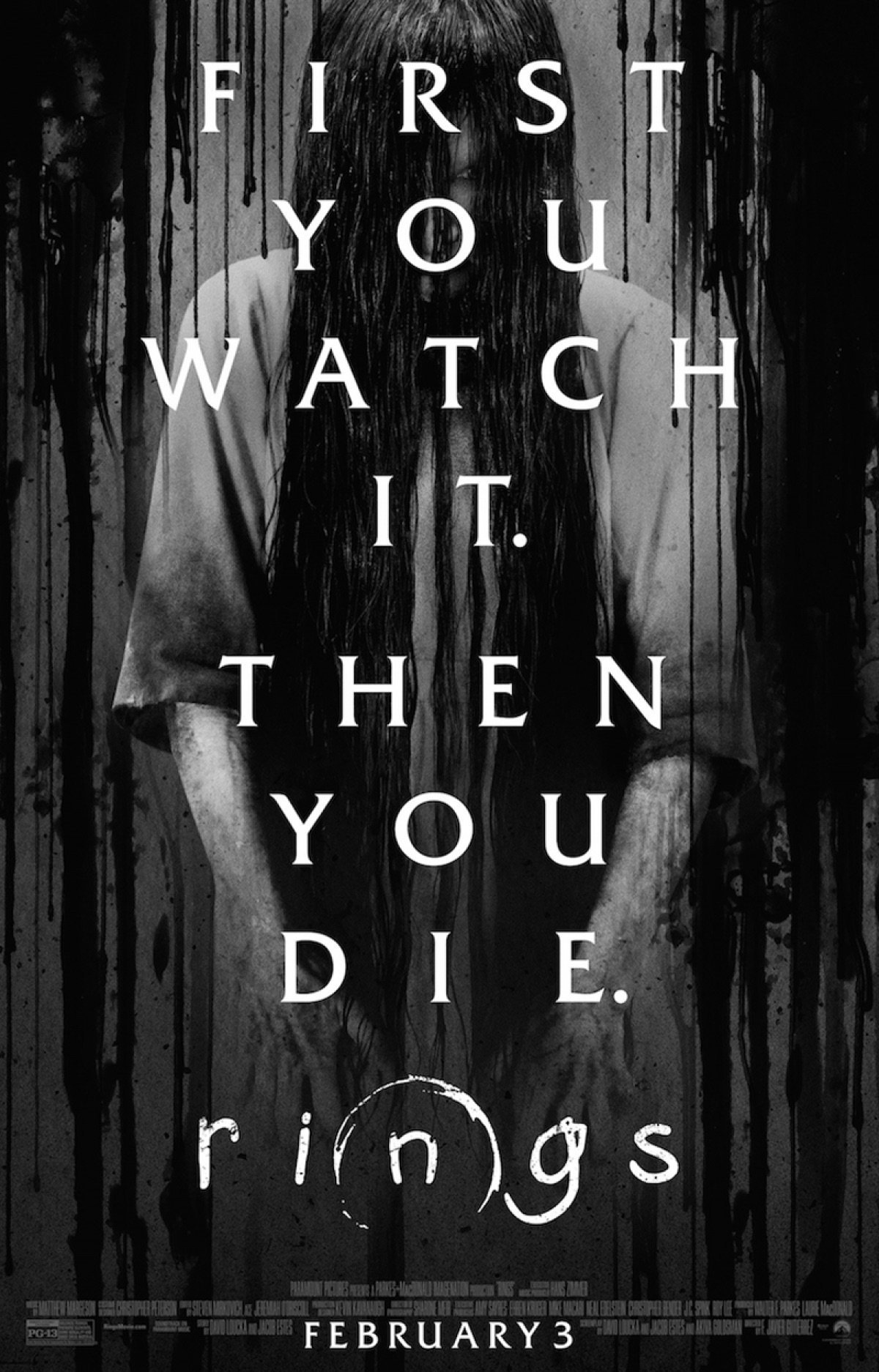
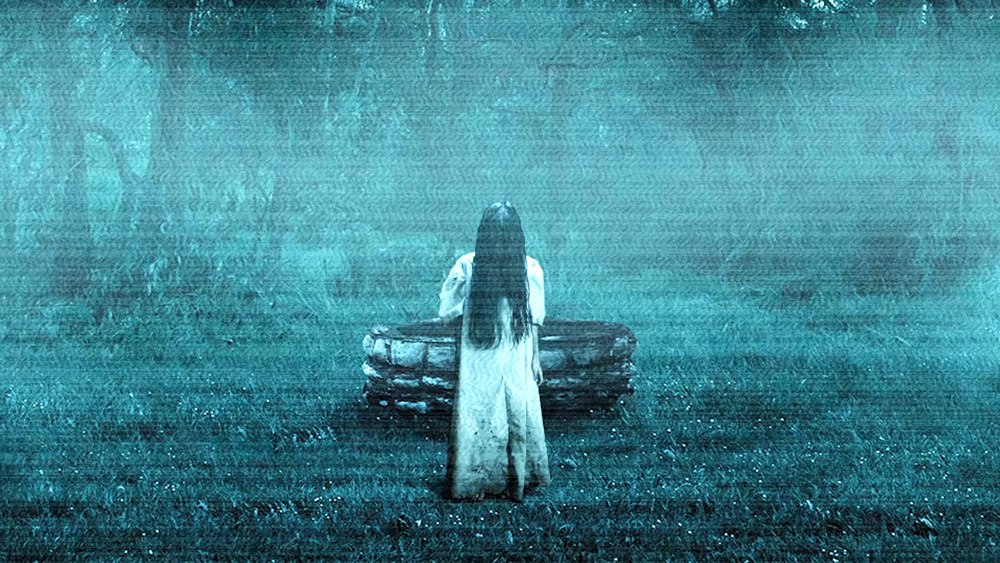
The latest franchise entry to be foisted on us without any kind of encouragement from fans, interested third parties, previous investors, or the terminally bewildered, Rings is a redundant exercise in supernatural nonsense that outstays its welcome right from the very start. Set on a plane, the opening scene plays out like a game of tag as first one passenger then another, and then another, reveals that they’ve all watched the dreaded videotape featuring Samara. It’s seven days on for all of them – just what are the odds? – and there’s nowhere for them to go: the plane’s in the air and the video screens are all working. And sure enough, heeeeeere’s Samara! Inevitably (there’s that word again), the plane crashes, killing everyone aboard. But has the cycle been broken?
Fast forward two years and the answer is an obvious, of course not. A college professor called Gabriel (Galecki) buys a battered old VCR at a garage sale and inevitably it contains a copy of the cursed videotape (just how many copies of this videotape were made?). Inevitably, Gabriel watches it. We’re then side-tracked into the lives of generic teen lovebirds, Julia (Lutz) and Holt (Roe) just as Holt is about to go off to college (guess who’s a professor there?). When Holt stops returning her calls and texts, and she receives a mysterious call from a girl called Skye (Teegarden) asking after Holt’s whereabouts, Julia drops everything and heads to Holt’s college. Soon, she’s met Skye and Gabriel, been introduced to “The Sevens”, a group of students involved in an experiment of Gabriel’s devising that involves Samara’s videotape, and been a passive witness to Skye’s demise. She learns that Holt has watched the tape and has twelve hours left before Samara kills him. Julia watches it too, but when she gets the call to tell her she has “seven days”, the phone burns a mark into her palm, and she has a vision of a door.
All this sets up a road trip to the town of Sacrament Valley, and an investigation into the whereabouts of Samara’s remains (Julia and Holt believe that by cremating her remains, Samara’s curse will be lifted). Soon they’re breaking into tombs, visiting a blind man named Burke (D’Onofrio) who knows some of Samara’s history in the town, and discovering hidden rooms below the church. There’s danger, more danger, continued supernatural threat, death, injury, more death, and a sequel-baiting ending that wants to have its Samara-shaped cake and eat it as well. Does it make any sense? On a convoluted, I-can’t-believe-it’s-not-simpler level, no, it doesn’t, and mainly because Samara’s influence is allowed to have an effect beyond the videotape and her murderous follow-up courtesy call seven days later. This allows for the deaths of two characters that are at odds with the basic set up, and an ending that makes no sense because it undermines the admittedly skewed logic created from the start, and the greater mythology of the franchise as a whole – as anyone who remembers the end of The Ring Two (2005) should be able to attest.
So what we have here is a belated series’ revival that should be filed under “cash-in”, or “uninspired knock-off”. It tries to reinvent the wheel in terms of Samara’s origins in an attempt to provide viewers with something different from previous outings, but in doing so, becomes laboured and unaccountably dull. Much of the time spent in Sacrament Valley plods along at a pace that defies audience involvement, and with each new plot “development” the sounds of heads being scratched and confused sighs being released act as a measure of just how stale the script has become. Said script has been cobbled together by David Loucka, Jacob Estes, and Akiva Goldsman (what with this and The Dark Tower, Goldsman isn’t exactly having a banner year – and that’s without his story credit for Transformers: The Last Knight). With its bland central duo, reflexive storyline and make-it-up-as-you-go-along plotting, Rings is a horror movie that aims to be as creepy as its forebears, but then forgets that the old trick of having Samara emerging from a TV has lost much of its original impact. The troubled teen spirit is old hat now, a horror icon who no longer possesses the power to frighten audiences, except in relation to how living in a well isn’t too good for the complexion.
At the helm of all this is Gutiérrez, a director whose last stint behind the camera was in 2008. There are certain moments and scenes where it’s clear he’s opted for a generic approach to the material, but what’s unclear is whether this was due to budgetary constraints or creative decision-making. But what it does is to make the movie drag for much of its latter half, which in conjunction with the script’s grinding to a dramatic halt, leaves the viewer stranded waiting for the movie to become interesting again. But neither the script nor Gutiérrez can overcome the lack of original ideas being put forward, and much as he might try, Gutiérrez lacks the wherewithal to inject a much needed spark into proceedings. The performances are perfunctory and lack depth (which is perhaps inevitable given the material), and the cinematography relies too heavily on scenes being lit as if exploring the wider edges of the frame wasn’t required, or important. Even the movie’s few jump scares are tired approximations of previous jump scares. With so much that’s ineffective and mundane, the only thing the viewer can hope for is that, despite its success at the box office, this is one sequel-cum-reboot that puts off anyone revisiting the curse of Samara anytime soon.
Rating: 4/10 – stereotypical even by horror franchise standards, and lacking a perceptible style all its own, Rings adds nothing of value to the series, instead settling for telling the kind of melodramatic detective story that has been done to death dozens of times before; a movie then that serves only to reinforce just how the franchise has deteriorated since the heady days of Hideo Nakata’s 1998 original.
The third and fourth sequels in their respective franchises, Jurassic World and Terminator Genisys are that rare combination: reboots that feed off the original movies. And you could argue that they’re also remakes, in that they take the basic plots of those original movies and put their own – hopefully – nifty spins on them. But while there’s a definite fan base for both series, which means both movies should do well at the box office (enough to generate further sequels), is there enough “new stuff” in these movies to actually warrant seeing them in the first place, or getting excited about any future releases that are in the pipeline? (And let me say just now, that both movies have ensured that the possibility of further entries in both franchises will be an absolute certainty.)
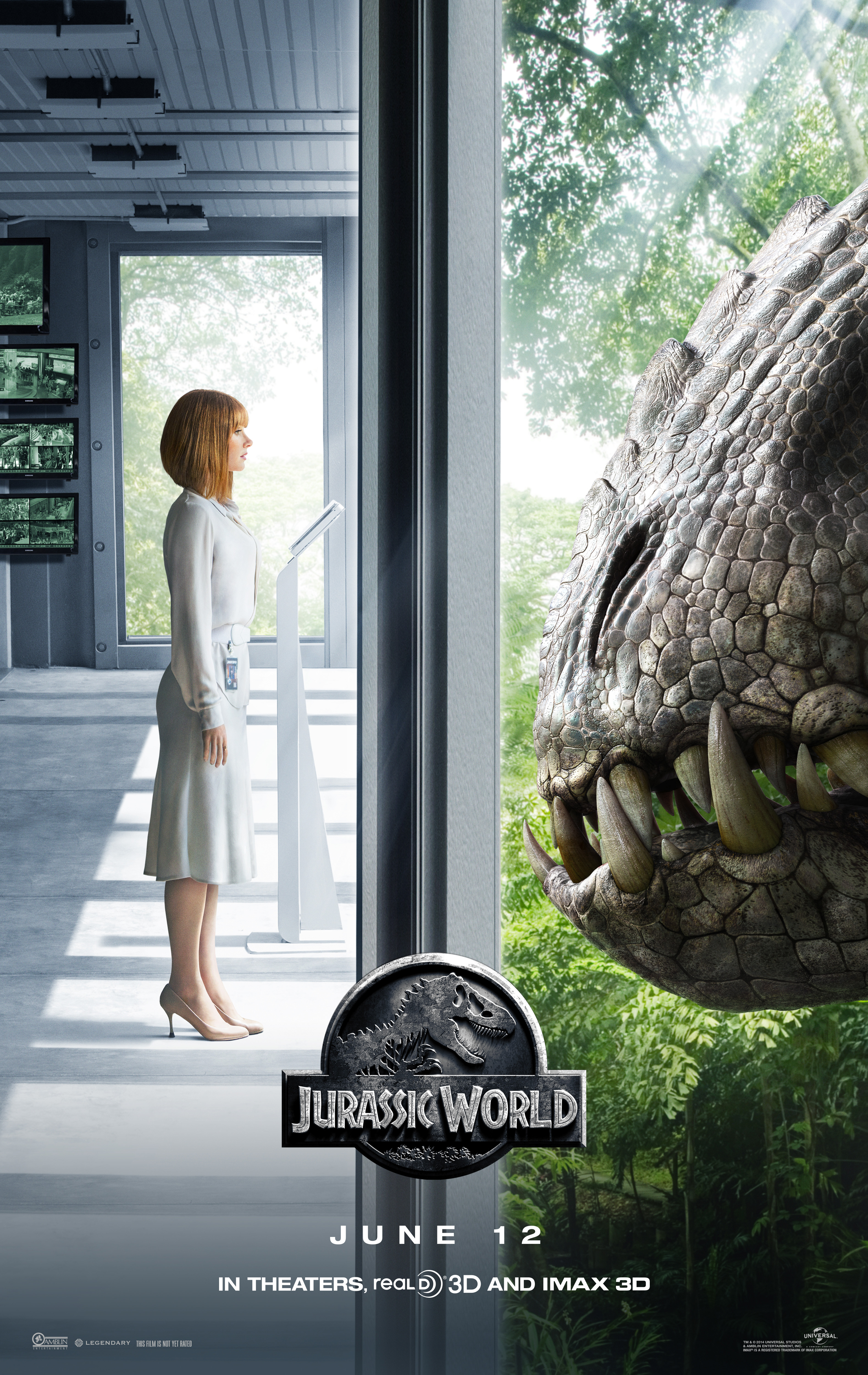
Jurassic World (2015) / D: Colin Trevorrow / 124m
Cast: Chris Pratt, Bryce Dallas Howard, Vincent D’Onofrio, Irrfan Khan, Ty Simpkins, Nick Robinson, Jake Johnson, Omar Sy, BD Wong, Judy Greer, Lauren Lapkus
Twenty-two years on from the disastrous attempt by John Hammond to open the world’s first dinosaur theme park, his dream has become a paying reality, but one that needs ever more impressive dinosaurs to keep visitors coming. Thanks to the backing of the park’s owner, Masrani (Khan), and the scientists responsible for cloning the park’s main attractions – led by Dr Henry Wu (Wong) – each new attraction strays further and further from the original concept of replicating the dinosaurs everyone is aware of. Now, Wu and his team have designed a new dinosaur, the so-called Indominus Rex, an intelligent, über-predator that is taller than a T. Rex and even more deadly.
When animal behavioural specialist Owen Grady (Pratt) is called in to assess the new dinosaur’s readiness for being shown to the public, he and park manager Claire (Howard) are unprepared for just how intelligent the Indominus Rex is; soon it escapes and begins to wreak havoc across the island. With an evacuation of over twenty thousand tourists going ahead, including Claire’s nephews Gray (Simpkins) and Zach (Robinson) who have strayed off the normal tourist track, Grady and Claire must try to keep everyone safe, as well as dealing with parent company InGen’s local representative, Hoskins (D’Onofrio), who sees Indominus Rex’s escape as a chance to prove that raptors – who have been trained by Grady – can be used as militarised weapons. But his strategy backfires, leaving everyone at risk from Indominus Rex and the raptors.
Given that Jurassic Park III (2001) was pretty much dismissed as so much dino guano on its release, the idea of making a fourth movie always seemed like a triumph of optimism over experience. And yet, Jurassic World is a triumph – albeit a small scale one – and while it doesn’t offer us anything really new (aside from Grady’s instinctive, respect-driven relationship with the raptors), it does make a lot of things feel fresher than they have any right to be. This is essentially a retread of the first movie, with Gray and Zach as our guides to the park’s wonders (and perils), the fiercest dinosaur in the park getting loose, and the humans relying on other dinosaurs to take down the big bad and save the day. It’s not a bad concept – after all, it worked the first time around – but despite how well the movie has been put together, it’s still a fun ride that just misses out on providing that much needed wow factor.
Part of the problem is that the movie makers have taken the bits of Jurassic Park (1993) that worked and added some stuff that doesn’t. Do we really need to see yet another misogynistic portrayal of a relationship, where the woman changes for the man and not the other way round? Do we really need to hear a scientist blame the moneyman for not paying attention when the scientist created something unethical? And do we really need to hear deathless lines such as “We have an asset out of containment” or “It can camouflage!” (a trick the Indominus Rex pulls off just the once, by the way, when it’s convenient to the narrative). Of course we don’t, but because this isn’t a straight remake, but a reboot/update/witting homage, that’s what we get. For all that the movie is technically well made, and looks fantastic in IMAX 3D, it’s still a retread, and lacks the thrills we need to invest in it properly (and that’s without the paper-thin characters, from the stereotypically neanderthal Hoskins, to the annoying dweeb in the park’s Control Centre (Johnson). In short, the movie lacks the depth necessary to make us care about it, and without that depth, it just becomes another superficial ride the viewer will forget without realising it.
Rating: 6/10 – another summer blockbuster that doesn’t do enough to justify its budget or hype, Jurassic World is like an old friend regaling you with a story you’ve heard a thousand times before; maybe this will work better as the intro to a bigger story and plot, but if not, then this is just another disappointing entry in that ever growing cache of movies known as the Unnecessary Sequel.
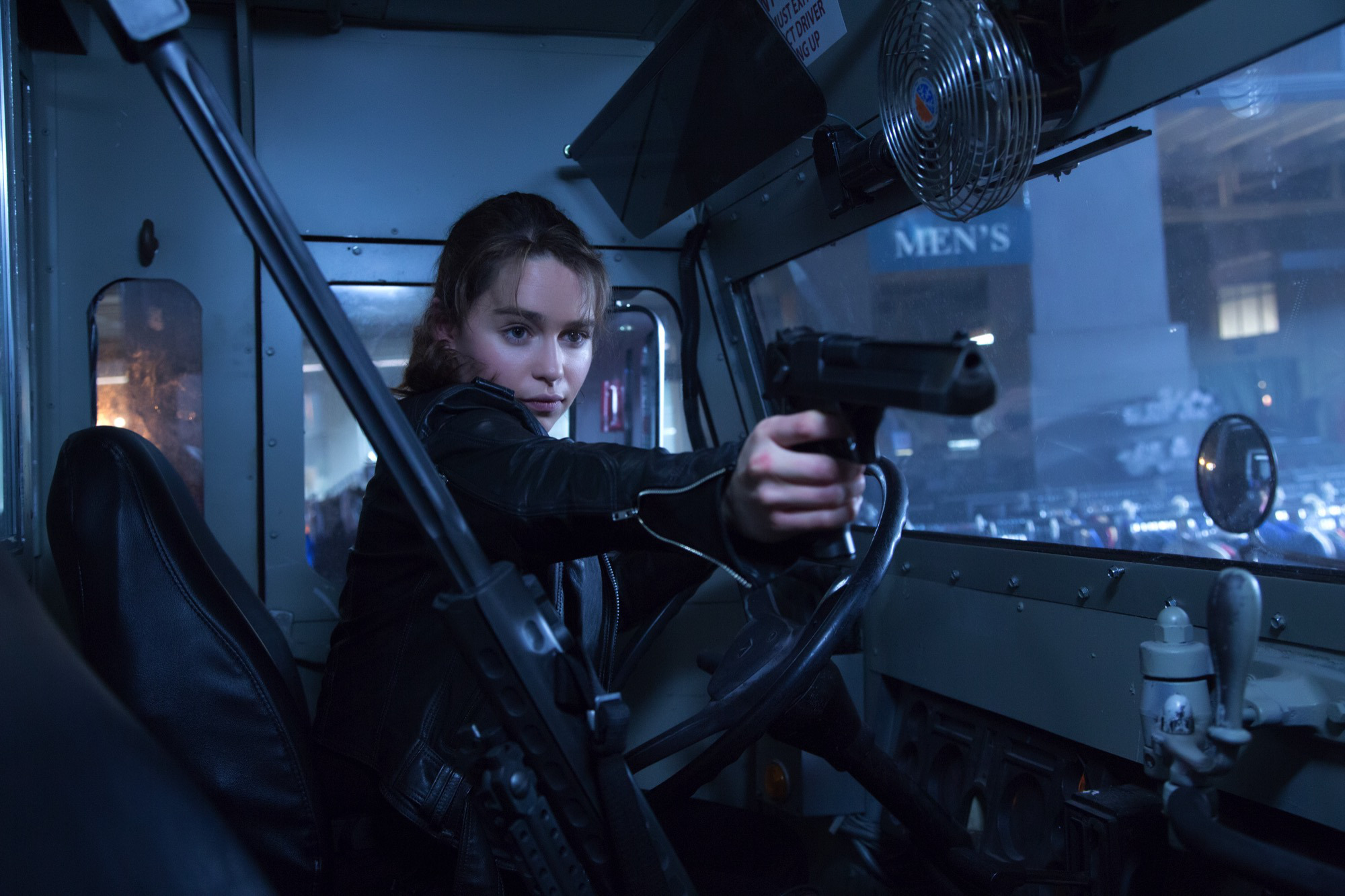
Terminator Genisys (2015) / D: Alan Taylor / 126m
Cast: Arnold Schwarzenegger, Jason Clarke, Emilia Clarke, Jai Courtney, J.K. Simmons, Dayo Okeniyi, Matt Smith, Courtney B. Vance, Byung-hun Lee, Michael Gladis, Sandrine Holt
In 2029, the human resistance, led by John Connor (Clarke), is on the verge of defeating Skynet and its machines. But it also needs to destroy Skynet’s last chance of avoiding defeat: a time displacement machine. When John reaches the site, though, he learns that Skynet has sent a terminator back to 1984 in order to kill his mother, Sarah Connor (Clarke); with her dead, John won’t be born and won’t be able to lead the resistance to victory. Knowing his past and what needs to be done, he agrees to let Kyle Reese (Courtney) travel back as well and keep Sarah safe. As the machine begins to work, though, Kyle sees John being attacked by a terminator.
When Kyle arrives in 1984 he finds himself being hunted by a T-1000 (Lee) before being rescued by Sarah – and a T-800 (Schwarzenegger). Sarah tells Kyle that the T-800 was sent to protect her when she was nine years old, but that she doesn’t know who sent it. With the T-1000 in constant pursuit, the trio do their best to work out why this timeline is now so different from the one that John has always known. Kyle is sure that it has something to with visions he’s been having of a future that hasn’t been destroyed by Skynet, a future that will still exist in 2017, the year that Skynet – in this timeline – launches the nuclear missiles that will seal Man’s fate. He persuades Sarah to travel with him to 2017 using a time displacement machine that she has built with the T-800’s aid.
However, their arrival in 2017 leads to their being arrested. But at the police station, an even greater surprise awaits them: the arrival of John…
As Arnold Schwarzenegger has said all along, “I’ll be back”, and here he is, older, greyer, slower, with a few motor skills issues, but as he also says, “not obsolete”. It’s a clever distinction that says as much about the actor as it does the character of the T-800, giving us an aging Terminator and providing a perfectly acceptable reason for the Austrian Oak to be involved. But while he’s the star of the show, it’s also noticeable that he’s sidelined a lot of the time, giving both Clarkes, and Courtney, the chance to carry the movie in their iconic star’s absence. That they don’t is down to a script that, as with Jurassic World, wants to be as much as a retread of its progenitor as it does an entirely new instalment. As a result, the need to include what might be generously termed “fan moments” – “Come with me if you want to live” – often means a narrative that struggles to find its own identity.
There’s the germ of a great idea here, predicated on the series’ idea that “the future isn’t set”, but its revisionist version of 1984, complete with Schwarzenegger taking on his younger self (one of the movie’s better ideas), devolves into an extended chase sequence that rehashes elements from Terminator 2: Judgment Day (1991), and acts as a kind of Terminator Greatest Hits. It’s all effectively staged by director Alan Taylor, but the sense of déjà vu persists throughout, making the screenwriters’ efforts to give us something new all the more disappointing. Even moving the action to 2017 is less than inspiring, not even allowing for a change of scenery or approach, but canny enough to include J.K. Simmons’ light relief, and change the thrilling truck chase from T2 to an unexciting helicopter pursuit. As with the trip to Isla Nubar, it’s all very professionally done, but with that one all-important ingredient still missing: something to make the viewer go “wow”.
Rating: 6/10 – as fourth sequels go, Terminator Genisys is a vast improvement on the last two instalments but remains very much a missed opportunity; with the way open for another sequel it’s to be hoped that it’ll be more original than this, and will take the kind of risks that the first movie made in order to be successful.





 thedullwoodexperiment