• 10 Reasons to Remember…
  • A Brief Word About…
  • About
  • For One Week Only
  • Happy Birthday
  • Monthly Roundup
  • Old-Time Crime
  • Other Posts
  • Poster of the Week
  • Question of the Week
  • Reviews
  • Trailers

thedullwoodexperiment

~ Viewing movies in a different light

thedullwoodexperiment

Tag Archives: Voting rights

Suffragette (2015)

26 Saturday Mar 2016

Posted by dullwood68 in Movies

≈ Leave a comment

Tags

Anne-Marie Duff, Ben Whishaw, Brendan Gleeson, Carey Mulligan, David Lloyd George, Derby Day, Drama, Emmeline Pankhurst, Equality, Helena Bonham Carter, Historical drama, Laundry worker, Meryl Streep, Panks, Review, Sarah Gavron, True story, Voting rights, Women's rights
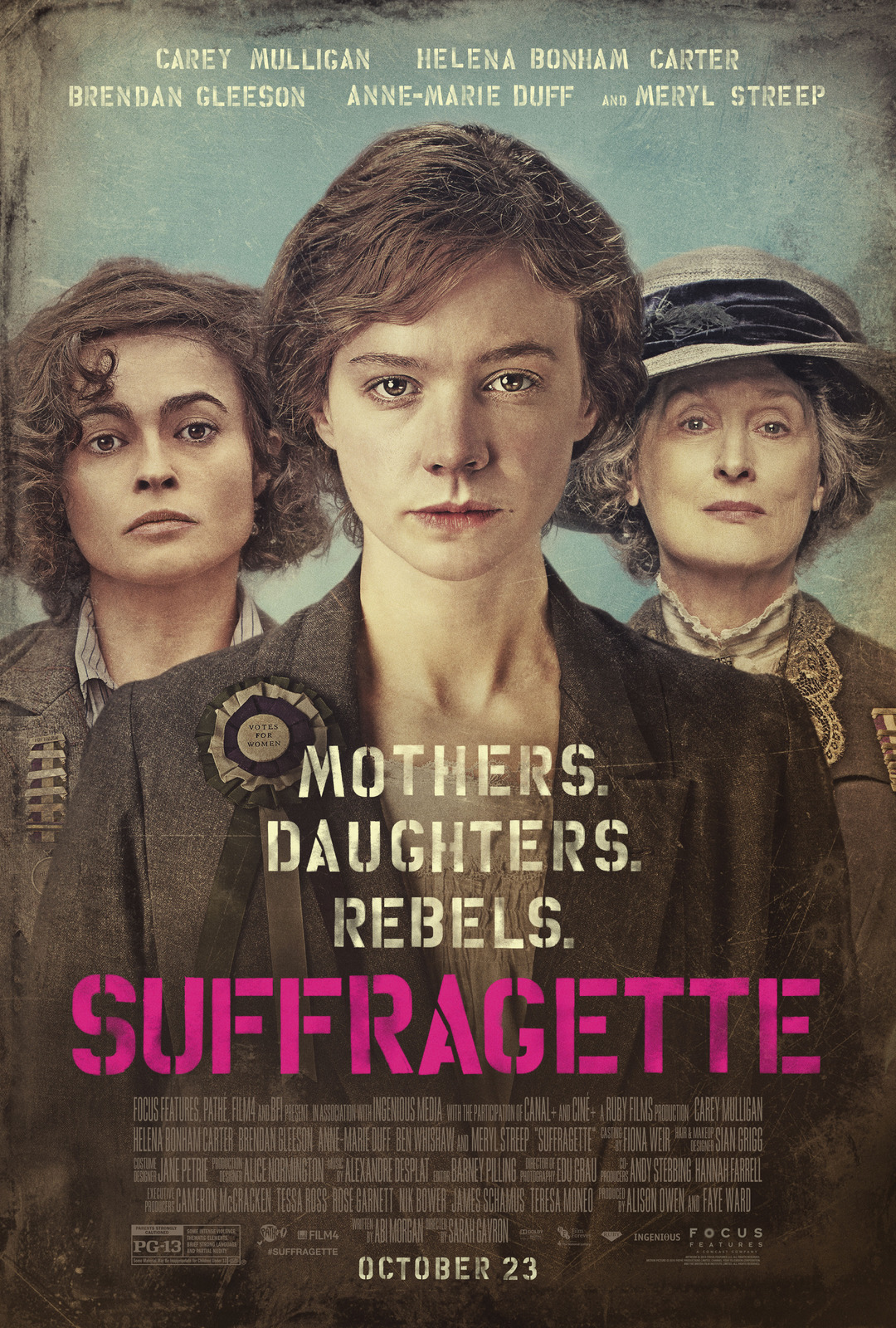
Suffragette

D: Sarah Gavron / 106m

Cast: Carey Mulligan, Helena Bonham Carter, Anne-Marie Duff, Brendan Gleeson, Ben Whishaw, Romola Garai, Natalie Press, Geoff Bell, Samuel West, Finbar Lynch, Adrian Schiller, Meryl Streep

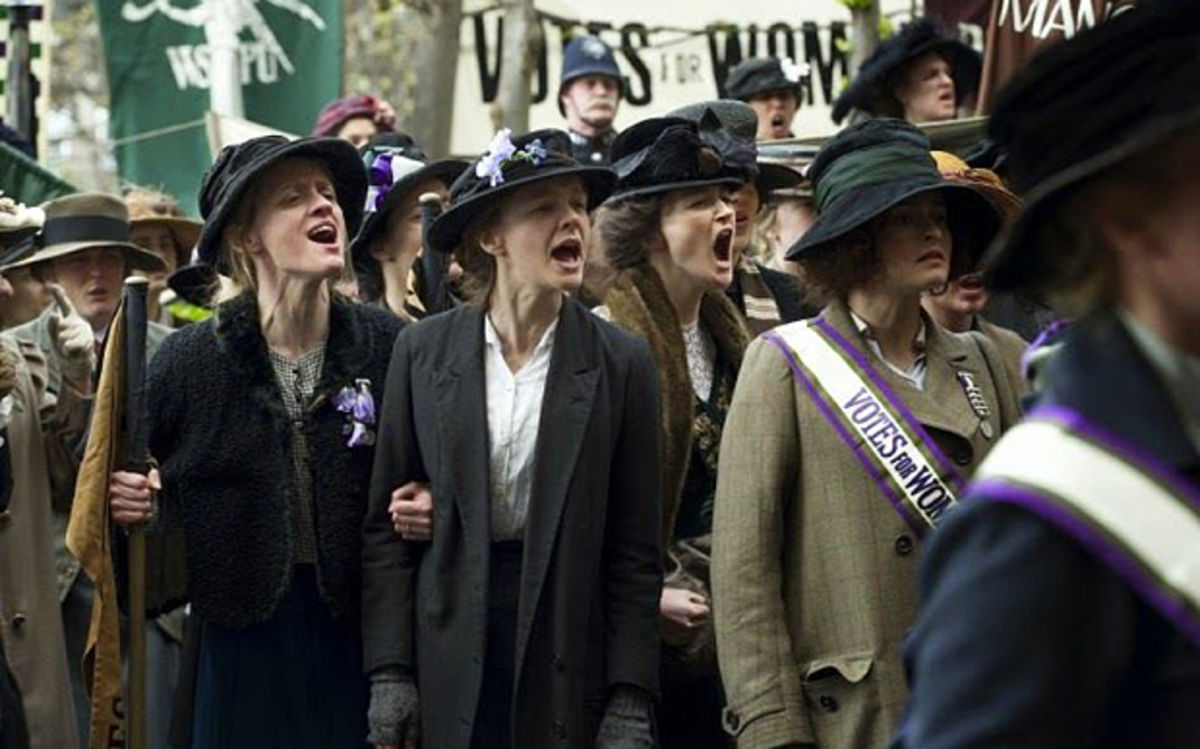
If you were to ask a hundred people, what was the Women’s Social and Political Union, and what was its purpose, most, if not all, wouldn’t be able to tell you. And yet the WSPU is perhaps one of the most important organisations in British history. Without its members and their tireless work, often in the face of police brutality and political intransigence, it’s very likely that women in the UK would not have been given the right to vote as early as they were (and even then it wasn’t until 1928). Suffragette, which looks at the Union’s activities in the run up to World War I, makes clear the level of sacrifice some of its members had to make in order to change the British political system for the better.

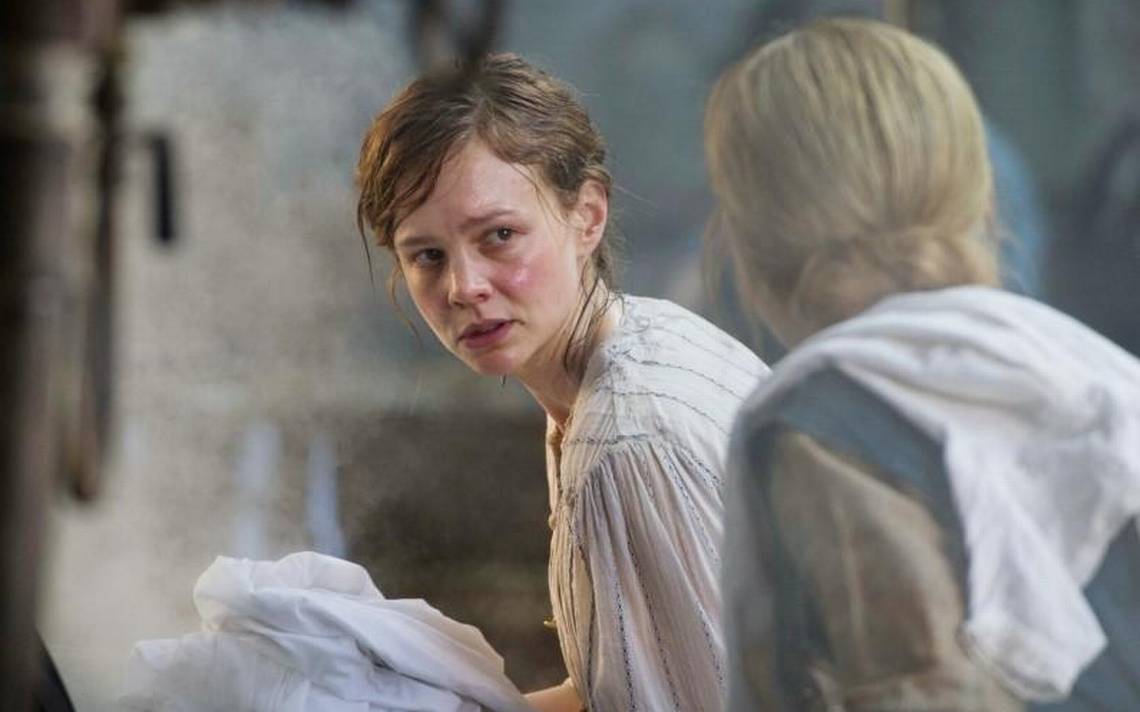
The struggle is seen through the eyes of laundry worker Maud Watts (Mulligan), wife of Sonny (Whishaw) and mother of their son, George. Maud is hardworking, has gained a certain degree of respect in the workplace, but at twenty-four has little future beyond what she’s already achieved. She appears to be accepting of her lot in life, but when a co-worker, Violet Miller (Duff), falls foul of their boss, Norman Taylor (Bell), Maud comes to her rescue and the two women strike up a friendship. Maud learns that Violet is a supporter of the women’s movement, and while she admires Violet’s courage and determination, she has no intention of becoming a suffragette.
Suffragette - scene2

An invitation to speak before then Chancellor of the Exchequer, David Lloyd George (Schiller), is arranged for Violet, but she is unable to speak. Maud stands in for her, and is invited to tell her story. Lloyd George is clearly sympathetic, but when an announcement is made some time later, the law remains unchanged. Caught up in the violent struggle that ensues, Maud is arrested. She is questioned by Inspector Arthur Steed (Gleeson), who has been tasked with rounding up the Union’s ringleaders, including its head, Emmeline Pankhurst (Streep). Maud denies being a suffragette, but when she’s released a week later, it’s obvious that people think she is. Sonny is upset by her involvement, and she promises to stay away from the WSPU and its members. But when a secret meeting, to be addressed by Emmeline Pankhurst is arranged, Maud can’t help but attend.

From there, along with Violet and a local pharmacist, Edith Ellyn (Carter), Maud becomes more and more involved in the WSPU and its plans. Unable to deal with her increasing involvement, Sonny kicks her out, and refuses to let her see George. In the meantime, she leaves the laundry as well, and devotes her time to the Union. She takes part in the destruction of postboxes and telephone lines, and other acts of civil disobedience. She’s arrested again, and Steed offers her a choice: inform on the Union’s activities, or face longer spells in jail. With the women under both suspicion and surveillance, and with Pankhurst exhorting them to increase their attacks on the establishment, Maud has to decide if her future resides with the WSPU.

Suffragette wears its heart on its sleeve right from the start. As a movie about the struggle of women to gain the right to vote it takes an earnest, pragmatic approach, and while it often strays from the truth in its efforts to shoehorn Maud into the events that did happen (particularly in the scenes set at Epsom on Derby Day, when Emily Wilding Davison was run down by the King’s horse), it also narrows its focus too much in its efforts to tell its story.

Suffragette - scene3

By choosing to tell the story of the WSPU’s struggle through the eyes of Maud, a neophyte in terms of the political landscape of the times, Abi Morgan’s script reduces the efforts and the sacrifices made by the real-life women of the time to the stuff of soap opera. From the disapproving looks of her neighbours as Maud walks home, to the reaction of Sonny after she goes back on her word, and even to the moment when she takes her long awaited “revenge” on Taylor for his bullying, rapacious behaviour, Maud’s journey from reluctant laundry worker to political activist is dealt with in such a clichéd, tick-box way that it robs the movie of any real drama. Indeed, the only time the movie achieves any kind of dramatic focus is when it opts to have Maud force-fed (something that happened to Davison forty-nine times; ironically, force-feeding was introduced after fellow suffragette Marion Wallace Dunlop was released from prison after being on hunger strike for ninety-one days).

With the politics of the time reduced to the simplest level possible, and the history of the struggle barely referred to, the movie operates in a kind of historical vacuum. And worst of all, it lacks passion. With everything that happens (and was happening at the time), Suffragette lacks a true sense of the anger and frustration that women must have felt back then. Morgan’s script shows the determination they had, but between that and Gavron’s emphasis on making sure that each scene moves on to the next as quickly as possible, any potential exploration of what women truly felt about their social and political situation back in the pre-War years is avoided. Instead, Maud is used as a kind of generic marker; if it happens to her then it happened to every woman, and that was very bad indeed (that sounds very simplistic, but then so is the movie).
Suffragette - scene1

On the performance side, Mulligan is dependable but is often asked to stand around observing while the likes of Duff and Carter do the heavy lifting. Gleeson does well as the Voice of Authority until a late script decision undoes all the good work he’s put in ’til then, Whishaw is the generally supportive husband who soon turns horrible simply because the movie needs him to, Garai is lost in a supporting role that keeps her on the edge of things throughout, Bell is once again called upon to be unconscionably malevolent, and Streep’s cameo lacks the gravitas it needs to be effective.

With radicalisation currently a hot topic, it would have been good to see Maud’s joining the WSPU in terms of indoctrination; after all, with their civil disobedience stretching to blowing up Lloyd George’s country home, it’s likely that they would have been described as terrorists if the word had existed in that context back then. But it’s an idea that’s never taken up, and like so many other areas where the movie could have gained some much needed depth, the need to keep it simple overrides all other considerations.

Rating: 5/10 – a so-so retelling of events leading up to 1914 and the outbreak of World War I (which really helped the suffragettes and their cause), Suffragette adopts a pedestrian approach to events of the time, and never comes alive in the way its makers probably intended; it’s ironic then, that in attempting to highlight the suffragettes’ fight for equality, the movie ends up portraying that fight in less than heroic terms.
Share this:

  • Click to share on X (Opens in new window) X
  • Click to share on Facebook (Opens in new window) Facebook
  • More
  • Click to print (Opens in new window) Print
  • Click to email a link to a friend (Opens in new window) Email
Like Loading...

Selma (2014)

10 Tuesday Feb 2015

Posted by dullwood68 in Movies

≈ 2 Comments

Tags

Alabama, André Holland, Ava DuVernay, Carmen Ejogo, David Oyelowo, Drama, Edmund Pettus Bridge, Lyndon B. Johnson, Martin Luther King Jr, Racial equality, Review, Tim Roth, Tom Wilkinson, True story, Violence, Voting rights

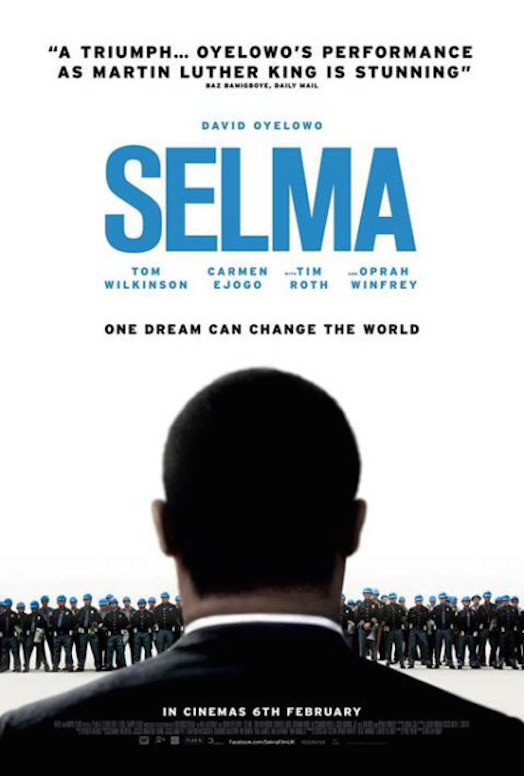
Selma

D: Ava DuVernay / 128m

Cast: David Oyelowo, Tom Wilkinson, Carmen Ejogo, André Holland, Stephan James, Common, Lorraine Toussaint, Giovanni Ribisi, Tim Roth, Wendell Pierce, Alessandro Nivola, Stephen Root, Oprah Winfrey, Dylan Baker, Cuba Gooding Jr, Martin Sheen

1964. Martin Luther King Jr (Oyelowo) receives the Nobel Peace Prize, mere weeks after the deaths of four children in an explosion at the 16th Street Baptist Church in Birmingham, Alabama. Also in Alabama, Annie Lee Cooper (Winfrey) tries to register to vote but has her application denied. King visits President Lyndon B. Johnson (Wilkinson) at the White House to ask for federal legislation that will allow black citizens to register without being impeded. Johnson tells him that, while he agrees with  King about the issue, it’s not one that he’ll be focusing on any time soon. Having already decided to march on the courthouse in Selma, Alabama if the President refuses to help, King sets things in motion.

Joined by members of the Southern Christian Leadership Conference (SCLC) and the Student Nonviolent Coordinating Committee (SNCC), King and his followers march on the courthouse where they’re confronted by the town sheriff and his men. A brawl ensues during which Clark is assaulted by Annie Lee Cooper and King and several others are jailed. Alabama’s governor, George Wallace (Roth) is angered by the protest, and when a night march in Marion is planned, he takes steps to have it dispersed. The march ends in violence and leads to the death of a young protester, shot while trying to avoid trouble in a restaurant. Following this, King receives criticism for his beliefs but he continues to insist that people should be fighting for their rights.

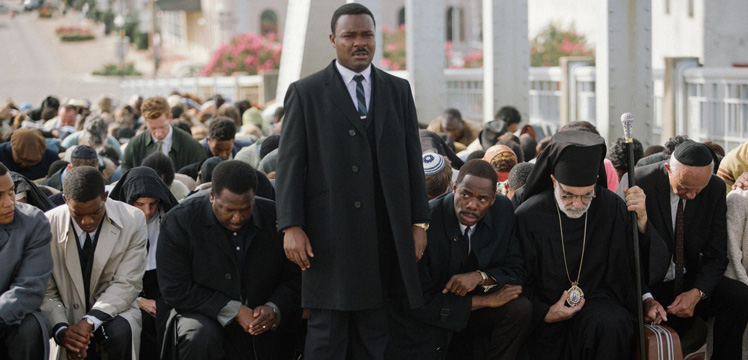
Another march is planned, this time from Selma to the state capital, Montgomery, a distance of fifty miles. Leaving Selma, the march crosses the Edmund Pettus Bridge where it is met by state troopers who instruct everyone to disperse. When they don’t, the troopers put on gas masks and start hurling tear gas into the crowd; they also attack the march using clubs and other weapons, as well as riding people down. It’s all witnessed by TV news crews and broadcast live across the nation, leaving Johnson angry at Wallace’s actions. He sends John Doar (Nivola), the Assistant Attorney General for Civil Rights to try and persuade King to call off the next attempt at marching to Montgomery, while he personally attempts to coerce Wallace into resolving the issue of registration and the use of state troopers if the march goes ahead.

White Americans who support King’s cause and civil rights in general, arrive to take part in the march. Again they cross the bridge, but this time King is leading. When they see the state troopers, they’re surprised to see them step aside. King kneels and prays for a few minutes, then heads back into Selma, effectively cancelling the march. More political manoeuvrings go on, including Johnson asking Congress for the quick passing of a bill to eliminate restrictions on registering, and the march to Montgomery finally goes ahead.

Selma - scene

For America, the Sixties were a turbulent decade, one that saw a variety of freedoms and rights enshrined in law, and the beginning of a transition from the kind of post-War conservatism that saw danger in any type of change, to a more free-minded liberalism that challenged the old order on almost every front. Racial issues were high on the agenda, if not for the politicians, then certainly for black people, and not just in the South. It was a time when people from all walks of life began to stand up and say, “enough is enough” (or to paraphrase Howard Beale in Network (1976): “We’re mad as hell, and we’re not going to take it anymore!”). But as ever, the battle was an uphill one, and there were plenty of people, equally, who were prepared to see it fail.

The determination and the will to succeed that existed in Martin Luther King Jr is shown here as forceful and impassioned, but there’s a measure of self-doubt as well, and it’s this rounding of the man that helps make the movie as commanding as it is. Avoiding any attempts at mythologising King, Selma gives us a portrait of a man fully aware of his mission in life and confident enough to second-guess himself when needed. It’s a balance that could have been lost on several occasions during the course of the movie, not least in its depiction of his troubled marriage, where the script so neatly sidesteps any possibility of descending into soap opera that it makes for a refreshing change. And the complexities of the organisations involved and how they all interact with King, are also well handled, showing the figurehead but not the leader. The movie shows King making decisions based both on his own ideas and those of others, and if his opponents – such as Wallace – appear too one-dimensional in comparison, well, maybe that’s because they just were.

King is played with tremendous gravitas and skill by Oyelowo, imbuing King with a pride and a sensitivity that never seem at odds with each other. It’s an impressive achievement, sharply detailed, perfectly pitched, and one of the finest acting performances you’re likely to see in a long while. It helps that he has a passing resemblance to King, but it’s the voice that he captures so well, that distinctive, low cadence that could rise to a crescendo so effortlessly in the middle of a sentence. It’s not far from the truth to say that Oyelowo inhabits the man rather than impersonates or mimics him (listen to the speech the real King made when the march reached Montgomery, and then listen to Oyelowo’s version and see how close he is), and he’s just as effective in the movie’s more pensive moments as he is when called upon to be the fiery orator.

Good as Oyelowo’s performance – and it is very good – he wouldn’t have been anywhere near as imposing if it weren’t for an extremely well-structured and heavily nuanced script, courtesy of Paul Webb (his first). He makes the politics easy to understand, the characters easy to empathise with or condemn (as necessary), and he doesn’t rein in on the complexities of the issues concerned. It’s a great screenplay, and the rest of the cast, aided and abetted by DuVernay’s strong, sanguine direction, relish every scene and line at their disposal. (If there is one area, though, where Webb fails to convince, it’s in Johnson’s refusal to address the issue of voting registration; his arguments are spurious at best, though they may have been so at the time – it’s hard to tell.)

DuVernay, making only her third feature, emphasises the various relationships that develop between the different factions, and never loses sight of the human factor in amongst all the politicking. She uses the camera with aplomb, particularly with medium shots, imparting a level of detail some more experienced directors fail to achieve ever. And there’s a richness about the movie that speaks of carefully considered choices made ahead of filming, of everyone involved knowing exactly what’s required and everyone involved having the conviction to carry it off. The mood of the times, and the look of the times, are tellingly rendered, and the atmosphere surrounding the planning of each march is palpable, taking the movie – unwittingly perhaps – into thriller territory. But the drama remains throughout, and by the movie’s end, the audience is rejoicing almost as much as the characters are.

Rating: 9/10 – a rewarding look at a particular place and time in American history, Selma takes a flashpoint that resonates far beyond its happening, and makes it as compelling and vital as if it were happening today; a triumph for all concerned and buoyed by Oyelowo’s superb performance, DuVernay’s apposite approach to the material, and Webb’s rewarding screenplay.

Share this:

  • Click to share on X (Opens in new window) X
  • Click to share on Facebook (Opens in new window) Facebook
  • More
  • Click to print (Opens in new window) Print
  • Click to email a link to a friend (Opens in new window) Email
Like Loading...

Blog Stats

  • 486,633 hits

Recent Posts

  • 10 Reasons to Remember Bibi Andersson (1935-2019)
  • Fantasia (1940)
  • Dances With Wolves (1990) – The Special Edition
  • Kiss of the Spider Woman (1985)
  • The Three Musketeers (1973)

Top Posts & Pages

  • Lost for Life (2013) - Another Look
    Lost for Life (2013) - Another Look
  • Lost for Life (2013)
    Lost for Life (2013)
  • About
    About
  • BFI London Film Festival 2015
    BFI London Film Festival 2015
  • Mr. Topaze (1961)
    Mr. Topaze (1961)
  • Winter's Tale (2014)
    Winter's Tale (2014)
  • Hunt for the Wilderpeople (2016)
    Hunt for the Wilderpeople (2016)
  • Shock and Awe (2017)
    Shock and Awe (2017)
  • Cardboard Boxer (2016)
    Cardboard Boxer (2016)
  • Billy Lynn's Long Halftime Walk (2016)
    Billy Lynn's Long Halftime Walk (2016)
Follow thedullwoodexperiment on WordPress.com

Blogs I Follow

  • Rubbish Talk
  • Film 4 Fan
  • Fast Film Reviews
  • The Film Blog
  • All Things Movies UK
  • Interpreting the Stars
  • Let's Go To The Movies
  • Movie Reviews 101
  • TMI News
  • Dan the Man's Movie Reviews
  • Film History
  • Jordan and Eddie (The Movie Guys)

Archives

  • April 2019 (13)
  • March 2019 (28)
  • February 2019 (28)
  • January 2019 (32)
  • December 2018 (28)
  • November 2018 (30)
  • October 2018 (29)
  • September 2018 (29)
  • August 2018 (29)
  • July 2018 (30)
  • June 2018 (28)
  • May 2018 (24)
  • April 2018 (21)
  • March 2018 (31)
  • February 2018 (25)
  • January 2018 (30)
  • December 2017 (30)
  • November 2017 (27)
  • October 2017 (27)
  • September 2017 (26)
  • August 2017 (32)
  • July 2017 (32)
  • June 2017 (30)
  • May 2017 (29)
  • April 2017 (29)
  • March 2017 (30)
  • February 2017 (27)
  • January 2017 (32)
  • December 2016 (30)
  • November 2016 (28)
  • October 2016 (30)
  • September 2016 (27)
  • August 2016 (30)
  • July 2016 (30)
  • June 2016 (31)
  • May 2016 (34)
  • April 2016 (30)
  • March 2016 (30)
  • February 2016 (28)
  • January 2016 (35)
  • December 2015 (34)
  • November 2015 (31)
  • October 2015 (31)
  • September 2015 (34)
  • August 2015 (31)
  • July 2015 (33)
  • June 2015 (12)
  • May 2015 (31)
  • April 2015 (32)
  • March 2015 (30)
  • February 2015 (37)
  • January 2015 (39)
  • December 2014 (34)
  • November 2014 (34)
  • October 2014 (36)
  • September 2014 (25)
  • August 2014 (29)
  • July 2014 (29)
  • June 2014 (28)
  • May 2014 (23)
  • April 2014 (21)
  • March 2014 (42)
  • February 2014 (38)
  • January 2014 (29)
  • December 2013 (28)
  • November 2013 (34)
  • October 2013 (4)

Create a free website or blog at WordPress.com.

Rubbish Talk

Film 4 Fan

A Movie Blog

Fast Film Reviews

The Film Blog

The official blog of everything in film

All Things Movies UK

Movie Reviews and Original Articles

Interpreting the Stars

Dave Examines Movies

Let's Go To The Movies

Film and Theatre Lover!

Movie Reviews 101

Daily Movie Reviews

TMI News

Latest weather, crime and breaking news

Dan the Man's Movie Reviews

All my aimless thoughts, ideas, and ramblings, all packed into one site!

Film History

Telling the story of film

Jordan and Eddie (The Movie Guys)

Movie Reviews & Ramblings from an Australian Based Film Fan

Privacy & Cookies: This site uses cookies. By continuing to use this website, you agree to their use.
To find out more, including how to control cookies, see here: Cookie Policy
  • Subscribe Subscribed
    • thedullwoodexperiment
    • Join 481 other subscribers
    • Already have a WordPress.com account? Log in now.
    • thedullwoodexperiment
    • Subscribe Subscribed
    • Sign up
    • Log in
    • Report this content
    • View site in Reader
    • Manage subscriptions
    • Collapse this bar
 

Loading Comments...
 

    %d