• 10 Reasons to Remember…
  • A Brief Word About…
  • About
  • For One Week Only
  • Happy Birthday
  • Monthly Roundup
  • Old-Time Crime
  • Other Posts
  • Poster of the Week
  • Question of the Week
  • Reviews
  • Trailers

thedullwoodexperiment

~ Viewing movies in a different light

thedullwoodexperiment

Tag Archives: Zatoichi

Zatoichi the Fugitive (1963)

13 Saturday Sep 2014

Posted by dullwood68 in Movies

≈ 1 Comment

Tags

Blind swordsman, Japanese film, Masayo Banri, Masseur, Otane, Rival yakuza gangs, Samurai, Shintarô Katsu, Yakuza, Zatoichi

Zatoichi the Fugitive

Original title: Zatôichi kyôjô-tabi

D: Tokuzô Tanaka / 86m

Cast: Shintarô Katsu, Miwa Takada, Masayo Banri, Jun’ichirô Narita, Tôru Abe, Jutarô Hojo, Sachiko Murase

Zatoichi (Katsu) is travelling alone in the countryside when he reaches a town where a sumo challenge is taking place.  Having won the challenge, the blind masseur is relaxing by a river when he is attacked by a lone yakuza.  Zatoichi defends himself, and as the yakuza lies dying from his wounds, he tells Zatoichi he only attacked him for his mother’s sake.  Zatoichi learns the man’s name and out of duty to him, learns where she lives and offers her his apologies.  The man’s mother, Maki (Murase), forgives him, but as Zatoichi leaves he’s stopped by the man’s clan boss, Yagiri (Abe), who demands his life in return.  But before any more blood can be spilt, Maki and the boss of another clan, Sakichi (Narita) intervene.  Sakichi takes on the responsibility for taking Zatoichi’s life, sparing him until the end of the festival that is taking place.

Zatoichi decides to rest at a local inn.  He is tended by Onobu (Takada), who is in love with Sakichi, though her father is against any match.  Also staying at the inn is a drunken ronin, Tanakura (Hojo) and his wife.  Zatoichi is surprised to find that she is Otane (Banri), the woman he was in love with.  As he begins to deal with the emotions this brings up, Zatoichi becomes aware of a plot involving Yagiri and the innkeeper to take over Sakichi’s territory; Tanakura is there to aid them.  With the festival drawing to a close, Yagiri tries to engineer matters so that Sakichi has to confront Zatoichi, but the young boss is too much of a coward to actually do so.  A fight between Zatoichi and some of Yagiri’s men leads to a final showdown between the masseur and Tanakura, and a tragic outcome.

Zatoichi the Fugitive - scene

The fourth in the series, Zatoichi the Fugitive is a slightly misleading title in that Zatoichi isn’t on the run, and everyone knows exactly where he is throughout.  What isn’t in any doubt, though, is that this instalment of the Zatoichi saga is just as well realised and absorbing as the previous entries.

The basic template is also firmly in place.  Zatoichi arrives in a small town, there’s bitter rivalry between two yakuza gangs, an innkeeper’s daughter may or may not provide a romantic interlude for our hero, various swordsmen will try their luck singly or in groups to kill Zatocihi, domestic intrigues will come to the fore, betrayal and treachery will occur as naturally as the characters breathe, and there is an eventual showdown between Zatoichi and an equally proficient samurai.  It’s all very familiar but it’s all so well executed that it’s almost comforting to watch.

While the sword fights are, on the surface, the main reason to watch a Zatoichi movie, it’s the drama that sets up these encounters that makes all the difference, and prove why the series is so effective four movies in (and with twenty-one still to come).  The script by Seiji Hoshikawa retains Zatoichi’s sense of honour and his deep sense of regret when he’s forced to kill someone, Katsu’s troubled looks and humble demeanour perfectly encapsulating the profound respect he has for (most of) those around him.  Here we see a little more of his anger than before, and directed at more than just the main villain, Yagiri.  With the character’s stoic nature already established, to see him more emotionally invested in his swordplay makes for an interesting broadening of the character and his humanity.  And, for the first time, we see how physically vulnerable he can be when Tanakura manages to wound him (though not too seriously, of course).

Zatoichi’s interplay with Onobu and Otane are given roughly equal screen time, and the distinction between them is made clear by their feelings about their own lives.  Onobu wishes to be with Sakichi and sees happiness for them both, while Otane regrets the future she’s already chosen.  Both actresses give impressive performances, though it’s Banri (playing Otane for the third time) who demands the most attention, her sorrow and despair at the way Otane’s life has turned out etched on her face like a mask she can’t remove.

With so much going on beneath the surface of all the characters, returning director Tanaka’s confident approach pays dividends throughout, and the movie looks glorious thanks to the vibrant colours of the Japanese countryside which are often stunning to look at.  The sword fights are the most exhilarating yet, and there’s a very clever display of Zatoichi’s “sword drawing” skills.  With a quietly emotive score by Akira Ifukube that complements the mounting tension, this entry in the long-running series is as effective and commanding as its predecessors (and how many Part Fours can say that?).

Rating: 9/10 – another superb entry in the series, Zatoichi the Fugitive ups the emotional content and has a gripping denouement that resonates long after the movie sees Zatoichi moving on; with Katsu giving yet another flawless performance, this is better than anyone – perhaps even production company Daiei – could hope for.

Share this:

  • Click to share on X (Opens in new window) X
  • Click to share on Facebook (Opens in new window) Facebook
  • More
  • Click to print (Opens in new window) Print
  • Click to email a link to a friend (Opens in new window) Email
Like Loading...

New Tale of Zatoichi (1963)

05 Saturday Jul 2014

Posted by dullwood68 in Movies

≈ 1 Comment

Tags

Blind swordsman, Japanese film, Masseur, Mikiko Tsubouchi, Revenge, Samurai, Sensei, Shintarô Katsu, Yakuza, Zatoichi

New Tale of Zatoichi

Original title: Shin Zatôichi monogatari

D: Tokuzô Tanaka / 91m

Cast: Shintarô Katsu, Mikiko Tsubouchi, Seizaburô Kawazu, Fujio Suga, Yutaka Nakamura, Mieko Kondô, Tatsuo Endô, Kanae Kobayashi

Following on from the events of The Tale of Zatoichi Continues (1962), New Tale of Zatoichi sees the blind masseur returning to his home village, there to find some peace after the showdown with his brother, Yoshiro.  Zatoichi (Katsu) is in a melancholy mood, and as reluctant to fight as ever, but it’s not long before he’s challenged by Yasuhiko (Suga), the brother of Boss Kanbei, who Zatoichi killed in the previous movie.  They fight, but it’s interrupted by the appearance of Zatoichi’s sensei, Master Banno (Kawazu).  Banno makes Zatoichi a guest at his training school, and introduces him to his younger sister Yayoi (Tsubouchi); she is meant to marry a samurai called Mooroke but has no love for him.  Her brother, meanwhile, is conspiring with a band of thieves called the Mito Tengo.  They plan to kidnap the son of a local businessman and hold him to ransom.

A bond develops between Zatoichi and Yayoi, one that leads to her falling in love with him.  She asks that he marry her and after confessing his past sins to her, and being forgiven for them, Zatoichi agrees and tells her he will renounce his old ways, including his sword fighting, in order that they might have a peaceful life together.  At that moment, Yasuhiko calls on Zatoichi to finish their duel.  He begs for mercy, leading Yasuhiko to devise an alternative plan for settling the issue between them: a throw of the dice – if Yasuhiko wins, Zatoichi will lose his right arm.  Zatoichi does lose, but Yasuhiko takes pity on the couple and lies about the result.  Later, Yayoi tells Banno of her love for the blind masseur, but her brother rejects her entreaties and tells Zatoichi to leave.

The kidnapping goes ahead as planned but Zatoichi becomes aware of Banno’s involvement, as does Yayoi.  He saves the businessman’s son, and faces off against the Mito Tengo.  He must then face Banno, knowing all the while that it will mean the end of his relationship with Yayoi.

New Tale of Zatoichi - scene

The third entry in the series, New Tale of Zatoichi retains the usual themes of betrayal and redemption, and adds the prospect of a romantic, settled future for our wandering hero.  If this had been the last in the series, such an ending might have been entirely appropriate, but the increasingly rootless nature of Zatoichi’s existence precludes such a conclusion (that and the success of the series so far).  He’s a tragic figure, always seeking a peaceful existence but doomed to a life of violence.  He’s also increasingly unlucky, both in love, and with his closest male relationships: first his brother betrays him, then his sensei.  With Fate proving so ineluctable, Zatoichi can only struggle on, hoping that his continued loneliness will eventually come to an end (though his love for Yayoi appears to be the closest he’ll come to achieving that).  It’s the kind of depth you don’t often find in a long-running series, and the fact that the makers have strived to maintain these themes throughout the series so far, is refreshing to watch.

Of course, such a wonderful character needs a wonderful actor, and once again Katsu puts in an incredible performance, his tender, compassionate nature seemingly at odds with his more aggressive abilities, but combining to paint a portrait of a man whose dual nature makes him so fascinating to watch.  It’s a beautifully modulated achievement, the quiet power of his scenes with Tsubouchi holding the audience’s attention like a vice, their characters’ mutual desire for happiness – against all the odds – breathtaking in both its painful longing and its simplicity.  That a movie which is essentially known for its fight scenes and good versus bad scenario can take the time to focus on its main character’s attempts to find joy, and make those scenes even more gripping than the rest, is truly impressive.

The first in the series to be filmed in colour, New Tale of Zatoichi doesn’t opt for a bright, colourful palette but settles instead for a dark-hued colour scheme that befits the subdued, sober approach to the material.  (In comparison with the first two movies, which were shot in dazzling black and white, this entry doesn’t look half as good.)  Behind the camera, director Tanaka retains many of the visual motifs used before, and encourages good performances from all concerned, especially Tsubouchi as Banno’s tender-hearted sister, the scene where she declares her love for Zatoichi demonstrating her skill at portraying someone whose yearning for happiness means everything.  Suga too gives a good portrayal of a vengeful samurai out-manoeuvred by love.  And there’s a terrific score by Akira Ifukube that complements both the emotional and the dramatic scenes, and is consistently rewarding.

Rating: 8/10 – another beautifully realised entry in the series, and one that reconfirms the care and attention that goes into each movie; more emotionally powerful than the first two movies, New Tale of Zatoichi takes its time with its characters, and this care pays off in dividends making the movie that rare beast: a second sequel that is as good as its predecessors.

Share this:

  • Click to share on X (Opens in new window) X
  • Click to share on Facebook (Opens in new window) Facebook
  • More
  • Click to print (Opens in new window) Print
  • Click to email a link to a friend (Opens in new window) Email
Like Loading...

The Tale of Zatoichi Continues (1962)

04 Sunday May 2014

Posted by dullwood68 in Movies

≈ 1 Comment

Tags

Blind swordsman, Feudal Japan, Kan Shimozawa, Masseur, Otane, Review, Sasagawa, Shintarô Katsu, Yoshiro, Zatoichi

Tale of Zatoichi Continues, The

Original title: Zoku Zatôichi monogatari

D: Kazuo Mori / 72m

Cast: Shintarô Katsu, Yaeko Mizutani, Masayo Banri, Tomisaburô Wakayama, Yutaka Nakamura, Sonosuke Sawamura, Shôsaku Sugiyama, Mitsuemon Arashi, Yoshito Yamaji, Eijirô Yanagi

Made to capitalise on the unexpected success of The Tale of Zatoichi (1962), the imaginatively titled The Tale of Zatoichi Continues sees the blind masseur (Katsu) making his way back to Sasagawa, to honour the promise he made in the first movie, to make an annual pilgrimage to the grave of Master Hirate, the ailing samurai he fought and killed a year ago.  An initial altercation with the men of Lord Kuroda leads to a further encounter that is interrupted (and dealt with) by a wandering samurai called Yoshiro (Wakayama – though credited as Kenzaburo Jo).  At the next town, Zatoichi is hired to give a massage to the same Lord Kuroda, who it turns out, is a simpleton.  Kuroda’s retainers, fearing that their Lord’s secret may be revealed by Zatoichi, aim to have him killed, and send their men to look for him.

At a nearby inn, three courtesans are bemoaning how quiet the evening is because of the search for Zatoichi.  One of the three women, Setsu (Mizutani) reminds him of his lost love, Ochiyo.  He asks to spend the evening with her, and she agrees.  Just then, Yoshiro and his retainer, Sanzo (Nakamura) enter (Zatoichi hides in case they’re Kuroda’s men).  It becomes clear that Yoshiro was also in love with a woman called Ochiyo, and Setsu bears an uncanny resemblance to her.  He too wants to spend the evening with her but she refuses, and she leaves with Zatoichi.  The next morning, Koruda’s men catch up with them, but Zatoichi bests them.  This leads Kuroda’s retainers to employ the services and men of local yakuza boss, Kanbei (Sawamura).  Kanbei’s men also fail to best Zatoichi but learn that he is making his way to the Joshoji Temple in Sasagawa; Kanbei aims to enlist the aid of that town’s yakuza boss, Sukegorô (Yanagi).

Yoshiro follows in Zatoichi’s wake and we discover he isn’t a wandering samurai but a wanted criminal.  He seeks help from Sukegorô but is advised to leave the area.  Meanwhile, news of Zatoichi’s return reaches Otane (Banri), the servant girl he left behind at the end of the previous movie.  She learns of Sukegorô and Kanbei’s plan to ambush Zatoichi at the temple and goes to warn him.  With Zatoichi able to repel both boss’s men, the fight is interrupted by the appearance of Yoshiro, and the two men duel to the death, during which the secret behind the story of Ochiyo is revealed.

Tale of Zatoichi Continues, The - scene

Although you could be forgiven for thinking that The Tale of Zatoichi Continues is a bit of a cheap knock-off, a knee-jerk reaction to the success of the first movie, nothing could be further from the truth.  True, the much shorter running time hints at that, but this is a worthy successor, and builds on the themes of betrayal and redemption that were introduced before.  The way in which Minoru Inuzuka’s script brings everything full circle back to the bridge at Sasagawa where Zatoichi and Hirate fought, is cleverly done and resonates in a way that is completely unexpected.  This is a sequel that could easily have been added to its predecessor for a much longer – and in some ways – more satisfying introduction to its wonderfully complex character.

The events of the first movie are given due reference, and allow Zatoichi’s skills as a swordsman to be used to good advantage, alternately hastening and delaying the expected swordplay, and allowing for a variety of encounters that are expertly choreographed (with the necessary exception of the final duel between Zatoichi and Yoshiro; it shows the blind swordsman isn’t as superhuman as his enemies might think, and the movie is all the better for it).  Returning characters Otane and Sukegorô (both played by the same actors as before), though given less to do, are both welcome elements, and their involvement lends an added depth to the final third of the movie, while the newer characters are played to perfection by a cast that are entirely credible throughout (as the brooding Yoshiro, Wakayama is a stand out).  As with the first movie, the cast don’t put a foot wrong, but it’s still very much Katsu’s movie, another superb performance given added depth with the revelation of his having a lost love: when he describes how she left him – and for the very man she professed to hate – the expression of pain and longing on Katsu’s face is   truly moving.

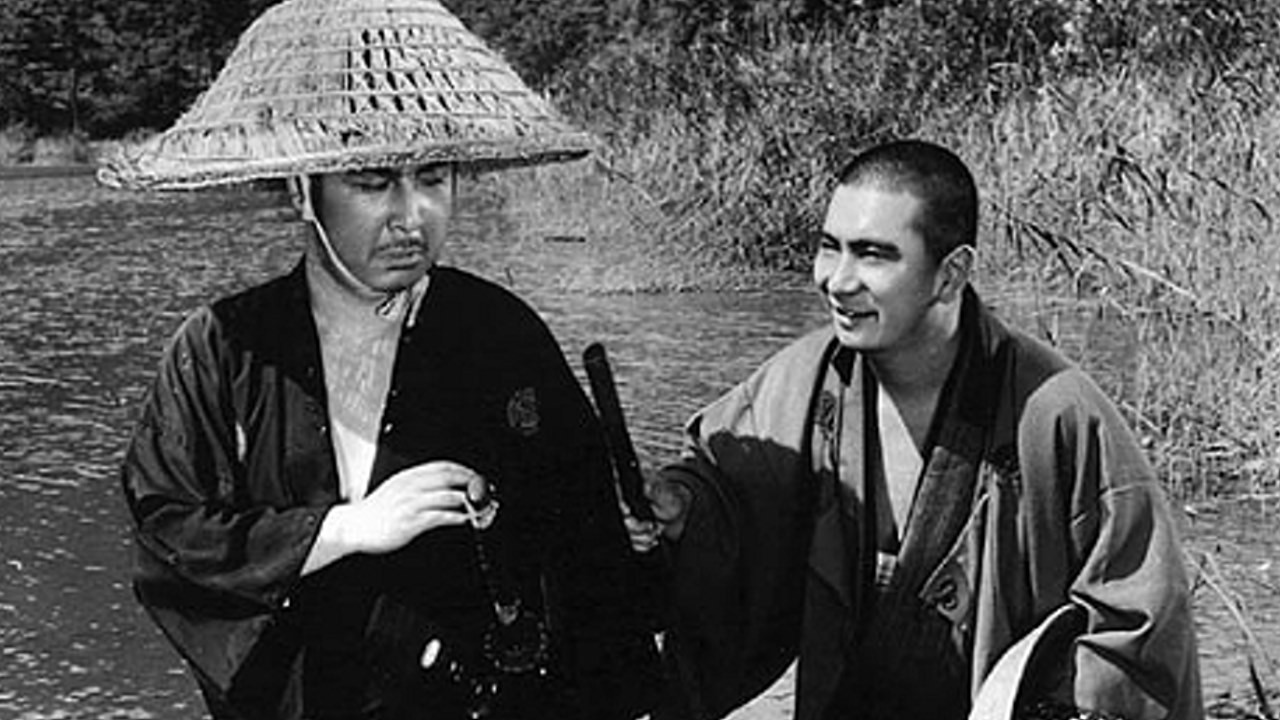
There is an added layer of humour this time round, as well as a more compelling female relationship for Zatoichi to deal with, and a hint of how the series is likely to develop, further enriching what is already a rewarding viewing experience.  Shot again in glorious black and white, the movie is often beautiful to watch – witness the scene where Zatoichi muses at the edge of a lake – and director Mori, while not adopting completely the style and look of the first movie, does show a willingness to experiment with unexpected shots and compositions (several scenes are shot from above, while one fight scene is filmed from such a distance it would be jarring if it weren’t also such a pleasant surprise).

Rating: 9/10 – a wonderful follow-up to The Tale of Zatoichi and confirmation if any were needed that the character’s development for cinema was no flash in the pan; intelligent, robust filmmaking that satisfies and rewards in so many ways it’s like a banquet.

Share this:

  • Click to share on X (Opens in new window) X
  • Click to share on Facebook (Opens in new window) Facebook
  • More
  • Click to print (Opens in new window) Print
  • Click to email a link to a friend (Opens in new window) Email
Like Loading...

The Tale of Zatoichi (1962)

05 Saturday Apr 2014

Posted by dullwood68 in Movies

≈ 1 Comment

Tags

Blind swordsman, Feudal Japan, Kenji Misumi, Masseur, Review, Rival yakuza gangs, Shintarô Katsu, Zatoichi

Tale of Zatoichi, The

Original title: Zatôichi monogatari

D: Kenji Misumi / 96m

Cast: Shintarô Katsu, Masayo Banri, Ryûzô Shimada, Hajime Mitamura, Shigeru Amachi, Chitose Maki, Ikuko Môri, Michirô Minami, Eijirô Yanagi, Manabu Morita

The first of twenty-five Zatoichi movies* made between 1962 and 1973, and all starring the magnificent Shintarô Katsu, The Tale of Zatoichi introduces us to the famous blind masseur turned wandering swordsman.

When we first meet Zatoichi he’s approaching a small village, Iioka.  He knows a yakuza boss there called Sukegorô (Yanagi), and accepts an offer to stay as Sukegorô’s guest.  He soon arouses the enmity of Sukegorô’s men, particularly Tate (Minami), but also the warm attention of Tate’s sister Otane (Banri).  It’s not long before he learns of the enmity between Sukegorô and Shigezô (Shimada), another yakuza boss in the neighbouring village of Sasagawa.  Both sides are looking to escalate the bad feeling between them into all out war, but neither has a tactical or manpower advantage, or the confidence to attack the other.  With Zatoichi as his guest, Sukegorô plans to persuade him to fight on Iioka’s side; he also hopes Zatoichi’s fame as a swordsman will give them an easy victory.  But Shigezô has his own guest who’s good with a sword, Master Hirate (Amachi), and so the two rivals wait for a break in the stalemate.

Zatoichi and Hirate meet and find they have a mutual respect for each other.  Hirate reveals that he is ill with consumption; Zatoichi is filled with concern for him, and while they talk about the impending war between the yakuza gangs, Zatoichi knows that his new friend would not be a fair opponent to take on.  He decides to withdraw from any fighting, much to Sukegorô’s disgust.  When Hirate collapses, Sukegorô seizes his chance to attack.

Alongside all this, Zatoichi becomes involved in the welfare of Otane.  She has split from her lover Seisuke (Morita), who enlists Tate’s help in winning her back.  Her continued refusals, allied with Zatoichi’s kindly and protective nature toward her, leads Otane to fall in love with him, thus adding to the problems it seems he will be compelled to solve.  With a showdown between Zatoichi and Hirate proving to be inevitable, the reluctant swordsman must do what he can to resolve matters before he can leave.

Tale of Zatoichi, The - scene

It’s easy to see why Zatoichi was such an unexpected success when the character debuted in 1962.  As brought to life by the splendid Katsu, Zatoichi is a wonderfully realised character, fully rounded from the outset, and possessed of a readily identifiable personal code, one that’s entirely separate from the accepted codes of the yakuza or samurai.  He has a wry, self-deprecating sense of humour and relishes the physical pleasures in life (though he espouses any romantic attachments, at least while in Iioka).  He is fiercely loyal to those he respects, and in his relationship with Otane shows signs of being an early proto-feminist.  He hates injustice, rails at corruption, refuses to suffer fools gladly, and yet is reluctant to take up his sword unless it is absolutely necessary – and only he decides when this will be.  In this first movie we discover all this and more about Zatoichi, and taken as the nearest there is to an “origin” movie, The Tale of Zatoichi does such an incredible of introducing him that by the movie’s end we feel like he’s an old friend.  As the titular hero, Katsu is simply superb, juggling the physical demands of the role with a raft of emotional demands that are surprising for what must have been viewed as “just another” lone samurai movie.  It’s rare when an actor inhabits a role so completely from the beginning, but Katsu does it with consummate ease.

Of course it helps that Minoru Inuzuka’s script (based on the short story by Kan Shimozawa) pays as much attention to the human and emotional aspects as it does to the swordplay, investing time in the rivalry between the gangs, Otane’s domestic situation, the bond between Zatoichi and Hirate, and the myriad jealousies and resentments that Zatoichi’s presence ignites.  It’s a wonderfully layered screenplay, replete with moments of regret, sadness and tarnished hope.  From this, director Misumi has fashioned a wonderful piece of Japanese cinema, a more than worthy rival to Kurosawa’s Yojimbo (whom Zatoichi would meet later in the series), and a classic in its own right.  The movie looks beautiful as well, Misumi opting for a slightly off-kilter framing style that nevertheless keeps things fresh throughout (the highlight of this approach is when Sukegorô’s men approach Sasagawa via the river; even in black and white it’s simply stunning).

Rating: 9/10 – breathtaking and completely absorbing with an amazing central performance, The Tale of Zatoichi is an almost perfect start to the series; an outstanding movie with more going on during its ninety-six minutes than some movies achieve in twice the running time.

*All the Zatoichi movies will be reviewed in the coming months.

Share this:

  • Click to share on X (Opens in new window) X
  • Click to share on Facebook (Opens in new window) Facebook
  • More
  • Click to print (Opens in new window) Print
  • Click to email a link to a friend (Opens in new window) Email
Like Loading...

Blog Stats

  • 486,598 hits

Recent Posts

  • 10 Reasons to Remember Bibi Andersson (1935-2019)
  • Fantasia (1940)
  • Dances With Wolves (1990) – The Special Edition
  • Kiss of the Spider Woman (1985)
  • The Three Musketeers (1973)

Top Posts & Pages

  • Lost for Life (2013) - Another Look
    Lost for Life (2013) - Another Look
  • Lost for Life (2013)
    Lost for Life (2013)
  • About
    About
  • Mr. Topaze (1961)
    Mr. Topaze (1961)
  • Hunt for the Wilderpeople (2016)
    Hunt for the Wilderpeople (2016)
  • Shock and Awe (2017)
    Shock and Awe (2017)
  • Cardboard Boxer (2016)
    Cardboard Boxer (2016)
  • Billy Lynn's Long Halftime Walk (2016)
    Billy Lynn's Long Halftime Walk (2016)
  • Winter's Tale (2014)
    Winter's Tale (2014)
  • Irrational Man (2015)
    Irrational Man (2015)
Follow thedullwoodexperiment on WordPress.com

Blogs I Follow

  • Rubbish Talk
  • Film 4 Fan
  • Fast Film Reviews
  • The Film Blog
  • All Things Movies UK
  • Interpreting the Stars
  • Let's Go To The Movies
  • Movie Reviews 101
  • TMI News
  • Dan the Man's Movie Reviews
  • Film History
  • Jordan and Eddie (The Movie Guys)

Archives

  • April 2019 (13)
  • March 2019 (28)
  • February 2019 (28)
  • January 2019 (32)
  • December 2018 (28)
  • November 2018 (30)
  • October 2018 (29)
  • September 2018 (29)
  • August 2018 (29)
  • July 2018 (30)
  • June 2018 (28)
  • May 2018 (24)
  • April 2018 (21)
  • March 2018 (31)
  • February 2018 (25)
  • January 2018 (30)
  • December 2017 (30)
  • November 2017 (27)
  • October 2017 (27)
  • September 2017 (26)
  • August 2017 (32)
  • July 2017 (32)
  • June 2017 (30)
  • May 2017 (29)
  • April 2017 (29)
  • March 2017 (30)
  • February 2017 (27)
  • January 2017 (32)
  • December 2016 (30)
  • November 2016 (28)
  • October 2016 (30)
  • September 2016 (27)
  • August 2016 (30)
  • July 2016 (30)
  • June 2016 (31)
  • May 2016 (34)
  • April 2016 (30)
  • March 2016 (30)
  • February 2016 (28)
  • January 2016 (35)
  • December 2015 (34)
  • November 2015 (31)
  • October 2015 (31)
  • September 2015 (34)
  • August 2015 (31)
  • July 2015 (33)
  • June 2015 (12)
  • May 2015 (31)
  • April 2015 (32)
  • March 2015 (30)
  • February 2015 (37)
  • January 2015 (39)
  • December 2014 (34)
  • November 2014 (34)
  • October 2014 (36)
  • September 2014 (25)
  • August 2014 (29)
  • July 2014 (29)
  • June 2014 (28)
  • May 2014 (23)
  • April 2014 (21)
  • March 2014 (42)
  • February 2014 (38)
  • January 2014 (29)
  • December 2013 (28)
  • November 2013 (34)
  • October 2013 (4)

Blog at WordPress.com.

Rubbish Talk

Film 4 Fan

A Movie Blog

Fast Film Reviews

The Film Blog

The official blog of everything in film

All Things Movies UK

Movie Reviews and Original Articles

Interpreting the Stars

Dave Examines Movies

Let's Go To The Movies

Film and Theatre Lover!

Movie Reviews 101

Daily Movie Reviews

TMI News

Latest weather, crime and breaking news

Dan the Man's Movie Reviews

All my aimless thoughts, ideas, and ramblings, all packed into one site!

Film History

Telling the story of film

Jordan and Eddie (The Movie Guys)

Movie Reviews & Ramblings from an Australian Based Film Fan

Privacy & Cookies: This site uses cookies. By continuing to use this website, you agree to their use.
To find out more, including how to control cookies, see here: Cookie Policy
  • Subscribe Subscribed
    • thedullwoodexperiment
    • Join 481 other subscribers
    • Already have a WordPress.com account? Log in now.
    • thedullwoodexperiment
    • Subscribe Subscribed
    • Sign up
    • Log in
    • Report this content
    • View site in Reader
    • Manage subscriptions
    • Collapse this bar
 

Loading Comments...
 

    %d