Springsteen & I (2013)

Tags

, , , , , , , , , , , ,

Springsteen & I

D: Baillie Walsh / 124m

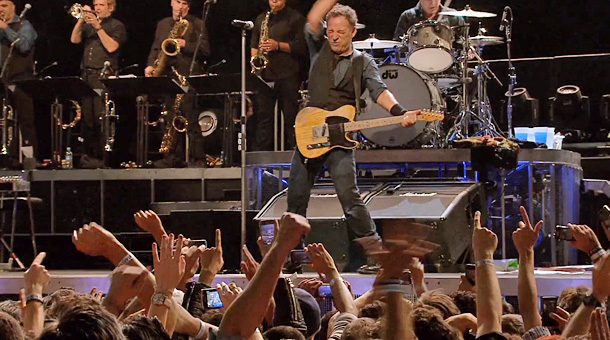
A documentary with a difference, Springsteen & I isn’t a straightforward trawl through the life and triumphs of the man they call The Boss, but a kind of accidental biography, a look back over his life, certainly, but at a remove, and as seen through the eyes of his fans (and one non-fan). It’s a novel approach, and one that conveniently circumvents any danger of the intended subject deciding he or she doesn’t want anything to do with the project (though here, Springsteen has generously allowed previously unseen live footage to be used).

So instead of The Boss talking about the ups and downs of his forty-year plus career, we get The Boss’s fans talking about their ups and downs in relation to him over the course of that career. In particular, we hear from three people who have shared the limelight with Bruce: a young woman who joined him on stage after waving a banner that stated “I’ll be ur Courteney Cox” (a reference to Cox’s appearing in the Dancing in the Dark video); an Elvis impersonator who sang Hound Dog with Bruce live on stage (and cheekily tried to add Blue Suede Shoes before realising he’d outstayed his welcome); and a musician who jammed with Bruce on a New York street. All three “collaborations” were filmed and it’s these instances that perhaps give the best insight into the man himself. Here, Springsteen comes across as unselfish, at ease with both his personal and professional image, genuinely supportive of others, and – this won’t be the first time it’s been mentioned – a really nice guy.

The rest of the movie follows a similar line, with fans queuing up to say how wonderful he is and how his music has had a profound influence on their lives, from the woman who plays nothing but Springsteen on her car stereo (her kids know not to ask for anything else), to the couple who have never seen him live but feel blessed to have his music enriching their lives, to the British fan who found himself and his wife given an unexpected upgrade at Madison Square Garden that saw them move from the very upper reaches of the venue to the front row itself; all these stories reinforce the positive effects Springsteen and his music have had on so many different people over so many years.

Springsteen & I - scene

Much is made of Springsteen’s writing about and for the working class in America, the blue collar part of the electorate who seem to have their hopes and dreams denied them time and time again, but remain determined to make something of their lives. This struggle is a recurring theme in Springsteen’s music, and finds it’s most apt expression in the comments made by a female trucker who has found empowerment through his lyrics.

Of course, the average viewer’s tolerance for all this will depend on their appreciation of Springsteen and how much of his music is familiar to them. Fans will lap this up, and are likely to derive intense satisfaction from seeing their own views reflected back at them, while those less familiar with The Boss’s output will quickly wonder if there’s going to be any alternative to all the cheery – but still heartfelt – eulogising (there is – twice – but they’re brief moments, although the second has one of the best responses to an off-camera question you’re ever likely to hear).

With other fans providing succinct three word appraisals of Springsteen – though some struggle to stop at three – as well as plenty of concert footage taken from various periods of Springsteen’s career (including a very early acoustic performance of Growin’ Up), the movie benefits greatly from the choices director Walsh has made for inclusion and the sure-handed editorial approach taken with the material. A word of caution though: the documentary proper ends around the eighty minute mark. The rest of the movie is taken up by live footage taken from Springsteen’s London concert in 2012 (and featuring Paul McCartney on a couple of Beatles tracks), and following that, a real surprise for the viewer (and some of the fans).

Rating: 8/10 – a well-constructed documentary that avoids any accusations of superficiality by virtue of the obvious sincerity of its participants; a treat for fans and a reminder of Springsteen’s enduring musical legacy.

The Book Thief (2013)

Tags

, , , , , , , , , , ,

Book Thief, The

D: Brian Percival / 131m

Cast: Geoffrey Rush, Emily Watson, Sophie Nélisse, Ben Schnetzer, Nico Liersch, Levin Liam, Rainer Bock, Barbara Auer, Roger Allam

Literary adaptations are a perilous thing, both for filmmakers and audiences alike. For every Schindler’s List there’s a Bonfire of the Vanities. Some are critically bulletproof, such as the Harry Potter series; despite the turgid nature of the first two movies featuring the bespectacled wizard, they were huge box office successes and paved the way for the remaining instalments (which, effectively, meant they were commercially bulletproof as well). Most fall somewhere in-between, neither success nor failure but an often strange combination of the two e.g. The Mortal Instruments: City of Bones or Smilla’s Sense of Snow, one moment distilling the essence of the original novel, the next demolishing that moment with an ill-judged sequence or change from the source material. Others simply die on the screen (the aforementioned Bonfire of the Vanities, The Osterman Weekend, the Jack Black version of Gulliver’s Travels).

Most try to be faithful to the novel they’re adapting but sometimes this is the very thing that stops the movie from being a success: by cleaving to the set-up, the characters and the events depicted in the novel, the movie somehow misses the spark that made the book a must-read. Instead of a must-see movie, audiences are presented with an adaptation that keeps the essential components but fails to breathe cinematic life into them.

DF-05687.JPG

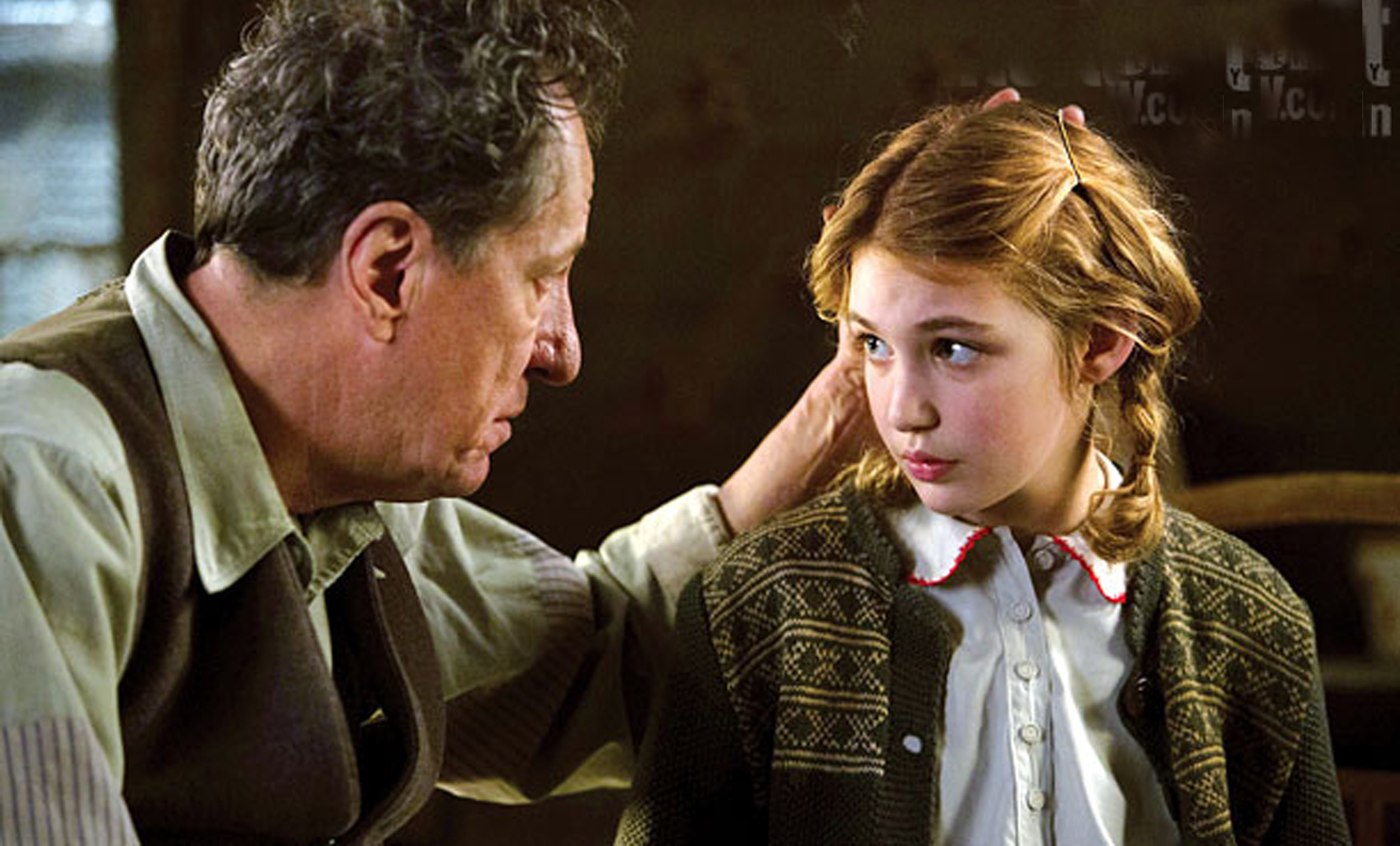
And so it is with The Book Thief. Adapted from the novel by Markus Zusak, The Book Thief in question is Liesel Meminger (Nelisse), a young girl who is given up for adoption by her mother (who may or may not be a communist) during the Second World War. She is taken in by the Hubermanns, Hans (Rush) and Rosa (Watson). Hans is a gentle, encouraging man who teaches Liesel how to read; from this Liesel develops her love of books. Rosa is stern and constantly criticising Liesel’s behaviour (though you know she has a soft spot for her, however horrid she might be). As time goes by and Liesel settles in to life with her new Mama and Papa, the war that seems to be going on in a separate part of Germany altogether, begins to encroach on their daily lives.

One day a young Jewish man called Max Vandenburg (Schnetzer) comes to their house. On the run from the Nazis, he is hurt and needs a place to hide. Owing a debt to his father, the Hubermanns at first hide him in Liesel’s room, then transfer him to the basement. There is an anxious occasion when a Nazi officer visits them and asks to see the basement but he goes away pretty quickly and has no idea that Max is there (and it turns out he’s not even looking for him). Helped back to nearly full health by Rosa’s administrations and Liesel’s reading to him (through books stolen from the burgermeister’s library), Max leaves before he can put them in greater danger. Then Hans is conscripted, despite his age. With the war getting nearer and nearer, Liesel’s future looks increasingly uncertain.

The Book Thief is a curiously flat, dramatically sterile movie that sticks to the same pace from its strikingly photographed opening to its let’s-try-and-be-upbeat-even-though-the-ending’s-a-downer conclusion. There’s very little drama here, very little of what the Germans refer to as sturm und drang (“storm and drive”). Michael Petroni’s adaptation is as dull and uneventful as a trip to a colour chart museum. There’s the visit by the Nazi officer, which should have the viewer on the edge of their seat, but as there’s so little invested in Max’s character, it doesn’t come across as a tense moment at all; it would have been more dramatic by this point if he had been discovered. The only other source of “trouble” that Liesel faces is from school bully and Nazi Youth member Franz Deutscher (Liam), and all he does is make empty threats about “reporting” her (and literally does no more than that). With such an absence of tension throughout, The Book Thief – while remaining true to its source – ends up being a collection of scenes that relate to each other but do little to involve the viewer at any particular point.

As a result, Rush and Watson have to fall back on their expertise to raise their characters from the level of caricatures or cardboard cut-outs, while newcomer Nelisse actually manages to impress even though she has as little to work with as her more experienced co-stars. Percival’s direction does nothing to improve things and is workmanlike at best, though the production – on a technical level – makes up for the emotional detachment, and is often lovely to look at. And there should be one final word for the narrator. Step forward, Death, as voiced by Roger Allam. If there is any further proof required that The Book Thief doesn’t work as well as it should, then take a listen to the dreadful dialogue Allam has to give voice to. If you’re not cringing after the first few sentences (right at the start of the movie) then you’ll probably enjoy The Book Thief a lot more than most.

Rating: 5/10 – dull as the proverbial ditchwater, and spoilt by a lack of engagement from its director and its writer; saved by the professionalism of its cast and crew, but a major disappointment nevertheless.

The Hot Flashes (2013)

Tags

, , , , , , , , , ,

Hot Flashes, The

D: Susan Seidelman / 99m

Cast: Brooke Shields, Daryl Hannah, Virginia Madsen, Camryn Manheim, Wanda Sykes, Eric Roberts, Mark Povinelli, Andrea Frankle, Jessica Rothe, Charlotte Graham, Carl Palmer, Kenny Alfonso, Heidi Hite

When the mobile mammogram service she helped start up is facing closure because of an administration oversight that’s also her fault, Beth Humphrey (Shields) decides she has to do something about it.  But with the service needing $25,000 to keep running, what exactly can she do?  The answer: contact some of her old high school basketball team and persuade them to take on that year’s high school state championship team in a best of three competition with any winnings they get from side betting to be used to keep the mammogram service going.

Of course, getting the old team back together isn’t without its ups and downs, and – on Beth’s part – a fair bit of lying about the commitment of each team member.  First there’s car dealer Ginger (Hannah), who isn’t sure Beth will be able to get everyone back together but is willing to take part.  Then there’s biker chick Roxie (Manheim), who thinks she’s too out of shape and won’t take part if a certain team member is involved.  That certain team member is repeat bride Clementine (Madsen), who had a fling with Roxie’s boyfriend back in the day; she doesn’t want to take part either.  And then there’s the current mayor, Florine (Sykes), who tells Beth she’s far too busy with her campaign for re-election.  Despite their objections, Beth tells each of them when the first practice session is, and – surprise, surprise – all four turn up.

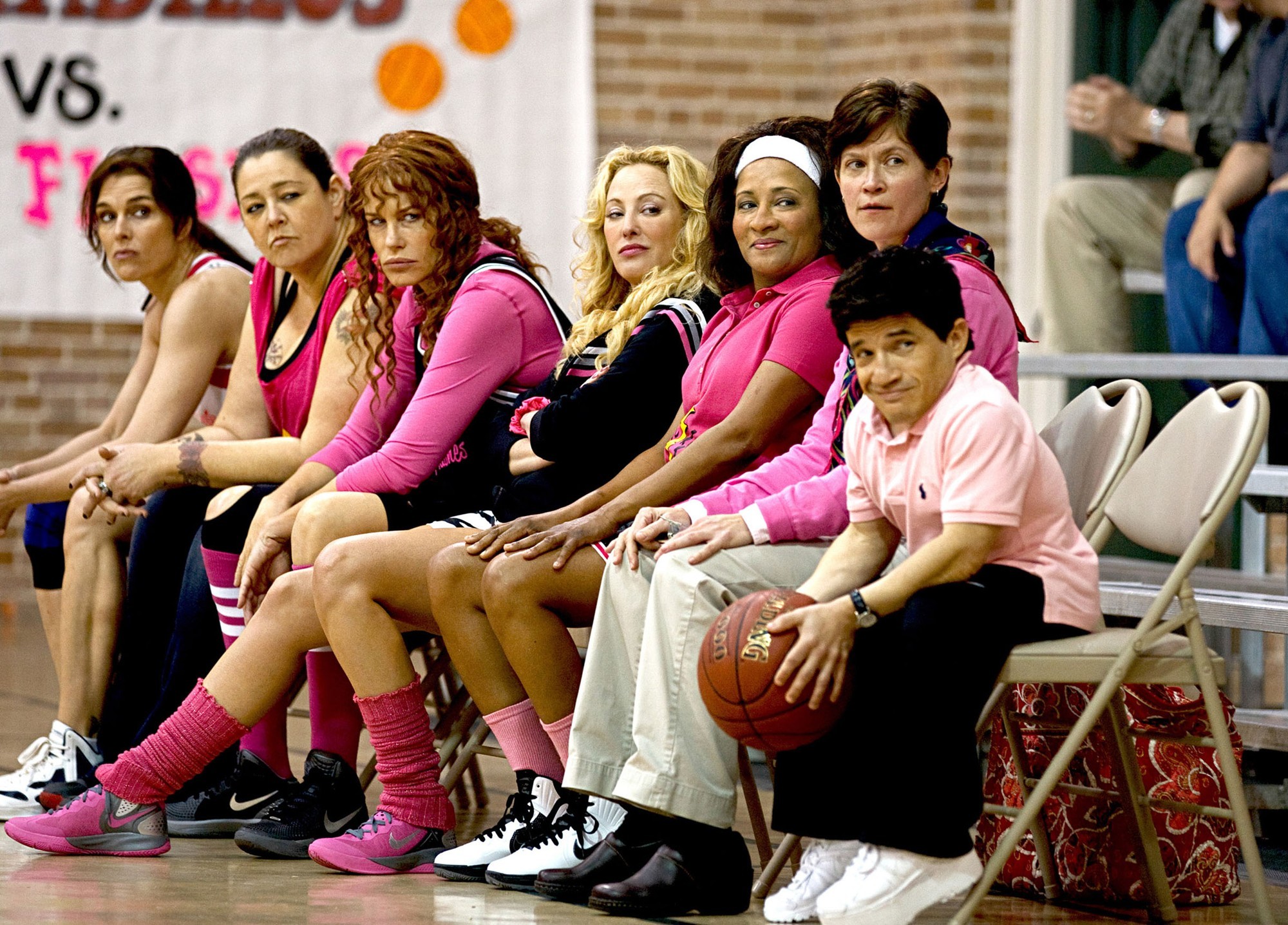
All five women still have some moves, and while fitness is an issue, the will to take on the current state champions, even though they’re around twenty-five to thirty years younger, helps them realise just how mundane their lives have become.  Beth’s marriage to Laurence (Roberts) has lost its passion, as has Roxie’s relationship with husband Tito (Alfonso).  Ginger is apparently single but constantly refers to her roommate, Jewel (Hite) in ways that make the other women believe they’re a couple.  Clementine is “between husbands”; being back on the team helps with her self-esteem and getting back at the state champions’ coach (Palmer), who’s also one of her exes.  And Florine learns to loosen up and not focus so much on her political career.  All five women begin to take better control of their lives and as their game improves, their friendships create an unbreakable bond between them.

Hot Flashes, The - scene

The Hot Flashes – the name the women give themselves as a team name – have to overcome a variety of obstacles to get all three games played, and it will come as no surprise that everything hinges on their winning the third and final game.  With Beth being tested most of all off the court – Laurence may be having an affair, her daughter Jocelyn (Graham) is on the champions’ team – it’s up to the rest of the women to help her pull through, and together save the mammogram service and show that middle-aged women can still be as competitive and determined as their younger counterparts.

This may not come as a surprise, but The Hot Flashes is another exercise in female empowerment slash wish fulfillment.  Unfortunately, it’s only mildly entertaining and while the cast do their best with some of the broadest female characterisations to be seen for a while, the movie fails to bring anything new to the genre, and only sporadically attains its own aspirations.  The women put aside their differences with speed and ease – even Roxie and Clementine bury the hatchet without their mutual enmity causing too much of a problem – and form the kind of sisterly bond that will see them remain friends for the rest of their lives (strange, though, how it wasn’t there when they were younger).  The problems they encounter are often superficial and/or banal, and add little depth or drama as the story unfolds.  There’s a bit of an old/young divide as well, with Jocelyn’s friend and teammate Kayla (Frankle) making ageist remarks at every turn, as if the women need a further spur toward achieving their goal.  And the male characters… well, let’s just say that in terms of gender equality, Brad Hennig’s script has no problem in showing them all to be self-centred, egotistical and unsupportive.

Distinct sexism aside, The Hot Flashes tries hard to be about team effort and team spirit conquering all, but even that aesthetic wears thin pretty quickly.  Which is a shame as the movie has a great cast and Susan Seidelman’s direction takes full advantage of the ladies’ experience and acting skills, despite being in service to a script that doesn’t give them half as much to do as it needs to.  Shields, who tends to do more TV work than film, takes centre stage and does well as the beleaguered Beth, while Madsen and Manheim squeeze more out of their roles than expected.  Hannah appears awkward, and Sykes is reduced to an occasional wisecrack or two, but even held back as they are, both actresses acquit themselves well considering the material.  As for the game sequences, all five women show an aptitude for basketball that will probably surprise most viewers, and the final game delivers a degree of otherwise unexpected tension (even if the outcome is never in doubt).

Rating: 5/10 – occasionally amusing but too patchy to work properly, The Hot Flashes (almost) wastes the talents of its cast; an unassuming diversion that works best on the court rather than off it.

Mini-Review: Kill Your Darlings (2013)

Tags

, , , , , , , , , , , , , , , ,

Kill Your Darlings

D: John Krokidas / 104m

Cast: Daniel Radcliffe, Dane DeHaan, Michael C. Hall, Jack Huston, Ben Foster, David Cross, Jennifer Jason Leigh, Elizabeth Olsen, John Cullum, David Rasche

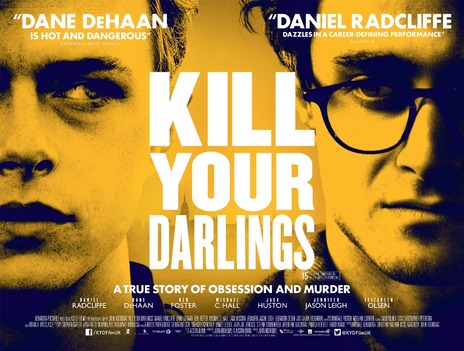
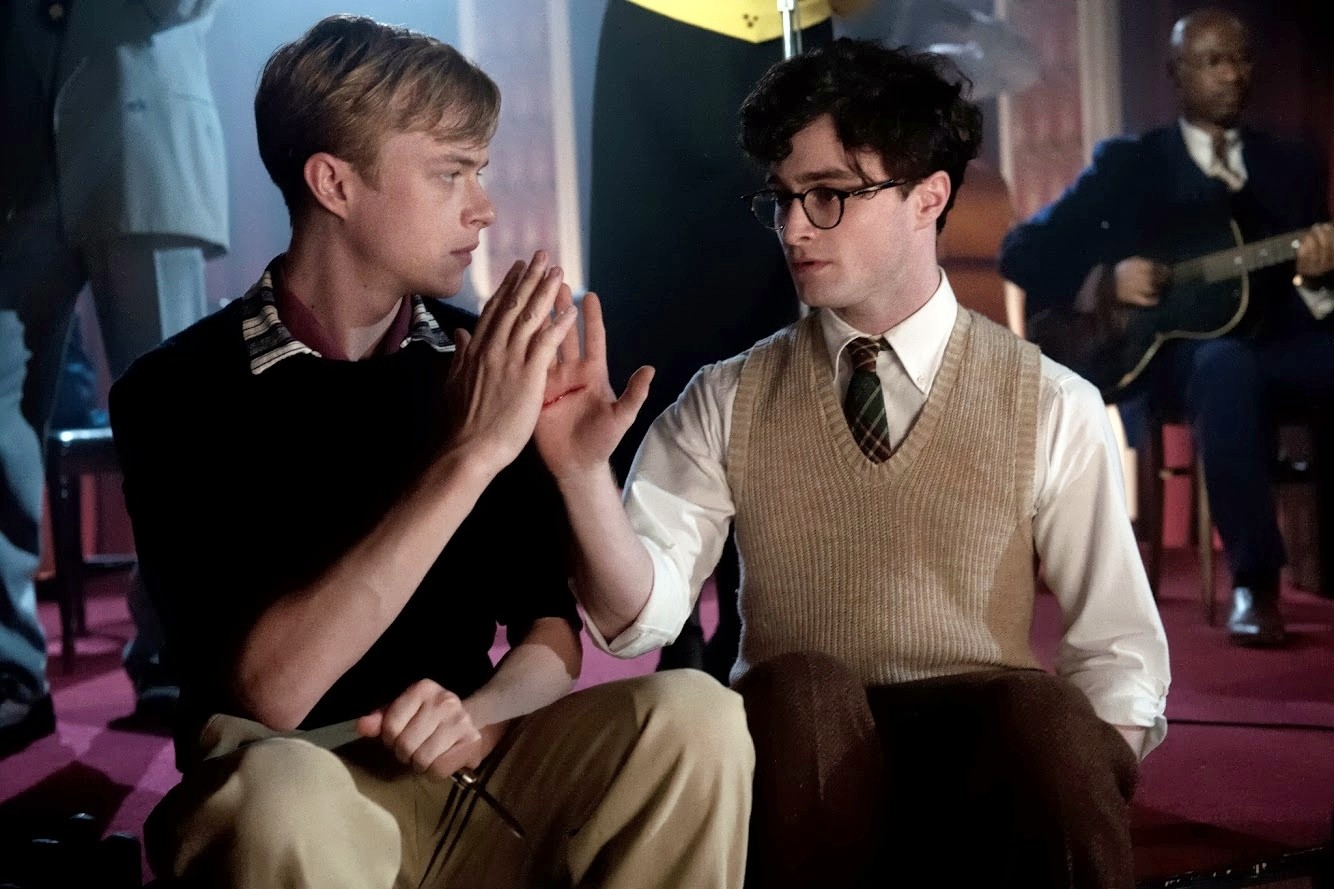
Covering the years 1943-45 while fledgling poet Allen Ginsberg (Radcliffe) was at Columbia University, Kill Your Darlings – a reference to William Faulkner – charts the growing infatuation between Ginsberg and fellow student Lucien Carr (Chronicle‘s DeHaan), their relationships with William Burroughs (Foster) and Jack Kerouac (Huston), and eventually, their roles in the murder of Dr David Kemmerer (Hall).

This is a slow burn movie, where the script strives to paint the characters as boldly as possible and with as much honesty as possible. Carr is shown as manipulative, pretentious and ultimately callow, while Ginsberg comes across as incredibly naive. As played by Radcliffe, Ginsberg is all grinning confusion and slow-on-the-uptake reactions. Unfortunately, this means that neither of them are particularly likeable (though Ginsberg edges it); as a result the movie suffers because it’s difficult to root for any of them, and when the details of the murder are revealed, any sympathies built up during the movie are swept away in a moment (though maybe that was the filmmakers’ intention).

Kill Your Darlings - scene

Like a lot of so-called “free thinkers” with plans to change the world, they’re more adept at ruining the world they live in than creating a new one. When it becomes clear that they’re no better than the system they despise, the movie starts to falter and first-timer Krokidas loses his previously sure grip on proceedings. Of the cast, Radcliffe and DeHaan acquit themselves well, while Foster exudes an icy menace as Burroughs. Hall, though, is miscast, and struggles as the doomed Kammerer. That said, Krokidas makes good use of a great cast, and allowing for the odd stumble, shows a great deal of promise. The 40’s recreation is done well, and Reed Morano’s cinematography recalls other movies from the same period. An interesting story, then, and well-mounted but it’s difficult to tell an interesting story when the main characters are so hollow inside.

Rating: 7/10 – a minor slice of history given a fair-minded treatment that doesn’t quite achieve its aims; absorbing though and another good performance from Radcliffe.

Group Review: Shed No Tears (1948) / Child Bride (1938) / Detective Kitty O’Day (1944)

Tags

, , , , , , , , , , , , , , ,

NOTE: All three movies were viewed courtesy of http://www.archive.org – go check it out!

Shed No Tears (1948)

Shed No Tears

D: Jean Yarbrough / 70m

Cast: Wallace Ford, June Vincent, Mark Roberts, Johnstone White, Frank Albertson, Dick Hogan, Elena Verdugo

Spirited noir with a constantly twisting, changing plot to keep its audience guessing (although the eventual outcome is never in doubt – it’s the Forties after all, and bad people still need to be punished).  After faking his death with the help of his wife Edna (Vincent), Sam Grover (Ford) hides out until Edna can collect on the insurance money.  What Sam doesn’t know is that Edna has no intention of sharing the money with him, and has her own plans involving her lover, Ray (Roberts).  Meanwhile, Sam’s son Tom (Hogan), unconvinced that his father’s “death” was accidental, hires a private detective (White) to look into the matter.  What follows is an entertaining yarn full of double crosses, unexpected twists and turns, and hard-boiled dialogue (mostly uttered by Vincent).  The cast are proficient – though some of Vincent’s line readings are memorable for all the wrong reasons – and Yarbrough’s direction shows a sure hand.  Not as slick or as impressive as some other post-war noirs but worth catching nevertheless.

Rating: 6/10 – a minor gem that works well when focusing on its lead characters’ greed; Vincent looks completely untrustworthy throughout.

Child Bride (1938)

Child Bride

D: Harry Revier / 62m

Cast: Shirley Mills, Bob Bollinger, Warner Richmond, Diana Durrell, Dorothy Carrol, George Humphreys, Frank Martin

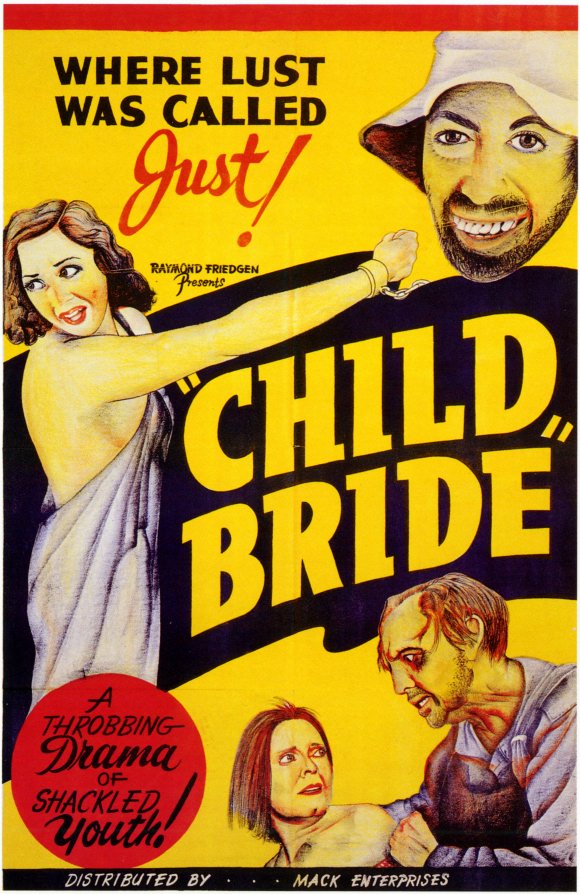
Exploitation curio that mixes child marriage reform with more traditional soap opera elements.  Jennie (Mills) is twelve.  She’s a bright, precocious child who lives with her mother (Carrol) and father (Humphreys) in the Ozarks.  The community there sees nothing wrong with children Jennie’s age being married because, as one character puts it, “there ain’t enough adult women to go round”.  The local school teacher, Miss Carol (Durrell) is fighting to have the law changed but it’s an uphill struggle.  Meanwhile, Jennie’s father falls foul of his partner in an illegal still, Jake Bolby (Richmond).  Events play out so that Jennie ends up betrothed to Bolby.  Will she be saved in the nick of time?  Child Bride moves along at a rapid pace and crams a lot into its short running time.  Revier directs ably enough but the cast vary from just about credible (Richmond) to downright terrible (Durrell and Martin).  There’s an extended sequence where Jennie goes skinny-dipping and it’s clear that Mills is naked, and an even more risible sequence where Miss Carol is abducted at night by hooded men.

Rating: 4/10 – engrossing in its way, Child Bride ends up being a little too melodramatic for its own good; it’s also dated badly but the presentation of its central theme still has the ability to make modern audiences uncomfortable.


Detective Kitty O’Day (1944)

Detective Kitty O'Day

D: William Beaudine / 61m

Cast: Jean Parker, Peter Cookson, Tim Ryan, Veda Ann Borg, Edward Gargan, Douglas Fowley, Herbert Heyes, Pat Gleason

Fast-paced comedy whodunnit featuring Parker as Kitty O’Day, who, when her boss is murdered, decides to find the killer – against the best advice of her boyfriend Johnny (Cookson) and the police (Ryan, Gargan).  But everywhere she turns, more dead bodies pop up and soon Kitty and Johnny become the number one suspects.  Parker and Cookson make for a good team, and if their banter seems a little forced at times, it doesn’t detract from the obvious chemistry they have together.  The storyline dips in and out of being plausible, and the final explanation is unnecessarily convoluted, but otherwise this is an enjoyable romp that relies largely on short, punchy scenes to make up its running time.  Beaudine – who could make this kind of movie in his sleep – keeps it light and frothy, and the cast fill their roles with ease, especially Ryan and Gargan who steal the show as the by turns exasperated and clueless cops on the case.  Not a classic – and neither is the sequel, Adventures of Kitty O’Day (1945) – but it’s a fun way to pass an hour.

Rating: 5/10 – tries to be rip-roaring but gets bogged down in its own plot; light and breezy throughout with few variations to compensate for all the frivolity.

Mini-Review: Captain Phillips (2013)

Tags

, , , , , , , ,

Captain Phillips

D: Paul Greengrass / 134m

Cast: Tom Hanks, Barkhad Abdi, Barkhad Abdirahman, Faysal Ahmed, Mahat M. Ali, Michael Chernus, Catherine Keener, David Warshofsky, Corey Johnson, Chris Mulkey

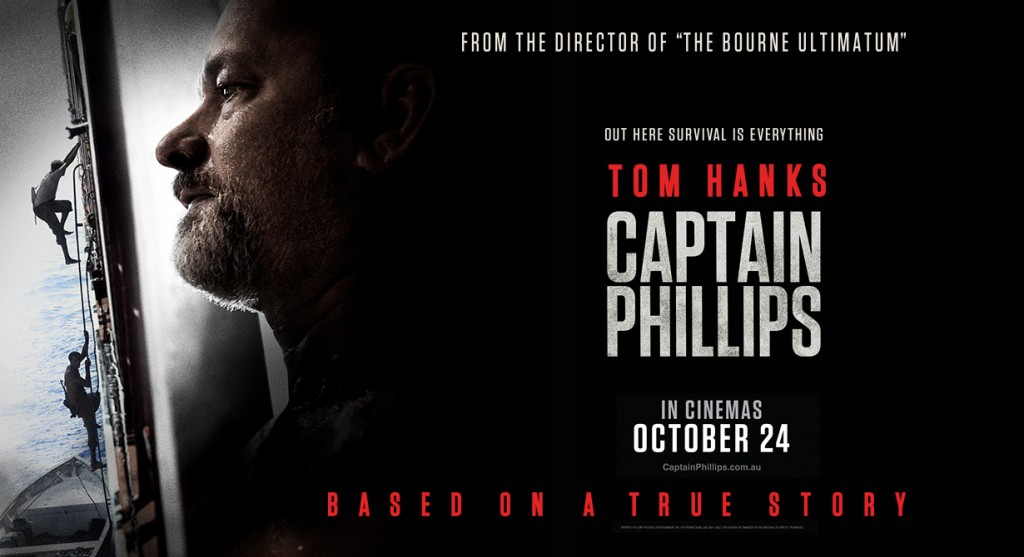
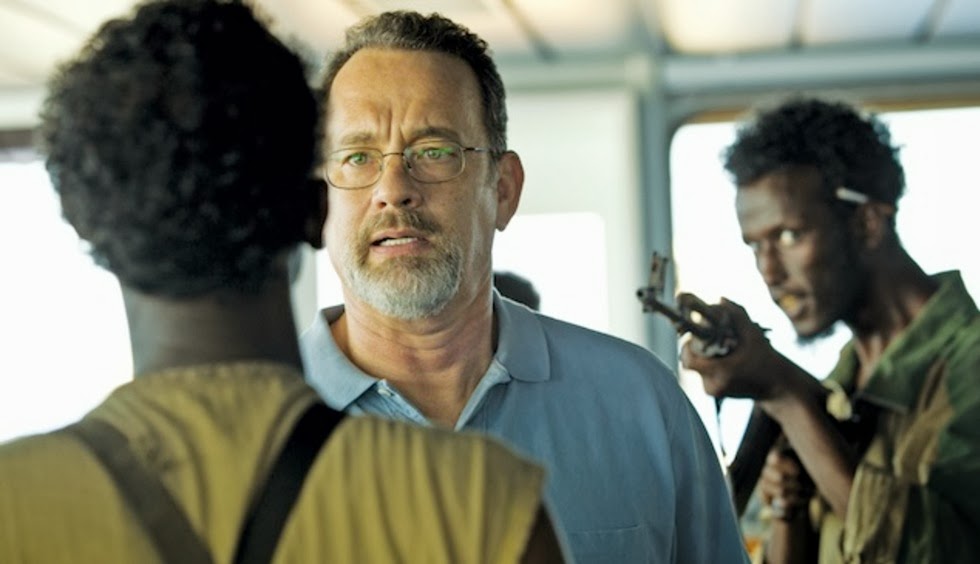
Based on the attempted hijacking of the freighter ship Maersk Alabama in 2009 by Somali pirates, Captain Phillips is a heart-stopping, adrenaline-charged powerhouse of a movie that grabs hold of its audience from the moment two ominous blips are seen on the Alabama’s radar screen, and doesn’t let go until nearly two hours later. The first time the Somalis attack they are unsuccessful, but the ship’s crew know they’ll be back; it’s just a question of how long. When they do, and they manage to board the ship, so begins a game of cat and mouse between the titular Captain Phillips (Hanks) and the Somali leader Muse (Abdi), a game that escalates when Phillips, Muse and Muse’s three compatriots, end up in the Alabama’s lifeboat heading for Somalia. The navy is called in – will they be able to rescue Phillips unscathed, or will the Somalis reach their home shores instead?

Captain Phillips - scene

The answer to both questions is not exactly, and maybe. This is high drama played out at such a pitch that it keeps the audience on the edge of its seat not daring to breathe. Through each twist and turn of the narrative, Greengrass keeps a tight hold on proceedings, ratcheting up the tension until it’s almost unbearable. He’s aided immeasurably by incredible performances by Hanks and Abdi, both equally mesmerising, and both deserving of every accolade they receive. Hanks’ final scene is incredible to watch, a wrenching, pitiless depiction of a man who has gone through so much he’s fighting to remain on top of things and not succeeding; while Abdi convinces as a Somali fisherman who is complex and threatening and naive and proud all at the same time. Of course, all this is down to Billy Ray’s incredible script, by turns thrilling, emotional, nerve-wracking and detailed. The photography by Barry Ackroyd and editing by Christopher Rouse are superb, but this is Greengrass’s towering achievement: his best film yet and easily the most kinetic, charged movie of 2013 – never has the word “execute” been the trigger for an audience to be able to release so much pent-up emotion.

Rating: 9/10 – my movie of the year for 2013 and easily the most exciting thriller of recent years; a powerful experience that lingers long in the memory.

Non-Stop (2014)

Tags

, , , , , , , , , , , , ,

Non-Stop

D: Jaume Collet-Serra / 106m

Cast: Liam Neeson, Julianne Moore, Scoot McNairy, Michelle Dockery, Nate Parker, Corey Stoll, Lupita Nyong’o, Omar Metwally, Jason Butler Harner, Linus Roache, Shea Whigham, Anson Mount

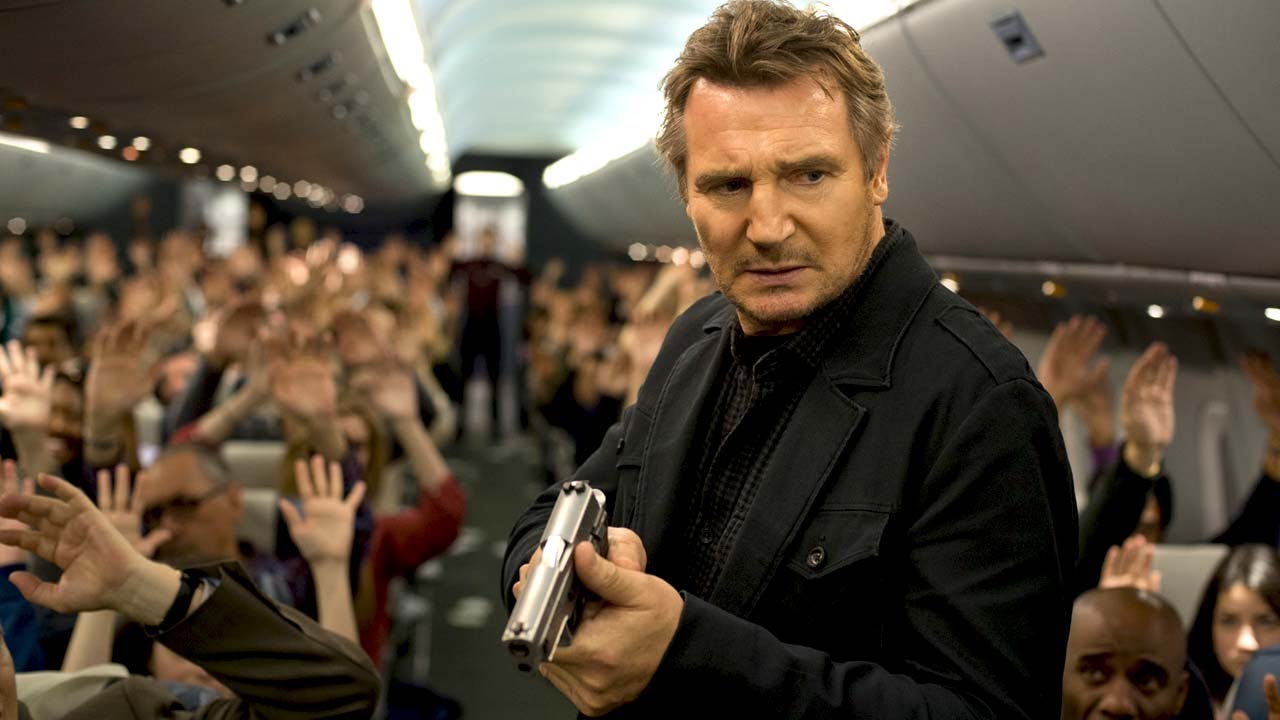
Non-Stop – or the continuing adventures of Liam Neeson in action movie land – starts off promisingly enough with air marshal Bill Marks (Neeson) preparing to board a flight to London from New York.  He looks a mess, he’s drinking, he’s obviously got problems, and he has a gun.  Once the flight is underway, Marks begins to get text messages over the air marshal network, which should be secure.  If the mystery person sending the texts isn’t paid $150 million dollars then someone on the plane will die every twenty minutes until it is.  Marks thinks it’s probably some kind of elaborate practical joke, and challenges the other air marshal on the plane, Hammond (Mount) about it, but it’s soon made clear Hammond didn’t send the messages.  He alerts the captain and the cabin staff as a precaution, and also his boss at the Transport Security Administration (TSA).  Only Marks takes the threat seriously.  As the first twenty minute marker nears, Marks finds himself attacked by Hammond (who, it turns out, is being coerced by the texter) and is forced to kill him, thereby doing the texter’s work for him.  Marks also discovers that Hammond was carrying a briefcase full of cocaine.

With Marks attempting to keep Hammond’s death from the crew and passengers – and no one making any attempt to use the toilet Hammond’s body is in – the plot thickens as it’s revealed that the account the texter wants the money transferred into is in Marks’ name.  With suspicion mounting against him, Marks attempts to discover the texter’s identity by checking the passengers’ cell phones.  Some of the passengers take umbrage at this, particularly NY cop Reilly (Stoll), and communications tech White (Parker).  When another murder takes place after forty minutes, Marks’ behaviour becomes increasingly more desperate as he attempts to locate the texter, alienating both the crew and passengers further, and as events unfold, putting himself in the frame for what is now being seen by the outside world as a hijacking.  Even the TSA believe he’s gone bad.  And when he discovers there’s a bomb on the plane, Marks must do all he can to save the plane and himself.

Non-Stop - scene

A movie like Non-Stop can be taken (no pun intended), in one of two ways: as a leave-your-brain-at-the-door-and-go-with-it type of movie that could end up being a fun ride, or as yet another dire attempt by Hollywood to provide thrills and spills but without any kind of focus on logic or credibility – still a fun ride perhaps, but one that coasts on its high concept and promise of seeing Neeson doing what he (currently) does best: kick ass.  In either circumstance, though, Non-Stop is a let-down, a polished yet soulless piece of work that is, seriously, a real piece of work.

The fault here lies squarely with the script by John W. Richardson, Christopher Roach and Ryan Engle, which piles on absurdity after absurdity and never lets you forget that credibility isn’t an issue.  As Marks gets ever more desperate to discover the texter’s identity, and he violates the passengers’ rights with ever-increasing enthusiasm, the script never pauses to wonder if there might be any actual protocols involved in dealing with such an admittedly unusual situation.  When Marks tells everyone about the bomb and a “damage limitation” procedure, you’re not sure if the script has made it up or it does exist in the real world.  Two fighters are scrambled to fly alongside the airliner and with instructions to shoot down the plane if it drops to 8,000 feet or below because then it becomes a civilian threat.  But the plane is flying over the Atlantic and is being directed to land in Iceland, not exactly the most populous of locations.  Two of the victims are killed by poison dart; neither could have happened in the way they do and the script doesn’t even challenge itself to come up with anything more clever; it settles far too often for a “well, this happens, and then this happens, and it just does” kind of approach.

When the texter’s identity and his or her reasons for doing all this are revealed, it’s such a weak excuse the viewer can only shake their head in dismay and move on to the rapidly approaching finale.  It’s also a pretty woolly excuse, and delivered with all the earnestness and conviction of someone trying to explain why they’ve just done something so stupid they’re terminally embarrassed about it (like signing on to be the villain in Non-Stop).

As the script is so poor, and character motivations almost on the nearly extinct list, the cast fare badly, unable to do anything other than say the lines and hit their marks.  Neeson tries valiantly to make his role work but he’s hampered by having to be a hero when it would have been so much more effective if there had been some real doubt as to his involvement in the hijacking.  Moore is on hand to provide support as the passenger who never doubts Marks for a moment, while McNairy, Stoll, Parker, Metwally and others are trotted out as potential hijackers as the guessing game continues.  Dockery, escaping from Downton Abbey (and maybe changing agents at this very moment) is only required to look shocked and surprised at various moments, while Nyong’o, after her triumph in 12 Years a Slave, is saddled with the role of stewardess-most-required-to-scream-and-panic-a-lot.

Collet-Serra directs with ambition and a certain flair, keeping the visual side of things interesting, and making good use of the cramped conditions.  However, even he can’t make much of the dire script, and as a result, the cast suffer even further, some, like Dockery, seemingly cast adrift.  The action sequences are casually brutal yet effective, though the crash landing at the end won’t be the best use of CGI seen this year.  If there is to be a Non-Stop 2 – and we can only pray there won’t be – it will have to be a great deal better than this to warrant a return flight.

Rating: 5/10 – as a popcorn movie, Non-Stop just about makes it, but with serious reservations; laughable in places, frustrating to watch, and just too dumb for its own good.

Cuban Fury (2014)

Tags

, , , , , , , , , ,

Cuban FuryD: James Griffiths / 98m

Cast: Nick Frost, Rashida Jones, Chris O’Dowd, Olivia Colman, Ian McShane, Kayvan Novak, Alexandra Roach, Rory Kinnear, Tim Plester, Ben Radcliffe

As a teenager, Bruce Garrett (Frost) is a salsa prodigy, winning with his sister, Sam (Colman) trophy after trophy, and heading for the top.  On his way to a major competition, Bruce is ambushed by three bullies who make fun of his sequinned outfit and assault him; ashamed and embarrassed by what has happened, Bruce turns his back on salsa and vows never to dance again.

Twenty-two years on, and Bruce is out-of-shape, without a girlfriend, and working for a tool-making company (though he does “love the lathe”).  When the company gains a new, American boss, Julia (Jones), Bruce finds himself attracted to her, and while they enjoy a good working relationship, Bruce convinces himself that nothing romantic will happen between them.  But when would-be Lothario and colleague, Drew (O”Dowd) begins to express a less than healthy interest in Julia, and prompted by the knowledge that Julia salsa dances as well, Bruce decides to renew his love for dance in the hope of winning Julia’s heart.

Renewing his love for dance, however, means getting back in touch with his old mentor, Ron Parfitt (McShane).  Ron isn’t too pleased to see Bruce, and makes him join his beginners class.  As Bruce comes to realise just how rusty he is, and how much salsa has moved on since he competed, he begins to regain his confidence.  When a dance competition is announced, Bruce trains even harder with the intention of asking Julia to be his partner.  But Drew is determined to bed her and engineers a situation that gives Bruce the impression he’s done so.  Will Bruce learn the truth before it’s too late?  Will Drew get his comeuppance?  And will Julia make it to the dancehall in time to partner Bruce in the final round?

Cuban Fury - scene

Based on an original idea by Nick Frost, Cuban Fury is a romantic comedy that charms its way into the viewer’s heart thanks to a combination of winning performances, a neat line in physical comedy, and well-choreographed dance sequences.  The movie wears its heart on its sleeve from the outset, showing the enjoyment the younger Bruce (Radcliffe) derives from dancing before it turns necessarily darker when Bruce is subject to the bullies’ attack.  Frost shows the same love and enjoyment in his dance sequences, displaying an agility and aptitude that, on paper at least, should be surprising, but in reality are entirely believable (though the acrobatics employed in the dance-off against Drew undermine Frost’s efforts in the rest of the movie).  O’Dowd has some good moves as well (though he’s more of an improviser than a formal dancer), but Jones only gets to strut her stuff in a couple of much shorter sequences.  Even so, their willingness to perform – with only a few shots the work of dance doubles – helps ground the movie so that the dance routines don’t stray too far from what you’d expect of the characters.

Away from the dance floor, Frost convinces as the hapless, ordinary man who no longer expects much from his life; it’s not exactly a stretch for Frost but he’s a likeable screen presence and adds layers to the character of Bruce that might not otherwise have been included.  O’Dowd excels as the ultra-sleazy Drew, the kind of man a woman would bite her own foot off to avoid, as clueless about the fairer sex as he is about gender equality and what constitutes inappropriate behaviour.  As the object of both men’s attentions, Jones has the lesser role and less opportunity to shine (though this misfortune can be laid firmly at the door of Jon Brown’s screenplay), while as Sam, Colman impresses as Bruce’s freewheeling sister, providing many of the movie’s prime laughs.  So too does Novak as Bejan, one of the learners in Ron’s class who befriends Bruce and helps him regain his confidence; with one-liners such as “I’m late for my ball waxing” it’s hardly surprising.  It’s left to McShane to provide the gravitas, scowling at Bruce and pushing him to work harder in order to succeed.  (There’s also a priceless cameo from one of Frost’s Cornetto Trilogy castmates.)

Behind the camera, Griffiths provides efficient if unfussy direction, saving the big camera moves for the infectious dance sequences, and using low camera angles to good effect.  The editing by Jonathan Amos, and the music choices (overseen by Nick Angel) combine to make these sections enthralling and enticing in equal measure (if you’re not tapping your toes there’s something wrong with you – peripheral neuropathy perhaps?).

Overall, Cuban Fury is an enjoyable variation on the boy-meets-girl, boy-deems-himself-not-worthy, boy-redeems-himself-and-wins-the-girl-through-accepting-hidden-talent tale of romantic woes and tribulations.  In reality there’s nothing entirely new here but it’s done with a lightness of touch that helps captivate the viewer and keeps them smiling all the way through.  And if there’s a sequel, let’s hope it’s called Cuban Fury 2: Heels of Steel.

Rating: 8/10 – funny, heart-warming and brimming with charm, Cuban Fury entertains throughout its running time; kudos to Frost for bringing his idea to life, and with such hip-swinging verve.

Evidence (2011)

Tags

, , , , , , ,

Evidence

D: Howie Askins / 78m

Cast: Abigail Richie, Ashley Bracken, Ryan McCoy, Brett Rosenberg

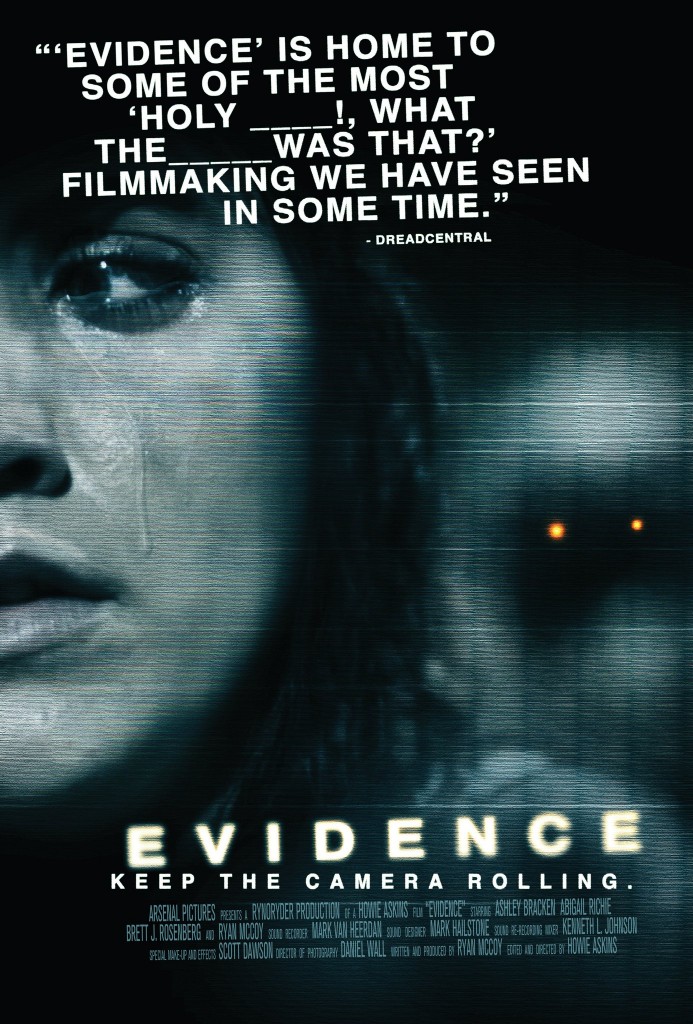
Yet another entry in the found-footage sub-genre of horror movies, Evidence is a low-budget exercise in misdirection that pulls the rug out from under its audience at the midway mark.  Ryan (McCoy, also the movie’s writer) is making a documentary about his friend Brett (Rosenberg) going on his first camping trip.  It’s a fairly inane reason for making a documentary and for the first twenty minutes or so it’s taken up with Brett voicing his dislike of being filmed, and Ryan being pretentious.  Along for the trip are their respective girlfriends, Ashley (Bracken) and Abigail (Richie).  On the first night they hear a noise that Ryan dismisses as a coyote.  The next day they see a strange creature in a nearby ravine.  That night the noise escalates, and stranger things begin to happen.

By this stage, Evidence is shaping up to be a Bigfoot-style movie.  And if it had continued in that vein the movie might have been less effective than it actually turns out.  And while the twist that happens after that second night takes the movie into a more nightmarish arena, there’s still something about the direction it takes that makes you want to find out if the filmmakers could have pulled off a more focused creature feature.  The creature itself is well-realised and mirrors the creature effects in Attack the Block (2011).  Once the twist is revealed, the movie does little but offer its two female leads running around and screaming a lot, while being chased.  For a while it even takes us into first-person-shooter territory with an approach that wouldn’t look out-of-place in a Resident: Evil game.  The filmmakers have strived to provide the audience with something different from the usual found-footage movies out there, and while they certainly succeed – two shots are as disturbing as anything seen in modern horror – the repetition that goes along with the change in direction undercuts the tension.

Evidence - scene

Director Askins (Devil Girl (2007), several shorts) moves the story along at a brisk pace suited to the running time, and McCoy’s script sticks closely to formula in that whatever is “out there” is shown fleetingly (until the end), and that whenever one of the characters is attacked, the camera is conveniently on the ground or out of focus.  (At least, on this occasion, there is a good reason for the characters to keep filming: most of the time it’s night and the light from the camera let’s them see what they’re doing and where they’re going.)

Richie and Bracken give good performances, even if some of their dialogue early on seems forced, but as mentioned before, once the twist kicks in they have little to do but run and scream a lot.  Rosenberg seems uncomfortable throughout, while McCoy is unafraid to play the jerk, and while other characters do appear, they’re not around for long.

Evidence does suffer at times from ploughing the same furrow as other found-footage movies, but its willingness to try something different is to its credit.  While it’s not entirely successful, and some elements appear lifted from other horror sub-genres, it’s nevertheless worth seeing.  One word of warning though: be prepared for maximum frustration in the last ten minutes as the filmmakers take video and audio fragmentation to its most annoying level ever.

Rating: 6/10 – for once, you won’t see what’s coming, and when you do you’ll find it’s more disturbing than you could have expected; uneven, it’s true, but still more of an achievement than a failure.

Originally posted on thedullwoodexperiment website.

Cold Weather (2010)

Tags

, , , , , , , , , ,

Cold Weather

D: Aaron Katz / 96m

Cast: Cris Lankenau, Trieste Kelly Dunn, Raúl Castillo, Robyn Rikoon, Jeb Pearson, Brendan McFadden

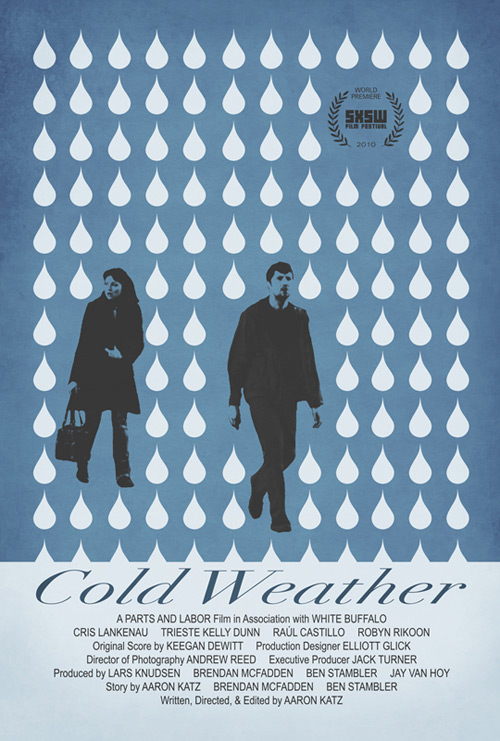
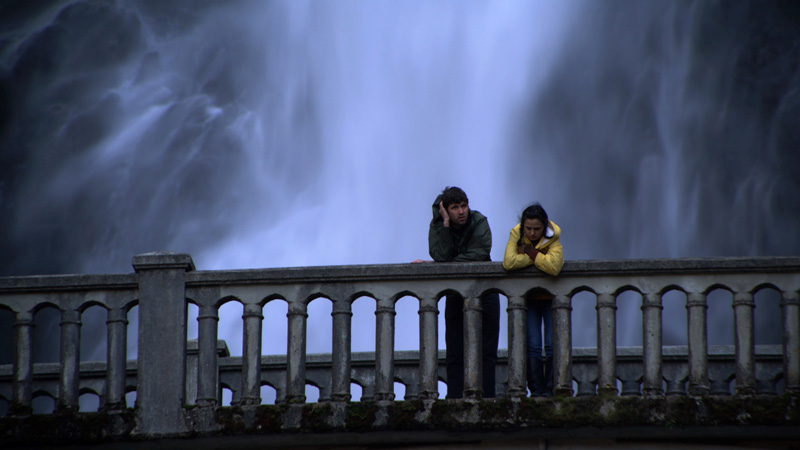
Doug (Lankenau) is a twenty-something slacker with a background in forensic science but no motivation to make a career from it.  When Cold Weather begins he’s without a job, without a girlfriend, and reduced to sleeping on his sister’s couch.  He’s a classic underachiever.  Eventually he gets a job working nights at an ice factory where he meets Carlos (Castillo).  They become friends, and the usually aimless Doug begins to come out of his shell, admitting his love of Sherlock Holmes and his dream to become a detective some day, like the sleuth of 221b Baker Street (also, throughout the movie Doug carries a copy of E.W. Hornung’s Raffles around with him).  When Doug’s ex-girlfriend, Rachel (Rikoon) appears on the scene her subsequent disappearance leads Doug, aided and pushed in equal measure by his sister, Gail (Dunn) and Carlos, into using his nascent detective skills to find her.

Cold Weather is a curious movie.  It mixes modern film noir with a slacker aesthetic and adopts a slow-burn pace in an effort to heighten the drama and the mystery of Rachel’s disappearance.  However, the mix fails to gel, and the viewer is left waiting for the movie to pull itself together.  When Doug and Carlos are in Rachel’s motel room looking for clues – a scene normally ripe for increased tension – there’s some rudimentary checking of drawers and the bathroom before Doug notices something in the parking lot.  Instead of this being a sudden revelation geared to reinforcing the audience’s attention, it falls flat due to a) Lankenau’s reading of the line (it’s not his fault, to be fair, it’s how the character has been written by Katz), and b) the static camerawork that leaves Carlos’ reaction almost offscreen.

Cold Weather - scene

There’s a fair degree of intelligence at work here but it’s undermined by the decision to pace the movie so glacially, and by having its central character be so socially awkward and unable to engage with others.  When we meet Rachel it’s hard to understand what she might have seen in Doug; plus it’s already obvious that the only female relationship that Doug is comfortable with is with Gail, and she is often more of a mother to him than a sister.  As the movie struggles on to its annoyingly abrupt ending, Doug does become less and less insular but only registers any real emotion when delighting in some minor vandalism.  What becomes clear is that without the involvement of Carlos and Gail, Doug would never have looked into Rachel’s disappearance at all.  With this in mind, the movie now feels contrived, and Doug given no motivation to act unless his friend and sister bully him into it.

Against this, there’s also the aforementioned glacial pacing.  Katz directs at a snail’s pace, dragging out shots and scenes for no other purpose (it seems) than to extend what would otherwise be a pretty short movie.  One sequence, where Gail and Doug are driving up to the top of a multi-storey car park, is filmed from the backseat and contains no dialogue as they ascend.  The view through the windscreen is over-exposed, so there’s no detail… and the whole sequence serves no valid purpose.  There are other, similar moments and while slow-paced movies can be rewarding in their own right, they still have to be engaging and astute in the assembly of the material.

Fortunately the performances are good, with Lankenau – who also appeared in Katz’s Quiet City (2007) – effective as the bordering-on-Asperger’s Doug, while Dunn quietly outshines everyone with her take on a sister who seems to have willingly put her life on hold to look after her brother.  Castillo and Rikoon provide solid support and the suitably wintry location photography – all steely greys and blues – is lensed by Andrew Reed to great effect.  And while Katz’s screenplay is packed with unnecessary longueurs, there is still enough of merit to warrant looking out for his other works (he just needs to sack his current editor – himself).

Rating: 5/10 – it drags badly in places but Cold Weather has a quirky feel to it that helps it through; there’s a deeper meaning here too but it all depends on whether or not the viewer is interested enough to dig for it.

Originally posted on thedullwoodexperiment website.

Blood Car (2007)

Tags

, , , , , , , , ,

Blood Car

D: Alex Orr / 76m

Cast: Mike Brune, Anna Chlumsky, Katie Rowlett, Matt Hutchinson, Marla Malcolm, Mr. Malt, Matthew Stanton, Hawmi Guillebeaux, Bill Szymanski, Vince Canlas

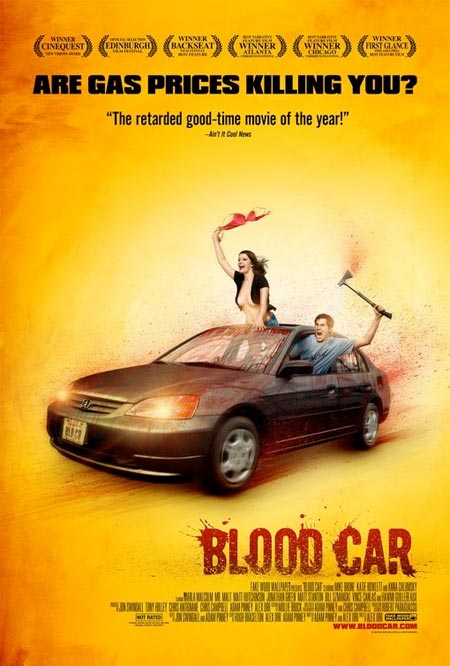
With an introduction to camera that tells the viewer that the movie is set in the near future – “a couple of weeks from now” – Blood Car begins with elementary school teacher Archie (Brune) telling his class the story of the Little Engine That Could. It’s a neat foreshadowing of the movie to come and a great offset to the carnage in store for the viewer.

In the future, gas prices in America have hit record levels, around $30 a gallon. Having a car that runs is a rich man’s game, but Archie isn’t rich. He does have a car though, and a plan to run it using wheatgrass. But his plan isn’t working, the wheatgrass will only let the car run for a minute or two, and he’s close to giving up when he stumbles on the real fuel he needs to keep his car running. There’s no prizes for guessing it’s blood (this isn’t called Wheatgrass Car, after all), but therein lies a problem: Archie is a vegan; how will he be able to find enough blood to keep his car running?

The answer is: quite easily. After some attempts at despatching the local wildlife, Archie graduates to larger animals i.e. dogs, but they’re simply not large enough to provide sufficient blood. When his neighbour, Mrs Butterfield (Barbara Carnes) passes away unexpectedly, it’s just a short drop from her veranda to the back of Archie’s car where he’s developed a contraption that is basically part blender and part engine. From then on, finding “donors” is only the first of Archie’s mounting problems.

Problem number one is Denise (Rowlett). She’s interested in Archie because of his car and is willing to let him sleep with her if he drives her around; their relationship becomes dependent on Archie finding enough blood for his car. Problem number two is Lorraine (My Girl‘s Chlumsky), who is attracted to Archie but begins to have suspicions about his car when he stops buying wheatgrass from her. Problem number three is the government: agents are sent to steal the car for the government’s own purposes and Archie has to fend them off almost continuously. And problem number four is Archie’s deteriorating mental stability; after all, how can someone kill so many people and not have it affect them?

Blood Car - scene

Adopting a grind house approach, Blood Car is a very black comedy and some aspects will doubtless offend people – Archie’s shooting at a dog tied to a stake; one of Archie’s pupils being shot in the head at point blank range; the final “throwaway” shot involving a baby – but the movie is very funny and if the humour is a little bit offensive in places then it’s balanced by moments where the script (by Orr and Adam Pinney) displays some fine touches – the predatory Denise letting Archie see her vulnerable side by inviting him back to her place; Archie having sex with Lorraine but clearly not enjoying the experience; Archie being carjacked and then debating the finer points of gas consumption with the carjacker (Mr. Melt); and the answer to the age-old question: how far will you get when the disabled war veteran you feed to your car has plastic legs and a plastic arm? (The answer is: not far.)

The script, however, does falter at times. Lorraine is underused, and once she and Archie sleep together, the script doesn’t know what to do with her. The government agents are presented as either stupid or psychotic, or both, and the eventual meeting between Archie and Agent Watkins (Hutchinson) reads like the conspiracy theories of a confused pot smoker. The editing is also clumsy at times, leaving the viewer wondering if what they’re seeing is happening in the right order (it’s a weird effect but that’s the best way to describe it). There’s an initial over-reliance on public domain classical music on the soundtrack, and the movie itself ends rather abruptly.

Further on the plus side, the general tone of the movie is feverish and this suits the subject matter perfectly, while the performances are likeable with Brune well cast in particular. There’s very little gore despite the killing method, but there is the requisite number of bare breasts on display throughout (watch out as well for the fantasy art that Lorraine has drawn of her and Archie). Orr, making his feature debut, shows a sure hand and keeps things moving along at a good pace while allowing his principal cast plenty of room to flesh out their characters. The satire is cleverly worked into the proceedings and the various messages surrounding society’s approach to consumption and waste are presented organically and without resorting to tub-thumping.

NOTE: When Archie and Denise are at the drive-in, the movie they’re watching is Stomp! Shout! Scream! (2005). Alex Orr appears in that movie as Deputy Frank.

Rating: 7/10 – hugely enjoyable satirical horror with a bit of a soft heart amidst the carnage; well worth tracking down despite (or maybe because of) its low-budget limitations.

Originally posted on thedullwoodexperiment website.

Mini-Review: The Fifth Estate (2013)

Tags

, , , , , , , , , ,

Fifth Estate, The

D: Bill Condon / 128m

Cast: Benedict Cumberbatch, Daniel Brühl, Anthony Mackie, Laura Linney, David Thewlis, Alicia Vikander, Peter Capaldi, Moritz Bleibtreu, Carice van Houten, Jamie Blackley, Stanley Tucci

Remarkably similar in tone and circumstance to the creation of Facebook as shown in David Fincher’s The Social Network, The Fifth Estate shows how WikiLeaks became such a global phenomenon.

In the beginning, Julian Assange (Cumberbatch) is shown struggling to get his site acknowledged by the wider Internet community. A fortuitous meeting with Daniel Berg (Brühl), a bored IT expert, gives Assange the help he needs in expanding and publicising WikiLeaks, and sets them on the road to international notoriety. Along the way they expose dictatorships, a tax-avoiding Swiss bank, rigged elections, and more. Then comes the tipping point: over 250,000 leaked documents relating to the US war crimes in Afghanistan, and diplomatic cables that describe the US’s real feelings about the various governments and world leaders it deals with. Assange and Berg fall out over how to disseminate the information, and the future of WikiLeaks is brought into sharp relief.

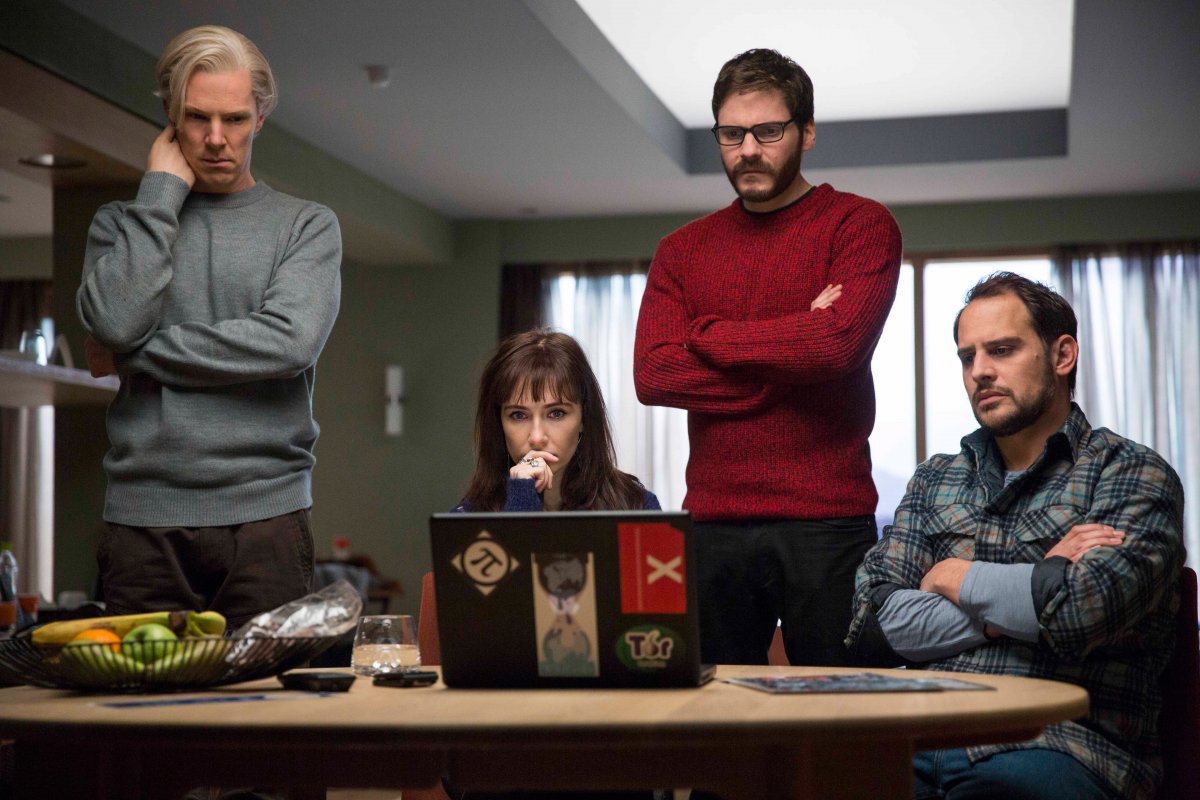
Fifth Estate, The - scene

Already disowned by Assange, The Fifth Estate shows WikiLeaks’ creator to be narcissistic, arrogant, paranoid, and a user of other people. Cumberbatch plays him superbly, all grating Australian accent and sneering condescension; but how close a representation of the man it really is, is difficult to tell. Based in part on Berg’s own book, the movie skirts perilously close to demonising the man, while Berg comes out of it looking whiter than white. For a film about a man with a burning desire to show people “the truth” about the world they live in, it’s a dangerous approach to take. This is one-sided reportage, and the film ends with Cumberbatch as Assange making reference to the film itself and dismissing it; it’s an uncomfortable coda, even though Assange has made his feelings clear about the movie.

That said, the movie is a gripping retelling of recent events and holds the attention throughout. The cast are uniformly excellent, and even though the script by Josh Singer contains large chunks of exposition, it’s all presented in an easy-to-follow manner. Condon, fresh off the challenges of the final two Breaking Dawn movies, directs confidently and with a clear eye for the complexities of the material. It’s a movie that will attract controversy for some time to come, but as a jumping off point for the wider issues involved, this is where the movie really succeeds.

Rating: 8/10 – powerful, with two mesmerising lead performances, The Fifth Estate is thought-provoking, intelligent and remarkable; while it’s not as rigorous in its approach as it would like to be, it’s still a fascinating examination of a recent global phenomenon.

No Contest (1995)

Tags

, , , , , , , , , , ,

No Contest

D: Paul Lynch / 98m

Cast: Shannon Tweed, Robert Davi, Andrew Clay, Roddy Piper, Nicholas Campbell, John Colicos, James Purcell, Judith Scott, Polly Shannon, Louis Wrightman, Keram Malicki-Sanchez, J.D. Nicholsen

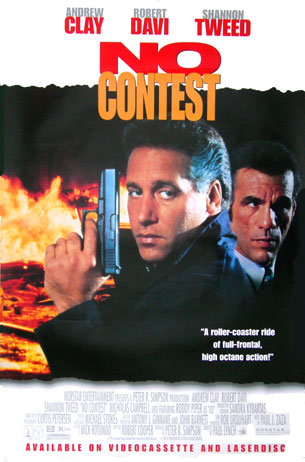
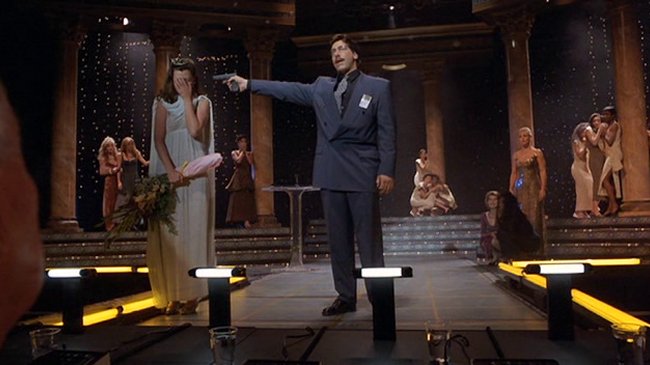
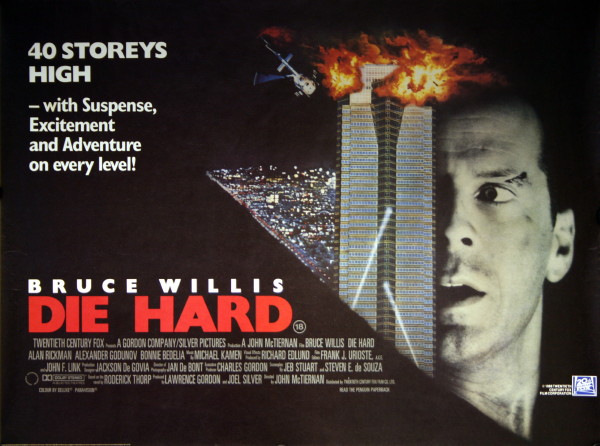
Seven years after Die Hard and still the rip-offs kept coming…  This time around the setting is a beauty pageant being staged in a hotel, and instead of wrong-cop-in-the-wrong-place John McClane, we have wrong-hostess-in-the-wrong-place Sharon Bell (Tweed).  As the winner is announced, arch-villain Oz (Clay) and his crew of ne’er-do-wells take over the pageant and the hotel and hold the finalists, plus Bell, as hostages.  Among the finalists is Miss U.S.A. (Shannon).  Her father, Senator Wilson (Colicos) and Oz used to be business partners until the Senator let him take the fall for a dodgy business deal gone wrong.  Now Oz is looking for some payback.

While Oz and co intimidate their hostages and try to look menacing, outside the building, Crane (Davi), Miss U.S.A.’s bodyguard, and Captain Hendricks (Purcell) plot to find a way into the hotel, rescue the hostages and thwart Oz’s evil plan.  Along the way there are the usual double crosses, action beats, less-than-credible dialogue, over-acting, lazy direction, ridiculous stunts (Davi hanging by his cane underneath a rising maintenance cart), and one climax too many.

No Contest -scene

As No Contest lurches from one absurd scene to the next, it becomes obvious that no one on the production side of things was concerned at just how absurd it all is.  And yet, the movie, despite all its faults – or maybe because of them – is one of the most enjoyable Die Hard rip-offs out there.  First, there is Shannon Tweed, taking time out from her usual role as a sexual predator in movies such as Body Chemistry 4: Full Exposure.  Now, Tweed is a beautiful woman and she has a terrific figure, but what she doesn’t have is any real talent for acting.  She never seems sure of how to play a scene, or react to what’s going on around her.  Watch her in the scene where Vic (Campbell) takes her down to the swimming pool and removes the explosive cuff she and the other hostages have been made to wear.  In a scene where her character should be scared of what’s coming next, the expression on her face relays confusion instead.  It’s almost as if she’s not sure what she’s supposed to be doing.  But with all this, the camera loves her and it’s hard to take your eyes off her whether she’s standing at a podium announcing the winner of the pageant or scrabbling through an air vent.

Second is the inspired casting of the bad guys.  Aside from Clay there’s ex-WWE wrestler Roddy Piper as psychotic sidekick Ice; the aforementioned Nicholas Campbell as vain, incompetent Vic; Louis Wrightman as trigger-happy Que; Keram Malicki-Sanchez as pony-tailed computer whiz Cal; and J.D. Nicholsen as spare wheel Zed.  All six make for a great team of villains, and each gets their own special ‘moment’ to shine, especially Malicki-Sanchez once Tweed has tied him to a pipe.

Third is just the sheer barminess of the plot.  The police initially send in just two armed officers to infiltrate the hotel; both are killed by a camera fitted out with a gun.  Oz takes control of the pageant while wearing a ill-fitting wig and moustache that he quickly discards and never wears again;  Ice survives lethal attack after lethal attack, enough to make you wonder if his real name is Michael Myers; and Crane puts having a cigarette before being a proper bodyguard to Miss U.S.A. and gets himself locked out of the hotel as a result.  It’s so bad it’s brilliant.

Lynch directs ably enough, and the fights are well-staged.  Tweed does well as an action heroine, and Clay hams it up so much you wonder if there was a porcine shortage during the movie’s making.  The film moves along at a fair pace and while it’s all very preposterous, it keeps the viewer entertained throughout.

Rating: 6/10 – Tweed proves a good focus for an action movie that is short on original ideas but is fun to watch nevertheless; a six-pack and a pizza kind of movie and just right for a zone-out Saturday night.

Originally posted on thedullwoodexperiment website.

The LEGO Movie (2014)

Tags

, , , , , , , , , , , , , , ,

Lego Movie, The

D: Phil Lord, Christopher Miller / 100m

Cast: Chris Pratt, Will Ferrell, Elizabeth Banks, Morgan Freeman, Liam Neeson, Will Arnett, Nick Offerman, Alison Brie, Cobie Smulders, Channing Tatum, Jonah Hill

When evil Lord Business (Ferrell) steals the Kragle from Vitruvius (Freeman), he plans to use it to destroy all the Lego worlds, including his own, in a bid to restore order where he sees only chaos. Before he does, though, Vitruvius warns Lord Business of a prophecy, that there will come a Special, a Master Builder who will find the Piece of Resistance that will, in turn, stop the Kragle from being used as a weapon. Lord Business is scornful of this idea and forges ahead with his plans.

Some time later, with Lord Business now ensconced as President Business, we meet lowly construction worker Emmet (Pratt), a smiling nobody who feels most comfortable when following instructions. At work he tries to fit in with the other employees but it’s almost as if he’s invisible. At the end of the day he discovers a young woman, Wyldstyle (Banks), searching through the ruins of the construction site (each day’s building work gets reduced to rubble again so the crews can start afresh each day – it’s a neat acknowledgement of how LEGO is used in “the real world”). She disappears, leaving Emmet to wonder what she was looking for. Falling through a hole he ends up discovering the Piece of Resistance before he’s knocked unconscious. When he wakes he’s in police custody, with the Piece of Resistance stuck to his back. Interrogated by Bad Cop (Neeson), Emmet struggles to prove his innocence. Rescued by Wyldstyle, they escape to The Old West where they meet up with Vitruvius.  Bad Cop follows them and they almost perish but for the intervention of Batman (Arnett).  Travelling on to Cloud Cuckoo Land where they meet Unikitty (Brie), Emmet, lacking the imagination of a true Master Builder, fails to impress a meeting of said same and they refuse to aid him against Lord Business.

The Master Builders are captured by Bad Cop while Emmet and some of the others manage to escape underwater.  Evading Bad Cop’s pursuit for a while, Emmet realises that the Master Builders need someone to mold them into a team, and he’s just the man for the job.  They hatch a plan to infiltrate Lord Business’s lair, rescue the Master Builders, neutralise the Kragle, and put a stop to Business’s plans once and for all.

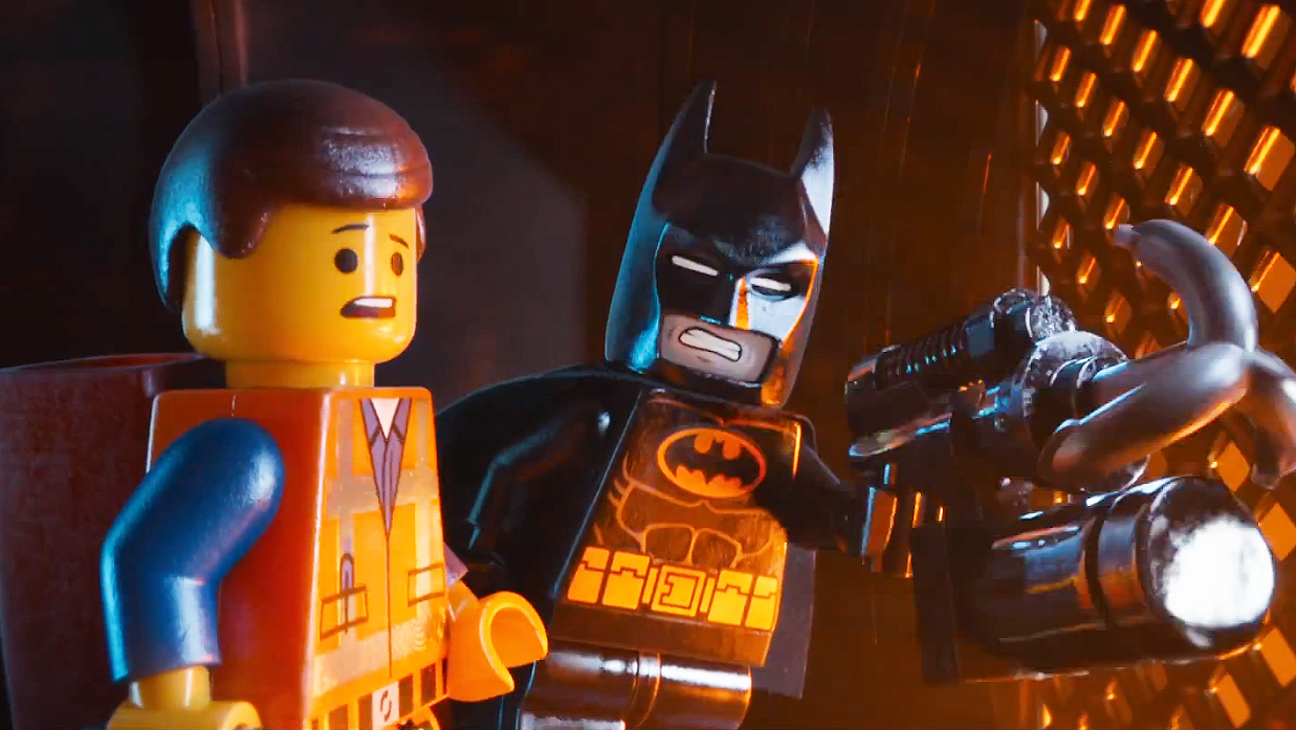
Lego Movie, The - scene

Now that it’s here, the first thing to be said about The LEGO Movie is: why the hell has it taken so long to get here?  We could have been enjoying Emmet’s adventures ages ago.  For The LEGO Movie is a blast, a glorious riot of colour and sound and unfettered imagination that erupts from the screen – especially in 3D – and happy-slaps the viewer full in the face… and then does it again several times over.  There’s just so much to enjoy, it’s embarrassing.  From the establishing shot stretching out from Emmet’s apartment to the level of detail in almost every frame, The LEGO Movie astonishes as often as it impresses as it entertains.  Of course, the visuals are key, the Lego worlds given a stunning amount of depth and solidity.  There’s so much going on that the movie needs a second or third viewing to catch everything that’s happening, and even then things are still likely to be missed.

With so many visual riches on display, and a dizzying array of sight gags – some daft, some ingenious and some just sublime – it would be wrong to think of the movie as just a kind of animator’s wet dream.  There is the script by co-directors Lord and Miller, a fantastic achievement that recognises the one over-riding aspect of LEGO that has been a part of its appeal since its first appearance in 1949: literally, anything can happen.  Witness the changes to Bad Cop’s car when he flies off the top of the train in The Old West, or the dizzying array of adaptations and changes that happen to the vehicle Emmet and Wyldstyle escape on when fleeing the police station.  The fact that the script can fit these wild feats of imagination into its more straightforward central storyline, and still deliver on some brilliant lines of dialogue as well – Batman: “I only work in black, or sometimes very, very dark grey”; Cowboy: “Do you think zeppelins are a bad investment?”; and Bad Cop: “Darn, darn, darny darn!” – shows just how much effort has been invested in bringing The LEGO Movie to completion.

The cast rise to the occasion, with Ferrell, Arnett and Freeman standing out from the crowd, supplying pitch perfect vocal performances, and there’s some great cameos – yes, that really is Anthony Daniels as C-3PO and Billy Dee Williams as Lando Calrissian (well, come on, who else was it going to be?) – that are fun to spot as well as goofily endearing.  And look out too for Superman (Tatum) being stalked by Green Lantern (Hill), a recurring gag that could be spun out into (at least) a LEGO short.  But the real, and completely unexpected vocal star, is Neeson, providing his usual gruff, tough-guy voice for Bad Cop, and alternating it when needed to a thin, whiny falsetto as Good Cop; it’s a wonderful performance and, well… who knew?

With a conclusion that veers close to being a little too sentimental – but is saved by a last-minute revelation that saves the day and sets up the sequel (due in 2017) – The LEGO Movie astonishes and amazes from start to finish.  It’s not often that an animated movie, ostensibly aimed at children, is this entertaining for adults as well but LEGO has been a part of so many people’s lives in the last sixty-five years that it should come as no surprise that adults will get as much out of the movie as kids will.  And it’s a rarer movie still that can cut across so many demographics and still retain its integrity.

Rating: 9/10 – a clever, impressive script married to a perfectly realised Lego environment makes The LEGO Movie an early contender for Animated Movie of the Year (and an earlier than expected challenge to Mr. Peabody & Sherman for that honour); sublime, exhilarating and pretty darn perfect.

Ride Along (2014)

Tags

, , , , , , , , , ,

Ride Along

D: Tim Story / 99m

Cast: Ice Cube, Kevin Hart, John Leguizamo, Bruce McGill, Tika Sumpter, Bryan Callen, Laurence Fishburne

There’s a moment in Ride Along where the viewer – even if they’ve only ever seen one other mismatched buddy-cop movie – has to say to themselves, “Whoa, hang on!”  The moment occurs when Ben (Hart) walks into a strip club convinced he’s dealing with a 126 (a nuisance call) and finds two guns pointed at him.  He doesn’t realise he’s in trouble and berates the two gunmen and challenges them to shoot him (he even throws in some reverse-racist taunting as well).  It’s the moment when the viewer has to throw his or her hands up in the air and say to themselves, “Okay, I know this isn’t the best mismatched buddy-cop movie in the world, but really, am I supposed to believe Ben is this dumb?”  Sadly, the answer is yes.

Ride Along is yet another dispiriting movie where the premise of two mismatched people having to work together to solve a mystery or crime is trotted out with ever decreasing results.  Ben is planning to marry Angela (Sumpter) but first has to get the approval of her brother, James (Cube).  James is a cop and thinks Ben isn’t good enough for Angela; he’s also trying to track down and apprehend a mysterious criminal called Omar (Fishburne).  Ben wants to impress James, and lets him know he’s been accepted to the police academy.  In an effort to dissuade him, James invites Ben on a ride along, a day spent with James to see if Ben has what it takes to be a police officer.

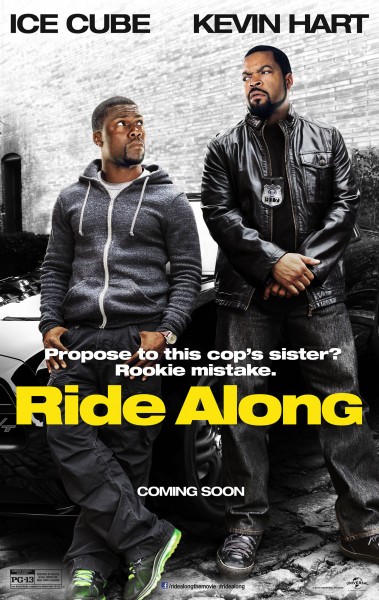
Ride Along - scene

There’s no prizes for guessing that while Ben makes mistake after mistake, he still manages to stumble onto clues that help James get closer to catching Omar.  It’s a tried and tested (and trusted) formula, but here it’s so wrung out and poorly plotted that even the average viewer is going to shake their head in disappointment.  It’s the same problem that most of these movies have to overcome: just how dumb or stupid does the main character have to be, and yet still be able to credibly help resolve whatever problem, crime or investigation is at the centre of the movie.  Hart is a promising talent – he’s like a less high-pitched Chris Tucker – but as Ben he’s unable to show a through line to both parts of the character.  He plays video games and it’s this that’s supposed to help him when he and James get into a firefight; but other than being able to recognise the sounds different guns make, it’s baffling how this could be of any real benefit, yet it’s treated like a major asset (and then only as briefly as it will take to read this).  Hart also falls into the trap of thinking that if he shouts something loudly enough it will be funny (it’s not).

Cube clumps through the movie like it’s a contractual obligation, using his trademark scowl as if it’s the only piece of characterisation he needs.  He has two expressions: mad and angry, and he uses them like weapons to batter the other characters.  It’s like watching someone who’s been told he’s got a week to live and the only item on his bucket list is to be as miserable as the situation demands.

With scenes that either outstay their welcome after a couple of minutes, or fail to advance or add to the storyline, Ride Along stutters and stumbles its way from the  lacklustre, poorly edited opening action sequence to the ridiculous denouement that inevitably involves Angela being put in danger by Omar.  By that point, anyone who’s stayed the distance will be hoping Omar wins out and shoots both Ben and James so that we don’t have to endure the inevitable – and recently announced – sequel.

Further down the cast list we have John Leguizamo, an actor with such a varied range and filmography that he can be forgiven his involvement here, while Fishburne pops up to provide unconvincing menace as Omar.  In the director’s chair, Tim Story brings a journeyman’s approach to the material, failing to add anything special to proceedings and shooting in a predictable, straightforward style.  It all adds up to something that’s actually less than the sum of its parts.

Rating: 4/10 – a dire retread of an already overworked “comedy” formula, Ride Along is about as rewarding as a cold sore; derivative, embarrassing and just plain bad.

Philomena (2013)

Tags

, , , , , , , , , , , , ,

Philomena

D: Stephen Frears / 98m

Cast: Judi Dench, Steve Coogan, Michelle Fairley, Sophie Kennedy Clark, Mare Winningham, Barbara Jefford, Ruth McCabe, Peter Hermann, Sean Mahon, Anna Maxwell Martin

In 2004, and finding himself at a bit of a loss as to what to do after losing his job as a Labour government advisor, ex-journalist Martin Sixsmith (Coogan) is approached by the daughter of Philomena Lee (Dench) who suggests he writes a story about her.  Fifty years before, Philomena was forced to give up her baby boy, Anthony, by the nuns she was staying with at Sean Ross Abbey in Roscrea.  She has been trying to find him ever since but the nuns have always said they are unable to provide any information as to his whereabouts.

Intrigued, Sixsmith agrees to pursue the story after he meets Philomena, and they travel to Roscrea to see if they can find out anything further.  Advised by Mother Barbara (McCabe) that the records relating to Philomena were lost in a fire, they later discover that the records were destroyed by the nuns in a bonfire.  They also learn that the nuns were selling the children under their care, and mostly to Americans.

Martin and Philomena follow Anthony’s trail to the US.  Through Martin’s contacts, he discovers that Anthony was adopted by Doc and Marge Hess, and that they renamed him Michael; they also adopted another child, Mary, the daughter of one of Philomena’s friends at the abbey.  Michael grew up to be a lawyer and senior official in both the Reagan and Bush administrations, but sadly, he died in 1995.  Philomena decides she wants to meet some of the people who knew Michael, including his adopted sister, Mary (Winningham).  This leads to revelations about Michael’s life, and his death, that lead Philomena and Martin back to Roscrea.

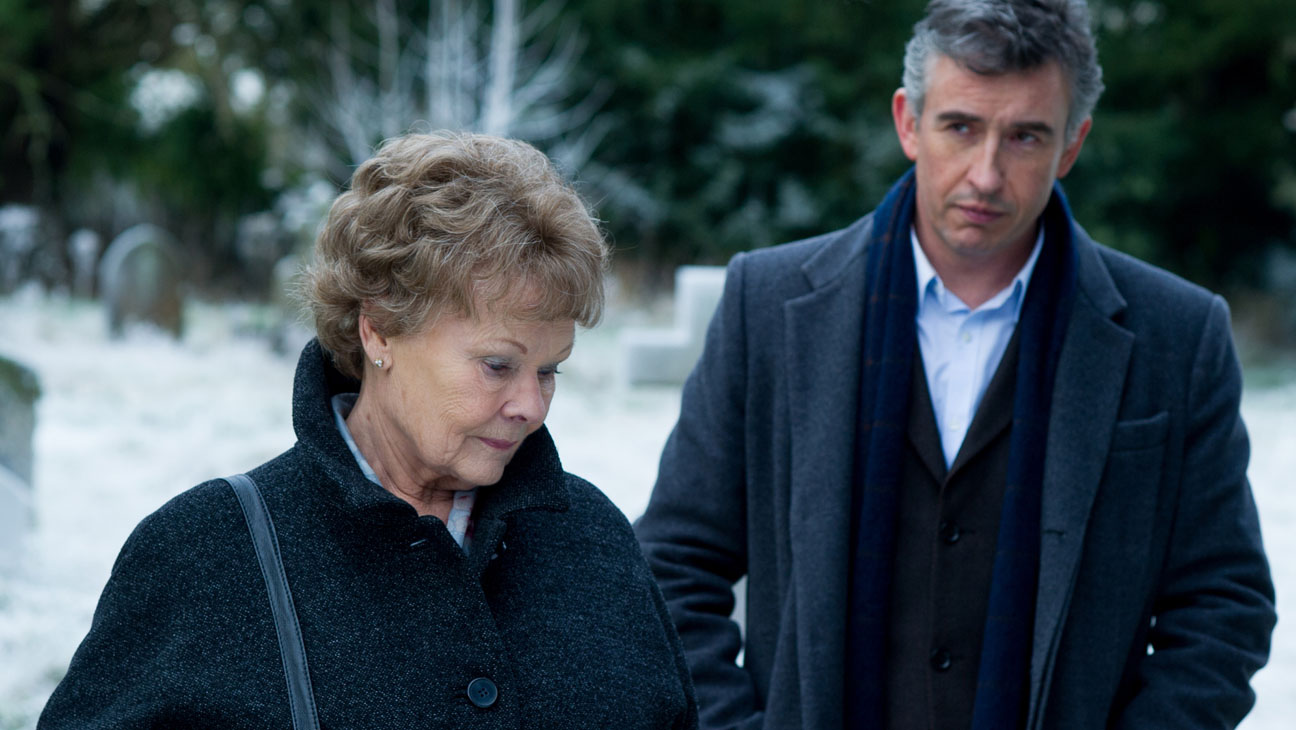
_D3S1363.NEF

With such an emotive subject, the script by Coogan and Jeff Pope, combines drama and humour and outrage in (nearly) equal measure.  The early scenes, showing some of the experiences the young Philomena (Clark) endured at the abbey are quite disturbing, and while we’ve seen a more systematic, and horrifying, appraisal of this type of religious “care” in Peter Mullen’s The Magdalene Sisters, they’re still distressing enough to get across the unfeeling and harsh approach of the nuns to the young women’s “sin of fornication”.  As their attempts to find out what happened to Anthony are blocked by the nuns, the movie deftly sidesteps the wider issue of Church-sanctioned neglect, and focuses on Philomena’s story instead.  It’s a wise move, and allows the movie to progress almost as a mystery, with discoveries made that add to the depth of the nuns’ deception.

Once in the US, the script adds elements of Philomena’s naïveté, at the same time as revealing she knows more about certain subjects than might be expected.  While there’s a certain amount of gentle mockery in these moments – she refers to several people as being “one in a million” – they’re offset by Philomena’s certainty in her own behaviour and outlook.  As played by Dench, Philomena is by turns, sad, angry, resourceful, determined, resigned, grieving, and ultimately, quite heroic.  There are several moments where Dench, in close-up, displays a range of emotions, and the viewer is left in no doubt as to what those emotions are, thanks to Dench’s skill as an actress.  There’s not one false note in her whole performance.

Thankfully, she’s matched by Coogan, whose performance begins more as a comic turn but soon develops into a dramatic one, his character finding his way into the story more and more and becoming as determined to discover the truth as Philomena.  As depicted here, Sixsmith is a bit ill-mannered, very dismissive of religion, and at times, manipulative.  His attitude compliments the more open and receptive nature that Philomena displays, and as a “team” their respective strengths make them both resourceful and disarming.  As they discover more and more about Michael, their reactions compliment each other as well.

Philomena is also buoyed up by confident, often impressive direction courtesy of Stephen Frears.  Frears is one of the most consistently thought-provoking directors working today, and he’s particularly good at taking complex material and making it accessible to audiences.  He’s helped here by the script, and by the wonderful performances, and orchestrates the various developments with great skill, making Philomena a particular pleasure to watch.  In many ways, it’s British filmmaking at its best: thoughtful, intelligent, humorous, well-mounted and inspiring.

Rating: 9/10 – aside from some deviations to the actual course of events, Philomena is a poignant, uplifting tale that can raise a tear as often as a smile; a triumph for all concerned and entirely deserving of the awards it’s won so far.

Mickey Cohen’s nose

Tags

, ,

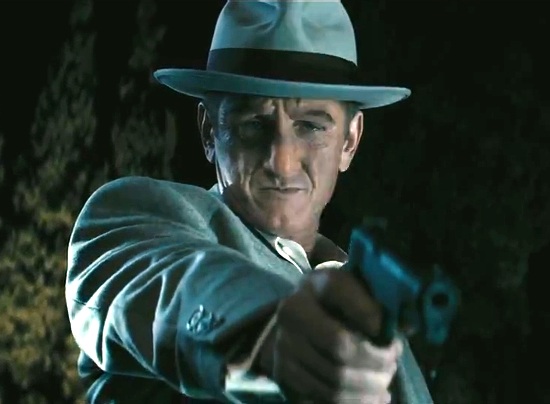
Just watched Gangster Squad again and I’m still in awe of the schnozz they put on Sean Penn.  I always hope there’s going to be an added scene where we see the nose enter a room a few seconds before the rest of Penn’s face but it never happens.  It made me wonder if he could even breathe through that thing!  Ah well…

Mickey Cohen's nose

Lone Survivor (2013)

Tags

, , , , , , , , , , , , ,

Lone Survivor

D: Peter Berg / 121m

Cast: Mark Wahlberg, Taylor Kitsch, Emile Hirsch, Ben Foster, Eric Bana, Alexander Ludwig, Yousuf Azami, Ali Suliman, Sammy Sheik

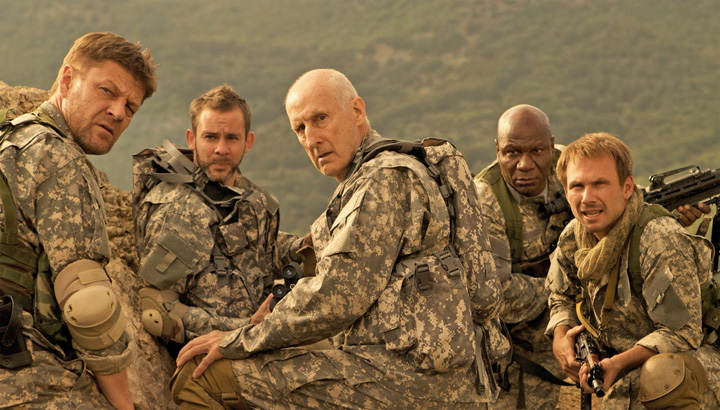
Based on the book by Marcus Luttrell, a serving Navy SEAL in Afghanistan in 2005, Lone Survivor tells the story of how Luttrell and three fellow SEALs found themselves under attack from the Taliban when a mission, Operation Red Wings, went horribly wrong.

Sent to locate and if possible, terminate the life of high-ranking Taliban leader Ahmad Shah (Azami), four SEALs, Luttrell (Wahlberg), Murphy (Kitsch), Dietz (Hirsch) and Axelson (Foster), find their target but at a camp where they would be heavily outnumbered if they engaged with Shah and his men. With their comms down, the group fall back to a position of safety before they attempt to reach higher ground for a better chance of their comms working.  There they are discovered by a trio of goat herders.  Stopping them from getting away, Luttrell and the rest of the team are faced with the dilemma of what to do with them.  The SEALs can either let them go, tie them up and leave them (with a good chance that the goat herders would perish after time), or kill them outright there and then.  Dietz and Axelson are keen for the third option to happen but Luttrell argues against it, until Murphy, as the team leader, decides they must be let go, despite knowing that the trio will tell the Taliban their location.  With the goat herders released, the four men have to get to higher ground and try and contact their base so they can be rescued.

Soon, Shah’s militia have caught up with them and the SEALs find themselves in a running firefight.  Still trying to contact their base, one by one the men are either shot or suffer injuries – Axelson twists an ankle, Dietz loses two or three fingers – that hamper their escape.  And one by one, the SEALs lose their lives until only Luttrell remains.  Faced with the daunting task of making it out alive by himself, Luttrell’s luck changes when he is discovered by nearby Pashtun villagers led by Gulab (Suliman).  He is given shelter while the villagers arrange for the nearest US base to be contacted, and Luttrell’s rescue can be effected.  Before that can happen, though, Shah’s men, led by second-in-command Taraq (Sheik), learn of his whereabouts and attack the village…

Lone Survivor - scene

Luttrell’s story is a remarkable one, a true tale of heroism and courage set against tremendous odds, and one in which his determination to survive reinforces how powerful that determination can be in an individual.  It’s worth noting that when Luttrell was found by the Pashtun villagers he had a number of fractures, a broken back, and various shrapnel wounds; later he sustained a gunshot wound as well.  We should salute the man’s bravery.  Lone Survivor is a testament to that, and to the team’s bravery as a whole.

However, under Peter Berg’s direction, Lone Survivor doesn’t quite hit the mark.  The one thing that’s missing from the movie is, perversely, any real sense of who these men are, even Luttrell.  We get no back stories, just perfunctory mentions of family back home, and the by-now familiar hazing that goes on in probably every military unit around the world.  All four men are presented as there were at that point in time; there’s no depth, no understanding of why these men have become SEALs or what it means to them.  In many ways, the script – adapted by Berg from Luttrell’s memoir – avoids getting to know these men, and this has a desensitising effect when they’re ambushed later in the movie.  When they come under fire, and begin sustaining injuries, there’s no emotional connection for the audience to make.  There are two scenes where the men are forced to put distance between them and Shah’s men by hurling themselves down rocky hillsides.  Instead of wincing at the punishment being (self-)inflicted, the viewer is instead left admiring the stunt work involved.

The extended encounter between the SEALs and the Taliban is set up well and there is a degree of tension before the first shot is fired.  After that, though, the movie settles for becoming the cinematic version of a video game, with – for the viewer – increased confusion as to where each man is in relation to the other, and even to their enemy.  When Murphy reaches a ledge where he can use his satellite phone to contact the base, it seems too far from where his comrades are, at that point, pinned down.  The same applies when Axelson is separated from Luttrell; again he appears to have travelled some considerable distance (albeit to no avail).  It’s these little anomalies that undermine the narrative and keep the firelight from being as tense and exciting as it should be.  When Luttrell finally manages to elude his attackers and is found by his rescuers, you have no real idea of how far he’s travelled, or even how he’s managed to avoid detection.

With all the attention given over to the physical exploits on display, there’s little for Wahlberg et al to do but decry each successive injury and show how much pain they are in.  Even in the relatively quieter moments in the village, where Luttrell befriends a young boy, there’s little for Wahlberg to do except look fearful and in pain (although there is a wonderful moment involving the word ‘knife’).

Ultimately, Lone Survivor feels like a movie that has just missed out on its full potential.  Berg’s direction is more than adequate for the material and while his script doesn’t help his own efforts in that area, he still manages to elicit good performances from his lead players.  The photography is polished and shows off the rugged countryside where the action takes place to often beautiful effect, and the sound editing is appropriately exciting and immersive during the firefight.  With a couple of uncredited appearances by Luttrell – watch for the SEAL who knocks over the coffee that newbie Patton (Ludwig) then has to clear up – Lone Survivor may have that participant’s blessing, but its audience will feel they need a lot more before they can give theirs.

Rating: 7/10 – while the action sequences are expertly staged and executed, they’re still not as exciting as they should have been, and the performances are bogged down by a lack of depth; not a complete misfire, but one that needed to beef up the characters and engage the audience’s sympathy a whole lot more.

The 86th Annual Academy Awards – The Oscars 2014

Tags

, , , , , , , , , , ,

Oscars 2014, The

Well, here we are again, falling to our knees in observance of the Oscars, that annual back-slap-athon where Hollywood’s mightiest (and occasionally humblest) come together to give their finest performances, particularly if they’re nominated but don’t win – the cameras are watching!  Here then are the winners (and losers), my views on the ceremony, Ellen DeGeneres as host, the jokes, the acceptance speeches, and who got those all-important statuettes… and whether they deserved them.  All this, and in a fraction of the time it takes to stage the whole show.  Winners in bold.

The show got off to a good start with Ellen DeGeneres wisecracking through a great opening monologue, taking the mickey out of Jennifer Lawrence’s trip from last year, June Squibb’s age, actors as college alumni (apparently Amy Adams didn’t go) and congratulating the guy impersonating Liza Minnelli.  The theme of the night was Movie Heroes and there were … montages shown throughout the show, as well as Bette Midler singing The Wind Beneath My Wings as a follow-on to the In Memoriam segment.  Ellen also set up a great running gag involving ordering in pizza (which for once, didn’t seem like it had been rehearsed).  But she also stumbled over her words a lot, and seemed distracted; a couple of times she wasn’t even ready to camera (let’s get the Bring Back Billy Crystal campaign going now!).

There was a tribute to The Wizard of Oz sung by Pink that was as effective as it was unexpected, the usual live performances of songs nominated for Best Original Song, and fortunately, no embarrassing moments where speeches too far over while someone thanked their auntie, their budgie and/or God (that was left to one of the winners).  Over all, it was an entertaining show but it still couldn’t avoid some of the usual pitfalls – the length, the awkwardness of certain presenters, wheeling out someone on their last legs (this year, Sidney Poitier), and clips that showed several actors shouting at each other as if that’s a sign of good acting.

Best Motion Picture of the Year

American Hustle, Captain Phillips, Dallas Buyers Club, Gravity, Her, Nebraska, Philomena, 12 Years a Slave, The Wolf of Wall Street

The right choice, but the longest, most excited speech of the night by Steve McQueen, and then he started jumping about!  Presented by Will Smith.

Best Performance by an Actor in a Leading Role

Christian Bale (American Hustle), Bruce Dern (Nebraska), Leonardo DiCaprio (The Wolf of Wall Street), Chiwetel Ejiofor (12 Years a Slave), Matthew McConaughey (Dallas Buyers Club)

No problems here except for McConaughey’s rambling, though emotional speech.  Presented by Jennifer Lawrence.

Best Performance by an Actress in a Leading Role

Amy Adams (American Hustle), Cate Blanchett (Blue Jasmine), Sandra Bullock (Gravity), Judi Dench (Philomena), Meryl Streep (August: Osage County)

A superb performance given its rightful due properly rewarded and with a pro-women stance in her speech from Blanchett.  Presented by Daniel Day-Lewis.

Best Performance by an Actor in a Supporting Role

Barkhad Abdi (Captain Phillips), Bradley Cooper (American Hustle), Michael Fassbender (12 Years a Slave), Jonah Hill (The Wolf of Wall Street), Jared Leto (Dallas Buyers Club)

Leto made a really good speech thanking his mother in particular and made reference to the troubles in Ukraine and Venezuela; a good start to the evening, and a well-deserved award.  Presented by Anne Hathaway.

Best Performance by an Actress in a Supporting Role

Sally Hawkins (Blue Jasmine), Jennifer Lawrence (American Hustle), Lupita Nyong’o (12 Years a Slave), Julia Roberts (August: Osage County), June Squibb (Nebraska)

A standing ovation for Nyong’o tops an amazing year for the actress, and her emotional speech was a highlight.  Presented by Christoph Waltz.

Best Achievement in Directing

Alfonso Cuarón (Gravity), Steve McQueen (12 Years a Slave), Alexander Payne (Nebraska), David O. Russell (American Hustle), Martin Scorsese (The Wolf of Wall Street)

Absolutely the right result and confirmation (as if it was needed) of the effort and work Cuarón put into making Gravity.  Presented by Angelina Jolie and Sidney Poitier.

Best Writing, Screenplay Written Directly for the Screen

Woody Allen (Blue Jasmine), Craig Borten, Melisa Wallack (Dallas Buyers Club), Spike Jonze (Her), Bob Nelson (Nebraska), Eric Warren Singer, David O. Russell (American Hustle)

A popular choice and a bit of a surprise, but it could have gone to any of the nominees.  Presented by Robert De Niro and Penelope Cruz.

Best Writing, Screenplay Based on Material Previously Produced or Published

Steve Coogan, Jeff Pope (Philomena), Richard Linklater (Before Midnight), Billy Ray (Captain Phillips), John Ridley (12 Years a Slave), Terence Winter (The Wolf of Wall Street)

Spot-on and an easy choice though, noticeably, no mention for Steve McQueen in Ridley’s acceptance speech.  Presented by Robert De Niro and Penelope Cruz.

Best Animated Feature Film of the Year

The Croods, Despicable Me 2, Ernest & Célestine, Frozen, The Wind Rises

Wow, another big surprise – not!  Still, a great result though it would have been nice to see Ernest & Célestine win the Oscar.  Notable for Disney’s first win in this category, and strangely, just when there wasn’t a Pixar movie in the running.  Presented by Kim Novak and Matthew McConaughey.

Best Foreign Language Film of the Year

The Broken Circle Breakdown, The Great Beauty, The Hunt, The Missing Picture, Omar

A great win for a great movie, and one of the easiest awards of the evening to predict.  Presented by Ewan McGregor and Viola Davis.

Best Achievement in Cinematography

Roger Deakins (Prisoners), Bruno Delbonnel (Inside Llewyn Davis), Philippe Le Sourd (The Grandmaster), Emmanuel Lubezki (Gravity), Phedon Papamichael (Nebraska)

Predictable win but should have gone to Phedon Papamichael; the first big disappointment (for me) of the evening.  Presented by Amy Adams and Bill Murray.

Best Achievement in Editing

Alan Baumgarten, Jay Cassidy, Crispin Struthers (American Hustle), Alfonso Cuarón, Mark Sanger (Gravity), Martin Pensa, John Mac McMurphy (Dallas Buyers Club), Christopher Rouse (Captain Phillips), Joe Walker (12 Years a Slave)

Let the Gravity backlash continue!  Captain Phillips was by far the better edited movie nominated and should have won hands down.  Presented by Anna Kendrick and Gabey Sidoureh.

Best Achievement in Production Design

K.K. Barrett, Gene Serdena (Her), Judy Becker, Heather Loeffler (American Hustle), Catherine Martin, Beverley Dunn (The Great Gatsby), Andy Nicholson, Rosie Goodwin, Joanne Woollard (Gravity), Adam Stockhausen, Alice Baker (12 Years a Slave)

Awarded after the award for Costume Design (see below) and a well-deserved double for Catherine Martin.  Presented by Jennifer Garner and Benedict Cumberbatch.

Best Achievement in Costume Design

William Chang Suk Ping (The Grandmaster), Catherine Martin (The Great Gatsby), Patricia Norris (12 Years a Slave), Michael O’Connor (The Invisible Woman), Michael Wilkinson (American Hustle)

Unsurprising win for Mrs Luhrmann. Presented by Naomi Watts and Samuel L. Jackson.

Best Achievement in Makeup and Hairstyling

Joel Harlow, Gloria Pasqua Casny (The Lone Ranger), Adruitha Lee, Robin Mathews (Dallas Buyers Club), Steve Prouty (Jackass Presents: Bad Grandpa)

Again, an unsurprising win; it almost seemed as if the other two movies were there just so there could be a list.  Presented by Naomi Watts and Samuel L. Jackson.

Best Achievement in Music Written for Motion Pictures, Original Score

William Butler, Andy Koyama (Her), Alexandre Desplat (Philomena), Thomas Newman (Saving Mr. Banks), Steven Price (Gravity), John Williams (The Book Thief)

A good result for a Brit, but not so sure that either Desplat or Newman shouldn’t have won instead.  Presented by Jamie Foxx and Jessica Biel.

Best Achievement in Music Written for Motion Pictures, Original Song

Kristen Anderson-Lopez, Robert Lopez – Let It Go (Frozen), Bono, Adam Clayton, The Edge, Larry Mullen Jr, Brian Burton – Ordinary Love (Mandela: Long Walk to Freedom), Karen O – The Moon Song (Her), Pharrell Williams – Happy (Despicable Me 2)

Fun acceptance speech and one of the best of the night but it should have been given to The Moon Song – at this stage both Frozen and The Great Gatsby had won more awards than 12 Years a Slave.  Presented by Jamie Foxx and Jessica Biel.

Best Achievement in Sound Mixing

Christopher Boyes, Michael Hedges, Michael Semanick, Tony Johnson (The Hobbit: The Desolation of Smaug), Chris Burdon, Mark Taylor, Mike Prestwood Smith, Chris Munro (Captain Phillips), Andy Koyama, Beau Borders, David Brownlow (Lone Survivor), Skip Lievsay, Niv Adiri, Christopher Benstead, Chris Munro (Gravity), Skip Lievsay, Greg Orloff, Peter F. Kurland (Inside Llewyn Davis)

Again, not much of a surprise, but should really have gone to Captain Phillips.  Presented by Chris Hemsworth and Charlize Theron.

Best Achievement in Sound Editing

Steve Boeddeker, Richard Hymns (All Is Lost), Brent Burge (The Hobbit: The Desolation of Smaug), Glenn Freemantle (Gravity), Wylie Stateman (Lone Survivor), Oliver Tarney (Captain Phillips)

See above.  Presented by Chris Hemsworth and Charlize Theron.

Best Achievement in Special Effects

Tim Alexander, Gary Brozenich, Edson Williams, John Frazier (The Lone Ranger), Roger Guyett, Pat Tubach, Ben Grossman, Burt Dalton (Star Trek: Into Darkness), Joe Letteri, Eric Saindon, David Clayton, Eric Reynolds (The Hobbit: The Desolation of Smaug), Christopher Townsend, Guy Williams, Erik Nash, Daniel Sudick (Iron Man 3), Timothy Webber, Chris Lawrence, David Shirk, Neil Corbould (Gravity)

If Gravity hadn’t won then there should have been a steward’s enquiry; well-deserved and absolutely the one undeniable shoo-in of the ceremony.  Presented by Emma Watson and Joseph Gordon-Levitt.

Best Documentary, Feature

The Act of Killing, Cutie and the Boxer, Dirty Wars, The Square, 20 Feet from Stardom

First real surprise of the night given that everyone pretty much expected The Act of Killing to win, and a chance to hear the amazing Darlene Love in full voice.  Presented by Bradley Cooper.

Best Documentary, Short Subject

Cavedigger, Facing Fear, Karama Has No Walls, The Lady in No 6, Prison Terminal: The Last Days of Private Jack Hall

A moving piece and well-deserved, and a tribute to Alice Sommer-Herz who sadly died a week ago.  Presented by Kate Hudson and Jason Sudeikis.

Best Short Film, Animated

Feral, Get a Horse!, Mr Hublot, Possessions, Room on the Broom

A great win for this French movie, and much deserved, in what was a very close category.  Presented by Kim Novak and Matthew McConaughey.

Best Short Film, Live Action

Do I Have to Take Care of Everything?, Helium, Just Before Losing Everything, That Wasn’t Me, The Voorman Problem

A great result and proof that the Academy gets it right pretty much every time in the “minor” short film categories.  Presented by Kate Hudson and Jason Sudeikis.

10 Reasons to Remember Alain Resnais (1922-2014)

Tags

, , , , , ,

Alain Resnais (3 June 1922 – 1 March 2014)

Alain Resnais

The career of Alain Resnais, which spanned over six decades, was a tribute to his ability to take complex notions of time and memory and make intricate, yet accessible movies around those same notions. Watching Hiroshima Mon Amour (1959) and Last Year at Marienbad (1961) – two of his most well-known movies – one is immediately struck by the way he bends narrative strands to sometimes hallucinatory effect.

Resnais was working in film long before then, though, making short features and documentaries (two of which are now believed lost). He was also an editor, only leaving that aspect of filmmaking behind when he became a director. His breakthrough was the quietly devastating Holocaust documentary Night and Fog (1955). Shot in black and white and letting the graphic images speak for themselves, Night and Fog is still a difficult watch even today.

In the Sixties, he was linked to the French New Wave but didn’t regard his work as part of that movement, preferring to work with authors such as Marguerite Duras and Jacques Sternberg, and refine his aptitude for movies about the passing of time and our relationship to it. He could be both stringent and playful, and always thought-provoking. Although his later projects didn’t achieve the kind of box office results his first few features did, they were still critically well-received, even when he moved towards making movies that explored the relation between cinema and other cultural forms such as music and theatre. His last movie, Life of Riley, an adaptation of a play by Alan Ayckbourn, will be released later this month.

A true original, with a distinct cinematic aesthetic, Resnais will be sorely missed. And here are ten reasons why.

Night and Fog

1 – Night and Fog (1955)

2 – Hiroshima Mon Amour (1959)

3 – Last Year in Marienbad (1961)

4 – Muriel, or the Time of Return (1963)

5 – Je t’aime je t’aime (1968)

6 – Providence (1977)

7 – My American Uncle (1980)

8 – Love Unto Death (1984)

9 – Smoking/No Smoking (1993)

10 – Private Fears in Public Places (2006)

Private Fears in Public Places

Swerve (2011)

Tags

, , , , , , , , , ,

Swerve

D: Craig Lahiff / 86m

Cast: Jason Clarke, Emma Booth, David Lyons, Travis McMahon, Vince Colosimo, Roy Billing, Chris Haywood

While travelling across the Australian desert region near Broken Hill, Colin (Lyons) happens upon a road accident.  He finds a dead man, a briefcase full of money, and, as this is a modern day noir thriller, a femme fatale in the form of Jina (Booth), who’s also the cause of the accident.  Colin takes her home and then heads into Broken Hill to hand in the money to the local sheriff (Clarke).  Everything is going okay, and Colin is preparing to continue on his way, when the sheriff, Frank, insists he come home with him to meet his wife as a gesture for being so public spirited.  (There’s no prizes for guessing just who Frank’s wife turns out to be.)  When the money goes missing, and a “representative” of the people the money was intended for shows up – with murderous intent – the fragile relationship between Frank, Jina and Colin begins to unravel.

What follows is a well-crafted thriller where, Colin aside, you’re never entirely sure who’s conning who, or if Jina can be entirely trusted, despite her obvious desire to get away from Frank (who is abusive and jealous).  Colin is the only “straight” character in the whole movie and although he does learn to become a bit more devious by the movie’s end, it’s still intriguing to see just how much has to happen to him before his natural attitude changes.  Lyons plays the part to perfection, and while he is adequately matched by Clarke as the increasingly dysfunctional Frank, it’s his integrity that actually holds the attention.

Clarke has since gone on to bigger things: Lawless, Zero Dark Thirty, Baz Luhrmann’s sumptuous The Great Gatsby, and White House Down.  Clarke is an intense actor, and he imbues Frank with a charming edginess that makes watching him an uneasy experience; you’re never too sure just how he’s going to react at any given moment, or in any given situation.  When a subplot involving the death of one of Frank’s deputies comes to the fore, Clarke ups the ante and makes Frank an even darker character than before but without sacrificing any credibility.

Swerve - scene

As Jina, a lot is required of Emma Booth as the character is the linchpin of the whole movie.  From the moment we see her racing down the highway, to the movie’s denouement, Booth displays just the right amounts of complexity and vulnerability to give her character a bruised steeliness that makes the viewer, like Colin, want to protect and mistrust her at the same time.

Lahiff, returning to feature film-making after a nine year hiatus, carries the audience through each twist and turn of the plot with skilled assurance, and makes great use of the desert locations; on occasion, David Foreman’s cinematography is stunning.  The script, also by Lahiff, is pared down to the bone and there’s not one superfluous moment or scene in the entire movie, an aspect helped immeasurably by Lahiff’s brother Sean being the movie’s editor.

Rating: 7/10 – an unpretentious and accomplished thriller from Down Under and the kind of movie the Aussies do so well; good performances and beautiful location work help Swerve stand out from the crowd.

Originally posted on thedullwoodexperiment website.

Mini-Review: Tracks (2013)

Tags

, , , , , , , , , , ,

Tracks

D: John Curran / 110m

Cast: Mia Wasikowski, Adam Driver, Emma Booth, Jessica Tovey, Rainer Bock, Robert Coleby, Roly Mintuma

An adaptation of Robyn Davidson’s account of her 1977 trek across 1700 miles of Australian countryside, from the interior to the Indian ocean, accompanied by four camels and her faithful dog, John Curran’s film is a beautiful, life-affirming odyssey that shows the highs and the lows of Davidson’s trip, and doesn’t shrink from showing her as naive, stubborn and arrogant alongside being focused, resourceful and kind-hearted. Helped by sponsorship from National Geographic magazine and “assisted” by NG photographer Rick Smolan (Driver), Davidson (Wasikowska) sets off on a journey that few people think she will finish. Along the way she meets and receives help from a variety of sources, including Mr Eddie (Mintuma), who helps guide her across sacred Aboriginal land. She faces hardship and heartbreak, and retains a dogged determination throughout.

Tracks - scene

By the journey’s end, you’re almost as pleased to see the ocean as she is. Wasikowska – who wasn’t even born when this project was first mooted – captures Davidson’s spirit and tenacity perfectly, and convinces in a number of subtly demanding scenes. Her fresh-faced appearance suits the role, and she is ably supported by Driver and the rest of the cast. Curran’s direction is unfussy and the journey unfolds at a measured pace that matches the time it took Davidson to travel those 1700 miles. As you’d expect, the scenery is stunning, and Mandy Walker’s cinematography shows off every vista and open landscape to beautiful effect. If there is anything that lets down the movie it’s the relative lack of incident – over 1700 miles there are only two events that, after viewing the film, will stay in the memory. Still, Tracks is an absorbing, impressive feature, and as you might expect, the camels steal every scene they’re in.
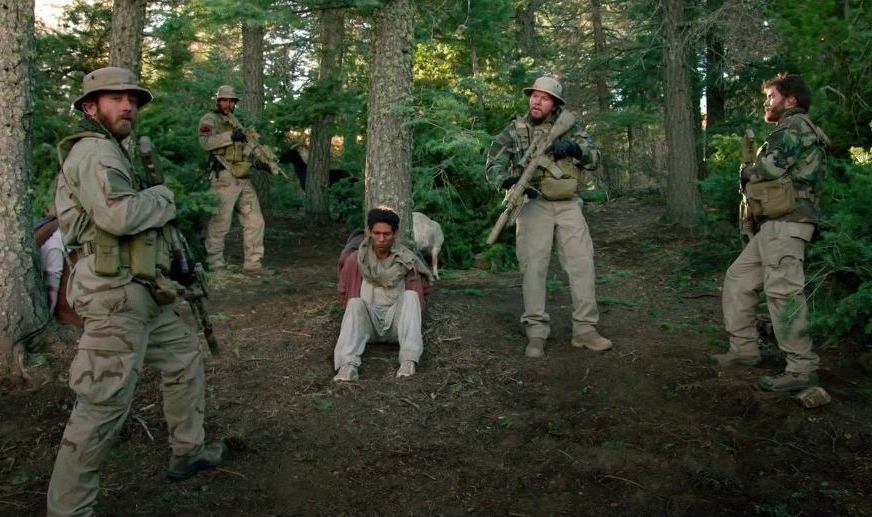
Rating: 8/10 – a true-life adventure given a respectful but intelligent approach; with vast swathes of the Australian outback on view, this is also breathtaking to watch.

Mandela: Long Walk to Freedom (2013)

Tags

, , , , , , , , , , , , ,

Mandela Long Walk to Freedom

D: Justin Chadwick / 141m

Cast: Idris Elba, Naomie Harris, Tony Kgoroge, Riaad Moosa, Zolani Mkiva, Simo Mogwaza, Fana Mokoena, Thapelo Mokoena

Since its publication in 1995, Nelson Mandela’s autobiography, Long Walk to Freedom has been one of those books that was always going to be adapted for the big screen; Mandela’s life was just too extraordinary to be ignored.  And now, thanks to producer Anant Singh, overseer of the project since the book’s publication, we now have fifty years of Mandela’s life condensed down into two hours and twenty one minutes.  Is it enough?  Perhaps…

The movie opens in 1942.  Mandela is a lawyer along with Oliver Tambo.  He works within the courts system and in his spare time, boxes.  He marries and has two children.  He is aware of the political injustice prevalent in South Africa, but has yet to become politicised.  When, in 1950, he witnesses a demonstration that advocates boycotting the buses – because the fares have increased unfairly – it triggers something inside him that makes him join the African National Congress.  Now a revolutionary, he supports non-violent means of attacking the system, but when the massacre at Sharpeville occurs in 1960, he realises that violence is a necessary tool against the Afrikaaners.  During this period, he also meets and takes as his second wife Winnie Madikizela (Harris), his first marriage having ended when he became radicalised.  Arrested in 1962 (according to the movie), Mandela is tried and sentenced to life imprisonment.  Along with seven other ANC members he is transported to Robben Island.  During his internment he remains an important figure within the ANC, but while he learns to approach the problem of apartheid by promoting peace, violent demonstrations and clashes with the police continue to occur across South Africa.  When the government comes calling with the promise of his being released if he helps quell the violence – by renouncing it – Mandela is faced with opposition from both Winnie and right-wing factions within the ANC.  He gains his release, begins to put into place his vision for a united South Africa, and this is where the movie ends, with Mandela having become president.

Mandela Long Walk to Freedom - scene

Adapting such a complex book was always going to be a challenge, and in the hands of William Nicholson, the screenplay does its best to cover the key moments in Mandela’s life without seeming like a hagiography.  However, this leads to many events being given a brief amount of screen time, and it becomes difficult on occasion to judge the importance of some of those events – for example, when Mandela and his fellow ANC members arrive at Robben Island, only one of them is given long trousers to wear, the rest, including Mandela, have to wear shorts.  Mandela campaigns to have long trousers for everyone, but his persistence – as well as the script’s – is free from explanation.  Elsewhere, Winnie’s own imprisonment – sixteen months in solitary confinement at one point – is referred to only when she gets out.  And therein lies another problem: the script shies away from making anything too unpalatable for the viewer.  Robben Island was an awful place, with cells that were too small, and living conditions that were designed to sap the will.  And yet, Mandela seems to get on okay there; you could argue that he even flourishes.  Winnie’s change from supportive wife and mother to violence advocating activist is presented in broad brush strokes, and while Harris convinces in an otherwise underwritten role, there’s too little character development for her, or the viewer, to latch onto.  (It doesn’t help that, due to the need to focus on Mandela, Winnie appears only here and there in the narrative, and in the end, she becomes the violent “face” of the ANC, a political boogeyman that Mandela is forced to distance himself from.)

With too many years to cover and too many incidents and events to fit in, Mandela: Long Walk to Freedom suffers in the long run, and ends up like a potted history of one man’s turbulent life.  There’s also a semi-reverential tone that stops the movie from being too emotive, even when the characters are suffering or events such as the Sharpeville massacre take centre stage (this tragedy, where children were killed as well as adults, is over in a matter of minutes; there’s no time to fully appreciate the horror of the impending situation nor its aftermath, and not in the way that, say, Richard Attenborough addressed the massacre at Amritsar in Gandhi).  With the movie thus appearing flat and with no appreciable highs and lows, it’s like being told about someone’s life but by someone who can’t quite connect with, or understand, the events they’re relating.

As Mandela, Elba gives a superb, measured performance that, thankfully, makes up for  a lot of the movie’s inefficiencies (good luck to anyone trying to work out who’s who in the ANC and on Robben Island; they may have names in the credits but they’re certainly not identified in the movie).  Elba dominates the movie, nailing the husky cadences of Mandela’s speech, and projecting an authoritative aura in the movie’s later stages when dealing with the government’s representatives and the political liability that Winnie has become.  He is never less than convincing throughout, and it’s a tribute to Elba that he manages to imbue Mandela with a spiritual quality that the script downplays and which might otherwise have been missed.  In support, Harris matches Elba for commitment and avoids demonising Winnie for her beliefs.  It’s a far more subtle performance than it first appears.

Hampered by the script, director Chadwick nevertheless manages to keep the movie interesting and rightly trains the camera on Elba as much as he can.  There’s a fine score courtesy of Alex Heffes, as well as crisp, warm cinematography from Lol Crawley.  With glorious location work, and good performances  all round, Mandela: Long Walk to Freedom doesn’t fly as high as you’d hope, but it does offer a fairly straightforward account of Mandela’s life over fifty years and the struggles he – and his country – endured during that period.

Rating: 7/10 – solid if unspectacular production raised up a notch or two by Elba’s excellent performance; worthy, yes, but also dull in places, and lacking in verve.

That Awkward Moment (2014)

Tags

, , , , , , , , , , , ,

That Awkward Moment

D: Tom Gormican / 92m

Cast: Zac Efron, Miles Teller, Michael B. Jordan, Imogen Poots, Mackenzie Davis, Jessica Lucas, Addison Timlin, Josh Pais

With the rom-com feeling like it’s hit a bit of a rut at the moment, this male-centric offering from first-time writer/director Gormican seems – at first glance – to offer something a little bit different.

When Mikey (Jordan) tells his friends Jason (Efron) and Daniel (Teller) that his wife, Vera (Lucas) wants a divorce, it prompts them to make a pact: to avoid serious, long-term relationships and revisit their younger days when they partied and flirted and drifted from woman to woman.  For Jason and Daniel this isn’t so difficult as this is what they’re already doing; for Mikey it proves a little bit harder as he still wants to rescue his marriage.

Jason meets Ellie (Poots) at a bar and they go back to her place.  A misunderstanding sees him leave before she wakes the next morning, but already he’s smitten.  When they meet again where he works as a book jacket designer (in tandem with Daniel), they resume their fledgling relationship, and begin spending more time together.  Daniel, who uses his friend Chelsea (Davis) to pick up girls, finds himself becoming attracted to her; their friendship evolves into their becoming lovers themselves.  With Mikey rekindling his marriage to Vera, all three men find themselves reneging on the pact they made.  Afraid of ruining their own relationships, the men find themselves struggling to admit their feelings for the women in their lives, both to themselves and to each other.

Film Review That Awkward Moment

That Awkward Moment is, at heart, more of a bromance than a romantic comedy, with the relationship between Jason, Daniel and Mikey taking centre stage.  With this in mind it’s easy to dismiss the movie as a “guys-can-be-jerks-but-deep-down-they’re-really-sensitive” modern-day fairy tale.  They’re all good guys and they have an obviously close bond but they can’t seem to relate that well to women, until they meet the right ones (or in Mikey’s case, fail to call her back).  There’s the usual missteps and misunderstandings along the way, a couple of minor emotional upheavals, and the sight of Efron and Teller both attempting to pee while dealing with the effects of Viagra.  The humour is generally low-key (there are few laugh-out-loud moments), and some scenes are entertaining in an offbeat way, but the way in which the guys lie and deceive each other is wearing and uninspired.  It’s this haphazard approach that keeps the movie from being as insightful as it would like to be, and as original as it thinks it is.
Of the male leads, Teller (recently revealed to be the new Reed Richards in the Fantastic Four reboot) fares best, his rapid fire delivery and caustic put-downs infused with a nervous energy that suits his often dismissive character.  Jordan is required to look either bemused or credulous a lot, and while his character is the most likeable of the three, he gets less screen time.  It’s Efron, though, who gets a bit of a raw deal.  Jason is, to put it bluntly, a bit of a prick.  He’s a commitment-phobe who balks when the women he’s seeing start to ask where their relationship is going (the awkward moment of the title), and he badly disappoints Ellie at a time when she really needs him.  He views being “serious” as something to be avoided, even when he is clearly falling in love; why he’s so repressed in this area is never satisfactorily explored or explained.  As a consequence, Efron is hard-pressed to make Jason sympathetic; he just makes too many easily avoided mistakes.
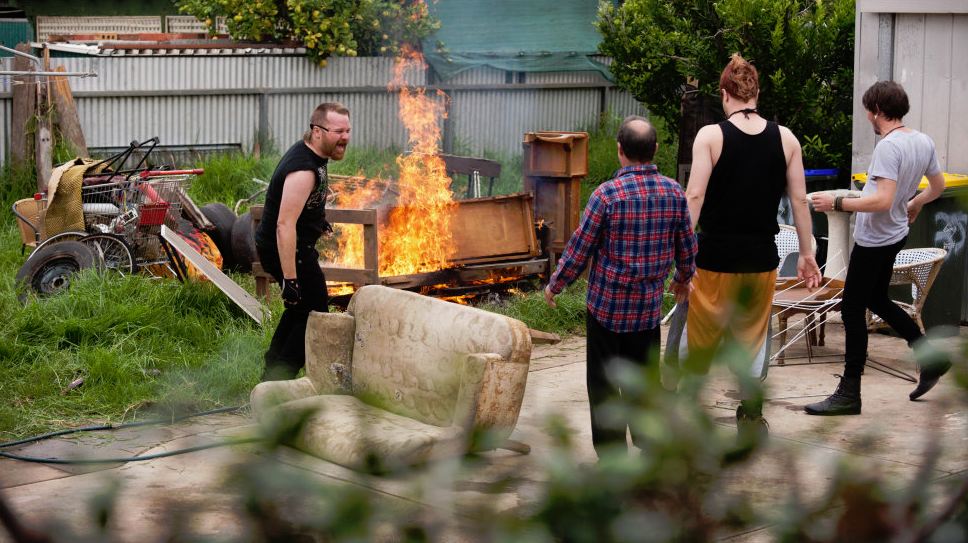
As the slightly kooky Ellie, Poots cements her rising star status, while Davis’s confident turn should ensure her career gains momentum, but Lucas is saddled with a one-note character who is never developed in a way that would make her interesting.  The script is at fault here, and it’s this lack of attention to some of the characters that stops the movie from breaking out of its own shell.  That aside, there are some good moments – Jason attending a party and misunderstanding the dress code, Daniel and Chelsea’s friendship evolving into something more serious – but there aren’t enough of them to make up for the shortage elsewhere.
Under Gormican’s direction, That Awkward Moment ambles through its running time, neither pleasing its audience entirely or taking too many risks.  The material wears thin too soon, and there’s not enough depth to make the interplay between the couples anything less than perfunctory.  There’s the germ of a good idea here, but Gormican can’t quite get it to flower.

Rating: 5/10 – below par bromantic comedy that never takes off or seems to want to; a patchy script means a patchy movie and a severely weakened premise.

Nebraska (2013)

Tags

, , , , , , , , , , ,

Nebraska

D: Alexander Payne / 115m

Cast: Bruce Dern, Will Forte, June Squibb, Stacy Keach, Bob Odenkirk

When Woodrow “Woody” Grant (Dern) receives a letter saying he’s won $1,000,000, he heads off on foot to Lincoln, Nebraska to claim it. The fact that he lives in Billings, Montana, means nothing to him, nor does his age or that he walks like someone who’s had a bad hip replacement (if what we see isn’t Dern’s natural gait then it’s an impressive piece of character development).  Woody believes the letter wouldn’t have been sent to him if the offer wasn’t legitimate, and though it’s clearly dubious, his resolve to travel to Lincoln doesn’t falter.

When it becomes clear Woody isn’t going to give up on his plan to claim his prize money from the promoters in Lincoln, his son David (Forte) agrees to take him there, even though he knows the prize offer isn’t as clear cut as it seems. David is struggling to make sense of his own life, and plans to use the trip to work out his problems. His relationship with Woody is strained as well, and as the journey begins, shows no sign of improving. With a stopover on the way at Woody’s hometown of Hawthorn and a stay with various relatives who all seem to want a slice of Woody’s money, David needs all his wits about him to avoid both a family feud and the more violent reprisals that sleazy ex-partner Ed (Keach) refers to if Woody doesn’t pay back the money he feels he’s owed.

Nebraska‘s strength lies in its main character. Woody is a man who has found himself at a distance from his family and his life. The money has given him a new purpose, and its the non-supportive response he receives from those nearest and (hopefully) dearest to him that goads him into action. There’s a case to be made for Woody knowing that the money isn’t “real”, and there’s a further case to be made that he’s enjoying the attention he’s getting, but Woody is a plain man with plain desires, and while everyone around him attempts to complicate matters, Woody keeps his head down and only occasionally looks up to see what’s happening around him. And when he does, it’s hard not to think he looks amused at all the shenanigans he’s caused. Woody is a wonderfully nuanced character, one who appears lost in a fog of early-onset dementia, but he’s a canny creation as well, diffident about most things but quietly impassioned about the things that matter to him.

Nebraska - scene

Using such a wonderful character as their base, director Payne and regular scriptwriter Bob Nelson have fashioned one of the most heartfelt and engaging movies of 2013. Shot in luminous black and white by Phedon Papamichael (This Is 40, The Descendants), and with a wonderful emotive score by Mark Orton, this is perhaps Payne’s most fully and perfectly realised feature to date. Dern is superb, an old man on the verge of giving up but who latches on to the prize money like a quest. Forte, usually a comic actor, here finds a quiet grace that instils his character perfectly, while Odenkirk as his brother Ross shines in a supporting role. Keach provides credible menace, but it’s June Squibb as Woody’s long-suffering wife Kate who steals the movie; she gets the best lines and delivers them all impeccably, including the best line in the whole movie.

With its bittersweet undercurrent and meditation on what it’s like to try and hold on to a sense of purpose as old age takes over, Nebraska is charming, heartwarming, life-affirming and altogether a gem. With its gentle, often hilarious comic moments and a clutch of winning performances, allied to a superb script and Payne’s sublime directing, this is one road trip you won’t want to end.

Rating: 9/10 – Nebraska tells a simple tale but adds several layers to give it an impressive depth; Payne continues to build an equally impressive body of work and stake his claim to being the US’s premier indie filmmaker.

Mini-Review: All Is Lost (2013)

Tags

, , , , ,

All Is Lost

D: J.C. Chandor / 106m

Cast: Robert Redford

All Is Lost is that cinematic rarity: a one-man show that really is a one-man show. Redford is in nearly every shot in this compelling movie about the courage to survive when a sailing trip goes from bad to worse to terrifying. Waking to find that his sailing boat has collided with a shipping container, and it has punched a hole in the side, Redford – whose character is simply known in the credits as ‘Our Man’ – patches the hole but finds himself unable to call for help, his radio having suffered water damage in the collision. Alone, but determined to get help or get home, Our Man finds himself next dealing with a terrifying storm… and the dreadful aftermath. Over the course of eight days, and as his situation becomes increasingly desperate, Our Man’s resourcefulness is put to the test, until even he begins to despair of being rescued.

All Is Lost - scene

This is an acting tour-de-force by Redford, who shows that despite recent efforts such as The Company You Keep and Lions for Lambs, he is still one of the best actors around, with a screen presence and a command of material that most younger actors can only hope to achieve. Every emotion, every surge of hope and slough of despair is projected perfectly for the audience to bear witness. The character’s pride and resolve is clearly referenced, and the sheer physicality of the character is heightened by his battle with the sea and the elements (it’s worth bearing in mind that Redford is now 77 – this must have been a very demanding shoot for him). With confident, focused direction by Chandor (from his script), All Is Lost holds the attention throughout and makes for riveting viewing. Filmed partly in the same tank at Baja, Mexico that was built for Titanic, All Is Lost is a fantastic piece of filmmaking, beautifully shot, and perfectly edited; there’s not a wasted moment in the whole movie.

Rating: 9/10 – a gripping, enthralling piece of filmmaking that gives Redford his best role in years; an incredible achievement all round.

Mini-Review: Le Week-end (2013)

Tags

, , , , , , , ,

Le Week-end

D: Roger Michell / 93m

Cast: Jim Broadbent, Lindsay Duncan, Jeff Goldblum, Olly Alexander

Nick (Broadbent) and Meg (Duncan) are celebrating their 30th wedding anniversary with a weekend in Paris, returning to where they had their honeymoon. It soon becomes clear that all is not well with their marriage, and that their relationship is foundering: they’ve lost any intimacy they once had, and Nick has recently lost his job as a teacher. As well, there are accusations of adultery, emotional abuse and repeated examples of each other’s despair at how things have gone so wrong. Nick is physically needy, while Meg is emotionally needy; both characters seem unwilling or unable to see beyond their own misgivings or regrets and rekindle the love they once had. This makes for a chilly romance between the pair who can imitate the love they once felt for each other, but have no idea how to resolve the issues they have. A chance encounter with one of Nick’s old college pals (Goldblum) leads to a dinner party invite and the confrontation of feelings they have been avoiding for so long.

Le Week-end - scene

Working from a script by Hanif Kureishi, director Michell has fashioned a creaking treatise on faded love and what it means to be aware of that loss within a failing relationship. Broadbent and Duncan are saddled with some awful, trite dialogue that wants to be meaningful but falls far short of the mark. At the dinner party, Nick makes a dreadful speech outlining his feelings that is so out-of-place and awkward it would only appear in a movie where the characters’ main purpose is to navel gaze repeatedly. Why movie makers continue to believe the dinner party confession is still a viable set piece in this day and age is incredible. On the plus side, Paris is as lovely as expected (there’s a particularly impressive view of the Eiffel Tower from Nick and Meg’s hotel room balcony), and Goldblum is a welcome antidote to the verbal posturings inflicted on the audience by his senior co-stars. By the movie’s end – itself feeling truncated and leaving things unresolved – it’s hard to care if Nick and Meg manage to sort things out or not. Still, it’s good to see Broadbent and Duncan in action – however hampered they are by the script – and at a trim 93 minutes, the movie doesn’t outstay its welcome. What would be interesting however, is this movie given a Before Sunset/Sunrise/Midnight make over; what Richard Linklater, Ethan Hawke and Julie Delpy could make of this idea… now that would be interesting.

Rating: 5/10 – a sadly under-performing movie, Le Week-end strives to be profound in its own small way, but merely ends up sounding arch; growing old is bad enough without the possibility of ending up like Nick and Meg.

Removal (2010)

Tags

, , , , , ,

Removal

D: Nick Simon / 91m

Cast: Billy Burke, Mark Kelly, Oz Perkins, Kelly Brook, Emma Caulfield, Elliott Gould, Sharon Omi

At the end of his work day, contract cleaner Cole (Kelly) is persuaded to visit a potential client, Sharpe (Perkins) and provide him with an estimate for the work he requires.  When Cole arrives he finds himself bullied into taking on the job, cleaning a very large mansion, that same night.  He also begins to suspect that Sharpe has killed his wife and child and that their bodies might still be in the property.  As he becomes increasingly convinced of their demise, so begins a deadly game of cat-and-mouse with Sharpe, a game that quickly escalates into something both unexpected and much grimmer.  And to complicate matters, Cole has a secret of his own…

An uneasy, well-directed thriller, Removal has an edgy, almost hallucinatory quality from the off that helps keep the viewer wrong-footed as the plot advances from its standard everyman thrust into uncharted territory beginning, to its clever denouement.  Set largely within the confines of Sharpe’s mansion, the movie prowls the empty rooms and corridors along with the increasingly suspicious Cole, and as the viewer is drawn into the mystery of whether or not Sharpe has killed his family, two things become evident: that Removal will confound expectations, and that it will prove to be a worthwhile viewing experience.  Much of the storyline is overwhelmingly familiar but in the hands of writer/director Simon and his co-writers Daniel Meersand and Oz Perkins, the familiarity is overlaid with a disconcerting sense that, at any moment, the rug is going to be pulled out from under the viewer’s feet.  And so it proves: two thirds of the way in, the game changes, and it’s a tribute to the creative minds behind Removal – not to mention the committed cast – that it works as well as it does.

Removal - scene

As the main protagonist, Cole, Kelly imbues his character with a measured hang-dog quality, his personal circumstances dictating the ease with which Sharpe manipulates him.  Kelly is never less than believable throughout, and is matched by Perkins (son of Anthony).  Sharpe is an arrogant bully, judgmental and quick to undermine Cole’s already fragile self-esteem.  Perkins plays him with a steely disdain for those he perceives as weaker than himself, and yet he still possesses an off-kilter charm.  Burke acquits himself well, too, despite having less screen time, as an acquaintance of Cole’s, Eric, who finds himself drawn into the mystery.  In smaller roles, Caulfield as Cole’s wife, and Brook as an unlikely estate agent, make an impression, but the one disappointment is Gould: his lines are delivered with all the enthusiasm of someone awaiting root canal treatment.

There’s atmospheric photography courtesy of Kevin Duggin, and a complementary score provided by Nima Fakhrara.  On the negative side, the movie relies a little too much on its game changer to facilitate its ending, and while there is a logical outcome to events, the movie places Cole and Eric in a potentially never-ending situation that could presage a sequel at some point – but which would be unnecessary – and spoils the effect of what has gone before.  However, it’s easy to see why the filmmakers went with the idea.

Rating: 7/10 – an old-fashioned has-he-dunnit tricked out with a more modern sensibility, Removal rewards the viewer by not “talking down” to them; intelligent and very well crafted.

Originally posted on thedullwoodexperiment website.

Mr. Peabody & Sherman (2014)

Tags

, , , , , , , , , , , , , , , , , , , , ,

Mr. Peabody & Sherman

D: Rob Minkoff / 92m

Cast: Ty Burrell, Max Charles, Ariel Winter, Allison Janney, Stanley Tucci, Patrick Warburton, Stephen Colbert, Leslie Mann, Lake Bell, Stephen Tobolowsky, Mel Brooks, Dennis Haysbert

The last Dreamworks animated movie was the dire Turbo (2013), a frustrating exercise in high concept animation that forgot very early on that it needed to be entertaining. With that in mind, and with How to Train Your Dragon 2 waiting in the wings, this update of two supporting characters from the Rocky and His Friends TV show that ran from 1959 to 1964 was likely to appear a bit of a gamble. In recreating Mr. Peabody the dog (Burrell) and his adopted son, Sherman (Charles), writer Craig Wright and director Minkoff have fashioned a fairly straightforward tale and surrounded it with some great visual gags, and all the emotional heft a movie like this could ever wish for.

After an extended prologue that introduces us to the WABAC machine – a device that allows Mr. Peabody to travel through time – and which finds the pair on a trip to the French Revolution (necessitating a daring escape from the clutches of Citizen Robespierre), Mr. Peabody reminds Sherman that the next day will see him go to school for the first time. His eagerness in History class earns the enmity of Penny Peterson (Winter), and during their lunch break she bullies him to the point where he retaliates and bites her. Enter Miss Grunion (Janney) from Child Services. She informs Mr. Peabody in no uncertain terms that if her investigation finds he is not a fit parent, then Sherman will be removed from his care.

On the same evening Miss Grunion is due to visit, Mr. Peabody invites Penny and her parents (Colbert, Mann) over for dinner in an attempt to smooth things over. While he entertains the Petersons, Sherman finds himself tricked into showing Penny the WABAC. Penny ends up in Ancient Egypt where she is to be betrothed to King Tutankhamun; at first she’s intent on staying as she’s being treated like a princess. When she learns that if he dies, so will she, Penny changes her mind about staying and it’s up to Mr. Peabody and Sherman to rescue her.

Getting back proves difficult and the trio end up visiting Leonardo da Vinci (Tucci) who is having problems painting a less than cooperative Mona Lisa (Bell). While Mr. Peabody repairs the WABAC, Sherman and Penny take da Vinci’s prototype aeroplane for a spin; here Sherman’s perceived recklessness causes the beginning of a rift between the titular pair. When their attempts to avoid a black hole ends with them back at the siege of Troy, Mr. Peabody is faced with Sherman’s determination to fight with Agamemnon (Warburton) and the rest of the Greek soldiers hidden within the Trojan Horse. Things escalate from there, and with Mrs Grunion planning to take Sherman into care at the same time as a rip in the space/time continuum threatens to destroy everything, can the pair patch things up in time to save the world?

Mr. Peabody & Sherman - scene

The good news is that, compared to Turbo, Mr. Peabody & Sherman is an absolute joy. There is so much to like about this movie. The relationship between Mr. Peabody and Sherman is played with obvious mutual affection, and Wright’s script tugs at the heartstrings on more than one occasion, highlighting the “deep respect” this odd parent and child have for each other. Burrell and Charles provide rich vocal performances, and while Robert Downey Jr was originally tipped to play Mr. Peabody, that interpretation may not have been the best idea because Burrell is terrific in a part that calls for him to relay more exposition than any other character in recent memory. Charles relays Sherman’s excitement and youthful insecurities with aplomb, and ends up almost stealing the show (although with Warburton in the cast, that’s nearly impossible).

The story has fun with its depictions of the past, taking a range of liberties but always with a sense of fun, and there’s an inspired shot that shows how the Greeks get out of the Trojan Horse. Historical figures are held up to gentle mockery but again there’s an obvious affection, even for Robespierre. There are cameos from Albert Einstein (Brooks), George Washington, and with a great one-liner, Bill Clinton. Of the present day characters, Mrs Grunion is a fearsome villain in the manner of Miss Trunchbull from Matilda, Penny is a mix of school bully and (eventual) best friend, and her parents are a winning combination of ditzy and clueless. The script juggles everyone to good effect, and rarely puts a foot wrong.

The movie is gorgeous to look at, the visuals popping off the screen – particularly in 3D – and the animation is packed with great sight gags and puns and there’s always something going on to overwhelm the attention. Minkoff keeps a sure hand on the tiller, making it look easy at times, and grounds the science fiction aspects through close attention to the relationship between Mr. Peabody and Sherman. The humour is infectious, and the general good-natured approach works tremendously, building up so much good will that by the movie’s end you’re prepared to forgive any missteps it might make on the way (there are a couple but they aren’t bad enough to hurt the movie or stop its momentum).

Rating: 9/10 – an early contender for best animated movie of 2014, Mr. Peabody & Sherman is a light-hearted romp that hits the mark with recurring ease; a treat for children and adults alike.

Under the Skin (2013)

Tags

, , , , , , ,

Under the Skin

D: Jonathan Glazer / 108m

Cast: Scarlett Johansson, Paul Brannigan, Michael Moreland, Scott Dymond, Jeremy McWilliams

Set in Scotland, Glazer’s third feature (after Sexy Beast and Birth) is a loose adaptation of Michel Faber’s novel, focusing on an alien, “Laura” (Johansson) who lures men to their deaths so that her species has a food supply.  The first half of the movie mostly sees “Laura” driving around in a white van asking various men for directions; it’s repetitive stuff and while there is some novelty in the fact that many of the men seen in the film didn’t know they were being filmed in the first place, it serves to keep the movie trudging along at a worryingly slow pace.  When she does pick a man to take back to the strange house she “lives” in, the men are mesmerised before being lured to their deaths. These instances are compelling and chilling at the same time, with the men’s uncomprehending gazes adding to the effectiveness of each occasion.

Things do pick up though as “Laura” begins to experience human feelings.  This leads to her going AWOL and the movie becomes more dramatic.  As she interacts with more and more people, her purpose becomes forgotten, leaving her struggling to come to terms with the emotions she experiences. A brief liaison with a man leads to “Laura” hitching a ride that ends in violence, and an unexpected revelation. All the while, she is being pursued by a mysterious man on a motorbike (who may or may not be a fellow alien).

Under the Skin - scene

Under the Skin is a bold, stylised movie that piles ambiguity on top of ambiguity, keeps things mysterious throughout, adds a discomforting off-kilter – yet effective – soundtrack to the mix, and is largely experimental in its construction.  The end result is a movie that challenges its audience and pushes dramatic expectations.

And yet all these positives add up to an underwhelming whole.  The pace is languid rather than measured, and Johansson is required to do little more than look confused or be annoyingly mute.  The men she lures to their deaths are character-less cyphers – even the one with acromegaly – and as such the audience is hard-pressed to work up any sympathy for them.  The cinematography is all wintry greys and bleached-out greens and browns, and the rural locations – which should be breathtaking, these are the Scottish highlands after all – are made drab and dreary.  The ending feels forced as well, almost as if Glazer and co-writer Walter Campbell couldn’t decide on a better outcome.

Glazer’s direction allows for little connection between “Laura” and the viewer, leaving the emotional arc she experiences one-sided and less than engaging. With a preference for long takes and static shots that add nothing to the mise-en-scène (but much to the running time), Glazer has created an empty, soulless movie that affects notions of humanity but fails to express any but the most basic emotions, and even then with only the most superficial of efforts.

There are other reasons why Under the Skin fails to convince: the absence of any momentum in the first half, its reliance on surrealist beats throughout that fail to add anything to the proceedings, and a script that seems afraid of saying anything literally.  Johansson is less than convincing at times, more so when she’s supposed to be confused about her burgeoning emotions; it’s an awkward performance, and while the character’s “evolution” should make for arresting (or at the least, intriguing) drama, Johansson doesn’t quite fulfil the role’s requirements.

Rating: 6/10 – an interesting failure that will no doubt do well with the “art” crowd, Under the Skin is well-intentioned but undermined by its approach; cold, elliptical and remote, it keeps the audience at too much of a remove.

Soldiers of Fortune (2012)

Tags

, , , , , , , , , , , ,

Soldiers of Fortune

D: Maxim Korostyshevsky / 93m

Cast: Christian Slater, Sean Bean, Ving Rhames, Dominic Monaghan, James Cromwell, Charlie Bewley, Oxana Korostyshevsky, Colm Meaney, Freddy Rodriguez, Ryan Donowho

Soldiers of Fortune, even with its impressive cast (who must still be paying off their mortgages), is still the epitome of a silly, war-related action movie. Playing fast and loose with both logic and credibility, Soldiers of Fortune begins with McCenzie (Slater) and Reed (Rodriguez) on a mission in Helmand province in 2008. Reed is disguised as a woman, and wears a full-length blue burqha in order to infiltrate a village hiding a weapons cache. He’s quickly rumbled and it’s up to “never-leave-a-man-behind” McCenzie to invade the village single-handedly and rescue Reed from both the Taliban and ultra-nasty CIA operative Mason (Meaney), and this despite clear orders to the contrary. Fast forward two dishonourable discharges and four years later, and McCenzie and Reed are in need of a big payday. Enter Oxana (Korostyshevsky) and Ernesto (Donowho), freedom fighters from an island off the coast of Eastern Europe. They want McCenzie and Reed to help them overthrow corrupt Colonel Lupo (Gennadi Vengerov), and reclaim their island. (Oh, and ultra-nasty CIA operative Mason who is now Lupo’s chief of security.)

At this point, so far, so predictable. But then the movie throws its one one and only curve ball… and it’s a doozy. The freedom fighters have gained financial backing for their intended coup from five multi-millionaires: metals magnate Dimitov (Bean); video games designer Tommy Sin (Monaghan); arms dealer Grimaud (Rhames); financial whizkid Vanderbeer (Bewley); and ageing tycoon Haussman (Cromwell). As well as providing financing for the intended coup, all five find themselves going along for the ride under the pretence of taking part in a televised war game. It’s down to McCenzie and Reed to keep them safe when the real bullets start flying.

Soldiers of Fortune - scene

It’s this aspect of the script – multi-millionaires in fatigues take on a well-trained guerrilla army – that heightens the absurdity of it all and takes it to new levels. And there is the added bonus of Tommy Sin having a broken leg from the mission’s beginning: initially it’s an obstacle to his getting about but it’s rarely of any consequence or cause of any impedance once the mission is fully under way. In fact, Sin walks and runs just as well as any of the others, even after he’s shot in the same leg later on in the movie.

Of the cast, Rhames and Cromwell fare best, while Slater is required to do little more than scowl a lot and show off his forward rolls. The action sequences are perfunctory, and the direction by first-timer Korostyshevsky is adequate for this kind of thing, although he often clutters the frame in his efforts to cram in all the cast. The locations, however, are beautiful, and if nothing else the cast must have had a wonderful time being there. There are the inevitable personal “showdowns” for each member of the team, and there is one completely WTF? moment when Grimaud produces a rocket launcher from – literally – out of nowhere.

Watching Soldiers of Fortune is akin to viewing the worst bits of a “boys with toys” wish-fulfillment video. The bad guys are always killed by one bullet when one of the team takes three hits before going out in a blaze of glory; Slater’s reputation for never losing anyone on a mission is overturned within minutes of the mission starting; one of the multi-millionaires turns out to be a traitor (gasp!); at boot camp, all five unfit multi-millionaires – even Monaghan – tackle the obstacle course with ease; and all the while the audience is left wondering if the script has been translated into a foreign language and then translated back again… by someone unversed in either language.

Rating: 4/10 – as bad as it looks but in a perverse way, fun too to see so many stars prepared to dumb down for the money; loud, stupid, and awful in equal measure.

Originally posted on thedullwoodexperiment website.

My Top 10 Movies – Part Ten

Tags

, , , , , , , , , ,

Die Hard (1988)

Die Hard

D: John McTiernan / 131m

Cast: Bruce Willis, Bonnie Bedelia, Alan Rickman, Reginald VelJohnson, William Atherton, Alexander Godunov, Paul Gleason, Hart Bochner, James Shigeta

If, like me, you started watching action movies during the Seventies, then you had a plethora of riches.  There was Clint Eastwood’s Dirty Harry series, the stunt-heavy movies of Burt Reynolds, Charles Bronson’s vigilante excursions, and occasional gems such as Dirty Mary, Crazy Larry (1974) and Vanishing Point (1971).  These movies were often gritty and darkly humorous.  The violence in them was often brutal.  They did their best to reflect the times in which they were made, and often there were political overtones that couldn’t be ignored or missed.

This attitude carried on into the Eighties but the introduction of broad humour in movies such as Commando (1985), and the sense of a genre trading on old glories became more prevalent.  For every Southern Comfort (1981) and First Blood (1982) that kept the flame alive, there was a Stroker Ace (1983) or a Missing in Action 2: The Beginning (1985).  Action movies were becoming stale and unimaginative.  It seemed the doldrums had set in, and we would have to wait some time for the genre to see a resurgence, and to reinvent itself.

Instead of a long wait into the Nineties, we only had to wait until 1988, and the introduction of a character created by author Roderick Thorp, New York cop John McClane.  Die Hard came along unheralded and with a star in Bruce Willis who had no proven track record as an action hero.  In many ways it was a risky deal for 20th Century Fox, but it paid off handsomely (even with parts of the script not having been finalised by the time filming began).

For my part, I wasn’t that interested in seeing it.  I knew Willis from TV’s Moonlighting, but had the same feeling about him as everyone else, and the concept didn’t seem to lend itself to an exciting, two-hour thrill ride.  And so I didn’t see it straight away, even when I saw the positive reviews it garnered, and even when friends who’d seen it did nothing but rave about it.  It wasn’t until three weeks had passed that I finally went to see it, expecting to be disappointed, and not looking forward to it at all.

Well, we’re all allowed to get it wrong sometimes, aren’t we?

Die Hard - scene

In fact, I was riveted.  I couldn’t remember the last time I’d been so impressed by an action movie, by the twists and turns, by the cat and mouse games played out between McClane and Hans Gruber (Rickman), by the skill of John McTiernan’s direction, and the sheer exuberance of the action sequences.  Here was a movie that didn’t short change the audience in terms of intelligence, thrills and well-judged humour.  Die Hard was exciting.  I remember still that classic moment where McClane drops the C4 explosive down the lift shaft and blows up one of the lower floors (and a couple of Gruber’s henchmen): not only was it an incredible moment, but it was topped by smarmy reporter Richard Thornberg’s quip to his cameraman, “Tell me you got that”.  I wanted to see that scene again so badly, I’d already decided I was going to stay on and see the movie again.

Over the next two weeks, I saw Die Hard a further three times, and enjoyed it more and more.  I became a majorly annoying convert, extolling the film’s virtues to anyone who’d listen (and a few who wouldn’t).  Aside from the appallingly ill-judged Deputy Chief of Police Dwayne T. Robinson (Gleason), the movie didn’t put a foot wrong.  The relationships were well handled, the characters believable, and the cast were all on top form (even the unfortunate Gleason).  I loved the fact that John McClane was an everyman character, and that Willis imbued him with a vulnerability that the likes of Arnold Schwarzenegger and Chuck Norris would have found beyond their acting abilities.  His self-doubt was a nice change of pace as well.  And, of course, he had the perfect adversary in Alan Rickman’s Hans Gruber, a villain so urbane and charming his very sneer could probably cut glass.  (Rickman steals the movie, as he would three years later in Robin Hood: Prince of Thieves).

When I got my first surround sound system – and Die Hard on DVD – this was one of two movies I used to show how good the system was (the other was The Matrix).  Over the years I’ve watched it countless times, and it’s still as fresh as ever.  It’s also one of the most influential action movies of all time: even now, the Die Hard template is still being used – Olympus Has Fallen, anyone?  And with one of the best catchphrases ever: “Yippie ki-ay, motherfucker”, it’s a movie that will keep on having a great reputation and winning over audiences with each new generation.

Rating: 9/10 – a tense, exciting, action movie that has a down-to-earth appeal amongst the gunfire and explosions; Willis and Rickman elevate the material and make it sing, just like Dean Martin.

Mini-Review: The Zero Theorem (2013)

Tags

, , , , , , , ,

Zero Theorem, The

D: Terry Gilliam / 107m

Cast: Christoph Waltz, David Thewlis, Mélanie Thierry, Lucas Hedges, Matt Damon, Tilda Swinton

Another dystopian fable from the mind of Terry Gilliam, The Zero Theorem bears a strong relation to Brazil, but lacks that movie’s charm and deft characterisation. Here, Waltz plays Qohen (not Quinn) Leth, a company man who is asked by Management (Damon) to solve the Zero Theorem, a mathematical formula which posits that everything amounts to nothing, or zero. With the help – or is it hindrance? – of Bainsley (Thierry) and Management’s son, Bob (Hedges), Leth does his best to solve the puzzle.

Zero Theorem, The - scene

Made on a predictably small budget, the movie flirts more with ideas than it does engage with them, and there’s a delicate romance in there as well, but it’s all kept in check by the type of narrative ambiguities that make movies like this such a struggle to enjoy and connect with. Gilliam can do this kind of thing in his sleep now and while that’s not necessarily a bad thing, it does seem to limit him as a filmmaker; ultimately it’s the visuals that strike home rather than any emotional heft the story may contribute (one visual conceit is the black hole that represents Leth’s inner turmoil…or is it his soul?…or his demons? Who knows?). It’s a shame then that The Zero Theorem zips along at a good pace, and the laughs, when they come, are very good indeed. Waltz plays the baffled, slightly obsessive Leth with a keen eye for the absurdities his character has to endure, while Thierry makes for an appealing heroine. It’s Thewlis though who steals the movie, mugging throughout but with all the best lines to excuse him. With an ending that reinforces the similarities to Brazil, the movie leaves one thinking that maybe for his next project Gilliam should tackle something that doesn’t depend on weird props and special effects to get itself noticed.

Rating: 6/10 – disappointing and hollow, The Zero Theorem shows Gilliam’s imagination running riot once again, but at the plot’s expense; scattered with flashes of brilliance but too few to elevate the material.

George and the Dragon (2004)

Tags

, , , , , , , , ,

George and the Dragon

aka Dragon Sword

D: Tom Reeve / 93m

Cast: James Purefoy, Piper Perabo, Patrick Swayze, Michael Clarke Duncan, Bill Treacher, Jean-Pierre Castaldi, Rollo Weeks, Paul Freeman, Caroline Carver, Simon Callow, Joan Plowright

After fighting in the Holy Wars, knight George (Purefoy) returns home to seek a quiet life and settle down on a small parcel of land. To this end he seeks out King Edgar (Callow). But the King’s daughter, Princess Luna (Perabo) has been abducted, and in return for the land he wishes, George agrees to help search for the Princess alongside her betrothed, Garth (Swayze). While the rescue party, accompanied by faithful retainer Elmendorf (Treacher) and adventure-seeking youngster Wryn (Weeks), look for the Picts they suspect have taken Luna, the truth is far stranger. Luna is actually holed up in a cave looking after a dragon’s egg, having been abducted by the mother (who she calls Adelaide for some reason). Luna is determined that the egg will hatch and when she is rescued by George, she thwarts his repeated attempts to destroy it. An uneasy alliance is formed between them as George agrees to help Luna get the egg out of harm’s way long enough for the baby dragon (who she calls Smite for some reason) to hatch. As they travel they must contend with the machinations of Garth, several bands of Picts, and an approaching band of mercenaries led by the dastardly El Cabillo (an uncredited Val Kilmer) who have heard there is a reward for the Princess’s safe return. Cue sword fights, chases, a comic priest (Castaldi), an easily swayed Mother Superior (Plowright), and a brief appearance by Bill Oddie as an innkeeper, not to mention an adequately rendered dragon and its offspring.

George and the Dragon - scene

Despite being a Euro-pudding of a movie – Germany, the UK and Luxembourg were all involved in the movie’s production – George and the Dragon is a light-hearted romp that doesn’t take itself too seriously, has a surfeit of knowing performances (Purefoy has the movie’s measure completely), a winning line in obvious, hokey pantomime humour (watch out for the woman fixing her thatched roof when George arrives at the village where his father (Freeman) lives), and a convincing medieval feel courtesy of the (largely) Scottish locations. Enjoying themselves as much as Purefoy, the rest of the cast give their all, and the script by director Reeve and Michael Burks is geared to provide each character with enough screen time to shine in their own right, as well as entertain the audience.

There’s nothing new here, obviously, but it doesn’t matter. It’s a simple tale simply told but with enough verve and skill to offset its modest budget. Reeve, better known as a producer, keeps the various plot strands and storylines clearly outlined, and frees his cast to inject the kind of earnest frivolity this kind of movie thrives on. The photography by Joost van Starrenburg shows off Scotland and Luxembourg’s scenery to great effect, and the physical and special effects are integrated seamlessly (well, except for the shot of the dragons splashing about in a lake).

On the minus side, Perabo’s allowed too many modern day inflections and references in her performance, and Swayze looks ill throughout; his wig doesn’t help either. And that’s about it. Nitpickers may find other things to complain about but that would be doing the movie a major disservice. It’s not the best movie ever made but George and the Dragon is fun, entertaining, and a more than pleasant way to spend ninety minutes.

Rating: 7/10 – an entirely enjoyable surprise of a movie that’s much better than it looks; for once, a “guilty pleasure” you can tell all your friends about.

Originally posted on thedullwoodexperiment website.

The Monuments Men (2014)

Tags

, , , , , , , , , , , , , , ,

Monuments Men, The

D: George Clooney / 118m

Cast: George Clooney, Matt Damon, Bill Murray, Cate Blanchett, John Goodman, Jean Dujardin, Hugh Bonneville, Bob Balaban, Dimitri Leonidas, Justus von Dohnányi, Holger Handtke

When you see the phrase “Based on a true story” at the beginning of a movie, there’s an expectation that what you’re about to see really happened, and in the way that it’s portrayed.  But the key word is “based”.  The word serves as a get-out clause for filmmakers the world over, so that when anyone criticises a movie for its accuracy they can say it’s not meant to be taken as a de facto retelling of events but as an interpretation.

With The Monuments Men, actor/director and co-scripter Clooney has taken a relatively unknown tale from World War II and – forgive the clumsy analogy – used broad brush strokes to bring it to the screen.  Playing Frank Stokes, we first see him in 1943 canvassing President Roosevelt about the importance of finding and safeguarding the huge amount of art that the Nazis are plundering across Europe, as well as asking for the military’s cooperation in avoiding unnecessary damage to important historical buildings and monuments.  Asked by Roosevelt how many men he needs, Stokes tells him six.

The six men are Americans James Granger (Damon), Richard Campbell (Miurray), Walter Garfield (Goodman), and Preston Savitz (Balaban), plus Brit Donald Jeffries (Bonneville), and Frenchman Jean Claude Clermont (Dujardin).  All six have the skills and the experience Stokes needs to identify, trace and recover the stolen art, and two pieces in particular: Michelangelo’s Madonna of Bruges and Jan van Eyck’s Ghent Altarpiece.  Splitting up to cover as much ground as possible the men set about tracing various treasures and seeking the cooperation necessary to avoid the continued ruinous bombing of buildings such as Monte Cassino.  In this respect, and despite clear orders from Roosevelt, they find themselves rebuffed at every turn.  They have better luck tracing the routes the Nazis are using to hide everything, but they still always seem to be one step behind.

In Paris, Granger is put in touch with Claire Simone (Blanchett).  She has a detailed list of all the artwork and treasures that were stolen by the Nazis in Paris, as well as who they belonged to and where they were to be taken.  Using this list, Stokes and co are able to discover the locations the Nazis chose to hide everything.  With the war now drawing to a close they face a race against time to reach the treasures before the approaching Russians.

Monuments Men, The - scene

The story of the Monuments Men and their achievements makes for a thrilling read but on screen it’s a different matter.  Clooney and co-scripter (and long-time collaborator) Grant Heslov have fashioned a story from the facts that has all the hallmarks of a rush job.  Character development is perfunctory and relies on the actors to fill in the gaps by using established traits: Dujardin flashes the winning smile seen in The Artist, Murray rehashes his bucolic approach to Lost in Translation, and Goodman continues to play the same role he’s played for the last ten years.  In a way it’s a clever approach, a kind of cinematic shorthand to help introduce the characters quickly and then get on with things, but other than the fact that these men all knew (or knew of) each other before coming together, we don’t really get to know them.  As Stokes, Clooney takes a back seat, giving himself a couple of rousing, authoritative speeches, and generally directing traffic – that’s not a criticism, there is an awful lot of poring over maps and working out which direction to take.  Damon and Blanchett struggle to make her initial distrust of Granger credible, while Bonneville’s turn as the plucky Brit using the mission to overcome his drink problem, though one of the (slightly) better performances, is undermined when you realise his drink problem isn’t going to reoccur and jeopardise things.

The movie also jumps about quite a bit as it attempts to cover both time and distance.  The events shown take place between 1943 and the end of the war.  Some scenes, particularly Garfield and Clermont’s encounter with a sniper, seem included for no other reason than they might prove exciting, but this rarely works out.  Clooney tries to instil a sense of urgency, but the timescale defeats him every time.  Even towards the end with the Russians right around the corner and the Madonna of Bruges to be rescued, there’s just no excitement to be had.  And when the team are put in harm’s way, it’s hard to be concerned because a) you don’t care enough them (see previous paragraph) and Clooney’s direction doesn’t stretch itself enough to provide any tension.

What you have then is a strangely flat movie that never really takes off but which, thanks to both the art and Phedon Papamichael’s wonderful photography, looks good and is handsomely mounted.  Clooney does have a good eye for composition, and he uses the camera to good effect throughout but by the end it’s not enough to distract from the disappointment that will have already been felt.  There’s also some misguided humour, along with a few too many one-liners (there are times when the movie skirts perilously close to coming across as a kind of Ocean’s Seven).  One moment, though, that does deserve a mention: Campbell, having received a recording from his daughter, hears it played over the camp tannoy system while in the shower.  As his tears mingle with the water from the shower, it’s an instance of emotional beauty in amongst all that glorious art.

Rating: 6/10 – a missed opportunity, too lacking in focus and without a cohesive script; a great story that will hopefully be revisited at a later date.

Grand Piano (2013)

Tags

, , , , , , , , ,

Grand Piano

D: Eugenio Mira / 90m

Cast: Elijah Wood, John Cusack, Kerry Bishé, Tamsin Egerton, Allen Leech, Don McManus, Alex Winter

A Hitchcockian thriller with a preposterous MacGuffin at its centre, Grand Piano is set at a classical concert that sees the return to the stage after five years of pianist Tom Selznick (Wood).  Selznick hasn’t played in all that time because he choked at his last recital, failing to complete a piece by his mentor Patrick Godureaux called La Cinquette.  Now, having been persuaded to return by his actress wife Emma (Bishé), Tom has to face both his fears about playing, and once he’s begun playing, a sniper hidden somewhere in the building.  The sniper, Clem (Cusack), wants Tom to play every note of the concert perfectly or he will kill Emma; in particular he wants Tom to play the same piece he couldn’t complete five years before.

The reason for Clem wanting Tom to play that particular piece is revealed at around the halfway mark, and has the potential to make some viewers give up there and then.  Up until that point, the script has made a good job of keeping both Tom and the audience in the dark about Clem’s intentions and the reasons why he’s doing it all.  It’s also done a good job of slowly increasing the tension as Tom tries to find a way of stopping Clem while keeping both himself and Emma alive, and still completing the concert.  Depending on your response to Clem’s motive – and this reviewer found it to be too complicated for its own good – the inherent implausibility in the whole endeavour will either cause you to say au revoir to Tom’s predicament, or keep going out of curiosity as to how everything will be resolved.

Grand Piano - scene

My advice, though, is to stick with it.  Grand Piano is one of those thrillers where the very unlikelihood of what’s transpiring is irrelevant (Speed anyone?).  Thanks to some inspired direction by Mira and a wonderfully nervy performance by Wood, Grand Piano succeeds where perhaps it shouldn’t.  From the moment where Tom finds notes from Clem written on his score sheets, the movie shifts up a gear, tightening the screws (or should that be piano strings?) with each new twist and turn.  Mira proves himself a supremely confident director, orchestrating the action with style and not a little panache.  He knows when to keep the camera moving, even if some of his pans are a little dizzying, but he’s more effective when he keeps the camera static; he makes a virtue of it when Tom begins to play La Cinquette, keeping the camera at a respectful distance and allowing Wood to show off his moves for a good two minutes.  It’s a bold move, holding up the action for a solo piano piece, but it works; you’re waiting for the moment where Tom froze last time, hoping the difficulty of the piece won’t trip him up again.

Mira also fares well with his cast, eliciting strong performances from all concerned.  As mentioned already Wood puts in a great performance, his initial stage fright giving way to panic and then to desperate resistance before finding a way out of his predicament. When he finally confronts Clem, the script is clever enough not to make him into an instant action hero, and his solution to their fight is entirely credible.  As the villain of the piece, Cusack’s performance is mostly a vocal one, as for most of the movie he’s just a disembodied voice in the earpiece he makes Tom wear.  Despite this restriction Cusack is more effective under these circumstances than he is when he finally confronts Tom; somehow his physical presence in the movie – while entirely necessary – still feels like a bit of a letdown.  It’s not Cusack’s fault, and yet given how good he is as just a threatening voice, maybe it is.

Of the supporting characters, most are underwritten in comparison with Tom and Clem, but they’re there to serve the story’s momentum rather than stand out.  Ashley (Egerton) and Wayne (Leech), as friends of Emma are annoying and dim in equal measure, while Emma herself is required to do little more than look constantly worried about her husband.  More interesting, and given better motivation and dialogue are Tom’s friend and conductor Norman (McManus) and Tom’s assistant (Winter).  Norman is larger than life and shows more faith in Tom than Tom does himself.  It’s a small part but McManus plays him with just the right amount of brio and concern.  As Tom’s assistant, Winter has a larger role than at first expected, but shows what a talented actor he is, keeping his character’s motives and actions pleasantly off-kilter.

The script, by Damien Chazelle, has its flaws, not least that McGuffin, but it’s structure is sound and it keeps the viewer wanting to know what’s next.  There’s some florid dialogue in there on occasion but the cast handle it well, and there’s a satisfying conclusion.  But ultimately this is Mora’s picture, and if it wasn’t his guiding hand on the baton, then this could have turned out a lot, lot worse.

Rating: 8/10 – a bravura piece of filmmaking that has a hypnotic effect on its audience; thrilling and exciting in equal measure, Wood’s convincing performance adds greatly to why the movie works so well.

Mini-Review: House of Bodies (2013)

Tags

, , , , , , , , , ,

House of Bodies

D: Alex Merkin / 78m

Cast: Terrence Howard, Peter Fonda, Alexz Johnson, Harry Zittel, George Katt, Queen Latifah, Francisco A. Pino, Juliana Harkavy, Elizabeth Brissenden, Karlee Eldridge

Alternating between a police interview with convicted serial killer, Henry Lee Bishop (Fonda) and events taking place in the house he used to live in, House of Bodies plays with notions of what is real and what isn’t and does it in quite a clever manner.  While the interview, carried out by Detective Starks (Howard) moves on, it becomes clear that events in the house are taking place before the interview so we’re treated to a framing device around an ongoing series of flashbacks.  It’s an awkward structure at times, with initial scenes appearing disjointed and confusing.  Once the movie hits its stride though, things become more clearcut, and the reason for the interview is brought into sharper relief.

Bishop’s house is being used as an internet site where members can log on and see recreations of Bishop’s original killings.  Run by Tracy (Brissenden), she employs three other girls, Kelli, Tisha and Ambra (Johnson, Harkavy and Eldridge) to play the victims and Ambra’s boyfriend Darryl (Pino) to play Bishop.  With each murder room set up with a video link and the requisite props, Tracy hopes to make a killing of her own.  On Kelli’s first night it becomes clear someone else is in the house with them; watching online is deaf teenager Kyle (Zittel).  He strikes up an unlikely relationship with Kelli and when he sees what’s happening (by hacking into the live feed – as all teenagers could), he tries to warn her.

House of Bodies - scene

House of Bodies has a neat premise but for a horror movie that sets up its serial killer as a particularly bloodthirsty monster, it’s quite tame when the killings are shown.  There’s very little tension during these sequences, and too much time is spent with Kelli and Kyle while the murders are taking place.  As an executive producer, Latifah adds another string to her bow by popping up a couple of times as Kyle’s online support worker, while Howard and Fonda give the movie a boost by making some very clunky dialogue sound better than it is.  Johnson and Zittel give it their best, but sadly the rest of the cast all seem on auto-pilot.  Merkin directs the interview scenes with confidence but lets himself down when things switch to the house, leaving the viewer stranded and waiting for the interview to resume.

Rating: 5/10 – a movie of two parts, with the worst part taking up too much of the (admittedly) short running time; if you’re new to the horror genre you might enjoy this, but if you’re not, you’ll be quickly disappointed.

Air Bud Series (1997-2003)

Tags

, , , , , , , , , , , , , , , ,

Air Bud Logo

Disney’s Air Bud series is a mostly entertaining quintet that is aimed squarely at a family audience, although parents might not be as enthralled as their children will be.  The first two movies received a theatrical release, while the rest were released direct-to-video.  After the last movie, Disney decided to shift the focus to Buddy’s offspring, and the Air Buddies franchise was created.  While that series continues to endure – the eighth in the series is due for release in 2015 – looking back over their predecessors reveals a series that for the most part tried to maintain a simple, unfussy approach to the stories, and kept Buddy’s sporting activities as credible as possible.

Air Bud (1997)

Air Bud

D: Charles Martin Smith / 98m

Cast: Michael Jeter, Kevin Zegers, Wendy Makkena, Bill Cobbs, Eric Christmas, Nicola Cavendish, Shayn Solberg, Brendan Fletcher, Norman Browning

Like a lot of low-budget Disney fare from the Nineties, Air Bud is a likeable tale of a young boy, Josh Framm (Zegers) coming to live in the small town of Fernfield and befriending an apparently stray dog.  The twist here is that the dog, a friendly golden retriever, is, like Josh, a whiz at playing basketball.

The dog is christened Buddy and after a few mishaps on the way to convincing his mother Jackie (Makkena) to keep him, Buddy helps Josh regain the confidence he lost when his father died the year before.  And when the school basketball team finds itself a player short, Josh repays Buddy’s help by getting him on the team.  Needless to say, Buddy proves to be a star player and it’s onward to the championship final, where… well, you can guess the rest.

But there is a fly in the ointment, in the form of Buddy’s real owner, Norm Snively (Jeter).  Norm is a clown, and at the movie’s beginning you see just how bad he is at it; only Buddy wins any applause from the children’s party they’re at.  Norm wants Buddy back and sues for custody.  Cue a courthouse sequence that is both funny and funnier still, largely due to loopy Judge Cranfield (Christmas).

Air Bud - scene

The cast as a whole is uniformly good, with Christmas being matched by the excellent Jeter.  Zegers – just thirteen but appearing in his eighth movie – gives an affecting performance even though he’s largely required to be moody and defensive for the first half of the movie.  The script avoids the usual syrupy sentimentality that so often mars Disney’s attempts at family fare, and Smith’s direction enables the cast to do just that bit more with characters that might otherwise have appeared as paper-thin stereotypes.

Of course, Air Bud was the first of five movies, and if you watch them back to back you’ll notice some interesting continuity issues that crop up as the series continues.  In this movie, keep a close eye on Makkena; this is her only appearance in the series, and it’s worth noting how the producers kept her replacements looking much the same.  Also, look out for the location of the town marker: there’s no prizes for guessing if it’s still in the same place in Air Bud: Golden Receiver.

Rating: 6/10 – a pleasing start to the franchise with winning performances and a slightly goofy nature; but shame on Disney for putting another dog altogether on the poster!

Air Bud: Golden Receiver (1998)

Air Bud Golden Receiver

D: Richard Martin / 90m

Cast: Kevin Zegers, Cynthia Stevenson, Gregory Harrison, Nora Dunn, Perry Anzilotti, Robert Costanzo, Shayn Solberg, Suzanne Ristic, Alyson MacLaren, Jaida Hay

Having excelled at basketball, this time around Josh tries out for the school football team after finding out he’s got a pretty good throwing arm.  When the team’s star quarterback is injured, guess who steps up to take his place?  You can’t?  Hmmm…  Buddy joins the team as well (the football powers-that-be seem to have the same lack of restrictions about players from a different species as the basketball powers-that-be have).  He’s a great catcher of the ball (naturally), and together they help the team reach… the championship final!

When it comes to the sports side of things, Air Bud: Golden Receiver is all very predictable, and it looks to have been a deliberate move on the producers’ part.  It’s only in Air Bud Spikes Back that the sport is the whole of the plot; here it’s secondary to Jackie (Stevenson) and her romance with new local vet Patrick (Harrison).  Josh isn’t sure about the relationship, and while he doesn’t go quite so far as to try and sabotage it – he does actually like Patrick – there are still enough wobbles along the way before everything works out as smoothly as expected.  There’s also a third storyline involving a couple of Russian circus owners who are stealing animals for their show, and want Buddy for their star attraction.  They make a couple of attempts to abduct him but fail so that Josh and Buddy can make it to the championship final – which is when Buddy finally gets dognapped.  Cue a frantic race against time to rescue Buddy and win the game.

Air Bud Golden Receiver - scene

While there was an element of slapstick in the first movie, it was legitimised by having the villain be a clown.  Here the two Russians, Natalya (Dunn) and Popov (Anzilotti) are so inept and so stupid they make a great case for involuntary euthanasia.  Why the producers decided to make them so stupid is a mystery as their inanity hurts the movie tremendously; rather than adding humour to the movie, they just leave the viewer wishing their scenes had been cut out altogether.  Where humour has been successfully added is at the championship game, where in an inspired move, Tim Conway and Dick Martin play two match commentators, foreshadowing the type of one’s barmy/one’s serious interaction seen in movies such as Best in Show (2000).

On the more serious side of things, the romance between Jackie and Patrick is handled well, and both Stevenson and Harrison keep it all grounded.  They both underplay the emotional aspect effectively, so much so that when Patrick has to decide whether or not to take up a job offer out of state, you’re never quite sure if he’s going to stay or not.

The script – Russians aside – is effective and expands on Air Bud while keeping the core elements that made that movie work so well.  Buddy and Josh still make for an attractive couple – there it’s been said! – and Martin’s direction keeps the action moving along nicely.

Back in Continuity Corner, Stevenson fits the mould created by Makkena, but now remember Harrison and see how his looks pan out with his successors in the rest of the series (and two of the Air Buddies movies).  And as for the town marker, isn’t it in a different place this time, a bit nearer to the centre of town, perhaps?  Hmmm…

Rating: 6/10 – an effective sequel let down by its simpleton villains; well-staged and amusing with good performances all round.

Air Bud: World Pup (2001)

Air Bud World Pup

D: Bill Bannerman / 83m

Cast: Kevin Zegers, Caitlin Wachs, Dale Midkiff, Chilton Crane, Brittany Paige Bouck, Miguel Sandoval, Shayn Solberg, Chantal Strand, Martin Ferrero, Don McMillan, Duncan Regehr, Patricia Idlette, Fred Keating

With the predictability of the Air Bud formula firmly entrenched from the outset – dog and master find they have a natural aptitude for ball-based sports and lead local team to a championship final with even further predictable results – the producers had begun to look at ways of focusing more on the characters rather than Buddy himself.  That said, with Air Bud: World Pup, Buddy has a larger role than in Air Bud: Golden Receiver, and the movie, while still as predictable as all the others in the series, is one of the more enjoyable entries.

Here, Buddy meets Molly and promptly falls head over paws in love.  Soon he’s sneaking out at night and returning the next morning.  Only Josh’s younger sister Andrea (Wachs) notices as he passes her window on his way out each night.  Could Buddy be spending some lurve time with Molly?

Meanwhile, Josh is beginning a fledgling relationship himself with Molly’s owner, Emma (Bouck).  She and her father (Regehr) have just moved to Fernfield from England and Emma is keen to try out for the school soccer team.  When the team proves to be a player short (and then another), guess who steps in to make up the numbers and take the team to the championship final?  (You can’t?  Really…?)

Air Bud World Pup - scene

There’s a lot to enjoy here.  Josh and Emma’s romance is handled well but stops short of their having any actual physical contact (not even a kiss, producers?  Come on!).  Zegers and Bouck are a good match and they have a relaxed chemistry together; their scenes are nicely played.  Wachs is good too as the now (much) older Andrea.  She and best friend Tammy (Strand) discover the reason for Buddy’s nocturnal excursions, and play a larger part in the general storyline.  All of which relegates Jackie (Crane, subbing for Cynthia Stevenson but given very little to do in comparison) and (now) stepdad Patrick (Midkiff) to the sidelines.  Sandoval is good as Coach Montoya, and this movie’s villains, Snerbert (Ferrero) and Webster (McMillan), are perhaps the least annoying in the series as a whole; McMillan at least displays an aptitude for comic timing.

There are various subplots: the team is temporarily suspended from the tournament because of Emma and Buddy’s participation; the villains’ plot to snatch Molly which prompts the standard race against time to get Josh, Emma and Buddy to the final in time; Josh’s friend Tom’s attempts to impress Emma; and Emma’s dad’s financial problems.

On the continuity front, Crane makes for a low-key Jackie, and only resembles Makkena and Stevenson in long shot; the movie opens with Jackie and Patrick getting married; Jay Brazeau reprises his role from the first two movies as a referee, while Frank C. Turner (a bailiff in Air Bud) reprises his role as a linesman in Air Bud: Golden Receiver; Andrea ages at least six years from the time of the previous movie; Midkiff looks completely unlike Gregory Harrison; the front of the Framm house has grown balconies; and that pesky town marker is now in the centre of town.

This was to be the last Air Bud movie where Josh would take centre stage.  It would also be the last Air Bud movie where there was as much focus on the characters, or any attempt to develop them further.  It’s a shame as, predictability aside, the series has been enjoyable and fun to watch.

Rating: 6/10 – perhaps the best entry in the series, though a little too reliant on the type of obvious humour that would scupper future instalments.

Air Bud: Seventh Inning Fetch (2002)

Air Bud Seventh Inning Fetch

D: Robert Vince / 93m

Cast: Caitlin Wachs, Cynthia Stevenson, Richard Karn, Molly Hagan, Patrick Cranshaw, Chantal Strand, Jay Brazeau, Frank C. Turner, Doug Funk, Kevin Zegers, Shayn Solberg

From this point on it’s easy to dismiss the Air Bud series as a series gone too far, and certainly this entry fails to add anything appreciably new to the format.  Instead it takes away a major character, Josh, and bumps his younger sister Andrea into the main role.  Josh is off to college, leaving Andrea feeling left out while Jackie (the returning Stevenson) and stepdad Patrick (Karn) concentrate on new addition to the Framm household, baby brother Noah.  Looking for something to occupy her time she lets best friend Tammy talk her into trying out for the school baseball team.  Unlike Josh, Andrea isn’t a natural and only makes it onto the team through Tammy’s intervention.  As the season progresses, she proves time and again how bad she is until Buddy helps her in the same way he did with Josh in the first movie.  Andrea improves her game, takes over from the injured Tammy – up tip now the team’s star player – and gets Buddy on the team as well.  They get all the way to the championship final and… well, you know the rest.

Air Bud Seventh Inning Fetch - scene

As usual there are villains that are up to no good, this time around in the form of Professor Siles (Brazeau) and his accomplice Carlton (Turner).  Siles is intent on kidnapping Buddy and his offspring in the hope of isolating the “super gene” that makes all of them so good at sports.  Then he can sell it to “professional athletes all round the world”.  One by one they abduct four of Buddy’s puppies – Shooter, Zack, Duke and Striker – and Buddy before being brought to justice by Sheriff Bob (Cranshaw) and Andrea and Tammy.

On the minus side, Brazeau and Turner’s constant mugging becomes tedious quite quickly, the proceedings are more predictable and more banal than usual, the performances stilted, and the baseball matches are filmed with an underwhelming approach that would only be topped by the approach in Air Bud: Spikes Back.  Producer Vince, making his debut as a series director (though he was previously responsible for the MVP: Most Valuable Primate movies), lets things drift along without any real pace, and Buddy is criminally underused.

However, there are some things to like.  The photography, by Glen Winter, is the best in the series, giving Fernfield and its environs a pleasing glow, while the inclusion of villain helper Rocky the Raccoon gives the movie a different “ahh” factor from Buddy and his crew.  Also, there is one short scene where Shooter’s owner reports him missing to Sheriff Bob that is as funny as anything in the whole series; the set up isn’t new but it is bulletproof.

On the continuity side, sharp-eyed viewers will be wondering what happened to the other two puppies seen in Air Bud: World Pup; third stepdad Karn bears no resemblance to previous stepdads Harrison and Midkiff; the front of the Framm house is back to its usual façade; and that darned town marker is back out on one of the roads into town, though now on the opposite side.

Rating: 5/10 – a poor sequel that badly needed some energy to raise it up; a muddled script and indifferent direction haven’t helped either.

Air Bud: Spikes Back (2003)

Air Bud Spikes Back

D: Mike Southon / 87m

Cast: Katija Pevec, Cynthia Stevenson, Edie McClurg, Tyler Boissonnault, Jake D. Smith, Patrick Cranshaw, Nicholas Harrison, Chantal Strand, Malcolm Scott

The last in the Air Bud series – before the Buddies took over – sees our erstwhile canine hero showing an aptitude for beach volleyball.  The movie also shows just how tired the series has become.

With Josh now out of the picture(s) altogether, the focus falls entirely on Andrea (Pevec) who’s devastated to learn that her best friend Tammy (Strand, the only cast member in all five movies) is moving to San Diego.  Andrea desperately wants to earn enough money to visit Tammy and so starts up a business as a dog sitter, with predictably disastrous results.  Then new neighbour Connor (Boissonnault) introduces her to the less-than-exciting world of beach volleyball, and wouldn’t you know it, the local team needs new players and are heading for the championship final, where the prize is… a trip to California!  Will Andrea and Buddy help win the championship, and will will Andrea get to visit best friend Tammy in San Diego?  Is Kevin Zegers lucky not to be in this movie?

There is also the inevitable subplot involving a couple of incompetent buffoons posing as villains.  Here it’s Gordon (Scott) and Justin (Bishop), a couple of would-be jewel thieves out to steal a large diamond on display at the Fernfield museum.  They can’t get past the lasers protecting the diamond but once they see Buddy winning an agility contest, they know he’ll be able to snatch the gem.  Of course, they put this move off continually until the day of the championship final, thus necessitating the ritual last-gasp chase and rescue sequence series’ die-hards have come to know and love.

There is a difference here in that Buddy rescues himself this time, and arranges for the villains to land themselves in the matchstick clutches of Sheriff Bob.  These two are still not the biggest idiots in the series – that honour still goes to Natalya and Popov from Air Bud: Golden Receiver – but they are painful to watch.

Air Bud Spikes Back - scene

And so is the rest of the movie.  This is by far the worst in the series, and there are several reasons, all emanating from the tired script.  The characters are mere cyphers now; whatever made them interesting or sympathetic in the previous movies has been systematically erased.  Pevec is bland and so too is Boissonnault; there’s supposed to be chemistry between them but they come across more as brother and sister than as a potential couple.  Mom Jackie and stepdad Patrick (Humphreys) are reduced to walk-on parts, being shipped off to a veterinary convention for most of the movie, and while the introduction of Gram Gram (McClurg) initially seems promising – she’s there to look after Andrea and Noah (Smith) while Jackie and Patrick are away – she’s given so little to do other than dote on her parrot and look sad when he disappears that it’s a waste of McClurg’s talent.  The direction by Southon (normally a DP) lacks focus and drains the movie of any energy it might have had, and the volleyball matches are repetitive and lifeless; the script can’t even keep track of the scoring properly.

Woeful as it is, Air Bud: Spikes Back still manages to raise the odd chuckle but by the movie’s end the level of fatigue on display, and affecting the viewer, is overwhelming.  On the continuity side, Humphreys is a much older Patrick; Pevec bears no resemblance to Wachs or even Alyson MacLaren; the puppies from the previous two instalments are nowhere to be seen (or even mentioned); Harrison moves up from being an umpire in Air Bud: Seventh Inning Fetch to being the team coach here; and the town marker… is nowhere to be seen.

Rating: 4/10 – saved from a lower score because of the production values and because the sight of Smith trying to bath a Great Dane is a minor moment of inspiration.

All reviews originally posted on thedullwoodexperiment website.

Mini-Review: Oldboy (2013)

Tags

, , , , , , , , , ,

Oldboy (2013)

D: Spike Lee / 104m

Cast: Josh Brolin, Elizabeth Olsen, Sharlto Copley, Samuel L. Jackson, Michael Imperioli, Pom Klementieff, James Ransone, Max Casella, Linda Emond

There are times when you just know that the phrase “just because you can doesn’t mean you should” is going to apply to an upcoming remake or sequel, and that what will eventually hit cinemas – if the movie’s that lucky (or has enough money behind it) – is going to be as disappointing as sunbathing during an eclipse.  It’s a very rare remake indeed that comes out as well as the original, and that’s mostly because those originals are lightning-in-a-bottle moments.  From Gus Van Sant’s ill-advised and unexpectedly dull shot-for-shot remake of Psycho (1998) to the current vogue for remaking what seems like every horror movie from the Eighties, remakes are the lazy filmmaker’s way of keeping busy.  And so it proves with Oldboy, Spike Lee’s remake of Chan-wook Park’s modern classic.

Oldboy (2013) - scene

Even with Lee and writer Mark Protosevich saying they’ve gone back to the original manga that Park based his movie on, this version still fails on so many levels.  The main character, Joe Doucett (played with his usual intensity by Brolin) is unlikeable from the start, so any sympathy we might have for him is dispensed with before he’s even held captive.  There’s a cartoonish performance from Samuel L. Jackson as chief gaoler Chaney that comes complete with blond ponytail and which sits at odds with the rest of the performances, and the tone of the movie as a whole.  When Joe meets Marie (Olsen) she gives him her number almost straight away in case he needs any help; yes, she’s an aid worker but would she really do that (but then how would the rest of the movie develop if she didn’t)?

The villain of the piece is played with pantomime bravura by Copley, and the only thing that’s missing from his performance is a bit of moustache-twirling (his vocal styling is quite irritating too).  The sequence where Joe takes on Chaney’s goons with just a hammer now looks over-rehearsed and lacks any visceral quality.  And the revelation of why Joe has been released is given a mock-opera makeover that resists any emotional engagement by the viewer because, in the set up, it appears that Copley’s character is able to install surveillance equipment wherever Joe goes and in advance of his knowing he’s going there.

In short, the movie relies on contrivance after contrivance and gives the viewer nothing to connect with.  As a reinterpretation (which sounds more like prevarication than anything else), Oldboy ends up being like a mime interpreting a song: you wonder what was the point.

Rating: 5/10 – proficient on a technical level with excellent photography courtesy of Sean Bobbitt, Oldboy strips away the cultural depth of Chan’s version and gives us nothing in return; even judged on its own merits it’s still a movie that doesn’t work.

Antboy (2013)

Tags

, , , , , , , , ,

Antboy

D: Ask Hasselbalch / 77m

Cast: Oscar Dietz, Nicolas Bro, Samuel Ting Graf, Amalie Kruse Jensen, Cecilie Alstrup Tarp, Caspar Phillipson

Based on the books by Kenneth Bøgh Andersen, Antboy is Denmark’s first superhero movie, a “small” tale about twelve year old Pelle who gets bitten by a radioactive ant.

Pelle is one of the ordinary kids, he doesn’t stand out in any way, he’s not particularly noticeable, and he has a crush on Amanda (Tarp), a girl in his class who, in classic fashion, doesn’t even know he exists.  One day after school he sees two bullies harassing comic book nerd Wilhem (Graf).  He intervenes, which saves Wilhelm, but leads to Pelle’s being chased by the bullies.  He evades them by hiding in the garden of an empty house.  Just as the coast is clear he is bitten by an ant.  Pelle passes out, and when he comes to, he goes home without a clue that everything has changed for him, and that he now has superpowers.

The next morning Pelle’s new powers begin to manifest themselves: his hand sticks to a milk carton, he has incredible strength, his sense of smell is heightened, and perhaps most worryingly of all, he discovers he can pee formic acid.  With Wilhelm noticing some of these things, it isn’t long before the two of them are finding out the extent of Pelle’s powers and deciding he needs a superhero costume to go with them.  And so, after dismissing Antman because Pelle isn’t married (or a man), Antboy is born, and he quickly becomes a hero in his local community, apprehending muggers and saving people from car crashes.

Which proves to be a good thing as soon there’s a super-villain on the loose, The Flea (Bro).  The Flea is the scientist who was responsible for creating the ant that bit Pelle, but who now has replicated the same formula but using – you’ve guessed it – a flea instead of an ant.  He kidnaps Amanda and it’s up to Antboy and Wilhelm, aided by Amanda’s sister Ida (Jensen), to rescue her and bring The Flea to justice.

Antboy

If you’re already thinking “blatant Spider-Man rip-off” then put it to the back of your mind and move on.  Antboy does take the basic template of the Spider-Man story but then riffs on it in its own, unique way.  For a start, and thanks to Pelle’s age, we’re spared the teenage angst that comes with Peter Parker’s story, and there’s none of that “with great power comes great responsibility” baggage either.  Instead, Pelle grows in confidence and enjoys being a superhero.  He retains his secret identity without putting others at risk all the time, and he develops a bit of a crush on Ida (there’s also time for a bit of payback on the two bullies).  It’s this guilt-free approach that helps make Antboy so enjoyable.

The casting is a plus as well.  Dietz has a cherubic face and surprisingly expressive eyes; when he has his Antboy mask on you can still see how he’s feeling.  He’s a very confident young actor and doesn’t appear daunted by the material in the least.  In fact, he makes it all look easy, and the movie, while never dull, always picks up a bit when he’s onscreen.  As his sidekick and chief costumier, Wilhelm, Graf sports big glasses and a grave manner throughout, and is more Alfred than Robin.  It’s a little bit worrying that Wilhelm is so handy with a sewing machine, and that he has one in his room, but it’s a nice touch nevertheless, and anyway, what superhero origin story doesn’t have the odd idiosyncrasy?  Bro, who looks too much like Timothy Spall at times, is a fun adversary and has pleasingly low-key reasons for his villainy (no destroying the world for him), and his costume is quite impressively detailed.  Jensen and Tarp are given little to do in comparison, but as the focus is quite rightly on the boys, this is unavoidable; the short running time doesn’t help either.

As directed by Hasselbalch, Antboy is a superior entry in the superhero arena, with deliberately simple and effective special effects, and a charming approach to what it would mean to a pre-teen if this were to really happen.  The script, by Anders Ølholm, is entertaining and precise, and the characters are clearly drawn and well fleshed out by the talented cast.  There are plenty of humorous moments, and the encounters between Antboy and The Flea are well-orchestrated.  With its slender running time, Antboy packs a lot in and leaves the viewer wanting more, so the expected sequel (due by the end of 2014) will come around with not a moment to spare.

Rating: 8/10 – an engaging treat for those superhero fans who might like to see a less darker, more simple movie than we’re being treated to at the moment; winning in all departments, Antboy shows how a lot of imagination can be achieved on a low budget.

Homefront (2013)

Tags

, , , , , , , , , ,

Homefront

D: Gary Fleder / 100m

Cast: Jason Statham, James Franco, Izabela Vidovic, Winona Ryder, Kate Bosworth, Marcus Hester, Clancy Brown, Rachelle Lefevre, Omar Benson Miller, Frank Grillo, Chuck Zito, Pruitt Taylor Vince, Austin Craig

Adapted by Sylvester Stallone from Chuck Logan’s novel of the same name – and once considered as the basis for a Rambo movie – Homefront finally makes it to the big screen with fellow Expendable Jason Statham in the lead role instead.

With its throwback style reminiscent of Seventies action movies such as Walking Tall, and Gator, Homefront settles into a familiar groove from the start, with undercover DEA agent Phil Broker (a badly bewigged Statham) having infiltrated drug dealing bikers The Outcasts.  When an attempt to bust them goes wrong, it leaves Outcasts kingpin Danny T (Zito) swearing revenge on Broker and his family.  Two years on and Broker has recently moved to the sleepy town of Rayville; in the meantime his wife has died and he’s left to bring up their nine year old daughter Maddy (Vidovic) all by himself.  A playground altercation with bully Teddy Klum (Craig) – Maddy gives him a bloody nose – leads to Teddy’s mom Cassie (Bosworth) seeking revenge.  She enlists the help of her brother, Gator (Franco), a local meth dealer.  When Gator finds out about Broker’s past he decides to let the remaining Outcasts deal with him; using his girlfriend Sheryl (Ryder) as an intermediary, Gator works out a deal where the Outcasts will distribute his drugs nationally in exchange for Broker’s whereabouts.

With its surprisingly leisurely pace, Homefront is a formulaic and professional Hollywood action movie, competently made, with no surprises and reminiscent of every other stranger-comes-to-town movie you’ve ever seen.  It allows Statham to stretch his acting muscles a little, sets up Franco as the baddest badass on the block only to renege on the deal two thirds in, puts Brown in uniform as the dishonest sheriff in Gator’s pocket (but does nothing more with it than that), gives Bosworth a chance to release her inner skank for a while, and sidelines Lefevre as Broker’s potential love interest at around the halfway mark.  Stallone’s script is full of these undeveloped story lines, and character arcs that are either cut short or allowed to peter out, all in order to allow more time for the action beats and the extended section where the Outcasts are brought back in.  It’s this part of the movie that is the most disappointing as the running time is padded out unnecessarily: Gator tells Sheryl to contact Danny T’s lawyer (Vince), Sheryl contacts him, he speaks to Danny T, Sheryl reports back to Gator, Sheryl meets Danny T’s lieutenant Cyrus (Grillo), and then the Outcasts travel to Rayville.  It all takes way too long, and all to set up the final showdown between Broker, Gator and the bikers which ends up being a two-part affair (and poorly edited at that).

Homefront - scene

While it’s always good to see Statham kick ass – a fight at a gas station is probably the movie’s highlight – here he’s asked to be conflicted about his violent abilities.  It’s not entirely successful, focusing as it does on the effect Broker’s activities have on Maddy. The problem is that Broker has taught Maddy self-defence already (that’s how she gives Teddy a bloody nose) and is really pleased with her for standing up for herself.  And yet when he has to defend himself and Maddy witnesses it, she acts horrified and troubled.  This raises the question of whether she knows what Broker did for a living (after all she’s old enough to know); it’s never referred to, though, and remains just another loose end in a movie that litters them like confetti.

The deficiencies of Stallone’s script aside, Homefront at least looks good, its Louisiana locations shot in that slightly rosy glow beloved of so many cinematographers (here Theo van de Sande), and Statham acquits himself well.  Vidovic is captivating, Franco and Ryder do their best with roles too underwritten to care about, there’s too little screen time for Brown, and for once, the “black sidekick/friend/new acquaintance” (Miller) doesn’t get killed in the crossfire, but actually kills one of the bikers when they attack Broker’s home.  The only real surprise is Bosworth, raging at the mouth, swearing like a motherf*cker, and fit to explode from the anger she has pent up inside her.  Sadly, the script requires her to undergo a sea change, and this unfortunately robs her character of any further credibility, but for the first thirty minutes or so she steals the movie completely.

Rating: 5/10 – a misfire on so many levels, Homefront suffers from an unpolished script and lacklustre direction; technically solid with a couple of good fight scenes involving Statham (which you’d expect anyway), this never really matches up to its potential.

Triassic Attack (2010)

Tags

, , , , , , , , ,

Triassic Attack

D: Colin Ferguson / 87m

Cast: Steven Brand, Kirsty Mitchell, Raoul Trujillo, Gabriel Womack, Emilia Clarke, Jazz Lintott, Christopher Villiers, Nathalie Buscombe, Vladimir Mihailov

Another in the long lame of SyFy movies, Triassic Attack is, on paper at least, one of the most wretched ideas they’ve come up with.  Angry at the sale of ancestral lands to the local university, Native American Dakota (Trujillo) decides to put things right by summoning the spirit of the Great Protector.  But the ritual goes awry and the skeletons of three dinosaurs housed in the local museum come alive and wreak havoc in the surrounding area, endangering all and sundry.  And that is basically that.  The skeletons appear all over the place, the local sheriff (Brand) looks dour and unhappy throughout (as well he should – turns out Dakota is his father), his estranged wife Emma (Mitchell) allows their daughter Savannah (Clarke from TV’s Game of Thrones) to be put in harm’s way time and time again, and any viewer watching this farrago should be warned of the danger to their health: they’re likely to break several ribs and hurt their jaw when it hits the floor repeatedly.

Now, before we move on, let’s get these very valid points out of the way: 1) the skeletons depicted aren’t of creatures that lived in the Triassic period; 2) they roar and bellow despite having no vocal cords or lungs; 3) they move around easily despite not having any eyes; 4) when two are “destroyed” at the same time, the pieces reassemble together to create a flying dinosaur that never existed in any historical period; and 5) the ROTC cadets seen in the movie appear to be equipped with both Bulgarian uniforms and a Russian anti-tank weapon.

Triassic Attack - scene

Of course, Triassic Attack is rubbish.  You might even say it’s ordure of an extremely high order.  It’s been cheaply made, with a cast that struggles to engage with a script that really does seem to have been cobbled together from that cynical experiment involving monkeys and typewriters, and the direction is leaden, uninspired, and often absent.  There are worse SyFy movies out there – check out Camel Spiders (2011) if you don’t believe me – and the premise is so ripe for mickey-taking it’s actually unfair. And yet…

Despite everything, it’s a fun movie to watch.  The attack sequences are laughable yet enjoyable at the same time.  Even though they’re incredibly silly, there’s still an underlying primal threat there that comes from seeing anyone attacked by such creatures (skeletal or otherwise).  The characters are a fraction above one-dimensional, and the acting (Womack’s spirited comedy turn aside) another fraction below competent.  The locations are attractive – though the town itself is marvellously short of proper buildings or residents – and the scenery compensates for a lot of the other detractions.  There’s a hissable university bureaucrat (Villiers), music that swells and falls in complete ignorance of what’s happening on screen, the climax is better than expected, and the movie shuffles along at an agreeable pace that doesn’t allow it to outstay its (negligible) welcome.  It all adds up to a silly movie that shouldn’t be taken seriously by anyone, and actually doesn’t set out to be.

Rating: 4/10, silly, stupid, brainless movie that should put a smile on your face even though it’s really, really, really bad; the title alone tells you all you need to know.

Originally posted on thedullwoodexperiment website.

Mini-Review: Thanks for Sharing (2012)

Tags

, , , , , , , , , , , ,

Thanks for Sharing

D: Stuart Blumberg / 112m

Cast: Mark Ruffalo, Tim Robbins, Gwyneth Paltrow, Josh Gad, Joely Richardson, Patrick Fugit, Alecia Moore, Carol Kane, Emily Meade

Initial expectations or perceptions would peg this as a romantic comedy, but in actuality this is a low-key drama with comic highlights (mostly provided by Gad). Focusing on Adam (Ruffalo), five years sober as a sex addict, his sponsor Mike (Robbins), and newbie Neil (Gad), Thanks for Sharing follows each addict as he tries to rebuild a particular area of his life: Adam begins a new relationship with Phoebe (Paltrow), Mike has to deal with the return of his ex-junkie son Danny (Fugit), and Neil has to want to be honest with himself and others.

Thanks for Sharing - scene


The movie pitches its highs and lows effectively, even if there’s nothing particularly original on display here, and the different story lines are each given sufficient space to involve the audience and draw them in to each characters’ plight. Ultimately though, the movie lacks any appreciable depth, and what few dramatic moments there are have been done more persuasively elsewhere. That said, the script has some good one-liners and the cast does well with the material over all; Ruffalo and Paltrow have a definite chemistry together, and Moore (better known as the pop singer Pink) almost steals the movie. Blumberg’s direction is efficient without ever being spectacular, and the movie keeps the audience’s attention throughout thanks to the quality cast.

Rating: 6/10 – a pleasant enough way to spend a couple of hours but too lightweight to make more than a passing impression; a great cast let down by a script that needed more focus.

The King Is Dead! (2012)

Tags

, , , , , , , , ,

King Is Dead!, The

D: Rolf de Heer / 106m

Cast: Dan Wyllie, Bojana Novakovic, Gary Waddell, Luke Ford, Lani John Tupu, Roman Vaculik, Lily Adey, Michaela Cantwell, Anthony Hayes

When science teacher Max (Wyllie) and his accountant wife Therese (Novakovic) move into their new home, they are unprepared for the nightmare that is their neighbour, King (Waddell).  An addled, often-stoned slacker with dubious friends and a habit of having loud late night/early morning parties, King is the kind of neighbour who would drive any normal sane person to the brink of desperation… and so it proves with Max and Therese.

At first they try and ignore the nightly disturbances and the antisocial behaviour, the screams and the shouts and the loud music, and what sounds like a woman being attacked.  But when they begin to report these incidents to the police, and warn King that his behaviour is unacceptable, then things take a darker turn than even Max and Therese could have anticipated, and what begins as a distinct Aussie comedy of manners becomes something much darker and less comfortable to watch.

King Is Dead!, The - scene

While the premise is familiar – what would you do when confronted with the neighbour from Hell? – what director de Heer (Ten CanoesBad Boy Bubby) does is take that basic premise and uses it to explore a variety of different, and often unexpected avenues.  At one point, Max and Therese are burgled during the night, and while their suspicions naturally steer in King’s direction, there is no evidence to connect him to the robbery.  But this, and a few more disturbances, sees them not only plotting their revenge, but finding themselves in a situation they are completely unable to deal with.

There is much to like about The King Is Dead!  As the put-upon couple, Wyllie and Novakovic have a winning chemistry together, and while we as observers might find them a little too middle-class in their outlook and aspirations, this is a movie as much about class as it is about how to deal with an annoying neighbour.  As the offending King, Waddell brings a much-needed pathos and underdog sincerity to the role, making the character less of a bad guy and more misunderstood.  The dynamics between the trio are well-handled and all three are recognisable, sympathetic characters we can relate to.

As noted above, the movie starts off as a comedy of manners, and there is much that will remind viewers of Mike Leigh’s work, especially in the opening scenes; the music is also reminiscent of Leigh’s work.  There is plenty of humour, and much of it is to be found in the way that Max and Therese attempt to deal with King and his friends’ behaviour without losing their understanding and sympathy for someone they view as less fortunate than themselves.  Fortunately, they don’t descend into pomposity or self-pity.  Rather, they attempt to take matters into their own hands, and this is when the tone of the movie begins to shift.

Deciding to rid themselves of the problem of King once and for all, Max and Therese devise a couple of plans that backfire on them before coming up with a “last resort” idea: framing King for another “robbery”.  Here we enter, briefly, thriller territory, and then… well, then things take another, entirely different turn, and the tone becomes darker and more unsettling.  This proves to be a step too far in terms of the narrative and doesn’t really work; it also leaves the movie’s ending feeling weak and slapdash.  That said, it’s a brave move, but one that needed to be given more consideration.

De Heer is a confident director and impresses with his handling of both the characters and the fractured community they live in (keep an eye out for the old Sicilian man played by Giuseppe Lo Faro who thinks Max should “burn the lot of them”).  The photography is low-key but effective and the music suits the changing moods throughout.  If the movie struggles on occasion in maintaining the right tone then it’s because of the frequent changes in tack that the movie comes up with.  Still, this is a well-crafted movie, with plenty to say.

Rating: 7/10 – another intriguing movie from Down Under, The King Is Dead! poses some interesting questions, and refuses to let its characters become, or behave as, stereotypes.

Originally posted on thedullwoodexperiment website.

Death of a Superhero (2011)

Tags

, , , , , , , , , ,

Death of a Superhero

D: Ian Fitzgibbon / 97m

Cast: Thomas Brodie-Sangster, Andy Serkis, Aisling Loftus, Michael McElhatton, Sharon Horgan, Ronan Raftery, Ben Harding, Killian Coyle, Jessica Schwarz

Donald (Brodie-Sangster) is fifteen and suffering from cancer.  He’s also a talented artist and draws pictures of an unnamed superhero, but while this aspect of his life allows him to express his (mixed) feelings about his illness, it’s the opposite of how he deals with his parents (McElhatton, Horgan), his teachers, and the succession of psychiatrists they take him to see.  Angry a lot of the time, Donald struggles to make sense of his feelings and tries hard to regain control of his life.  He flirts with suicide, clashes with authority figures, and only begins to make sense of things when he meets new-girl-in-school Shelly (Loftus) and art therapist Adrian King (Serkis).

Death of a Superhero is a brave attempt to show us a teenage cancer protagonist who isn’t bravely coping with his illness, or making a supreme effort to live a “normal” life, or offering intuitive support to other sufferers his age.  Instead, Donald is angry and afraid and resistant to the good intentions of his parents and the people around him.  His artwork is appropriately dark and disturbing, and features a villain called The Glove who invades his dreams; and in one particularly effective scene, Donald’s body.  As he begins to come to terms with his illness, Donald also learns to take part in his own life again.

Death of a Superhero - scene

As played by Brodie-Sangster, Donald is a drifting soul, unsure of how to react to the people closest to him, or how to deal with his emotions.  Brodie-Sangster is entirely convincing, his demeanour perfectly expressing Donald’s feelings without any intrusive sentimentality.  As his unconventional therapist, Serkis is solid if a trifle too laid back, while Loftus impresses as the object of his burgeoning affections.  The rest of the cast offer equally solid support, and are ably marshalled by director Fitzgibbon.  The script – adapted by Anthony McCarten from his novel of the same name – is strangely unmoving, but given the less than humorous subject matter this doesn’t detract from the overall effect.  The characters are well-defined, and the drama is never allowed to descend into melodrama.

The animated sequences have a power all of their own but are used sparingly so as not to overwhelm the “human elements”, and they serve as indicators to Donald’s emotional moods.  (The Glove is a great villain though; it would have been good to see  more of him.)  The film’s focus does change towards the end as Donald’s friends try to ensure he loses his virginity, and while this lifts the movie out of the bleak territory it inhabits mostly, it’s at odds with the movie’s overall tone (even if it is a welcome shift).

Rating: 7/10 – an unsparing look at teenage mortality and the efforts of one young man to make sense of what’s happening to him; ultimately life-affirming and affecting, Death of a Superhero succeeds where many other movies have tried something similar and failed.

Originally posted on thedullwoodexperiment website.

My Top 10 Movies – Part Nine

Tags

, , , , , , , , ,

The General (1926)

General, The

D: Clyde Bruckman, Buster Keaton / 75m

Cast: Buster Keaton, Marion Mack, Glen Cavender, Jim Farley, Frederick Vroom, Charles Henry Smith, Frank Barnes

A lot of my earliest movie memories are of watching silent comedians such as Charlie Chaplin, Roscoe “Fatty” Arbuckle, Harold Lloyd, and Laurel and Hardy.  When I was growing up, their movies  were a major part of the programming during the mornings on the UK’s BBC 2 channel, along with the Flash Gordon serials, Tarzan movies, and later, Charlie Chan features.  Silent short films were often included in the schedules as filler, but for me they were more welcome than most of the feature length, talking pictures that were shown.  The Tarzan movies starring Johnny Weissmuller seemed interchangeable after a while, and when Andy Hardy and Dr. Kildare entered the fray, their small-town dramatics quickly felt repetitive.  No, it was Chaplin et al. who were my preferred choice, and I did my best to make sure I didn’t miss any that were shown (this was before the advent of video).

At first, it was the antics of Laurel and Hardy that I liked most.  Then, I saw a short called The Haunted House (1921), followed (a few days later) by One Week (1920).  Now I was asking myself, Who is this Buster Keaton?  (And why don’t the BBC show more of his movies?)  I kept checking the schedules for any more Keaton movies, eventually seeing only a half dozen or so more.  It was frustrating, especially as I now knew he’d made feature length movies as well; where were they when a budding cineaste needed them?

Here my memory becomes a little less reliable.  I know that College (1927) was the first of his features that I saw, but when The General came along, that moment is lost in the mists of early onset Alzheimers.  But it was a pivotal moment, because like the true aficionado of silent film that I believed I was – I wasn’t Kevin Brownlow, but as a self-taught teenager, I didn’t think I was doing too badly – when I saw The General I knew I was watching Keaton’s masterpiece, the movie he will always be remembered for above all his other movies.

General, The - scene

What I liked straight away was the level of detail, the lengths that Keaton and his co-director, the (for me) much underrated Clyde Bruckman had gone to in order to recreate the American Civil War, and to re-enact a famous event from that period.  So often comedy exists in its own little “bubble”, a place where a joke or a gag can have the most effect.  But here, Keaton uses the War as the grounding for all the jokes to come, all the visual gags and physical stunts, so that when you’re watching them they don’t seem as far-fetched as they would do if they were presented purely by themselves.  For me, there will never be a greater physical stunt/gag than when he sits on the train’s cowcatcher and flips railroad ties out of the way of the approaching General; knowing this was done for real with no camera trickery involved just makes it all the more impressive (and frightening if it had gone wrong).

There’s a subtlety to The General, as well, a sense that Keaton was aiming higher by making the comic elements arise organically from the overall mise-en-scène, along with the romantic and action elements.  Having taken an event from the War that a lot of people would either still remember or be well aware of, he takes what was, ultimately, a tragic tale, and elevates it.  In the process he provides us with an uplifting, surprisingly emotional experience that makes us laugh and urge him on, and it’s all done with a seeming effortlessness that we know can’t have been the case.  And I don’t think Keaton’s stoic features have ever been used to better effect than here.  He’s often accused of being expressionless, but in The General you’re never in any doubt as to how he’s feeling, or what he’s thinking.  Again, it’s the subtlety that makes this so fascinating to watch.

A few years ago, I took a friend to see The General at London’s National Film Theatre. It was having what they like to call an Extended Run, playing several times a day for around six weeks.  My friend has a passion for movies but he’s very much a “modern day” moviegoer; he likes the sturm und drang of today’s multiplex fare.  With this in mind I thought it would be a great idea to take him to see The General.  He had some reservations, not least because it was a silent movie, but because it was so far out of his comfort zone (even the fact that it was “only” seventy-five minutes long didn’t entirely persuade him he would be fine).  And while we waited for the movie to start he was visibly nervous (I wish I’d been able to video this).  When the movie ended, he turned to me and said, “That was incredible.  I can’t believe how incredible that was.”  Vindicated, and feeling on top of the world for seeing the movie for the first time on the big screen, I couldn’t help but feel that here was the true strength of Keaton’s masterpiece: that it can captivate and envelop anyone who comes to it.

Rating: 9/10 – not just a comedy, The General works on so many levels it’s almost embarrassing; one of the finest silent movies ever made, and as breathtaking today for its perfection as it was back in 1926.

Mini-Review: Filth (2013)

Tags

, , , , , , , , , , , , ,

Filth

D: Jon S. Baird / 97m

Cast: James McAvoy, Jamie Bell, Eddie Marsan, Martin Compston, Imogen Poots, John Sessions, Shirley Henderson, Gary Lewis, Kate Dickie, Joanne Froggatt, Jim Broadbent, Emun Elliott

Freewheeling, offensive, scabrous adaptation of Irvine Welsh’s novel that pushes so many boundaries it’s hard to keep track of them all. No politically incorrect aspect is ignored: homophobia, sexism, racism, substance abuse – all indulged in to within an inch of the script’s life. McAvoy is Detective-Sergeant Bruce Robertson, angling for promotion to Detective-Inspector, but saddled with the small matter of the murder of a Japanese tourist to deal with first. Add to that the manoeuvrings of his fellow Detecive-Sergeants – Poots, Lewis, Bell and Elliott – as well as a subplot involving his wife (Shauna Macdonald), and the mystery of who is making obscene phone calls to fellow lodge member Bladesey’s wife (a panting Henderson), and Bruce has got his work cut out for him. It’s a shame then he has such a dependency for drugs, booze and illicit sex. As the pressure on him builds and he becomes ever more desperate to secure his promotion, Bruce’s world slowly but surely falls apart, and in the process, he starts to see things that aren’t there: from his younger brother Davey, killed in a childhood accident, to increasingly bizarre sequences involving his doctor (Broadbent).

Filth - scene

This is a potent adaptation, with plenty of energy and ‘they-didn’t-did-they?” moments of humour. McAvoy continues to cement his reputation as one of our finest young actors (okay, so he is 34), while amongst the supporting cast, both Marsan (as Bladesey) and Sessions (as Robertson’s boss) shine in their respective roles (it’s particularly good to see Sessions back on the big screen, and in a comic role as well). Baird directs with confidence and integrates the fantasy sequences with aplomb; he also manages the cast effectively and with a firm eye for avoiding caricature. There are times when the movie isn’t for the faint-hearted (“Have you started yet, baby cock?”), but anyone with a fondness for the novel or a penchant for politically incorrect humour will have a ball, especially when it comes to the photocopier game. Much better than you might expect and driven by a powerhouse performance by McAvoy, Filth is a breath of often rancid air that is all the better for not pulling its punches.

Rating: 8/10 – with a title that is far from ironic, Filth lives up to its name but is often searingly funny; a descent into one man’s nightmare that isn’t afraid to look into the abyss and then tell it to f**k off.

Jaws of Justice (1933)

Tags

, , , , , , , , ,

Jaws of Justice

D: Spencer Gordon Bennet / 58m

Cast: Kazan the Wonder Dog, Jack Perrin, Robert Walker, Ruth Sullivan, Gene Toler, Lafe McKee, Lightnin’ Teddy

While the animal hero genre has taken a bit of a satirical bashing in recent years – “What’s that, Champion/Skippy/Lassie?  Little Timmy’s fallen down the well/mineshaft/stairs?” – this movie from a simpler, bygone era has a certain charm about it that makes it more enjoyable than you might expect (or believe).

The plot is straightforward enough: when old timer ‘Seeker’ Dean reveals he’s found the location of a “lost lode” that will make his fellow townspeople rich, his only proviso is that he won’t tell anyone where it is until he’s spoken to the Canadian government about it (it’s never made clear why he needs to do this).  However, he does tell semi-adopted youngster ‘Kickabout’ (Toler) where the lode is and swears him to secrecy (‘Kickabout’ is mute so this isn’t difficult for him).  Dean’s daughter, Judy (Sullivan) is being romanced by “writer” Boone Jackson (Walker); Jackson offers to drive Dean to his meeting with the government but on the way Dean discovers Jackson’s in the employ of some land-grabbers who want the lode for themselves.  A fight ensues and Dean is killed.  Questions follow.  Will Dean’s body be discovered, or will he still be regarded as missing, even though a year passes?  Will the location of the lode be revealed?  Will Jackson marry Judy, even though she’s really attracted to Mountie Sergeant Kinkaid (Perrin, billed as Richard Terry)?  Will ‘Kickabout’ ever stop trying to matchmake between Judy and Kinkaid?  And will Kazan do much more than jump in and out of – and through – windows during the course of the movie?

Jaws of Justice - scene

For such a short running time, Jaws of Justice packs a lot in, and while some of it is painful filler – shots of Kazan waiting for the next instruction from his off-screen handler, Kinkaid smiling gormlessly at Judy in apparent adoration over and over again – the plot ticks over with surprising efficiency, albeit in a clumsy, melodramatic way.  The fight between Dean and Jackson shows McKee to be a bit sprightly for his age, Perrin looks like he’s not been told this is a talkie, Sullivan sports one of the worst fringes this side of Lloyd from Dumb & Dumber (1994), and the two main interiors are the same set but with or without a huge fireplace.  Nevertheless, it’s still a fun piece, not least because of the below-par acting, or the stilted dialogue, but because like pretty much all b-movies from the period, they were cheaply made and the casts and crews were simply doing their best with the material(s) at hand.

But what about Kazan the Wonder Dog?  How does he fare in his first starring role (he made two more movies before retiring)?  Well, he’s no Rin Tin Tin, but he does have a certain screen presence, and he is prepared to launch himself onto the back of poor old Walker on a couple of occasions, as well as being flung through the air into a wall (I’m not sure if that was done by a stunt double or a dummy; probably a dummy).  There’s also the fantastic moment when he jumps through a window and the sound of breaking glass is added a second or so afterwards.  He gets shot too, which allows him to show off his crawling-on-his-belly-then-rolling-over routine.  It’s cute, and while it wouldn’t have won him an animal Oscar, the whimpering he does as well sells it convincingly.

Gentle mockery aside, Jaws of Justice is a passable way to spend an hour, and its stock characters and plot contrivances are predictable (and even banal), but it’s entertaining in the way that only this type of movie can be.  Bennet’s direction is serviceable, the outdoor locations are picturesque, and to cap it all, there’s an exciting climax that shows Kazan has asbestos paws.

Rating: 5/10 – enter into the spirit of things and Jaws of Justice will only disappoint when it ends too soon; still, it’s one for aficionados of this sort of thing, and anyone who believes animals are smarter than humans.

Dallas Buyers Club (2013)

Tags

, , , , , , , , , , , ,

Dallas Buyers Club

D: Jean-Marc Vallée / 117m

Cast: Matthew McConaughey, Jennifer Garner, Jared Leto, Denis O’Hare, Steve Zahn, Michael O’Neill, Dallas Roberts, Griffin Dunne, Kevin Rankin

It’s 1985. Rock Hudson has recently died from a new, mostly unheard of disease called AIDS. Quickly attributed as a “homosexual” disease, and with all the accumulated prejudice that goes with it, what would you do if you were told you were HIV+, that it was too far advanced, and you had only thirty days to live? Live on in denial? Put together a bucket list and work your way through it? Admit yourself into hospital and let the doctors do their best? Or would you do something completely unexpected?  Say, bribe a hospital employee to get you an experimental drug called AZT?  And if you did, what would you do if that drug was cut off from you?  Would you then travel to Mexico to get some more?  And all in the last two days of your predicted remaining lifespan?

Well, if you were Ron Woodroof you’d do all that, and more.  As played by Matthew McConaughey, Ron finds salvation (of sorts) in Mexico thanks to Dr Vass (Dunne).  Vass treats Ron with a combination of ddC and the protein peptide T, and lets him know that AZT isn’t effective if a patient has other health issues e.g. drug addiction.  With AZT being pushed by the US medical establishment, Ron decides to bring Vass’s drugs into the US – where they are unapproved but not illegal – and distribute them to fellow AIDS sufferers.  Back in Texas, he sets up the Dallas Buyers Club; for a monthly membership fee of $400, anyone who is HIV+ can get the same drugs that are keeping Ron alive, and for free.  However, it’s not long before the FDA begins to look into what Ron is up to, and tries to stop him from supplying the drugs, even though they are proven to be non-toxic and beneficial to both Ron and the people he provides them for.

Also during this time, Ron meets a transgender AIDS sufferer called Rayon (Leto).  Ron is initially guarded around Rayon but in time comes to view her as a friend as well as a partner in the club (Rayon’s contacts help boost the club’s membership).  With support from his former physician, Dr Saks (Garner), but antipathy from her boss, Dr Sevard (O’Hare), as well as FDA agent Barkley (O’Neill), Ron continues to find loophole after loophole to allow him to supply the drugs his members need.  It’s only when the FDA gets the law changed so that unapproved drugs are also illegal, that Ron faces an uphill struggle to keep the Dallas Buyers Club going.

Dallas Buyers Club - scene

Dallas Buyers Club does what a lot of really good movies do: it starts off slow, is a little bit predictable, and makes you wonder if all the hype isn’t unfounded; it’s good but it’s not that good.  The acting is good, the direction is more than proficient, the script is several notches above the usual level, and then… somehow, the movie just takes off like a rocket.  In cinematic terms this is what happens once Ron wakes up in Mexico and finds himself still alive after thirty days.  The movie not only moves up a gear, it maintains that level of excellence throughout the rest of its running time.  Make no mistake, Dallas Buyers Club is one of those movies that grabs your attention and then doesn’t let go.

High praise, indeed, and all thanks to screenwriter Craig Borten, who interviewed Woodroof for the purpose of writing a screenplay, and who had access to Woodroof’s personal journals.  As a result, the script is compelling, dramatic, humorous when necessary, sad, affecting, stirring, compassionate, aggressive, and at times, disturbing.  Co-written with Melisa Wallack, Borten’s script keeps the focus tightly on Ron and his constant struggle to stay alive, and the transformation he undergoes from being an opportunist selling drugs to fellow sufferers, to the modest philanthropist he becomes when providing the drugs becomes more important than making a profit.  It’s a gradual process, and because there’s no overnight road-to-Damascus epiphany involved, it makes it all the more credible.

Of course, none of the above would have been possible if not for the amazing performance given by McConaughey.  McConaughey just keeps getting better and better at the moment, and Dallas Buyers Club proves – if you weren’t already convinced by his work in Killer Joe (2011), Mud and Magic Mike (both 2012) – that his range and skills as an actor are broader and more focused than most people would have expected.  He dominates the screen, displaying a maturity and conviction that most actors wouldn’t even get within a thousand yards of.  His performance is awe-inspiring.  He doesn’t miss an emotional beat, never once takes a misstep in terms of how his character would behave or react, and is always believable.  It’s an acting tour-de-force, one of those times you forget there’s an actor playing a role.

He’s matched for commitment and credibility by Leto, who turns in a career best performance.  At first, he’s unrecognisable, such is the transformation he undergoes in the movie, but the commitment and the emotional vulnerability he brings to the role is staggering.  For a movie to have one such performance in it is amazing enough; when there’s two, it’s astounding.

There is a downside, however.  With McConaughey and Leto on such incredible form, it leaves their fellow cast members left way behind.  It’s not their fault, as the script keeps Ron at its centre, and he is the focus of almost every scene.  Against the pyrotechnics McConaughey brings to the role, actors such as Garner and O’Hare, and the underused Zahn, can’t help but seem a little less interesting or appear less worthy of our time.  Garner’s character, in particular, seems only there to allow us to get to know Ron a little bit better, as if we don’t know him well enough already, or as if we need to see his casual, more relaxed, more charming side, instead of the determined, tenacious side we see throughout the rest of the movie.

But while the performances and the script are first-class, what about the direction?  Well, Vallée does an impressive job here, his confidence in the material and his cast showing through in every scene.  He has a wonderful sense of space as well; watch the  scenes set in the motel rooms where the club is set up and see if the framing doesn’t allow for more to be going on than there should be.  It’s a delicate touch, and keeps the movie continually interesting from a visual perspective.  He also knows when to switch from one character to another in a scene – something some directors never get right – and when to place a reaction shot at just the right moment.  Vallée’s intuitive style works well here, and it’s hard to imagine another director getting it as right as he does.

Rating: 9/10 – If I’d seen this at the cinema in 2013, it would have been in my Top 10 for the year, and probably in my Top 5; a thought-provoking, emotionally draining drama that amuses, inspires, and educates in equal measure, and which – thankfully – doesn’t feel the need to descend into crowd-pleasing.