• 10 Reasons to Remember…
  • A Brief Word About…
  • About
  • For One Week Only
  • Happy Birthday
  • Monthly Roundup
  • Old-Time Crime
  • Other Posts
  • Poster of the Week
  • Question of the Week
  • Reviews
  • Trailers

thedullwoodexperiment

~ Viewing movies in a different light

thedullwoodexperiment

Tag Archives: Abbie Cornish

Lavender (2016)

28 Thursday Jun 2018

Posted by dullwood68 in Movies

≈ Leave a comment

Tags

Abbie Cornish, Dermot Mulroney, Diego Klattenhoff, Drama, Ed Gass-Donnelly, Horror, Justin Long, Memories, Murder, Mystery, Review, Supernatural, Thriller
aka Trauma

D: Ed Gass-Donnelly / 92m

Cast: Abbie Cornish, Diego Klattenhoff, Lola Flanery, Dermot Mulroney, Justin Long, Sarah Abbott, Liisa Repo-Martell, Peyton Kennedy

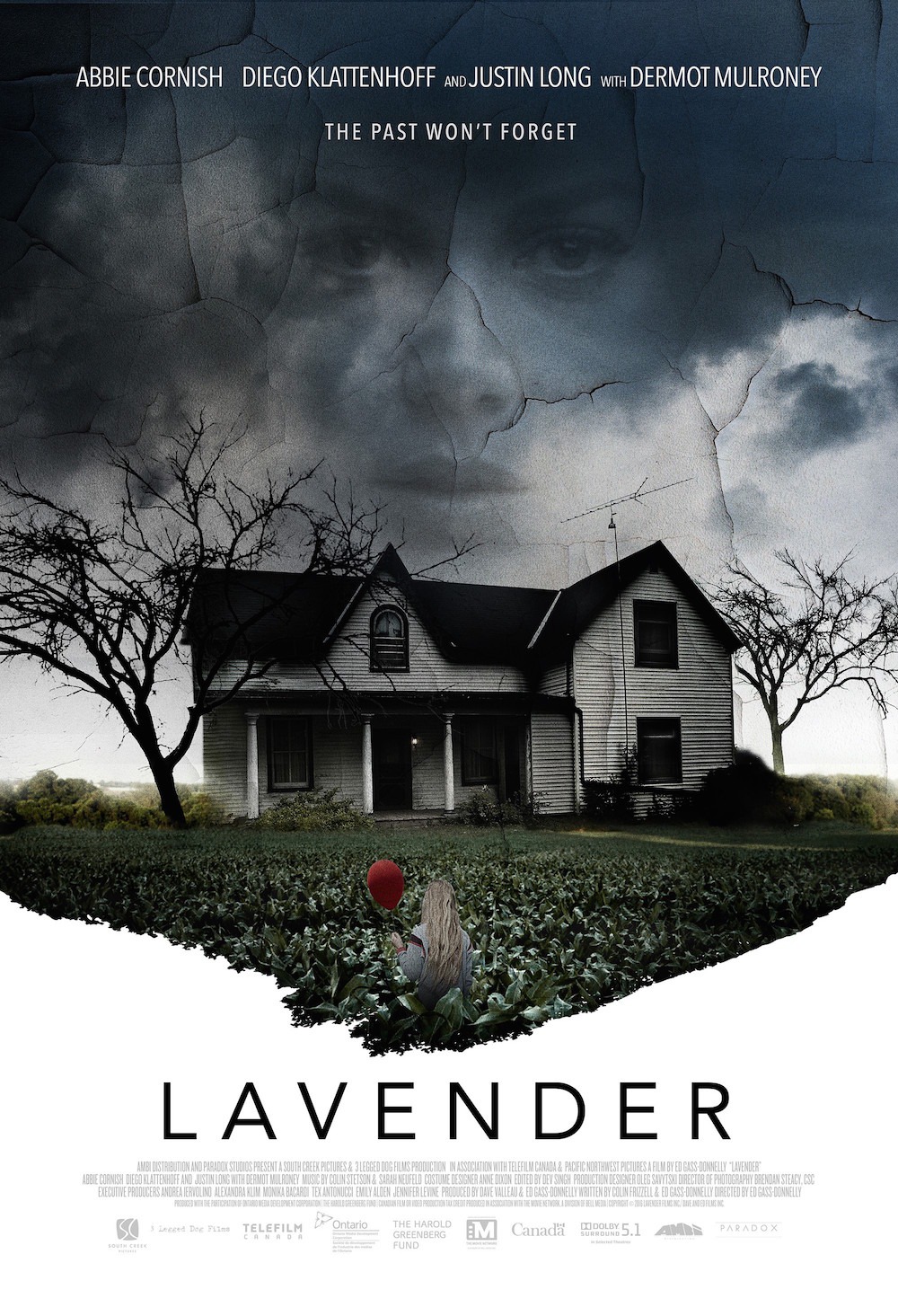
1985 – Jane Ryer (Kennedy) is the sole survivor when her family is murdered in their remote farmhouse; she’s found covered in blood and holding a cutthroat razor. Twenty-five years later, Jane (Cornish) is married to Alan (Klattenhoff), and has a young daughter, Alice (Flanery). She runs a photographer’s studio that showcases the pictures she takes of often abandoned rural properties, and is plagued by lapses in her memory. A stay in hospital following a car accident reveals Jane has several skull fractures from when she was a child, but she has no memory of being injured. She also comes to learn that one of the farmhouses she has photographed is one that she owns, even though she has no memory of it, or an uncle, Patrick (Mulroney), who has been paying the taxes on it and maintaining it. Drawn to discovering what happened when she was a child, Jane, Alan and Alice decide to meet Patrick and stay at the farmhouse. Soon, Jane discovers that the house is the source of a series of supernatural occurrences that relate to the murder of her family all those years before…

From the outset, with Patrick being informed of the deaths of his sister’s family and the horrific aftermath being presented in a series of tableaux, it seems as if Lavender isn’t interested in offering viewers another generic rural ghost story. But that opening sequence, culminating in the discovery of a clearly traumatised Jane, unfortunately marks the beginning of the end in terms of originality. Jane’s plight, going from being forgetful to being plagued by supernatural events and visions, is played out in too flat a manner for it to be entirely effective. While the script – by director Gass-Donnelly and Colin Frizzell – takes its time in revealing the details of just what happened in 1985, it does so in a measured, unhurried way that robs the movie of any appreciable pace or momentum. This doesn’t even allow for a slowburn approach to the material, and instead, has the opposite effect, making the viewer wish some scenes would hurry up, while wishing others wouldn’t repeat motifs and experiences that Jane – and we – have already witnessed over and over. As a result, the central mystery is treated with sincerity but lacks verve, and the characters are forced to repeat conversations and actions that harm the movie’s narrative structure.

When presenting supernatural events on screen, many directors and screenwriters adopt a kind of “kitchen sink” approach, and throw in scares and jolts and all sorts of shenanigans because they might look good (or cool), and because even a cheap scare can be a winner. Lavender has a number of these moments, such as when adult Jane and her younger sister, Susie (Abbott), hide under a sheet in the stables. As something wicked comes nearer – cue heavy footfalls – Susie urges Jane to run, and when she does the sheet becomes more voluminous than it should be and when she finally escapes from it, she’s in the middle of a field. The juxtaposition between the expanse of the field after the confines of the sheet works well, but in terms of dramatic effect, it makes no sense (we already know Jane’s mental state isn’t the best). Gass-Donnelly works hard to give the movie a tense, unnerving atmosphere, and employs a grimly portentous score from Colin Stetson and Sarah Neufeld to help matters along, but the material is too thinly stretched in places, and too flatly handled, for their efforts to be successful. By the time things pick up for the climax, and some energy is injected into the proceedings, some viewers might have already taken their leave.

Rating: 5/10 – with the performances proving merely adequate (Cornish, though, makes a virtue of appearing blank-faced), and the script veering off at odd tangents at odd moments, Lavender is a lukewarm psychological horror that doesn’t follow through on its initial promise; tiresome in places, and with a central mystery that shouldn’t come as a surprise when it’s exposed, the movie struggles to be consistently interesting, and passes on several opportunities to better itself.
Share this:

  • Share on X (Opens in new window) X
  • Share on Facebook (Opens in new window) Facebook
  • More
  • Print (Opens in new window) Print
  • Email a link to a friend (Opens in new window) Email
Like Loading...

6 Days (2017)

21 Saturday Oct 2017

Posted by dullwood68 in Movies

≈ Leave a comment

Tags

Abbie Cornish, DFRLA, Drama, Hostages, Iranian Embassy, Jamie Bell, Kate Adie, Literary adaptation, London, Mark Strong, Review, Rusty Firmin, SAS, Thriller, Toa Fraser, True story

D: Toa Fraser / 94m

Cast: Jamie Bell, Mark Strong, Abbie Cornish, Martin Shaw, Ben Turner, Emun Elliott, Aymen Hamdouchi, Andrew Grainger, Colin Garlick, Te Kohe Tuhaka, Tim Pigott-Smith

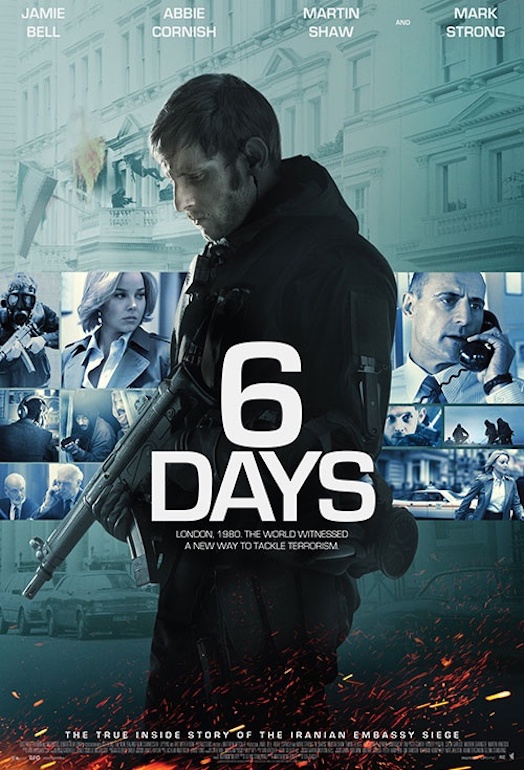
Between 30 April and 5 May 1980, the Iranian Embassy in London came under siege from six armed men whose aim was to secure the release of ninety-one Arab prisoners being held in Iran. Taking twenty-six hostages, they also demanded safe passage out of the United Kingdom once their goal was achieved. Of course, the outcome was very much different from what they were hoping for. Following the killing of one of the hostages, the order was given to send in the SAS. On the evening of the sixth day of the siege, they stormed the building and in the ensuing seventeen minutes killed five of the six armed men, rescued all but one of the remaining hostages (five had been released over the previous days), and gave notice to the world that the UK would not tolerate terrorism on any level.

What 6 Days does is to cover that dramatic period from a variety of angles in an effort to provide the viewer with a comprehensive overview of what was going on at the time both inside the embassy and outside it. So we see the six members of the Democratic Revolutionary Front for the Liberation of Arabistan (DRFLA), led by Salim (Turner), as they try to control the situation from an ever decreasing state of authority, as well as the Metropolitan Police’s chief negotiator, Max Vernon (Strong), as he does his best to keep things from escalating out of control. We also see the SAS teams that would eventually end the siege gathering intelligence on how best to enter the building, BBC reporter Kate Adie (Cornish) establish her reputation as a serious news journalist, and the political manoeuvring that went on behind the scenes involving the Home Secretary, William Whitelaw (Pigott-Smith), and the various decision makers who would debate and interpret the government’s policy of non-compliance in terrorist matters.

With such an intense, dramatic situation, and one whose violent conclusion was played out – deliberately – in front of a number of assembled news cameras, you might expect 6 Days to be as equally intense and dramatic, but sadly, whatever tension is achieved is arrived at accidentally. Glenn Standring’s screenplay, adapted from the awkwardly titled Go! Go! Go!: The SAS. The Iranian Embassy Siege. The True Story (2011) by Rusty Firmin and Will Pearson, alternates between each angle with an initial promise that soon falls away to offer routine exchanges between all concerned, a worrying number of occasions where we see the SAS fail in their preparations, Cornish’s role as Kate Adie built up so that her billing is made more credible, and negotiations between Vernon and Salim that consist of Vernon reassuring Salim that he wants to help, while Salim insists that he’ll kill a hostage if his demands aren’t met – over and over. (If there was ever any intention of exploring the psychological aspects of hostage negotiation, they certainly didn’t make it into the final script.)

There are other problems, some that relate to the movie’s pacing, and others that relate to director Toa Fraser’s handling of the material. Fraser made the enjoyably quirky Dean Spanley (2008), but here the confidence he showed with that movie appears to have deserted him. With an array of characters and situations to be exploited, Fraser leaves many scenes high and dry in terms of their potential effectiveness, opting for a flatness of tone that proves wearying the more it happens. As a result, he often leaves his talented cast looking as if they’ve been cast adrift from the narrative and are wondering where the lifeboats are. Bell, as the same Rusty Firmin whose book this is based on, can’t quite convince as a lance corporal in the SAS, and he’s too bland a character to make much of an impact. Cornish is kept on standby until the siege is broken, which is the point at which Adie came into her own and sealed her journalistic reputation by reporting events as they happened (though the movie has her standing heroically out in the open, whereas in reality Adie wisely hid behind a car door). Cornish also attempts a vocal interpretation of Adie that is off-putting to say the least.

But if you have to spare a thought for anyone in the movie it’s Mark Strong, a fine actor with an impressive range, but here reduced to staring continually in anguished sincerity while his character tries to keep things from going very wrong very quickly. In comparison with much of the rest of the movie, he’s one of the best things in it, but he’s hamstrung by the demands of the script and his director’s inability to make each scene anything more than flat and undemanding. This inattention leads to the movie having an equally flat and undemanding tone that negates any sense of urgency about the siege and the political machinations surrounding it. It’s not until the SAS storm the building that the movie wakes up and remembers it’s as much a thriller as a political drama, but even then there’s a great deal of confusion as to what’s happening where and, in the case of the SAS themselves, to whom.

Again, there are pacing issues as well, and too much repetition to make 6 Days anything other than a pedestrian representation of an event that made international headlines and kept a nation glued to their televisions and radios throughout its duration. There are flashes of humour that are largely muted (though a comment from an embassy staff member to Firmin is priceless by itself), the odd attempt at post-ironic commentary, contemporary footage that sits side by side with the movie’s recreations of the same images, and an eerily effective opening shot that sees the six terrorists passing by the Royal Albert Hall, but they’re not enough on their own to make the movie more engaging or gripping. There’s a great deal of earnestness and melodramatic sincerity on display, but it’s all in service to a script that feels as if it’s trying to tell its story at a remove from the actual events, and which compresses those fateful six days into an hour and a half and still finds the need to pad out the narrative with unnecessary detours and longueurs.

Rating: 4/10 – muddled and far from absorbing, 6 Days is an undemanding viewing experience that doesn’t try too hard to make its true story anything other than perfunctory and banal; by the time the SAS storm the embassy you’ll be thinking “at last” – not because the movie is finally going to be halfway exciting, but because it means the movie is close to being over.

Share this:

  • Share on X (Opens in new window) X
  • Share on Facebook (Opens in new window) Facebook
  • More
  • Print (Opens in new window) Print
  • Email a link to a friend (Opens in new window) Email
Like Loading...

Solace (2015)

11 Monday Jan 2016

Posted by dullwood68 in Movies

≈ 1 Comment

Tags

Abbie Cornish, Afonso Poyart, Anthony Hopkins, Colin Farrell, Drama, FBI, Jeffrey Dean Morgan, Murder, Psychics, Review, Serial killer, Terminal illnesses, Thriller, Visions

Solace

D: Afonso Poyart / 101m

Cast: Anthony Hopkins, Jeffrey Dean Morgan, Abbie Cornish, Colin Farrell, Xander Berkeley, Marley Shelton, Janine Turner, Kenny Johnson, Sharon Lawrence

Solace is one of those movies. You know, a movie that dares you not to laugh at the absurdity of it all. It’s a movie that acknowledges the idea of credibility and then tramples all over it with big hob-nailed boots on. It’s so consistently bad that there’s no getting over just how awful it is. And it just goes to show that, sometimes, actors definitely go for the pay cheque rather than the artistic challenge (not that there is one here, unless you count keeping a straight face when the movie gets really silly).

But in amongst all the terrible dialogue and horrible acting, there are lessons to be learnt from Sean Bailey and Ted Griffin’s script, lessons that could prove invaluable if you’ve a mind to write your own serial killer thriller. Here are ten pointers toward making that movie a success.

1 – Always give your central protagonist – here Hopkins’ psychic John Clancy – a heartrending backstory that will have no relevance at all until the final scene, when you can reveal a dark secret that sheds new light on the character and his/her motivations (but which will be redundant in terms of the drama).

Solace - scene3

2 – If your central character is a psychic it’s important to keep moving the goalposts in terms of what triggers his/her visions. Start off with being touched by others, then move on to have them be practically all-seeing all by themselves.

3 – If your villain is another psychic with advanced “powers”, don’t forget to make sure that, in the end, he/she is no match for your central character, and can be easily defeated, despite having a talent for seeing every outcome of every situation ahead of time.

4 – If you have to involve the police or Federal authorities, then make sure that those characters are at odds with each other in terms of their beliefs; one should be totally behind your psychic hero, while the other should doubt their abilities, and say so more than once.

Solace - scene2

5 – If you have an agent or policeman who doubts the psychic’s abilities then you should definitely include a scene where their history is laid bare with as much detail as possible, and which should be upsetting for them to hear. (This will ensure that the audience is completely impressed with the psychic’s powers.)

6 – It’s very important that your villain should be able to kill on more than one occasion and never leave any DNA or other forensic evidence at any of the crime scenes. This will make him/her seem invincible/uncatchable until it’s time for them to be defeated with ease by the psychic hero.

7 – Always ensure your psychic hero gets to upstage their police partners by making educated guesses that they can pass off as benefits of their psychic abilities. This will be important when the narrative takes a wrong turn or gets bogged down by its own implausibilities.

Solace - scene1

8 – When deciding on the killer’s motivations, it’s always best to make them sound like they’re acting with the best of (misguided) intentions. But always be sure to translate those motivations into the kind of dialogue that even the most talented actor couldn’t make convincing.

9 – Never ever insult your audience by including a scene where the psychic refuses to help the authorities because of past traumas. Everyone knows they’ll take the case, and everyone knows their reason for doing so is completely irrelevant (if it’s mentioned at all).

10 – Be sure to include several “psychic montages” that comprise shots and short clips from the rest of the movie interspersed with other, abstract images that have no relevance to the story at all (but which look pretty or ominous). Feel free also to include shots that feature the characters but which don’t actually occur anywhere else in the movie; get away with this by saying these shots are “interpretive”.

Oh, and if you can, get Anthony Hopkins to play your psychic hero. He doesn’t seem to mind what roles he takes on these days.

Rating: 3/10 – originally shot in 2013 and shelved by Warner Bros until it was picked up for distribution by troubled Relativity Media, Solace is a dreadful thriller that deserves to be locked up and never seen again; the cast are wasted, the direction is ham-fisted, and the script refuses to make any sense whatsoever, leaving the viewer with only one option – and you don’t have to be psychic to work out what that is.

Share this:

  • Share on X (Opens in new window) X
  • Share on Facebook (Opens in new window) Facebook
  • More
  • Print (Opens in new window) Print
  • Email a link to a friend (Opens in new window) Email
Like Loading...

RoboCop (2014)

20 Thursday Mar 2014

Posted by dullwood68 in Movies

≈ Leave a comment

Tags

Abbie Cornish, Detroit, ED-209, Gary Oldman, Joel Kinnaman, Michael Keaton, Omnicorp, Remake, Review, Robot, Robotics, Samuel L. Jackson

QUAD_UK_ROBO_101294f.indd

D: José Padilha / 117m

Cast: Joel Kinnaman, Gary Oldman, Michael Keaton, Abbie Cornish, Jackie Earle Harley, Michael K. Williams, Jennifer Ehle, Jay Baruchel, Marianne Jean-Baptiste, Samuel L. Jackson, Aimee Garcia, Douglas Urbanski, John Paul Ruttan, Patrick Garrow, Zach Grenier

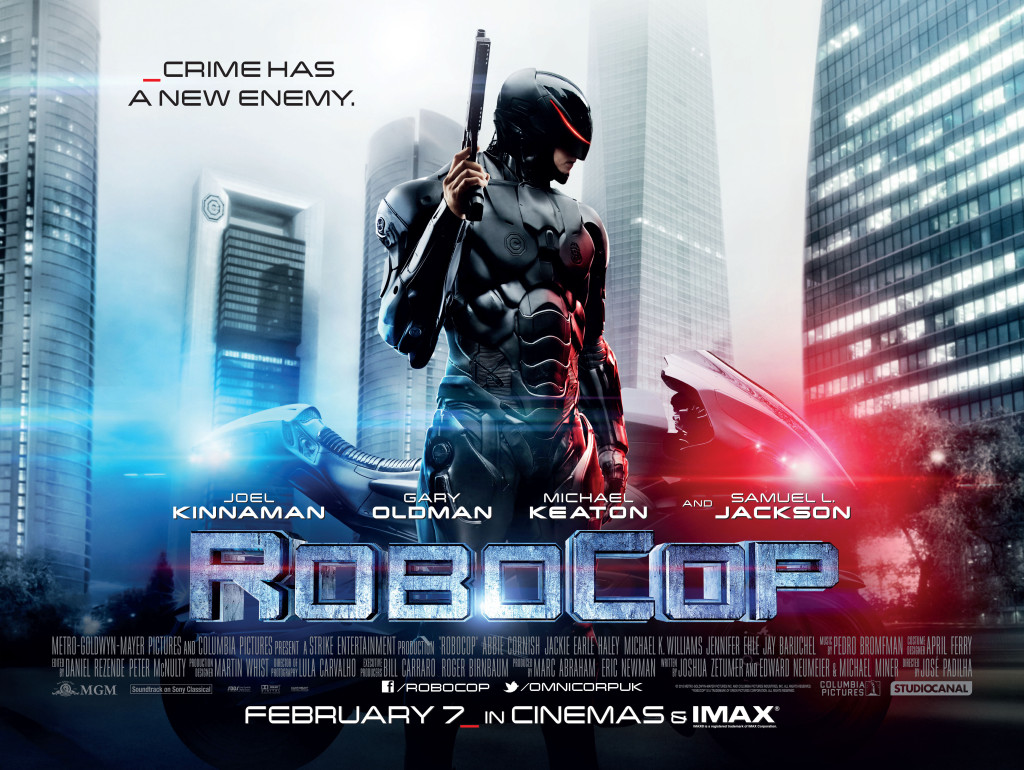
With the Eighties being increasingly plundered for material that can be remade, rebooted or re-imagined, the likelihood of a new RoboCop movie was always a strong possibility.  Now that it’s here, it’s inevitable that the comparisons between this version and Paul Verhoeven’s 1987 original are appearing thick and fast, with equally inevitable results: it’s not the same (shock! horror!).

From the black suit to the addition of a wife and child, RoboCop is – and was always going to be – a different beast from its predecessor(s) (let’s not even mention the animated and live action TV series’).  Some things remain the same though.  Alex Murphy (Kinnaman) is still a Detroit cop, working with his partner, Jack Lewis (Williams) to bring down crime boss Antoine Vallon (Garrow).  When the pair get too close, Lewis is wounded in a shootout and Murphy is subsequently blown up outside his home.  With his life hanging in the balance, OmniCorp boss Raymond Sellars (Keaton) offers his wife Clara (Cornish) a way to keep Alex alive: sign up to their research programme, headed by Dr Norton (Oldman).

Three months later, Alex is restored to waking consciousness to find himself encased in a metal suit and horrified by what is happening to him.  After an escape attempt fails he begins to accept the reality of his situation and works with Norton to make the best of things and, more importantly, find his way back to Clara and his son David (Ruttan).  With a projected annual return of $600 billion if their robot police programme is a success – and if a bill banning robot police officers is repealed by the Senate – OmniCorp is determined not to let Alex’s individuality ruin their investment.  They take steps to control his emotional and judgmental responses, but reckon without his love for his family – and his need for revenge on Vallon – overriding their protocols.  Soon, Alex begins to understand the depth of Sellars’ duplicity, and with his partner’s help, sets out to – yes, you’ve guessed it – bring Sellars to justice.

RoboCop (2014) - scene

Although Ed Neumeier and Michael Miner – the screenwriters of the 1987 version – are credited alongside newbie Josh Zetumer, little remains from their script except various names, the Detroit location, and the movie’s basic structure.  It’s not a bad (exo-) skeleton to hang things on and ensures the movie doesn’t stray too far from the (in-built) audience’s expectations.  The major difference here is that Alex isn’t killed but is critically injured, making his memories and emotions a much more potent angle to explore… except the movie doesn’t.  With the exception of a brief (read: cut short in the editing process) scene where Alex goes home for the first time as RoboCop, there’s no real exploration of what Alex might be feeling beyond having Kinnaman look aggrieved for a few moments in-between the action elements.

There’s also a lot of talking.  RoboCop may be the first action movie in a long time to spend so much of its screen time having its secondary characters talk so often, and to so little effect.  Jackson ramps it up as a thinly disguised version of Fox News’ Bill O’Reilly, spouting diatribes as only he can, and providing the movie with its thinly disguised attack on corporate America and the media as devious bedfellows (Jackson also gets to say m*thaf*cka, so some things are all right with the world).  And then there’s the continual back-and-forth between Sellars and Norton where Norton voices a concern or a negative opinion, and Sellars just waffles a few sentences and Norton goes away appeased.  (I swear I have no idea what Michael Keaton is saying in those scenes.)

With all this dialogue and by-the-numbers plotting, how then do the action scenes fare?  Well, one first-person shooter sequence aside (which sticks out like a sore thumb), RoboCop delivers fairly effective if unexceptional action beats until it wimps out altogether and gives us one of the most ineffectual showdowns in action cinema history (look for the well-armed guard who doesn’t fire a shot – no, look for him: once RoboCop appears he all but vanishes).  And if I have to make one comparison only between this version and the 1987 movie, it’s that Vallon is a poor, practically disposable villain when set against Clarence Boddicker.

The cast perform efficiently enough and Kinnaman makes for a strong-jawed hero, while Oldman does his best with a character whose motivations change from scene to scene (and sometimes within them).  Keaton underplays Sellars and only occasionally shows off the nervous energy that made him so exciting to watch earlier on in his career, and Baruchel gets to play the annoying marketing character you hope gets killed by an ED-209.  As Clara, Cornish has little to do but look angry or upset from the sidelines, and Jean-Baptiste (so brilliant in Mike Leigh’s Secrets and Lies) is here reduced to treading water until her character is no longer required by the narrative.

Padilha directs with an efficiency and a drive that never quite translates into sustained tension, and there are too many filler shots of RoboCop zooming through the streets of Detroit on his customised motorbike.  That said, there are things to like: Lula Carvalho’s steel-burnished photography; Murphy’s treatment of hired mercenary Mattox (Haley) after a training exercise; a short scene where a man with robotic hands plays the guitar; Mattox’s choice of music during Murphy’s first training session (plus Norton’s bemused response); the seamless special effects, a predictably vast improvement on 1987; and the movie’s best scene by far: the moment when Murphy discovers just how much of himself fills the suit.

Ultimately, what’s missing from RoboCop is a clear attempt at relating the emotional trauma of being a man in a “tin suit”.  Without it, RoboCop doesn’t engage in the way it should do, and many scenes pass by without having any meaningful effect on the audience.  It makes for frustrating viewing, and robs the movie of any real drama; sadly, it all ends up being just too impersonal.

Rating: 6/10 – a tidier script would have helped but this is by no means a disaster; a shaky start to a new series of movies(?) but enjoyable enough despite its flaws.

Share this:

  • Share on X (Opens in new window) X
  • Share on Facebook (Opens in new window) Facebook
  • More
  • Print (Opens in new window) Print
  • Email a link to a friend (Opens in new window) Email
Like Loading...

Blog Stats

  • 495,298 hits

Recent Posts

  • 10 Reasons to Remember Bibi Andersson (1935-2019)
  • Fantasia (1940)
  • Dances With Wolves (1990) – The Special Edition
  • Kiss of the Spider Woman (1985)
  • The Three Musketeers (1973)

Top Posts & Pages

  • The Red Balloon (1956)
    The Red Balloon (1956)
  • The White Orchid (2018)
    The White Orchid (2018)
  • Cardboard Boxer (2016)
    Cardboard Boxer (2016)
  • Izulu lamí (2008)
    Izulu lamí (2008)
  • Stephanie (2017)
    Stephanie (2017)
  • Don Jon (2013)
    Don Jon (2013)
  • Predestination (2014)
    Predestination (2014)
  • Sand Storm (2016)
    Sand Storm (2016)
  • Sorry to Bother You (2018)
    Sorry to Bother You (2018)
  • I Can't Think Straight (2008)
    I Can't Think Straight (2008)
Follow thedullwoodexperiment on WordPress.com

Blogs I Follow

  • Rubbish Talk
  • Film 4 Fan
  • Fast Film Reviews
  • The Film Blog
  • All Things Movies UK
  • Interpreting the Stars
  • Let's Go To The Movies
  • Movie Reviews 101
  • TMI News
  • Dan the Man's Movie Reviews
  • Film History
  • Jordan and Eddie (The Movie Guys)

Archives

  • April 2019 (13)
  • March 2019 (28)
  • February 2019 (28)
  • January 2019 (32)
  • December 2018 (28)
  • November 2018 (30)
  • October 2018 (29)
  • September 2018 (29)
  • August 2018 (29)
  • July 2018 (30)
  • June 2018 (28)
  • May 2018 (24)
  • April 2018 (21)
  • March 2018 (31)
  • February 2018 (25)
  • January 2018 (30)
  • December 2017 (30)
  • November 2017 (27)
  • October 2017 (27)
  • September 2017 (26)
  • August 2017 (32)
  • July 2017 (32)
  • June 2017 (30)
  • May 2017 (29)
  • April 2017 (29)
  • March 2017 (30)
  • February 2017 (27)
  • January 2017 (32)
  • December 2016 (30)
  • November 2016 (28)
  • October 2016 (30)
  • September 2016 (27)
  • August 2016 (30)
  • July 2016 (30)
  • June 2016 (31)
  • May 2016 (34)
  • April 2016 (30)
  • March 2016 (30)
  • February 2016 (28)
  • January 2016 (35)
  • December 2015 (34)
  • November 2015 (31)
  • October 2015 (31)
  • September 2015 (34)
  • August 2015 (31)
  • July 2015 (33)
  • June 2015 (12)
  • May 2015 (31)
  • April 2015 (32)
  • March 2015 (30)
  • February 2015 (37)
  • January 2015 (39)
  • December 2014 (34)
  • November 2014 (34)
  • October 2014 (36)
  • September 2014 (25)
  • August 2014 (29)
  • July 2014 (29)
  • June 2014 (28)
  • May 2014 (23)
  • April 2014 (21)
  • March 2014 (42)
  • February 2014 (38)
  • January 2014 (29)
  • December 2013 (28)
  • November 2013 (34)
  • October 2013 (4)

Create a free website or blog at WordPress.com.

Rubbish Talk

Film 4 Fan

A Movie Blog

Fast Film Reviews

The Film Blog

The official blog of everything in film

All Things Movies UK

Movie Reviews and Original Articles

Interpreting the Stars

Dave Examines Movies

Let's Go To The Movies

Film and Theatre Lover!

Movie Reviews 101

Daily Movie Reviews

TMI News

Latest weather, crime and breaking news

Dan the Man's Movie Reviews

All my aimless thoughts, ideas, and ramblings, all packed into one site!

Film History

Telling the story of film

Jordan and Eddie (The Movie Guys)

Movie Reviews & Ramblings from an Australian Based Film Fan

Privacy & Cookies: This site uses cookies. By continuing to use this website, you agree to their use.
To find out more, including how to control cookies, see here: Cookie Policy
  • Subscribe Subscribed
    • thedullwoodexperiment
    • Join 481 other subscribers
    • Already have a WordPress.com account? Log in now.
    • thedullwoodexperiment
    • Subscribe Subscribed
    • Sign up
    • Log in
    • Report this content
    • View site in Reader
    • Manage subscriptions
    • Collapse this bar
 

Loading Comments...
 

    %d