• 10 Reasons to Remember…
  • A Brief Word About…
  • About
  • For One Week Only
  • Happy Birthday
  • Monthly Roundup
  • Old-Time Crime
  • Other Posts
  • Poster of the Week
  • Question of the Week
  • Reviews
  • Trailers

thedullwoodexperiment

~ Viewing movies in a different light

thedullwoodexperiment

Tag Archives: Bruce Dern

The Hateful Eight (2015)

18 Thursday Feb 2016

Posted by dullwood68 in Movies

≈ 1 Comment

Tags

Bounty hunter, Bruce Dern, Demián Bichir, Drama, Jennifer Jason Leigh, Kurt Russell, Michael Madsen, Minnie's Haberdashery, Mystery, Quentin Tarantino, Review, Samuel L. Jackson, Thriller, Tim Roth, Walton Goggins, Western, Wyoming

The Hateful Eight

D: Quentin Tarantino / 167m

Cast: Samuel L. Jackson, Kurt Russell, Jennifer Jason Leigh, Walton Goggins, Tim Roth, Demián Bichir, Michael Madsen, Bruce Dern, James Parks, Channing Tatum

It’s post-Civil War Wyoming, and a stagecoach trying to outrun a fast approaching snowstorm (in already treacherous weather) is stopped by an unexpected encounter with a bounty hunter, Major Marquis Warren (Jackson), stranded on the road to the nearest safe haven, a staging post named Minnie’s Haberdashery. On board the stagecoach is another bounty hunter, John “The Hangman” Ruth (Russell) and his prisoner, Daisy Domergue (Leigh), heading for the town of Red Rock so she can face trial. Once bona fides are established between the two men, Warren is allowed to journey on aboard the stagecoach. Later they pick up another stranded man, Chris Mannix (Goggins), who tells them he’s also heading to Red Rock where he is to take up the post of sheriff.

At Minnie’s Haberdashery, they find that an earlier stagecoach has taken shelter there, and there are four men waiting out the impending snowstorm. One is a Southern general, Sanford Smithers (Dern), who’s come to Wyoming in search of his missing son. Another is Joe Gage (Madsen), a cowboy heading home after being away on a lengthy cattle trail. The third introduces himself as Oswaldo Mobray (Roth), on his way to Red Rock to act as hangman should Daisy Domergue be found guilty at her trial. And then there’s Bob (Bichir), a Mexican who tells Warren that Minnie and her husband, Sweet Dave, have gone to see her mother, and that they’ve entrusted the upkeep of the staging post to him. But Warren is unconvinced.

Once everyone is inside and introduced to each other, Ruth is quick to make it clear that he believes at least one person there isn’t who he says he is, and that it’s likely they’re going to try and free Daisy (though he doesn’t say why, or how he knows). Warren believes him, and they agree to join forces and keep an eye on the other men. But things begin to go wrong when Warren recognises Smithers, and he realises why the old man is there, and so far from home.

THE - scene1

The eighth movie by Quentin Tarantino is ostensibly a Western, but thanks to its writer/director’s penchant for being a movie magpie, it’s also a thriller, a revenge drama, an old dark house-style mystery, and yet another movie where he assembles a great cast only to give preference to some – Jackson, Russell, Goggins – while neglecting others – Leigh, Bichir, Madsen. That Tarantino wants to stuff his movie with references to other movies has always been a part of his movie making raison d’être, so it shouldn’t come as any surprise that The Hateful Eight isn’t just a Western. But this time around, the end result is a movie that struggles to find its identity, and thanks to the novel-style approach of Tarantino’s script – it’s made up of six Chapters – it feels much more artificial than it should be.

As Tarantino nudges along his characters in the wake of Jackson’s central character, and takes in issues of racism and post-War guilt, and a very occasional stab at the morality behind the execution of women, it becomes clear that these characters are mere cyphers, lacking in development and free from any real, appreciable insight into their motives. Given this lack of investment by Tarantino’s script, and despite the detailed and often hypnotic rhythms of the dialogue he grants them, it’s left to his very talented cast to make up the shortfall. Some achieve this with aplomb – Goggins in particular – but even the likes of Russell and Leigh can’t elevate the shallow nature of their characters. Russell bellows like an absurdist bully, while Leigh at one point is reduced to the kind of playground boasting that was outmoded even in the 1860’s.

Spare a thought then for Tarantino regular Jackson. Having landed the lead role in the movie, and been given the kind of back story that most actors would relish getting their hands on (or teeth into), it must have been dispiriting to see the final product and realise that for all the blood and thunder involved, it was all for nought given how the character is treated in the movie’s final chapter. There’s a lot to be said for a movie of this length when it exposes some of its maker’s more crueller narrative decisions and forces its audience to wonder if its wunderkind creator is quite the impressive writer/director he’s reputed to be. And this is where The Hateful Eight is most successful: in showing that the hype surrounding Tarantino isn’t always deserved.

THE - scene2

Take one scene in particular, the beginning of Chapter Four, entitled Domergue’s Got a Secret. Unable to introduce a major plot development in any other way (apparently), Tarantino resorts to the use of an offscreen narrator (voiced by himself) who not only explains what Daisy’s secret is, but clearly signposts for those in the audience who may be hard of understanding, what this means in terms of what follows. It’s like someone stopping a theatre production of Macbeth and stepping forward to explain that when Shakespeare says Macbeth can’t be “killed by man born of woman” he actually means he can be killed by someone born via Caesarean. Got it? Then let’s move on.

From there on The Hateful Eight swiftly unravels in a welter of violence and bloodshed that throws out all the groundwork made to get this far, and concentrates instead on bumping off its cast of characters. But any fascination or sympathy the viewer may have had for anyone is eroded by Tarantino’s decision to go for a bloodbath rather than a tense showdown. And then there’s the final chapter, so awkward and clunkily written that the viewer can’t help but wonder if Tarantino didn’t know how to end his movie, and settled on the first thought that came to him – and then didn’t even bother to polish the finished script. For once, Tarantino relinquishes control over the material, and the camerawork by Robert Richardson – up til then one of the few consistent positives about the movie – is undermined by the kind of reckless scissor-happy editing that you’d expect from someone having to deal with far less filmed material and an impossible deadline (and the movie’s editor, Fred Raskin, is a much better editor than that – check out his work on another 2015 Western, Bone Tomahawk, for proof).

THE - scene3

When all is said and done, The Hateful Eight isn’t a movie that works; at least, not entirely. If anything, the movie never proceeds to anywhere successful once Chris Mannix boards the stagecoach and they arrive at Minnie’s Haberdashery. Up til then, Tarantino does what he does best: he introduces his characters through his trademark intricate dialogue, and he sets the scene for the rest of the movie. But once in Minnie’s Haberdashery, the plot has to take over, and it soon runs out of steam. The addition of a flashback in Chapter Five feels even more awkward than the revelation that Daisy has a secret, and makes scant use of Channing Tatum into the bargain.

And finally, as if to rub salt into the movie’s wounds, we have a score by Ennio Morricone that has no impact throughout, and isn’t in any way memorable (there are times when it doesn’t even feel suited to the material). When your favourite movie composer can’t even make a difference then you just know that it’s not going to work. Sometimes – and this applies to anyone who writes and directs their own movies, or who have carte blanche from the studio that writes the cheques – having an idea isn’t enough. And building on that idea isn’t enough. And writing a screenplay isn’t enough. Sometimes you just have to let an idea go. Often it’s the kindest thing you can do for everyone.

Rating: 6/10 – narrative glitches aside, Tarantino’s eighth movie proves lacklustre both in terms of its visuals and its attention to its characters, leaving the viewer without anyone to sympathise with or warm to; The Hateful Eight is also the first of the writer/director’s movies to feel incomplete in terms of his investment in the project, and while he may argue otherwise, there’s a distance between him and the final product that hasn’t been there in any of his other, seven movies.

Share this:

  • Click to share on X (Opens in new window) X
  • Click to share on Facebook (Opens in new window) Facebook
  • More
  • Click to print (Opens in new window) Print
  • Click to email a link to a friend (Opens in new window) Email
Like Loading...

Cut Bank (2014)

12 Tuesday May 2015

Posted by dullwood68 in Movies

≈ Leave a comment

Tags

Billy Bob Thornton, Bruce Dern, Crime, Drama, John Malkovich, Liam Hemsworth, Matt Shakman, Michael Stuhlbarg, Miss Cut Bank pageant, Montana, Movie reviews, Murder, Postman, Review, Reward money, Teresa Palmer, Thriller

Cut Bank

D: Matt Shakman / 93m

Cast: Liam Hemsworth, Teresa Palmer, John Malkovich, Billy Bob Thornton, Bruce Dern, Michael Stuhlbarg, Oliver Platt, Sonya Salomaa, David Burke, Denis O’Hare

In the small town of Cut Bank, Montana, car mechanic Dwayne McLaren (Hemsworth) dreams of leaving town with his girlfriend Cassandra (Palmer), but he hasn’t got any money and he has to look after his disabled father (O’Hare). While spending time together on the outskirts of town, Dwayne inadvertently films the murder of local postman Georgie Witts (Dern). He takes the footage to Cassandra’s father, car dealer Big Stan Steeley (Thornton), who calls in the sheriff, Roland Vogel (Malkovich). The sheriff watches the footage and declares it’s the town’s first murder.

With the community in shock over Georgie’s death and the disappearance of the mail van he was driving, Vogel begins his investigation. At the same time, a loner with a strong interest in taxidermy named Derby Milton (Stuhlbarg) comes looking for a parcel he was expecting (and which was in the mail van). Where Vogel looks for a vehicle with a particular set of tyres, Milton looks for a boot with a particular sole. He finds out that a Native American named Match (Burke) bought a pair a few months before.

Meanwhile, Dwayne applies for a reward due for evidence relating to the death of a member of the postal service. The reward – $100,000 – will allow Dwayne to find alternative care for his father, and give him and Cassandra the chance to start a new life together in California. But when the Postal Inspector (Platt) arrives to confirm the reward, there’s only one snag: he needs to see the body, which so far hasn’t been found as it was taken with the mail van.

Matters escalate when Big Stan makes a discovery at his spare parts yard, a discovery that sees him brutally attacked. However, Milton – still looking for his parcel and unwilling to forget about it – makes the same discovery, but with a different outcome, one that implicates Dwayne. With the reward money not being paid out for a few months, it’s down to Cassandra to win the upcoming Miss Cut Bank pageant and its first prize of $5,000, and thereby give them enough money to leave town for good. But Milton has other ideas, and the sheriff is beginning to put all the pieces together surrounding Georgie’s death…

Cut Bank - scene

Watching Cut Bank, the obvious comparison is with Fargo (1996), but while that movie is still highly regarded as a classic nearly twenty years on, it’s hard to believe that Cut Bank will be looked on in the same way, or remembered at all. While it does its best to look and feel as moody as many other small-town crime dramas, it’s the quality of the story that lets it down. There are too many occasions where the story is driven forward by the messiest of contrivances, or characters behave in ways that contradict their previous attitudes. For the viewer it means a suspension of disbelief that is needed on several occasions, and for which the movie makes no apologies, as it just carries on digging a bigger and bigger hole for itself.

Indeed, it’s the script by Roberto Patino, and as directed by Shakman, that proves the movie’s downfall, causing as it does a loss of faith almost from the beginning. It plods through its twists and turns with all the authority of a movie that doesn’t know where it’s going or why – and which winds things up with one of the worst, most nonsensical outcomes that anyone could possibly imagine (except Patino). To say that it defies belief would be to suggest that the viewer might actually have some by this point. And as for some of the dialogue, the script aims for clever and insightful, but succeeds in being arch and unimportant. Only the running gag, “I thought you were dead” works as well as it should, and at one point it receives a great pay-off, but it’s the only aspect of the script that really hits home.

With the script being so derivative and uneven, the movie suffers and so too does its more than talented cast. Hemsworth proves once more that he’s the blandest of the Hemsworth brothers, and still has trouble being convincing as any character in any movie, while Palmer has an embarrassing pageant song to sing and dance to but very little else. Thornton portrays Big Stan as the same kind of no-nonsense bully he’s played so often before, and Malkovich gives possibly the best performance as the sheriff who looks to be so out of his depth that he can’t see the bottom. Of the rest of the cast, Dern is great but not well-used, and Stuhlbarg is given a monologue that attempts to explain his behaviour but which actually proves too confusing to be much of an explanation. And Platt breezes through his scenes with all the bluster that he’s employed elsewhere, but here, it’s all to no effect, and his character adds nothing to the mix.

Shakman orchestrates the various plot strands and characters with the confidence of a director who doesn’t quite know what to do with the material – which is strange as he directed two episodes of the TV version of Fargo (2014) – but again it’s the quality of the material that hampers him. He does display an appreciation for widescreen composition, but he never seems comfortable presenting any close ups, and appears content to work with medium or long-range shots instead. This creates a distancing effect between the audience and the characters, and before long, the viewer has lost all interest in what’s happening, or how important it might all be. This applies particularly to Milton’s basement “secret”, which, when it’s revealed, is never adequately explained (though an attempt is made with Milton’s monologue). It’s the movie’s one true moment where it pulls something out of the bag that’s different and entirely unexpected.

In failing to live up to its potential, and by wasting the talents of its cast, Cut Bank stalls and stutters so often, and finds it so difficult to maintain a convincing approach that in the end it becomes too frustrating to watch, and is so undermined by its cavalier attitude to law enforcement and guilt, that it never recovers. The plot lacks originality, and the characters lack any appreciable depth, often doing things without any clear motivation. That said, there’s supportive and beautiful cinematography by Ben Richardson, and while some scenes appear to run on too long, the editing by Carol Littleton is sharp and keeps things moving (when they should be stalling).

Rating: 4/10 – with a script that tries to be clever and ingenious, but falls short on both counts, Cut Bank is left to founder in almost every area; one to avoid unless the idea of a murder mystery that leaves out the mystery is an attractive one that you can’t pass up.

NOTE: The trailer contains a few spoilers that aren’t included in the above synopsis, so if you watch it, please bear this in mind.

Share this:

  • Click to share on X (Opens in new window) X
  • Click to share on Facebook (Opens in new window) Facebook
  • More
  • Click to print (Opens in new window) Print
  • Click to email a link to a friend (Opens in new window) Email
Like Loading...

Nebraska (2013)

28 Friday Feb 2014

Posted by dullwood68 in Movies

≈ 1 Comment

Tags

$1000000, Alexander Payne, Billings Montana, Bob Odenkirk, Bruce Dern, Family feud, June Squibb, Lincoln Nebraska, Review, Road trip, Stacy Keach, Will Forte

Nebraska

D: Alexander Payne / 115m

Cast: Bruce Dern, Will Forte, June Squibb, Stacy Keach, Bob Odenkirk

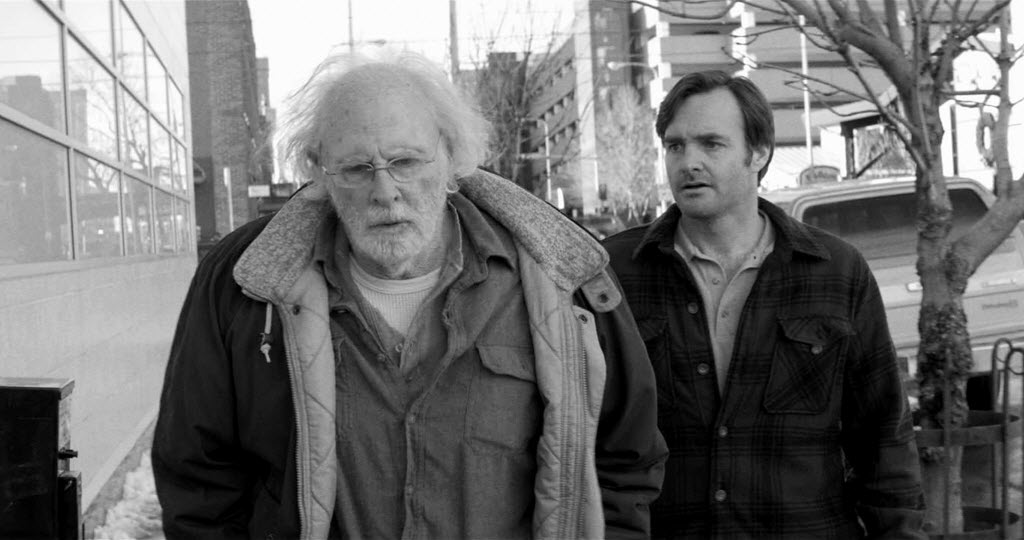
When Woodrow “Woody” Grant (Dern) receives a letter saying he’s won $1,000,000, he heads off on foot to Lincoln, Nebraska to claim it. The fact that he lives in Billings, Montana, means nothing to him, nor does his age or that he walks like someone who’s had a bad hip replacement (if what we see isn’t Dern’s natural gait then it’s an impressive piece of character development).  Woody believes the letter wouldn’t have been sent to him if the offer wasn’t legitimate, and though it’s clearly dubious, his resolve to travel to Lincoln doesn’t falter.

When it becomes clear Woody isn’t going to give up on his plan to claim his prize money from the promoters in Lincoln, his son David (Forte) agrees to take him there, even though he knows the prize offer isn’t as clear cut as it seems. David is struggling to make sense of his own life, and plans to use the trip to work out his problems. His relationship with Woody is strained as well, and as the journey begins, shows no sign of improving. With a stopover on the way at Woody’s hometown of Hawthorn and a stay with various relatives who all seem to want a slice of Woody’s money, David needs all his wits about him to avoid both a family feud and the more violent reprisals that sleazy ex-partner Ed (Keach) refers to if Woody doesn’t pay back the money he feels he’s owed.

Nebraska‘s strength lies in its main character. Woody is a man who has found himself at a distance from his family and his life. The money has given him a new purpose, and its the non-supportive response he receives from those nearest and (hopefully) dearest to him that goads him into action. There’s a case to be made for Woody knowing that the money isn’t “real”, and there’s a further case to be made that he’s enjoying the attention he’s getting, but Woody is a plain man with plain desires, and while everyone around him attempts to complicate matters, Woody keeps his head down and only occasionally looks up to see what’s happening around him. And when he does, it’s hard not to think he looks amused at all the shenanigans he’s caused. Woody is a wonderfully nuanced character, one who appears lost in a fog of early-onset dementia, but he’s a canny creation as well, diffident about most things but quietly impassioned about the things that matter to him.

Nebraska - scene

Using such a wonderful character as their base, director Payne and regular scriptwriter Bob Nelson have fashioned one of the most heartfelt and engaging movies of 2013. Shot in luminous black and white by Phedon Papamichael (This Is 40, The Descendants), and with a wonderful emotive score by Mark Orton, this is perhaps Payne’s most fully and perfectly realised feature to date. Dern is superb, an old man on the verge of giving up but who latches on to the prize money like a quest. Forte, usually a comic actor, here finds a quiet grace that instils his character perfectly, while Odenkirk as his brother Ross shines in a supporting role. Keach provides credible menace, but it’s June Squibb as Woody’s long-suffering wife Kate who steals the movie; she gets the best lines and delivers them all impeccably, including the best line in the whole movie.

With its bittersweet undercurrent and meditation on what it’s like to try and hold on to a sense of purpose as old age takes over, Nebraska is charming, heartwarming, life-affirming and altogether a gem. With its gentle, often hilarious comic moments and a clutch of winning performances, allied to a superb script and Payne’s sublime directing, this is one road trip you won’t want to end.

Rating: 9/10 – Nebraska tells a simple tale but adds several layers to give it an impressive depth; Payne continues to build an equally impressive body of work and stake his claim to being the US’s premier indie filmmaker.

Share this:

  • Click to share on X (Opens in new window) X
  • Click to share on Facebook (Opens in new window) Facebook
  • More
  • Click to print (Opens in new window) Print
  • Click to email a link to a friend (Opens in new window) Email
Like Loading...

Twixt (2011)

16 Saturday Nov 2013

Posted by dullwood68 in Movies

≈ 1 Comment

Tags

Bruce Dern, Drama, Edgar Allan Poe, Elle Fanning, Francis Ford Coppola, Horror, Murder investigation, Murders, Old Chickering hotel, Psychological thriller, Review, Swann Valley, Thriller, Val Kilmer

D: Francis Ford Coppola / 88m

Cast: Val Kilmer, Bruce Dern, Elle Fanning, Ben Chaplin, Joanne Whalley, David Paymer, Anthony Fusco, Alden Ehrenreich, Bruce A. Miroglio

Several years ago, Francis Ford Coppola announced he would be making only personal films, and since then we’ve had Youth Without Youth (2007), Tetro (2009), and now Twixt, ostensibly a horror movie but one that veers off down several different paths before its conclusion.

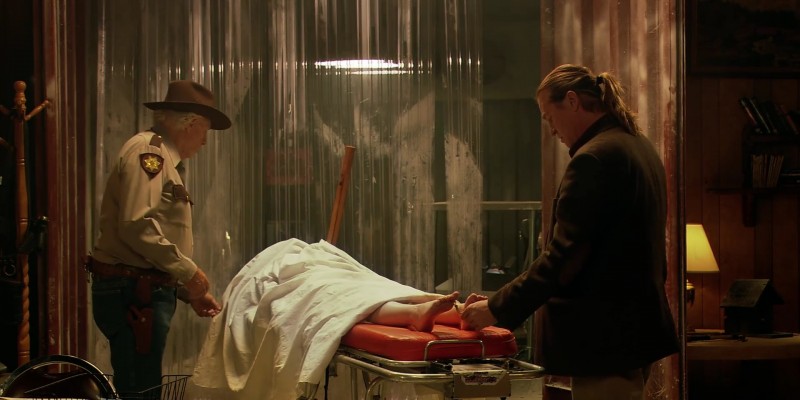
Hall Baltimore (Kilmer) is a moderately successful writer of witchcraft-themed horror novels.  He’s also in a bit of a creative slump.  While on a book tour, he finds himself in the small town of Swann Valley. He meets Sheriff Bobby LeGrange (Dern) who tells him about a mystery that involves a dead girl and a group of teens camped out across the lake. The girl is recently deceased, “obviously the victim of a serial killer”, according to LaGrange, and still in the sheriff’s office-cum-morgue with a stake through her heart. That night, Baltimore falls asleep and dreams of walking through town and out into the surrounding woods. There he meets V (Fanning), a young girl who looks drained of blood. They go to the Old Chickering Hotel where Baltimore learns that the bodies of twelve children are buried under the floor. This adds to the mystery, and when Baltimore wakes up he realises the answers to both his creative slump and the murder of the dead girl are to be found in his dreams.

To give a fuller description of the plot would take a while as Coppola, serving as writer, producer and director, piles layer upon layer of story onto the already overloaded plotting.  There’s several appearances by Edgar Allan Poe (Chaplin) who helps Baltimore in his dreams but also provides some literary allusions to the main plot. There’s a sub-plot involving a seven-sided clock tower where each clock face tells a different time. The twelve children were the charge of Pastor Allan Floyd (Fusco); there’s a protracted sequence involving a Jim Jones-style massacre. LaGrange acts strangely throughout, at one point knocking Baltimore unconscious out of anger (but also as a handy device for getting him to the next dream sequence). Baltimore is also mourning the death of his teenage daughter, while fending off the financial needs of his wife Denise (Whalley). The teens across the river, led by Beaudelaire-quoting Flamingo (Ehrenreich), provide temporary relief from the increasing pretentiousness of all the other proceedings. Oh, and there’s a scene involving a Ouija board, and Baltimore fighting writer’s block by impersonating Marlon Brando (with a near-quote from Apocalypse Now) and James Mason amongst others, and an ending so abrupt you might wonder if you’ve nodded off and missed a few minutes.

Twixt - scene

From all this you could be forgiven for thinking that Twixt is a bit of a mess, and largely it is. Coppola has applied a kind of kitchen sink approach to the movie, and it would be a dedicated viewer – one prepared to watch it several times in fact – who could find a strict, coherent storyline that runs through the movie, and who could adequately explain the various diversions that Coppola includes. However, it’s unclear if Coppola himself knows exactly what’s going on, or why, and if he doesn’t, then the rest of us don’t stand a chance.

Visually, though, the movie is often stunning to look at, the initial dream sequences – at the Old Chickering hotel, Baltimore’s chat with Poe in the same location – all have a weird, surreal quality that suits the action that’s unfolding. The characters speak with a slight hollowness, and the colour scheme, all grey, metallic hues, looks wonderfully unsettling. This is where Twixt works best, in the dreamworld that Baltimore inhabits as often as he can. Coppola pulls out all the stops in these sequences, imbuing them with a sense of predatory menace that elevates them from perfunctory scenes of exposition to something more disquieting. Alas, the scenes in the real world lack any kind of sense or coherence, and as a result, bog down the movie unnecessarily.

The cast do their best under the circumstances, Kilmer injecting some humour when he can at the absurdity of LaGrange’s eccentricities, but otherwise going with the flow and committing to the script’s vagaries. Dern adds another oddball character to his repertoire, while Fanning plays the girl who may or may not have gotten away from the pastor (it’s never made clear) with an appropriate detachment. Chaplin copes well with some really dense, literary dialogue, and rest of the supporting cast do the best they can as well, particularly Miroglio as Deputy Arbus.

Ultimately, the best that can be said about Twixt is that it’s no better or worse than a lot of other horror movies made in the last five years, but definitely a step up visually.  Coppola still knows how to construct a scene and have it play out – even if the internal logic is skewed – and he still has the confidence borne out of his many years as a director.  He may not have made the best decision in working from his own script, and if truth be told, this may not be the best version of that script (some of the cast have apparently seen an earlier, different version), but despite the absurdities and the incoherent plot, Twixt still has enough going for it to make it worth watching, even if it’s just to say you have.

Rating: 6/10 – Coppola delivers what appears to be a train wreck of a movie, but on closer inspection, there’s still a few carriages on the track to rescue things; worth seeing for its hallucinogenic visuals and Kilmer back on form after too many low-budget thrillers.

Share this:

  • Click to share on X (Opens in new window) X
  • Click to share on Facebook (Opens in new window) Facebook
  • More
  • Click to print (Opens in new window) Print
  • Click to email a link to a friend (Opens in new window) Email
Like Loading...

Blog Stats

  • 491,130 hits

Recent Posts

  • 10 Reasons to Remember Bibi Andersson (1935-2019)
  • Fantasia (1940)
  • Dances With Wolves (1990) – The Special Edition
  • Kiss of the Spider Woman (1985)
  • The Three Musketeers (1973)

Top Posts & Pages

  • Cardboard Boxer (2016)
    Cardboard Boxer (2016)
  • The Mule (2014)
    The Mule (2014)
  • The End (2012)
    The End (2012)
  • Speak (2004)
    Speak (2004)
  • A Monster Calls (2016)
    A Monster Calls (2016)
  • 7:19 (2016)
    7:19 (2016)
  • Virginity (1937)
    Virginity (1937)
  • Murder on a Sunday Morning (2001)
    Murder on a Sunday Morning (2001)
  • The Town That Dreaded Sundown (1976)
    The Town That Dreaded Sundown (1976)
  • Where There's a Prank, There's a Pay Off: Spider (2007) and Family Values (2011)
    Where There's a Prank, There's a Pay Off: Spider (2007) and Family Values (2011)
Follow thedullwoodexperiment on WordPress.com

Blogs I Follow

  • Rubbish Talk
  • Film 4 Fan
  • Fast Film Reviews
  • The Film Blog
  • All Things Movies UK
  • Interpreting the Stars
  • Let's Go To The Movies
  • Movie Reviews 101
  • TMI News
  • Dan the Man's Movie Reviews
  • Film History
  • Jordan and Eddie (The Movie Guys)

Archives

  • April 2019 (13)
  • March 2019 (28)
  • February 2019 (28)
  • January 2019 (32)
  • December 2018 (28)
  • November 2018 (30)
  • October 2018 (29)
  • September 2018 (29)
  • August 2018 (29)
  • July 2018 (30)
  • June 2018 (28)
  • May 2018 (24)
  • April 2018 (21)
  • March 2018 (31)
  • February 2018 (25)
  • January 2018 (30)
  • December 2017 (30)
  • November 2017 (27)
  • October 2017 (27)
  • September 2017 (26)
  • August 2017 (32)
  • July 2017 (32)
  • June 2017 (30)
  • May 2017 (29)
  • April 2017 (29)
  • March 2017 (30)
  • February 2017 (27)
  • January 2017 (32)
  • December 2016 (30)
  • November 2016 (28)
  • October 2016 (30)
  • September 2016 (27)
  • August 2016 (30)
  • July 2016 (30)
  • June 2016 (31)
  • May 2016 (34)
  • April 2016 (30)
  • March 2016 (30)
  • February 2016 (28)
  • January 2016 (35)
  • December 2015 (34)
  • November 2015 (31)
  • October 2015 (31)
  • September 2015 (34)
  • August 2015 (31)
  • July 2015 (33)
  • June 2015 (12)
  • May 2015 (31)
  • April 2015 (32)
  • March 2015 (30)
  • February 2015 (37)
  • January 2015 (39)
  • December 2014 (34)
  • November 2014 (34)
  • October 2014 (36)
  • September 2014 (25)
  • August 2014 (29)
  • July 2014 (29)
  • June 2014 (28)
  • May 2014 (23)
  • April 2014 (21)
  • March 2014 (42)
  • February 2014 (38)
  • January 2014 (29)
  • December 2013 (28)
  • November 2013 (34)
  • October 2013 (4)

Blog at WordPress.com.

Rubbish Talk

Film 4 Fan

A Movie Blog

Fast Film Reviews

The Film Blog

The official blog of everything in film

All Things Movies UK

Movie Reviews and Original Articles

Interpreting the Stars

Dave Examines Movies

Let's Go To The Movies

Film and Theatre Lover!

Movie Reviews 101

Daily Movie Reviews

TMI News

Latest weather, crime and breaking news

Dan the Man's Movie Reviews

All my aimless thoughts, ideas, and ramblings, all packed into one site!

Film History

Telling the story of film

Jordan and Eddie (The Movie Guys)

Movie Reviews & Ramblings from an Australian Based Film Fan

Privacy & Cookies: This site uses cookies. By continuing to use this website, you agree to their use.
To find out more, including how to control cookies, see here: Cookie Policy
  • Subscribe Subscribed
    • thedullwoodexperiment
    • Join 481 other subscribers
    • Already have a WordPress.com account? Log in now.
    • thedullwoodexperiment
    • Subscribe Subscribed
    • Sign up
    • Log in
    • Report this content
    • View site in Reader
    • Manage subscriptions
    • Collapse this bar
 

Loading Comments...
 

    %d