• 10 Reasons to Remember…
  • A Brief Word About…
  • About
  • For One Week Only
  • Happy Birthday
  • Monthly Roundup
  • Old-Time Crime
  • Other Posts
  • Poster of the Week
  • Question of the Week
  • Reviews
  • Trailers

thedullwoodexperiment

~ Viewing movies in a different light

thedullwoodexperiment

Tag Archives: Carey Mulligan

Happy Birthday – Carey Mulligan

28 Saturday May 2016

Posted by dullwood68 in Movies

≈ 3 Comments

Tags

Actress, An Education, Career, Carey Mulligan, Drive (2011), Movies, Never Let Me Go, Nicolas Winding Refn, Shame, The Greatest

Carey Mulligan (28 May 1985 -)

Carey Mulligan

It’s hard to believe but Carey Mulligan has been gracing our screens for just eleven years since her debut as Kitty Bennet in Pride & Prejudice (2005). Since then she’s appeared in a number of high profile, and high quality movies that have earned critical approval – both for the movies themselves and for Mulligan’s performances – and she’s earned a reputation as one of today’s most intelligent and captivating actresses. She’s adept at playing strong-willed heroines such as Bathsheba Everdene in Far from the Madding Crowd (2015), and was en pointe as the vivacious and mysterious Daisy Buchanan in Baz Luhrmann’s The Great Gatsby (2013). Some people may still only know her as the potential Time Lord companion, Sally Sparrow, in an episode of Doctor Who back in 2007, but that’s just another indication of how much of an impact she can have when given the right role. Here are five other performances that show off Mulligan’s skills as an actress, and five movies where her appearance has benefitted them greatly.

Never Let Me Go (2010) – Character: Kathy H

Carey Mulligan - Never Let Me Go

In this adaptation of Kazuo Ishiguro’s prize-winning novel, Mulligan is one of a group of friends whose lives aren’t quite what they seem, and who go on the run when they discover just what it is they’ve been “chosen” for. Mulligan got the role of Kathy after the producers spent quite some time trying to find an actress suitable for the role, but this is one of her best performances: honest, insightful, and haunting. The movie may have divided critics and audiences alike, but the effectiveness of Mulligan’s portrayal is one of the few things in the movie that can’t be denied.

An Education (2009) – Character: Jenny Mellor

Carey Mulligan - An Education

Another adaptation, this time of the memoir by British journalist Lynn Barber, An Education sees Mulligan playing sixteen year old Jenny, a bright, intelligent schoolgirl who finds herself seduced by Peter Sarsgaard’s charming con man. It’s a coming of age tale that sees Mulligan display a range of feelings and emotions that engender a tremendous amount of sympathy for the character, especially when the extent of her naïve behaviour has unfortunate consequences. Mulligan was nominated for an Oscar for her portrayal (but didn’t win), and won a BAFTA instead; not bad for what was only her second, proper lead role.

Shame (2011) – Character: Sissy Sullivan

Carey Mulligan - Shame

In Steve McQueen’s powerful drama, Mulligan is the troubled, disturbed sister of Michael Fassbender’s sex addict, a role she invests with such an intense, emotionally charged air of futility that it’s hard to look away when she’s on screen. It’s a raw, unflinching performance, one that matches Fassbender’s own for the depths to which she takes the character, and there’s a fearlessness that is astonishing to watch. It’s a testament to Mulligan’s immersive portrayal that she is never less than credible from beginning to end. And she has a great singing voice too.

The Greatest (2009) – Character: Rose

Carey Mulligan - The Greatest

2009 was Mulligan’s breakout year, with An Education and this emotionally adroit drama about a family trying to deal with the unexpected death of their son, helping to put Mulligan “on the map”. While parents Susan Sarandon and Pierce Brosnan come to terms with their loss, they also find themselves dealing with Mulligan’s character, who turns up on their doorstep and tells them that she’s pregnant with their son’s child. The movie’s a bit of an emotional rollercoaster, and is a little uneven in places, but Mulligan’s fragile, emotionally uncertain Rose is the strong focus that ties all the elements together into a (mostly) satisfying whole.

Drive (2011) – Character: Irene

Carey Mulligan - Drive

In Nicolas Winding Refn’s hard-boiled, occasionally wince-inducing crime drama, Mulligan is the love interest for Ryan Gosling’s taciturn stunt car (and sometime getaway) driver. But this being a Refn movie, the term “love interest” isn’t as generic as it sounds, as Mulligan makes Irene more than just a predictable foil for the “hero”, and helps make the audience root for their relationship. Mulligan portrays Irene as good-natured and helpless – on the surface – but there’s an underlying steeliness that Gosling’s driver responds to, and Mulligan accentuates the character’s dual nature without being obvious about it – and that’s an achievement all by itself.
Share this:

  • Click to share on X (Opens in new window) X
  • Click to share on Facebook (Opens in new window) Facebook
  • More
  • Click to print (Opens in new window) Print
  • Click to email a link to a friend (Opens in new window) Email
Like Loading...

Suffragette (2015)

26 Saturday Mar 2016

Posted by dullwood68 in Movies

≈ Leave a comment

Tags

Anne-Marie Duff, Ben Whishaw, Brendan Gleeson, Carey Mulligan, David Lloyd George, Derby Day, Drama, Emmeline Pankhurst, Equality, Helena Bonham Carter, Historical drama, Laundry worker, Meryl Streep, Panks, Review, Sarah Gavron, True story, Voting rights, Women's rights

Suffragette

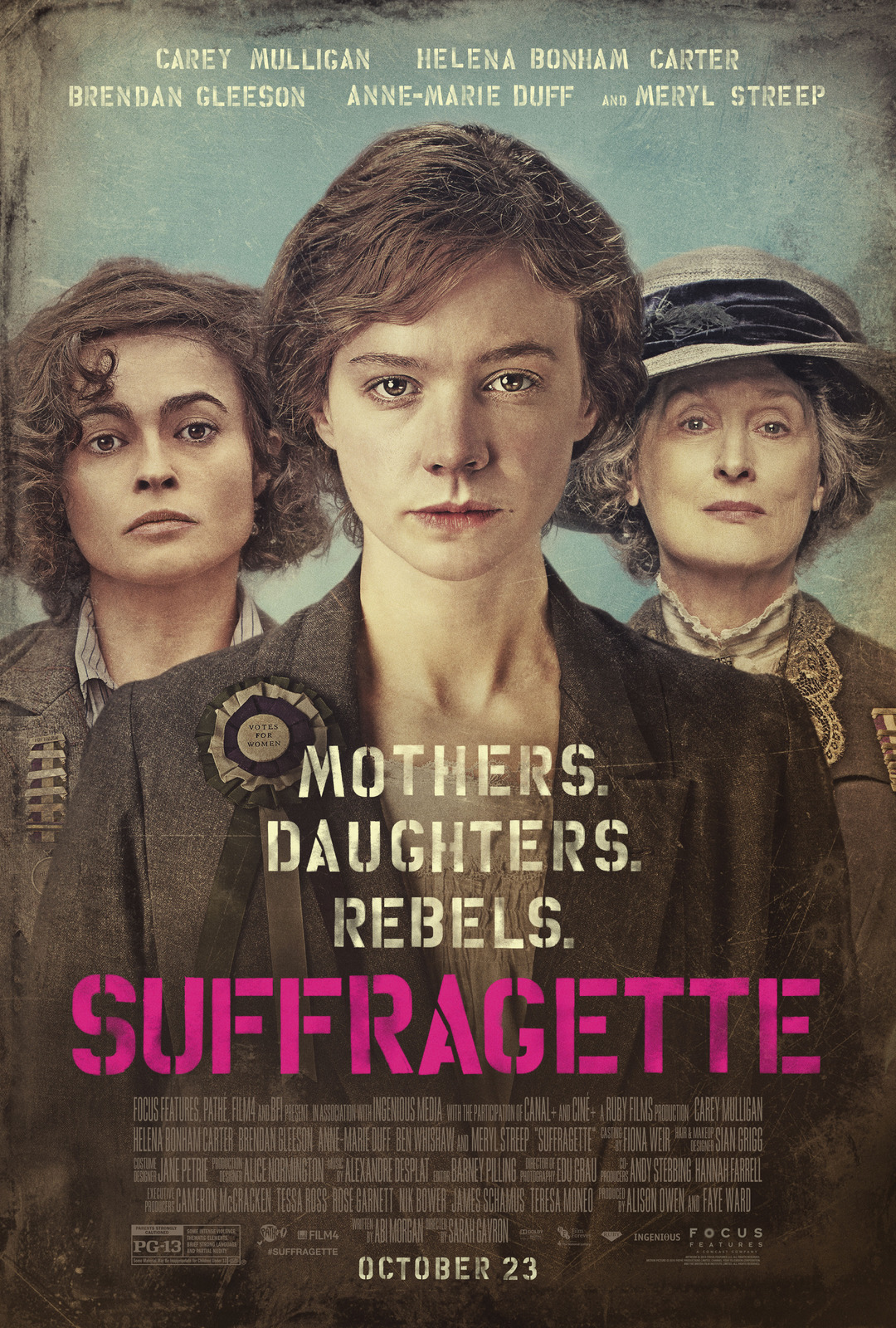
D: Sarah Gavron / 106m

Cast: Carey Mulligan, Helena Bonham Carter, Anne-Marie Duff, Brendan Gleeson, Ben Whishaw, Romola Garai, Natalie Press, Geoff Bell, Samuel West, Finbar Lynch, Adrian Schiller, Meryl Streep

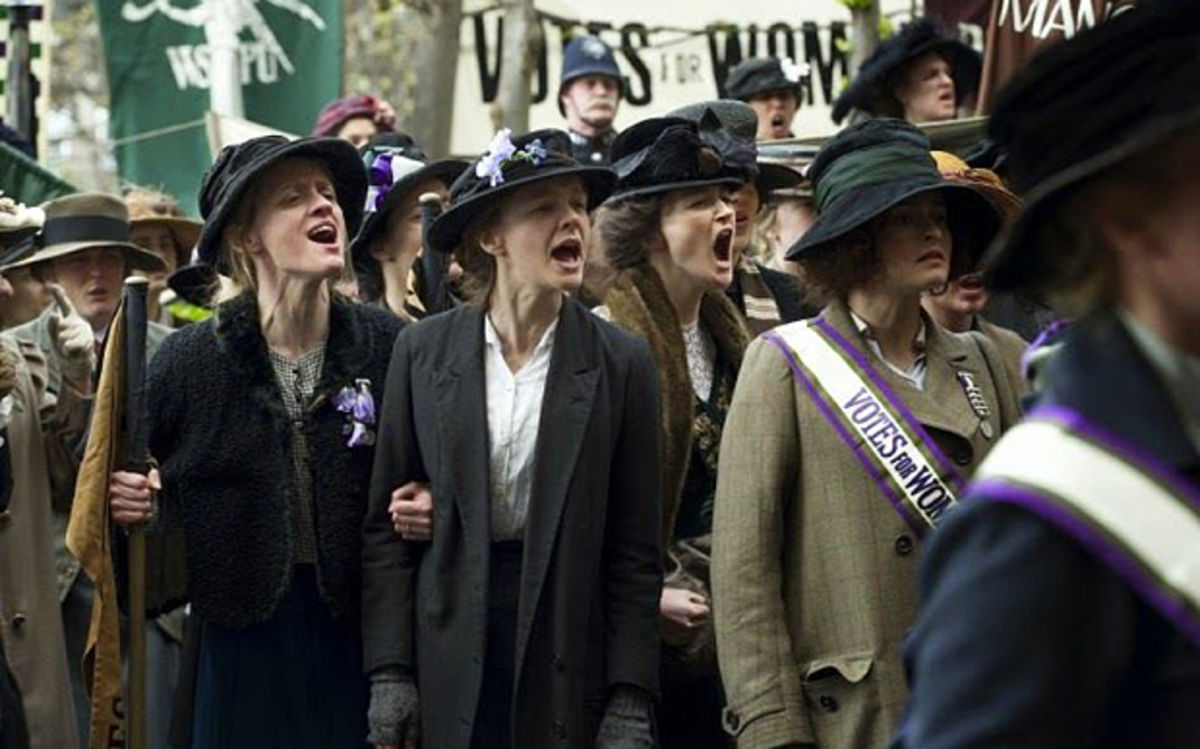
If you were to ask a hundred people, what was the Women’s Social and Political Union, and what was its purpose, most, if not all, wouldn’t be able to tell you. And yet the WSPU is perhaps one of the most important organisations in British history. Without its members and their tireless work, often in the face of police brutality and political intransigence, it’s very likely that women in the UK would not have been given the right to vote as early as they were (and even then it wasn’t until 1928). Suffragette, which looks at the Union’s activities in the run up to World War I, makes clear the level of sacrifice some of its members had to make in order to change the British political system for the better.

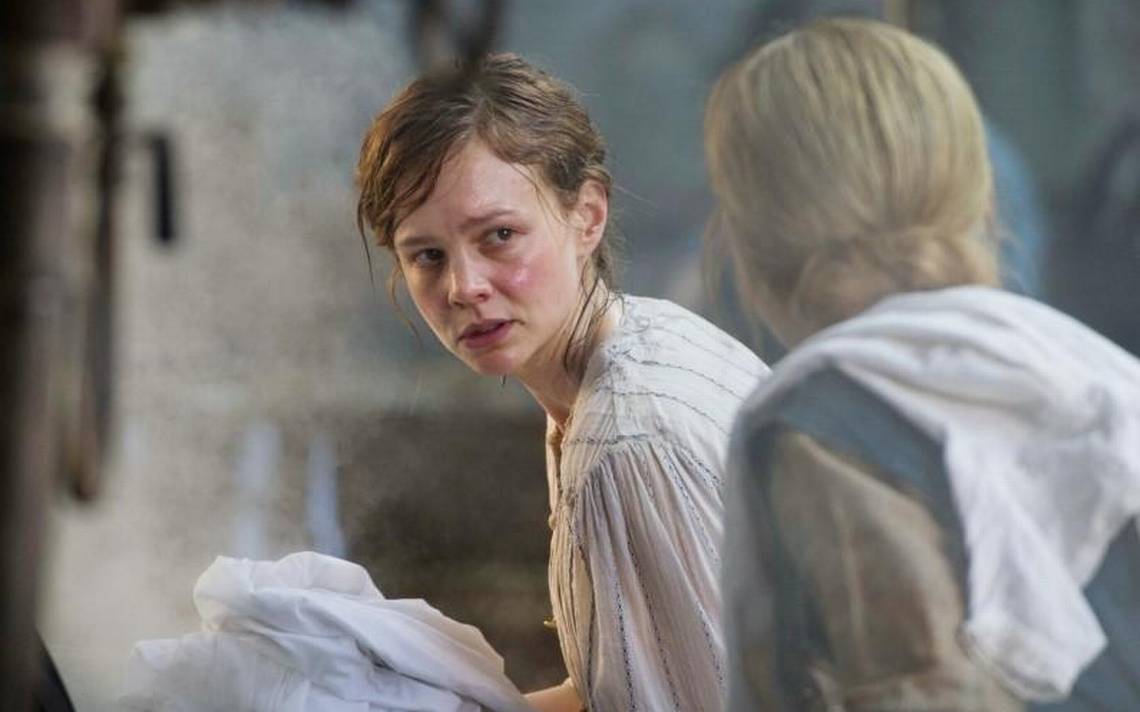
The struggle is seen through the eyes of laundry worker Maud Watts (Mulligan), wife of Sonny (Whishaw) and mother of their son, George. Maud is hardworking, has gained a certain degree of respect in the workplace, but at twenty-four has little future beyond what she’s already achieved. She appears to be accepting of her lot in life, but when a co-worker, Violet Miller (Duff), falls foul of their boss, Norman Taylor (Bell), Maud comes to her rescue and the two women strike up a friendship. Maud learns that Violet is a supporter of the women’s movement, and while she admires Violet’s courage and determination, she has no intention of becoming a suffragette.

Suffragette - scene2

An invitation to speak before then Chancellor of the Exchequer, David Lloyd George (Schiller), is arranged for Violet, but she is unable to speak. Maud stands in for her, and is invited to tell her story. Lloyd George is clearly sympathetic, but when an announcement is made some time later, the law remains unchanged. Caught up in the violent struggle that ensues, Maud is arrested. She is questioned by Inspector Arthur Steed (Gleeson), who has been tasked with rounding up the Union’s ringleaders, including its head, Emmeline Pankhurst (Streep). Maud denies being a suffragette, but when she’s released a week later, it’s obvious that people think she is. Sonny is upset by her involvement, and she promises to stay away from the WSPU and its members. But when a secret meeting, to be addressed by Emmeline Pankhurst is arranged, Maud can’t help but attend.

From there, along with Violet and a local pharmacist, Edith Ellyn (Carter), Maud becomes more and more involved in the WSPU and its plans. Unable to deal with her increasing involvement, Sonny kicks her out, and refuses to let her see George. In the meantime, she leaves the laundry as well, and devotes her time to the Union. She takes part in the destruction of postboxes and telephone lines, and other acts of civil disobedience. She’s arrested again, and Steed offers her a choice: inform on the Union’s activities, or face longer spells in jail. With the women under both suspicion and surveillance, and with Pankhurst exhorting them to increase their attacks on the establishment, Maud has to decide if her future resides with the WSPU.

Suffragette wears its heart on its sleeve right from the start. As a movie about the struggle of women to gain the right to vote it takes an earnest, pragmatic approach, and while it often strays from the truth in its efforts to shoehorn Maud into the events that did happen (particularly in the scenes set at Epsom on Derby Day, when Emily Wilding Davison was run down by the King’s horse), it also narrows its focus too much in its efforts to tell its story.

Suffragette - scene3

By choosing to tell the story of the WSPU’s struggle through the eyes of Maud, a neophyte in terms of the political landscape of the times, Abi Morgan’s script reduces the efforts and the sacrifices made by the real-life women of the time to the stuff of soap opera. From the disapproving looks of her neighbours as Maud walks home, to the reaction of Sonny after she goes back on her word, and even to the moment when she takes her long awaited “revenge” on Taylor for his bullying, rapacious behaviour, Maud’s journey from reluctant laundry worker to political activist is dealt with in such a clichéd, tick-box way that it robs the movie of any real drama. Indeed, the only time the movie achieves any kind of dramatic focus is when it opts to have Maud force-fed (something that happened to Davison forty-nine times; ironically, force-feeding was introduced after fellow suffragette Marion Wallace Dunlop was released from prison after being on hunger strike for ninety-one days).

With the politics of the time reduced to the simplest level possible, and the history of the struggle barely referred to, the movie operates in a kind of historical vacuum. And worst of all, it lacks passion. With everything that happens (and was happening at the time), Suffragette lacks a true sense of the anger and frustration that women must have felt back then. Morgan’s script shows the determination they had, but between that and Gavron’s emphasis on making sure that each scene moves on to the next as quickly as possible, any potential exploration of what women truly felt about their social and political situation back in the pre-War years is avoided. Instead, Maud is used as a kind of generic marker; if it happens to her then it happened to every woman, and that was very bad indeed (that sounds very simplistic, but then so is the movie).

Suffragette - scene1

On the performance side, Mulligan is dependable but is often asked to stand around observing while the likes of Duff and Carter do the heavy lifting. Gleeson does well as the Voice of Authority until a late script decision undoes all the good work he’s put in ’til then, Whishaw is the generally supportive husband who soon turns horrible simply because the movie needs him to, Garai is lost in a supporting role that keeps her on the edge of things throughout, Bell is once again called upon to be unconscionably malevolent, and Streep’s cameo lacks the gravitas it needs to be effective.

With radicalisation currently a hot topic, it would have been good to see Maud’s joining the WSPU in terms of indoctrination; after all, with their civil disobedience stretching to blowing up Lloyd George’s country home, it’s likely that they would have been described as terrorists if the word had existed in that context back then. But it’s an idea that’s never taken up, and like so many other areas where the movie could have gained some much needed depth, the need to keep it simple overrides all other considerations.

Rating: 5/10 – a so-so retelling of events leading up to 1914 and the outbreak of World War I (which really helped the suffragettes and their cause), Suffragette adopts a pedestrian approach to events of the time, and never comes alive in the way its makers probably intended; it’s ironic then, that in attempting to highlight the suffragettes’ fight for equality, the movie ends up portraying that fight in less than heroic terms.

Share this:

  • Click to share on X (Opens in new window) X
  • Click to share on Facebook (Opens in new window) Facebook
  • More
  • Click to print (Opens in new window) Print
  • Click to email a link to a friend (Opens in new window) Email
Like Loading...

Far from the Madding Crowd (2015)

30 Sunday Aug 2015

Posted by dullwood68 in Movies

≈ Leave a comment

Tags

1870, Carey Mulligan, Dorset, Drama, Historical drama, Literary adaptation, Matthias Schoenaerts, Michael Sheen, Review, Romance, Thomas Hardy, Thomas Vinterberg, Tom Sturridge, Weatherbury

Far from the Madding Crowd

D: Thomas Vinterberg / 119m

Cast: Carey Mulligan, Matthias Schoenaerts, Michael Sheen, Tom Sturridge, Juno Temple, Jessica Barden, Hilton McRae, Bradley Hall

1870. Bathsheba Everdene (Mulligan) shelling out on her aunt’s farm in Dorset. Her aunt’s neighbour, Gabriel Oak (Schoenaerts), is a shepherd with a hundred acres and two hundred sheep. One day he proposes marriage to Bathsheba but she rejects his offer, telling him that she is too independent for him and he would never be able to tame her. Soon after, Gabriel’s sheep are all killed when his sheepdog herds them over a cliff; unable to keep his farm going he is forced to sell up and move on. Bathsheba is sorry to see him go, but her sadness is by the news that she has inherited her uncle’s estate in Weatherbury.

Determined to run the estate herself, Bathsheba brooks no nonsense from her staff. Now a wandering worker for hire, Gabriel learns of a position as shepherd on the estate. When he arrives there he and Bathsheba are both pleased to see each other again, but she insists on the proper formalities now that she is his employer. When her efforts attract the attention of her neighbour, William Boldwood (Sheen), he too proposes marriage as Gabriel did. Bathsheba turns him down as well, and when she and Gabriel discuss the matter, his dislike for the way she treated Boldwood leads to her telling him to leave. But a problem with the sheep gives her no choice but to rehire him.

Some time later, Bathsheba is walking the grounds of her estate one night when she unexpectedly meets ex-soldier Francis Troy (Sturridge). He tells her she’s beautiful, but although she’s pleasantly surprised she tells him to leave. When she finds Troy helping with the harvest the next morning, she again tells him to leave, but before he does he manages to persuade her to meet him the next day. When she does, he proposes to her, and this time she accepts. They marry – against Gabriel’s advice – and Troy’s rapacious nature reveals itself. He milks the estate for money and treats Bathsheba like she’s his property. But his past comes back to haunt him in the form of Fanny Robbin (Temple), a young woman he was betrothed to but who went to the wrong church on their wedding day. She tells him she’s carrying his child; he agrees to meet her the next day but she doesn’t show up. Later, her discovered corpse is taken to Weatherbury (because she was a servant there). When Troy sees the body he tells Bathsheba she is nothing to him, and he leaves. He swims out to sea and Bathsheba is informed of his drowning. With the estate’s fortunes in jeopardy because of Troy’s gambling, Bathsheba is once more offered support from William Boldwood…

Carey Mulligan as "Bathsheba" and Matthias Schoenaerts as "Gabriel" in FAR FROM THE MADDING CROWD. Photos by Alex Bailey.  © 2014 Twentieth Century Fox Film Corporation All Rights Reserved

Leaving aside any comparison with John Schlesinger’s 1967 version, Far from the Madding Crowd is a hard movie to enjoy, determined as it is to play down the passion inherent in Thomas Hardy’s novel, and the social proprieties of the period. Thanks to the adaptation and screenplay by David Nicholls, and Thomas Vinterberg’s pedestrian direction, the movie fails to ignite at any point, preferring instead to tread safely along, ticking off the novel’s high points like a classroom exercise. This leaves the unlucky viewer wondering if and when the pace will pick up, or the buttoned-down emotions will ever be released in a way that can be recognised or acknowledged.

For this is a movie that trades on lingering looks and silent expressions. Bathsheba and Gabriel do little else but show their attraction for each other by looking pointedly and often at each other (God forbid anyone should display their feelings – William Boldwood excepted). So much is left unspoken there are moments that wouldn’t feel out of place in a silent movie. No doubt this is to allow Mulligan and Schoenaerts to “act” but instead it drags the movie along, and leaves both of them somewhat stranded, as the audience waits patiently for their expected romance to finally come to fruition (once Troy and Boldwood are dispensed with).

There’s also the sense that somewhere along the way – the editing stage, probably – the decision was taken to fit the movie to a two-hour running time, because this is a movie that feels hurried and disjointed at the same time. Some scenes feel truncated, while others feel as if they’re missing the one that should have come before. It’s an odd feeling, and never really goes away, even though the movie becomes more interesting once Bathsheba is married and it holds the attention a little better. Presented in this fashion, though, leads to the movie feeling like the edited version of a mini-series. (If there’s a Director’s Cut on the horizon, then a three-hour version wouldn’t come as a surprise.)

Against this, the performances are solid if unspectacular, though Sheen is a standout as the troubled yet hopeful Boldwood, the scene where he reveals his feelings about Bathsheba to Gabriel a small masterclass in making more from stilted dialogue than would seem possible. Mulligan convinces as a free spirit (though not as a woman instantly lovestruck by the romantic attentions of a soldier), while Schoenaerts gives such a laid-back performance it’s tempting to have his pulse checked from time to time. As the dashing Troy, Sturridge acts with his top lip to the fore, and delivers his lines as if he was reading from The Young Rogue’s Guide to Eligible Damsels. And Temple is wasted as Fanny, reduced to a few scenes and given little more to do than pop in and out of the narrative as required.

What saves the movie is Charlotte Bruus Christensen’s luminous landscape photography, allied to some richly detailed interiors, and a recreation of the period that feels exactly as it would have been. Beyond that, Craig Armstrong’s score is used sparingly and with surprising acuity, the few emotional scenes left free of music so as to focus the viewer’s attention on the scene itself, and not manipulate them into feeling the “correct” emotion. It’s a rare feat, but it works well here (unlike the scenes themselves).

Rating: 5/10 – sluggish and only fleetingly engaging, Far from the Madding Crowd looks and feels like a movie that deserves a better, more considered approach; while hitting its mark sporadically may account for some of the kinder reviews out there, this is still a major disappointment from Vinterberg, and if you’re a fan of Hardy, a letdown as well.

Share this:

  • Click to share on X (Opens in new window) X
  • Click to share on Facebook (Opens in new window) Facebook
  • More
  • Click to print (Opens in new window) Print
  • Click to email a link to a friend (Opens in new window) Email
Like Loading...

Inside Llewyn Davis (2013)

26 Sunday Jan 2014

Posted by dullwood68 in Movies

≈ 1 Comment

Tags

Audition, Carey Mulligan, Chicago, Drama, Ethan Coen, Folk music, Gaslight Café, Greenwich Village, Joel Coen, John Goodman, Justin Timberlake, Llewyn Davis, New York, Oscar Isaac, Relationships, Review

Inside Llewyn Davis

D: Ethan Coen, Joel Coen / 104m

Cast: Oscar Isaac, Carey Mulligan, John Goodman, Justin Timberlake, Garrett Hedlund, Adam Driver, Stark Sands, Jeanine Serralles, F. Murray Abraham

The Coen brothers have led a remarkably charmed cinematic life, making quirky, offbeat movies featuring all sorts of weird and wonderful characters in all sorts of weird and wonderful situations. Part of the fun to be had from watching a Coen brothers movie is that you never quite know what’s going to happen next; the Coens are so unpredictable there’s always that element of surprise in every movie, even something as outwardly formulaic as The Ladykillers (2004) or True Grit (2010). It’s a real surprise then, to find that the main character in their latest melancholy opus, Inside Llewyn Davis is, to put it mildly, a bit of a shit.

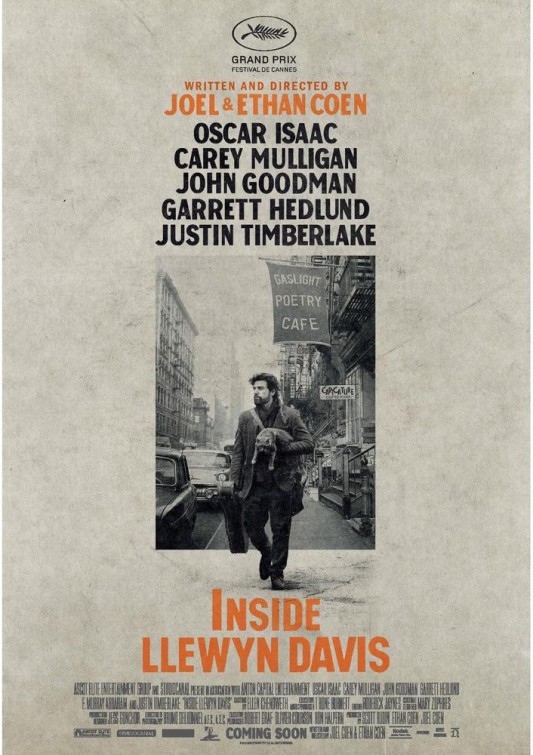
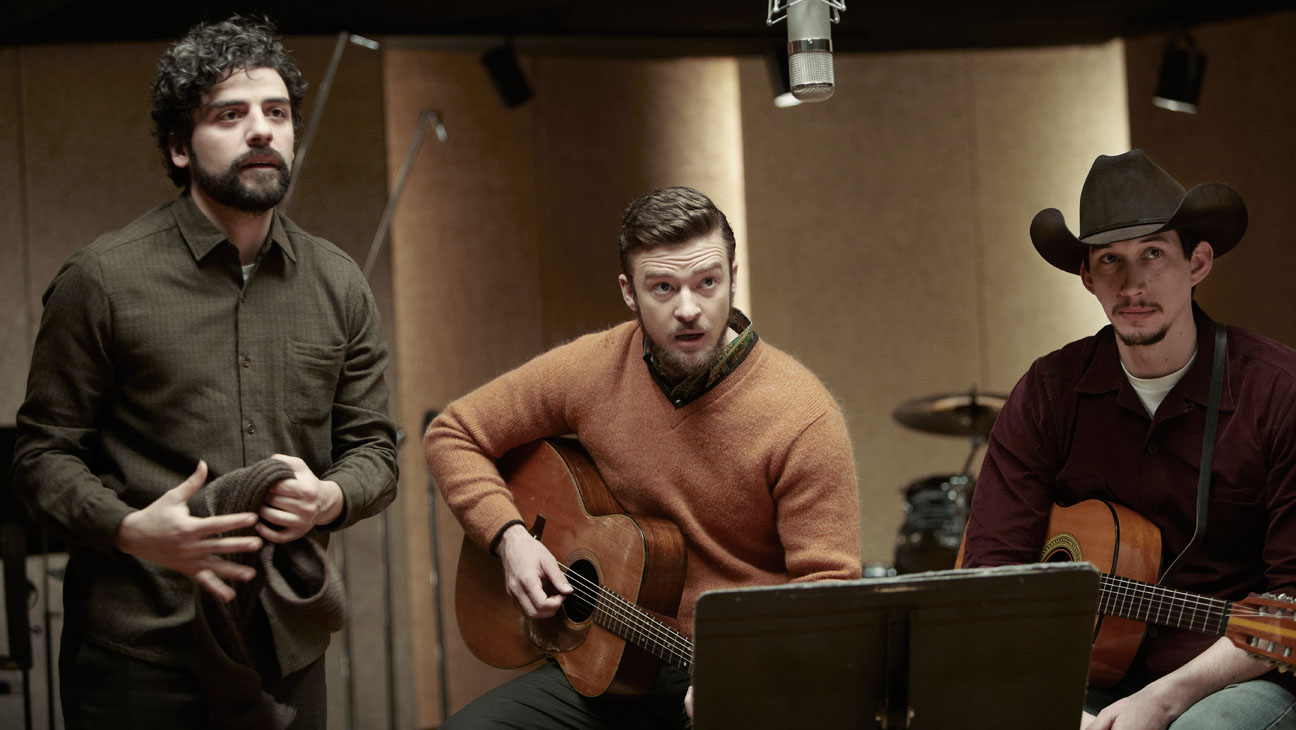
The movie is set in Greenwich Village, New York in 1961. Davis (Isaac) is a folk singer, eking out a career in clubs but without a clear idea on where he’s heading. He doesn’t have a place to live, so he sofa hops from place to place, trying the patience of friends and acquaintances, and never really repaying their kindnesses to him. He scoffs at the performances of others, including folk duo Jim (Timberlake) and Jean (Mulligan), but fails to see the weakness in his own abilities, weaknesses exacerbated by the recent death of his singing partner. Davis is horrible to just about everyone around him, foisting his unhappiness on them with all the fervour of a man trying to offload his troubles as fast as he gains them. His relationship with Jean becomes complicated when she tells him she’s pregnant and he might be the father. But Davis is so wretched she would rather have an abortion than give birth to a child that might be his. While he tries to deal with that issue, he’s also trying to deal with having lost his friends, the Gorfeins, cat. (When he takes a replacement cat back to them, it leads to one of the best lines in a Coen brothers movie ever.)  Taking a chance he can kick start his solo career in Chicago, Davis travels with proto-beat poet Johnny Five (Hedlund) and musician Roland Turner (Goodman) to audition for promoter Bud Grossman (Abraham). What he learns there has the possibility of changing his life.

Inside Llewyn Davis - scene

From its darkened, confessional-style opening at the Gaslight Café with Isaac proving himself to be a passionate vocalist, Inside Llewyn Davis is a fitting tribute to the era when folk music was at a turning point (see the singer who follows Davis on stage at the movie’s end). As well, though, it’s a clever, witty and engaging look at a man for whom Life is a constant struggle, but only because he hasn’t developed the ability to be happy. Thanks to a terrific performance by Isaac, Davis isn’t entirely the angry curmudgeon he appears to be. There are glimmers of hope throughout the movie that elicit the audience’s sympathy for him, and if he buries those glimmers almost as soon as they pop up, it’s still enough that they happen for him. Davis is like the black sheep of the family or the troubled friend you secretly like – despite all the times they upset you or let you down – and hope Life will eventually be kind to. For Davis it’s all about the music, the only thing he truly cares about, and around which his life revolves; without it he would be a truly broken man.

Once again, the Coens have chosen a strong supporting cast for their leading man, with Mulligan’s angry turn a standout, and Goodman close behind as the disabled, anecdote spouting Turner. It’s good to see the likes of Driver and Sands given the chance to shine in small, beautifully realised roles, and Abraham too, albeit in a smaller though more pivotal role (and obviously fitted in between episodes of Homeland). A wintry New York looks cold and yet somehow vibrant thanks to crisp, striking photography courtesy of Bruno Delbonnel, and the period detail is subtly evoked by Jess Gonchor’s production design and Deborah Jensen’s art direction.

What is less obvious from this review so far is the humour that permeates the movie. Davis may be an awkward, unlikely source of merriment, but the Coens weave comedy into the somewhat solemn proceedings with deceptive skill. There are laughs to be had, and they’re scattered here and there in the script like precious jewels. And then there’s the music. Perhaps closest to O Brother, Where Art Thou? (2000) in terms of dramatic importance, the music in Inside Llewyn Davis is extremely well chosen, both for reflecting the state of Davis’s life, and for providing a candid view of the folk music scene at the time (check out the wonderfully daft Please Mr. Kennedy, an ode to world peace performed by Isaac, Timberlake and Driver that amazes as much as it amuses). As already noted, Isaac has a commanding vocal style, and his deep, rich, melodic delivery suits the material well; it’s hard now to imagine anyone else in the role.

Rating: 9/10 – a richly detailed movie that delights and impresses in equal measure; confident, absorbing, and wickedly funny in places, Inside Llewyn Davis confirms once more that when it comes to off-kilter, the Coen brothers are in a class of their own.

Share this:

  • Click to share on X (Opens in new window) X
  • Click to share on Facebook (Opens in new window) Facebook
  • More
  • Click to print (Opens in new window) Print
  • Click to email a link to a friend (Opens in new window) Email
Like Loading...

Blog Stats

  • 486,528 hits

Recent Posts

  • 10 Reasons to Remember Bibi Andersson (1935-2019)
  • Fantasia (1940)
  • Dances With Wolves (1990) – The Special Edition
  • Kiss of the Spider Woman (1985)
  • The Three Musketeers (1973)

Top Posts & Pages

  • Lost for Life (2013) - Another Look
    Lost for Life (2013) - Another Look
  • Lost for Life (2013)
    Lost for Life (2013)
  • About
    About
  • Mr. Topaze (1961)
    Mr. Topaze (1961)
  • Winter's Tale (2014)
    Winter's Tale (2014)
  • Billy Lynn's Long Halftime Walk (2016)
    Billy Lynn's Long Halftime Walk (2016)
  • The Hitman's Bodyguard (2017)
    The Hitman's Bodyguard (2017)
  • Shock and Awe (2017)
    Shock and Awe (2017)
  • 5 Famous Movie Roles That Nearly Went to Someone Else
    5 Famous Movie Roles That Nearly Went to Someone Else
  • The Layover (2017)
    The Layover (2017)
Follow thedullwoodexperiment on WordPress.com

Blogs I Follow

  • Rubbish Talk
  • Film 4 Fan
  • Fast Film Reviews
  • The Film Blog
  • All Things Movies UK
  • Interpreting the Stars
  • Let's Go To The Movies
  • Movie Reviews 101
  • TMI News
  • Dan the Man's Movie Reviews
  • Film History
  • Jordan and Eddie (The Movie Guys)

Archives

  • April 2019 (13)
  • March 2019 (28)
  • February 2019 (28)
  • January 2019 (32)
  • December 2018 (28)
  • November 2018 (30)
  • October 2018 (29)
  • September 2018 (29)
  • August 2018 (29)
  • July 2018 (30)
  • June 2018 (28)
  • May 2018 (24)
  • April 2018 (21)
  • March 2018 (31)
  • February 2018 (25)
  • January 2018 (30)
  • December 2017 (30)
  • November 2017 (27)
  • October 2017 (27)
  • September 2017 (26)
  • August 2017 (32)
  • July 2017 (32)
  • June 2017 (30)
  • May 2017 (29)
  • April 2017 (29)
  • March 2017 (30)
  • February 2017 (27)
  • January 2017 (32)
  • December 2016 (30)
  • November 2016 (28)
  • October 2016 (30)
  • September 2016 (27)
  • August 2016 (30)
  • July 2016 (30)
  • June 2016 (31)
  • May 2016 (34)
  • April 2016 (30)
  • March 2016 (30)
  • February 2016 (28)
  • January 2016 (35)
  • December 2015 (34)
  • November 2015 (31)
  • October 2015 (31)
  • September 2015 (34)
  • August 2015 (31)
  • July 2015 (33)
  • June 2015 (12)
  • May 2015 (31)
  • April 2015 (32)
  • March 2015 (30)
  • February 2015 (37)
  • January 2015 (39)
  • December 2014 (34)
  • November 2014 (34)
  • October 2014 (36)
  • September 2014 (25)
  • August 2014 (29)
  • July 2014 (29)
  • June 2014 (28)
  • May 2014 (23)
  • April 2014 (21)
  • March 2014 (42)
  • February 2014 (38)
  • January 2014 (29)
  • December 2013 (28)
  • November 2013 (34)
  • October 2013 (4)

Create a free website or blog at WordPress.com.

Rubbish Talk

Film 4 Fan

A Movie Blog

Fast Film Reviews

The Film Blog

The official blog of everything in film

All Things Movies UK

Movie Reviews and Original Articles

Interpreting the Stars

Dave Examines Movies

Let's Go To The Movies

Film and Theatre Lover!

Movie Reviews 101

Daily Movie Reviews

TMI News

Latest weather, crime and breaking news

Dan the Man's Movie Reviews

All my aimless thoughts, ideas, and ramblings, all packed into one site!

Film History

Telling the story of film

Jordan and Eddie (The Movie Guys)

Movie Reviews & Ramblings from an Australian Based Film Fan

Privacy & Cookies: This site uses cookies. By continuing to use this website, you agree to their use.
To find out more, including how to control cookies, see here: Cookie Policy
  • Subscribe Subscribed
    • thedullwoodexperiment
    • Join 481 other subscribers
    • Already have a WordPress.com account? Log in now.
    • thedullwoodexperiment
    • Subscribe Subscribed
    • Sign up
    • Log in
    • Report this content
    • View site in Reader
    • Manage subscriptions
    • Collapse this bar
 

Loading Comments...
 

    %d