• 10 Reasons to Remember…
  • A Brief Word About…
  • About
  • For One Week Only
  • Happy Birthday
  • Monthly Roundup
  • Old-Time Crime
  • Other Posts
  • Poster of the Week
  • Question of the Week
  • Reviews
  • Trailers

thedullwoodexperiment

~ Viewing movies in a different light

thedullwoodexperiment

Tag Archives: Cate Blanchett

Thor: Ragnarok (2017)

24 Tuesday Oct 2017

Posted by dullwood68 in Movies

≈ Leave a comment

Tags

Asgard, Cate Blanchett, Chris Hemsworth, Comedy, Drama, Fantasy, Jeff Goldblum, Marvel, Review, Sakaar, Sequel, Taika Waititi, The Grandmaster, Tom Hiddleston, Valkyrie
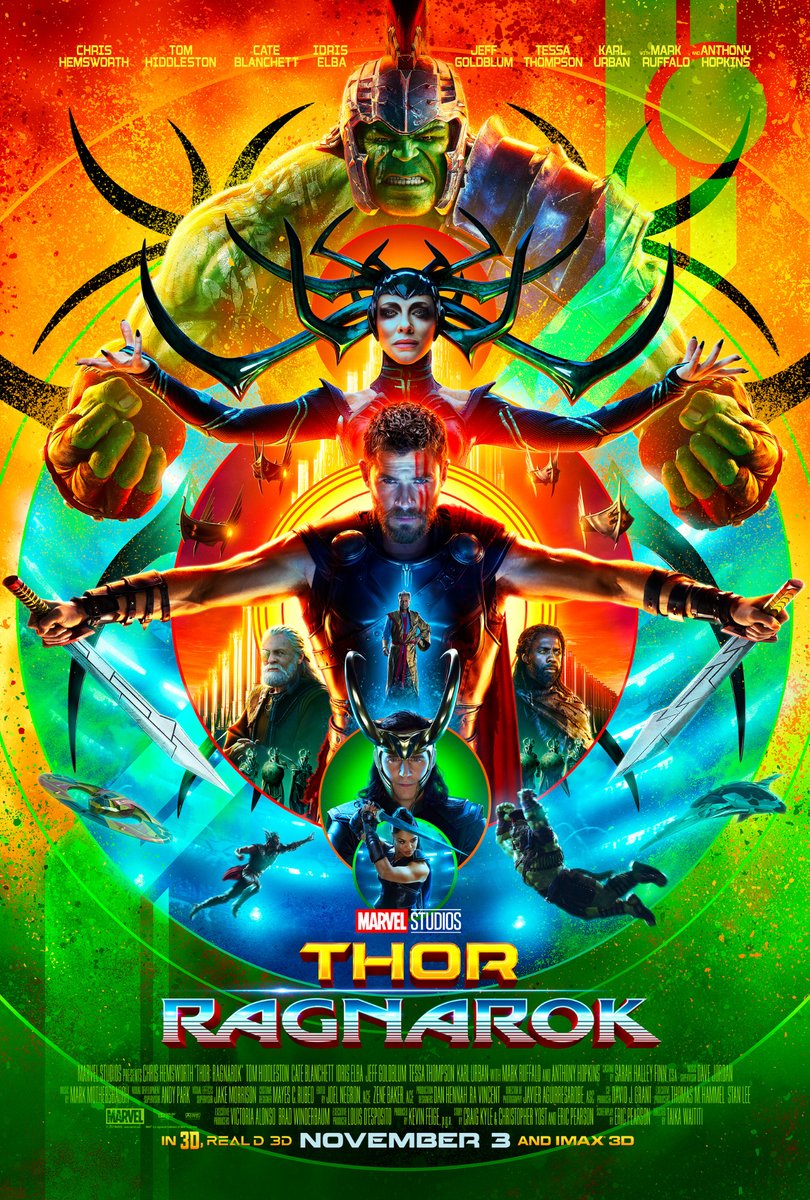
D: Taika Waititi / 130m

Cast: Chris Hemsworth, Tom Hiddleston, Cate Blanchett, Idris Elba, Jeff Goldblum, Tessa Thompson, Karl Urban, Mark Ruffalo, Anthony Hopkins, Benedict Cumberbatch, Taika Waititi, Rachel House, Clancy Brown

Ah, Thor, God of Thunder – where have ye been? And what have ye done? Is there anything we should know about? After seeing Thor: Ragnarok, you might be thinking, no, there isn’t, as Marvel’s latest attempt to spin an interesting solo movie out of the Son of Asgard throws punchline after one liner after humorous quip as it tries to draw the audience’s attention away from the fact that, once again, Marvel have very few ideas as to what to do with the character (or Loki, or Odin, or worse still, Bruce Banner/Hulk). By making this a de facto comedy, somewhere along the line they forgot to provide a compelling story. Sure, there’s drama in Hela, the Goddess of Death (Blanchett) coming to destroy Asgard, and yes, there’s further drama in Thor and Hulk both ending up on the same planet and needing to team up to save themselves and Asgard, but it’s all buried under a layer of humour that is often clumsy and intrusive.

The main problem is with Marvel’s decision to split the narrative in two. At the beginning we have the re-emergence of Hela and the threat to Asgard as we know it. Hela proves a formidable opponent to Thor and sends him spinning off through time and space where he ends up on the planet of Sakaar. This is where the movie becomes a little schizophrenic, hopping to and fro from Sakaar, where Thor finds himself prisoner of the Grandmaster (Goldblum), a futuristic Nero-in-waiting who organises gladiatorial games in the kind of overblown colosseum where the unlucky folks in the seats all the way at the top need to bring binoculars in order to see the duels properly, and Asgard, where Hela spends her time waiting for Thor to come back for the big showdown (sorry, that should read behaving nefariously and cruelly to the people of Asgard). Either of these stories could have made an effective single movie, but here they only serve to rub up against each other awkwardly, and as a result, neither are particularly effective.
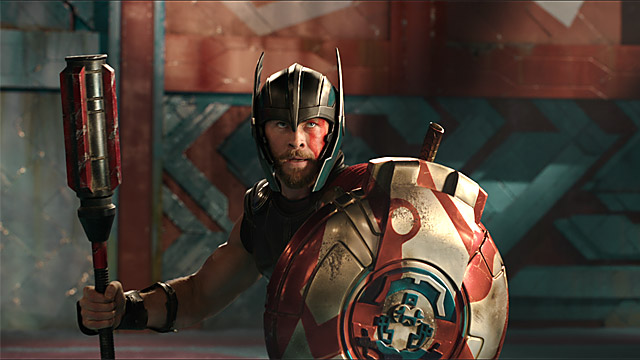
While Hela misbehaves in Asgard, Thor discovers he’s not alone on Sakaar. Loki (Hiddleston) is also there, having suffered the same fate at the hands of Hela as his brother. Of course, Loki is just as conniving and deceitful as ever, but equally as ever he can still be persuaded to do the right thing when the need arises. Also on Sakaar is Bruce Banner (Ruffalo), still transformed into the Hulk from his last appearance in the Marvel Cinematic Universe towards the end of Avengers: Age of Ultron (2015). Hulk is the Grandmaster’s champion gladiator, still indomitable, still fuelled by rage but also satisfied by not having returned to being his weaker alter ego. And then there’s a third “refugee”, Scrapper-142, otherwise known as Valkyrie (Thompson), an Asgardian whose presence (and age) aren’t fully explained in the script, but who has history with Hela. Together, Thor, Hulk, Loki and Valkyrie must team up to escape from Sakaar, head for Asgard, and defeat the waiting Hela (sorry, that should read defeat the nefarious and cruelly behaving Hela).

While all this takes place over a matter of days (presumably), it lacks for tension and suspense. We all know that Thor and his team of Revengers will escape from Sakaar, even if it is through the notorious Devil’s Anus (a spectacular wormhole that hovers conveniently over Sakaar), but half the problem is that it takes him so long to do so. And by the time everyone’s back in Asgard for the big showdown, it leaves the final battle feeling a little rushed. Along the way, Bruce relays his reluctance to return to being Hulk, Loki plays both sides to his own advantage, Valkyrie is convinced to help Thor, and the Grandmaster behaves in the kind of off-kilter, quirky, madcap kind of way that only Jeff Goldblum can manage. Meanwhile, Hela sits on the throne of Asgard, glowers a lot, dispenses with a horde of Asgardian warriors in quick fashion, makes an acolyte of Karl Urban’s opportunistic Skurge, and goes back to glowering and waiting for Thor to return (sorry, that should read glowering and plotting the end of Asgard – though you’d think that, having been banished for what seems a very long time, she would have a firm course of action in mind by now).
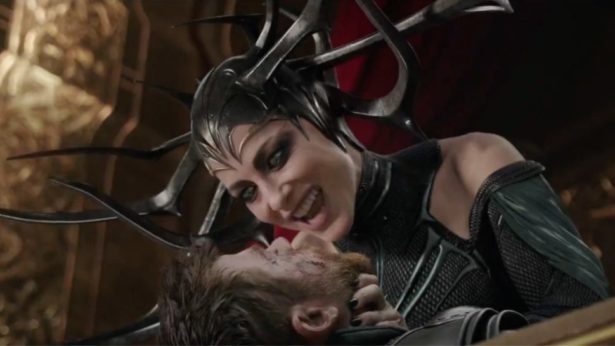
It’s all put together by Marvel newbie Waititi in bright, airy fashion and with huge dollops of the aforementioned humour to wash it all down with. Some of the humour does work – the already seen in the trailer, “he’s a friend from work”, a lovely mini-performance by Hopkins as Loki playing at being Odin, and Thor trying to break a window – but overall there are just too many moments where the humour is forced or feels like it’s there to carry the scene instead of being an integral part of it. It also comes perilously close to making Thor seem like an inveterate joker rather than the more serious God of Thunder. Even Hela gets a number of wry, pithy observations to put across, and while Blanchett is clearly having fun, having the main villain sounding like a bored straight man trying to get a laugh doesn’t help at all. Marvel seem to be experimenting with each new instalment in the MCU, and Thor: Ragnarok has all the hallmarks of a comedy script that’s been beefed up dramatically thanks to the inclusion of Hela.

That the movie is still a lot of fun despite all this is a tribute to the talent of Waititi and his directorial skills, and the Marvel brand itself, increasingly less homogeneous of late, but still sticking to a winning formula. But there’s very, very little here that adds to the twenty-two movie story arc that will culminate in Untitled Avengers Movie (2019), and if this movie didn’t exist it’s not entirely certain that anyone would be too concerned if Thor and Hulk didn’t show up on our screens until Avengers: Infinity War (2018). Thor himself does undergo some changes (and it’s not just the hair), but where they will ultimately take him if there are to be any further solo movies is open to debate. As for Bruce Banner and his jolly green alter ego, the greater problem of how to provide him with his own solo movie remains unsolved, as the movie keeps him in a supporting role and shows just how effective the character can be when he’s not the main focus. A pleasant diversion then before we delve into the world of Wakanda, but one that’s like a bowl of ice cream: memorable only while it’s being consumed.

Rating: 7/10 – despite the critical drubbing that Thor: The Dark World has taken since its release in 2013, and despite the infusion of a huge amount of comedy, Thor: Ragnarok is ultimately the least of the God of Thunder’s outings so far (though only just); with too many holes in the script, and too many occasions where the characters react and behave in service to the humour rather than the other way around, this is still entertaining stuff, just not as bold or as consistent as it could, or should, have been.

Share this:

  • Click to share on X (Opens in new window) X
  • Click to share on Facebook (Opens in new window) Facebook
  • More
  • Click to print (Opens in new window) Print
  • Click to email a link to a friend (Opens in new window) Email
Like Loading...

Notes on a Scandal (2006)

04 Monday Apr 2016

Posted by dullwood68 in Movies

≈ Leave a comment

Tags

Affair, Bill Nighy, Cate Blanchett, Drama, Judi Dench, Lesbian, Literary adaptation, Patrick Marber, Review, Richard Eyre, St George's School, Student/teacher relationship, Zoë Heller

Notes on a Scandal

D: Richard Eyre / 92m

Cast: Judi Dench, Cate Blanchett, Bill Nighy, Philip Davis, Andrew Simpson, Michael Maloney, Juno Temple, Max Lewis, Joanna Scanlan, Tom Georgeson, Julia McKenzie

Adapted by Patrick Marber from the novel by Zoë Heller, Notes on a Scandal should be sought out for three reasons: the acting masterclasses given by Judi Dench and Cate Blanchett, a superb, unsettling score by Philip Glass, and the script itself, a beautifully constructed piece that delves into some very dark corners indeed, and which still allows itself the luxury of including a mordaunt sense of humour.

The story centres around two outwardly very different teachers in a London comprehensive school, St George’s. Dench is Barbara Covett, a history teacher who is approaching retirement. She’s never married, doesn’t have a significant other, is respected but not liked by the other teachers, and adopts a disdainful air that keeps everyone at a distance. Blanchett is Sheba Hart, a much younger art teacher who lacks Barbara’s experience and thick skin. She’s married to an older man, Richard (Nighy), and has two children, Polly (Temple) and Ben (Lewis). Sheba is the kind of teacher who often finds themselves out of their depth, and it’s on one such occasion that Barbara comes to her rescue.

Grateful to her, Sheba begins a friendship with Barbara that sees the older woman visiting Sheba’s home more and more often. Sheba effectively becomes Barbara’s protegé, although there is still a wide gulf between them, stemming mostly from Barbara’s dislike of Sheba’s middle-class lifestyle. One evening, Barbara waits for Sheba to attend a school drama performance, but Sheba is late. Barbara goes in search of her, and discovers Sheba having sex with a pupil, Steven Connolly (Simpson). Shocked, and feeling betrayed, Barbara confronts Sheba. The younger woman pleads with Barbara not to tell anyone. To Sheba’s surprise, Barbara has no intention of telling anyone – because they’re friends (though Barbara does insist Sheba end the affair immediately). Barbara sees her chance to become closer to Sheba, or destroy her if Sheba doesn’t agree to spending more time with her.

NOAS - scene3

But Steven won’t be put off by Sheba’s pleas to stop the affair. He continues to see her, and Sheba allows their relationship to continue (though she keeps this a secret from Barbara). But it’s not long before Barbara discovers Sheba’s duplicity, and when she attempts to blackmail Sheba into spending time with her – to be with her at the expense of spending time with her family – Sheba has no choice but to put her family first. Angry and spiteful, Barbara seizes an opportunity presented to her by another teacher, Brian Bangs (Davis), and it’s not long before Steven’s mother is at Sheba’s house and the whole affair is revealed.

Richard leaves Sheba in order to have time to think about their relationship, and unable to face being in their home without him, asks Barbara if she can stay with her for a few days. Barbara quite naturally agrees, but a chance discovery leads to Sheba finding out the true extent of what their friendship means to Barbara, and how their relationship has been manipulated by Barbara from the beginning. With the future of her marriage looking uncertain, and facing jail because Steven is only fifteen, Sheba has no option but to confront Barbara over what the older woman has done.

NOAS - scene1

Simply put, Notes on a Scandal is gripping stuff. Patrick Marber’s script hustles and bustles with undisguised hostility towards its two central characters, revealing their darkest traits and baser instincts with a scalpel-like precision that flays their more self-serving attributes to the metaphorical bone. Both Barbara and Sheba have their secrets, and both struggle to keep them hidden, but Marber won’t allow them any such luxury. As they interact with each other, lying and obscuring the truth about themselves, Barbara and Sheba become more and more unlikeable as the movie continues. Barbara’s domineering, manipulative demeanour is barely hidden at times, but she covers it well enough to fool Sheba, whose self-centred moral nihilism means she can’t see when someone has seen through her own carefully constructed façade.

The two women become involved in a one-sided battle, one-sided because Sheba doesn’t realise that Barbara wants nothing less than complete capitulation, and on her terms alone. Sheba is to be the sacrifice to Barbara’s vanity, another in a (conceivably) long line of hand maidens to Barbara’s idea of friendship. (The viewer may deduce that Barbara is a lesbian because of her intentions toward Sheba, but Marber’s script is too clever for that; instead, Barbara is more asexual than sexual, and is horrified at the suggestion – made by Sheba late on in the movie – that her motives lie in that direction.) Sheba, however, is very definitely a sexual creature, one who defines herself and her existence by the way in which she is found attractive and desired (once, after they’ve had sex, Steven tells Sheba she is “fit”, and Sheba positively glows under the praise). Both women are confused about love, Barbara seeing it as a kind of managed companionship, and Sheba as a validation of her sexual appeal. These confusions amount to huge fault lines in both their personalities, and when they eventually clash, the end result is force majeure.

NOAS - scene2

As noted above, this is a movie that features two very impressive performances, and there’s not even a hair’s breadth between them in terms of how good they are. Dench is icy and abrupt as Barbara, calculating and insidious, a woman used to being respected (and feared even) and getting her own way. Dench doesn’t shy away from examining Barbara’s less savoury characteristics, using Marber’s script to highlight the way in which she expects everyone around her to fit in with her ideas and prejudices. Dench is also good at portraying Barbara’s emotional sterility through a succession of expertly judged expressions, all testifying to the void in both her heart and her feelings.

Blanchett has what feels like the more compelling, emotionally wrought role, but Sheba is a pleasure seeker, and can only justify her actions in ways that are meant to elicit sympathy for what she sees as her unexciting lifestyle. It’s interesting that she was one of Richard’s students when they first met (though she was twenty and not fifteen when he seduced her – or she seduced him; which it is we’re not told), and she does use this as an attempt to excuse her behaviour and the affair, but Richard quite rightly decries this, leaving Sheba unable to gain any sympathy or acceptance for what she’s done. Blanchett embraces the complex neediness that infuses Sheba’s personality and doesn’t shy away from portraying the character’s selfish obsessions and somewhat childish naïvete. Like Barbara, Sheba is used to getting what she wants; the only real difference between them is that Barbara has grown used to being on her own, whereas it’s a situation that scares Sheba unreasonably.

Acting as an extra layer of emotional intensity, Philip Glass’s insistent, urgent score ramps up the tension as the story unfolds. It acts as an unseen musical narrator, underscoring (if that’s an appropriate analogy) the drama as it heads towards a necessarily downbeat ending. Coordinating this and the performances of Dench and Blanchett, director Richard Eyre, along with DoP Chris Menges, uses his theatrical flair to keep the movie both visually and dramatically exciting, and he teases every nuance and vicious piece of brinkmanship out of Marber’s acerbic screenplay. With great supporting turns from Nighy, Davis and Simpson, as well as some equally adept editing by John Bloom and Antonia Van Drimmelen, this is an exceptionally well crafted movie that still stands out ten years after it was released.

Rating: 9/10 – with human frailty and arrogance brought to uncomfortable life by two of today’s finest actresses, Notes on a Scandal has enough positive attributes for two movies; richly detailed and endlessly fascinating, it’s a movie whose value is unlikely to deteriorate or become degraded by repeat viewings, and which remains a remarkable convergence of talent.

Share this:

  • Click to share on X (Opens in new window) X
  • Click to share on Facebook (Opens in new window) Facebook
  • More
  • Click to print (Opens in new window) Print
  • Click to email a link to a friend (Opens in new window) Email
Like Loading...

Truth (2015)

02 Tuesday Feb 2016

Posted by dullwood68 in Movies

≈ Leave a comment

Tags

60 Minutes, Cate Blanchett, CBS, Dan Rather, Dennis Quaid, Drama, George W. Bush, James Vanderbilt, Literary adaptation, Mary Mapes, Preview, Review, Robert Redford, Texas Air National Guard, Topher Grace, True story

Truth

D: James Vanderbilt / 125m

Cast: Cate Blanchett, Robert Redford, Topher Grace, Dennis Quaid, Elisabeth Moss, Bruce Greenwood, Stacy Keach, Noni Hazlehurst, John Benjamin Hickey, David Lyons, Rachael Blake, Dermot Mulroney, Andrew McFarlane, Connor Burke

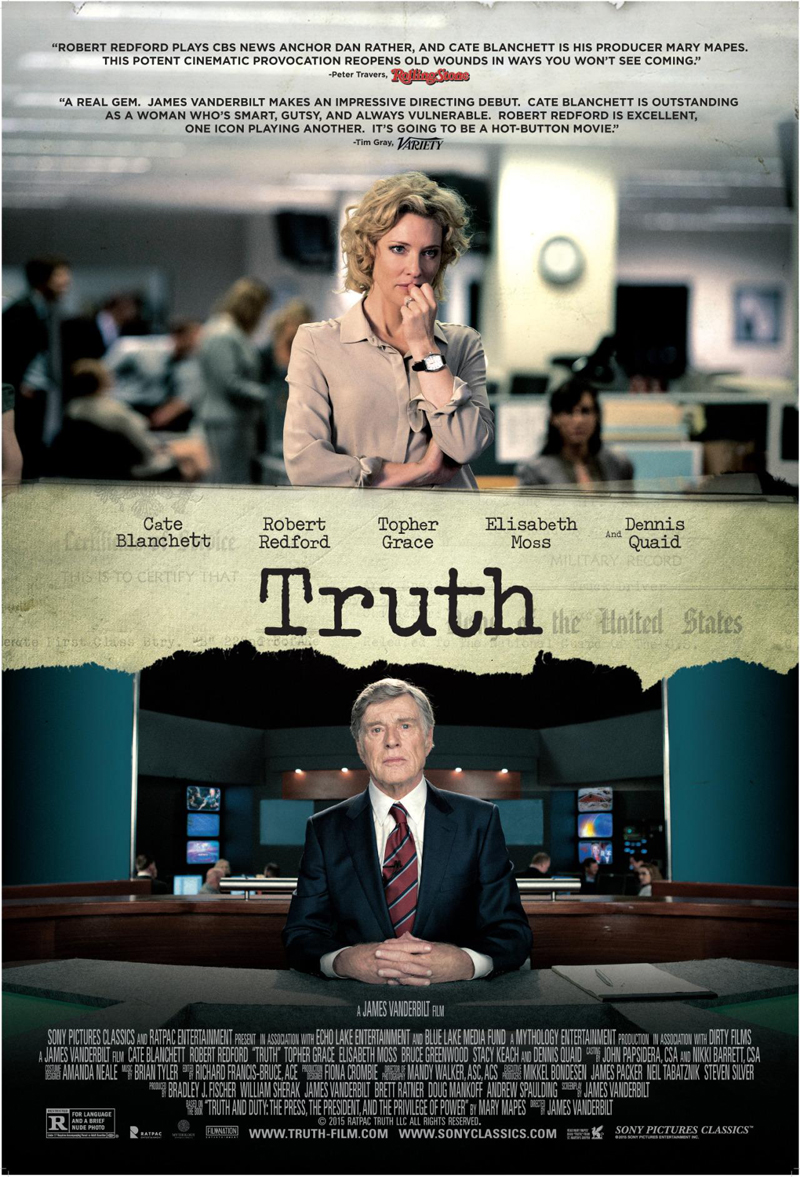
In 2004, Mary Mapes (Blanchett) was a producer at CBS’ flagship news programme, 60 Minutes. She worked with the legendary news anchor Dan Rather (Redford), and earlier that year she and her team had produced a news report on the abuse happening at Abu Ghraib (which later won a Peabody Award). Mapes was a highly regarded producer who had been at CBS for fifteen years; when she told her bosses that she wanted to investigate irregularities connected with then President George W. Bush’s service in the Texas Air National Guard during the early Seventies, she was given the go ahead to look into the matter and prepare a segment for broadcast.

Soon after, Mapes came into possession of documents – memos – that claimed to show Bush had failed to follow orders while in the ANG, and that efforts were made by his superiors to influence and improve his record. These documents were purportedly written by Bush’s commander, the late Jerry B. Killian. Mapes and her team set about trying to find witnesses who could corroborate the content of these memos, but were consistently rebuffed. At the same time they sought to have the documents examined for authenticity. But there were problems: the documents weren’t the originals, and their source wasn’t confirmed before the segment was aired on 8 September 2004. Mapes, even though the documents were copies of the originals, was convinced of their probity at least, and so was Rather. The segment was broadcast, and during it, Rather stated that “the material” had been authenticated.

Truth - scene1

But this wasn’t true, and soon criticism of the show’s claims were spreading far and wide, and focused primarily on the typography used in the memos and other anachronisms that seemed damning. CBS found themselves backtracking, and Mapes was disturbed to learn that the person who’d given her the documents, retired Lt. Col. Bill Burkett (Keach), had lied about where he got them from. With their provenance appearing unsavoury at the least, Mapes came under pressure from the head of CBS, Andrew Heyward (Greenwood), to limit the damage of these revelations, and to find conclusive proof that the memos were even written by Killian. Unable to, and with other accusations of poor journalism coming in thick and fast, Mapes and her team were suspended pending an internal investigation. With his own integrity tarnished by the criticisms, Rather made a public apology regarding the segment, and later, announced his retirement.

Adapted from Mapes’ book Truth and Duty: The Press, the President, and the Privilege of Power, writer/director James Vanderbilt’s debut feature is an awkward beast, telling its story with a great deal of enthusiasm for showing just how tarnished Bush’s ANG record was, but then failing to properly acknowledge just how badly Mapes and her team scored a classic own goal. You don’t have to be an expert in TV news journalism to realise that the whole issue of the memos – their authenticity, their provenance, what they appeared to say – was handled with an irresponsible disregard for true journalistic integrity. Anyone watching Truth, and that really does mean anyone, will be watching events unfold and wincing at just how readily Mapes and her team were willing to put their heads in a collective noose. They failed to do the one thing that any journalist or writer needs to do to make an accusation: have conclusive, incontrovertible proof that what they’re saying is true. And Mapes didn’t have that.

Truth - scene2

But again, the movie tries its best to avoid acknowledging what should be obvious to anyone watching. It still supports Mapes in her efforts to “get out from under” the storm of approbation and scathing criticism that rains down on her once the segment airs. And it tries to make her into a scapegoat for a much larger conspiracy, one that’s expressed with anguished contempt by her colleague, Mike Smith (Grace), but the whole idea lacks weight, despite the movie clinging to it unashamedly for the last thirty minutes. This may be how Mapes and her team felt at the time, but a judicious helmer would have excised it for being too incongruous and absurd a proposition (it’s also one of those embarrassing tantrums that people have when they haven’t got anyone else to blame but themselves).

All this leads to an inescapable, but strangely welcome conclusion: the movie you’re watching is about failure, a rare topic in American movies, but one that Vanderbilt at least tries to embrace, even if he doesn’t quite know what to do with it, hence the ambivalence towards Mapes and the schoolboy errors she makes. Rather makes his apology but is seen doing so on a variety of TV screens and monitors, rather than up close, thereby limiting the effect of his regret and the connection we can make to it; it’s almost inconsequential to what’s happening to Mapes at the time, as if the movie has to acknowledge it occurred but doesn’t want to lend it too much importance. It’s like when someone says to you, “Oh, by the way…” But Mapes is resolute in her convictions right up until the credits. In any other movie the audience would be applauding her for standing up for her beliefs, but instead you can’t help but wonder if she ever learnt anything of personal value from it all.

Truth - scene3

In the end we’re asked to have a tremendous amount of sympathy for Mapes and the way she’s treated, but it becomes increasingly difficult. Even Blanchett can’t make her entirely sympathetic, and while she gives a good performance, she’s hampered by the fact that she’s trying to elevate the position of someone who was the author of her own downfall. As Rather, Redford is a bit of a distraction, not because of how we see him after all these years, but because we have no idea if he’s portraying Rather with any degree of accuracy; there’s just not enough there for us to be sure. Further down the cast list, Grace essays yet another earnest young man role, while Quaid adds gravitas as the ex-military man on Mapes’ team. Moss rounds out Mapes’ (in)famous five, Greenwood is her angry, unsupportive boss, and Keach is the whistle blower who isn’t telling the whole truth. All give adequate performances but bow to Blanchett’s greater involvement and do their best not to get in the way when she’s in full flow (which is often).

With half an eye trained on being a prestige, awards-gathering picture, Truth aims for solid and dependable, and for the most part achieves those aims, but lacks the passion that would have made all the difference to the material. Vanderbilt has the talent to make better, more focused movies, and he’s to be congratulated for attracting what is a top-notch cast for his first project, but too often they’re operating at the edge of the frame to be effective, and are given few chances to shine (except for Blanchett, that is). And Vanderbilt needs to interpret his material more, to let it breathe and grow beyond the obvious, as several scenes in Truth have the feel of filler instead of moments that advance the storyline. But these are forgivable errors for a first-time director to make, and though the movie isn’t entirely successful on its own merit, there’s just enough here to make the experience pleasant enough to hang around til the end.

Rating: 6/10 – flawed, and with a central character who loses the audience’s sympathy with each passing minute, Truth should be an engrossing exposé of journalistic persecution, but instead proves to be far stranger, less convincing affair; Blanchett does her best to hold it all together, but she’s defeated by the material and Mapes’ recurring ability to undermine herself without anyone else’s help.

Share this:

  • Click to share on X (Opens in new window) X
  • Click to share on Facebook (Opens in new window) Facebook
  • More
  • Click to print (Opens in new window) Print
  • Click to email a link to a friend (Opens in new window) Email
Like Loading...

Carol (2015)

16 Friday Oct 2015

Posted by dullwood68 in Movies

≈ Leave a comment

Tags

1950's, Cate Blanchett, Custody battle, Drama, Kyle Chandler, Lesbianism, Literary adaptation, Love, Patricia Highsmith, Review, Road trip, Rooney Mara, The Price of Salt, Todd Haynes

Carol

D: Todd Haynes / 118m

Cast: Cate Blanchett, Rooney Mara, Kyle Chandler, Sarah Paulson, Jake Lacy, Nik Pajic, John Magaro, Cory Michael Smith, Carrie Brownstein

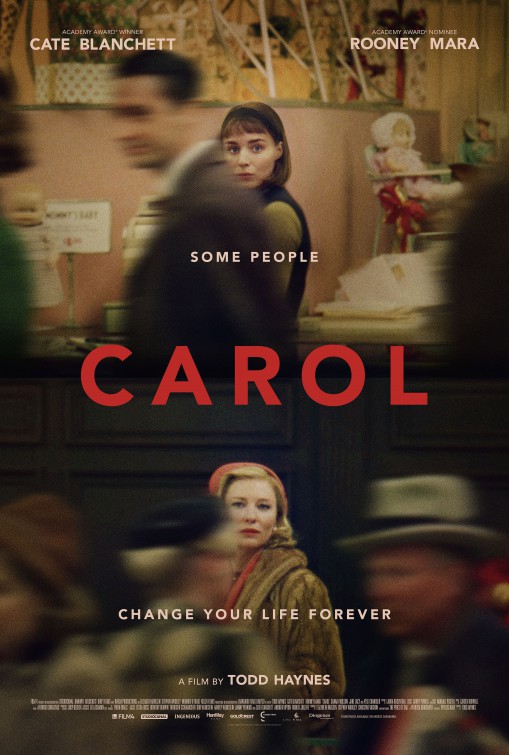
Therese (pronounced Ter-rez) Belivet (Mara) is young, has a devoted boyfriend, Richard (Lacy), works in a department store, but is unsure of her future. One day a female customer in the store engages her in conversation, and even though the customer makes mention of being married with a young child, it’s clear to Therese that there’s a mutual attraction. When the woman leaves her gloves behind, Therese goes to the effort of finding the woman’s address and sending them to her. This act of kindness leads to the woman, whose name is Carol Aird (Blanchett), inviting Therese to lunch. They meet, and a friendship begins, one that starts to cause problems between Therese and Richard, as she begins to lose interest in a planned trip to Europe with him, and spends more time with Carol.

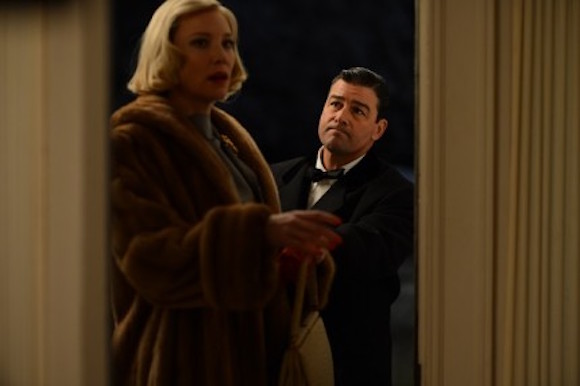
Unbeknownst to Therese, Carol and her husband, Harge (Chandler) have separated due to his awareness that his wife has had an affair with her best friend, Abby (Paulson). Willing to overlook this “indiscretion” if she stays with him, Harge warns her that if she doesn’t then he’ll seek sole custody of their little girl, Rindy. With Xmas approaching, he takes Rindy to his parents for the holiday period; Carol decides to invite Therese to come stay with her. Although nothing happens, Harge returns home unexpectedly and sees them together. Fearing that Carol is embarking on another lesbian relationship, he files for divorce and sole custody of Rindy. Unable to see her child until the custody hearing, which will take two or three months to happen, Carol invites Therese on a road trip, where they can spend some time together, and where Harge can’t find them.

They stay in a succession of motel rooms, at first staying in separate rooms. At one particular motel they stay in the Presidential suite; the next morning, Therese gets to talking with a travelling salesman called Tommy (Smith). Although he tries to sell them something from his sales kit, he has no joy, though Therese wishes him well in the future. At the next motel, she and Carol finally make love. But a telegram Carol receives the next morning reveals Harge’s awareness of where she is, and the fact that she and Therese are now lovers. Unable to risk the now serious possibility of losing the custody hearing, Carol decides she has to return home to face Harge, and sends Abby in her place to see Therese gets home safely. But for both women, returning to their old lives proves unsatisfactory…

Carol - scene

There’s a moment in Todd Haynes’ beautifully crafted Carol, an adaptation of Patricia Highsmith’s novel The Price of Salt, when it looks certain that the title character and Therese will make love for the first time. It’s a moment that the movie is clearly heading toward, and it’s a moment that audiences will be expecting, but Haynes, along with screenwriter Patricia Nagy, holds off from that first time and maintains the sense of anticipation that both characters (and viewers) must be feeling. For the audience, it’s also a moment – among many others – that shows just how much control Haynes has over both the material and its emotional centre, and how finely calibrated it all is, for Carol is without a doubt, one of 2015’s finest movies.

Of course, with previous projects such as Far from Heaven (2002) and the TV version of Mildred Pierce (2011), Haynes has already shown an affinity for what used to be termed “women’s pictures”, but here his immersion in a time – the 1950’s – when lesbianism was still something to be kept hidden, and where male attitudes towards the issue were still highly aggressive, feels also like a snapshot of an era where female empowerment was beginning to gain the upper hand, despite the so-called Lavender Scare that was prevalent at the time. Through Carol’s determination not to be defined by her sexuality, we get to see an example of what, in historical terms, was a turning of the tide, and also a love story that is simply that: a love story.

This simplicity is at the heart of Haynes’ confident handling of the story, and it shows in every scene, with every look and every gesture, and in the way that he brings Carol and Therese together within the frame – these moments where they’re “close but not touching” are so charged with pent-up emotion and increasing desire that the idea that they might be kept apart by Harge’s machinations becomes intolerable. These scenes are so expertly handled, with repressed longing so forcefully expressed, that the viewer is swept along with the characters’ desire to live freely and without sanction. Haynes makes great use of the era’s sense of propriety, using it as a touchstone against which Carol and Therese’s affair can be measured in both intensity and necessity. Therese quizzes Richard about same sex relationships but he has no point of reference, and has no understanding of why they occur; he loves her unequivocally but can’t see that two women – or two men for that matter – might feel the same way about each other as he does about Therese. It’s another of those moments where the audience can see just how difficult it was to live a life outside the (perceived) norm.

With the historical and social background of the story firmly in place, and with Nagy’s script making it clear that lesbians were expected to pretend to be happy in heterosexual relationships or face the social consequences, the movie paints an honest portrait of two women, both of whom gain increased confidence in themselves through their relationship, who come together at a point in both their lives where they’re looking for a way to find future happiness. That they find it in each other, if only briefly, and with such passion, gives value to the idea that any relationship is worth pursuing or fighting for. And even though Carol leaves Therese to fight for custody of her child, it’s not the end of their affair, but rather an interruption (albeit for Therese an unexpected one), and even though the younger woman is upset by it, her feelings remain, and though the movie tries for an air of ambiguity in its final scene, viewers won’t be fooled at where Carol and Therese’s relationship is likely to find itself.

Carol -scene3

The difference in ages might feel like it should be an issue but it’s left unexplored, and with good reason: it doesn’t matter. Love is love, and though an argument could be made that Therese is looking for a guide or a mentor first and foremost, it’s not the role Carol adopts in their relationship. As the “older woman”, Blanchett gives yet another astonishing, awards-worthy performance, striking the right balance between heartfelt longing for an honest life and acknowledging the difficulties that longing entails. Her brittle, striking features show the pain of Carol’s situation without too much need of more overt playing, but in those moments when overt emotion is required, Carol’s fears and hopes are etched indelibly on those striking features. It’s a magnificent performance, sincere, heartbreaking at times, and riveting.

She’s matched by Mara, whose portrayal of the unmoored, ingenuous Therese is so finely tuned that watching her blossom, however slowly, into a stronger, more confident young woman is like watching a flower grow out of the shadows to its full height. There are moments where the camera focuses on her smooth, unlined features and the only expression is there in the eyes, but Mara uses this approach to such good effect that the viewer is never in doubt as to what Therese is thinking or feeling. And as the movie progresses, Mara subtly shifts the weight of Therese’s longing for love so that it becomes a part of her, and not the whole, leaving her a character as strong in her own right as Carol is in hers.

With two such commanding performances, it would be a shame if the supporting cast were overshadowed, but Chandler, in what is superficially the “villain” role, brings out Harge’s pain and sense of loss over Carol with such force that his actions are less stereotypical than expected and driven more by his own deep love for her. In the same way that society says Carol can’t have Therese (in public at least), it also says that Harge can’t have Carol because of her “sexual impropriety”. Both characters are in danger of losing what they want most, and both are suffering as a result. Chandler is unexpectedly moving in the role, and his scenes with Blanchett are so emotionally charged it’s like an intense version of force majeure. Meanwhile, Paulson comes late to matters as Abby, but gives a brief but potent performance as Carol’s longtime friend, confidant and ex-lover, filling in the gaps of Therese’s knowledge about Carol, and providing further context for Carol’s emotional and sexual desires.

Carol - scene2

It’s all beautifully filmed by Edward Lachman, with lots of bright primary colours mixed in with rich earthy tones, making the period seem so alive as to be almost intoxicating, and acting as a dynamic background to the impassioned nature of Carol and Therese’s relationship. There’s some equally impressive attention to historical detail, and Haynes makes the era come alive as a result; this is a fully realised world, even if it does appear at first to be bathed in nostalgia (the scenes in the department store appear right out of a Fifities child’s fantasy of what such a store should look like), but in many ways it was a simpler time, and the script reflects this with aplomb. And the whole thing is embraced by a smoothly nonchalant yet spirited score by Carter Burwell that complements the on-screen proceedings with well orchestrated brio.

Rating: 9/10 – a firm contender for Movie of the Year, Carol is a masterpiece of mood and repressed emotional yearning, with two outstanding performances, and a director on the absolute top of his form; a model of period movie making, and rewarding in every department you can possibly think of, this is a movie that should go to the top of everyone’s must-see list.

Share this:

  • Click to share on X (Opens in new window) X
  • Click to share on Facebook (Opens in new window) Facebook
  • More
  • Click to print (Opens in new window) Print
  • Click to email a link to a friend (Opens in new window) Email
Like Loading...

For One (Stretched) Week Only: Australian Cinema – Part V

25 Tuesday Aug 2015

Posted by dullwood68 in Movies

≈ 3 Comments

Tags

1991-2015, Australian cinema, Baz Luhrmann, Cate Blanchett, Chopper, Heath Ledger, Hollywood, Looking for Alibrandi, Mad Max: Fury Road, Movies, Muriel's Wedding, Nineties, Ozploitation, Sam Neill, Strictly Ballroom, The Adventures of Priscilla Queen of the Desert, The Castle, The Dish

Australian Cinema Part V – 1991-2015

The resurgence of the Australian Movie Industry during the Seventies and Eighties continued into the Nineties, but with an extra consideration: the industry had to make movies that could appeal to foreign audiences as much as those at home. Following the international success of “Crocodile” Dundee (1986), movie makers slowly came round to the idea that Australian movies didn’t have to be so insular or phlegmatic, determinedly historical or austere. It was during the Nineties that more and more Australian movies showed that they could get serious messages across – and still be fun.

Most of these movies were made on low budgets, but they were inventive and funny and warm-hearted, and audiences (and not just in Australia) found themselves enjoying the time they spent with some of the quirkiest characters to come out of any country’s working class psyche. Characters such as the determined Scott Hastings in Strictly Ballroom (1992), the socially awkward Muriel Heslop in Muriel’s Wedding (1994) (“You’re terrible, Muriel”), and the magnificently patriarchal Darryl Kerrigan in The Castle (1997) – these three and more showed audiences just how unconventional Australians could be and still be recognisable as individuals just like us. And these movies were hilarious, tapping into a cultural cheerfulness and sense of the absurdity of every day life that elevated them above the likes of Barry Mackenzie Holds His Own (1974) or The True Story of Eskimo Nell (1975). It was as if Australian producers, writers and directors had somehow (finally) tapped into the nation’s sense of humour and realised what a box office goldmine they had.

Further crowd pleasers followed: The Adventures of Priscilla, Queen of the Desert (1994) was such an unexpected treat that it spawned a stage musical that can still be seen somewhere in the world in 2015. Even now, lines like “Ummm… do you have The Texas Chainsaw Mascara?” and “That’s just what this country needs: a cock in a frock on a rock” are still as laugh out loud funny as they were twenty-one years ago. And the performances in these and other comedies are all first class, guided by precocious up-and-coming directors like Stephan Elliott, P.J. Hogan, and the Dutch-born Rolf de Heer. 1996 saw an Australian movie that successfully combined drama with comedy to provide an emotionally charged study of a musician battling with mental illness. The movie was Shine, and it brought Geoffrey Rush to the world’s attention (and bagged him a Best Actor Oscar). Here was further evidence that Australian movie makers were growing bolder and less afraid of taking risks with their projects. Even when certain movies didn’t achieve their full potential – Doing Time for Patsy Cline (1997), Paperback Hero (1999) amongst others – there was enough that was right about each production to warrant giving each movie a more than cursory look.

Dish, The

With the industry at its healthiest, it eased into the new millennium and gave the world three very different movies that showcased the confidence and eclecticism of contemporary Australian movie makers. One was The Dish (2000), the second was Looking for Alibrandi (2000), and the third was Chopper (2000). Though each movie told a different story in a different style, and they were poles apart in terms of subject matter and approach, with, in particular, Chopper‘s uncompromising violence and hard-edged grittiness contrasted against The Dish‘s feelgood, humanistic recounting of Australia’s involvement in the 1969 Moon landing (who can forget the band playing the US national anthem?), Looking for Alibrandi was an emotionally resonant and complex look at the trials and traumas of regular teenage life. But this disparity was proof that Australian cinema was continuing to be vital and expressive on a variety of themes, and that it was growing bolder with each year, challenging the notion that such a relatively small producer of movies couldn’t possibly hold its own against Hollywood.

Chopper

The decade continued in the same vein, with Australia proving a showcase for the type of talent that couldn’t be found elsewhere. Australia’s cultural heritage, once the “meat and potatoes” of Australian movie production, had given way to examinations of modern day issues that had previously been overlooked or given scant notice. Directors such as Baz Luhrmann came into their own, while actors such as Heath Ledger and Cate Blanchett rose to prominence. Awards from around the world kept flooding in, and there was a feeling that Australian cinema was unbeatable, its refusal to follow cinematic trends or the dictates of other movie industries, leading to further examples of a country finally embracing all the elements and factors that go into making a great Australian movie. Between 2001 and 2006, Australian production companies made and released the following movies:

2001 – Charlotte Gray, Lantana, The Man Who Sued God, Moulin Rouge!

2002 – Black and White, Dirty Deeds, Rabbit-Proof Fence, Swimming Upstream, The Tracker

2003 – Cracker Bag, Gettin’ Square, Japanese Story, The Rage in Placid Lake

2004 – A Man’s Gotta Do, Oyster Farmer, Somersault, Tom White

2005 – Little Fish, The Proposition, Wolf Creek

2006 – Candy, Happy Feet, Jindabyne, Kenny, Ten Canoes

And then in 2007, a strange thing happened: roughly the same amount of movies were being made, but the steady stream of critical and commercial hits dried up. 2007 was a year that yielded a succession of disappointing, uninspired movies, and 2008 proved only slightly better, with only The Black Balloon and Mark Hartley’s energetic Not Quite Hollywood: The Wild, Untold Story of Ozploitation! making any real impact (sad, also, that a movie looking back over Australia’s recent output should prove to be more engaging than its current offerings). 2009 brought some minor gems – The Boys Are Back, Bright Star, In Her Skin, Mary and Max – but again there wasn’t one movie that stood out from the rest in terms of quality or, more importantly, appeal.

Less movies were made in 2010 as the industry began to stumble in the face of increasing disappointment from critics and audiences alike. Animal Kingdom (2010) bucked the trend, but it was alone in its efforts to reinvigorate what many were coming to feel was a stagnant period in Australian movie making. 2011 was no different, leading viewers to mistrust the idea that Australia was still capable of making provocative, entertaining, relevant movies any more. Fred Schepisi had some success with The Eye of the Storm, and Sleeping Beauty was an icily stylised look at sexual compulsion, but again, two movies out of around thirty doesn’t make for a good return.

Sleeping Beauty

As the decade continued, Australian movies found themselves precariously balanced between staying true to their cultural and historical roots (and putting enough of a twist on things to make them appeal to a broader audience), and attempting, as “Crocodile” Dundee (1986) had, to appeal to as wide an audience as possible. A degree of uncertainty seemed to be holding movie makers back, and risk taking seemed to be avoided at all costs. 2012 was no different, and despite featuring new movies from the likes of John Duigan (Careless Love), Rob Sitch (Any Questions for Ben?), Rolf de Heer (The King Is Dead!), and P.J. Hogan (Mental), left many wondering if the industry would ever climb out of the innovative mire it had found itself in.

And then in 2013, signs that a revival – of sorts – was beginning to happen began appearing, with a clutch of movies that showed it wasn’t all doom and gloom (though the industry wasn’t quite out of the woods just yet). Baz Luhrmann released his lavishly mounted but flawed The Great Gatsby. Mystery Road, Tracks, Two Mothers, and The Railway Man were also released and made an impact that suggested the downturn was about to be redressed. And 2014 continued the upward trend, with more well received movies being released than in previous years, including The Babadook, Kill Me Three Times, The Mule, and Predestination.

Now in 2015, there’s still a lingering sense that the industry needs to step up its game. But a massive boost was given to it this year with the return of one, sorely missed, iconic character from Australia’s post-apocalyptic future, Max Rockatansky, in Mad Max: Fury Road. Now officially the most successful Australian movie ever made – sorry, “Crocodile” Dundee – George Miller’s crazy, riotous action movie is the kind of bold, frenetic auteur-driven visual/aural experience that doesn’t come along too often, but if it helps to give Miller’s directing confederates the push needed to make their own bold movies then with a bit of luck Australian cinema might just regain the acclaim it deserved in the Eighties and Nineties.

Mad Max Fury Road

Share this:

  • Click to share on X (Opens in new window) X
  • Click to share on Facebook (Opens in new window) Facebook
  • More
  • Click to print (Opens in new window) Print
  • Click to email a link to a friend (Opens in new window) Email
Like Loading...

The Hobbit: The Battle of the Five Armies (2014)

23 Tuesday Dec 2014

Posted by dullwood68 in Movies

≈ 1 Comment

Tags

Bard the Bowman, Bilbo Baggins, Cate Blanchett, Erebor, Galadriel, Gandalf, Ian McKellen, J.R.R. Tolkien, Legolas, Literary adaptation, Martin Freeman, Middle Earth, Orlando Bloom, Peter Jackson, Richard Armitage, Sauron, Smaug, Thorin Oakenshield

Hobbit The Battle of the Five Armies, The

D: Peter Jackson / 144m

Cast: Ian McKellen, Martin Freeman, Richard Armitage, Orlando Bloom, Evangeline Lilly, Ken Stott, Lee Pace, Luke Evans, Aidan Turner, Dean O’Gorman, Graham McTavish, Cate Blanchett, Hugo Weaving, Christopher Lee, Sylvester McCoy, Stephen Fry, Ryan Gage, Billy Connolly, James Nesbitt, Ian Holm, John Bell, Mikael Persbrandt, Manu Bennett, John Tui, Benedict Cumberbatch

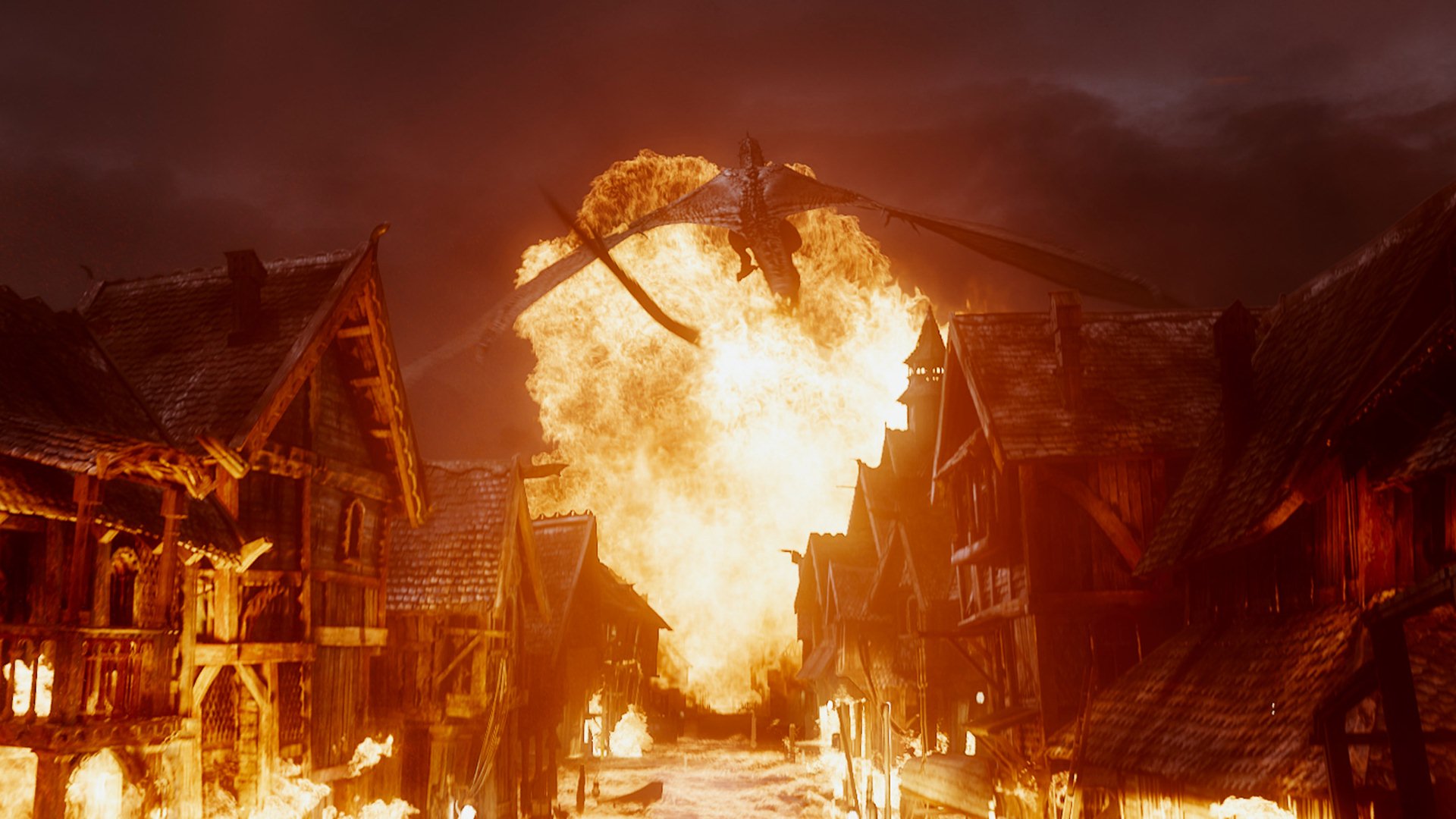
Angered by the attempt to kill him, Smaug (Cumberbatch) leaves the Lonely Mountain and the dwarf city of Erebor to wreak his vengeance on Laketown and its people. As he lays fiery waste to the doomed town, Bard the Bowman (Evans) seeks a way to defeat the dragon. With the aid of his son, Bain (Bell), Bard succeeds, but the town is in ruins. With winter fast approaching the inhabitants of Laketown look to Erebor and the promise made by Thorin (Armitage) when he was aided by Bard. But Thorin is in the grip of dragon sickness, his mind fixed on protecting the gold in the mountain, and he refuses to give the people of Laketown shelter; instead they are forced to take refuge in the ruined town of Dale.

Inside Erebor, Thorin’s madness worsens with the absence of the Arkenstone, the jewel that ensures his position as king of the dwarves. It transpires that Bilbo (Freeman) was able to take the jewel during his encounter with Smaug, but he fears giving it to Thorin. Meanwhile, the woodland elves, led by Thranduil (Pace), arrive in Dale with supplies for the humans and with the intention of reclaiming some jewels that are owed to him by Thorin’s forebears. Bard attempts to reason with Thorin but the dwarf leader refuses to yield. With an army of Orcs led by Azog the Defiler (Bennett) almost upon them, Gandalf (McKellen) arrives in time to provide support for the human-elf alliance.

Bilbo sneaks out of Erebor and gives the Arkenstone to Thranduil. One last attempt is made to avoid bloodshed but Thorin is adamant he will have war. With the arrival of a dwarf army led by Thorin’s cousin Dain (Connolly), a battle between the dwarves and the elves begins but is interrupted by the arrival of Azog’s forces. The dwarves and the elves and the humans all join forces against the orcs, while in Erebor, Thorin is on the brink of being completely subsumed by madness. And to make matters worse, Legolas (Bloom) and Tauriel (Lilly) discover that there is a second army of orcs heading for Erebor as well.

Hobbit The Battle of the Five Armies, The - scene

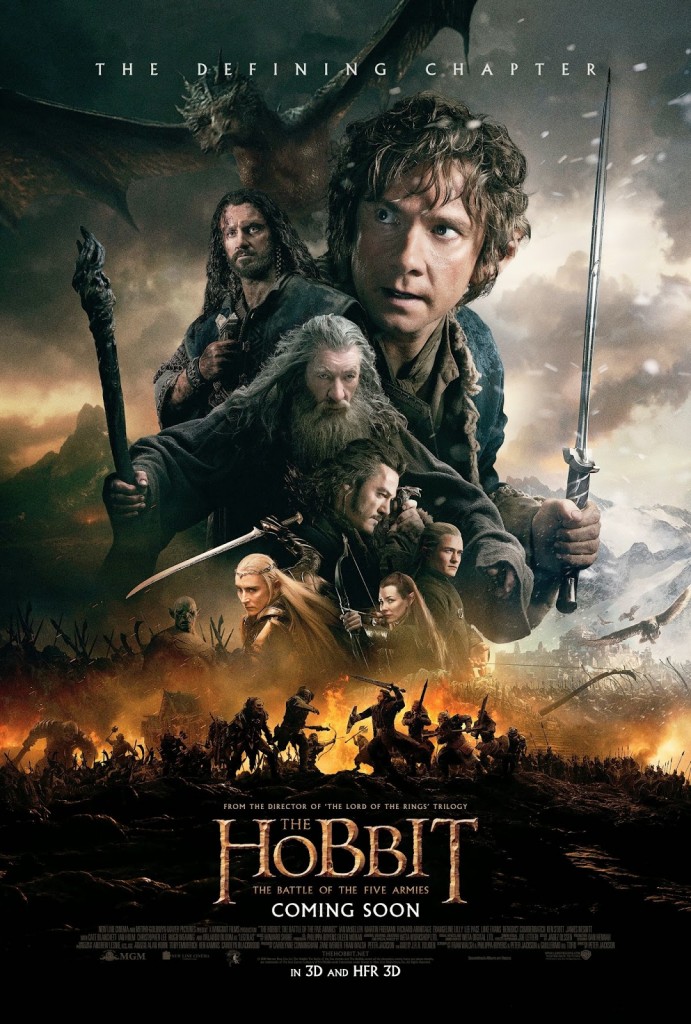
And so, in true George Lucas/Star Wars fashion, we come to the end of the journey – in the middle of it. Heralded as the “defining chapter” this is the movie that Jackson needed to get right above all the other Hobbit movies. Everything has been a prelude to this, the linking chapter in a six film series that has come to define fantasy movie-making on an epic, unprecedented scale, while always retaining a true sense of what’s most important: the characters. Whatever your thoughts on the idea that two movies would have been better than three, what can’t be disputed is the care and attention that Jackson and co-scripters Fran Walsh and Philippa Boyens (with additional input from Guillermo del Toro) have taken in their efforts to bring Tolkien’s short novel to the screen.

Dispensing with the traditional prologue that shows previous events, The Battle of the Five Armies picks up directly after The Desolation of Smaug and throws us into one of the trilogy’s most exciting action sequences, as the dragon vents its wrath on the unfortunate Laketown. It’s a bravura piece of movie making, each burst and eruption of flame so convincingly rendered it’s hard to believe that most of the action has been created in a computer. With Smaug’s death it’s full speed ahead to the climactic battle that involves dwarfs, men, elves, orcs and eagles. It’s a fast-paced, often relentless movie, tilting headlong from one skirmish to another, barely pausing for breath, and yet able to maintain an emotional intensity that other fantasy movies can’t even begin to come near. It also shows Jackson near the height of his directorial powers – that honour goes to The Lord of the Rings: The Return of the King (2003) – firmly in command of the material and assembling it all in a way that looks far too easy.

Jackson’s decision to make The Battle of the Five Armies the shortest of the Hobbit movies is a wise one, making it a more immediate, thrilling experience, but still with that depth of emotion that we’ve come to know and expect from each trip to Middle Earth. The relationship between Bilbo and Thorin is this movie’s finest flourish, so adroitly handled and acted by Freeman and Armitage that their scenes together are capable of making the viewer hold their breath. The added romance between Tauriel and Kili (Turner) is perhaps more perfunctory but is still touching enough to warrant its inclusion. In truth, the whole cast excel, with McKellen, Armitage and Evans the standouts in a movie with more than its fair share of superb performances. It’s been said before, but Jackson has created such a vivid world that even when he introduces creatures that very closely resemble the worms from Tremors (1990), they still feel a part of Middle Earth. This attention to detail, this “world building”, is what separates these movies from all the rest. And of course, there’s the action, inventive, compelling, and wonderfully choreographed for maximum effect. It’s impressive stuff – as you’d expect – and full of horror, humour, seamless CGI (unless, for some reason, it involves Radagast the Brown), and stirring feats of physicality (Legolas vs Bolg). But best of all, and after all has been said and done, and the battle is over, Jackson treats us to a wordless scene between Bilbo and Gandalf that is perfect in its simplicity.

With an ending that blends effortlessly with the beginning of The Lord of the Rings: The Fellowship of the Ring (2001), the movie also doesn’t outstay its welcome, but mostly because this isn’t the end of an era, but the opening chapter in a much grander tale. As such its shorter running time is to be applauded; though don’t be fooled, the movie packs so much in it’s a masterclass of concise plotting and scripting. Some fans may still complain about the treatment of certain characters – Beorn (Persbrandt) has even less to do here than before – and the similarities between the Battle of the Pelennor Fields and this one are self-apparent, but all in all, Jackson’s adaptation of The Hobbit has been a success. To those who say The Hobbit trilogy is less dramatic or satisfying than The Lord of the Rings trilogy, it should be mentioned that they are very different “beasts”, one originally intended as a children’s novel, its follow-up more for older audiences. What Jackson has done is to keep the essential ingredients of the novels and expanded the material around them to make one long story albeit in two sections and with sixty years between them. It’s still a staggering achievement and worthy of as much high praise as can be doled out.

The same can also be said for the movie’s crew, including director of photography Andrew Lesnie, production designer Dan Hennah, and composer Howard Shore (and not forgetting the sterling work of second unit director Andy Serkis). These and the thousands of other people who have worked on the movies deserve some kind of reward for their efforts.

Rating: 9/10 – a rip-roaring, spectacular action movie to wind up the trilogy, The Hobbit: The Battle of the Five Armies is guaranteed to put a smile on the face of fans, and reassure those doubters that Jackson had made a mistake by manipulating the novel into three movies; but take heart anyone who thinks they’ve seen the last of all things Middle Earth, there’s still an extended edition of the movie to come.

Share this:

  • Click to share on X (Opens in new window) X
  • Click to share on Facebook (Opens in new window) Facebook
  • More
  • Click to print (Opens in new window) Print
  • Click to email a link to a friend (Opens in new window) Email
Like Loading...

How to Train Your Dragon 2 (2014)

28 Monday Jul 2014

Posted by dullwood68 in Movies

≈ 1 Comment

Tags

Alpha dragon, Animation, Berk, Cate Blanchett, Dean DeBlois, Drago Bloodfist, Dragons, Gerard Butler, Hiccup, Jay Baruchel, Sequel, Toothless

How to Train Your Dragon 2

D:Dean DeBlois / 102m

Cast: Jay Baruchel, Cate Blanchett, Gerard Butler, Craig Ferguson, America Ferrera, Jonah Hill, Christopher Mintz-Plasse, T.J. Miller, Kristen Wiig, Djimon Hounsou, Kit Harington

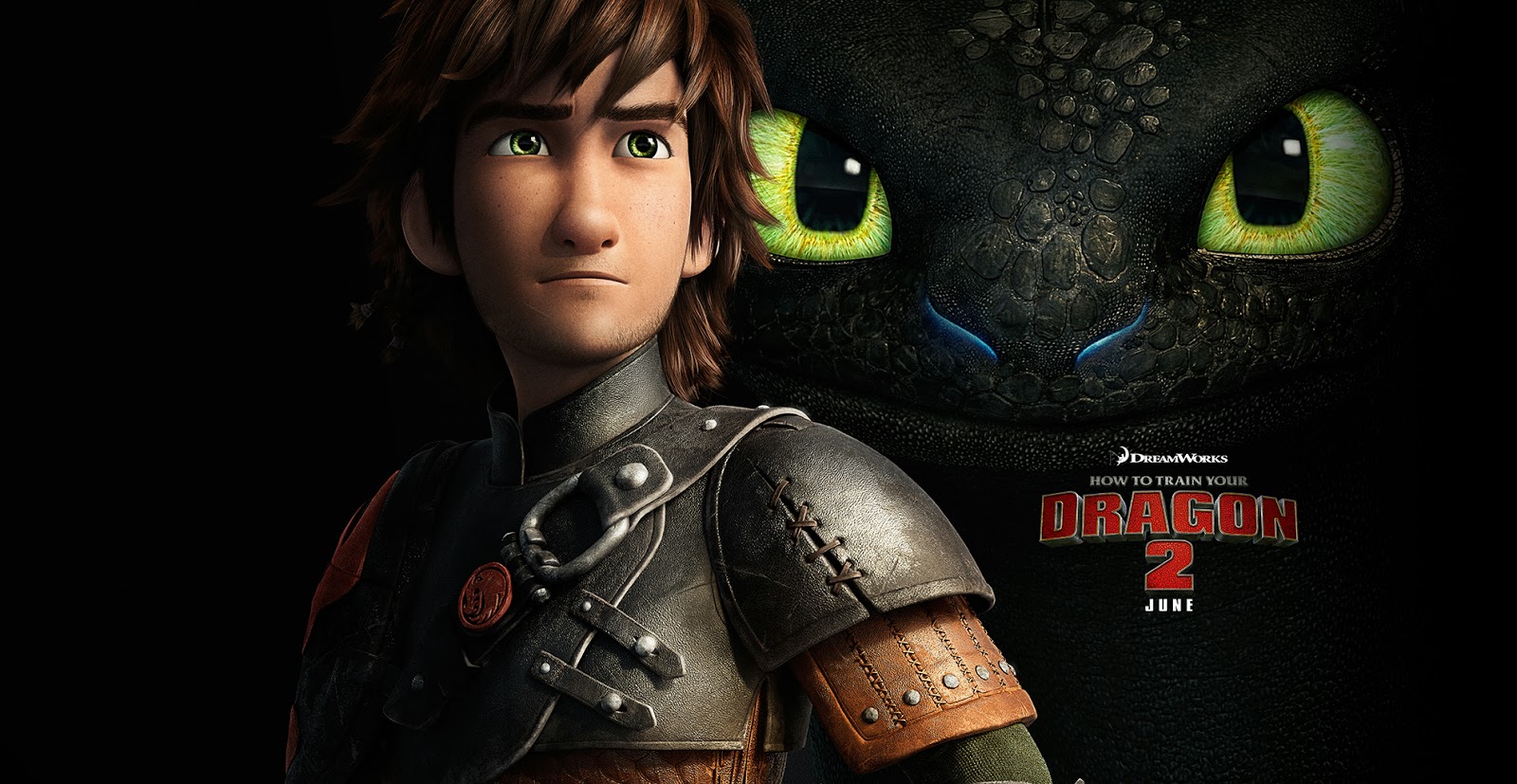
Five years after the events of the first movie, the villagers of Berk are now co-existing peacefully with dragons.  While everyone has settled into this new arrangement, Hiccup (Baruchel) is still as restless and inquisitive about the world as he’s always been.  While out one day mapping new lands with his dragon Toothless, Hiccup is joined by Astrid (Ferrera) and together they encounter a dragon trapper named Eret (Harington).  He tries to capture the two dragons but Hiccup and Astrid escape; they also learn that Eret is trapping dragons for Drago Bloodfist (Hounsou) who is building an army of them in order to conquer the surrounding lands.  Returning to Berk, Hiccup tells his father, Stoick (Butler), about Drago.  Stoick adopts a siege mentality, telling Hiccup they must prepare for the worst, for Drago is not a man who can be reasoned with.  Hiccup doesn’t believe this, and with Astrid, goes off to find Eret, where they promptly surrender in an attempt to be taken to Drago.  However, Stoick, village blacksmith Gobber (Ferguson) and Hiccup and Astrid’s friends find and rescue them.

Hiccup and Toothless carry on with their search for Drago but are surprised by the appearance of a masked dragon rider, who captures them with ease.  The rider is revealed to be Hiccup’s mother, Valka (Blanchett).  She went missing twenty years before when Hiccup was a baby, and has been saving dragons the whole time, learning about them and keeping them safe in an island haven created out of ice by a giant, alpha dragon.  As mother and son reunite, Stoick tracks Hiccup to the island, while Astrid and friends abduct Eret and get him to take them to where Drago is readying his army of men and dragons, but they are captured and Drago learns of Berk and its dragons.  Stoick and Valka are reunited, but soon Drago attacks the island.  Valka and her dragons put up a strong resistance, but Drago has an ace up his sleeve: another alpha dragon that challenges and defeats Valka’s.  With Drago’s alpha dragon able to control all the other dragons, including Toothless, Drago moves on to Berk.

How to Train Your Dragon 2 - scene

Expanding on the original movie’s themes of tolerance and understanding, How to Train Your Dragon 2 once again reveals that the biggest threat in a world full of dragons is Man himself.  With Berk now a harmonious place where dragons are part and parcel of daily life, Hiccup’s search for new lands and new experiences is a neat reflection on the movie itself, a way for the series – part three is due in 2016 – to beef up the drama and bring the wider world and all its complications back to Berk.  By broadening the movie’s horizons, the storyline attempts to become richer and attain a greater depth, and in doing so, rewards the audience at (almost) every turn. The introduction of two new protagonists, Valka and Drago, stops the movie from being a retread of the first movie, and allows How to Train Your Dragon 2 to work as a movie in its own right, while at the same time, pointing the way to a greater, three-movie story arc that has yet to play out fully.  With the reintroduction of Stoick, Gobber, Astrid, Snotlout (Hill) et al – old friends all of them – the mix of the familiar and the new is a (mostly) winning formula.

Of the two new characters, Valka is the more fascinating, an absentee mother who has greater empathy with dragons than with her son or husband.  Her abandonment of Hiccup when he is merely a baby is one of the movie’s more surprising scenes, a moment when a mother’s love for her son is outweighed by her horror at the injustice she sees happening around her.  With this back story fleshed out, the stage is set for some familial conflict, but writer/director DeBlois avoids any emotional confrontations, and instead opts for a reconciliation between Valka, Stoick and Hiccup that tugs very, very effectively at the heartstrings but fails to elevate the drama inherent in such a situation.  (With Valka’s past behaviour all forgiven in an instant, the viewer could also be forgiven for wondering why her absence was so important in the first place.)  In comparison, Drago is the more straightforward character, but carelessly so, his thirst for power so poorly referenced and explained that he becomes just another necessary tyrant for the hero to overcome, an almost stock villain complete with obligatory sneer and sharply angled features.  What could have been an interesting connection – Drago lost an arm to a dragon, Hiccup his foot – is brushed over as soon as it’s revealed, and even in the face of overwhelming evidence of the good that can come from a symbiotic relationship with dragons, maintains his conquering mindset.  It’s all too convenient, poor motivation that preserves the threat he represents, and the need for a large-scale, crowd-pleasing climax.

There’s a lot of rushing in the movie, a hurrying to get to the next scene, the next big animated showpiece, that stops How to Train Your Dragon 2 from being entirely successful.  There is one event that is so unexpected, and so dramatically effective that its subsequent glossing over is close to unforgivable – it would also have made for a better ending to the movie, as well as providing Part 3 with a strong opening.  It should have a lasting effect on several of the characters but instead is shunted aside in favour of the aforementioned climax (which ends the movie predictably and with a complete lack of resonance, despite Hiccup’s upbeat voice over).

In spite of all this, the movie is on the whole, an absolute joy to watch, the animation often breathtaking, and the warmth it carries over from the first movie working completely in its favour.  It’s good to see Hiccup and his friends so credibly older, their teenage years now left behind and their adult lives just beginning.  The animators have aged them well, and it’s a pleasure to be reacquainted with them.  The relationship between Hiccup and Toothless is as moving as before, and so too is his emerging romance with Astrid: it’s gently done and handled with great affection.  Their friends all get their chance in the limelight, particularly Ruffnut (Wiig) who develops a major crush on the unfortunate Eret, and there’s sterling work from the sheep.  Back on composing duties, John Powell provides an emotionally rousing score that complements the material with assured ease, and in the director’s chair, DeBlois proves more than capable of helming a movie on his own, showing a flair for, and an understanding of, the material that bodes well for Part 3 (providing he gets someone to co-write the script with him).

Rating: 8/10 – missed opportunities aside, what’s on screen is bigger, bolder, and in places, more beautifully rendered than in the first movie; funny as well – and in all the right places – How to Train Your Dragon 2 may disappoint some younger viewers with its more adult themes, but this is animation of often stunning quality and with a top-notch cast who all know exactly what they’re doing.

Share this:

  • Click to share on X (Opens in new window) X
  • Click to share on Facebook (Opens in new window) Facebook
  • More
  • Click to print (Opens in new window) Print
  • Click to email a link to a friend (Opens in new window) Email
Like Loading...

The 86th Annual Academy Awards – The Oscars 2014

03 Monday Mar 2014

Posted by dullwood68 in Movies

≈ Leave a comment

Tags

12 Years a Slave, Academy Awards, Alfonso Cuarón, Cate Blanchett, Dallas Buyers Club, Ellen DeGeneres, Frozen, Gravity, Heroes, Matthew McConaughey, Steve McQueen, The Great Gatsby

Oscars 2014, The

Well, here we are again, falling to our knees in observance of the Oscars, that annual back-slap-athon where Hollywood’s mightiest (and occasionally humblest) come together to give their finest performances, particularly if they’re nominated but don’t win – the cameras are watching!  Here then are the winners (and losers), my views on the ceremony, Ellen DeGeneres as host, the jokes, the acceptance speeches, and who got those all-important statuettes… and whether they deserved them.  All this, and in a fraction of the time it takes to stage the whole show.  Winners in bold.

The show got off to a good start with Ellen DeGeneres wisecracking through a great opening monologue, taking the mickey out of Jennifer Lawrence’s trip from last year, June Squibb’s age, actors as college alumni (apparently Amy Adams didn’t go) and congratulating the guy impersonating Liza Minnelli.  The theme of the night was Movie Heroes and there were … montages shown throughout the show, as well as Bette Midler singing The Wind Beneath My Wings as a follow-on to the In Memoriam segment.  Ellen also set up a great running gag involving ordering in pizza (which for once, didn’t seem like it had been rehearsed).  But she also stumbled over her words a lot, and seemed distracted; a couple of times she wasn’t even ready to camera (let’s get the Bring Back Billy Crystal campaign going now!).

There was a tribute to The Wizard of Oz sung by Pink that was as effective as it was unexpected, the usual live performances of songs nominated for Best Original Song, and fortunately, no embarrassing moments where speeches too far over while someone thanked their auntie, their budgie and/or God (that was left to one of the winners).  Over all, it was an entertaining show but it still couldn’t avoid some of the usual pitfalls – the length, the awkwardness of certain presenters, wheeling out someone on their last legs (this year, Sidney Poitier), and clips that showed several actors shouting at each other as if that’s a sign of good acting.

Best Motion Picture of the Year

American Hustle, Captain Phillips, Dallas Buyers Club, Gravity, Her, Nebraska, Philomena, 12 Years a Slave, The Wolf of Wall Street

The right choice, but the longest, most excited speech of the night by Steve McQueen, and then he started jumping about!  Presented by Will Smith.

Best Performance by an Actor in a Leading Role

Christian Bale (American Hustle), Bruce Dern (Nebraska), Leonardo DiCaprio (The Wolf of Wall Street), Chiwetel Ejiofor (12 Years a Slave), Matthew McConaughey (Dallas Buyers Club)

No problems here except for McConaughey’s rambling, though emotional speech.  Presented by Jennifer Lawrence.

Best Performance by an Actress in a Leading Role

Amy Adams (American Hustle), Cate Blanchett (Blue Jasmine), Sandra Bullock (Gravity), Judi Dench (Philomena), Meryl Streep (August: Osage County)

A superb performance given its rightful due properly rewarded and with a pro-women stance in her speech from Blanchett.  Presented by Daniel Day-Lewis.

Best Performance by an Actor in a Supporting Role

Barkhad Abdi (Captain Phillips), Bradley Cooper (American Hustle), Michael Fassbender (12 Years a Slave), Jonah Hill (The Wolf of Wall Street), Jared Leto (Dallas Buyers Club)

Leto made a really good speech thanking his mother in particular and made reference to the troubles in Ukraine and Venezuela; a good start to the evening, and a well-deserved award.  Presented by Anne Hathaway.

Best Performance by an Actress in a Supporting Role

Sally Hawkins (Blue Jasmine), Jennifer Lawrence (American Hustle), Lupita Nyong’o (12 Years a Slave), Julia Roberts (August: Osage County), June Squibb (Nebraska)

A standing ovation for Nyong’o tops an amazing year for the actress, and her emotional speech was a highlight.  Presented by Christoph Waltz.

Best Achievement in Directing

Alfonso Cuarón (Gravity), Steve McQueen (12 Years a Slave), Alexander Payne (Nebraska), David O. Russell (American Hustle), Martin Scorsese (The Wolf of Wall Street)

Absolutely the right result and confirmation (as if it was needed) of the effort and work Cuarón put into making Gravity.  Presented by Angelina Jolie and Sidney Poitier.

Best Writing, Screenplay Written Directly for the Screen

Woody Allen (Blue Jasmine), Craig Borten, Melisa Wallack (Dallas Buyers Club), Spike Jonze (Her), Bob Nelson (Nebraska), Eric Warren Singer, David O. Russell (American Hustle)

A popular choice and a bit of a surprise, but it could have gone to any of the nominees.  Presented by Robert De Niro and Penelope Cruz.

Best Writing, Screenplay Based on Material Previously Produced or Published

Steve Coogan, Jeff Pope (Philomena), Richard Linklater (Before Midnight), Billy Ray (Captain Phillips), John Ridley (12 Years a Slave), Terence Winter (The Wolf of Wall Street)

Spot-on and an easy choice though, noticeably, no mention for Steve McQueen in Ridley’s acceptance speech.  Presented by Robert De Niro and Penelope Cruz.

Best Animated Feature Film of the Year

The Croods, Despicable Me 2, Ernest & Célestine, Frozen, The Wind Rises

Wow, another big surprise – not!  Still, a great result though it would have been nice to see Ernest & Célestine win the Oscar.  Notable for Disney’s first win in this category, and strangely, just when there wasn’t a Pixar movie in the running.  Presented by Kim Novak and Matthew McConaughey.

Best Foreign Language Film of the Year

The Broken Circle Breakdown, The Great Beauty, The Hunt, The Missing Picture, Omar

A great win for a great movie, and one of the easiest awards of the evening to predict.  Presented by Ewan McGregor and Viola Davis.

Best Achievement in Cinematography

Roger Deakins (Prisoners), Bruno Delbonnel (Inside Llewyn Davis), Philippe Le Sourd (The Grandmaster), Emmanuel Lubezki (Gravity), Phedon Papamichael (Nebraska)

Predictable win but should have gone to Phedon Papamichael; the first big disappointment (for me) of the evening.  Presented by Amy Adams and Bill Murray.

Best Achievement in Editing

Alan Baumgarten, Jay Cassidy, Crispin Struthers (American Hustle), Alfonso Cuarón, Mark Sanger (Gravity), Martin Pensa, John Mac McMurphy (Dallas Buyers Club), Christopher Rouse (Captain Phillips), Joe Walker (12 Years a Slave)

Let the Gravity backlash continue!  Captain Phillips was by far the better edited movie nominated and should have won hands down.  Presented by Anna Kendrick and Gabey Sidoureh.

Best Achievement in Production Design

K.K. Barrett, Gene Serdena (Her), Judy Becker, Heather Loeffler (American Hustle), Catherine Martin, Beverley Dunn (The Great Gatsby), Andy Nicholson, Rosie Goodwin, Joanne Woollard (Gravity), Adam Stockhausen, Alice Baker (12 Years a Slave)

Awarded after the award for Costume Design (see below) and a well-deserved double for Catherine Martin.  Presented by Jennifer Garner and Benedict Cumberbatch.

Best Achievement in Costume Design

William Chang Suk Ping (The Grandmaster), Catherine Martin (The Great Gatsby), Patricia Norris (12 Years a Slave), Michael O’Connor (The Invisible Woman), Michael Wilkinson (American Hustle)

Unsurprising win for Mrs Luhrmann. Presented by Naomi Watts and Samuel L. Jackson.

Best Achievement in Makeup and Hairstyling

Joel Harlow, Gloria Pasqua Casny (The Lone Ranger), Adruitha Lee, Robin Mathews (Dallas Buyers Club), Steve Prouty (Jackass Presents: Bad Grandpa)

Again, an unsurprising win; it almost seemed as if the other two movies were there just so there could be a list.  Presented by Naomi Watts and Samuel L. Jackson.

Best Achievement in Music Written for Motion Pictures, Original Score

William Butler, Andy Koyama (Her), Alexandre Desplat (Philomena), Thomas Newman (Saving Mr. Banks), Steven Price (Gravity), John Williams (The Book Thief)

A good result for a Brit, but not so sure that either Desplat or Newman shouldn’t have won instead.  Presented by Jamie Foxx and Jessica Biel.

Best Achievement in Music Written for Motion Pictures, Original Song

Kristen Anderson-Lopez, Robert Lopez – Let It Go (Frozen), Bono, Adam Clayton, The Edge, Larry Mullen Jr, Brian Burton – Ordinary Love (Mandela: Long Walk to Freedom), Karen O – The Moon Song (Her), Pharrell Williams – Happy (Despicable Me 2)

Fun acceptance speech and one of the best of the night but it should have been given to The Moon Song – at this stage both Frozen and The Great Gatsby had won more awards than 12 Years a Slave.  Presented by Jamie Foxx and Jessica Biel.

Best Achievement in Sound Mixing

Christopher Boyes, Michael Hedges, Michael Semanick, Tony Johnson (The Hobbit: The Desolation of Smaug), Chris Burdon, Mark Taylor, Mike Prestwood Smith, Chris Munro (Captain Phillips), Andy Koyama, Beau Borders, David Brownlow (Lone Survivor), Skip Lievsay, Niv Adiri, Christopher Benstead, Chris Munro (Gravity), Skip Lievsay, Greg Orloff, Peter F. Kurland (Inside Llewyn Davis)

Again, not much of a surprise, but should really have gone to Captain Phillips.  Presented by Chris Hemsworth and Charlize Theron.

Best Achievement in Sound Editing

Steve Boeddeker, Richard Hymns (All Is Lost), Brent Burge (The Hobbit: The Desolation of Smaug), Glenn Freemantle (Gravity), Wylie Stateman (Lone Survivor), Oliver Tarney (Captain Phillips)

See above.  Presented by Chris Hemsworth and Charlize Theron.

Best Achievement in Special Effects

Tim Alexander, Gary Brozenich, Edson Williams, John Frazier (The Lone Ranger), Roger Guyett, Pat Tubach, Ben Grossman, Burt Dalton (Star Trek: Into Darkness), Joe Letteri, Eric Saindon, David Clayton, Eric Reynolds (The Hobbit: The Desolation of Smaug), Christopher Townsend, Guy Williams, Erik Nash, Daniel Sudick (Iron Man 3), Timothy Webber, Chris Lawrence, David Shirk, Neil Corbould (Gravity)

If Gravity hadn’t won then there should have been a steward’s enquiry; well-deserved and absolutely the one undeniable shoo-in of the ceremony.  Presented by Emma Watson and Joseph Gordon-Levitt.

Best Documentary, Feature

The Act of Killing, Cutie and the Boxer, Dirty Wars, The Square, 20 Feet from Stardom

First real surprise of the night given that everyone pretty much expected The Act of Killing to win, and a chance to hear the amazing Darlene Love in full voice.  Presented by Bradley Cooper.

Best Documentary, Short Subject

Cavedigger, Facing Fear, Karama Has No Walls, The Lady in No 6, Prison Terminal: The Last Days of Private Jack Hall

A moving piece and well-deserved, and a tribute to Alice Sommer-Herz who sadly died a week ago.  Presented by Kate Hudson and Jason Sudeikis.

Best Short Film, Animated

Feral, Get a Horse!, Mr Hublot, Possessions, Room on the Broom

A great win for this French movie, and much deserved, in what was a very close category.  Presented by Kim Novak and Matthew McConaughey.

Best Short Film, Live Action

Do I Have to Take Care of Everything?, Helium, Just Before Losing Everything, That Wasn’t Me, The Voorman Problem

A great result and proof that the Academy gets it right pretty much every time in the “minor” short film categories.  Presented by Kate Hudson and Jason Sudeikis.

Share this:

  • Click to share on X (Opens in new window) X
  • Click to share on Facebook (Opens in new window) Facebook
  • More
  • Click to print (Opens in new window) Print
  • Click to email a link to a friend (Opens in new window) Email
Like Loading...

The Monuments Men (2014)

21 Friday Feb 2014

Posted by dullwood68 in Movies

≈ 7 Comments

Tags

Bill Murray, Bob Balaban, Cate Blanchett, George Clooney, Ghent Altarpiece, Hidden treasures, Hugh Bonneville, Jean Dujardin, John Goodman, Madonna of Bruges, Matt Damon, Nazis, Review, Stolen art, True story, World War II

Monuments Men, The

D: George Clooney / 118m

Cast: George Clooney, Matt Damon, Bill Murray, Cate Blanchett, John Goodman, Jean Dujardin, Hugh Bonneville, Bob Balaban, Dimitri Leonidas, Justus von Dohnányi, Holger Handtke

When you see the phrase “Based on a true story” at the beginning of a movie, there’s an expectation that what you’re about to see really happened, and in the way that it’s portrayed.  But the key word is “based”.  The word serves as a get-out clause for filmmakers the world over, so that when anyone criticises a movie for its accuracy they can say it’s not meant to be taken as a de facto retelling of events but as an interpretation.

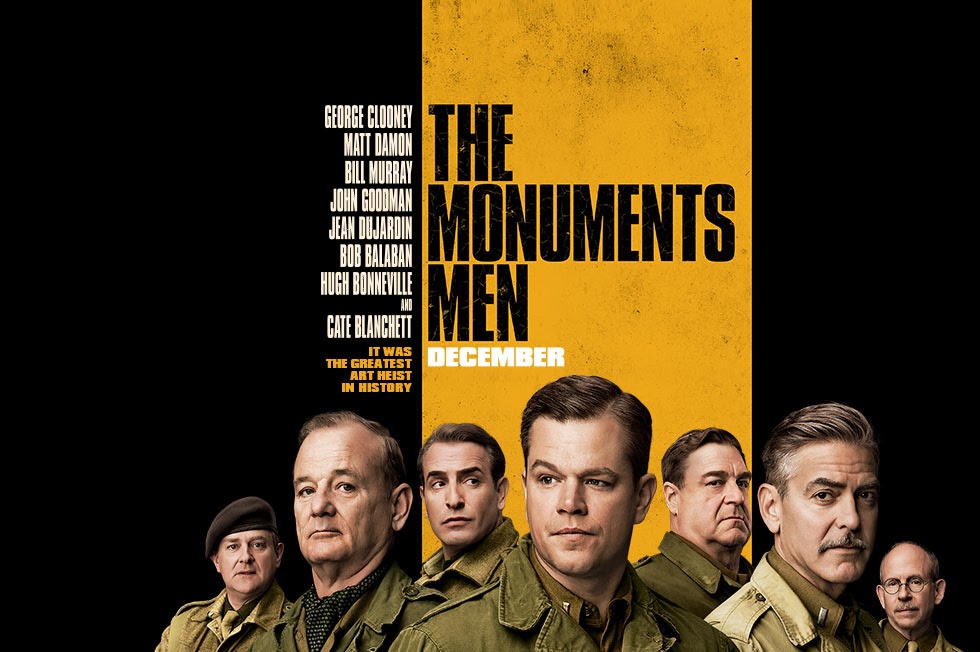
With The Monuments Men, actor/director and co-scripter Clooney has taken a relatively unknown tale from World War II and – forgive the clumsy analogy – used broad brush strokes to bring it to the screen.  Playing Frank Stokes, we first see him in 1943 canvassing President Roosevelt about the importance of finding and safeguarding the huge amount of art that the Nazis are plundering across Europe, as well as asking for the military’s cooperation in avoiding unnecessary damage to important historical buildings and monuments.  Asked by Roosevelt how many men he needs, Stokes tells him six.

The six men are Americans James Granger (Damon), Richard Campbell (Miurray), Walter Garfield (Goodman), and Preston Savitz (Balaban), plus Brit Donald Jeffries (Bonneville), and Frenchman Jean Claude Clermont (Dujardin).  All six have the skills and the experience Stokes needs to identify, trace and recover the stolen art, and two pieces in particular: Michelangelo’s Madonna of Bruges and Jan van Eyck’s Ghent Altarpiece.  Splitting up to cover as much ground as possible the men set about tracing various treasures and seeking the cooperation necessary to avoid the continued ruinous bombing of buildings such as Monte Cassino.  In this respect, and despite clear orders from Roosevelt, they find themselves rebuffed at every turn.  They have better luck tracing the routes the Nazis are using to hide everything, but they still always seem to be one step behind.

In Paris, Granger is put in touch with Claire Simone (Blanchett).  She has a detailed list of all the artwork and treasures that were stolen by the Nazis in Paris, as well as who they belonged to and where they were to be taken.  Using this list, Stokes and co are able to discover the locations the Nazis chose to hide everything.  With the war now drawing to a close they face a race against time to reach the treasures before the approaching Russians.

Monuments Men, The - scene

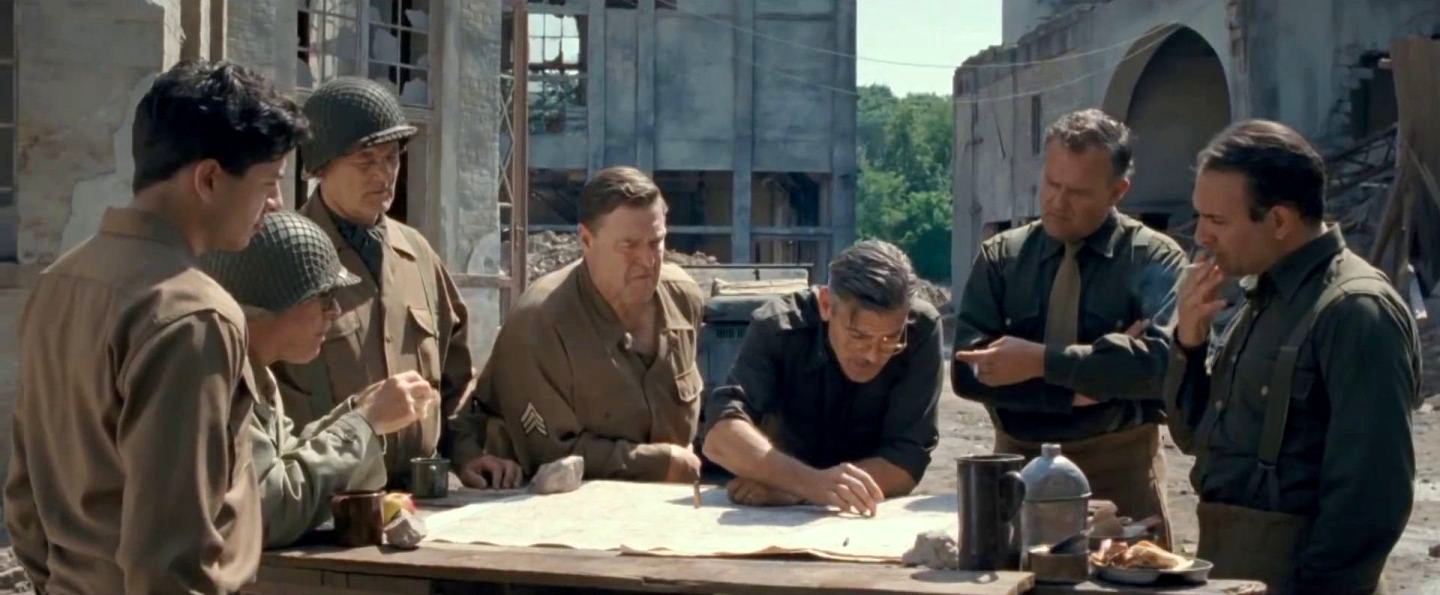
The story of the Monuments Men and their achievements makes for a thrilling read but on screen it’s a different matter.  Clooney and co-scripter (and long-time collaborator) Grant Heslov have fashioned a story from the facts that has all the hallmarks of a rush job.  Character development is perfunctory and relies on the actors to fill in the gaps by using established traits: Dujardin flashes the winning smile seen in The Artist, Murray rehashes his bucolic approach to Lost in Translation, and Goodman continues to play the same role he’s played for the last ten years.  In a way it’s a clever approach, a kind of cinematic shorthand to help introduce the characters quickly and then get on with things, but other than the fact that these men all knew (or knew of) each other before coming together, we don’t really get to know them.  As Stokes, Clooney takes a back seat, giving himself a couple of rousing, authoritative speeches, and generally directing traffic – that’s not a criticism, there is an awful lot of poring over maps and working out which direction to take.  Damon and Blanchett struggle to make her initial distrust of Granger credible, while Bonneville’s turn as the plucky Brit using the mission to overcome his drink problem, though one of the (slightly) better performances, is undermined when you realise his drink problem isn’t going to reoccur and jeopardise things.

The movie also jumps about quite a bit as it attempts to cover both time and distance.  The events shown take place between 1943 and the end of the war.  Some scenes, particularly Garfield and Clermont’s encounter with a sniper, seem included for no other reason than they might prove exciting, but this rarely works out.  Clooney tries to instil a sense of urgency, but the timescale defeats him every time.  Even towards the end with the Russians right around the corner and the Madonna of Bruges to be rescued, there’s just no excitement to be had.  And when the team are put in harm’s way, it’s hard to be concerned because a) you don’t care enough them (see previous paragraph) and Clooney’s direction doesn’t stretch itself enough to provide any tension.

What you have then is a strangely flat movie that never really takes off but which, thanks to both the art and Phedon Papamichael’s wonderful photography, looks good and is handsomely mounted.  Clooney does have a good eye for composition, and he uses the camera to good effect throughout but by the end it’s not enough to distract from the disappointment that will have already been felt.  There’s also some misguided humour, along with a few too many one-liners (there are times when the movie skirts perilously close to coming across as a kind of Ocean’s Seven).  One moment, though, that does deserve a mention: Campbell, having received a recording from his daughter, hears it played over the camp tannoy system while in the shower.  As his tears mingle with the water from the shower, it’s an instance of emotional beauty in amongst all that glorious art.

Rating: 6/10 – a missed opportunity, too lacking in focus and without a cohesive script; a great story that will hopefully be revisited at a later date.

Share this:

  • Click to share on X (Opens in new window) X
  • Click to share on Facebook (Opens in new window) Facebook
  • More
  • Click to print (Opens in new window) Print
  • Click to email a link to a friend (Opens in new window) Email
Like Loading...

Blog Stats

  • 490,512 hits

Recent Posts

  • 10 Reasons to Remember Bibi Andersson (1935-2019)
  • Fantasia (1940)
  • Dances With Wolves (1990) – The Special Edition
  • Kiss of the Spider Woman (1985)
  • The Three Musketeers (1973)

Top Posts & Pages

  • The Dark Tower (2017)
    The Dark Tower (2017)
  • The White Orchid (2018)
    The White Orchid (2018)
  • Central Intelligence (2016)
    Central Intelligence (2016)
  • Taken (2008)
    Taken (2008)
  • Lost for Life (2013) - Another Look
    Lost for Life (2013) - Another Look
  • Captain Fantastic (2016)
    Captain Fantastic (2016)
  • Miss Baek (2018)
    Miss Baek (2018)
  • Two Shorts by François Ozon: A Summer Dress (1996) and X2000 (1998)
    Two Shorts by François Ozon: A Summer Dress (1996) and X2000 (1998)
  • Cardboard Boxer (2016)
    Cardboard Boxer (2016)
  • A Brief Word About Cineworld Unlimited
    A Brief Word About Cineworld Unlimited
Follow thedullwoodexperiment on WordPress.com

Blogs I Follow

  • Rubbish Talk
  • Film 4 Fan
  • Fast Film Reviews
  • The Film Blog
  • All Things Movies UK
  • Interpreting the Stars
  • Let's Go To The Movies
  • Movie Reviews 101
  • TMI News
  • Dan the Man's Movie Reviews
  • Film History
  • Jordan and Eddie (The Movie Guys)

Archives

  • April 2019 (13)
  • March 2019 (28)
  • February 2019 (28)
  • January 2019 (32)
  • December 2018 (28)
  • November 2018 (30)
  • October 2018 (29)
  • September 2018 (29)
  • August 2018 (29)
  • July 2018 (30)
  • June 2018 (28)
  • May 2018 (24)
  • April 2018 (21)
  • March 2018 (31)
  • February 2018 (25)
  • January 2018 (30)
  • December 2017 (30)
  • November 2017 (27)
  • October 2017 (27)
  • September 2017 (26)
  • August 2017 (32)
  • July 2017 (32)
  • June 2017 (30)
  • May 2017 (29)
  • April 2017 (29)
  • March 2017 (30)
  • February 2017 (27)
  • January 2017 (32)
  • December 2016 (30)
  • November 2016 (28)
  • October 2016 (30)
  • September 2016 (27)
  • August 2016 (30)
  • July 2016 (30)
  • June 2016 (31)
  • May 2016 (34)
  • April 2016 (30)
  • March 2016 (30)
  • February 2016 (28)
  • January 2016 (35)
  • December 2015 (34)
  • November 2015 (31)
  • October 2015 (31)
  • September 2015 (34)
  • August 2015 (31)
  • July 2015 (33)
  • June 2015 (12)
  • May 2015 (31)
  • April 2015 (32)
  • March 2015 (30)
  • February 2015 (37)
  • January 2015 (39)
  • December 2014 (34)
  • November 2014 (34)
  • October 2014 (36)
  • September 2014 (25)
  • August 2014 (29)
  • July 2014 (29)
  • June 2014 (28)
  • May 2014 (23)
  • April 2014 (21)
  • March 2014 (42)
  • February 2014 (38)
  • January 2014 (29)
  • December 2013 (28)
  • November 2013 (34)
  • October 2013 (4)

Create a free website or blog at WordPress.com.

Rubbish Talk

Film 4 Fan

A Movie Blog

Fast Film Reviews

The Film Blog

The official blog of everything in film

All Things Movies UK

Movie Reviews and Original Articles

Interpreting the Stars

Dave Examines Movies

Let's Go To The Movies

Film and Theatre Lover!

Movie Reviews 101

Daily Movie Reviews

TMI News

Latest weather, crime and breaking news

Dan the Man's Movie Reviews

All my aimless thoughts, ideas, and ramblings, all packed into one site!

Film History

Telling the story of film

Jordan and Eddie (The Movie Guys)

Movie Reviews & Ramblings from an Australian Based Film Fan

Privacy & Cookies: This site uses cookies. By continuing to use this website, you agree to their use.
To find out more, including how to control cookies, see here: Cookie Policy
  • Subscribe Subscribed
    • thedullwoodexperiment
    • Join 481 other subscribers
    • Already have a WordPress.com account? Log in now.
    • thedullwoodexperiment
    • Subscribe Subscribed
    • Sign up
    • Log in
    • Report this content
    • View site in Reader
    • Manage subscriptions
    • Collapse this bar
 

Loading Comments...
 

    %d