• 10 Reasons to Remember…
  • A Brief Word About…
  • About
  • For One Week Only
  • Happy Birthday
  • Monthly Roundup
  • Old-Time Crime
  • Other Posts
  • Poster of the Week
  • Question of the Week
  • Reviews
  • Trailers

thedullwoodexperiment

~ Viewing movies in a different light

thedullwoodexperiment

Tag Archives: Concentration camp

Son of Saul (2015)

19 Tuesday Apr 2016

Posted by dullwood68 in Movies

≈ 2 Comments

Tags

Auschwitz, Burial, Concentration camp, Drama, Géza Röhrig, Hungary, Kaddish, Kapo, László Nemes, Review, Sonderkommando, World War II

Son of Saul

Original title: Saul fia

D: László Nemes / 107m

Cast: Géza Röhrig, Levente Molnár, Urs Rechn, Todd Charmont, Jerzy Walczak, Sándor Zsótér, Marcin Czarnik, Levente Orbán, Kamil Dobrowolski, Uwe Lauer, Christian Harting

Having claimed a number of awards, including an Oscar for Best Foreign Language Film, since its debut at the 2015 Cannes Film Festival, Son of Saul has also been extremely well received by critics and was in many Top 10 lists at the end of last year. Through its central character of Saul Ausländer (Röhrig), we’re introduced to the Sonderkommandos, concentration camp work units that were usually comprised of Jews, and whose job it was to assist in the disposal of the people (and their belongings) who had been killed in the gas chambers. A Sonderkommando was never given a choice about their role, and though they had slightly better living conditions than the rest of the camp inmates, it was inevitable that they would be “retired” after three or four months of working.

Against this backdrop, and the events that took place at Auschwitz in October 1944, first-time writer/director László Nemes has fashioned a grim, harrowing, and remarkable movie debut that acknowledges the horrors of the Holocaust while also allowing for rare moments of peace and beauty and hope amidst all the despair of life in a concentration camp. How Nemes does this is perhaps the most impressive aspect of the movie, as the camera – formidably handled by DoP Mátyás Erdély – sticks close to the character of Saul and rarely strays further than a foot away from his head or shoulders. When it does, though, and the larger picture of life in the camp is revealed, it has an impact that Nemes quite carefully cultivates for maximum effect.

SOS - scene1

With the camera being so close to Saul, Nemes also distances the background by keeping it out of focus, a decision that fits with the world as Saul sees it. There will be viewers who will find this approach annoying, and perhaps less dramatic than if the wider “world” around Saul had been revealed in all its ugly wretchedness. But this would be to miss the point of Saul’s involvement with the rest of the camp. Even before he discovers the boy who survives the gas chamber – and then only to be summarily suffocated by a Nazi doctor – and takes him to be his son, Saul has chosen to survive in the camp by cutting himself off from everyone else, and only interacting with others when he needs to. So the movie’s visual design, where events happen around Saul and without his direct involvement, are kept fuzzy and indistinct, and where Saul has chosen to keep them.

To mitigate against this distancing effect, however, Nemes has also made the movie’s sound design an integral part of the drama, as through the various sounds and noises of the camp, and those made by the inmates and the guards, the things that Saul chooses to ignore are made vividly obvious and given a chilling reality that offsets the visual composition. As the continual blurring of background images occurs so too does the sharpness of dialogue and sound effects, perhaps most effectively realised in the sequence where, with one of the gas chambers not ready to be used, the latest arrivals are taken out to the nearby woods and stripped and shot. It’s an incredible sequence, shot in a cinéma vérité style that reinforces the horrible expediency that cost so many people their lives.
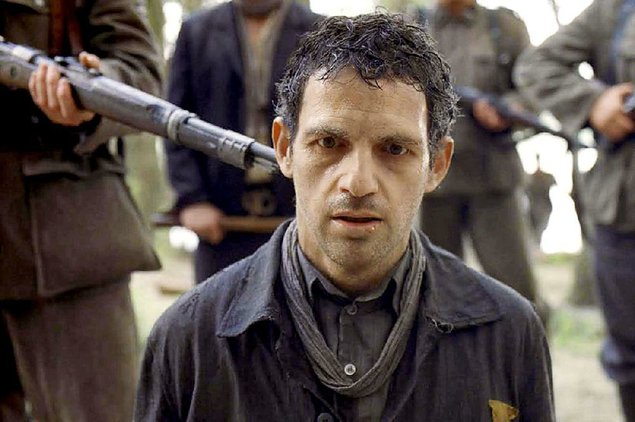
SOS - scene2

Away from the visual and aural decisions that make the movie look and sound like no other Holocaust movie before it, Saul’s story is a simple one: he wants to give the boy he believes to be his son a proper burial, and the attendant service given by a rabbi (Saul is not a practising religious man; as a result he doesn’t realise that a rabbi isn’t necessary for what he wants to do). Saul becomes obsessed with making his plan happen, but it proves harder to achieve than he thought. He’s unable to find a rabbi who will perform the ceremony, and his efforts to find one are constantly interrupted or foiled by the demands of some of the other Sonderkommandos. They’re planning an uprising, and want Saul to help them. His attempts to please them and also satisfy his own needs form the basis of the narrative, but Nemes makes it clear that Saul’s need to bury the boy is his first priority.

Again, some viewers may have an issue with the single-mindedness that Saul adopts here, as he jeopardises both his own life and those of his fellow Sonderkommandos as he seeks out a rabbi. His determination is such that he acts recklessly, and seemingly without regard for his own safety or the safety of others. An attempt to photograph some of the atrocities carried out at the camp is nearly discovered thanks to Saul’s unthinking behaviour, and later, when he finds someone he believes to be a rabbi (Charmont), Saul nearly ends up being mistaken for a new arrival (and killed). And when circumstances dictate that the uprising needs to happen sooner than planned, Saul’s only concern is ensuring that the boy’s body is kept safe enough to be buried still. But it’s this dogged refusal to give up that enables Saul to keep going, it’s his way of retaining some humanity in the face of the wanton cruelty he sees each and every day.

SOS - scene3

As Saul, Röhrig gives an incredible, melancholy performance that is built on telling expressions and a minimal amount of dialogue. Saul is a man consumed by reticence and detachment, focused on whatever he himself is doing at any given moment, and Röhrig, whose only previous acting experience was in a Hungarian TV show in 1989, shows the character’s distance from his surroundings as both a blessing and a curse. It’s a finely nuanced and controlled performance, intelligent and surprisingly emotive, and his ability to display a variety of emotions through the mask-like appearance Saul adopts in the camp is a masterclass in screen acting.

In addressing the issue of the Sonderkommandos and their place in the concentration camps, Nemes is also giving a voice to the people who didn’t survive the camps. It’s a fine distinction to make when so many other Holocaust movies celebrate the survivors over the ones who met their fates in a gas chamber. It makes the movie a bleaker experience than most, and its haunting, distressing tone is all the more forceful and compelling because of it. Son of Saul may not be a comfortable movie to watch, and it may not be rewarding in the traditional sense, but it is a testament to the tenacity and the courage of those who found themselves in one of the worst predicaments ever: that of aiding in the deaths of millions of people like themselves.

Rating: 9/10 – expertly handled, and refusing to indulge in any kind of melodrama, Son of Saul is one of the finest Holocaust movies ever made; intense, horrible (and horrifying), disturbing, and brilliant, there are moments that will linger in the memory, but in shining a light on a rarely discussed aspect of “life” in the camps, the movie earns its place in cinema history as an important historical record.
Share this:

  • Click to share on X (Opens in new window) X
  • Click to share on Facebook (Opens in new window) Facebook
  • More
  • Click to print (Opens in new window) Print
  • Click to email a link to a friend (Opens in new window) Email
Like Loading...

Phoenix (2014)

02 Sunday Nov 2014

Posted by dullwood68 in Movies

≈ 1 Comment

Tags

Christian Petzold, Concentration camp, Drama, Germany, Literary adaptation, Marriage, Nina Hoss, Reconstructive surgery, Relationships, Review, Ronald Zehrfeld, World War II

Phoenix

D: Christian Petzold / 98m

Cast: Nina Hoss, Ronald Zehrfeld, Nina Kunzendorf, Michael Maertens, Imogen Kogge

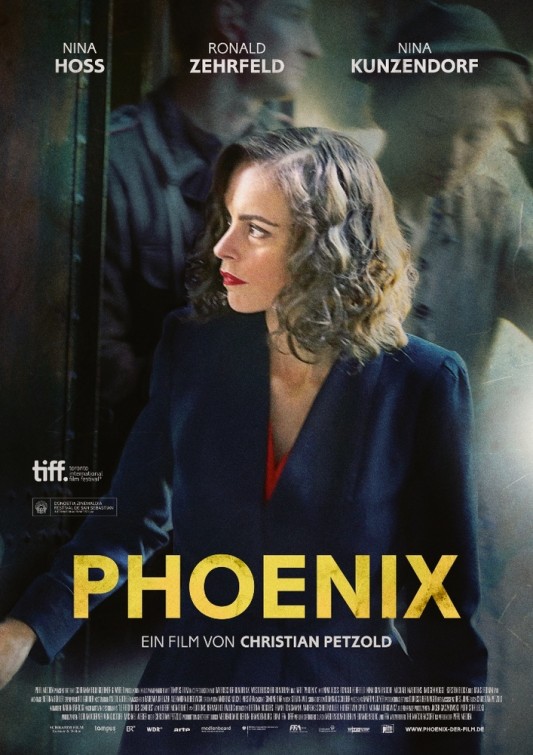
Nelly (Hoss) is a former nightclub singer who was interned in a concentration camp during World War II and subsequently disfigured.  At the war’s end she undergoes reconstructive surgery that makes her look as close as possible to her real self.  The resemblance is striking but there are enough differences that she could be mistaken for someone else.  Nelly recovers from her surgery with the help of fellow survivor, Lene (Kunzendorf).  When Nelly is better, Lene wants both of them to emigrate to Israel, but Nelly has other ideas: she wants to return to Berlin and find her husband, Johnny (Zehrfeld).

Her search takes her to the Phoenix club, where she finds Johnny, but there is no happy reunion.  When he sees her, Johnny doesn’t recognise her, but he does see the resemblance and comes up with a plan to claim Nelly’s inheritance.  After a period in which he will teach her to “be” Nelly, he will present her to their families and friends, and pass her off as his wife.  Nelly goes along with the plan.  She keeps quiet about her identity in the hope that Johnny will one day recognise her, but those hopes are cruelly dashed when Lene learns that Johnny was the person who deposed her to the authorities and which led to her being taken to the concentration camp (and then divorced her the day after).

Upset by this news, Nelly becomes ambivalent towards Johnny and begins to question his plan and its chances of succeeding.  She drops hints about her true identity but he doesn’t pick up on them.  She challenges him and makes things more difficult for him when he tries to tell her about their past, questioning what he tells her.  She also changes the way she is asked to dress and behave, subtly altering the balance of power in their relationship.  As the time approaches when Nelly is due to “return”, she must make the decision to either reveal the truth, or go along with the deception.

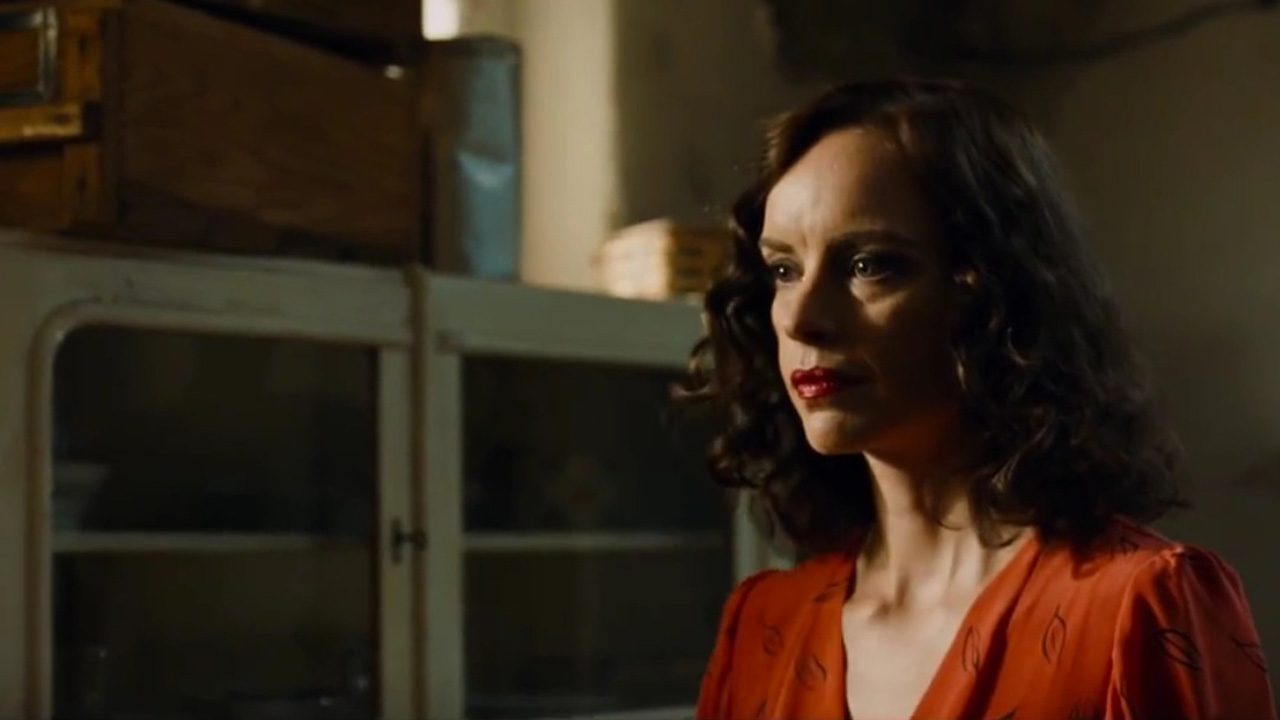
Phoenix - scene

A mordant, austere tale about one woman’s attempt to reconstruct her life and reconnect with her past, but under unexpected conditions, Phoenix is the sixth collaboration between Petzold and Hoss, and a great example of contemporary German cinema.

Adapted by Petzold from the novel Return from the Ashes by Hubert Monteilhet, Phoenix is a quietly gripping examination of memory and identity, and the ways in which each can undermine the other.  From the movie’s beginning, with Nelly about to undergo the surgery she hopes will give her her life back, it’s clear that she has lost more than just her looks.  She’s lost her sense of self, and by looking as much as possible as she did – and not differently as recommended by her surgeon – she has faith that this will restore her.  But what is really missing is the self-confidence she had before she was interned, and even looking as she did, she’s still hesitant and unsure of herself.

When it comes to actually rebuilding her life with Johnny she doesn’t find it easy, her emotional fragility keeping her subdued and unwilling to jeopardise the duplicitous scheme her ex-husband has come up with.  Being able to do the “role” justice begins to change matters, Nelly slowly gaining in confidence until she is as much in control of Johnny’s scheme as he is – if not more so.  The power play that develops between them adds tension and a deeper emotional complexity than up til now, and as Nelly begins to assert herself – and not the impostor version she’s adopted – her sense of pride develops as well.  The final scene shows just how far Nelly has come, and it’s a rewarding moment both for her and for the viewer (if not for Johnny).

With Nelly finding that Johnny’s memories of their marriage lack any residual warmth or fondness, she also has to come to terms with the idea that her view of their marriage may not be as truthful as she believed.  As she struggles to maintain that wilting perspective, the moment when she puts it all behind her and decides to move forward is put off until the very end, leaving the movie balanced on a cinematic precipice.  Mean-spirited it may be, but whether or not Nelly and Johnny do go back to each other after all their plotting, is largely irrelevant.  That Nelly now has a choice in the decision is what matters, and by the look on Johnny’s face at the end, it’s not a choice he’s looking forward to her making.

As the uncertain, deceptively enigmatic Nelly, Hoss puts in a superb performance, perfectly capturing the various fears, worries and concerns of a person playing a part and slowly learning how empowering it can be.  Hoss is one of the best actresses working in movies today, and she gives a measured, quietly authoritative performance that shows her complete command of the character and her (somewhat skewed) behaviour.  It’s a fantastic achievement, outwardly clinical in that detached manner people expect from German actors, but ruinously emotional underneath, emoting often with just her eyes, her expressionless face hiding the inner turmoil Nelly feels inside.  It’s an acting masterclass, the kind of role that would go to Nicole Kidman if there was an English language remake (though let’s hope there isn’t).

Phoenix Ronald Zehrfeld Nina Hoss

With his lead actress having such firm control over the main character, Petzold is free to highlight the emotional and psychological aspects of his script, keeping “Nelly” hidden away for most of the movie, even when the war is over and she’s forced to hide behind the surgery she’s had.  Petzold (with Hoss’s help of course) brings Nelly to life with painstaking attention to the more poignant aspects of her tale, most notably in a scene where by dressing as she once did Nelly hopes to reignite a spark in Johnny’s heart, that even though he doesn’t feel toward her as he did before the War, that he might do so now, even though she’s different.  It’s an incredibly touching, hopeful moment, beautifully and sensitively acted by Hoss and Zehrfeld, and on its own, one of the most powerful scenes you’re likely to see all year.

The post-war period is effectively replicated and photographed (by Hans Fromm), and there’s a simple but equally effective score by Stefan Will (who has worked on all bar one of Petzold’s movies).  It all adds up to a quietly engrossing tale that makes a virtue of keeping its main characters’ emotions hidden close under the surface, and by making Nelly’s struggle to unite her past and future all the more enthralling.

Rating: 8/10 – at first glance, Phoenix looks gloomy and uninviting, but Petzold is an astute director and the movie is far more passionate than it seems; with another outstanding performance from Hoss, this is a movie that exceeds expectations and does so with honesty and tremendous skill from its makers.

Share this:

  • Click to share on X (Opens in new window) X
  • Click to share on Facebook (Opens in new window) Facebook
  • More
  • Click to print (Opens in new window) Print
  • Click to email a link to a friend (Opens in new window) Email
Like Loading...

Blog Stats

  • 490,512 hits

Recent Posts

  • 10 Reasons to Remember Bibi Andersson (1935-2019)
  • Fantasia (1940)
  • Dances With Wolves (1990) – The Special Edition
  • Kiss of the Spider Woman (1985)
  • The Three Musketeers (1973)

Top Posts & Pages

  • The Dark Tower (2017)
    The Dark Tower (2017)
  • The White Orchid (2018)
    The White Orchid (2018)
  • Lost for Life (2013) - Another Look
    Lost for Life (2013) - Another Look
  • Captain Fantastic (2016)
    Captain Fantastic (2016)
  • Miss Baek (2018)
    Miss Baek (2018)
  • Two Shorts by François Ozon: A Summer Dress (1996) and X2000 (1998)
    Two Shorts by François Ozon: A Summer Dress (1996) and X2000 (1998)
  • Central Intelligence (2016)
    Central Intelligence (2016)
  • Taken (2008)
    Taken (2008)
  • A Brief Word About Cineworld Unlimited
    A Brief Word About Cineworld Unlimited
  • Nancy Drew... Reporter (1939)
    Nancy Drew... Reporter (1939)
Follow thedullwoodexperiment on WordPress.com

Blogs I Follow

  • Rubbish Talk
  • Film 4 Fan
  • Fast Film Reviews
  • The Film Blog
  • All Things Movies UK
  • Interpreting the Stars
  • Let's Go To The Movies
  • Movie Reviews 101
  • TMI News
  • Dan the Man's Movie Reviews
  • Film History
  • Jordan and Eddie (The Movie Guys)

Archives

  • April 2019 (13)
  • March 2019 (28)
  • February 2019 (28)
  • January 2019 (32)
  • December 2018 (28)
  • November 2018 (30)
  • October 2018 (29)
  • September 2018 (29)
  • August 2018 (29)
  • July 2018 (30)
  • June 2018 (28)
  • May 2018 (24)
  • April 2018 (21)
  • March 2018 (31)
  • February 2018 (25)
  • January 2018 (30)
  • December 2017 (30)
  • November 2017 (27)
  • October 2017 (27)
  • September 2017 (26)
  • August 2017 (32)
  • July 2017 (32)
  • June 2017 (30)
  • May 2017 (29)
  • April 2017 (29)
  • March 2017 (30)
  • February 2017 (27)
  • January 2017 (32)
  • December 2016 (30)
  • November 2016 (28)
  • October 2016 (30)
  • September 2016 (27)
  • August 2016 (30)
  • July 2016 (30)
  • June 2016 (31)
  • May 2016 (34)
  • April 2016 (30)
  • March 2016 (30)
  • February 2016 (28)
  • January 2016 (35)
  • December 2015 (34)
  • November 2015 (31)
  • October 2015 (31)
  • September 2015 (34)
  • August 2015 (31)
  • July 2015 (33)
  • June 2015 (12)
  • May 2015 (31)
  • April 2015 (32)
  • March 2015 (30)
  • February 2015 (37)
  • January 2015 (39)
  • December 2014 (34)
  • November 2014 (34)
  • October 2014 (36)
  • September 2014 (25)
  • August 2014 (29)
  • July 2014 (29)
  • June 2014 (28)
  • May 2014 (23)
  • April 2014 (21)
  • March 2014 (42)
  • February 2014 (38)
  • January 2014 (29)
  • December 2013 (28)
  • November 2013 (34)
  • October 2013 (4)

Create a free website or blog at WordPress.com.

Rubbish Talk

Film 4 Fan

A Movie Blog

Fast Film Reviews

The Film Blog

The official blog of everything in film

All Things Movies UK

Movie Reviews and Original Articles

Interpreting the Stars

Dave Examines Movies

Let's Go To The Movies

Film and Theatre Lover!

Movie Reviews 101

Daily Movie Reviews

TMI News

Latest weather, crime and breaking news

Dan the Man's Movie Reviews

All my aimless thoughts, ideas, and ramblings, all packed into one site!

Film History

Telling the story of film

Jordan and Eddie (The Movie Guys)

Movie Reviews & Ramblings from an Australian Based Film Fan

Privacy & Cookies: This site uses cookies. By continuing to use this website, you agree to their use.
To find out more, including how to control cookies, see here: Cookie Policy
  • Subscribe Subscribed
    • thedullwoodexperiment
    • Join 481 other subscribers
    • Already have a WordPress.com account? Log in now.
    • thedullwoodexperiment
    • Subscribe Subscribed
    • Sign up
    • Log in
    • Report this content
    • View site in Reader
    • Manage subscriptions
    • Collapse this bar
 

Loading Comments...
 

    %d