
Tags
Alec Baldwin, Alzheimers, Drama, Early onset Alzheimers, Julianne Moore, Kate Bosworth, Kristen Stewart, Lisa Genova, Literary adaptation, Memory loss, Review, Richard Glatzer, Wash Westmoreland
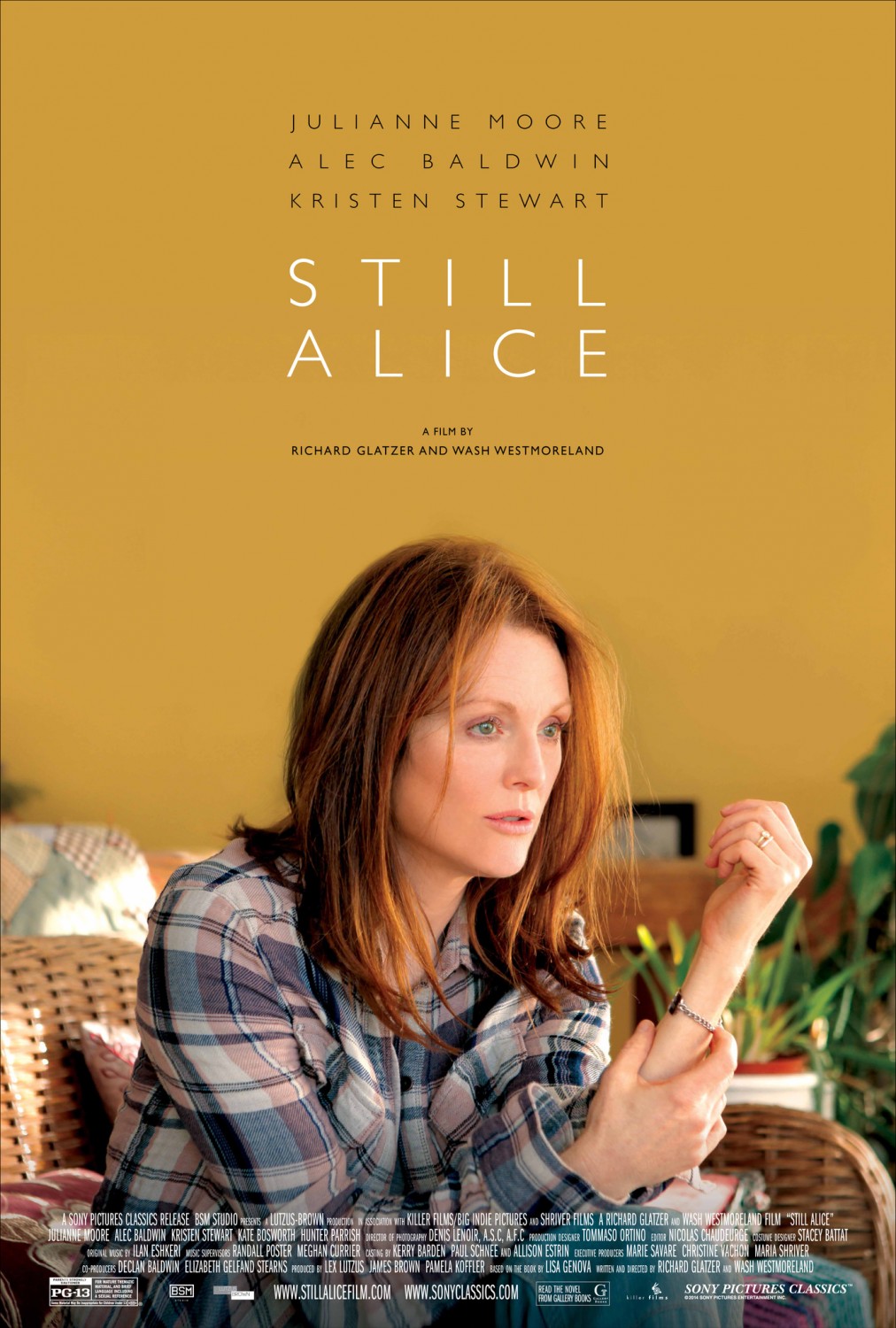
D: Richard Glatzer, Wash Westmoreland / 101m
Cast: Julianne Moore, Alec Baldwin, Kristen Stewart, Kate Bosworth, Hunter Parrish, Shane McRae, Stephen Kunken
Alice Howland (Moore) is a respected linguistics professor at Columbia University. She has a loving husband, John (Baldwin), and three grown up children, Anna (Bosworth), Tom (Parrish), and Lydia (Stewart). Shortly after her fiftieth birthday she gives a lecture and forgets the word ‘lexicon’. She brushes it off but when she’s out running one day she reaches the campus and for one disorientating moment she has no idea where she is. She begins to see a neurologist (Kunken) and undergoes various tests. When it comes, the diagnosis is a shock: she has early onset Alzheimers. Further tests also reveal that it’s familial, and her children are at risk of carrying the recessive gene that causes it.
As expected, the news is a blow to Alice’s family, but she is determined to fight the disease for as long as she can. Her children have different reactions: Anna is tested and is positive; she and her husband, Charlie (McRae), are trying for a baby via an infertility clinic and need to know. Tom tests negative, while Lydia, who is a budding actress living on the West Coast and a bit of a free spirit, decides not to find out. But they and their father all do their best to support Alice as she comes to terms with what her life will become.
But the illness is aggressive, and Alice’s initial coping mechanisms of using her mobile phone to record information, and setting herself little memory tests, lose their effectiveness, and she begins to forget even more. Her awareness of the speed at which her illness is affecting her, leads Alice to record a video message advising her future self to commit suicide by taking a bottle of pills. One day, while she and John are at their beach house, she forgets where the bathroom is and wets herself. As she begins to forget more and more, she receives an invitation to speak at an Alzheimers convention. There she gives a moving description of the ways in which the disease is affecting her but also the ways in which she deals with it.
Alice’s deteriorating mental abilities become more and more obvious. When Lydia performs at a local theatre, Alice forgets her name when they meet up afterwards. And she becomes anxious when John receives an offer to work at the Mayo Clinic, which will mean moving. And then Alice discovers the video message she made earlier…

Adapted from the novel by Lisa Genova, Still Alice is a gloomy, yet also affecting look at the debilitating effects of Alzheimers on an intelligent, academically respected individual, and her immediate family. It’s a straightforward, no frills movie that aims to pull no punches regarding the debilitating aspects of the disease, but can’t quite stop itself from trying to salvage a degree of personal triumph out of Alice’s dilemma. In fact, Still Alice tries so hard to make Alice’s fight against Alzheimers laudatory that it almost misses the tragedy that goes with it hand in hand.
In telling Alice’s story, writer/directors Gratzer and Westmoreland have resorted to charting the gradual effects of the disease by signposting them with often clumsy simplicity. First Alice forgets a word in a lecture, next she forgets where she is, then she forgets someone’s name and their address in a test. As each lapse in memory and example of cognitive impairment is trotted out, their presence in the narrative seems to be crying out, “See? She’s getting worse!”, as if the viewer couldn’t work that out for themselves. And when she’s told that her form of Alzheimers, matched by her intelligence and mental acuity, means that the disease will have a more rapid effect on her, it’s almost like kicking someone when they’re down; not only is Alice already unlucky to be suffering at so young an age, but because she’s so smart it’s another point against her.
This kind of unnecessary melodrama hurts the middle third of the movie so much that it’s only thanks to Moore’s superb performance that it remains so affecting and watchable. Even when the script piles on the pain and anguish she remains utterly believable, painting a sincere, credible portrait of a woman losing her sense of herself, and portraying the terrible ramifications of having her personality destroyed from within. The scene where Alice can’t find the bathroom is a powerful example, as the camera stays with her at waist height as she rushes through the house. When she stops the camera focuses on her face and the evident torment she’s experiencing. The viewer knows exactly what’s happening, from the shame and distress Alice is feeling to the moment where the inevitable happens, and when the camera pans back to reveal the stain down the front of her jogging bottoms it’s nowhere near as effective as the acting masterclass that Moore has honoured us with. Simply put, Moore is astonishing, and when the disease has robbed Alice of nearly all cognisance of the world around her, and her eyes are dulled by incomprehension, it’s heartbreaking.
Sadly, Moore is the best thing in a movie that fails to paint convincing portraits of Alice’s family and resorts to their providing implausible levels of support throughout. Not once does any one of them lose their temper, or voice their own distress at what’s happening to her, or display any hesitation in doing what they can. Even when John is offered the job at the Mayo Clinic and Alice states her reluctance of doing so, the scene is set for the kind of antagonism that must surely happen in these situations. But instead, John swallows his disappointment in seconds and the moment passes. It’s an uncomfortable moment because it feels so false, and Baldwin doesn’t pull it off (for once though, we see another character looking as lost as Alice is). But Baldwin isn’t alone. Each of the supporting cast has their “uncomfortable moment”, Stewart early on when Alice and Lydia have one of those awkward mother-daughter conversations about careers that seems to have been cribbed from a thousand and one other similar mother-daughter conversations in the movies, and which leaves Stewart struggling to make her supposedly independent-minded character sound anything other than petulant. In contrast, Bosworth is the waspish eldest daughter, saddled with lines that are largely derogatory of others and with no obvious reason for her being that way. And Parrish is sidelined pretty much throughout as Alice’s son, allowed only a brief moment to shine (but not say much) at the Alzheimers convention.
With Moore’s formidable performance taken out of the equation, Still Alice skirts perilously close to formulaic disease-of-the-week TV movie status. It’s a movie that wants to say something profound about the way in which a disease as awful as Alzheimers can be managed – albeit in its early stages – and while Alice’s address to the conference is genuinely moving, it relies too heavily on her normal mental capability to be completely persuasive. With other dramatic flaws that weigh the movie down, Glatzer and Westmoreland’s efforts remain lumbering and inconsequential. The movie is also curiously bland to watch, with too many neutral colours in the background, and Alice aside, too many characters who evince emotion with restraint. There’s also a mawkish score by Ilan Eshkeri that only occasionally matches the action for poignancy.
Rating: 6/10 – gaining two points because of the sheer brilliance and sensitivity of Moore’s performance, Still Alice is gripping stuff when Moore is onscreen but turgid and lacking validity when she isn’t; if it wasn’t for her this would be one movie that could be so easily forgotten, and without any attendant grief.
 thedullwoodexperiment