• 10 Reasons to Remember…
  • A Brief Word About…
  • About
  • For One Week Only
  • Happy Birthday
  • Monthly Roundup
  • Old-Time Crime
  • Other Posts
  • Poster of the Week
  • Question of the Week
  • Reviews
  • Trailers

thedullwoodexperiment

~ Viewing movies in a different light

thedullwoodexperiment

Tag Archives: Hallucinations

A Field in England (2013)

01 Saturday Jul 2017

Posted by dullwood68 in Movies

≈ Leave a comment

Tags

Ben Wheatley, Catch Up movie, Drama, English Civil War, Hallucinations, Horror, Michael Smiley, Peter Ferdinando, Reece Shearsmith, Review, Richard Glover, Ryan Pope, Thriller
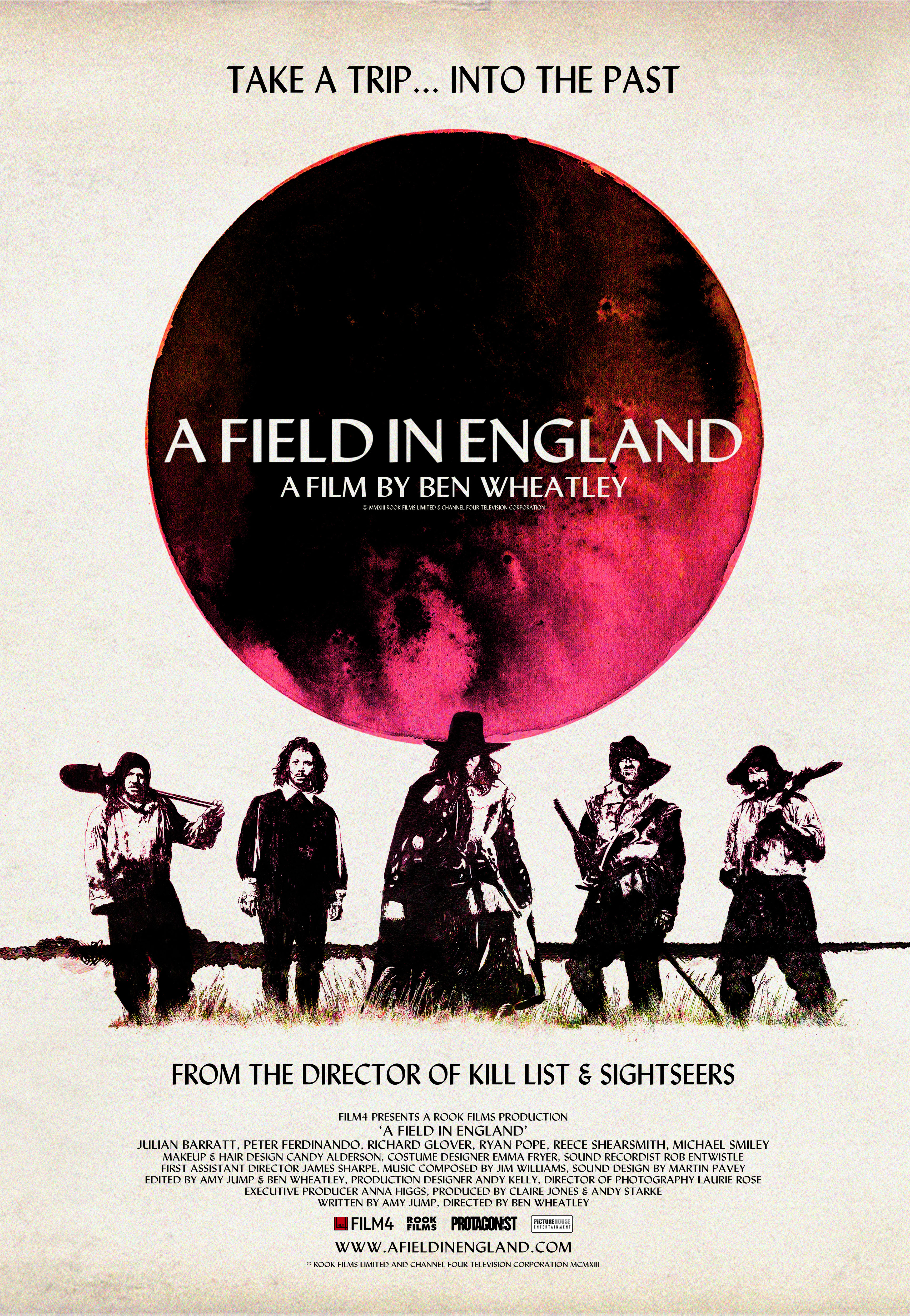
D: Ben Wheatley / 90m

Cast: Julian Barratt, Peter Ferdinando, Richard Glover, Ryan Pope, Reece Shearsmith, Michael Smiley

The British writer/director/editor Ben Wheatley has made six movies to date, all of which have been greeted warmly by critics, but less so by audiences. So what does this say about the movies Wheatley makes? Or the critics that review them so favourably? Or the audiences who aren’t as moved as the critics? Well, like any discerning director, Wheatley makes the movies he wants to make. He’s not singing or dancing to anyone else’s tune, and he’s never been just a director for hire. His movies are personal to him (and his co-writer/co-editor, and wife Amy Jump), and he brings his own unique visual aesthetic to them. Perhaps it’s this individuality of purpose that makes him so popular with the critics. But still, wider audiences haven’t taken to Wheatley’s movies, and he remains a movie maker with a great deal of critical caché but very little box office appeal.

Is this fair? Possibly not, but Wheatley’s distinctive approach to making movies isn’t always as welcoming as it could be. His fourth movie, A Field in England, is probably the best example of how his distinctive approach can get in the way of making a movie accessible, or even fundamentally appealing. Set during an English Civil War battle, the movie begins with Reece Shearsmith’s cowardly alchemist’s assistant, Whitehead, crashing through a hedge and cowering in fear from his pursuer, Commander Trower (Barratt). Rescued by a soldier named Cutler (Pope), the pair also encounter a couple of deserters, an alcoholic called Jacob (Ferdinando) and his witless companion, Friend (Glover). They decide to leave the battle and travel to an alehouse that Cutler tells them isn’t far away. They begin crossing a field that’s ringed by mushrooms, and Cutler forces Jacob and Friend to eat them. Things begin to a turn for the weird when the men seemingly haul an Irishman named O’Neill (Smiley) from out of the ground. He quickly assumes control of the group and convinces them that there is treasure buried in the field, and traumatises Whitehead into become a kind of human divining rod in order for them to know where to dig.

What follows is a series of events and episodes that may or may not be the result of the men ingesting the mushrooms, as hallucinations and psychotic breaks affect the whole group except for O’Neill (who may be real and then again he might not be; his provenance is doubtful). And this is the point where what occurs, and what follows, can’t be trusted. If you accept that Wheatley has sent his characters on a really strange trip, then you can go with the flow quite easily and just accept what you’re seeing without worrying about what it might all mean. But if you do need to know what it all means, then the rest of the movie is going to be problematic for you.

Wrongly or rightly, deliberately or accidentally, A Field in England is a movie that takes a huge stylistic and narrative gamble around the half hour mark and never looks back. It maintains a semblance of traditonal storytelling but filters it all through a succession of moments of bravura visual and sonic experimentation. At one point, while being chased by O’Neill, Whitehead shoves mushroom after mushroom into his mouth and Wheatley uses it as a cue to transport the viewer into Whitehead’s mind and expose them to the kaleidoscopic and fantastical visions that the character is experiencing. It’s a tremendous feat of editing, combining fractured and composite visuals with an overwhelming audio conflation of natural sound and music, and it’s far and away the standout moment… but, exceptional as it is, it’s also indicative of the way in which Wheatley and Jump have decided to treat the narrative, and the material as a whole.

As the movie progresses, and the characters experience vision after hallucination after extended fever dream, it becomes clear that the story, such as it is, has been abandoned in favour of transporting the viewer into a world where anything Wheatley and Jump can come up with is the new norm, and regardless of whether it makes sense or not. What makes this all the more frustrating is that the dialogue and the characterisations, which were so redolent during the movie’s first half hour, are also abandoned, and the characters – literally – all become pawns to be moved around the field at random, and until Wheatley can set up the final showdown between Whitehead and O’Neill (which ends with a line from Whitehead that has Eighties action movie cliché written all over it; not bad for a movie set during the English Civil War). In the end, the viewer has no choice but to go along with what’s happening, because Wheatley isn’t giving them a choice; and if it doesn’t make sense – which a lot of it doesn’t – then it’s too bad.

But where the movie scores highly is in its imaginative cinematography, courtesy of DoP Laurie Rose (who has lensed all of Wheatley’s movies). The crisp, pin-sharp black and white images are hugely immersive, and close ups are rendered in such a precise, detailed fashion that there are several moments where the urge to pause the movie and savour the image is irresistible. It’s a movie that’s staggeringly beautiful at times, and if it’s ever released in a 4K UHD version it would be an even more incredible viewing experience. Full marks too to sound designer Martin Pavey and composer Jim Williams for combining their work in a way that adds so much resonance to the images, and helps accentuate the profoundly disturbed states of mind of the characters once their real “journey” has begun. Without these elements – the imagery and the soundtrack – A Field in England would definitely suffer further, but thankfully they more than make up for the errant narrative and directorial choices that Wheatley has made.

Rating: 6/10 – impressive visuals and an equally impressive soundscape aren’t enough to stop A Field in England from being a disappointing, and frustrating viewing experience; loaded with style and directorial flourishes, it neglects its storyline in favour of these approaches, and leaves the movie struggling to retain any meaning, which makes it an exercise in style that overwhelms any substance it may have had in the beginning. (1/31)

Share this:

  • Click to share on X (Opens in new window) X
  • Click to share on Facebook (Opens in new window) Facebook
  • More
  • Click to print (Opens in new window) Print
  • Click to email a link to a friend (Opens in new window) Email
Like Loading...

Regression (2015)

28 Thursday Apr 2016

Posted by dullwood68 in Movies

≈ Leave a comment

Tags

1990, Alejandro Amenábar, David Dencik, David Thewlis, Drama, Emma Watson, Ethan Hawke, Hallucinations, Horror, Hypnosis, Minnesota, Regression therapy, Review, Ritual Satanic Abuse, Satanism, Thriller

Regression

D: Alejandro Amenábar / 106m

Cast: Ethan Hawke, Emma Watson, David Thewlis, Lothaire Bluteau, Dale Dickey, David Dencik, Devon Bostick, Aaron Ashmore, Peter MacNeill

Minnesota, 1990. Farmer John Gray (Dencik) confesses to molesting his seventeen year old daughter, Angela (Watson) – but there’s a catch: even though Angela has made an accusation, Gray can’t remember doing anything of the sort, and is confessing purely because Angela has never lied to him, so in his mind it must be true. Detective Bruce Kenner (Hawke) is assigned to the case, and while Gray languishes in prison awaiting a trial date, he begins to look into the matter. It’s not long though before Kenner begins to find that the case isn’t as straightforward as his boss, Chief Cleveland (O”Neill), would like.

With the help of Professor Kenneth Raines (Thewlis), Kenner learns through Raines’ use of regression therapy techniques that Gray wasn’t alone when his abuse of Angela was supposed to have happened. When the other person present is revealed to be a fellow police officer, George Nesbitt (Ashmore), that revelation opens up another can of worms altogether: that Nesbitt, along with an unwitting Gray, are members of a satanic cult. With the rest of the police force treating the idea of a satanic cult as a joke, and Gray’s family proving resentful of Kenner’s investigation, it’s not until he gets to meet Angela that Kenner begins to believe that there might actually be something in what her father has remembered.

Regression - scene2

Kenner remains sceptical but insists on keeping an open mind, and begins looking into the possibility that a cult is operating in the local area. A second meeting with Angela has him believing more and more, and even more so when he begins to have strange dreams, some where he appears to be involved in the blood sacrifice of a newborn baby (and which echoes what Angela has told him of her own experiences). Kenner becomes paranoid, and his relationships with those around him begin to deteriorate. When Nesbitt is released for lack of evidence, Kenner believes he has to risk everything in order to keep Angela safe, but if the cult is for real, will he be able to?

The period setting of Regression is deliberate. In the US in 1980, a book was published called Michelle Remembers, and it was written by Michelle Smith and her future husband Lawrence Pazder (who was then her psychiatrist). In it, Smith recounted – through Pazder’s use of hypnotherapy – alleged memories of what became known as Ritual Satanic Abuse (RSA). These memories related to abuse supposed to have been perpetrated by Michelle’s mother in the mid-Fifties when Michelle was five. The book proved to be a starting point for allegations of widespread satanic activity within the US (and further afield), and although skepticism of Smith and Pazder’s book was equally widespread, as the Eighties progressed, the idea of satanic cults prospered, and the book, and Pazder’s “expertise” on the subject, were used as a guide for prosecutors preparing cases against individuals accused of satanic practices.

Set against the backdrop of this developing fear and paranoia, Regression touches on several attendant topics – the (mis)use of regressive therapy, the impact of such allegations on closed communities, individual feelings of guilt and/or responsibility, the ease with which unsubstantiated rumour becomes accepted fact – but it does so in such an awkward, hamfisted way that any dramatic emphasis is reduced by the way in which Amenábar’s script fails to follow through on these topics. The end result is a movie that has a lot going on but little of it that makes consistent sense.

Regression - scene1

Worrying aspects crop up almost from the start, with a very clumsily inserted “clue” that Nesbitt is more involved than is initially apparent, and this is followed by the way in which Detective Kenner commits himself so unreservedly, leaving the viewer to wonder just what it is that drives him (a question the movie avoids answering). Raines’ involvement so soon into the investigation, and the way in which he’s allowed to take the lead on so many interviews is concerning in terms of likelihood (it doesn’t help that Raines is often unnecessarily aggressive as well), and a sequence where Kenner “sees” the events described to him by Angela is another cause for concern, as it comes across as a stylistic exercise rather than a character trait.

Kenner is the viewer’s guide through the events of the movie but he proves an unreliable guide, prone to making schoolboy errors in terms of the investigation, and behaving unprofessionally with Angela. The movie doesn’t give any real reason for the waywardness of his behaviour, and as the mystery deepens his growing paranoia (and belief) that the satanic cult is real causes him to behave so irrationally that the extent of it becomes unconvincing. With Gray already acting strangely, and with most of the local community seemingly in thrall to the cult that no one can identify, Amenábar’s decision to have Kenner become a victim as well becomes exasperating rather than effective in terms of the drama.

Regression - scene3

Viewers should be able to determine the movie’s outcome without too much trouble, but once they do, and once the movie reaches that point, the whole thing collapses in on itself and the last fifteen minutes feel like a compromise instead of a conclusion decided on from the start. Amenábar does his best, but even with the support of Hawke and Watson, he doesn’t appear to be fully in control of his own narrative or where it’s going. Scenes feel divorced from each other, and too often, characters act oddly because the script needs them to.

The performances are committed at least, with Hawke giving his all in yet another not-fully-realised horror thriller, and Watson putting Hermione Granger firmly behind her as the victim(?) whose safety becomes Kenner’s primary concern. Thewlis and his character are abandoned by Amenábar two thirds of the way through, while the rest of the supporting cast (save Dencik) do what they can in respect of filling in the blanks. In the end, Regression is a movie where the characters exist to service the plot, and at no point do any of them feel organic, leaving the cast to try and work out what’s the best approach for each one. It leads to a clash of acting styles in some scenes, and a lack of cohesion in others. Amenábar at least keeps things visually interesting, albeit in a dour, dark-hued way, and the sequences of satanic worship and sacrifice are well shot and edited together, but all in all this needed a tighter script and a better ending to be anywhere near successful.

Rating: 5/10 – though Regression is based around real events that occurred over a period of time, it never really offers a cohesive or credible story to match its general assumptions about what was happening at the time; not as scary or effective as it would like to be, the movie winds up playing it safe instead of giving the viewer any real food for thought.

Share this:

  • Click to share on X (Opens in new window) X
  • Click to share on Facebook (Opens in new window) Facebook
  • More
  • Click to print (Opens in new window) Print
  • Click to email a link to a friend (Opens in new window) Email
Like Loading...

Blog Stats

  • 486,575 hits

Recent Posts

  • 10 Reasons to Remember Bibi Andersson (1935-2019)
  • Fantasia (1940)
  • Dances With Wolves (1990) – The Special Edition
  • Kiss of the Spider Woman (1985)
  • The Three Musketeers (1973)

Top Posts & Pages

  • Lost for Life (2013) - Another Look
    Lost for Life (2013) - Another Look
  • Lost for Life (2013)
    Lost for Life (2013)
  • About
    About
  • Mr. Topaze (1961)
    Mr. Topaze (1961)
  • Hunt for the Wilderpeople (2016)
    Hunt for the Wilderpeople (2016)
  • Shock and Awe (2017)
    Shock and Awe (2017)
  • Billy Lynn's Long Halftime Walk (2016)
    Billy Lynn's Long Halftime Walk (2016)
  • Winter's Tale (2014)
    Winter's Tale (2014)
  • BFI London Film Festival 2015
    BFI London Film Festival 2015
  • 10 Reasons to Remember Arthur Hiller (1923-2016)
    10 Reasons to Remember Arthur Hiller (1923-2016)
Follow thedullwoodexperiment on WordPress.com

Blogs I Follow

  • Rubbish Talk
  • Film 4 Fan
  • Fast Film Reviews
  • The Film Blog
  • All Things Movies UK
  • Interpreting the Stars
  • Let's Go To The Movies
  • Movie Reviews 101
  • TMI News
  • Dan the Man's Movie Reviews
  • Film History
  • Jordan and Eddie (The Movie Guys)

Archives

  • April 2019 (13)
  • March 2019 (28)
  • February 2019 (28)
  • January 2019 (32)
  • December 2018 (28)
  • November 2018 (30)
  • October 2018 (29)
  • September 2018 (29)
  • August 2018 (29)
  • July 2018 (30)
  • June 2018 (28)
  • May 2018 (24)
  • April 2018 (21)
  • March 2018 (31)
  • February 2018 (25)
  • January 2018 (30)
  • December 2017 (30)
  • November 2017 (27)
  • October 2017 (27)
  • September 2017 (26)
  • August 2017 (32)
  • July 2017 (32)
  • June 2017 (30)
  • May 2017 (29)
  • April 2017 (29)
  • March 2017 (30)
  • February 2017 (27)
  • January 2017 (32)
  • December 2016 (30)
  • November 2016 (28)
  • October 2016 (30)
  • September 2016 (27)
  • August 2016 (30)
  • July 2016 (30)
  • June 2016 (31)
  • May 2016 (34)
  • April 2016 (30)
  • March 2016 (30)
  • February 2016 (28)
  • January 2016 (35)
  • December 2015 (34)
  • November 2015 (31)
  • October 2015 (31)
  • September 2015 (34)
  • August 2015 (31)
  • July 2015 (33)
  • June 2015 (12)
  • May 2015 (31)
  • April 2015 (32)
  • March 2015 (30)
  • February 2015 (37)
  • January 2015 (39)
  • December 2014 (34)
  • November 2014 (34)
  • October 2014 (36)
  • September 2014 (25)
  • August 2014 (29)
  • July 2014 (29)
  • June 2014 (28)
  • May 2014 (23)
  • April 2014 (21)
  • March 2014 (42)
  • February 2014 (38)
  • January 2014 (29)
  • December 2013 (28)
  • November 2013 (34)
  • October 2013 (4)

Create a free website or blog at WordPress.com.

Rubbish Talk

Film 4 Fan

A Movie Blog

Fast Film Reviews

The Film Blog

The official blog of everything in film

All Things Movies UK

Movie Reviews and Original Articles

Interpreting the Stars

Dave Examines Movies

Let's Go To The Movies

Film and Theatre Lover!

Movie Reviews 101

Daily Movie Reviews

TMI News

Latest weather, crime and breaking news

Dan the Man's Movie Reviews

All my aimless thoughts, ideas, and ramblings, all packed into one site!

Film History

Telling the story of film

Jordan and Eddie (The Movie Guys)

Movie Reviews & Ramblings from an Australian Based Film Fan

Privacy & Cookies: This site uses cookies. By continuing to use this website, you agree to their use.
To find out more, including how to control cookies, see here: Cookie Policy
  • Subscribe Subscribed
    • thedullwoodexperiment
    • Join 481 other subscribers
    • Already have a WordPress.com account? Log in now.
    • thedullwoodexperiment
    • Subscribe Subscribed
    • Sign up
    • Log in
    • Report this content
    • View site in Reader
    • Manage subscriptions
    • Collapse this bar
 

Loading Comments...
 

    %d