You can’t help but watch the trailer for 55 Steps and think: shameless Oscar-bait. And then hard on the heels of that thought is: and it was released last year?
In truth, the movie received its premiere at the 2017 Toronto International Film Festival on 7 September. But since then, Bille August’s latest feature has made an appearance at the Moscow International Film Festival on 20 April 2018, had a limited release in Germany on 3 May (where it’s known as Eleanor & Colette), and a further appearance at Belgium’s Filmfestival Oostende on 8 September. The question arises: if it’s been seen at a handful of festivals (and you’d think festival programmers would be a bit more savvy than most movie watchers), then why such a delayed release?
Well, the trailer does give it away. Although “based on a true story”, and featuring Helena Bonham Carter and Hilary Swank in the lead roles, this has all the hallmarks of an old-fashioned David vs Goliath story, with Swank as the ambitious and out of her depth lawyer taking on the medical establishment, and Carter as the client who behaves oddly but endearingly, and who, despite having mental health problems that would have most people in real life crossing the street to avoid her, is presented here as someone who’s actually really lovely when you get to know her. It’s depressingly predictable, and potentially patronising, and though there’s a serious issue buried deep in the trailer – the risk of prescribed medication causing more problems than the illness or condition it’s meant to treat – you know that the movie’s real focus is going to be on the two women’s friendship, and the positive impact they have on each other’s lives. What’s wrong with that, you might ask. But if you do, then you’re not seeing how formulaic and depressingly banal this movie already looks, and in a format that’s supposed to promote it and persuade people to pay money to see it.
And one final word: when a trailer adds a quote that calls a performance “transformative”, it’s something of an insult to the make up, hair and costume departments who in this case clearly helped Helena Bonham Carter create her character’s look. Instead of praising the actor or actress, how about acknowledging the work of the production team instead?
Cast: Carey Mulligan, Helena Bonham Carter, Anne-Marie Duff, Brendan Gleeson, Ben Whishaw, Romola Garai, Natalie Press, Geoff Bell, Samuel West, Finbar Lynch, Adrian Schiller, Meryl Streep
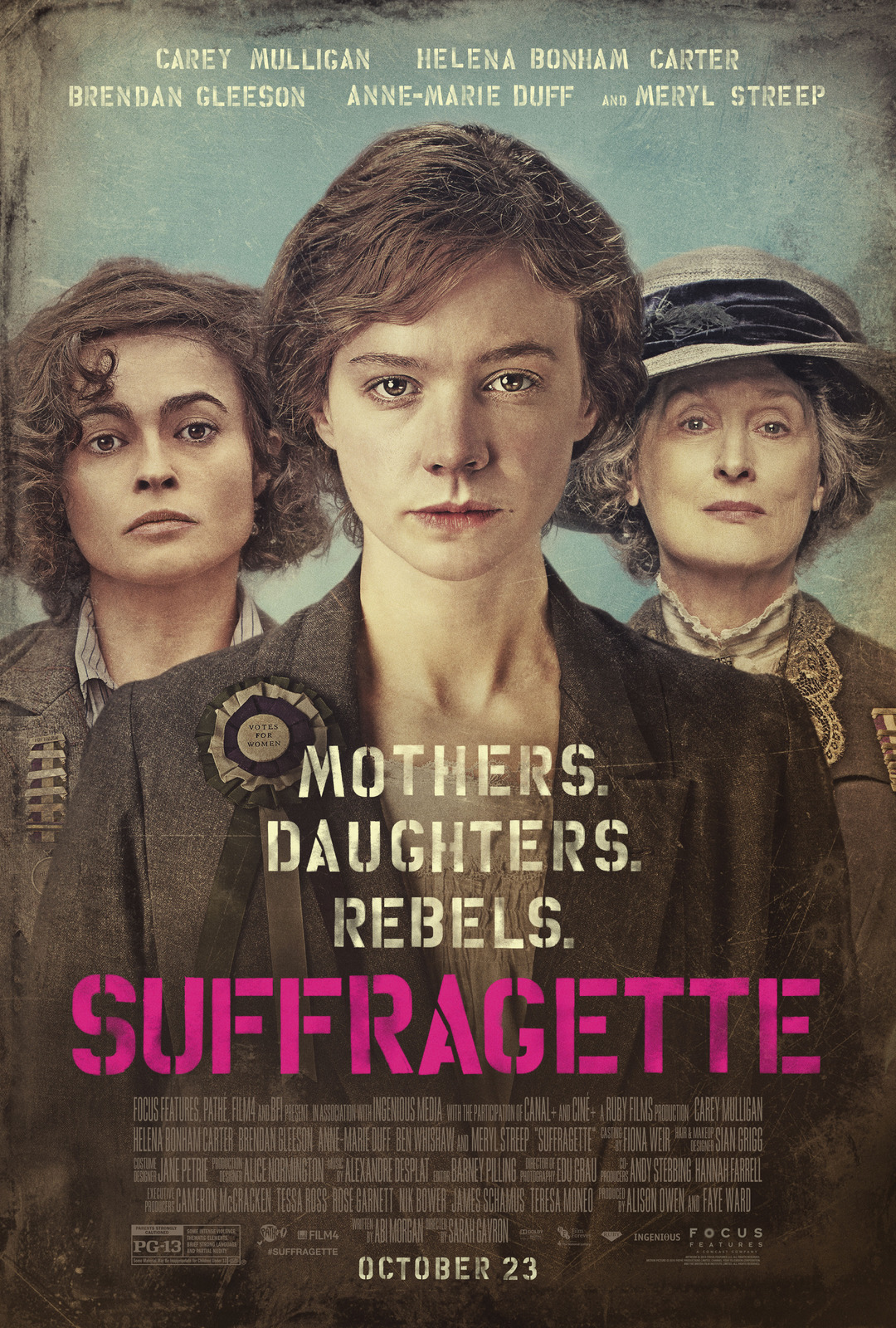
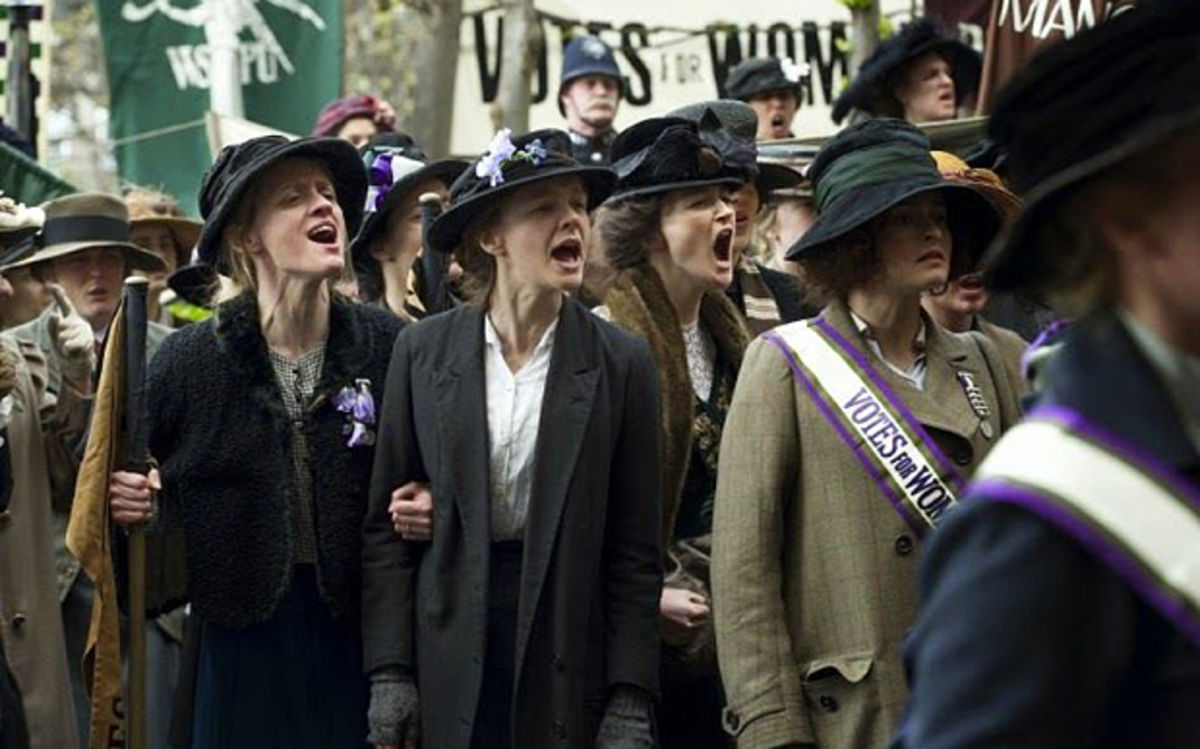
If you were to ask a hundred people, what was the Women’s Social and Political Union, and what was its purpose, most, if not all, wouldn’t be able to tell you. And yet the WSPU is perhaps one of the most important organisations in British history. Without its members and their tireless work, often in the face of police brutality and political intransigence, it’s very likely that women in the UK would not have been given the right to vote as early as they were (and even then it wasn’t until 1928). Suffragette, which looks at the Union’s activities in the run up to World War I, makes clear the level of sacrifice some of its members had to make in order to change the British political system for the better.
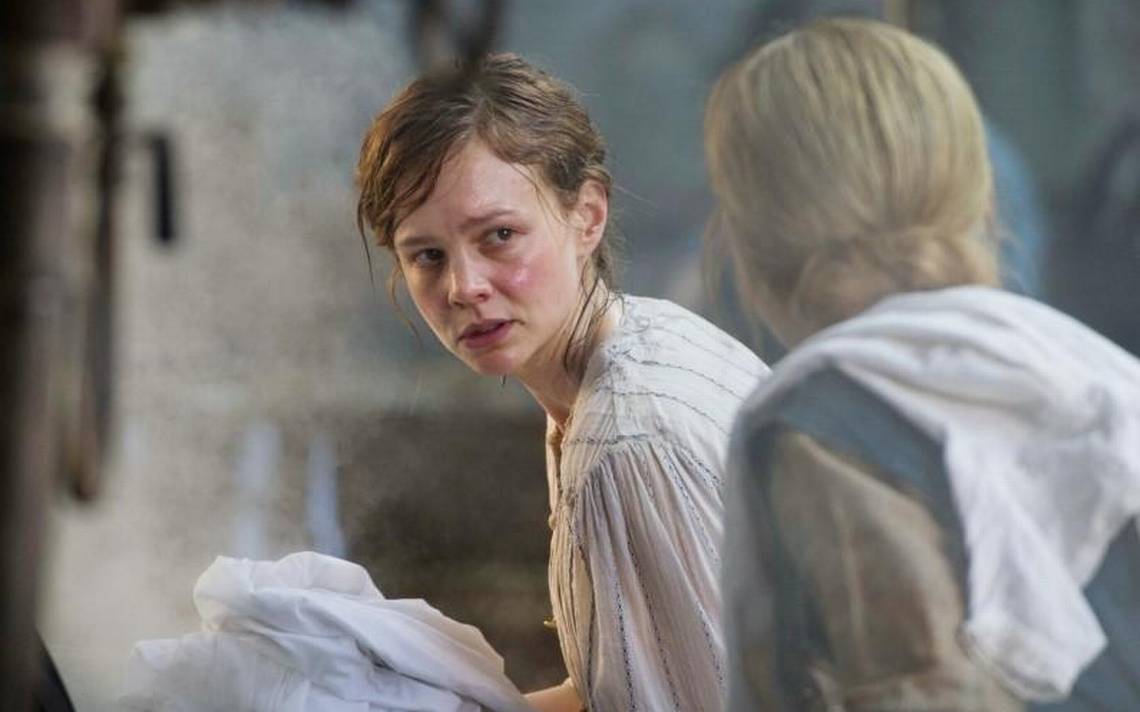
The struggle is seen through the eyes of laundry worker Maud Watts (Mulligan), wife of Sonny (Whishaw) and mother of their son, George. Maud is hardworking, has gained a certain degree of respect in the workplace, but at twenty-four has little future beyond what she’s already achieved. She appears to be accepting of her lot in life, but when a co-worker, Violet Miller (Duff), falls foul of their boss, Norman Taylor (Bell), Maud comes to her rescue and the two women strike up a friendship. Maud learns that Violet is a supporter of the women’s movement, and while she admires Violet’s courage and determination, she has no intention of becoming a suffragette.
An invitation to speak before then Chancellor of the Exchequer, David Lloyd George (Schiller), is arranged for Violet, but she is unable to speak. Maud stands in for her, and is invited to tell her story. Lloyd George is clearly sympathetic, but when an announcement is made some time later, the law remains unchanged. Caught up in the violent struggle that ensues, Maud is arrested. She is questioned by Inspector Arthur Steed (Gleeson), who has been tasked with rounding up the Union’s ringleaders, including its head, Emmeline Pankhurst (Streep). Maud denies being a suffragette, but when she’s released a week later, it’s obvious that people think she is. Sonny is upset by her involvement, and she promises to stay away from the WSPU and its members. But when a secret meeting, to be addressed by Emmeline Pankhurst is arranged, Maud can’t help but attend.
From there, along with Violet and a local pharmacist, Edith Ellyn (Carter), Maud becomes more and more involved in the WSPU and its plans. Unable to deal with her increasing involvement, Sonny kicks her out, and refuses to let her see George. In the meantime, she leaves the laundry as well, and devotes her time to the Union. She takes part in the destruction of postboxes and telephone lines, and other acts of civil disobedience. She’s arrested again, and Steed offers her a choice: inform on the Union’s activities, or face longer spells in jail. With the women under both suspicion and surveillance, and with Pankhurst exhorting them to increase their attacks on the establishment, Maud has to decide if her future resides with the WSPU.
Suffragette wears its heart on its sleeve right from the start. As a movie about the struggle of women to gain the right to vote it takes an earnest, pragmatic approach, and while it often strays from the truth in its efforts to shoehorn Maud into the events that did happen (particularly in the scenes set at Epsom on Derby Day, when Emily Wilding Davison was run down by the King’s horse), it also narrows its focus too much in its efforts to tell its story.
By choosing to tell the story of the WSPU’s struggle through the eyes of Maud, a neophyte in terms of the political landscape of the times, Abi Morgan’s script reduces the efforts and the sacrifices made by the real-life women of the time to the stuff of soap opera. From the disapproving looks of her neighbours as Maud walks home, to the reaction of Sonny after she goes back on her word, and even to the moment when she takes her long awaited “revenge” on Taylor for his bullying, rapacious behaviour, Maud’s journey from reluctant laundry worker to political activist is dealt with in such a clichéd, tick-box way that it robs the movie of any real drama. Indeed, the only time the movie achieves any kind of dramatic focus is when it opts to have Maud force-fed (something that happened to Davison forty-nine times; ironically, force-feeding was introduced after fellow suffragette Marion Wallace Dunlop was released from prison after being on hunger strike for ninety-one days).
With the politics of the time reduced to the simplest level possible, and the history of the struggle barely referred to, the movie operates in a kind of historical vacuum. And worst of all, it lacks passion. With everything that happens (and was happening at the time), Suffragette lacks a true sense of the anger and frustration that women must have felt back then. Morgan’s script shows the determination they had, but between that and Gavron’s emphasis on making sure that each scene moves on to the next as quickly as possible, any potential exploration of what women truly felt about their social and political situation back in the pre-War years is avoided. Instead, Maud is used as a kind of generic marker; if it happens to her then it happened to every woman, and that was very bad indeed (that sounds very simplistic, but then so is the movie).
On the performance side, Mulligan is dependable but is often asked to stand around observing while the likes of Duff and Carter do the heavy lifting. Gleeson does well as the Voice of Authority until a late script decision undoes all the good work he’s put in ’til then, Whishaw is the generally supportive husband who soon turns horrible simply because the movie needs him to, Garai is lost in a supporting role that keeps her on the edge of things throughout, Bell is once again called upon to be unconscionably malevolent, and Streep’s cameo lacks the gravitas it needs to be effective.
With radicalisation currently a hot topic, it would have been good to see Maud’s joining the WSPU in terms of indoctrination; after all, with their civil disobedience stretching to blowing up Lloyd George’s country home, it’s likely that they would have been described as terrorists if the word had existed in that context back then. But it’s an idea that’s never taken up, and like so many other areas where the movie could have gained some much needed depth, the need to keep it simple overrides all other considerations.
Rating: 5/10 – a so-so retelling of events leading up to 1914 and the outbreak of World War I (which really helped the suffragettes and their cause), Suffragette adopts a pedestrian approach to events of the time, and never comes alive in the way its makers probably intended; it’s ironic then, that in attempting to highlight the suffragettes’ fight for equality, the movie ends up portraying that fight in less than heroic terms.
Cast: Kyle Catwell, Helena Bonham Carter, Judy Davis, Callum Keith Rennie, Niamh Wilson, Jakob Davies, Dominique Pinon, Julian Richings
On a ranch in Montana, ten year old T.S. Spivet (Catwell) lives with his mother (Carter), father (Rennie) and sister Gracie (Wilson). He used to have a twin brother, Layton (Davies), but his death from an accident involving a rifle has left the family fractured and each member spends most of their time absorbed in their own interests: his mother studies the morphology of beetles, his father dedicates himself to running the ranch, while his sister tries to promote the virtues of the Miss America pageant (as well as her desire to take part). As for T.S., he has an aptitude for science that is way beyond his years, and he spends his time drawing maps and conducting experiments. When he learns that no one has been able to come up with a perpetual motion machine, he takes it on as a personal challenge. He sends his plans to the Smithsonian Institute in Washington D.C. and is surprised to learn that he has won the coveted Baird Award and is expected to travel there to collect his prize and give a speech.
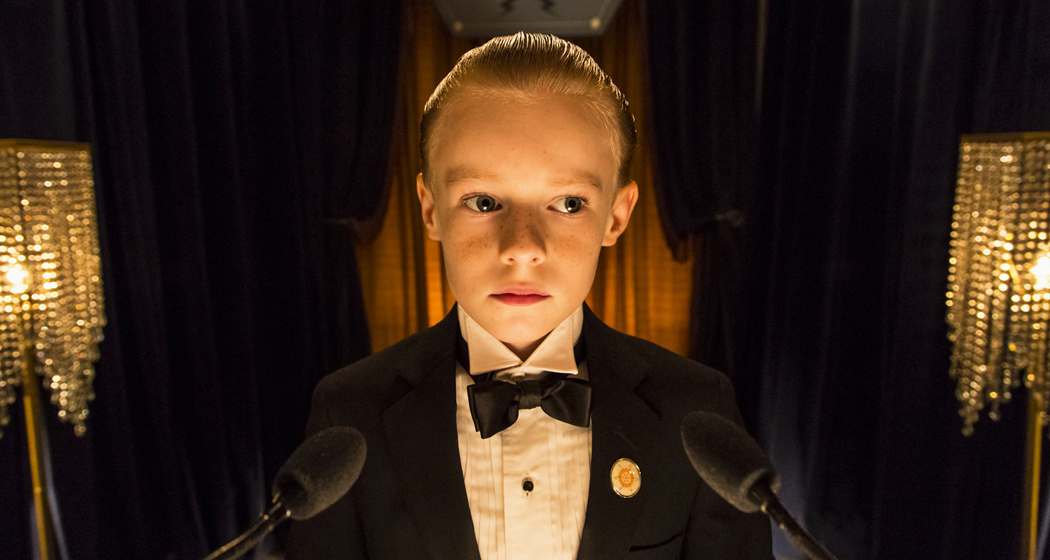
T.S. decides to attend the award ceremony, and leaves home early one morning to travel alone by freight train. His journey across the US is hampered by train guards and the police, but he is also helped along the way by kind-hearted strangers such as trucker Ricky (Richings). When he arrives at the Smithsonian, he is taken under the wing of undersecretary G.H. Jibsen (Davis). At the award ceremony, T.S. makes an emotive speech about the death of his brother, and reveals that he died during an experiment T.S. was trying to carry out. The story, along with the perpetual motion machine makes T.S. an instant celebrity, and Jibsen arranges for him to take part in press interviews, and finally, a talk show. With the addition of a surprise guest to the show, T.S.’s family begin to reconnect with each other.
Adapted from the novel by Reif Larsen, The Young and Prodigious T.S. Spivet is an appealing piece of movie-making from a director whose sensibilities and visual style are a perfect match for the material. Jeunet, making only his second English language movie – let’s try to forget the giant misstep that was Alien: Resurrection (1997) – displays his fondness for odd camera angles, bold camerawork, and meticulous set design. The movie is a visual triumph, ravishing in its depiction of Montana’s rugged landscapes, ingenious in its rendering of T.S.’s work and drawings (especially if viewed in 3D), and endlessly inventive on a technical level. Even in relatively static scenes there’s always something to draw the attention. Working with cinematographer Thomas Hardmeier, Jeunet has created a movie that is so wonderfully detailed in its look that the eye is seduced over and over again by what’s on screen.
Larsen’s novel – adapted by Jeunet and Guillaume Laurant – with its own visual style, is regarded by many as a modern classic, but the same problem the novel has, sadly, remains in the movie, and Jeunet’s faithfulness to his source ultimately undoes a lot of the good work that’s gone before. The last third, following T.S.’s arrival in Washington D.C., feels flat and lifeless in comparison to the rest of the movie, and isn’t helped by Davis’s pantomime villain performance as Jibsen (she takes annoying to new levels). With the addition of a talk show host who is more caricature than character, T.S.’s time in Washington is let down by the inclusion of their inanity and the movie suffers greatly (a pat resolution to all the family issues seems forced as well). Only T.S.’s candid, and quietly emotional, description of the events surrounding Layton’s death has any impact during this section, and that’s due to Catlett’s artless delivery.
Of the cast, Catlett more than holds his own against his more experienced co-stars, and invests T.S. with a genuine sense of bafflement at most of the ways in which adults behave, or how the world works. Carter adds another quirky performance to her résumé, and Davis mistakes exaggeration for character development, while Wilson looks so much like Chloë Grace Moretz that it becomes distracting. Rennie has little to do other than look manly (he’s like a modern day Marlboro man), and Jeunet stalwart Pinon almost steals the movie as one of the strangers who help T.S. on his journey.
With the storyline grinding to a halt two thirds in, The Young and Prodigious T.S. Spivet falls short of achieving its full potential, and while some viewers may also have an issue with the whimsical nature of much of the movie, it’s more of a strength than a disadvantage. If you buy into Jeunet’s vision then there’s much to enjoy, and there’s more subtlety lurking beneath the movie’s artistic sheen than you might expect.
Rating: 7/10 – entertaining and beautiful to look at, The Young and Prodigious T.S. Spivet may not be as fully realised as audiences would expect, but there’s still more than enough going on to still make this a (mostly) rewarding experience; an effectively grounded viewing pleasure despite its frequent flights of fancy.




 thedullwoodexperiment