• 10 Reasons to Remember…
  • A Brief Word About…
  • About
  • For One Week Only
  • Happy Birthday
  • Monthly Roundup
  • Old-Time Crime
  • Other Posts
  • Poster of the Week
  • Question of the Week
  • Reviews
  • Trailers

thedullwoodexperiment

~ Viewing movies in a different light

thedullwoodexperiment

Tag Archives: Holliday Grainger

My Cousin Rachel (2017)

12 Monday Jun 2017

Posted by dullwood68 in Movies

≈ 1 Comment

Tags

Cornwall, Daphne du Maurier, Drama, Holliday Grainger, Iain Glen, Literary adaptation, Poison, Rachel Weisz, Remake, Review, Roger Michell, Romance, Sam Claflin, Thriller

D: Roger Michell / 106m

Cast: Rachel Weisz, Sam Claflin, Holliday Grainger, Iain Glen, Pierfrancesco Favino, Simon Russell Beale, Tim Barlow

Philip Ashley (Claflin) is a young man whose guardian, Ambrose Ashley, owns a large Cornish estate. When Ambrose travels to Italy, his letters home tell of a woman he’s met, their mutual cousin, Rachel (Weisz). They are married, but it’s not long before Ambrose falls ill. His letters become increasingly paranoid, with claims that Rachel is watching him closely and that he can trust no one, and so Philip travels to Italy and the villa where Ambrose is living. There he meets Rainaldi (Favino), a friend of Rachel’s who tells Philip that Ambrose has died of a brain tumour. Philip returns home without meeting Rachel, and once there, he inherits the estate. Blaming Rachel for Ambrose’s death (he doesn’t believe there was a brain tumour), he makes it clear that if they ever meet he will exact a punishment on her. Not long after, though, Rachel arrives at the estate, and despite his vengeful intentions, Philip finds himself fascinated by her.

A relationship begins to develop between them, a friendship at first, and one that is welcomed by his godfather, Nick Kendall (Glen). Philip soon becomes infatuated with Rachel, and reacts poorly to tales of her misbehaviour in Italy with Rainaldi. Goaded by such gossip, Philip ensures she has an allowance (which she spends too rapidly), and at an estate party, wears a pearl necklace that was his mother’s. Kendall is none too happy with this, but Rachel returns them without any fuss. With his twenty-fifth birthday approaching – when he can do whatever he likes with his inheritance – Philip has a transfer written whereby Rachel becomes the estate’s owner. In return he expects Rachel to marry him, but she denies him, and despite their friendship having become intimate. And then Philip falls ill, and the similarities between his illness and Ambrose’s leads him to suspect that Rachel is now poisoning him…
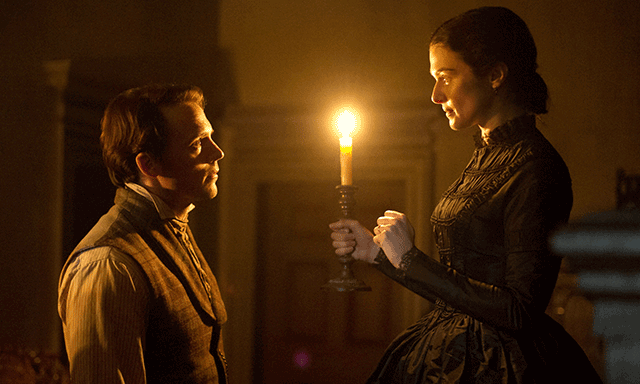
A late arrival in the remake stakes, My Cousin Rachel appears sixty-five years on from its predecessor, and offers several good reasons for the gap being longer. Based on the novel by Daphne du Maurier, Roger Michell’s adaptation is a heady exercise in turgid melodrama that does little with its “Did she? Didn’t she? Is she? Isn’t she?” storyline, and instead of concentrating on the thriller elements, turns to a one-sided romance for its focus. This means there are plenty of scenes where Claflin’s love-sick booby hovers over and around Weisz’s prideful widow, and with the worst kind of eager beaver-itis. That Philip goes from determined avenger to smitten teenager (even though he’s twenty-four) in the blink of an eye, should alert viewers that this isn’t going to be an engrossing Gothic-tinged chiller, but a romantic drama with all the fizzle of a sparkler reaching the end of its lifespan. Philip’s actions in pursuit of Rachel’s affections become more and more absurd the longer they go on, until they culminate in his climbing up to her bedroom window in order to bestow on her the family jewellery (and in the process  his own jewels). (Oh, and he climbs down again the next morning.)

In between all this uninspiring swooning, the movie remembers to include scenes that paint Rachel as some kind of predatory black widow (as well as Ambrose’s sad demise, her first husband was killed in a duel). This secondary plot (which should be the movie’s primary one), relies heavily on Ambrose having left hidden notes and letters in his clothing and books, and their being conveniently found just when Rachel’s potential perfidy needs a nudge in the right direction. Out of this, any ambiguity is brushed aside as Michell’s script lacks the panache to sow doubt in the mind of the viewer. And if you’re familiar with the novel or Henry Koster’s 1952 version, then you’ll already know the outcome, something that Michell fumbles badly thanks to a very, very clumsy piece of foreshadowing, and an equally clumsy denouement.

Against this, Weisz delivers an arresting performance that in many ways highlights the paucity of ideas and the lack of energy that the movie exhibits elsewhere. Weisz’s career can safely be described as eclectic, and in recent years she’s done some of her best work. As Rachel, Weisz is an hypnotic presence, her round, moon-faced features expressing vulnerability, pride, determination, gratitude and forbearance in equal measure. As the naïve Philip, Claflin has the harder task, and he doesn’t always succeed, but this is due more to the script than his portrayal, as the character is more callow than necessary, and he operates on a dramatic level that never allows the viewer to feel sorry for him. Grainger (as Kendall’s daughter) and Glen offer solid support, while there’s a terrific turn from Barlow as the estate’s chief overseer, Secombe. It’s all wrapped up in a bucolic haze that’s further enhanced by Mike Eley’s evocative cinematography and Alice Normington’s impressive production design.

Rating: 5/10 – a movie that could have been a whole lot better had its writer/director tried harder to make it more compelling, and more of a psychological thriller, My Cousin Rachel is undermined by its inability to seem more than a stifled piece of moviemaking; Weisz’s performance almost makes up for its obvious shortcomings, but if you have to see this then adjust your expectations accordingly.

Share this:

  • Click to share on X (Opens in new window) X
  • Click to share on Facebook (Opens in new window) Facebook
  • More
  • Click to print (Opens in new window) Print
  • Click to email a link to a friend (Opens in new window) Email
Like Loading...

The Finest Hours (2016)

18 Monday Apr 2016

Posted by dullwood68 in Movies

≈ 4 Comments

Tags

1952, Ben Foster, Cape Cod, Casey Affleck, Chatham, Chris Pine, Coast Guard, Drama, Eric Bana, Holliday Grainger, Literary adaptation, Motor boat, Rescue, Review, SS Pendleton, True story

The Finest Hours

D: Craig Gillespie / 117m

Cast: Chris Pine, Casey Affleck, Ben Foster, Holliday Grainger, Eric Bana, John Ortiz, Kyle Gallner, John Magaro, Graham McTavish, Michael Raymond-James, Beau Knapp, Josh Stewart, Abraham Benrubi, Keiynon Lonsdale, Rachel Brosnahan

On 18 February 1952, the SS Pendleton, sailing from New Orleans to Boston, was one of two ships caught in a severe storm; both broke in two off the coast of Cape Cod, Massachusetts. The other unfortunate ship was the SS Fort Mercer. With thirty-three crew members aboard the still floating stern of the ship, the Coast Guard despatched a motor boat from nearby Chatham, though with only four crew on board. In rough seas and with no guarantee they would reach the ailing ship in time, the motor boat reached the Pendleton and was able to rescue all but one of the remaining crew. The rescue was widely regarded as one of the most daring rescues in the history of the United States Coast Guard. In 2009, the rescue was the subject of a book, The Finest Hours: The True Story of the U.S. Coast Guard’s Most Daring Sea Rescue by Michael J. Tougias and Casey Sherman.

If the brief account given above seems to indicate that The Finest Hours will be a gripping, edge-of-the-seat recounting of the that daring rescue mission, then potential viewers be warned: the movie doesn’t reach that level of excitement at any point in its running time. Instead the movie elects to be a very pedestrian retelling of the events on that fateful day, and initially, seems more concerned about covering the romance between motor boat skipper Bernie Webber (Pine) and his girlfriend, Miriam Pentinen (Grainger). We get to see how the two meet, and then there’s a protracted sequence where their engagement requires Bernie to speak to his commander, Daniel Cluff (Bana), for permission to wed (it’s a formality but Bernie treats it as if he’s asking Cluff  for something major).

TFH - scene3

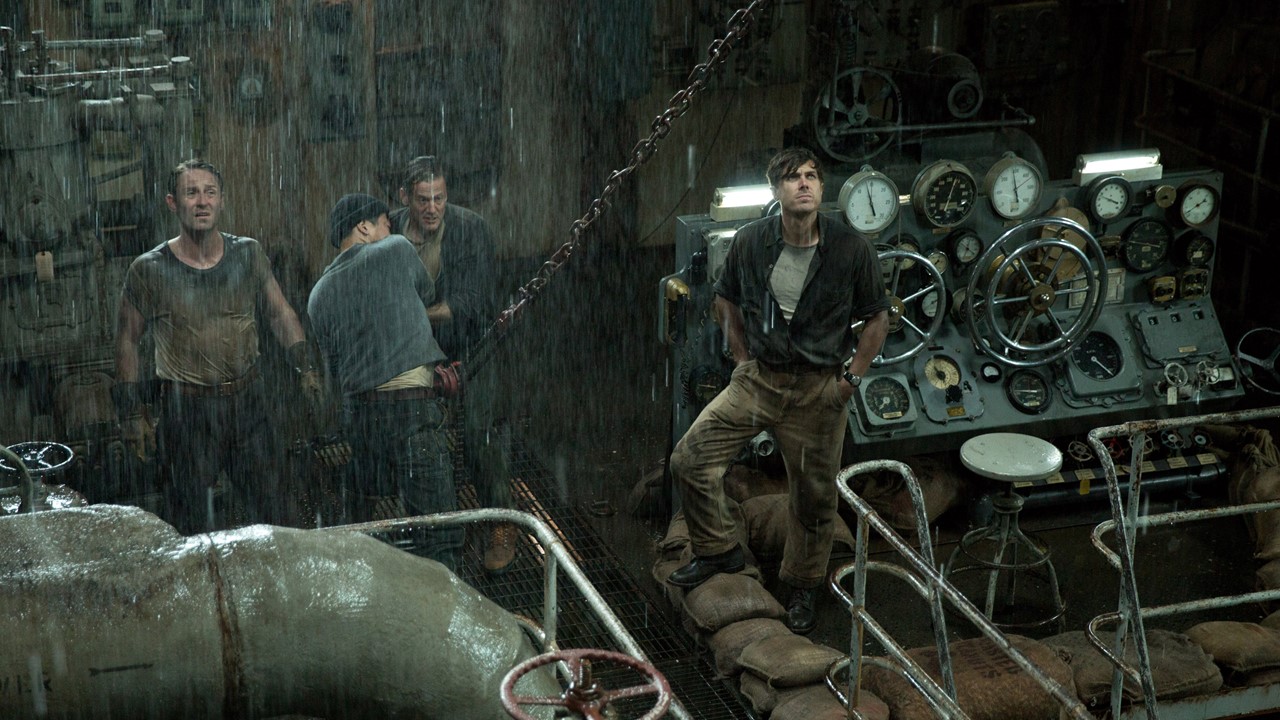
In the midst of Bernie’s dithering, the SS Fort Mercer‘s plight is reported, but other coast guard stations are already dealing with it. It’s only when the Pendleton’s equal predicament comes to light that Bernie actually stops being a bit of a doormat and chooses to go out to the stricken vessel. Most everyone sees it as a reckless, even suicidal mission, and Bernie is joined by just two of his colleagues, Richard Livesey (Foster) and Andy Fitzgerald (Gallner), and by a seaman, Ervin Maske (Magaro), who just happens to be there when the Pendleton‘s plight is discovered. Each man knows that there’s a good chance they won’t make it to the ship, or even come back, but as Bernie says, “They say you gotta go out. They don’t say you gotta come back”. And with that reassuring quote, the four men take a motor boat out into heavy seas and fight their way over a stretch of treacherous water called the Bar. And from there, and without a compass to guide them, they attempt to find the Pendleton.

Even now it all seems highly dramatic, the kind of heroic true story that proves inspiring, and makes the viewer want to be a part of that rescue mission if it were at all possible. But the movie founders from this point on, and while the crew of the Pendleton, ostensibly led by engineer Ray Sybert (Affleck), struggle to keep the stern afloat until help arrives, Bernie and his crew are faced with a seemingly number of violent swells to overcome, and all of which are bested by Bernie – basically – accelerating over or through them. This repetition proves wearing, and robs the movie of any tension, because no matter how big the approaching waves are, Bernie just floors it, and any sense of peril is quickly and completely dismissed.

TFH - scene2

Meanwhile, Sybert has to contend with semi-mutinous crew member D.A. Brown (Raymond-James) and his insistence that they get off the Pendleton by using the lifeboats. In one of the movie’s better scenes, Sybert shows everyone why that isn’t such a good idea, but otherwise any tension is dissipated by Affleck’s restrained performance, and no concrete sense that anyone on the ship is in any real danger (which is disconcerting considering their situation). And this is the movie’s main problem: it doesn’t really know how to make all this frightening or gripping or challenging. Even during the rescue, a sequence which should have ramped up the tension to unbearable levels, the movie fails to capitalise on the situation and keep the viewer on the edge of their seat. Instead the movie acts as a kind of dramatic, clichéd tick box exercise.

The movie also marginalises all its characters with the exception of Miriam. While Bernie and his crew become mere figures on a boat who are focused on the seas ahead, everyone back at Chatham is kept either hanging round the coast guard radio, or eventually, in a risible sequence where the townsfolk gather their cars at the dock with their headlights on to guide poor Bernie home, asked to pull together and be part of the heroic effort themselves. This is partly down to Miriam, who makes an attempt to get the rescue mission called off because Bernie has decided to do the right thing. It’s an incredibly selfish thing to do, but the movie tries to make her look heroic rather than self-serving, and it never recovers from it. And once he is out there, and despite several dozen close ups, Pine’s Bernie could be just about anyone getting buckets of water thrown over them.

TFH - scene1

The Finest Hours also has an odd visual look about it, one that heightens the artificality of the CGI rendered waves and the Pendleton‘s exterior, particularly when the actual rescue is in progress. It’s at this point that the viewer will be unable to retain a sense of the scope and size of the mission itself, and will be trapped into thinking, “what a small tank they must have used”. And then, with the trip out to the stricken Pendleton having taken so long, the movie rushes the return trip, and the movie ends without ever establishing itself as a thrill-ride or a serious, dramatic tale of heroism on the high seas.

Partly this is due to the structure of the script, which pays too much attention to events playing out on land rather than at sea, and Gillespie’s watered-down direction (pun intended). As a result, the cast make little impact, with only Grainger standing out from the faceless crowd – Foster is one of several cast members who are completely wasted in their roles – and the movie lurches from one unconvincing scene to the next, devoid of any sense of unease, and ending up as stranded as the Pendleton is in the few hours left to it before it sinks completely.

Rating: 5/10 – only occasionally (and even then briefly) powerful, The Finest Hours does scant justice to its true story, and introduces too many fictional elements to make it work effectively; with a bland central performance from Pine, and without a strong-minded director at the helm, the movie disappoints more than it impresses and seems almost wilfully lacklustre.

Share this:

  • Click to share on X (Opens in new window) X
  • Click to share on Facebook (Opens in new window) Facebook
  • More
  • Click to print (Opens in new window) Print
  • Click to email a link to a friend (Opens in new window) Email
Like Loading...

The Riot Club (2014)

30 Thursday Oct 2014

Posted by dullwood68 in Movies

≈ Leave a comment

Tags

Annual dinner, Debauchery, Douglas Booth, Drama, Holliday Grainger, Lone Scherfig, Lord Ryot, Max Irons, Membership, Oxford, Review, Sam Claflin, University

Riot Club, The

D: Lone Scherfig / 107m

Cast: Sam Claflin, Max Irons, Douglas Booth, Holliday Grainger, Sam Reid, Ben Schnetzer, Freddie Fox, Olly Alexander, Matthew Beard, Jessica Brown Findlay, Jack Farthing, Michael Jibson, Natalie Dormer, Tom Hollander

Two new students at an Oxford university, Alistair Ryle (Claflin) and Miles Richards (Irons), are from privileged backgrounds but couldn’t be more different.  Alistair is cold and aloof, and arrogant in his approach to others.  Miles is more carefree and open, and less snobbish.  Despite their very different personalities they both find themselves sought after for membership of the Riot Club, an exclusive fraternity that favours drinking and debauchery and any other hedonistic pursuits.  With their annual dinner coming up, and both young men needed to meet the required numbers for the dinner to go ahead, the Riot Club recruits them (but not before they have to undergo a variety of tests to prove they’re worthy of membership).

In the meantime, Miles has begun a relationship with Lauren (Grainger), a young woman of humbler origins.  But as the selection process for the Riot Club begins in earnest, Miles fails to see the warning signs of being part of the club while Lauren sees them all too clearly.  When she starts to question Miles’s need to be a part of the Riot Club, a rift begins to open up between them, but they remain friends nevertheless.

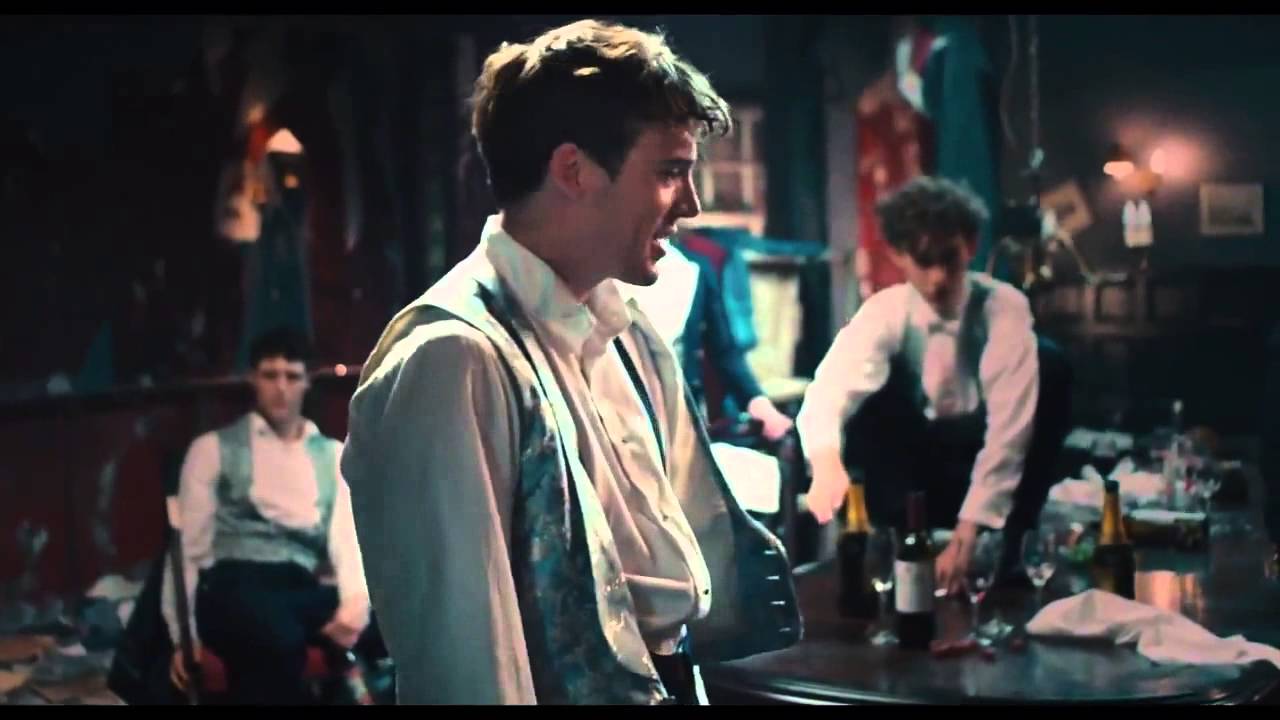
With the club having been banned from most of the pubs and bars and restaurants in Oxford, they are forced to hold their annual dinner at a country pub.  The landlord, Chris (Jibson), is delighted to have them as it will mean a substantial amount of revenue for the pub, but his daughter, Rachel (Findlay) isn’t so sure, or so keen to have them there.  The evening arrives and the club members quickly become drunk and rowdy, causing a disturbance and behaving with appalling manners.  When the prostitute (Dormer) that club member Harry Villiers (Booth) has arranged baulks at giving oral sex to all ten men, Alistair secretly uses Miles’s mobile phone to text Lauren and get her to come to the pub.  When she arrives, thinking that Miles is looking forward to seeing her, she is shocked to find herself verbally abused and asked to substitute for the prostitute.  Even worse, Miles fails to do anything to help her; she leaves in tears.

As the evening progresses, the Riot Club members become increasingly unruly, and when they discover that the food they ordered isn’t exactly what they asked for, they grow aggressive and begin to trash the dining room, egged on by Alistair, who spouts class-based bile.  When Chris sees the damage they’ve done and tries to remonstrate with them, things take a darker, more violent turn…

Riot Club, The - scene

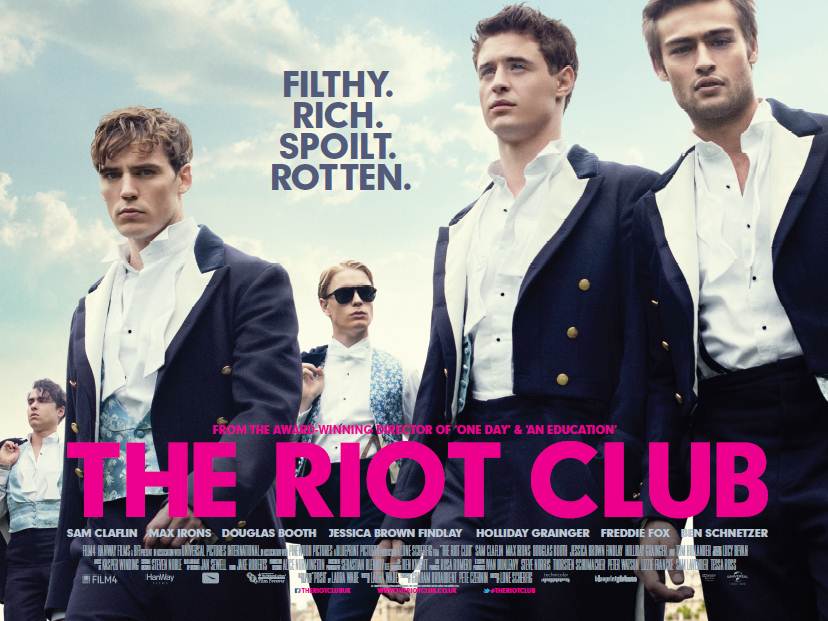
Featuring the cream of young British male acting talent, The Riot Club is a demanding, disturbing look at the ways in which privilege and contempt can go hand in hand and lead to the most horrifying of situations and circumstances.  Adapted by Laura Wade from her play, Posh – itself based on the exploits of the Bullingdon Club – The Riot Club depicts the kind of arrogant, dismissive behaviour most viewers will take for granted, and therein lies one of the movie’s main problems: even at its most melodramatic, the club’s actions aren’t quite as appalling as the movie would like them to be.  True, they’re abusive, disdainful, egotistical, misogynistic, conceited and full of their own self-importance, but we’ve seen this kind of misconduct before, and while it’s competently presented, viewers won’t be surprised by the direction in which the storyline travels.

What we have here is a spurious social commentary made up to appear relevant in relation to the latest ideas about the class divide (and acerbically delivered in a caustic speech by Claflin near the dinner’s end).  In truth it boils down to the standard, predictable belief that the haves are dismissive of, and abhor, the have-nots, and look down on them as inferior and unimportant when weighed against the needs of the so-called elite.  It’s hardly news, and Wade’s depiction of these privileged young men is often as cynical as the characters’ attitudes, leaving the viewer unsure if she, in her own way, is as contemptuous of them as they are of Lauren et al.  There’s an attempt as well to provide a political as well as social context to the club members’ behaviour, but it comes across as too prosaic to have much of an impact.  Alistair’s desperate assertions notwithstanding, it’s clear there’s no excuse for what they do, and the script rarely tries to provide any credible explanation.  This leaves the club’s self-aggrandising dissipation with no other justification than that they behave the way they do purely because they can, a message that is clear from the beginning.

In transferring Wade’s play to the screen, Scherfig wisely stages things with a nod to the material’s theatrical origins, and the dinner party itself achieves a certain claustrophobic ambience after a time, and while Scherfig keeps the camera moving – often dizzyingly so – the movie traps the viewer in that room with the Riot Club and keeps a seat there for them throughout, in an attempt to make them in some way complicit in the debauchery.  It’s a neat idea, but doesn’t quite work, the camera forced to move outside the room too often to maintain the effect.  Otherwise, the dinner party and all its tawdry developments – the movie’s own main course, if you will – have a cumulative effect that is surprisingly effective from a visual perspective.  In fact, the movie looks good throughout, a tribute to both DoP Sebastian Blenkov and production designer Alice Normington.

Of the cast, Claflin stands out the most by virtue of being the movie’s most clearly defined villain, an acid-tongued, rancour-spouting advocate of class hatred.  It’s a fierce, uncompromising performance and confirms Claflin isn’t afraid to “mix it up” outside of the heroics of The Hunger Games.  As his foil and target, Irons makes Miles a little too insipid to be entirely credible or likeable, while Grainger quietly steals the movie with a well-rounded portrayal of a young woman for whom the best privilege is being where she is, and having a sense of achievement her more aristocratic co-students can’t (or don’t have to) fathom.  In amongst all the sturm und drang, its cast members such as Jibson as the conflicted Chris that make the most impact, while Booth, Reid and Alexander et al. struggle to do much with their less detailed roles.

A clutch of good performances however, fail to make up for the unevenness of the material and its often simplistic notions of class warfare.  That the members of the Riot Club are snobbish and uncaring of others is a given; that they don’t show any signs of self-awareness means their unrestrained amorality becomes both unpleasant and increasingly dull to watch.  To see so much bad behaviour taking place, and with continued impunity, makes The Riot Club a frustrating experience to watch and one that arrives at its final “point” with a dispiriting vindication that robs the viewer of any catharsis from what they’ve seen up til then.  And that’s a mean trick to play on anyone.

Rating: 5/10 – visually arresting at times, and with strong performances that offset the often muddled dramatics, The Riot Club has energy to spare but doesn’t quite know what to do with it all; suffocating at times, and not as “relevant” as it might have been thirty years ago.

Share this:

  • Click to share on X (Opens in new window) X
  • Click to share on Facebook (Opens in new window) Facebook
  • More
  • Click to print (Opens in new window) Print
  • Click to email a link to a friend (Opens in new window) Email
Like Loading...

Blog Stats

  • 486,729 hits

Recent Posts

  • 10 Reasons to Remember Bibi Andersson (1935-2019)
  • Fantasia (1940)
  • Dances With Wolves (1990) – The Special Edition
  • Kiss of the Spider Woman (1985)
  • The Three Musketeers (1973)

Top Posts & Pages

  • Lost for Life (2013) - Another Look
    Lost for Life (2013) - Another Look
  • Lost for Life (2013)
    Lost for Life (2013)
  • About
    About
  • Exposed (2016)
    Exposed (2016)
  • Cardboard Boxer (2016)
    Cardboard Boxer (2016)
  • A Brief Word About La La Land (2016)
    A Brief Word About La La Land (2016)
  • The Monuments Men (2014)
    The Monuments Men (2014)
  • BFI London Film Festival 2015
    BFI London Film Festival 2015
  • A Brief Word About Netflix Original Comedies
    A Brief Word About Netflix Original Comedies
  • Removal (2010)
    Removal (2010)
Follow thedullwoodexperiment on WordPress.com

Blogs I Follow

  • Rubbish Talk
  • Film 4 Fan
  • Fast Film Reviews
  • The Film Blog
  • All Things Movies UK
  • Interpreting the Stars
  • Let's Go To The Movies
  • Movie Reviews 101
  • TMI News
  • Dan the Man's Movie Reviews
  • Film History
  • Jordan and Eddie (The Movie Guys)

Archives

  • April 2019 (13)
  • March 2019 (28)
  • February 2019 (28)
  • January 2019 (32)
  • December 2018 (28)
  • November 2018 (30)
  • October 2018 (29)
  • September 2018 (29)
  • August 2018 (29)
  • July 2018 (30)
  • June 2018 (28)
  • May 2018 (24)
  • April 2018 (21)
  • March 2018 (31)
  • February 2018 (25)
  • January 2018 (30)
  • December 2017 (30)
  • November 2017 (27)
  • October 2017 (27)
  • September 2017 (26)
  • August 2017 (32)
  • July 2017 (32)
  • June 2017 (30)
  • May 2017 (29)
  • April 2017 (29)
  • March 2017 (30)
  • February 2017 (27)
  • January 2017 (32)
  • December 2016 (30)
  • November 2016 (28)
  • October 2016 (30)
  • September 2016 (27)
  • August 2016 (30)
  • July 2016 (30)
  • June 2016 (31)
  • May 2016 (34)
  • April 2016 (30)
  • March 2016 (30)
  • February 2016 (28)
  • January 2016 (35)
  • December 2015 (34)
  • November 2015 (31)
  • October 2015 (31)
  • September 2015 (34)
  • August 2015 (31)
  • July 2015 (33)
  • June 2015 (12)
  • May 2015 (31)
  • April 2015 (32)
  • March 2015 (30)
  • February 2015 (37)
  • January 2015 (39)
  • December 2014 (34)
  • November 2014 (34)
  • October 2014 (36)
  • September 2014 (25)
  • August 2014 (29)
  • July 2014 (29)
  • June 2014 (28)
  • May 2014 (23)
  • April 2014 (21)
  • March 2014 (42)
  • February 2014 (38)
  • January 2014 (29)
  • December 2013 (28)
  • November 2013 (34)
  • October 2013 (4)

Create a free website or blog at WordPress.com.

Rubbish Talk

Film 4 Fan

A Movie Blog

Fast Film Reviews

The Film Blog

The official blog of everything in film

All Things Movies UK

Movie Reviews and Original Articles

Interpreting the Stars

Dave Examines Movies

Let's Go To The Movies

Film and Theatre Lover!

Movie Reviews 101

Daily Movie Reviews

TMI News

Latest weather, crime and breaking news

Dan the Man's Movie Reviews

All my aimless thoughts, ideas, and ramblings, all packed into one site!

Film History

Telling the story of film

Jordan and Eddie (The Movie Guys)

Movie Reviews & Ramblings from an Australian Based Film Fan

Privacy & Cookies: This site uses cookies. By continuing to use this website, you agree to their use.
To find out more, including how to control cookies, see here: Cookie Policy
  • Subscribe Subscribed
    • thedullwoodexperiment
    • Join 481 other subscribers
    • Already have a WordPress.com account? Log in now.
    • thedullwoodexperiment
    • Subscribe Subscribed
    • Sign up
    • Log in
    • Report this content
    • View site in Reader
    • Manage subscriptions
    • Collapse this bar
 

Loading Comments...
 

    %d