Cast: Melissa McCarthy, Kristen Bell, Peter Dinklage, Ella Anderson, Tyler Labine, Kathy Bates, Cecily Strong, Mary Sohn, Kristen Schaal, Timothy Simons, Cedric Yarbrough
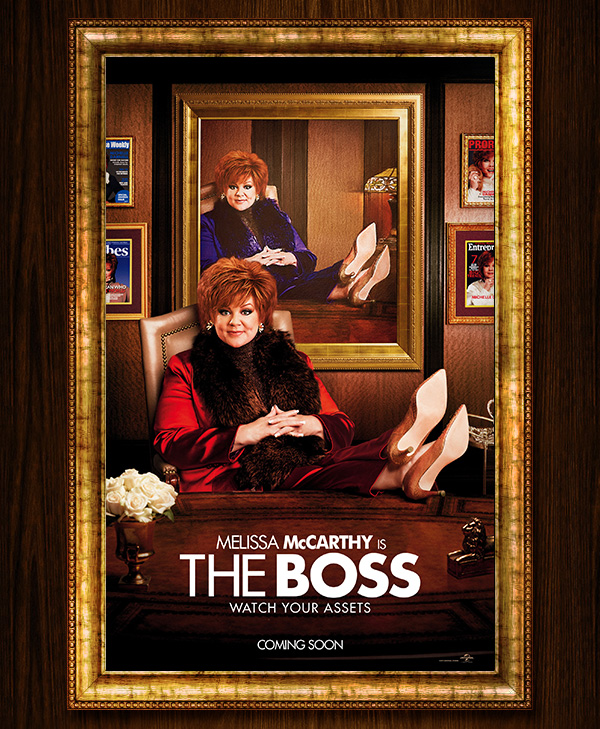
Just when you thought it was safe to sit down and watch a movie featuring Melissa McCarthy – and this based on her supporting turn in St. Vincent (2014) and the refreshing change of career pace that was Spy (2015) – along comes The Boss, a throwback to the haphazard comedies she was making in the wake of her break-out turn in Bridesmaids (2011). That McCarthy has both comedic and acting chops to spare makes her decision to appear in The Boss seem like a backward step, a contractual obligation perhaps, but even though she has the ability to step up a gear when required, this sees the future Ghostbuster idling in neutral for much of the movie’s running time.
It’s a slight tale. McCarthy is Michelle Darnell, the 47th richest woman in America, a businesswoman whose foster-care childhood has made her the self-absorbed, take no prisoners, care about no one else success story she’s always wanted to be. But when she’s careless with a deal set up via insider trading, arch-rival and one-time lover Renault (Dinklage), makes sure she’s arrested. Cue a stretch in prison that does nothing to change her attitude. When she gets out she has nowhere to go, so she offloads herself on her ex-PA Claire (Bell), and Claire’s daughter, Rachel (Anderson). Financial salvation (and ultimately personal redemption) comes in the unlikely combination of Rachel’s Dandelions group, and Claire’s ability to make amazing brownies. Using the group to sell the brownies, Michelle begins to claw her way back up the business ladder, but will it be at the expense of the new-found regard for others that she’s discovered, and will she recognise at last that trusting in others brings its own rewards?
If you have to think about the answer to that question then… where have you been, and wherever you were, what were doing all this time? This is a riches to rags to riches movie that plays fast and loose with its stitched together screenplay, and seems content to make Michelle as brainless/obtuse/horrible as possible before she experiences the usual road to Damascus moment required in movies such as this and turns into a loveable, and loving, heroine. You’ve seen this kind of movie too often for it to offer anything new, and to be fair to McCarthy and her co-screenwriters, Falcone and Steve Mallory, it doesn’t once try too hard to be anything but what it is: a so-so comedy that offers occasional laughs while its cast tries to make more out of it than is on the page (which results in one of Dinklage’s worst performances for some time, and Labine reduced to cuddly man-child duties as Claire’s potential boyfriend). If you’re a fan of McCarthy’s previous movies, such as Tammy (2014) and Identity Thief (2013), then you’ll be amused. But if not, then this will be a hard slog indeed.
Rating: 5/10 – a by-the-numbers comedy that relies too much on its star being objectionable for no real reason, The Boss also features some awkward scenes that go on for far too long in their efforts to make the viewer laugh – the scene where McCarthy plays with Bell’s breasts being a good case in point; it’s no earth-shaker to be sure, but when even the star isn’t trying too hard, then you know this is just filler before the next, hopefully more rewarding project.
Cast: Leonardo DiCaprio, Jonah Hill, Margot Robbie, Kyle Chandler, Matthew McConaughey, Rob Reiner, Jon Bernthal, Jon Favreau, Jean Dujardin, Joanna Lumley, Cristin Milioti, Shea Whigham, P.J. Byrne, Kenneth Choi, Brian Sacca, Henry Zebrowski, Ethan Suplee
Already the basis for the movie Boiler Room (2000), and adapted from the life and experiences of Jordan Belfort (DiCaprio), an investment broker who started his career on Wall Street in the late Eighties, and went on to become the head of his own company, selling penny stocks to gullible investors before moving into the big leagues, The Wolf of Wall Street is a modern day cautionary tale about greed, corruption and the pursuit of money.
Having become a licensed stock broker, Belfort begins work on the worst day possible, 19 October 1987, Black Monday. With his company ruined by the fallout, Belfort is forced to start again at the bottom, working for a small investment company that sells penny shares to small-time investors. Seeing the potential in a part of the investment industry that offers a fifty per cent commission on any sales, Belfort starts up his own investment company, Stratton Oakmont. Taking some of the staff from the investment company, he shows them how to persuade reluctant investors into parting with their money, and more importantly, ensuring they never take their money out again, thereby keeping up the exorbitant profits Belfort and his staff are raking in. He meets Donnie Azoff (Hill) who comes to work for him; together they build up the company until they’re at a point where they can compete with some of the bigger Wall Street firms. Their selling tactics and methods bring them to the attention of the FBI’s Agent Denham (Chandler) who begins an investigation into their fraudulent business practices. In the meantime, Belfort’s first marriage collapses; he becomes addicted to drugs, booze and sex; the FBI’s investigation prompts him to spirit his money away to Switzerland; he remarries, this time to Naomi (Robbie), and has two children with her; risks his life getting to Switzerland when it looks as if he’ll lose all his money; sees one of his friends, Brad (Bernthal), go to jail thanks to Azoff’s stupidity; and excess dominates his life completely. When a deal to take a shoe company public on the stock market (and illegally arrange to be the major stockholder) begins to unravel, and his marriage falls apart, Belfort finds himself helping the FBI incriminate his colleagues in order to avoid a long prison sentence.
With occasional breaks to camera, Belfort relates his life of excess with a relish that reflects both his character and, you suspect, a love for the times that hasn’t quite dissipated. Starting as a typically naive young man with bold aspirations, Belfort appears easily swayed when Azoff coaxes him into taking drugs, and he seems equally unconcerned by the ease with which he can swindle unsuspecting investors. While this aspect isn’t properly addressed, it’s not so much where Belfort has come from as what he does once he’s there that the movie is concerned with. The Wolf of Wall Street focuses on the excess of both the characters and the times they were active, a period in recent history (the Nineties) where affluence by any means was a mantra to live by, and if you weren’t rich then you were a nobody.
Working with his usual technical mastery, Scorsese recreates that period with remarkable skill and the level of incidental detail is impressive. The look of the movie is always arresting, and there’s never a moment when the camera doesn’t pick out an impressive detail or something visually interesting. Scorsese also knows when to keep the camera moving, or when to choose an odd camera angle to highlight the mood or emotion of a scene. There are moments when it’s like watching a cinematic masterclass, so sure is Scorsese of his filmmaking prowess and intuition.
Arresting as it is visually, The Wolf of Wall Street stumbles a bit when it comes to the structure of the movie and its content. There are too many extended pep talks that Belfort gives to his staff, too many scenes of drug-fuelled debauchery (we get it – that was the lifestyle), and too many occasions where the core of a scene is repeated but with some variation (Belfort reassuring first wife Teresa (Milioti) that everything will be okay; Azoff and Belfort congratulating themselves on the amount of money they’ve made). There are moments that lead nowhere: Belfort’s butler saying he’s seen Azoff at a gay club; sudden changes in tone: Belfort attacks Naomi when she threatens to leave him and take their children with her; and awkward moments that should be more meaningful: Belfort confessing his addictions to Naomi’s Aunt Emma (Lumley).
Terence Winter’s script, adapted from Belfort’s own memoir, does contain some good scenes, hits a patchy stretch around the two hour mark, and relegates the FBI investigation to a handful of scenes where Denham stares at info-laden whiteboards. Thankfully there are more than enough individual scenes that work – and work brilliantly – to offset the missteps. There’s Belfort’s lunch with first boss Mark Hanna (McConaughey), a mini-classic where Hanna explains the attitude needed to succeed as a stockbroker; McConaughey almost steals the movie with that one scene alone. There’s the scene where Azoff meets Belfort and quits his job upon seeing proof of the amount of Belfort’s earnings; Belfort waking up at the end of a flight to Switzerland and having Azoff explain why he’s restrained in his seat; Belfort’s veiled attempt to bribe Denham during a meeting on Belfort’s yacht – and Denham’s amused response; and best of all, Belfort’s attempts to leave a country club after succumbing to the effects of several out-of-date Quaaludes – it’s the funniest sequence of 2013 and shows that DiCaprio has a surprising aptitude for physical comedy.
As Belfort, DiCaprio puts in one of his best performances, imbuing the man with a vain pride that proves his downfall. It’s no one-dimensional characterisation, and DiCaprio nails the insecurities and the insanity of Belfort’s lifestyle: regarding money as “fun vouchers”; thinking he can seduce Aunt Emma; the aforementioned trip to Switzerland that results in the sinking of his yacht. It’s a raging, tornado-like performance, with DiCaprio towering above his co-stars, eclipsing everyone around him. As Belfort’s loyal “partner in excess” Azoff, Hill sports prominent false teeth and exudes charmless unreliability from every pore. Robbie, fresh from playing the girl who got away in Richard Curtis’ About Time, is superb as Naomi, a simple girl from New Jersey who falls for Belfort but resists the darker aspects of the dream life he builds for them. In minor supporting roles, Dujardin – as a slimy Swiss banker – and Lumley stand out from the crowd, and in the role of Belfort’s father, Reiner provides a calm at the eye of the storm that helps offset the wanton debauchery.
Ultimately, the success of The Wolf of Wall Street depends on whether or not the rise and inevitable downfall of a self-confessed drug addict and convicted fraudster is worth three hours of anyone’s time. The movie is entertaining and convincingly portrays the hedonistic, shallow lifestyle Belfort and his cronies enjoyed, and it’s shot through with humorous moments, and yet the movie appears to revel in the hedonism itself. With a cameo from the real Belfort, as well as only a passing nod towards the thousands of investors who were defrauded, The Wolf of Wall Street could be seen to be saying that Belfort et al were just greedy and selfish, and not so deserving of our approbation. The operative words here, though, are “could be”. Without those occasional darker elements, our sympathy for Belfort would be complete.
Rating: 7/10 – a better collaboration for Scorsese and DiCaprio than the lamentable Shutter Island (2010), The Wolf of Wall Street is striking, beautifully filmed and too eager to have its coke and snort it; less a character study than a valediction of the times, and saved by a handful of smart, knowing performances.




 thedullwoodexperiment