Cast: Jason Statham, Jessica Alba, Tommy Lee Jones, Michelle Yeoh, Sam Hazeldine, John Cenatiempo, Toby Eddington, Femi Elufowoju Jr, Anteo Quintavalle
Meh.
Rating: 3/10 – a terrible sequel that lies dead on the screen, Mechanic: Resurrection features some of the worst green screen work ever (the opening fight in Buenos Aires), a plot that makes absolutely no sense at all, and performances from all concerned that border almost on perfunctory – if only they could have made that much effort; action movies don’t have to tie up every loose end or narrative loophole, but this has a script that just doesn’t know when to give up and go home, making it one of the worst experiences you’re likely to have at the cinema all year.
Cast: Hailee Steinfeld, Samuel L. Jackson, Sophie Turner, Jessica Alba, Dove Cameron, Toby Sebastian, Thomas Mann, Rachael Harris, Jaime King, Dan Fogler, Steve-O, Gabriel Basso, Rob Huebel, Jason Ian Drucker
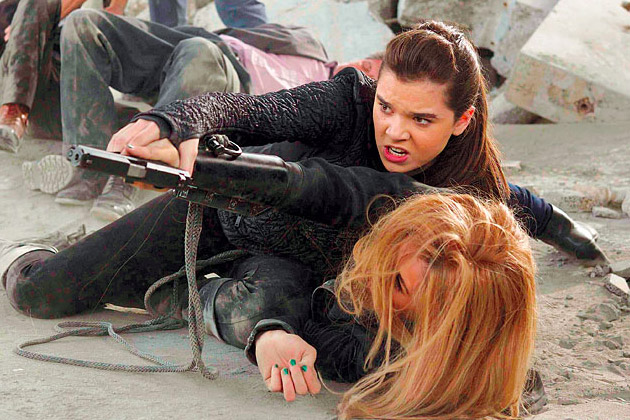
Sixteen year old Agent 83 (Steinfeld) works for a top secret organisation called Prescott that adopts orphaned girls and trains them to be assassins. But she yearns for a more ordinary, regular life, glimpses of which she gets when on her missions. When a plan to capture wanted terrorist Victoria Knox (Alba) leaves Agent 83 missing presumed dead, she takes the opportunity to live a normal life. She changes her name to Megan Walsh, invents a back story for herself and enrols herself in a foreign student exchange programme that sees her living with the Larsons – mum (Harris), daughter Liz (Cameron), and son Parker (Drucker) – and attending high school.
Fitting in, though, proves harder than she’d imagined. Despite doing her research, Megan finds average life more demanding, and confusing, than anything she’s encountered before. With Liz wanting nothing to do with her, and her faux-Canadian background doing her no favours, it’s not until the intervention of high school heart-throb and teen singing sensation Cash Fenton (Sebastian) that Megan begins to be accepted. Megan develops an immediate crush on Cash, but she already has an admirer in tech-geek Roger Marcus (Mann). Having been tricked into applying for the role of football team mascot – and getting it – Megan gains true acceptance when she takes out three would-be kidnappers of the team mascot, a traditional prank foiled by Megan’s “special set of skills”.
The resulting video goes viral and leads to her being found by her instructor at Prescott, Hardman (Jackson). Along with fellow Prescott agent Pedro (Steve-O), Hardman interrogates Megan, believing she’s working for someone else. But when it becomes clear she just wants to lead a normal life, Hardman tells her she only has time to wrap things up before coming back to Prescott. Later, at a party where she’s looking forward to hooking up with Cash, she finds Agent 84 (Turner), aka Heather, in attendance. Annoyed that Hardman would use Heather to keep an eye on her, Megan is further annoyed when Heather makes a play for Cash.
Another meeting with Hardman reveals that Knox has escaped and will no doubt be looking to catch up with Megan and kill her. Despite his offer of protection if she comes back to Prescott, Megan refuses to leave her new home, and begins to take steps to ensure that the Larsons remain safe. And at the upcoming Homecoming dance, she hopes to finally land Cash as her boyfriend, though she has begun to have conflicting feelings for Roger. With all this going on, Megan has to fall back on her training in order to get through it all, and maintain her new lifestyle.
The idea of a teen assassin dealing with the pitfalls of high school is one that could have given new meaning to the phrase “mean girls”, but here it’s the starting point for an extremely lightweight, by-the-numbers movie that is pleasantly assembled, but astoundingly hollow at the same time. By bringing in such a talented cast, Barely Lethal (not the best pun for a movie, either), may give the interested viewer the impression that the movie is going to be better than it actually is. But in the hands of director Newman (whose previous feature, Fanboys (2009), was a surprise pleasure) and writer John D’Arco, the movie is one that struggles to maintain an even tone, and squanders many of its chances to layer its basic premise with appropriate levels of irony.
The movie makes no effort to avoid or subvert the standard tropes of high school movies, and instead embraces them wholeheartedly without doing anything new with them. This leaves the movie looking and feeling like any other generic high school movie and even the introduction of Megan and her special skill set doesn’t hamper or redefine it. This level of familiarity works against the movie and though Steinfeld et al. waltz through it all with confidence, for them it must have been like the acting equivalent of treading water. Even Jackson and Alba can’t do much with characters that scream “simple movie stereotype”. With every character and situation proving lacklustre as a result, the movie never really manages to take off and become as enjoyable as it should be.
The humour in the movie is also quite forced, from the youngest Prescott recruits being called “grandma” when their driving skills don’t come up to scratch, to Megan’s first day outfit, to creepy teacher Mr Drumm (Fogler) and his stalking of Cash, to Roger’s even creepier father (Huebel) whose conversation is almost entirely inappropriate – none of it is as funny as it probably seemed at the time of filming, and even with the best efforts of the cast. Newman’s direction doesn’t help either, as each development in the script is allowed to play out with little emphasis on the drama involved, or what reaction it provokes in the characters, and the humour doesn’t leaven things either.
As the girl who’s more comfortable deciphering weapons schematics than the pitfalls of high school life, Steinfeld is an engaging presence but settles for doing just enough to satisfy the demands of the script. The same is true of Turner, who pouts her way through the movie as Megan’s chief rival, and Alba, playing an impression of a caricature of a stereotype as the villainous Knox. Mann emerges relatively unscathed by the experience, and Jackson is predictably hard-nosed (but with a heart of gold), but by and large the performances are as blandly likeable as the material. And the whole thing is rounded off by the kind of soundtrack selections that attempt to mirror the on screen action for emotion but lack any real nuance.
Rating: 4/10 – a missed opportunity, Barely Lethal is so humdrum it should be called Barely Lethargic; with a lack of flair behind the camera allied to a below-par script, the movie sinks under the weight of its own low expectations and despite an opening sequence that passes muster, never amounts to much more than being acceptable.
Cast: Patrick Wilson, Chris Pine, Ed Helms, James Badge Dale, Brooklyn Decker, Jessica Alba, Shaun Toub, Randy Couture, Matthew Willig, Ben Bray, David Hasselhoff, Ray Liotta, Norman Reedus
Following the unexpected break up of his relationship with the love of his life, Candace (Decker), would-be actor and ex-cocaine and gambling addict Stretch (Wilson) turns to limo driving to make ends meet. With his life coasting along in neutral, it comes as a shock when one day a gambling debt he thought had lapsed, is taken over by Ignacio (Bray), who wants payment by midnight of the same day. With little chance of coming up with the $6,000 he owes, Stretch convinces one of his co-workers, Charlie (Alba), to steer any high-paying customers his way during the evening, in the hope that he’ll earn enough in tips to pay off Ignacio.
With his boss Naseem (Toub) worried about a rival limo company run by the mysterious Jovi (Couture), Stretch sees his first pick-up, David Hasselhoff, persuaded to go with the Jovi. In an attempt at getting his own back, Stretch gets to the Jovi’s next client, Ray Liotta, first. Picking him up from a movie set, Liotta leaves with a prop gun and fake police I.D., but insists that Stretch return them to the studio. Before he can do so, Charlie sets him up with another client, an eccentric businessman called Roger Karos (Pine). Knowing that he’s a renowned big tipper, Stretch tells Karos about his gambling debt; Karos agrees to tip Stretch that amount if he takes him wherever he wants to go.
“Wherever” turns out to be a secret sex club. When they get there, Karos gives Stretch a task: to visit another club, see a Frenchman called Laurent (Dale) and obtain a specific briefcase, plus locate a supply of cocaine, and all within one hundred minutes – without fail. But Laurent is expecting Karos to hand over some ledgers in exchange for the briefcase (which contains a lot of money). Using Ray Liotta’s fake police I.D., Stretch bluffs his way out of the club with the briefcase, and by chance runs into Candace. Without batting an eyelid he tells her he’s doing really well and when she shows a renewed interest in him, Stretch turns her down flat.
He gets hold of some cocaine but the limo gets stolen. With the briefcase hidden inside it, he tracks it down, only for it to be towed by the Jovi’s brother, Boris (Willig). Stretch manages to get the limo back and returns to pick up Karos. But Karos reneges on his deal to pay Stretch the $6,000, saying he was a minute late in returning to collect him. So when Ignacio calls demanding the money, Stretch tells him to meet him where Karos wants to go next. But when they all meet up, Stretch’s plans go awry when the Jovi appears and Karos hands Stretch over to him.
You know, a funny thing happened on the way to the box office…
Stretch was originally scheduled for release in March 2014, but with two months to go, Universal scrapped the release and allowed producer Jason Blum to offer the movie to other distributors. But no one picked it up, and it came back to Universal. Eventually the movie was released on iTunes and Amazon.com, and VOD, in October 2014. Which begs the question, if Universal were so eager to disown it, then just how bad a movie is it?
The answer is: not that bad. It is rough and ready though, and often threatens to disappear up its own backside by trying to be edgy and complicated, but on the whole Joe Carnahan’s blackly comic limo ride is a bit of a guilty pleasure. He’s helped immensely by the casting of Wilson in the title role, his resigned, long-suffering features put to excellent use throughout as Stretch manoeuvres his way through the kind of night that only happens to characters in the movies. It’s Scorsese’s After Hours (1985) given a more modern sensibility and with a higher absurdity quotient.
It does, however, take an age to get going. It’s not until Ray Liotta’s dropped off at his hotel that the movie begins to move up a gear, and Stretch’s evening really starts to fall apart. Up until then we’re treated to too many scenes that show just how much his life sucks, and how everything he tries never quite works out how he needs it to. By the third or fourth example we get the idea, but Carnahan isn’t finished, and Stretch’s humiliation continues, right up until the moment he cons the briefcase from Laurent. From then on he begins to fight back – against Naseem, the Jovi and Boris, Ignacio, and Karos. It’s great to see this particular worm turning, and Wilson’s unprotesting features change to reflect the smug satisfaction Stretch begins to experience as he turns the tables on everyone. It’s a winning performance, and one that makes the viewer root for Stretch at every turn.
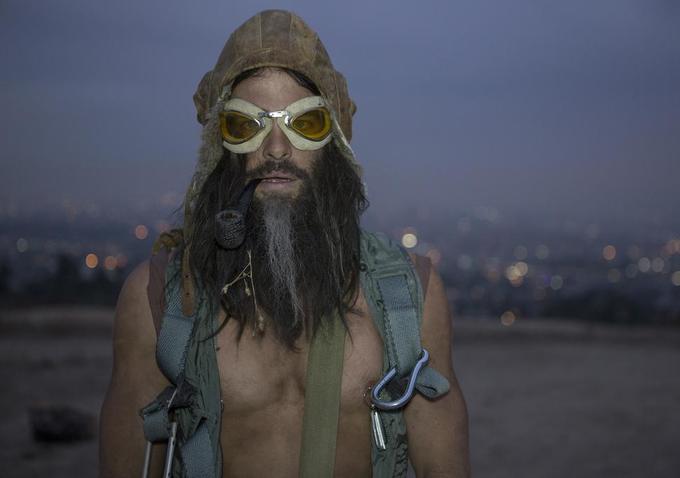
Wilson is the calm centre at the midst of what is an otherwise wild and wacky tale of male empowerment gone AWOL, but more than holds his own when up against the feverish performance given by an uncredited Pine. Sporting a bushy hairstyle and beard, and making his appearance semi-naked in a parachute, Pine gives such a larger than life performance it’s almost as if he’s been given carte blanche by Carnahan to do and say whatever he wants (such as setting fire to the inside of the limo, or punching himself in the face for “clarity”). Luckily, he’s not so over-the-top that he proves too much of a distraction, but when he isn’t on screen, his absence is palpable; full marks to Carnahan then for not over-relying on him, or letting the character take over.
But while Wilson and Pine have fun with their roles, fun that translates as unwavering commitment in front of the camera, spare a thought for poor Ed Helms, saddled with playing Karl, the ghost of an ex-limo driver. The script requires him to pop up at odd moments and either point out Stretch’s failings, or pass comment on the action. He’s meant to be a source of humour, and Helms plays him that way, but alas nobody thought to tell Carnahan, who provides him with some of the most awkward dialogue this side of a later entry in the Saw series. To compensate, though, the cameos – from Hasselhoff, Liotta, Shaun White, and Norman Reedus – are all hilarious (especially Reedus’s).
With the movie pushing credibility further and further under the wheels of absurdity, Stretch often comes perilously close to derailing, but at each crazy turn Carnahan reins it in and finds some plausibility – however weak – from somewhere, and the movie carries on regardless. It’s a movie that comes self-contained and relies on its own twisted logic to work, and for the most part, that’s exactly what happens: it works. There’s a romantic sub-plot involving Stretch and a woman he’s met online, plus the whole running-scared-of-the-Jovi-and-his-brother routine, and they add nicely to the mix, adding some small amount of depth to the story and providing some secondary amusement.
If its’ all a little too far-fetched then it’s to be expected. And though being a little far-fetched doesn’t necessarily hurt the movie, it does raise that question again: just what bee had gotten into Universal’s bonnet? Because from here, Carnahan’s crazy thrill ride has a lot to offer once that shaky start has passed.
Rating: 7/10 – with a very slow start leading eventually to all sorts of comic encounters and dialogue – “I’m sorry, I didn’t see the light.” “Well, don’t go towards it now.” – Stretch is an imperfect but still hugely enjoyable comedy-thriller; best viewed with any expectations dialled down so that it can (again eventually) surprise you and make you glad you watched it.
Cast: Mickey Rourke, Jessica Alba, Josh Brolin, Joseph Gordon-Levitt, Rosario Dawson, Bruce Willis, Eva Green, Powers Boothe, Dennis Haysbert, Ray Liotta, Christopher Meloni, Jeremy Piven, Christopher Lloyd, Jaime King, Juno Temple, Stacy Keach, Marton Csokas, Jude Ciccolella, Jamie Chung, Julia Garner
Basin City, night. Marv (Rourke) is having trouble remembering what’s happened to him as he surveys the wreckage of two cars and the bodies of two young men lying in the road. As the night’s events become clearer, he remembers an encounter with four young men, and being shot by one of them. Heading for the Projects, two of the young men attempt to ambush Marv but they’re stopped by unseen assailants. Marv kills them both and chases the other two down, bringing his memory full circle.
At Kadie’s Bar, a poker game in a back room is presided over by Senator Roark (Boothe). Johnny (Gordon-Levitt), a drifter, invites himself into the game and wins big, earning the enmity of the Senator. Later, Johnny has the fingers of his lucky hand broken by the Senator, and is shot in the leg as well. Johnny swears revenge but Roark is dismissive of the threat, believing himself invincible because of the power he wields.
Elsewhere in Basin City, private eye Dwight (Brolin) receives a phone call from someone he’d hoped he’d never hear from again, old flame Ava (Green). They meet, and she reveals she is in an abusive marriage, and is fearful for her life. When she’s forced to leave by Manute (Haysbert), who works for her husband, Dwight decides to find out more. He goes to Ava’s home but is caught by Manute and viciously beaten up. Back at his apartment, Dwight receives another visit from Ava and they have sex, but again Manute arrives and takes her away. Enlisting Marv’s help, Dwight returns to Ava’s home, where he kills her husband, Damien (Csokas), but soon realises he’s been set up by Ava who shoots him. Marv (who’s blinded Manute in a vicious fight between the two) rescues Dwight and they get away to Old Town. Helped by old friend Gail (Dawson), Dwight recovers and enlists her help in seeking revenge on Ava. They return to Ava’s home to settle matters once and for all.
Johnny finds a doctor (Lloyd) to help him with his injuries and he returns to the poker game where once again he beats Roark. His victory is short-lived as Roark turns the tables on him once more. While Roark reclaims his standing, Nancy (Alba), a stripper at Kadie’s, plots to kill him in revenge for the death of Hartigan (Willis), a cop she cared about. But Nancy drinks too much and hasn’t the courage to act on her anger. In a fit of rage, she disfigures herself, which leads Marv to offer his help. Together they make their way to Roark’s estate, where Nancy comes face to face with the Senator.
Arriving nine years after its predecessor, Sin City: A Dame to Kill For retains many of the earlier movie’s characters, the same visual approach, hard-boiled dialogue and non-linear storytelling, and extreme bouts of violence. As a companion piece, the movie works well, but there’s something missing from the experience: anything new.
The first movie worked precisely because it was new. The mixture of live action and CGI, allied to heavily stylised violence and Frank Miller’s nihilistic characters, was, in its own way, a refreshing change from other violent dramas (and thankfully proved hard to duplicate). The problem here is that Miller and Rodriguez have stuck too closely to the original formula, leaving Sin City: A Dame to Kill For looking and feeling like a greatest hits version of the first movie, rather than a bona fide sequel. It’s disquieting to realise as you watch the movie that everything’s the same, and with that realisation it also becomes clear that this outing is going to lack the verve and complexity of Miller and Rodriguez’s first collaboration. The tone is the same and there’s no variation.
Worse still is the lack of investment in certain characters, notably Johnny who we don’t really care about, despite his opposition to Senator Roark, and Nancy, whose bitter reluctance to act against the Senator seems forced rather than natural. Twice she has him in her sights while performing a routine, and both times she fails to pull the trigger. Credible? No; and nor is Marv appearing in each storyline, and helping out in the same fashion on two separate occasions (it’s also problematical that he died in the first movie – why is he in this one?) Hartigan returns as a ghost but makes almost no impact on Nancy’s story, while Gail and her team of female assassins are treated like bystanders.
Even the cast can’t raise this one from its slumbers, though Green makes the biggest impression, making Ava one of the most deceitful and alluring femme fatales to be seen for some time (she’s naked quite a lot as well, and shot in a fetishistic fashion that is reserved only for her). Brolin subs for Clive Owen, and Boothe steps out from behind Rutger Hauer to play the movie’s main villain with aggressive panache.
Ultimately, the stories aren’t strong enough, or interesting enough, to resonate beyond a first viewing, and by the end, even the violence has lost its charm, becoming repetitive and – sadly – unexciting. What’s left is an uneven mix that doesn’t know how to straighten itself out or make itself more coherent.
Rating: 5/10 – below par in pretty much every department with just enough being done to make the movie look better than it actually is, Sin City: A Dame to Kill For is a sequel that tries hard to recreate the magic of its forerunner, but never really succeeds; if a further entry is planned, Messrs Miller and Rodriguez will need to spend more time at the drawing board before committing anything to film.







 thedullwoodexperiment