• 10 Reasons to Remember…
  • A Brief Word About…
  • About
  • For One Week Only
  • Happy Birthday
  • Monthly Roundup
  • Old-Time Crime
  • Other Posts
  • Poster of the Week
  • Question of the Week
  • Reviews
  • Trailers

thedullwoodexperiment

~ Viewing movies in a different light

thedullwoodexperiment

Tag Archives: Jonah Hill

True Story (2015)

05 Saturday Sep 2015

Posted by dullwood68 in Movies

≈ Leave a comment

Tags

Christian Longo, Drama, Felicity Jones, James Franco, Jonah Hill, Literary adaptation, Mike Finkel, Murder, New York Times, Review, Rupert Goold, Trial, True story

True Story

D: Rupert Goold / 99m

Cast: Jonah Hill, James Franco, Felicity Jones, Robert John Burke, Ethan Suplee, Gretchen Mol, Maria Dizzia, Byron Jennings

A journalist with the New York Times, Mike Finkel (Hill) hands in an assignment that looks at the African slave trade. It becomes the cover story for the New York Times Magazine, but later it’s discovered that Finkel hasn’t been entirely honest about his research and has created a composite character for the story’s focus. Finkel is subsequently fired and returns to his home in Montana where he lives with his wife Jill (Jones). At around the same time, the discovered bodies of a woman and her three children has led authorities to Mexico where they arrest a man who claims to be Mike Finkel. His real name, though, is Christian Longo (Franco), and he’s accused of having killed his family.

When Finkel becomes aware that Longo claimed to be him, he becomes intrigued. He begins to look into the case, and travels to see Longo in prison. At their first meeting, Longo tells Finkel he’s admired his writing for a long time. They also strike a bargain: in return for Longo’s story, Finkel will teach him to write and he won’t discuss what they talk about until after Longo’s trial. Soon after, Finkel receives a lengthy letter in which Longo describes the events that led up to his wife and children’s murders – but it stops short of going further.

Over the next few months as the two men continue to meet, Longo intimates that he didn’t kill his family, and Finkel begins to believe he may be innocent, even though Longo avoids giving any definitive statement on the matter, and refers to a mysterious “someone” he needs to protect. He tells Finkel he’ll plead Not Guilty at his arraignment, and the journalist begins to believe that there must be another answer to the question of who murdered Longo’s wife and children. But at the arraignment, Longo pleads Not Guilty to the murders of two of his children, and Guilty to the murder of his wife and other child. Feeling betrayed, Finkel confronts him, but Longo hides behind the idea that he’s protecting someone.

As the trial approaches, Finkel – who has been busy turning his and Longo’s correspondence into a book – now begins to doubt the veracity of Longo’s claims, but though he’s approached by one of the detectives who arrested Longo, Greg Ganley (Burke) and asked to provide evidence for the prosecution, he refuses. The trial takes place and the prosecution puts forward a convincing case for Longo’s guilt. But then the defence begins its case, and Longo is called to the stand…
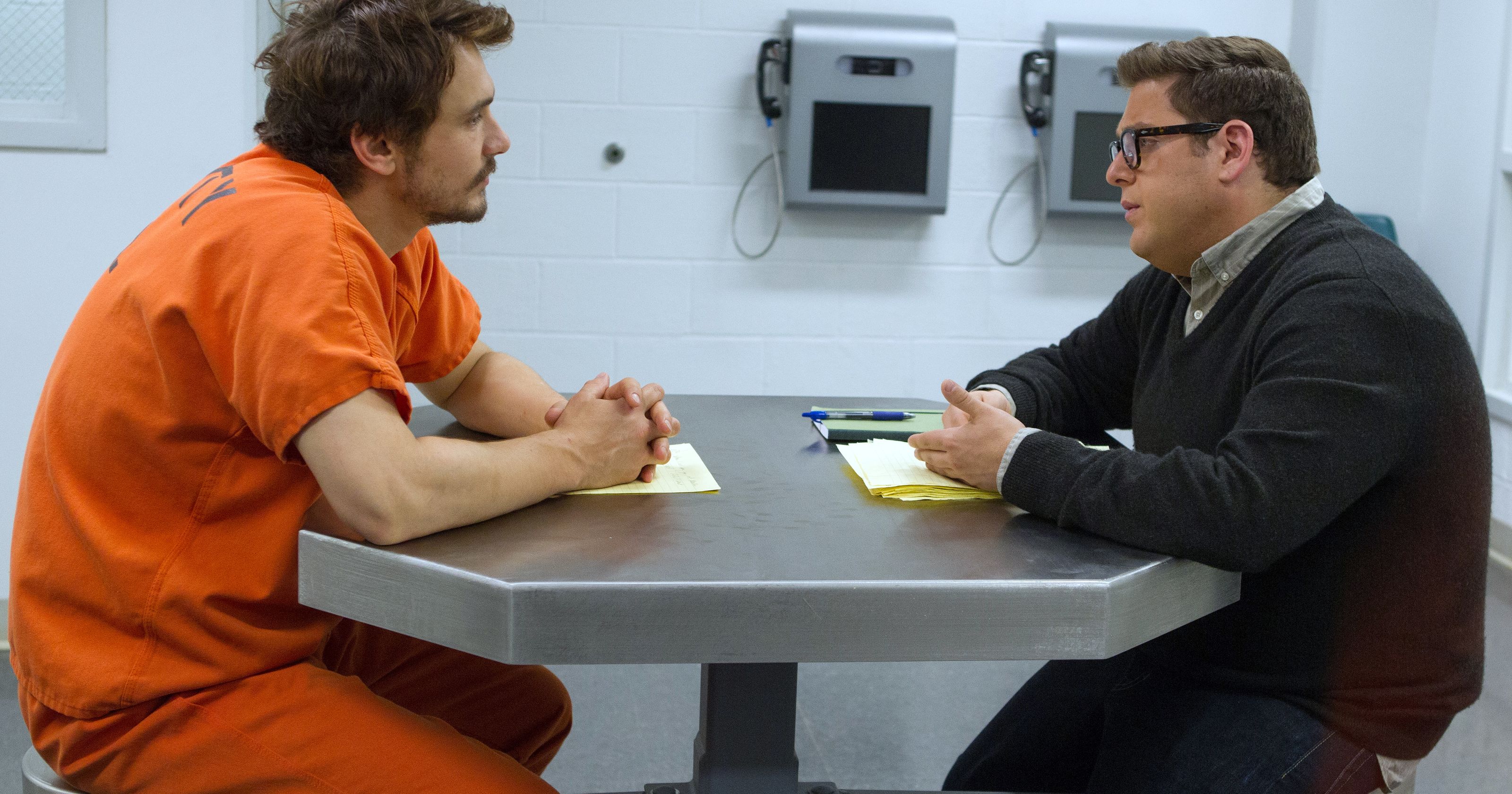
True Story - scene

At one point in True Story, Christian Longo tells Mike Finkel that “sometimes the truth isn’t believable. But that doesn’t mean that it’s not true.” It’s a fine idea, and the movie trades on Longo’s assertion for most of its running time, leading the audience down various dead ends and blind alleys in an attempt to keep the mystery of what really happened to Longo’s family from being revealed too soon. There’s always a degree of fun to be had from a character who is deliberately elliptical, or who hides behind a wall of half-clues and misdirection, but while Franco’s cold-eyed, hooded expressions suit the character’s manipulative nature, the movie isn’t so convincing that anyone would think Finkel could be easily duped. In fact, the way in which their scenes are set up and choreographed, it should have been obvious that Longo was trying to influence Finkel’s thinking, and by doing so, gain an acquittal at his trial.

But as many people say, hindsight is a wonderful thing, but it is something that the movie can’t quite avoid dealing with. As a fairly straightforward retelling of a relationship between two narcissistic, prideful individuals, the movie wisely avoids coming down on the side of one character over the other, but at the same time, Finkel’s credulity is incredibly worrying; he is a seasoned journalist after all, even if he has made an almighty, career-shredding error of judgment. Hill plays him as a kind of eager puppy dog, wanting to be liked and willing to believe in anything that will help him get back on top. He also shows the desperation Finkel feels when the book deal is jeopardised, or when he begins to suspect that Longo is probably guilty – he needs Longo to be innocent so that he won’t look like he’s been fooled.

As the potential murderer of his entire family, Franco keeps Longo self-contained and aloof, meeting Finkel partway but never revealing anything of real substance. He uses a blank expression to convey all the audience needs to know about him, and acts with his eyes for the most part, conveying hurt and innocence and sadness, but failing to show any regret for his family’s demise, or anger at being arrested. (Again, it’s worrying that Finkel never picked up on any of this.) Both actors play well against each other, with Hill slightly edging it by virtue of his being more emotive. As Jill, Jones – in a somewhat underwritten role – is given a remarkable scene in which she’s able to confront Longo and show her contempt for him, but it smacks too much of writer’s licence, and as a result, interrupts the movie’s flow. Elsewhere she’s required to look concerned and irritable by turns, and her participation becomes yet another example of a very talented actress being shamefully underused.

Making his feature debut, Goold steps up from directing British TV dramas to make a solid, if restrained movie that tries its best to examine issues of trust and falsehood, as well as public perception, but ultimately it shies away from looking at them in any depth. Goold is better with his cast, even when his screenplay – co-written with David Kajganich – has them repeating conversations and scenes, and emphasising over and over the “mystery” that Longo implies has happened. There’s also an attempt at some basic psychology that doesn’t come off too well, and it’s a humourless piece for the most part, with only a few ironic statements to leaven the drama.

Rating: 7/10 – absorbing for the most part, True Story tries to be direct and complex at the same time, but the two approaches don’t mix, leaving the audience with a story that leaks vitality and energy as it progresses; Hill and Franco are good value, and Longo’s testimony is a highlight, but there are too many questions left unanswered for it to be entirely successful.
Share this:

  • Click to share on X (Opens in new window) X
  • Click to share on Facebook (Opens in new window) Facebook
  • More
  • Click to print (Opens in new window) Print
  • Click to email a link to a friend (Opens in new window) Email
Like Loading...

22 Jump Street (2014)

11 Wednesday Jun 2014

Posted by dullwood68 in Movies

≈ Leave a comment

Tags

Action, Bromance, Channing Tatum, College, Comedy, Drugs, Ice Cube, Jenko, Jonah Hill, Peter Stormare, Review, Schmidt, Sequel, Spring break, Undercover cops

22 Jump Street

D: Phil Lord, Chris Miller / 112m

Cast: Jonah Hill, Channing Tatum, Ice Cube, Peter Stormare, Wyatt Russell, Amber Stevens, Jillian Bell, Kenny Lucas, Keith Lucas, Nick Offerman, Jimmy Tatro, Caroline Aaron

Having saved the day in 21 Jump Street – and to everyone’s surprise – rookie cops Schmidt (Hill) and Jenko (Tatum) are given another assignment, but this time instead of going undercover at a high school, they’re off to college instead.  With the church at 21 Jump Street having been bought back by the Koreans, the pair are assigned to the Vietnamese church across the road at 22 Jump Street.  Still under the command of the ever-cussing Captain Dickson (Cube), Schmidt and Jenko have to find who’s dealing a new drug on campus called WhyPhy (pronounced Wi-Fi), and who the supplier is as well.

College life proves to be divisive for the duo, with Jenko being welcomed into a jock fraternity headed by Zook (Russell), while Schmidt finds himself welcome amongst the geeks, in particular, art major Maya (Stevens).  When Zook is revealed to have an incriminating tattoo, Jenko refuses to accept he might be the dealer; so strong is his new attachment to the fraternity life he decides he and Schmidt should go their own way.  When the college counsellor is arrested and the case officially closed, neither Schmidt nor Jenko is convinced he’s the dealer.  They resume their investigation and discover the supplier is a criminal known as the Ghost (Stormare).  They also find out he plans to distribute the new drug at the upcoming spring break celebrations at Puerto Mexico.  With the dealer’s identity still a mystery, Schmidt and Jenko travel there in a bid to apprehend him and stop the drug spreading nationwide.

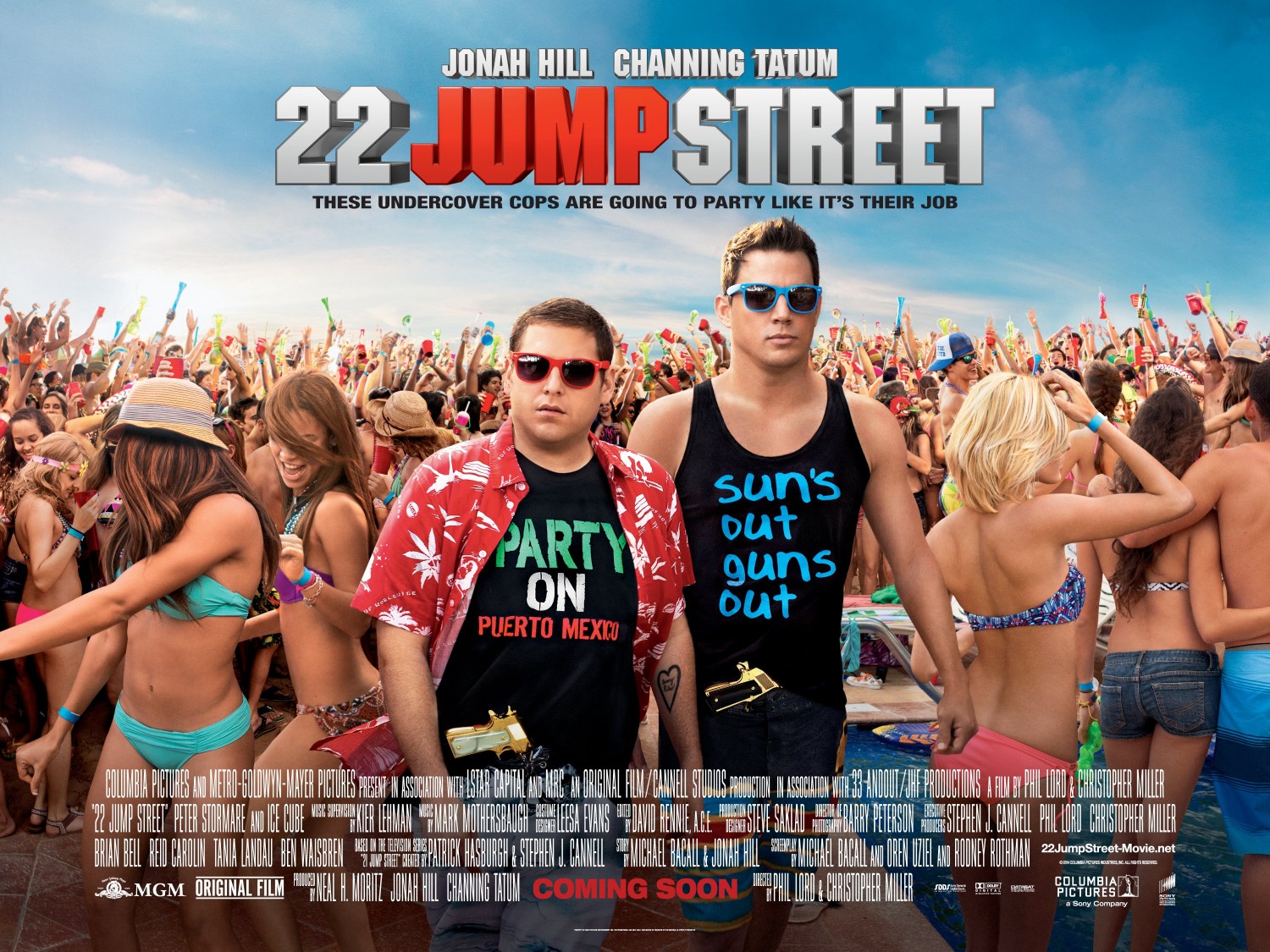
22 Jump Street - scene

The surprise success of 21 Jump Street meant that a sequel was inevitable, and returning writers/directors Lord and Miller have a great time subverting the pitfalls of such an endeavour, most notably in an extended sequence featuring the hangdog Deputy Chief Hardy (Offerman) where his instructions to Schmidt and Jenko to “keep things the same because they seemed to work the first time” are carried to their logical extreme (and then beyond).  There’s even a reference to the increased budget for the movie – $70m as opposed to the original’s $42m – when Hardy says the top brass have given 22 Jump Street more money to help them with their investigation.  It’s one of the funniest scenes in the movie, and played to perfection by messrs Offerman, Tatum and Hill.

As it turns out, the investigation is of secondary (hell, even tertiary) importance, as the movie focuses on the break-up of Schmidt and Jenko’s professional and personal relationships, with Jenko’s bromance with Zook taking up a great deal of screen time (as if we didn’t get how important it is to him), leaving Schmidt to act possessive and look broken hearted, even with his budding romance with Maya taking off at the same time.  This jealousy angle, somewhat signposted from the beginning, is given far more emphasis than it needs, and there’s very little room for the actual investigation, other than a few half-hearted attempts at surveillance and a trip to the counsellor’s office that ends up mocking every couples therapy session you’ve ever seen.  But, despite these scenes being very well played by Tatum and Hill, they often outstay their welcome, and could do with some judicious editing.

With plenty of scenes that could have been excised or shortened, 22 Jump Street is a movie sequel where the saying “Less is more” is definitely not adhered to.  It’s as if Lord and Miller, by embracing the tropes and conventions that contribute to most sequels, felt that being self-referential was all they had to do, and that it would get them off the hook when things didn’t quite work out.  But by following the template of the first movie so closely, what little originality there is on display is overwhelmed by so much that is familiar.  It’s a tightrope walk, and one where not everyone manages to stay on.  That said, the jokes about the stars’ age and looks come thick and fast and are very funny, with Hill in particular being given a roasting on more than one occasion.

Hill and Tatum still make for a great double act, though it’s Tatum who edges it here, his physicality and willingness to look foolish having more appeal than Hill’s strident comic style.  Cube is, well, Cube playing every other foul-mouthed, aggressive character he’s ever played (he’s in danger of becoming his own caricature now), while the rest of the supporting cast deal well with a range of underwritten characters.  There are cameos from Rob Riggle and Dave Franco, and the usual attempts to make it difficult to work out who the dealer is (not easy but not difficult either), and there’s a great moment when Jenko uses a girl on the beach to see off two of the Ghost’s thugs (who appear out of nowhere).

Enjoyable for the most part, with one absolutely standout moment about halfway through – watch for Jenko’s reaction when he finds out something about Schmidt’s love life – 22 Jump Street coasts along for much of its running time, riffing off the previous movie and doing just enough for the most part to avoid being looked on as a “contractual obligation”.  There are laughs to be had, but the action scenes are low-key and not very exciting, and there’s an incredibly indulgent end credits sequence that is amusing to begin with but soon runs out of both steam and imagination.

Rating: 5/10 – too long, and too uninterested in its drugs-related storyline, 22 Jump Street will nevertheless please fans of the original; if there is a 23 Jump Street (as seems likely) then a tighter, less self-reverential storyline will be required.

Share this:

  • Click to share on X (Opens in new window) X
  • Click to share on Facebook (Opens in new window) Facebook
  • More
  • Click to print (Opens in new window) Print
  • Click to email a link to a friend (Opens in new window) Email
Like Loading...

The Wolf of Wall Street (2013)

02 Sunday Feb 2014

Posted by dullwood68 in Movies

≈ Leave a comment

Tags

Drama, FBI, Insider trading, Investment fraud, Jean Dujardin, Joanna Lumley, Jonah Hill, Jordan Belfort, Leonardo DiCaprio, Margot Robbie, Martin Scorsese, Matthew McConaughey, Penny stocks, Review, Stratton Oakmont, True story

Wolf of Wall Street, The

D: Martin Scorsese / 180m

Cast: Leonardo DiCaprio, Jonah Hill, Margot Robbie, Kyle Chandler, Matthew McConaughey, Rob Reiner, Jon Bernthal, Jon Favreau, Jean Dujardin, Joanna Lumley, Cristin Milioti, Shea Whigham, P.J. Byrne, Kenneth Choi, Brian Sacca, Henry Zebrowski, Ethan Suplee

Already the basis for the movie Boiler Room (2000), and adapted from the life and experiences of Jordan Belfort (DiCaprio), an investment broker who started his career on Wall Street in the late Eighties, and went on to become the head of his own company, selling penny stocks to gullible investors before moving into the big leagues, The Wolf of Wall Street is a modern day cautionary tale about greed, corruption and the pursuit of money.

Having become a licensed stock broker, Belfort begins work on the worst day possible, 19 October 1987, Black Monday. With his company ruined by the fallout, Belfort is forced to start again at the bottom, working for a small investment company that sells penny shares to small-time investors. Seeing the potential in a part of the investment industry that offers a fifty per cent commission on any sales, Belfort starts up his own investment company, Stratton Oakmont. Taking some of the staff from the investment company, he shows them how to persuade reluctant investors into parting with their money, and more importantly, ensuring they never take their money out again, thereby keeping up the exorbitant profits Belfort and his staff are raking in. He meets Donnie Azoff (Hill) who comes to work for him; together they build up the company until they’re at a point where they can compete with some of the bigger Wall Street firms. Their selling tactics and methods bring them to the attention of the FBI’s Agent Denham (Chandler) who begins an investigation into their fraudulent business practices. In the meantime, Belfort’s first marriage collapses; he becomes addicted to drugs, booze and sex; the FBI’s investigation prompts him to spirit his money away to Switzerland; he remarries, this time to Naomi (Robbie), and has two children with her; risks his life getting to Switzerland when it looks as if he’ll lose all his money; sees one of his friends, Brad (Bernthal), go to jail thanks to Azoff’s stupidity; and excess dominates his life completely. When a deal to take a shoe company public on the stock market (and illegally arrange to be the major stockholder) begins to unravel, and his marriage falls apart, Belfort finds himself helping the FBI incriminate his colleagues in order to avoid a long prison sentence.

With occasional breaks to camera, Belfort relates his life of excess with a relish that reflects both his character and, you suspect, a love for the times that hasn’t quite dissipated. Starting as a typically naive young man with bold aspirations, Belfort appears easily swayed when Azoff coaxes him into taking drugs, and he seems equally unconcerned by the ease with which he can swindle unsuspecting investors. While this aspect isn’t properly addressed, it’s not so much where Belfort has come from as what he does once he’s there that the movie is concerned with. The Wolf of Wall Street focuses on the excess of both the characters and the times they were active, a period in recent history (the Nineties) where affluence by any means was a mantra to live by, and if you weren’t rich then you were a nobody.

Wolf of Wall Street, The - scene

Working with his usual technical mastery, Scorsese recreates that period with remarkable skill and the level of incidental detail is impressive. The look of the movie is always arresting, and there’s never a moment when the camera doesn’t pick out an impressive detail or something visually interesting. Scorsese also knows when to keep the camera moving, or when to choose an odd camera angle to highlight the mood or emotion of a scene. There are moments when it’s like watching a cinematic masterclass, so sure is Scorsese of his filmmaking prowess and intuition.

Arresting as it is visually, The Wolf of Wall Street stumbles a bit when it comes to the structure of the movie and its content. There are too many extended pep talks that Belfort gives to his staff, too many scenes of drug-fuelled debauchery (we get it – that was the lifestyle), and too many occasions where the core of a scene is repeated but with some variation (Belfort reassuring first wife Teresa (Milioti) that everything will be okay; Azoff and Belfort congratulating themselves on the amount of money they’ve made).  There are moments that lead nowhere: Belfort’s butler saying he’s seen Azoff at a gay club; sudden changes in tone: Belfort attacks Naomi when she threatens to leave him and take their children with her; and awkward moments that should be more meaningful: Belfort confessing his addictions to Naomi’s Aunt Emma (Lumley).

Terence Winter’s script, adapted from Belfort’s own memoir, does contain some good scenes, hits a patchy stretch around the two hour mark, and relegates the FBI investigation to a handful of scenes where Denham stares at info-laden whiteboards.  Thankfully there are more than enough individual scenes that work – and work brilliantly – to offset the missteps.  There’s Belfort’s lunch with first boss Mark Hanna (McConaughey), a mini-classic where Hanna explains the attitude needed to succeed as a stockbroker; McConaughey almost steals the movie with that one scene alone.  There’s the scene where Azoff meets Belfort and quits his job upon seeing proof of the amount of Belfort’s earnings; Belfort waking up at the end of a flight to Switzerland and having Azoff explain why he’s restrained in his seat; Belfort’s veiled attempt to bribe Denham during a meeting on Belfort’s yacht – and Denham’s amused response; and best of all, Belfort’s attempts to leave a country club after succumbing to the effects of several out-of-date Quaaludes – it’s the funniest sequence of 2013 and shows that DiCaprio has a surprising aptitude for physical comedy.

As Belfort, DiCaprio puts in one of his best performances, imbuing the man with a vain pride that proves his downfall.  It’s no one-dimensional characterisation, and DiCaprio nails the insecurities and the insanity of Belfort’s lifestyle: regarding money as “fun vouchers”; thinking he can seduce Aunt Emma; the aforementioned trip to Switzerland that results in the sinking of his yacht.  It’s a raging, tornado-like performance, with DiCaprio towering above his co-stars, eclipsing everyone around him.  As Belfort’s loyal “partner in excess” Azoff, Hill sports prominent false teeth and exudes charmless unreliability from every pore.  Robbie, fresh from playing the girl who got away in Richard Curtis’ About Time, is superb as Naomi, a simple girl from New Jersey who falls for Belfort but resists the darker aspects of the dream life he builds for them.  In minor supporting roles, Dujardin – as a slimy Swiss banker – and Lumley stand out from the crowd, and in the role of Belfort’s father, Reiner provides a calm at the eye of the storm that helps offset the wanton debauchery.

Ultimately, the success of The Wolf of Wall Street depends on whether or not the rise and inevitable downfall of a self-confessed drug addict and convicted fraudster is worth three hours of anyone’s time.  The movie is entertaining and convincingly portrays the hedonistic, shallow lifestyle Belfort and his cronies enjoyed, and it’s shot through with humorous moments, and yet the movie appears to revel in the hedonism itself.  With a cameo from the real Belfort, as well as only a passing nod towards the thousands of investors who were defrauded, The Wolf of Wall Street could be seen to be saying that Belfort et al were just greedy and selfish, and not so deserving of our approbation.  The operative words here, though, are “could be”.  Without those occasional darker elements, our sympathy for Belfort would be complete.

Rating: 7/10 – a better collaboration for Scorsese and DiCaprio than the lamentable Shutter Island (2010), The Wolf of Wall Street is striking, beautifully filmed and too eager to have its coke and snort it; less a character study than a valediction of the times, and saved by a handful of smart, knowing performances.

Share this:

  • Click to share on X (Opens in new window) X
  • Click to share on Facebook (Opens in new window) Facebook
  • More
  • Click to print (Opens in new window) Print
  • Click to email a link to a friend (Opens in new window) Email
Like Loading...

Blog Stats

  • 486,528 hits

Recent Posts

  • 10 Reasons to Remember Bibi Andersson (1935-2019)
  • Fantasia (1940)
  • Dances With Wolves (1990) – The Special Edition
  • Kiss of the Spider Woman (1985)
  • The Three Musketeers (1973)

Top Posts & Pages

  • Lost for Life (2013) - Another Look
    Lost for Life (2013) - Another Look
  • Lost for Life (2013)
    Lost for Life (2013)
  • About
    About
  • Mr. Topaze (1961)
    Mr. Topaze (1961)
  • Billy Lynn's Long Halftime Walk (2016)
    Billy Lynn's Long Halftime Walk (2016)
  • Winter's Tale (2014)
    Winter's Tale (2014)
  • The Hitman's Bodyguard (2017)
    The Hitman's Bodyguard (2017)
  • 5 Famous Movie Roles That Nearly Went to Someone Else
    5 Famous Movie Roles That Nearly Went to Someone Else
  • The Layover (2017)
    The Layover (2017)
  • Transcendence (2014)
    Transcendence (2014)
Follow thedullwoodexperiment on WordPress.com

Blogs I Follow

  • Rubbish Talk
  • Film 4 Fan
  • Fast Film Reviews
  • The Film Blog
  • All Things Movies UK
  • Interpreting the Stars
  • Let's Go To The Movies
  • Movie Reviews 101
  • TMI News
  • Dan the Man's Movie Reviews
  • Film History
  • Jordan and Eddie (The Movie Guys)

Archives

  • April 2019 (13)
  • March 2019 (28)
  • February 2019 (28)
  • January 2019 (32)
  • December 2018 (28)
  • November 2018 (30)
  • October 2018 (29)
  • September 2018 (29)
  • August 2018 (29)
  • July 2018 (30)
  • June 2018 (28)
  • May 2018 (24)
  • April 2018 (21)
  • March 2018 (31)
  • February 2018 (25)
  • January 2018 (30)
  • December 2017 (30)
  • November 2017 (27)
  • October 2017 (27)
  • September 2017 (26)
  • August 2017 (32)
  • July 2017 (32)
  • June 2017 (30)
  • May 2017 (29)
  • April 2017 (29)
  • March 2017 (30)
  • February 2017 (27)
  • January 2017 (32)
  • December 2016 (30)
  • November 2016 (28)
  • October 2016 (30)
  • September 2016 (27)
  • August 2016 (30)
  • July 2016 (30)
  • June 2016 (31)
  • May 2016 (34)
  • April 2016 (30)
  • March 2016 (30)
  • February 2016 (28)
  • January 2016 (35)
  • December 2015 (34)
  • November 2015 (31)
  • October 2015 (31)
  • September 2015 (34)
  • August 2015 (31)
  • July 2015 (33)
  • June 2015 (12)
  • May 2015 (31)
  • April 2015 (32)
  • March 2015 (30)
  • February 2015 (37)
  • January 2015 (39)
  • December 2014 (34)
  • November 2014 (34)
  • October 2014 (36)
  • September 2014 (25)
  • August 2014 (29)
  • July 2014 (29)
  • June 2014 (28)
  • May 2014 (23)
  • April 2014 (21)
  • March 2014 (42)
  • February 2014 (38)
  • January 2014 (29)
  • December 2013 (28)
  • November 2013 (34)
  • October 2013 (4)

Create a free website or blog at WordPress.com.

Rubbish Talk

Film 4 Fan

A Movie Blog

Fast Film Reviews

The Film Blog

The official blog of everything in film

All Things Movies UK

Movie Reviews and Original Articles

Interpreting the Stars

Dave Examines Movies

Let's Go To The Movies

Film and Theatre Lover!

Movie Reviews 101

Daily Movie Reviews

TMI News

Latest weather, crime and breaking news

Dan the Man's Movie Reviews

All my aimless thoughts, ideas, and ramblings, all packed into one site!

Film History

Telling the story of film

Jordan and Eddie (The Movie Guys)

Movie Reviews & Ramblings from an Australian Based Film Fan

Privacy & Cookies: This site uses cookies. By continuing to use this website, you agree to their use.
To find out more, including how to control cookies, see here: Cookie Policy
  • Subscribe Subscribed
    • thedullwoodexperiment
    • Join 481 other subscribers
    • Already have a WordPress.com account? Log in now.
    • thedullwoodexperiment
    • Subscribe Subscribed
    • Sign up
    • Log in
    • Report this content
    • View site in Reader
    • Manage subscriptions
    • Collapse this bar
 

Loading Comments...
 

    %d