• 10 Reasons to Remember…
  • A Brief Word About…
  • About
  • For One Week Only
  • Happy Birthday
  • Monthly Roundup
  • Old-Time Crime
  • Other Posts
  • Poster of the Week
  • Question of the Week
  • Reviews
  • Trailers

thedullwoodexperiment

~ Viewing movies in a different light

thedullwoodexperiment

Tag Archives: Lois Weber

For One Week Only: Women Directors – 1. Dorothy Arzner

06 Friday Nov 2015

Posted by dullwood68 in Movies

≈ 1 Comment

Tags

Alice Guy, Boom mike, Career, Clara Bow, Craig's Wife, Dorothy Arzner, Editor, Famous Players-Lasky, For One Week Only, History, Lois Weber, Manhattan Cocktail, Movies, Old Ironsides, Screen Directors Guild, Screen writer, Silent Era, The Wild Party, Women directors

Later than advertised (and now running from 5-11 November 2015), this edition of For One Week Only is going to focus on women directors.

Introduction

Women have been directing movies since the very beginnings of cinema. In 1896, Frenchwoman Alice Guy made what is regarded as the first movie directed by a woman, La fée aux choux (The Cabbage Fairy). It’s not the most sophisticated of early silents, and only lasts a minute, but it does go some way to proving that it wasn’t entirely a man’s world at the end of the 19th century. Guy went on to have a prolific career as a director: between 1896 and 1920 she made a staggering 430 movies.

During the silent era there were many other “firsts” involving women directors, from Lois Weber’s being the highest-paid female director of the silent era – $5000 a week – to actresses such as Cleo Madison and Grace Cunard finding as much or more success behind the camera than they did in front of it. And the world’s first full-length animated feature, Die Geschichte des Prinzen Achmed (The Adventures of Prince Achmed), made in 1926, was directed by Germany’s Lotte Reiniger. But with the advent of the Talkies, women’s involvement in directing – in the US at least – began to lessen, although by coincidence, there was one woman who managed to buck the trend and carved out a career that included a significant number of achievements.

Dorothy Arzner (1897-1979)
Dorothy Arzner

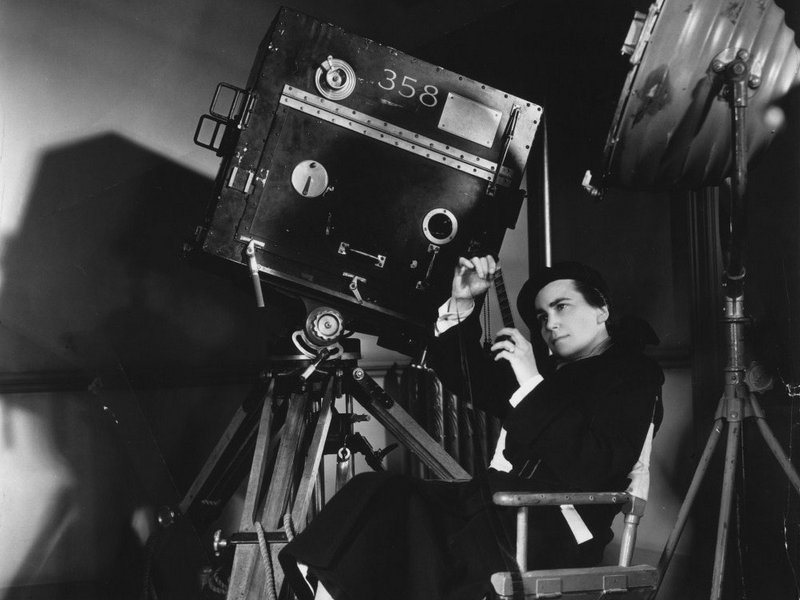
It’s ironic looking back over Dorothy Arzner’s life and career that she had a connection to Hollywood from quite a young age. Her parents ran a café in Los Angeles that was frequented by such movie luminaries as Charles Chaplin, William S. Hart and Erich von Stroheim, and Dorothy worked there as a waitress. But her ambition lay in the medical profession and she enrolled in a pre-med programme after graduating from high school; during World War I she served as an ambulance driver.

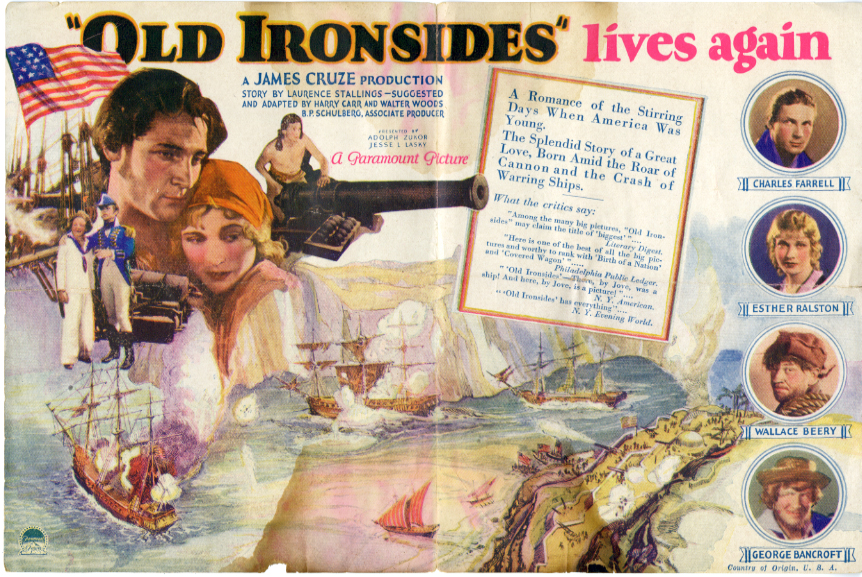
Once hostilities had ceased, Arzner changed tack and got a job working for a newspaper. There she was introduced to William C. DeMille – Cecil’s brother – and landed a job as a stenographer at Famous Players-Lasky (the forerunner of Paramount Pictures). Having become very interested in working in the movies, Arzner began to amass as much knowledge as she could and she soon became a script writer, as well as an editor. Between 1919 and 1926 she worked on eight features as a screen writer, and eight features as an editor, including uncredited duties in both capacities on James Cruze’s Old Ironsides (1926). So good was her work that she was the first person of either gender to receive an on-screen credit as an editor.
Old Ironsides

Her ambition though was to become a director, and in 1927 she made her first feature, Fashions for Women, a drama about a cigarette girl played by Esther Ralston who falls in love with a count while finding success as a model. It was a rather innocuous start to her career as a director but did well enough for her to tackle two more movies that year, Ten Modern Commandments, a romantic comedy-drama that also featured Ralston, and Get Your Man, a romantic comedy set in Paris that starred Clara Bow. But it was Manhattan Cocktail (1928) that was to be the second of many “firsts” that Arzner would achieve in her career, as she became the first female to direct a sound feature (albeit a part-talkie).

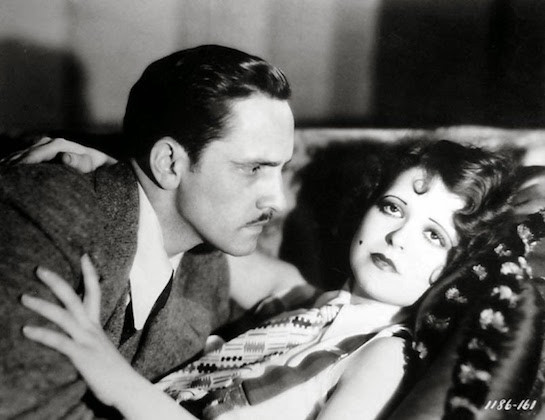
Reuniting with Bow for The Wild Party (1929), Arzner found her star struggling with the demands of making her first talkie, and specifically the microphones that were being used. In order to accommodate and reassure her star, Arzner came up with what was, for then, a unique solution: she devised the industry’s first boom mike so that Bow could move around unhampered by having to be near a microphone.
Wild Party, The

As her career continued into the Thirties, Arzner made a number of moderately successful pre-Code movies, and worked with a variety of Paramount stars, such as Claudette Colbert, Pat O’Brien, Ginger Rogers, Fredric March, Ruth Chatterton, Paul Lukas, Sylvia Sidney, and a young Cary Grant. But as Paramount’s fortunes suffered due to the Depression, and the company insisted on pay cuts across the board, Arzner became a freelance director and was quickly snapped up by RKO to direct Christopher Strong (1933). The movie starred Katharine Hepburn and the two didn’t get along, so much so that Hepburn complained about Arzner to the studio; wisely, RKO backed their director.

Despite the animosity between the two women the movie was a critical, if not financial, success, and Arzner moved on to Nana (1934), a vanity project for Anna Sten, a Russian actress being promoted by Samuel Goldwyn. Alas the movie was a flop, and it wasn’t until 1936 that Arzner made another picture, the well-received and critically lauded Craig’s Wife, starring Rosalind Russell. Also that year, Arzner was the first woman to be enrolled into the recently formed Screen Directors Guild; for many years afterward she would remain the only woman in the Guild until Ida Lupino joined in 1950.
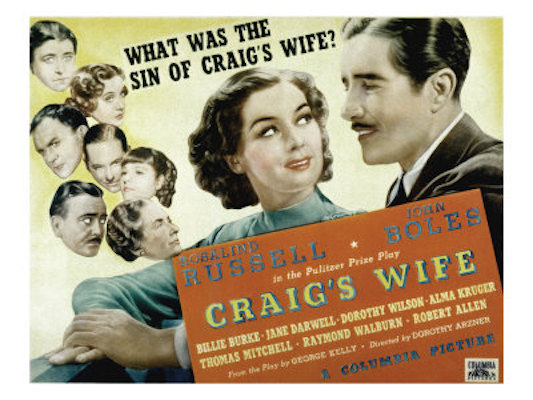
Craig's Wife

1937 saw Arzner work with and establish a close friendship with Joan Crawford, firstly providing uncredited direction on The Last of Mrs Cheyney, and then directing the star in that same year’s rags-to-riches tale The Bride Wore Red. Both movies were successful with audiences, but Arzner was unable to secure another picture until 1940 and the romantic drama Dance, Girl, Dance. Though it was a critical and commercial failure at the time, the movie underwent a re-evaluation in the 1970’s and is now regarded as one of Arzner’s more intriguing and important movies and as an early example of female empowerment. Three years later, Arzner made her last feature, the wartime drama First Comes Courage, an exercise in propaganda that featured the clearly Scandinavian Merle Oberon as a resistance fighter torn between Nazi Carl Esmond and Brit Brian Aherne.

Arzner turned her attention to the war effort after that, and made several training movies for the Women’s Army Corps. After the war she decided to work in television, making documentaries and commercials until the 1950’s when she became a filmmaking teacher. She first taught at the Pasadena Playhouse before moving to UCLA in the Sixties (one of her pupils was Francis Ford Coppola). She stayed there until her death in 1979.

Even though Dorothy Arzner was the most well-known female director working in Hollywood during its so-called Golden Age, the late Twenties through to the early Forties, she was also the only female director working in Hollywood during that time. She made movies that featured strong female heroines, and she found ways of including some of her feminist beliefs in the movies she made, slyly and with style. She also had a unique visual approach to the material she directed, and if you watch her movies today there’s a freshness about them that separates them from the otherwise formulaic movies being made at the time.

Arzner fought her way up from the bottom, and refused to be intimidated by the phallocentric system she worked in. She occupied a unenviable position in Hollywood, both as a woman and as a lesbian, but did so without compromising those values she felt strongly about. That she chose to give up directing movies after World War II is a cause for disappointment; it would have been interesting to see what she made of the role of women in the post-War era. But perhaps she’d had enough of being the only woman in such a male-dominated industry. After all, she did have this to say: “When I went to work in a studio, I took my pride and made a nice little ball of it and threw it right out the window.”
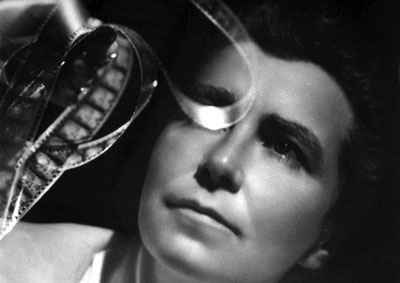
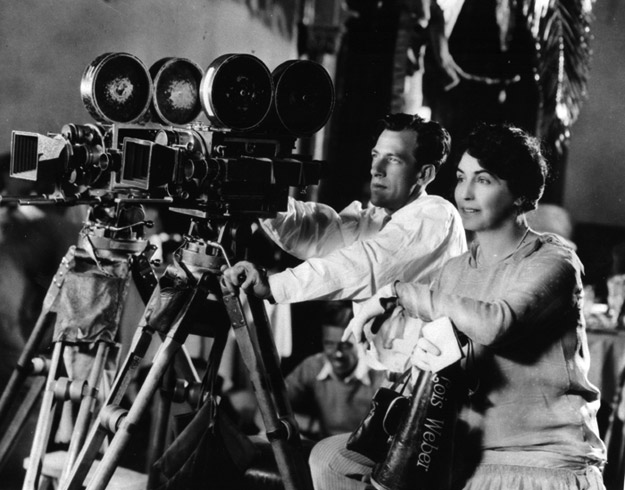
Dorothy Arzner 2

Share this:

  • Click to share on X (Opens in new window) X
  • Click to share on Facebook (Opens in new window) Facebook
  • More
  • Click to print (Opens in new window) Print
  • Click to email a link to a friend (Opens in new window) Email
Like Loading...

Preview: For One Week Only 2 – 8 November 2015

31 Saturday Oct 2015

Posted by dullwood68 in Movies

≈ Leave a comment

Tags

Angelina Jolie, For One Week Only, Lois Weber, Movies, Preview, Sight & Sound, Women directors

In the October issue of UK movie magazine Sight & Sound, the feature article was entitled, The Female Gaze: 100 Overlooked Films Directed by Women. In the article’s introduction, Isabel Stevens asks the question, “Other than decrying the status quo and highlighting and critiquing new films by female directors, what can a film magazine do?” The answer is to shed light on a variety of movies made by women directors and to reinforce the notion that they were and are just as capable as their male counterparts of making intelligent, thought-provoking, and entertaining movies on a wide variety of subjects.

Lois Weber

In recognition of this, and over the coming week, thedullwoodexperiment will be looking at some of the movies on the Sight & Sound list, and celebrating the contribution that women directors have made since those groundbreaking days of 1896. In the meantime you may want to look at the reviews of the movies directed by women that are already on the site, women such as:

Sima Urale, Margot Benacerraf, Allison Burnett, Ellie Kanner, Jennifer Kent, Amma Asante, Kimberly Peirce, Laura Poitras, Stacie Passon, Carol Morley, Sam Taylor-Johnson, Madonna, Jennifer Lee, Ana Lily Amirpour, Rebecca Johnson, Susan Seidelman, Lois Weber, Lake Bell, Courteney Cox, Lynn Shelton, Megan Griffiths, Karen Leigh Hopkins, Sara St. Onge, Gillian Robespierre, Jane Anderson, Gren Wells, Jen & Sylvia Soska, Clio Barnard, Susanne Bier, Laura Lau, Caryn Waechter, Annette K. Olesen, Maggie Carey, Vivian Qu, Karen Moncrieff, Angelina Jolie, Marjane Satrapi, Haifaa Al-Mansour, Shira Piven, Jocelyn Towne, Crystal Moselle, and Lauren Montgomery.

Angelina Jolie

Share this:

  • Click to share on X (Opens in new window) X
  • Click to share on Facebook (Opens in new window) Facebook
  • More
  • Click to print (Opens in new window) Print
  • Click to email a link to a friend (Opens in new window) Email
Like Loading...

Hypocrites (1915)

01 Tuesday Jul 2014

Posted by dullwood68 in Movies

≈ 1 Comment

Tags

Courtenay Foote, Gabriel the Ascetic, Hypocrisy, Lois Weber, Nude, Religion, Silent film, Statue, Truth

Hypocrites

D: Lois Weber / 54m

Cast: Courtenay Foote, Myrtle Stedman, Herbert Standing, Adele Farrington, Margaret Edwards

The present day: the Reverend Gabriel (Foote) is preaching a sermon on hypocrisy to a congregation who are by turns, disinterested, bored, or unable to see that his sermon has any relevance to themselves.  Even one of his own assistants is seen reading a Sunday newspaper.  Seeing this, Gabriel rounds on everyone there and focuses the message of the sermon on them.  With the service concluded, several of the congregation gather outside the church and plot to have Gabriel removed.  Back inside, one of his female assistants (Stedman), clearly enamoured of the cleric, attempts to speak with him but he is so lost in thought she that she passes up the opportunity.  When everyone is gone, Gabriel slumps in a chair, the offending newspaper in hand, his thoughts continuing to reach out to God.

He falls into a reverie.  In it he finds himself dressed in medieval robes, ascending a steep hill.  His parishioners pass by on the road below; some see Gabriel and others climbing the trail, but fail to follow him for various selfish or thoughtless reasons.  Two women make the climb with him (including the woman who is fond of him), but they fall by the wayside, leaving Gabriel at the summit, alone and beseeching God for a better understanding of his flock’s lack of moral probity.

The past: Gabriel is a monk living in a monastery where the other monks are shown having what looks like a feast.  Gabriel is working on a statue, a gift for the monastery and the people of the town where it’s located.  He works in secrecy until the day his work is ready to be shown.  The monks arrange a celebration to go with the unveiling, but when the statue is uncovered there is shock and uproar: the statue is of a naked woman, whom Gabriel calls Truth.  Gabriel is seized by a mob and killed.  Back in the present day, his body is found by his parishioners, the newspaper still in his hand; a later headline reveals their shock at his being found in such circumstances.

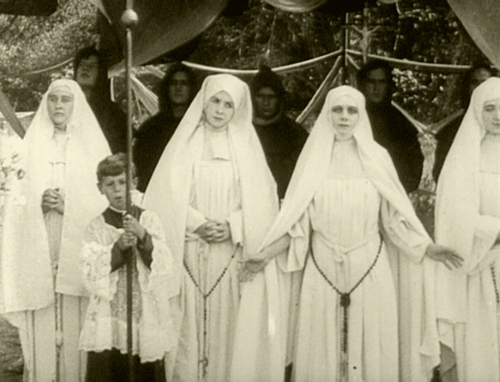
Hypocrites - scene

Hypocrites is a movie that has gained quite a good reputation over the years, and it’s easy to see why.  Though its moralising is a little heavy-handed by today’s standards, it’s still an effective piece, the use of the same actors in both time periods serving to highlight how little Man has changed over the centuries, his selfish, irreligious behaviour leading him further and further away from the path to true enlightenment and happiness.  Viewed like this it’s no surprise that the modern day congregation reacts in the way it does, seeking to oust someone who holds a mirror up to their vain, self-serving posturing.  This is further explored in an extended sequence where Truth (Edwards) – depicted as a naked young woman – shows Gabriel various examples of the hypocrisy his congregation indulges in, e.g. the politician whose banner reads “My platform is honesty” but who is then seen taking bribes (businessmen, lovers by convenience, and the clergy also come under fire).

The decision to portray Truth as a naked woman caused a degree of uproar at the time of the movie’s release, despite being passed by the National Board of Censorship.  Hypocrites was banned in Ohio, there were riots in New York (strange to think now that a movie could provoke that violent a reaction), and reputedly the mayor of Boston wanted each frame including Truth to be hand-painted to cover her nakedness.  In the movie itself, the depiction of Truth is achieved via the use of double exposure, thus curtailing the level of detail that can be seen (and Edwards holds an arm across her breasts for the most part), and her appearance is in no way salacious.  That the movie received such an unfavourable welcome in places must have been the best thing the filmmakers could have wished for.

As a piece of propaganda for the morality brigade, the movie is expertly handled by Weber whose background before entering the film industry was as a street-corner evangelist.  In this sense, her mastery of the material is to be expected, and she offers convincing portraits of moral backsliding, the cast of familiar (if uncredited) faces cranking back on the declamatory style of acting usually found in movies of the period (though Foote more than makes up for any shortfall).  Indeed, it’s refreshing to see a wealth of what audiences today would call more naturalistic performances.  Weber also displays a technical mastery of the medium, her use of the camera and location photography combining to bring an absorbing, fresh approach at a time when movies were still largely set bound and with the camera employed as a fixed observer.  The pace of the movie is well maintained also, and each scene is constructed to accommodate and/or support the fullest expression of the moral laxity it’s presenting.  It all makes for an impressive feat of moviemaking.

Rating: 9/10 – as relevant now as it was in 1915, Hypocrites depicts Man at his most shamelessly self-interested and duplicitous; a classic of silent cinema and clear evidence that Lois Weber was as talented – if not more so – than many of her peers.

Share this:

  • Click to share on X (Opens in new window) X
  • Click to share on Facebook (Opens in new window) Facebook
  • More
  • Click to print (Opens in new window) Print
  • Click to email a link to a friend (Opens in new window) Email
Like Loading...

Blog Stats

  • 486,528 hits

Recent Posts

  • 10 Reasons to Remember Bibi Andersson (1935-2019)
  • Fantasia (1940)
  • Dances With Wolves (1990) – The Special Edition
  • Kiss of the Spider Woman (1985)
  • The Three Musketeers (1973)

Top Posts & Pages

  • Lost for Life (2013) - Another Look
    Lost for Life (2013) - Another Look
  • Lost for Life (2013)
    Lost for Life (2013)
  • About
    About
  • Mr. Topaze (1961)
    Mr. Topaze (1961)
  • Billy Lynn's Long Halftime Walk (2016)
    Billy Lynn's Long Halftime Walk (2016)
  • Winter's Tale (2014)
    Winter's Tale (2014)
  • The Hitman's Bodyguard (2017)
    The Hitman's Bodyguard (2017)
  • 5 Famous Movie Roles That Nearly Went to Someone Else
    5 Famous Movie Roles That Nearly Went to Someone Else
  • The Layover (2017)
    The Layover (2017)
  • Transcendence (2014)
    Transcendence (2014)
Follow thedullwoodexperiment on WordPress.com

Blogs I Follow

  • Rubbish Talk
  • Film 4 Fan
  • Fast Film Reviews
  • The Film Blog
  • All Things Movies UK
  • Interpreting the Stars
  • Let's Go To The Movies
  • Movie Reviews 101
  • TMI News
  • Dan the Man's Movie Reviews
  • Film History
  • Jordan and Eddie (The Movie Guys)

Archives

  • April 2019 (13)
  • March 2019 (28)
  • February 2019 (28)
  • January 2019 (32)
  • December 2018 (28)
  • November 2018 (30)
  • October 2018 (29)
  • September 2018 (29)
  • August 2018 (29)
  • July 2018 (30)
  • June 2018 (28)
  • May 2018 (24)
  • April 2018 (21)
  • March 2018 (31)
  • February 2018 (25)
  • January 2018 (30)
  • December 2017 (30)
  • November 2017 (27)
  • October 2017 (27)
  • September 2017 (26)
  • August 2017 (32)
  • July 2017 (32)
  • June 2017 (30)
  • May 2017 (29)
  • April 2017 (29)
  • March 2017 (30)
  • February 2017 (27)
  • January 2017 (32)
  • December 2016 (30)
  • November 2016 (28)
  • October 2016 (30)
  • September 2016 (27)
  • August 2016 (30)
  • July 2016 (30)
  • June 2016 (31)
  • May 2016 (34)
  • April 2016 (30)
  • March 2016 (30)
  • February 2016 (28)
  • January 2016 (35)
  • December 2015 (34)
  • November 2015 (31)
  • October 2015 (31)
  • September 2015 (34)
  • August 2015 (31)
  • July 2015 (33)
  • June 2015 (12)
  • May 2015 (31)
  • April 2015 (32)
  • March 2015 (30)
  • February 2015 (37)
  • January 2015 (39)
  • December 2014 (34)
  • November 2014 (34)
  • October 2014 (36)
  • September 2014 (25)
  • August 2014 (29)
  • July 2014 (29)
  • June 2014 (28)
  • May 2014 (23)
  • April 2014 (21)
  • March 2014 (42)
  • February 2014 (38)
  • January 2014 (29)
  • December 2013 (28)
  • November 2013 (34)
  • October 2013 (4)

Blog at WordPress.com.

Rubbish Talk

Film 4 Fan

A Movie Blog

Fast Film Reviews

The Film Blog

The official blog of everything in film

All Things Movies UK

Movie Reviews and Original Articles

Interpreting the Stars

Dave Examines Movies

Let's Go To The Movies

Film and Theatre Lover!

Movie Reviews 101

Daily Movie Reviews

TMI News

Latest weather, crime and breaking news

Dan the Man's Movie Reviews

All my aimless thoughts, ideas, and ramblings, all packed into one site!

Film History

Telling the story of film

Jordan and Eddie (The Movie Guys)

Movie Reviews & Ramblings from an Australian Based Film Fan

Privacy & Cookies: This site uses cookies. By continuing to use this website, you agree to their use.
To find out more, including how to control cookies, see here: Cookie Policy
  • Subscribe Subscribed
    • thedullwoodexperiment
    • Join 481 other subscribers
    • Already have a WordPress.com account? Log in now.
    • thedullwoodexperiment
    • Subscribe Subscribed
    • Sign up
    • Log in
    • Report this content
    • View site in Reader
    • Manage subscriptions
    • Collapse this bar
 

Loading Comments...
 

    %d