• 10 Reasons to Remember…
  • A Brief Word About…
  • About
  • For One Week Only
  • Happy Birthday
  • Monthly Roundup
  • Old-Time Crime
  • Other Posts
  • Poster of the Week
  • Question of the Week
  • Reviews
  • Trailers

thedullwoodexperiment

~ Viewing movies in a different light

thedullwoodexperiment

Tag Archives: Lone Scherfig

Their Finest (2016)

04 Thursday May 2017

Posted by dullwood68 in Movies

≈ Leave a comment

Tags

Bill Nighy, Drama, Gemma Arterton, History, Literary adaptation, Lone Scherfig, Ministry of Information, Moviemaking, Review, Sam Claflin, Screenwriting, World War II

D: Lone Scherfig / 117m

Cast: Gemma Arterton, Sam Claflin, Bill Nighy, Jack Huston, Paul Ritter, Rachael Stirling, Richard E. Grant, Henry Goodman, Jake Lacy, Jeremy Irons, Eddie Marsan, Helen McCrory

Britain, the summer of 1940. Since the outbreak of World War II, the British Ministry of Information has been making short information movies to be shown at cinemas. Its film department – headed up by Roger Swain (Grant) – takes on a young Welsh woman called Catrin Cole (Arterton) to act as a screenwriter, and in particular, to write better dialogue for any female characters (the other screenwriters are, unsurprisingly, all male). Catrin settles in, and finds herself working alongside Tom Buckley (Claflin) and Raymond Parfitt (Ritter), and under the stewardship of Phyl Moore (Stirling). Catrin soon earns a degree of respect from Buckley, who is nominally more experienced, and her work begins to gain recognition. But at home, it’s not quite the same. Catrin’s husband, Ellis (Huston), is a struggling artist whose bleak reflections on the War aren’t attracting any attention. He’s pleased that she’s doing well in her own job, but is inwardly jealous at the same time.

The film department is charged with making a full-length feature. Catrin is given the task of talking to twin sisters who took out their father’s boat and sailed across to Dunkirk to help in the evacuation. But she soon discovers that the boat developed engine trouble five miles out and they never even got to Dunkirk, let alone rescued anyone. Undeterred, Catrin returns to the Ministry and tells a fictional version of the twins’ story – and one that is believed by everyone except Tom. He keeps quiet, and the project is given the go-ahead. Catrin, Tom and Raymond all work on the script, while the casting goes ahead. Pompous actor Ambrose Hilliard (Nighy) is approached through his agent, Sammy Smith (Marsan), but turns down the supporting role of drunken Uncle Frank out of misplaced pride. Tragedy strikes, however, and Hilliard takes on the role thanks to pressure from Sammy’s sister, Sophie (McCrory).

The truth about the twins’ rescue mission is discovered, and though the Ministry has been determined to make a movie out of an act of real life heroism, Catrin convinces everyone to make a fictional version. Production begins on location in Devon, but the unexpected intervention of the Secretary of War (Irons) means that the script will now have to accommodate the presence of an American soldier in its plot, and specifically, Eagle Squadron pilot (and non-actor) Carl Lundberg (Lacy). Catrin persuades Hilliard to tutor Lundberg, while she and Tom grow closer. As the shoot progresses, their relationship develops to the point where surprising information volunteered by Catrin herself promises a sea change in her relationships with both Ellis and Tom.

Adapted from the novel, Their Finest Hour and a Half by Lissa Evans, this awkwardly titled movie is the kind of heritage picture that the British do so well. From the moment Catrin steps out onto a Blitz-torn street we’re in oh-so familiar territory, with just enough artfully stylised devastation to provide the viewer with a visual shorthand as to the time and place they’re witnessing. In a way it’s comforting, seeing all these bomb blasted buildings with their scattered debris, and as Arterton’s plucky Welsh screenwriter-to-be makes her way to the Ministry of Information, there’s a sense that whatever happens in Their Finest, it will retain the opening’s carefully constructed sense of artificiality, and avoid any “difficult” or “realistic” moments.
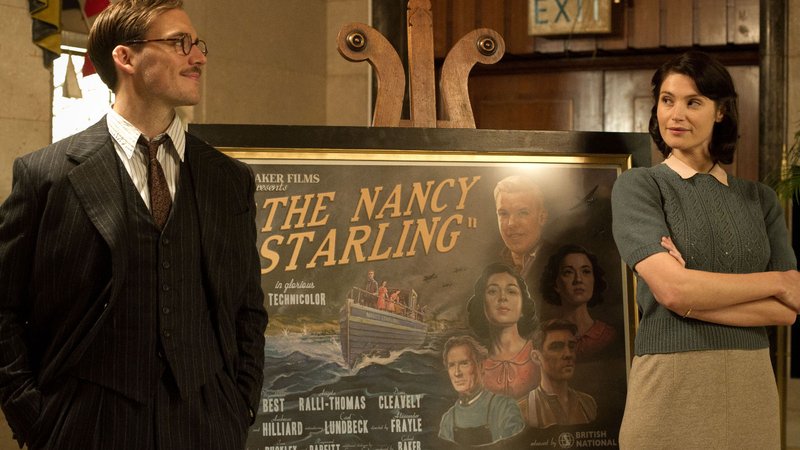
And so it proves. The movie ticks all the boxes for a nicely balanced period feature, with Catrin filling the role of innocent abroad, Tom as the adversary-cum-mentor figure that she’ll inevitably fall in love with, Hilliard as the curmudgeonly actor who’s on grudging terms with humility, and a variety of supporting characters who pop up every now and again, contribute a further variety of notable moments or dialogue (“He is an actor. Unless you have reviewed him, had intercourse with him, or done both simultaneously, he won’t remember you.”), and then fade back into the background until needed again. There’s the requisite number of apparently insurmountable problems that are resolved in under a minute flat, bickering and misunderstandings between the romantic leads, obvious references to the sexism of the times, Richard E. Grant pulling faces whenever he can, and all of it coated with the rosy sheen of familiarity and nostalgia.

But again, this is the kind of heritage picture that the British (or the British as led by a director from Denmark) do so well, and again, so it proves. While the plot and its surrounding storylines all have the look and feel of scenarios we’ve seen before – and too many times at that – the best thing that can be said about Their Finest is that the director, the writer, the cast, the crew, hell everyone involved, knew this was true, and proceeded without a moment’s hesitation in using that knowledge as the basis for providing audiences with a very enjoyable movie indeed. Is Their Finest a true original, groundbreaking and constantly surprising? No, it’s not. Is it a movie that will change anyone’s life? Again, no, it’s not. But it is a movie that does do something unexpected: it makes the movie within the movie, The Nancy Starling, the emotional core of everything, and it does so with a carefree, nonchalant sense of entitlement that you couldn’t have predicted at the start. It’s here that Hilliard proves what a fine actor he really is, it’s here where a lunkhead American soldier can appear soulful and poetic, and where traditional values around serving the greater good and unavoidable personal sacrifice are made self-evident.
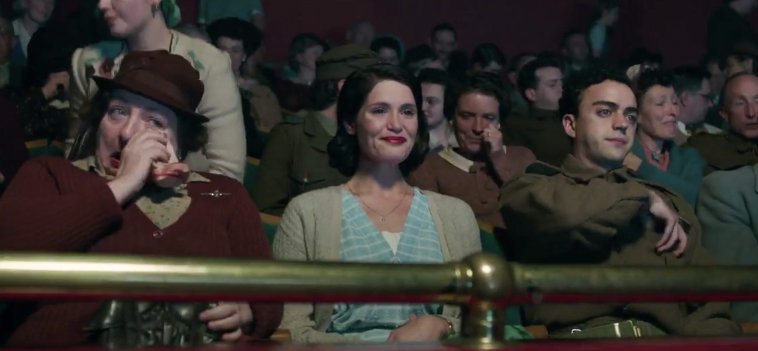
While the movie within a movie offers more dramatic meat than its parent, what the rest of the movie does offer is a recognisable template to hang a romantic comedy with dramatic elements on. It does this effectively and with a minimum of fuss, and gives the audience a succession of self-reflexive feelgood moments where anticipation is satisfied and rewarded thanks to the script’s commitment to playing it (pleasantly) safe. Only two moments stand out as being darker than all the rest. One is a bitter reflection on the realities of death by bombing, while the other is a “twist” that is as bold as it is dispiriting. Otherwise and elsewhere, the movie maintains its wry, comedic edge and its avoidance of being too serious.

Scherfig injects her usual bonhomie into things, keeping it all light enough to fly away forever, and doing so with a studied sense of what’s acceptable in terms of such lightweight material. A quality cast helps tremendously with Arterton displaying a charm and likeability that has been missing from more recent roles, while Claflin is all pent-up superiority and diffidence as the movie’s real leading man. Nighy invites the viewer to laugh at Hilliard with affection, while further down the cast list, McCrory scores highly as another woman attempting to do well in a traditionally man’s world. It’s all neatly held together by Gaby Chiappe’s heartfelt and engaging script, and the scenes behind the making of the movie within a movie are terrific in the way that they expose some of the tricks of the trade back in the Forties. It’s dourly glamorous too, with fine cinematography by Sebastian Blenkov, and there’s a suitably nostalgic yet rousing score by Rachel Portman that perfectly accentuates the movie’s sprightly tone.

Rating: 7/10 – an enjoyable piece of wartime flag-waving, Their Finest is funny, romantic, occasionally dramatic, and as winsome as it can be given its backdrop; entertaining in a generic yet fulfilling way, the movie coasts along for much of its running time, but it does so in such an amiable fashion that most viewers won’t mind at all.

Share this:

  • Click to share on X (Opens in new window) X
  • Click to share on Facebook (Opens in new window) Facebook
  • More
  • Click to print (Opens in new window) Print
  • Click to email a link to a friend (Opens in new window) Email
Like Loading...

The Riot Club (2014)

30 Thursday Oct 2014

Posted by dullwood68 in Movies

≈ Leave a comment

Tags

Annual dinner, Debauchery, Douglas Booth, Drama, Holliday Grainger, Lone Scherfig, Lord Ryot, Max Irons, Membership, Oxford, Review, Sam Claflin, University

Riot Club, The

D: Lone Scherfig / 107m

Cast: Sam Claflin, Max Irons, Douglas Booth, Holliday Grainger, Sam Reid, Ben Schnetzer, Freddie Fox, Olly Alexander, Matthew Beard, Jessica Brown Findlay, Jack Farthing, Michael Jibson, Natalie Dormer, Tom Hollander

Two new students at an Oxford university, Alistair Ryle (Claflin) and Miles Richards (Irons), are from privileged backgrounds but couldn’t be more different.  Alistair is cold and aloof, and arrogant in his approach to others.  Miles is more carefree and open, and less snobbish.  Despite their very different personalities they both find themselves sought after for membership of the Riot Club, an exclusive fraternity that favours drinking and debauchery and any other hedonistic pursuits.  With their annual dinner coming up, and both young men needed to meet the required numbers for the dinner to go ahead, the Riot Club recruits them (but not before they have to undergo a variety of tests to prove they’re worthy of membership).

In the meantime, Miles has begun a relationship with Lauren (Grainger), a young woman of humbler origins.  But as the selection process for the Riot Club begins in earnest, Miles fails to see the warning signs of being part of the club while Lauren sees them all too clearly.  When she starts to question Miles’s need to be a part of the Riot Club, a rift begins to open up between them, but they remain friends nevertheless.

With the club having been banned from most of the pubs and bars and restaurants in Oxford, they are forced to hold their annual dinner at a country pub.  The landlord, Chris (Jibson), is delighted to have them as it will mean a substantial amount of revenue for the pub, but his daughter, Rachel (Findlay) isn’t so sure, or so keen to have them there.  The evening arrives and the club members quickly become drunk and rowdy, causing a disturbance and behaving with appalling manners.  When the prostitute (Dormer) that club member Harry Villiers (Booth) has arranged baulks at giving oral sex to all ten men, Alistair secretly uses Miles’s mobile phone to text Lauren and get her to come to the pub.  When she arrives, thinking that Miles is looking forward to seeing her, she is shocked to find herself verbally abused and asked to substitute for the prostitute.  Even worse, Miles fails to do anything to help her; she leaves in tears.

As the evening progresses, the Riot Club members become increasingly unruly, and when they discover that the food they ordered isn’t exactly what they asked for, they grow aggressive and begin to trash the dining room, egged on by Alistair, who spouts class-based bile.  When Chris sees the damage they’ve done and tries to remonstrate with them, things take a darker, more violent turn…

Riot Club, The - scene

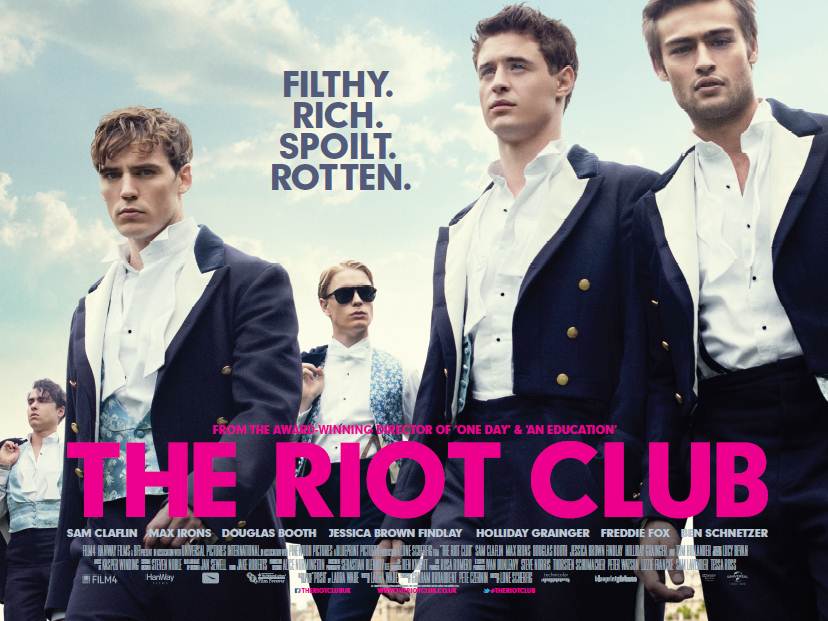
Featuring the cream of young British male acting talent, The Riot Club is a demanding, disturbing look at the ways in which privilege and contempt can go hand in hand and lead to the most horrifying of situations and circumstances.  Adapted by Laura Wade from her play, Posh – itself based on the exploits of the Bullingdon Club – The Riot Club depicts the kind of arrogant, dismissive behaviour most viewers will take for granted, and therein lies one of the movie’s main problems: even at its most melodramatic, the club’s actions aren’t quite as appalling as the movie would like them to be.  True, they’re abusive, disdainful, egotistical, misogynistic, conceited and full of their own self-importance, but we’ve seen this kind of misconduct before, and while it’s competently presented, viewers won’t be surprised by the direction in which the storyline travels.

What we have here is a spurious social commentary made up to appear relevant in relation to the latest ideas about the class divide (and acerbically delivered in a caustic speech by Claflin near the dinner’s end).  In truth it boils down to the standard, predictable belief that the haves are dismissive of, and abhor, the have-nots, and look down on them as inferior and unimportant when weighed against the needs of the so-called elite.  It’s hardly news, and Wade’s depiction of these privileged young men is often as cynical as the characters’ attitudes, leaving the viewer unsure if she, in her own way, is as contemptuous of them as they are of Lauren et al.  There’s an attempt as well to provide a political as well as social context to the club members’ behaviour, but it comes across as too prosaic to have much of an impact.  Alistair’s desperate assertions notwithstanding, it’s clear there’s no excuse for what they do, and the script rarely tries to provide any credible explanation.  This leaves the club’s self-aggrandising dissipation with no other justification than that they behave the way they do purely because they can, a message that is clear from the beginning.

In transferring Wade’s play to the screen, Scherfig wisely stages things with a nod to the material’s theatrical origins, and the dinner party itself achieves a certain claustrophobic ambience after a time, and while Scherfig keeps the camera moving – often dizzyingly so – the movie traps the viewer in that room with the Riot Club and keeps a seat there for them throughout, in an attempt to make them in some way complicit in the debauchery.  It’s a neat idea, but doesn’t quite work, the camera forced to move outside the room too often to maintain the effect.  Otherwise, the dinner party and all its tawdry developments – the movie’s own main course, if you will – have a cumulative effect that is surprisingly effective from a visual perspective.  In fact, the movie looks good throughout, a tribute to both DoP Sebastian Blenkov and production designer Alice Normington.

Of the cast, Claflin stands out the most by virtue of being the movie’s most clearly defined villain, an acid-tongued, rancour-spouting advocate of class hatred.  It’s a fierce, uncompromising performance and confirms Claflin isn’t afraid to “mix it up” outside of the heroics of The Hunger Games.  As his foil and target, Irons makes Miles a little too insipid to be entirely credible or likeable, while Grainger quietly steals the movie with a well-rounded portrayal of a young woman for whom the best privilege is being where she is, and having a sense of achievement her more aristocratic co-students can’t (or don’t have to) fathom.  In amongst all the sturm und drang, its cast members such as Jibson as the conflicted Chris that make the most impact, while Booth, Reid and Alexander et al. struggle to do much with their less detailed roles.

A clutch of good performances however, fail to make up for the unevenness of the material and its often simplistic notions of class warfare.  That the members of the Riot Club are snobbish and uncaring of others is a given; that they don’t show any signs of self-awareness means their unrestrained amorality becomes both unpleasant and increasingly dull to watch.  To see so much bad behaviour taking place, and with continued impunity, makes The Riot Club a frustrating experience to watch and one that arrives at its final “point” with a dispiriting vindication that robs the viewer of any catharsis from what they’ve seen up til then.  And that’s a mean trick to play on anyone.

Rating: 5/10 – visually arresting at times, and with strong performances that offset the often muddled dramatics, The Riot Club has energy to spare but doesn’t quite know what to do with it all; suffocating at times, and not as “relevant” as it might have been thirty years ago.

Share this:

  • Click to share on X (Opens in new window) X
  • Click to share on Facebook (Opens in new window) Facebook
  • More
  • Click to print (Opens in new window) Print
  • Click to email a link to a friend (Opens in new window) Email
Like Loading...

Blog Stats

  • 491,358 hits

Recent Posts

  • 10 Reasons to Remember Bibi Andersson (1935-2019)
  • Fantasia (1940)
  • Dances With Wolves (1990) – The Special Edition
  • Kiss of the Spider Woman (1985)
  • The Three Musketeers (1973)

Top Posts & Pages

  • Cardboard Boxer (2016)
    Cardboard Boxer (2016)
  • Carrie (2013)
    Carrie (2013)
  • Hickey (2016)
    Hickey (2016)
  • I Origins (2014)
    I Origins (2014)
  • The Inner Circle (1946)
    The Inner Circle (1946)
  • Death in High Heels (1947)
    Death in High Heels (1947)
  • Speak (2004)
    Speak (2004)
  • Poster of the Week - For a Few Dollars More (1965)
    Poster of the Week - For a Few Dollars More (1965)
  • Jaws of Justice (1933)
    Jaws of Justice (1933)
  • Lone Survivor (2013)
    Lone Survivor (2013)
Follow thedullwoodexperiment on WordPress.com

Blogs I Follow

  • Rubbish Talk
  • Film 4 Fan
  • Fast Film Reviews
  • The Film Blog
  • All Things Movies UK
  • Interpreting the Stars
  • Let's Go To The Movies
  • Movie Reviews 101
  • TMI News
  • Dan the Man's Movie Reviews
  • Film History
  • Jordan and Eddie (The Movie Guys)

Archives

  • April 2019 (13)
  • March 2019 (28)
  • February 2019 (28)
  • January 2019 (32)
  • December 2018 (28)
  • November 2018 (30)
  • October 2018 (29)
  • September 2018 (29)
  • August 2018 (29)
  • July 2018 (30)
  • June 2018 (28)
  • May 2018 (24)
  • April 2018 (21)
  • March 2018 (31)
  • February 2018 (25)
  • January 2018 (30)
  • December 2017 (30)
  • November 2017 (27)
  • October 2017 (27)
  • September 2017 (26)
  • August 2017 (32)
  • July 2017 (32)
  • June 2017 (30)
  • May 2017 (29)
  • April 2017 (29)
  • March 2017 (30)
  • February 2017 (27)
  • January 2017 (32)
  • December 2016 (30)
  • November 2016 (28)
  • October 2016 (30)
  • September 2016 (27)
  • August 2016 (30)
  • July 2016 (30)
  • June 2016 (31)
  • May 2016 (34)
  • April 2016 (30)
  • March 2016 (30)
  • February 2016 (28)
  • January 2016 (35)
  • December 2015 (34)
  • November 2015 (31)
  • October 2015 (31)
  • September 2015 (34)
  • August 2015 (31)
  • July 2015 (33)
  • June 2015 (12)
  • May 2015 (31)
  • April 2015 (32)
  • March 2015 (30)
  • February 2015 (37)
  • January 2015 (39)
  • December 2014 (34)
  • November 2014 (34)
  • October 2014 (36)
  • September 2014 (25)
  • August 2014 (29)
  • July 2014 (29)
  • June 2014 (28)
  • May 2014 (23)
  • April 2014 (21)
  • March 2014 (42)
  • February 2014 (38)
  • January 2014 (29)
  • December 2013 (28)
  • November 2013 (34)
  • October 2013 (4)

Blog at WordPress.com.

Rubbish Talk

Film 4 Fan

A Movie Blog

Fast Film Reviews

The Film Blog

The official blog of everything in film

All Things Movies UK

Movie Reviews and Original Articles

Interpreting the Stars

Dave Examines Movies

Let's Go To The Movies

Film and Theatre Lover!

Movie Reviews 101

Daily Movie Reviews

TMI News

Latest weather, crime and breaking news

Dan the Man's Movie Reviews

All my aimless thoughts, ideas, and ramblings, all packed into one site!

Film History

Telling the story of film

Jordan and Eddie (The Movie Guys)

Movie Reviews & Ramblings from an Australian Based Film Fan

Privacy & Cookies: This site uses cookies. By continuing to use this website, you agree to their use.
To find out more, including how to control cookies, see here: Cookie Policy
  • Subscribe Subscribed
    • thedullwoodexperiment
    • Join 481 other subscribers
    • Already have a WordPress.com account? Log in now.
    • thedullwoodexperiment
    • Subscribe Subscribed
    • Sign up
    • Log in
    • Report this content
    • View site in Reader
    • Manage subscriptions
    • Collapse this bar
 

Loading Comments...
 

    %d