• 10 Reasons to Remember…
  • A Brief Word About…
  • About
  • For One Week Only
  • Happy Birthday
  • Monthly Roundup
  • Old-Time Crime
  • Other Posts
  • Poster of the Week
  • Question of the Week
  • Reviews
  • Trailers

thedullwoodexperiment

~ Viewing movies in a different light

thedullwoodexperiment

Tag Archives: Martin Freeman

Ghost Stories (2017)

11 Wednesday Apr 2018

Posted by dullwood68 in Movies

≈ Leave a comment

Tags

Alex Lawther, Andy Nyman, Drama, Ghosts, Horror, Jeremy Dyson, Martin Freeman, Paranormal investigator, Paul Whitehouse, Review

D: Jeremy Dyson, Andy Nyman / 98m

Cast: Andy Nyman, Paul Whitehouse, Alex Lawther, Martin Freeman, Leonard Byrne, Samuel Bottomley, Jake Davies, Nicholas Burns

Beginning with fragmented home movie footage set in 1979, Ghost Stories is the latest British horror movie to be granted a wide release, and to be backed by generous praise. The home movie footage shows incidents from the childhood of professor Phillip Goodman (Nyman), a paranormal investigator who has a TV show that debunks self-proclaimed psychics. Goodman receives an invitation from 70’s paranormal investigator Charles Cameron (Byrne), to look into three cases of apparently unexplainable ghostly sightings. The first relates to a nightwatchman (Whitehouse) working in an old, disused women’s asylum. The second relates to a young man (Lawther) who has an encounter with the Devil while driving home one night. And the third concerns a financier (Freeman), who experiences poltergeist activity at his home. Goodman investigates each case in turn, and comes to the conclusion that there is nothing remotely supernatural or paranormal about any of the cases, preferring instead to believe that what each person has experienced is actually the result of their own neuroses and psychological issues. But when he returns to confront Cameron with his findings, what happens next is far more disturbing…

…except, it isn’t. What happens next takes the movie into completely different territory and serves only to dissipate the sense of muted dread that has been achieved so far. It expands on the framing device of Goodman’s investigations, but in a way that abandons the eerie approach of the first hour in favour of a waking nightmare scenario that sees Goodman haunted by events from his childhood. There’s a pay off at the end (which is meant to be clever, but feels contrived instead), but by then it’s too late. The initial promise of the movie – that Goodman’s investigations will reveal a world of horror he can’t explain away rationally – never gets off the ground, and while there are plenty of riffs and echoes on events within the movie, there’s too much that proves superfluous. The title is misleading as well, as only one of the stories, the first, is about an actual ghost. And as the movie progresses, it does what so many other horror movies fall prey to: having inexplicable things happen for no other reason than that it’s a supernatural story and anything can happen… even though they shouldn’t.

The movie is also hampered by its indecisive tone. There’s humour here, and in the second story a little too much (though Lawther’s reply to the Devil’s command to “Stay” is priceless), and some of the situations and the performances veer between serious and comic, often within the same scene. Whitehouse plays his character straight for the most part, but the script can’t resist giving him a few forced one-liners. Lawther is batty with a side order of nuts, while Freeman opts for supercilious, a decision that fits the character but which leaves him looking and sounding as if he’s walked in from another movie altogether (and not a horror movie). Alas, it’s Nyman who really draws the short straw, which is unfortunate given his involvement as co-writer and co-director with Jeremy Dyson. Goodman is a classic naïf, in way over his head, and with no idea what he’s got himself into. As a result, Nyman does baffled a lot, and then afraid without knowing why he should be (aka baffled a bit more). On the plus side, Ole Bratt Birkeland’s widescreen cinematography is a major asset – you’ll be looking in every corner for the next scare – but aside from some knowing references to Seventies British horror, this is standard fare given an unlikely and surprising boost by critics who really should know better.

Rating: 5/10 – an adaptation of the original stage play, Ghost Stories is less the straight up horror movie it looks like, and more of the convoluted psychological thriller with horror overtones that it actually is; less effective than it needs to be, and uneven for much of its running time, it’s a movie that manages to throw in a few good scares, and offers a handful of creepy moments, but very little else to keep real fans of the genre properly entertained.

Share this:

  • Click to share on X (Opens in new window) X
  • Click to share on Facebook (Opens in new window) Facebook
  • More
  • Click to print (Opens in new window) Print
  • Click to email a link to a friend (Opens in new window) Email
Like Loading...

Whiskey Tango Foxtrot (2016)

03 Sunday Jul 2016

Posted by dullwood68 in Movies

≈ Leave a comment

Tags

Afghanistan, Alfred Molina, Billy Bob Thornton, Comedy, Drama, Glenn Ficarra, John Requa, Journalist, Kabul, Kim Barker, Literary adaptation, Margot Robbie, Martin Freeman, Review, Taliban, Tina Fey, True story, War

Whiskey Tango Foxtrot

D: Glenn Ficarra, John Requa / 112m

Cast: Tina Fey, Margot Robbie, Martin Freeman, Alfred Molina, Christopher Abbott, Billy Bob Thornton, Nicholas Braun, Stephen Peacocke, Sheila Vand, Evan Jonigkeit, Fahim Anwar, Josh Charles, Cherry Jones

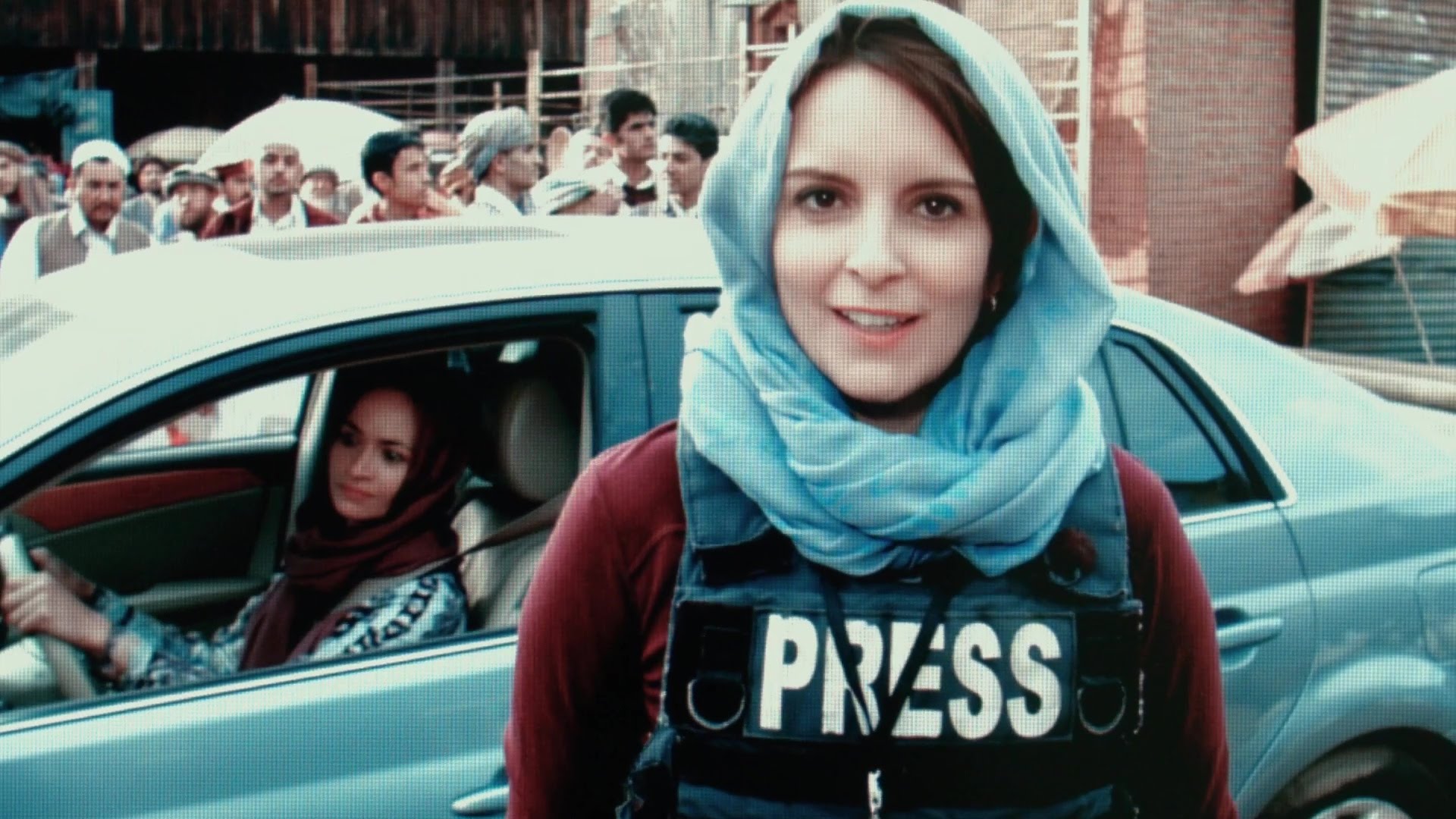
If you’re a fan of Tina Fey, and have been waiting to see Whiskey Tango Foxtrot with some anticipation after seeing the trailer, be warned! This isn’t the out and out comedy with occasional dramatic moments that the trailer makes it out to be. Instead it’s the opposite, a drama with occasional comedic moments that fit awkwardly for the most part with the movie’s main focus, the true story of one woman journalist’s stay in Afghanistan and the experiences she had there.

Fey plays Kim Baker, the fictionalised version of Kim Barker (why the slight name change?). In 2004 and dissatisfied with the way her career in television news is going, she takes up the offer of an assignment reporting from Afghanistan. Taking a huge chance – she doesn’t know the language or the customs, and has never reported from a war zone before – Baker is assigned a driver/interpreter, Fahim (Abbott), and a personal bodyguard, Nic (Peacocke). She’s also grateful to find another female journalist there in the form of Tanya Vanderpoel (Robbie).

WTF - scene3

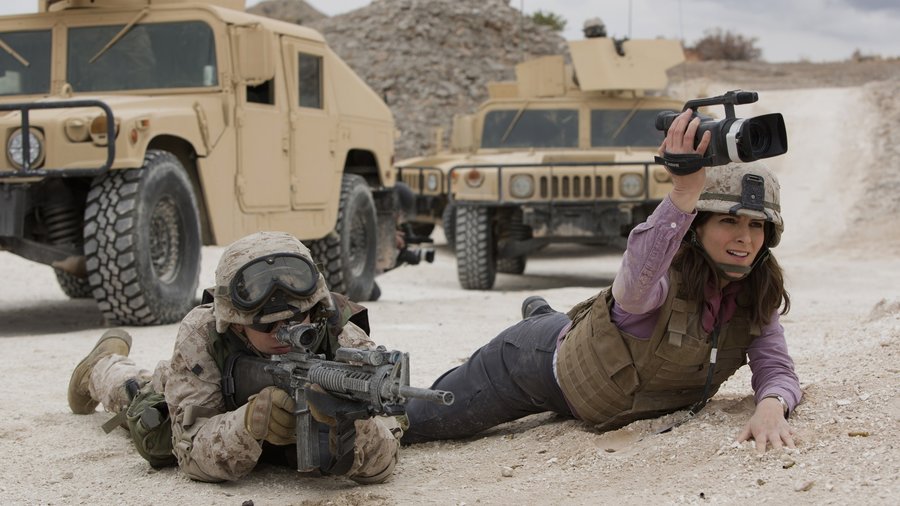
At first, Kim’s inexperience doesn’t do her any favours but she soon begins to gauge the lie of the land and the feelings of the US soldiers stationed there. Her status as a woman helps her gain access to news stories that other (male) journalists and reporters are unable to gather, and as time goes by, she earns the respect of her fellow journalists, Fahim, and even General Hollanek (Thornton), the head of the US forces. She also takes risks when she feels it necessary, such as leaving an armoured vehicle when the convoy she’s in is attacked and capturing the event on video. The only downside of her experience thus far is when she catches her boyfriend (Charles) with another woman during an unscheduled video call.

Her sudden availability has its upside, though. It allows her to manipulate local Afghan minister Ali Massoud Sadiq (Molina), into providing her with background intelligence, though Fahim warns her that she is becoming like the drug addicts he used to treat before the war: willing to do anything to get a story. She also develops a relationship with Scottish journalist Iain MacKelpie (Freeman); at first it’s only serious on his side, but Kim becomes attached to him, and their relationship deepens. As the two get to know each other, Iain tells her of an opportunity to interview a local warlord. The only drawback is his location: on the other side of a mountain pass that is closed due to heavy snow. While they wait for the snows to clear, Kim finds herself having to justify her continuing presence in Afghanistan, and travels to New York to state her case in person. There she discovers an unexpected rival for her “spot”, and also learns that Iain has been abducted for ransom…

WTF - scene1

Barker’s story – recounted in her book The Taliban Shuffle: Strange Days in Afghanistan and Pakistan – is remarkable for how “Pakistan and Afghanistan would ultimately become more all-consuming than any relationship [she] had ever had.” Sadly, Robert Carlock’s screenplay only manages to skirt round this attachment, preferring instead to imply an unrequited attraction between Kim and Fahim that can never be consummated, and an actual relationship with Iain that sees Fey look uncomfortable whenever she and Freeman end up in a clinch. This is one of many components that the movie never finds a satisfactory place for, and the result is an uneven, sporadically effecive piece that does occasional justice to Barker’s story, and Fey’s skills as an actress.

As with so many true stories adapted for the screen, the movie changes a lot, and in the process loses sight of what works best. Kim’s back story is predictably sketchy – why is she so miserable about her job?; how did she get to a point where the idea of covering a war in a far-off country became her best option? – and it’s jettisoned just as predictably once she arrives in Kabul. The movie continues in the same vein, offering brief soundbites in lieu of solid characterisations, and making only intermittent attempts to provide motivations for the actions of its principals (when it can be bothered to go beyond the superficial). By failing to provide any of its characters with any depth – Thornton’s General is so lightweight he’s practically gossamer-thin – it becomes hard to care about anyone, even Kim. Aside from a sincere yet unnecessary subplot involving a wounded soldier (Jonigkeit), Whiskey Tango Foxtrot rarely gives the viewer a reason to believe that any of Barker’s memoir has been adapted with a view to making it appear earnest or artless.

WTF - scene2

Fey’s obvious forté is comedy, and when the movie needs her to be, she’s very funny indeed. But she’s not quite so confident in the dramatic stretches, and it’s these moments that help undermine the movie further. Fey only comes across as comfortable in these situations if she can put a comedic spin on things, and the script lets her do this far too often for the audience to be comfortable as well. In support, Freeman puts in a good enough performance but isn’t given enough to do that’s memorable or fresh, while Robbie flits in and out of the narrative just enough for viewers to remember she’s there, and to remind Fey as Kim that in Afghanistan she’s gone from a solid six to a nine (so much for female solidarity in a male-dominated society). As for Molina, he plays Sadiq as a lecherous horny goat, a character two steps removed from a Carry On movie racial stereotype; it’s not quite a completely offensive portrayal, but both Molina and directors Ficarra and Requa should have known better.

Despite all this, the movie is amiable enough, and under Ficarra and Requa’s stewardship makes for an undemanding viewing experience. Like Fey they seem more at home when dealing with the more humorous aspects of Barker’s time in Afghanistan (Pakistan is left out of the equation entirely), though they redeem themselves in terms of the movie’s look. Along with DoP Xavier Grobet, the directing duo give the movie a rich visual style that offers crisp compositions at almost every turn, and a warm colour palette that refutes the idea of Afghanistan as a ravaged, war-blighted country lacking in beauty. At least they got that right.

Rating: 5/10 – an awkward mix of drama and comedy where neither comes out on top and where each ends up countering the other, Whiskey Tango Foxtrot isn’t as bad as it may seem, but it’s also not as good as it could have been; fans of Fey may be satisfied by her performance here, and she’s to be applauded for trying something outside her comfort zone, but there’s too many times when she doesn’t do the (admittedly) thin material any justice.

Share this:

  • Click to share on X (Opens in new window) X
  • Click to share on Facebook (Opens in new window) Facebook
  • More
  • Click to print (Opens in new window) Print
  • Click to email a link to a friend (Opens in new window) Email
Like Loading...

The Hobbit: The Battle of the Five Armies (2014)

23 Tuesday Dec 2014

Posted by dullwood68 in Movies

≈ 1 Comment

Tags

Bard the Bowman, Bilbo Baggins, Cate Blanchett, Erebor, Galadriel, Gandalf, Ian McKellen, J.R.R. Tolkien, Legolas, Literary adaptation, Martin Freeman, Middle Earth, Orlando Bloom, Peter Jackson, Richard Armitage, Sauron, Smaug, Thorin Oakenshield

Hobbit The Battle of the Five Armies, The

D: Peter Jackson / 144m

Cast: Ian McKellen, Martin Freeman, Richard Armitage, Orlando Bloom, Evangeline Lilly, Ken Stott, Lee Pace, Luke Evans, Aidan Turner, Dean O’Gorman, Graham McTavish, Cate Blanchett, Hugo Weaving, Christopher Lee, Sylvester McCoy, Stephen Fry, Ryan Gage, Billy Connolly, James Nesbitt, Ian Holm, John Bell, Mikael Persbrandt, Manu Bennett, John Tui, Benedict Cumberbatch

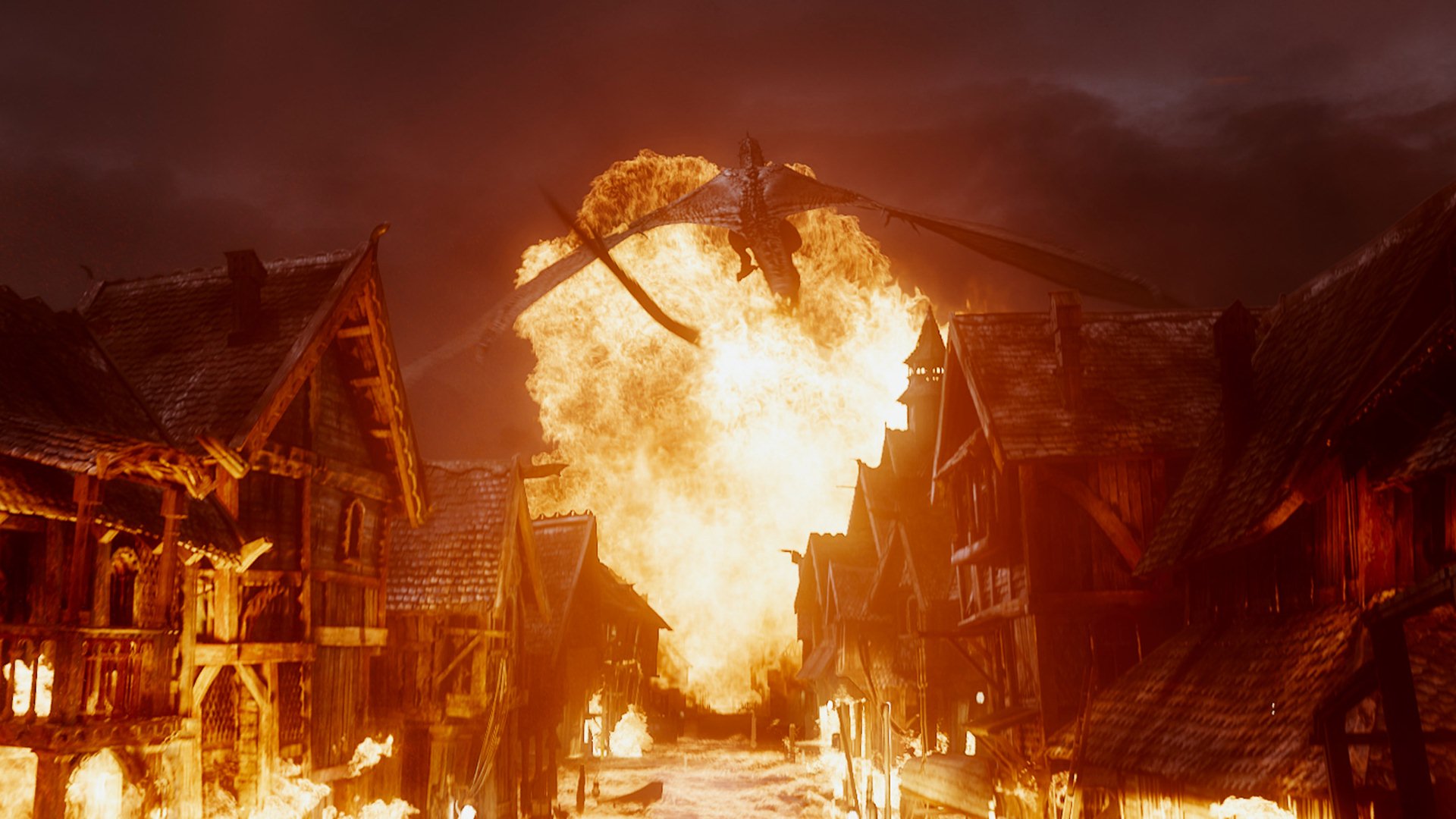
Angered by the attempt to kill him, Smaug (Cumberbatch) leaves the Lonely Mountain and the dwarf city of Erebor to wreak his vengeance on Laketown and its people. As he lays fiery waste to the doomed town, Bard the Bowman (Evans) seeks a way to defeat the dragon. With the aid of his son, Bain (Bell), Bard succeeds, but the town is in ruins. With winter fast approaching the inhabitants of Laketown look to Erebor and the promise made by Thorin (Armitage) when he was aided by Bard. But Thorin is in the grip of dragon sickness, his mind fixed on protecting the gold in the mountain, and he refuses to give the people of Laketown shelter; instead they are forced to take refuge in the ruined town of Dale.

Inside Erebor, Thorin’s madness worsens with the absence of the Arkenstone, the jewel that ensures his position as king of the dwarves. It transpires that Bilbo (Freeman) was able to take the jewel during his encounter with Smaug, but he fears giving it to Thorin. Meanwhile, the woodland elves, led by Thranduil (Pace), arrive in Dale with supplies for the humans and with the intention of reclaiming some jewels that are owed to him by Thorin’s forebears. Bard attempts to reason with Thorin but the dwarf leader refuses to yield. With an army of Orcs led by Azog the Defiler (Bennett) almost upon them, Gandalf (McKellen) arrives in time to provide support for the human-elf alliance.

Bilbo sneaks out of Erebor and gives the Arkenstone to Thranduil. One last attempt is made to avoid bloodshed but Thorin is adamant he will have war. With the arrival of a dwarf army led by Thorin’s cousin Dain (Connolly), a battle between the dwarves and the elves begins but is interrupted by the arrival of Azog’s forces. The dwarves and the elves and the humans all join forces against the orcs, while in Erebor, Thorin is on the brink of being completely subsumed by madness. And to make matters worse, Legolas (Bloom) and Tauriel (Lilly) discover that there is a second army of orcs heading for Erebor as well.

Hobbit The Battle of the Five Armies, The - scene

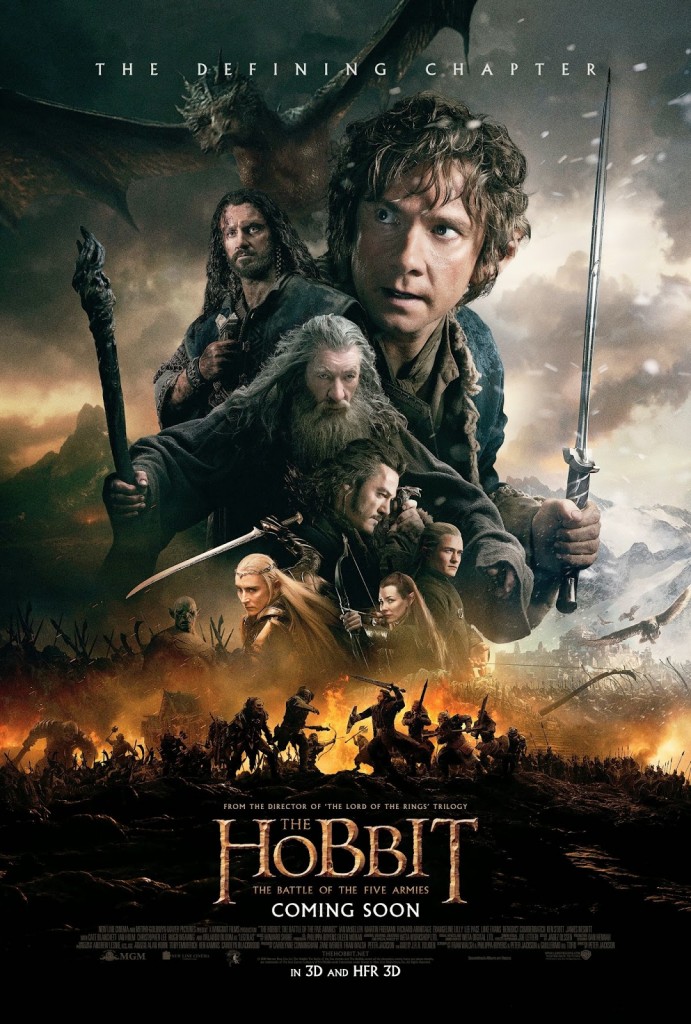
And so, in true George Lucas/Star Wars fashion, we come to the end of the journey – in the middle of it. Heralded as the “defining chapter” this is the movie that Jackson needed to get right above all the other Hobbit movies. Everything has been a prelude to this, the linking chapter in a six film series that has come to define fantasy movie-making on an epic, unprecedented scale, while always retaining a true sense of what’s most important: the characters. Whatever your thoughts on the idea that two movies would have been better than three, what can’t be disputed is the care and attention that Jackson and co-scripters Fran Walsh and Philippa Boyens (with additional input from Guillermo del Toro) have taken in their efforts to bring Tolkien’s short novel to the screen.

Dispensing with the traditional prologue that shows previous events, The Battle of the Five Armies picks up directly after The Desolation of Smaug and throws us into one of the trilogy’s most exciting action sequences, as the dragon vents its wrath on the unfortunate Laketown. It’s a bravura piece of movie making, each burst and eruption of flame so convincingly rendered it’s hard to believe that most of the action has been created in a computer. With Smaug’s death it’s full speed ahead to the climactic battle that involves dwarfs, men, elves, orcs and eagles. It’s a fast-paced, often relentless movie, tilting headlong from one skirmish to another, barely pausing for breath, and yet able to maintain an emotional intensity that other fantasy movies can’t even begin to come near. It also shows Jackson near the height of his directorial powers – that honour goes to The Lord of the Rings: The Return of the King (2003) – firmly in command of the material and assembling it all in a way that looks far too easy.

Jackson’s decision to make The Battle of the Five Armies the shortest of the Hobbit movies is a wise one, making it a more immediate, thrilling experience, but still with that depth of emotion that we’ve come to know and expect from each trip to Middle Earth. The relationship between Bilbo and Thorin is this movie’s finest flourish, so adroitly handled and acted by Freeman and Armitage that their scenes together are capable of making the viewer hold their breath. The added romance between Tauriel and Kili (Turner) is perhaps more perfunctory but is still touching enough to warrant its inclusion. In truth, the whole cast excel, with McKellen, Armitage and Evans the standouts in a movie with more than its fair share of superb performances. It’s been said before, but Jackson has created such a vivid world that even when he introduces creatures that very closely resemble the worms from Tremors (1990), they still feel a part of Middle Earth. This attention to detail, this “world building”, is what separates these movies from all the rest. And of course, there’s the action, inventive, compelling, and wonderfully choreographed for maximum effect. It’s impressive stuff – as you’d expect – and full of horror, humour, seamless CGI (unless, for some reason, it involves Radagast the Brown), and stirring feats of physicality (Legolas vs Bolg). But best of all, and after all has been said and done, and the battle is over, Jackson treats us to a wordless scene between Bilbo and Gandalf that is perfect in its simplicity.

With an ending that blends effortlessly with the beginning of The Lord of the Rings: The Fellowship of the Ring (2001), the movie also doesn’t outstay its welcome, but mostly because this isn’t the end of an era, but the opening chapter in a much grander tale. As such its shorter running time is to be applauded; though don’t be fooled, the movie packs so much in it’s a masterclass of concise plotting and scripting. Some fans may still complain about the treatment of certain characters – Beorn (Persbrandt) has even less to do here than before – and the similarities between the Battle of the Pelennor Fields and this one are self-apparent, but all in all, Jackson’s adaptation of The Hobbit has been a success. To those who say The Hobbit trilogy is less dramatic or satisfying than The Lord of the Rings trilogy, it should be mentioned that they are very different “beasts”, one originally intended as a children’s novel, its follow-up more for older audiences. What Jackson has done is to keep the essential ingredients of the novels and expanded the material around them to make one long story albeit in two sections and with sixty years between them. It’s still a staggering achievement and worthy of as much high praise as can be doled out.

The same can also be said for the movie’s crew, including director of photography Andrew Lesnie, production designer Dan Hennah, and composer Howard Shore (and not forgetting the sterling work of second unit director Andy Serkis). These and the thousands of other people who have worked on the movies deserve some kind of reward for their efforts.

Rating: 9/10 – a rip-roaring, spectacular action movie to wind up the trilogy, The Hobbit: The Battle of the Five Armies is guaranteed to put a smile on the face of fans, and reassure those doubters that Jackson had made a mistake by manipulating the novel into three movies; but take heart anyone who thinks they’ve seen the last of all things Middle Earth, there’s still an extended edition of the movie to come.

Share this:

  • Click to share on X (Opens in new window) X
  • Click to share on Facebook (Opens in new window) Facebook
  • More
  • Click to print (Opens in new window) Print
  • Click to email a link to a friend (Opens in new window) Email
Like Loading...

The Hobbit: The Desolation of Smaug (2013)

23 Monday Dec 2013

Posted by dullwood68 in Movies

≈ 1 Comment

Tags

Benedict Cumberbatch, Bilbo Baggins, Evangeline Lilly, Ian McKellen, J.R.R. Tolkien, Legolas, Literary adaptation, Martin Freeman, Orlando Bloom, Review, Smaug, The Hobbit, The Lord of the Rings

Hobbit The Desolation of Smaug, The

D: Peter Jackson / 161m

Cast: Martin Freeman, Ian McKellen, Richard Armitage, Ken Stott, Benedict Cumberbatch, Orlando Bloom, Evangeline Lilly, Lee Pace, Luke Evans, Stephen Fry, Sylvester McCoy

The Hobbit: An Unexpected Journey (2012) was, in some ways, a difficult movie to appreciate.  As the beginning of what is effectively now a six-film series, the difference in tone and approach threw some viewers who were expecting a match for The Lord of the Rings (2001-3).  Jackson and co-scriptwriters Fran Walsh and Philippa Boyens, and Guillermo del Toro, took the more humorous elements of Tolkien’s novel and weaved them into the story with accomplished ease.  They made several key decisions with the characterisations of the dwarves that left audiences unsure if the comedic aspects were appropriate or in keeping with the overall tone of the trilogy (not to mention the darker trilogy that follows it).  What seemed to be forgotten in the rush to criticise the movie was that it was the first of three: making any kind of criticism at this early stage was actually irrelevant.  As the first two Lord of the Rings movies were largely ignored at the Oscars, only for the third to be so heavily rewarded, so we should wait until all three parts of The Hobbit are released.  Then we can make a proper decision.

What is clear is that with The Hobbit: The Desolation of Smaug, Jackson has hit his stride, and as a result, the trilogy has hit its stride as well.  The exposition of the first movie is largely dismissed with, and the introduction of new characters such as Thranduil (Pace) and Tauriel (Lilly) is handled concisely and with greater attention than before.  There is an even greater focus on action, with the barrel-rolling sequence a highlight, and a greater sense that this movie’s events fit in with, or more appropriately foreshadow, the events of The Lord of the Rings.

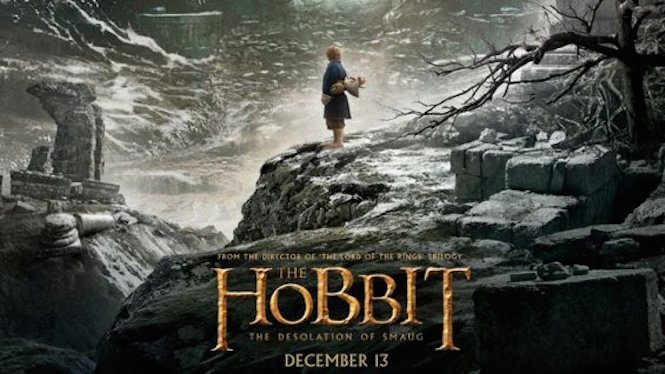
Having survived the attack by orcs at the end of the first movie, Bilbo (Freeman), Thorin (Armitage) and the rest of the dwarves set off into Mirkwood where spiders – and not just any spiders – inhabit the forest.  Meanwhile, Gandalf (McKellen) heads off to Dol Guldur to face the rising power of the Necromancer (Cumberbatch).  The dwarf company, or überfellowship, make it out of Mirkwood only to find themselves captured by elves.  With Bilbo’s help, they escape, and are pursued by orcs, Tauriel – who has developed a bit of a crush on dwarf Kili (Adrian Turner) – and Thranduil’s son Legolas (Bloom).  At Dol Guldur, Gandalf meets up with Radagast the Brown (McCoy) and finds that the Necromancer is preparing an orc army to march against the lands of the west.    The dwarves evade the orcs with the help of Bard the Bowman (Evans).  Bard lives in Lake-town, and he takes Thorin and his band there where they can both tend to Kili, who has been hit by a poisoned orc arrow, and plan the next step of their journey to the Lonely Mountain.  The orcs attack again but not before Thorin has left; Bard helps the dwarves that have been left behind and Tauriel and Legolas join the fray as well.  Bilbo finds the way into the Lonely Mountain where he encounters the dragon Smaug (Cumberbatch), and despite their best attempts the dwarves fail to kill him.  Enraged, Smaug breaks free of the mountain and heads to Lake-town to wreak his revenge.

The movie ends there, rather abruptly too, with only Bilbo’s anguished “What have we done?” to see out proceedings.  As might be expected there has been a large amount of criticism of the movie ending this way, but watching The Desolation of Smaug, and with Smaug’s entrance occurring around the two-hour mark, anyone even half aware of the movie’s running time would have known a resolution to the problem of Smaug was always going to be unlikely.  And it means that The Hobbit: The Battle of the Five Armies (2014) is going to have one hell of a start.

Hobbit The Desolation of Smaug, The - scene

The ending aside, the movie does still suffer from “middle child syndrome”, with too many storylines set up to be resolved in the next one, and the running time feeling a little too long.  Gandalf is sidelined for much of the movie (fairly reflecting the novel), while some of the dwarves are given very little to do indeed – anyone know something specific that Ori or Bifor did?  Radagast gets a cameo this time round (and repeats his bird under the hat trick), Azog (Manu Bennett) cedes his quest for Thorin’s head to Bolg (Lawrence Makoare), and the worst kept secret in town: the identity of the Necromancer, is revealed at last.  Oh, and there’s the weird matter of Legolas sporting contact lenses; it makes him look slightly alien rather than Elvish.

These minor quibbles aside, The Desolation of Smaug is a terrific addition to the complete saga, thrilling, intense, spectacular to look at with even more beautiful New Zealand scenery to devour, a continued line of humour that complements the increasing sombre tone (Legolas’ dismay at seeing a picture of Gloin’s son), the introduction of Lilly as Tauriel (this trilogy’s Arwen), Jackson’s complete mastery of both the material and the visual language needed to present it, a cast that more than matches him for commitment and artistry, and of course, the mighty Smaug, without doubt the most realistic, most impressive dragon ever imagined.  Voiced by Cumberbatch, Smaug is the movie’s highlight: an arrogant, vain, greedy, vicious, preening monster who trades verbal barbs with Bilbo in the movie’s best scenes.  Both Freeman and Cumberbatch are on superb form here, adding layers to their performances that bring out all the subtleties of the dialogue, and keeping the audience riveted as they spar back and forth.

With another year to go before the trilogy’s conclusion, The Hobbit: The Desolation of Smaug is a more than satisfying instalment that works well and impresses on a regular basis.  There’s little doubt that Jackson and co are firing on all cylinders, and if the purists out there are still complaining about the increasing lack of fidelity to the original novel then they’re missing the point: this is an adaptation, and a wonderful one at that.

Rating: 9/10 – a rousing blend of action and spectacle that moves at breakneck pace, The Hobbit: The Desolation of Smaug rarely disappoints; event cinema that we see too little of these days and absolutely best seen in 48hfr on an IMAX screen.

Share this:

  • Click to share on X (Opens in new window) X
  • Click to share on Facebook (Opens in new window) Facebook
  • More
  • Click to print (Opens in new window) Print
  • Click to email a link to a friend (Opens in new window) Email
Like Loading...

Blog Stats

  • 486,736 hits

Recent Posts

  • 10 Reasons to Remember Bibi Andersson (1935-2019)
  • Fantasia (1940)
  • Dances With Wolves (1990) – The Special Edition
  • Kiss of the Spider Woman (1985)
  • The Three Musketeers (1973)

Top Posts & Pages

  • Lost for Life (2013) - Another Look
    Lost for Life (2013) - Another Look
  • Lost for Life (2013)
    Lost for Life (2013)
  • About
    About
  • Exposed (2016)
    Exposed (2016)
  • Cardboard Boxer (2016)
    Cardboard Boxer (2016)
  • A Brief Word About La La Land (2016)
    A Brief Word About La La Land (2016)
  • The Monuments Men (2014)
    The Monuments Men (2014)
  • A Brief Word About Netflix Original Comedies
    A Brief Word About Netflix Original Comedies
  • Removal (2010)
    Removal (2010)
  • My Top 10 Guilty Pleasures
    My Top 10 Guilty Pleasures
Follow thedullwoodexperiment on WordPress.com

Blogs I Follow

  • Rubbish Talk
  • Film 4 Fan
  • Fast Film Reviews
  • The Film Blog
  • All Things Movies UK
  • Interpreting the Stars
  • Let's Go To The Movies
  • Movie Reviews 101
  • TMI News
  • Dan the Man's Movie Reviews
  • Film History
  • Jordan and Eddie (The Movie Guys)

Archives

  • April 2019 (13)
  • March 2019 (28)
  • February 2019 (28)
  • January 2019 (32)
  • December 2018 (28)
  • November 2018 (30)
  • October 2018 (29)
  • September 2018 (29)
  • August 2018 (29)
  • July 2018 (30)
  • June 2018 (28)
  • May 2018 (24)
  • April 2018 (21)
  • March 2018 (31)
  • February 2018 (25)
  • January 2018 (30)
  • December 2017 (30)
  • November 2017 (27)
  • October 2017 (27)
  • September 2017 (26)
  • August 2017 (32)
  • July 2017 (32)
  • June 2017 (30)
  • May 2017 (29)
  • April 2017 (29)
  • March 2017 (30)
  • February 2017 (27)
  • January 2017 (32)
  • December 2016 (30)
  • November 2016 (28)
  • October 2016 (30)
  • September 2016 (27)
  • August 2016 (30)
  • July 2016 (30)
  • June 2016 (31)
  • May 2016 (34)
  • April 2016 (30)
  • March 2016 (30)
  • February 2016 (28)
  • January 2016 (35)
  • December 2015 (34)
  • November 2015 (31)
  • October 2015 (31)
  • September 2015 (34)
  • August 2015 (31)
  • July 2015 (33)
  • June 2015 (12)
  • May 2015 (31)
  • April 2015 (32)
  • March 2015 (30)
  • February 2015 (37)
  • January 2015 (39)
  • December 2014 (34)
  • November 2014 (34)
  • October 2014 (36)
  • September 2014 (25)
  • August 2014 (29)
  • July 2014 (29)
  • June 2014 (28)
  • May 2014 (23)
  • April 2014 (21)
  • March 2014 (42)
  • February 2014 (38)
  • January 2014 (29)
  • December 2013 (28)
  • November 2013 (34)
  • October 2013 (4)

Create a free website or blog at WordPress.com.

Rubbish Talk

Film 4 Fan

A Movie Blog

Fast Film Reviews

The Film Blog

The official blog of everything in film

All Things Movies UK

Movie Reviews and Original Articles

Interpreting the Stars

Dave Examines Movies

Let's Go To The Movies

Film and Theatre Lover!

Movie Reviews 101

Daily Movie Reviews

TMI News

Latest weather, crime and breaking news

Dan the Man's Movie Reviews

All my aimless thoughts, ideas, and ramblings, all packed into one site!

Film History

Telling the story of film

Jordan and Eddie (The Movie Guys)

Movie Reviews & Ramblings from an Australian Based Film Fan

Privacy & Cookies: This site uses cookies. By continuing to use this website, you agree to their use.
To find out more, including how to control cookies, see here: Cookie Policy
  • Subscribe Subscribed
    • thedullwoodexperiment
    • Join 481 other subscribers
    • Already have a WordPress.com account? Log in now.
    • thedullwoodexperiment
    • Subscribe Subscribed
    • Sign up
    • Log in
    • Report this content
    • View site in Reader
    • Manage subscriptions
    • Collapse this bar
 

Loading Comments...
 

    %d