Cast: Logan Lerman, Elle Fanning, Michelle Monaghan, Kyle Chandler, Blake Jenner, Nathan Lane, Yahya Abdul-Mateen II, Margaret Qualley, Janina Gavankar, Tim Blake Nelson, Darren Pettie
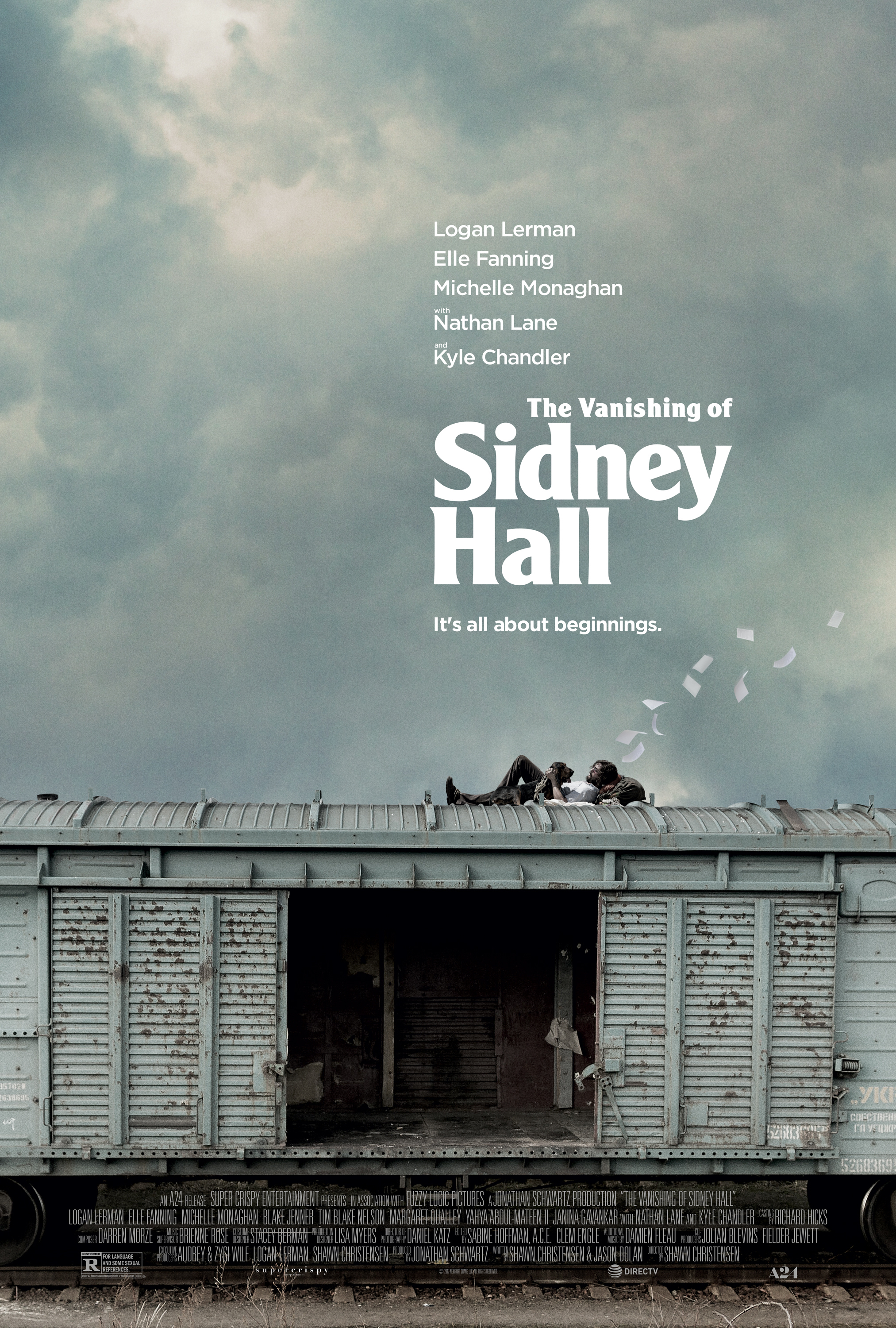
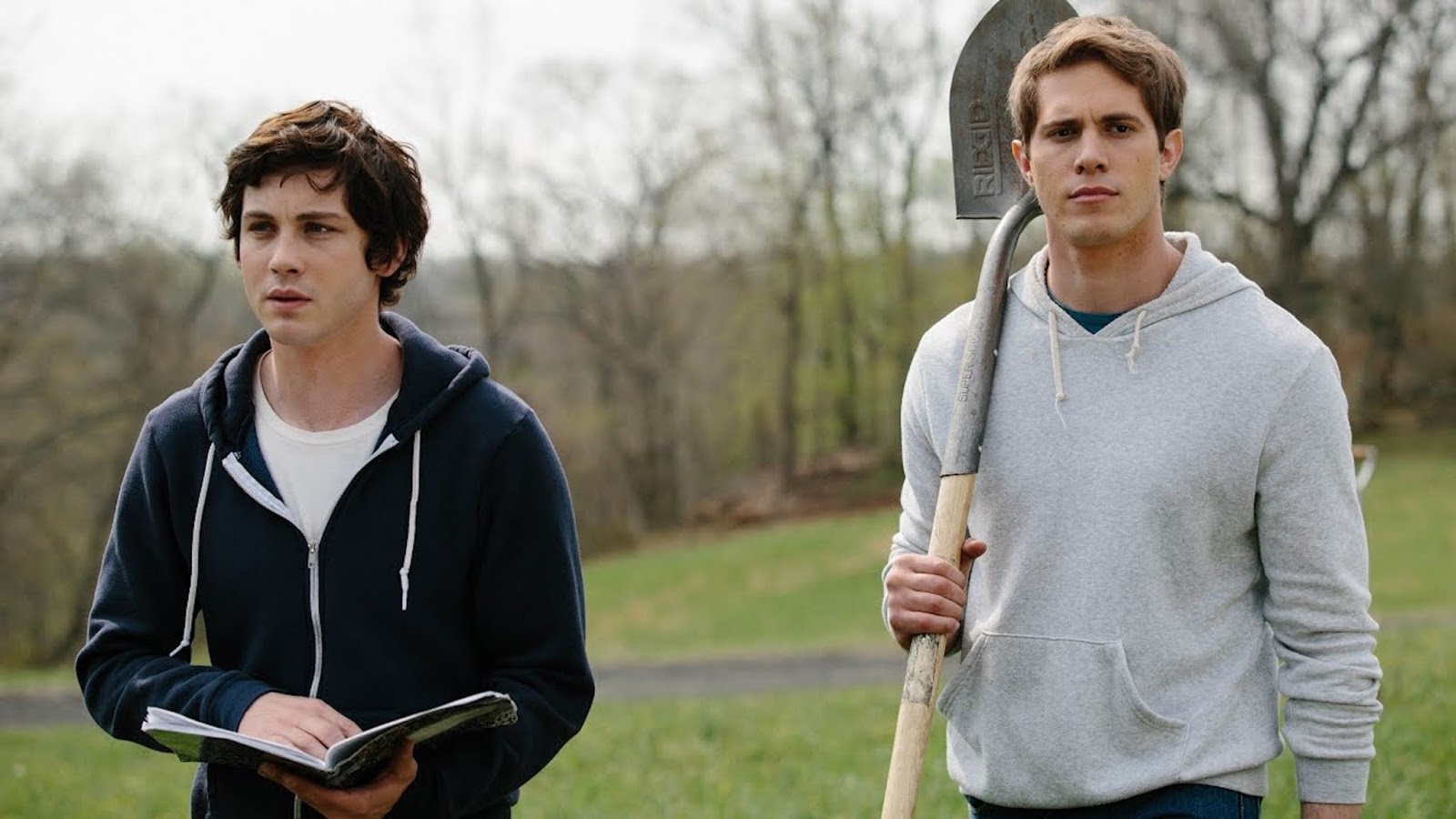
A publishing phenomenon, Sidney Hall (Lerman) writes a first novel called Suburban Tragedy that is nominated for a Pulitzer Prize; he’s only eighteen when he starts writing it. By the time he’s twenty-four, he’s written a follow-up, State of Execution; both novels sit atop the New York Times Best Seller list. But Sidney isn’t happy. His past, and in particular, the source of inspiration for Suburban Tragedy, haunts him. He has married his teenage sweetheart, Melody (Fanning), but is unable to resist the attentions of his publisher’s daughter, Alexandra (Qualley), leading to an affair. As time passes, Sidney becomes more and more reclusive, until he disappears altogether. Soon after, a spate of arson attacks in bookshops and libraries, where the only books burnt are Hall’s, attracts the attention of a police detective (Chandler). Tracing the arson attacks across the Midwest, the detective becomes convinced that the perpetrator is Hall himself. But why would he do such a thing, and why disappear in the first place? What could have made Sidney Hall throw away everything he’d achieved?
Non-linear stories such as The Vanishing of Sidney Hall have two benefits: they can tease out important plot points in a way that keeps the viewer intrigued and wanting to know more, and they can reshape a movie’s storyline to ensure a greater emotional or dramatic impact when the mystery (whatever it is) is finally revealed. Shawn Christensen’s second feature aims for both, and is moderately successful as a whole, but makes one fatal flaw that stops the movie from achieving the goals Christensen has set for it: it makes Hall himself too miserable – and unrelentingly so – for the viewer to feel much sympathy for him. While the roots of his melancholy lie in a terrible tragedy that he feels responsible for, it’s a long time before the movie reveals this. And by the time that it does, and those all important plot points have been left as clues for us to piece together, the movie has become lethargic and banal. A late-on reveal feels forced (and less than entirely credible), while key moments are replayed without ever adding any greater emotional or dramatic impact. At the same time, the movie’s structure is both its best and worst component.
Something of a labour of love for Christensen, the movie often wears its heart on its sleeve, and though Hall is the kind of tortured literary genius we’ve seen so many times before, the co-writer/director surrounds him with a number of supporting characters that often prove more interesting. Sidney’s mother (Monaghan) is the kind of toxic parent who blames their child for being born and ruining their life, while his English teacher (Abdul-Mateen II) is so desperate to ride Hall’s coat-tails to literary success that his neediness is embarrassing. These are stories that, on their own, could comprise a number of separate movies, but Christensen keeps them in Sidney’s orbit, satellites bouncing off his celebrity, and feeling hard done by because of it. In the end, Sidney’s determination to punish himself pushes everyone away from him (hence, in part, his disappearance), but the script always makes it feel deserved. As the complex literary genius, Lerman is a solid presence, better at playing him as a teenager than as an adult, while Fanning offers strong support as the love of his life. There are good performances throughout, and the movie is beautifully photographed by Daniel Katz, but in its themes and ambitions, it lacks the overall cogency needed to make it all gel.
Rating: 6/10 – a worthy attempt at portraying the devastating effects of one tragic event on a young man’s much deserved success, The Vanishing of Sidney Hall falls short thanks to its title character’s unnecessary (and hard to condone) self-flagellation; with its insistence on breaking the story down into bite-size chunks of culpable exposition, it’s also a movie that says a lot but forgets to add enough substance to back it all up.
Cast: Jamie Foxx, Michelle Monaghan, Dermot Mulroney, Scoot McNairy, David Harbour, Tip ‘T.I.’ Harris, Gabrielle Union, Octavius J. Johnson, Tim Connolly
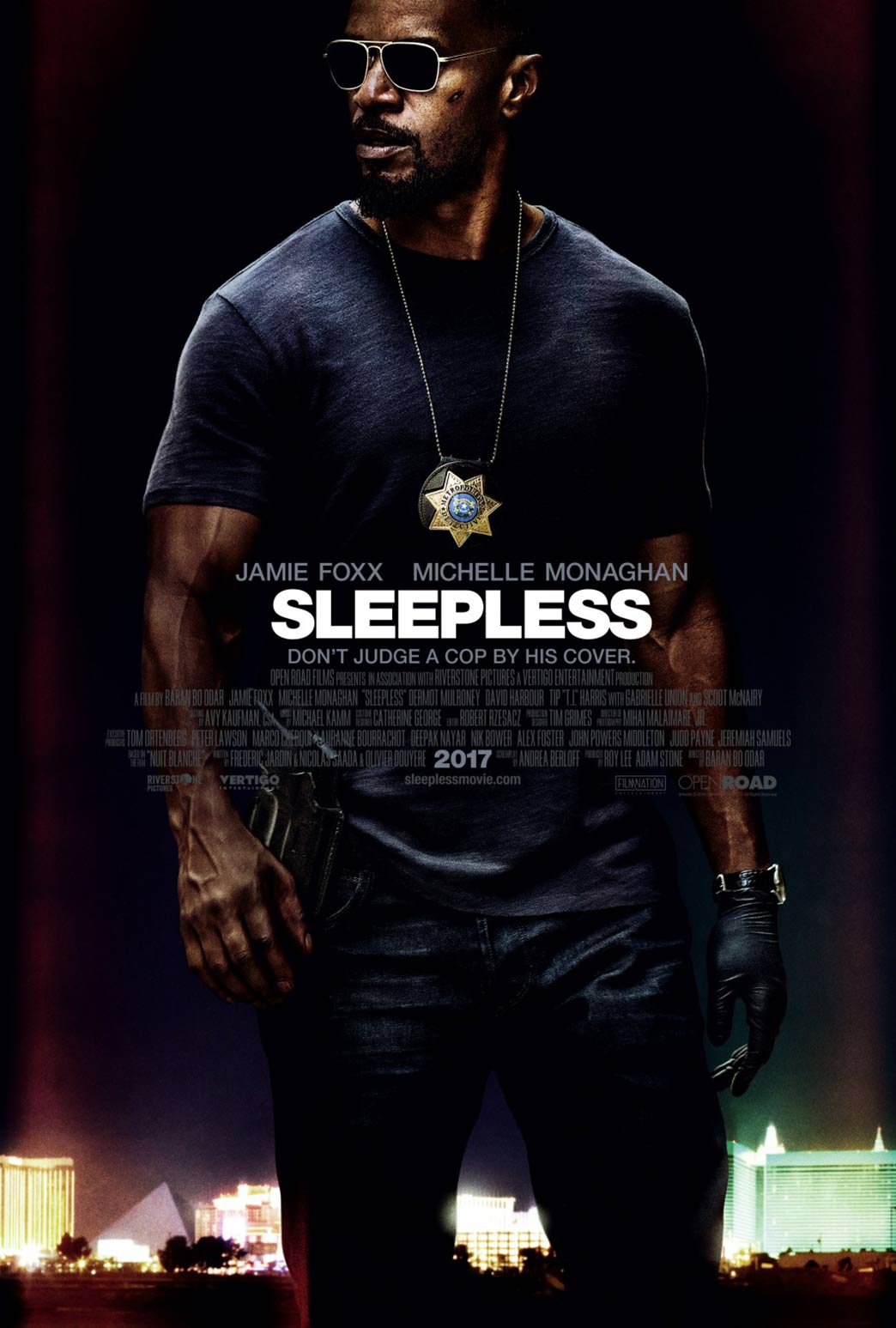
Vincent Downs (Foxx) is a crooked Las Vegas cop. Sean Cass (Harris) is his equally crooked partner. Together they steal twenty-five bundles of cocaine (though why they do this is a little fuzzy). Their use of department issue weapons gains the attention of Internal Affairs officer, Jennifer Bryant (Monaghan), who immediately suspects Downs of the theft. Convinced by her own intuition that he’s dirty, she brings her suspicions to her partner, Doug Dennison (Harbour), but he’s not convinced. Meanwhile, Downs – who has an ex-wife, Dena (Union) and teenage son Thomas (Johnson) – is trying to maintain a semblance of post-divorce family life when Thomas is abducted by local casino-cum-crime boss Stanley Rubino (Mulroney). The reason for this? Simple: the cocaine is his and he wants it back, or Thomas will pay for Downs’ actions.
Downs takes the cocaine to Rubino’s casino, but in one of those plot “twists” that never make sense, he hides twenty-three of the bundles in the casino, gives Rubino the other two and bargains for his son’s life, stating that he’ll hand over the rest when he knows his son is safe. Rubino agrees, but when Downs tries to retrieve the rest of the cocaine from its hiding place, he discovers that Bryant (who has been following him) has taken it, and in a move that would have her investigated by Internal Affairs as well, has hidden it elsewhere in the casino. But there’s a further wrinkle: the cocaine is owed to gangster Bobby Novak (McNairy), and he’s there to collect…
Nuit blanche. That’s the title of the French/Belgian/Luxembourgian co-production, released in 2011 that, in its English language guise, has become Sleepless. If it matters to you, Nuit blanche (aka Sleepless Night) has a score of 75 on Metacritic, while Sleepless has a score of 33. Which version would you rather see? (Don’t worry, it’s a rhetorical question.) Inevitably, Sleepless – a title that makes no sense without the word “night” attached to it – is professionally made, glamorous to look at, has Foxx and Monaghan working really hard to overcome the preposterousness of Andrea Berloff’s urgent-but-empty screenplay, and never once makes you care about Downs or his son’s predicament. It tries to, on several occasions, but thanks to a combination of Berloff’s writing and director Odar’s reliance on style over substance, it has a shallow, seen-it-all-before vibe that harms the movie more than it helps it, and which stops it from letting the audience in on the – sadly – warmed over intrigue.
Remakes of foreign language movies often suffer in comparison because there are more things that can be lost in translation than just the dialogue. Tone, the original movie’s rhythm, its location, its visual aesthetic, any subtexts – all these and more can be either abandoned or discarded in the process of “re-imagining” a movie for audiences who speak another language (though surely that’s what subtitles are for?). There may be an element of “we can do better” about these remakes, and though that certainly isn’t the case with Sleepless (and despite any intentions its makers may have had), this is still a bad idea that lets down audiences at every turn. Even its fight scenes, which see Foxx get pummelled regularly but to minimal effect even though he has a stab wound to deal with, don’t elicit enough reaction to be successful in themselves. And if an action thriller can’t get those scenes right…
Rating: 4/10 – lacklustre, and padded out with way too many establishing shots of Las Vegas itself (we know where we are, for Foxx’ sake), Sleepless is a run-of-the-mill effort that tries hard but doesn’t know how to deliver; an over-complicated script proves too much for the cast to deal with, and despite its relatively compact running time, you’ll be wishing for a quicker resolution than is actually on offer.
Cast: Mark Wahlberg, Kevin Bacon, John Goodman, J.K. Simmons, Michelle Monaghan, Alex Wolff, Themo Melikidze, James Colby, Michael Beach, Rachel Brosnahan, Christopher O’Shea, Jake Picking, Jimmy O. Yang, Vincent Curatola, Melissa Benoist, Khandi Alexander, Adam Trese, Dustin Tucker
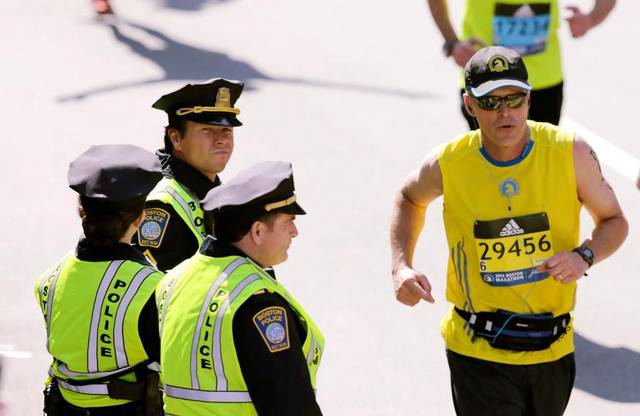
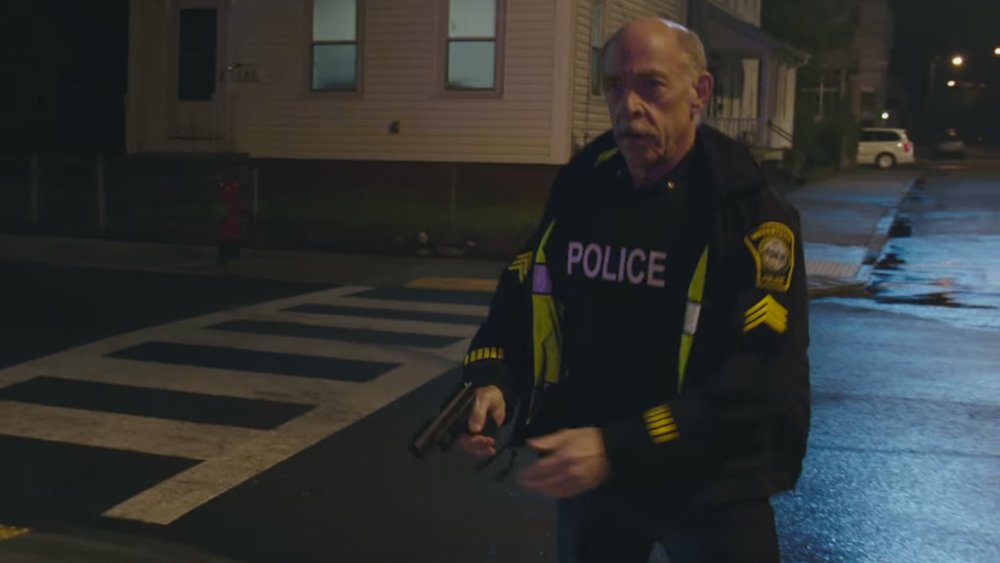
At 2:48pm on 15 April 2013, the 117th annual Boston Marathon was taking place, and was proceeding as smoothly as in previous years. It was already nearly three hours since the winner had crossed the finish line, and the remainder of the runners – some 5,700 – were still to complete the course. A minute later, at 2:49pm, a bomb exploded in the crowd of onlookers near the finish line; approximately thirteen seconds after, a second bomb exploded one block further away. Between them, the blasts claimed the lives of three people, and injured hundreds of others, including sixteen people who lost limbs. It was a terrorist attack that no one saw coming, and such was the confusion at the time of the blasts that runners still crossed the finish line for another eight minutes.
This is the core event of Patriots Day, a recreation of the bombings that occurred that fateful day, and the subsequent manhunt that took place over the next four days. It begins with Boston Police Department Sergeant Tommy Saunders (Wahlberg) and moves on to introduce a variety of individuals whose lives will be affected by the bombing and subsequent events. These include Tommy’s wife, Carol (Monaghan), Boston Police Commissioner Ed Davis (Goodman), young couple Jessica Kensky (Brosnahan) and Patrick Downes (O’Shea), Chinese student Dun Meng (Yang), MIT police officer Sean Collier (Picking), district of Watertown police Sergeant Jeffrey Pugliese (Simmons), Boston Police Superintendent Billy Evans (Colby), naturalised U.S. citizen Dzhokhar Tsarnaev (Wolff), his brother Tamerlan (Melikidze), and Tamerlan’s American-born wife, Katherine (Benoist).
By the time the race starts we know that Tamerlan and Dzhokhar will be the people who place the bombs. And as the race begins, and we see them moving amongst the crowds, what has been a fairly straightforward, and somewhat leisurely approach to the events of 15 April 2013 begins to become something altogether more focused, and darker. When the bombs do go off – and we know they will – the explosions, and the devastation they cause, are still shocking. And it’s as this point that Patriots Day, which could have so easily been a tale of jingoistic heroism sprinkled with Hollywood-ised action beats, becomes something even richer and more surprising: a movie based on true events that incorporates an incredible level of detail, and better still, includes actual footage from the time. It’s this aspect of the movie, the mixture of real and realised that impresses the most, as it makes the verisimilitude that much more potent.
In adapting the book, Boston Strong by Casey Sherman and Dave Wedge, director Peter Berg has made his most accomplished and impactful movie to date. Reuniting with Mark Wahlberg for the third time after Lone Survivor (2013) and Deepwater Horizon (2016) – also true stories – Berg has finally crafted a movie that resonates on more than one level, and which doesn’t rely on the jingoistic heroism mentioned above. It does celebrate the way in which the residents of Boston came together in the wake of a terrorist attack, but Sergeant Pugliese’s incredibly brave confrontation with Tamerlan Tsarnaev aside, there aren’t any moments of gung ho courage, just an acknowledgment of how determined everyone – law enforcement and public alike – were in making sure the bombers were captured. It’s not often that a movie gives you a true sense of a community coming together in such a way, but this is definitely one of them, and it does so powerfully and succinctly.
The various storylines are cleverly interwoven as well, with each character given a relevant amount of screen time, and their lives, even Wahlberg’s composite policeman, explored with a tremendous surety of touch. Admittedly, some of the investigators – Bacon’s overly experienced FBI agent Richard DesLauriers, Goodman’s shocked and angry Police Commissioner – fare less well in this respect due to the nature of their involvement, but otherwise, people such as Downes and Kensky, who had reached the finish line when the first bomb went off, are afforded due recognition because of what happened to them not only then but subsequently. The same is true of Steve Woolfenden (Tucker), who was injured and separated from his young son, Leo. Away from the injured, the fates of people such as Dun Meng and MIT police officer Sean Collier are played out with sincerity and a lack of sensationalism, or the kind of made-for-TV banality that offsets any strived-for veracity.
Once the manhunt is under way and an initial identification of the suspects has been made (one of the movie’s cleverest moments), the movie steps up a gear, and becomes intensely exciting. The scenes involving Dun and the Tsarnaevs are mini-masterclasses in how to keep an audience on the edge of their seat, and all this is achieved by precision editing (courtesy of Gabriel Fleming and Colby Parker Jr) and an emotional undercurrent that permeates the movie as a whole. Berg makes you care about the people in this movie, these people who experienced so much and came out the other side so much stronger (albeit not all of them). The same can be said of the shootout on Watertown’s Laurel Street, a literally explosive confrontation between the police and the Tsarnaevs that stands head and shoulders above most movie shootouts, and which again, thanks to Fleming and Parker Jr, leaves the viewer gasping at how insane it all was, and how frightening it must have been to be a part of it all.
Berg’s commitment to telling this story as honestly and passionately as possible, while not sensationalising it in any way, is the reason why it works so well, and why it deserves every possible accolade. He’s helped tremendously by a cast so committed to meeting his vision of the story that there’s not one performance that’s out of place or not operating in service of the material. Wahlberg, who always seems to feel more comfortable playing blue collar workers, puts in his best work since The Fighter (2010), while the likes of Goodman, Bacon, Monaghan and Simmons all deliver solid, credible supporting performances that enhance the narrative whenever they’re on screen. As the Tsarnaevs, Wolff and Melikidze are an impressive teaming, establishing both the bonds and the boundaries between the two brothers with almost nonchalant ease; it’s an adversarial relationship in many ways (as with so many brothers), but you never once question their commitment to their cause and each other. But if there has to be one actor or actress who stands out for any reason, then that is unquestionably Melissa Benoist, TV’s current Supergirl. Watch the scene where Katherine is interrogated by a nameless “spook”: it’s an exemplary display of a character’s doubt, fear, loathing, and blinkered self-assurance, and is as surprising for its conclusion as it is for the iciness of the scene as a whole.
The movie ends as most movies attempting to tell a true story often do: with an update on some of the people whose lives were affected on that terrible day in April 2013. And then it goes one step further, and you hear the voice of the real Patrick Downes, and then you see both him and Jessica Kensky as they talk about that day and what it’s meant to them since. You see officials such as Ed Davis and Richard DesLauriers, and as they talk about the notion of Boston Strong, the unifying concept that sprang up in the wake of the bombings, the idea that Boston and its people would not be intimidated by acts of terrorism – listening to them you understand just why Berg and his team were so determined not to make this an exercise in hyperbole or the cinematic equivalent of yellow journalism. Because if they had, then the movie’s final image – its message if you like – would have meant nothing. It would have lacked context, and it would have lacked the emotional jolt that the movie leaves you with. And what was that image? Ah, now that would be telling…
Rating: 9/10 – a superb retelling of the Boston Marathon bombings and the manhunt that followed over the next one hundred and five hours, Patriots Day is a movie devoid of frills, unnecessary plot devices, or political finger-pointing; a tribute to all those who survived the bombings, and the extraordinary levels of cooperation between a city and its law enforcement – a de facto curfew was in place following the shootout in Watertown – the movie focuses on telling its story matter-of-factly and audaciously, and by concentrating on the people who were caught up in it all, an approach that many other movies “based on real events” should try adopting as well.
Cast: Adam Sandler, Kevin James, Michelle Monaghan, Josh Gad, Peter Dinklage, Matt Lintz, Brian Cox, Sean Bean, Jane Krakowski, Fiona Shaw
Ten things you’ll be wondering while watching Pixels, and the answers that may well pop into your head:
1) How on earth has Adam Sandler landed a four-picture deal with Netflix – didn’t anyone at Netflix see this before they signed on the dotted line? (He must have something on the guys who run it.)
2) Is it really necessary for Sandler and Michelle Monaghan to behave like five year olds in the White House? (No, but it does seem like the script’s idea of cutting edge humour.)
3) Will it be easier to watch if I shut my eyes? (Probably.)
4) Would Americans really elect a complete idiot to the highest office in the land? (Hang on, who was that guy George something or other?)
5) When is that unfunny Rob Schneider cameo going to turn up? (Hopefully when it’s time for a toilet break.)
6) If the aliens are using video game characters that were around in 1982, just how many video games that came out post-1982 are they going to be allowed to use as well? (Loads, because nobody could be bothered to do the research.)
7) When is Chris Columbus going to direct another decent movie? (On this evidence, not any time soon.)
8) Why are the human characters more like cartoons than the video game characters? (Perhaps it’s meant to be ironic? Maybe?)
9) Just how many young actors are there that look like Adam Sandler when he was a kid, and are they all receiving counselling? (Too many, and probably not; what help could they possibly be given?)
10) Hang on, hasn’t this been done before – and better – in an episode of Futurama? (Yes, it has, so why aren’t I watching that instead of this mess?)
Rating: 3/10 – sci-fi has had a rough summer this year, and Pixels, with its lazy script and so-what-if-it-doesn’t-make-sense-or-is-particularly-funny approach acts as yet another nail in the coffin of tent-pole sci-fi movies; Sandler coasts, James gives yet another unfunny embarrassing performance, Monaghan and Cox look inconsolable, and Gad is left to – well, it’s not clear – making this ill-advised project one of the biggest disappointments of the year.
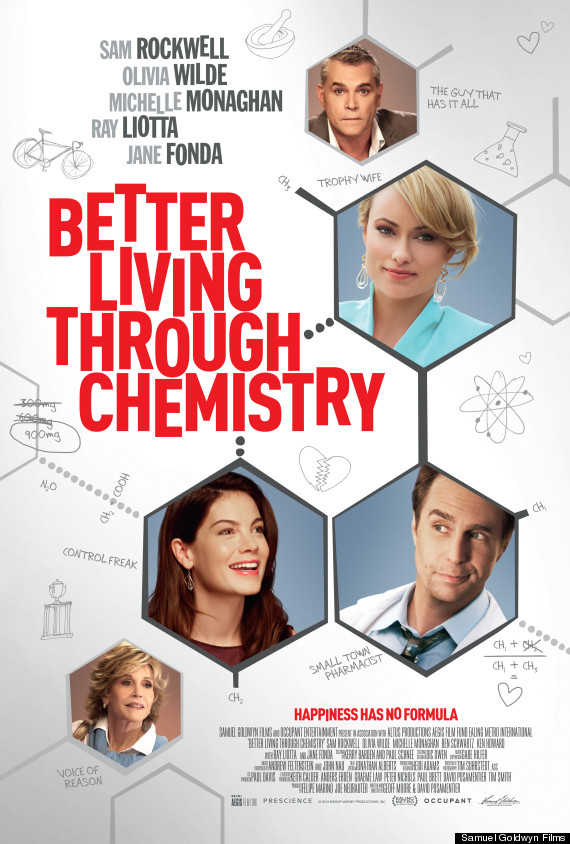
Cast: Sam Rockwell, Olivia Wilde, Michelle Monaghan, Norbert Leo Butz, Ben Schwartz, Ken Howard, Harrison Holzer, Ray Liotta, Jane Fonda
Another slice of American small-town life, Better Living Through Chemistry introduces us to pharmacist Doug Varney (Rockwell). Doug is married to Kara (Monaghan) and they have a twelve year old son, Ethan (Holzer). Kara is too absorbed in her work as a fitness instructor to pay Doug much attention and they haven’t had sex for ages, while their son is getting into trouble at school. At work, Doug has just taken over his father-in-law’s pharmacy business but is dismayed to find the sign isn’t changing from Bishop’s Pharmacy to Varney’s Pharmacy. Browbeaten and ignored by the people closest to him, Doug continually finds it difficult to stand up for himself, or make any lasting changes in his life. Seeing no way out of his predicament, he coasts along resignedly… until he meets Elizabeth (Wilde).
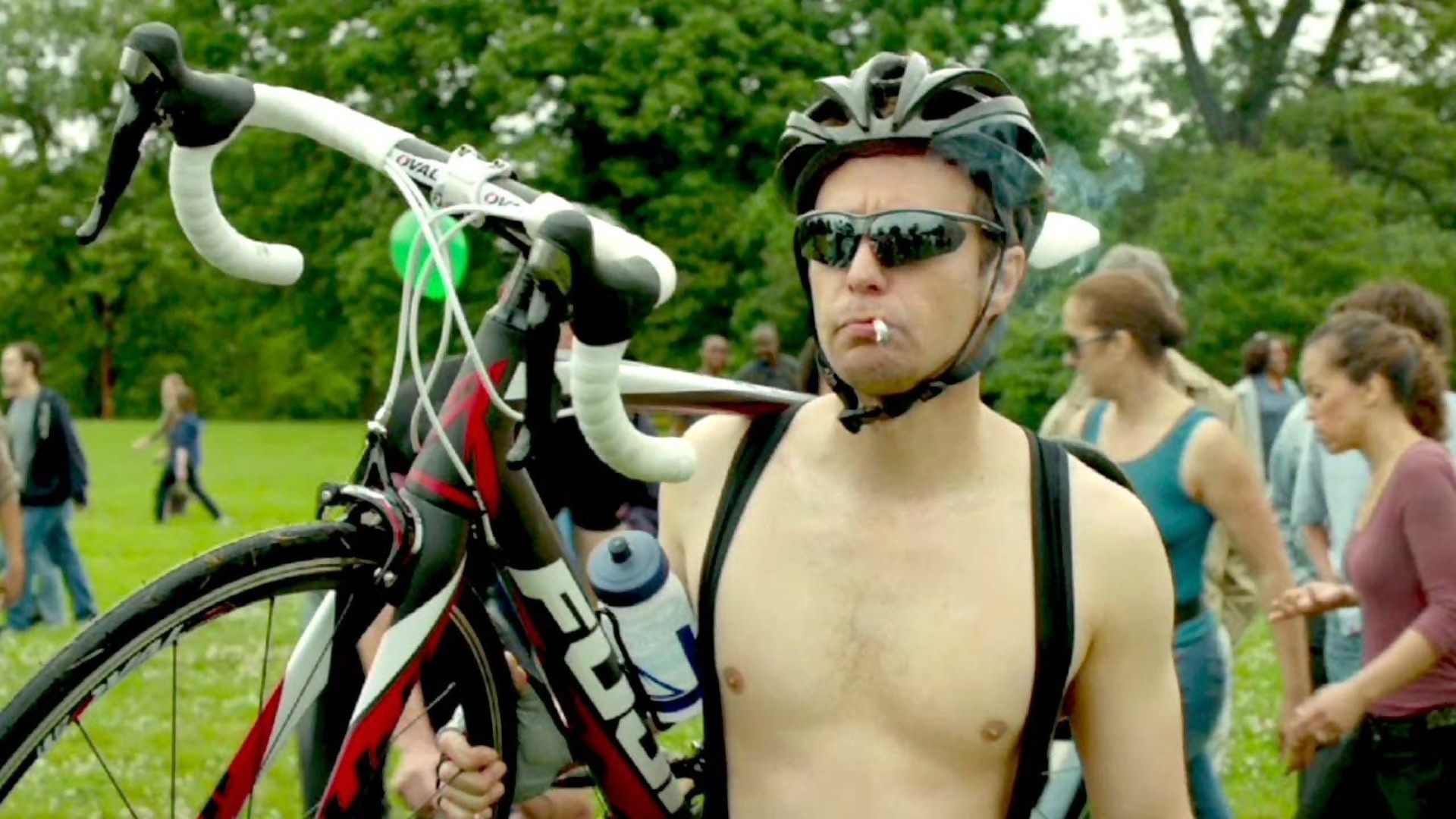
Elizabeth has recently moved to town with her husband, Jack (Liotta). She takes a lot of pills and drinks a lot of alcohol and tells Doug about her troubled marriage. They begin an affair, during which Doug takes one of Elizabeth’s pills, the first time he’s ever taken any drug, prescribed or otherwise. Gaining a liking for how drugs can make him feel, Doug begins to make his own, mixing various pills in order to maintain and then boost the wellbeing he’s experiencing. The drugs boost his confidence, and this in turn, helps him address matters at home. He reconnects with Ethan, and devises a plan to beat Kara in the annual cycling race she has dominated for five of the last six years. And as well as juggling work, his home life, and his affair with Elizabeth, Doug also has to deal with a routine investigation by DEA agent Carp (Butz), that might uncover his misuse of his stock.
Doug and Elizabeth’s affair becomes more serious and they plan to leave town together, but Elizabeth has signed a pre-nuptual agreement, and Doug will lose what little he has in a divorce. They decide to bump off Jack by making a slight change to his prescription. Elizabeth leaves town to establish an alibi, and Doug arranges for Jack’s medication to be delivered by assistant Noah (Schwartz). But their plans go awry, and in a way neither of them could have foreseen…
A bittersweet drama with comedic episodes woven into the movie’s fabric, Better Living Through Chemistry is an enjoyable though perilously lightweight movie that benefits tremendously from Rockwell’s confident central performance. There’s little here that’s entirely new but co-writers/directors Moore and Posamentier have done a good job in bringing together and exploiting both the humorous and the dramatic elements. The movie switches focus with ease from scene to scene, offering different moods at different times, but there’s nothing forced or contrived about the way events unfold, or how the characters react to or deal with them.
This is largely due to the script, which (as mentioned above) only occasionally strays towards depth, but does have a few things to say about love and marriage (even if we’ve heard and seen them many times before). Where it does do well is in its ability to upset the audience’s expectations. After the cycling race, Doug and Kara have sex, and it’s the most satisfying sex they’ve had in ages, but it doesn’t presage a sea change in their relationship. Instead, it reinforces Doug’s decision to leave Kara for Elizabeth. It’s this kind of twist in the tale that the movie does so well, and this and some other surprises stop it from being entirely predictable.
Unfortunately, the characters are mostly one-dimensional, especially as written, but thankfully the cast are more than up to the challenge of breathing life into them. Rockwell excels as the mild-mannered pharmacist turned would-be killer for love (you’ll never look at him in the same way again after seeing him in a leotard), and carries the movie effortlessly, making Doug an everyman character we can all sympathise with and root for. Wilde has the glamour role, and carries it off with ease, subverting expectations as to Elizabeth’s motivations at every turn. Monaghan has the least developed role but still manages to make Kara a shade more interesting than if she was just a hard-nosed bitch, and in minor roles, Liotta (providing what amounts to a cameo) and Butz add flavour to the proceedings. The oddest role goes to Jane Fonda who not only narrates the movie as if she’s been witness to everything that happens, but also appears briefly at the end, and is listed as herself in the end credits.
With its well-chosen cast and its carefree approach to recreational drug use, Better Living Through Chemistry is neither a cautionary tale nor an exposé of small town secrets. At its heart it’s a look at one man’s road to emotional self-recovery, and on that level it works splendidly. But without any appreciable depth to proceedings, the movie misses out on being as effective as it could have been.
Rating: 7/10 – a charming movie given life by its well-chosen cast (it’s hard now to envision first choice Jeremy Renner in the role of Doug), Better Living Through Chemistry often comes close to letting itself down but just manages to avoid doing so; an undemanding movie, but still a winning one for all that.







 thedullwoodexperiment