• 10 Reasons to Remember…
  • A Brief Word About…
  • About
  • For One Week Only
  • Happy Birthday
  • Monthly Roundup
  • Old-Time Crime
  • Other Posts
  • Poster of the Week
  • Question of the Week
  • Reviews
  • Trailers

thedullwoodexperiment

~ Viewing movies in a different light

thedullwoodexperiment

Tag Archives: Moscow

The Death of Stalin (2017)

26 Thursday Oct 2017

Posted by dullwood68 in Movies

≈ Leave a comment

Tags

Armando Iannucci, Central Committee, Comedy, Drama, Jeffrey Tambor, Literary adaptation, Michael Palin, Moscow, Olga Kurylenko, Review, Simon Russell Beale, Soviet Russia, Steve Buscemi

D: Armando Iannucci / 106m

Cast: Steve Buscemi, Simon Russell Beale, Jeffrey Tambor, Michael Palin, Andrea Riseborough, Olga Kurylenko, Jason Isaacs, Rupert Friend, Dermot Crowley, Paul Whitehouse, Paul Chahidi, Paddy Considine, Adrian McLoughlin

The Death of Stalin could have easily been subtitled Fear and Loathing in Moscow, such are the high levels of animosity and opposition that ensue following the death of Soviet leader, “Uncle Joe” Stalin (McLoughlin). As the various members of the Central Committee scramble to establish a way forward – and more importantly, decide which one of them will be the country’s new leader – loyalties are tested, schemes are hatched, alliances are forged, but political manoeuvring continues unabated (it’s just that some of the goals, and the goalposts themselves, are changed from moment to moment). Under the satirical gaze of writer/director Armando Iannucci, the events that took place in the wake of Stalin’s death provide the basis for a movie that combines very black humour with a surprisingly serious approach to the material that helps the movie operate effectively on two separate levels, both comedic and dramatic.

While not everything happened in the way that Iannucci portrays it, some things did, and it’s the way in which he emphasises the absurdity of these real events that adds greatly to the effectiveness of the screenplay which has been co-written by Iannucci, David Schneider and Ian Martin, with additional material by Peter Fellows, and which itself is based on a screenplay by original source material writer Fabien Nury (The Death of Stalin has been adapted from the comic book of the same name). One such event occurs following the stroke Stalin suffered on 1 May 1953. When he’s found the next morning, it takes around twelve hours for a doctor to be called, as each member of the Central Committee refuses to make a decision by themselves in case Stalin recovers and takes them to task for their actions. It’s only when all the Committee members are in agreement that a doctor is needed that anything more is done. But then there’s another issue: thanks to the recent Doctors’ Plot, where prominent doctors were accused of conspiring to assassinate Soviet leaders, all the good, well regarded physicians in Moscow have been either imprisoned or executed. So, who to call? It’s moments like these, absurdist moments that challenge the perception of what’s real and what’s invented that makes the movie so enjoyable to watch.

But Iannucci isn’t solely interested in pointing out how ridiculous some of the events surrounding Stalin’s death were, but also how deadly serious that milieu was and how nothing could be taken for granted, be it a job, a reputation, or worse still, a life. Iannucci is quick to show the darker side of Soviet life in the Fifties, with Stalin’s Head of Security, Lavrentiy Beria (Beale), relishing his role as a combination accuser,  torturer, and executioner, whether he’s chasing down real enemies of the state or fabricating evidence to convict the innocent through political expediency. With Stalin’s full support while he’s alive, Beria has attained a position of power that he seeks to build on once his mentor is dead, and as he manipulates the Deputy Leader, the fragile minded Georgy Malenkov (Tambor), it’s left to Nikita Khrushchev (Buscemi) to put a stop to Beria’s ambitions.

One of the more absurdist notions of Iannucci’s movie is that it puts forth Nikita Khrushchev as its hero, but this was Khrushchev’s time, the moment where he took power in the wake of Stalin’s death and set about making long-lasting reforms. Here he’s a worried politician who wants to see an end to the tyranny of Stalin’s rule, and fears that Beria’s influence on Malenkov will see an unnecessary continuation of past horrors. Iannucci makes it clear that fear is the one overwhelming motivator in Soviet life, no matter what level you’re at. There’s fear of saying the wrong thing, fear of being seen with the wrong person, fear of ignorance and knowledge together, and fear of being in the wrong place at the wrong time. The movie shows how stressful this must have been, and how easy it must have been to make a simple honest mistake that might mean the difference between life and death, and how either outcome could shift according to whim or will.

Such a dark period in Soviet history (one of many though, to be fair) might not be the best subject for a dark comedy, but The Death of Stalin is more than that, and as well as its exploration of a society living in fear, it also seeks to examine how power corrupts those who look for it above all else – Beria seals his fate by threatening each of the other Committee members with what he knows about them. These dramatic moments, where the political jockeying turns brittle and ugly, allows the humour to have even more of an impact; if you didn’t laugh, you’d have to acknowledge the tragedy and the terrible nature of what’s happening. But Iannucci knows when to raise a laugh and when to keep the drama humour-free. It’s a delicate tightrope that he traverses, but he does it with style and confidence, creating a restrained yet also panic-ridden atmosphere for his characters to operate in. He also finds time to highlight the self-serving hypocrisy of the Committee members, something that’s best expressed through the attitude of Vyacheslav Molotov (Palin), who denounced his wife for the good of the party – and his own position within it.

With Iannucci and his co-writers putting together such a good script, and Iannucci himself proving that he’s firmly in control of both the tone and the pace of the movie, things are made even more impressive by the cast that he’s assembled. Buscemi is terrific as Khrushchev, a bureaucrat holding the fate of a nation within his hands, while Tambor’s turn as Malenkov is a delight, even if you have to wonder how such a dimwit got onto the Committee in the first place. There are first-rate supporting turns from Isaacs as a very gruff, very Yorkshire-sounding Head of the Red Army, Georgy Zhukov; Riseborough as Stalin’s daughter, Svetlana; Considine as an under threat theatre manager who really needs to record a live concert; and Palin, who gives such a subtle reading of his character that it serves as a reminder that when he’s not travelling the world, he’s a very accomplished actor indeed. But if anyone stands out it’s Beale as the venal, grotesque Beria, a character who seems fully formed from the moment we first see him, flinging horrible caustic remarks about with no concern for the feelings of others, and telling the audience everything they need to know about him in one perfect line of dialogue: “Have a long sleep, old man. I’ll take it from here.” It’s a performance that’s unlikely to win any awards thanks to the nature of the movie, but if Beale did win an award, it would be entirely justified. It’s the perfect cap to a movie that operates effectively on so many levels, and which has a lot more going on below the surface both in terms of the narrative, and its recreation of a period when laughing at senior Soviet politicians would have meant a swift trip to a gulag…or worse.

Rating: 8/10 – a movie that treats its historical backdrop with a great deal of respect (even when it alters certain facts to suit the material), The Death of Stalin is a small, unassuming gem of a movie that is both horrifying and amusing at the same time, and without either element undermining the other; with its clutch of richly perceptive performances, cleverly constructed humour, and astute direction, it’s a movie that may not find the wider audience it deserves, but is nevertheless a must-see for anyone who likes their political satire barbed and ready to sting.

Share this:

  • Click to share on X (Opens in new window) X
  • Click to share on Facebook (Opens in new window) Facebook
  • More
  • Click to print (Opens in new window) Print
  • Click to email a link to a friend (Opens in new window) Email
Like Loading...

Despite the Falling Snow (2016)

08 Tuesday Nov 2016

Posted by dullwood68 in Movies

≈ Leave a comment

Tags

Antje Traue, Charles Dance, Cold War, Defection, Drama, Espionage, Literary adaptation, Moscow, Rebecca Ferguson, Review, Romance, Russia, Sam Reid, Shamim Sarif, Spying

despite-the-falling-snow-poster

D: Shamim Sarif / 93m

Cast: Rebecca Ferguson, Sam Reid, Charles Dance, Antje Traue, Oliver Jackson-Cohen, Thure Lindhardt, Anthony Head

One of the things that never happened in the Golden Age of Cinema was an author being given the opportunity to make a movie of one of their novels or stories. Some were employed to adapt their novels and stories, but none were ever allowed to step behind the camera as well and actually direct the movie. Nowadays, this isn’t so unusual, but it’s also still not very prevalent. So step forward Shamim Sarif, author and movie maker, who has been making movies from her novels from the very beginning. She is possibly unique in this way, and has gained a very good reputation from working on both sides of the creative arena. Despite the Falling Snow is the third movie she’s made from one of her novels, and while she may be well regarded in some quarters as the perfect person to adapt her work – after all, who knows it better than she? – the finished product here isn’t quite the testament to her talents as a director.

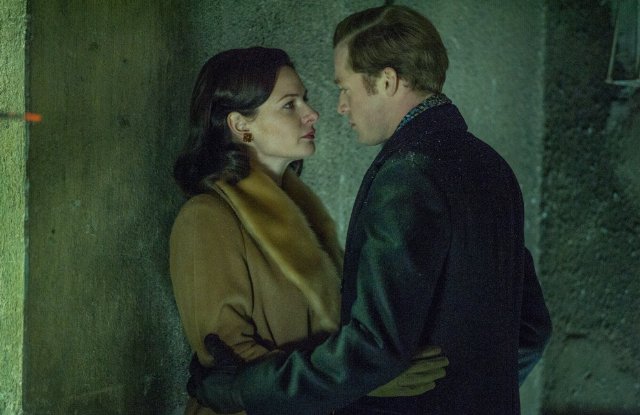
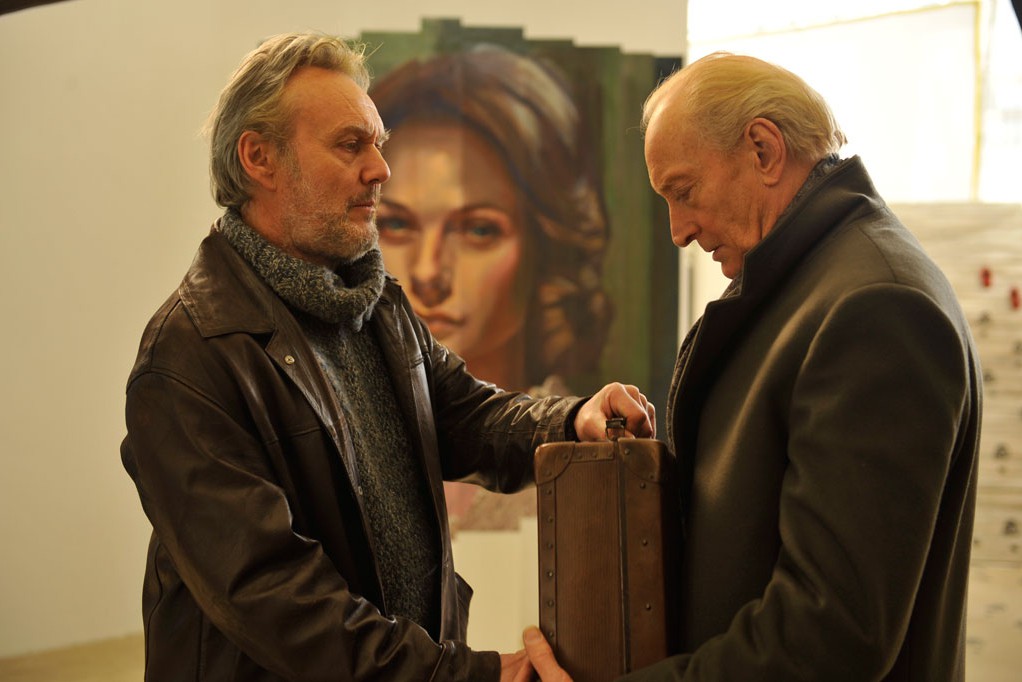
The movie begins in New York in 1961 with the defection of a Russian government official called Sasha (Reid). As he’s helped to escape from his Russian handlers, he asks about his wife, Katya (Ferguson). She’s back in Moscow, but his new, US handlers have no idea where she is or what has happened to her. Fast forward thirty years and Sasha (Dance) is a successful restaurateur who has a niece, Lauren (also Ferguson) who is the spitting image of Katya, and who wants to travel to Moscow to try and find out what happened to her aunt. Sasha refuses to go with her, though, so Lauren, who’s lucky enough to be an artist who’s been asked to mount an exhibition in Moscow, heads off by herself.

day-17-2-881x588

While Lauren’s story plays out in 1991, Katya’s story plays out in tandem from 1959 to 1961. Katya is a teaching assistant who’s also helping her friend and government official Misha (Jackson-Cohen) steal secrets and pass them on to the Americans. At a party she meets Sasha but is unimpressed by him. It’s only when Misha persuades her to get close to Sasha because of his position in the Kremlin that she finds herself falling in love with him. Meanwhile, in 1991, Lauren meets and befriends a journalist called Marina (Traue) who helps her in finding out about Katya. Marina learns that Misha (Head) is still alive, and they make plans to visit him. When they do they find he’s become an embittered, angry old man who wants nothing to do with them.

Back in 1961, Katya and Sasha wed, but she agonises over whether she should tell him she’s a spy. In 1991, Marina’s behaviour becomes suspicious, and the unexpected arrival of Sasha in Moscow prompts a revelation. Katya’s decision to tell Sasha leads to his agreeing to defect, but thirty years on only Misha holds the key to what happened to her.

mv5bmtq1ndu0mjmyov5bml5banbnxkftztgwnzqxotkznje-_v1_sx640_sy720_

A romantic drama set – partly – during a period of intense political and social upheaval, namely the early Sixties, Despite the Falling Snow has such a generic feel to it that it could have been made about any couple in any country at any time, and still have made the same kind of impact. This is thanks to Sarif’s uninspired, pedestrian direction, and a visual style that never rises above formulaic. It’s as if Sarif has forgotten to add the drama needed to make the narrative more than just a succession of events and scenes that show how two people came together and then were separated by fate in the form of expediency. Even when suspicion falls on the officials in the Kremlin, including Sasha and Misha, it’s a moment where real terror at being found out translates instead as a mild concern. Misha is almost fatalistic about the whole thing, a reaction that not even the talented Jackson-Cohen can make convincing; this man should be even more scared than he’s been already.

But if the steady stream of narrative downplaying that infuses the scenes in early Sixties Russia also makes those scenes feel awkward and inconsistent, then spare a thought for those set in 1991. Sarif makes reference to the Berlin Wall having come down two years earlier, but her new Moscow is an uneasy mix of contemporary US stylings and Russian forebearance, as evidenced by Marina’s designer clothing and old Misha’s tower block abode. The juxtaposition jars, and adds to the overall feeling that Sarif wants her characters to look glamorous against the concrete backdrop of post-Stalinist Russia (Katya seems never to be without her red lipstick). The visual conceit is highlighted by Sarif’s decision to have Katya and Sasha, and Lauren and Marina, walk along the same snow-laden stretch of riverside pavement at different times, but instead of creating an echo of past events, it appears to be more of a budgetary deference than a creative decision.

despite_the_falling_snow-15

Elsewhere, narrative developments that appear out of nowhere are treated as if they are absolutely necessary to the overall plot, and that includes a left-field decision to have Lauren and Marina begin a sexual relationship. Old Sasha’s willingness to stay home out of harm’s way is overturned by the contents of a fax, while Old Misha’s decision to spill the beans about what happened to Katya is spurred on by feelings of guilt, and that old chestnut, a terminal illness. And when the viewer does find out what happened to Katya, Sarif handles it in such a hamfisted way that any emotional weight the scene might – or should – have engendered with said viewer, is lost before the scene’s even begun.

A lacklustre movie then, one that doesn’t even aim particularly high, but which does feature another of Charles Dance’s supporting roles (is he semi-retired now, is that what’s going on?) and a level of political naïvete that further dilutes the drama that isn’t really there. On the performance side, Ferguson is unable to make much of either role, as Sarif never allows the viewer to engage with them as anything other than under-developed non-characters. Reid is earnest but treading in a pool so shallow it’s practically evaporated, while Traue is allowed to look moody and resentful in equal measure even when she’s kissing Ferguson. Dance and Head bring a degree of old-time gravitas to the proceedings, but even they can’t avoid the pitfalls that are inherent in the script. On this showing, Sarif needs some more time to clarify her goals in making such a movie, and maybe next time, getting someone else to direct.

Rating: 4/10 – Sixties Moscow never looked cleaner, quieter, or more family friendly than it does in this movie, and that’s despite several efforts to make it look as if it’s not brand new; as a drama it never gets started, despite the best efforts of its cast, and by the end you’ll only want to know what happened to Katya just so that you can move on in (roughly) the same way everyone else does: without too much fuss.

Share this:

  • Click to share on X (Opens in new window) X
  • Click to share on Facebook (Opens in new window) Facebook
  • More
  • Click to print (Opens in new window) Print
  • Click to email a link to a friend (Opens in new window) Email
Like Loading...

Child 44 (2015)

04 Monday May 2015

Posted by dullwood68 in Movies

≈ Leave a comment

Tags

Daniel Espinosa, Drama, Gary Oldman, Joel Kinnaman, Leo Demidov, Literary adaptation, Moscow, Murder, Noomi Rapace, Review, Rostov, Serial killer, Soviet Union, Thriller, Tom Hardy, Tom Rob Smith

Child 44

D: Daniel Espinosa / 137m

Cast: Tom Hardy, Noomi Rapace, Gary Oldman, Joel Kinnaman, Paddy Considine, Fares Fares, Vincent Cassel, Jason Clarke, Nikolaj Lie Kaas, Tara Fitzgerald, Sam Spruell, Charles Dance

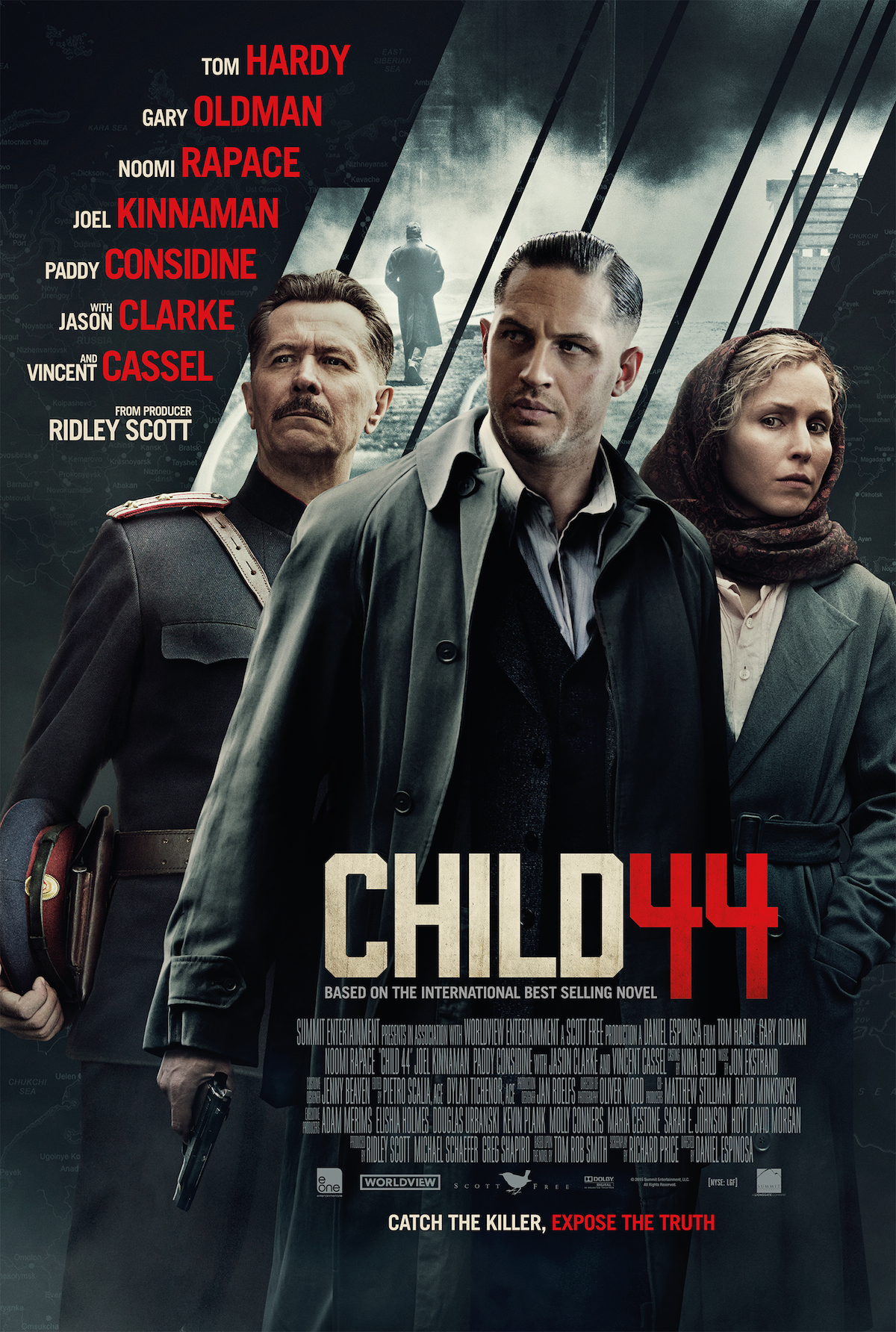
In post-war Soviet Russia, Leo Demidov (Hardy) is a respected officer in the Secret Police. Along with wartime comrades Vasili Nikitin (Kinnaman) and Alexei Andreyev (Fares) he investigates crimes against the state. When a suspect, Anatoly Brodsky (Clarke) goes on the run, their pursuit takes them to a farm where Brodsky has taken refuge. Against Leo’s wishes, Vasili kills the farmer’s wife and his young son; this drives a wedge between the two men.

A short while later, Andreyev’s young son is found dead by some railroad tracks. Though it’s clear that he has been murdered, thanks to Stalin’s edict that there shall be “no murder in paradise”, Leo is commanded by his superior, Major Kuzmin (Cassel), to tell Andreyev that the death was accidental. The idea doesn’t sit well with Leo but he goes ahead with it. When another child is murdered, Leo learns that there have been even more, similar cases. At the same time, he is tasked with investigating another suspected enemy of the state: his wife, Raisa (Rapace). She works in a school, and is friendly with one of the teachers, Ivan Sukov (Kaas). When his investigation reveals nothing incriminating about Raisa, his report is used as an excuse to strip Leo of his job and his home.

Leo is sent to Rostov to work under the command of General Mikhail Nesterov (Oldman). There, the discovery of another child’s body leads Leo to believe that the killer is responsible for over forty murders and is using the railway line between Rostov and Moscow as a means of hiding his crimes. Convincing Nesterov of his theory, Leo, aided by Raisa, returns to Moscow to seek help from Andreyev and gain access to files that will provide further information. But Vasili, who has been promoted to Leo’s old post, learns of his being in Moscow and tries to track him down and arrest him. Leo and Raisa manage to get out of Moscow and make their way back to Rostov. Now knowing that this is where the killer lives and works, Leo tries to find him on his own, but he has to work completely outside the law to do so.

Child 44 - scene

Based on the novel by Tom Rob Smith, Child 44 looks, on the surface, to be the kind of quality literary adaptation that offers outstanding performances, first-rate direction, a gripping script, and all of it culminating in a rewarding cinematic experience. Alas, this isn’t that kind of movie.

Instead, Child 44 is one of the most lethargic, dullest thrillers in recent years. It’s hard to say just what is right about the movie, cloaked as it is in a thick layer of cod-Russian accents and the kind of amateur thesping expected from a movie with a much smaller budget.

That such a talented cast appears so ill-at-ease is thanks largely to a script by Richard Price that leaves them high and dry in terms of conviction, and rarely links two scenes with any sense that they’re connected. The movie opens with two scenes that show Leo and Vasili growing up and during the war. Anyone who’s read the novel will know the importance of this, but thanks to Price it has as much relevance later on as its clichéd outcome requires (which isn’t much). There are other moments and aspects of the novel that are included and then ignored, such as Raisa’s initial fear of Leo when they first met, and these go some way to making the movie feel uncoordinated and ill-considered.

And the movie feels rushed once Leo has to look into Raisa’s activities, as if the strain of adapting so much wieldy material became too much and Price had to jettison any subtlety in favour of just ploughing ahead with the thriller side of things. The end result is a movie that plods along avoiding any attempt to re-engage with its audience. As such, it becomes a chore, and the average viewer will be regretting the lengthy running time.

As mentioned above, the cast can do little with what they’re given. Hardy – usually a reliably  hard-working actor – here fails to get to grips with the character of Leo, and gives a drab, uninspired performance that runs out of steam before even a quarter of the movie is over. Raoace, who really should be picking her roles with more perspicacity, is left on the sidelines too much and only ever registers when taking part in a fight scene. Oldman appears halfway through, has a handful of scenes and then disappears until the end; Kinnaman plays Vasili as a one-note sociopath (and looks increasingly like a young Keith Carradine); and Considine is saddled with the role of the killer, but never looks comfortable when trying to make him seem pitiable.

Perhaps it’s as much Espinosa’s fault as the script’s, as the director never seems to have s firm grip on the material, and shoots several scenes with a peculiarly uninvolved approach that makes them seem as if they’ve been included for the sake of it. Under his wing, the movie lacks any real thrills, and the race to track down the killer is hampered by too many longeuers to be entirely effective. And when you have a cast of this quality, not getting the best out of them is practically criminal.

Rating: 4/10 – with its superficial recreation of Soviet Russia, and cruelly dispassionate approach to the material, Child 44 never convinces; when a movie adaptation is this disappointing it’s a sure sign that everyone was having a very long off day.

Share this:

  • Click to share on X (Opens in new window) X
  • Click to share on Facebook (Opens in new window) Facebook
  • More
  • Click to print (Opens in new window) Print
  • Click to email a link to a friend (Opens in new window) Email
Like Loading...

The November Man (2014)

15 Saturday Nov 2014

Posted by dullwood68 in Movies

≈ Leave a comment

Tags

Action, Belgrade, Bill Smitrovich, Chechnya, Drama, Luke Bracey, Moscow, Olga Kurylenko, Pierce Brosnan, Review, Roger Donaldson, Spies, Thriller, War criminal

November Man, The

D: Roger Donaldson / 108m

Cast: Pierce Brosnan, Luke Bracey, Olga Kurylenko, Bill Smitrovich, Lazar Ristovski, Eliza Taylor, Caterina Scorsone, Will Patton, Mediha Musliovic, Amila Terzimehic, Patrick Kennedy

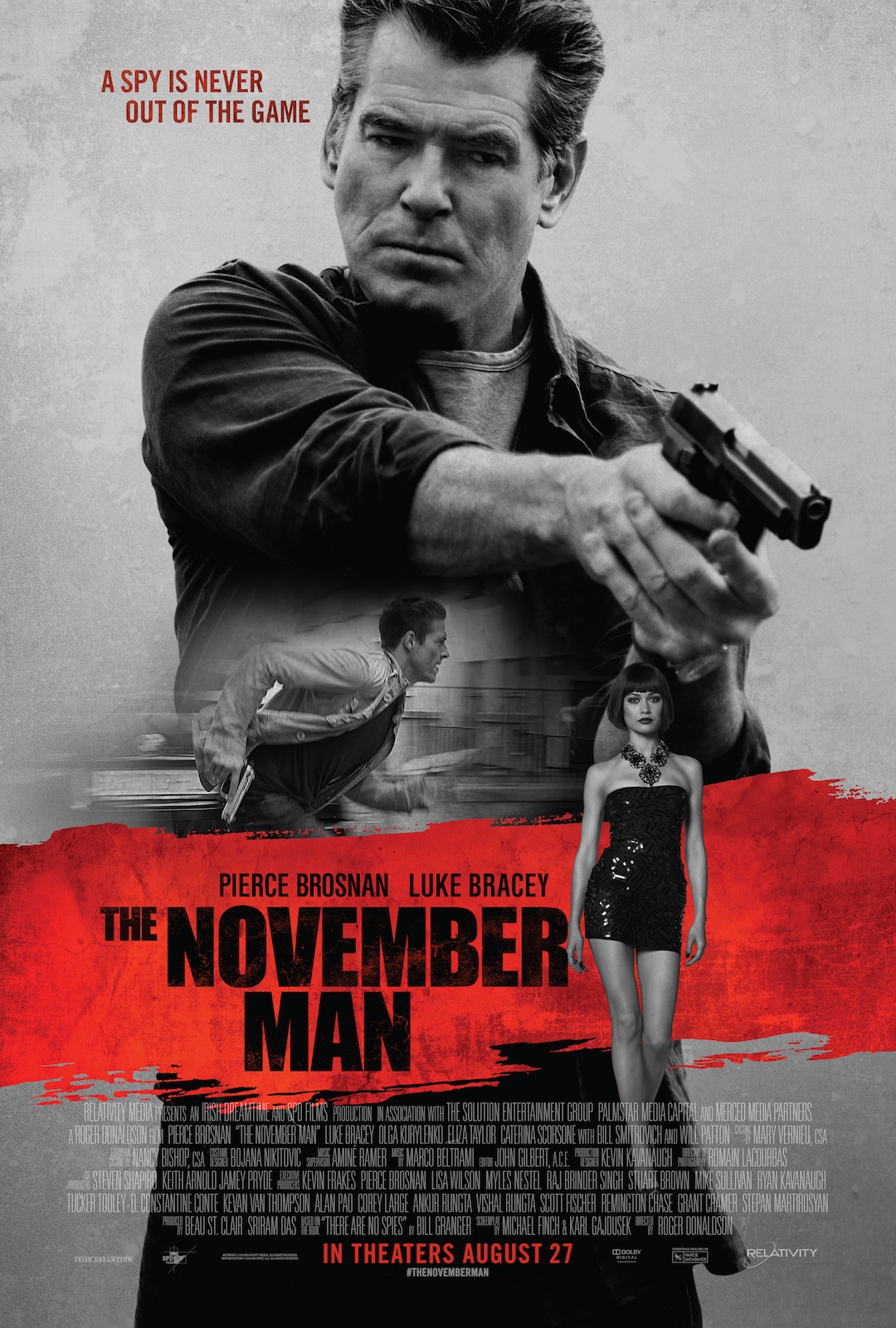
Montenegro, 2008. CIA agent Peter Devereaux (Brosnan) and his protegé David Mason (Bracey) are on an assignment to stop the assassination of a visiting dignitary. Devereaux takes the man’s place and while they identify and kill the would-be assassin, it comes at a price: Mason’s lack of experience causes the death of a young boy.

Lausanne, 2013. Devereaux is now retired and owns a small lakeside cafe. One day he’s approached by his old handler, Hanley (Smitrovich), with a job. Devereaux’s ex-lover, Natalia (Musliovic) is in trouble. She is in Moscow working undercover as an aide to Russian President-elect Arkady Federov (Ristovski). Natalia has uncovered intelligence that she says will destroy Federov’s chances of becoming president, but won’t reveal any details unless she’s extracted. Devereaux agrees to get her out. On the day of the extraction, Natalia obtains the evidence she needs against Federov but her actions are discovered. With her position compromised, and with Federov’s men chasing her, she evades capture long enough for Devereaux to find her. However, Hanley’s superior, Weinstein (Patton) gives an order that leads the extraction team – led by Mason – to kill her.

Devereaux kills the rest of Mason’s team but leaves him alive. While Mason is tasked with tracking down his mentor – Weinstein believes Devereaux and Hanley are in collusion, but doesn’t know why – Devereaux seeks to find out just what was going on in Moscow and why Natalia was killed. Using the evidence she gathered and was able to give him before she died, Devereaux tries to find a young woman named Mira Filipova; she is the only witness to war crimes Federov committed in Chechnya, and he will stop at nothing to silence her. With the only clue to her whereabouts being her association with a Belgrade women’s aid centre, Devereaux – and an assassin (Terzimehic) sent by Federov – attempts to find out more from centre worker Alice Fournier (Kurylenko). They go on the run together, chased by both Federov’s assassin and Mason, but managing to stay one step ahead of both. Along the way Devereaux tests Mason’s resolve, learns the truth about Federov’s involvement in a bombing that started the Chechnya war, and finds his twelve year old daughter, Lucy, put in harm’s way.

_LAS9652.NEF

An old-fashioned spy thriller where the Russians are – ostensibly – the bad guys, and the CIA is equally corrupt, this adaptation of the novel There Are No Spies by Bill Granger (and the seventh in a series of novels featuring Devereaux) has a simple, retro feel to it, but the now over-familiar Belgrade locations and haphazard plotting, as well as some disastrous attempts at characterisation, leave the movie looking and feeling disjointed and ill-conceived. From its opening sequence, The November Man makes a valiant attempt to bring the viewer on board but then keeps them at a distance thanks to its unfailing ability to jettison credibility at every turn.

Despite the retro feel – at one point Devereaux picks a lock the old-fashioned way – The November Man makes the occasional attempt to appear and feel relevant, but making Devereaux seem like an ageing Jason Bourne merely highlights the scarcity of original thought on display. The script, by Michael Finch and Karl Gajdusek, is littered with ill-considered and poorly written scenes that fail to advance the plot, and which give the impression that, rather than adapting Granger’s novel, they were making things up as they went along. There’s one very disturbing, completely out of left field scene where Devereaux cuts the femoral artery of Mason’s neighbour, Sarah (Taylor), leaving her to die unless Mason saves her (and doesn’t pursue his mentor). It’s an incredibly stupid scene, badly written and directed, and serves only to show how determined the movie is to get it wrong.

The basic plot is sound if unoriginal – someone in the CIA colluded with Federov to instigate the war in Chechnya, but who? – but somewhere along the way the need to add in as many convoluted twists and turns as possible has distorted the movie’s focus and made it more ludicrous than convincing. There’s also some wildly absurd action beats that defy logic, such as when Mason drives at full speed into a wall in order to kill the agent he’s riding with (don’t ask!); seconds later, Mason’s running away from the crash as if nothing’s happened.

Against all this, not even Brosnan can rescue things, even when running along alleyways and hotel corridors like he did in his Bond days. He’s also tasked with constantly looking aggrieved (and judging by how badly the movie’s turned out, he probably knew something was up during filming), but it’s the continual change back and forth between cold-blooded killer and sensitive family man that fails to have any impact. Thanks to the script, Brosnan is effectively playing two different Devereauxs, but they don’t fit together (not even once), leaving the actor struggling to combine the two into one recognisable character. It’s no surprise then that the rest of the cast fare equally badly, though Bracey deserves special mention for the woodenness of his expressions and the awkwardness of his line readings. Kurylenko has a little more to do than be the female lead who gets to “stand-next-to-the-star-and-look-pretty”, and Smitrovich does aggressive even when the script doesn’t call for it.

In the end, The November Man is a soggy mess of a movie that does just enough to hold the attention but without putting in too much effort. Donaldson directs as if he’s only seen every other page of the script, and the location photography by Romain Lacourbas is perfunctory, leaving the backdrop of the movie looking less than interesting. And John Gilbert’s editing lacks the necessary punch and energy to make the action scenes anything more than humdrum and predictably constructed.

Rating: 4/10 – weak in almost every department, The November Man is a dire attempt at replicating the kind of spy thrillers that popped up every other month throughout the Eighties; it doesn’t work here, and hasn’t done in any of the three hundred similar movies that Steven Seagal has made in the last ten years either.

Share this:

  • Click to share on X (Opens in new window) X
  • Click to share on Facebook (Opens in new window) Facebook
  • More
  • Click to print (Opens in new window) Print
  • Click to email a link to a friend (Opens in new window) Email
Like Loading...

Jack Ryan: Shadow Recruit (2014)

07 Friday Feb 2014

Posted by dullwood68 in Movies

≈ Leave a comment

Tags

Chris Pine, CIA analyst, Drama, Jack Ryan, Keira Knightley, Kenneth Branagh, Kevin Costner, Moscow, Review, Spy thriller, Terrorist attack, Tom Clancy

Jack Ryan Shadow Recruit

D: Kenneth Branagh / 105m

Cast: Chris Pine, Kevin Costner, Keira Knightley, Kenneth Branagh, Lenn Kudrjawizki, Alec Utgoff, Peter Andersson, Elena Velikanova, Nonso Anozie, Seth Ayott, Colm Feore, Gemma Chan

With franchise reboots seemingly the order of the day in Hollywood at the moment, we shouldn’t be too surprised to find Tom Clancy’s CIA analyst dusted down and given a new lease of life courtesy of parent company Paramount.  Twelve years on from the frankly underwhelming The Sum of All Fears, we find our hero not only younger but given the dubious benefit of an origin story.  It’s a slightly too comfortable move by Paramount, and while you can understand they might want to make a few more Jack Ryan movies in the future, this is quite a soft, predictable movie for a “first” outing.

We first meet Ryan at college in England on the day of 9/11.  The terrible events of that day prompt him to enlist in the Marines and we move on to events in Afghanistan that see Ryan badly injured and needing intense physical therapy so that he can walk again.  Here he meets two people who will be instrumental in getting him back on his feet: junior doctor Cathy Muller (Knightley), and shadowy spook Thomas Harper (Costner).  Fast forward ten more years and Ryan is working on Wall Street as an undercover analyst working for Harper and looking for financial dealings and transactions that might indicate terrorist funding.  He is living with Cathy who knows nothing of his double life.  When Ryan discovers Russian accounts that are being hidden from view, he travels to Moscow to investigate.  Surviving an attempt on his life, Ryan meets businessman Viktor Cheverin (Branagh) and discovers a plot to destabilise the US economy.  To make matters more complicated, there’s a terrorist attack being planned, and Ryan’s girlfriend turns up unexpectedly in Moscow.

Jack Ryan Shadow Recruit - scene

While the plotting and characterisations in Jack Ryan: Shadow Recruit are fairly simple and straightforward, there’s a disconnect between the high-tech gadgetry and versatility of the modern communications devices on display, against the feel and visual styling that Branagh brings to the fore throughout.  This is very much an Eighties spy thriller, with many of the Cold War frills that were prevalent then, and there’s a large debt owed to The Fourth Protocol (1987).  The script tries its best to avoid the usual clichés but remains a fairly sterile affair, devoid of any real tension and saddled with the kind of arch-villainy better suited to a Bond movie.  (Indeed, Branagh’s character and performance would have looked completely at home during Pierce Brosnan’s tenure.)  What elements the movie does pilfer from recent years gives it more of a Jason Bourne feel but without the angst.  When Cathy turns up in Moscow there’s a sense that hers and Ryan’s relationship – given such a strong focus in the first third of the movie – is going to continue in the same vein, but the script relegates her to the necessary damsel in distress; and once she’s saved she’s removed from the movie altogether until the inevitable coda (but not before she’s conveniently validated Ryan’s double life, previously a plot point that drove their relationship).

With Cheverin’s financial machinations lacking the flair or excitement that can only be offset by a series of (thankfully) non-CGI action sequences, the movie plays out its showdowns and action beats proficiently enough without giving us anything new or different.  (The last third, with its chases through Moscow and Manhattan, also seem to  provide a potential cure for back pain: Ryan’s injuries from Afghanistan, still causing him problems today, are forgotten about as he’s thrown around a lot in vehicle collisions and found hanging out the back of a truck.)  There’s a distinct lack of tension as well, and the short scene where Ryan determines both the location of the terrorist attack and the person who’ll carry it out, is laughably preposterous.  Branagh juggles the various elements to good effect but thanks to the script’s holding back, he can’t quite make things as exciting as they should be.

Pine is okay as the newest Ryan on the block, his youth and inexperience played to good effect until he’s required to don the mantle of action hero.  Knightley takes the generic girlfriend role and manages to make it interesting, though she’s hampered by the script’s reluctance to include her character as anything more than attractive window-dressing (it’ll be interesting to see if she returns for any sequels).  As the equally generic villain, Branagh fares better as the patriot willing to sacrifice anything to humble the West, but it’s Costner, experiencing a bit of a career revival at the moment, who fares the best.  He gives a quiet, unshowy performance that adds some much-needed gravitas to the proceedings, and he dominates each scene he appears in.

Rating: 7/10 – as a reboot, Jack Ryan: Shadow Recruit shows too much restraint on the action front, and has a plot that is too underwhelming for its own good (even if it does sound a credible threat); if there is a sequel it will need to take some bigger steps if it’s going to compete with the Bonds and the Bournes of this world.

Share this:

  • Click to share on X (Opens in new window) X
  • Click to share on Facebook (Opens in new window) Facebook
  • More
  • Click to print (Opens in new window) Print
  • Click to email a link to a friend (Opens in new window) Email
Like Loading...

Blog Stats

  • 486,528 hits

Recent Posts

  • 10 Reasons to Remember Bibi Andersson (1935-2019)
  • Fantasia (1940)
  • Dances With Wolves (1990) – The Special Edition
  • Kiss of the Spider Woman (1985)
  • The Three Musketeers (1973)

Top Posts & Pages

  • Lost for Life (2013) - Another Look
    Lost for Life (2013) - Another Look
  • Lost for Life (2013)
    Lost for Life (2013)
  • About
    About
  • Mr. Topaze (1961)
    Mr. Topaze (1961)
  • Billy Lynn's Long Halftime Walk (2016)
    Billy Lynn's Long Halftime Walk (2016)
  • Winter's Tale (2014)
    Winter's Tale (2014)
  • The Hitman's Bodyguard (2017)
    The Hitman's Bodyguard (2017)
  • 5 Famous Movie Roles That Nearly Went to Someone Else
    5 Famous Movie Roles That Nearly Went to Someone Else
  • The Layover (2017)
    The Layover (2017)
  • Transcendence (2014)
    Transcendence (2014)
Follow thedullwoodexperiment on WordPress.com

Blogs I Follow

  • Rubbish Talk
  • Film 4 Fan
  • Fast Film Reviews
  • The Film Blog
  • All Things Movies UK
  • Interpreting the Stars
  • Let's Go To The Movies
  • Movie Reviews 101
  • TMI News
  • Dan the Man's Movie Reviews
  • Film History
  • Jordan and Eddie (The Movie Guys)

Archives

  • April 2019 (13)
  • March 2019 (28)
  • February 2019 (28)
  • January 2019 (32)
  • December 2018 (28)
  • November 2018 (30)
  • October 2018 (29)
  • September 2018 (29)
  • August 2018 (29)
  • July 2018 (30)
  • June 2018 (28)
  • May 2018 (24)
  • April 2018 (21)
  • March 2018 (31)
  • February 2018 (25)
  • January 2018 (30)
  • December 2017 (30)
  • November 2017 (27)
  • October 2017 (27)
  • September 2017 (26)
  • August 2017 (32)
  • July 2017 (32)
  • June 2017 (30)
  • May 2017 (29)
  • April 2017 (29)
  • March 2017 (30)
  • February 2017 (27)
  • January 2017 (32)
  • December 2016 (30)
  • November 2016 (28)
  • October 2016 (30)
  • September 2016 (27)
  • August 2016 (30)
  • July 2016 (30)
  • June 2016 (31)
  • May 2016 (34)
  • April 2016 (30)
  • March 2016 (30)
  • February 2016 (28)
  • January 2016 (35)
  • December 2015 (34)
  • November 2015 (31)
  • October 2015 (31)
  • September 2015 (34)
  • August 2015 (31)
  • July 2015 (33)
  • June 2015 (12)
  • May 2015 (31)
  • April 2015 (32)
  • March 2015 (30)
  • February 2015 (37)
  • January 2015 (39)
  • December 2014 (34)
  • November 2014 (34)
  • October 2014 (36)
  • September 2014 (25)
  • August 2014 (29)
  • July 2014 (29)
  • June 2014 (28)
  • May 2014 (23)
  • April 2014 (21)
  • March 2014 (42)
  • February 2014 (38)
  • January 2014 (29)
  • December 2013 (28)
  • November 2013 (34)
  • October 2013 (4)

Blog at WordPress.com.

Rubbish Talk

Film 4 Fan

A Movie Blog

Fast Film Reviews

The Film Blog

The official blog of everything in film

All Things Movies UK

Movie Reviews and Original Articles

Interpreting the Stars

Dave Examines Movies

Let's Go To The Movies

Film and Theatre Lover!

Movie Reviews 101

Daily Movie Reviews

TMI News

Latest weather, crime and breaking news

Dan the Man's Movie Reviews

All my aimless thoughts, ideas, and ramblings, all packed into one site!

Film History

Telling the story of film

Jordan and Eddie (The Movie Guys)

Movie Reviews & Ramblings from an Australian Based Film Fan

Privacy & Cookies: This site uses cookies. By continuing to use this website, you agree to their use.
To find out more, including how to control cookies, see here: Cookie Policy
  • Subscribe Subscribed
    • thedullwoodexperiment
    • Join 481 other subscribers
    • Already have a WordPress.com account? Log in now.
    • thedullwoodexperiment
    • Subscribe Subscribed
    • Sign up
    • Log in
    • Report this content
    • View site in Reader
    • Manage subscriptions
    • Collapse this bar
 

Loading Comments...
 

    %d