• 10 Reasons to Remember…
  • A Brief Word About…
  • About
  • For One Week Only
  • Happy Birthday
  • Monthly Roundup
  • Old-Time Crime
  • Other Posts
  • Poster of the Week
  • Question of the Week
  • Reviews
  • Trailers

thedullwoodexperiment

~ Viewing movies in a different light

thedullwoodexperiment

Tag Archives: Murder

The Trials of Cate McCall (2013)

14 Sunday Sep 2014

Posted by dullwood68 in Movies

≈ 1 Comment

Tags

Alcoholism, Anna Anissimova, Appeal case, Courtroom drama, Custody battle, James Cromwell, Karen Moncrieff, Kate Beckinsale, Lawyer, Murder, Nick Nolte, Review, Thriller
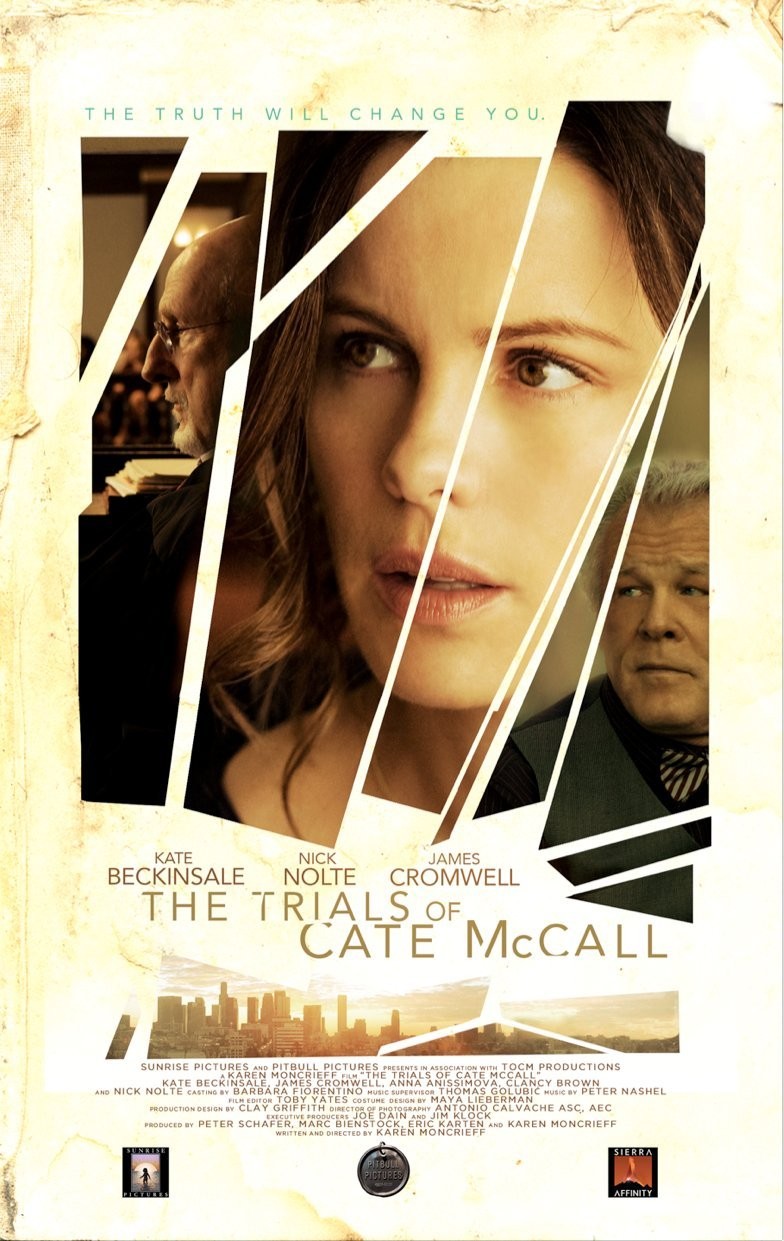
Trials of Cate McCall, The

D: Karen Moncrieff / 89m

Cast: Kate Beckinsale, Nick Nolte, James Cromwell, Mark Pellegrino, Anna Anissimova, Taye Diggs, Kathy Baker, Clancy Brown, Brendan Sexton III, David Lyons, Ava Kolker, Isaiah Washington, Dale Dickey, Amanda Aday

Cate McCall (Beckinsale) has her fair share of problems.  Despite being a talented lawyer, she has a serious drink problem that has resulted in her being put on probation and assigned to work in a small law office.  She’s also trying to retain custody of her daughter Augie (Kolker) following the break up of her marriage to Josh (Lyons).  As she fights to regain control of her life, Cate is assigned an appeal case involving Lacey Stubbs (Anissimova).  Lacey has been convicted of murder, but claims she was set up by the lead detective on the case, Welch (Pellegrino).  She also alleges that, while in prison, she was raped by a guard.

With the help of her mentor, Bridges (Nolte), Cate begins to look into the case and finds quickly that some of the witness testimonies don’t match up, and that there are problems with the police evidence.  Lacey maintains her innocence, while Welch proves evasive and aggressive when Cate talks to him.  As Cate begins to suspect a miscarriage of justice has taken place, the pressure of trying to deal with both the case and spending time with Augie begins to affect her ability to maintain her sobriety.

The appeal hearing sees Lacey’s case upheld, but Cate’s success is short-lived.  No sooner is the hearing over than she begins to uncover further evidence that Lacey has been lying all along.  But can she trust this new evidence?  Now Cate has to find out whether or not she was used by Lacey, and in the process, decide if being a part of Augie’s life is appropriate for her daughter while she still has a drink problem.

Trials of Cate McCall, The - scene

From the outset, The Trials of Cate McCall tries hard to be different from all the other courtroom-based dramas out there, and in terms of its title character, it certainly succeeds.  Cate McCall is, frankly, a bit of a mess, and while the reason for her drinking problem is adequately explained, the movie’s determination to make things difficult for her at almost every turn borders on the sadistic.  It’s only within the confines of the courtroom that she’s allowed to hold it together and have any success; outside, and she makes mistake after mistake, sometimes deliberately.  There is an element of masochism as well in these moments, as if Cate is punishing herself, and while on a psychological level this is all completely understandable, it makes for a somewhat frustrating viewing experience.  It’s not long into the movie before the viewer will be wondering, just how much more can this character take before she puts her head in the oven?

But Cate’s work keeps her going, even while she screws up everything else in her life.  The two worlds she inhabits, her professional and private lives, are addressed with equal gravitas, and thanks to Beckinsale’s committed, earnest portrayal, the movie is on solid ground when Cate tries to deal with the responsibilities of both (even if she fails more often than not).  It’s an unselfish performance from Beckinsale, an actress who can do a lot more than wear tight-fitting black leather and make fangs look sexy, and she’s at her best when the script piles on the setbacks (she even ends up in jail at one point, that’s how bad things get for her).  Beckinsale is also clever enough to ensure that Cate isn’t entirely sympathetic, and this helps make the character more credible.

She’s ably supported by the likes of Nolte (grizzled, understanding), Cromwell (sanguine, duplicitous), Anissimova (nervy, put-upon), and Pellegrino (arrogant, shady), and there’s a winning performance from six year old Kolker as Cate’s troubled daughter (Augie though – really?).  With such a good cast – and one that can find room for actors such as Brown and Baker in minor roles – the movie’s mix of domestic drama and courtroom machinations is handled well by writer/director Moncrieff, even if there are moments where plausibility is stretched so thin it’s practically see-through (the prosecution’s withholding of exculpatory evidence is a case in point; the ease with which Cate and Welch bury their differences is another).

But all in all, the movie is a worthwhile watch though it plays flat through certain stretches – the repetitive bickering between Cate and Josh, the subplot involving Cromwell’s lecherous judge – and the issue of Lacey’s guilt can be guessed from the beginning, but away from the courtroom there’s enough to keep an audience engaged and wanting to find out what happens next.  Ultimately though, and aside from the reliability of its cast, the material isn’t solid enough to withstand close scrutiny (or cross-examination), and while it’s entirely respectable in its aims and intentions, it doesn’t quite hit the mark.

Rating: 6/10 – with alcoholism, murder and a custody battle occupying the time of its main character, The Trials of Cate McCall is actually less intriguing than it thinks it is; Beckinsale is the movie’s major asset, and while there’s nothing to suggest this might be the beginning of a series, another visit with Cate could still be something to look forward to.


Share this:

  • Share on X (Opens in new window) X
  • Share on Facebook (Opens in new window) Facebook
  • More
  • Print (Opens in new window) Print
  • Email a link to a friend (Opens in new window) Email
Like Loading...

Kristy (2014)

11 Thursday Sep 2014

Posted by dullwood68 in Movies

≈ 3 Comments

Tags

Ashley Greene, College campus, Drama, Haley Bennett, Horror, Internet cult, Intruders, Murder, Olly Blackburn, Review, Thanksgiving, Thriller

Kristy

D: Olly Blackburn / 86m

Cast: Haley Bennett, Ashley Greene, Lucas Till, James Ransone, Chris Coy, Mike Seal, Lucius Falick, Mathew St Patrick, Erica Ash

Justine (Bennett) is a slightly nerdy college student who’s planning to spend Thanksgiving on campus as she can’t afford to get home for the holiday.  Her boyfriend, Aaron (Till), tries to persuade her to come with him to stay with his family but she won’t accept his kindness.  With only her friend, Nicole (Ash) and campus security guard Wayne (St Patrick) for company, Justine is looking forward to spending some time (largely) by herself.  However, Nicole heads home too, leaving Justine (nearly) all alone.

When she goes out to get some supplies at a local gas station, she encounters a young woman (Greene) whose strange attitude and challenging manner Justine attempts to placate in order to avoid an ugly encounter with the gas station attendant.  With her offer rebuffed, Justine voices her disappointment at not being able to just help someone.  The young woman rounds on her and tells her she’s the “Kristy”.  Later, on her way back to the campus, the young woman uses her car to block Justine’s, but Justine gets past her.  She tells Wayne what’s happened and although he’s sure nothing worse will happen, Justine isn’t so sure.

It isn’t long before she’s proven right.  The young woman appears in her room carrying  a knife.  Justine gets past her but soon learns the young woman isn’t alone: she has three male accomplices, all wearing tin foil masks and hoodies, and all carrying weapons.  A game of cat and mouse begins between Justine and the intruders.  Wayne is murdered and Justine is forced to run from building to building in an attempt to avoid being killed as well.  Even when she seeks help from the campus maintenance man, Scott (Ransone), who has a shotgun, the intruders outsmart him and Justine is left to fend for herself once again.  She must use every ounce of ingenuity she has to outwit the intruders and stay alive…

RANDOM

With its mix of Halloween (1978), The Shining (1980) and every school-based slasher movie ever released, Kristy could be accused of being derivative and unimaginative.  But in the hands of director Blackburn and writer Anthony Jaswinski, the movie is strong on atmosphere, as tense as barbed wire, and features some sterling, predatory camerawork thanks to DoP Crille Forsberg.  It’s an impressively mounted picture as well, the university environs – in particular, the swimming pool – put to very good use, the wide open spaces of the grounds proving just as claustrophobic as the interiors, Justine’s attempts at hiding or escape placed against a pitiless, unremarkable background of beiges and off-whites.

It’s a very measured, well-constructed mise-en-scene that benefits from Blackburn’s close attention to detail, validating his decision to combine tightly framed shots with wider, equally threatening compositions that add immeasurably to the sense of unease the movie displays from the first moment an overhead light begins to flicker in the dorm’s laundry room.  But while there’s a sure hand behind the camera, in front of it there’s a commanding performance from Bennett, her slightly geeky, girl-next-door looks and demeanour explored with effortless simplicity in the opening twenty minutes, from her interaction with Aaron to a deceptively effective montage of her activities once everyone’s left.  Justine is instantly likeable, the kind of young woman who makes you smile from the off.  Bennett invests her with a goofy charm, and while she spends the middle third running from the intruders, once Justine decides to take the hunt to them instead, she applies a calculating side of her character that comes across as entirely natural (it’s less the worm turning, more the worm realising she’s actually more than a match for her tormentors).

As the unreasoning, psychotic leader of a cell that’s part of a wider, Internet-based cult, Greene is hidden for the most part under a pink-tinged hoodie, only her facial piercings and chapped lips allowed any prominence.  She gives an angry, embittered performance, her coiled physicality threatening to erupt at any moment, making her the most unpredictable character of all; you watch her to see just what she’ll do next.  As her homicidal accomplices, Messrs Coy, Seal and Falick are hidden behind their masks but their presences are felt even when they’re off screen (Kristy is one of those movies where the viewer can’t quite be sure that one or more of them won’t just pop into view when it’s least expected).

There is violence throughout, from an opening montage of video clips of the cell’s other victims (which are posted on the Internet for other cult members to “enjoy”), to the outcome of Justine’s showdown with the young woman, but there is very little actual bloodshed, and Blackburn wisely avoids the kind of brutality that would have taken Kristy down the torture-porn route.  Instead, and aside from one crowd-pleasing contact blow that is entirely justified, each kill is rendered out-of-shot and with an emphasis on good old-fashioned sound effects.  In fact, the sound mix is one of the most effective aspects of the movie (take a bow, Michael B. Koff), particularly when the intruders are stalking Justine through the kitchens, their knives and weapons scraping against the fixtures and walls with hideous potency.

As mentioned above, the movie is indebted to several other horror outings, and while there will be those who won’t see beyond those influences, and will see deliberate moments taken from those movies – the fate of one character is lifted wholesale from Kubrick’s masterpiece – any naysayers will be missing the efficiency and verve that Blackburn et al. have employed to make these staple ingredients appear fresh and invigorated.  It’s very difficult these days to come up with something new in the horror arena, and while the thriller elements are pushed to the fore here, this variation on the home invasion sub-genre is refreshingly presented and, one unnecessary post-end credits sequence aside, belies its derivative nature to provide a riveting viewing experience.

Rating: 8/10 – unnerving, gripping and rewarding in equal measure, Kristy is a step up from other movies of a similar nature, and treats its audience accordingly; with clear intelligence at work both behind and in front of the camera this is one horror/thriller that really does deserve a wider audience.

Share this:

  • Share on X (Opens in new window) X
  • Share on Facebook (Opens in new window) Facebook
  • More
  • Print (Opens in new window) Print
  • Email a link to a friend (Opens in new window) Email
Like Loading...

Lost for Life (2013)

07 Thursday Aug 2014

Posted by dullwood68 in Movies

≈ 18 Comments

Tags

Brian Draper, Documentary, Jacob Ind, Joshua Rofé, Josiah Ivy, Juvenile killers, Life sentences, Murder, Review, Sean Taylor, teenkillers.org, Torey Adamcik

Lost for Life

D: Joshua Rofé / 75m

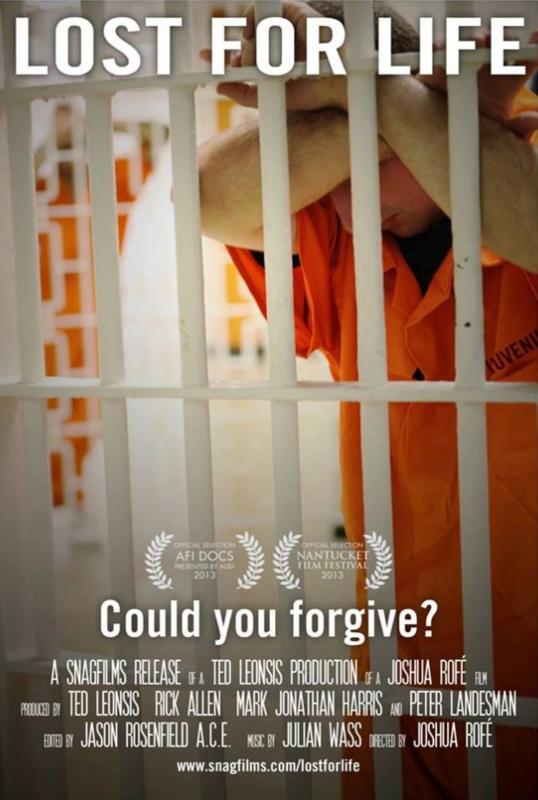
A candid, often unsettling look at juvenile killers, Lost for Life looks at four cases where teenagers have committed murder and are currently serving life sentences in US prisons.

The first case is that of Brian Draper and Torey Adamcik, a couple of sixteen year olds who convinced each other it would be a good idea to kill their classmate, Cassie Stoddart.  One night they went to her home and stabbed her to death.  The second case involves Jacob Ind, who at fifteen, killed his mother and stepfather by shooting them.  Third is the case of Josiah Ivy, who at sixteen killed two strangers, Stacy Dahl and Gary Alflen, at their home.  And lastly, there’s Sean Taylor, who at seventeen killed a rival gang member in a drive-by shooting.

Each case features the juvenile killers several years on from when they committed their crimes, and explores their reasons for killing and how they’ve dealt with the repercussions of their actions, and how  – or if – they’ve come to terms with what they did.  There’s also input from their families as well as some of the relatives of the victims, and the movie also takes in the recent Supreme Court decision relating to whether or not minors who commit murder should be sentenced to life without parole.

Lost for Life - scene

All four stories are potent in their own way, and initially it’s hard to understand just how any one of these murders could have come about, but thanks to the involvement of the perpetrators, it becomes clearer and clearer as the movie goes on that there’s never just one factor that sets things in motion, and that the reasons for these dreadful acts are often complex and unpredictable.  What makes these cases all the more interesting is the distance in time and attitude that these “teen killers” have travelled in their own efforts to recognise and grasp both the enormity of what they’ve down, and how their deeds have affected others.

Brian is perhaps the most balanced – if that word can be applied to someone who deliberately set out to kill a girl he was attracted to – of the group, and despite an intermittent stutter, is quite articulate as he talks about what he did and how he’s come to terms with his guilt and how “broken” he was as a teenager.  By contrast, his accomplice in the crime, Torey, is shown evincing an almost complete denial of his actions, and he’s supported by his parents who in one uncomfortable moment – both for Torey and the viewer – state his innocence as if it was the most obvious thing imaginable.  (And this in spite of the fact that the pair filmed themselves planning the murder, and then again after they’d committed it.)

Jacob is equally articulate but there’s something not quite right about his responses and the moments when he closes his eyes – which happen quite a lot – it’s as if he’s reliving the memories of killing his mother and stepfather.  It’s an unnerving possibility, and he’s almost casual about the effect killing them has had on him.  He’s aware of the wickedness of his crime, but it all comes across as if it had happened to someone else, and he talks dispassionately about the events that led up to the crime, including his persuasion of a friend to carry out the murders first of all, and his equally worrying admission that he shot both parents almost as if it was a fait accompli (his friend having failed to do the “job” properly).

The saddest case is that of Josiah, abused as a child and seen as a withdrawn adult, his emotions and his ability to talk about the random killings that will see him spend the rest of his life in prison so suppressed that his lawyer has to instruct him in how to respond from off camera.  To compensate, the movie spends more time with his sister Amber.  She proves to be an eloquent interviewee, but even she struggles to completely understand how her brother could have killed two complete strangers “just to see what it felt like”.  From this we meet Jennifer Bishop-Jenkins, who founded the website www.teenkillers.org following the deaths of her sister and brother-in-law and their unborn baby, and Sharletta Evans who has forgiven the killers of her three year old son and thinks other teen “lifers” should be given a “first chance”.  Seeing the two women together is inspiring – albeit for different reasons – and adds a layer of emotion that helps show the effect that these crimes have on the victims’ families.

Sean’s story shows how redemption can be achieved.  In prison he became interested in Islam and eventually became a Muslim, changing not only his religion but his approach to life, rejecting his gang background and lifestyle, and forging a new life for himself.  His moving account of his rehabilitation offers hope for all those teenagers who have killed without giving due consideration of the effect their actions will have on others, and the way in which self-respect can be regained.  Without him the movie would have been painfully pessimistic, but thanks to Rofé’s considered approach to the material and the careful assembly of the various interviews, Lost for Life is a captivating, intriguing, and necessarily thought-provoking documentary that wisely avoids looking for definitive answers as to why these terrible crimes happened, but asks if we can ever forgive the people who commit them.  It’s a difficult question, and as mentioned before, the candour the movie invokes goes some way to increasing the difficulty in deciding, but without this challenge, the movie would not be as rewarding or as stimulating as it is.

Rating: 8/10 – a tough subject given fair treatment, and very pertinent in terms of what’s happened recently in US law, Lost for Life paints a terrifying portrait of youth gone awry; by shying away from a more sensationalist approach, this is an impressive, often haunting documentary that is both horrific and uplifting.

Share this:

  • Share on X (Opens in new window) X
  • Share on Facebook (Opens in new window) Facebook
  • More
  • Print (Opens in new window) Print
  • Email a link to a friend (Opens in new window) Email
Like Loading...

The Purge: Anarchy (2014)

02 Saturday Aug 2014

Posted by dullwood68 in Movies

≈ Leave a comment

Tags

Annual event, Big Daddy, Carmen Ejogo, Crime, Frank Grillo, James DeMonaco, Murder, Revenge, Review, Sequel

Purge Anarchy, The

D: James DeMonaco / 103m

Cast: Frank Grillo, Carmen Ejogo, Zach Gilford, Kiele Sanchez, Zoë Soul, Justina Machado, John Beasley, Jack Conley, Michael K. Williams

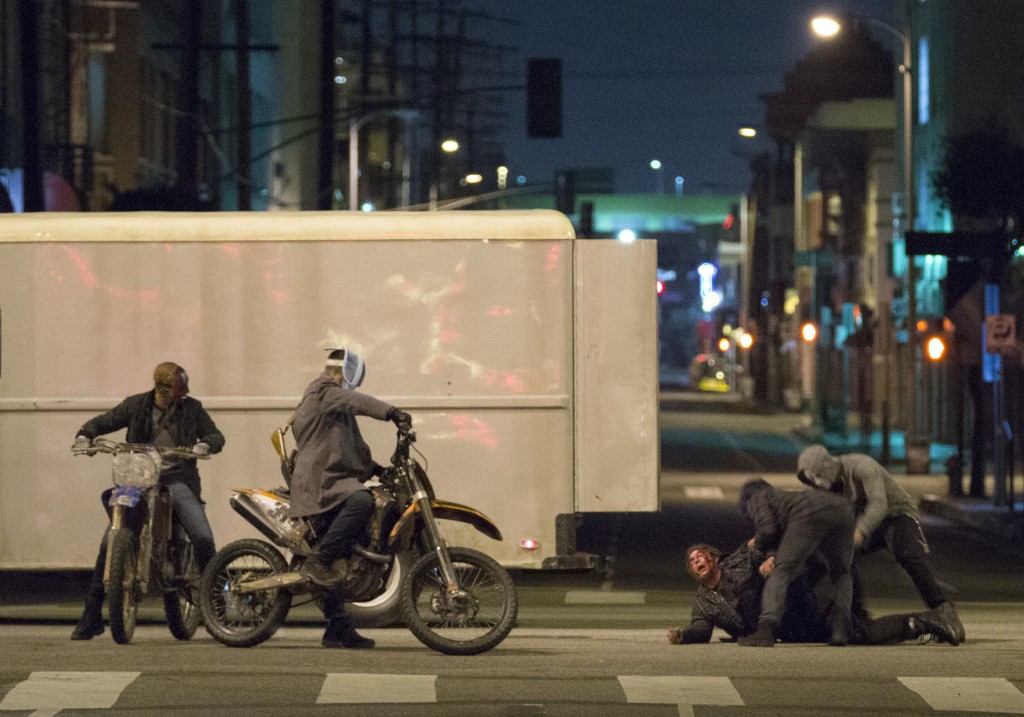
March 31, 2023: The annual Purge is mere hours away.  A police sergeant, Leo (Grillo) is preparing to use the twelve hour crime amnesty to murder the man who ran over and killed his son.  A diner waitress, Eva (Ejogo) is on her way home to spend the evening with her daughter, Cali (Soul) and father, Rico (Beasley).  And a couple, Shane (Gilford) and Liz (Sanchez), are travelling to see his sister; they have something important to tell her.  Then the couple’s car breaks down, leaving them stranded and pursued by a gang of masked and face-painted Purgers.  Meanwhile, Eva and Cali are doing their best to reassure their father that they will be able to cope with the increasing cost of his medical treatment, but Rico is dismissive.  While they prepare dinner, he leaves their apartment, having made arrangements that will see both of them well taken care of… but at a price.

The Purge begins.  Leo takes to the streets, while Shane and Liz continue to try and avoid the gang that’s pursuing them.  Eva and Cali discover their father has gone – and the reason why.  They also find their building under attack from a team of SWAT-like intruders led by Big Daddy (Conley).  A more immediate threat comes from one of their neighbours but the women find themselves abducted by Big Daddy’s men instead.  Leo happens to be passing by when he sees Eva and Cali being dragged into the street; against his better judgment he rescues the women, and without knowing it, Shane and Liz as well (they’ve taken the opportunity to hide in the back of his car).  Their escape sees Leo’s car hit several times by bullets and later it breaks down.  Eva tells Leo she has a friend nearby with a car and if he gets everyone to her friend’s apartment then she’ll persuade her friend, Tanya (Machado) to let him have the car.  Leo agrees and they all set off on foot.  The group finds itself under attack before they reach Tanya’s apartment, and Shane is wounded in the shoulder in the process.

Simmering tensions amongst Tanya’s family leads to unexpected bloodshed and the group are forced to leave – but without a car.  Outside it isn’t long before Big Daddy’s men capture them.  They are taken to a building that has been set up to provide rich patrons with the opportunity to have their own private Purge, and the five find themselves in a room being stalked by seven of the rich Purgers.  Leo kills some of them, at which point the building is invaded by a group of anti-Purgists led by Carmelo (Williams).  Leo, Eva and Cali flee in the confusion and they head to the home of the man who killed Leo’s son.  The women try to convince Leo to let it go, but he enters the man’s home anyway…

Purge Anarchy, The - scene

It’s an ominous thought, but there’s a good possibility that we’ll be “treated” to a Purge movie every year until the law of dwindling financial returns convinces the producers to shut up shop and move on to pastures new.  In the meantime, this first sequel does its best to expand on the original movie’s intriguing premise, but dulls matters despite its increased budget ($9 million, triple the original’s), and a broadening of the material that takes in everything from Government corruption to an anti-Purge movement to its third act Most Dangerous Game development.   It’s a smart move, but it’s not too long before the viewer may well be wondering, Why didn’t they stick with the whole home under siege schtick of the first movie?  The family under attack is briefly referenced when Eva and Cali’s building is stormed by Big Daddy’s men but it’s less an excuse for some carefully built-up tension and suspense than for Noel Gugliemi’s gun-toting neighbour to bring on the ham.  And the makers have fallen into the trap of so many other filmmakers in the past, and failed to realise that having a group of people running around deserted streets at night while being pursued is about as exciting a prospect as watching an Uwe Boll double bill.

The main problem here is that none of the characters are particularly likeable, so it’s difficult to care if they’re killed or not.  Where The Purge (2013) took some time to introduce its dysfunctional family, here the emphasis is on quick brush strokes and on to the next set up before anyone realises how little has been invested in creating a group the audience can root for.  Leo is as taciturn as you’d expect from a character who occupies an uneasy moral high ground, while Eva, who you might also expect to turn out to be the resourceful heroine is instead relegated to bystander the longer the movie goes on.  Cali is too whiny to care about, and Shane and Liz are as irritating as a paper cut – of all five, these are the ones you hope don’t make it to the next morning.  However, this isn’t the actors’ fault, but returning writer/director DeMonaco’s, his script trying to cram too much in – the whole third act with the moneyed elite feels like it should be the focus of another instalment, and is as dramatically rushed as the rest of the movie.

Thanks to its hurried pacing and uninspired plotting, The Purge: Anarchy is only fitfully involving, and with only hints and oblique clues as to the even wider conspiracy still to be explored, the movie feels increasingly like a transition piece, something to keep the audience happy until the bigger story can be worked out and put on screen.  That said, there are some nice, incidental touches: the woman covered in blood at the roadside, the bus on fire rolling by in the background, the return of the Stranger (Edwin Hodge) from the first movie, but they’re so few and far between, they make you wonder why the rest of the movie has to be so predictable.  The cast do their best with the material but the limitations of their characters defeat them for the most part, and the lack of any real threat – having someone wearing face paint really isn’t scary or threatening any more, not on screen at least – leaves the group’s chances of survival looking more likely than not.  DeMonaco directs efficiently enough but without bringing anything new visually or stylistically that we haven’t seen in a hundred other similar movies.

Rating: 5/10 – a calculated sequel that never really takes off, The Purge: Anarchy shows what can happen when a movie is unexpectedly successful and the idea of a franchise is borne; future Purges will need to be more tightly focused than this episode, and with characters the audience can invest in emotionally, otherwise the series may well find itself purged of anyone who’s interested.

Share this:

  • Share on X (Opens in new window) X
  • Share on Facebook (Opens in new window) Facebook
  • More
  • Print (Opens in new window) Print
  • Email a link to a friend (Opens in new window) Email
Like Loading...

Violet & Daisy (2011)

01 Friday Aug 2014

Posted by dullwood68 in Movies

≈ Leave a comment

Tags

Alexis Bledel, Assassins, Crime, Geoffrey Fletcher, James Gandolfini, Murder, Rival killers, Saoirse Ronan, Teenagers

Violet & Daisy

D: Geoffrey Fletcher / 88m

Cast: Saoirse Ronan, Alexis Bledel, James Gandolfini, Marianne Jean-Baptiste, Danny Trejo, Tatiana Maslany, Lynda Gravatt

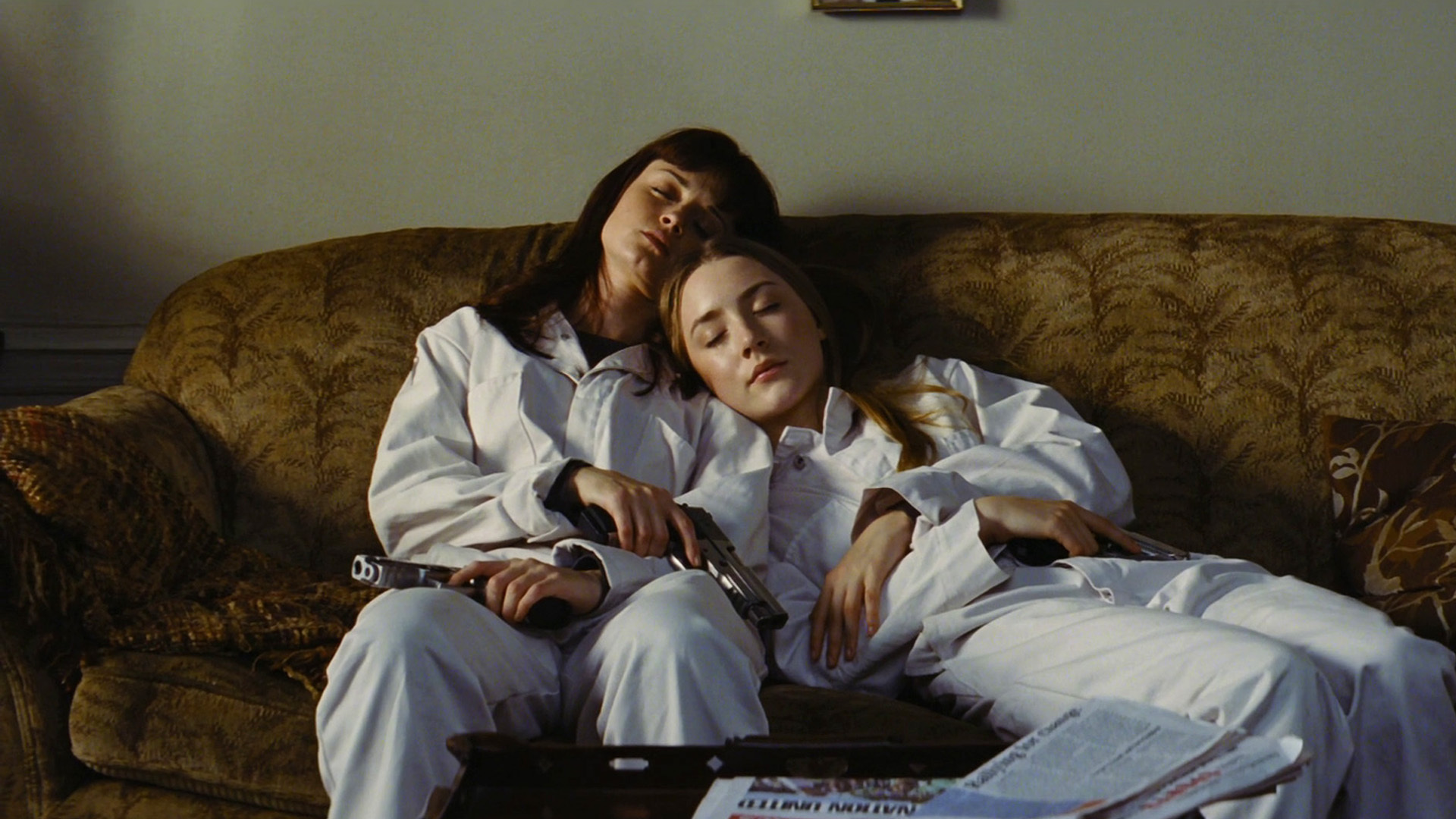
Two teenagers, Violet (Bledel) and Daisy (Ronan), when they’re not obsessing over singing sensation Barbie Sunday, are professional assassins.  They work for a man called Chet but they’ve never met him; instead they’re given their jobs via an intermediary, Russ (Trejo).  When their next assignment – to kill a man who’s stolen from Chet – is given to them the set up seems a little strange: the man has contacted Chet and given his name and address.  As planned, the pair wait for the man at his apartment, but fall asleep while waiting for him to come home.  When they wake, they find he’s covered them with a quilt and is unsurprised to see them; in fact, he tells them he’s been expecting them.  With the hit already not going to plan, Violet and Daisy decide to just shoot the man and have done with it but when they try – blasting away at where he was sitting moments before – they find he’s got up and made them cookies.

Now out of bullets, Violet leaves the apartment to get some more, leaving Daisy and the man alone.  They start to talk, learning about each other, and a bond develops between them.  The man reveals he’s also expecting another set of killers to pay him a visit as he’s stolen from their boss as well.  They’re part of a rival organisation and when they arrive at the man’s apartment, Daisy stalls them long enough for Violet to return and kill them.  Learning more about the man, and discovering he has terminal cancer, Violet once more leaves the flat to re-stock their arsenal, still determined to carry out their mission.  The man tells Daisy about his daughter, April (Maslany), and his regret over the way his relationship with her has deteriorated.  As it becomes increasingly clear that the man has engineered his death by stealing from Chet and his rival, it’s down to the two girls to decide if this is one hit that shouldn’t be carried out.

Violet & Daisy - scene

The feature debut of the screenwriter of Precious (2009), Violet & Daisy is a singularly adventurous movie that does its best to wrong foot its audience throughout, and maintains a quirky, offbeat charm through its sometimes whimsical script and its trio of lead performances.  The set up is intriguing, and provides a lot of laughs as Violet and Daisy try and get the measure of a man who isn’t afraid of them, or the fact that they’re there to kill him.  While their confidence doesn’t quite desert them, it is undermined by the man’s calmness, and how nicely he treats them.  It’s fun to see the pair heading off to another room (while remaining in earshot) in an effort to decide what to do, their experience counting for little in the face of such cooperation and concern for them as individuals.

This basic premise is fleshed out by the inclusion of the rival killers and the history that Violet has with them, as well as a nosy neighbour, Dolores (Gravatt), and the threat of Chet’s number one assassin (Jean-Baptiste) lurking outside the building (to take out the man or Violet and Daisy is never clear).  The girls’ relationship is explored as well, giving both actresses the chance to provide strong, compelling performances that highlight the disparity between the girls’ feelings about the way their mission has gone awry.  Ronan is superb as always, Daisy’s somewhat gauche behaviour during the early part of the movie giving way to a measured, more emotional response to the situation, her growing liking for the man giving her a confidence that she didn’t have before.  As the initially controlling Violet, Bledel has the more obviously showy role but as the movie progresses, she shows the vulnerability beneath the confidence, and while it would be taking it too far to say their roles are reversed, by the end there’s a balance that actually compromises their working relationship.  And Gandolfini is as artless and affecting as ever, imbuing his character with a quiet determination that perfectly illustrates his need to give meaning to the end of his life.

Fletcher organises his cast and the material with a poise and assurance that belies the fact this is his first director’s credit, and the movie’s mix of violence, black humour and indie drama makes Violet & Daisy a real pleasure to watch.  With top-notch performances, and an unshowy, yet deadpan approach to the situation, Fletcher creates a winning crime drama that has a strong visual approach and features equally strong performances.  The references to the singer Barbie Sunday are probably the movie’s main weakness, giving Violet and Daisy a fairly spurious reason for taking on the job in the first place, and there are a few moments where the humour does a disservice to the drama it’s meant to offset.  But these are minor issues, and don’t hinder the movie at all.

Rating: 8/10 – an underrated gem, Violet & Daisy has lots to offer, and rewards the viewer from start to finish; Ronan and Bledel make a great team, and the movie’s indie sensibility means it provides a fresh take on what could have been a much more straightforward and predictable tale.

Share this:

  • Share on X (Opens in new window) X
  • Share on Facebook (Opens in new window) Facebook
  • More
  • Print (Opens in new window) Print
  • Email a link to a friend (Opens in new window) Email
Like Loading...

Mini-Review: The Panther’s Claw (1942)

10 Thursday Jul 2014

Posted by dullwood68 in Movies

≈ Leave a comment

Tags

B-movie, Byron Foulger, Crime, Drama, Extortion, Murder, Mystery, Opera company, PRC, Producers Releasing Corporation, Sidney Blackmer, William Beaudine

Panther's Claw, The

D: William Beaudine / 70m

Cast: Sidney Blackmer, Rick Vallin, Byron Foulger, Herbert Rawlinson, Lynn Starr, Barry Bernard, Gerta Rozan, Joaquin Edwards, John Ince, Martin Ashe, Frank Darien, Billy Mitchell

When gauche wigmaker Everett P. Digberry (Foulger) is discovered leaving a cemetery at one in the morning, it’s not long before the extortion plot he’s mixed up in leads to murder.  Having been sent a letter demanding he leave $1000 in the cemetery, it transpires that similar letters have been received by members of the New York Opera Company (or Gotham Opera Company if you read the headlines); Digberry has a connection to the company in that he provides the wigs for their productions.  The case is taken up by the police commissioner, Thatcher Colt (Blackmer), but his search for an extortionist who signs his letters with the footprint of a panther points increasingly to Digberry being the culprit behind it all.  And then one of the members of the opera company is found dead, and it appears that Digberry is guilty of that crime as well.  Is Digberry a cunning criminal mastermind, or is he being set up?

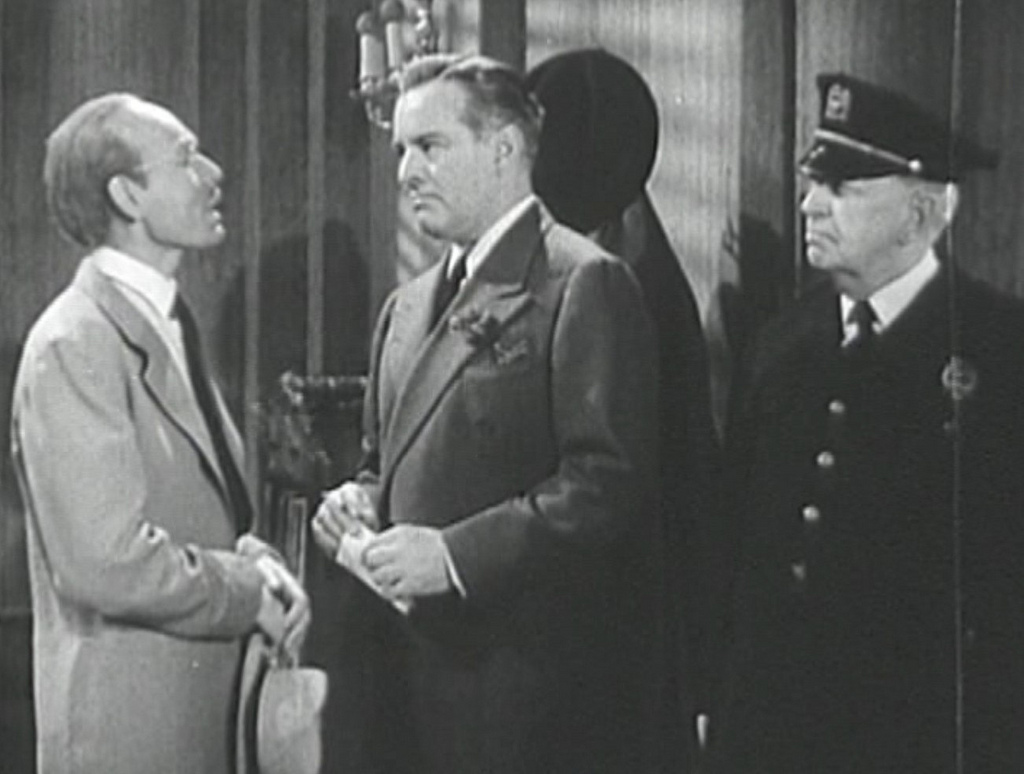
Panther's Claw, The - scene

Another quickie from low-budget movie factory Producers Releasing Corporation – the third and last movie to feature Anthony Abbot’s fictional detective, Thatcher Colt – The Panther’s Claw is a convoluted tale, with twists and turns galore and a large dash of playful humour, held together by Foulger’s dazed, nervous performance and a confidence in the material that helps move things along swiftly.  Foulger is effectively the lead and is afforded a lot of screen time, leaving Blackmer to sit back and appear knowing and debonair at the same time.  There’s able support from the rest of the cast, including Rawlinson as an impatient District Attorney looking to convict Digberry because it’s an election year, and Edwards as the kind of hammy opera singer with a drink problem that’s almost a caricature by modern standards.

Beaudine’s direction is as briskly efficient as ever, and while the sets are of the usual “bare bones” quality and the camerawork as bland and uninspired as you might expect, the movie has an energy and a surprising sense of its own silliness (which it embraces).

Rating: 6/10 – an offbeat, entertaining production from PRC that is better than most of their output from the period; Blackmer is a great replacement for Adolphe Menjou, and the mystery elements add to the fun.


Share this:

  • Share on X (Opens in new window) X
  • Share on Facebook (Opens in new window) Facebook
  • More
  • Print (Opens in new window) Print
  • Email a link to a friend (Opens in new window) Email
Like Loading...

Tokarev (2014)

29 Sunday Jun 2014

Posted by dullwood68 in Movies

≈ Leave a comment

Tags

Action, Crime, Criminal past, Danny Glover, Irish gang, Kidnapping, Murder, Nicolas Cage, Paco Cabezas, Rachel Nichols, Revenge, Russian gang

Tokarev

aka Rage

D: Paco Cabezas / 98m

Cast: Nicolas Cage, Rachel Nichols, Danny Glover, Max Ryan, Michael McGrady, Peter Stormare, Pasha D. Lychnikoff, Max Fowler, Aubrey Peeples, Jack Falahee, Ron Goleman

Paul Maguire (Cage) is a successful property developer with a beautiful wife, Vanessa (Nichols), and a precocious teenage daughter, Caitlin (Peeples).  One evening, while Paul and Vanessa are out to dinner with the mayor, and Caitlin is at home with two friends, they’re interrupted by Detective St. John (Glover), who tells them that Caitlin has been kidnapped.  Her two friends, Mike (Fowler) and Evan (Falahee) tell Paul and the police that three armed men broke into the house and took Caitlin; the men were brutal, efficient and said nothing.  St. John warns Paul to let the police do their job and not use the skills he has to track the men down (it turns out Paul was part of a criminal gang but got out and has been straight ever since).  Paul pays lip service to St. John’s advice and enlists the help of old friends Kane (Ryan) and Doherty (McGrady) in searching for his daughter.

Their own enquiries reveal nothing; no one knows who is behind the kidnapping.  Then, after a few days, Caitlin’s body is found in a nearby river; she’s been shot in the head.  At her funeral, Paul is stopped by his ex-boss, Francis O’Connell (Stormare), who warns him not to stir up any more trouble than already exists between O’Connell’s gang, and that of the Russians, led by Chernov (Lychnikoff).  The warning brings back memories of a heist Paul and his two friends carried out nearly twenty years before, and which ended with them killing Chernov’s younger brother.  Having kept their involvement a secret all these years, Paul wonders if someone now knows, and Caitlin’s death is a form of payback.  Convinced this is the case, Paul, Kane and Doherty begin to target the Russians’ drug business, shutting down distribution houses and killing anyone that gets in their way.

Soon enough, Chernov begins to retaliate.  He abducts Kane and tortures him, while at the same time, Paul begins to suspect that Doherty has told someone what they did to Chernov’s brother.  With St. John doing his best to keep Paul out of trouble, and Chernov getting ever closer to finding out what happened to his brother, a sudden realisation leads Paul to the truth about Caitlin’s kidnapping and murder.

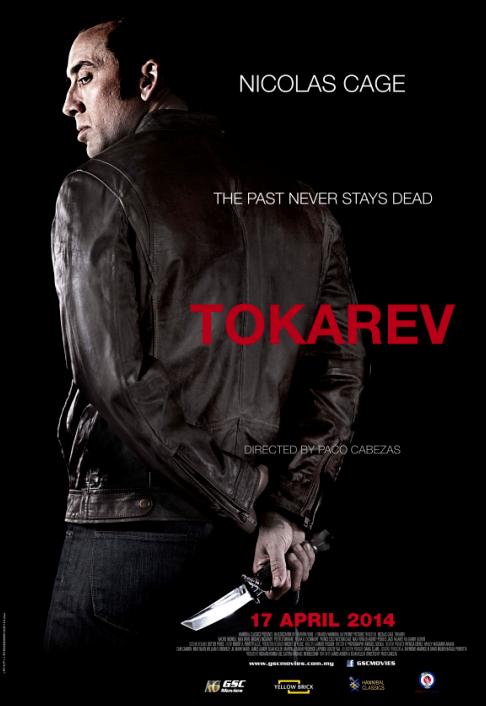
Tokarev - scene

Tokarev, with its slipshod script and lacklustre mise-en-scène, re-confirms the downward spiral that seems to be Nicolas Cage’s career.  Since World Trade Center (2006), Cage has appeared in twenty-one movies before this one, and the number of genuinely good movies he’s made can be counted on the fingers of one hand*.  It’s also hard to believe Cage is an Oscar winner, such is the decline in quality of the movies he’s made since then (only Cuba Gooding Jr’s post-Oscar career contains more poor choices).  Either Cage has some serious bills to pay, or his critical faculties are all burnt out, but either way, Tokarev is an out-and-out turkey.

None of it makes any sense, from Paul’s having been able to walk away clean from his criminal past, to the hackneyed “secret-no-one-knows” subplot, to St John’s leniency in the face of Paul’s flagrant vigilante behaviour, to O’Connell’s warning to Paul to let it go.  Expediency is piled on top of artifice which is then topped off with preposterousness, and it all comes complete with a large side order of implausibility.  The truth behind Caitlin’s abduction and murder is so unlikely even Cage can’t make it work (not that he’s trying very hard; his performance isn’t so much phoned in as faxed in from a different decade).  It’s all so much nonsense it’s almost insulting, the script by Jim Agnew and Sean Keller adding up to a series of barely connected scenes and events that operate separately from each other, and sometimes, in complete isolation (the two or three scenes where Paul tries to persuade Vanessa to find somewhere safe to be while he does the things she’s asked him to do but really doesn’t want to know about).

Adding to the disappointment doled out by the script is the leaden direction courtesy of Cabezas, an amazing combination of apathy towards the material and disinterest in the characters, leaving the cast adrift and having to fend for themselves.  What acting there is in the movie is mostly unexpected, as Cage et al. deliver their dialogue with all the capability of people for whom English is a second language.  Doherty, in particular, seems unable to say anything without mangling the content, and even when he does manage a clean delivery, there’s no emotion or heart there; he’s like a robot who’s stuck in neutral.  Nichols plays the upset second wife and stepmother as if she’s grateful to be there, while Stormare (in a glorified cameo) attempts an Irish accent with all the purpose of a man who knows he’s probably not going to be called back for redubbing.  As for Glover, he’s hamstrung by a character so vapid and ineffectual (as a policeman) that he might as well be invisible.

It doesn’t help that the movie is also drab to look at, with uninspired lighting and camera movements, and pacing that kills the movie stone dead just minutes in (editor Robert A. Ferretti has the same problem as the script writers: he doesn’t know what to focus on or for how long).  Scenes that should be powerful and dramatic are regularly stopped from doing so, and thanks to Cabezas, any potential interest in the story is quickly abandoned, leaving the viewer to count the minutes until the movie ends.

Rating: 3/10 – with the action sequences providing a bare minimum of excitement, Tokarev – the make of gun that kills both Chernov’s brother and Caitlin – has little to recommend it; fans of Nicolas Cage might give it a go, but otherwise this is one quasi-revenge movie that should be avoided completely.

*Those genuinely good movies: Kick-Ass (2010), The Croods (2013), and Joe (2013).

Share this:

  • Share on X (Opens in new window) X
  • Share on Facebook (Opens in new window) Facebook
  • More
  • Print (Opens in new window) Print
  • Email a link to a friend (Opens in new window) Email
Like Loading...

Sabotage (2014)

28 Wednesday May 2014

Posted by dullwood68 in Movies

≈ 2 Comments

Tags

Action, Arnold Schwarzenegger, Crime, David Ayer, DEA agents, Drugs cartel, Murder, Olivia Williams, Review, Robbery, Sam Worthington, Stolen money

sabotage_c82f99af

D: David Ayer / 109m

Cast: Arnold Schwarzenegger, Sam Worthington, Olivia Williams, Terrence Howard, Mireille Enos, Joe Manganiello, Harold Perrineau, Josh Holloway, Max Martini, Kevin Vance, Martin Donovan

When a DEA task force led by veteran John “Breacher” Wharton takes down a house used by a Mexican drugs cartel, it becomes clear they have a more primary mission their superiors know nothing about: to steal $10 million of the cartel’s money.  Hiding the money in the sewers to be collected later, “Breacher” and his team – “Monster” (Worthington), “Grinder” (Manganiello), “Sugar” (Howard), “Neck” (Holloway), “Pyro” (Martini), “Tripod” (Vance), and Lizzy (Enos) – are soon under investigation by Internal Affairs on suspicion of stealing the money, but when they go to collect it, they find it’s gone.  Six months later, and with IA having found no evidence to prove they took the money, “Breacher” and his team are reinstated.

Shortly after, one of the team is killed when his trailer is hit by a train (it was moved onto the tracks while he was unconscious).  The death is investigated by Detective Caroline Brentwood (Williams) and her partner Darius Jackson (Perrineau).  Attempting to interview the team proves fruitless, and Brentwood enlists “Breacher”‘s help in talking to them.  They visit one of the team, only to find he’s been killed as well, and in a way that suggests the Mexican drugs cartel is targeting them in retaliation for stealing the money.  They find a third member of the team murdered also, along with clear evidence that he was killed by the cartel, one of whom they find dead nearby.  Jackson traces the dead man’s mobile phone to an apartment block; he and Brentwood take a squad there to arrest them but “Breacher” and the remainder of his team get there first and kill the men they find there, only to discover they aren’t the cartel’s hit squad.  When the bodies of the cartel hit squad are found a short time after, and it becomes clear they couldn’t have committed the first two murders, “Breacher” realises it’s one of his team that is picking them off one by one.

Things quickly unravel.  One of the team tells Brentwood about the money, and is subsequently murdered while talking to her and “Breacher”.  With no other possibilities as to the murderer’s identity, “Breacher” agrees to a meeting with them.  In the ensuing showdown, the whereabouts of the money is revealed and the motive for its theft becomes clear.

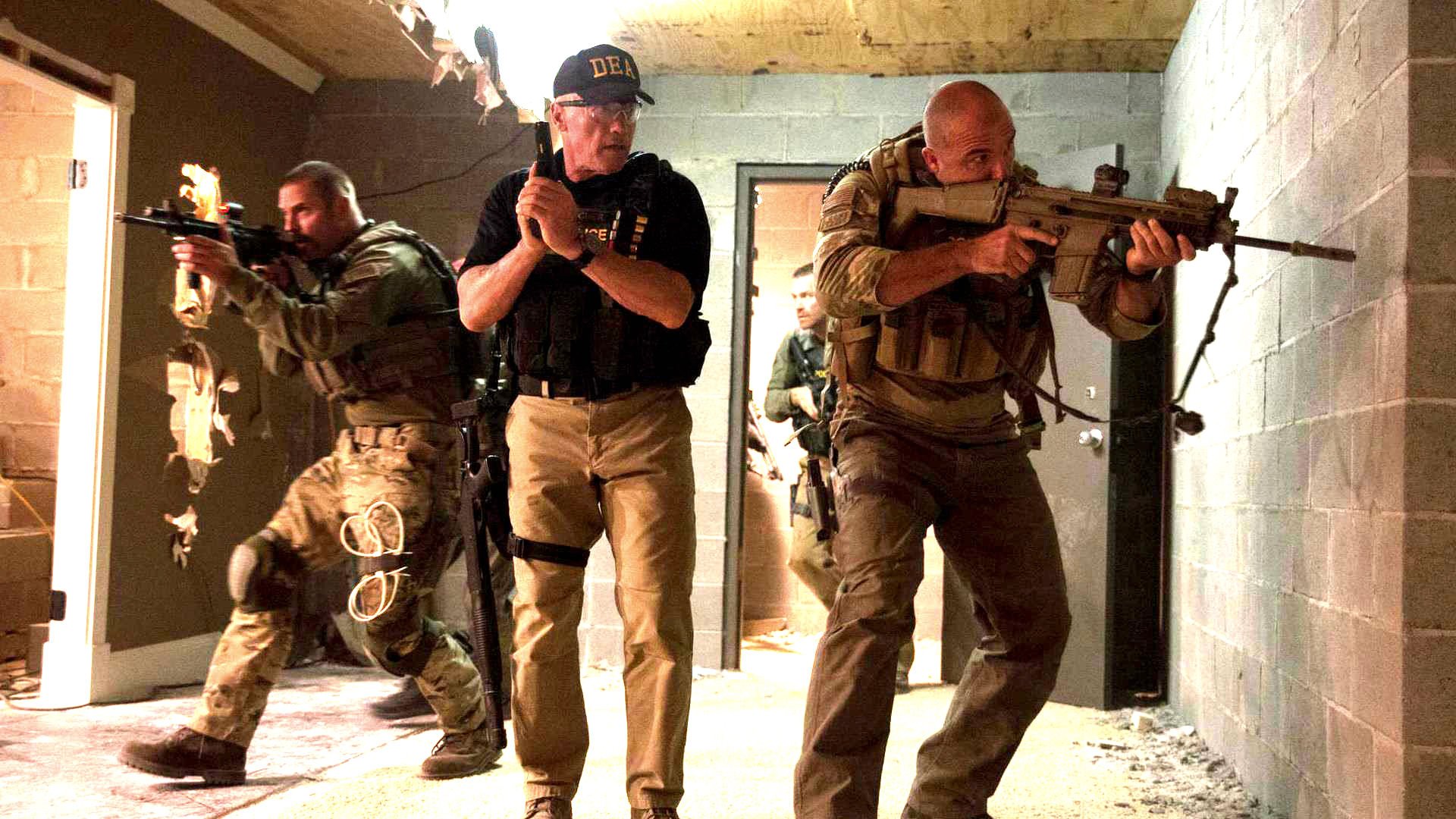
Sabotage (2014) - scene

Aiming for the kind of contemporary, gritty, urgent, down and dirty feel achieved in two of Ayer’s other outings as a writer – Training Day (2001) and End of Watch (2012) – Sabotage starts promisingly enough with a well-staged assault on the cartel house but then stumbles badly with its decision to delay the ensuing action for six months.  It doesn’t make sense that the cartel would wait that long to make their reprisals, nor that the killer within the team – especially when their motive is revealed – would also wait so long to target their teammates.  There’s also the matter of the back story involving “Breacher” that is revealed halfway through, which, once out in the open, muddies the waters even further.  With three separate ways of approaching the murders, and the reasons for them, Ayer’s script does its best to keep things as straightforward as possible, but there are too many times when narrative complexity is abandoned for moving the story along quickly to the next action sequence.  This leads to some lapses in logic that also weaken proceedings, such as Brentwood jumping into bed with “Breacher” at the drop of a hat, and “Breacher” allowing one of his team to have a drug problem, and there’s an air of convenience throughout.

Continuing his return to the big screen, Schwarzenegger puts in a grizzled performance that still relies on his trademark squint and square-jawed impassivity.  He’s the rock that anchors the movie but he doesn’t bring anything new to the table, and coasts on his physical presence, leaving the emoting to the rest of the cast (it’s still good to have him back though).  The casting of Williams is an interesting choice but she’s hampered by having to provide “Breacher” with a potential love interest, as well as trying to be a bad-ass detective.  From the team, Worthington and Enos fare best, while Holloway, whose career post-Lost seems to consist of uninspiring cameo turns, is forgettable in a role that appears written as one-dimensional.  Howard is sidelined for much of the movie, and Perrineau is the kind of peppy partner who’s so annoying you wonder why Brentwood hasn’t already shot him for the peace and quiet.

What hampers the movie most, though, is the curiously flat feel it has.  Everything happens at the same pitch, with little or no attempt to make even the action scenes tense or exciting, and the drama is disappointing for being so casually handled.  With Ayer’s direction largely AWOL, his and Skip Woods’ script is left to fend for itself, and its limitations are cruelly highlighted as a result.  By the time we get to the movie’s epilogue – a long time coming in and of itself – the viewer is left wondering what was the point.

Rating: 5/10 – not quite as terrible as it looks, Sabotage is nevertheless a serious letdown given the talent involved; one for fans of Ah-nold, and best viewed as an undemanding Saturday night/beer and a takeaway movie.

Share this:

  • Share on X (Opens in new window) X
  • Share on Facebook (Opens in new window) Facebook
  • More
  • Print (Opens in new window) Print
  • Email a link to a friend (Opens in new window) Email
Like Loading...

Calvary (2014)

26 Saturday Apr 2014

Posted by dullwood68 in Movies

≈ 1 Comment

Tags

Abuse, Atonement, Attempted suicide, Brendan Gleeson, Chris O'Dowd, Guilt, John Michael McDonagh, Kelly Reilly, Murder, Priesthood, Review

Calvary

D: John Michael McDonagh / 100m

Cast: Brendan Gleeson, Chris O’Dowd, Kelly Reilly, Aiden Gillen, Dylan Moran, Isaach De Bankolé, M. Emmet Walsh, Marie-Josée Croze, Domhnall Gleeson, David Wilmot, Pat Shortt, Gary Lydon, Killian Scott, Orla O’Rourke, Leo Sharpe

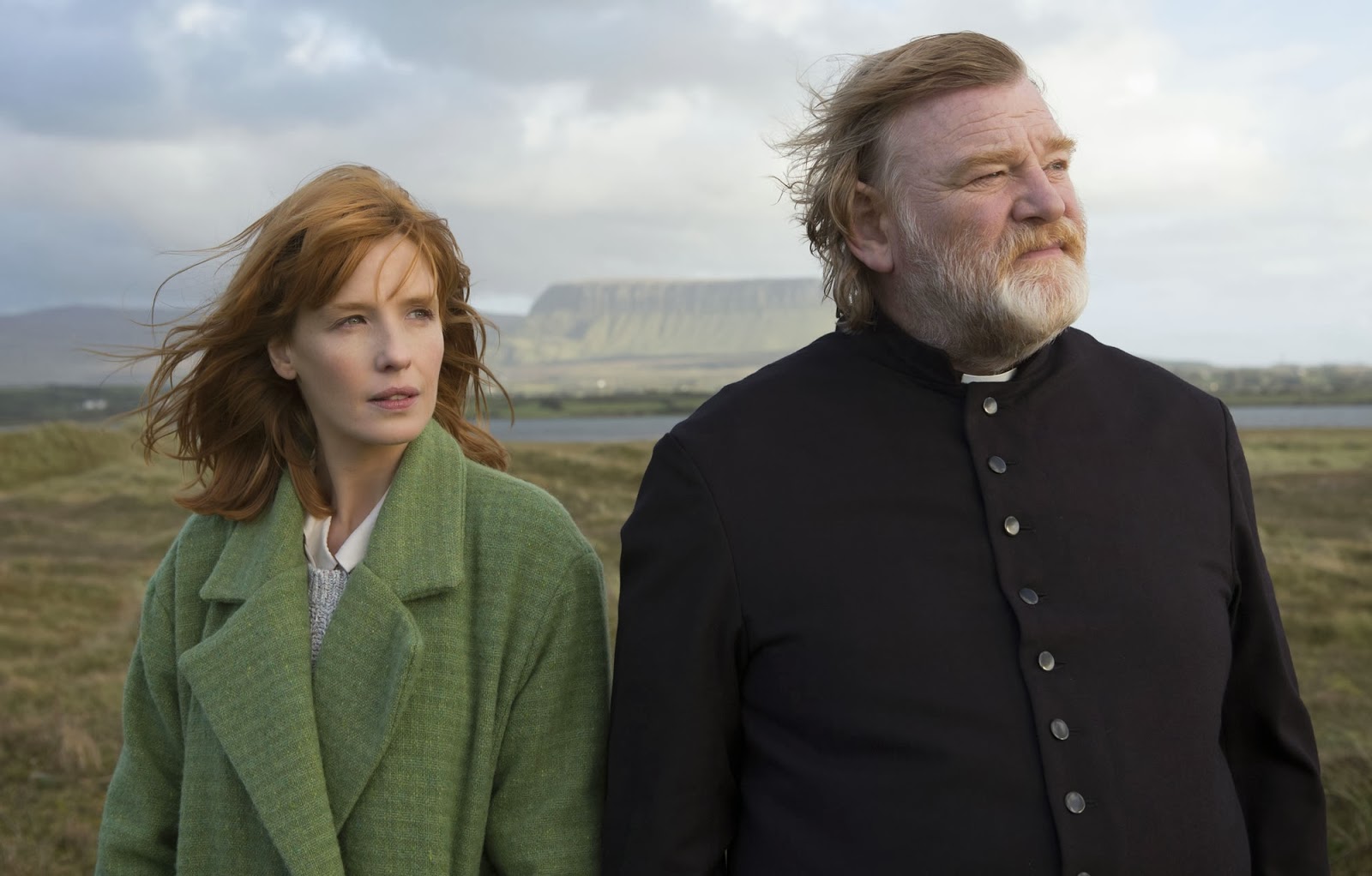
Calvary opens with a confession, not of sins committed, but of a sin to be carried out.  The priest hearing the confession, Father Lavelle (Gleeson), is flippant at first, then astounded as the proposed sin is murder, and the victim will be himself.  The parishioner was abused as a child by another priest (now dead) and wants his revenge; what better way to offend God than to kill a good priest, rather than a bad one?  It’s a powerful opening, and one that is bookended by an equally powerful conclusion.  What occurs in between, in the week leading up to the proposed murder, is often wryly humorous, sometimes emotionally uplifting, occasionally absurd, but alas, rarely convincing.

The main problem Calvary has is what to do with Father Lavelle once his death sentence is announced.  His superior, Bishop Montgomery (David McSavage), offers no real support or advice, and the priest he shares duties with, Father Leary (Wilmot), is so ineffectual he eventually leaves the parish.  A visit from his daughter, Fiona (Reilly), reveals his inadequacy a a biological father – she’s recovering from a suicide attempt and has been estranged from him since the death of her mother – and while some inroads are made in their relationship, his interaction with the rest of the village is less successful.  As he alienates more and more people, his intended murderer’s assertion that he’s a good priest becomes more and more untenable, and his failings as a man and a priest are increasingly highlighted.  This is a man whose own demons, once banished, are coming back to claim him.  (There’s an argument here that the man planning to kill him would know all this, making his choice of Lavelle as a “good priest” less a case of conviction, and more likely, of convenience.)

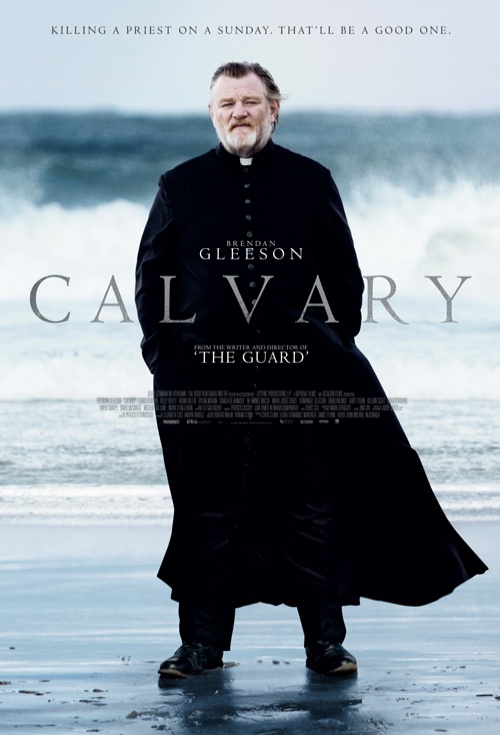
Calvary - scene

But while Father Lavelle continually fails to understand or support his parishioners – wife-beater and butcher Jack (O”Dowd), his errant wife Veronica (O’Rourke) and her lover Simon (De Bankolé), local businessman Fitzgerald (Moran), angry doctor Frank Harte (Gillen), local policeman Inspector Stanton (Lydon) and his rent boy lover Leo (Sharpe) – the audience is left wondering just how he managed to become a priest in the first place.  The number of ways in which he misunderstands the villagers is increasingly impressive, but becomes tiring after a (very short) while, so when he comforts the widow (Croze) of a French tourist who’s been killed in a car accident, it’s great to find he can be appropriately sympathetic and contrite (the movie has several quiet moments like this one, but it’s by far the most effective).

As events conspire to push Lavelle closer to the edge of a breakdown, and violence becomes a bitter factor in his involvement with the village, Calvary becomes a much darker movie and one that seems determined to offer no ray of hope for its embattled cleric.  Gleeson is a perfect choice for the dour, embittered character he portrays, a man who has come late to the priesthood, and now finds himself the target of someone’s hatred of the institution he represents.  In the hands of director and screenwriter McDonagh, this premise should have been the basis for a trenchant examination of faith, responsibility and social exclusion.  What it serves up instead is a treatise on bad decisions and atonement, with unresolved guilt as a side order.  Aside from the village’s odd assortment of inhabitants, there’s little in terms of the drama taking place that we haven’t seen before (and with more sharply defined characters).  It’s not that Calvary is a bad film per se, just that it promises much more than it delivers.

Rating: 7/10 – strong performances and beautiful location photography side, Calvary doesn’t quite draw the audience in as planned; still worth watching though as there are few movies out there that take these kind of risks with both the material and its performances.

Share this:

  • Share on X (Opens in new window) X
  • Share on Facebook (Opens in new window) Facebook
  • More
  • Print (Opens in new window) Print
  • Email a link to a friend (Opens in new window) Email
Like Loading...

The Inner Circle (1946)

13 Sunday Apr 2014

Posted by dullwood68 in Movies

≈ Leave a comment

Tags

Adele Mara, Blackmail, Crime, Johnny Strange, Murder, Mystery, Philip Ford, Republic Pictures, Review, Secretary, Warren Douglas

Inner Circle, The

D: Philip Ford / 57m

Cast: Adele Mara, Warren Douglas, William Frawley, Ricardo Cortez, Virginia Christine, Will Wright, Dorothy Adams

When private eye Johnny Strange (Douglas) wants a new secretary, he calls an agency and explains what he needs: “a blonde, beautiful, between 22-28, unmarried, with skin you love to touch, and a heart you can’t”.  His wish is granted immediately in the form of Geraldine Travis (Mara), who appears before he can finish the call, and effectively gives herself the job.  Overwhelmed and on the back foot from the moment she appears, Strange agrees to her employment just as the phone rings.  Geraldine deals with the call which is from a Spanish woman, asking for Strange to meet her later that evening; she has something very important she needs to talk to him about.

Strange meets the woman, who insists on hiding her identity behind a thick black veil.  They drive to her home where Strange is surprised to find the body of a man who’s been shot dead.  The Spanish woman attempts to bribe Strange into dealing with the body her way but when he declines and begins to call the police, she knocks him unconscious.  At this point, the movie reveals a major twist in the plot, and it becomes as much a whodunit as a whydunit?  The police, headed by ultra-suspicious Detective Lieutenant Webb (Frawley), think Strange killed the man – revealed as notorious gossip columnist Anthony Fitch – but with little evidence to secure a conviction, and the testimony of his new secretary keeping him out of jail, Strange resolves to find the killer and clear his name completely.

It soon becomes evident that Fitch wasn’t well-liked, and a number of people had motive and opportunity: there’s club owner Duke York (Cortez); singer Rhoda Roberts (Christine); Fitch’s housekeeper Emma Wilson (Adams); and Fitch’s gardener Henry Boggs (Wright).  Each behaves suspiciously but each denies any involvement in Fitch’s murder, even though they all saw him on the day he was killed.  When Strange learns that Fitch was about to reveal somebody’s big secret in his next radio broadcast, the why becomes clear but the who remains a mystery (unless you’ve seen some of these kind of movies before).

Inner Circle, The - scene

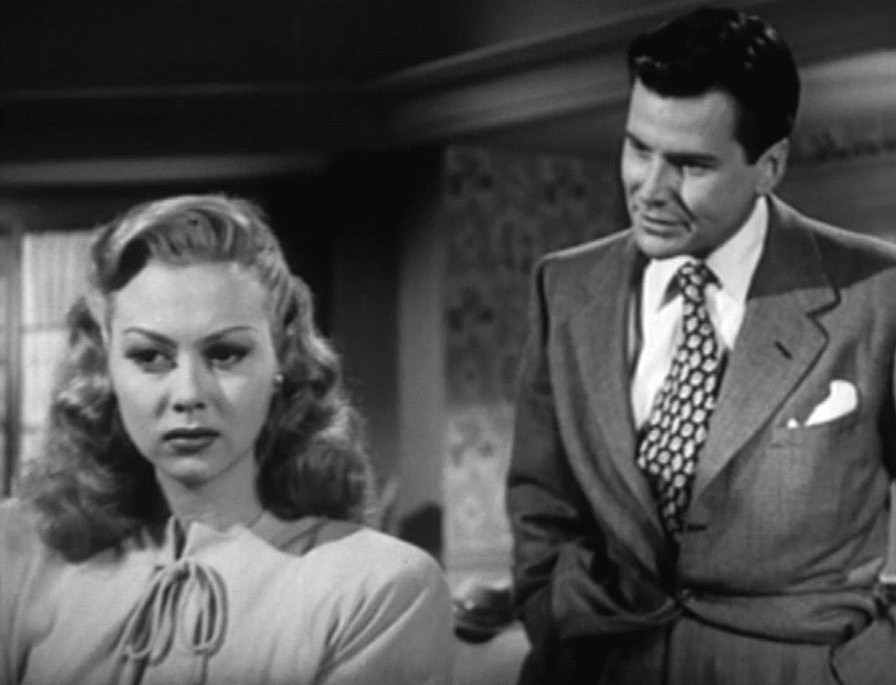
The Inner Circle has a jaunty, often comic feel to it that is nicely underplayed by its cast, and there are some great one-liners (mostly at Strange’s expense).  The humorous tone softens and complements the mystery elements, while the drama spins out at a surprisingly leisurely pace given the movie’s short running time.  It’s an easy movie to watch, and has a distinct charm that lifts it above the usual fare delivered by Republic Pictures during the Forties.  Mara and Douglas are a good match for each other, displaying a real chemistry together, and adding a spark to their scenes that benefits the movie throughout.  The mystery itself is hardly original, and there are moments when the audience’s credulity is strained as Strange makes yet another goof (is he really as good a private investigator as he thinks he is?), but taken as a whole, The Inner Circle succeeds with defiant ebullience.

What helps is it’s determination not to take the easy route.  So much of the movie – courtesy of Dorrell and Stuart E. McGowan’s fractious screenplay – turns on a willingness to upset its audience’s preconceptions.  The twist revealed after Strange is knocked unconscious gives a great indication of how slyly subversive the rest of the movie will turn out to be, with the murder complicated by side orders of blackmail, theft and unexpected revelations.  It all culminates in a radio broadcast where all the suspects are persuaded to play themselves in reenactments of key moments from earlier in the plot.  It’s like an Agatha Christie homage but with extra attitude in the staging and playing.

The cast all give good performances – Wright is a particular joy as the irascible gardener – and Ford’s direction shows a firm grasp of the material.  With its short running time and pleasant air, The Inner Circle deserves a wider audience than it’s likely to get these days.  As an example from the days when Poverty Row often meant appalling sets and even worse acting and/or directing, this is one movie that bucks the trend, and does it with a wonderful lack of concern.

Rating: 7/10 – often surprisingly witty and with a slightly eccentric approach to telling its story, The Inner Circle is a delight from beginning to end; proof as well that even Republic could grind out a winner every now and then.

Share this:

  • Share on X (Opens in new window) X
  • Share on Facebook (Opens in new window) Facebook
  • More
  • Print (Opens in new window) Print
  • Email a link to a friend (Opens in new window) Email
Like Loading...

Death on the Nile (1978)

31 Monday Mar 2014

Posted by dullwood68 in Movies

≈ 1 Comment

Tags

Agatha Christie, Angela Lansbury, Bette Davis, David Niven, Egypt, Hercule Poirot, John Guillermin, Mia Farrow, Murder, Nile, Pearls, Peter Ustinov, Review, Shooting, Steamer, Whodunnit

Death on the Nile

D: John Guillermin / 140m

Cast: Peter Ustinov, Jane Birkin, Lois Chiles, Bette Davis, Mia Farrow, Jon Finch, Olivia Hussey, I.S. Johar, George Kennedy, Angela Lansbury, Simon MacCorkindale, David Niven, Maggie Smith, Jack Warden

Making a somewhat delayed appearance after the success of Murder on the Orient Express (1974, and referenced here near the end), Death on the Nile takes the all-star format of that movie and replicates it in another Agatha Christie adaptation.  Instead of Albert Finney as Hercule Poirot we have an avuncular, slightly whimsical Peter Ustinov, aided and abetted by old friend Colonel Race (Niven).  The set up: murder committed on a steamer making its way down the Nile, makes good use of its confined setting, and keeps the audience guessing throughout.

The story begins in England.  Heiress Linnet Ridgeway (Chiles) meets Simon (MacCorkindale), the fiancé of her best friend, Jackie (Farrow).  Not long after Linnet and Simon marry, much to the dismay of Jackie.  On their honeymoon tour of Europe and the Middle East, Jackie keeps popping up when they least expect it, attempting to ruin their trip.  They give Jackie the slip on the morning of their trip down the Nile, and board the steamer, unaware that nearly everyone else on board has a reason to want to see Linnet dead.  There’s her maid, Louise (Birkin), who is in love with a married man; Linnet refuses to give Louise the money she’s been promised so she can be with him.  Sex-mad authoress Salome Otterbourne (Lansbury) is being sued by Linnet over an ill-disguised representation of her in one of Salome’s novels.  Salome’s daughter, Rosalie (Hussey), will do anything to see her mother isn’t ruined.  Mrs Van Schuyler (Davis) has designs on a set of valuable pearls that Linnet owns, while her companion, Miss Bowers (Smith), saw her family ruined by Linnet’s father.  Then there is Andrew Pennington (Kennedy), Linnet’s American lawyer, who is embezzling funds from her estate, and would be ruined himself if she finds out.  Add to the mix, would-be (but not very convincing) socialist Mr. Ferguson (Finch), who thinks people like Linnet should be done away with, and the secretive Dr Bessner (Warden), as well as Jackie – who finds her way on to the steamer after all – and you have the usual glut of suspects you come to expect from one of Agatha  Christie’s whodunits.

One evening, Simon and Jackie have an argument.  Jackie has been drinking and in a fit of anger, she pulls out a gun and shoots Simon in the leg.  While a distraught Jackie is looked after by some of the other passengers, and Simon is seen to by Dr Bessner, someone takes the opportunity to steal Jackie’s gun and kill Linnet with it.  Entrusted by the company that owns the steamer to investigate the matter before it reaches its destination, Poirot and Colonel Race seek to discover the murderer’s identity and reveal how the murder was committed and why.

Generally regarded as one of Agatha Christie’s better novels, Death on the Nile has all the hallmarks of a prestige, international movie, with its glamorous Nile location, its glittering array of stars, and its lead character, recognised the world over.  In Ustinov’s hands, Poirot is by turns tetchy, amused, officious, arrogant, playful, and generous.  Given all that, it’s actually a less mannered performance than Finney’s, with Ustinov relaxing in the role for long stretches – particularly in the movie’s rather long-winded first hour – and providing some much-needed humour when the story requires it.  The traditional speech where he reveals the murderer is delivered with a nice mix of gravitas and sadness, making him less the avenging angel of some interpretations and more of a weary observer of human weaknesses.  It’s an astute performance, and one he was able to repeat in two further big screen outings – Evil Under the Sun (1982) and Appointment With Death (1988) – as well as three made for TV movies.

The rest of the cast all get their moments to shine, but some have less to do than others (Finch is probably given the least to do, but it’s unsurprising as his character is there mainly to provide Rosalie with a romantic attachment).  Davis and Smith make for a great double act, and even now it’s amazing to see the way in which Smith pulls Davis about without a moment’s hesitation.  Farrow plays the vengeful ex-fiancée to the hilt while supposedly star-crossed newlyweds Chiles and MacCorkindale provide less than convincing performances, she being unable to match her facial expressions to the emotion required, and he being unable to manage any facial expressions.  Niven has the thankless task of playing baffled foil to the great detective, while it’s Lansbury who steals the movie out from everyone with her portrayal of an ageing authoress with sex on the brain and a more than passing interest in the bar (she makes for a great lush).

With all the emphasis on its cast, the storyline and plotting take a bit of a back seat, despite being played out for nearly two hours before Poirot gathers everyone together for the “big reveal”.  Events occur that might be important, others prove to be red herrings, and one attempted murder at a temple is quickly forgotten about until the end, when the perpetrator is revealed.  Anthony Shaffer’s screenplay takes the bulk of Christie’s novel and puts it up there for all to see but in the process drags out the running time.  A case in point is the long stretch in the second hour where Poirot challenges the other passengers with his versions of how each one could have committed the murder.  They’re all of a similar nature and some judicious pruning at this stage would have been more effective; just one or two “recreations” would have sufficed for the audience to get the picture.

In the director’s chair, Guillermin coaxes good performances from his cast, and keeps the audience guessing throughout as to whether or not they’ve seen or heard something important or not (though chances are they have – it’s that kind of adaptation).  Having made the disastrous King Kong (1976) remake, it’s good to see him assemble the cast, script, locations and photography to such good effect, giving the movie a light, airy visual style that offsets the seriousness of the storyline and keeps it continually entertaining.

Rating: 8/10 – its length notwithstanding, Death on the Nile is an above par Christie adaptation, with a strong cast abetted by confident direction and beautiful location work; a good mystery too, with an ending that’s way more downbeat than anyone would ever expect.

Share this:

  • Share on X (Opens in new window) X
  • Share on Facebook (Opens in new window) Facebook
  • More
  • Print (Opens in new window) Print
  • Email a link to a friend (Opens in new window) Email
Like Loading...

Reasonable Doubt (2014)

24 Monday Mar 2014

Posted by dullwood68 in Movies

≈ Leave a comment

Tags

Court case, Crime, District attorney, Dominic Cooper, Gloria Reuben, Hit and run, Murder, Parolees, Peter Howitt, Revenge, Review, Samuel L. Jackson, Wife and child

Reasonable Doubt

D: Peter P. Croudins / 91m

Cast: Dominic Cooper, Samuel L. Jackson, Gloria Reuben, Ryan Robbins, Erin Karpluk, Dylan Taylor

Pop quiz: You’re a mega-successful district attorney who’s never lost a case.  After a night out celebrating another win in court, and having had a few drinks, you still drive home because you’re worried your car might be stolen while you take a taxi.  On the way, you hit and injure a man.  Do you: a) call for an ambulance using your mobile phone and stay with the man until it arrives? b) call for an ambulance by using a pay phone and then drive off? or c) carry on driving and don’t look back?  If you answered b, then give yourself a gold star.

This is what hot shot DA Mitch Brockden (Cooper) does, and inevitably it sets in motion a series of events that ends with his wife, Rachel (Karpluk) and newborn child Ella being put in mortal danger.  In between those two events, Mitch gets an uncomfortable case of the guilts.  When Clinton Davis (Jackson) is arrested with the injured man – who is now dead – in his car later that evening, Davis’s assertion that he had found the man and was trying to get him to a hospital rings true with Mitch, even though Davis has tools in his car that match the weapons that caused the man’s other injuries.  When Davis is charged with the man’s murder, it’s Mitch who gets to prosecute him.

For reasons too tiresome and unlikely to reveal here, Mitch’s estranged step-brother Jimmy (Robbins) testifies at the trial that he saw the hit and run.  Davis is freed.  Soon after, another man is found dead with similar injuries.  Mitch now believes Davis did kill the man he knocked down, and when investigating Detective Kanon (Reuben) mentions other incidents that Davis is connected to, Mitch is convinced of Davis’s guilt.  He decides to investigate further, but soon finds that Davis is more dangerous than he expected.

Reasonable Doubt - scene

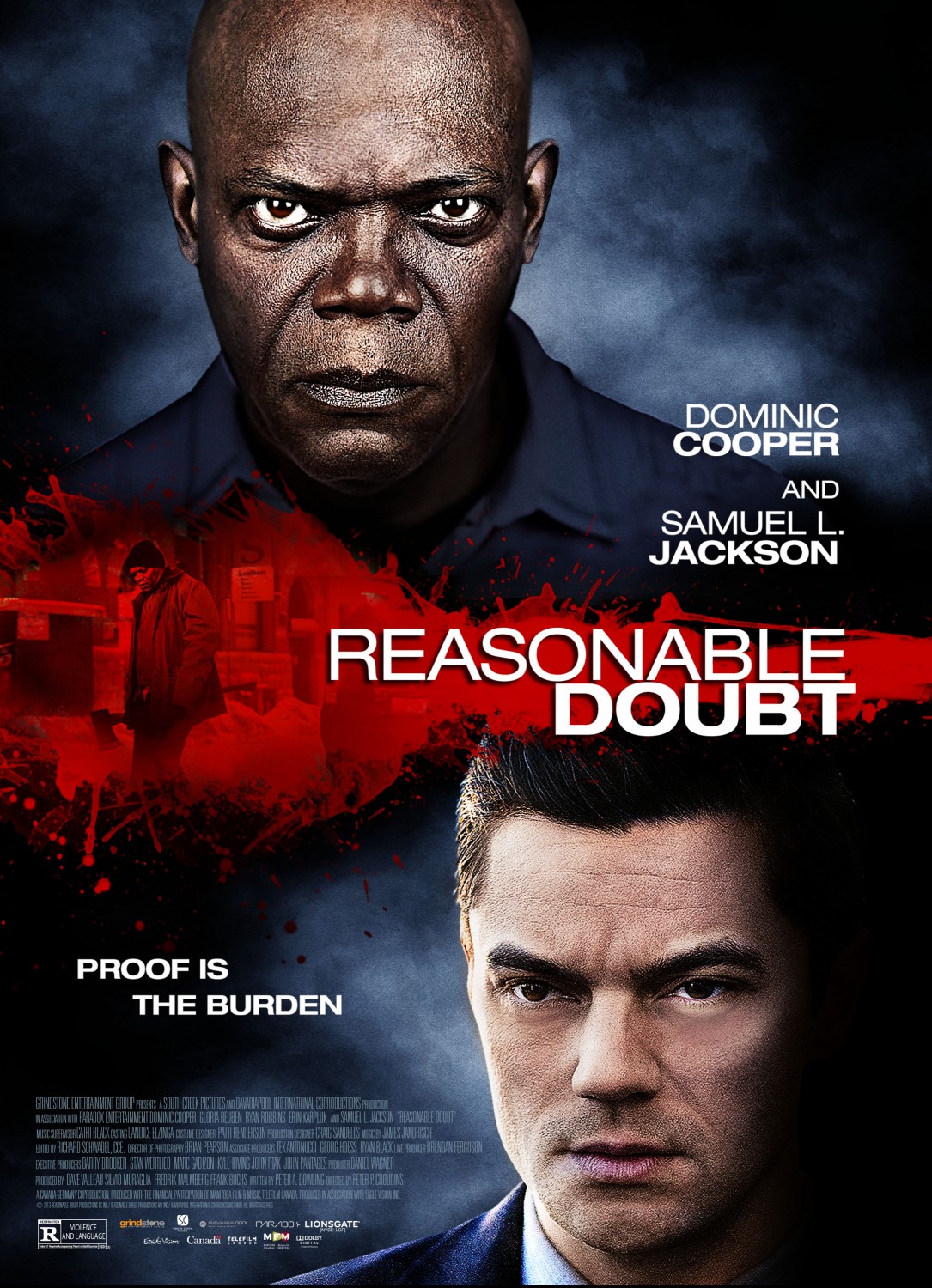
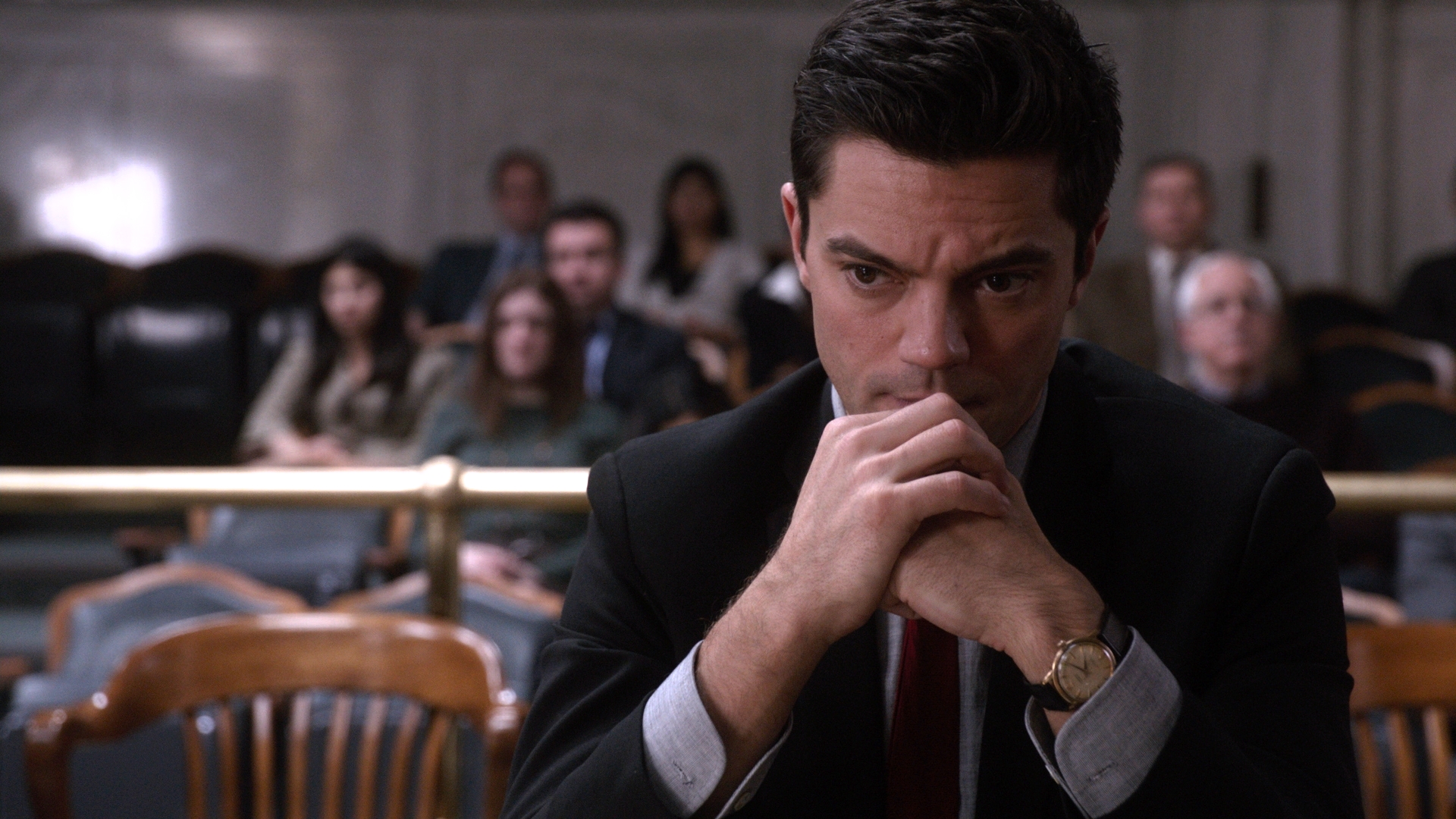
It’s not that the whole scenario of Reasonable Doubt is far-fetched, or that the motivations of both Mitch and Davis are about as convincing as a politician’s probity, nor even that the level of credibility is undermined continually by Cooper’s lacklustre performance – he demonstrates guilt by looking as if his haemorrhoids are playing up – it’s more that no one stopped to take stock of the movie while it was being made and said, “Hold on, isn’t this just the biggest load of rubbish?”  If someone had, then perhaps we’d all have been spared this poor excuse for a thriller.  As it is, the audience has to endure scene after scene of disjointed dialogue, uncomfortable plot contrivances, woeful acting (Cooper and Reuben are the worst offenders), and such dreadful direction that Peter Howitt’s name is changed in the credits (see above).

It’s always frustrating when movies like this are made.  Reasonable Doubt could have been so much better, but the script by Peter A. Dowling comes across as a hastily assembled first draft.  There is very little internal logic on display, and what there is is so ridiculous that even if you suspended all credulity you’d still be asking yourself if what you were seeing was really happening.  The character of Mitch bears no resemblance to anyone in real life, he makes risky decisions based more on the script’s need for him to do so than any actual self-motivation, and for someone who is so good at his job – so much so that he knows a judge’s decision before he even makes it – he makes one stupid mistake after another, until he ends up arrested for the attempted murder of his step-brother.

And then the movie presents us with it’s most ridiculous and stupid moment: after receiving a call from Davis who tells him he’s going to kill Rachel and Ella, and after he overpowers a police officer, Mitch walks out of the police station without being stopped and while carrying the police officer’s gun!  He doesn’t even try to hide it, just walks out with it in his hand!  It’s when a script offers this as a development, and no one stops to say “Hold on, isn’t this just the biggest load of complete rubbish?” that you know no one really cares.  So why should the audience?

There are – amazingly – worse thrillers out there, but these are mostly low-budget affairs with semi-professional casts and inexperienced directors.  Here, there’s a level of conspicuous ability but it’s all for nought.  Even Jackson phones in his performance, giving us a less intense, less convincing version of his character from Meeting Evil (2012).  You could say that Reasonable Doubt is so bad it’s mesmerising… but that would be a whole other load of rubbish.

Rating: 3/10 – dreadful thriller that insults its own cast as well as the audience; proof if any were needed that some movies should have their productions shut down after day one.

Share this:

  • Share on X (Opens in new window) X
  • Share on Facebook (Opens in new window) Facebook
  • More
  • Print (Opens in new window) Print
  • Email a link to a friend (Opens in new window) Email
Like Loading...

Recreator (2012)

21 Friday Mar 2014

Posted by dullwood68 in Movies

≈ Leave a comment

Tags

Alexander Nifong, Clones, DNA, Experiment, Gregory Orr, Jamal Mallory-McCree, Mad scientist, Murder, Review, Stella Maeve

Recreator

aka Cloned: The Recreator Chronicles

D: Gregory Orr / 90m

Cast: Stella Maeve, Alexander Nifong, Jamal Mallory-McCree, John de Lancie, Laura Moss

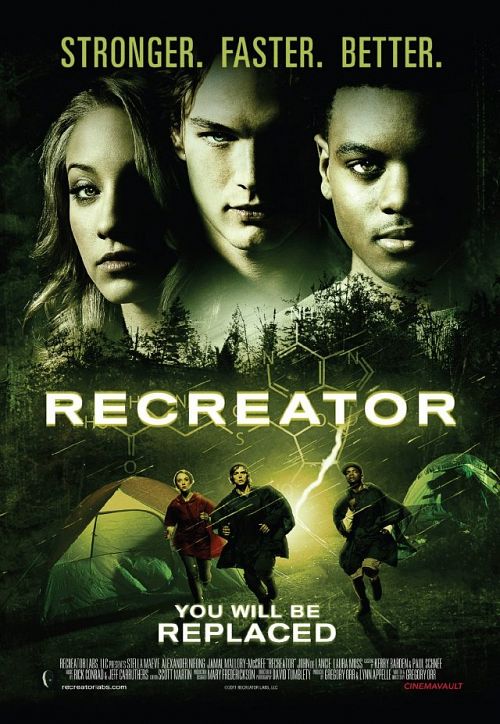
A trio of teens, Tracy (Maeve), Craig (Nifong) and Derek (Mallory-McCree), arrive at lake-bound Brewster Island for a camping trip.  They spy a house above the treelike and when Tracy decides she’d rather the bathroom than go in the woods, she unwittingly sets in motion events that will put all their lives in danger.  That night there is a terrible storm, complete with lightning, and the trio decide to throw all aims of camping out of the tent and take refuge in the house.  The next morning the owners (de Lancie, Moss) return from the mainland.  When they realise someone has been in their house, they react in a totally unexpected way: they coerce the trio into helping them bury the real owners – who they resemble exactly.

At this stage of the movie the plot introduces the duplicates of Tracy, Craig and Derek, and becomes a battle of wills between the two trios.  The duplicates – or clones – are stronger, more intelligent and above all, unscrupulous; they plan to kill the original trio as soon as possible.  Initially unaware of this, Tracy, Craig and Derek are still mistrustful of the whole situation, but seem more content to argue amongst themselves about what to do.  In the end, Derek leaves the island to get help.  While he’s gone, Tracy’s clone begins to develop feelings for Craig, while Craig’s clone attempts to seduce Tracy.  And all the while, Tracy and Craig try to work out why all this is happening…

Recreator - scene

Recreator begins well, with a couple of eerie, atmospheric sequences involving the house’s owners, but then fails to make its trio of original protagonists even remotely likeable.  Derek is arrogant, Tracy is self-absorbed, and Craig is wetter than water.  When their clones show up it’s almost a relief, as they truly are “better” than the real thing.  However, this is probably to allow for the dramatic aspects of the story to be heightened.  We know the clones are inherently bad, and we know that there will be a showdown at the end, and we know that there will be a large degree of proselytising from the clones about the world needing them more than the originals, and we also know that Tracy and Craig will discover the reason why all this is happening… but… will it be worth sticking around to find out?

The answer is yes and no.  Writer/director Orr has hit on a great idea for a movie, but in putting it all together, he’s taken a scattershot approach to his material.  The relationships appear culled from an indie movie, the sci-fi elements from any number of Fifties’ mad scientist outings, and the overall feel is like watching any of the first four Friday the 13th movies but without the gratuitous gore or semi-nudity.  The dialogue varies too, from faux-existential to banal to (possibly) semi-improvised.  Orr’s direction too is often off-balance, as if the mix of styles is problematical for him: some scenes are played as sinister when they should be more straightforwardly dramatic, while others have a latent humour that passes by either unacknowledged or under-utilised.

On the plus side, Maeve, Nifong and Mallory-McCree do well with roles that require them to play two sides of the same personality, and the necessary split-screen work is well done, particularly in a lake-set scene involving both Tracys.  The raison d’être for everything is laid out well, and while the latter day mechanics of it are a bit suspect – they involve a cesspit of all things – the lake bound setting keeps the action believably contained.  The music by Jeff Carruthers and Rick Conrad is effective, and David Tumblety’s photography, while not striking, does create a distinctive mood that fits with the storyline.  Even with the caveats mentioned above, Recreator is mostly engaging and even thought-provoking on occasion.

The movie ends with the legend To be continued.  If Orr gets a better grip on his ideas and material, then a sequel will be something to look forward to.
Rating: 6/10 – problems with the script knock this movie down a point; however, all problems aside, there’s enough here to warrant more than a cursory glance.

Originally posted on thedullwoodexperiment website.

Share this:

  • Share on X (Opens in new window) X
  • Share on Facebook (Opens in new window) Facebook
  • More
  • Print (Opens in new window) Print
  • Email a link to a friend (Opens in new window) Email
Like Loading...

Mini-Review: Kill Your Darlings (2013)

13 Thursday Mar 2014

Posted by dullwood68 in Movies

≈ 1 Comment

Tags

Allen Ginsberg, Beat poets, Ben Foster, Columbia University, Dane DeHaan, Daniel Radcliffe, David Kemmerer, Elizabeth Olsen, Infatuation, Jack Huston, John Krokidas, Love, Lucien Carr, Michael C. Hall, Murder, Review, William Burroughs

Kill Your Darlings

D: John Krokidas / 104m

Cast: Daniel Radcliffe, Dane DeHaan, Michael C. Hall, Jack Huston, Ben Foster, David Cross, Jennifer Jason Leigh, Elizabeth Olsen, John Cullum, David Rasche

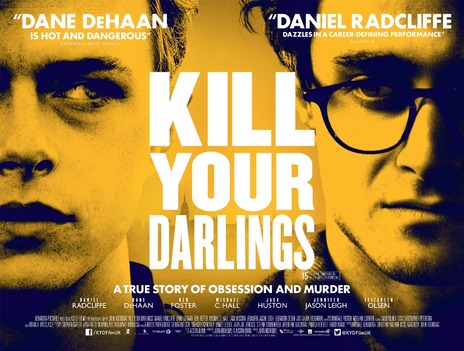
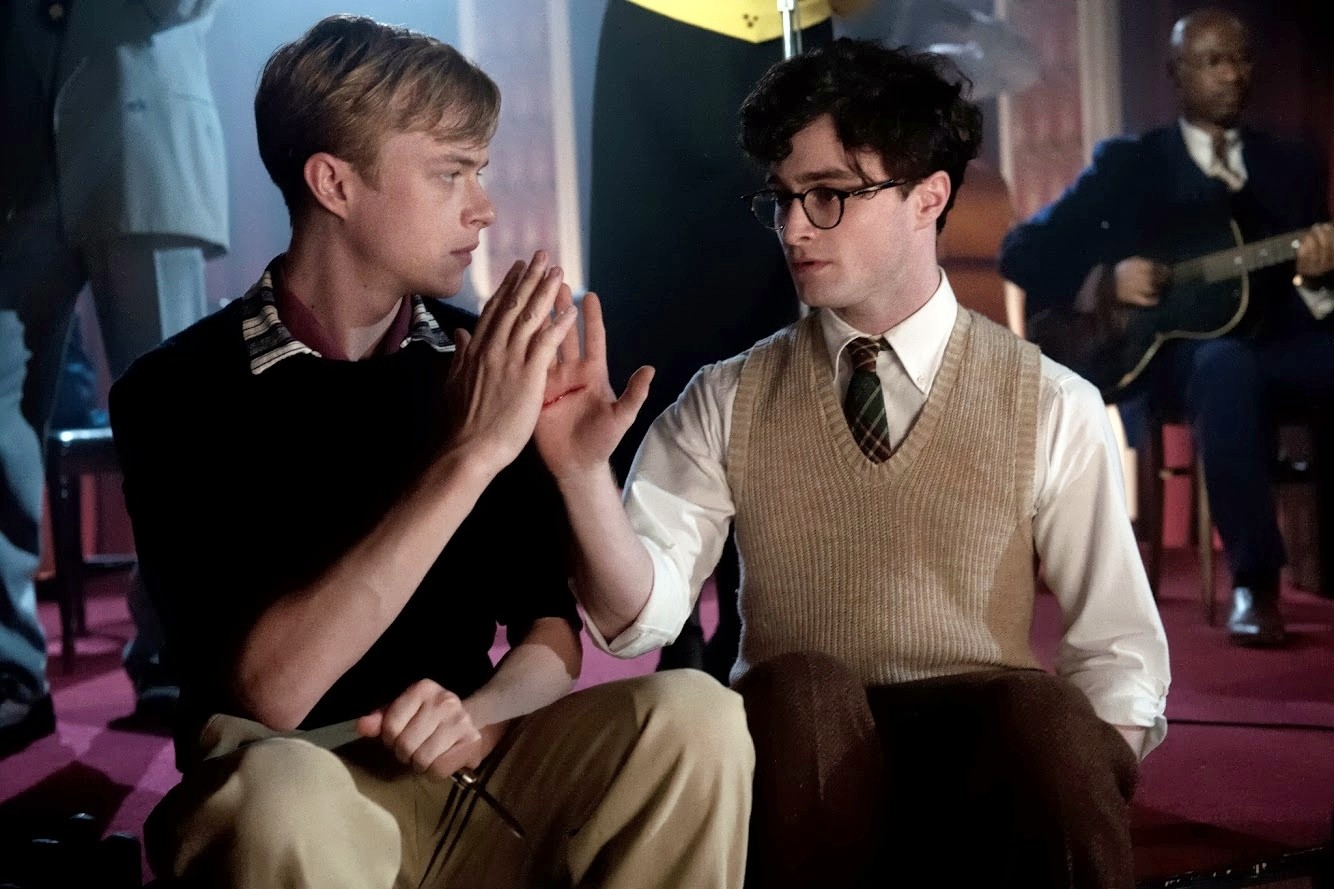
Covering the years 1943-45 while fledgling poet Allen Ginsberg (Radcliffe) was at Columbia University, Kill Your Darlings – a reference to William Faulkner – charts the growing infatuation between Ginsberg and fellow student Lucien Carr (Chronicle‘s DeHaan), their relationships with William Burroughs (Foster) and Jack Kerouac (Huston), and eventually, their roles in the murder of Dr David Kemmerer (Hall).

This is a slow burn movie, where the script strives to paint the characters as boldly as possible and with as much honesty as possible. Carr is shown as manipulative, pretentious and ultimately callow, while Ginsberg comes across as incredibly naive. As played by Radcliffe, Ginsberg is all grinning confusion and slow-on-the-uptake reactions. Unfortunately, this means that neither of them are particularly likeable (though Ginsberg edges it); as a result the movie suffers because it’s difficult to root for any of them, and when the details of the murder are revealed, any sympathies built up during the movie are swept away in a moment (though maybe that was the filmmakers’ intention).

Kill Your Darlings - scene

Like a lot of so-called “free thinkers” with plans to change the world, they’re more adept at ruining the world they live in than creating a new one. When it becomes clear that they’re no better than the system they despise, the movie starts to falter and first-timer Krokidas loses his previously sure grip on proceedings. Of the cast, Radcliffe and DeHaan acquit themselves well, while Foster exudes an icy menace as Burroughs. Hall, though, is miscast, and struggles as the doomed Kammerer. That said, Krokidas makes good use of a great cast, and allowing for the odd stumble, shows a great deal of promise. The 40’s recreation is done well, and Reed Morano’s cinematography recalls other movies from the same period. An interesting story, then, and well-mounted but it’s difficult to tell an interesting story when the main characters are so hollow inside.

Rating: 7/10 – a minor slice of history given a fair-minded treatment that doesn’t quite achieve its aims; absorbing though and another good performance from Radcliffe.

Share this:

  • Share on X (Opens in new window) X
  • Share on Facebook (Opens in new window) Facebook
  • More
  • Print (Opens in new window) Print
  • Email a link to a friend (Opens in new window) Email
Like Loading...

Group Review: Shed No Tears (1948) / Child Bride (1938) / Detective Kitty O’Day (1944)

13 Thursday Mar 2014

Posted by dullwood68 in Movies

≈ Leave a comment

Tags

Child marriage, Crime, Exploitation, Harry Revier, Insurance fraud, Jean Parker, Jean Yarbrough, June Vincent, Murder, Mystery, Ozarks, Review, Shirley Mills, Wallace Ford, William Beaudine, www.archive.org

NOTE: All three movies were viewed courtesy of http://www.archive.org – go check it out!

Shed No Tears (1948)

Shed No Tears

D: Jean Yarbrough / 70m

Cast: Wallace Ford, June Vincent, Mark Roberts, Johnstone White, Frank Albertson, Dick Hogan, Elena Verdugo

Spirited noir with a constantly twisting, changing plot to keep its audience guessing (although the eventual outcome is never in doubt – it’s the Forties after all, and bad people still need to be punished).  After faking his death with the help of his wife Edna (Vincent), Sam Grover (Ford) hides out until Edna can collect on the insurance money.  What Sam doesn’t know is that Edna has no intention of sharing the money with him, and has her own plans involving her lover, Ray (Roberts).  Meanwhile, Sam’s son Tom (Hogan), unconvinced that his father’s “death” was accidental, hires a private detective (White) to look into the matter.  What follows is an entertaining yarn full of double crosses, unexpected twists and turns, and hard-boiled dialogue (mostly uttered by Vincent).  The cast are proficient – though some of Vincent’s line readings are memorable for all the wrong reasons – and Yarbrough’s direction shows a sure hand.  Not as slick or as impressive as some other post-war noirs but worth catching nevertheless.

Rating: 6/10 – a minor gem that works well when focusing on its lead characters’ greed; Vincent looks completely untrustworthy throughout.

Child Bride (1938)

Child Bride

D: Harry Revier / 62m

Cast: Shirley Mills, Bob Bollinger, Warner Richmond, Diana Durrell, Dorothy Carrol, George Humphreys, Frank Martin

Exploitation curio that mixes child marriage reform with more traditional soap opera elements.  Jennie (Mills) is twelve.  She’s a bright, precocious child who lives with her mother (Carrol) and father (Humphreys) in the Ozarks.  The community there sees nothing wrong with children Jennie’s age being married because, as one character puts it, “there ain’t enough adult women to go round”.  The local school teacher, Miss Carol (Durrell) is fighting to have the law changed but it’s an uphill struggle.  Meanwhile, Jennie’s father falls foul of his partner in an illegal still, Jake Bolby (Richmond).  Events play out so that Jennie ends up betrothed to Bolby.  Will she be saved in the nick of time?  Child Bride moves along at a rapid pace and crams a lot into its short running time.  Revier directs ably enough but the cast vary from just about credible (Richmond) to downright terrible (Durrell and Martin).  There’s an extended sequence where Jennie goes skinny-dipping and it’s clear that Mills is naked, and an even more risible sequence where Miss Carol is abducted at night by hooded men.

Rating: 4/10 – engrossing in its way, Child Bride ends up being a little too melodramatic for its own good; it’s also dated badly but the presentation of its central theme still has the ability to make modern audiences uncomfortable.


Detective Kitty O’Day (1944)

Detective Kitty O'Day

D: William Beaudine / 61m

Cast: Jean Parker, Peter Cookson, Tim Ryan, Veda Ann Borg, Edward Gargan, Douglas Fowley, Herbert Heyes, Pat Gleason

Fast-paced comedy whodunnit featuring Parker as Kitty O’Day, who, when her boss is murdered, decides to find the killer – against the best advice of her boyfriend Johnny (Cookson) and the police (Ryan, Gargan).  But everywhere she turns, more dead bodies pop up and soon Kitty and Johnny become the number one suspects.  Parker and Cookson make for a good team, and if their banter seems a little forced at times, it doesn’t detract from the obvious chemistry they have together.  The storyline dips in and out of being plausible, and the final explanation is unnecessarily convoluted, but otherwise this is an enjoyable romp that relies largely on short, punchy scenes to make up its running time.  Beaudine – who could make this kind of movie in his sleep – keeps it light and frothy, and the cast fill their roles with ease, especially Ryan and Gargan who steal the show as the by turns exasperated and clueless cops on the case.  Not a classic – and neither is the sequel, Adventures of Kitty O’Day (1945) – but it’s a fun way to pass an hour.

Rating: 5/10 – tries to be rip-roaring but gets bogged down in its own plot; light and breezy throughout with few variations to compensate for all the frivolity.

Share this:

  • Share on X (Opens in new window) X
  • Share on Facebook (Opens in new window) Facebook
  • More
  • Print (Opens in new window) Print
  • Email a link to a friend (Opens in new window) Email
Like Loading...

Jaws of Justice (1933)

16 Sunday Feb 2014

Posted by dullwood68 in Movies

≈ Leave a comment

Tags

Canine hero, Drama, Jack Perrin, Kazan the Wonder Dog, Lost gold, Murder, Review, Robert Walker, Ruth Sullivan, Spencer Gordon Bennet

Jaws of Justice

D: Spencer Gordon Bennet / 58m

Cast: Kazan the Wonder Dog, Jack Perrin, Robert Walker, Ruth Sullivan, Gene Toler, Lafe McKee, Lightnin’ Teddy

While the animal hero genre has taken a bit of a satirical bashing in recent years – “What’s that, Champion/Skippy/Lassie?  Little Timmy’s fallen down the well/mineshaft/stairs?” – this movie from a simpler, bygone era has a certain charm about it that makes it more enjoyable than you might expect (or believe).

The plot is straightforward enough: when old timer ‘Seeker’ Dean reveals he’s found the location of a “lost lode” that will make his fellow townspeople rich, his only proviso is that he won’t tell anyone where it is until he’s spoken to the Canadian government about it (it’s never made clear why he needs to do this).  However, he does tell semi-adopted youngster ‘Kickabout’ (Toler) where the lode is and swears him to secrecy (‘Kickabout’ is mute so this isn’t difficult for him).  Dean’s daughter, Judy (Sullivan) is being romanced by “writer” Boone Jackson (Walker); Jackson offers to drive Dean to his meeting with the government but on the way Dean discovers Jackson’s in the employ of some land-grabbers who want the lode for themselves.  A fight ensues and Dean is killed.  Questions follow.  Will Dean’s body be discovered, or will he still be regarded as missing, even though a year passes?  Will the location of the lode be revealed?  Will Jackson marry Judy, even though she’s really attracted to Mountie Sergeant Kinkaid (Perrin, billed as Richard Terry)?  Will ‘Kickabout’ ever stop trying to matchmake between Judy and Kinkaid?  And will Kazan do much more than jump in and out of – and through – windows during the course of the movie?

Jaws of Justice - scene

For such a short running time, Jaws of Justice packs a lot in, and while some of it is painful filler – shots of Kazan waiting for the next instruction from his off-screen handler, Kinkaid smiling gormlessly at Judy in apparent adoration over and over again – the plot ticks over with surprising efficiency, albeit in a clumsy, melodramatic way.  The fight between Dean and Jackson shows McKee to be a bit sprightly for his age, Perrin looks like he’s not been told this is a talkie, Sullivan sports one of the worst fringes this side of Lloyd from Dumb & Dumber (1994), and the two main interiors are the same set but with or without a huge fireplace.  Nevertheless, it’s still a fun piece, not least because of the below-par acting, or the stilted dialogue, but because like pretty much all b-movies from the period, they were cheaply made and the casts and crews were simply doing their best with the material(s) at hand.

But what about Kazan the Wonder Dog?  How does he fare in his first starring role (he made two more movies before retiring)?  Well, he’s no Rin Tin Tin, but he does have a certain screen presence, and he is prepared to launch himself onto the back of poor old Walker on a couple of occasions, as well as being flung through the air into a wall (I’m not sure if that was done by a stunt double or a dummy; probably a dummy).  There’s also the fantastic moment when he jumps through a window and the sound of breaking glass is added a second or so afterwards.  He gets shot too, which allows him to show off his crawling-on-his-belly-then-rolling-over routine.  It’s cute, and while it wouldn’t have won him an animal Oscar, the whimpering he does as well sells it convincingly.

Gentle mockery aside, Jaws of Justice is a passable way to spend an hour, and its stock characters and plot contrivances are predictable (and even banal), but it’s entertaining in the way that only this type of movie can be.  Bennet’s direction is serviceable, the outdoor locations are picturesque, and to cap it all, there’s an exciting climax that shows Kazan has asbestos paws.

Rating: 5/10 – enter into the spirit of things and Jaws of Justice will only disappoint when it ends too soon; still, it’s one for aficionados of this sort of thing, and anyone who believes animals are smarter than humans.

Share this:

  • Share on X (Opens in new window) X
  • Share on Facebook (Opens in new window) Facebook
  • More
  • Print (Opens in new window) Print
  • Email a link to a friend (Opens in new window) Email
Like Loading...

The High Command (1938)

17 Friday Jan 2014

Posted by dullwood68 in Movies

≈ Leave a comment

Tags

Drama, James Mason, Lionel Atwill, Lucie Mannheim, Military fort, Murder, Review, The General Goes Too Far, Thorold Dickinson, West Africa

High Command, The

D: Thorold Dickinson / 84m

Cast: Lionel Atwill, Lucie Mannheim, Steven Geray, James Mason, Leslie Perrins, Allan Jeayes, Michael Lambart, Kathleen Gibson

In Ireland in 1921, two army majors, Sangye (Atwill) and Challoner (Philip Strange), are caught in an ambush by Republican rebels.  With the attack over, and both men the only survivors, Challoner turns on Sangye and threatens him over Sangye’s affair with Challoner’s wife.  He also reveals that Sangye is the real father of Challoner’s daughter.  Sangye is remorseful but when Challoner tries to shoot him, he’s forced to shoot first, killing Challoner.  Sangye covers up his crime, but is unaware that the doctor who saw to Challoner’s body has identified the bullet that killed him as coming from Sangye’s gun.

Sixteen years later, Sangye is now Major-General Sir John Sangye VC, and in charge of a fort located on the West Coast of Africa.  With him is his ward, Challoner’s daughter Belinda (Gibson).  Feeling that the events in Ireland are far behind him, Sangye is unsettled by the arrival of Major Carson (Perrins) who appears to know what happened all those years ago.  In turn, Carson who has travelled to the fort in the company of local businessman’s wife Diana Cloam (Mannheim), is related to Captain Heverall (Mason), one of Sangye’s junior officers.  Heverall and Diana are attracted to each other but vow to remain friends for the good of her marriage to jealous husband Martin (Geray).  Carson has no such qualms, and actively pursues her.  This leads to a misunderstanding that results in Carson’s murder.  When it’s revealed that Heverall stands to inherit a fortune as a result of Carson’s death, he is arrested and put on trial by a military court.  With Challoner’s murder about to be exposed, and Heverall’s life at stake, Sangye determines to unmask Carson’s killer, and by doing so, redeem himself.

High Command, The - scene

A quickly made drama that belies its low budget, The High Command, once past its awkward exposition-heavy opening, settles into a predictable yet entertaining groove that’s bolstered by a measured performance from Atwill, and fine supporting turns from Mannheim (Miss Smith in Hitchcock’s The 39 Steps) and Jeayes as the Governor who must reluctantly accept the evidence of Sangye’s guilt.  It’s actually good to see Atwill at work here; he’s a much underrated actor who deserves far more credit than he’s usually given.  As the outwardly composed but inwardly tortured Sangye, Atwill proves a good fit for the part, and rewards the producers for their picking him for the role.  Allied to Dickinson’s fluid direction and focus on the emotional undercurrents anchoring the plot, Atwill displays a capacity for vulnerability that most other roles he played didn’t allow him to reveal.

In an early role, Mason is less than convincing as Diana Cloam’s love interest, while Geray narrowly avoids chewing the scenery to tatters as her embittered husband.  The subplot involving Sangye being Belinda’s father is left aside in favour of Heverall’s trial, and the introduction of comic relief in the form of trial witness Miss Tuff (Drusilla Wills) almost overshadows the drama of the situation.  The identity of Carson’s killer is obvious despite a half-hearted attempt to make it a mystery, the cast contend well with appropriately clipped and/or stilted dialogue, and the minimalist art direction proves occasionally distracting (would a fort be this sparse with its fixtures and furnishings?).  With so much clashing going on, Dickinson ably holds it all together with his usual sense of restrained intimacy and a keen eye for the social and military hierarchies and how they commingle.

The High Command adequately reflects the prevailing attitudes of its time and fares well when exposing the hypocrisies of its main characters; pride is a theme that recurs throughout the movie, and the consequences of having too much pride are keenly observed.  The script by Katherine Strueby, Walter Meade and Val Valentine from the novel The General Goes Too Far – a much better title – by Lewis Robinson calls for less histrionics than might be expected, and allows the cast to inhabit their roles instead of get bogged down in the usual stuffed shirt theatrics.  Otto Heller’s photography is occasionally a little soft but otherwise well-framed, and the music by Ernest Irving ably supports the action.

Rating: 6/10 – raised up by good performances and clever direction, The High Command works best when focusing on Atwill and Mannheim; a minor gem well worth seeking out.

Share this:

  • Share on X (Opens in new window) X
  • Share on Facebook (Opens in new window) Facebook
  • More
  • Print (Opens in new window) Print
  • Email a link to a friend (Opens in new window) Email
Like Loading...

The Shadow of Silk Lennox (1935)

14 Saturday Dec 2013

Posted by dullwood68 in Movies

≈ 1 Comment

Tags

Bank robbery, Creighton Chaney, Crime drama, FBI, Gangster, Lon Chaney Jr, Murder, Nightclub, Ray Kirkwood, Review

Shadow of Silk Lennox, The

D: Ray Kirkwood / 60m

Cast: Lon Chaney Jr, Dean Benton, Marie Burton, Jack Mulhall, Eddie Gribbon, Larry McGrath, Allen Greer, Theodore Lorch

After four years of being billed as Creighton Chaney in an effort to make his own way in movies, Lon Chaney Jr finally landed his first lead role in this below average potboiler.  As nightclub owner cum gangster John Arthur “Silk” Lennox, Chaney does his best to appear urbane and charming, and there are moments when he almost pulls it off, but mostly he looks uncomfortable; when he’s being an out and out villain, Chaney appears more relaxed.  It was inevitable perhaps that Chaney’s career – outside of Of Mice and Men (1939) and The Wolf Man (1941) – would be given over to playing villains.  He wasn’t blessed with matinee idol looks, and often his delivery was a little off, but he was a formidable screen presence, and it’s interesting to see him here finding his feet.

Lennox and his gang rob banks.  He tricks the police into giving him a cast-iron alibi for his latest robbery, and when they fail to make any headway, it’s down to the FBI to lend a hand.  Fortuitously, one of Lennox’s gang, the Deacon (Budd Buster), tries to leave town with the money from the robbery.  Lennox tracks him down and has him killed; this provides the FBI with the opportunity they need to bring Lennox to justice.

Shadow of Silk Lennox, The - scene

The short running time reflects the slightness of the plot, and the by-the-numbers filmmaking.  The script, adapted by Norman Springer from his story The Riot Squad, is too weak to make much of an impact, and Kirkwood directs without attempting to make any of it appear interesting.  There’s a sub-plot involving an act at the nightclub – played by Benton and Burton – that plays as unconvincingly as Lennox’s trademark saying “It’s all going as smooth as silk”.  The sets are functional and look entirely too flimsy, and the photography, by the usually reliable Robert F. Cline, is flat and uninspired, leaving the movie a chore to look at.  There’s a chirpy performance from Mulhall that raises the stakes when he’s onscreen but this isn’t until the last twenty minutes or so; before then, everyone else fails to ignite the soggy material.

From here, Chaney would go on to a succession of uncredited roles in movies such as Slave Ship (1937) and Love and Hisses (also 1937).  He had other, credited, roles but it wasn’t until Of Mice and Men that he finally broke out as a leading man, even if it was largely in low budget horror movies.  Chaney was capable of giving strong performances when needed, but all too often his personal demons got in the way of his career.  Seeing Chaney in The Shadow of Silk Lennox is like watching a fighter early on in his career who’ll maybe only get that one chance at a title shot.  It’s reassuring to know that, even with his eventual decline as an actor – Face of the Screaming Werewolf (1964) anyone? – Chaney had his time in the sun.  He was sometimes an unpredictable actor, and that often makes watching some of his movies more rewarding than they should be (although that can’t be said here).

Rating: 3/10 – low budget doesn’t have to mean low quality but it does here; ponderous and underwhelming, The Shadow of Silk Lennox fails to rise above its mediocre origins.

Share this:

  • Share on X (Opens in new window) X
  • Share on Facebook (Opens in new window) Facebook
  • More
  • Print (Opens in new window) Print
  • Email a link to a friend (Opens in new window) Email
Like Loading...

Miss Nobody (2010)

27 Wednesday Nov 2013

Posted by dullwood68 in Movies

≈ Leave a comment

Tags

Adam Goldberg, Barry Bostwick, Black comedy, Brandon Routh, Comedy, Kathy Baker, Leslie Bibb, Murder, Office politics, Review, Vivica A. Fox

Miss Nobody

D: T. Abram Cox / 92m

Cast: Leslie Bibb, Adam Goldberg, Kathy Baker, Barry Bostwick, Geoffrey Lewis, Vivica A. Fox, Eddie Jemison, Patrick Fischler, Paula Marshall, Sam McMurray, Richard Riehle, Missi Pyle, Brandon Routh

When the position of Junior Executive becomes available at Judge Pharmaceuticals, bored secretary Sarah Jane McKinney (Bibb) decides to go for the job. To her surprise she gets it but when she arrives at her new office to begin her “new life”, she finds another executive, Milo Beeber (Routh), has been given the post instead and she is to be his new assistant. After a working dinner one evening, she and Milo end up at his place and when he makes a move on her, Milo ends up dead, albeit accidentally. This one event sets in motion a series of murders, blackmail attempts, career progressions, and the romantic attentions of a homicide detective, Bill Malloy (Goldberg). Through it all, Sarah Jane has to keep her cool and stave off the cutthroat machinations of her colleagues, the growing suspicions of Malloy, and stay “three steps ahead” of everyone else as she ascends the corporate ladder. “Helping” her is her patron saint, St George, who Sarah Jane believes has been guiding and intervening for her since childhood (she also has a bust of St George that she prays to).

Miss Nobody - scene

Miss Nobody is a deftly handled black comedy that benefits from a witty, not entirely unpredictable script, and succeeds thanks to a cast that expertly plays out the twists and turns of the plot. The underrated Bibb is terrific, blending gauche innocence with increasing steeliness in her efforts to get – and stay – ahead. (She also gets the best line in the movie, a perfect rug-pull of the audience’s assumption about her character, and delivered to perfection.)

The supporting cast fares just as well, from the ever-reliable Baker as Sarah Jane’s mother, to Bostwick as a slightly dodgy priest, and Lewis as the McKinney’s sole, dementia-suffering boarder. The various executives in Sarah Jane’s way to the top are all sly, manipulative creeps but they have their various quirks that help distinguish them from each other, and provide the raison d’être for Sarah Jane’s “dealing” with them (how she despatches Patrick Fischler’s arrogant, vile Pierre Jejeune is a particular highlight).

The movie zips along at a good pace, and the various deaths are well set up and executed (so to speak). Doug Steinberg’s script artfully mixes broad comedy, pathos and black humour, and Cox’s direction matches the spirit and genial absurdity of the script’s basic premise. As already noted, there are twists and turns – loads of them –  some delightful exchanges between Sarah Jane and Bill as he tries to unravel the puzzle of so many deaths at one company, and there’s a final cliffhanger that will either annoy you, or – hopefully – make you smile at how appropriate it is.

Rating: 7/10 – charming and entertaining, Miss Nobody is a great way to spend ninety-two minutes, helped immeasurably by Bibb’s wonderful performance, and a very confident script.

Originally posted on thedullwoodexperiment website.

Share this:

  • Share on X (Opens in new window) X
  • Share on Facebook (Opens in new window) Facebook
  • More
  • Print (Opens in new window) Print
  • Email a link to a friend (Opens in new window) Email
Like Loading...

Roar of the Press (1941)

26 Tuesday Nov 2013

Posted by dullwood68 in Movies

≈ Leave a comment

Tags

B-movie, Comedy, Crime mystery, Drama, Honeymoon, Jean Parker, Monogram Pictures, Murder, Mystery, New York, Newlyweds, Phil Rosen, Review, Thriller, Wallace Ford

Roar of the Press

D: Phil Rosen / 71m

Cast: Jean Parker, Wallace Ford, Jed Prouty, Suzanne Kaaren, Harland Tucker, Evalyn Knapp, Robert Frazer, Dorothy Lee, John Holland, Maxine Leslie, Paul Fix, Betty Compson, Matty Fain, Byron Foulger

When journalist Wally Williams (Ford) and his just-married-that-morning bride Alice (Parker) arrive in New York for their honeymoon, little does Alice know she’s about to find out just how committed her husband is to his job. Within seconds of arriving at the building where they’ll be staying, Alice sees a body fall from a nearby building. Rushing over to the scene, Wally purloins a piece of paper from the dead man’s hands then runs back to Alice is waiting, rushes into their building, commandeers the telephone and phones the news through to his editor at the Globe, Gordon MacEwan (Prouty). Soon, MacEwan is doing everything in his power to keep Wally on the story, and away from an increasingly isolated and fuming Alice. The piece of paper turns out to be a personal ad from the Globe. This leads Wally to another dead body, and a deepening mystery involving a pacifist organisation. All the while, Alice remains at a loose end in their honeymoon penthouse, except for visits from some of the other newspaper wives, including Angela (Kaaren). As Wally’s plans to spend time with Alice are either curtailed or he finds himself hijacked, he finds himself torn between wanting to spend time with her, and solving the mystery.

Roar of the Press - scene

A Monogram picture – one of twenty-nine released in 1941 – Roar of the Press benefits from its two leads’ performances (though Parker is sorely underused throughout), and the kind of newsroom comedy made popular by His Girl Friday (1939). While the mystery itself is rather dull and only routinely presented – it doesn’t really take centre stage until the last twenty minutes – and the domestic issues are repeated a little too often, its the characters that make the movie, from MacEwan’s story-at-all-costs approach, to Mrs Mabel Leslie (coincidentally, Leslie)’s acid take on the reliability of newspaper men, to dodgy businessman ‘Sparrow’ McGraun (Fix) who proves to be a valuable friend to Wally, and to henpecked Eddie Tate (Foulger), a fellow newshound. These and other smooth characterisations provide the enjoyment the movie’s plot sadly lacks, and shows the cast picking up the slack with enviable ease. This is one of those B-movies where, by the end, everyone’s an old friend.

Rosen, who cut his teeth working successfully in silent movies, here does his best with some really slight material and keeps things as engaging as possible. His skill as a director isn’t tested here, and while some aspects of the movie are handled well, Roar of the Press always feels like an assembly line production where everyone was encouraged to knock off early but thankfully didn’t. The script, by Albert Duffy from an original story by Alfred Block, struggles to unite the two story lines – crime mystery and domestic drama – and the dialogue isn’t as snappy as it would like to be. The photography by Harry Neumann is proficient enough, but often settles for a standard medium-shot that doesn’t help the movie visually. For true movie buffs out there, there are also one-scene cameos for Dorothy Lee (regular foil to Bert Wheeler and Robert Woolsey) and Betty Compson, and a blink-and-you’ll-miss-it appearance by I. Stanford Jolley.

Rating: 5/10 – it often misses the mark (sometimes by a mile) but Roar of the Press gets by thanks to sterling work by its cast, and by having a director who can (mostly) elevate poor material; if you’re a fan of Ford or Parker then by all means track it down, otherwise this is one trip to the newsroom that can be missed.

NOTE: Currently, there’s no trailer for Roar of the Press.

Share this:

  • Share on X (Opens in new window) X
  • Share on Facebook (Opens in new window) Facebook
  • More
  • Print (Opens in new window) Print
  • Email a link to a friend (Opens in new window) Email
Like Loading...

Deer Crossing (2012)

24 Sunday Nov 2013

Posted by dullwood68 in Movies

≈ Leave a comment

Tags

Carvin County, Christian Jude Grillo, Christopher Mann, Disappearance, Doug Bradley, Drama, K.J. Linhein, Murder, Review, Thriller

Deer Crossing

D: Christian Jude Grillo / 110m

Cast: Christopher Mann, Laura L. Cottrel, K.J. Linhein, Doug Bradley, Tom Detrik, Carmela Hayslett, Jennifer Butler, Warren Hemenway, Kevin Fennell

Part thriller, part drama, part horror, Deer Crossing is a mixed bag to say the least, with elements from so many different genres it’s hard to keep track of them all. Just when you think you’ve got a handle on what’s going on writer/director Grillo turns the tables on you and leaves you thinking WTF?

At the film’s beginning, Maggie (Cottrel) and her six year old son Cole (Sebastian Banes) set out on a trip to visit her mother. They have an accident and are never seen again by husband and father Michael (Hemenway). Eight years pass and one day Michael receives a phone call from a boy claiming to be Cole and telling him that Maggie has died. Michael contacts the detective who was in charge of the original investigation, Stanswood (Mann), and asks him to look into it. At first the detective, recently retired and looking after his invalid wife, declines. Tragedy ensues and Stanswood then agrees to help. He travels to Carvin County and the small town where the phone call was made. Once there he encounters Sheriff Lock (Bradley) who proves less than helpful without being openly obstructive. It isn’t long however before suspicion points its ugly head in the direction of psychotic mountain man Lukas Walton (Linhein). And what Stanswood discovers proves to be only half the story…

By now, if you’ve reached this point in the movie you will already know Maggie and Cole’s fate and what part Walton has played in it. You’ll also know that director Christian Jude Grillo – here making his feature film debut – isn’t one for subtlety or a tight script. What you’ll also discover is that in a Christian Jude Grillo movie, padding comes along every five minutes or so in the shape of town hairdresser/brothel owner/drug dealer Gail Kennedy (Butler) and her amoral partner Randy (Detrik). Their antics take up far too much time and while both actors, Detrik in particular, are entirely watchable, their scenes are an unwelcome interruption to the main storyline. (Having said that, one scene featuring Randy threatening to lop off one gay punter’s nuts if he doesn’t obey the brothel’s rules is both disturbing and hypnotic at the same time. It may even be the movie’s best written scene; it just doesn’t fit with the rest of them.)

Deer Crossing - scene

As Stanswood gets nearer to finding the truth, a truth the viewer is fully aware of, Grillo pulls off one majorly mean trick on the audience and two of his characters. It’s a real shocker, make no mistake. It also leaves a nasty taste in the mouth, and one that female viewers will probably not appreciate. By this stage, though, the level of misogynism the movie is unafraid to portray will probably have alienated them anyway.

But is the movie any good? On the whole, no. There are too many random scenes that have no relevance to the ones before them, too few characters to feel sympathy or root for, haphazard pacing and plotting, hazy character motivation, dialogue that sounds forced, okay performances (though Linhein makes a great villain), and at least two storylines that add nothing to the movie as a whole. Grillo does have talent, he just needs someone, a strong producer perhaps, to rein him in when he starts to throw everything including the kitchen sink into his movies.

Rating: 5/10 – a muddled thriller with torture porn overtones sadly sabotaged by its own director’s over-reaching ambition.

Originally posted on thedullwoodexperiment website.

Share this:

  • Share on X (Opens in new window) X
  • Share on Facebook (Opens in new window) Facebook
  • More
  • Print (Opens in new window) Print
  • Email a link to a friend (Opens in new window) Email
Like Loading...
Newer posts →

Blog Stats

  • 505,207 hits

Recent Posts

  • 10 Reasons to Remember Bibi Andersson (1935-2019)
  • Fantasia (1940)
  • Dances With Wolves (1990) – The Special Edition
  • Kiss of the Spider Woman (1985)
  • The Three Musketeers (1973)

Top Posts & Pages

  • Monthly Roundup
    Monthly Roundup
  • The Corpse of Anna Fritz (2015)
    The Corpse of Anna Fritz (2015)
  • 10 Reasons to Remember Carrie Fisher (1956-2016)
    10 Reasons to Remember Carrie Fisher (1956-2016)
  • A Brief Word About La La Land (2016)
    A Brief Word About La La Land (2016)
  • The Courageous Dr. Christian (1940)
    The Courageous Dr. Christian (1940)
  • The White Orchid (2018)
    The White Orchid (2018)
  • Holiday (2018)
    Holiday (2018)
  • Cardboard Boxer (2016)
    Cardboard Boxer (2016)
  • Cold Lunch (2008)
    Cold Lunch (2008)
  • The Cat Returns (2002)
    The Cat Returns (2002)
Follow thedullwoodexperiment on WordPress.com

Blogs I Follow

  • Rubbish Talk
  • Film 4 Fan
  • Fast Film Reviews
  • The Film Blog
  • All Things Movies UK
  • Interpreting the Stars
  • Let's Go To The Movies
  • Movie Reviews 101
  • TMI News
  • Dan the Man's Movie Reviews
  • Film History
  • Jordan and Eddie (The Movie Guys)

Archives

  • April 2019 (13)
  • March 2019 (28)
  • February 2019 (28)
  • January 2019 (32)
  • December 2018 (28)
  • November 2018 (30)
  • October 2018 (29)
  • September 2018 (29)
  • August 2018 (29)
  • July 2018 (30)
  • June 2018 (28)
  • May 2018 (24)
  • April 2018 (21)
  • March 2018 (31)
  • February 2018 (25)
  • January 2018 (30)
  • December 2017 (30)
  • November 2017 (27)
  • October 2017 (27)
  • September 2017 (26)
  • August 2017 (32)
  • July 2017 (32)
  • June 2017 (30)
  • May 2017 (29)
  • April 2017 (29)
  • March 2017 (30)
  • February 2017 (27)
  • January 2017 (32)
  • December 2016 (30)
  • November 2016 (28)
  • October 2016 (30)
  • September 2016 (27)
  • August 2016 (30)
  • July 2016 (30)
  • June 2016 (31)
  • May 2016 (34)
  • April 2016 (30)
  • March 2016 (30)
  • February 2016 (28)
  • January 2016 (35)
  • December 2015 (34)
  • November 2015 (31)
  • October 2015 (31)
  • September 2015 (34)
  • August 2015 (31)
  • July 2015 (33)
  • June 2015 (12)
  • May 2015 (31)
  • April 2015 (32)
  • March 2015 (30)
  • February 2015 (37)
  • January 2015 (39)
  • December 2014 (34)
  • November 2014 (34)
  • October 2014 (36)
  • September 2014 (25)
  • August 2014 (29)
  • July 2014 (29)
  • June 2014 (28)
  • May 2014 (23)
  • April 2014 (21)
  • March 2014 (42)
  • February 2014 (38)
  • January 2014 (29)
  • December 2013 (28)
  • November 2013 (34)
  • October 2013 (4)

Create a free website or blog at WordPress.com.

Rubbish Talk

Film 4 Fan

A Movie Blog

Fast Film Reviews

The Film Blog

The official blog of everything in film

All Things Movies UK

Movie Reviews and Original Articles

Interpreting the Stars

Dave Examines Movies

Let's Go To The Movies

Film and Theatre Lover!

Movie Reviews 101

Daily Movie Reviews

TMI News

Latest weather, crime and breaking news

Dan the Man's Movie Reviews

All my aimless thoughts, ideas, and ramblings, all packed into one site!

Film History

Telling the story of film

Jordan and Eddie (The Movie Guys)

Movie Reviews & Ramblings from an Australian Based Film Fan

Privacy & Cookies: This site uses cookies. By continuing to use this website, you agree to their use.
To find out more, including how to control cookies, see here: Cookie Policy
  • Subscribe Subscribed
    • thedullwoodexperiment
    • Join 481 other subscribers
    • Already have a WordPress.com account? Log in now.
    • thedullwoodexperiment
    • Subscribe Subscribed
    • Sign up
    • Log in
    • Report this content
    • View site in Reader
    • Manage subscriptions
    • Collapse this bar
 

Loading Comments...
 

    %d