• 10 Reasons to Remember…
  • A Brief Word About…
  • About
  • For One Week Only
  • Happy Birthday
  • Monthly Roundup
  • Old-Time Crime
  • Other Posts
  • Poster of the Week
  • Question of the Week
  • Reviews
  • Trailers

thedullwoodexperiment

~ Viewing movies in a different light

thedullwoodexperiment

Tag Archives: Ozploitation

For One (Stretched) Week Only: Australian Cinema – Part V

25 Tuesday Aug 2015

Posted by dullwood68 in Movies

≈ 3 Comments

Tags

1991-2015, Australian cinema, Baz Luhrmann, Cate Blanchett, Chopper, Heath Ledger, Hollywood, Looking for Alibrandi, Mad Max: Fury Road, Movies, Muriel's Wedding, Nineties, Ozploitation, Sam Neill, Strictly Ballroom, The Adventures of Priscilla Queen of the Desert, The Castle, The Dish

Australian Cinema Part V – 1991-2015

The resurgence of the Australian Movie Industry during the Seventies and Eighties continued into the Nineties, but with an extra consideration: the industry had to make movies that could appeal to foreign audiences as much as those at home. Following the international success of “Crocodile” Dundee (1986), movie makers slowly came round to the idea that Australian movies didn’t have to be so insular or phlegmatic, determinedly historical or austere. It was during the Nineties that more and more Australian movies showed that they could get serious messages across – and still be fun.

Most of these movies were made on low budgets, but they were inventive and funny and warm-hearted, and audiences (and not just in Australia) found themselves enjoying the time they spent with some of the quirkiest characters to come out of any country’s working class psyche. Characters such as the determined Scott Hastings in Strictly Ballroom (1992), the socially awkward Muriel Heslop in Muriel’s Wedding (1994) (“You’re terrible, Muriel”), and the magnificently patriarchal Darryl Kerrigan in The Castle (1997) – these three and more showed audiences just how unconventional Australians could be and still be recognisable as individuals just like us. And these movies were hilarious, tapping into a cultural cheerfulness and sense of the absurdity of every day life that elevated them above the likes of Barry Mackenzie Holds His Own (1974) or The True Story of Eskimo Nell (1975). It was as if Australian producers, writers and directors had somehow (finally) tapped into the nation’s sense of humour and realised what a box office goldmine they had.

Further crowd pleasers followed: The Adventures of Priscilla, Queen of the Desert (1994) was such an unexpected treat that it spawned a stage musical that can still be seen somewhere in the world in 2015. Even now, lines like “Ummm… do you have The Texas Chainsaw Mascara?” and “That’s just what this country needs: a cock in a frock on a rock” are still as laugh out loud funny as they were twenty-one years ago. And the performances in these and other comedies are all first class, guided by precocious up-and-coming directors like Stephan Elliott, P.J. Hogan, and the Dutch-born Rolf de Heer. 1996 saw an Australian movie that successfully combined drama with comedy to provide an emotionally charged study of a musician battling with mental illness. The movie was Shine, and it brought Geoffrey Rush to the world’s attention (and bagged him a Best Actor Oscar). Here was further evidence that Australian movie makers were growing bolder and less afraid of taking risks with their projects. Even when certain movies didn’t achieve their full potential – Doing Time for Patsy Cline (1997), Paperback Hero (1999) amongst others – there was enough that was right about each production to warrant giving each movie a more than cursory look.

Dish, The

With the industry at its healthiest, it eased into the new millennium and gave the world three very different movies that showcased the confidence and eclecticism of contemporary Australian movie makers. One was The Dish (2000), the second was Looking for Alibrandi (2000), and the third was Chopper (2000). Though each movie told a different story in a different style, and they were poles apart in terms of subject matter and approach, with, in particular, Chopper‘s uncompromising violence and hard-edged grittiness contrasted against The Dish‘s feelgood, humanistic recounting of Australia’s involvement in the 1969 Moon landing (who can forget the band playing the US national anthem?), Looking for Alibrandi was an emotionally resonant and complex look at the trials and traumas of regular teenage life. But this disparity was proof that Australian cinema was continuing to be vital and expressive on a variety of themes, and that it was growing bolder with each year, challenging the notion that such a relatively small producer of movies couldn’t possibly hold its own against Hollywood.

Chopper

The decade continued in the same vein, with Australia proving a showcase for the type of talent that couldn’t be found elsewhere. Australia’s cultural heritage, once the “meat and potatoes” of Australian movie production, had given way to examinations of modern day issues that had previously been overlooked or given scant notice. Directors such as Baz Luhrmann came into their own, while actors such as Heath Ledger and Cate Blanchett rose to prominence. Awards from around the world kept flooding in, and there was a feeling that Australian cinema was unbeatable, its refusal to follow cinematic trends or the dictates of other movie industries, leading to further examples of a country finally embracing all the elements and factors that go into making a great Australian movie. Between 2001 and 2006, Australian production companies made and released the following movies:

2001 – Charlotte Gray, Lantana, The Man Who Sued God, Moulin Rouge!

2002 – Black and White, Dirty Deeds, Rabbit-Proof Fence, Swimming Upstream, The Tracker

2003 – Cracker Bag, Gettin’ Square, Japanese Story, The Rage in Placid Lake

2004 – A Man’s Gotta Do, Oyster Farmer, Somersault, Tom White

2005 – Little Fish, The Proposition, Wolf Creek

2006 – Candy, Happy Feet, Jindabyne, Kenny, Ten Canoes

And then in 2007, a strange thing happened: roughly the same amount of movies were being made, but the steady stream of critical and commercial hits dried up. 2007 was a year that yielded a succession of disappointing, uninspired movies, and 2008 proved only slightly better, with only The Black Balloon and Mark Hartley’s energetic Not Quite Hollywood: The Wild, Untold Story of Ozploitation! making any real impact (sad, also, that a movie looking back over Australia’s recent output should prove to be more engaging than its current offerings). 2009 brought some minor gems – The Boys Are Back, Bright Star, In Her Skin, Mary and Max – but again there wasn’t one movie that stood out from the rest in terms of quality or, more importantly, appeal.

Less movies were made in 2010 as the industry began to stumble in the face of increasing disappointment from critics and audiences alike. Animal Kingdom (2010) bucked the trend, but it was alone in its efforts to reinvigorate what many were coming to feel was a stagnant period in Australian movie making. 2011 was no different, leading viewers to mistrust the idea that Australia was still capable of making provocative, entertaining, relevant movies any more. Fred Schepisi had some success with The Eye of the Storm, and Sleeping Beauty was an icily stylised look at sexual compulsion, but again, two movies out of around thirty doesn’t make for a good return.

Sleeping Beauty

As the decade continued, Australian movies found themselves precariously balanced between staying true to their cultural and historical roots (and putting enough of a twist on things to make them appeal to a broader audience), and attempting, as “Crocodile” Dundee (1986) had, to appeal to as wide an audience as possible. A degree of uncertainty seemed to be holding movie makers back, and risk taking seemed to be avoided at all costs. 2012 was no different, and despite featuring new movies from the likes of John Duigan (Careless Love), Rob Sitch (Any Questions for Ben?), Rolf de Heer (The King Is Dead!), and P.J. Hogan (Mental), left many wondering if the industry would ever climb out of the innovative mire it had found itself in.

And then in 2013, signs that a revival – of sorts – was beginning to happen began appearing, with a clutch of movies that showed it wasn’t all doom and gloom (though the industry wasn’t quite out of the woods just yet). Baz Luhrmann released his lavishly mounted but flawed The Great Gatsby. Mystery Road, Tracks, Two Mothers, and The Railway Man were also released and made an impact that suggested the downturn was about to be redressed. And 2014 continued the upward trend, with more well received movies being released than in previous years, including The Babadook, Kill Me Three Times, The Mule, and Predestination.

Now in 2015, there’s still a lingering sense that the industry needs to step up its game. But a massive boost was given to it this year with the return of one, sorely missed, iconic character from Australia’s post-apocalyptic future, Max Rockatansky, in Mad Max: Fury Road. Now officially the most successful Australian movie ever made – sorry, “Crocodile” Dundee – George Miller’s crazy, riotous action movie is the kind of bold, frenetic auteur-driven visual/aural experience that doesn’t come along too often, but if it helps to give Miller’s directing confederates the push needed to make their own bold movies then with a bit of luck Australian cinema might just regain the acclaim it deserved in the Eighties and Nineties.

Mad Max Fury Road

Share this:

  • Click to share on X (Opens in new window) X
  • Click to share on Facebook (Opens in new window) Facebook
  • More
  • Click to print (Opens in new window) Print
  • Click to email a link to a friend (Opens in new window) Email
Like Loading...

For One Week Only: Australian Cinema – Part IV

23 Sunday Aug 2015

Posted by dullwood68 in Movies

≈ Leave a comment

Tags

"Crocodile" Dundee, Aborigines, Australian cinema, Australian New Wave, Fred Schepisi, Jimmy Governor, John Gorton, Literary adaptation, Outback gothic, Ozploitation, The Chant of Jimmie Blacksmith, Tommy Lewis, True story

Australian Cinema Part IV – 1971-1990

With Australian cinema firmly in the doldrums, it took John Gorton, the Prime Minister from 1968-1971 to come to its rescue. He implemented a raft of government sponsored schemes designed to support cinema and the arts, and this was continued by his successor, Gough Whitlam. With funding and training now widely available, Australian movies began to appear in ever greater numbers, and two distinct forms of movie making emerged in the Seventies, the Australian New Wave and Ozploitation.

The New Wave (also known as the Australian Film Revival, Australian Film Renaissance, or New Australian Cinema) introduced a more direct, volatile approach to movie making, with themes of violence and sexuality brought more to the fore than they had previously. New Wave directors often made movies that were tough and uncompromising, with the Australian landscape featuring as an integral part of contemporary features. The era saw the start of several impressive careers, both behind the camera – directors Peter Weir, Bruce Beresford, George Miller, John Duigan, and DoP John Seale – and in front of it – Judy Davis, Jack Thompson, Bryan Brown, Sam Neill, Nicole Kidman.

Australian movies began to be regarded highly abroad as well as at home. Walkabout (1971) premiered at the Cannes Film Festival. The Adventures of Barry McKenzie (1972) was the first movie to achieve over A$1,000,000 at the Australian box office. Production was booming suddenly, and some movies proved bulletproof; such was the scarcity of homegrown content in the Sixties that this resurgence also brought back audiences in droves. The New Wave revitalised and democratised the industry, leading to startling, indisputably Australian movies being made such as The Cars That Ate Paris (1974) and Sunday Too Far Away (1975). The so-called Ozploitation movement also saw highly individual movies being released, movies such as Alvin Purple (1973) and Inn of the Damned (1975). And there was a further sub-genre of Australian movies dubbed “outback gothic”, where survival in harsh situations or locations were a vital element of the plot or story. And Australia’s first animated movie was released: Marco Polo Jr. Versus the Red Dragon (1972). It seemed at last that there was something for everyone, both at home and abroad.

Australian movie makers also began looking to their own history and began to make forays into the darker moments of its colonial past. Though it wasn’t based on a true story (though it certainly felt like it), Picnic at Hanging Rock (1975) explored class and social distinctions of the era it depicted through the prism of a girls’ school. Eliza Fraser (1976), though ostensibly a bawdy romp, still had some pertinent things to say about early colonialism and the hardships involved. But one of the most powerful movies to be made during the Seventies, and one that explored themes of Aboriginal exploitation, was the industry’s first determined effort to fully address the issue of the country’s indigenous racism.

The Chant of Jimmie Blacksmith Quad

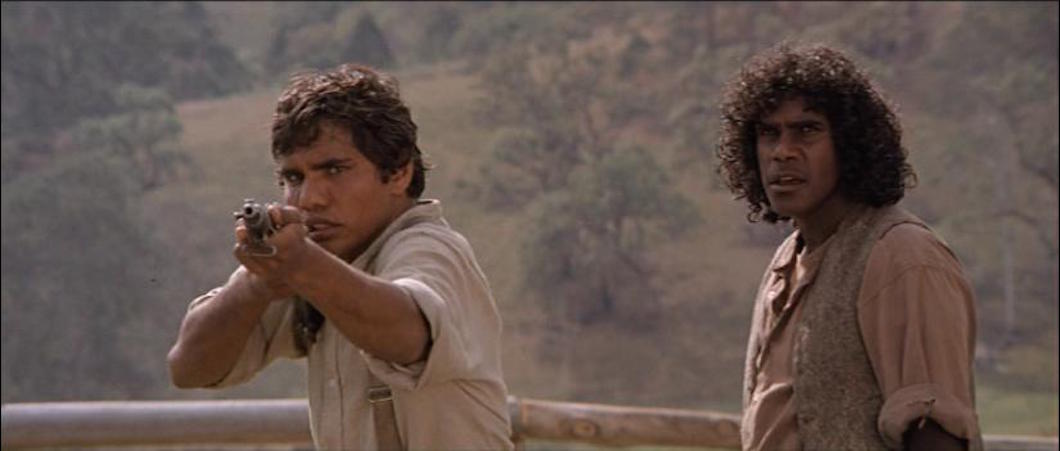
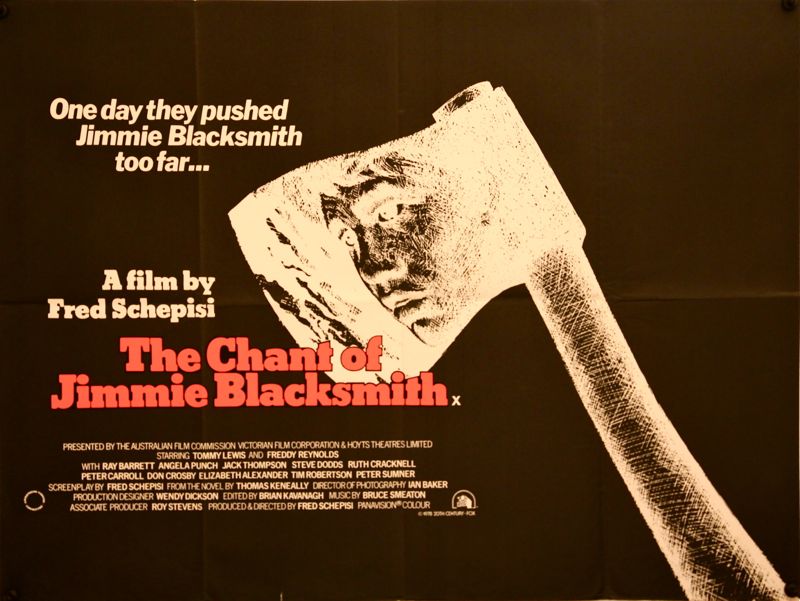
The Chant of Jimmie Blacksmith (1978) / D: Fred Schepisi / 120m

Cast: Tommy Lewis, Freddy Reynolds, Ray Barrett, Jack Thompson, Angela Punch McGregor, Steve Dodd, Peter Carroll, Ruth Cracknell, Don Crosby, Tim Robertson, Elizabeth Alexander, Peter Sumner

Half-white, half-Australian Jimmie Blacksmith (Lewis) is raised by a benevolent minister, Reverend Neville (Thompson) and his wife. Neville’s belief is that he can foster positive social ambitions in Jimmie by teaching him Christian values and by providing him with an entry into the wider, white society. Jimmie is a hard worker, conscientious and respectful, but this is due to his upbringing with the Nevilles. At the first job he takes on, building fences on a farm, the owner fails to pay Jimmie and his Aboriginal half-brother Mort (Reynolds) the agreed wage, and when Jimmie challenges this he’s then sacked. The same happens to him at the next farm he works at. By this point, Jimmie is beginning to understand that not all whites are like the Nevilles.

Jimmie finds work as a policeman. He accepts the role of law enforcer with equanimity, and has no trouble administering the law when it comes to Aboriginals. But matters change when he witnesses a flagrant abuse of the law he believes in, an abuse that shows him there will always be one rule for whites and no rules for others. Appalled, he leaves the police force and eventually finds work on a sheep ranch owned by a Mr Newby (Crosby). Here he sends for Gilda (McGregor), a woman he met at one of the farms and who has agreed to marry him. When she arrives she is heavily pregnant, but when the baby is born it’s obvious that Jimmie isn’t the father. Newby’s family are less than sympathetic, and take every opportunity to make snide remarks about “his child”. Jimmie makes the best of it, but when a well-meaning acquaintance of the Newby’s suggests that Gilda should take her baby and leave Jimmie, and he’s let go without any pay, the steady tide of oppression that he’s encountered since leaving the Nevilles leads to a shocking, violent outburst that leaves Jimmie, Mort, his uncle Tabidgi (Dodd), and Gilda on the run from the police.

Chant of Jimmie Blacksmith, The - scene

Adapted from the novel by Thomas Keneally, itself based on the true story of Jimmy Governor, The Chant of Jimmie Blacksmith is like an unexpected slap across the face, a shocking moment that is made all the worse by the surprise factor. The same can be said about the movie, one that the viewer goes into thinking they know what to expect, but then finds themselves reeling from the ferocity of emotion, violent or otherwise, that they experience. It’s an impressive, extraordinary movie that can still do that nearly forty years after it was first released, and a testament to the vision of Schepisi, and the lead performance of Lewis.

Watching the movie today its bleak and uncompromising nature really is that startling for modern viewers unused to having outrage displayed in such frank and brutal terms, from the casual verbal racism of the whites to the inverse scorn of the Aborigines who feel Jimmie is losing his heritage by associating too closely with whites. In a brave but necessary move, writer/director Schepisi paints a portrait of a time and a society where sympathy and consideration for Australia’s indigenous people was considered anathema, but offers no judgement on either sides feelings or beliefs. With Jimmie’s increasing disillusionment and anger at the attitude of his white employers and the larger, endemic disdain for his race, Schepisi’s uncompromising treatment of the material leaves the audience facing a dilemma: are Jimmie’s actions defensible given his treatment by the whites, or are they too extreme for extenuating circumstances to be taken into consideration or provide mitigation? Whatever your opinion, Schepisi doesn’t make it easy, and nor should he.

It’s refreshing too that the movie doesn’t try to be relevant to the Seventies, or invite the viewer to search for a subtext. This is entirely about the times, and the hardship of life in Australia in the early twentieth century if you weren’t white: it doesn’t need to be about anything else. And Jimmie, as a character, is refreshingly free from the type of psychological interpretation that would no doubt be employed if the movie were to be made today. Lewis is completely convincing in the title role, Jimmie’s sense of belonging to two cultures but without knowing which he should commit to, rendered with such detail and commitment that it’s hard to believe that Lewis had never acted before. It’s an amazing achievement, and with Schepisi, he reinforces the idea that Jimmie can be sympathised with or detested in equal measure.

With the movie proving so intense, it definitely can’t be regarded as entertainment, but it is thought-provoking, consistently tough-minded and hard-hearted, and avoids any undue sentimentality, settling for a discomforting nihilism that suits the mood of the times, and underpins Jimmie’s struggle to fit in. Schepisi left Australia for Hollywood after this, citing the struggles he had to endure to get the movie made, but he’s yet to make another movie on a par with this one. Lewis continued to make movies, but he never played a lead role again. Perhaps it’s fitting for both men as it’s hard to see how either could top The Chant of Jimmie Blacksmith for sheer gritty realism and power.

The movie also benefits from measured performances from Thompson, Barrett and McGregor, while there are minor roles for Bryan Brown, John Jarratt, and Arthur Dignam, and surprisingly, Lauren Hutton. It’s shot in a dour, unflattering way by Ian Baker that enhances and embraces the material, but still leaves room to showcase Australia’s natural beauty. And the score by Bruce Smeaton is similarly enriching, adding an emotive layer to the proceedings that complements the bleak narrative.

Rating: 9/10 – desolate and austere in its approach but all the more potent for it, The Chant of Jimmie Blacksmith is the kind of tough, relentlessly savage movie that is rarely this confident or emotionally draining; all credit to Schepisi for refusing to water down the febrile nature of the story, or the tragic consequences that arise from one man’s refusal to be treated so arrogantly.


The late Seventies and early Eighties saw a rise in the number of movies that looked at classical stories from Australian literature and history, movies such as My Brilliant Career (1979) and Breaker Morant (1980). International acclaim had been building steadily across the Seventies, with Peter Finch becoming the first Australian actor to win an Oscar (albeit posthumously) for Network (1976), and the Eighties saw Australian movies consolidate and expand on that success. The focus was more on dramatic stories rather than comedies, and several prestige movies garnered awards from around the world. At home, The Man from Snowy River (1982) proved to be such a well-received movie that it was regarded as the best Australian movie of all time (though not for long).

In 1986, a movie arrived that was a comedy, that had been cleverly constructed for international audiences, contained adventure and romance, told a delightful fish out of water story, and made an international star out of its creator, Paul Hogan. The movie was “Crocodile” Dundee, and when it was released in the US (in September ’86), it achieved the distinction of being the second highest grossing movie of the year (losing out to Top Gun). At the time, Hogan stated that he was “planning for it to be Australia’s first proper movie… a real, general public, successful, entertaining movie”. Some may have felt that Hogan was being unfair, but the movie’s success did lead to a sea change in the way that Australian movie makers approached those stories that were essentially Australian in terms of subject matter and cultural reference. As the Eighties drew to a close, and with the industry still enjoying its renaissance, “Crocodile” Dundee‘s example would lead to an even richer period of Australian movie making, and an even stronger presence abroad.

Share this:

  • Click to share on X (Opens in new window) X
  • Click to share on Facebook (Opens in new window) Facebook
  • More
  • Click to print (Opens in new window) Print
  • Click to email a link to a friend (Opens in new window) Email
Like Loading...

Blog Stats

  • 486,647 hits

Recent Posts

  • 10 Reasons to Remember Bibi Andersson (1935-2019)
  • Fantasia (1940)
  • Dances With Wolves (1990) – The Special Edition
  • Kiss of the Spider Woman (1985)
  • The Three Musketeers (1973)

Top Posts & Pages

  • Lost for Life (2013) - Another Look
    Lost for Life (2013) - Another Look
  • Lost for Life (2013)
    Lost for Life (2013)
  • About
    About
  • BFI London Film Festival 2015
    BFI London Film Festival 2015
  • Mr. Topaze (1961)
    Mr. Topaze (1961)
  • Shock and Awe (2017)
    Shock and Awe (2017)
  • Hunt for the Wilderpeople (2016)
    Hunt for the Wilderpeople (2016)
  • Cardboard Boxer (2016)
    Cardboard Boxer (2016)
  • Billy Lynn's Long Halftime Walk (2016)
    Billy Lynn's Long Halftime Walk (2016)
  • Winter's Tale (2014)
    Winter's Tale (2014)
Follow thedullwoodexperiment on WordPress.com

Blogs I Follow

  • Rubbish Talk
  • Film 4 Fan
  • Fast Film Reviews
  • The Film Blog
  • All Things Movies UK
  • Interpreting the Stars
  • Let's Go To The Movies
  • Movie Reviews 101
  • TMI News
  • Dan the Man's Movie Reviews
  • Film History
  • Jordan and Eddie (The Movie Guys)

Archives

  • April 2019 (13)
  • March 2019 (28)
  • February 2019 (28)
  • January 2019 (32)
  • December 2018 (28)
  • November 2018 (30)
  • October 2018 (29)
  • September 2018 (29)
  • August 2018 (29)
  • July 2018 (30)
  • June 2018 (28)
  • May 2018 (24)
  • April 2018 (21)
  • March 2018 (31)
  • February 2018 (25)
  • January 2018 (30)
  • December 2017 (30)
  • November 2017 (27)
  • October 2017 (27)
  • September 2017 (26)
  • August 2017 (32)
  • July 2017 (32)
  • June 2017 (30)
  • May 2017 (29)
  • April 2017 (29)
  • March 2017 (30)
  • February 2017 (27)
  • January 2017 (32)
  • December 2016 (30)
  • November 2016 (28)
  • October 2016 (30)
  • September 2016 (27)
  • August 2016 (30)
  • July 2016 (30)
  • June 2016 (31)
  • May 2016 (34)
  • April 2016 (30)
  • March 2016 (30)
  • February 2016 (28)
  • January 2016 (35)
  • December 2015 (34)
  • November 2015 (31)
  • October 2015 (31)
  • September 2015 (34)
  • August 2015 (31)
  • July 2015 (33)
  • June 2015 (12)
  • May 2015 (31)
  • April 2015 (32)
  • March 2015 (30)
  • February 2015 (37)
  • January 2015 (39)
  • December 2014 (34)
  • November 2014 (34)
  • October 2014 (36)
  • September 2014 (25)
  • August 2014 (29)
  • July 2014 (29)
  • June 2014 (28)
  • May 2014 (23)
  • April 2014 (21)
  • March 2014 (42)
  • February 2014 (38)
  • January 2014 (29)
  • December 2013 (28)
  • November 2013 (34)
  • October 2013 (4)

Create a free website or blog at WordPress.com.

Rubbish Talk

Film 4 Fan

A Movie Blog

Fast Film Reviews

The Film Blog

The official blog of everything in film

All Things Movies UK

Movie Reviews and Original Articles

Interpreting the Stars

Dave Examines Movies

Let's Go To The Movies

Film and Theatre Lover!

Movie Reviews 101

Daily Movie Reviews

TMI News

Latest weather, crime and breaking news

Dan the Man's Movie Reviews

All my aimless thoughts, ideas, and ramblings, all packed into one site!

Film History

Telling the story of film

Jordan and Eddie (The Movie Guys)

Movie Reviews & Ramblings from an Australian Based Film Fan

Privacy & Cookies: This site uses cookies. By continuing to use this website, you agree to their use.
To find out more, including how to control cookies, see here: Cookie Policy
  • Subscribe Subscribed
    • thedullwoodexperiment
    • Join 481 other subscribers
    • Already have a WordPress.com account? Log in now.
    • thedullwoodexperiment
    • Subscribe Subscribed
    • Sign up
    • Log in
    • Report this content
    • View site in Reader
    • Manage subscriptions
    • Collapse this bar
 

Loading Comments...
 

    %d