• 10 Reasons to Remember…
  • A Brief Word About…
  • About
  • For One Week Only
  • Happy Birthday
  • Monthly Roundup
  • Old-Time Crime
  • Other Posts
  • Poster of the Week
  • Question of the Week
  • Reviews
  • Trailers

thedullwoodexperiment

~ Viewing movies in a different light

thedullwoodexperiment

Tag Archives: Patricia Highsmith

A Kind of Murder (2016)

05 Sunday Mar 2017

Posted by dullwood68 in Movies

≈ Leave a comment

Tags

Andy Goddard, Crime, Drama, Eddie Marsan, Jessica Biel, Literary adaptation, Murder, Patricia Highsmith, Patrick Wilson, Review, The Blunderer, Thriller, Vincent Kartheiser
kind_of_murder

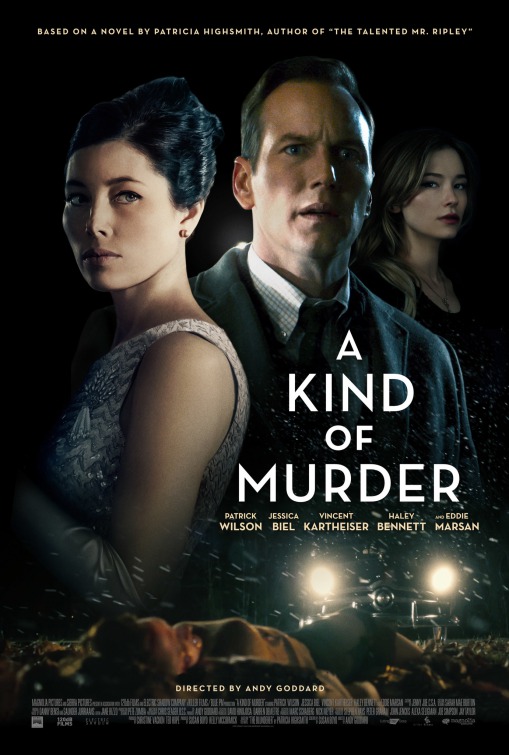
D: Andy Goddard / 95m

Cast: Patrick Wilson, Jessica Biel, Vincent Kartheiser, Haley Bennett, Eddie Marsan, Radek Lord, Jon Osbeck, Christine Dye

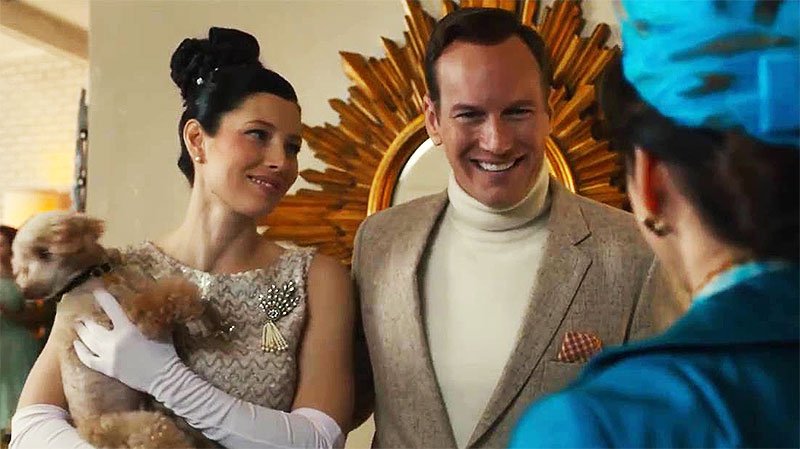
New York City, the Sixties. Walter Stackhouse (Wilson) is a successful architect with a beautiful home and a beautiful wife, Clara (Biel). In his free time he writes short stories about crime and murder. On the outside he’s living the perfect life, but his marriage is strained. Clara has a history of mental instability, and is remote from him. At the same time, though, she’s jealous and possessive, accusing him of having an affair with a young woman, Ellie (Bennett), who attended a party they gave. When Clara is like this, Walter usually ends up in a local bar. It’s on one such occasion that he reads an article in a newspaper about the unsolved murder of a woman outside of New York at a rest stop called Harry’s Rainbow Grill.

Suspicion seems to rest on the woman’s husband, a bookstore owner called Kimmel, but he has an alibi. This isn’t enough for the detective investigating the case, Corby (Kartheiser), who is convinced Kimmel is the killer. While he tries to intimidate Kimmel into confessing, Walter becomes more and more fascinated with the murder, and like Corby, becomes convinced that Kimmel is guilty. He even goes so far to visit Kimmel at his bookstore. But at home, his marriage goes from bad to worse. Clara takes an overdose and ends up in hospital. When she comes home, her jealousy remains firmly in place, and she remains convinced that Walter is having an affair with Ellie. When she’s proved right, Walter tells her he’s going to divorce her; Clara retaliates by saying she’ll definitely kill herself if he does.
a-kind-of-murder-2016-1

Undeterred, Walter continues with his relationship with Ellie, but when Clara leaves suddenly to visit her sick mother upstate, he follows the bus she takes until it reaches Harry’s Rainbow Grill. But though she gets off the bus, Walter doesn’t see her, and he heads back to New York City. Later, Walter receives terrible news, news that causes Corby to link him to the murder of Kimmel’s wife, his relationship with Ellie to falter, and his business partnership to founder. With his honesty and integrity on the line, as well as his freedom, Walter must find a way of extricating himself from a situation that grows worse every day, and that could ultimately cost him his life.

An adaptation of Patricia Highsmith’s novel The Blunderer, A Kind of Murder is a good-looking movie in search of a leading character for the audience to identify and sympathise with. Walter’s plight should be one that has the viewer on the edge of their seat, but thanks to both the script and Wilson’s performance, he’s vanilla bland from start to finish, and the movie never really knows how to make his predicament more intriguing or exciting. Walter becomes interested in the murder of Kimmel’s wife because he’s beginning to have thoughts about killing Clara. As he believes Kimmel killed his wife, Walter is supposed to feel some kind of kinship with the bookstore owner, but it’s all psychologically unconvincing. Walter channels his feelings about Clara into his writing, something we see on more than one occasion, and so any idea that he and Kimmel are similar can be disregarded from the start.

BRR 11-29-14-5392.dng

What this leaves us with is a contrived relationship that never develops beyond an uneasy semi-alliance against Corby’s invasive and confrontational detective work. And there’s never any doubt as to whether or not Kimmel killed his wife, or if Walter’s situation will lead to his livelihood being compromised. As the movie progresses from potential whodunnit to unabashed thriller, Susan Boyd’s first-time script forgets to instil proceedings with any tension, as Walter’s predicament never sees him fully in jeopardy, or at risk of having his comfortable world taken away from him. And in conjunction with Boyd’s script, Wilson delivers what may well be one of his least successful performances ever. For an actor who can genre-hop with ease, and who at least doesn’t look out of place in a period drama, Wilson never connects with Walter and gives a wayward portrayal of a man whose calm, outward manner belies a compulsive, selfish individual hidden away on the inside.

It’s this duality that the movie tries hard to promote, with Walter and Kimmel meant to be two sides of the same coin, and Clara and Ellie both representing the best and worst of Walter’s relationships with women. But again, there’s nothing for the audience to connect with. Even when Clara spells out her intention to kill herself if Walter goes ahead with the divorce, and tells him everyone will blame him for not doing enough to help her, there’s nothing there to back up that claim. It carries the weight of an empty paper bag, and as such, loses any validity, so that when Walter receives his terrible news, it doesn’t have the impact that it should have. And this is the moment when the viewer should find themselves completely on Walter’s side… but probably won’t.

akindofmurder_clipdeath

As a thriller, A Kind of Murder stumbles along trying to match Highsmith’s elegant turn of phrase to its early Sixties setting, and only doing so on very rare occasions. It also dispenses with any attempt at providing back stories for any of the characters, leaving us in a void when it comes to understanding their current motivations. Clara is clearly mentally ill, and she’s clearly difficult to live with, so why Walter stays with her is a bit of a mystery (and a better one than if Kimmel killed his wife or not). And why Corby becomes so obsessed with Kimmel and bringing him to justice isn’t explained either. In the end, these are characters operating in a vacuum, occasionally bumping into each other but failing to make a proper connection.

And so it goes for the length of the movie. Wilson’s disappointing turn is matched by Biel’s monotone performance, Kartheiser’s unncessarily angry cop, and Bennett’s subdued turn as Walter’s girlfriend. Only Eddie Marsan deserves any praise, giving the kind of unexpected, yet nuanced performance that this kind of movie needs to be anywhere near successful. His brooding, snake-like approach to Kimmel is a master-class in big screen malevolence. Tying all this together is Goddard, known mostly for his TV work, but not stretching his abilities too far in bringing this tale to the big screen. However, he’s on firmer ground with the movie’s recreation of Sixties New York, with its colourful vibrancy and Mad Men-style glamour of the period, and all despite (or in spite of) the wintry backdrop. But for anyone expecting more substance with their style, this isn’t the place to be looking for it.

Rating: 5/10 – lacklustre in too many ways to even count, A Kind of Murder flatlines for most of its running time, and forgets to make itself interesting for the viewer; with so-so performances and a dull script, this is one thriller that can be given a wide berth unless you’re a fan of Marsan’s, or in an undemanding mood when it comes to choosing something to watch.
Share this:

  • Click to share on X (Opens in new window) X
  • Click to share on Facebook (Opens in new window) Facebook
  • More
  • Click to print (Opens in new window) Print
  • Click to email a link to a friend (Opens in new window) Email
Like Loading...

Carol (2015)

16 Friday Oct 2015

Posted by dullwood68 in Movies

≈ Leave a comment

Tags

1950's, Cate Blanchett, Custody battle, Drama, Kyle Chandler, Lesbianism, Literary adaptation, Love, Patricia Highsmith, Review, Road trip, Rooney Mara, The Price of Salt, Todd Haynes

Carol

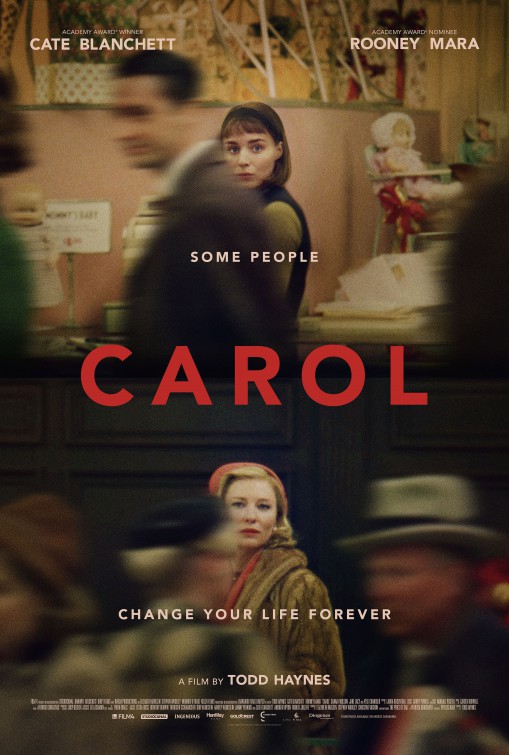
D: Todd Haynes / 118m

Cast: Cate Blanchett, Rooney Mara, Kyle Chandler, Sarah Paulson, Jake Lacy, Nik Pajic, John Magaro, Cory Michael Smith, Carrie Brownstein

Therese (pronounced Ter-rez) Belivet (Mara) is young, has a devoted boyfriend, Richard (Lacy), works in a department store, but is unsure of her future. One day a female customer in the store engages her in conversation, and even though the customer makes mention of being married with a young child, it’s clear to Therese that there’s a mutual attraction. When the woman leaves her gloves behind, Therese goes to the effort of finding the woman’s address and sending them to her. This act of kindness leads to the woman, whose name is Carol Aird (Blanchett), inviting Therese to lunch. They meet, and a friendship begins, one that starts to cause problems between Therese and Richard, as she begins to lose interest in a planned trip to Europe with him, and spends more time with Carol.

Unbeknownst to Therese, Carol and her husband, Harge (Chandler) have separated due to his awareness that his wife has had an affair with her best friend, Abby (Paulson). Willing to overlook this “indiscretion” if she stays with him, Harge warns her that if she doesn’t then he’ll seek sole custody of their little girl, Rindy. With Xmas approaching, he takes Rindy to his parents for the holiday period; Carol decides to invite Therese to come stay with her. Although nothing happens, Harge returns home unexpectedly and sees them together. Fearing that Carol is embarking on another lesbian relationship, he files for divorce and sole custody of Rindy. Unable to see her child until the custody hearing, which will take two or three months to happen, Carol invites Therese on a road trip, where they can spend some time together, and where Harge can’t find them.

They stay in a succession of motel rooms, at first staying in separate rooms. At one particular motel they stay in the Presidential suite; the next morning, Therese gets to talking with a travelling salesman called Tommy (Smith). Although he tries to sell them something from his sales kit, he has no joy, though Therese wishes him well in the future. At the next motel, she and Carol finally make love. But a telegram Carol receives the next morning reveals Harge’s awareness of where she is, and the fact that she and Therese are now lovers. Unable to risk the now serious possibility of losing the custody hearing, Carol decides she has to return home to face Harge, and sends Abby in her place to see Therese gets home safely. But for both women, returning to their old lives proves unsatisfactory…

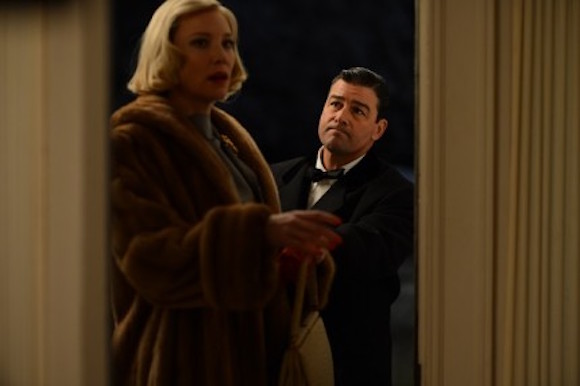
Carol - scene

There’s a moment in Todd Haynes’ beautifully crafted Carol, an adaptation of Patricia Highsmith’s novel The Price of Salt, when it looks certain that the title character and Therese will make love for the first time. It’s a moment that the movie is clearly heading toward, and it’s a moment that audiences will be expecting, but Haynes, along with screenwriter Patricia Nagy, holds off from that first time and maintains the sense of anticipation that both characters (and viewers) must be feeling. For the audience, it’s also a moment – among many others – that shows just how much control Haynes has over both the material and its emotional centre, and how finely calibrated it all is, for Carol is without a doubt, one of 2015’s finest movies.

Of course, with previous projects such as Far from Heaven (2002) and the TV version of Mildred Pierce (2011), Haynes has already shown an affinity for what used to be termed “women’s pictures”, but here his immersion in a time – the 1950’s – when lesbianism was still something to be kept hidden, and where male attitudes towards the issue were still highly aggressive, feels also like a snapshot of an era where female empowerment was beginning to gain the upper hand, despite the so-called Lavender Scare that was prevalent at the time. Through Carol’s determination not to be defined by her sexuality, we get to see an example of what, in historical terms, was a turning of the tide, and also a love story that is simply that: a love story.

This simplicity is at the heart of Haynes’ confident handling of the story, and it shows in every scene, with every look and every gesture, and in the way that he brings Carol and Therese together within the frame – these moments where they’re “close but not touching” are so charged with pent-up emotion and increasing desire that the idea that they might be kept apart by Harge’s machinations becomes intolerable. These scenes are so expertly handled, with repressed longing so forcefully expressed, that the viewer is swept along with the characters’ desire to live freely and without sanction. Haynes makes great use of the era’s sense of propriety, using it as a touchstone against which Carol and Therese’s affair can be measured in both intensity and necessity. Therese quizzes Richard about same sex relationships but he has no point of reference, and has no understanding of why they occur; he loves her unequivocally but can’t see that two women – or two men for that matter – might feel the same way about each other as he does about Therese. It’s another of those moments where the audience can see just how difficult it was to live a life outside the (perceived) norm.

With the historical and social background of the story firmly in place, and with Nagy’s script making it clear that lesbians were expected to pretend to be happy in heterosexual relationships or face the social consequences, the movie paints an honest portrait of two women, both of whom gain increased confidence in themselves through their relationship, who come together at a point in both their lives where they’re looking for a way to find future happiness. That they find it in each other, if only briefly, and with such passion, gives value to the idea that any relationship is worth pursuing or fighting for. And even though Carol leaves Therese to fight for custody of her child, it’s not the end of their affair, but rather an interruption (albeit for Therese an unexpected one), and even though the younger woman is upset by it, her feelings remain, and though the movie tries for an air of ambiguity in its final scene, viewers won’t be fooled at where Carol and Therese’s relationship is likely to find itself.

Carol -scene3

The difference in ages might feel like it should be an issue but it’s left unexplored, and with good reason: it doesn’t matter. Love is love, and though an argument could be made that Therese is looking for a guide or a mentor first and foremost, it’s not the role Carol adopts in their relationship. As the “older woman”, Blanchett gives yet another astonishing, awards-worthy performance, striking the right balance between heartfelt longing for an honest life and acknowledging the difficulties that longing entails. Her brittle, striking features show the pain of Carol’s situation without too much need of more overt playing, but in those moments when overt emotion is required, Carol’s fears and hopes are etched indelibly on those striking features. It’s a magnificent performance, sincere, heartbreaking at times, and riveting.

She’s matched by Mara, whose portrayal of the unmoored, ingenuous Therese is so finely tuned that watching her blossom, however slowly, into a stronger, more confident young woman is like watching a flower grow out of the shadows to its full height. There are moments where the camera focuses on her smooth, unlined features and the only expression is there in the eyes, but Mara uses this approach to such good effect that the viewer is never in doubt as to what Therese is thinking or feeling. And as the movie progresses, Mara subtly shifts the weight of Therese’s longing for love so that it becomes a part of her, and not the whole, leaving her a character as strong in her own right as Carol is in hers.

With two such commanding performances, it would be a shame if the supporting cast were overshadowed, but Chandler, in what is superficially the “villain” role, brings out Harge’s pain and sense of loss over Carol with such force that his actions are less stereotypical than expected and driven more by his own deep love for her. In the same way that society says Carol can’t have Therese (in public at least), it also says that Harge can’t have Carol because of her “sexual impropriety”. Both characters are in danger of losing what they want most, and both are suffering as a result. Chandler is unexpectedly moving in the role, and his scenes with Blanchett are so emotionally charged it’s like an intense version of force majeure. Meanwhile, Paulson comes late to matters as Abby, but gives a brief but potent performance as Carol’s longtime friend, confidant and ex-lover, filling in the gaps of Therese’s knowledge about Carol, and providing further context for Carol’s emotional and sexual desires.

Carol - scene2

It’s all beautifully filmed by Edward Lachman, with lots of bright primary colours mixed in with rich earthy tones, making the period seem so alive as to be almost intoxicating, and acting as a dynamic background to the impassioned nature of Carol and Therese’s relationship. There’s some equally impressive attention to historical detail, and Haynes makes the era come alive as a result; this is a fully realised world, even if it does appear at first to be bathed in nostalgia (the scenes in the department store appear right out of a Fifities child’s fantasy of what such a store should look like), but in many ways it was a simpler time, and the script reflects this with aplomb. And the whole thing is embraced by a smoothly nonchalant yet spirited score by Carter Burwell that complements the on-screen proceedings with well orchestrated brio.

Rating: 9/10 – a firm contender for Movie of the Year, Carol is a masterpiece of mood and repressed emotional yearning, with two outstanding performances, and a director on the absolute top of his form; a model of period movie making, and rewarding in every department you can possibly think of, this is a movie that should go to the top of everyone’s must-see list.

Share this:

  • Click to share on X (Opens in new window) X
  • Click to share on Facebook (Opens in new window) Facebook
  • More
  • Click to print (Opens in new window) Print
  • Click to email a link to a friend (Opens in new window) Email
Like Loading...

The Two Faces of January (2014)

14 Saturday Feb 2015

Posted by dullwood68 in Movies

≈ Leave a comment

Tags

Athens, Drama, Fraud, Hossein Amini, Istanbul, Kirsten Dunst, Oscar Isaac, Patricia Highsmith, Review, Thriller, Tour guide, Viggo Mortensen

Two Faces of January, The

D: Hossein Amini / 96m

Cast: Viggo Mortensen, Kirsten Dunst, Oscar Isaac, David Warshofsky, Daisy Bevan, Omiros Poulakis

Athens, 1962. Rydal Keener is an American working as a tour guide. He meets an American couple on holiday there, Chester and Colette McFarland (Mortensen, Dunst). They invite him to dinner and he accepts, mainly because he’s attracted to Colette. Later, after dropping them off at their hotel, Rydal discovers Colette has left a bracelet behind in the taxi. He decides to return it. Meanwhile, the McFarland’s have another visitor, a private detective named Vittorio (Warshofsky). It transpires that Chester has defrauded several people in an investment scam, and it’s this money that is allowing the McFarlands to travel around Europe. Vittorio and Chester scuffle and the private detective is killed. As he attempts to get Vittorio back to his own room in the hotel, he’s discovered by Rydal. Chester convinces Rydal that the man is merely out cold from drinking too much, and together they get him into his room.

Chester convinces Rydal that he and Colette need to leave Athens as soon as possible, but their passports are being kept by the hotel. Seeing a way of scamming some money out of Chester, Rydal agrees to help them; it also gives him a chance to be nearer to Colette. He arranges for new passports to be given to them in Crete, where they all travel to next. Without identification papers they’re forced to wait on the quayside for the next day’s bus to Chania. While they are there, Colette visits Rydal in his room while Chester is sleeping. Back on the bus, Colette panics when she sees photos of her and Chester in a newspaper and thinks they’ve been spotted. At a rest stop, Colette gets off the bus and the two men chase after her. They walk on and eventually reach the ruins of Knossos.

Rain causes them to seek shelter in the ruins. Chester lures Rydal down into the lower levels and knocks him unconscious. When Colette realises what he’s done they argue and she falls to her death from some steps. Chester flees, leaving Rydal to come to the next morning and be seen by a group of schoolgirls and their teacher as he leaves. Rydal hurries to catch up with Chester, who has collected the new passports and is heading back to Athens on a ship. There is a confrontation between the two where each tries to outwit and out-threaten the other, but both come to realise that they are bound together by their actions over the past couple of days, and would find it easy to implicate the other if either informed the police. But when they get to Athens airport, Rydal finds that Chester has one more trick up his sleeve.

Two Faces of January, The -scene

Adapted from the novel by Patricia Highsmith, The Two Faces of January is a ponderous, though well acted drama that never quite gets off the ground, despite an intriguing storyline and some glorious location photography. As written and directed by Amini – something he’d been working on for around fifteen years – there is a distance between the audience and the main characters that stops them from ever becoming likeable or sympathetic. We never get to really know them either. Chester is a cheat but it’s just accepted that he’s a cheat; there’s no back story to explain why. Colette is aware of his duplicity and has obviously chosen to stay with him but we never find out why either. It’s confusing as well when their previous happiness is so quickly overturned by the arrival of Rydal in their lives: does she really love Chester or is she too a fraud? And Rydal’s past, with his father issues and need for independence, is also glossed over, with the questions, “Why Athens?” and “Why a tour guide?” completely unanswered.

There is one clear motivation that drives them all however: escape. But it’s clumsily used as a device to keep the narrative and the characters moving, and while Amini uses it to show how each is trying to escape themselves (and more so than the authorities), this is also clumsily done. What we’re left with as a result is a mini-travelogue where it seems that the characters are constantly outwitting each other – or appear to be – but in actuality aren’t doing anything of the sort. Chester imagines all sorts of deviousness in Rydal’s behaviour (and Isaac’s performance goes a long way to suggesting this, even though it’s not true), and he’s continually on his guard for some new twist. But ultimately he’s the author of his own downfall, and has no one to blame but himself for what happens.

Amini never reconciles Rydal’s willingness to keep in with the McFarlands, even after he knows what they’ve done, and while his attraction for Colette is an understandable reason in itself, there are moments where he’s making decisions about carrying on but we never find out what his reasons are. It ends up being a problem for the narrative when it just feels that if he didn’t, the plot (and the movie) would grind to a halt.

In adapting Highsmith’s novel, Amini has jettisoned the homo-erotic subplot between Chester and Rydal in favour of a more conventional love triangle approach, and in doing so he robs the movie of a potential, and valuable, source of tension. For otherwise, the movie plods along looking good but feeling empty, its characters relying heavily on plot contrivances such as Rydal just happening to know someone who can provide forged passports, and Colette getting so easily frightened and leaving the bus.

As Chester, Mortensen puts in a good performance but even he can’t reconcile the character’s initial fearfulness and vulnerability with the more callous character he becomes. Dunst has a couple of emotional scenes that show off her skills as an actress, but again she can’t reconcile Colette’s initial happiness with her husband with the antipathy she shows toward him once they leave Athens (she already knows they’re on the run, why should this make her feel any different? And this is before she learns of Vittorio’s death). Rounding off the trio, Isaac portrays Rydal as a conspiring victim, unsure of himself as he gets in deeper and looking for a way out, even though he can’t see one. It’s a confident performance, not as conflicted as Mortensen and Dunst’s, but unfortunately, still a little shy of being satisfactory.

Two Faces of January, The - scene2

With the scenery providing a welcome (and thankful) distraction from the unwieldy and undercooked melodramatics, the movie adds a particularly awkward scene at a customs hall where Chester and Rydal act so suspiciously it’s a wonder they aren’t picked out of their respective queues sooner. And the denouement, included to add some much needed excitement, is so poorly edited that any sense of vitality is diminished quite rapidly. There’s a great movie to be had from Highsmith’s novel, but alas, this isn’t it, and for that, Amini is the only one to blame.

Rating: 5/10 – with its cast unable to elevate the material or make up for Amini’s lack of directorial control, The Two Faces of January fails to provide any tension or mystery; plodding, and with a weak resolution, the movie looks great throughout but offers little that’s arresting to occupy the viewer’s time.

Share this:

  • Click to share on X (Opens in new window) X
  • Click to share on Facebook (Opens in new window) Facebook
  • More
  • Click to print (Opens in new window) Print
  • Click to email a link to a friend (Opens in new window) Email
Like Loading...

Blog Stats

  • 486,601 hits

Recent Posts

  • 10 Reasons to Remember Bibi Andersson (1935-2019)
  • Fantasia (1940)
  • Dances With Wolves (1990) – The Special Edition
  • Kiss of the Spider Woman (1985)
  • The Three Musketeers (1973)

Top Posts & Pages

  • Lost for Life (2013) - Another Look
    Lost for Life (2013) - Another Look
  • Lost for Life (2013)
    Lost for Life (2013)
  • About
    About
  • Mr. Topaze (1961)
    Mr. Topaze (1961)
  • Shock and Awe (2017)
    Shock and Awe (2017)
  • Hunt for the Wilderpeople (2016)
    Hunt for the Wilderpeople (2016)
  • Cardboard Boxer (2016)
    Cardboard Boxer (2016)
  • Billy Lynn's Long Halftime Walk (2016)
    Billy Lynn's Long Halftime Walk (2016)
  • Winter's Tale (2014)
    Winter's Tale (2014)
  • Exposed (2016)
    Exposed (2016)
Follow thedullwoodexperiment on WordPress.com

Blogs I Follow

  • Rubbish Talk
  • Film 4 Fan
  • Fast Film Reviews
  • The Film Blog
  • All Things Movies UK
  • Interpreting the Stars
  • Let's Go To The Movies
  • Movie Reviews 101
  • TMI News
  • Dan the Man's Movie Reviews
  • Film History
  • Jordan and Eddie (The Movie Guys)

Archives

  • April 2019 (13)
  • March 2019 (28)
  • February 2019 (28)
  • January 2019 (32)
  • December 2018 (28)
  • November 2018 (30)
  • October 2018 (29)
  • September 2018 (29)
  • August 2018 (29)
  • July 2018 (30)
  • June 2018 (28)
  • May 2018 (24)
  • April 2018 (21)
  • March 2018 (31)
  • February 2018 (25)
  • January 2018 (30)
  • December 2017 (30)
  • November 2017 (27)
  • October 2017 (27)
  • September 2017 (26)
  • August 2017 (32)
  • July 2017 (32)
  • June 2017 (30)
  • May 2017 (29)
  • April 2017 (29)
  • March 2017 (30)
  • February 2017 (27)
  • January 2017 (32)
  • December 2016 (30)
  • November 2016 (28)
  • October 2016 (30)
  • September 2016 (27)
  • August 2016 (30)
  • July 2016 (30)
  • June 2016 (31)
  • May 2016 (34)
  • April 2016 (30)
  • March 2016 (30)
  • February 2016 (28)
  • January 2016 (35)
  • December 2015 (34)
  • November 2015 (31)
  • October 2015 (31)
  • September 2015 (34)
  • August 2015 (31)
  • July 2015 (33)
  • June 2015 (12)
  • May 2015 (31)
  • April 2015 (32)
  • March 2015 (30)
  • February 2015 (37)
  • January 2015 (39)
  • December 2014 (34)
  • November 2014 (34)
  • October 2014 (36)
  • September 2014 (25)
  • August 2014 (29)
  • July 2014 (29)
  • June 2014 (28)
  • May 2014 (23)
  • April 2014 (21)
  • March 2014 (42)
  • February 2014 (38)
  • January 2014 (29)
  • December 2013 (28)
  • November 2013 (34)
  • October 2013 (4)

Create a free website or blog at WordPress.com.

Rubbish Talk

Film 4 Fan

A Movie Blog

Fast Film Reviews

The Film Blog

The official blog of everything in film

All Things Movies UK

Movie Reviews and Original Articles

Interpreting the Stars

Dave Examines Movies

Let's Go To The Movies

Film and Theatre Lover!

Movie Reviews 101

Daily Movie Reviews

TMI News

Latest weather, crime and breaking news

Dan the Man's Movie Reviews

All my aimless thoughts, ideas, and ramblings, all packed into one site!

Film History

Telling the story of film

Jordan and Eddie (The Movie Guys)

Movie Reviews & Ramblings from an Australian Based Film Fan

Privacy & Cookies: This site uses cookies. By continuing to use this website, you agree to their use.
To find out more, including how to control cookies, see here: Cookie Policy
  • Subscribe Subscribed
    • thedullwoodexperiment
    • Join 481 other subscribers
    • Already have a WordPress.com account? Log in now.
    • thedullwoodexperiment
    • Subscribe Subscribed
    • Sign up
    • Log in
    • Report this content
    • View site in Reader
    • Manage subscriptions
    • Collapse this bar
 

Loading Comments...
 

    %d