• 10 Reasons to Remember…
  • A Brief Word About…
  • About
  • For One Week Only
  • Happy Birthday
  • Monthly Roundup
  • Old-Time Crime
  • Other Posts
  • Poster of the Week
  • Question of the Week
  • Reviews
  • Trailers

thedullwoodexperiment

~ Viewing movies in a different light

thedullwoodexperiment

Tag Archives: Texts

Personal Shopper (2016)

24 Wednesday May 2017

Posted by dullwood68 in Movies

≈ Leave a comment

Tags

Drama, Ghost story, Kristen Stewart, Kyra, Lars Eidinger, Mystery, Olivier Assayas, Paris, Review, Texts, Thriller
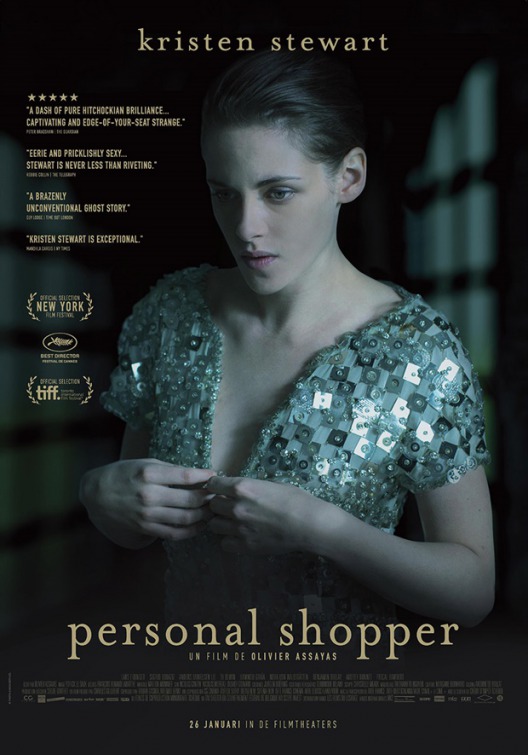
D: Olivier Assayas / 105m

Cast: Kristen Srewart, Lars Eidinger, Sigrid Bouaziz, Anders Danielsen Lie, Ty Olwin, Nora von Waldstätten, Benjamin Biolay, Audrey Bonnet, Pascal Rambert

Maureen Carmichael (Stewart) is an American living in Paris whose twin brother, Lewis, has recently died of a heart attack, the result of a congenital defect that Maureen has as well. The pair made a pact when they were younger that if one of them died, the other would wait to receive a sign that the deceased had passed on to an afterlife. Maureen is committed to doing this, and she stays for a night in a chateau that her brother purchased before he died. She experiences strange phenomena while she’s there but isn’t sure it was Lewis that was causing it. She returns to the chateau again and this time she has a supernatural experience that is terrifying, but which doesn’t seem to involve her brother.

At a loss as to whether or not she should stop waiting for a sign from Lewis, Maureen focuses on her work as a personal shopper to a celebrity called Kyra (von Waldstätten). Maureen spends her time in exclusive boutiques, handpicking clothes and shoes and accessories so that Kyra always appears glamorous and ahead of the fashion game. In many ways it’s a thankless role, but it pays well enough for Maureen to continue waiting for Lewis to “get in touch”. One day, after dropping off some items for Kyra, Maureen receives the first in a series of mysterious text messages from an unknown sender. The texts tease her into thinking that she may be conversing with a ghost, or some kind of mischievous spirit, as the sender seems to know a lot about her and the trips she’s making.
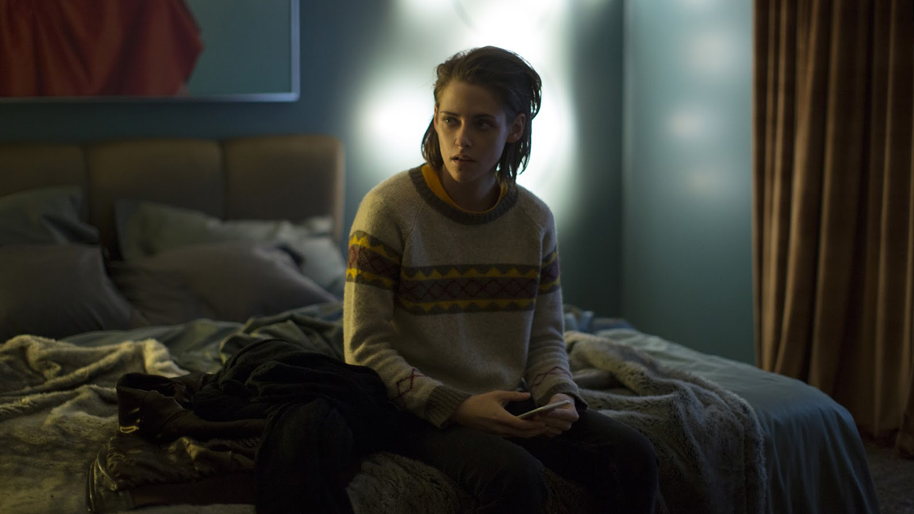
The texts also prompt Maureen into doing something that Kyra has forbidden her to do: namely, wear the clothes and outfits that Maureen has chosen for her. One night, Maureen dresses up as Kyra, an act that is emotionally fulfilling but which also has unexpected ramifications. A visit to Kyra’s apartment reveals a shocking surprise, as does a rendezvous with her anonymous texter, all of which leave Maureen wondering if she knows anymore what is real and what isn’t.

Part ghost story, part thriller, part reflection of celebrity culture, and part exploration of the nature of grief, Personal Shopper is a movie that comes laden with purpose and promise, a Gallic hodge-podge of ideas and themes that sometimes mesh seamlessly together, but which also prove frustratingly obtuse when clarity would have been a better approach to take. The narrative moves awkwardly at times between its trio of storylines – Maureen searching for proof of her brother’s existence after death, Maureen co-opting Kyra’s identity for her own as an outlet for her grief, Maureen dealing with her phone stalker – but at least gives each storyline equal weight, and provides Kristen Stewart with her best role yet. It’s a movie that attempts to say much, and for the most part it does so with skill and determination, but any messages it wants to send – like it’s unknown texter – don’t always have the depth to match their weight.

In exploring the nature and the need of Maureen’s sense of loss, Assayas keeps the focus on Maureen’s belief in an afterlife, used as much as a reason for her to persist as to exist, and as a doleful foreshadowing of the scenes where she’s plagued by text by an unknown admirer. These two storylines blend well together, and Assayas is on firm ground when he plays up the supernatural possibility that Maureen is in touch with a spirit (albeit one that seems remarkably human still). He exploits Maureen’s naïve gullibility, and Stewart’s guileless performance anchors the character’s desperate need to believe that her brother isn’t just dead. But while the question of the mystery texter’s identity is rarely in doubt – the clues are there – Assayas does what so many other directors have done in recent years, and shows the texts on Maureen’s phone, often holding the shot while we wait for each bait and response. If these scenes are meant to provide some much needed tension, then Assayas has badly misjudged his own sense of what works and what doesn’t, as they only serve to derail the narrative and undermine the visual acuity of the rest of the movie.

Ironically, the storyline that doesn’t work so well is the one that concerns Maureen’s job as a personal shopper. Offering a jejune commentary on modern celebrity culture, Assayas predictably makes Kyra a “monster”, and Maureen just a cog in the machine that keeps it all going. Despite her reservations about the job, Maureen is keen to remind the people she buys or borrows clothes from that she is the same size and shape as her employer, but affects a “best not” approach when encouraged to try on any of Kyra’s outfits. When finally, at the urging of her mystery texter she tries on one of these outfits it leads to an expression of physical pleasure that is impactful by virtue of its being so unexpected. But having Maureen dress up as someone else and finding fulfillment isn’t something that resonates as much as perhaps Assayas intended. Instead it’s a moment where narrative conviction gives way to unnecessary dramatic licence.

The muddled question of which is Maureen’s dominant personality aside, Personal Shopper is also a mystery that operates on two levels, with the supernatural aspects handled well but losing importance as the movie progresses, and the identity of the texter taking centre stage by the movie’s midpoint but fizzling out once Maureen makes her shocking discovery. By dovetailing these two elements, Assayas does make the bulk of the movie intriguing (until he reveals the truth behind everything), and while as mentioned before, they’re the movie’s strongest components, this is largely due to the atmosphere that Assayas creates around them, rather than any intensity that might arise naturally out of the material. It’s the same for the thriller elements that come into play late on: on a technical level they’re handled extremely well, but they lack a connection to what’s gone before and remain adrift from the rest of the material as a result.

Stewart gives easily her best performance so far, inhabiting the twin worlds of Maureen’s passive/more passive existence with skill and intelligence. Hers is a powerful study of a woman whose connection to the real world is as remote as the probability that her brother will make contact with her. It’s a trenchant, incisive portrayal, and Assayas exploits Stewart’s commitment to the character every chance he gets, shooting in close up wherever possible and getting the actress to express every trace of Maureen’s internal confusion. It’s Stewart’s movie, and she takes full advantage of the opportunity given to her. But unfortunately she remains, like the audience, subject to the narrative whims of the material, and Assayas’ random allocation of depth and importance to the material as a whole. This is definitely a good movie, but lurking somewhere inside it, there’s a potentially great movie that, like Lewis, is just waiting to be heard from.

Rating: 7/10 – a movie that is likely to leave many viewers scratching their heads in their efforts to derive satisfaction from its messy screenplay, Personal Shopper is a case of a movie taking two steps forward and then one step back in its approach to the material; Assayas and Stewart work extremely well together, but the French auteur has fashioned better movies in the past, and even though he won the Best Director award at Cannes (tying with Cristian Mungiu), this is not the best example of what he can achieve.

Share this:

  • Click to share on X (Opens in new window) X
  • Click to share on Facebook (Opens in new window) Facebook
  • More
  • Click to print (Opens in new window) Print
  • Click to email a link to a friend (Opens in new window) Email
Like Loading...

Perfect Strangers (2016)

08 Friday Jul 2016

Posted by dullwood68 in Movies

≈ 1 Comment

Tags

Affairs, Alba Rohrwacher, Anna Foglietta, Comedy, Dinner party, Drama, Edoardo Leo, Friends, Giuseppe Battiston, Kasia Smutniak, Marco Giallini, Mobile phones, Paolo Genovese, Relationships, Review, Secrets, Texts, Valerio Mastandrea

Perfetti sconosciuti

Original title: Perfetti sconosciuti

D: Paolo Genovese / 96m

Cast: Giuseppe Battiston, Anna Foglietta, Marco Giallini, Edoardo Leo, Valerio Mastandrea, Alba Rohrwacher, Kasia Smutniak, Benedetta Porcaroli

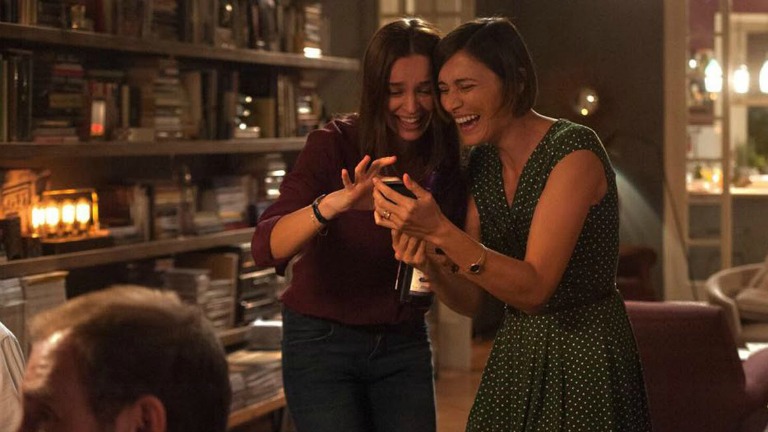
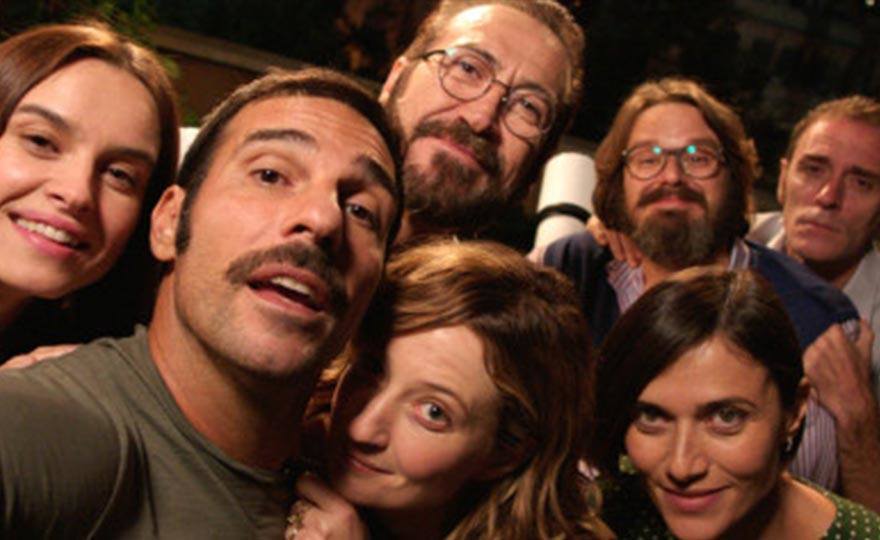
Seven friends gather together for a dinner party, held at the home of cosmetic surgeon Rocco (Giallini) and his wife, therapist Eva (Smutniak). Joining them are newlyweds Cosimo (Leo) and Bianca (Rohrwacher), who have decided to try for a baby; distant married couple Lele (Mastandrea) and Carlotta (Foglietta); and single friend Peppe (Battiston), who should be bringing his new girlfriend for everyone to meet, but who turns up alone as she’s fallen ill. Before the dinner party gets under way, we’re treated to telling glimpses of the three couples’ relationships, and in particular, the fractious way in which Rocco and Eva deal with their daughter, Sofia (Porcaroli).

With an eclipse of the sun due to occur that evening, the friends muse on that and various other topics before a phone call to one of them raises the question of whether or not any of them know each other as well as they think. With the call used as an instigator, Eva suggests they all play a game: each has to place their mobile phone on the table and if they receive a phone call during the evening they have to let everyone else hear what the caller is saying, or if they receive a text or e-mail they have to read it out and show someone else to prove what they’re saying is correct. Rocco isn’t too keen to play the game but he’s in the minority, and so he goes along with it. Eva is keen to see if anyone has any secrets they want to hide, but everyone denies the likelihood that she’ll be proven right.

As the evening progresses, certain calls and texts lead to certain revelations: that at least three of the friends are having affairs, one is on the verge of doing so, two are living a lie, and one has been betrayed from the very beginning of their relationship with their partner. Emotions run high, accusations are made, confrontations are endured, and relationships are smashed apart with only the barest possibility of reconciliations occurring in the future. And still more secrets go unrevealed…

PS - scene2

Before the invention of the telephone, the letter was the pre-eminent way for lovers, especially those conducting their affairs under cover of secrecy, to communicate their feelings for each other (when they weren’t able to snatch some time together). The telephone made communication easier and more immediate – no more waiting for a letter that might be intercepted or not even arrive – but with the explosion in telecommunications over the last twenty years it’s become easier to conduct our secret affairs in private, and to keep our unwitting partners in the dark, our misdeeds hidden behind a barrage of passcodes and biometric security.

Against this, it’s hard to imagine anyone agreeing to reveal the nature of the calls and messages they receive on their mobile phones, especially if their partners are there with them at the time, so Rocco’s objection seems correct. Like everyone else he has a secret, but in relation to subsequent revelations it’s on the trivial side (though it does speak volumes for the state of his relationship with Eva). But because everyone else, despite some minor objections, agrees to go along with Eva’s “game”, Perfect Strangers avoids discussing either our over-reliance on modern technology, or the ways in which it can allow us to lead hidden, secretive lives. Instead, and after a suitably languorous period where suspicions go unraised and calls/texts are easily explained away, the movie starts to unravel the lives of its characters and the façades they adopt in everyday life. As the poster puts it, each of us has three lives: a public one, a private one, and a secret one.

PS - scene3

Once these façades are exposed for what they are – the masks we wear to prove that our deceit is necessary and/or acceptable, at least to ourselves – the script by director Genovese, Filippo Bologna, Paolo Costella, Paola Mammini and Rolando Ravello piles on the anguish and the shame and does its best to up the ante with each new secret that’s revealed. With some of the secrets proving inter-connected, and in ways that stretch the narrative’s carefully established plausibility – these are friends you can believe have known each other for years, and are comfortable with each other – the movie becomes overheated, its characters behaving as if the betrayals they’ve discovered are worse than any betrayal they’ve committed themselves. There’s a stark, angry moment when the provenance of a pair of earrings reveals an unexpected connection between two of the characters; it’s a brief scene that arrives out of the blue and is all the better for it. Otherwise, the script opts for extended, unlikely conversations that feel too articulate for the emotions everyone’s supposed to be feeling.

That said, this is the type of movie that feels as if it could have been adapted from a stage play (or could be adapted into one). Rocco and Eva’s apartment, an assortment of rooms dominated not by the dining room (which always feels cramped, adding to the notion of a pressure cooker environment) but by their vast kitchen, is the kind of set where a camera can prowl around characters with impunity and a keen eye for deceitful behaviour or motivations. Genovese frames his characters carefully, always showing the emotional distance between them (as well as the physical distance) while they’re at the dinner table, and the further distance they put between themselves when they’re away from it. As the movie progresses, and small rifts of insecurity become gaping chasms of duplicity, it reinforces the idea that we never really know anyone, even someone we live with or have known for a long time.

PS - scene1

At the movie’s end, and with the guests departing in various degrees of haste, Genovese and his co-screenwriters throw audiences a curveball that allows for a different, perhaps more mournful ending than expected. It’s awkwardly done, and as curveballs go, isn’t signposted too well; some audiences may be confused by what they’re seeing, but in relation to what’s happened throughout the evening it does allow the individual viewer to make their own mind up as to whether or not “honesty is the best policy”.

The cast all get their moments to shine, with Battiston delivering Peppe’s verdict on his friends’ behaviour with a sad resignation that’s entirely appropriate. Foglietta is on fine form as the wife who yearns for something more from her marriage but can’t find the wherewithal to find it and keep it, and Rohrwacher gives a touching performance as Bianca, the naïve young newcomer to the group whose aspirations as a wife and willing friend are cruelly dashed. Mastandrea has the most difficult role, but thanks to some poorly crafted dialogue, isn’t allowed to make Lele’s secret as affecting or believable as it needs to be. Genovese directs them all with aplomb, allowing each character to grow and develop, but again there are too many moments where, in the wake of a revelation, the movie struggles to maintain momentum thanks to the recurring decision to have a character express their feelings at length, and with too much hesitation.

Rating: 7/10 – a fascinating, though contrived drama, Perfect Strangers takes a dinner party game and uses it as a way of exposing the deceptions and dishonesty that can lie at the heart of modern relationships; too astute for its own good at times, the movie is occasionally uncomfortable to watch, but it features a wealth of good performances, some effective and unexpectedly poignant moments, and doesn’t – not once – allow the audience to feel superior to any of its characters.


http://amzn.to/2js0gWd

Share this:

  • Click to share on X (Opens in new window) X
  • Click to share on Facebook (Opens in new window) Facebook
  • More
  • Click to print (Opens in new window) Print
  • Click to email a link to a friend (Opens in new window) Email
Like Loading...

Blog Stats

  • 483,557 hits

Recent Posts

  • 10 Reasons to Remember Bibi Andersson (1935-2019)
  • Fantasia (1940)
  • Dances With Wolves (1990) – The Special Edition
  • Kiss of the Spider Woman (1985)
  • The Three Musketeers (1973)

Top Posts & Pages

  • Lost for Life (2013) - Another Look
    Lost for Life (2013) - Another Look
  • Lost for Life (2013)
    Lost for Life (2013)
  • The Monuments Men (2014)
    The Monuments Men (2014)
  • About
    About
  • Exposed (2016)
    Exposed (2016)
  • Cardboard Boxer (2016)
    Cardboard Boxer (2016)
  • Mini-Review: Good Kill (2014)
    Mini-Review: Good Kill (2014)
  • Bone Tomahawk (2015)
    Bone Tomahawk (2015)
  • Mini-Review: The Falling (2014)
    Mini-Review: The Falling (2014)
  • 45 Years (2015)
    45 Years (2015)
Follow thedullwoodexperiment on WordPress.com

Blogs I Follow

  • Rubbish Talk
  • Film 4 Fan
  • Fast Film Reviews
  • The Film Blog
  • All Things Movies UK
  • Interpreting the Stars
  • Let's Go To The Movies
  • Movie Reviews 101
  • TMI News
  • Dan the Man's Movie Reviews
  • Film History
  • Jordan and Eddie (The Movie Guys)

Archives

  • April 2019 (13)
  • March 2019 (28)
  • February 2019 (28)
  • January 2019 (32)
  • December 2018 (28)
  • November 2018 (30)
  • October 2018 (29)
  • September 2018 (29)
  • August 2018 (29)
  • July 2018 (30)
  • June 2018 (28)
  • May 2018 (24)
  • April 2018 (21)
  • March 2018 (31)
  • February 2018 (25)
  • January 2018 (30)
  • December 2017 (30)
  • November 2017 (27)
  • October 2017 (27)
  • September 2017 (26)
  • August 2017 (32)
  • July 2017 (32)
  • June 2017 (30)
  • May 2017 (29)
  • April 2017 (29)
  • March 2017 (30)
  • February 2017 (27)
  • January 2017 (32)
  • December 2016 (30)
  • November 2016 (28)
  • October 2016 (30)
  • September 2016 (27)
  • August 2016 (30)
  • July 2016 (30)
  • June 2016 (31)
  • May 2016 (34)
  • April 2016 (30)
  • March 2016 (30)
  • February 2016 (28)
  • January 2016 (35)
  • December 2015 (34)
  • November 2015 (31)
  • October 2015 (31)
  • September 2015 (34)
  • August 2015 (31)
  • July 2015 (33)
  • June 2015 (12)
  • May 2015 (31)
  • April 2015 (32)
  • March 2015 (30)
  • February 2015 (37)
  • January 2015 (39)
  • December 2014 (34)
  • November 2014 (34)
  • October 2014 (36)
  • September 2014 (25)
  • August 2014 (29)
  • July 2014 (29)
  • June 2014 (28)
  • May 2014 (23)
  • April 2014 (21)
  • March 2014 (42)
  • February 2014 (38)
  • January 2014 (29)
  • December 2013 (28)
  • November 2013 (34)
  • October 2013 (4)

Create a free website or blog at WordPress.com.

Rubbish Talk

Film 4 Fan

A Movie Blog

Fast Film Reviews

The Film Blog

The official blog of everything in film

All Things Movies UK

Movie Reviews and Original Articles

Interpreting the Stars

Dave Examines Movies

Let's Go To The Movies

Film and Theatre Lover!

Movie Reviews 101

Daily Movie Reviews

TMI News

Latest weather, crime and breaking news

Dan the Man's Movie Reviews

All my aimless thoughts, ideas, and ramblings, all packed into one site!

Film History

Telling the story of film

Jordan and Eddie (The Movie Guys)

Movie Reviews & Ramblings from an Australian Based Film Fan

Privacy & Cookies: This site uses cookies. By continuing to use this website, you agree to their use.
To find out more, including how to control cookies, see here: Cookie Policy
  • Subscribe Subscribed
    • thedullwoodexperiment
    • Join 481 other subscribers
    • Already have a WordPress.com account? Log in now.
    • thedullwoodexperiment
    • Subscribe Subscribed
    • Sign up
    • Log in
    • Report this content
    • View site in Reader
    • Manage subscriptions
    • Collapse this bar
 

Loading Comments...
 

    %d