• 10 Reasons to Remember…
  • A Brief Word About…
  • About
  • For One Week Only
  • Happy Birthday
  • Monthly Roundup
  • Old-Time Crime
  • Other Posts
  • Poster of the Week
  • Question of the Week
  • Reviews
  • Trailers

thedullwoodexperiment

~ Viewing movies in a different light

thedullwoodexperiment

Tag Archives: Time travel

The Girl Who Leapt Through Time (2006)

25 Sunday Mar 2018

Posted by dullwood68 in Movies

≈ Leave a comment

Tags

Animation, Drama, Fantasy, Japan, Mamoru Hosoda, Mitsutaka Itakura, Review, Riisa Naka, Takuya Ishida, Time travel

Original title: Toki o kakeru shôjo

D: Mamoru Hosoda / 98m

Cast: Riisa Naka, Takuya Ishida, Mitsutaka Itakura, Ayami Kakiuchi, Mitsuki Tanimura, Yuki Sekido, Sachie Hara, Utawaka Katsura, Midori Ando

Makoto (Naka) is a seventeen year old whose life consists of one lucky break after another: whether she oversleeps or not she still gets to school in the nick of time, she does well enough on her tests even though she doesn’t study too hard, and when she loses control of her bike heading downhill toward a train crossing, she always manages to regain control just before reaching the barrier. She has two male friends, Chiaki (Ishida) and Kosuke (Itakura), whom she plays baseball with after school, and a female friend, Kaho (Tanimura). But her various relationships undergo a variety of changes – some good, some bad – when an accident at school leaves her with the ability to leap back in time. At first she tries to help her friends in different ways, but her plans and ideas always seem to backfire, and she has to keep repeatedly going back to the same times and places to try and fix the things that she’s caused to happen. Soon Makoto learns that she has a finite number of time leaps available to her, and as they begin to run out, she has to double her efforts to ensure that everyone affected – including herself – is better off than when she started.

It’s heartening to discover that in The Girl Who Leapt Through Time, the girl is only interested in using her gift to help others. She finds that helping herself has adverse effects on others that she couldn’t have predicted, while she also finds she has only modest ambitions for herself. Instead she tries to bring Kosuke and Kaho together (an idea that suffers a multitude of setbacks), and attempts to find out more about her newfound gift. One of the nicest things about Satoko Okudera’s script, itself a semi-sequel to Yasutaka Tsutsui’s 1967 novel of the same name, is that it doesn’t preach about the perils of interfering in the lives of others, or how dangerous it might be to meddle with time. What we get instead is a sensitive portrait of teen anxiety in the face of unresolved romantic feelings, and a heartfelt treatise on the nature of individual responsibility. What hampers Makoto from getting things right is her inexperience and her naïvete; she can’t see the potential consequences of her actions, no matter how unselfish they might be.

Hosoda brings all this together in charming and winning fashion, and provides an often beautiful backdrop for the action. The backgrounds are often astonishing for their vibrancy and depth of colour, and many scenes have a simplicity of style and execution that is inspiring. However, while the characters are well drawn, certain aesthetic decisions conspire to make them look outlandish and bizarre. Makoto suffers the most, with one scene showing her tipping her head back with laughter and her mouth widening to the extent that it looks freakish (or something out of a horror movie). And Hosoda curiously elects to remove all facial features from characters when they are in the background. These elements, along with a sub-plot about a time traveller from the future and a particular painting Makoto’s aunt is restoring, distract from the overall effect, and prove unsettling and unrewarding in equal measure. But there is a fresh, joyous quality to the material that makes up for much of this, and there are plenty of subtle emotional layers to be savoured throughout the movie. The voice cast acquits itself well, and though Hosoda’s direction is uneven at times, this remains a delightful, if unspectacular, coming-of-age anime.

Rating: 7/10 – it’s easy to forget that there are other animation studios in Japan beside Studio Ghibli (here it’s Madhouse), but despite some obvious flaws, The Girl Who Leapt Through Time is a positive reminder; engaging and unpretentious, it’s a movie that treats its more serious themes with genuine integrity, while adding a lively sense of humour, all of which makes for an entertaining, if not entirely polished, viewing experience.

Share this:

  • Click to share on X (Opens in new window) X
  • Click to share on Facebook (Opens in new window) Facebook
  • More
  • Click to print (Opens in new window) Print
  • Click to email a link to a friend (Opens in new window) Email
Like Loading...

The Warriors Gate (2016)

13 Thursday Apr 2017

Posted by dullwood68 in Movies

≈ Leave a comment

Tags

Action, Ancient China, Black Knight, Dave Bautista, Drama, Fantasy, Mark Chao, Martial arts, Matthias Hoene, Ni Ni, Princess, Time travel, Uriah Shelton

D: Matthias Hoene / 107m

Cast: Uriah Shelton, Mark Chao, Ni Ni, Dave Bautista, Sienna Guillory, Francis Chun-Yu Ng, Zha Ka, Dakota Daulby, Luke Mac Davis

Jack Bronson (Shelton) is a teenager whose online gaming avatar, the Black Knight, is a complete badass, winning fantasy encounter after fantasy encounter. Away from his computer, however, he’s not quite so powerful or dominating. His life has its fair share of problems: his mother, Annie (Guillory), is a realtor who hasn’t sold a property in months (which means money is fast becoming an issue), and at school he’s being bullied by an older teen called Travis (Daulby). Jack does have a job, at least, even if it doesn’t pay an awful lot, but his boss likes him, enough to give Jack a gift: a large wooden, ornamental box. Jack takes it home and keeps it in his room. That first night, Jack wakes to find a sword at his throat, and an ancient Chinese warrior (Chao) asking if he’s the Black Knight. Even though he’s clearly not the fierce warrior the stranger is looking for, Jack is still given a task: to protect the Princess Su Lin (Ni) from harm.

The Princess is left in Jack’s care – but not before her bodyguard disappears back to their world via the box. The Princess is used to getting her own way, and it’s not long before she has Jack take her to the local mall so that she can learn how to blend in. But it’s also not long before mercenaries from the Princess’s world come for her, and despite Jack’s best efforts (which aren’t that great anyway), she’s taken back to her world. Jack follows, and finds himself in the company of the bodyguard, whose name is Zhoo. Soon, Jack learns that the Princess is the target of a murderous warlord called Arun the Cruel (Bautista). Arun plans to wed Su Lin, and once they’re married, kill her and assume the role of Emperor. Zhoo’s mission is to rescue her and kill the warlord. With the occasional aid of a wizard (Ng), and Jack himself, Zhoo sets off for the Imperial Palace.

Along the way they encounter danger in the form of three tree nymphs with a taste for human flesh, a number of Arun’s men, and having to cross a large lake despite Zhoo being unable to swim. Once at the Imperial Palace, their attempt to rescue the Princess is stalled, and they find themselves imprisoned. It’s only when a butterfly appears at their cell window that Zhoo is certain that his plan (which he’s making up as he goes along) will actually work.

If nothing else, The Warriors Gate proves that with great publicity comes greater accusations of racism. Zhang Yimou’s bloated melodrama The Great Wall (2016) came in for heaps of criticism for having an Occidental hero coming to China’s rescue when faced with hordes of rampaging dragons. Here, Matthias Hoene’s tiresome fantasy swaps Matt Damon’s Irish mercenary for Uriah Shelton’s whiny teenager as a Chinese dynasty comes under threat from a surly warlord who’s massively into face painting. And yet The Warriors Gate is just as guilty of cultural whitewashing as its more expensively mounted compatriot. More so, perhaps. How galling must it be for Chinese audiences to see their heritage, their culture, and their fierce warrior history ignored in favour of making the hero a – let’s say it again – whiny teenager.

Bad as this approach is, The Warriors Gate has far more things wrong with it than there are good. A pale imitation of the far more entertaining The Forbidden Kingdom (2008), Hoene’s follow-up to the low-concept, low return Cockneys vs Zombies (2012) sees him take a script by Luc Besson and Robert Mark Kamen (who really should have known better) and turn it into a bland, functional, and entirely unremarkable teen fantasy movie that feels like it was made in the Nineties and has only recently secured a big screen release. With its bizarre set up, fortune cookie philosophising, bland time travel theatrics, agonising moments of teen humour, bullying subplot, cultural indifference to Chinese history, off-putting tonal shifts (sometimes in the same scene), and forgettable characters, the movie struggles hard to work on any level… and then struggles some more.

It’s a movie that steals from other, better movies too, and in doing so, only serves to highlight just how derivative and unoriginal it all is. Jack’s lack of self-confidence is such a staple of teen heroes and heroines these days that it’s a wonder any of them get out of bed in the first place. Naturally he has a skill that will enable him to defeat the bad guy, but the script can’t decide if it’s inside him all along or is something that he’ll need to learn. In the end, the movie settles for Jack being shown one single, semi-meditative pose and it’s all he needs to be the warrior Zhoo has been looking for. Inside of him all along, or a simple technique easily learned – either way Jack steps up and never looks back. And of course, everyone says they always believed in him (and yet Zhoo doubts him repeatedly).

There’s also the small issue of the reason Jack follows the kidnapped Princess into her world: he’s horny, has never been kissed, and fancies Su Lin like mad. (His hormones made him do it!) Even when he’s fully aware of what’s at stake if Arun’s plan succeeds, Jack is still thinking with his ‘nads, and though it’s unreasonable to assume he’s trying to help for more noble reasons, the movie keeps him firmly in place as a teenager with only one thing on his mind: getting the girl. With this level of ambition, it’s no wonder Jack is a character who screams “superficial!” when compared with his Chinese assistants – sorry, enablers. Unsurprisingly, Su Lin is attracted to Jack, but their romance has all the emotional clout of a Hallmark movie of the week.

The script sabotages itself too often for comfort. Arun the Cruel is revealed to be a pretty fair despot on the whole, and possessed of a sly line in humour. Bautista gets the tone right fortunately, but can’t do anything with the silly-sounding dialogue he’s lumbered with. As the Princess, Ni is allowed to be haughty for all of five minutes before falling for Jack’s, err, charms, while Chao has the dour straight man role and as a result, sometimes fades into the background. Ng is clearly enjoying his turn as a comedy wizard, while Guillory gets the thankless role of worried mother. The cast as a whole are hampered by having to deal with perfunctory characterisations and finding themselves unsupported by Hoene and the script. The fight sequences have a certain panache, but when the final showdown between hero and villain takes place, it’s too little too late (and no one ever explains why the Princess is hanging by her wrists the whole time).

Rating: 4/10 – sloppy writing and an uninspired vibe make The Warriors Gate (yes, there’s no apostrophe) a disappointing entry in the teen fantasy stakes; acceptable only if you don’t care enough to be insulted, the movie can best be summed up by stealing a paraphrased line from the New York Times movie critic A.O. Scott: it sets a very low bar for itself, and then trips over it repeatedly.

Share this:

  • Click to share on X (Opens in new window) X
  • Click to share on Facebook (Opens in new window) Facebook
  • More
  • Click to print (Opens in new window) Print
  • Click to email a link to a friend (Opens in new window) Email
Like Loading...

For One Week Only: Unnecessary Sequels – 2. Joe Dirt 2: Beautiful Loser (2015)

10 Tuesday May 2016

Posted by dullwood68 in Movies

≈ Leave a comment

Tags

1965, Biker gang, Brittany Daniel, Christopher Walken, Comedy, David Spade, Fred Wolf, Joe Dirt, Lynyrd Skynyrd, Mark McGrath, Patrick Warburton, Review, Sequels, Time travel, Twister

Introduction

When talking about sequels, two genres seem to be referred to more than any others: horror and comedy. They’re cheap to make, don’t always require big names to attract an audience, and will generally attract said audience by virtue of being an easy watch (whether that’s the case or not). Comedy sequels rarely retain the charm or gag-to-laugh ratio of their predecessors, even if the same cast/director/screenwriter returns; the original idea, if done right, should have had all its comic potential mined from source, so that any follow-up has really got to go the extra mile to work anywhere near as well. What you get – usually – are the same jokes rehashed, the same characters held in development stasis, and maybe some new characters that don’t add anything new to the mix. When a comedy sequel arrives so long after the original, you have to wonder at the reason for it, and will it have anything new to say? The reason is usually a financial one (it’s a very rare sequel that’s made under the auspices of “artistic merit”), and in terms of having anything new to say, well, let’s just say you shouldn’t count on it. Here’s a “great” example.

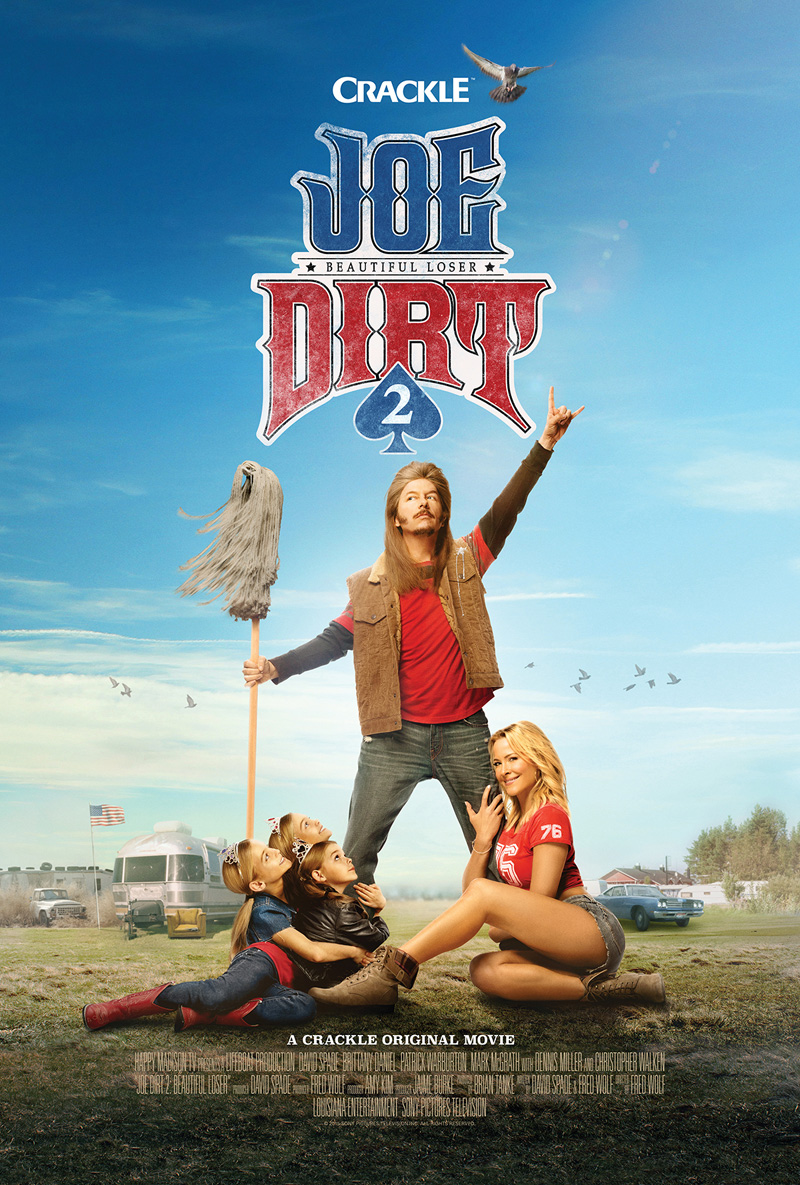
Joe Dirt 2: Beautiful Loser (2015) / D: Fred Wolf / 107m

Joe Dirt 2 Beautiful Loser

Cast: David Spade, Brittany Daniel, Patrick Warburton, Mark McGrath, Dennis Miller, Christopher Walken, Rhonda Dents, Tracy Weisert, Adam Beach

David Spade is the member of Adam Sandler’s “posse” whose career has been made up of appearances on TV, supporting turns in his pal Sandler’s movies, and voice work in a multitude of animated series and features. In 2001, he co-wrote and starred in a movie called Joe Dirt. It was about a man searching for his parents (who abandoned him as a baby), and the man, Joe, was a complete idiot. The movie wasn’t brilliant, but it wasn’t awful either; instead it occupied that middle ground where there are as many good things to say about it as there are bad. And it was funny in places, really funny, and Spade made the best of a rare leading role.

Fast forward fourteen years and Spade is back, co-writing (with director Fred Wolf, who also co-wrote the first movie) and starring in a not quite inevitable sequel. The same narrative structure is used as in the first movie – Joe recounts a journey he’s taken, this time going back to 1965 and traversing the years until he reaches the pivotal moment where he meets his wife, Brandy (Daniel) – and along the way he finds himself in all sorts of trouble while admitting to anyone who’ll listen that he’s as dumb as a box of spanners. Of course, this being a road movie of sorts, it’s also about Joe taking a journey of self-discovery and realising what’s really important (his wife and family, being true to oneself, having a good heart – the usual drivel).

JD2BL - scene1

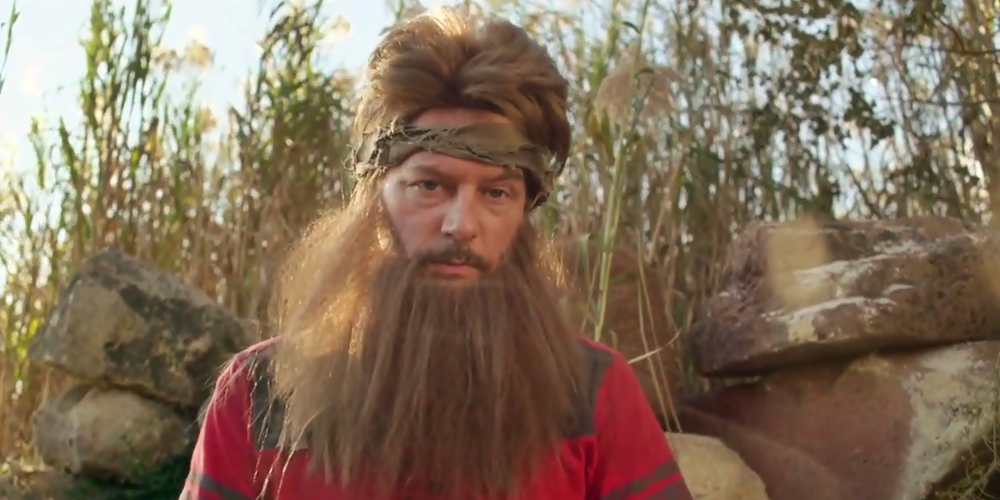
But Spade and Wolf have a secret agenda. As Joe Dirt 2: Beautiful Loser finds its time travelling groove, and goes about ripping off elements from The Wizard of Oz (1939), Back to the Future (1985), Forrest Gump (1994), and Cast Away (2000), the movie can’t help but have Joe interact with various moments in US history, particularly an encounter with the founder members of Lynyrd Skynyrd when they were still The Wildcats that ends abruptly when they mention being rich and successful enough to own their own airplane. It’s a scene obviously shoehorned into the script to be both amusing and maudlin at the same time, but thanks to the number of suggestions that Joe makes, all of which will ensure the group’s fame and fortune, the scene falls flat, and loses whatever bittersweet poignancy it may have aimed for.

It’s the same for most of the movie, as scenes lacking any subtlety (the scene with Buffalo Bob, a “future” scene involving vodka soaked tampons) vie for attention with scenes that are meant to be heartfelt. But sadly it doesn’t matter what the tempo or mood of any given scene, thanks to Wolf’s casual approach to directing, they all feel as if they’ve gone on too long, or that the meaning of the scene has been eclipsed by the need to include a joke or bit of business that doesn’t work. It all leads to long stretches where the narrative stalls unnecessarily and any momentum the movie has managed to attain is kicked to the kerb.

JD2BL - scene2

Of course, being a sequel, the movie does its best to bring back as many of the original cast as possible. This is usually a good thing, as the familiarity of the characters is (hopefully) maintained along with a great deal of goodwill towards them; when they show up, the viewer is meant to be happy to see them. However, Spade aside, none of the returning cast get very much to do. Daniel is sidelined for much of the movie, Walken pops up for three scenes (and coasts through all of them), Beach gets a cameo, and Miller acts as an occasional prompt for the narrative. Of the newcomers, Warburton gets the lion’s share of screen time but never seems like he’s connected with his character(s), while the only thing that McGrath does of note is to name check himself in the scene relating to the vodka soaked tampons (and weirdly, not in a good way).

Like many sequels, Joe Dirt 2: Beautiful Loser tries hard to justify its existence but never succeeds in stating a good case for itself. Much of the humour is forced, and on a couple of occasions is reliant on Spade’s verbal dexterity, leaving the movie feeling like the vanity project of someone who’s easily persuaded that the material they’ve come up with is more than enough to gain critical and commercial approbation. Alas, in this case, that’s not true. At best, the movie is inoffensive (even when it tries its best to be offensive), at worst it’s a disappointing, unrewarding exercise in recreating what little lightning was in the original bottle.

Rating: 4/10 – slackly directed, and edited to the point of distraction by Joseph McCasland, Joe Dirt 2: Beautiful Loser is a sequel that spends more time riffing on other, more successful movies than creating something new and effective; Spade is fine as Joe, but as this is his baby he should bear the responsibility of what is ultimately a shoddy, sporadically amusing misfire.

Share this:

  • Click to share on X (Opens in new window) X
  • Click to share on Facebook (Opens in new window) Facebook
  • More
  • Click to print (Opens in new window) Print
  • Click to email a link to a friend (Opens in new window) Email
Like Loading...

Short Movies Volume 1

27 Friday Nov 2015

Posted by dullwood68 in Movies

≈ Leave a comment

Tags

Aliens, Andrea Jensen, Animation, Blue Sky, Brian Dietzen, Camera, Casino, Christmas Scrat-tastrophe, Dave Calub, David Mead, Devon Avery, Documentary, Erinn Hayes, Galen Chu, Gambling, History, Horror, Invasion, Is This Free?, Jack Hawkins, Lauris Beinerts, Matthew Kalish, Megan Prescott, Mike Thurmeier, One-Minute Time Machine, Ransom Riggs, Reviews, Romance, Ryder Bach, Salton Sea, Scrat, Short movies, Spaceship, The Accidental Sea, The Plan (2008), Time travel, Turn Around When Possible

The short movie is an oft-neglected aspect of movie viewing these days, with fewer outlets available to the makers of short movies, and certainly little chance of their efforts being seen in our local multiplexes (the exceptions to these are the animated shorts made to accompany the likes of Pixar’s movies, the occasional cash-in from Disney such as Frozen Fever (2015), and Blue Sky’s Scrat movies (see below). Otherwise it’s an internet platform such as Vimeo, YouTube (a particularly good place to find short movies, including the ones in this post), or brief exposure at a film festival. Even on DVD or Blu-ray, there’s a dearth of short movies on offer. In an attempt to bring some of the gems that are out there to a wider audience, here is the first in an ongoing series of posts that will focus on short movies. Who knows? You might find one that becomes a firm favourite – if you do, please let me know.

One-Minute Time Machine (2014) / D: Devon Avery / 6m

Cast: Brian Dietzen, Erinn Hayes

One-Minute Time Machine

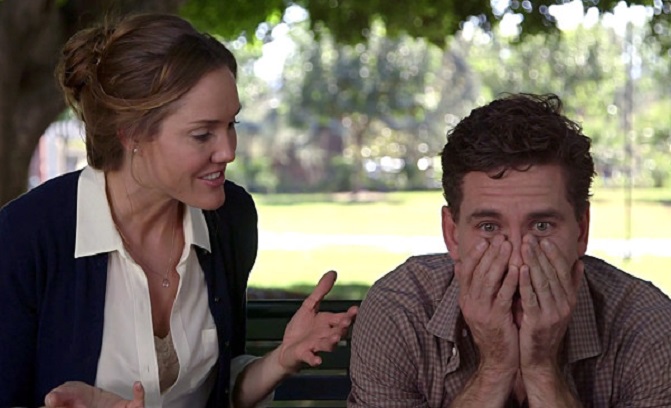
Rating: 9/10 – A comedy about a young man who invents a time machine in order to impress the girl of his dreams, this brief but inventive short is like a sci-fi version of Groundhog Day, but with a humorous sting in the tale. The two leads are well chosen, with Dietzen (NCIS‘s Jimmy Palmer) playing the lovelorn geek to perfection, and Hayes proving to be an equally effective sparring partner. It does make up its own rules about time travel but that’s no bad thing, and Avery makes a virtue of the way in which he cuts between his two characters. A rewarding little movie that is well worth watching.

Turn Around When Possible (2014) / D: Dave Calub, David Mead / 7m

Cast: Megan Prescott, Holly Hoyland

Turn Around When Possible

Rating: 7/10 – Two young women trust their sat-nav too much in this British short that sees them lost in the forest and at the mercy of something strange lurking in the undergrowth. Just what is lurking in the undergrowth is very reminiscent of a creature you shouldn’t get wet or feed after midnight, and the acting is a little amateurish, but this is still an atmospheric, well-shot movie that also manages to provide viewers with a surprisingly ambiguous ending.

Is This Free? (2011) / D: Lauris Beinerts / 8m

Is This Free?

Cast: Jack Hawkins, Tarryn Meaker, Abdiel LeRoy, Cornelia Baumann, Julian Lamoral-Roberts, David Cullinane, Chloe Massey, Katie Goldfinch, Véronique Sevegrand

Rating: 8/10 – Observational comedy is the focus here as Hawkins’ Luka illustrates the various responses he gives to people who ask if the seat next to him is free. Ranging from the risible – woman agrees to pay £2 to avoid someone else getting the seat – to the awkwardly humorous – Luka allows someone to sit next to him on a bench but tells them they’re being watched – Beinerts makes the most of his central idea, and it’s put together with a great deal of heart. And of course Luka doesn’t get it all his own way, which helps the movie avoid being too clever for its own good.

The Plan (2008) / D: Matthew Kalish / 4m

Cast: Ryder Bach, Andrea Jensen

Plan, The

Rating: 8/10 – Mitch (Bach) is unhappy with his life and decides to ditch his job, his girlfriend, and travel to Las Vegas to bet everything’s he’s got on red. Along the way he meets a young woman (Jensen) who steals his camera, but proves to be an augur of a better future. Shot in black and white, and with a Fifties feel to it that adds to the movie’s overall charm, this is both romantic and transformative at the same time, and despite Kalish’s predilection for unnecessary camera angles.

The Accidental Sea (2011) / D: Ransom Riggs / 6m

Accidental Sea, The

Rating: 8/10 – The writer of the Miss Peregrine’s Home for Peculiar Children‘s trilogy provides a potted history of California’s Salton Sea, from its origins as a major engineering mistake to its heyday as a holiday destination before the sea became too salty to sustain the surrounding infrastructure. Of particular interest thanks to Riggs’ modern day footage, where the area looks like the aftermath of the end of the world, the only fault is the sudden appearance of an old man who’s been making art out of the area’s refuse, and who isn’t on screen for nearly long enough. Haunting and wistful, this is a documentary short that is visually arresting and endlessly fascinating.

Christmas Scrat-tastrophe (2015) / D: Mike Thurmeier, Galen Chu / 5m

Cast: Ray Romano, John Leguizamo, Denis Leary, Chris Wedge

Christmas Scrat-tastrophe

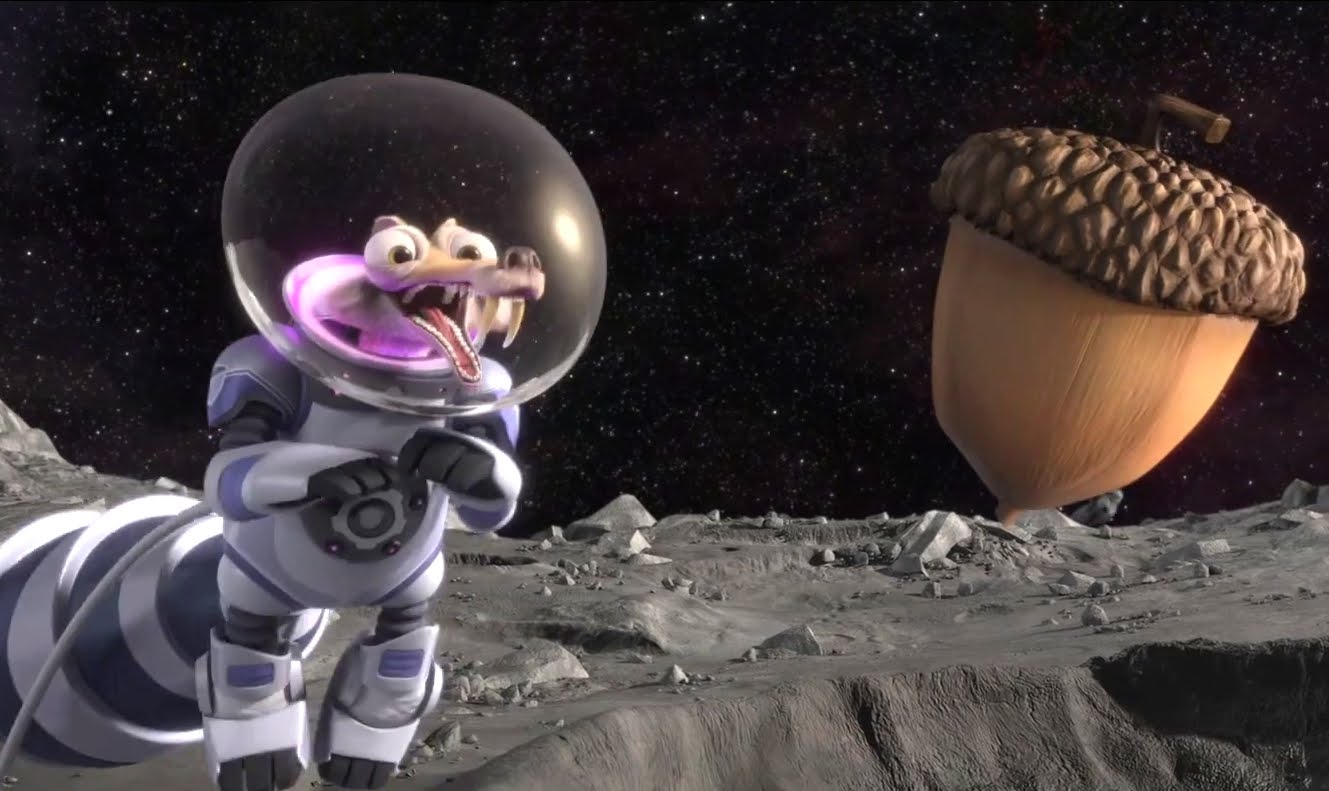
Rating: 9/10 – Scrat’s back, and this time his obsession with keeping his nut all to himself leads to his being aboard the spaceship we glimpsed in the first Ice Age movie. From there, Scrat heads off into space to play havoc with the planets and go for a space walk, with predictably disastrous effects. Unabashedly entertaining (and with a complete disregard for physics and astrodynamics), this is top-notch stuff that, unfortunately, serves as a reminder that Scrat’s solo adventures are still far more entertaining than the full-length movies he has a supporting turn in.

Share this:

  • Click to share on X (Opens in new window) X
  • Click to share on Facebook (Opens in new window) Facebook
  • More
  • Click to print (Opens in new window) Print
  • Click to email a link to a friend (Opens in new window) Email
Like Loading...

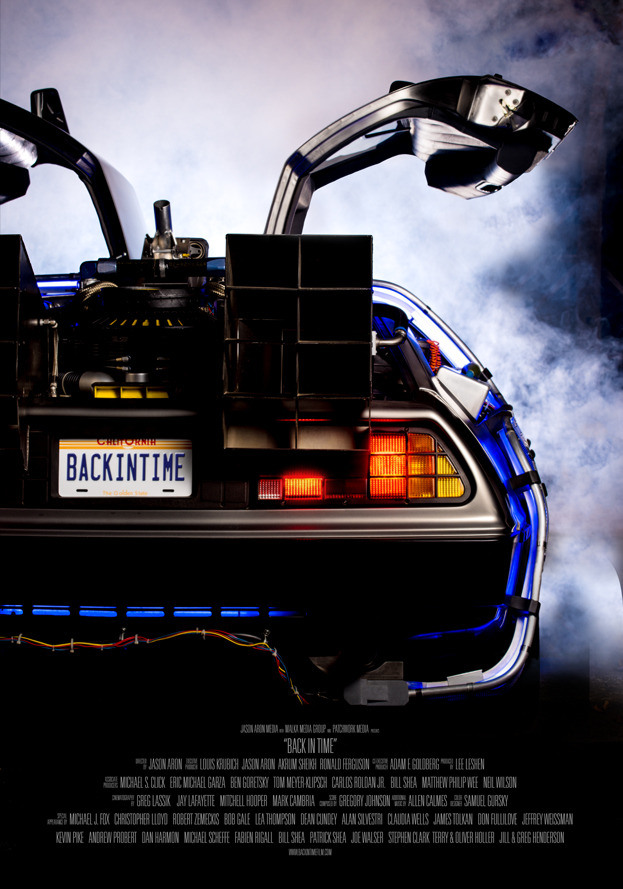
Back in Time (2015)

13 Friday Nov 2015

Posted by dullwood68 in Movies

≈ Leave a comment

Tags

1955, 1985, 2015, Back to the Future, Back to the Future Part II, Back to the Future Part III, Backtothefuture.com, Bob Gale, Christopher Lloyd, Crispin Glover, DeLorean, Doc Brown, Documentary, Hoverboard, Lea Thompson, Marty McFly, Michael J. Fox, Princess Diana, Review, Robert Zemeckis, Thomas F. Wilson, Time travel

Back in Time

D: Jason Aron / 95m

With: Bob Gale, Robert Zemeckis, Michael J. Fox, Christopher Lloyd, Lea Thompson, Steven Spielberg, Frank Price, Donald Fullilove, Huey Lewis, Claudia Wells, James Tolkan, Alan Silvestri, Dean Cundey, Dan Harmon, Adam F. Goldberg, Jeffrey Weissman, Andrew Probert, Kevin Pike, Michael Scheffe

The enduring appeal of the Back to the Future trilogy is due to one inescapable fact: the scripts – by Bob Gale and Robert Zemeckis on Part I, and Gale alone on parts II and III – are some of the best screenplays ever written. Forget that these aren’t movies that explore in depth the meaning of life, or what it is to be human, or any other deep, meaningful topics. Remember instead that these movies, taken together, constitute one of the most enjoyable, most rewarding movie trilogies this side of the Toy Story series (and if you ignore animation altogether, then they win hands down – sorry anyone waving the Star Wars Original Trilogy at me; I have just one word for you: Ewoks).

Jason Aron’s likeable, though fumbled, documentary looks at the story behind the making of the first movie, and then widens its scope to look at how it’s affected the lives of some of its fans, people like Stephen Clark, who became the Executive Director of Backtothefuture.com, the one-stop shop for anyone looking for information or merchandise relating to the series. Or Terry and Oliver Holler, who bought a DeLorean as a Bucket List idea when Oliver was diagnosed with cancer; now they travel around the US in their BttF-style DeLorean raising money for Michael J. Fox’s Parkinson’s charity. Or Greg and Jill Henderson, who through their company Arx Pax, have created a working hoverboard.

vlcsnap-00001

While these stories are interesting in and of themselves, and the people recounting them are engaging and refreshingly down-to-earth about their love for the movies and the work they do as a result of that love, it all comes at the expense of the movies themselves. If you’re a fan of Parts II and III, then this is not the movie for you if you’re looking for insights into the making of those movies, or any anecdotes relating to them. Part II gets a brief look, while Part III is practically ignored. The focus is squarely on Part I as the launching point for all the fan activity that followed in its wake.

So this leaves the movie feeling, initially, like it’s going to be about the making of all three movies. But it keeps veering away, jumping from personal recollections to detailed analyses of how several DeLoreans were transformed (by several different people) into copies of the cars used in the movies. There’s feedback from other entertainers/writers/directors, such as Dan Harmon, who created Community, and Adam F. Goldberg, the creator of The Goldbergs. And there are glimpses of conventions and public events, including the Secret Cinema presentation of Back to the Future from 2014. The movie covers a lot of ground, but in doing so, misses out on quite a lot also.

vlcsnap-00003

Part of the issue is, as mentioned above, the way in which Back in Time‘s structure reduces the amount of time we have to find out about one of the most respected and well-regarded cultural icons of the last thirty years. There are some great anecdotes about the making of the first movie, including Disney’s reaction to the script, and Gale is a great guide for the viewer, but without the contributions of Fox, Lloyd and Thompson in particular, this would be a rather dry examination of a wonderful movie (Zemeckis looks uncomfortable throughout, as if looking back on such a long-ago project detracts from the work he’s doing today).

There’s a flatness about the movie as well, a quality that makes it difficult for the viewer to become completely engaged with it. Whole stretches pass by in such a plain, matter-of-fact way that anyone watching from the comfort of their armchair might be inclined to skip ahead to the next section and see if it’s any more interesting. Aron also  keeps the shooting style pretty plain and simple, and the static talking head approach is rarely abandoned for anything different.

As for the cast and crew of Back to the Future, the absence of Thomas F. Wilson (any Tannen you care to mention), and Crispin Glover (George McFly in Part I) is disappointing even though it’s expected. Aside from voicing his characters on various video games over the years, Wilson hasn’t milked his association with the series in the way that, say, Wells and Fullilove have (just watch the movie to find out how), but it would have been interesting to hear what he recalls about making the movies*. Glover, of course, shot himself in the foot when negotiating his contract for Parts II and III, but again, his contribution to such a terrific movie would be great to hear about. (The same goes for Eric Stoltz, but that’s probably not going to happen either.)

vlcsnap-00002

With the movie not quite working at the level it needs to, and even though there are some priceless moments – Fox referring to Princess Diana as “smokin’ hot”; Greg Henderson saying if he could time travel he’d like to go back and “bitch slap” a couple of people – it’s perhaps fitting to end this review with an absolutely brilliant quote from Dan Harmon: “We actually use the same logic when we go to see movies as we do walking into a casino. We largely know we’re gonna get ripped off, but the chance is worth it. If it were any other industry, we would have long ago shut it down and sued everybody. Because if it was cans of tuna, the equivalent would be like every third can had a human finger in it. Movies are so bad now.” And amen to that.

Rating: 6/10 – imperfectly assembled and with too many distractions from the “main feature”, Back in Time is only occasionally successful in doing justice to the movie series it has such high regard for; a once only viewing experience that will only have viewers clamouring for more about the movies and not the fans – they should have been saved for another movie all their own.


*If you want to have some idea of how Thomas F. Wilson feels about his association with Back to the Future, check this out:

Share this:

  • Click to share on X (Opens in new window) X
  • Click to share on Facebook (Opens in new window) Facebook
  • More
  • Click to print (Opens in new window) Print
  • Click to email a link to a friend (Opens in new window) Email
Like Loading...

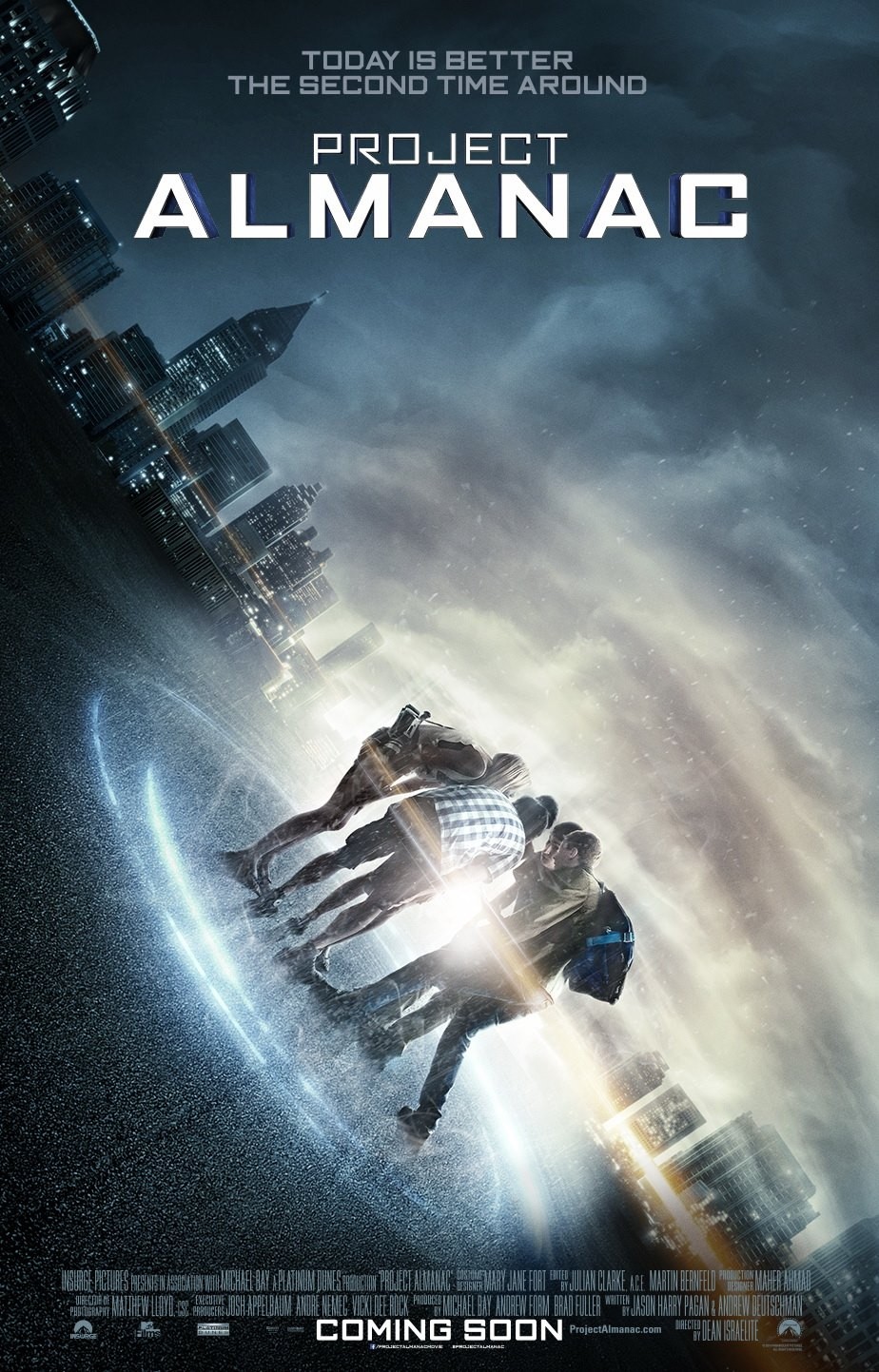
Project Almanac (2014)

02 Monday Mar 2015

Posted by dullwood68 in Movies

≈ Leave a comment

Tags

Allen Evangelista, Almanac, Cinema One, Dean Israelite, Drama, Jonny Weston, Review, Sam Lerner, Sci-fi, Sofia Black-D'Elia, Thriller, Time machine, Time travel, Virginia Gardner, Welcome to Yesterday

Project Almanac

D: Dean Israelite / 106m

Cast: Jonny Weston, Sofia Black-D’Elia, Sam Lerner, Allen Evangelista, Virginia Gardner, Amy Landecker, Gary Weeks

Budding inventor David Raskin (Weston) has been accepted into MIT but is unable to afford his tuition. When his mother (Landecker) finds out she plans to sell their home. In an attempt to avoid this happening, David decides to see if he can find anything amongst the various inventions left behind by his father (Weeks) before he died on David’s seventh birthday in a car crash. Instead he finds an old camcorder that contains footage of his seventh birthday party. Watching it back he’s shocked to discover himself as he is now in the background of one of the shots. He shows this to his sister, Christina (Gardner) and his two friends, Adam (Evangelista) and Quinn (Lerner). With their help David finds the blueprints for a “temporal relocation device” that his father was apparently building.

They then find the prototype he was working on and using some additional resources, such as the battery from the car of the girl David has a crush on, Jessie (Black-D’Elia), they manage to get the machine to work. But Jessie discovers what they’re doing and she becomes part of the group. All five travel back in time to the previous day and decide to play a trick on Quinn, but it nearly backfires on them. Making a pact to always use it together, they use the time machine for personal gain, Adam winning the lottery, Christina getting her own back on a school bully, and Quinn passing an important test. They also decide to travel back three months to a Lollapalooza festival where David has a chance to declare his feelings for Jessie. However, he hesitates too much and the moment passes. When it becomes clear that Jessie is upset by this and growing distant from him, David travels back alone to the festival to fix things.

But even though he and Jessie are a couple when he comes back, the change has caused a ripple effect that has culminated in a plane crash that killed everyone aboard. David goes back again to fix things but this time it causes a different set of problems. Jessie begins to suspect that David has manipulated their being together, but when they both travel back to correct things, Jessie meets her past self and is erased from that particular timeline. Worldwide catastrophes occur as a result, which prompt David to travel back to his seventh birthday and warn his father of the consequences of building his machine…

Project Almanac - scene

As with No Good Deed (2014), Project Almanac is a movie whose release has been delayed for reasons unknown, but anyone watching the movie – also known and advertised as Welcome to Yesterday before ending up with its current title – will have a fair idea of why when the quintet win big on the lottery (but not as big as expected), and Adam says, “I’m not winning the lottery a second time!” Casting aside its biggest mystery – just what was David doing at his seventh birthday party? – the movie opts for several bouts of wish fulfilment first before sending in the expected trials and tribulations of changing the past (has anyone noticed that the ripple effects in these movies are always for the worst, and never the best? Isn’t that equally as likely to happen?).

The script, by Jason Pagan and Andrew Deutschman, never really has a clear goal for its characters and never really gets its head around the conundrums of time travel, preferring instead to pull the rug out from under David et al with often ill-considered consequences attached. As attempts to heighten the drama they’re less than successful: one minute David’s mother has a job, the next she hasn’t; one minute Adam’s fine, the next he’s been run over; one minute David’s in one timeline, the next he’s not – and he has no idea what’s been happening in either. If it’s frustrating or maddening for the characters, imagine what it’s like for the poor viewer, having to sit through yet another time travel movie that doesn’t fully explore the possibilities inherent in its plotting and storyline. In the end it takes an unconvincing way out and doubles back on itself in a way that you know the makers think is clever, but if you give it enough thought, you’ll soon realise it’s a cheat.

With the plot and story chock full of holes, and constantly undermining itself, Project Almanac also plays havoc with its characters and their continuity. David is meant to be intelligent and inventive with a streak of geek in him that makes his relationship with Jessie that much more awkward to navigate. But the script throws out any intelligence he has when he goes back to Lollapalooza to change his and Jessie’s life together. Would someone so smart really want to manipulate his “true” love in such a way? And why is he suddenly so insensitive and shallow? And why can’t he see that with each trip he makes he runs the risk of losing everything? (Because the script needs him to, is the answer to all these questions.) And as this central romance takes prominence, the rest of the group become less interesting and less involved, and are reduced to making dire predictions about David’s tampering with time travel.

To make matters worse, the found footage style of filming used here often makes no sense, particularly in the scene where David travels back to Lollapalooza – just who is filming him and Jessie if this is now a separate timeline and he’s making his move? It’s moments like these that further undermine the credibility of events and make the movie such a disheartening viewing experience. Making his feature debut, Israelite pulls off some clever visuals, but shows his lack of experience throughout, leaving his cast adrift for most of the movie and along with the screenwriters, making the science seem too absurd for its own good (it’s handy that David’s high school has a good supply of hydrogen tanks – hydrogen tanks, really?). One plus is the lack of a musical score – as it should be – but it’s a sad state of affairs when the absence of something is a movie’s best feature.

Rating: 3/10 – with too many stupid decisions made by an apparently intelligent character – he got into MIT, remember? – Project Almanac is another in the long line of low budget time travel movies that fails to capitalise adequately on its basic premise; continually underwhelming, it remains risible throughout and entirely forgettable.

Share this:

  • Click to share on X (Opens in new window) X
  • Click to share on Facebook (Opens in new window) Facebook
  • More
  • Click to print (Opens in new window) Print
  • Click to email a link to a friend (Opens in new window) Email
Like Loading...

Predestination (2014)

29 Saturday Nov 2014

Posted by dullwood68 in Movies

≈ 3 Comments

Tags

Drama, Ethan Hawke, Fizzle Bomber, Noah Taylor, Review, Sarah Snook, Sci-fi, Spacecorp, The Spierig Brothers, Thriller, Time travel

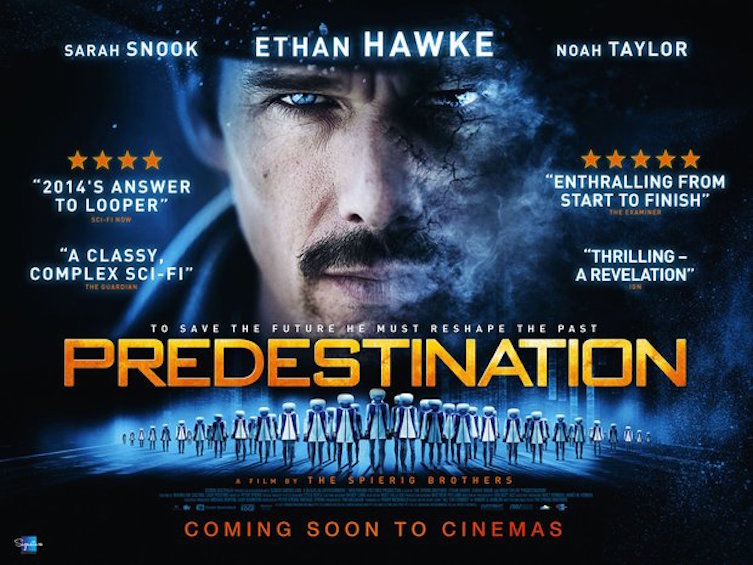
Predestination

D: The Spierig Brothers / 97m

Cast: Ethan Hawke, Sarah Snook, Noah Taylor, Christopher Kirby, Cate Wolfe, Ben Prendergast, Freya Stafford

A man enters a building and heads for the basement where the boiler is housed. There he finds an explosive device that’s counting down to its detonation. Just as he is about to stop the bomb from detonating he is shot at and injured. He makes one last attempt to save the building and the people inside it, but is badly burnt in the process. In desperation, he reaches for what looks like a violin case, but it’s just out of reach. Then someone pushes it closer, the man is able to push some buttons on the case… and he vanishes. When he wakes up he’s in a hospital recovering from severe burns to his face and throat. So bad were the man’s injuries, the doctors have had to carry out extensive reconstructive surgery, and he’s advised that the pitch of his voice will be very different than before.

The man (Hawke) is a temporal agent, able to travel back and forth in time within fifty-three years of 1981, the year in which time travel is achieved. Working for a secret organisation, his task – as before – is to track down and eliminate the so-called Fizzle Bomber, a terrorist responsible for several arson attacks in the Sixties and Seventies, but whose greatest “achievement” was the murder of 11,000 people in a massive explosion in New York City in 1975. Accepting one last chance to stop the Fizzle Bomber, the agent travels back from 1985 to 1978 and finds work in a bar. One night a young man comes in who reveals himself to be a writer of true confessions stories. The agent challenges him to tell the best story he knows.

The young man begins by telling the agent that when he was a girl he was abandoned by his parents on the steps of an orphanage when he was just a baby; he was named Jane. Growing up healthy and fit, and with a fierce intellect, he was precocious and headstrong. As a teenager he tried to join an organisation called Spacecorp which trained future astronauts but an anomaly discovered during a physical meant he had to leave the programme. At a night class, he met a man and fell pregnant. The child, a girl,  was born by Caesarean, and afterwards one of his doctors (Pendergast) explained to him that his internal organs were both male and female, and that they’d made the decision to remove the female organs and set him on the path to becoming a man. And if that wasn’t enough to deal with, his child was abducted a few days later and never seen again. Eventually moving to New York City, he found he had a knack for writing true confessions-style magazine articles, and now here he is. The agent is unimpressed however, and reveals that he’s known who the man is all along. The man believes he’s being scammed, but when the agent tells him that he can help him kill the man who got him pregnant (and presumably stole their child), the man is sufficiently intrigued to agree to whatever the agent has in mind.

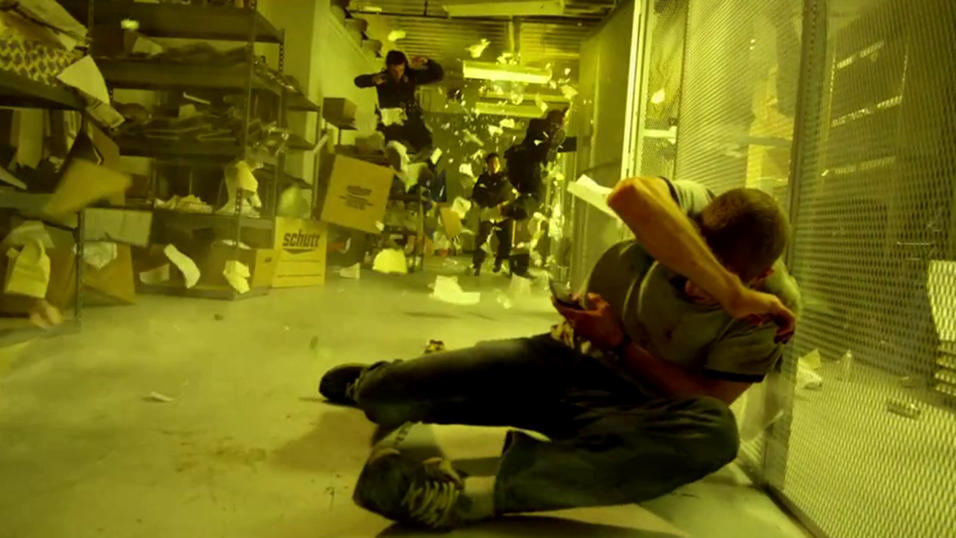
Predestination - scene

With such a lengthy back story, Predestination has the look and feel of a convoluted soap opera, its abandoned/stolen babies and sex change protagonist the kind of thing that is so open to parody and ridicule it risks losing its audience’s involvement from the moment the writer mentions being born a girl. But the premise is played out in such a straight, deliberate fashion that what might be loosely termed “a tall story” soon proves to have more depth than is readily obvious. As the writer embarks on his quest for revenge he finds himself drawn into a world of time travel, unexpected twists and turns, temporal paradoxes, and the mystery of the Fizzle Bomber.

What happens before the scene in the bar is repeated later in the movie, while what happens after the scene in the bar sees the agent and the writer separating and converging in ways that neither they nor (hopefully) the audience are able to predict. Adapted from the short story All You Zombies by Robert A. Heinlein – a copy of his novel Stranger in a Strange Land can be seen on the writer’s desk at one point – Predestination is a mostly faithful retelling of Heinlein’s tale, and keeps the time travel paradox that unites the main characters. Outwardly complex and confusing, the movie isn’t actually that difficult to follow, but it does its best to obscure matters (mostly by having the agent make several seemingly unconnected “jumps” in the final third), and creators the Spierig Brothers (Michael and Peter) have fun providing just enough misdirection to complicate matters when necessary. But while it all adds up to an occasionally challenging viewing experience, and it holds the attention for most of its running time, sadly the movie doesn’t quite become more than the sum of its parts.

Part of this is due to the central time travel paradox, a clever conceit on paper, but not so reasonable when portrayed on film. That it breaks one of the biggest taboos ever regarding time travel is at first impressive, but then as the plot unfolds and things fall into place, the movie takes that taboo and pretty much tramples all over it. It’s actually hard to work out if Heinlein’s original concept was as well thought out as it might have been, or if the Spierigs have taken the idea a step too far (certainly the ending is modified from the original). In either case the movie begins to stumble over itself in the final third as it seeks a satisfactory conclusion. What it comes up with, though bold in itself, is not as dramatically rewarding as was perhaps intended, and some viewers may feel short changed by the nihilism employed.

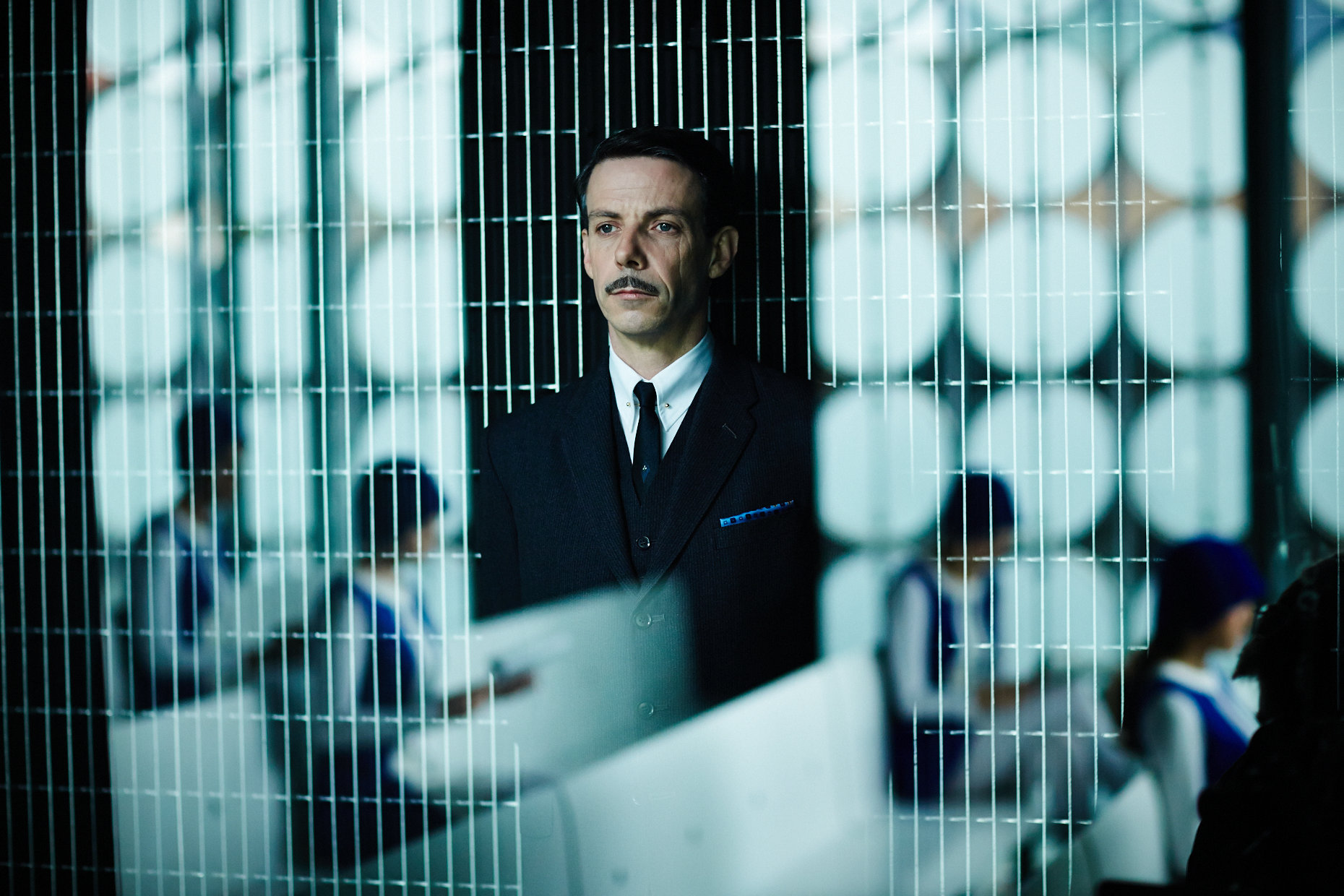
With the story losing its way, the cast have a greater struggle on their hands than just remembering where they are in any given scene. There are emotional arcs here that need to be maintained, and character motivations that need to be reliably and consistently adhered to, and thanks to decisive performances from Hawke and Snook, this is largely the case, but even they are unable to offset the emphasis on overly clever plotting that hampers the last thirty minutes. Taylor has a more shadowy role as the head of the time travel agency, and while he maintains an air of inscrutability throughout, his appearances are too few to provide any real answers as to what is going on.

The various time frames and locations are kept to a generic minimum, with only costume changes and/or cars to herald the period the characters find themselves in, and the score and song choices are integrated into these scenes with aplomb. The look and style of the movie is fairly gloomy, and the camerawork by Ben Nott isn’t as fluid as perhaps was needed, though the Spierigs show a knack for effective medium shots that contain a lot of visual information for the viewer to ponder on. It’s not an attractive movie to watch for the most part, but the look of the movie is consistent, and it certainly fits the mood of the piece.

Rating: 7/10 – an intriguing idea given a progressively rougher handling than necessary, Predestination is still a valiant attempt at an intelligent science fiction story, and for that reason, shouldn’t be overlooked; a movie that sees Hawke and Snook on fine form, this also has a great sense of its own tragedy, and bravely takes its time in setting up the main storyline.

Share this:

  • Click to share on X (Opens in new window) X
  • Click to share on Facebook (Opens in new window) Facebook
  • More
  • Click to print (Opens in new window) Print
  • Click to email a link to a friend (Opens in new window) Email
Like Loading...

I’ll Follow You Down (2013)

12 Tuesday Aug 2014

Posted by dullwood68 in Movies

≈ 1 Comment

Tags

1947, Albert Einstein, Disappearance, Drama, Gillian Anderson, Haley Joel Osment, Missing scientist, Review, Rufus Sewell, Sci-fi, Time machine, Time travel

I'll Follow You Down

D: Richie Mehta / 93m

Cast: Haley Joel Osment, Gillian Anderson, Rufus Sewell, Victor Garber, Susanna Fournier, John Paul Ruttan, Sherry Miller

When scientist Gabe Whyte (Sewell) flies off to New York for a convention, his wife Marika (Anderson) and young son Erol (Ruttan) have no idea that it’s the last time they’ll ever see him.  The mystery deepens when they discover that he never checked out of his hotel room, and he never attended the conference.  With the aid of her father, Sal (Garber), a physics professor, Marika discovers a basement laboratory that Gabe was using, along with his wallet and mobile phone, and crates of equipment.

Twelve years pass.  Erol is now attending university, while Marika is a successful artist though she has yet to come to terms with Gabe’s disappearance.  They have an uneasy relationship, both excelling in their relative fields but also going through the motions in many respects.  When Sal approaches Erol with details about Gabe’s work, details which indicate that Gabe was working on some kind of time travel device, Erol’s reaction is that it’s all a fantasy and he walks away from it.  He puts Sal’s revelation behind him, but when Marika takes an overdose it spurs him on to replicate his father’s work, and to try and find out if his father really did travel back to 1947 as his notebooks indicate, and if he met Albert Einstein as he’d planned.

But certain elements elude him and the project always fails.  Erol also learns that a man similar in description to his father was killed in 1947.  Now Erol has a twofold mission: to save his father, and to bring him back to the present in order that his family’s lives can resume from when his father was due back from New York.  In the meantime his relationship with his girlfriend Grace (Fournier) runs aground when she finds out what he’s trying to do; if Erol succeeds then the life they’ve built together from when they were children, and the child she is carrying, will disappear, leaving no guarantee that she and Erol will have the same life if his father goes back.  Undeterred, he redoubles his efforts and having solved the problem that had been eluding him, travels back to 1947 with a plan to make sure his father returns home.

I'll Follow You Down - scene

More of a family drama than a sci-fi movie, I’ll Follow You Down downplays the science in favour of a measured approach to its domestic tribulations.  Sadly, this decision makes for a somewhat dour, unattractive looking movie that relies heavily on its cast’s commitment to the material, but which never really springs to life, despite its intriguing premise.  Its low budget doesn’t help either, lending the movie the look of a TV drama of the week, with its drab lighting and flat photography exacerbating things from start to finish.

The performances are the best thing here: from Osment’s tortured son, to Anderson’s depressed wife and mother, to Fournier’s challenging girlfriend, the cast do wonders with a script that skirts banality with uncomfortable regularity.  As Erol, Osment has a tough time developing his character beyond that of the enfant terrible whose genius outshines his father’s, and while he’s convincing enough, when he reveals his solution for persuading his father to return to his own time, it’s hard to credit that Erol would do what he does, as sudden and unexpected as it is.  Before that, Erol is a young man adrift in the world, his father’s disappearance having caused an impediment to his emotional development.  In his scenes with his girlfriend, Grace (Fournier), his lack of understanding of her needs make him seem ungrateful rather than appreciative, and in these scenes his single-mindedness leaves a lingering aftertaste that undermines any sympathy the audience is supposed to feel for him.  But Osment makes Erol as fatally determined as his father, and this symmetry works in the movie’s favour.  It’s not a great performance, but it’s better than the character deserves.

As his overwhelmed mother, Anderson gives a persuasive portrayal of a woman as adrift as her son, but who struggles to lead a normal life after her husband vanishes.  It’s the mystery surrounding his disappearance – the unexplained nature of it – that swamps her and causes her to withdraw from so much of her “normal” life.  Thanks to Anderson, Marika draws the audience’s sympathy in ways that Erol isn’t even close to, and she does it with a minimum of fuss, eliciting the viewer’s support without them being aware of it.  The same can’t be said for Gabe, who in the opening scenes is seen as a doting father, loving husband and all-round good guy.  By the end, these aspects of his character seem more like a charade, as he is revealed to be self-centred and not as considerate of his family as you’d expect him to be.  Sewell has probably the most difficult job of all in trying to make Gabe as credible as he should be, but the script is against him, and never fully expands on his reasons for creating the time machine in the first place.

Garber and Fournier are fine in supporting roles, but again it’s the script – by writer/director Mehta – that lets things down, its plotting too contrived at times (and also, strangely predictable) to be entirely coherent (not to mention that it avoids any philosophical or metaphysical implications relating to the issue of time travel).  In addition, Mehta’s direction fails to add any tension to proceedings, and leaves the final confrontation between Erol and his father lacking in both drama and plausibility; it’s as if the movie needed to end as quickly as possible by this point, and this scene was the only thing Mehta could come up with to do so.  I’ll Follow You Down could have been a deeper, richer, more cinematic experience but instead it opts for a level tone that it rarely deviates from, and which ultimately stops it from being as absorbing and entirely worthwhile.

Rating: 5/10 – viewers expecting a sombre drama centred around the impact of a father’s disappearance on his family, will be disappointed, while sci-fi fans will find the haphazard focus on time travel quite annoying; a bit of a misfire, then, I’ll Follow You Down lacks both emotional substance and a fervent approach to the material, leading to a movie that hopes the viewer will engage with it, while it makes almost the least amount of effort.

Share this:

  • Click to share on X (Opens in new window) X
  • Click to share on Facebook (Opens in new window) Facebook
  • More
  • Click to print (Opens in new window) Print
  • Click to email a link to a friend (Opens in new window) Email
Like Loading...

X-Men: Days of Future Past (2014)

27 Tuesday May 2014

Posted by dullwood68 in Movies

≈ 1 Comment

Tags

Beast, Bolivar Trask, Bryan Singer, Hugh Jackman, Ian McKellen, James McAvoy, Jennifer Lawrence, Magneto, Marvel, Michael Fassbender, Mutants, Patrick Stewart, Professor X, Quicksilver, Review, Sci-fi, Sentinels, Time travel, Wolverine

x-men-days-of-future-past_04aaf850

D: Bryan Singer / 131m

Cast: Hugh Jackman, James McAvoy, Michael Fassbender, Jennifer Lawrence, Nicholas Hoult, Patrick Stewart, Ian McKellen, Ellen Page, Peter Dinklage, Halle Berry, Shawn Ashmore, Evan Peters, Omar Sy, Josh Helman, Mark Camacho

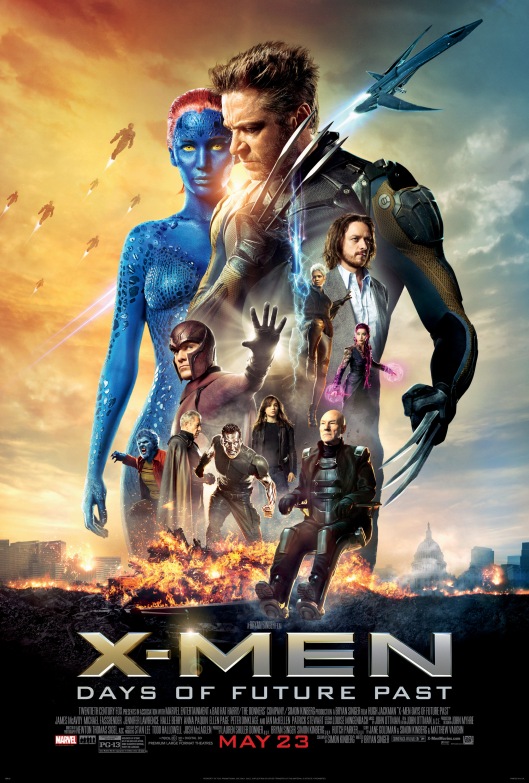
With X-Men: The Last Stand (2006) leaving a sour taste in the mouth after the glories of the first two X-Men movies, and with two subsequent Wolverine adventures proving that even a massive fan favourite doesn’t mean an automatically good movie, the future of the X-Men franchise was looking a little doubtful.  With both Patrick Stewart and Ian McKellen “getting on a bit”, the decision to revisit Charles Xavier and Eric Lehnsherr in their younger days in X-Men: First Class (2011) was a positive boon for the franchise and one that revitalised what was otherwise a moribund series.  Now, with the equivalent of a spring in its step, we have a movie that both acknowledges its predecessors and forges a whole new path for its mutant protagonists.

Opening in the near future, with mutants and mankind alike being targeted for extinction by Sentinels, the world is a wasteland.  With the Sentinels able to assimilate whatever mutant powers are pitched against them, a band of mutants including Kitty Pryde (Page), Bishop (Sy) and Iceman (Ashmore) fight a rearguard action against them that sees Professor X’s pupils evade certain death through Kitty’s ability to send a person’s consciousness back in time; this allows the remaining mutants to anticipate a Sentinel attack and flee before it can happen, thus erasing that particular timeline.  With the arrival of Professor X (Stewart), Magneto (McKellen), Logan aka Wolverine (Jackman) and Storm (Berry), a last, desperate decision is made to send Wolverine’s consciousness back into his body in 1973, the year the Sentinels were created by industrialist Bolivar Trask (Dinklage).  Back then, Trask was assassinated by Raven aka Mystique (Lawrence), which led to her capture and the advancement of the Sentinel programme using her DNA (this enables the Sentinels to assimilate other mutants’ powers).  Logan’s mission: to unite the estranged Charles and Erik, track down Raven, and stop her from killing Trask.

Of course, it’s not easy.  Since the events of X-Men: First Class, Charles has taken to wallowing in self-pity at the loss of Raven, and has lost his powers thanks to a serum created by Hank McCoy aka Beast (Hoult) that allows him to walk.  He agrees to help for Mystique’s sake, though he is unhappy about needing Erik’s help.  With the aid of Quicksilver (Peters), they free Erik from a cell beneath the Pentagon and travel to Paris (where Raven is due to kill Trask at a conference).  Imitating a Vietnamese officer, Raven infiltrates the conference room where Trask plans to sell his Sentinel technology to the highest bidder.  He reveals a hand-held mutant detector that is triggered by Raven’s presence.  Hastily despatching the other attendees – including a young William Stryker (Helman) – Raven is stopped from shooting Trask by the arrival of Logan et al.  Erik disarms her and then turns the gun on her; aware that her DNA will make the Sentinels an unstoppable force he believes it is better for her to die than to let them become so strong.  Raven makes her escape but is wounded in the attempt.  Erik tries to follow her but is stopped by Hank who has morphed into his Beast persona.  All three are caught on film and the “mutant menace” espoused by Trask is taken up by President Nixon (Camacho) who gives the go ahead to the Sentinel programme.

At a press conference in the grounds of the White House set up to reveal the existence of the Sentinels and their purpose, Raven impersonates a Secret Service agent in order to get to Trask.  Now on his own, Erik steals back the helmet that magnifies his powers and uses them to levitate a baseball stadium; he transports it to the press conference and drops it around the White House, effectively sealing it off from the police and everyone else.  Charles is trapped under a piece of fallen scaffolding, while Logan and Hank do battle with one of the Sentinels (which are now under Erik’s control).  In the future, the Sentinels attack the mutant hideout; casualties mount up as Professor X and Magneto wonder if Logan’s mission will be successful in time.  As the future becomes ever bleaker, Erik castigates the President and his staff for their animosity towards mutants, and threatens them with a new world order, with mutants in control.  With Logan and Hank unable to stop the Sentinel, and Raven still intent on killing Trask, and Erik about to dispose of Nixon and his staff, in the future the Sentinels breach the mutant hideout and target Magneto and Professor X…
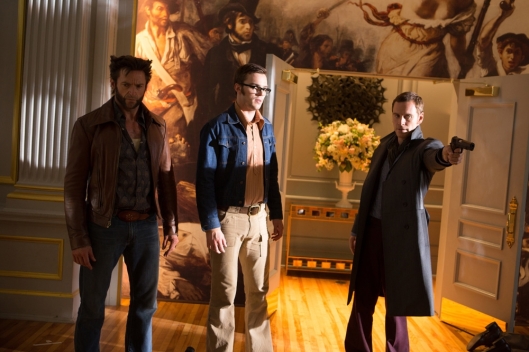
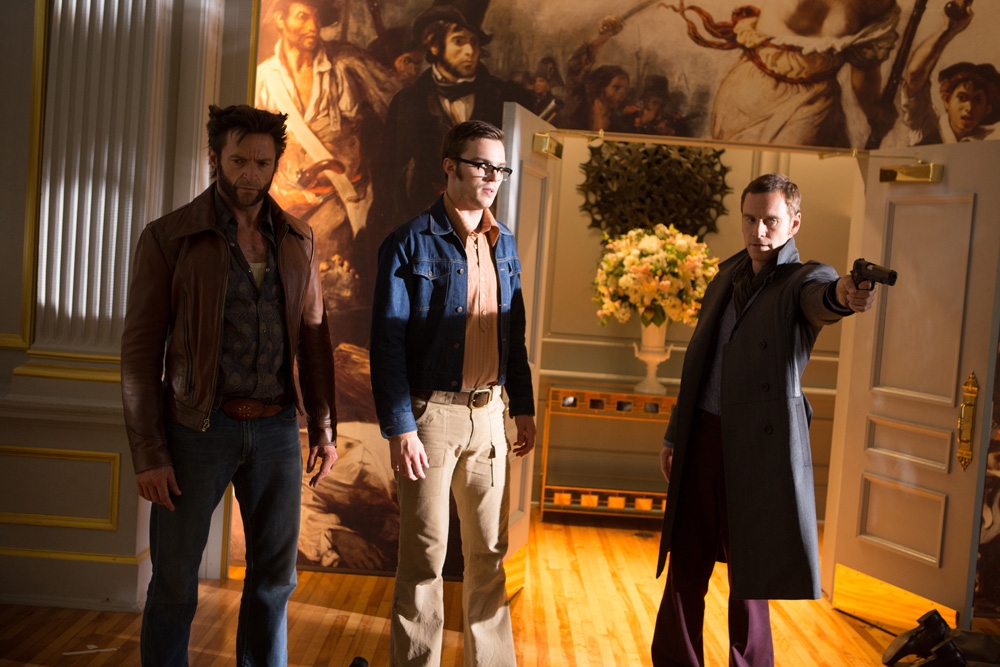
X-Men Days of Future Past - scene

Even at this late stage in the game there’s still more to the story than you’d expect.  X-Men: Days of Future Past is a triumph for all concerned, an exciting, often unpredictable addition to the X-Men saga that more than lives up to expectations but also deepens and enriches the story begun in X-Men: First Class.  With the stakes upped considerably, and the inclusion of more mutants than have been seen since The Last Stand, the movie seems, at first glance, to be overdoing it, adding too much to the mix for it to be as satisfying or rewarding as it should be (by necessity as much as expediency, some characters have more screen time than others).  But thanks to Simon Kinberg’s measured script, the movie glides smoothly along, gaining momentum, adding layer upon layer of meaning, and providing an emotional depth that is missing from most – if not all – other superhero movies.

Largely this is due to the stellar cast, led by McAvoy and Fassbender, two actors who have made their roles their own.  Their adversarial friendship is expanded upon here, both characters’ sense of having been betrayed by the other adding a dangerous edge to their scenes together, adding to the tension that develops as the world heads towards oblivion.  Both actors give tremendous performances (McAvoy is superb in his opening scenes with Jackman), and the support they receive, notably from Hoult and Jackman, is equally impressive, while Dinklage (sporting a wig and a half) invests Trask with an eerie messianic quality that elevates the character from perfunctory villain to unwavering fear monger.  And then there’s Lawrence, endowing Raven/Mystique with a mix of rage, sadness and longed-for redemption that makes her the most intriguing character of all, her dual nature at odds with itself even when fiercely determined to walk her own path.  The real surprise, though, is the inclusion of Quicksilver.  Peters turns in a funny, smart, freewheeling performance that is as charming as it is a real comedic shot in the arm.  His sardonic smile and deadpan glances are perfectly pitched, and his appearance leaves you wanting more (which we’ll get in X-Men: Apocalypse).

Returning to the director’s chair following the departure of Matthew Vaughn, Singer shows a firm grasp of the material and an even firmer grasp on ensuring the human/mutant element isn’t lost amongst all the special effects and impressively mounted carnage.  Even a small scene, such as the one between Professor X and Magneto towards the end of the movie, is more affecting than you might expect, and there are numerous occasions where Singer’s pleasure at being back in the director’s chair couldn’t be more evident if he’d stopped the movie mid-scene and held up a sign saying “I loved making this movie”.  Singer is an expressive director, always willing to try something new, and his staging of the showdown at the White House shows a clear intention to avoid the usual action motifs, making the sequence that much more impressive (it’s also a clever move to reduce Logan’s involvement in the action, especially as he doesn’t have his adamantium skeleton for Erik to play around with).

The early Seventies are recreated with a fine eye for the details of the time, and there’s an astute tweaking on contemporary fashions (though it might have been fun to see Wolverine in bell bottoms), while the inclusion of footage shot as if it were news reports from the time is a clever conceit and works particularly well during Raven’s escape from the conference.  The Sentinels are appropriately scary (and make Terminator 2’s T-1000 look like a skinny prototype), there’s the by-now obligatory post-credits sequence that sets up the next instalment, and there are a number of cameos that will have fans cheering in their seats (two cameos are very welcome indeed).

There are some stumbles.  The opening ten to fifteen minutes, where the plot is established and some new characters introduced, is a bit clunky and muddled, and as mentioned before some of the cast don’t fare as well as others.  Page does little more than sit with her fingers poised either side of Jackman’s temples for most of the movie, while McKellen gets to add the odd line here and there, but it’s Berry who’s almost completely sidelined, so much so that one of the cameo turns has more lines than her.  (And on the subject of screen time, someone should give Anna Paquin’s agent a gold star; she appears for approximately ten dialogue-free seconds but is seventh billed; now that’s impressive.)  Trask’s hand-held mutant detector is a clumsy contrivance that feels like it was added at the last minute, and the movie’s coda owes a little too much to another recent sci-fi franchise reboot (but it’s a welcome development nevertheless).  All in all, though, the movie is too well constructed and executed for any of these (very minor) problems to spoil the overall presentation.

Rating: 8/10 – back on top as the best of the superhero movie franchises thanks to Singer’s return and an intelligent approach to the story (one of the comics’ most well-respected outings), X-Men: Days of Future Past is a treat for fans and non-fans alike; audacious, skilful, thought-provoking and often dazzling, the movie helps erase the debacle that was X-Men: The Last Stand, and is a better alternative universe for it.


Share this:

  • Click to share on X (Opens in new window) X
  • Click to share on Facebook (Opens in new window) Facebook
  • More
  • Click to print (Opens in new window) Print
  • Click to email a link to a friend (Opens in new window) Email
Like Loading...

Mr. Peabody & Sherman (2014)

25 Tuesday Feb 2014

Posted by dullwood68 in Movies

≈ 3 Comments

Tags

Adoption, Agamemnon, Allison Janney, Ancient Egypt, Animation, Ariel Winter, French Revolution, King Tut, Lake Bell, Leonardo da Vinci, Marie Antoinette, Max Charles, Mona Lisa, Patrick Warburton, Review, Robespierre, Stanley Tucci, Time travel, Trojan Horse, Troy, Ty Burrell, WABAC

Mr. Peabody & Sherman

D: Rob Minkoff / 92m

Cast: Ty Burrell, Max Charles, Ariel Winter, Allison Janney, Stanley Tucci, Patrick Warburton, Stephen Colbert, Leslie Mann, Lake Bell, Stephen Tobolowsky, Mel Brooks, Dennis Haysbert

The last Dreamworks animated movie was the dire Turbo (2013), a frustrating exercise in high concept animation that forgot very early on that it needed to be entertaining. With that in mind, and with How to Train Your Dragon 2 waiting in the wings, this update of two supporting characters from the Rocky and His Friends TV show that ran from 1959 to 1964 was likely to appear a bit of a gamble. In recreating Mr. Peabody the dog (Burrell) and his adopted son, Sherman (Charles), writer Craig Wright and director Minkoff have fashioned a fairly straightforward tale and surrounded it with some great visual gags, and all the emotional heft a movie like this could ever wish for.

After an extended prologue that introduces us to the WABAC machine – a device that allows Mr. Peabody to travel through time – and which finds the pair on a trip to the French Revolution (necessitating a daring escape from the clutches of Citizen Robespierre), Mr. Peabody reminds Sherman that the next day will see him go to school for the first time. His eagerness in History class earns the enmity of Penny Peterson (Winter), and during their lunch break she bullies him to the point where he retaliates and bites her. Enter Miss Grunion (Janney) from Child Services. She informs Mr. Peabody in no uncertain terms that if her investigation finds he is not a fit parent, then Sherman will be removed from his care.

On the same evening Miss Grunion is due to visit, Mr. Peabody invites Penny and her parents (Colbert, Mann) over for dinner in an attempt to smooth things over. While he entertains the Petersons, Sherman finds himself tricked into showing Penny the WABAC. Penny ends up in Ancient Egypt where she is to be betrothed to King Tutankhamun; at first she’s intent on staying as she’s being treated like a princess. When she learns that if he dies, so will she, Penny changes her mind about staying and it’s up to Mr. Peabody and Sherman to rescue her.

Getting back proves difficult and the trio end up visiting Leonardo da Vinci (Tucci) who is having problems painting a less than cooperative Mona Lisa (Bell). While Mr. Peabody repairs the WABAC, Sherman and Penny take da Vinci’s prototype aeroplane for a spin; here Sherman’s perceived recklessness causes the beginning of a rift between the titular pair. When their attempts to avoid a black hole ends with them back at the siege of Troy, Mr. Peabody is faced with Sherman’s determination to fight with Agamemnon (Warburton) and the rest of the Greek soldiers hidden within the Trojan Horse. Things escalate from there, and with Mrs Grunion planning to take Sherman into care at the same time as a rip in the space/time continuum threatens to destroy everything, can the pair patch things up in time to save the world?

Mr. Peabody & Sherman - scene

The good news is that, compared to Turbo, Mr. Peabody & Sherman is an absolute joy. There is so much to like about this movie. The relationship between Mr. Peabody and Sherman is played with obvious mutual affection, and Wright’s script tugs at the heartstrings on more than one occasion, highlighting the “deep respect” this odd parent and child have for each other. Burrell and Charles provide rich vocal performances, and while Robert Downey Jr was originally tipped to play Mr. Peabody, that interpretation may not have been the best idea because Burrell is terrific in a part that calls for him to relay more exposition than any other character in recent memory. Charles relays Sherman’s excitement and youthful insecurities with aplomb, and ends up almost stealing the show (although with Warburton in the cast, that’s nearly impossible).

The story has fun with its depictions of the past, taking a range of liberties but always with a sense of fun, and there’s an inspired shot that shows how the Greeks get out of the Trojan Horse. Historical figures are held up to gentle mockery but again there’s an obvious affection, even for Robespierre. There are cameos from Albert Einstein (Brooks), George Washington, and with a great one-liner, Bill Clinton. Of the present day characters, Mrs Grunion is a fearsome villain in the manner of Miss Trunchbull from Matilda, Penny is a mix of school bully and (eventual) best friend, and her parents are a winning combination of ditzy and clueless. The script juggles everyone to good effect, and rarely puts a foot wrong.

The movie is gorgeous to look at, the visuals popping off the screen – particularly in 3D – and the animation is packed with great sight gags and puns and there’s always something going on to overwhelm the attention. Minkoff keeps a sure hand on the tiller, making it look easy at times, and grounds the science fiction aspects through close attention to the relationship between Mr. Peabody and Sherman. The humour is infectious, and the general good-natured approach works tremendously, building up so much good will that by the movie’s end you’re prepared to forgive any missteps it might make on the way (there are a couple but they aren’t bad enough to hurt the movie or stop its momentum).

Rating: 9/10 – an early contender for best animated movie of 2014, Mr. Peabody & Sherman is a light-hearted romp that hits the mark with recurring ease; a treat for children and adults alike.

Share this:

  • Click to share on X (Opens in new window) X
  • Click to share on Facebook (Opens in new window) Facebook
  • More
  • Click to print (Opens in new window) Print
  • Click to email a link to a friend (Opens in new window) Email
Like Loading...

Free Birds (2013)

29 Wednesday Jan 2014

Posted by dullwood68 in Movies

≈ Leave a comment

Tags

Amy Poehler, George Takei, Hazmats, Jake, Jimmy Hayward, Owen Wilson, Plymouth Plantation, Reggie, Review, S.T.E.V.E., Thanksgiving, Time travel, Turkeys, Woody Harrelson

Free Birds

D: Jimmy Hayward / 91m

Cast: Owen Wilson, Woody Harrelson, Amy Poehler, George Takei, Colm Meaney, Keith David, Dan Fogler, Jimmy Hayward

With an opening sequence reminiscent of Chicken Run (2000), Free Birds has scrawny, unliked turkey Reggie (Wilson) trying to convince his fellow meals-in-waiting that being picked for “turkey paradise” isn’t as great as it sounds.  When the US President arrives at their farm to choose that year’s Pardoned Turkey it’s Reggie’s luck to be chosen.  After adapting to a lifestyle spent watching TV and ordering in pizza, Reggie ends up being coerced into helping fellow turkey Jake (Harrelson) who is determined to travel back in time to the first Thanksgiving and ensure that turkeys are taken off the menu forever.  Using a time machine called S.T.E.V.E. (Takei) that is hidden underground at Camp David, Reggie and Jake travel back to 1621 to the Plymouth plantation and meet up with the local turkey colony led by Chief Broadbeak (David).  With the planned Thanksgiving feast only days away, and the turkeys being hunted by cruel Myles Standish (Meaney), it’s up to Reggie and Jake to convince Chief Broadbeak and his daughter Jenny (Poehler) to take the fight to the settlers.

While it’s high concept storyline and Back to the Future-style plotting offers nothing new, Free Birds tries its best to entertain, throwing in a few clever jokes and keeping it light.  It’s not too demanding, and for children below the age of ten it should be diverting enough but there’s a lack of charm that seriously hurts the movie’s chances of broadening its audience.  The storyline is weak and underdeveloped, and there’s too much reliance on Reggie’s verbal schtick to pad out the uncomfortable dialogue.  With many of the ideas and speculations from Robert Zemeckis’ trilogy trotted out like badly tuned homages, Free Birds also proves derivative rather than referential, leaving the underused Takei to save the day as the time machine.

TURKEYS

The characters are painted with broad brushstrokes, leaving the cast with too much work to do to make the audience connect with anyone.  Wilson plays Reggie like a nerd with a persecution complex, rarely deviating from the standard vocal patter he uses in live action movies.  Harrelson is saddled with a bigger problem playing the loveable lunkhead Jake, a character so one-dimensional it’s amazing the actor manages to add some light and shade to his performance.  Takei aside, the rest of the cast make next to no impression at all, and the roles could have been played by anyone without any significant improvement or change.  With the script proving so undercooked, it’s often a relief to see that some ideas – the Hazmats, the President’s narcoleptic daughter – have managed to find their way in to alleviate matters.

Visually, Free Birds looks colourful and richly detailed but the movie lacks that zing that computer animation can bring to the big screen.  The time travel sequences look like they were filched from an Eighties animated movie, and the backgrounds don’t always look convincing.  That said, there are some stand-out sequences, the attack on the turkey’s hideout being one of them, but on the whole the movie isn’t visually strong enough to grab the attention; there’s not enough going on in the frame to fully occupy the viewer.

Hayward orchestrates the various elements with a lack of flair that keeps the movie treading water for most of its running time, and while he has a strong background in animation – he directed the much better Horton Hears a Who! (2008), as well as working on several Pixar movies – it’s a shame he’s let the material (co-written with Scott Mosier), and what appears to be a limited budget, get the better of him.

Rating: 5/10 – not the complete bust it sounds like but definitely one for a younger audience; a chore for adults then but leavened, thankfully, by some quirky humour.

Share this:

  • Click to share on X (Opens in new window) X
  • Click to share on Facebook (Opens in new window) Facebook
  • More
  • Click to print (Opens in new window) Print
  • Click to email a link to a friend (Opens in new window) Email
Like Loading...

About Time (2013)

12 Sunday Jan 2014

Posted by dullwood68 in Movies

≈ Leave a comment

Tags

Bill Nighy, Comedy, Domhnall Gleeson, Father/son relationship, Margot Robbie, Rachel McAdams, Review, Richard Curtis, Romantic comedy, Time travel, Tom Hollander

About Time

D: Richard Curtis / 123m

Cast: Domhnall Gleeson, Rachel McAdams, Bill Nighy, Lydia Wilson, Lindsay Duncan, Richard Cordery, Joshua McGuire, Tom Hollander, Margot Robbie, Will Merrick, Vanessa Kirby

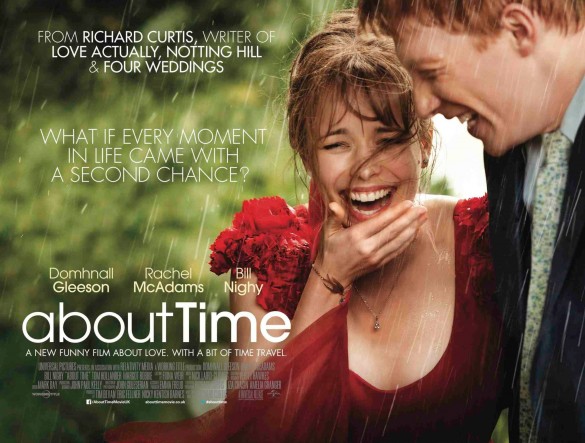
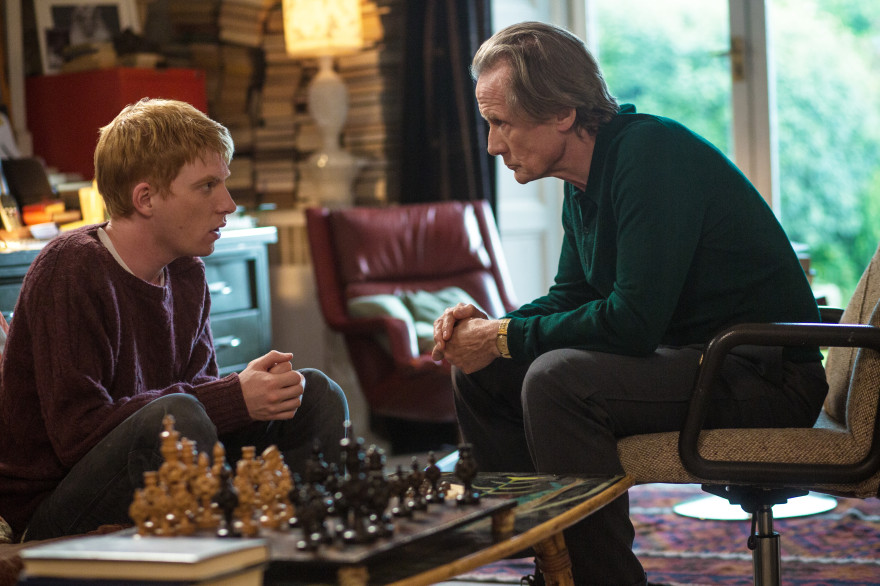
On his 21st birthday, Tim (Gleeson) is let into the big family secret by his dad (Nighy): that the men in the family can time travel.  Disbelieving at first, he follows his dad’s instructions and finds it’s all true; he travels back to a fateful New Year’s Eve party and  finds he’s able to change some of the things that did or didn’t happen.  Tim’s dad further explains the rules: they can’t travel back beyond their birth, they can’t travel forward in time, and they can only travel back to places and events that they can picture in their mind or can remember.

Tim initially uses this gift in order to rewrite awkward moments where he makes embarrassing mistakes, such as squirting a large amount of sun cream over sister Kit Kat’s friend Charlotte (Robbie).  Tim’s crush on Charlotte leads to his discovering that no matter how hard he tries, and no matter how many times he manipulates the past, he can’t make someone fall in love with him.  Which is just as well because when he meets Mary (McAdams) it’s love at first sight for both of them.  But when Tim makes a choice about returning to the night they met and does something different, he finds himself having to woo her all over again as that “something different” has meant they haven’t met (still with me?).

What follows is a series of events and situations requiring Tim’s intervention in the past, some to good effect, and one, involving Kit Kat (Wilson), that has a disastrous consequence requiring Tim to make a difficult reconsideration.  All the while, Tim and Mary’s relationship grows stronger, and their friends and families benefit from Tim’s gift.

About Time

At the heart of the movie is the relationship between Tim and his dad, a paternal romance that Curtis makes more of than the romance between Tim and Mary.  It’s uncomfortably sentimental and cloying at times, and Curtis only just manages to avoid it being completely off-putting, a testament to his skill as a writer, and the performances by Gleeson and Nighy, who portray the close bond the characters have with accomplished finesse.  If you like your romantic comedies with a little more bite or a little less mawkish, this isn’t the movie for you.  If, however, you don’t mind a couple of hours of breezy, effusive, bright-eyed and bushy-tailed romanticism, then this is definitely the movie to see.

Curtis directs capably if unspectacularly from his own script, and there’s a raft of great performances from the likes of Duncan (as Tim’s mum, acerbic but touching); Cordery as a slightly simple, less aggressive version of Four Weddings and a Funeral‘s Mad Old Man (as played by Kenneth Griffith); McGuire as the hapless Rory, Tim’s colleague; and the ever excellent Hollander as Harry, the scathing, egotistical playwright Tim lives with for a while.  As Tim’s first love, and potential moment of weakness once Tim and Mary are together, Robbie does well with a slightly underwritten character (actually more of a plot contrivance), and McAdams, here channelling the spirit of Andie MacDowell (and that’s not a bad thing), breathes life into a role that could have been relentlessly and annoyingly perky in the hands of some actresses.

But when all’s said and done the movie belongs to Gleeson and Nighy.  Gleeson, still probably best known for playing Bill Weasley in the Harry Potter movies, steps out from behind that particular shadow and gives a charming, instinctive performance that makes all the absurdities of Curtis’s script – and there are many – far more acceptable to an audience as a result; he’s credible in a way that draws in the viewer and makes Tim seem like a really good friend whose telling you this really good shaggy dog story.  And Nighy is just as excellent: diffident, amused (and amusing), relaxed, spontaneous, and a joy to behold.  He embraces the character’s foibles and makes virtues of them, grounding the movie also, and having a lot of fun at the same time.  It’s a performance made to look so easy you could be forgiven for thinking he wasn’t even trying.

The absurdities of the script can be overlooked because Curtis knows funny, and he uses the absurdities to punch up the humour rather than to drive the story forward.  That said, a couple of subplots help pad out the running time unnecessarily, and if Tim uses his gift three or four times too often, by the movie’s end he comes to a much delayed conclusion about the real benefits of time travel, and this offsets the repetition.  Curtis is a clever writer, a little under-appreciated for his movie work, but this is a clever movie, with a very clever cast, and a very clever central conceit.

Rating: 8/10 – ignore the naysayers, About Time is another quintessentially English movie from Richard Curtis that entertains from start to finish; blessed with a great cast and enough laugh-out-loud moments to shame a truckload of other comedies, this is a movie that radiates good will and is all the better for it.
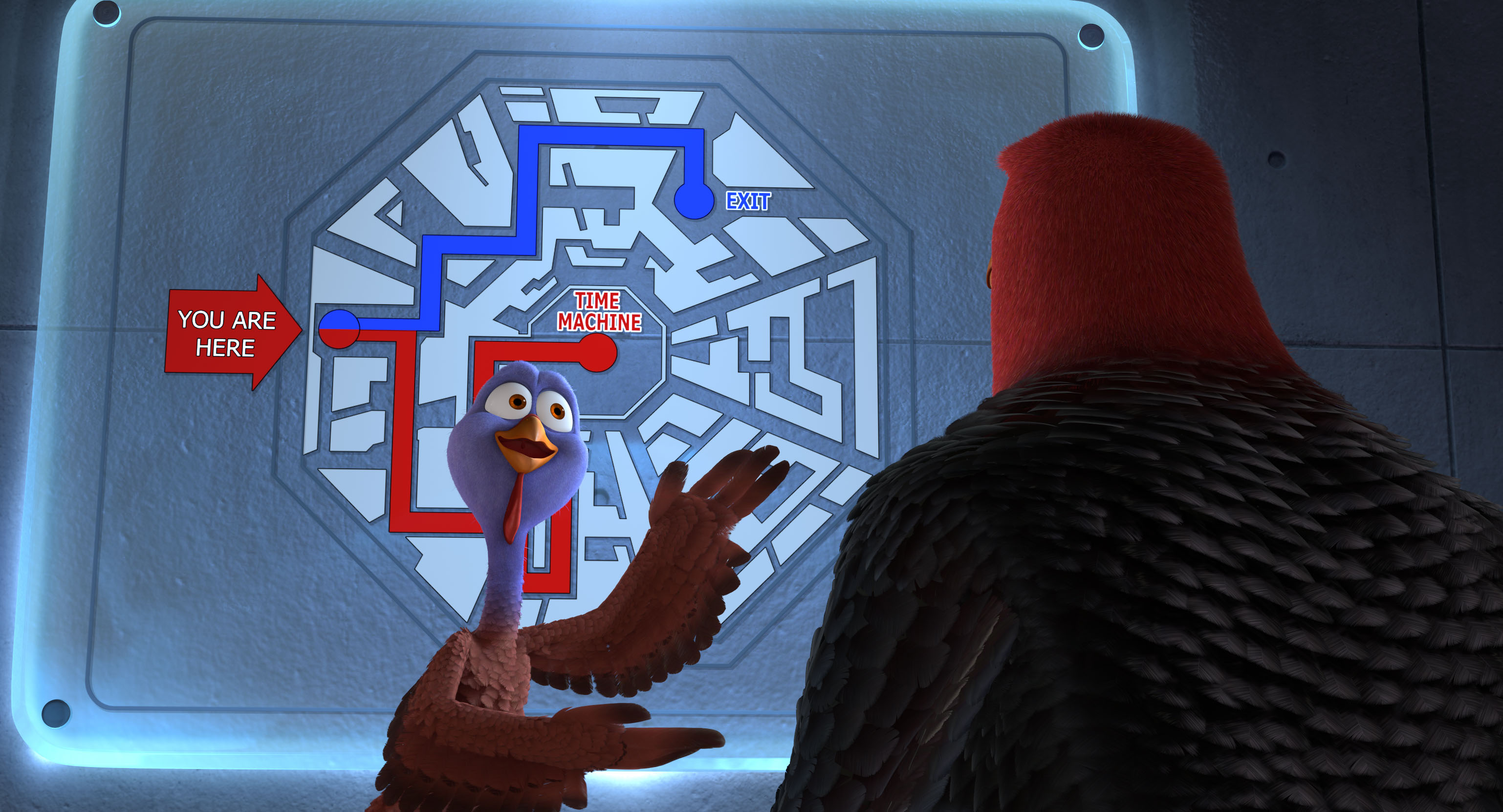
Share this:

  • Click to share on X (Opens in new window) X
  • Click to share on Facebook (Opens in new window) Facebook
  • More
  • Click to print (Opens in new window) Print
  • Click to email a link to a friend (Opens in new window) Email
Like Loading...

Blog Stats

  • 486,527 hits

Recent Posts

  • 10 Reasons to Remember Bibi Andersson (1935-2019)
  • Fantasia (1940)
  • Dances With Wolves (1990) – The Special Edition
  • Kiss of the Spider Woman (1985)
  • The Three Musketeers (1973)

Top Posts & Pages

  • Lost for Life (2013) - Another Look
    Lost for Life (2013) - Another Look
  • Lost for Life (2013)
    Lost for Life (2013)
  • About
    About
  • Mr. Topaze (1961)
    Mr. Topaze (1961)
  • Billy Lynn's Long Halftime Walk (2016)
    Billy Lynn's Long Halftime Walk (2016)
  • Winter's Tale (2014)
    Winter's Tale (2014)
  • The Hitman's Bodyguard (2017)
    The Hitman's Bodyguard (2017)
  • 5 Famous Movie Roles That Nearly Went to Someone Else
    5 Famous Movie Roles That Nearly Went to Someone Else
  • The Layover (2017)
    The Layover (2017)
  • Transcendence (2014)
    Transcendence (2014)
Follow thedullwoodexperiment on WordPress.com

Blogs I Follow

  • Rubbish Talk
  • Film 4 Fan
  • Fast Film Reviews
  • The Film Blog
  • All Things Movies UK
  • Interpreting the Stars
  • Let's Go To The Movies
  • Movie Reviews 101
  • TMI News
  • Dan the Man's Movie Reviews
  • Film History
  • Jordan and Eddie (The Movie Guys)

Archives

  • April 2019 (13)
  • March 2019 (28)
  • February 2019 (28)
  • January 2019 (32)
  • December 2018 (28)
  • November 2018 (30)
  • October 2018 (29)
  • September 2018 (29)
  • August 2018 (29)
  • July 2018 (30)
  • June 2018 (28)
  • May 2018 (24)
  • April 2018 (21)
  • March 2018 (31)
  • February 2018 (25)
  • January 2018 (30)
  • December 2017 (30)
  • November 2017 (27)
  • October 2017 (27)
  • September 2017 (26)
  • August 2017 (32)
  • July 2017 (32)
  • June 2017 (30)
  • May 2017 (29)
  • April 2017 (29)
  • March 2017 (30)
  • February 2017 (27)
  • January 2017 (32)
  • December 2016 (30)
  • November 2016 (28)
  • October 2016 (30)
  • September 2016 (27)
  • August 2016 (30)
  • July 2016 (30)
  • June 2016 (31)
  • May 2016 (34)
  • April 2016 (30)
  • March 2016 (30)
  • February 2016 (28)
  • January 2016 (35)
  • December 2015 (34)
  • November 2015 (31)
  • October 2015 (31)
  • September 2015 (34)
  • August 2015 (31)
  • July 2015 (33)
  • June 2015 (12)
  • May 2015 (31)
  • April 2015 (32)
  • March 2015 (30)
  • February 2015 (37)
  • January 2015 (39)
  • December 2014 (34)
  • November 2014 (34)
  • October 2014 (36)
  • September 2014 (25)
  • August 2014 (29)
  • July 2014 (29)
  • June 2014 (28)
  • May 2014 (23)
  • April 2014 (21)
  • March 2014 (42)
  • February 2014 (38)
  • January 2014 (29)
  • December 2013 (28)
  • November 2013 (34)
  • October 2013 (4)

Blog at WordPress.com.

Rubbish Talk

Film 4 Fan

A Movie Blog

Fast Film Reviews

The Film Blog

The official blog of everything in film

All Things Movies UK

Movie Reviews and Original Articles

Interpreting the Stars

Dave Examines Movies

Let's Go To The Movies

Film and Theatre Lover!

Movie Reviews 101

Daily Movie Reviews

TMI News

Latest weather, crime and breaking news

Dan the Man's Movie Reviews

All my aimless thoughts, ideas, and ramblings, all packed into one site!

Film History

Telling the story of film

Jordan and Eddie (The Movie Guys)

Movie Reviews & Ramblings from an Australian Based Film Fan

Privacy & Cookies: This site uses cookies. By continuing to use this website, you agree to their use.
To find out more, including how to control cookies, see here: Cookie Policy
  • Subscribe Subscribed
    • thedullwoodexperiment
    • Join 481 other subscribers
    • Already have a WordPress.com account? Log in now.
    • thedullwoodexperiment
    • Subscribe Subscribed
    • Sign up
    • Log in
    • Report this content
    • View site in Reader
    • Manage subscriptions
    • Collapse this bar
 

Loading Comments...
 

    %d