• 10 Reasons to Remember…
  • A Brief Word About…
  • About
  • For One Week Only
  • Happy Birthday
  • Monthly Roundup
  • Old-Time Crime
  • Other Posts
  • Poster of the Week
  • Question of the Week
  • Reviews
  • Trailers

thedullwoodexperiment

~ Viewing movies in a different light

thedullwoodexperiment

Tag Archives: True story

12 Years a Slave (2013)

10 Friday Jan 2014

Posted by dullwood68 in Movies

≈ 1 Comment

Tags

Benedict Cumberbatch, Chiwetel Ejiofor, Edwin Epps, Lupita Nyong'o, Michael Fassbender, Patsey, Paul Dano, Plantation, Review, Sarah Paulson, Slavery, Solomon Northup, Steve McQueen, True story, US history, Whipping
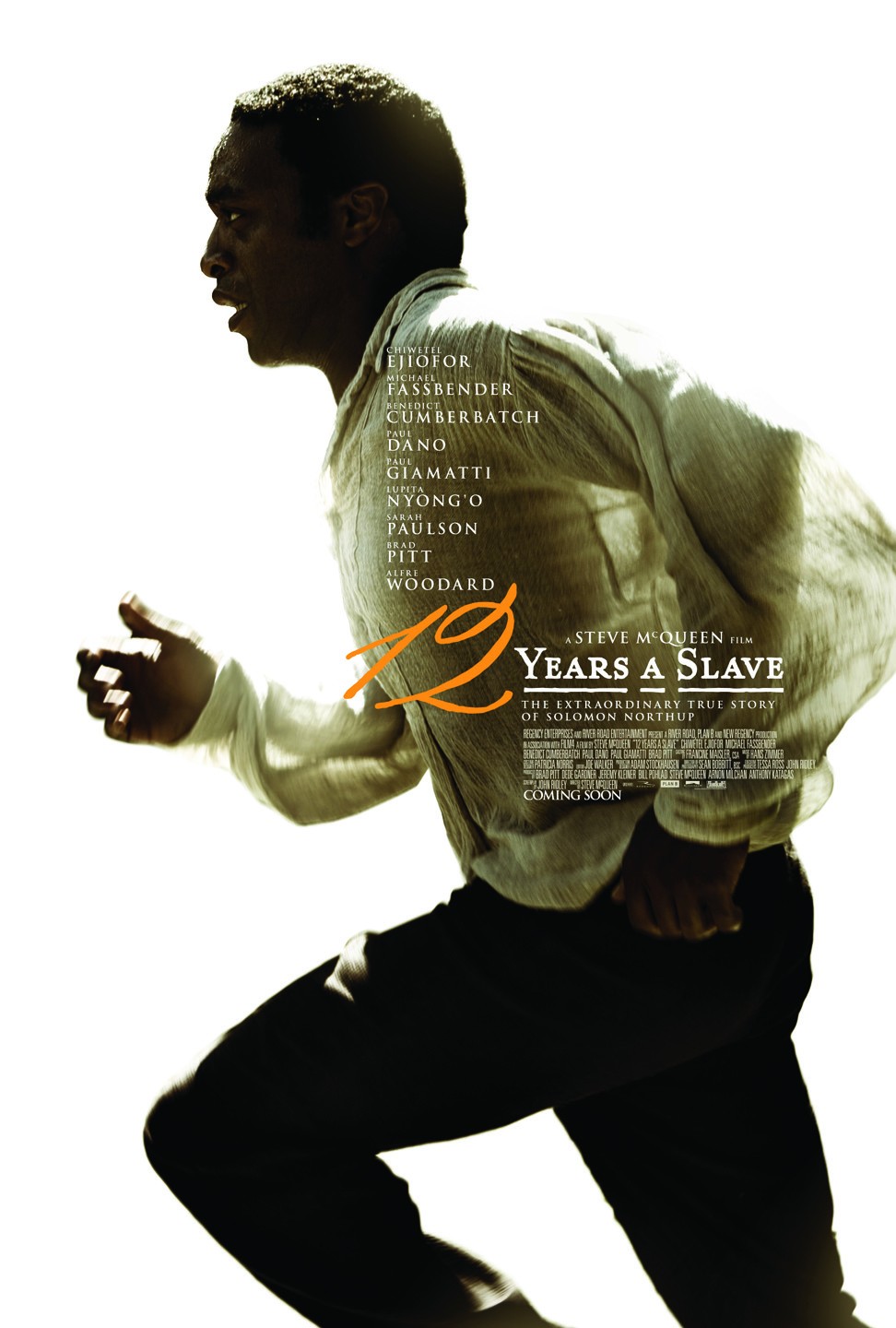
12 Years a Slave

D: Steve McQueen / 134m

Cast: Chiwetel Ejiofor, Michael Fassbender, Lupita Nyong’o, Benedict Cumberbatch, Paul Dano, Sarah Paulson, Adepero Oduye, Paul Giamatti, Garret Dillahunt, Brad Pitt, Alfre Woodard, Scoot McNairy, Taran Killam

In 2013 the movie that drew most people to the cinema was the third solo outing for Marvel’s high-tech reboot of the Tin Man, Iron Man 3. That movie was fun, a well-made piece of confectionery that was hyped, trailed and previewed to within an inch of its life. Enjoyable as it was though, it was still the equivalent of a Big Mac and fries, offering a quick fix for the Geek Squads and providing little or no nourishment for anyone not au fait with Marvel’s plan for Cinematic World Domination. But if 2013 is to be remembered as the year a man in a can was seen by more people than any other movie, what of that other way of remembering any given year: by the movie that was easily the best the year had to offer.

In some years, that “choice” has been easy. In 1930, All Quiet on the Western Front. In 1945, Les enfants du paradis. In 1962, Lawrence of Arabia. In 1974, The Godfather Part II. In 1993, Schindler’s List. And in 2013…a movie most of us won’t see until 2014. A movie called 12 Years a Slave.

Directed by McQueen from the account written by Solomon Northup, a free man living in New York with his wife and two children in 1841, 12 Years a Slave is a devastating account of one man’s abduction into slavery, and his subsequent experiences on the plantations of Louisiana. Northup is an accomplished musician, well-respected, and flattered when two members of a circus troupe approach him to join their company.  He journeys from New York to Washington with them only to wake up after a night’s drinking to find himself in chains and told he is now a slave; his name is also denied him and he is told he is to answer to Platt.  At first he finds himself at the mercy of (the ironically named) slave trader Freeman (Giamatti), until he is sold, along with a woman called Eliza (Oduye), to plantation owner Mr Ford (Cumberbatch).  Ford is in the process of adding extra buildings to his land, and has a master carpenter Tibeats (Dano) who oversees the construction. Northup impresses Ford with his engineering skills but soon makes an enemy of Tibeats.  Before long, Tibeats pushes Northup too far and Northup beats him with his own whip. Tibeats swears revenge against Northup and returns with two men; they proceed to hang Northup but are stopped by Ford’s overseer, Chapin (J.D. Evermore).  Although Chapin stops Northup from being killed, he leaves him hanging from the tree with his toes barely touching the ground to save himself from being strangled; it’s only when Ford returns at the end of the day that he is cut down.  But Ford’s leniency comes at a price: he must sell Northup on in order to save his plantation from Tibeats’ wrath.

Where Ford has been a considerate and compassionate man, Northup’s new owner, Edwin Epps is anything but.  He has his slaves  whipped if they don’t make the daily quota for picking cotton, and when his wife complains that he is paying too much attention to one of the female slaves, Patsey (Nyong’o), he tells her coldly that he will see the back of her before he will rid himself of Patsey.  Northup becomes Patsey’s confidante, and he does his best to keep Epps from bothering her, but it doesn’t always work.  It’s only when a carpenter named Bass (Pitt) comes to work on the plantation, and speaks of equality, that Northup takes courage and explains his situation.  Bass agrees to help him, and some time later, Northup is freed and reunited with his family.

12 Years a Slave - scene

From the outset, 12 Years a Slave grabs the attention and keeps its audience riveted.  The topic of slavery is one that has been only fitfully addressed in cinema, and while movies such as Amistad (1997), and Amazing Grace (2006) have taken a political approach to the issue, there hasn’t been a movie that has looked at it from both the financial side of things, and the actual day-to-day living experience.  Throughout the movie it’s made clear that slavery is a business, and a lucrative one for people such as the trader Freeman, and for the plantation owners who invest in slaves as a means of reaping huge profits.  Against this wellspring of money, a slave’s life is worth nothing at all, and the movie delivers this message on several occasions.  When Northup is on tiptoe trying not to hang, it’s heartbreaking to see the other slaves carry on with their tasks as if he isn’t there; only by going about their business can they add value to their lives.

12 Years a Slave is also quite graphic in its depiction of the violence endemic in slavery, with one on-screen whipping being truly horrifying, and its the casual nature of it all that the movie depicts so well, along with the hateful racism that fuelled so much of it.  Early on, before Northup is placed with Freeman, he is beaten with a paddle.  The scene is shocking both for what happens to Northup, and for the sustained nature of the beating.  Epps’s wife throws a decanter in Patsey’s face, her racism mixed with jealousy and injured pride.  There are other moments where violence escalates from nothing, and there is a palpable sense of the violent undercurrents that were prevalent during this period.  If the movie presents these aspects unflinchingly, then it is to show the full horror of the constant threat of injury or death that slaves experienced.  (And to anyone who feels these scenes were unnecessary or uncomfortable to watch, then you are missing the point.  The life of a slave was far worse than anything depicted here, and by showing us the things that we do see, the movie reinforces the fact that, so far removed from both those times and those circumstances as we are in our daily lives, we can easily fail to realise how terrible slavery actually was.)

Thankfully, in amongst the brutal violence and the despair there are quiet moments of hope to offset the horror.  Northup’s relationship with Patsey is affecting and desperately sad at the same time, and shows how two people can still retain a measure of their humanity despite existing under appalling conditions.  Thanks to both Ejiofor and Nyong’o, their scenes together are both emotionally charged and riveting viewing.

The heart of the film is Ejiofor’s towering performance, a career best that is breathtaking to watch as he depicts a man who somehow retains his dignity and his sense of self through twelve years of degradation and terror.  Ejiofor holds the attention in every scene he’s in, deflecting focus even from Fassbender, whose performance as Epps is mesmerising in its intensity.  The audience is drawn to Ejiofor as their moral compass and guide; without him, the movie would be a series of vignettes without a central point of reference.  He displays a clear understanding of the emotions that governed Northup’s reactions and response to his situation: the despair, the anger, the resignation to his plight, the fear, the barely acknowledged hope of regaining his freedom, the sadness, the sense of loss, and most effective of all, the will to survive.  It’s a magnificent achievement.

As already mentioned, Fassbender is on brilliant form as the tortured, torturing Epps, adding layers to a character who could have been portrayed more matter-of-factly and with less attention to nuance and interpretation.  His performance is mercurial, adding a sense of uncertainty to Epps that makes his unpredictable nature more dangerous.  His scenes with Ejiofor are akin to an acting masterclass.  In the various supporting roles, Dano stands out as the mealy-mouthed, insecure Tibeats, all puffed-up pride and coiled hostility, while Cumberbatch continues to impress as the fair-minded, socially conscious Ford.  Paulson also impresses as Mistress Epps, her eyes never once betraying any emotion other than disgust.  And making her feature debut, Nyong’o is superb as the object of Epps’s lust, imbuing Patsey with an inner strength and determination that offsets the cruelty she receives at the hands of Epps and his wife.

This is McQueen’s third feature – after Hunger (2008) and Shame (2011) – and serves to reinforce how talented a director he is.  His control of the material is confident and assured, and he elicits strong performances from everyone in the cast.  In conjunction with cinematographer Sean Bobbitt, McQueen places the camera in exactly the right place in each scene, framing the action expertly and with close attention to the physical and emotional requirements of each set-up.  His decision to make 12 Years a Slave has proved to be a wise one, and the way in which he’s overcome the difficulties inherent in telling such a complex story is compelling.

12 Years a Slave is a harrowing, disturbing look at a shameful period in US history, and while some people might say that we don’t need to see the barbarity of the times to know it was evil, a reminder as powerful as this one is should always be welcome.  With stand-out performances, an insightful, intricate script courtesy of John Ridley, and a score by Hans Zimmer that perfectly supports the emotional and dramatic moments in the film, 12 Years a Slave is a movie deserving of everyone’s attention.

Rating: 9/10 – a modern masterpiece, with much to say about the nature of evil as the will to survive it; an engrossing, deeply moving account of one man’s journey through a contemporary hell and his eventual salvation.
Share this:

  • Share on X (Opens in new window) X
  • Share on Facebook (Opens in new window) Facebook
  • More
  • Print (Opens in new window) Print
  • Email a link to a friend (Opens in new window) Email
Like Loading...

The Butler (2013)

29 Sunday Dec 2013

Posted by dullwood68 in Movies

≈ Leave a comment

Tags

Cecil Gaines, Civil rights movement, David Oyelowo, Drama, Eugene Allen, Forest Whitaker, History, Lee Daniels, Martin Luther King, Oprah Winfrey, Presidents, Racism, Review, True story, White House

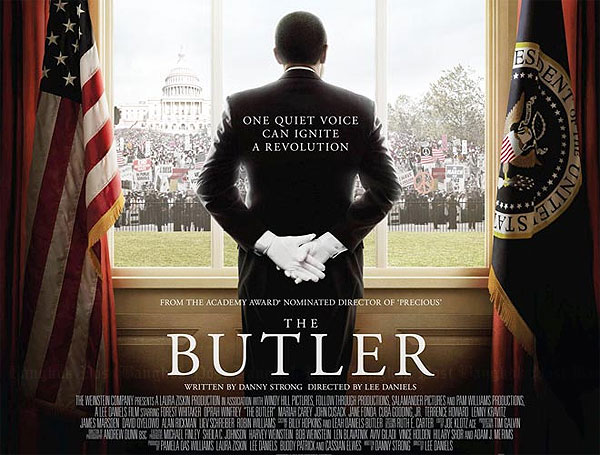
Butler, The

D: Lee Daniels / 132m

Cast: Forest Whitaker, Oprah Winfrey, Cuba Gooding Jr, Lenny Kravitz, David Oyelowo, Terrence Howard, Olivia Washington, Yaya DaCosta, Clarence Williams III, Vanessa Redgrave, Alex Pettyfer, Robin Williams, John Cusack, James Marsden, Liev Schreiber, Alan Rickman, Jane Fonda

Based on the life of Eugene Allen (here re-named Cecil Gaines), The Butler covers over eighty years of American history, and focuses on the civil rights movement as seen through the eyes of Gaines, his family, and the various Presidents he served in the White House.  Beginning in 1926 where the young Gaines and his mother and father work on a cotton plantation, the film progresses through the decades touching on various important political events and attempts to establish the effect these events have on Gaines (Whitaker) and his family – wife Gloria (Winfrey), and two sons, Louis (Oyelowo) and Charlie (Isaac White, Elijah Kelley).

While Cecil’s climb from plantation worker’s son to White House servant takes up the first part of the movie, and reflects the prevailing attitudes surrounding race and social integration (or lack of it), there’s a hint throughout these scenes that this is merely the build up to the central story; there’s a lack of real incident once Cecil leaves the plantation and too much time passes as well.  Once he begins work at the White House it becomes clear that Louis isn’t as impressed by his father’s job, and sees his father’s easy acceptance of his place within a society struggling to achieve equality as a betrayal.

As Louis becomes more and more involved in the civil rights movement – he rides the Freedom Bus, works for Martin Luther King, joins the Black Panthers – we see the widening gulf between father and son at the same time as a nation begins to unify itself.  It’s this disparity that offers the most drama, while the political machinations and behind the scenes decision-making make for an interesting counterpoint to the home-spun drama being played out.

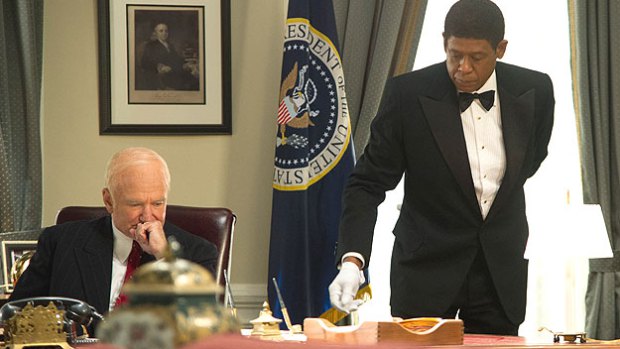
Butler, The - scene

It’s an interesting story, and one that shines a rare light on the personal side of political and social upheaval witnessed in the US during the 50s, 60s and 70s, and features strong performances from all concerned.  However – and it’s a big however – the movie has one major flaw: in attempting to cover so much ground it ends up being largely superficial and only fleetingly involving.  Thanks to Danny Strong’s wayward script, scenes pass with little purpose other than to reinforce Gaines’ apathy with regard to the fight for racial equality, and after the sixth or seventh or eighth time they become tedious and wearing (we get it already!).  Likewise for Louis’s involvement with the movement: yes, he’s committed, yes he sees his father as a sell-out, yes he feels with his head rather than his heart – all this is laboured and needlessly pedantic.  Gloria and Charlie are given small moments throughout as a result, and the larger family dynamic is reduced to odd scenes set around the dinner table; the only problem is there’s no meat being served. There are scenes that never amount to much: Gaines’ friend Howard (Howard) trying to seduce Gloria; a late-night encounter in the kitchens with Nixon (Cusack).

And then there are the Presidents, Eisenhower (Williams), Kennedy (Marsden), Johnson (Schreiber), Nixon and Reagan (Rickman).  Each actor has only two or three scenes to work with, and while each does well with what he’s given, they all suffer from the same approach: show the man in the highest office in the land struggling to decide what to do (though Kennedy comes off best in this regard).  At least the movie stops short of Gaines acting as some kind of authoritative guide, offering the best advice at the right time; but he does remain annoyingly non-partisan, except for the issue of equal pay between the white and the black employees at the White House (his own small battle for equality that is shown as the only part of the struggle he’s ever interested in).

The performances, though, are good, and while some of the cast are given little to work with – Kravitz, Washington, Howard, and surprisingly, Winfrey – they rise above the script’s limitations to convey a sense of what it was like to live during those troubled times.  Whitaker carries the movie with ease, and while it’s a little difficult to accept him as a man in his late twenties (when he takes over the part from Aml Ameen, himself a twenty-eight year old playing a fifteen year old), he displays a confidence and conviction that helps his character immensely.  Whitaker is an actor who can be unpredictable at times, but here he reins in any of his usual eccentricities and maintains the stolid, often resigned approach of a man who feels he has found his place in the world and doesn’t need to reach any further.

As with all historical dramas where real events are being portrayed there are inaccuracies and fabrications galore, but while this is sometimes glaring – Reagan’s indifference to civil rights, Eugene Allen’s son Charles wasn’t the political activist Louis is – they’re not so glaring that they detract from the story that’s being told.  This is based on the life of Eugene Allen, and if people are offended or upset by any deviation from “the truth” or historical fact, then they should avoid this movie completely.

On the technical side, Daniels directs with an increasingly confident flair but is hampered by the script’s lack of dramatic focus (it still feels odd to say that about a movie that appears to be all drama), and has no answer for its often stop/start structure.  That said, the movie is beautifully lensed by Andrew Dunn, and the production design by Tim Galvin, allied with Lori Agostino, Erik Polczwartek and Jason Baldwin Stewart’s art direction, means the movie is always handsome to look at.  Alas, Rodrigo Leão’s score is intrusive and overcooks the emotional beats.

Rating: 5/10 – not the incisive overview of the civil rights movement it should have been, nor the family drama it could have been, The Butler will probably do well in the Awards season, but there’s a lack of substance, and focus, here that holds it back from being a truly good movie; good performances aside, this has little to recommend it if you already know enough about its subject matter.

Share this:

  • Share on X (Opens in new window) X
  • Share on Facebook (Opens in new window) Facebook
  • More
  • Print (Opens in new window) Print
  • Email a link to a friend (Opens in new window) Email
Like Loading...

My Top 10 Movies – Part Two

18 Wednesday Dec 2013

Posted by dullwood68 in Movies

≈ Leave a comment

Tags

Abel Gance, Albert Dieudonné, Drama, French movie, History, Kevin Brownlow, Napoleon, Review, Silent film, Triptych, True story

Napoléon (1927)

Napoleon

D: Abel Gance / 330m

Cast: Albert Dieudonné, Vladimir Roudenko, Edmond Van Daële, Gina Manès, Antonin Artaud, Alexandre Koubitzky, Marguerite Gance, Yvette Dieudonné, Philippe Hériat, Abel Gance

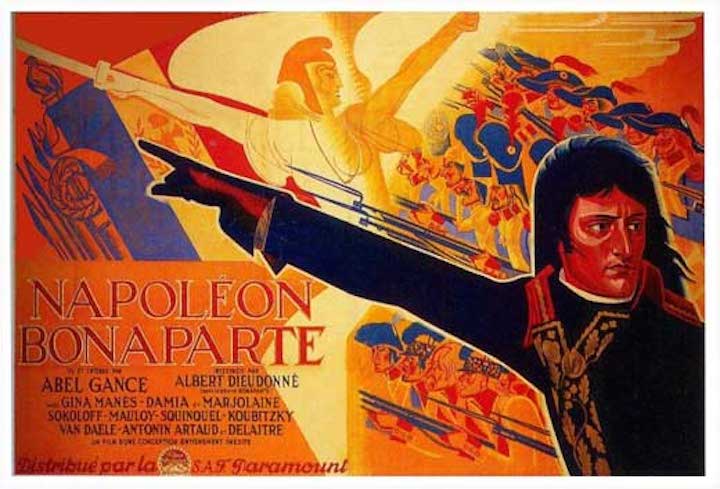
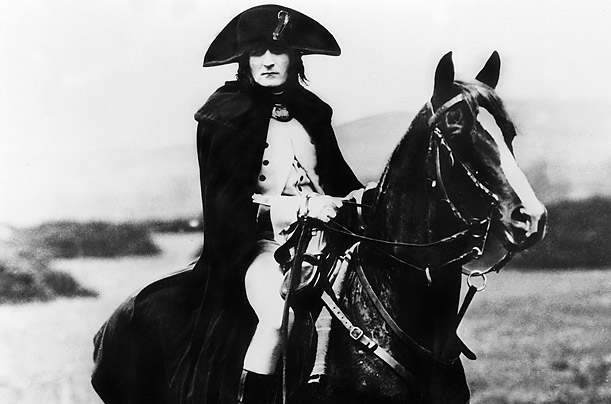
A five and a half hour silent movie?  One that’s unavailable in any home video format, and is unlikely to be for the very foreseeable future?  A rich visual spectacle that impresses from its opening snow fight sequence to its stunning triptych finale?  I have only one word as my answer: Absolutely!

Before I saw Napoléon, my exposure to silent movies had been restricted largely to comedies featuring the likes of Charlie Chaplin, Buster Keaton, Larry Semon etc.  The Keystone Kops were a favourite, and Harold Lloyd impressed me even more when I discovered he’d lost his right thumb and forefinger in an accident involving a bomb prop (I know, it’s a bit shallow, but in mitigation I was around nine or ten).  I remember seeing most of The Iron Horse (1924) on TV, and it had the effect of making me realise that silent movies could last longer than twenty minutes, but UK TV wasn’t in the habit of showing anything other than the short films already mentioned.  When Napoléon was shown as part of a nationwide tour in 1980 at my local arts theatre – with live piano accompaniment – I saw the advert for it and took out my trusty copy of Halliwell’s Film Guide to find out more about it.

It was the length of the movie that intrigued me.  At that time – and my memory is a bit hazy on this – the available print ran to just over five hours.  The idea of sitting in a theatre for that length of time, plus interval, was daunting, but equally an attractive one.  It’s a little shallow (again) but I wanted to see if I could “stay the course” and be able to say – if anyone I knew had even cared! – that I had seen, all the way through, the five hour plus silent movie set during the French Revolution and beyond.  It was like having a badge of honour.

Napoleon - scene

Imagine my surprise (and delight) when the movie began and I found myself swept up by the depth and breadth of Gance’s technical mastery of the silent medium.  By the intensity of the performances, the sweep of the narrative, the visual panache of the battle scenes – Gance put his camera in the middle of the action, unheard of up until then – and the effectiveness of the quieter moments against the stirring swirl of historical events.  Those five hours flew by.  At the interval, I can remember coming out of the auditorium (and into the light) and feeling overwhelmed.  Aside from 2001: A Space Odyssey (1968), I’d never been affected as much by a movie, and definitely not by a silent movie.  I was seeing techniques and a visual language that were truly amazing; this was breathtaking stuff and I couldn’t wait to go back in and see if the rest of the movie was as incredible.  And, of course, it was.

Since then I’ve seen Napoléon four more times.  (Sadly, I was out of the country for its most recent UK screening, on 30 November 2013.)  Each time I’ve revelled in its complexity and the sheer joy it provides, and each time I’ve come away wanting someone, anyone – but preferably Kevin Brownlow – to come along and say, “We’ve found all the missing footage, and will be presenting the original premiere version of Napoléon in just a few months’ time”.  I know this is unlikely, and Brownlow has said himself that the current version is probably the longest it will be for some time to come.  (But, what’s the world without a little hope, eh?)  Perhaps the best screening was the premiere of Carl Davis’s score for the movie shown at the Royal Festival Hall on London’s south bank.  The addition of an orchestra made the whole event even more wonderful and fulfilling.

Napoléon was the first movie that really engaged my heart and my mind and wouldn’t let go.  It holds a special place for me as the one movie that remains an event each time I see it.  In these days of instant streaming and fast downloads and blu ray discs, the notion of only being able to see a film at a cinema or a concert hall is somehow reassuring, that we haven’t lost that true element of spectacle that we take now for granted.  This was how audiences were first exposed to movies, not with ads for the latest trainers or holiday destinations, but with a sense of scale and excitement, a palpable tension at being swept away by what was unfolding on screen.  The language of cinema was being created by these movies, and it’s this aspect that shouldn’t be overlooked or forgotten.  Without trailblazers such as Gance, a lot of what we take for granted about movies today (or don’t even notice), would be missing.  That we’ve lost some of that grandeur is simply disappointing.

Sadly, it will be some time before Napoléon will be seen again on the big screen.  But when it is, you can rest assured that I’ll be there (if it’s in the UK), and ready to be enthralled and transported and amazed all over again.

Share this:

  • Share on X (Opens in new window) X
  • Share on Facebook (Opens in new window) Facebook
  • More
  • Print (Opens in new window) Print
  • Email a link to a friend (Opens in new window) Email
Like Loading...

Saving Mr. Banks (2013)

13 Friday Dec 2013

Posted by dullwood68 in Movies

≈ Leave a comment

Tags

Annie Rose Buckley, Australia, Colin Farrell, Comedy, Disney, Drama, Emma Thompson, John Lee Hancock, Mary Poppins, P.L. Travers, Review, Tom Hanks, True story, Walt Disney

Saving Mr. Banks

D: John Lee Hancock / 125m

Cast: Emma Thompson, Tom Hanks, Annie Rose Buckley, Colin Farrell, Paul Giamatti, Ruth Wilson, Bradley Whitford, Jason Schwartzman, B.J. Novak, Rachel Griffiths, Kathy Baker, Ronan Vibert

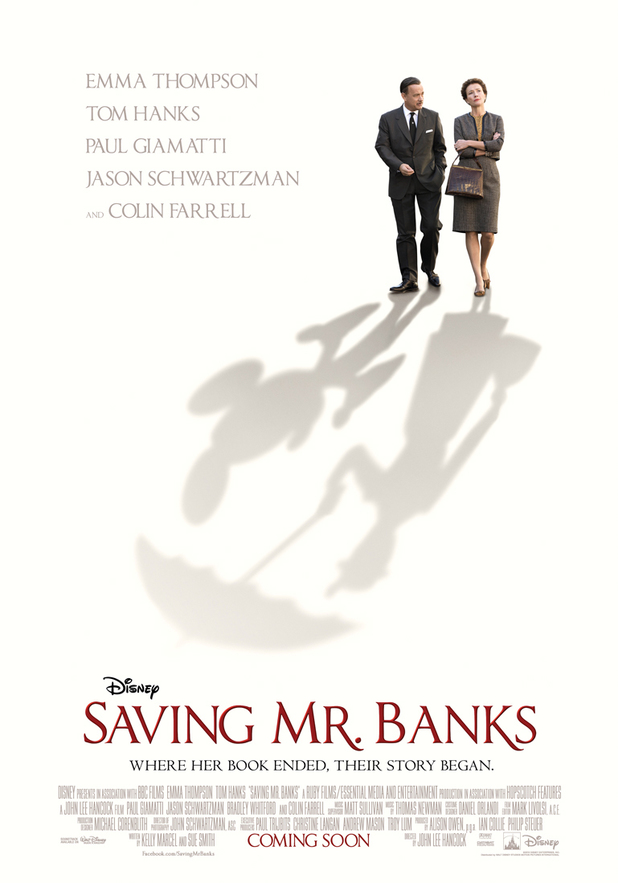
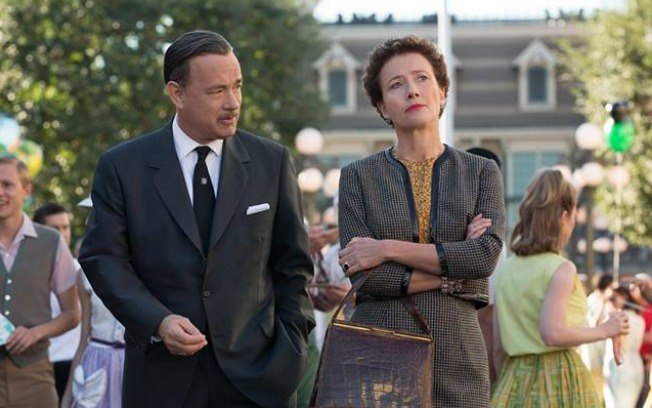
Based on the true story of Walt Disney’s attempts to secure the film rights to P.L. Travers’ Mary Poppins, Saving Mr. Banks opens with the financially compromised author (Thompson) telling her agent she has absolutely no intention of flying to Los Angeles and letting Disney (Hanks) ruin her creation.  One quick turnaround later and we see Travers arriving in La La Land and being met by her driver for the duration of her stay, Ralph (Giamatti).  One dispiriting car journey (for her) later and she is introduced to the charming and sincere Disney.  Her doubts assuaged for the time being, she agrees to work with the proposed movie’s writers (Whitford, Schwartzman and Novak).  As they work through the script and songs we’ve all come to know – and perhaps love – Travers’ objections remain largely in place, but gradually her resistance is worn down by a combination of the writers’ enthusiasm, Disney’s determination not to renege on a promise made to his daughters twenty years before, and memories of her childhood that resurface during the visit.

It’s these flashbacks that add meat to the otherwise thin story of “a writer taking on the system”.  As portrayed by Thompson – and superbly, I might add – Travers is presented as a bit of an old dragon: scathing, contemptuous of her American “cousins”, rude, condescending and almost completely out of her depth.  Hancock and writers Kelly Marcel and Sue Smith, instead of making the movie a “fish out of water” story where the fish wins out by virtue of personal fortitude and stubbornness, have wisely chosen to look at the reasons for Travers’ animosity towards Disney, and why the character of Mr Banks was so important to her.  As Travers’ back story unfolds through the depiction of her childhood, so we come to learn the fundamental truth behind the characters of Mr Banks and of Mary Poppins herself, and the long-term effect Travers’ childhood has had on her.  These scenes give a much-needed depth to the movie, and allows Thompson to provide a richer, more psychological approach to P.L. Travers than may have been expected.  Thompson dominates the movie, reducing even Tom Hanks to the level of humble onlooker in their scenes together, and gives a masterclass in screen acting, her voice and mannerisms and facial expressions all perfectly pitched to leave the audience in no doubt as to her thoughts and feelings at any time.

Saving Mr. Banks - scene

Matching Thompson in terms of screen performance, and presence, is her younger counterpart, Annie Rose Buckley.  With only an episode of Aussie soap Home and Away back in 2010 under her belt, Buckley’s performance as Ginty is intuitive, mesmerising and a minor revelation.  As her scenes transform from pastoral idyllic to domestic unstable, Buckley displays a maturity and command of the material that few actresses her age would be capable of achieving, let alone maintaining, over the course of a two hour movie.  She’s a remarkable find, and all credit to the casting director Ronna Kress for picking her out.

As Disney, Tom Hanks gives a comfortable performance but the script often sidelines him, so that he pops up only now and again to urge on Travers and perform a little light damage control when required.  It’s effectively a supporting role, and one that doesn’t stretch him in any way.  In other roles, Farrell as the inspiration for Mr Banks plays against type for the first half of the movie, while Wilson is given little to do as his wife other than look disappointed or, in one scene, have a five minute breakdown.  Giamatti is good as Travers’ driver, and he provides several deft comic ripostes to Thompson’s sarcastic jibes.  And in perhaps the most sublime casting decision of all, Rachel Griffiths messes with our acceptance of Julie Andrews as Mary Poppins by portraying the “real” Mary.

Saving Mr. Banks is lovely to watch, courtesy of bright, colourful photography by John Schwartzman (half-brother of Jason), and a pleasing recreation both of turn-of-the-20th-century Australia and 60’s Los Angeles.  Disneyland is given an effective retro makeover, and the music by Thomas Newman – incorporating several of the songs from Mary Poppins (1964) – adds extra emotional elements to both storylines.  If there is a lightness of touch, a slight distancing from the more dramatic aspects of Ginty’s childhood, then it should be remembered that this is still a Disney movie, and the studio that works hard to sanitise almost all of its family-oriented movies – and at heart this is still one of them, make no mistake – isn’t about to let people leave the cinema feeling saddened or depressed.  Fortunately, Saving Mr. Banks carries enough emotional heft to offset its more calculated hilarity, and if there are moments where you wonder just how much of it all is true or not, the fact that Disney were banking on a much-loved “product” in Mary Poppins, also informs this movie as well.

Rating: 8/10 – enjoyable, handsomely mounted movie that avoids being as original as say, “Supercalifragilisticexpialidocious”; and without Thompson in the lead role providing a strong point of reference for the audience, would have struggled to stand out from the crowd of other “true stories” set in Hollywood.

Share this:

  • Share on X (Opens in new window) X
  • Share on Facebook (Opens in new window) Facebook
  • More
  • Print (Opens in new window) Print
  • Email a link to a friend (Opens in new window) Email
Like Loading...

Jobs (2013)

19 Tuesday Nov 2013

Posted by dullwood68 in Movies

≈ Leave a comment

Tags

Apple, Apple II, Ashton Kutcher, Biography, Drama, Home computers, iMac, Josh Gad, Joshua Michael Stern, Review, Steve Jobs, Steve Wozniak, True story

Jobs

D: Joshua Michael Stern / 128m

Cast: Ashton Kutcher, Dermot Mulroney, Josh Gad, Lukas Haas, Matthew Modine, J.K. Simmons, Lesley Ann Warren, Ron Eldard, Ahna O’Reilly, Victor Rasuk, John Getz, Kevin Dunn, Robert Pine, James Woods

Opening with the unveiling of the iPod in 2001, Jobs looks back at the founding of Apple, and the emergence of the Mac, while also providing a biography of Apple’s co-founder Steve Jobs (Kutcher).  The movie covers the years 1974 to 1996, and while there is at least one other movie that paints a better picture of those times – Pirates of Silicon Valley (1999) – this tries hard to provide a fair representation of both the events that occurred and the people involved with them.  That said, the focus here is squarely on Steve Jobs.

From the earliest moments at Reed College where Jobs has dropped out, the movie paints him as a maverick, well-liked, able to maintain relationships, but still an outsider.  Two of these aspects would fade as time passed, but in these early days it’s easy to root for Jobs because he has an almost goofy enthusiasm for what he’s doing. When he sees what his friend Steve Wozniak (Gad) is working on, and realises the potential for the home computer market (which didn’t exist back in 1976), he persuades Wozniak to go into business with him, and Apple Computer Ltd is born.

Getting Apple off the ground isn’t easy, but Jobs pushes and pushes until the company is launched on the stock market.  But there’s no overnight success story.  The Apple II consumes so much research and development money that Apple is on the verge of being financially crippled; the shareholders start to question Jobs’ methods, and the board of directors, led by Arthur Rock (Simmons), relieve Jobs of his position as head of the company.

Asked by board member (and original investor) Mike Markkula (Mulroney) to work on another project that Apple had initially passed on, Jobs takes over the development of the Macintosh.  The same motivations and working methods cause similar problems but the Macintosh is a revolutionary step forward for home computing.  When the board is presented with the Mac they see its potential but have no idea how to market it.  Jobs insists they hire John Sculley (Modine) away from Pepsi (he came up with the Pepsi Taste Test Challenge).  With Sculley on board, everything looks set for the success everyone has waited for.  But there’s a problem (isn’t there always?): the cost of making the Mac is prohibitive in terms of selling it to the public.  This time, the board votes to remove Jobs from Apple altogether, and install Sculley as its CEO.  Let down by everyone around him, Jobs turns his back on Apple and works on another project that he launches himself, NeXT.  While this affords him modest success, the same can’t be said for Apple.  The company flounders without him, the shares take a nosedive, and they spend too much time and money competing with Microsoft.  With things spiralling out of control, the new board, led by Ed Woolard (Pine), bring Jobs back in as – at first – a consultant, and then as the new CEO.  Back in charge of his own company, Jobs takes Apple forward on the journey that so many of us are grateful for.

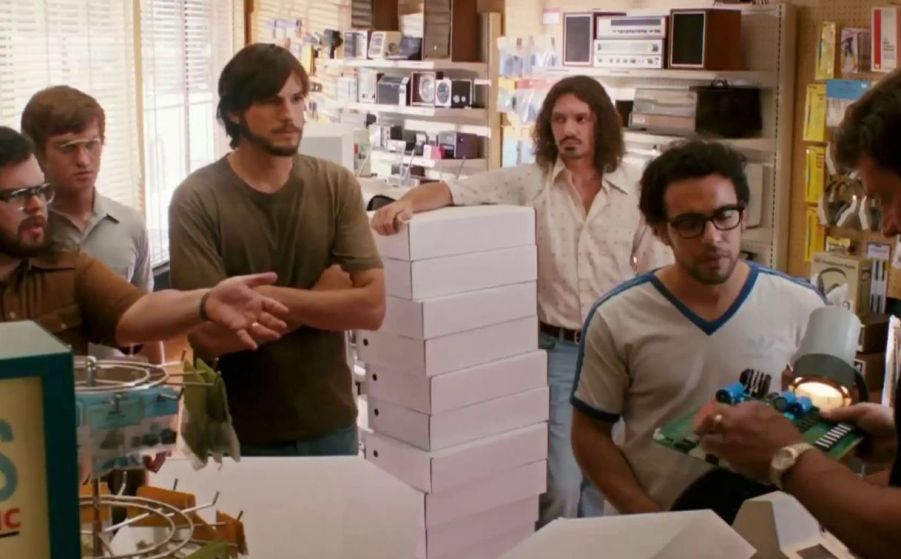
Jobs - scene

As a one-stop shop for the early history of Apple, Jobs is consistently lightweight, both in its depictions of those early days, and the impact those days have on us now, and it’s the movie’s split personality that gets in the way.  It wants to be a chronicle of those pioneering days when home computers were a dream that only a few could imagine.  It also wants to be a biopic of Steve Jobs.  And even though the movie runs over two hours, it always feels that there’s a lot of incidents and events that have been left out.

The movie also struggles to explain a lot of what was happening and why on a personal level.  The relationship between Jobs and Wozniak is a case in point.  Wozniak is the man largely responsible for the first Apple computer; his initial work paved the way for all the Apple computer products we use today.  He and Jobs, at first, are great pals.  But as the business grows and Jobs becomes more and more obsessed with making Apple a pioneer in home computing, their relationship withers until Wozniak decides he has to leave.  Gad gets a compelling but ultimately “Hollywood” speech to make as Wozniak, explaining why he thinks things have gone wrong between them.  It’s a rare moment in a movie that provides plenty of strong emotional moments – Jobs’ rant at Bill Gates over the phone is a highlight – but they’re not grounded in any kind of recognisable, explainable way.  Jobs shouts at his co-workers to goad them on; Jobs refuses to believe his girlfriend’s child is his; Markkula says he’s on Jobs’ side the night before he votes with the board to force Jobs out; all these events or moments and more remain unexplained or unexplored.

The problem lies with the script by Matt Whiteley.  It skims over a lot of events without attaching any depth to them, or overdoes the “significance” factor (Jobs throwing away a Walkman).  The dialogue is often simplistic in relation to the people involved, but seems more sure-footed when dealing with the technical side of things.  It also provides a few unintentional moments of humour, and in its efforts to cover such a long period of time, misses things out altogether (for example, Jobs’ marriage to Laurene Powell – she and their first child, Reed, appear out of the blue).  Stern fails to address these issues, and while most scenes hold the attention, they often lack for any cohesion or cumulative effect – sometimes it’s like watching a series of vignettes.

Kutcher has a superficial resemblance to the younger Jobs, and this may be why he was cast.  However, Kutcher is not an actor with a broad range, and there are several instances where he fails to convince, mostly when Jobs is being cruel: the conviction is there but Kutcher makes Jobs sound petulant as well, an aspect of his character that seems out of place.  Mulroney and Simmons do well, as does Gad, although each actor has a minimal amount of support from the script and their director.  The production design by Freddy Waff is solid if unspectacular, while Russell Carpenter’s cinematography gives the movie a welcome boost.  For a movie made in the past year, it certainly looks like one made in the 70’s and 80’s, and that contemporary feel is one of the few positive aspects Jobs gets right.

Rating: 5/10 – a scattershot approach to the early days of Apple leaves Jobs as unrewarding as buying a Betamax video player must have been; watch only as a jumping off point, or to dip your toes in the water.

Share this:

  • Share on X (Opens in new window) X
  • Share on Facebook (Opens in new window) Facebook
  • More
  • Print (Opens in new window) Print
  • Email a link to a friend (Opens in new window) Email
Like Loading...
Newer posts →

Blog Stats

  • 495,225 hits

Recent Posts

  • 10 Reasons to Remember Bibi Andersson (1935-2019)
  • Fantasia (1940)
  • Dances With Wolves (1990) – The Special Edition
  • Kiss of the Spider Woman (1985)
  • The Three Musketeers (1973)

Top Posts & Pages

  • The Red Balloon (1956)
    The Red Balloon (1956)
  • The White Orchid (2018)
    The White Orchid (2018)
  • Cardboard Boxer (2016)
    Cardboard Boxer (2016)
  • Sorry to Bother You (2018)
    Sorry to Bother You (2018)
  • I Can't Think Straight (2008)
    I Can't Think Straight (2008)
  • 10 Reasons to Remember Bruno Ganz (1941-2019)
    10 Reasons to Remember Bruno Ganz (1941-2019)
  • Don Jon (2013)
    Don Jon (2013)
  • Predestination (2014)
    Predestination (2014)
  • Sand Storm (2016)
    Sand Storm (2016)
  • 10 Reasons to Remember Arthur Hiller (1923-2016)
    10 Reasons to Remember Arthur Hiller (1923-2016)
Follow thedullwoodexperiment on WordPress.com

Blogs I Follow

  • Rubbish Talk
  • Film 4 Fan
  • Fast Film Reviews
  • The Film Blog
  • All Things Movies UK
  • Interpreting the Stars
  • Let's Go To The Movies
  • Movie Reviews 101
  • TMI News
  • Dan the Man's Movie Reviews
  • Film History
  • Jordan and Eddie (The Movie Guys)

Archives

  • April 2019 (13)
  • March 2019 (28)
  • February 2019 (28)
  • January 2019 (32)
  • December 2018 (28)
  • November 2018 (30)
  • October 2018 (29)
  • September 2018 (29)
  • August 2018 (29)
  • July 2018 (30)
  • June 2018 (28)
  • May 2018 (24)
  • April 2018 (21)
  • March 2018 (31)
  • February 2018 (25)
  • January 2018 (30)
  • December 2017 (30)
  • November 2017 (27)
  • October 2017 (27)
  • September 2017 (26)
  • August 2017 (32)
  • July 2017 (32)
  • June 2017 (30)
  • May 2017 (29)
  • April 2017 (29)
  • March 2017 (30)
  • February 2017 (27)
  • January 2017 (32)
  • December 2016 (30)
  • November 2016 (28)
  • October 2016 (30)
  • September 2016 (27)
  • August 2016 (30)
  • July 2016 (30)
  • June 2016 (31)
  • May 2016 (34)
  • April 2016 (30)
  • March 2016 (30)
  • February 2016 (28)
  • January 2016 (35)
  • December 2015 (34)
  • November 2015 (31)
  • October 2015 (31)
  • September 2015 (34)
  • August 2015 (31)
  • July 2015 (33)
  • June 2015 (12)
  • May 2015 (31)
  • April 2015 (32)
  • March 2015 (30)
  • February 2015 (37)
  • January 2015 (39)
  • December 2014 (34)
  • November 2014 (34)
  • October 2014 (36)
  • September 2014 (25)
  • August 2014 (29)
  • July 2014 (29)
  • June 2014 (28)
  • May 2014 (23)
  • April 2014 (21)
  • March 2014 (42)
  • February 2014 (38)
  • January 2014 (29)
  • December 2013 (28)
  • November 2013 (34)
  • October 2013 (4)

Blog at WordPress.com.

Rubbish Talk

Film 4 Fan

A Movie Blog

Fast Film Reviews

The Film Blog

The official blog of everything in film

All Things Movies UK

Movie Reviews and Original Articles

Interpreting the Stars

Dave Examines Movies

Let's Go To The Movies

Film and Theatre Lover!

Movie Reviews 101

Daily Movie Reviews

TMI News

Latest weather, crime and breaking news

Dan the Man's Movie Reviews

All my aimless thoughts, ideas, and ramblings, all packed into one site!

Film History

Telling the story of film

Jordan and Eddie (The Movie Guys)

Movie Reviews & Ramblings from an Australian Based Film Fan

Privacy & Cookies: This site uses cookies. By continuing to use this website, you agree to their use.
To find out more, including how to control cookies, see here: Cookie Policy
  • Subscribe Subscribed
    • thedullwoodexperiment
    • Join 481 other subscribers
    • Already have a WordPress.com account? Log in now.
    • thedullwoodexperiment
    • Subscribe Subscribed
    • Sign up
    • Log in
    • Report this content
    • View site in Reader
    • Manage subscriptions
    • Collapse this bar
 

Loading Comments...
 

    %d