• 10 Reasons to Remember…
  • A Brief Word About…
  • About
  • For One Week Only
  • Happy Birthday
  • Monthly Roundup
  • Old-Time Crime
  • Other Posts
  • Poster of the Week
  • Question of the Week
  • Reviews
  • Trailers

thedullwoodexperiment

~ Viewing movies in a different light

thedullwoodexperiment

Tag Archives: Bolivia

Jungle (2017)

01 Wednesday Nov 2017

Posted by dullwood68 in Movies

≈ 1 Comment

Tags

Alex Russell, Amazon Rain Forest, Bolivia, Daniel Radcliffe, Drama, Greg McLean, Joel Jackson, Literary adaptation, Review, Survival, Thomas Kretschmann, Thriller, True story, Yossi Ghinsberg

D: Greg McLean / 116m

Cast: Daniel Radcliffe, Thomas Kretschmann, Alex Russell, Joel Jackson, Yasmin Kassim, Luis Jose Lopez, Lily Sullivan, Jacek Koman, Angie Milliken, John Bluthal

After serving three years in the Israeli military, and forgoing his father’s wish that he study to become a lawyer, Yossi Ghinsberg (Radcliffe) travelled to South America where he spent time travelling around the region until he wound up in Bolivia in 1981. There he made two new friends, Swiss school teacher Marcus Stamm (Jackson), and Marcus’s friend, Kevin Gale (Russell), an American and an avid adventurer-cum-photographer. Yossi also met an Austrian named Karl Ruchprecter (Kretschmann). Karl persuaded Yossi and his two new friends to go on an expedition into the jungle to find a lost Indian tribe that Karl was certain could be found. They set off on foot, and were soon miles from any kind of human habitation. But the dynamic of the group began to sour, especially when Marcus’s feet became badly blistered and he became unable to keep up the pace. With the expedition only partly completed, Karl announced that he was going back on foot, but that the others could use a raft to traverse the river that would take them to their destination. Marcus went with Karl, and Yossi and Kevin put together a raft and set off. But when the current proved too strong, and an accident caused the two to be separated, it left Yossi alone in the jungle, and with no tools to help him survive or find his way to safety…

As Jungle is based on the book of the same name by Ghinsberg himself, there’s no surprise in how the movie ends, but what is surprising is how compelling it all is once Ghinsberg is separated from Kevin, and the perils of being lost in the jungle become all too apparent. However, before all that, the viewer has to wade through some fairly tortuous scenes in the first hour, where the four main characters are introduced but without providing them with any appreciable depth, or Yossi aside, any clear motivations as to why they’re all there in the first place. Karl remains a mystery right until the end, when we learn something very important about him, while Kevin and Marcus come across as the unfortunate tag-alongs who share part of Yossi’s trials and tribulations, but whose own dilemmas don’t rate as much interest in Justin Monjo’s straightforward screenplay.
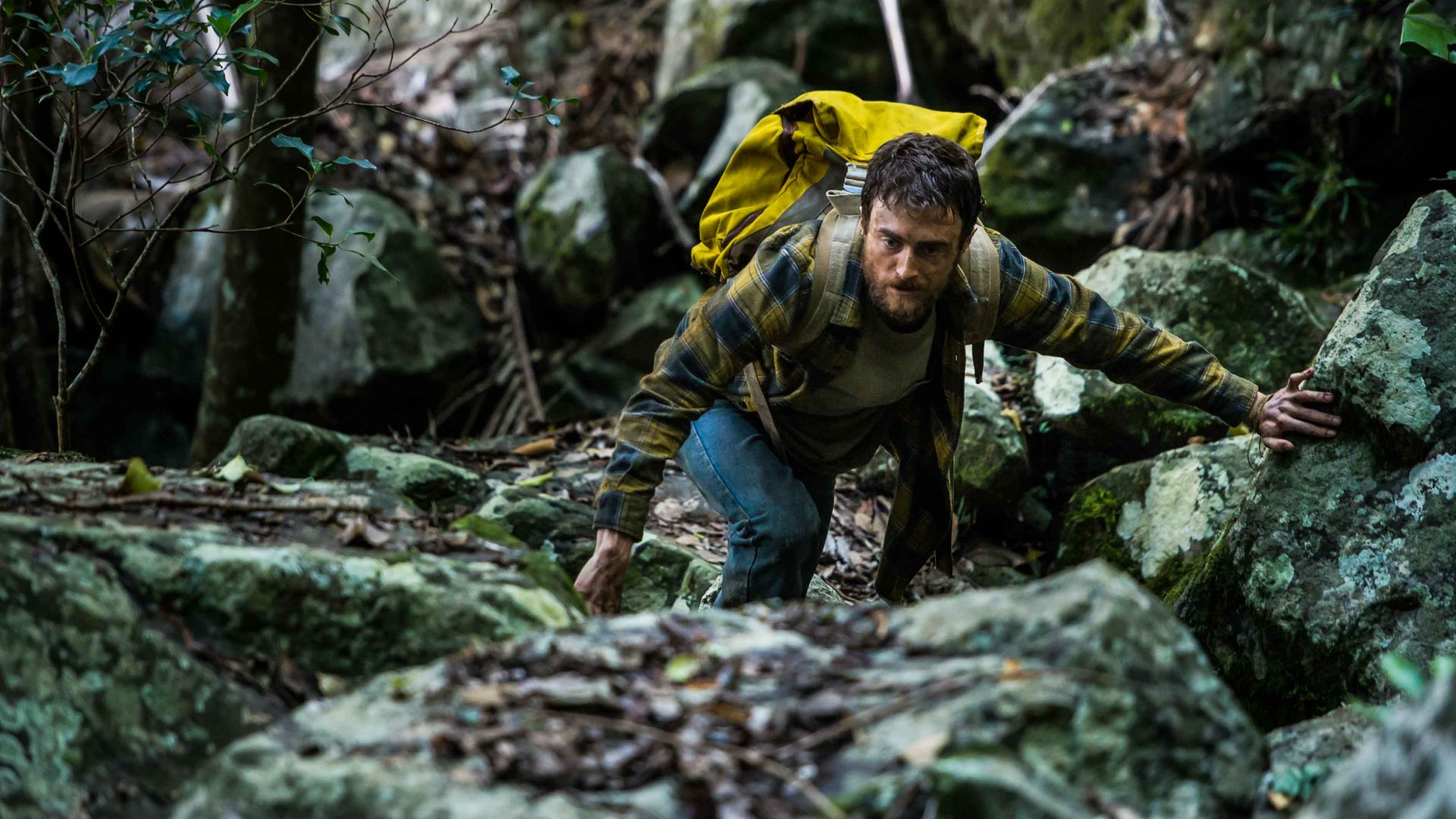
Once tensions arise within the group, it’s Yossi’s unintended lack of sympathy for Marcus’s plight that provokes the turning point where the quartet split up, but once that happens, the movie seems to breathe a huge sigh of relief, as if now it can concentrate on the story it really wants to tell. And aided by yet another impressive performance from Daniel Radcliffe, the movie quickly comes into its own and puts both Yossi and the viewer through the wringer as days pass and Yossi’s situation worsens with every step. He has to combat starvation, fatigue, disorientation, hallucinations, jungle predators, and the likelihood that he will wander round and round in circles without ever coming close to being found. It’s a horrifying situation to be in, and the script (perhaps unfairly) revels in giving Yossi moments of hope only to have them dashed a moment later. But these occasions also help to sharpen the narrative and accentuate the idea that the jungle has no time for sympathy if you’re unprepared for what it can do.

As the beleaguered Yossi, Radcliffe provides further evidence that he’s a more than capable actor, and though the role of Ghinsberg could be considered as just another in the long line of physical endurance roles that actors take on from time to time, thanks to Radcliffe’s commitment and understanding of the effects these rigours can have, Yossi’s deteriorating physical appearance and fast-eroding mental stability is made all the more credible and shocking when at last he reveals the extent of his (admittedly CGI enhanced) malnourishment. Ghinsberg somehow managed to survive for nineteen days before he was found, and though McLean fumbles the moment of discovery through some poor editing choices, there’s still an emotional kick to be found that is undeniable.
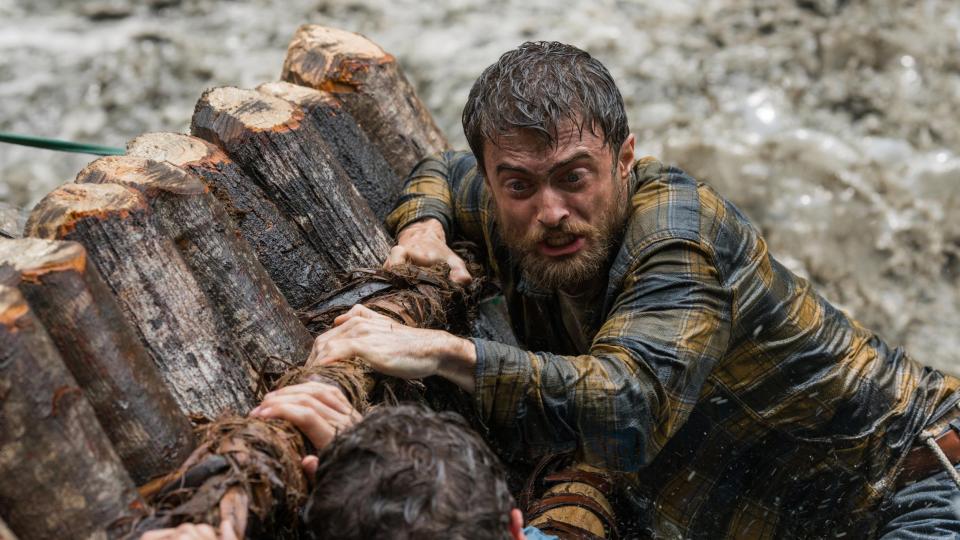
In telling such a dramatic true story, McLean and Monjo have crafted an old-fashioned survival story that focuses (eventually) on its central character’s will to cheat death and find their way back to civilisation, no matter how remote. McLean knows how to maintain dramatic tension – even if he hasn’t applied that ability to some of his more recent movies; The Darkness (2016) anyone? – and he uses close ups and an always unsettling, always encroaching soundscape to highlight both the pressure and the impending sense of doom that Yossi is experiencing. It’s a shame then that all this tension and pressure doesn’t come into play until around the halfway mark, and that McLean hasn’t been able to make Munjo’s script as compelling from the first page as it is to the last. Still, it’s a movie that goes someway to redeeming McLean’s “street cred” as a director, and there are plenty of moments where his skill as a director can be recognised in the claustrophobic nature of the jungle itself, and the ease with which he integrates Yossi’s hallucinations into the narrative so that they look and feel like an organic part of the whole.

True stories ultimately stand or fall based on the risks a movie maker is willing to take with the material, and though McLean has been stuck in something of a creative rut in recent years, here those risks relate to the various hallucinations/dream sequences that Yossi has, some of which provide some much needed humour into the mix. By taking Yossi, and the viewer, away from the threatening environment of the jungle, McLean gives both a chance to grab a breather and prepare themselves for the next part of Yossi’s heroic journey. The jungle itself is a fearsome opponent, and helped by cinematographer Stefan Duscio, McLean disorients and distracts both Yossi and the viewer so that each new setback to his finding safety increases the sense of fearfulness and increasing despair that the real Yossi must have felt all those years ago. That his predicament has proven so effective in terms of his will to survive, is as much a testament to the man himself, as it is – for the most part – to the movie itself.

Rating: 7/10 – an unfortunate first hour aside, Jungle is a harsh, unblinking look at a stranger in a strange land and the unwise decisions that cause him to be lost and alone in an inhospitable and deadly setting; Radcliffe is the main draw here, and then it’s McLean, and though McLean could have been tougher with some of the narrative decisions that were made, all in all this is a tough, unsentimental true story that impresses more than it disappoints.

Share this:

  • Click to share on X (Opens in new window) X
  • Click to share on Facebook (Opens in new window) Facebook
  • More
  • Click to print (Opens in new window) Print
  • Click to email a link to a friend (Opens in new window) Email
Like Loading...

Our Brand Is Crisis (2015)

25 Thursday Feb 2016

Posted by dullwood68 in Movies

≈ Leave a comment

Tags

Anthony Mackie, Billy Bob Thornton, Bolivia, Campaign, Comedy, David Gordon Green, Drama, Joaquim de Almeida, Negative campaign, Political consultants, Politics, Polls, Presidential elections, Review, Sandra Bullock

Our Brand Is Crisis

D: David Gordon Green / 107m

Cast: Sandra Bullock, Billy Bob Thornton, Anthony Mackie, Joaquim de Almeida, Ann Dowd, Scoot McNairy, Zoe Kazan, Dominic Flores, Reynaldo Pacheco, Louis Arcello, Octavio Gómez Berríos, Luis Chávez

When a Bolivian politician, Pedro Castillo (de Almeida), hires an American political consulting firm to help him win the upcoming Presidential elections, they’re unprepared for how unpopular he is with the Bolivian people, and how uncharismatic he is. With their candidate adrift in the polls by twenty-eight points, the consultants, led by Ben (Mackie), bring in “Calamity” Jane Bodine (so called because of the way in which she’s mishandled the last four electoral campaigns she’s overseen). Arriving in Bolivia, Jane is initially laid low by altitude sickness, and takes a few days to find her feet. During this time, the other consultants do their best to make Castillo more voter friendly, but nothing seems to work.

Castillo’s main rival is a plain-speaking man of the people called Rivera (Arcello). His campaign is being run by Jane’s nemesis, Pat Candy (Thornton), a man who – like Jane – isn’t averse to lying and cheating to getting the job done. When he orchestrates a physical assault on Castillo, Jane sees the answer to the campaign’s problems in Castillo’s response – he knocks his assailant to the ground – and at once she regains her old flair for electoral battle. She quickly energises the consulting team (and against their better judgment on occasion), and impresses on them that the message should be that Castillo doesn’t have time for silly publicity stunts; he’s too busy trying to get elected so that he can save the country from the crisis it finds itself in right then.

Our Brand Is Crisis Movie Film Trailers Reviews Movieholic Hub

This approach begins to work, and Castillo makes up some ground in the polls, but there’s a problem: it won’t be enough. Jane advocates starting a negative campaign, looking for dirt on Rivera, anything that will put him in a bad light. But Castillo is resistant to the idea, and refuses to do it. Behind his back, Jane has some flyers printed that make it seem Rivera has launched his own negative campaign. Castillo relents, and Jane digs deep into Rivera’s background, uncovering a public funding fraud related to the purchase of some cars. It proves to be the first salvo in a battle between Jane and Candy that in time, changes the whole complexion of the campaign, and gives Castillo a fighting chance of winning the election.

For anyone watching Our Brand Is Crisis who finds themselves suffering an attack of déjà vu, it will be because this story has been covered before (with the real people concerned) in the 2005 documentary of the same name. Covering the 2002 Bolivian Presidential elections, and the involvement of US consulting firm Greenberg Carville Shrum, Rachel Boynton’s timely examination of political campaign tactics was both illuminating and worrying in equal measure. Arriving ten years on, and without the benefit of those elections to give it some much-needed context, Our Brand Is Crisis feels out-of-sorts with itself from the moment it touches down in Bolivia and tries to develop its comedy credentials by having Jane look ill and barf into a wastebasket.

It’s at this point that anyone expecting a political satire will begin to suspect they’re going to be disappointed. And so it proves, with the movie’s comic highlight involving the sad demise of a llama (so not really much of a highlight). Elsewhere there’s a nervy, whingy performance from McNairy that is meant to provide further humour but looks and sounds out of place, and the kind of uncomfortable banter between Jane and Candy that in any other workplace would have seen him fired for sexual harrassment. It’s hard to see why such obvious attempts at comedy were included in the movie, as all they do is interrupt the more carefully orchestrated drama, and detract from the somewhat clumsy message the movie is promoting (basically, never trust a politician or the people who work for him/her).

OBIC - scene1

That said, the movie does get its point across quite succinctly at times. Castillo has a quiet exchange on the campaign bus with a naïve young supporter called Eduardo (Pacheco) in which he spells out exactly what’s going to happen if he’s elected, and by inference, what it will mean for Bolivia. It’s played with due restraint by the two actors and is the movie’s most plainly shot scene, a simple two-hander (with cutaways to Jane) that also shows just how good the movie could have been if the effects of political expediency had been shown rather than the lengths that some consulting teams will go to to maintain that expediency. And in its own deceptive way it illustrates clearly the difference between a campaign promise and an elected imperative.

Again, it’s the political dirty tricks that become the focus, from the revelation that Castillo had an affair (and which Peter Straughan’s script never manages to make as devastating as it’s meant to be), to the ridiculous notion that Rivera has Nazi sympathies. The game of political oneupmanship between Jane and Candy is also one of the movie’s less convincing sleight of hands, while the impromptu visit by Jane to Eduardo’s home (and which leads to her getting drunk and arrested) merely adds to the notion that the script hasn’t decided what it wants to be: searing political drama, raucous comedy, or mocking satire. In the end it’s none of these. Instead it’s a messy political exposé that fails to tell us anything new about either South American politics or the grubby tactics used by US consulting firms to ensure their candidate’s success.

OBIC - scene3

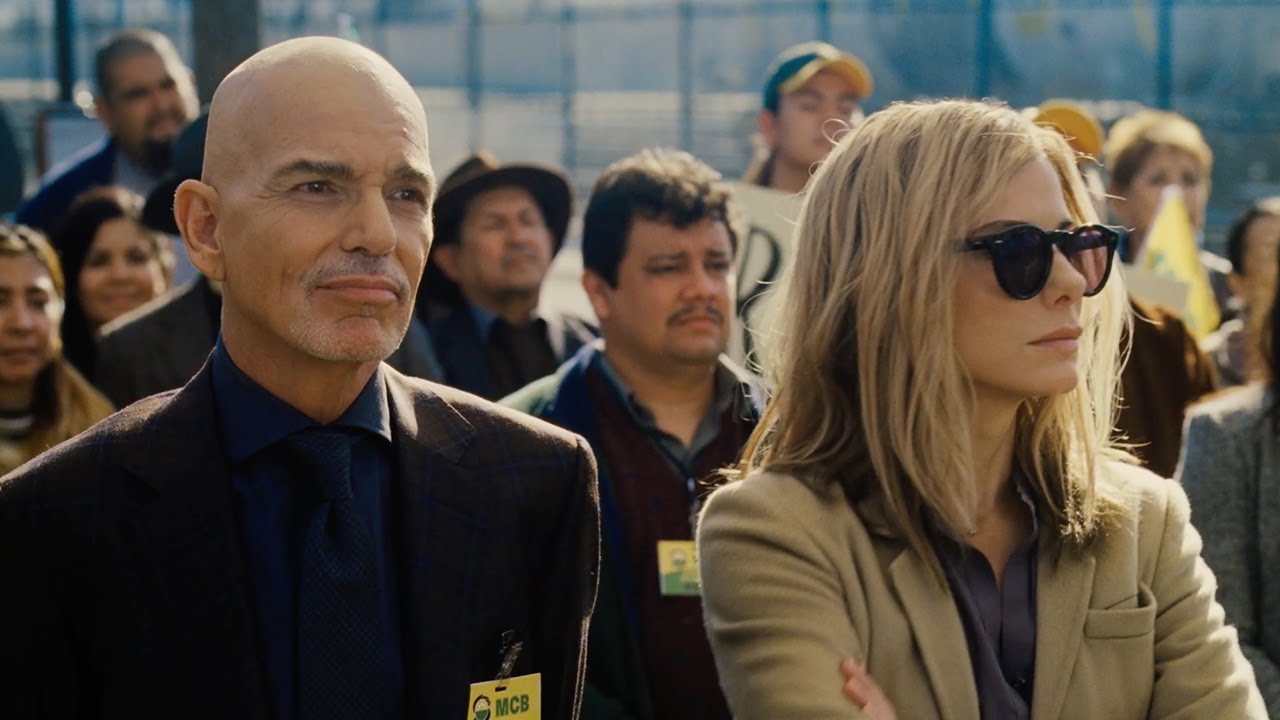
It does, however, have one great redeeming feature: Sandra Bullock. In a movie that tries too hard and spreads itself too thin (and often in the same scene), Bullock is the through line that the audience can connect and stay with. Beneath her seen-it-all-with-warts-on demeanour and lack of shame at some of the things she devises, Jane is a memorable character made all the more memorable for Bullock’s portrayal of her as a media-savvy manipulator with hidden reserves of compassion. There’s a scene at the end that, in the hands of some actresses, would have appeared maudlin and unconvincing. But Bullock nails it with a dazed expression and eyes full of fear for what she’s done. It’s the movie’s strongest, most affecting moment; it’s just a shame that it comes so late in the day.

Developed by George Clooney and his producing partner Grant Heslov, Our Brand Is Crisis was originally meant to be directed by and star Clooney, but as time – and the movie’s development – rolled on, his intended participation dwindled to that of producer. Seeing the movie now this seems like a wise move on his part. Even though Green is a clever, often mercurial director, he’s defeated here by the hit-and-largely-miss script, and as a result he never finds a consistent tone that the movie can adhere to. Away from Bullock, the rest of the cast provide serviceable performances (thanks to some cruelly underdeveloped characters), with only de Almeida showing what can be done with the briefest of outlines. And Thornton, drafted in to give one of his patented Machiavellian opponent roles, does just that – and nothing more.

Rating: 5/10 – an undemanding look at how political campaigns can be manipulated toward a desired outcome, Our Brand Is Crisis lacks dramatic focus and a clear approach to the material; saved by Bullock’s performance, the movie nevertheless struggles to fly when she’s not on screen, and ends up as disappointing as the electoral outcome.

Share this:

  • Click to share on X (Opens in new window) X
  • Click to share on Facebook (Opens in new window) Facebook
  • More
  • Click to print (Opens in new window) Print
  • Click to email a link to a friend (Opens in new window) Email
Like Loading...

Blackthorn (2011)

18 Friday Jul 2014

Posted by dullwood68 in Movies

≈ Leave a comment

Tags

Bolivia, Butch Cassidy, Sam Shepard, Stolen money, Western

Blackthorn

D: Mateo Gil / 102m

Cast: Sam Shepard, Eduardo Noriega, Stephen Rea, Magaly Solier, Nikolaj Coster-Waldau, Padraic Delaney, Dominique McElligott

Bolivia, 1927: An old man named Blackthorn (Shepard) writes a letter to his nephew saying that after spending too long in South America, he is planning to come back to the US and finally meet the young man he’s never seen.  Leaving behind the woman who’s shared part of his life in Bolivia, Yana (Solier), Blackthorn sets off on horseback.  Along the way he encounters Eduardo Apodaca (Noriega), a Spanish engineer with a nearby mining company who has stolen $50,000 and is being chased by what appear to a posse hired by the mining company.  Blackthorn agrees to help Apodaca in return for half of the money, and they head for the mine where the money is hidden.

As they make their way there, flashbacks show that Blackthorn is actually Butch Cassidy (Coster-Waldau), believed to have died in a shootout with the Bolivian army in 1908.  With his partner, the Sundance Kid (Delaney) and Etta Place (McElligott), he travels from the US down through Mexico and into Argentina, where in 1905 he is almost captured by Pinkerton agent Mackinley (Rea).  Later, Ella, now pregnant with Sundance’s child, returns to the States; Butch and Sundance end up in Bolivia where the aftermath of their encounter with the Bolivian army leaves Butch helping a wounded Sundance to escape.

Blackthorn and Apodaca retrieve the money and narrowly avoid the posse.  They return to Blackthorn’s cabin, but the next morning two members of the posse arrive looking for Apodaca.  There is a shootout in which Blackthorn is wounded, and Yana and the posse members are killed.  The two men attempt to flee the country by heading across the Uyuni salt flats and over the mountains beyond.  The posse tries to outflank them; the two men split up and in the process manage to kill their pursuers.  Blackthorn reaches a nearby town and is treated by a doctor.  While he’s unconscious, the doctor notifies a now retired Mackinley about Blackthorn’s presence.  At first, Mackinley plans to have Blackthorn arrested by the Bolivian army, but he changes his mind; he also tells Blackthorn the truth about Apodaca’s theft of the money: the mining company is owned by the mining families, which means Blackthorn has aided Apodaca in stealing from “the people”, something which is at odds with his principles.  He sets out to track down the Spaniard, but is pursued by the Bolivian army and the miners.

Blackthorn - scene

A slow-moving, often leisurely movie, Blackthorn takes a “What if…?” idea – what if Butch Cassidy didn’t die in 1908 but lived on, what would he be like, say, twenty years on? – and spends an hour and forty-two minutes still trying to work out an answer to the question.  On the surface, Blackthorn is a handsomely mounted movie that aims for an elegiac feel but instead falls short, its pace so slow at times that elegiac becomes sluggish.  The main problem is that once it’s clear that Blackthorn is Cassidy, the mythic nature of the man is confirmed, leaving his involvement with Apodaca and the pursuing miners something of a letdown.  It’s perhaps more realistic in terms of the time and place, but it’s also less satisfying at the same time.  It’s as if the filmmakers, deciding to bring Cassidy back, then couldn’t come up with a better story to suit the man and his iconic status.

The character of Apodaca is also a problem, his callow treachery entirely to be expected, and Blackthorn’s inability to see through him as believable as Mackinley’s later change of heart.  It all goes to serve a plot that twists and turns in on itself with increasing frequency, the money stolen by the Spaniard proving no more than one of Hitchcock’s famous McGuffins, an unadventurous hook on which to hang the storyline and the action.  Also, with Blackthorn proving such a taciturn and irascible old man, it becomes difficult to sympathise with him as the movie progresses.  Even when he becomes aware of Apodaca’s lies, his reaction is less angry and more slightly peeved, which is in stark contrast to when his initial encounter with Apodaca leads to the loss of his horse and the $6000 in savings it was carrying.  Losing his horse makes him furious; duping him and putting his life in danger, well, that’s not so bad.

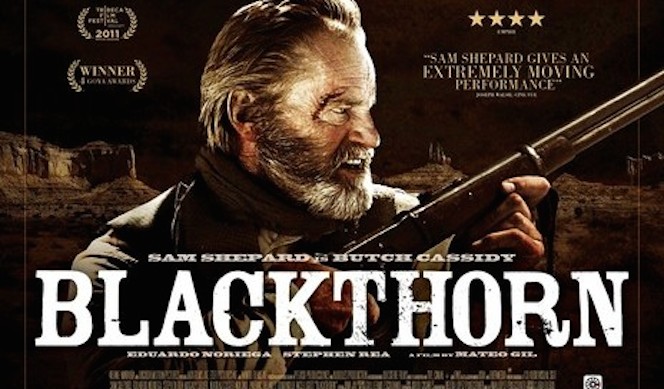
Shepard is a great choice for Blackthorn, but the producers decision to cast Coster-Waldau as the outlaw’s younger self, undermines the idea that only twenty years have passed since Cassidy’s “demise”, as there’s no physical similarity between them, and there’s such a disparity in their characters that any sense of regret that Blackthorn may feel at spending so much time in Bolivia seems false by comparison.  That said, Shepard brings a quiet authority to the role, as well as a requisite world-weariness, and is a commanding presence that is sorely missed in those scenes he doesn’t take part in.  As the Spaniard, Noriega is whiny and annoying in equal measure, but has little room to manoeuvre as the script by Miguel Barros doesn’t attempt to add any flesh to the character’s bones.  Rea is a breath of fresh air, his measured performance as Mackinley adding some true depth and pathos to the notion that these two men, once great adversaries, have seen their time come and go, and now deserve whatever peace they can find.

Gil is a capable director, and makes the most of the Bolivian locations, in particular the salt flats which are spectacular, but he falters when trying to find the emotion in a scene, or the connection between some of the characters; only Blackthorn’s relationship with Yana has any degree of conviction or truth to it.  Barros’ script attempts to extract some mileage out of Blackthorn’s age and situation but it often feels forced and unreliable.  Shot with the deliberate look and feel of a Sixties western, Blackthorn looks the part, and it has that Spanish feel to it that is reminiscent of international oaters of the time.  And there’s a great score by Lucio Godoy that evokes the period and the movie’s western antecedents with emotive aplomb.

Rating: 6/10 – not a bad movie per se, Blackthorn still falls short of its ambitions, stumbling through a too simple story that lacks depth and passion; often beautiful to look at, it’s for fans of speculative drama and the great Sam Shepard.

Share this:

  • Click to share on X (Opens in new window) X
  • Click to share on Facebook (Opens in new window) Facebook
  • More
  • Click to print (Opens in new window) Print
  • Click to email a link to a friend (Opens in new window) Email
Like Loading...

Blog Stats

  • 486,528 hits

Recent Posts

  • 10 Reasons to Remember Bibi Andersson (1935-2019)
  • Fantasia (1940)
  • Dances With Wolves (1990) – The Special Edition
  • Kiss of the Spider Woman (1985)
  • The Three Musketeers (1973)

Top Posts & Pages

  • Lost for Life (2013) - Another Look
    Lost for Life (2013) - Another Look
  • Lost for Life (2013)
    Lost for Life (2013)
  • About
    About
  • Mr. Topaze (1961)
    Mr. Topaze (1961)
  • Winter's Tale (2014)
    Winter's Tale (2014)
  • Billy Lynn's Long Halftime Walk (2016)
    Billy Lynn's Long Halftime Walk (2016)
  • The Hitman's Bodyguard (2017)
    The Hitman's Bodyguard (2017)
  • Shock and Awe (2017)
    Shock and Awe (2017)
  • 5 Famous Movie Roles That Nearly Went to Someone Else
    5 Famous Movie Roles That Nearly Went to Someone Else
  • The Layover (2017)
    The Layover (2017)
Follow thedullwoodexperiment on WordPress.com

Blogs I Follow

  • Rubbish Talk
  • Film 4 Fan
  • Fast Film Reviews
  • The Film Blog
  • All Things Movies UK
  • Interpreting the Stars
  • Let's Go To The Movies
  • Movie Reviews 101
  • TMI News
  • Dan the Man's Movie Reviews
  • Film History
  • Jordan and Eddie (The Movie Guys)

Archives

  • April 2019 (13)
  • March 2019 (28)
  • February 2019 (28)
  • January 2019 (32)
  • December 2018 (28)
  • November 2018 (30)
  • October 2018 (29)
  • September 2018 (29)
  • August 2018 (29)
  • July 2018 (30)
  • June 2018 (28)
  • May 2018 (24)
  • April 2018 (21)
  • March 2018 (31)
  • February 2018 (25)
  • January 2018 (30)
  • December 2017 (30)
  • November 2017 (27)
  • October 2017 (27)
  • September 2017 (26)
  • August 2017 (32)
  • July 2017 (32)
  • June 2017 (30)
  • May 2017 (29)
  • April 2017 (29)
  • March 2017 (30)
  • February 2017 (27)
  • January 2017 (32)
  • December 2016 (30)
  • November 2016 (28)
  • October 2016 (30)
  • September 2016 (27)
  • August 2016 (30)
  • July 2016 (30)
  • June 2016 (31)
  • May 2016 (34)
  • April 2016 (30)
  • March 2016 (30)
  • February 2016 (28)
  • January 2016 (35)
  • December 2015 (34)
  • November 2015 (31)
  • October 2015 (31)
  • September 2015 (34)
  • August 2015 (31)
  • July 2015 (33)
  • June 2015 (12)
  • May 2015 (31)
  • April 2015 (32)
  • March 2015 (30)
  • February 2015 (37)
  • January 2015 (39)
  • December 2014 (34)
  • November 2014 (34)
  • October 2014 (36)
  • September 2014 (25)
  • August 2014 (29)
  • July 2014 (29)
  • June 2014 (28)
  • May 2014 (23)
  • April 2014 (21)
  • March 2014 (42)
  • February 2014 (38)
  • January 2014 (29)
  • December 2013 (28)
  • November 2013 (34)
  • October 2013 (4)

Blog at WordPress.com.

Rubbish Talk

Film 4 Fan

A Movie Blog

Fast Film Reviews

The Film Blog

The official blog of everything in film

All Things Movies UK

Movie Reviews and Original Articles

Interpreting the Stars

Dave Examines Movies

Let's Go To The Movies

Film and Theatre Lover!

Movie Reviews 101

Daily Movie Reviews

TMI News

Latest weather, crime and breaking news

Dan the Man's Movie Reviews

All my aimless thoughts, ideas, and ramblings, all packed into one site!

Film History

Telling the story of film

Jordan and Eddie (The Movie Guys)

Movie Reviews & Ramblings from an Australian Based Film Fan

Privacy & Cookies: This site uses cookies. By continuing to use this website, you agree to their use.
To find out more, including how to control cookies, see here: Cookie Policy
  • Subscribe Subscribed
    • thedullwoodexperiment
    • Join 481 other subscribers
    • Already have a WordPress.com account? Log in now.
    • thedullwoodexperiment
    • Subscribe Subscribed
    • Sign up
    • Log in
    • Report this content
    • View site in Reader
    • Manage subscriptions
    • Collapse this bar
 

Loading Comments...
 

    %d