Cast: Chloë Sevigny, Kristen Stewart, Jamey Sheridan, Fiona Shaw, Kim Dickens, Denis O’Hare, Jeff Perry
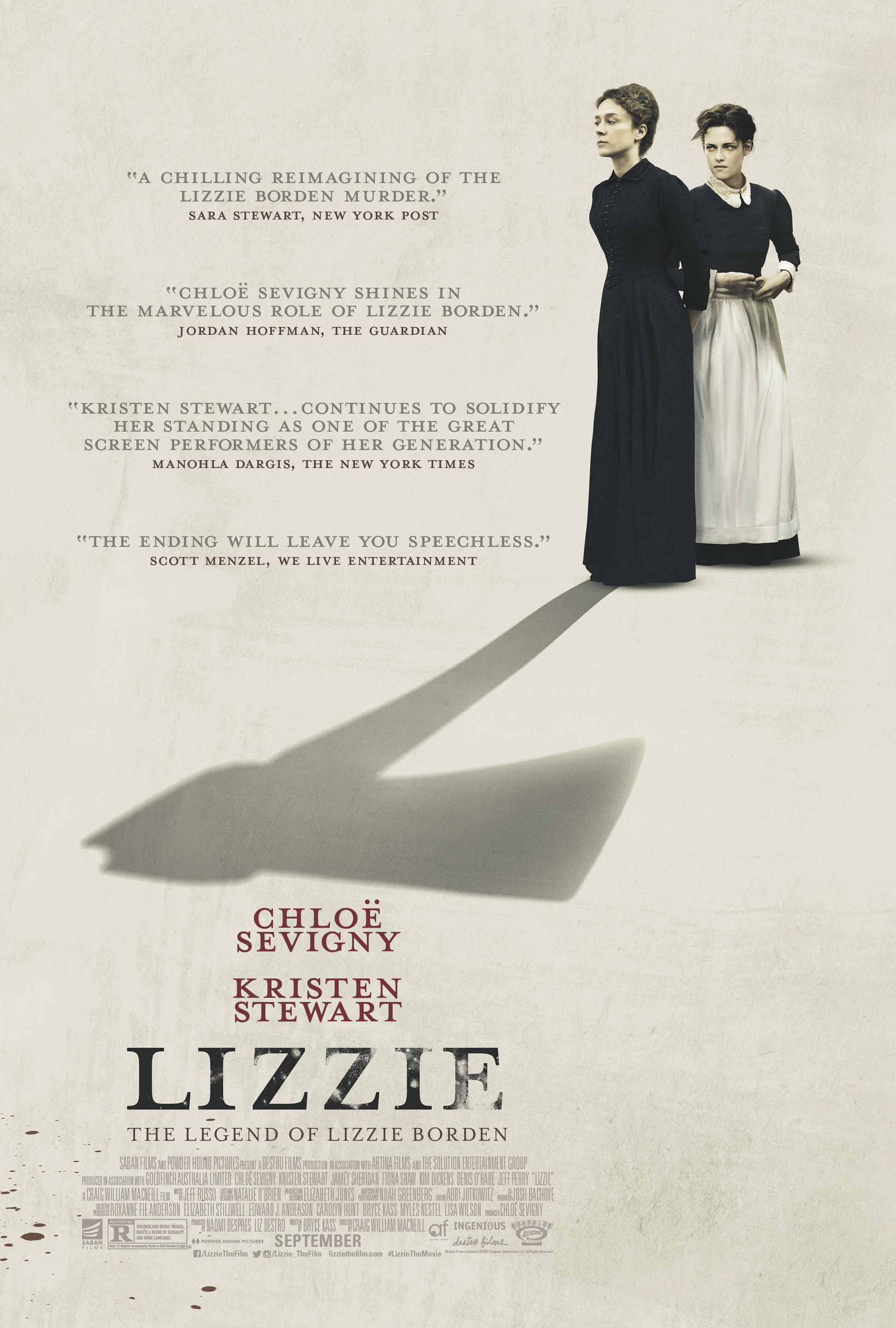
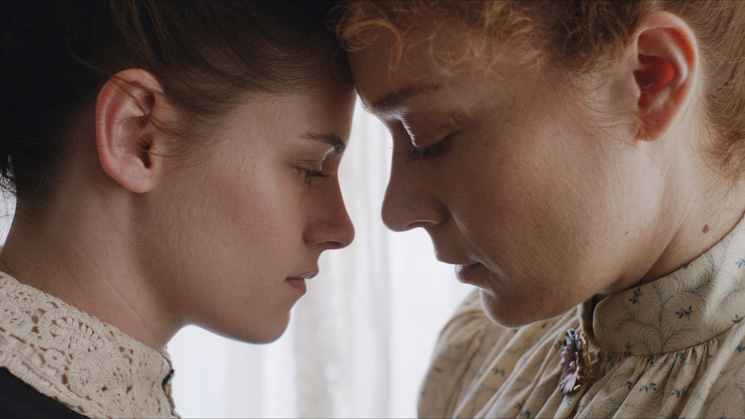
Fall River, Massachusetts, 1892. Lizzie Borden (Sevigny) is the youngest daughter of respected local businessman Andrew Borden (Sheridan). Unmarried at thirty-two, Lizzie is constantly at odds with her father over the way in which she conducts herself. She finds a supporter of sorts when her father engages a new servant, Bridget Sullivan (Stewart). Known as Maggie, Bridget and Lizzie develop a close bond just when Andrew begins receiving anonymous threats to his life. Consulting with his brother-in-law, John Morse (O’Hare), he alludes to a will that would see Morse inherit his estate if his wife, Abby (Shaw), were to pre-decease him. Lizzie overhears this conversation and decides to take matters into her own hands. Her actions lead to an outbreak of violent events within the Borden household, while at the same time, Lizzie and Bridget become lovers. Lizzie’s father discovers their relationship and forbids Lizzie from having anything to do with Bridget unless it is related to her role as a servant. And then on the morning of 4 August, Lizzie discovers that someone has killed her father…
Something of a cause célèbre even now, the murders of Andrew and Abby Borden have become the stuff of gory legend, spawning a famous rhyme (“Lizzie Borden took an axe…”), and maintaining a lurid fascination that is unlikely to dissipate anytime soon. Of course, the main problem with any re-telling of the story is that Lizzie was tried and acquitted of the murders, and no one else was ever accused (though Morse was viewed as a possible suspect for a while). With this in mind, any explanation for the murders must be conjecture only, and Bryce Kass’s chilly screenplay chooses to adopt the theory put forward by crime writer Ed McBain in 1984, that Lizzie killed her father and stepmother after her lesbian relationship with Bridget had been discovered. The issue of the will adds a further twist to the story, and seems as likely as any other reason, but the script approaches these theories as if they are fact, and any ambiguity is abandoned with the recreation of the Bordens’ deaths. Up until then, the movie has established an atmosphere of subdued yet inevitable violence that is almost suffocating; knowing what’s going to happen makes it all the worse. And when it does, it’s almost as cathartic for the viewer as it appears to be for Lizzie.
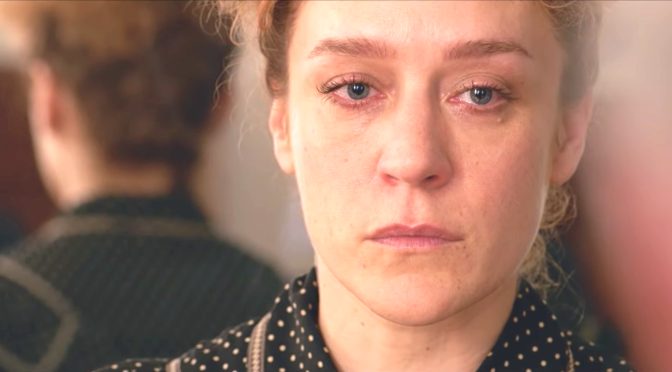
Lizzie is brought to life thanks to a wonderfully astute performance from Sevigny that highlights both the character’s rebellious nature and the deeper passions that she had to keep hidden. It’s an intelligent, well constructed portrayal that never falters in its conviction and which isn’t afraid to make Lizzie unsympathetic, as in the aftermath of the murders when she appears unperturbed (we see these scenes before we see the murders). Stewart has the more emotional role, and projects Bridget’s discomfort at the situation she finds herself in with empathy and compassion. There’s sterling support from Sheridan as the domineering Andrew Borden, and O’Hare is suitably nasty as the avaricious Morse, but Shaw and Dickens are left with precious little to do except when it suits the screenplay. Macneill directs with a keen understanding that Lizzie feels very much like a prisoner in her own home, and Noah Greenberg’s exemplary cinematography captures and expands on this idea through careful framing and extensive use of close ups. There are some minor issues with pacing as the movie introduces both the characters and the psychological backdrop to their behaviours, and the score by Jeff Russo doesn’t always complement the action, but overall this is an impressive, richly detailed recreation of two visceral, unsolved murders that continue to enthrall and captivate us over a hundred and twenty years on.
Rating: 8/10 – anchored by a sterling performance by Sevigny, and a palpable sense of impending dread, Lizzie is a subtle, yet powerful movie that explores what can happen when repressed emotions remain that way for too long; beginning as a perceptive character study before descending into startling, but necessary melodrama, it’s an intriguing, intelligently expressed piece that is confidently handled and often unflinching in its approach.
With all the potential topics available to movie makers worldwide, and all the potential titles that could be used by movie makers, it does seem a little unfair on audiences when two movies are released relatively close to each other, and have the same title. Remakes are to be expected, but original movies? Surely, movie makers could check to see ahead of time if some other release is using the same title? And if so, to avoid any confusion, change theirs if they’re going to be second out of the gate? Well, with these two movies that obviously didn’t happen. But if anyone out there is reading this, and they have a movie coming out that has the same title as another recent release, please could you make it clear in the advertising that your movie isn’t the other one? Because that would definitely ensure that viewers don’t run the risk of being disappointed (as they would be in this instance).
The Boy (2015) / D: Craig William Macneill / 110m
Cast: David Morse, Jared Breeze, Rainn Wilson, Bill Sage, Mike Vogel, Zuleikha Robinson, Aiden Lovekamp, David Valencia, Sam Morse
A quiet motel, the Mountain View Lodge, is the setting for this adaptation of a section of a novel by Clay McLeod Chapman, a dark psychological thriller that deftly explores the mind of nine year old Ted Henley (Breeze), a boy with little to do other than clean the rooms and scoop up roadkill from outside the motel. Ted is a quiet child who misses his mother; she ran off with someone who stayed at the motel and is now living in Florida. His father, John (Morse), is a lonely, broken down man running a lonely, broken down motel, and both in their own way are still grieving the loss of Ted’s mother. John drinks too much, while Ted – who gets paid twenty-five cents for every roadkill he finds – begins to leave food on the main road so that animals will be attracted to it and run over. His aim is to amass enough money to leave and journey to Florida. And when his father mentions a deer being in the vicinity, Ted sees a chance to “make a killing”.
His plan goes slightly awry. The deer is hit by a car that ends up in need of repair, and the driver suffers a bad head injury. The man, named Colby (Wilson), ends up staying while he recuperates and his car is fixed. As the only other person there, Ted starts to gravitate towards him, and they strike up a friendship of sorts. When a couple and their son arrive and need an overnight stay, Ted fixes their car so that it won’t start the next morning. While they hang around another day, Ted and the son play together, but Ted’s lack of social awareness makes their play awkward for the other boy. When the family leaves, Ted reverts back to spending time with Colby, and he learns that the man has recently lost his wife in a fire.
But Ted’s interest in Colby is matched by the local Sheriff’s interest in him as well. Colby’s story about his wife may not be the whole truth, and a decision that Ted makes has terrible consequences, but not as terrible as the consequences when attendees at a local prom book the motel for their post-prom celebrations and treat Ted badly.
The Boy is often an uncomfortable viewing experience, but not for the reasons you may be thinking. Anyone watching the movie beyond its opening stretch will feel certain that what they’re watching is the slow accumulation of traits that will lead to Ted’s first foray into full-blown sociopathic behaviour. And for the most part, they’d be right. But while Ted is front and centre for most of the movie, Macneill pays close attention to the two fathers in Ted’s life during this time, and in doing so, also makes much of the atmosphere that inadvertently supports Ted’s inevitable “decline”.
John is unable to connect with his son, unable to realise just how much Ted is hurting over the loss of his mother. It’s likely he’s always been unable to connect with Ted; he mentions how time-consuming running the motel has always been. It’s therefore also likely that his father has been neglecting Ted for as long as Ted can remember (John inherited the motel from his father). With both parents absent from his life, one physically, the other emotionally, it’s no wonder that Ted has grown up with a different view on life than anyone else he knows (or meets). It’s also no wonder that he tries to strike up a relationship with Colby. Colby represents an opportunity for escape, but Colby has his own issues, issues that conflict with Ted’s needs. There is an inevitable confrontation, but while it’s a necessarily dramatic one, it pales before the conversation Colby has with John about what’s best for Ted. So much is said, and yet it’s what is left unsaid by the two men (and yet understood by them) that makes their conversation so important and so relevant. It’s the point in the movie when the viewer realises that Ted is lost forever.
As Ted, Breeze gives an astonishing, mesmerising performance. The movie’s effectiveness rests almost solely on his young shoulders, but he’s more than up to the challenge, portraying Ted with an eerie, absent intensity that is more chilling to see than any number of masked slashers. There’s a moment where he clutches a rabbit to his chest, and the vacant look on his face is so disconcerting it’s hard to know if the rabbit is safe or not. Kudos then to Macneill for his direction of Breeze, a major plus that could have gone horribly wrong, and a testament to both their individual skills. Elsewhere, Macneill maintains a palpable sense of impending, unavoidable dread, using the Colombian locations to excellent effect and playing up the unremitting remoteness of Ted’s childhood.
But while the bulk of The Boy is chilling and engrossing, it’s in the last thirty minutes that it takes an unfortunate stumble. The prom party are deliberately antagonistic and unsympathetic, and treat Ted harshly. Their behaviour, coupled with his father’s final act of neglect, pushes Ted to take much more determined, and deliberate steps on his road to becoming a full-blown sociopath. Macneill lets the sequence get away from him, prolonging an audio aspect of things way beyond what’s necessary, and tying things up rather too neatly, thereby negating the complex narrative structure he and original author Chapman have constructed up til then.
Rating: 8/10 – as an examination of nascent evil, The Boy is unsettling in its portrait of a nine year old’s unhealthy fascination with death; with superb performances from Morse and Wilson, and especially Breeze, Macneill’s movie is one that will linger long in the mind, and prove difficult to shift.
The Boy (2016) / D: William Brent Bell / 93m
Cast: Lauren Cohan, Rupert Evans, Jim Norton, Diana Hardcastle, James Russell, Ben Robson
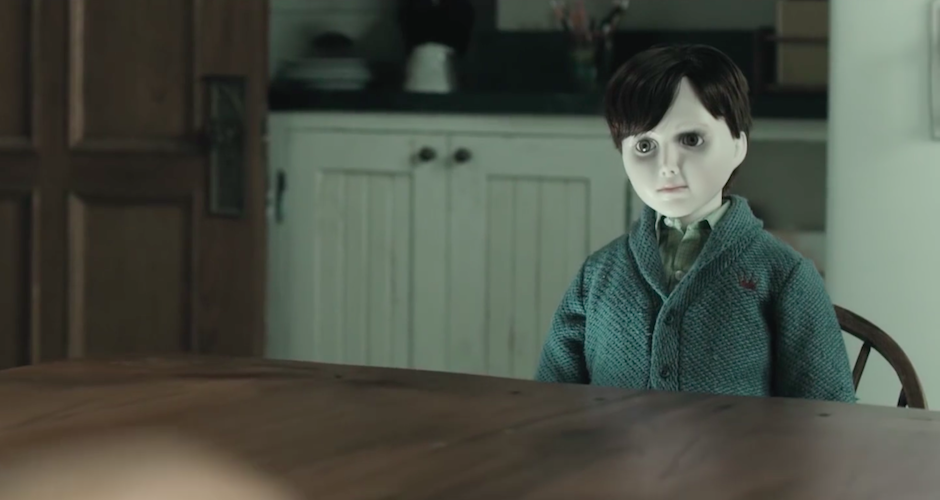
The boy in William Brent Bell’s inefficient chiller is actually a doll, and rather than have a fairly nondescript name like Ted Henley, goes by the unlikely moniker of Brahms Heelshire (pronounced Hillsher). Despite having perished in a fire twenty years ago, Brahms’ memory is kept alive by his parents (Norton, Hardcastle), who treat the doll as if Brahms were still alive. They “teach” him, play him music, read to him, set a place for him at meal times, and have set times when he “sleeps”. Into this bizarre situation comes American, Greta Evans (Cohan), to act as Brahms’ nanny while the Heelshires take their first trip away in twenty years. Before she’s even got halfway through the front door her shoes go missing, the first example of several mysterious occurrences that happen in the following days, and which lead her to believe that the doll is possessed by Brahms’ restless spirit.
As you might expect, The Boy is a silly attempt at a horror movie, and one that stretches credibility as often as it possibly can. In contrast to its titular “rival”, this movie lacks subtlety, a coherent script, competent direction, and halfway decent performances. It’s the kind of movie that looks as if it was offered to Hammer but they turned it down because it needed too much work to make it, well, work. As it is, we’re treated to interminable shots of the doll staring back at the camera, Greta exploring the Heelshires’ house and finding herself trapped at one point in the attic, the promise of Greta’s abusive boyfriend turning up just to be killed, and a twist that undoes everything – however superficial – that the movie has built up until then.
The performances are serviceable, though Norton and Hardcastle bring a level of competence to their roles that the movie doesn’t deserve. Otherwise there’s very little to recommend The Boy, only that it’s mercifully forgettable.
Rating: 3/10 – despite a level of expectation that the movie has no intention of following through on, The Boy is neither scary nor terrifying, and for the most part settles for risible; Cohan is wasted, and Evans struggles as a character who has no clear reason for being there except to look confused – much like the unlucky viewer who settles down to watch this thinking they’re going to watch a movie about a nine year old sociopath.




 thedullwoodexperiment