• 10 Reasons to Remember…
  • A Brief Word About…
  • About
  • For One Week Only
  • Happy Birthday
  • Monthly Roundup
  • Old-Time Crime
  • Other Posts
  • Poster of the Week
  • Question of the Week
  • Reviews
  • Trailers

thedullwoodexperiment

~ Viewing movies in a different light

thedullwoodexperiment

Tag Archives: Diary

The Sense of an Ending (2017)

04 Sunday Jun 2017

Posted by dullwood68 in Movies

≈ Leave a comment

Tags

Charlotte Rampling, Diary, Drama, Harriet Walter, Jim Broadbent, Literary adaptation, Review, Ritesh Batra, Suicide, The Sixties
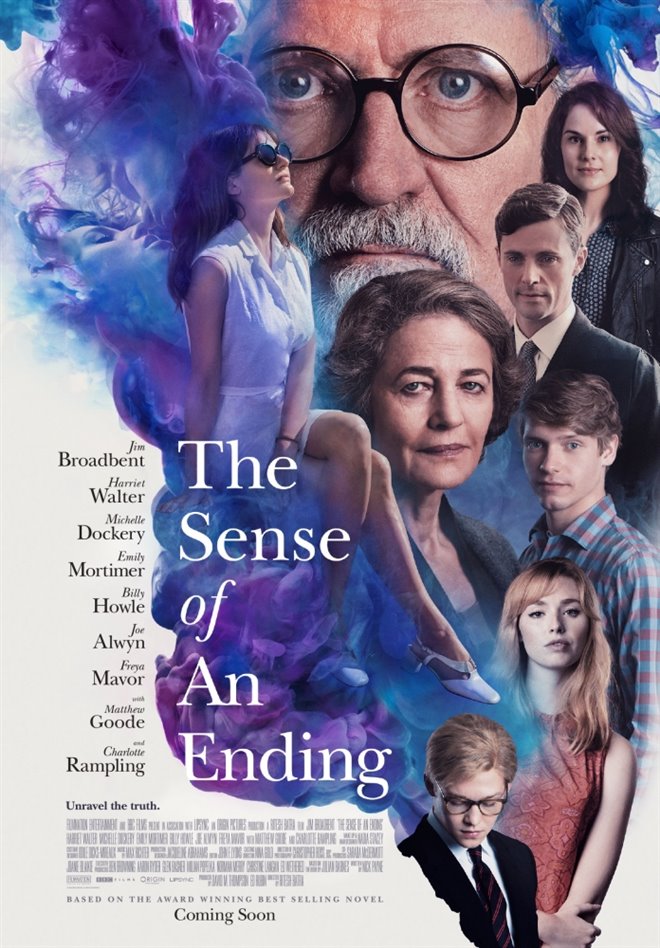
D: Ritesh Batra / 108m

Cast: Jim Broadbent, Charlotte Rampling, Harriet Walter, Michelle Dockery, Matthew Goode, Emily Mortimer, James Wilby, Edward Holcroft, Billy Howle, Freya Mavor, Joe Alwyn, Peter Wight, Hilton McRae

In Ritesh Batra’s first movie since The Lunchbox (2013), Jim Broadbent’s elderly divorcé, Tony Webster, receives a solicitor’s letter telling him that he has been left something in the will of a woman he knew back in the Sixties. The woman was Susan Ford (Mortimer), the mother of Tony’s first love, Veronica (Mavor). At first, Tony is puzzled by the news, and he’s further puzzled when he discovers that the “something” is the diary of a schoolfriend, Adrian Finn (Alwyn). This prompts Tony to reflect back on his life as a university student, and his relationship with Veronica. But getting hold of Adrian’s diary proves more difficult than he expects; it’s in Veronica’s hands and she’s not passing it on to her solicitors’.

Tony seeks advice from his ex-wife, Margaret (Walter), who is also in the legal profession. Margaret, though, can’t understand why getting hold of the diary means so much to Tony, so he attempts to tell her the story of how he and Veronica met, and the beginning of his friendship with Adrian. As he recounts that period of his life, Tony remembers times and events that he had largely forgotten, and he begins to suspect that things were happening that he wasn’t fully aware of. Eventually he persuades Veronica’s solicitors to ask her to contact him, and they arrange to meet. Tony is expectant that he’ll finally receive the diary, but Veronica is distant and tells him that she’s burnt it. After the meeting, Tony follows Veronica but is unable to find out where she lives.
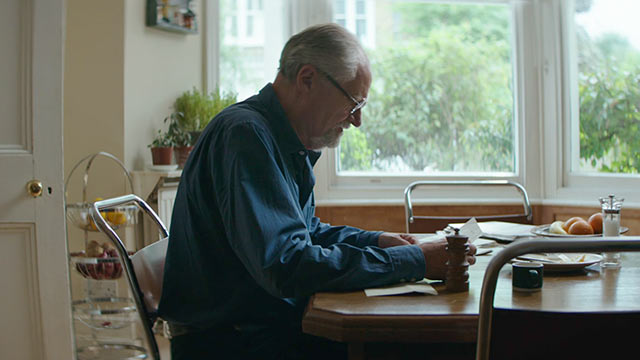
Tony’s memories of his student days continue to plague him, forcing him to remember a letter he wrote when Veronica stopped seeing him and began seeing Adrian instead. The events that followed his sending the letter make Tony view himself in a bad light, but then another attempt to follow Veronica reveals a circumstance that takes him by surprise. In time, this circumstance shows that his understanding of the events of his school days is not only flawed, but has informed the majority of his adult life, something that means Tony has to face up to the idea that he’s lived a life that could have been very much different.

An adaptation of Julian Barnes’ 2011 Man Booker Prize-winning novel, The Sense of an Ending is the kind of low-key, measured drama that offers big rewards provided that you can get past its slow, deceptively pedestrian approach. This is a movie that relies on teasing out the emotional undercurrents of its story, and doing so in a well considered, thoughtful manner that makes each revelation and divulgence of motive more affecting than you might suspect. Barnes’ novel concerned itself with notions of memory and ageing, and while both those aspects are present here, there are others that are equally potent. Adapted by Nick Payne, the movie seeks to explore the ways in which the actions of our youth inform our behaviour as adults, and the ways in which the consequences of those actions can lead to repressed feelings and the slow accumulation of guilt.

At the beginning of the movie, Tony has no understanding of the events that surrounded him as a student, other than how they affected him at the time. However, Tony’s involvement, when looked at closely, was entirely minimal, and as the movie progresses and we see more of those events unfold, what emerges is a portrait of a man trying to attach meaning to a period of his life where he was in many ways a supporting character in the drama of everyone else’s lives. It’s instructive that as an adult Tony’s life is lived somewhat on the fringes as well. He’s divorced though still in touch with his ex-wife, has a daughter whose pregnancy brings them only slightly more together (he attends a pre-natal class with her), and owns a business that sells classic Leica cameras (in a very small shop). It’s not clear that he has any appreciable “life” beyond these things, and his general demeanour is dismissive. He may not be living in the past – until the solicitor’s letter arrives that is – but he’s not exactly living in the present either.

As the past exerts a fearsome pull on Tony, his memories begin to have a profound effect on him, leading him to question what he remembers and what actually happened. Veronica is pre-disposed not to help him, and as her story is revealed you can understand why. But Tony’s determination to solve the mystery of his youth and reconstruct his younger self from the tangle of his memories at least proves cathartic, and by the movie’s end he’s more settled than perhaps he’s ever been. As we follow Tony on his journey of self-rediscovery, we’re guided along the way by another terrific performance from the ever-reliable Broadbent, whose initially perplexed expressions speak of credible bemusement. But soon these give way to expressions of doubt and regret, as the full enormity of what happened all those years ago begins to unravel and Tony’s foundations as an adult begin to crumble. Broadbent allows the audience to see the tragic trajectory of Tony’s life, and the hollow man he’s become, and still he maintains a sympathy for the character that’s not entirely deserved.
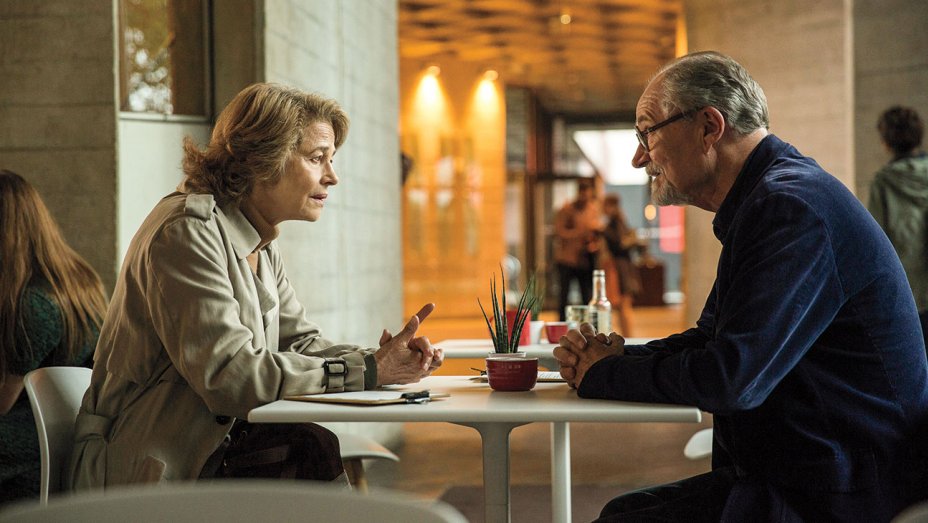
Carrying the majority of the movie, Broadbent is simply magnificent in a role that is heartfelt, honest and sincere. He’s also at the top of a very impressive cast, with Rampling excelling as usual as Veronica, a woman who has no time for broad introspection or revisiting a past that is painful to her if not to Tony. The rest of the cast provide sterling support, with special mentions going to Howle as the younger Tony, and Mortimer as Veronica’s mother. Even the likes of Goode and Holcroft (as Tony’s teacher and Veronica’s brother respectively) make an impact despite being given less to do than others, and Alwyn – in only his second movie after Billy Lynn’s Long Halftime Walk (2016) – handles Finn’s philosophical musings with both humour and subtlety.

The contrasts between the past and the present are handled well by Batra and his talented production crew, with Tony’s student days presented in a warm, nostalgic glow that could be considered rose-tinted were it not for the tragic elements at the heart of it all. The present day is much more airy and coolly defined, with sharper colours and rigid edges used to define the emotional trap waiting for Tony to walk into it. Batra displays a confidence with the material that keeps it all feeling genuine and without guile, and as the narrative builds toward its inevitable (and only semi-signposted) revelation, his skill at revealing the various complexities of Tony’s student days becomes more and more evident. And by the time Tony’s daughter has given birth and he’s accepted his life for what it can be rather than what it is, the movie has provided rich dividends for the viewer willing to look beyond its superficially mundane surface.

Rating: 8/10 – something of a mood piece, but bolstered by assured direction, a weighty and compelling script, and skilled performances from its cast, The Sense of an Ending is an engaging and thought-provoking movie that makes a virtue of its earnest and somewhat melancholy narrative; a prime example of a literary adaptation that takes the virtues of its source material and adds a smattering of cinematic probity to the mix, it’s a plaintive, absorbing investigation into the nature of elusive recall and the relationship between memory and remembrance.
Share this:

  • Click to share on X (Opens in new window) X
  • Click to share on Facebook (Opens in new window) Facebook
  • More
  • Click to print (Opens in new window) Print
  • Click to email a link to a friend (Opens in new window) Email
Like Loading...

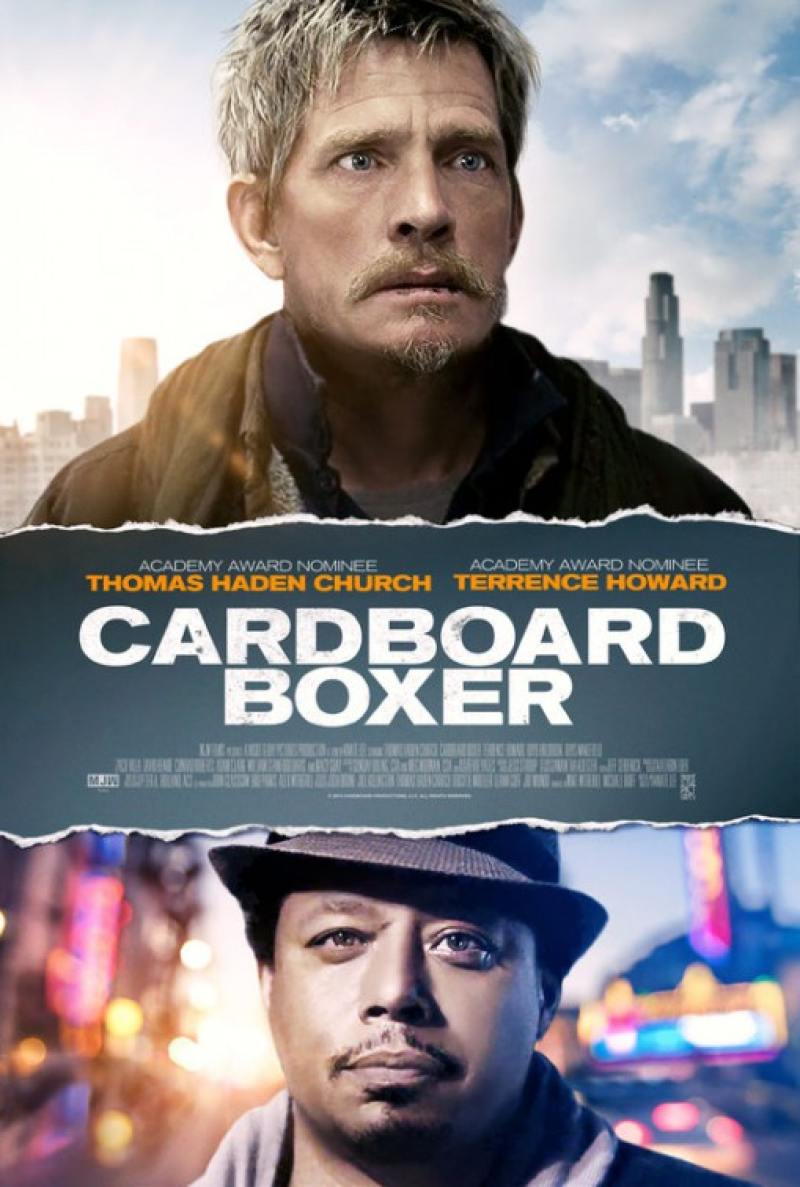
Cardboard Boxer (2016)

18 Friday Nov 2016

Posted by dullwood68 in Movies

≈ Leave a comment

Tags

Boyd Holbrook, Diary, Drama, Fighting, Homelessness, Knate Lee, Review, Terrence Howard, Thomas Haden Church

cardboard-boxer_poster

D: Knate Lee / 88m

Cast: Thomas Haden Church, Terrence Howard, Boyd Holbrook, Rhys Wakefield, Zach Villa, William Stanford Davies, Macy Gray, Carlton Byrd, David Henrie, Conrad Roberts, Adam Clark

Willie (Church) is a homeless man who sleeps in a cardboard box at night, and who wanders the streets by day looking for food wherever he can find it (even if it’s not exactly fresh), and hoping to score money from passersby. He lives a lonely existence, keeping himself to himself and spending a considerable amount of his “downtime” on a rooftop that affords him a panoramic view of the city where he lives. Down at ground level, home is a place on a back street with a group of other homeless people.

Willie doesn’t engage with other people. He keeps himself to himself, and tries not to get in anybody else’s way, including a local man (Clark) who carries a skillet and threatens to hurt anyone in the homeless group who aggravates him. Fortunately, while his approach to the group is antagonistic, there’s a taxi driver everyone calls The Pope (Howard) who is supportive; he provides blankets and food when he can. Willie and The Pope have a grudging respect for each other, but there are also clear boundaries that The Pope keeps in place.

cardboard-boxer-600x306

One day, Willie finds a little girl’s diary in a rubbish container. It’s burnt around the edges, like the other stuff there, but curious, he begins to read it. He learns at the beginning that the little girl has started the diary after her mother has died. Finding himself affected by her story he attempts to continue reading it, but is defeated by its being in cursive (basically joined-up writing). He begins to ask others in the homeless group if they’ll read it for him but he’s rebuffed at every turn. It’s not until he helps a war veteran, a man named Pinky (Holbrook), that he finds someone willing to read the rest of the diary to him (though he does learn to read cursive as well).

Some time later, two young men, JJ (Wakefield) and Tyler (Villa), appear in the homeless group’s back street and, for fun, challenge skillet man to fight someone for fifty dollars. Willie just happens to be in the wrong place at the wrong time, and is attacked by skillet man. However, Willie defends himself and beats the man unconscious. JJ is impressed, and starts calling Willie his friend, something that makes Willie proud and self-conscious at the same time. But JJ has an ulterior motive: using Willie to curry favour with his friends, he persuades him to fight other homeless men for money while he makes even more money via side betting. But things begin to get out of hand when skillet man makes a return appearance…

cardboard-boxer

If there’s one thing that tales of the down-and-out and the dispossessed always do, is to inform the viewer just why the main character(s) are down-and-out or dispossessed. It’s like a courtesy feature. Here’s a man (or a woman) who’s down on their luck, and here’s the reason why. Except in Cardboard Boxer, the viewer has to make his or her own mind up about why Willie is homeless, and it’s not an easy thing to decipher, because writer/director Knate Lee isn’t about to tell you. That said, it’s not too diffcult, given Willie’s skill as a fighter – well, brawler might be a better term – that his slow-witted nature could have been caused by one too many blows to the head, but even that interpretation lacks confirmation. Here, Willie is extra handy with his fists, and that’s all you need to know.

Except it really isn’t. Willie isn’t exactly an ordinary character, despite his doing ordinary stuff and trying to fit in as an ordinary human being, his emotional attachment to a war veteran whose legs are missing below each knee, and a little girl whose name he doesn’t even know show a need to connect, and it surprises him as much as it does us. But as he works his way through the diary, and begins to express his need for human contact, Willie doesn’t become any more sympathetic, or any more likeable. This is someone who’ll batter a fellow homeless person for money and the apparent “respect” of a young man well over twenty years his junior. And he’s not looking to find a way out of his “predicament”. Instead, and despite sums of money coming his way that could begin to make a difference, Willie shows no sign of wanting to improve his life, even when he has enough money to do so. Sure, he rents a hotel room and takes a shower and eats snacks while watching TV, but this is literally the best that he can come up with. His life literally doesn’t get any better than that.

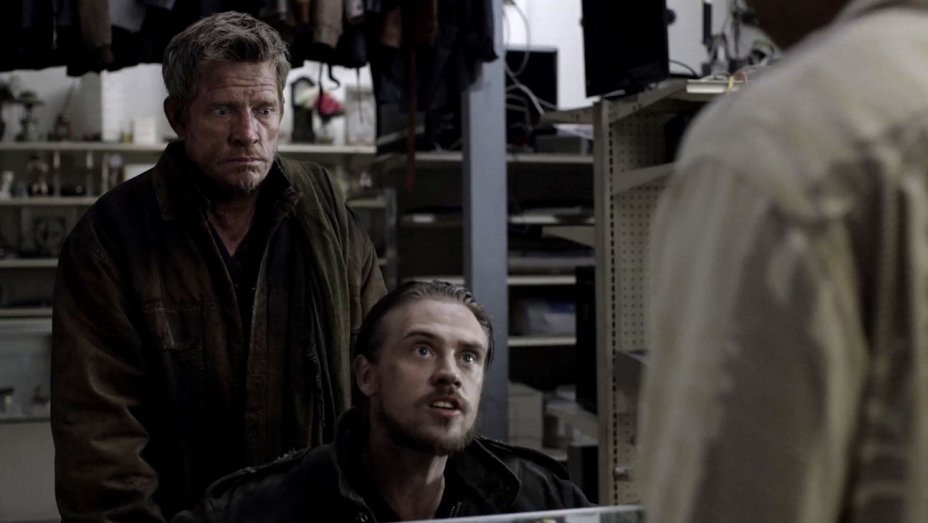
And so, the movie falls back on the little girl’s diary, with Knate Lee’s script painting a picture of abuse and despair that compliments Willie’s own life – or at least it would do if we ever knew what caused his fall through the cracks of society in the first place. In the end, Lee’s script is a bleak portrait of a disconnected man’s empty life and his belated attempts to give it meaning, even if his methods – fighting for money, treating his fellow down-and-outs with disrespect, latching onto a possibly dead girl’s memory – aren’t exactly forgivable. It all makes for a dour, miserable movie that relies too heavily on Church’s distracted, almost there performance, and which features way too many shots of Willie standing on his favourite rooftop, or on a street corner, or just trudging round the city aimlessly. His life lacks purpose, but that’s an easy call; unfortunately, writer/director Lee feels the need to remind us of this constantly. Take away all those “blank stare” moments and the movie would run at least twenty minutes shorter.

thc_bh_pawn-h_2016

Despite being on board as an executive producer, Church’s involvement doesn’t do anything to elevate or improve the material, and he does little to convince the viewer that there’s an interior life going on behind the placid-featured façade he adopts for the most part. Howard is stuck with a supporting role that probably didn’t require him to be on set for more than a few days, while Holbrook’s turn as the disabled war veteran Pinky is yet another in a long line of indistinguishable disabled roles that movie makers believe audiences still have a lot of time for. And as for Wakefield, well, JJ is a caricature role that follows a predictable arc that’s married to a predictable portrayal.

The movie has been shot in a nondescript, visually unappealing style by Peter Holland that is no doubt meant to be a reflection of the lack of glamour inherent in Willie’s life, but it’s too obvious a choice and feels like a better effort couldn’t be decided on or made. And under Lee’s guidance, Jeff Seibenick’s editing leaves several scenes feeling as if there should be more to them, or in a weird contradiction, that they should be shorter and more punchy – but the material won’t allow it. This is Lee’s feature debut, and it shows, the choices he makes as a director showing a lack of imagination and confidence. And this is borne out by the movie’s conclusion, a fairytale ending that is both unnecessarily mawkish and dramatically inept given what’s gone before. But at least it’s not as downbeat as the rest of the movie.

Rating: 4/10 – a lumbering attempt to find grace and purpose even amongst homeless people, Cardboard Boxer lacks depth and a sense of purpose, and a central character the audience can get behind; while it merrily (and that’s still not the best word) goes about telling its largely redundant, determinedly non-complex tale, viewers will be wondering when and if the movie’s ever going to grow and stretch into something more affecting and worthwhile.


//ws-eu.amazon-adsystem.com/widgets/q?ServiceVersion=20070822&OneJS=1&Operation=GetAdHtml&MarketPlace=GB&source=ss&ref=as_ss_li_til&ad_type=product_link&tracking_id=thedullwoodex-21&marketplace=amazon&region=GB&placement=B01KWN1ZOE&asins=B01KWN1ZOE&linkId=d46234aee881214ec33cc823ecd6f62b&show_border=true&link_opens_in_new_window=true

Share this:

  • Click to share on X (Opens in new window) X
  • Click to share on Facebook (Opens in new window) Facebook
  • More
  • Click to print (Opens in new window) Print
  • Click to email a link to a friend (Opens in new window) Email
Like Loading...

Blog Stats

  • 486,528 hits

Recent Posts

  • 10 Reasons to Remember Bibi Andersson (1935-2019)
  • Fantasia (1940)
  • Dances With Wolves (1990) – The Special Edition
  • Kiss of the Spider Woman (1985)
  • The Three Musketeers (1973)

Top Posts & Pages

  • Lost for Life (2013) - Another Look
    Lost for Life (2013) - Another Look
  • Lost for Life (2013)
    Lost for Life (2013)
  • About
    About
  • Mr. Topaze (1961)
    Mr. Topaze (1961)
  • Billy Lynn's Long Halftime Walk (2016)
    Billy Lynn's Long Halftime Walk (2016)
  • Winter's Tale (2014)
    Winter's Tale (2014)
  • The Hitman's Bodyguard (2017)
    The Hitman's Bodyguard (2017)
  • 5 Famous Movie Roles That Nearly Went to Someone Else
    5 Famous Movie Roles That Nearly Went to Someone Else
  • The Layover (2017)
    The Layover (2017)
  • Transcendence (2014)
    Transcendence (2014)
Follow thedullwoodexperiment on WordPress.com

Blogs I Follow

  • Rubbish Talk
  • Film 4 Fan
  • Fast Film Reviews
  • The Film Blog
  • All Things Movies UK
  • Interpreting the Stars
  • Let's Go To The Movies
  • Movie Reviews 101
  • TMI News
  • Dan the Man's Movie Reviews
  • Film History
  • Jordan and Eddie (The Movie Guys)

Archives

  • April 2019 (13)
  • March 2019 (28)
  • February 2019 (28)
  • January 2019 (32)
  • December 2018 (28)
  • November 2018 (30)
  • October 2018 (29)
  • September 2018 (29)
  • August 2018 (29)
  • July 2018 (30)
  • June 2018 (28)
  • May 2018 (24)
  • April 2018 (21)
  • March 2018 (31)
  • February 2018 (25)
  • January 2018 (30)
  • December 2017 (30)
  • November 2017 (27)
  • October 2017 (27)
  • September 2017 (26)
  • August 2017 (32)
  • July 2017 (32)
  • June 2017 (30)
  • May 2017 (29)
  • April 2017 (29)
  • March 2017 (30)
  • February 2017 (27)
  • January 2017 (32)
  • December 2016 (30)
  • November 2016 (28)
  • October 2016 (30)
  • September 2016 (27)
  • August 2016 (30)
  • July 2016 (30)
  • June 2016 (31)
  • May 2016 (34)
  • April 2016 (30)
  • March 2016 (30)
  • February 2016 (28)
  • January 2016 (35)
  • December 2015 (34)
  • November 2015 (31)
  • October 2015 (31)
  • September 2015 (34)
  • August 2015 (31)
  • July 2015 (33)
  • June 2015 (12)
  • May 2015 (31)
  • April 2015 (32)
  • March 2015 (30)
  • February 2015 (37)
  • January 2015 (39)
  • December 2014 (34)
  • November 2014 (34)
  • October 2014 (36)
  • September 2014 (25)
  • August 2014 (29)
  • July 2014 (29)
  • June 2014 (28)
  • May 2014 (23)
  • April 2014 (21)
  • March 2014 (42)
  • February 2014 (38)
  • January 2014 (29)
  • December 2013 (28)
  • November 2013 (34)
  • October 2013 (4)

Blog at WordPress.com.

Rubbish Talk

Film 4 Fan

A Movie Blog

Fast Film Reviews

The Film Blog

The official blog of everything in film

All Things Movies UK

Movie Reviews and Original Articles

Interpreting the Stars

Dave Examines Movies

Let's Go To The Movies

Film and Theatre Lover!

Movie Reviews 101

Daily Movie Reviews

TMI News

Latest weather, crime and breaking news

Dan the Man's Movie Reviews

All my aimless thoughts, ideas, and ramblings, all packed into one site!

Film History

Telling the story of film

Jordan and Eddie (The Movie Guys)

Movie Reviews & Ramblings from an Australian Based Film Fan

Privacy & Cookies: This site uses cookies. By continuing to use this website, you agree to their use.
To find out more, including how to control cookies, see here: Cookie Policy
  • Subscribe Subscribed
    • thedullwoodexperiment
    • Join 481 other subscribers
    • Already have a WordPress.com account? Log in now.
    • thedullwoodexperiment
    • Subscribe Subscribed
    • Sign up
    • Log in
    • Report this content
    • View site in Reader
    • Manage subscriptions
    • Collapse this bar
 

Loading Comments...
 

    %d