• 10 Reasons to Remember…
  • A Brief Word About…
  • About
  • For One Week Only
  • Happy Birthday
  • Monthly Roundup
  • Old-Time Crime
  • Other Posts
  • Poster of the Week
  • Question of the Week
  • Reviews
  • Trailers

thedullwoodexperiment

~ Viewing movies in a different light

thedullwoodexperiment

Tag Archives: Hammer Films

Poster of the Week – Blonde Bait (1956)

20 Tuesday Feb 2018

Posted by dullwood68 in Movies

≈ Leave a comment

Tags

Beverly Michaels, Blonde Bait, Hammer Films, Poster of the week, Women Without Men

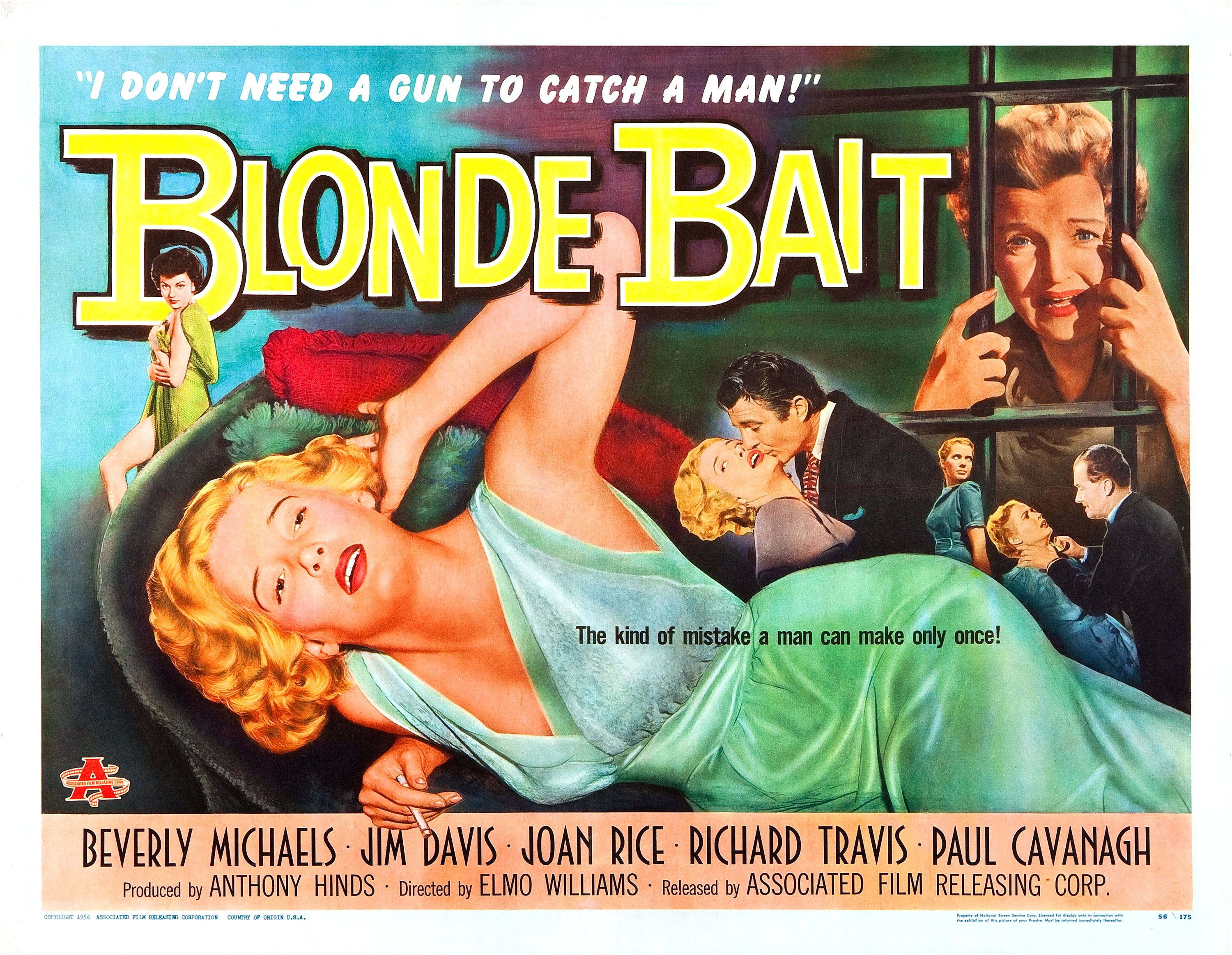
Blonde Bait was the US title given to a re-edited version of Women Without Men, a Hammer production about three women who escape from prison, each for their own reason. While the movie itself isn’t particularly memorable, the US poster is anything but, and for a number of reasons. It’s another terrific design from the Fifties that’s doing its best to promote its female cast and characters as having an earthy sensuality, and the kind of loose morals that come about from lounging decoratively on soft furnishings. It’s also another poster that’s packed with incident, from the central image of star Beverly Michaels reclining awkwardly on a chaise longue and trying not to burn a hole in it, to the shocked countenance of Avril Angers staring out from behind bars.

It’s a busy poster, and one that’s making a lot of different statements all at the same time. Aside from Michaels’ attempt at looking sultry while fluffing her hair, behind her head there’s the smaller image of Joan Rice looking defiant as she clutches what looks like the remains of a dress – remains that still allow her to show off a shapely leg. She may be in some kind of trouble, but that doesn’t mean she’s not going to look fabulous while she deals with it all. A girl’s gotta do… and all that. Then there’s the image perched above Michaels’ hip, a one-sided clinch that looks as if the #MeToo movement should get involved. Michaels is trying to get away from her would-be Lothario (actually Jim Davis), but has the look of someone who’s trying to remember if they left the stove on, or if they locked the front door on their way out.

To their immediate right is a classic image, that of a woman pressed against something that helps emphasise the curvature and fullness of her breasts. Here it’s the bar of a cage, an appropriate choice given the movie’s opening backdrop, but in its own way it’s the least subtle image within the whole poster. Moving further to the right, and we have the poster’s most awkward component, with Michaels being doubly threatened by her near-namesake Ralph Michael. With his left hand he’s attempting to strangle her, but what’s going on with his right hand? Is he grabbing her lapel or trying to punch her? (Make up your mind, man.)

The title is represented in clunky chunky yellow lettering that makes for an eye-catching alternative to the other primary colours on display, but it’s not so bold that it distracts from the various images it has to contend with. Its positioning is also effective in terms of the overall composition, but the same can’t be said for the horrendous tagline that begins at Michaels’ left breast and spreads across to the top of her leg. And to make matters worse, the font makes it look like a last-minute addition, and the wording itself doesn’t make any sense. “The kind of mistake a man can make only once”? Really? How about, “The kind of mistake movie posters should never make” instead? At least the poster’s other tagline, “I don’t need a gun to catch a man!’ is a little more in keeping with the movie’s subject matter.

The poster is rounded off with the usual round of credits, expressed in a nice Roman-style font, and reflecting the inclusion of three stars who didn’t appear in the original British version (Davis, Travis and Cavanagh). The inclusion of Associated Film Releasing Corp in the credits helps explain the logo towards the bottom left hand corner, and further reinforces the notion that this is an exciting, passion-filled American movie (and not some stuffy British crime drama – Heaven forbid). Though there’s a fair degree of misrepresentation going on in this particular poster, it’s hard to complain about it too much as pretty much everyone was doing the same in the mid- to late Fifties. As always, sex is the selling point, though for once there’s no image of some exaggerated, gravity defying cleavage. Now, that’s where the designer went wrong…

Share this:

  • Click to share on X (Opens in new window) X
  • Click to share on Facebook (Opens in new window) Facebook
  • More
  • Click to print (Opens in new window) Print
  • Click to email a link to a friend (Opens in new window) Email
Like Loading...

Death in High Heels (1947)

17 Monday Jul 2017

Posted by dullwood68 in Movies

≈ Leave a comment

Tags

Catch Up movie, Christianna Brand, Crime, Don Stannard, Drama, Elsa Tee, Hammer Films, Leslie Tomlinson, Literary adaptation, Murder, Mystery, Review, Thriller, Veronica Rose

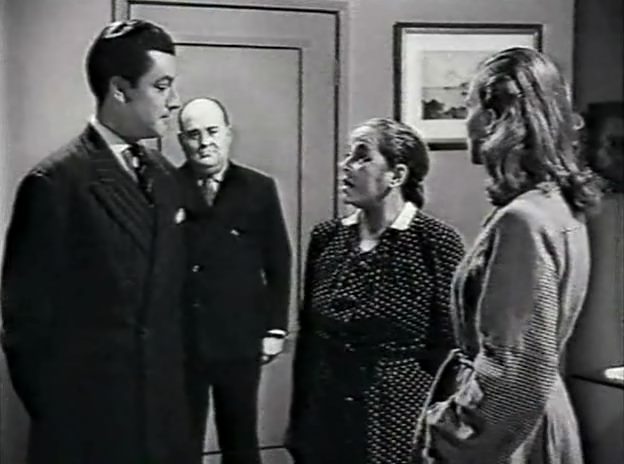
D: Lionel Tomlinson (as Tommy Tomlinson) / 48m

Cast: Don Stannard, Elsa Tee, Veronica Rose, Denise Anthony, Patricia Laffan, Diana Wong, Nora Gordon, Bill Hodge, Kenneth Warrington, Leslie Spurling

A cheap and cheerful murder mystery – told by the lead detective in flashback – Death in High Heels is a “quota quickie” designed by Hammer Films (who had been dormant as a production company since 1937) as a way of reviving the company name and helping to fill the gaps in cinema schedules. Made on a shoestring, its tale of murder in a Bond Street dress shop is a perfect example of the material that Hammer looked to release at the time, and though it seems unremarkable at first glance, acts as a snapshot of the period, and what could be done on a micro-budget.

As already mentioned, the movie is set (largely) in a dress shop and is narrated by Detective Charlesworth (Stannard) as he recounts a tale of murder, jealousy and ambition. The dress shop is called Christof’s, and it’s owned and run by a man named Frank Bevan (Warrington). He employs a staff of seven: two supervisors, Agnes Gregory (Rose) and Magda Doon (Laffan); a designer, Mr Cecil (Hodge); three dress models, Victoria (Tee), Aileen (Anthony), and Almond Blossom (Wong); and a cleaning lady, Mrs ‘Arris (Gordon). Eight very different people all together, but with seven of them all united about one thing: their dislike of Miss Gregory. Sharp-tongued and unfriendly, Miss Gregory has earned the enmity of everyone at one time or another. She has attached herself to Bevan though, and when Magda is put in line for a promotion ahead of her, Miss Gregory does her best to get the job instead. When Bevan changes his mind, and gives the job to Miss Gregory, Magda’s unexpected death (which follows soon after), leads to a murder investigation.

The cause of death is poisoning, and by an acid that was brought into the shop by Aileen and Victoria in order to clean a hat. Most of it was spilt on the floor and then cleared up by Mrs ‘Arris who was supposed to have left it in an envelope on a table. But the envelope disappears before Magda’s death, and no one will admit to taking it. Everyone is a suspect, but Charlesworth quickly deduces that Magda wasn’t the intended victim, it was Miss Gregory, the poison added to her lunch but eaten by her rival instead. As his investigation continues, Charlesworth learns that some of the staff have secrets that may or may not be reasons for trying to kill Miss Gregory, and as he sifts through a web of lies and deceit, two main suspects emerge… but did either one of them try to poison Miss Gregory?

The answer is nowhere near as obvious as you’d expect, though it’s not really the point of this fast-paced little thriller, which seeks instead to shine a light on post-War Britain and the social imperatives of the period. Bevan is the haughty self-made man who enjoys the prestige that goes with having titled clients and a shop in London’s exclusive Bond Street. Miss Gregory has ideas above her station as well, and behaves badly towards the others because she rides on Bevan’s coat-tails and presumes an intimacy with him that allows her to feel superior to everyone else. Aileen’s “young man” is “very grand” and it’s her ambition to be as grand as he is, even though she’s from a working class background, the same background as Mrs ‘Arris. Mr Cecil is something of an hysterical ninny, a man whose sense of self-worth is reinforced by his mother. Only Magda and Victoria seem comfortable in their own skin, as even Almond Blossom’s aloof nature seems to be a cover for an unfortunate prior experience with Bevan. All this is neatly laid out in the nineteen minutes before Magda’s death, and all this has a bearing on the nature of Charlesworth’s investigation.

Inevitably, the secrets the characters have been trying to hide are revealed, and just as inevitably they prove predictable and of no relevance to the murder. But Christianna Brand’s screenplay, adapted from her novel of the same name, makes good use of the distrust amongst the characters, and even if to contemporary eyes there doesn’t seem to be anything too striking about the inter-relationships and the society in microcosm approach to the staff and their foibles, nevertheless, someone watching this seventy years ago would have recognised much of the social dynamic on display. They would have felt comforted by it to some degree, and even now the movie has that ability to reassure the viewer as to its intentions. Familiar territory then, and all the better for it; and despite some awkward line readings, it holds the attention and balances its various storylines with ease.

Though the performances range from arch (Wong, Rose) to overtly theatrical (Laffan), there’s still the sense that everyone is familiar with the material and knows what to do. Stannard gives a carefree performance that is amusing and relaxed, while Tee is confident and direct, and in their brief scenes together, a good foil for his breezy attitude. Tomlinson, whose first feature this was, keeps the camera as agile as possible given the confines of the sets, and uses his previous experience as an editor to give the movie a sprightly feel that adds to the pleasant nature of the material as a whole. It’s not a movie that will rock anyone’s world (not that it was ever meant to), but as a calling card to the rest of the British movie industry that Hammer was back and here to stay, it has to be judged a success.

Rating: 6/10 – it’s too easy to be dismissive of a movie like Death in High Heels, and too easy to ignore its obvious virtues, but anyone willing to give the movie the benefit of the doubt will be pleasantly surprised by its jaunty nature and effective character building; the low budget and sparse production values do hinder things, and some unnecessary narrative leaps and bounds in the second half don’t help, but overall this is a solid, agreeable mystery that deserves a wider audience. (16/31)

NOTE: Unsurprisingly, there isn’t a trailer for Death in High Heels.

Share this:

  • Click to share on X (Opens in new window) X
  • Click to share on Facebook (Opens in new window) Facebook
  • More
  • Click to print (Opens in new window) Print
  • Click to email a link to a friend (Opens in new window) Email
Like Loading...

Poster of the Week – The Hound of the Baskervilles (1959)

01 Monday Sep 2014

Posted by dullwood68 in Movies

≈ 1 Comment

Tags

Baskerville, Christopher Lee, Hammer Films, Hound, Movie poster, Peter Cushing, Poster of the week, Sherlock Holmes

Hound of the Baskervilles, The (1959)

The Hound of the Baskervilles (1959)

Another Hammer movie poster – see also Dracula (1958) – this unusually simple piece of advertising (for its time), has an impact that can’t be denied.  With its human cast relegated to the sidelines (literally), the hound is allowed to take centre stage and dominate the poster.  It’s less of a hound and more of a wolf, of course, but its sharp, pointed teeth, tipped with blood, and yellow-eyed stare, is more than enough to put anyone off from wanting to encounter the beast on a lonely, deserted moor.

Its grey and white fur, offset by deep, shadowy blacks, frames the hound’s features to considerable effect, with its canines to the fore, almost as if it’s about to take a chunk out of the title.  The eyes have a demonic gleam to them, and there’s a hypnotic quality to them as well, as if by staring at them for too long there’s a chance the hound will jump out of the poster and rip you to pieces – far-fetched, perhaps, but there is a certain, unnerving element to the image, one that is far more effective on closer inspection.  And then there’s the moon, a grey smudge near the top right corner, hinting at lycanthropy and occupying a place that would otherwise have been completely blank (though no less effective for being so).

The bold red of the title, in its way splashed across the poster, demands attention from the eye, and the colour hints at the bloodshed that is likely to occur in the movie (even if it’s not quite as brutal as we’d like to imagine).  The tag line at the top of the poster tries too hard to grab the attention away from the hound, while the main cast members are sequestered over on the left hand side, almost as an afterthought; even the acknowledgment to Sir Arthur Conan Doyle turns out to be in a smaller typeface  than that advising of the movie’s having been made in Technicolor (as for the director et al., mentioned in the bottom left hand corner, unless you’ve got 20/20 vision, you won’t have a clue who they are).

It’s a simple, effective poster and deserves a wider audience, free from artifice and pseudo-intellectual interpretations: in short, a poster that’s way more compelling than you’d initially give it credit for.

Agree?  Disagree?  Please feel free to let me know.

Share this:

  • Click to share on X (Opens in new window) X
  • Click to share on Facebook (Opens in new window) Facebook
  • More
  • Click to print (Opens in new window) Print
  • Click to email a link to a friend (Opens in new window) Email
Like Loading...

Poster of the Week – Dracula (1958)

22 Tuesday Jul 2014

Posted by dullwood68 in Movies

≈ 1 Comment

Tags

Christopher Lee, Hammer Films, Horror, Movie poster, Poster of the week, Vampire, Victim

Dracula (1958)

Dracula (1958)

Hammer Films not only made lurid melodramas and (for their time) sex-driven horror movies, they also produced lurid, sex-driven movie posters.  This poster, for the first in what would be seven movies featuring Christopher Lee as the titular bloodsucker, isn’t as daring as some that would follow, but in its own way it has a disturbing quality that perfectly matches, and complements, the mood of the movie it’s advertising.

First, there’s the woman, lying prone and unconscious, her neck and shoulders exposed, the intended victim who is unaware of the terrible thing that is about to be done to her.  She looks innocent, a perfect contrast to the beast in human form that has her in its clutches, the threat of its vampire fangs clearly visible, his intention equally clear: he is about to defile her innocence.  It’s a horrifying prospect: the woman is unable to defend herself and her fate is assured; she too will become a vampire.

The image has some clever touches.  There’s the bronzed, healthy skin tones of the woman which are in stark contrast to the unhealthy pallor of the vampire’s, his pale(r) flesh revealing another loss the woman will endure once she’s bitten.  And then there’s the proximity of Dracula’s hand at her neck: could it be there to caress her rather than keep her hair away from where he plans to bite her?  If so, this neatly ties in with the movie’s audacious tag line, its bold assertion giving rise to the idea that maybe Dracula wants more than just blood from his victim, that there’s another thrill involved here (they are both lying down); maybe the woman is a willing participant instead?

The warning in the bottom right hand corner is another clever piece of marketing, urging couples to see the movie, to experience the thrills and chills together (and thereby boost the box office).  The principal cast are given prominent billing, the director et al. appearing slightly less important as usual, and lastly there’s the added touch of the reminder that an X certificate movie is for adults only – perhaps as a further hint of the “terrifying love” that they’ll witness within the movie?

Agree?  Disagree?  Feel free to let me know.

Share this:

  • Click to share on X (Opens in new window) X
  • Click to share on Facebook (Opens in new window) Facebook
  • More
  • Click to print (Opens in new window) Print
  • Click to email a link to a friend (Opens in new window) Email
Like Loading...

Slave Girls (1967)

24 Sunday Nov 2013

Posted by dullwood68 in Movies

≈ Leave a comment

Tags

Africa, Cave girls, Drama, Edina Ronay, Fantasy, Hammer Films, Kanuka tribe, Martine Beswick, Michael Carreras, Michael Latimer, Queen Kari, Review, White rhinoceros

Slave Girls

aka Prehistoric Women

D: Michael Carreras / 90m

Cast: Martine Beswick, Edina Ronay, Michael Latimer, Stephanie Randall, Carol White, Alexandra Stevenson, Sydney Bromley, Robert Raglan

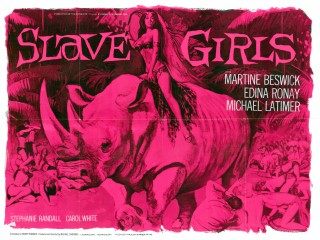
The second of Hammer’s “cave girls” movies, Slave Girls begins with stock footage shot in Africa, then moves to a set bound hunting expedition led by David Marchand (Latimer). Tracking a wounded leopard, he ventures into the lands of the Kanuka tribe, where he is captured. Taken before their leader, he is told of their god, the white rhinoceros, and the legend surrounding it, that all trespassers on their lands will be executed until either the white rhinoceros (now extinct) returns, or the large white rhinoceros statue they worship is destroyed. At the point of his being executed, David reaches out to touch the statue. There is a flash of lightning, the tribesmen are frozen in time, and the rock wall behind the statue opens to reveal another part of the jungle.

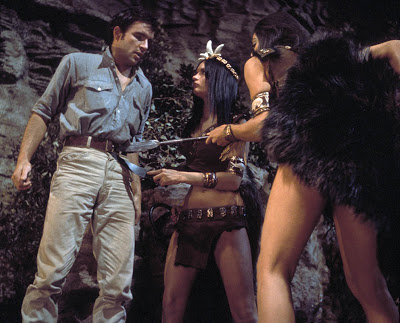
David explores this new area and encounters a girl, Saria (Ronay).  She attacks him but he knocks her unconscious. Immediately, he is surrounded by other women brandishing spears and taken prisoner. The women are part of a tribe led by the malicious Queen Kari (Beswick). It soon becomes clear there is a hierarchy here where brunette women have the power and blonde women are used as slaves. The men are all imprisoned in a cave. Asked by Kari to reign by her side, David refuses, and is imprisoned as well. Meanwhile, the blonde women plot to rebel against Kari and regain their freedom.

Slave Girls - scene

Watching Slave Girls over forty-five years on from its release, the first thing that strikes you isn’t the overtly sexist approach taken by writer/director Michael Carreras, or even the dreadful, convoluted storyline. Instead it’s the sense of déjà vu: isn’t this all terribly familiar? Well, yes it is, because the viewer is looking at the same sets and costumes that were used for Hammer’s first foray into the cave girl mini-genre One Million Years B.C. (1966). Full marks for economising then, but it’s subtly distracting. Once you get past that though, the full awfulness of the movie hits you full in the face, from the pallid direction to the atrocious dialogue to the contra-feminist approach to the material to the dreadful acting (some of the blondes don’t do themselves any favours in this regard), to the tribal dance routines designed to pad out the movie’s running time to the men all seemingly borrowed from a ratty beard and hair club.

And yet, as so often with Hammer’s movies from the mid- to late Sixties, Slave Girls retains a kind of quirky likeability. Despite its glaring faults (some as large as the white rhinoceros statue itself), the movie holds the attention throughout, is well-paced thanks to editor Roy Hyde, and offsets the limitations of the budget by providing some decent special effects in amongst the painted backdrops and cardboard-looking sets. The campy feel that would detract from several later Hammer movies is kept to a minimum, and Beswick is suitably cruel and manipulative as Queen Kari, while Latimer, all brooding stares and rampant masculinity, overcomes some awkwardness in his early scenes to gain increasing confidence in his role. As David’s love interest, Saria, Ronay proves surprisingly good, providing a strong counterpoint to Beswick. (Look out too for a brief appearance at the end by Steven Berkoff in his first, credited, screen performance.)

Made quickly as a response to the success of One Million Years B.C., Slave Girls fails to match that movie’s quality but does manage to be entertaining enough for all that. Hammer would go on to make two more cave girl movies, 1970’s When Dinosaurs Ruled the Earth, and 1971’s Creatures the World Forgot (also scripted by Carreras). Both films traded heavily on even more scantily clad women as part of their attraction, but neither were as barmy in terms of its script as Slave Girls.

Rating: 5/10 – saved by strong performances and Robert Jones’ art direction, Slave Girls holds a fascination that makes up for its many mistakes; a bit of a cult movie now and well worth watching on that basis.

Share this:

  • Click to share on X (Opens in new window) X
  • Click to share on Facebook (Opens in new window) Facebook
  • More
  • Click to print (Opens in new window) Print
  • Click to email a link to a friend (Opens in new window) Email
Like Loading...

Blog Stats

  • 486,528 hits

Recent Posts

  • 10 Reasons to Remember Bibi Andersson (1935-2019)
  • Fantasia (1940)
  • Dances With Wolves (1990) – The Special Edition
  • Kiss of the Spider Woman (1985)
  • The Three Musketeers (1973)

Top Posts & Pages

  • Lost for Life (2013) - Another Look
    Lost for Life (2013) - Another Look
  • Lost for Life (2013)
    Lost for Life (2013)
  • About
    About
  • Mr. Topaze (1961)
    Mr. Topaze (1961)
  • Winter's Tale (2014)
    Winter's Tale (2014)
  • Billy Lynn's Long Halftime Walk (2016)
    Billy Lynn's Long Halftime Walk (2016)
  • The Hitman's Bodyguard (2017)
    The Hitman's Bodyguard (2017)
  • Shock and Awe (2017)
    Shock and Awe (2017)
  • 5 Famous Movie Roles That Nearly Went to Someone Else
    5 Famous Movie Roles That Nearly Went to Someone Else
  • The Layover (2017)
    The Layover (2017)
Follow thedullwoodexperiment on WordPress.com

Blogs I Follow

  • Rubbish Talk
  • Film 4 Fan
  • Fast Film Reviews
  • The Film Blog
  • All Things Movies UK
  • Interpreting the Stars
  • Let's Go To The Movies
  • Movie Reviews 101
  • TMI News
  • Dan the Man's Movie Reviews
  • Film History
  • Jordan and Eddie (The Movie Guys)

Archives

  • April 2019 (13)
  • March 2019 (28)
  • February 2019 (28)
  • January 2019 (32)
  • December 2018 (28)
  • November 2018 (30)
  • October 2018 (29)
  • September 2018 (29)
  • August 2018 (29)
  • July 2018 (30)
  • June 2018 (28)
  • May 2018 (24)
  • April 2018 (21)
  • March 2018 (31)
  • February 2018 (25)
  • January 2018 (30)
  • December 2017 (30)
  • November 2017 (27)
  • October 2017 (27)
  • September 2017 (26)
  • August 2017 (32)
  • July 2017 (32)
  • June 2017 (30)
  • May 2017 (29)
  • April 2017 (29)
  • March 2017 (30)
  • February 2017 (27)
  • January 2017 (32)
  • December 2016 (30)
  • November 2016 (28)
  • October 2016 (30)
  • September 2016 (27)
  • August 2016 (30)
  • July 2016 (30)
  • June 2016 (31)
  • May 2016 (34)
  • April 2016 (30)
  • March 2016 (30)
  • February 2016 (28)
  • January 2016 (35)
  • December 2015 (34)
  • November 2015 (31)
  • October 2015 (31)
  • September 2015 (34)
  • August 2015 (31)
  • July 2015 (33)
  • June 2015 (12)
  • May 2015 (31)
  • April 2015 (32)
  • March 2015 (30)
  • February 2015 (37)
  • January 2015 (39)
  • December 2014 (34)
  • November 2014 (34)
  • October 2014 (36)
  • September 2014 (25)
  • August 2014 (29)
  • July 2014 (29)
  • June 2014 (28)
  • May 2014 (23)
  • April 2014 (21)
  • March 2014 (42)
  • February 2014 (38)
  • January 2014 (29)
  • December 2013 (28)
  • November 2013 (34)
  • October 2013 (4)

Blog at WordPress.com.

Rubbish Talk

Film 4 Fan

A Movie Blog

Fast Film Reviews

The Film Blog

The official blog of everything in film

All Things Movies UK

Movie Reviews and Original Articles

Interpreting the Stars

Dave Examines Movies

Let's Go To The Movies

Film and Theatre Lover!

Movie Reviews 101

Daily Movie Reviews

TMI News

Latest weather, crime and breaking news

Dan the Man's Movie Reviews

All my aimless thoughts, ideas, and ramblings, all packed into one site!

Film History

Telling the story of film

Jordan and Eddie (The Movie Guys)

Movie Reviews & Ramblings from an Australian Based Film Fan

Privacy & Cookies: This site uses cookies. By continuing to use this website, you agree to their use.
To find out more, including how to control cookies, see here: Cookie Policy
  • Subscribe Subscribed
    • thedullwoodexperiment
    • Join 481 other subscribers
    • Already have a WordPress.com account? Log in now.
    • thedullwoodexperiment
    • Subscribe Subscribed
    • Sign up
    • Log in
    • Report this content
    • View site in Reader
    • Manage subscriptions
    • Collapse this bar
 

Loading Comments...
 

    %d