• 10 Reasons to Remember…
  • A Brief Word About…
  • About
  • For One Week Only
  • Happy Birthday
  • Monthly Roundup
  • Old-Time Crime
  • Other Posts
  • Poster of the Week
  • Question of the Week
  • Reviews
  • Trailers

thedullwoodexperiment

~ Viewing movies in a different light

thedullwoodexperiment

Tag Archives: John Lithgow

Beatriz at Dinner (2017)

06 Saturday Jan 2018

Posted by dullwood68 in Movies

≈ Leave a comment

Tags

Connie Britton, Dinner party, Drama, Healer, John Lithgow, Miguel Arteta, Mike White, Review, Salma Hayek

D: Miguel Arteta / 82m

Cast: Salma Hayek, John Lithgow, Connie Britton, Jay Duplass, Amy Landecker, Chloë Sevigny, David Warshofsky, John Early

The dinner party has long been used as an excuse for movies to explore the differences between people, or to expose secrets, or to raise questions of a social, sexual, psychological, philosophical, or moral nature. Beatriz at Dinner seeks to cover each of these angles in its relatively short running time, but is it as successful as it may have wanted to be? The answer lies in the way in which it establishes its main character, the titular Beatriz (Hayek). When we first meet her, Beatriz is in a rowboat in a mangrove swamp. It’s a beautiful location, peaceful and calming, and on a bright sunny day. It’s idyllic. But then Beatriz spies a white goat stranded on the shore line. The camera moves in closer – and then Beatriz wakes up; it’s all been a dream. However, it’s a dream that has a basis in reality, because Beatriz has a goat in a pen in her bedroom. It tells us a lot about her, about her principles, and what type of person she is. How will she fare then, when placed in a room with a group of people whose experiences of life, and whose attitudes, are so different from hers?

That’s the question at the heart of Mike White’s screenplay, one of four that were made into movies during 2017 – the others were The Emoji Movie, Brad’s Status, and Pitch Perfect 3. White is a multi-hyphenate who has built up a solid reputation for himself as a screenwriter, and since his first script for Dead Man on Campus (1998), he’s plied his trade in both mainstream and indie circles. Beatriz at Dinner is definitely one of his indie projects, and it reunites him with Arteta, who directed another of White’s scripts, Chuck & Buck (2000). But where White is usually sharper and more astute with his indie scripts, this time around there’s a sense that not all the movie’s ambitions have been met. It’s puzzling, yet perhaps shouldn’t be, because it all hinges on Beatriz, and Beatriz isn’t exactly the kind of heroine that we were probably expecting. She’s a legal migrant from Mexico, she works as a therapist at a cancer treatment centre, and she does private massages for a variety of clients. She doesn’t wear any make-up, drives an old beat up car, has a goat and two dogs, doesn’t appear to be in a relationship, and believes in an holistic approach to life.

One of her clients is Kathy (Britton). Kathy lives with her husband, Grant (Warshofsky), in a gated community outside of Los Angeles. Their house has a view of the ocean and practically yells new money. Beatriz arrives one afternoon to give Kathy a massage, but her car won’t start when she tries to leave. Kathy insists that Beatriz stay for dinner, even though it’s a dinner party for two of Grant’s business colleagues and their wives, and Beatriz is only waiting on a friend to come and get her car started. The first guests, Alex (Duplass) and Shannon (Sevigny) arrive, followed by the other couple, Doug (Lithgow) and Jeana (Landecker). The three couples are celebrating a business deal that Alex has closed, and which stands to make them even richer than they already are. Beatriz begins to suspect that she knows Doug from some time in her past, perhaps in Mexico. As the evening progresses, Beatriz has a little too much to drink, but not enough to stop her voicing her disgust when Doug brags about his having hunted big game in Africa. But her outburst causes a rift between her and Kathy, and when she learns more about Doug and challenges him on some of his sharp practices as a businessman, that rift grows even wider…

Beatriz at Dinner has been widely regarded as a comedy as well as a drama. This is a little misleading, as while there are certainly humorous moments, and other moments where a darkly satirical tone is adopted, this is a drama through and through, serious in its intentions, and direct in its approach to the material. White is looking to skewer the pompous, affected nature of these entitled men and their equally entitled wives, and he does so by providing them with dialogue that makes them sound crass, insensitive, patronising, and lacking in self-awareness. It even extends to the “help”, when John Early’s eerily proficient Evan interrupts Beatriz when she’s talking, to advise on the starters that are available. Beatriz is talking about the hardships she’s experienced in her life; he wants to make sure the guests know what sauces go with the beef and the halibut. Just by that alone you know the evening isn’t going to go well.
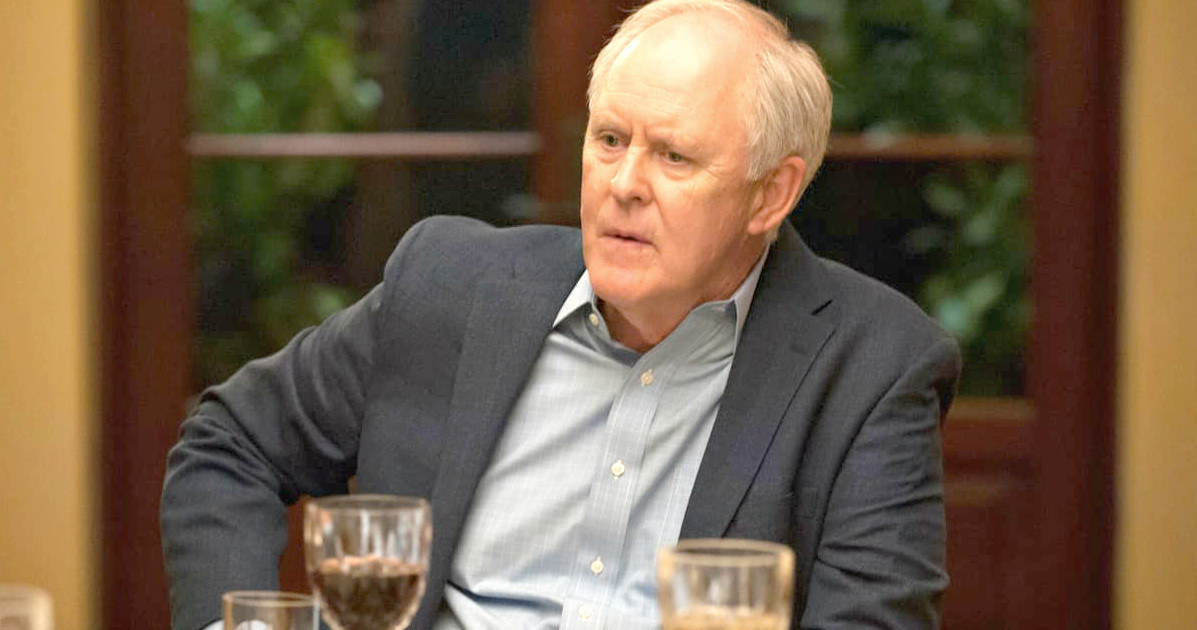
Tension arises through the character of Doug, whose company has been involved in several controversial incidents, some of which have occurred in Mexico. The scene is set for a showdown between Beatriz and Doug, but White makes Doug look like he’s made out of Teflon; no matter how angry or aggrieved Beatriz becomes, Doug just shrugs it off as if it’s of so little importance than he can’t even be bothered to acknowledge it. By adopting this approach to the character, White has made him incapable of being affected, and so he remains a largely anodyne villain, in place to stir up emotions and provide conflict, but too remote in attitude to care about being attacked in the first place. Lithgow is good as Doug, expressing right-wing opinions on a variety of topics, and forever wondering why anyone should care if what he does is harmful or even immoral. Doug is a character we want to see bested and taught a valuable lesson about responsibility, but White has other ideas, and so in those terms the movie ends unsatisfactorily, and worse still, elliptically.

Aside from Beatriz, Doug and Kathy, the characters are bland, interchangeable versions of each other, though Grant does show a huge propensity for ass-kissing (see how many times he agrees with something Doug says). As a result there’s little in the way of scene-stealing, and Sevigny and Duplass are on the periphery of the action for the most part, their roles more mundane than necessary. Britton is good as the outwardly empathetic but inwardly image conscious Kathy, while Hayek connects well with Beatriz’s sense of herself as a healer, expressing the character’s spiritual and environmental passions with an understated yet still fervent sincerity. Arteta has trouble mustering enough energy in some scenes, leaving the movie feeling flat and prosaic, and there are times when it seems as if something momentous is about to occur – but it doesn’t (though when something momentous actually does occur, even then it’s undermined by narrative decision making). All this makes for occasionally intriguing viewing, but in the end, the movie leaves too much unaddressed to make it work consistently or completely.

Rating: 6/10 – a movie that often lacks substance thanks to the stereotypical nature of most of its characters, Beatriz at Dinner is neither acerbic enough nor penetrating enough in its efforts to expose the moral and ethical lassitude of America’s nouveau riche; Hayek gives an impassioned portrayal, but it isn’t matched elsewhere, and though the script strives for political relevance, it doesn’t offer the kind of insights that would have an audience nodding their heads in weary recognition.


Share this:

  • Click to share on X (Opens in new window) X
  • Click to share on Facebook (Opens in new window) Facebook
  • More
  • Click to print (Opens in new window) Print
  • Click to email a link to a friend (Opens in new window) Email
Like Loading...

Daddy’s Home Two (2017)

19 Tuesday Dec 2017

Posted by dullwood68 in Movies

≈ 1 Comment

Tags

Comedy, Fathers, John Lithgow, Mark Wahlberg, Mel Gibson, Review, Sean Anders, Sequel, Will Ferrell, Xmas

D: Sean Anders / 100m

Cast: Will Ferrell, Mark Wahlberg, Mel Gibson, John Lithgow, Linda Cardellini, Alessandra Ambrosio, Owen Vaccaro, Scarlett Estevez, Didi Costine, John Cena

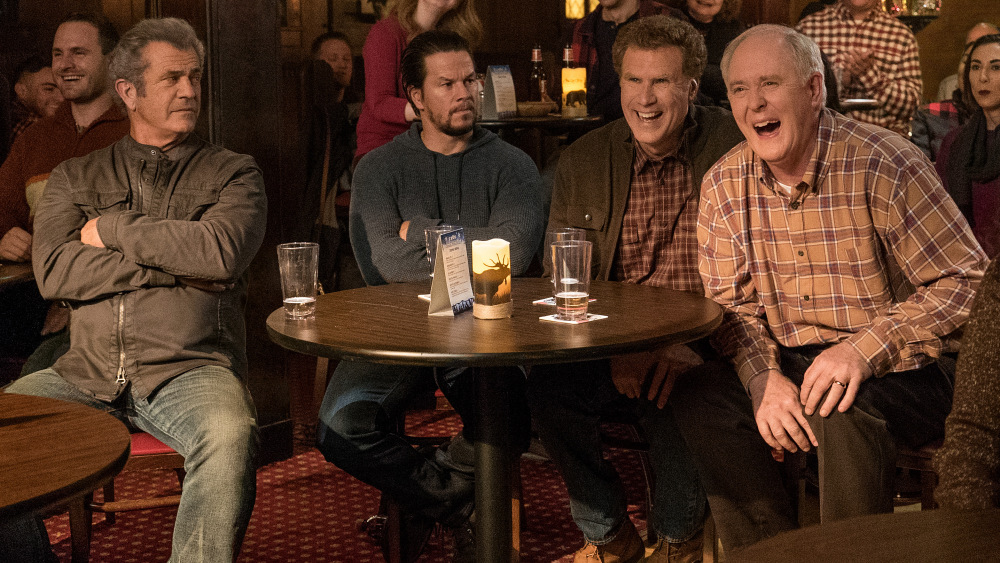
Is it only two years since we were “treated” to Daddy’s Home (2015), the lacklustre real dad versus step-dad movie that was banal and uninspired except on a handful of occasions (bet you can’t name any of them now, though)? Well, the sad answer is yes, it is, and if this entirely expected (but unnecessary) sequel achieves anything, then it’s being blander and less funny than its predecessor. It’s actually quite impressive: the lengths to which the makers of Daddy’s Home Two have gone to ensure this sequel is a snoozefest on an epic level. This is a movie that makes the original look and sound like a multi-award winning cult classic. It’s also one of the dreariest movies to come along in a very long while. If you manage to get through this from start to finish, give yourself a pat on the back and a gold star.

Deciding that making a sequel means bringing in bigger names to bolster the cast, this has somehow managed to attract the likes of Mel Gibson, John Lithgow, and most bizarrely of all, Chesley ‘Sully’ Sullenberger, the pilot responsible for the 2009 Miracle on the Hudson plane landing. There are always projects where you wonder if anyone read a finished script before shooting began, and what appears to be obvious here is that if they did they didn’t worry about the lack of laughs, the terrible dialogue, the predictable arc of the story, or the OTT feelgood ending that sees most of the main cast “singing” Do They Know It’s Christmas by Band Aid (why? Don’t ask). Comedy sequels usually aim higher, bigger, broader, or sometimes opt to be more extreme. However, this is a comedy sequel that eschews all that and goes all out to be the cinematic equivalent of beige; as a result, it’s unrelentingly tedious. The movie lasts for one hundred minutes but watching it feels like it takes twice as long.

The main problem is that the script – by director Sean Anders and John Morris – doesn’t have a purpose other than to make the audience wait until Gibson’s horny old goat, Kurt, finally succumbs to the idea of peace and goodwill to all men and kisses his son, Dusty (Wahlberg), on the mouth (and yes, you are reading that right). Before then, the movie takes an age to undermine the friendship and mutual understanding that was established between Dusty and Brad (Ferrell) in the first movie, and only around the hour mark does it finally pit them against each other. Cue lots of moody looks between the two characters, and both of them engaging in the kind of low-key antagonism that is best expressed by Brad’s fake-pumping a snowball throw: there’s a minimum of intent and no follow through. Throughout, Dusty tells Brad that Kurt is looking to undermine their co-dad status, and while Kurt is certainly dismissive of their friendship – and questions their masculinity at every opportunity – again there’s more intent than action. This is a sequel that talks a lot about what’s going to happen, and what did happen, but has a hard time focusing on the present.

As a comedy, it relies on a series of pratfalls that happen to Don (Lithgow), Brad’s father, and Brad himself; a number of uninspired one-liners; the blossoming attraction of pre-teen Dylan (Vaccaro) for his pre-teen step-sister, Adrianna (Costine); and… that’s about it. There are an awful lot of scenes that occur purely in order to set up the next scene, and then that scene sets up the next scene, and so on, until finally a scene comes along that has a specific purpose. By then, however, any sense that the script knows what it’s doing, or that Anders has any intention of loading the movie with any appreciable energy, is long gone, and as the movie drags itself along like a sick animal looking for a place to curl up and die, any sympathy that arises is entirely for the viewer, and not for the cast and crew who took part in it. They should have known better. (And it all takes place at Xmas, for no better reason than to provide an excuse for Kurt and Don to be involved, as if family get-togethers don’t happen at any other time of year.)

In the end, it’s a lazy movie with lazy performances and a hazy sense of its own quality. Ferrell has made too many similar “comedies” for anyone to be surprised at his involvement, while Wahlberg keeps everything on the same level throughout. Their performances are as perfunctory as possible, and they’re encouraged by Anders’ desultory approach to directing; going through the motions is all that’s required of them. Gibson is hamstrung by his character’s one-note attitude to parenting, while Lithgow’s dad-with-a-secret tries for pathos in one scene but is let down by the comic shifts that occur right alongside his tragic reveal. Cardellini and Ambrosio are the token women putting up with Brad and Dusty’s shenanigans, and with barely a word of protest (hey, whatever happened to strong female characters in comedies?), while the child actors are used for maximum cuteness, something that soon wears thin.

Forbearance is a wonderful thing, and so is patience, but if you absolutely have to see Daddy’s Home Two, then be prepared to wait around for long stretches for anything to have an impact, or provide a genuine laugh, or provide you with anything that will make the experience worthwhile. If this is the best that everyone can do, then it’s a further damning example of the parlous state of mainstream movie making in America today. With a budget of $69 million, it’s hard to work out where the money was spent, but easy enough to see why it was greenlit in the first place. That doesn’t excuse the poor quality of the script, though, or the lack of commitment from all concerned, all of which makes the movie not just a disappointment but a dire retread of themes and ideas that have been done to death already. You could argue that a movie like this one isn’t expected to be great, or a must-see, but with the talent involved it is reasonable to expect a greater effort made in making the movie as good as can be. That it doesn’t look like anyone could be bothered is both appalling and, worse, unsurprising.

Rating: 3/10 – sequels are an easy source of revenue (this has already made its money back and more), but they needn’t be an excuse for a shoddy finished product; Daddy’s Home Two is both of those things, and is also laboured, boring, unimaginative, and a slap in the face to viewers hoping to be entertained, something this movie gives up on with alacrity.

Share this:

  • Click to share on X (Opens in new window) X
  • Click to share on Facebook (Opens in new window) Facebook
  • More
  • Click to print (Opens in new window) Print
  • Click to email a link to a friend (Opens in new window) Email
Like Loading...

Miss Sloane (2016)

14 Tuesday Mar 2017

Posted by dullwood68 in Movies

≈ Leave a comment

Tags

Alison Pill, Corruption, Drama, Gugu Mbatha-Raw, Gun control, Jessica Chastain, John Lithgow, John Madden, Lobbying, Mark Strong, Politics, Review, Senate hearing, Thriller

D: John Madden / 132m

Cast: Jessica Chastain, Mark Strong, Gugu Mbatha-Raw, Alison Pill, Michael Stuhlbarg, Jake Lacy, John Lithgow, Sam Waterston, David Wilson Barnes, Al Mukadam, Douglas Smith, Chuck Shamata, Dylan Baker

At the beginning of Miss Sloane, the title character (Chastain) looks directly into camera and says the following: “Lobbying is about foresight. About anticipating your opponent’s moves and devising counter measures. The winner plots one step ahead of the opposition. And plays her trump card just after they play theirs. It’s about making sure you surprise them. And they don’t surprise you.” Chastain delivers this short speech with complete conviction and due gravitas. And in doing so, the movie puts the audience on notice: what follows may not be as true or as real as you believe.

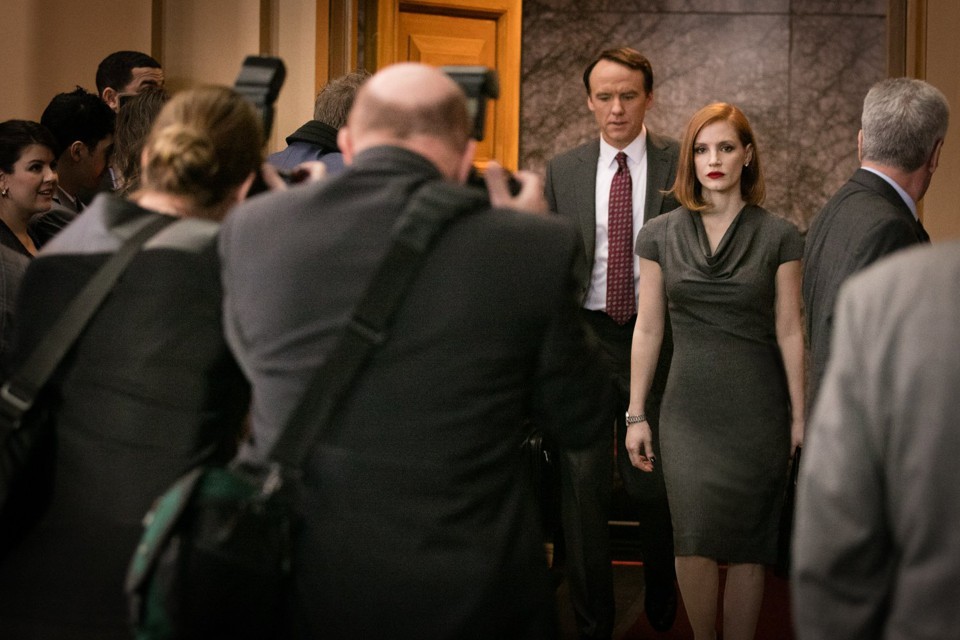
The movie follows lobbyist Elizabeth Sloane into a senate hearing where she’s accused of authorising expenses for the Indonesian government, something which is illegal for a lobbyist to do. At first she refuses to answer the questions she’s asked, hiding behind her lawyer’s brief to “plead the Fifth”. But a more personal line of questioning leads to her abandoning this line of defence and taking the fight to the hearing. Afterwards, her lawyer (Barnes) keeps repeating “five years”, the term of imprisonment she’ll receive if she’s found guilty of perjury. But Elizabeth appears unperturbed.

The movie then travels back to roughly seven months before. Elizabeth is working for a law firm owned by George Dupont (Waterston). A representative of the National Rifle Association, Bob Sanford (Shamata), asks for her help in connecting with a broader female demographic ahead of an upcoming vote on a bill that would mean mandatory background checks on anyone looking to purchase a gun. The NRA sees it as an infringement on civil liberties, and wants to make sure that the bill, the Heaton-Harris Amendment, isn’t passed. Elizabeth laughs in Sanford’s face, and refuses to have anything to do with it. Later, Dupont makes it clear that if she doesn’t work on the NRA’s initiative then her position won’t be as assured as she thinks. That night she meets Rodolfo Schmidt (Strong), head of the law firm Peterson Wyatt, and the man in charge of the fight to get the Heaton-Harris Amendment passed. The next day, Elizabeth resigns, and takes several of her team with her to Peterson Wyatt, though one of her best colleagues, Jane Molloy (Pill), chooses to stay.

In order for the Amendment to have a chance of being successful, Elizabeth, her team, and the staff at Peterson Wyatt, including Esme Manucharian (Mbatha-Raw), have to persuade sixteen out of twenty-one uncommitted senators to vote their way. As they set about this seemingly huge task – Dupont and the NRA only need to persuade six – Elizabeth plays out various strategies in her efforts to secure the necessary votes. But it soon becomes obvious that she’ll cross almost any line in order to win, even if it means sacrificing colleagues or lying to them deliberately. With the tide turning in her favour, and Dupont becoming ever more determined to derail her progress, her old firm launches a smear campaign, one that leads to Elizabeth’s sitting before a senate hearing committee and having to answer for her actions.

From the off, Miss Sloane is a thriller that throws the viewer deep into the mire of political lobbying, and which expects them to keep up with everything that’s going on. It’s an intellectual minefield, with so many issues dependent on the appropriate (or inappropriate) use of legal and ethical considerations, that looking away for even a moment could mean the difference between knowing exactly what’s going on – difficult enough thanks to Jonathan Perera’s dauntingly detailed script – and what might be going on. If you’re ever unsure as to what is happening, and/or why, then it’s best to bear in mind that opening speech, and the lobbyist always being “one step ahead”. Do that, and most of the movie will make sense… eventually.

By preferring (or needing) to stay one step ahead at all times, Elizabeth inevitably becomes a character that the viewer can’t trust. But we can have faith in her, in her need to win, and her commitment to never being out-thought, outfoxed, or outmanoeuvred. For all her manipulations and outright deceptions, Elizabeth is consistent in her efforts to be the winner, and she makes no bones about her methods: if they get the win then that’s all that matters. Along the way this means there are some casualties, notably Mbatha-Raw’s Esme, who has a personal secret exposed in front of millions of TV viewers. Elizabeth would argue that the end justifies the means, but as she is drawn deeper and deeper into the fight to get the Amendment passed, she begins to learn that some lines, once crossed, can’t be re-crossed. And as the stakes are increased, and the senate hearing hoves into view, Elizabeth has no option but to reassess her approach to lobbying and the people she works with.

Bringing the character of Elizabeth Sloane to mesmerising life, Chastain gives, arguably, her best performance since Zero Dark Thirty (2012). Cool, controlling, yet undeniably complex in both her motivations and her need to win at all costs, Chastain portrays Elizabeth as a restless, rest-avoiding predator, always looking for the weak link in an opponent’s armour, and always ready to exploit that weak link. She’ll even use her own people if she feels it’s necessary, but she’s up front about it, and it’s this straight-shooting, unapologetic persona that Chastain exploits so well, making her unlikeable and yet still strangely admirable at the same time. Chastain is the star of the movie, unforgettable whether she’s trampling on other people’s feelings or struggling to contain her own. She’s not alone, though. As her “boss” (a term you soon feel is inadequate in describing anyone who employs her), Strong goes from marvelling at her successes to feeling increasingly worried that she’s going too far with her own, hidden agenda. As the cruelly exposed Esme, Mbatha-Raw is a perfect foil for Chastain’s ebullient performance, her wide-eyed naïvete and quiet strength making her the movie’s most sympathetic character. And there’s further impressive support from Stuhlbarg as Elizabeth’s main adversary at Dupont, Lithgow as the head of the senate committee, and Barnes as her exasperated lawyer.

Orchestrating all this is Madden, now free from depicting events at the Best Exotic Marigold Hotel, and displaying all the skills and directorial touches needed to shepherd Perera’s screenplay (a top five Black List script from 2015) through its varied twists and turns. Make no mistake, this is an intelligent, penetrating look at a world few of us have any conception of, and which is paced like a thriller, all of which makes Miss Sloane a much more compelling movie than expected. It’s also put together very skilfully by editor Alexander Berner, and he and Madden ensure that the many scenes that are taken up by immense amounts of exposition are as equally vital as those scenes where Elizabeth’s plans are achieving momentum, or are already in full swing. In the end, it’s a tale about personal redemption set against a dark backdrop of corruption and ethical malaise, and thanks to Chastain, is nothing less than exhilarating.

Rating: 8/10 – marred only by its predictable denouement, some by-the-numbers villainy from Dupont, and Elizabeth’s not-quite-credible overall gamble, Miss Sloane is still a political thriller with teeth, and replete with flashes of dark humour that leaven the serious tone; irresistible once it’s in full flow, this has unfortunately been overlooked by audiences – which is a shame given the pedigree of the cast, the skill of its director, and the sharpness of its script.

Share this:

  • Click to share on X (Opens in new window) X
  • Click to share on Facebook (Opens in new window) Facebook
  • More
  • Click to print (Opens in new window) Print
  • Click to email a link to a friend (Opens in new window) Email
Like Loading...

The Accountant (2016)

11 Friday Nov 2016

Posted by dullwood68 in Movies

≈ 1 Comment

Tags

Action, Anna Kendrick, Autism, Ben Affleck, Cynthia Addai-Robinson, Drama, Gavin O'Connor, J.K. Simmons, John Lithgow, Jon Bernthal, Living Robotics, Review, Thriller, Treasury

theaccountantgross

D: Gavin O’Connor / 128m

Cast: Ben Affleck, Anna Kendrick, J.K. Simmons, Jon Bernthal, Cynthia Addai-Robinson, John Lithgow, Jeffrey Tambor, Jean Smart, Andy Umberger, Robert C. Treveiler

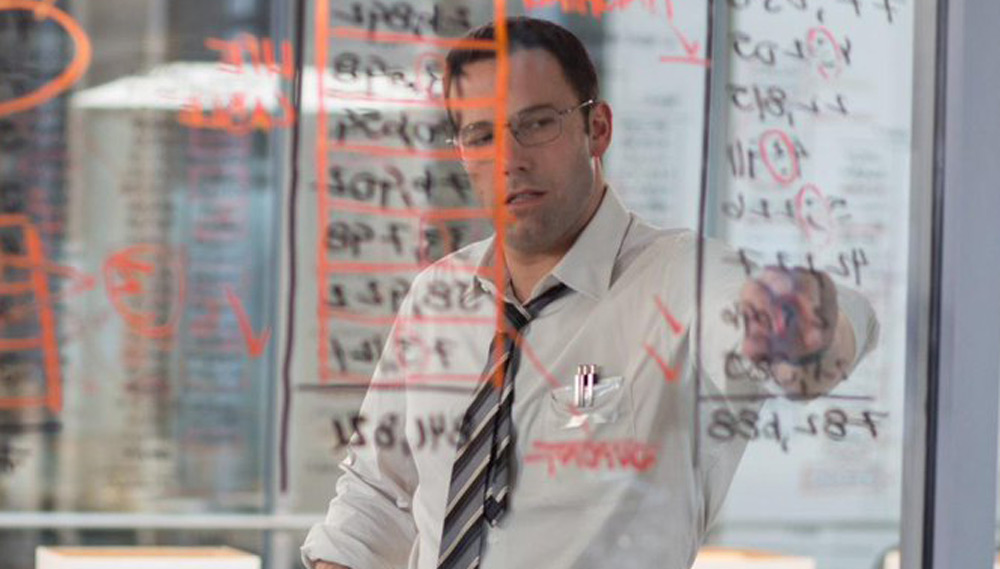
To all intents and purposes, Christian Wolff (Affleck) is a public certified accountant who also happens to have high-functioning autism. He’s occasionally blunt to the point of rudeness, has trouble interacting with other people in certain situations, does his best to fit in, lives alone in a spartan apartment, and is the man to go to if you’re a big time criminal organisation and you want your “books” to look whiter than white. Over time he’s attracted the attention of the US Treasury Department, and in particular, soon-to-be-retired agent Ray King (Simmons), who wants to track Wolff down before he goes. To this end, he coerces Treasury analyst Marybeth Medina (Addai-Robinson) into helping him.

Meanwhile, Wolff is hired by a legitimate company, Living Robotics, to audit their accounts in full as one of their own analysts, Dana Cummings (Kendrick), has spotted what appears to be a huge, unaccounted loss. The company is owned by Lamar Blackburn (Lithgow), and it makes high-end prosthetic limbs. Wolff soon goes to work and it doesn’t take him long to identify just how much money has been stolen from the company – over $61m. But the apparent suicide of one of the company’s senior executives (and a lifelong friend of Blackburn’s) brings Wolff’s investigation to an abrupt halt. But Wolff is unable to leave it at that and intends to find out if the senior executive was responsible.

ben-affleck-accountant

There follows an attempt on his life which he foils, and he learns that Dana is being targeted as well. He gets to her in time and going against his usual “mission parameters” he determines to keep her safe. In the meantime, Medina has managed to put a name to the face of the “Accountant” and has tracked him to where he lives, but with Wolff having gone to ground after the attempts on his and Dana’s lives, the Treasury Department is no nearer to catching him. Holed up in a fancy hotel, he and Dana develop a friendship, while Wolff figures out that Living Robotics hasn’t been stolen from, but that they’re operating a scam designed to inflate their share price when the company goes public. Now that he knows what’s been going on and why, Wolff decides to pay Lamar Blackburn a home visit… but Blackburn has a small, private army, led by The Assassin (Bernthal), in place to ensure that Wolff doesn’t get to “finish the job” he started.

On the surface, The Accountant is a slightly above average Hollywood action thriller with a good cast and good production values. Its decision to make its central character suffer from autism – even if it’s at the high end of the range – is different, and for the most part, works thanks to Affleck’s studied, and muted, performance (the script does, however, have to keep reminding itself that Wolff is indeed autistic, and should show some ritual behaviour from time to time).  Also for the most part, it makes the usual unexplained narrative leaps that compromise the logic and flow of the story, and has many of its characters doing things in ways that are consistently at odds with their usual behaviour.

accountant-2

It’s also a movie that contains a number of scenes that are so redundant or unnecessary (and sometimes both) that you begin to wonder if a Director’s Cut due to be released on Blu-ray and DVD in six months’ time has been released to cinemas instead. When King coerces Medina into helping him track down Wolff, he does it by virtue of her having lied on her Treasury application form; she helps him or he’ll see that she’s prosecuted (forget that he appears to be the only one who’s vetted her properly since she applied). As the scene plays out, the viewer can only sit back and ask themselves, couldn’t he have just asked for her help, or used his seniority to get her working on the case? Wouldn’t that have been simpler? Of course it would, but the scene is there nevertheless, and the way it pans out it just doesn’t work.

Elsewhere, Wolff and Dana hit it off way too quickly, not only because her life is in danger and he’s yet another assassin who’s too good deep down to “walk away”, but because it’s an attempt to remind us that Wolff can connect when he tries, and the script seems to be saying, look, give the guy a break, he’s never had a girlfriend before. It’s the wrong kind of break, though, because Wolff gets close to Anna Kendrick in full on perky, quirky mode, the actress using all her standard comic traits and reactions in a role that is yet another too easy variation on the role she usually plays almost everywhere else. In their scenes together, Affleck doesn’t even have to try too hard: he’s inhabiting the role, she’s channelling the ghost of every eager-to-please young actress from the Sixties.

ben-affleck-accountant-images

And then there’s the moment, around two thirds in, where the movie decides to grind to a halt and spend around ten minutes detailing a back story involving King that nearly kills the movie’s momentum. And then there’s the final showdown between Wolff and the Assassin, which veers off into left field territory – unless you’ve been paying attention – and ends on an emotional note you won’t have seen coming. All of which adds up to a movie which is, appropriately or not, somewhat schizophrenic in places, or perhaps put more plainly, deliberately uneven.

In the end, The Accountant is yet another example of action movie making that only takes risks with its central character, and only when it doesn’t get in the way of his being an extremely talented assassin. The scenes where we witness Wolff grow from easily agitated pre-teen to kick-ass teenager thanks to his tough-as-nails father are weirdly compelling (when they shouldn’t be), and the action sequences are imaginative and well choreographed for the most part, even if they also lack the necessary “wow” factor that should have viewers hoping for more. By the end it’s clear that the producers are hoping that further on down the line there’ll be more adventures for Christian Wolff as he goes about writing other wrongs with his pocket protector and his high-calibre arsenal.

Rating: 7/10 – worth seeing for another committed performance from Affleck that elevates the otherwise pedestrian nature of the material on offer, The Accountant does its best to be more than a standard Hollywood action thriller, but can’t quite pull it off; with O’Connor handling things well from behind the camera, but without injecting too much pizzazz into proceedings, the movie ends up being exactly the kind of Saturday night choice that goes perfectly with pizza and beer.

Share this:

  • Click to share on X (Opens in new window) X
  • Click to share on Facebook (Opens in new window) Facebook
  • More
  • Click to print (Opens in new window) Print
  • Click to email a link to a friend (Opens in new window) Email
Like Loading...

The Homesman (2014)

25 Wednesday Mar 2015

Posted by dullwood68 in Movies

≈ 1 Comment

Tags

1850's, Action, Drama, Hilary Swank, History, John Lithgow, Literary adaptation, Madness, Mary Bee Cuddy, Meryl Streep, Nebraska Territory, Review, Tommy Lee Jones, Western

Homesman, The

D: Tommy Lee Jones / 122m

Cast: Tommy Lee Jones, Hilary Swank, Grace Gummer, Miranda Otto, Sonja Richter, Jo Harvey Allen, Barry Corbin, David Dencik, William Fichtner, Evan Jones, Caroline Lagerfelt, John Lithgow, Tim Blake Nelson, Jesse Plemons, James Spader, Hailee Steinfeld, Meryl Streep

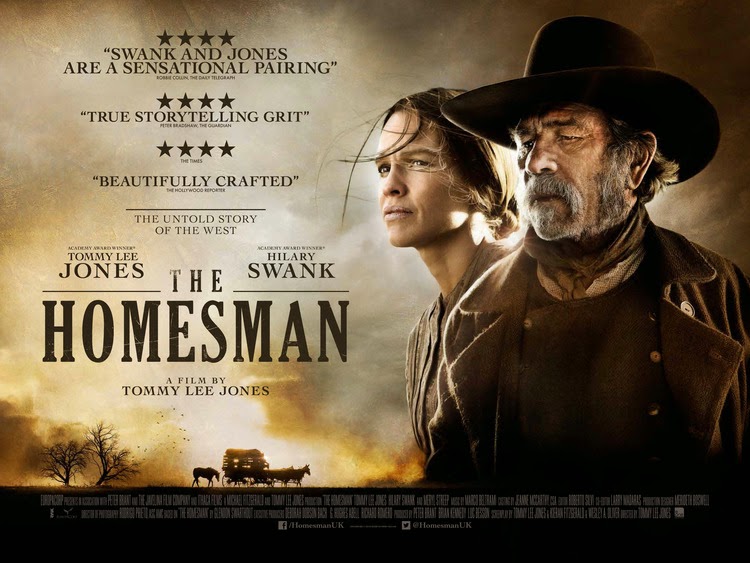
In the Nebraska Territory in the 1850’s, three women – Arabella Sours (Gummer), Theoline Belknap (Otto), and Gro Svendsen (Richter) – fall victim to madness after enduring various hardships. Their pastor, Reverend Dowd (Lithgow), calls upon one of their husbands to take them to Hebron, Iowa where there is a church that will take care of them. With one refusing to do it at all, and the other two proving less than ideal, spinster and homesteader Mary Bee Cuddy (Swank) accepts the task, hoping that the “adventure” will help with her own feelings of isolation and depression.

Buddy encounters George Briggs (Jones), and saves him from being hanged for using another man’s home. She persuades him to accompany her and promises him $300 if they make it to Hebron. Briggs agrees but makes for surly company, and challenges Cuddy at every opportunity. However, they come to a mutual understanding, and Briggs’ experience proves invaluable when problems arise, such as one of the women wandering off and being found by a man (Nelson) who wants her for his own, and when they find themselves being watched by Indians.

However, when they find the desecrated grave of an eleven year old girl, Cuddy elects to restore it while Briggs continues on with the women. But Cuddy loses her way and finds herself back at the child’s grave. When she finally catches up with Briggs, she suggests to him that they should marry, but he rejects her offer, telling her – like som many other men before him – that she is too plain and too bossy. Later, she comes to him naked and they have sex. The next morning, Briggs makes a terrible discovery, one that changes the whole nature of the trek to Hebron.

Homesman, The - scene

Achingly stark yet beautiful at the same time, Jones’ adaptation of the novel by Glendon Swarthout, The Homesman, is a melancholic, richly detailed portrait of the hardships of frontier life in the 1850’s, and the different ways in which loneliness can affect even the strongest and most determined of people. Through the journey that Cuddy, Briggs and the three women make, the movie delves into notions of longing, despair, loss and, more curiously, faith (though to a lesser degree than the others). It’s a confident, expertly constructed and devised movie, and it features a handful of strong, finely detailed performances – from Jones, Swank, Streep and Lithgow – and also features some stunning photography courtesy of Rodrigo Prieto, but ultimately it’s a movie that plays too much to convention.

Part of the problem lies in the relationship between Briggs and Cuddy, two people for whom loneliness has become their lives. But where Briggs is comfortable in being alone, Cuddy isn’t, and strives to match herself with someone (at the beginning of the movie it’s another homesteader (Evan Jones), but her desperation is alienating). When she and Briggs meet it’s inevitable that she will offer him the same proposal of marriage it seems she’s made to everyone else. That Briggs will refuse her is another inevitability, and one that robs the moment of any dramatic tension; it also makes Cuddy’s willingness to strip naked and sleep with him too desperate (that Briggs would agree to this approach is unsurprising). What follows is robbed of any potency by Jones’ not allowing any build up to it – it’s presented so matter-of-factly that it makes Cuddy’s importance to the narrative seem irrelevant.

And so the focus remains on Briggs, a curmudgeonly old fox who lacks several degrees of decency, and who develops an unlikely sense of responsibility to the three madwomen (and purely, it seems, because they’ll follow him wherever he goes, a development that’s never really explained). He’s otherwise a selfish, mean-spirited man with no measure of social conscience, but who seems to gain said social conscience without a second thought, and who tries to echo Cuddy’s desperate need to fit in and be accepted by making a similar (uncomfortable) proposal to Steinfeld’s waitress. In Jones’s hands, he’s meant to be a sympathetic character overall, but his personality and way with others is too wayward to afford consistency, and Briggs’ initial roguishness gives way to behaving in whichever way the script needs him to.

With Jones the actor hamstrung by Jones the co-writer – along with Kieran Fitzgerald and Wesley A. Oliver – it’s left to Jones the director to save the day. If there’s one aspect that he’s very, very good at, it’s in the look of his movies. As in The Three Burials of Melquiades Estrada (2005), Jones’ mastery of the frame is simply superb, each shot crafted with a care and attention to light and shade and detail that is consistently impressive. His use of perspective is also finely attuned, the various landscape shots peppered throughout the movie displaying a level of natural beauty married to the width and depth of the image that is often breathtaking. And it’s no different in medium or close up shots: Jones displays such a sure knowledge of what’s he doing and how he’s presenting it that each scene has a rare quality to it, one that few other directors would be able to reproduce.

The movie moves along at a measured pace that gives the cast adequate time to make an impression, and which shows Jones to be generous when sharing the screen with someone else. He gives supporting actors such as Spader, Fichtner and Steinfeld plenty of room to impress, and stands well back to let them do their thing. Though the script gives them little to do except stare off into the distance, Gummer, Otto and Richter, are effective as the three women driven mad by circumstance and hardship (particularly Richter, who has a chilling and very disturbing scene with a sowing needle). They don’t quite achieve the prominence the story allows them at the beginning, but all three characters are convincingly portrayed throughout.

There are casual nods to the sexism of the times, and the grim nature of trying to survive in what was an often harsh, unforgiving environment is well depicted. The final twenty minutes serve more as a coda than a final act, and some viewers may feel this section is a little off-centre as a result, as the three madwomen arrive at their destination and Streep’s affable pastor’s wife takes centre stage (her performance is a reminder, if any were needed, of just how good an actress she is). And the final scene itself ends the movie on an awkward, offhand note that smacks of contrivance rather than a satisfying end to the story.

Rating: 7/10 – absorbing if uneven, The Homesman scores highly because of Jones’ ability as a director and his often glorious use of the camera; with its story often straying off into some unwanted dead ends, this journey is only occasionally involving, and only occasionally matches the commitment made by its cast.

Share this:

  • Click to share on X (Opens in new window) X
  • Click to share on Facebook (Opens in new window) Facebook
  • More
  • Click to print (Opens in new window) Print
  • Click to email a link to a friend (Opens in new window) Email
Like Loading...

Love Is Strange (2014)

01 Sunday Feb 2015

Posted by dullwood68 in Movies

≈ Leave a comment

Tags

Alfred Molina, Drama, Gay couple, Homelessness, Ira Sachs, John Lithgow, Marisa Tomei, Music teacher, Painter, Relationships, Review, Same sex marriage

Love Is Strange

D: Ira Sachs / 94m

Cast: John Lithgow, Alfred Molina, Marisa Tomei, Darren Burrows, Charlie Tahan, Eric Tabach, Christina Kirk, Christian Coulson

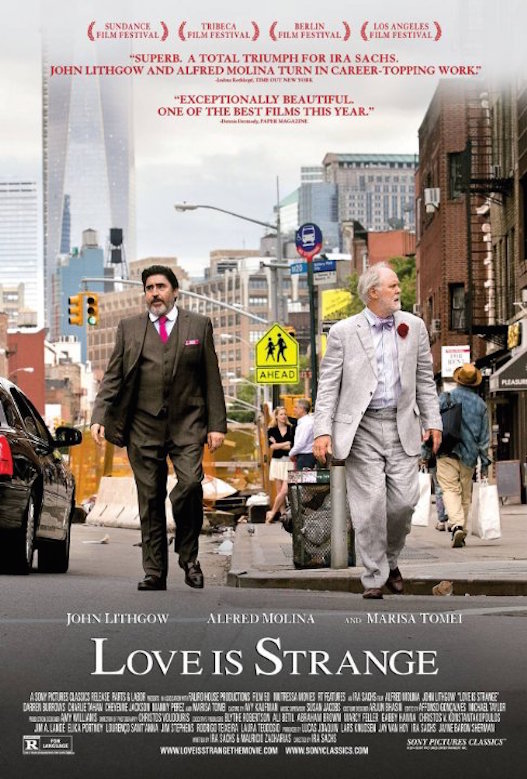
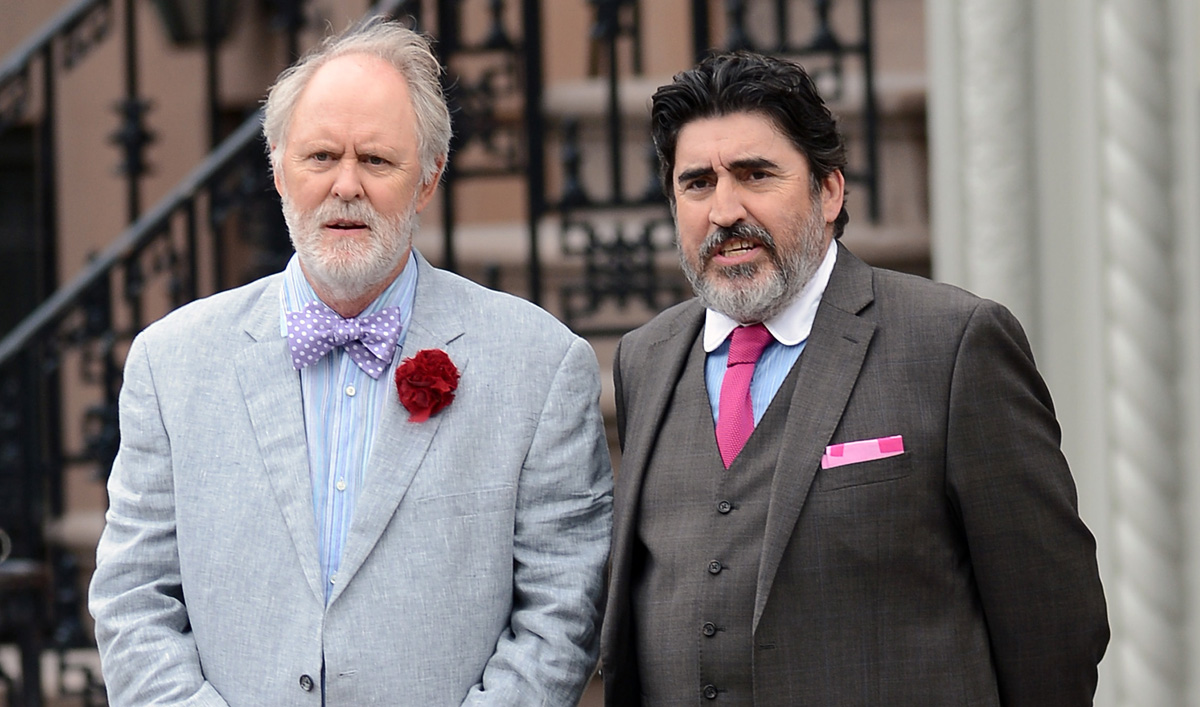
Ben (Lithgow) and George (Molina) are a gay couple who, after nearly forty years together, decide to get married. They have a wonderful day surrounded by friends and Ben’s family, but their happiness is short-lived. George works as a music teacher at a Catholic school; when the archdiocese finds out he’s now married, he’s dismissed. Unable to afford the upkeep on their apartment, they’re forced to sell it and seek somewhere else to live. They round up their friends and Ben’s family and ask them to put them up until they can find somewhere. Ben goes to live with his nephew, Elliot (Burrows), his wife Kate (Tomei) and their teenage son Joey (Tahan). Meanwhile George moves in with their friends and neighbours, Ted and Roberto.

At his nephew’s Ben finds himself sharing a room with Joey, a situation that is uncomfortable for both of them. Kate, a writer working on her latest book, soon tires of Ben’s presence as he interrupts her work. Elliot, a music producer, works long hours and doesn’t always see the upheaval Ben’s being there entails. Issues surrounding Joey’s friendship with another boy called Vlad (Tabach) begin to cause arguments between Elliot and Kate, and Ben does his best to remain neutral but he’s clearly affected by the atmosphere in their home.

George also encounters problems at Ted and Roberto’s. They have a large group of friends that are always visiting. George’s sense of isolation begins to increase, and the frustration of not finding work straight away, or being able to find a new place to live, soon wears him down. He finds solace by visiting Ben as often as he can, and the two of them rekindle their life together. One day, Ben has a bad fall and his injuries leave him with his right arm in a sling. As he recovers, Joey and Vlad are discovered to have been stealing books from their school library. This leads to a confrontation between Elliot and Kate that results in her feelings about Ben being made apparent. And then George has a chance meeting with Brit Ian (Coulson), one that could mean he and Ben have somewhere new to live.

Film Set - 'Love Is Strange'

A measured, emotionally gratifying movie about long-term commitment and mutual dependence, Love Is Strange features the kind of performances that seem effortless, a script that is both poignant and relevant (and would remain so whatever the nature of the main relationship), direction that is carefully nuanced, and a set up with consequences that are entirely convincing. It’s a modern day chamber piece, a look at the lives of a couple whose near forty year relationship is threatened by the vicissitudes of contemporary living. It’s also one of the most emotionally honest movies made in recent years.

The relationship between retired painter Ben and music teacher George is one based on a love of the arts, but more importantly it’s the love they have for each other that the movie focuses on. Their artistic backgrounds inspire their life together; without each other they stumble and – literally in Ben’s case – fall. Once they reconnect with each other, they become re-energised, their adoration for each other so genuine that the viewer can’t help but be moved by it. After some time apart, George has had enough. He hurries to see Ben, and when he gets to him he collapses, sobbing with relief, in Ben’s arms. It’s a powerful, heart-rending moment, but where most writers would end the scene there, co-scripters Sachs and Mauricio Zacharias let the scene play on to include Elliot and Kate and their reactions. Both are made ill at ease by George’s emotional outburst, and walk away, their discomfort magnified by the lack of such a devotion in their own marriage (there’s an unresolved subplot that hints at Elliot having an affair; Kate is distant toward him as a result). It’s a brilliant moment, quietly yet impressively shot, and with such a visceral impact it’s almost shocking.

As the beleaguered duo, Lithgow and Molina are superb, investing both characters with  charm, honesty, intelligence, depth of feeling, and pathos. There’s very little that’s sentimental or saccharine about their performances either; they play each emotion and feeling with a refreshing lack of embellishment, unafraid to play it straight. It’s a joy to watch them, two experienced actors taking the material laid down by Sachs and Zacharias and making it sing. It’s a testament to both men that, although the focus is more on Ben than George, it always seems that they’re sharing the same amount of screen time, that the audience is investing the same amount of energy in following their individual trials and tribulations. Lithgow essays Ben’s increasing frailty with authority, while Molina conveys George’s sadness at his predicament with practiced ease. There’s not a false note from either of them throughout.

The same can be said for Tomei, whose portrayal of Kate continues to show her at the top of her game; the moment when she responds to Elliot’s accusation of being too soft with Joey is so vivid and so powerful it’s alarming. Tahan and Burrows offer solid support, and the narrative is beautifully endorsed by several pieces by Chopin, their melancholy refrains providing a moving counterpoint to Ben and George’s travails. A special mention as well for editors Affonso Gonçalves and Michael Taylor, who keep the rhythm of the movie at such a steady, effective pace throughout that it’s almost like “watching” a piece of music. But overall, this is Sachs’s triumph, a balanced, emotive, wonderfully constructed and delivered movie that rewards on every level.

Rating: 9/10 – with the feel and style of a European arthouse movie, but married to an American indie movie sensibility, Love Is Strange is simply, a pleasure; Lithgow and Molina make a great team, and Sachs throws his hat in the ring as someone whose next movie should definitely be sought out.

Share this:

  • Click to share on X (Opens in new window) X
  • Click to share on Facebook (Opens in new window) Facebook
  • More
  • Click to print (Opens in new window) Print
  • Click to email a link to a friend (Opens in new window) Email
Like Loading...

Blog Stats

  • 486,528 hits

Recent Posts

  • 10 Reasons to Remember Bibi Andersson (1935-2019)
  • Fantasia (1940)
  • Dances With Wolves (1990) – The Special Edition
  • Kiss of the Spider Woman (1985)
  • The Three Musketeers (1973)

Top Posts & Pages

  • Lost for Life (2013) - Another Look
    Lost for Life (2013) - Another Look
  • Lost for Life (2013)
    Lost for Life (2013)
  • About
    About
  • Mr. Topaze (1961)
    Mr. Topaze (1961)
  • Billy Lynn's Long Halftime Walk (2016)
    Billy Lynn's Long Halftime Walk (2016)
  • Winter's Tale (2014)
    Winter's Tale (2014)
  • The Hitman's Bodyguard (2017)
    The Hitman's Bodyguard (2017)
  • 5 Famous Movie Roles That Nearly Went to Someone Else
    5 Famous Movie Roles That Nearly Went to Someone Else
  • The Layover (2017)
    The Layover (2017)
  • Transcendence (2014)
    Transcendence (2014)
Follow thedullwoodexperiment on WordPress.com

Blogs I Follow

  • Rubbish Talk
  • Film 4 Fan
  • Fast Film Reviews
  • The Film Blog
  • All Things Movies UK
  • Interpreting the Stars
  • Let's Go To The Movies
  • Movie Reviews 101
  • TMI News
  • Dan the Man's Movie Reviews
  • Film History
  • Jordan and Eddie (The Movie Guys)

Archives

  • April 2019 (13)
  • March 2019 (28)
  • February 2019 (28)
  • January 2019 (32)
  • December 2018 (28)
  • November 2018 (30)
  • October 2018 (29)
  • September 2018 (29)
  • August 2018 (29)
  • July 2018 (30)
  • June 2018 (28)
  • May 2018 (24)
  • April 2018 (21)
  • March 2018 (31)
  • February 2018 (25)
  • January 2018 (30)
  • December 2017 (30)
  • November 2017 (27)
  • October 2017 (27)
  • September 2017 (26)
  • August 2017 (32)
  • July 2017 (32)
  • June 2017 (30)
  • May 2017 (29)
  • April 2017 (29)
  • March 2017 (30)
  • February 2017 (27)
  • January 2017 (32)
  • December 2016 (30)
  • November 2016 (28)
  • October 2016 (30)
  • September 2016 (27)
  • August 2016 (30)
  • July 2016 (30)
  • June 2016 (31)
  • May 2016 (34)
  • April 2016 (30)
  • March 2016 (30)
  • February 2016 (28)
  • January 2016 (35)
  • December 2015 (34)
  • November 2015 (31)
  • October 2015 (31)
  • September 2015 (34)
  • August 2015 (31)
  • July 2015 (33)
  • June 2015 (12)
  • May 2015 (31)
  • April 2015 (32)
  • March 2015 (30)
  • February 2015 (37)
  • January 2015 (39)
  • December 2014 (34)
  • November 2014 (34)
  • October 2014 (36)
  • September 2014 (25)
  • August 2014 (29)
  • July 2014 (29)
  • June 2014 (28)
  • May 2014 (23)
  • April 2014 (21)
  • March 2014 (42)
  • February 2014 (38)
  • January 2014 (29)
  • December 2013 (28)
  • November 2013 (34)
  • October 2013 (4)

Create a free website or blog at WordPress.com.

Rubbish Talk

Film 4 Fan

A Movie Blog

Fast Film Reviews

The Film Blog

The official blog of everything in film

All Things Movies UK

Movie Reviews and Original Articles

Interpreting the Stars

Dave Examines Movies

Let's Go To The Movies

Film and Theatre Lover!

Movie Reviews 101

Daily Movie Reviews

TMI News

Latest weather, crime and breaking news

Dan the Man's Movie Reviews

All my aimless thoughts, ideas, and ramblings, all packed into one site!

Film History

Telling the story of film

Jordan and Eddie (The Movie Guys)

Movie Reviews & Ramblings from an Australian Based Film Fan

Privacy & Cookies: This site uses cookies. By continuing to use this website, you agree to their use.
To find out more, including how to control cookies, see here: Cookie Policy
  • Subscribe Subscribed
    • thedullwoodexperiment
    • Join 481 other subscribers
    • Already have a WordPress.com account? Log in now.
    • thedullwoodexperiment
    • Subscribe Subscribed
    • Sign up
    • Log in
    • Report this content
    • View site in Reader
    • Manage subscriptions
    • Collapse this bar
 

Loading Comments...
 

    %d