• 10 Reasons to Remember…
  • A Brief Word About…
  • About
  • For One Week Only
  • Happy Birthday
  • Monthly Roundup
  • Old-Time Crime
  • Other Posts
  • Poster of the Week
  • Question of the Week
  • Reviews
  • Trailers

thedullwoodexperiment

~ Viewing movies in a different light

thedullwoodexperiment

Tag Archives: Kristen Wiig

Nasty Baby (2015)

11 Thursday Oct 2018

Posted by dullwood68 in Movies

≈ Leave a comment

Tags

Brooklyn, Drama, Harrassment, Kristen Wiig, Performance art, Reg E. Cathey, Review, Sebastián Silva, Surrogacy, Tunde Adebimpe

D: Sebastián Silva / 101m

Cast: Sebastián Silva, Kristen Wiig, Tunde Adebimpe, Reg E. Cathey, Mark Margolis, Agustín Silva, Alia Shawkat, Lillias White, Neal Huff

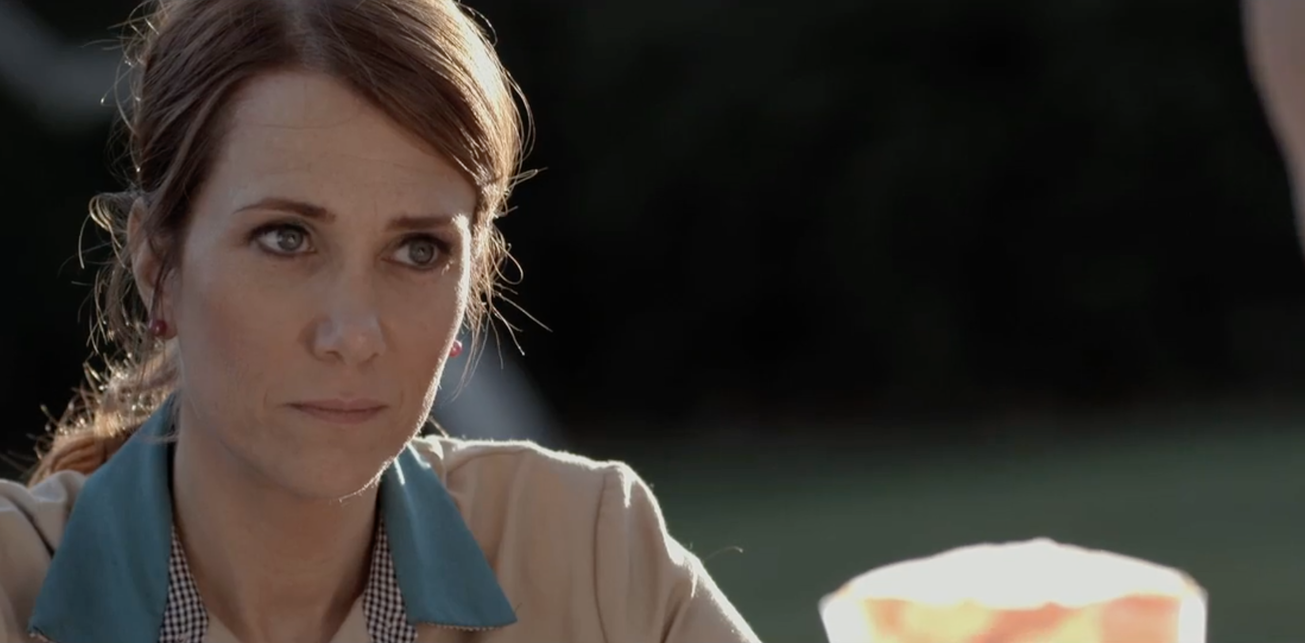
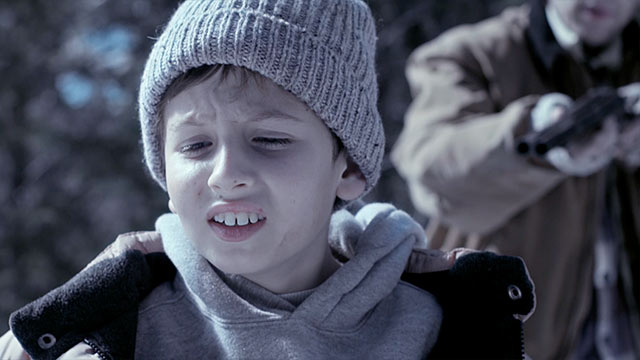
Performance artist Freddy (Sebastián Silva) has two current ambitions: to complete a short movie that sees him explore what it is to be a baby (and with himself portraying one), and to have a baby with his best friend, Polly (Wiig). But Freddy’s sperm count is too low, which rules him out as a donor. This leaves Freddy’s partner, Mo (Adebimpe), as a potential substitute. At first, Mo is supportive and willing to take over from Freddy, but when it comes to making his first “contribution”, he finds he can’t do it. Meanwhile, Freddy decides to expand the content of his movie to include other people, including Mo, Polly, and his assistant, Wendy (Shawkat). Having secured a possible spot at a local art gallery, Freddy is keen to complete the project as quickly as he can, but as well as the issue of Polly’s pregnancy – which Mo eventually has a change of heart about – one of his neighbours, a mentally disturbed man who calls himself The Bishop (Cathey), is the source of anti-social behaviour that has a greater and greater effect on Freddy, and Polly as well…

Sometimes, when discussing a movie, it’s hard to do so when that movie trundles along quite happily in one direction – and for most of the running time – and then suddenly it changes tack, and heads off into the unknown or the unexpected. This is the case with Nasty Baby, writer/director Sebastián Silva’s ode to creativity and creation, and a movie that is for the most part quite amiable (if a little under-nourished in the drama department), but which becomes a different movie entirely in its last twenty minutes. Nasty Baby was (somewhat famously) meant to premiere at the 2014 Toronto International Film Festival, but the festival organisers didn’t like the ending and suggested Silva change it. Silva stuck to his guns, but so too did the organisers, and it wasn’t until the 2015 Sundance Film Festival that the movie was first shown to audiences. Watching the movie now, you can understand Toronto’s reluctance, and also Silva’s determination. The ending of the movie is so tonally and dramatically separated from what’s gone before that it’s hard to work out if Silva intended it all along, or it was designed to provide an ending where there wasn’t one before. (Hmmmm…)
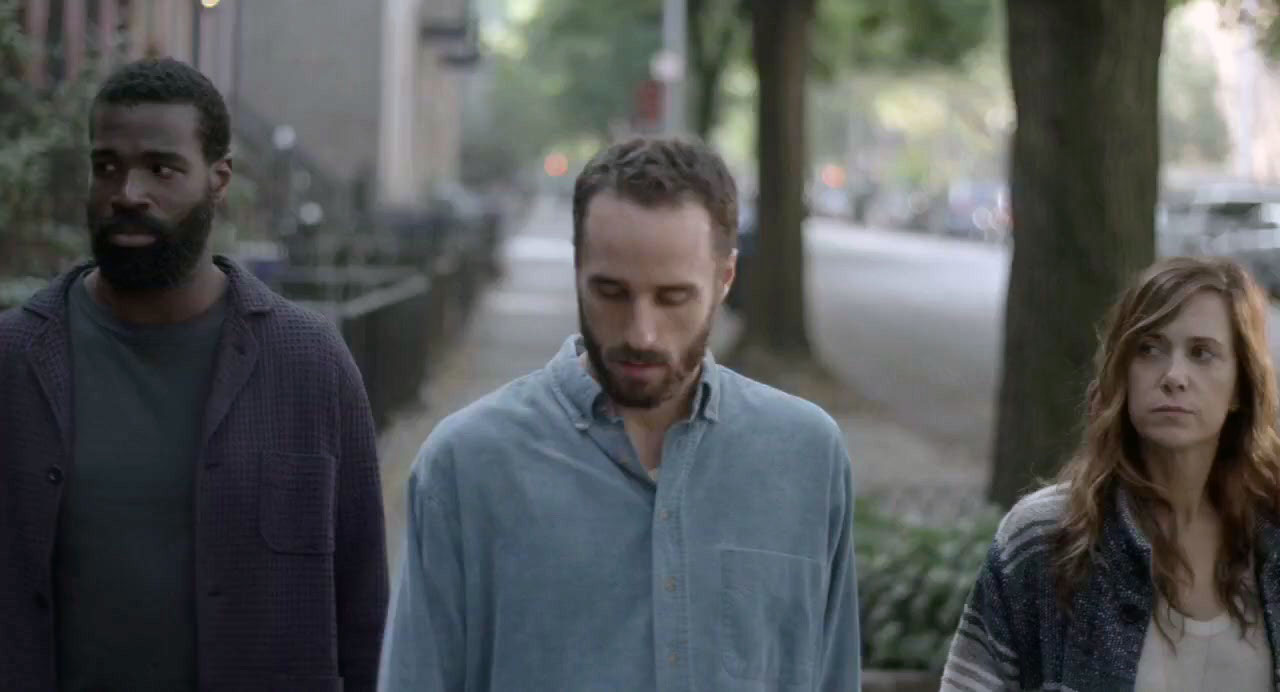
On the other hand, the ending is much more dramatic than anything else that’s gone before. The rest of the movie is engaging enough, even though not much happens, and it features good performances from Wiig and Adebimpe, but there’s a tremendous sense of waiting – waiting for Silva to pick up the pace, and waiting for Silva to plot a through line that doesn’t feel forced or lacking in focus. The surrogacy issue is left largely unexplored, as well as Polly’s need for a baby, and Freddy’s performance art work lacks a reason for being also, making this a movie where things are set up for no discernible reason, and it jumps from scene to scene without many of them having an impact. Even Cathey’s mentally disturbed neighbour, who provides the movie’s only real source of conflict, soon becomes tiresome due to the repetitive nature of his harrassment. A trip to visit Mo’s family further underlines the waywardness of Silva’s screenplay, with an awkward dinner table conversation about the suitability of a black gay man being the sperm donor for a straight white woman, and how this would affect the child. It’s awkward not because the subject matter is obviously contentious, but because, like so many other aspects of the movie, Silva hasn’t quite worked out what he’s trying to say.

Rating: 6/10 – though on the face of it, Nasty Baby has the look and feel of an accomplished indie movie, the truth is that it stumbles way too often for comfort, and keeps its characters at a distance from the viewer; the aforementioned performances go a long way toward making up for the movie’s shortfalls, and Silva does at least make good use of his Fort Greene, Brooklyn locations, but overall this is a movie that lacks the cohesiveness needed to make it work effectively.
Share this:

  • Click to share on X (Opens in new window) X
  • Click to share on Facebook (Opens in new window) Facebook
  • More
  • Click to print (Opens in new window) Print
  • Click to email a link to a friend (Opens in new window) Email
Like Loading...

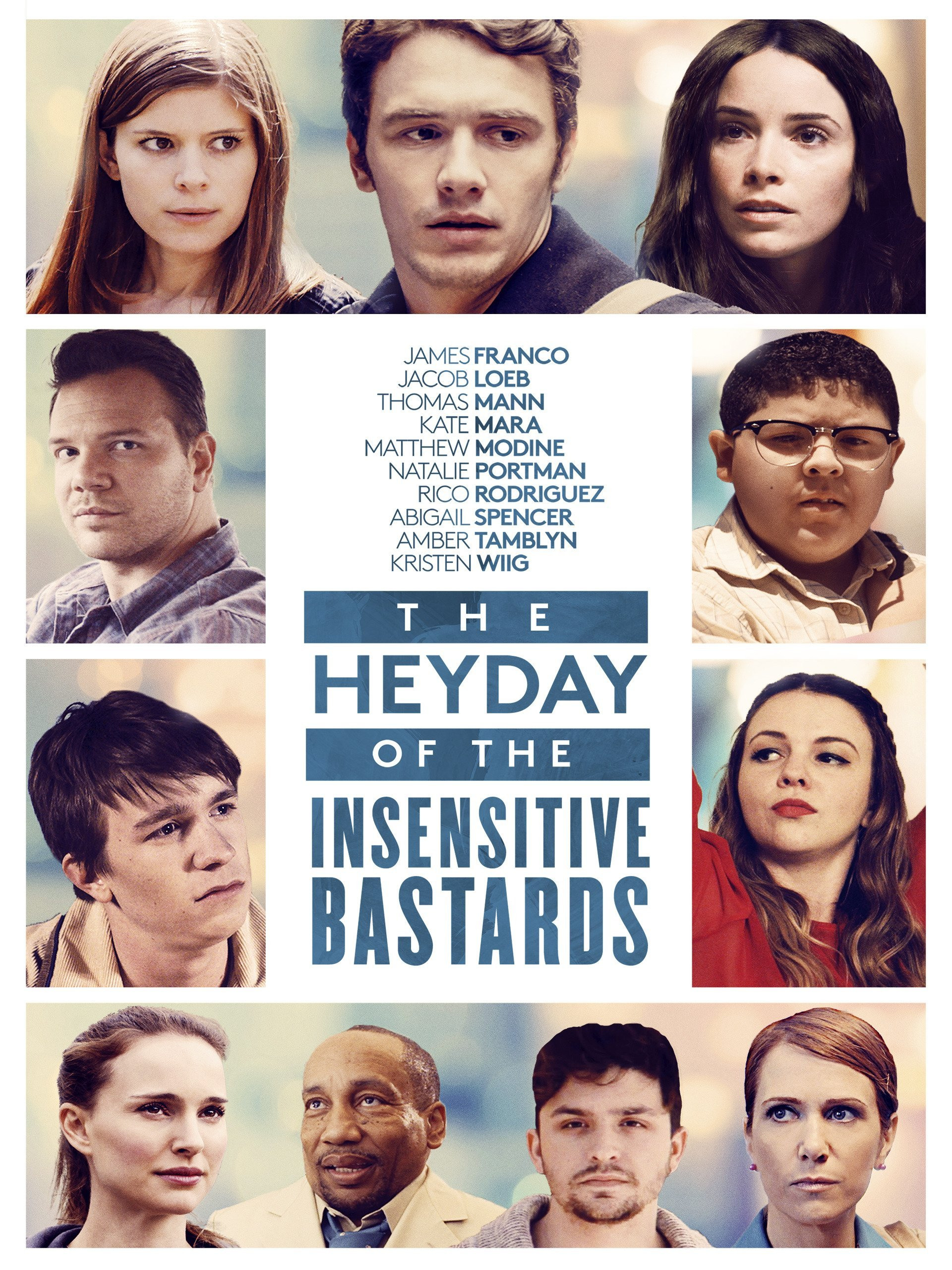
The Heyday of the Insensitive Bastards (2015)

14 Tuesday Nov 2017

Posted by dullwood68 in Movies

≈ Leave a comment

Tags

Amber Tamblyn, Childhood, Drama, Jacob Loeb, James Franco, Jeremy David White, Jim Parrack, Kate Mara, Keir Gilchrist, Kristen Wiig, Mark Columbus, Memory, Natalie Portman, Review, Ryan Moody, Sarah Jean Kruchowski, Shadae Lamar Smith, Simon Savelyev, Thomas Mann, Vanita Shastry

D: Ryan Moody, Mark Columbus, Sarah Jean Kruchowski, Shadae Lamar Smith, Vanita Shastry, Simon Savelyev, Jeremy David White / 97m

Cast: James Franco, Abigail Spencer, Rico Rodriguez, Matthew Modine, Kate Mara, Amber Tamblyn, Kristen Wiig, Tony Cox, Jimmy Kimmel, Jim Parrack, Natalie Portman, Thomas Mann, Keir Gilchrist, Bo Mitchell, Jacob Loeb, Kelsey Ford, Tyler Labine

A collection of seven short movies adapted from the short story collection of the same name by Robert Boswell, The Heyday of the Insensitive Bastards is that inopportune beast, a movie with no clear, discernible focus other than a plan to relate various tales of longing and regret, and all with the same dour approach to each of the “slices of life” that are depicted. A project that was assembled by graduate students of James Franco’s UCLA moviemaking class, it’s telling that the movie was first seen at the Atlanta Film Festival back in March 2015, but is only now receiving a limited release in the US. It’s an arthouse movie, structured in a way that makes it seem more knowing and truthful than it actually is, and which proves only moderately successful in its aims and ambitions.

The seven tales on display are a mixed bunch, both in terms of their content, and in their relation to each other. The first, A Walk in Winter, sees Conrad (Franco), a young man returning to his hometown to identify the remains of a body that may be that of his long-missing mother. An extended visit to the sheriff’s office reveals a childhood beset by abuse and further mystery. The second, Guests, concerns a young boy, Charlie (Rodriguez), who has to deal with his ailing, cancer-stricken father (Modine) and a school bully at the same time. He’s the quintessential chubby kid who’s picked on because he’s different (thanks to his dad), but he’s not the pushover everyone thinks he is. In the third tale, Almost Not Beautiful, sisters Lisa (Mara) and Amanda (Tamblyn) revisit aspects of their childhood while also trying to reconnect after spending some time apart. In doing so they discover a mutual dependency that they’d forgotten about. The fourth tale, Miss Famous, features a maid, Monica (Wiig), whose antipathy towards her clients provokes fantasies where she is rich and famous.

In the fifth, Lacunae, a young man, Paul (Parrack), also returns to his hometown, ostensibly to see his parents, but also to see an ex-girlfriend, Laura (Portman), who may have given birth to their son. Paul is adamant that the child isn’t his, but he can’t resist seeing for himself. In the sixth tale, Smoke, three friends (Gilchrist, Mann, Mitchell) sit round a camp fire and tell bogus stories of their sexual exploits. Each is seeking approbation from the other two, and each story is clearly a longed-for fantasy. And in the final tale, The Heyday of the Insensitive Bastards, another young man, this time called Keen (Loeb), attends a party where he not only hooks up with a young woman, Lila (Ford), but also finds himself in serious trouble with the law. Each tale is bookended by clips and randomly assembled stills from old home movies and family celebrations, and all of which adds a melancholy feel to the material, and which also serves to provide a sense that these tales take place in a time and a place where nostalgia doesn’t provide a soothing balm, but quite the opposite.

With any collection of stories that are meant to have a unifying theme, that theme needs to be evident – even if it’s to varying degrees – in order for the overall movie to work effectively, and also to offset the obvious problem whereby the viewer is forced to reinvest their attention every ten to fifteen minutes in a new story and new characters, while also attempting to assimilate each tale into an organic whole. This is where any portmanteau movie succeeds or fails, but in this case, it’s very nearly a draw, with three stories lacking any appreciable impact by themselves, three other stories working effectively on their own, and one having a foot in both camps. As a whole, though, the movie remains sporadically engaging, with its broader themes of memory and fantasy pushed to the fore when its more telling themes of disappointment and paralysed ambition should be front and centre. This isn’t a feelgood movie, and nor does it come with any message of hope for its characters. Mistakes have been made, and more mistakes will be made as they move forward with their lives. The question is, will any of them learn from their mistakes?

With childhood trauma leading the way in explaining why these characters behave and struggle as they do, each director approaches their tale in a way that, unfortunately, isolates each one from the rest. There’s no symmetry to the stories, and no unifying directorial approach (other than that there is no unifying approach), all of which leaves each episode feeling under-developed or prosaic. Despite some good performances – Franco, Tamblyn, Wiig, Portman, Loeb – the movie relates each tale as if it contains a singular message within itself, and a broader message for everyone to pick up as well (though just when is difficult to work out). But the problem is that with only three of the stories working effectively enough on their own – and they are A Walk in Winter, Guests, and The Heyday of the Insensitive Bastards – too much of the movie feels like there should be more to it, and too much of the movie feels like it should be making more of a connection with the viewer.

That said, there’s no denying the ambition and some of the talent on display behind the camera – Moody, Columbus, and White stand out in particular – but it’s all in service to material that isn’t as compelling as it should be given Boswell’s talent as a writer (he also provides the movie with a jaundiced, earnest narration). Some viewers may find some of the tales hard to decipher, while others may feel there’s no need for any deciphering at all, but what is clear is that some amount of interpretation is required, but that it won’t benefit the viewer in the long run. Sometimes, a teenager bragging about having sex with an older woman, is purely wish fulfilment and nothing more. It doesn’t need to resonate, and it doesn’t here. This, ultimately, is where the movie falters, by failing to resonate. And no matter how much effort has been spent, and no matter how much artistic endeavour is on display, when the tale itself isn’t able to carry the viewer forward then it’s time to move on to the next one… unless the next one has the same problem.

Rating: 5/10 – a great idea for a graduate project that proves to be less than a great idea for a movie as a whole, The Heyday of the Insensitive Bastards wants to be engaging and meaningful, but hasn’t the consistency to make it all work; some tolerance is required to get through the more sluggish and unaffecting episodes, but despite a clutch of good performances, it remains a frustrating experience and one that should be approached with caution.

Share this:

  • Click to share on X (Opens in new window) X
  • Click to share on Facebook (Opens in new window) Facebook
  • More
  • Click to print (Opens in new window) Print
  • Click to email a link to a friend (Opens in new window) Email
Like Loading...

Monthly Roundup – September 2016

30 Friday Sep 2016

Posted by dullwood68 in Movies

≈ 3 Comments

Tags

Action, Andrew Asper, Antoine Fuqua, Ben-Hur, Chris Pratt, Denzel Washington, Drama, Elizabeth Mitchell, Fantasy, Florence Foster Jenkins, Frank Grillo, George Montgomery, Ghostbusters (2016), Glenn R. Miller, Historical drama, Horror, Hugh Grant, Ione Butler, Jack Huston, James DeMonaco, Kristen Wiig, Melissa McCarthy, Meryl Streep, Paul Feig, Review, Richard Boone, Robbers' Roost, Sidney Salkow, Stephen Frears, The Magnificent Seven (2016), The Purge: Election Year, Thriller, Timur Bekmambetov, Toby Kebbell, Western, Zoombies

The Purge: Election Year (2016) / D: James DeMonaco / 109m

Cast: Frank Grillo, Elizabeth Mitchell, Mykelti Williamson, Joseph Julian Soria, Betty Gabriel, Terry Serpico, Edwin Hodge, Kyle Secor

the-purge-election-year

Rating: 6/10 – several years after the events in The Purge: Anarchy (2014), ex-cop Leo Barnes (Grillo) is now head of security for Presidential candidate Senator Charlie Roan (Mitchell) – whose anti-Purge stance has made her a significant target come the latest Purge night; more of the same from writer/director DeMonaco, with the villainous Founding Fathers coming in for more grief thanks to the series’ need to avoid repeating itself, but without it actually finding a solution to the problem, all of which leads to The Purge: Election Year sounding good on paper, but proving instead that it’s an idea that’s already running out of steam.

Ben-Hur (2016) / D: Timur Bekmambetov / 125m

Cast: Jack Huston, Toby Kebbell, Rodrigo Santoro, Nazanin Boniadi, Ayelet Zurer, Pilou Asbæk, Morgan Freeman, Sofia Black-D’Elia

ben-hur

Rating: 3/10 – meh; a waste of time, money, resources, the cast, the crew, and another unwanted remake which ruins the one thing it should have moved Heaven and Earth to ensure it got right: yes, the chariot race, a sequence that’s assembled and edited so badly that you won’t have any idea what happens to Messala (Kebbell) other than that he loses.

Robbers’ Roost (1955) / D: Sidney Salkow / 83m

Cast: George Montgomery, Richard Boone, Sylvia Findley, Bruce Bennett, Peter Graves, Tony Romano, Warren Stevens

robbers-roost

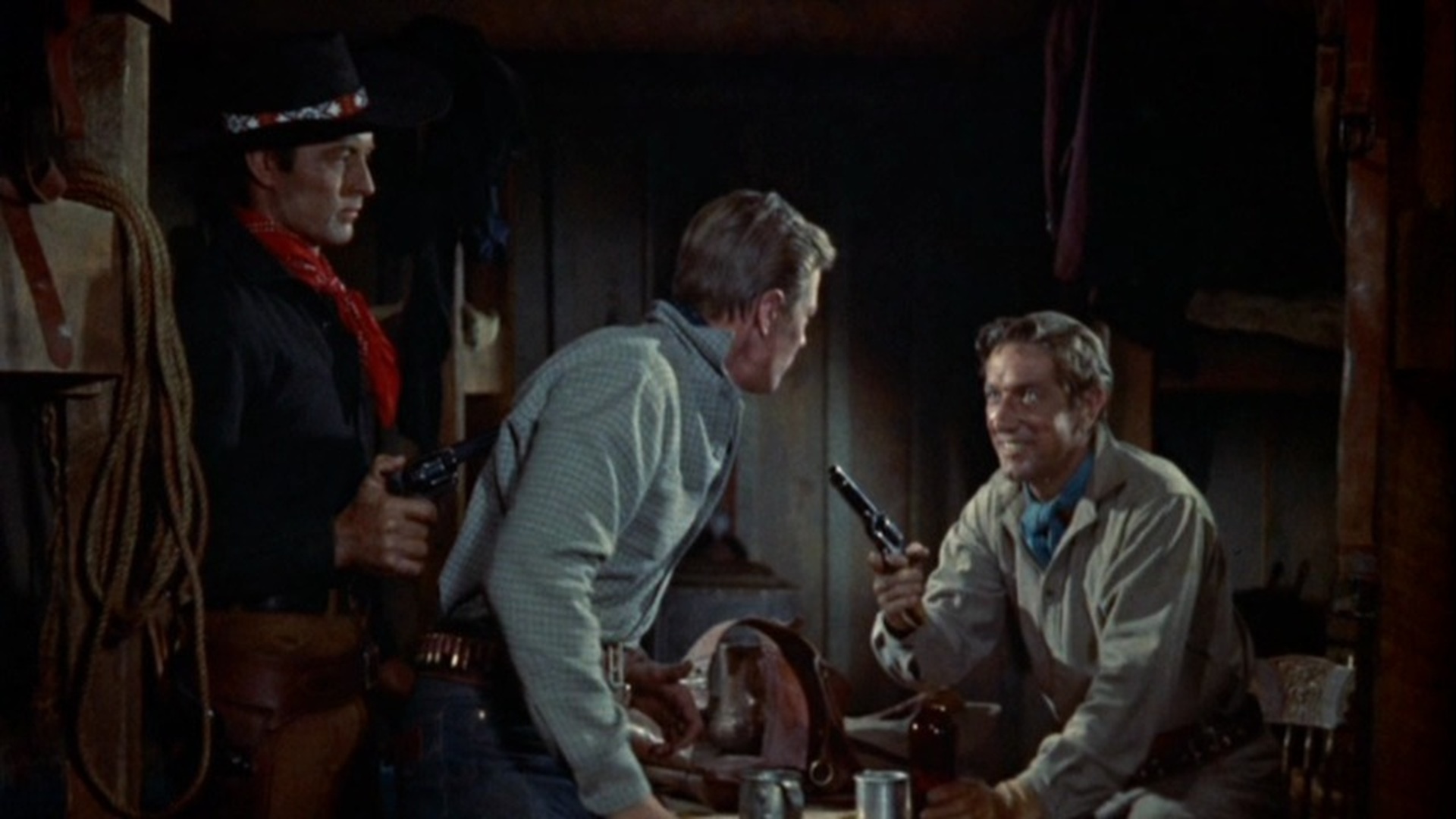
Rating: 6/10 – revenge is on the mind of cowboy Jim Wall (Montgomery) as he tries to track down the killers of his wife, some of whom he suspects may be part of a notorious gang of cattle rustlers led by Hank Hays (Boone); an average Western bolstered by a strong cast, Robbers’ Roost is rough and tough and bristling with repressed macho energy, all of which is channelled – eventually – into a less than exciting showdown, and an about-face by Hays that undermines both the character, and Boone’s enjoyable portrayal of him.

Florence Foster Jenkins (2016) / D: Stephen Frears / 111m

Cast: Meryl Streep, Hugh Grant, Simon Helberg, Rebecca Ferguson, Nina Arianda, Stanley Townsend, Allan Corduner, Christian McKay, David Haig, John Sessions, Brid Brennan

florence-foster-jenkins

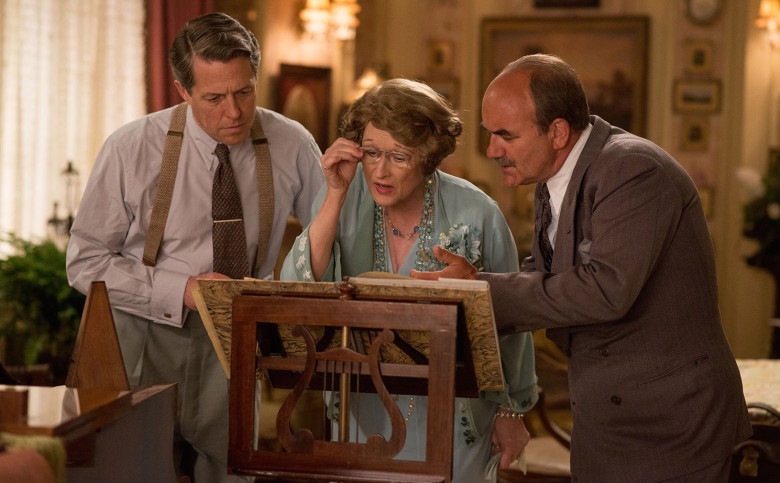
Rating: 7/10 – the true story of musically misguided socialite Florence Foster Jenkins (Streep) as she determines to bring her less than gifted voice to the unsuspecting ears of the public; as light and fluffy as a soufflé (and as enjoyable), Florence Foster Jenkins tries to be serious from time to time, but nothing can detract from Florence’s whimsical nature or the script’s determination to be nicer than nice, even when it needs to be a tad dramatic, such as when Florence’s husband (a terrific Hugh Grant) is shown to be having an affair, or Florence faces jeers rather than cheers from her audience.

The Magnificent Seven (2016) / D: Antoine Fuqua / 133m

Cast: Denzel Washington, Chris Pratt, Ethan Hawke, Vincent D’Onofrio, Byung-hun Lee, Manuel Garcia-Rulfo, Martin Sensmeier, Peter Sarsgaard, Haley Bennett, Luke Grimes, Matt Bomer

the-magnificent-seven

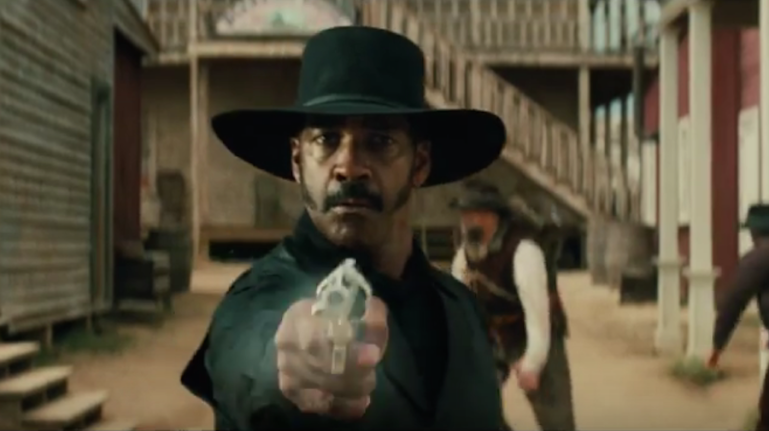
Rating: 4/10 – a land-grabbing, thieving, murdering businessman (Sarsgaard) plays nasty with the small town of Rose Creek and threatens to ruin them all, leaving them with only one choice: to hire a band of mercenaries who’ll save the town and defeat the evil land baron; leaden and uninspired, Fuqua’s remake features characters you don’t care about, a huge body count that quickly becomes tedious to watch, and a cast that move about like they’re wading in treacle searching for some much needed motivation (not that they’re likely to find any, as it’s something the script isn’t interested in exploring in any real depth).

Zoombies (2016) / D: Glenn R. Miller / 87m

Cast: Ione Butler, Andrew Asper, LaLa Nestor, Kim Nielsen, Marcus Anderson, Brianna Joy Chomer, Ivan Djurovic, Aaron Groben, Kaiwi Lyman-Mersereau

zoombies

Rating: 3/10 – somehow monkeys become infected with a virus that brings on zombie-like symptoms, and before you can shout “No, don’t open the door!”, they’re loose in the grounds of a massive zoo just days before it opens to the public; rubbish on a bargain basement level, Zoombies is lame in so many ways you’d need more time than the movie plays for to go through it all – and that’s if you can at least stomach the movie’s incessant inanity, and it’s seriously worst-ever gorilla suit.

Ghostbusters (2016) / D: Paul Feig / 116m

Cast: Melissa McCarthy, Kristen Wiig, Leslie Jones, Kate McKinnon, Chris Hemsworth, Neil Casey, Michael Kenneth Williams, Matt Walsh, Andy Garcia, Cecily Strong, Ed Begley Jr, Charles Dance

ghostbusters

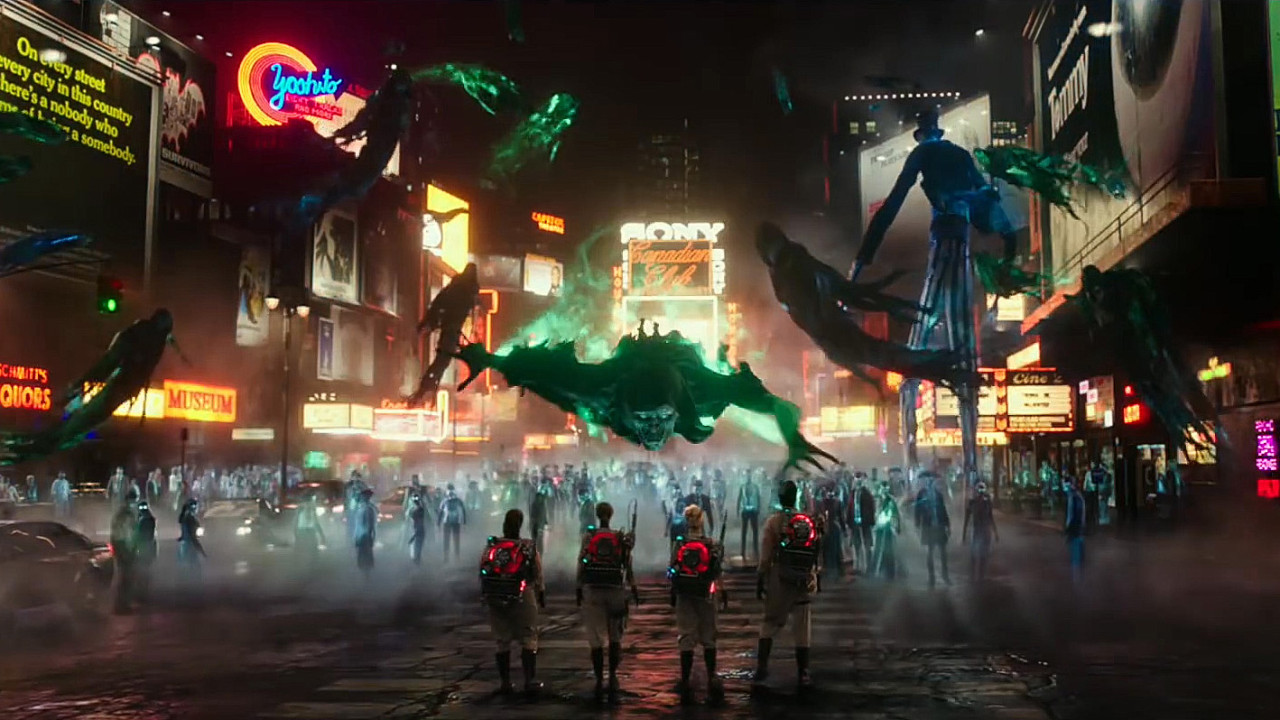
Rating: 3/10 – more meh; a perfect example of just how out of tune some movie makers are when it comes to remakes, Ghostbusters is so lame it makes Ghostbusters II (1989) look like a masterpiece of comic horror fantasy, and labours consistently under the impression that if you put four comediennes together in the same room, instant hilarity will be the result – an idea that this farrago lays to rest speedily thanks to Feig and Katie Dippold’s creatively moribund screenplay (and let’s try to forget the awful cameos from Murray, Weaver, Ackroyd, and Hudson).

Share this:

  • Click to share on X (Opens in new window) X
  • Click to share on Facebook (Opens in new window) Facebook
  • More
  • Click to print (Opens in new window) Print
  • Click to email a link to a friend (Opens in new window) Email
Like Loading...

The Martian (2015)

14 Wednesday Oct 2015

Posted by dullwood68 in Movies

≈ 1 Comment

Tags

Andy Weir, Ares III, Chiwetel Ejiofor, Drama, Hermes, Jeff Daniels, Jessica Chastain, Kristen Wiig, Literary adaptation, Mark Watney, Mars, Matt Damon, NASA, Pathfinder, Potato crop, Review, Ridley Scott, Sci-fi, Thriller

Martian, The

D: Ridley Scott / 144m

Cast: Matt Damon, Chiwetel Ejiofor, Jessica Chastain, Jeff Daniels, Kristen Wiig, Michael Peña, Sean Bean, Kate Mara, Sebastian Stan, Aksel Hennie, Benedict Wong, Mackenzie Davis, Donald Glover

On Mars to explore the terrain and collect samples, the crew of the spaceship Hermes, headed by Commander Melissa Lewis (Chastain), have established a habitat station (the Hab) that allows them to check their samples before sending the results back to NASA. It’s also a living space for them. When a fierce storm approaches more quickly than expected, and some of the team are caught outside, botanist Mark Watney (Damon) is struck by debris and catapulted out of sight. With little option but to abandon the habitat centre and return to the Hermes, Lewis makes the decision to leave Mars even though she wants to find Watney. When NASA learns what’s happened, its director, Teddy Sanders (Daniels), holds a press conference that details the mission’s current status, and Watney’s unfortunate death.

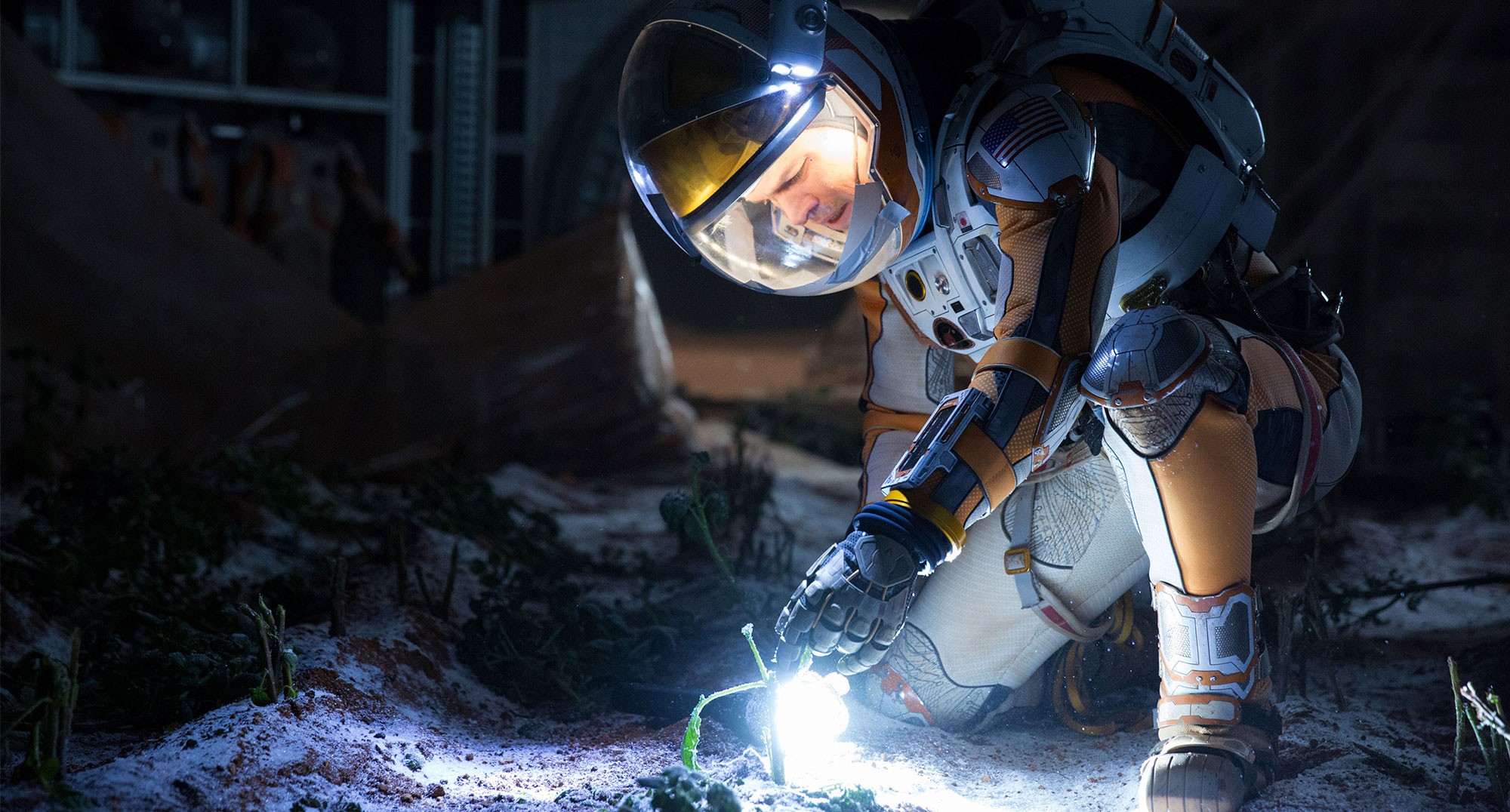
But Sanders’ declaration proves to be wrong. Watney is still alive, though when he wakes after the storm has passed, he has a piece of antenna sticking out of his torso. He makes it back to the habitat station where he removes the antenna and staples shut the wound. He then starts to work out how long he can survive on the rations left in the Hab, but quickly realises that he doesn’t anywhere near enough to sustain him until a rescue mission can reach him. Drawing on his knowledge as a botanist, Watney decides to use the Hab’s resources (including his and the crew’s waste), and the Martian soil to grow potatoes. Meanwhile, back at NASA, mission director Vincent Kapoor (Ejiofor) is alerted to the fact that there is unexpected movement occurring on Mars, and soon it becomes apparent to everyone that Watney is alive.

Watney travels to where the Pathfinder probe lies abandoned and manages to get it to transmit images back to Earth. He and NASA come up with a means of communicating with each other (even if it is a bit slow due to the distance between them), and soon Watney is able to establish a more stable comms link. With NASA determined to rescue Watney, they finally decide to tell his crewmates that he’s alive. They’re all pleased but angry as well for being left out of the loop. But disaster strikes, when an airlock decompression at the Hab destroys the potato crop, leaving Watney with only enough rations for around 200 days, and a rocket supply drop arranged by NASA malfunctions and blows up before it even leaves Earth’s atmosphere. With time running out, NASA must find a way of getting to Watney before his food runs out, and he has to find a way of making his food last as long as possible.

Martian, The - scene

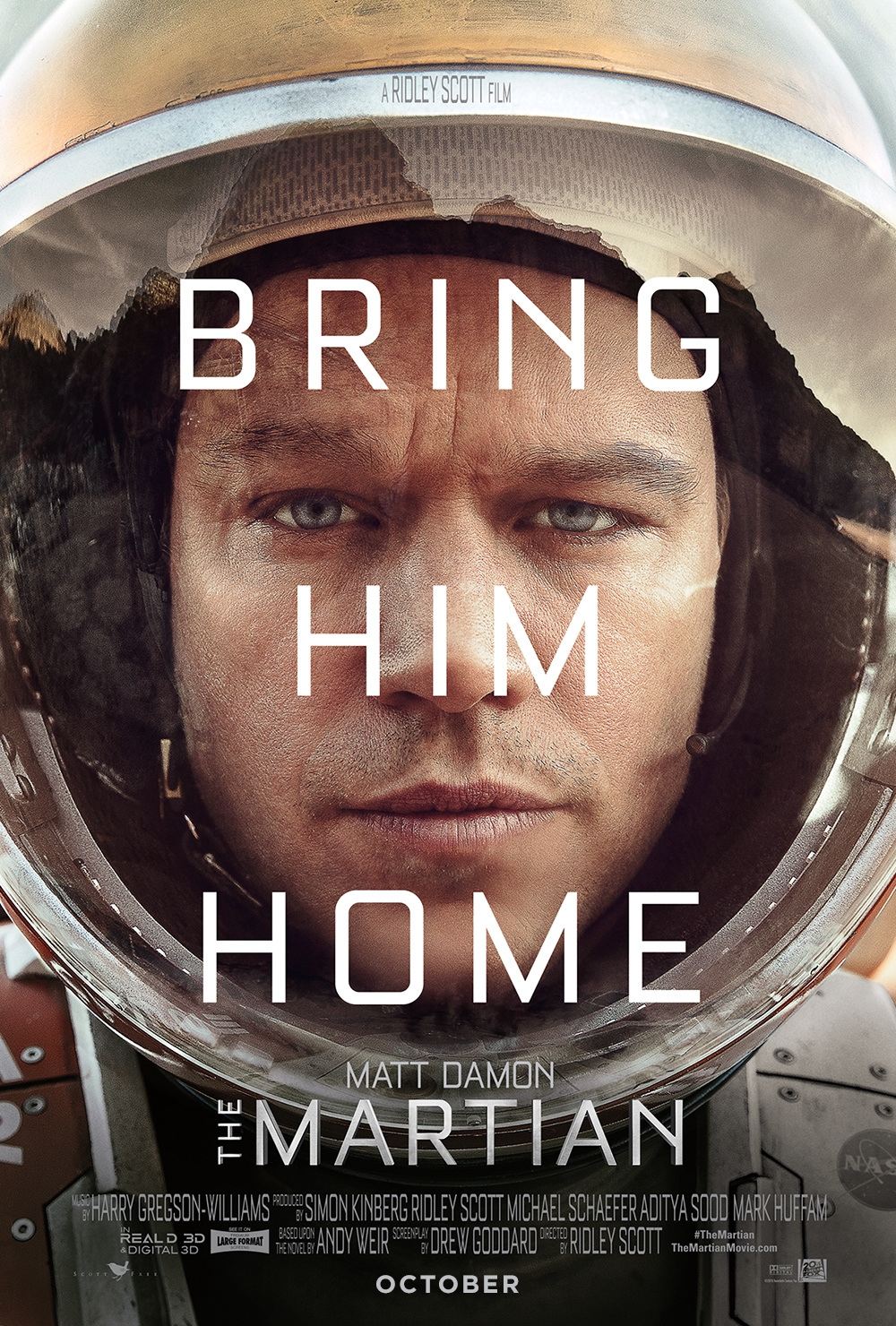
An adaptation of the bestseller by Andy Weir, The Martian is something of a return to form for Ridley Scott, with the septuagenarian director making his most accessible and expertly constructed movie for some time. This is largely due to Drew Goddard’s assured, though not entirely flawless screenplay, which juggles successfully not only the hard science that keeps Watney alive (and making it relatable to the average viewer), but a myriad cast of characters, all of whom had the potential to become stereotypes. But Scott keeps all this in check and presents us with a sci-fi thriller that feels fresher than most recent outings (despite some obvious antecedents), and which features an impressive central performance from Matt Damon that helps ground the movie immeasurably.

So good, in fact, is Damon as the embattled astronaut of the title, that sometimes the events happening on Earth come as a bit of an intrusion. Yes, it’s good to see the effort being put in to rescue one man (even though you could argue that the cost of doing so would be too prohibitive for even the most caring of space agencies to consider), but these scenes too often feel like second cousins to those in Apollo 13 (1995), and Ejiofor’s character also feels like a close relative to his character from 2012 (2009). With this element of the narrative ticking several expected boxes, even down to the plucky, rule-bending astrodynamicist (Glover) who comes up with a plan to save Watney that no one else has thought of, it’s thanks to Goddard’s understanding of the necessity for these scenes, and Scott’s accomplished direction, they’re intrusion becomes less worrisome, and as Watney’s continued survival comes closer and closer to connecting with his rescue, the viewer can root for both camps.

But with so much happening back on Earth (and with such a large ensemble cast to cater to), the script doesn’t put Watney in as much jeopardy as Weir’s novel does. Part of the fun of reading the novel was that Weir consistently came up with ways to put Watney in danger, and he consistently made it seem as if Mars itself was conspiring to make Watney pay for being there. But here the suspense is lessened in favour of Watney’s unflagging determination to survive, which is admirable in itself, but there needs to be more in the way of peril, even if we can all guess the outcome. Harking back to Apollo 13, it was the way in which problems continued to mount on that mission that heightened the drama, and the way in which each problem was overcome that made it all the more engrossing and exciting. Here, Watney’s methodical, never-say-die attitude ensures that each setback is dealt with matter-of-factly and in double-quick time (and usually by virtue of a montage). By taking some of the natural tension of the situation away, the gravity of Watney’s dilemma is lessened when it should have had us on the edge of our seats.

But Damon holds it all together, making Watney a pleasure to spend time with, and be sympathetic of. The little dance and shouts of joy he makes when he discovers he can talk to NASA is a small moment of inspiration, especially when he looks round to check if anyone has seen him. And Damon is equally good at expressing the character’s somewhat arrogant sense of humour and keeping the viewer on his side, even with lines such as “They say once you grow crops somewhere, you have officially colonised it. So technically, I colonised Mars. In your face, Neil Armstrong!” There are few actors audiences would want to spend an entire movie with, alone, but Damon is one of them, and he keeps the viewer focused on what is essentially one man’s battle for survival against (almost) impossible odds.

Martian, The - scene2

He’s supported by a great ensemble cast headed up by the ever reliable Ejiofor, with Wiig playing serious for once, and Daniels giving Sanders a sardonic air that fits well with his job as director of NASA. Chastain and Peña grab most of the limelight from Mara, Stan and Hennie as Watney’s fellow astronauts, and The Martian marks one of the few occasions when Sean Bean’s character in a movie doesn’t get killed (he’s also part of a great joke involving The Lord of the Rings). As you’d expect from a movie directed by Ridley Scott, it all looks incredible, with Jordan standing in for Mars, Arthur Max’s expressive production design, and very impressive cinematography from Dariusz Wolski (Scott’s go-to DoP for his last few movies). And on the music front, anyone expecting to hear David Bowie’s Life on Mars? at some point will find that Scott has gone for Starman instead, and there’s the completely unexpected use of ABBA’s Dancing Queen, which should feel out of place but is surprisingly apt for the point at which it’s used.

Rating: 8/10 – good sci-fi these days is rare (as anyone who’s seen Prometheus (2012) should know – sorry, Ridley), but The Martian is that rare beast, and is intelligent enough overall to overcome a few narrative concerns; with Damon in commanding form, and the drama of the situation sufficiently gripping, being stranded on another planet has never seemed so tempting.

Share this:

  • Click to share on X (Opens in new window) X
  • Click to share on Facebook (Opens in new window) Facebook
  • More
  • Click to print (Opens in new window) Print
  • Click to email a link to a friend (Opens in new window) Email
Like Loading...

Welcome to Me (2014)

19 Tuesday May 2015

Posted by dullwood68 in Movies

≈ 1 Comment

Tags

$86m, Borderline Personality Disorder, Comedy, Drama, James Marsden, Joan Cusack, Kristen Wiig, Linda Cardellini, Lottery win, Mental health, Review, Shira Piven, Swan boat, Tim Robbins, TV show, Wes Bentley

Welcome to Me

D: Shira Piven / 105m

Cast: Kristen Wiig, Wes Bentley, Linda Cardellini, Joan Cusack, Loretta Devine, Jennifer Jason Leigh, Thomas Mann, James Marsden, Tim Robbins, Alan Tudyk

Alice Klieg (Wiig) suffers from borderline personality disorder and lives off of benefits. She doesn’t have a job, but she is on medication and she sees a psychiatrist, Dr Daryl Moffet (Robbins). She plays the California state lottery each week; when she wins $86 million, Alice decides she wants to regain the life she had before she was diagnosed. She stops taking her medication and tells Dr Moffet that she no longer wishes to see him. She also moves out of her apartment and goes to stay in a casino hotel.

An avid TV watcher, Alice becomes enamoured of a show hosted by Gabe Ruskin (Bentley). She is in the audience one day when a volunteer is needed; Alice rushes to the stage. What follows attracts the attention of Gabe’s brother, Rich (Marsden), his producer and with Gabe co-owner of the production company that airs the show. Alice takes the opportunity to request a show of her own that she wants to call Welcome to Me. When she pays for a hundred two-hour shows upfront, Rich agrees to her suggestion – though the rest of the production team aren’t so sold on the idea. The first show airs and is a disaster, but instead of being put off, Alice invests more money into the show, thus making it look more professional.

She and Gabe begin a relationship, and the show slowly gains in popularity thanks to Alice’s confessional approach to the show’s content, and re-enactments of key scenes from her past. However, as she becomes more and more fixated on the show, her family and her closest friend, Gina (Cardellini) are largely forgotten about. She has a brief fling with a college reporter (Mann); when Gabe learns about it on one of Alice’s shows he’s visibly upset and angry. And when Alice accidentally spills hot chili on herself, burning her chest and upper arms, he reassessment of what the show needs leads to her carrying out live neutering of dogs and cats.

Things come to a head when Gabe quits and Rich learns that, thanks to Alice’s slanderous statements about people on her show, the company is facing a number of lawsuits. Rich confronts Alice live on air and tells her she needs to change her ideas about the show and fast. This causes Alice to halt the show and return to the casino hotel where in the days that follow she suffers a nervous breakdown. While she’s in hospital – and back on her medication – Alice begins to think of a way in which she can make it up to all the people she’s let down.

Welcome to Me - scene

Treading a very fine line between being sympathetic (mostly) and exploitative (occasionally), Welcome to Me is an odd movie that appears to go to some lengths to make its audience uncomfortable while watching it. We’ve had movies that feature characters with mental health problems many, many, many times before, but none that have placed them in a world where their private fantasies have been given such a free rein, and so easily.

The problem with the movie’s treatment of Alice is that it wants you to believe that she has a plan when in fact she really doesn’t. It also wants you to believe that a television production company would let Alice on the air without first vetting her and putting any relevant checks and balances in place. This isn’t public service broadcasting, and the speed and the convenience of Alice’s show hitting the airwaves (and making it onto the ratings) makes for an unconvincing development. And it’s during these segments that it becomes clear the script – by Eliot Laurence – doesn’t really know what to do with Alice, or how to explore the traumatic experiences that have triggered Alice’s disorder.

It’s a shame as it takes the edge off of Wiig’s inspired performance – possibly her best to date – and saddles the movie with several tiresome stretches that fail to engage as effectively as when the action happens away from the studio. Laurence and director Piven (sister of Jeremy, and wife of co-producer Adam McKay) invest a lot of time and effort in making Alice such a credible, fully believable character, and then place her in a milieu that doesn’t even bother to reflect on the vagaries of being a celebrity with mental health problems. It does touch on the way in which fame can isolate celebrities from the “normal” people around them, but in Alice’s case she’s already isolated, so where is the drama? And it doesn’t help that the characters surrounding Alice aren’t as sufficiently well drawn as she is, leaving cast members such as Marsden and Bentley struggling to make much of an impact (Marsden is particularly ill-served).

With all the focus and attention going on Alice, it’s to Wiig’s credit that she inhabits the role so completely and confidently that she carries the movie effortlessly, making up for the shortfall elsewhere. In fact, it’s such a strong, emotive performance that the movie loses its footing on the rare occasions she’s not on screen. Emotionally adrift yet  bound up in her own unresolved feelings of anger and rejection, Alice is a role that suits Wiig’s ability to “blank face” to a tee; you can see Alice looking out at you and seeing right through you at the same time.

Elsewhere, Clayton Hartley’s production design (reflecting the chaotic nature of Alice’s mind at home and in the studio), and David Robbins’ score (providing clever emotional cues for Alice’s behaviour) work to the movie’s advantage, while the script’s attempts at quirky, indie sensibility humour work with more of a success rate than the drama does.

Rating: 6/10 – a decent idea but lacking a through follow through, Welcome to Me ultimately has little to say about mental illness or the perils of being a modern day celebrity; relenting when it should be biting, this is saved (constantly) by Wiig’s ambitious and exhilarating performance.

Share this:

  • Click to share on X (Opens in new window) X
  • Click to share on Facebook (Opens in new window) Facebook
  • More
  • Click to print (Opens in new window) Print
  • Click to email a link to a friend (Opens in new window) Email
Like Loading...

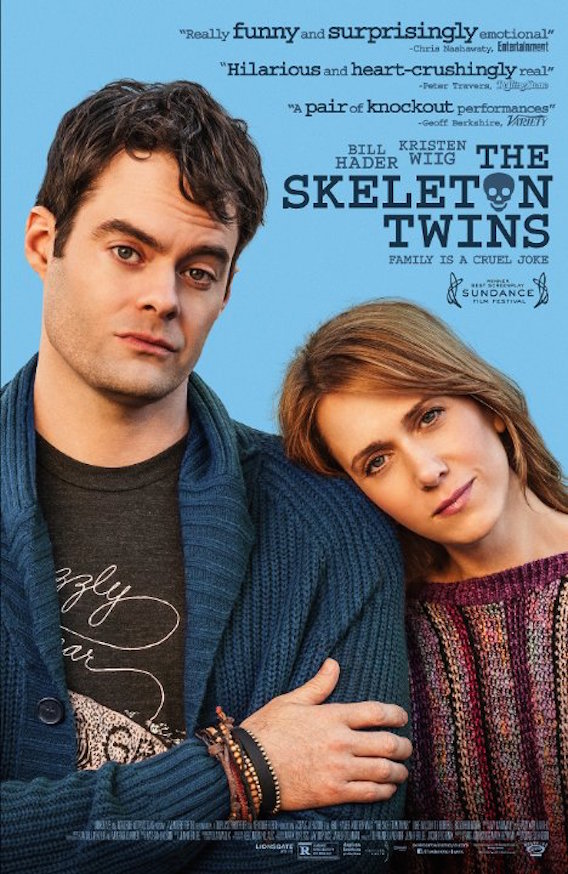
The Skeleton Twins (2014)

03 Wednesday Dec 2014

Posted by dullwood68 in Movies

≈ Leave a comment

Tags

Attempted suicide, Bill Hader, Comedy, Craig Johnson, Drama, Kristen Wiig, Luke Wilson, Pregnancy, Relationships, Review, Ty Burrell

Skeleton Twins, The

D: Craig Johnson / 93m

Cast: Bill Hader, Kristen Wiig, Luke Wilson, Ty Burrell, Boyd Holbrook, Joanna Gleason

Following an unsuccessful suicide attempt, Milo Dean (Hader) agrees to stay for a while with his twin sister, Maggie (Wiig) and her husband, Lance (Wilson). Milo and Maggie haven’t seen or spoken to each other in ten years, and at first, they are hesitant with each other. Milo is gay, and getting over the end of a relationship (hence the suicide attempt), while Maggie appears happy in her marriage but is always off taking courses – currently it’s scuba diving – and while Lance is keen to have children, Maggie is secretly taking the pill.

While out one day, Milo sees an “old flame”, Rich (Burrell), working in a bookstore. He approaches him but Rich is hostile. Meanwhile, Maggie is becoming increasingly attracted to her scuba diving instructor, Billy (Holbrook). Milo begins helping Lance with his work clearing paths in the woods, and after a visit from their mother (Gleason) that doesn’t go well, Milo and Maggie take the first proper steps in rebuilding their relationship. The next day, Milo returns to the bookstore and things go better with Rich; Maggie though, goes to a bar after class with Billy and they end up having sex in the bathroom.

The issue of pregnancy and Maggie’s abilities as a mother lead to a falling out between her and Milo. They patch things up, and in the process, tell each other some secrets: Milo reveals he has had sex with a woman, while Maggie reveals she’s on birth control. She further reveals it’s not because she doesn’t want children, but that she always sleeps with her instructors; it’s a compulsion she can’t help. That evening, Milo meets up with Rich and they spend the night together (even though Rich has a wife and son).

Halloween comes round and Milo and Maggie decide to dress up and go out like they did as kids. While they’re in a bar, Milo goes to the bathroom and leaves his phone behind. It rings and Maggie sees that it’s Rich calling. This leads to a row between them. Soon after, Lance and Milo have a Dudes Day, during which Lance voices his concerns that he might be shooting blanks because of how long it’s taking for Maggie to become pregnant. Milo, still smarting over Maggie’s reaction to his seeing Rich, plants the seed that she may be taking some “medication” that Lance doesn’t know about. But unbeknownst to both Lance and Milo, Maggie just might be pregnant after all.

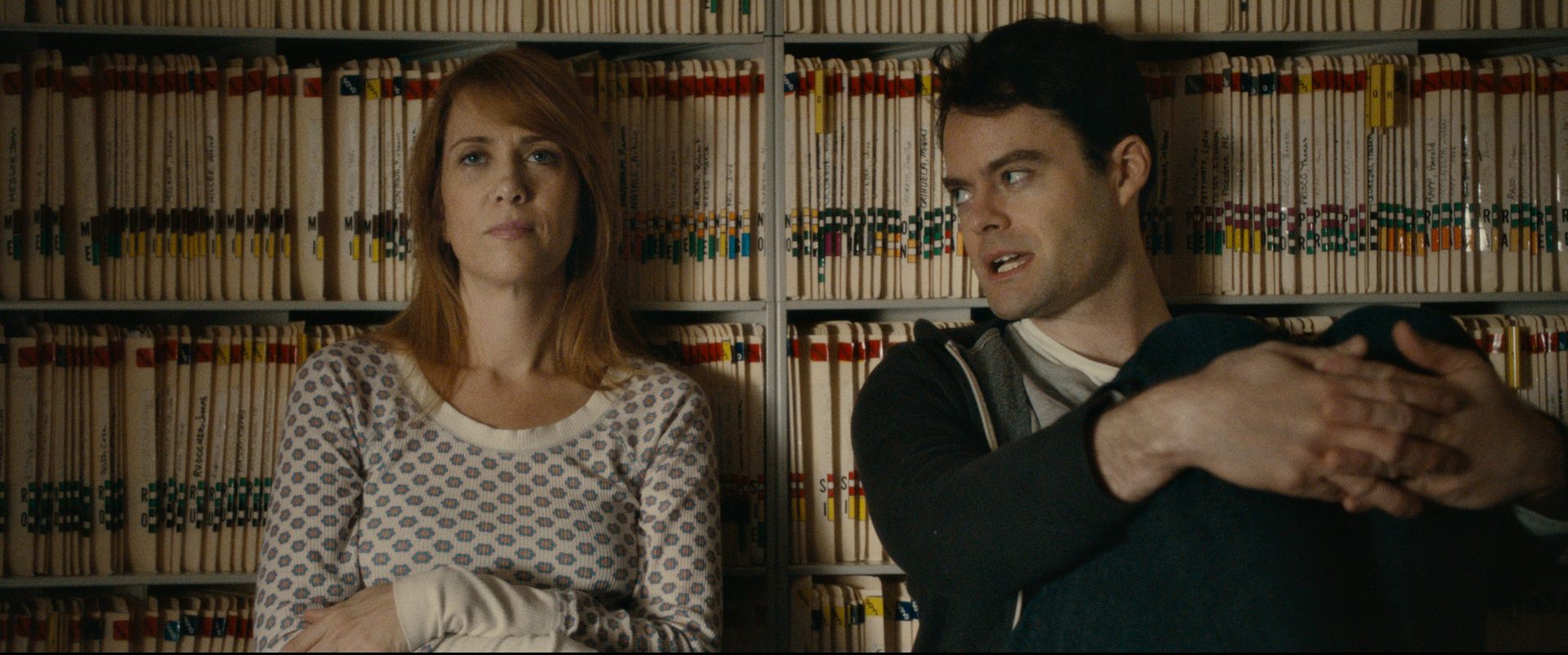
Skeleton Twins, The - scene

Early on in The Skeleton Twins we see Maggie holding a handful of pills with the intention of taking them and ending her life. She’s interrupted by the call that tells her about Milo’s failed attempt. Suicide is a big issue in the movie, and while it sets the scene for the movie as a whole, and is referred to on several occasions, it appears more as a deus ex machina than as a raison d’être, spurring the movie on when Craig Johnson and Mark Heyman’s script needs it to. There’s plenty of incident in the movie, and there’s more than enough to keep an audience interested, but the recurring use of suicide as a plot device makes it seem – by the movie’s end – artificial, and it loses its effect. If it had been used just to set up, or introduce, the characters of Milo and Maggie then it might have had more potency. As it is, their reasons for trying to end their lives – while obvious – are never really explored in any real depth, and what becomes clear as the movie progresses is that the viewer will only be given access to Milo and Maggie’s surface feelings and nothing more profound.

Which makes The Skeleton Twins a frustrating, though nevertheless enjoyable viewing experience. As mentioned above, there’s a lot going on in the movie, and a lot of it is very engaging, and even though it’s predictable in the way that indie movies that deal with fractured relationships often are, it’s that familiar sheen that carries the movie forward and makes it work (for the most part). Milo and Maggie live average lives that border on quiet desperation; they both want to feel something more than they usually feel, and both are searching for a contentment they can’t quite grasp hold of. Milo feels the need to brag to Rich about an acting career he doesn’t have, because he’s envious of the life Rich is leading. Maggie feels the need to have affairs because being settled scares her. Both of them want stability but don’t know to achieve or maintain it. In the end, they learn to rely on each other a little bit more than they used to, but they’re still a long way from finding the peace that has so far eluded them.

There are other angles and avenues that aren’t fully explored – their mother’s role in their childhood (and the same for their father), the previous relationship between Milo and Rich, Maggie’s compulsion re: extra-marital sex – and these add to the sense that the script wasn’t fully developed before filming began. However, the script does have its compensations, not least some terrific dialogue, and an often delightful sense of the absurd. And there’s a great sequence where Milo cheers up Maggie by miming to Starship’s Nothing’s Gonna Stop Us Now, so vividly expressed by the pair that it’s easily the movie’s highlight.

What saves the movie completely, though, are the performances from Hader and Wiig. Wiig is on fine form, displaying an understanding of the character that makes Maggie a lot more sympathetic than she might be otherwise (both she and Milo are quite self-centred and narcissistic in their own ways, and these aren’t always attractive qualities in either of them). Maggie has a vulnerability about her as well that Wiig portrays with skill, and she pulls off the difficult moments when Maggie is overwhelmed by her own feelings with both talent and proficiency. But the real performance of note is Hader’s, shrugging off his usual comic schtick to provide an impressive, noteworthy portrayal of a man hoping to reconnect with a time when he felt valued and needed (even if it wasn’t the best of situations). There’s a soulful aspect to his performance that makes Milo the more likeable of the two siblings, and even when he’s messing things up in his relationship with Maggie, you can see clearly that Milo is doing his best, even if it’s coming out wrong. It’s a well-balanced rendition that is more affecting that might be expected, and shows Hader to be a far more intuitive actor than previous roles have indicated.

Alongside Hader and Wiig, Wilson takes Lance’s almost puppy-dog looks and personality and makes him the quintessential good guy, but not quite so bland or vanilla that you can’t see Maggie’s attraction to him. It’s the awkward, not-quite-so-invested-in-by-the-script supporting role that can seem a bit colourless, but Wilson is quietly effective throughout. As Rich, Burrell has the more dramatic role, and gives a good portrayal of a man afraid of his past and the feelings it brings up, matching Hader for intensity in their scenes together.

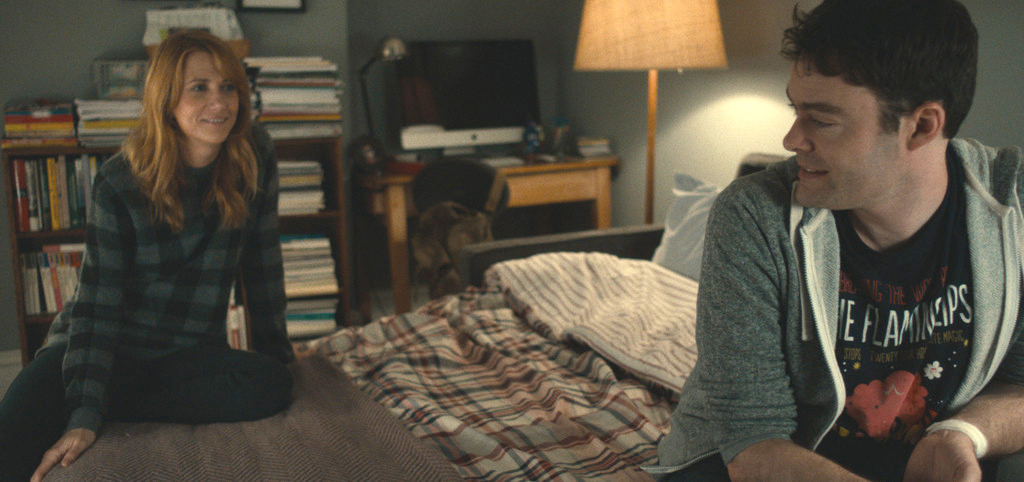
Skeleton Twins, The - scene2

In the director’s chair, Johnson directs his and Heyman’s script with a delicate touch that, unfortunately, leaves much of the drama either quickly dispelled with or feeling lightweight and lacking in importance. He fares better with the visual look of the movie, the various locations and interiors given a sharp focus by Reed Morano’s complementary photography, and he uses close ups with a firm understanding of how potent they can be at the right time. Nathan Larson’s score is evocative and breezy, and full marks absolutely have to go to key makeup artist Liz Lash for coming up with Milo’s Halloween look – disturbing, for once, for all the right reasons.

Rating: 6/10 – with the material only scratching the surface of its characters lives and problems, The Skeleton Twins just misses out on being as poignant and as emotionally involving as it should have been; stellar lead performances aside, this is a movie that is still worth watching but with the proviso that it’s sadly less than the sum of its parts.

Share this:

  • Click to share on X (Opens in new window) X
  • Click to share on Facebook (Opens in new window) Facebook
  • More
  • Click to print (Opens in new window) Print
  • Click to email a link to a friend (Opens in new window) Email
Like Loading...

The Secret Life of Walter Mitty (2013)

15 Wednesday Jan 2014

Posted by dullwood68 in Movies

≈ Leave a comment

Tags

Ben Stiller, Cover photo, Drama, Fantasy, Iceland, Kristen Wiig, Life magazine, Review, Romantic drama, Sean Penn, Shirley MacLaine, Walter Mitty

Secret Life of Walter Mitty, The

D: Ben Stiller / 114m

Cast: Ben Stiller, Kristen Wiig, Adam Scott, Shirley MacLaine, Kathryn Hahn, Adrian Martinez, Ólafur Darri Ólafsson, Patton Oswalt, Sean Penn

Working as a negative accounts manager (responsible for photo negatives sent in by contributing photographers) at Life magazine, Walter Mitty (Stiller) has led a largely unremarkable life.  Unmarried, with few friends, Walter is devoted to his job, but with the recent arrival of Cheryl Melhoff (Wiig) at the magazine, he finds himself smitten.  Upheaval also arrives with the news that the magazine is being cancelled in favour of an online edition.  Brought in to oversee the closure of the magazine and staff lay-offs, Ted Hendricks (Scott) picks on Walter, having caught him day-dreaming in the office.  When noted photographer Sean O’Connell (Penn) sends in a series of negatives, with one being his preferred choice for the final cover, Walter is horrified to discover he can’t find it.  With the final issue a matter of two weeks away, Walter decides to track down O’Connell and retrieve the missing negative.

Walter enlists Cheryl’s help in finding the elusive O’Connell.  A clue leads Walter to Iceland, where a drunken helicopter pilot (Ólafsson) tells him O’Connell is heading via trawler to Greenland.  He catches up with the trawler at sea but O’Connell has already left the ship.  Arriving in Greenland, Walter learns that his quarry is headed for a local airstrip.  As he gets there, O’Connell’s plane takes off… and a nearby volcano erupts.  With no further leads to help him follow O’Connell, Walter is forced to return to New York.  Back at work, he’s fired by Hendricks.  Depressed, Walter visits his mother (MacLaine) who tells him O’Connell came to see her a few weeks before.  She also provides him with enough information to help Walter decipher another clue he’s picked up during his travels.  Travelling to the foothills of the Himalayas, Walter finally catches  up with O’Connell and the mystery of the missing negative is solved.

THE SECRET LIFE OF WALTER MITTY

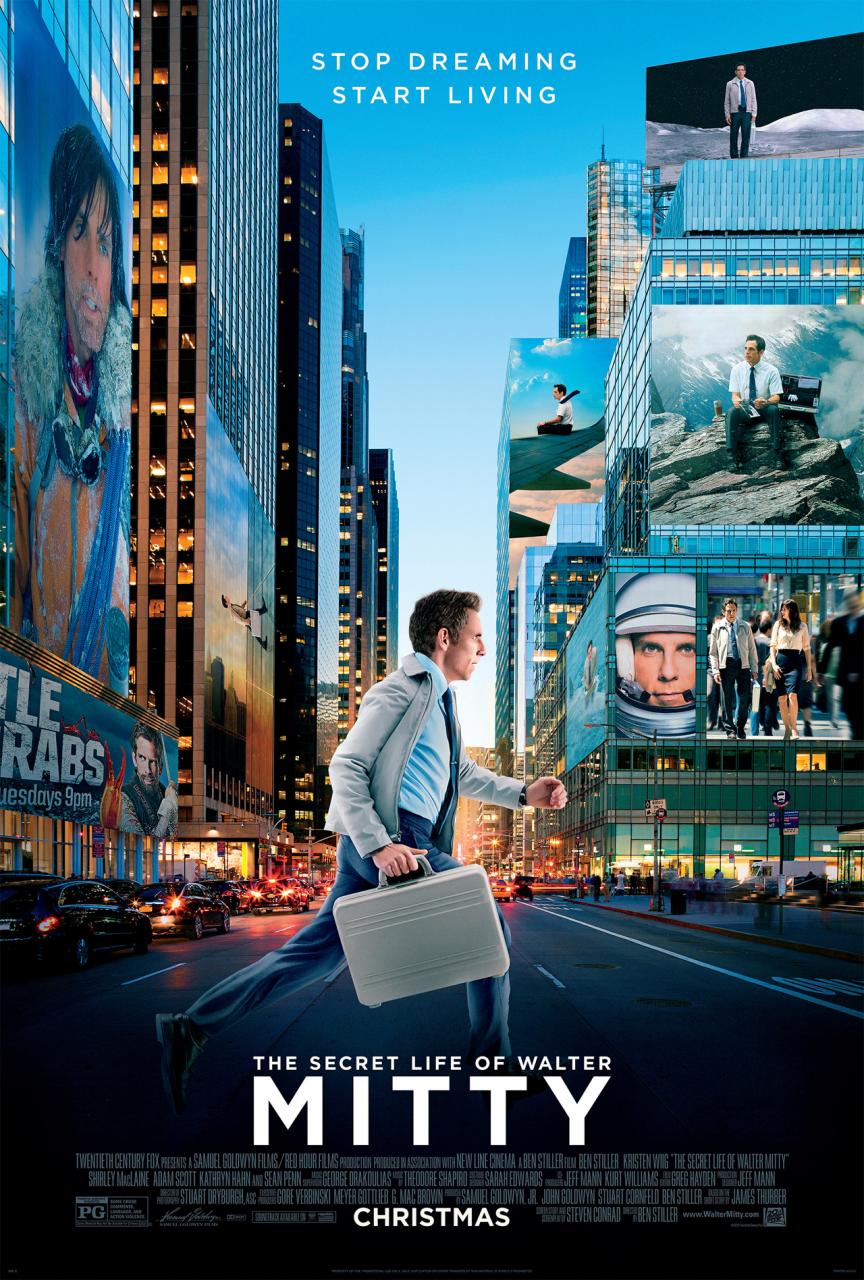
From its trailer, The Secret Life of Walter Mitty could be mistaken for another comic fantasy à la Stiller’s Night at the Museum movies, but thanks to a sharply observed script by Steve Conrad, and a sure hand at the helm from Stiller himself, nothing could be further from the truth.  This is not just an excuse for humorous fantasy sequences designed to prop up a patchy script, but a carefully thought out, intelligent, affectionate account of one man’s emergence from his own shell.  Walter is a terrific creation, a recognisable person with recognisable hopes and dreams, and a genuinely nice man who’s self-confidence is only evident when he’s at work.  His attraction to Cheryl is handled beautifully, his longing for a relationship played with adroitness and charm.  And as Walter’s adventures bring him further into the real world, and away from the fantasy world he slips into so easily, the acceptance he finds from the people he meets brings him a series of personal rewards.  By the time he confronts O’Connell, Walter is a changed man, able to deal with anything Life can throw at him (and which comes in handy when he later confronts Hendricks).

It’s a wonderful, nuanced turn from Stiller, subtle, skilful and affecting in equal measure, and a joy to watch.  It’s a life-affirming performance, ably supported by a well-chosen supporting cast headed by Wiig, and Stiller proves a confident director, marshalling the disparate elements of the script with verve and evident ease.  Penn is a great choice for the errant photographer, and Wiig adds several shades to a character she has played similar versions of before.  The only false note amongst the performances is Scott’s but that’s because his character is written as an obnoxious prat from the beginning; it’s the script’s only misstep.

The movie is often gorgeous to look at as well, especially when Walter is trekking through the foothills of the Himalayas; as he walks along the top of one particular ridge the panorama behind him is simply breathtaking.  But even amongst the offices of Life magazine, Stiller’s compositions are pleasing to the eye and far from perfunctory, a testament to the effort he’s made in presenting a movie that has a unique visual style throughout.  He’s ably supported by cinematographer Stuart Dryburgh and editor Greg Hayden, and there’s a wonderful score replete with songs courtesy of José González.

The Secret Life of Walter Mitty is that modern rarity amongst Hollywood movies, an uplifting, feel good, life-affirming romantic drama that isn’t queasily sentimental or emotionally over-the-top, and which doesn’t outstay its welcome.  It’s worth watching a second time for the subtle bits of business Stiller peppers the movie with, and for the pleasure of spending the best part of two hours with someone you’d be happy to call your friend.

Rating: 9/10 – a triumph for Stiller and his very talented cast and crew, The Secret Life of Walter Mitty deserves to be seen over and over again; a winning, multi-faceted experience that will keep a smile on your face for hours after seeing it.

Share this:

  • Click to share on X (Opens in new window) X
  • Click to share on Facebook (Opens in new window) Facebook
  • More
  • Click to print (Opens in new window) Print
  • Click to email a link to a friend (Opens in new window) Email
Like Loading...

Anchorman 2: The Legend Continues (2013)

05 Sunday Jan 2014

Posted by dullwood68 in Movies

≈ 1 Comment

Tags

Comedy, David Koechner, Global News Network, Harrison Ford, Kristen Wiig, News anchor, Paul Rudd, Review, Ron Burgundy, San Diego, Sequel, Steve Carell, Will Ferrell

Anchorman 2 The Legend Continues

D: Adam McKay / 119m

Cast: Will Ferrell, Steve Carell, Paul Rudd, David Koechner, Christina Applegate, Meagan Good, James Marsden, Josh Lawson, Kristen Wiig, Dylan Baker, Judah Nelson, Greg Kinnear, Harrison Ford

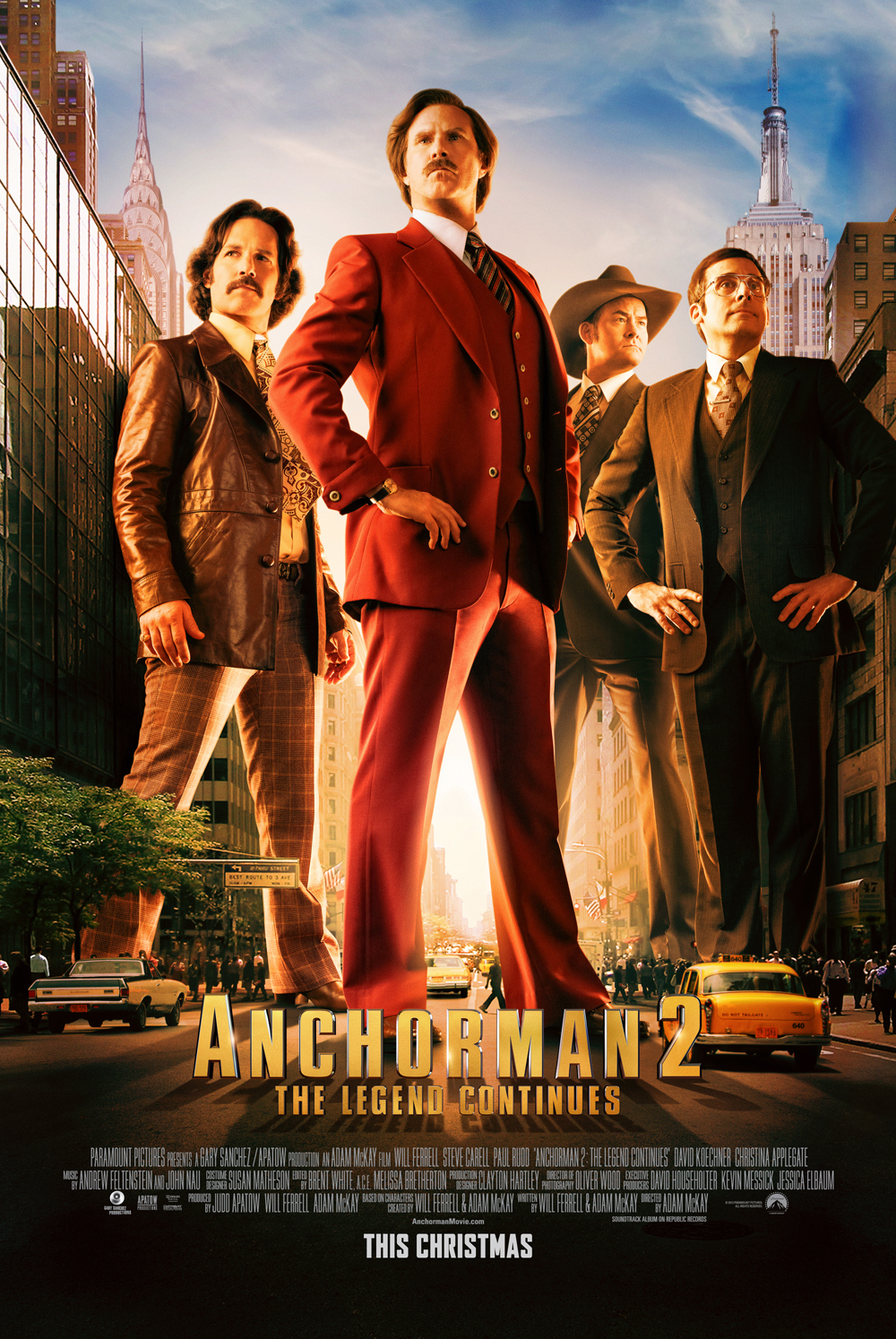
Nine years after Ron Burgundy’s first outing, the news anchor with the salon quality hair is back, still unrepentantly sexist, still with an ego the size of San Diego, and still oblivious to the chaos he causes around him.  Happily married to Veronica Corningstone (Applegate) and sharing the lead anchor spot with her at the World Broadcast news station, Ron’s life is devastated when news boss Mack Tannen (Ford) promotes Veronica to lead anchor and fires Ron.  Forcing Veronica to choose between him and her promotion, she chooses the job and Ron leaves her and their son Walter (Lawson).  After a stint at San Diego’s Sea World, Ron is approached by Freddie Shapp (Baker) to come work for Global News Network and be part of the first ever 24-hour news channel.  Ron agrees on the proviso that he can assemble his own news team.  He tracks down Brian Fantana (Rudd), Champ Kind (Koechner) and Brick Tamland (Carell), and with his team around him, he sets about regaining his position at the top of the news tree.

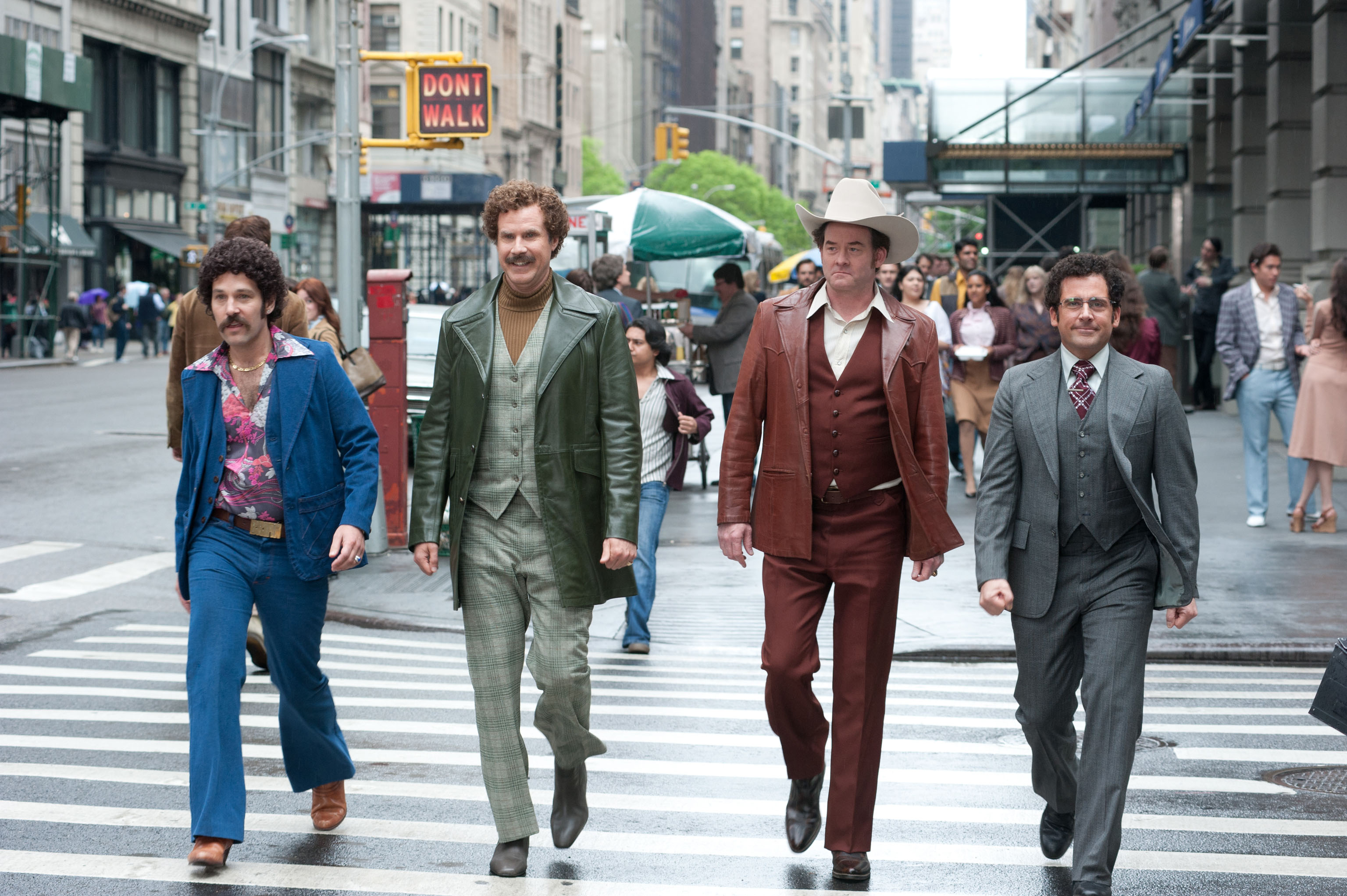
The success of Anchorman: The Legend of Ron Burgundy, a slow-build process fuelled by home video and extensive word of mouth, brought with it the fans’ desire for a sequel.  On its own merits, the first movie can be seen as a “happy accident”, an uneven mixture of stupidity and witlessness that was nevertheless funny at the same time.  Ron was crass and boorish in a “who-let-the-moron-out?” kind of way, while his news team almost matched him low IQ for low IQ.  Carell, then still climbing the comedy ladder, was endearing as the intellectually challenged Brick, Rudd was boyishly charming as Brian, and Koechner was – intentionally? by accident? – the funniest of all of them as Champ Kind, a man who has never heard a woman speak before.  Ferrell created a fantastic character, a vain popinjay with delusions of adequacy, and milked the character for all he was worth.  The performances made the movie, and over the years, have firmly lodged themselves in our collective comedy memories, so much so that we remember them with excessive fondness.

Sadly, that’s how they should have remained.  Anchorman 2: The Legend Continues trades heavily on our love of the characters but holds them in a kind of developmental stasis; in nearly ten years they haven’t changed a bit.  Ron is still vain, Brian is still the scent-fixated ladies man, Champ is still the least developed of the four, and Brick is still an idiot.  Veronica, having challenged Ron’s supremacy in the first movie, is demoted back to the same role again.  The secondary characters are used as a foil for the news team’s shenanigans – not least Kristen Wiig’s uncomfortable turn as Brick’s love interest, Chani – and even Ron’s nemesis at GNN, Jack Lime (Marsden), is given little to make him a serious rival for the news anchor crown.  And as with the first movie, Ron’s “story arc” is that he learns not to be so self-centred.

Anchorman 2: The Legend Continues

A re-tread then rather than a true sequel, Anchorman 2 arrives with a tremendous weight of expectation and reveals itself as more of a vanity project for Will and the gang (including director/co-writer McKay).  There are laughs but as most of them are repeats of gags and scenes from the first movie, it’s hard to look upon them as anything but nostalgic or, worse still, lazy.  Add the awkwardness of Carell’s performance – the line between exploiting Brick’s “disability” and treating him kindly is crossed time and time again – plus two sequences that inflate the running time beyond what’s necessary, and a recurring sense that the script was a first draft, and you have a movie that never quite gels in the way its makers had hoped.  There’s an attempt at lampooning the public’s appetite for sensationalist news but it’s only briefly explored, and whatever criticism is implied by the need for ratings success over quality content is given short shrift also.

The movie does have a professional sheen to it, however, and the technical side of things is adequately handled but there are times when it even has the feel of a TV show.  Ferrell acquits himself well, despite the limitations of his own script, and is ably supported by his cast mates.  McKay directs ably enough, and the soundtrack throws up a few Eighties gems despite itself.  And as for the final, cameo-studded battle of the news stations, what starts out as a glorious free-for-all, ends up as a let-down with a poor ending…and this is, ultimately, the main fault with the movie: scenes begin strongly but soon peter out.  Once or twice in a two-hour movie is forgivable, but not all the way through.  With this much talent involved, a better return would have been expected.

Rating: 5/10 – a huge disappointment and a perfect example of when cherished, much-loved movies should be left to stand alone; uninspired, derivative and overlong.

Share this:

  • Click to share on X (Opens in new window) X
  • Click to share on Facebook (Opens in new window) Facebook
  • More
  • Click to print (Opens in new window) Print
  • Click to email a link to a friend (Opens in new window) Email
Like Loading...

Blog Stats

  • 490,516 hits

Recent Posts

  • 10 Reasons to Remember Bibi Andersson (1935-2019)
  • Fantasia (1940)
  • Dances With Wolves (1990) – The Special Edition
  • Kiss of the Spider Woman (1985)
  • The Three Musketeers (1973)

Top Posts & Pages

  • The White Orchid (2018)
    The White Orchid (2018)
  • Lost for Life (2013) - Another Look
    Lost for Life (2013) - Another Look
  • Captain Fantastic (2016)
    Captain Fantastic (2016)
  • Miss Baek (2018)
    Miss Baek (2018)
  • Two Shorts by François Ozon: A Summer Dress (1996) and X2000 (1998)
    Two Shorts by François Ozon: A Summer Dress (1996) and X2000 (1998)
  • Central Intelligence (2016)
    Central Intelligence (2016)
  • The Dark Tower (2017)
    The Dark Tower (2017)
  • Taken (2008)
    Taken (2008)
  • Deer Crossing (2012)
    Deer Crossing (2012)
  • Cardboard Boxer (2016)
    Cardboard Boxer (2016)
Follow thedullwoodexperiment on WordPress.com

Blogs I Follow

  • Rubbish Talk
  • Film 4 Fan
  • Fast Film Reviews
  • The Film Blog
  • All Things Movies UK
  • Interpreting the Stars
  • Let's Go To The Movies
  • Movie Reviews 101
  • TMI News
  • Dan the Man's Movie Reviews
  • Film History
  • Jordan and Eddie (The Movie Guys)

Archives

  • April 2019 (13)
  • March 2019 (28)
  • February 2019 (28)
  • January 2019 (32)
  • December 2018 (28)
  • November 2018 (30)
  • October 2018 (29)
  • September 2018 (29)
  • August 2018 (29)
  • July 2018 (30)
  • June 2018 (28)
  • May 2018 (24)
  • April 2018 (21)
  • March 2018 (31)
  • February 2018 (25)
  • January 2018 (30)
  • December 2017 (30)
  • November 2017 (27)
  • October 2017 (27)
  • September 2017 (26)
  • August 2017 (32)
  • July 2017 (32)
  • June 2017 (30)
  • May 2017 (29)
  • April 2017 (29)
  • March 2017 (30)
  • February 2017 (27)
  • January 2017 (32)
  • December 2016 (30)
  • November 2016 (28)
  • October 2016 (30)
  • September 2016 (27)
  • August 2016 (30)
  • July 2016 (30)
  • June 2016 (31)
  • May 2016 (34)
  • April 2016 (30)
  • March 2016 (30)
  • February 2016 (28)
  • January 2016 (35)
  • December 2015 (34)
  • November 2015 (31)
  • October 2015 (31)
  • September 2015 (34)
  • August 2015 (31)
  • July 2015 (33)
  • June 2015 (12)
  • May 2015 (31)
  • April 2015 (32)
  • March 2015 (30)
  • February 2015 (37)
  • January 2015 (39)
  • December 2014 (34)
  • November 2014 (34)
  • October 2014 (36)
  • September 2014 (25)
  • August 2014 (29)
  • July 2014 (29)
  • June 2014 (28)
  • May 2014 (23)
  • April 2014 (21)
  • March 2014 (42)
  • February 2014 (38)
  • January 2014 (29)
  • December 2013 (28)
  • November 2013 (34)
  • October 2013 (4)

Blog at WordPress.com.

Rubbish Talk

Film 4 Fan

A Movie Blog

Fast Film Reviews

The Film Blog

The official blog of everything in film

All Things Movies UK

Movie Reviews and Original Articles

Interpreting the Stars

Dave Examines Movies

Let's Go To The Movies

Film and Theatre Lover!

Movie Reviews 101

Daily Movie Reviews

TMI News

Latest weather, crime and breaking news

Dan the Man's Movie Reviews

All my aimless thoughts, ideas, and ramblings, all packed into one site!

Film History

Telling the story of film

Jordan and Eddie (The Movie Guys)

Movie Reviews & Ramblings from an Australian Based Film Fan

Privacy & Cookies: This site uses cookies. By continuing to use this website, you agree to their use.
To find out more, including how to control cookies, see here: Cookie Policy
  • Subscribe Subscribed
    • thedullwoodexperiment
    • Join 481 other subscribers
    • Already have a WordPress.com account? Log in now.
    • thedullwoodexperiment
    • Subscribe Subscribed
    • Sign up
    • Log in
    • Report this content
    • View site in Reader
    • Manage subscriptions
    • Collapse this bar
 

Loading Comments...
 

    %d