Cast: Natasha Negovanlis, Elise Bauman, Justin Gerhard, Winny Clarke, Mark Matechuk, Pujaa Pandey, David John Phillips
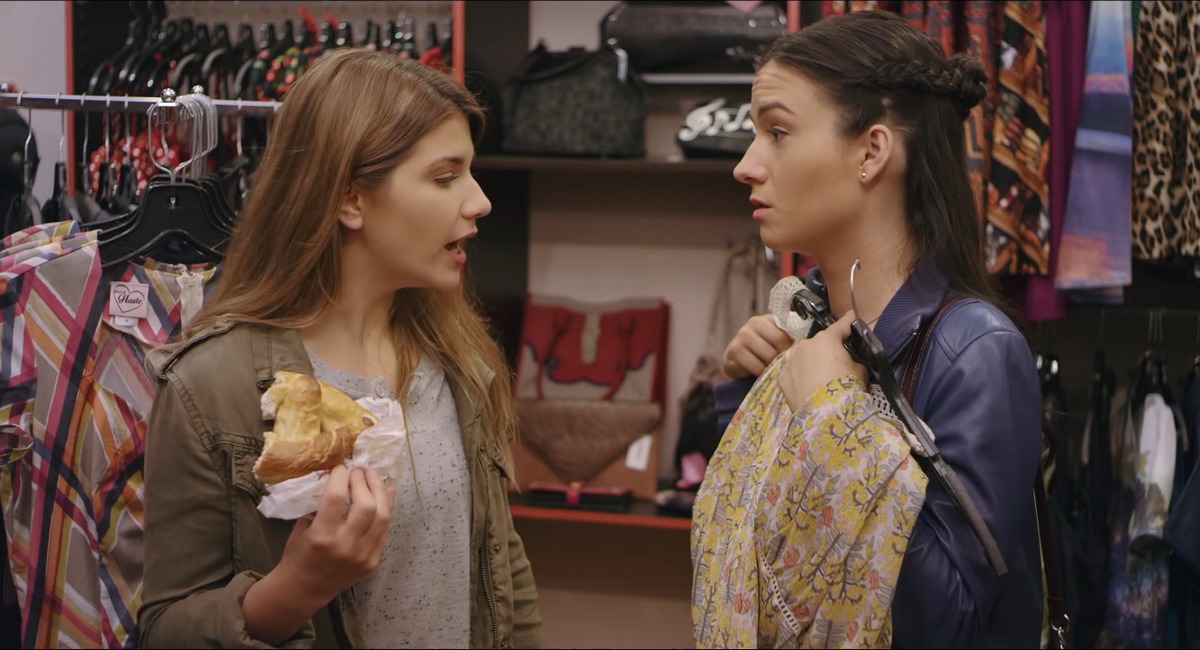
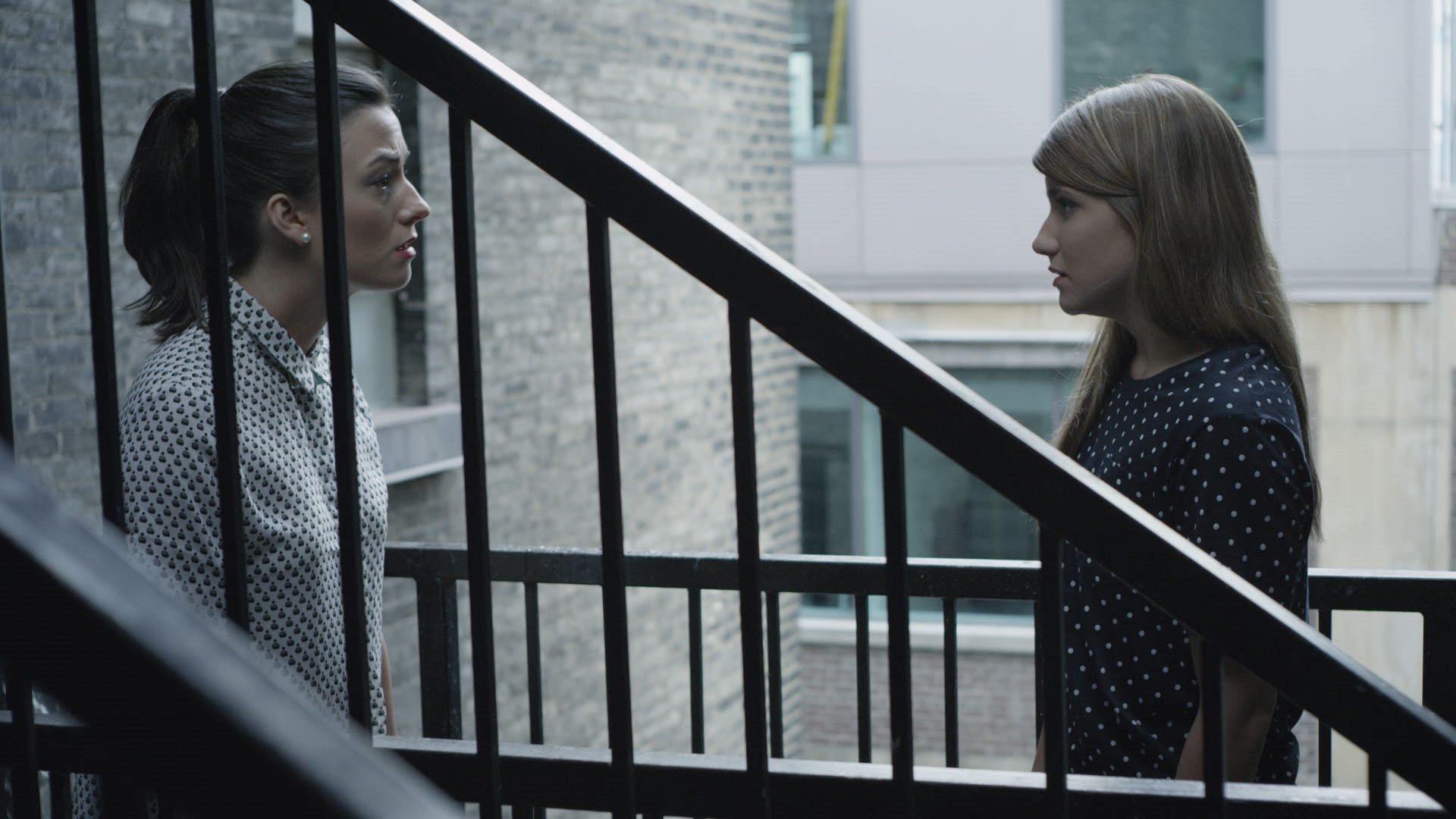
Cassie (Negovanlis) and Mackenzie (Bauman) are best friends on the verge of leaving college and heading out into the wider world. Cassie has recently split up from her boyfriend, Matthew (Matechuk), while Mackenzie is coming to terms with being a lesbian. While Cassie tells Mackenzie about her love life, Mackenzie feels awkward about coming out to Cassie; she’s told their mutual gay friend, Levi (Gerhard), and recently her parents, but is unsure how Cassie will react. Persuaded by Levi to look for a girlfriend on Tumblr, Mackenzie continues to avoid telling Cassie she’s a lesbian, while a couple of chance encounters with Matthew lead Cassie to wonder if she is over him. Inevitably, Cassie finds out about Mackenzie’s “secret”, and her disappointment causes a rift between them. As they navigate the new dynamic of their friendship, with each finding fault with the other for their attitudes and behaviours, both Cassie and Mackenzie try to come to terms with all the new feelings and emotions they’re experiencing. Mackenzie begins a relationship with Elliot (Clarke), while Cassie focuses on getting the job she wants. As they focus on their own needs, though, their friendship suffers even more…
In any movie where one character keeps something a secret from their family/friends/workmates (delete as appropriate), the reason for their doing so often remains unanswered at best, or spuriously explained at worst. Almost Adults opts for the second approach and never makes Mackenzie’s reasoning convincing. Fortunately, this narrative misstep doesn’t hurt the movie too much, but it does mean that the animosity that develops between Cassie and Mackenzie feels unnecessarily contrived; in real life, Mackenzie’s reticence probably wouldn’t make such a difference. But where Adrianna DiLonardo’s subtly observant screenplay scores more highly is in its depiction not of two characters falling out because of a poorly motivated secret, but because they are finally learning how to be responsible adults. Their friendship – when we first meet them – is the kind that has them swearing to be in each other’s lives forever, the kind of promise that teenagers make out of a desperate need to be needed. DiLonardo soon waves off this affectation, and has Cassie and Mackenzie behave like the insecure and selfish young adults they really are. When faced with the demands of moving on to the next stage in their lives – and their friendship – life soon finds them unprepared and trying their utmost to control everything around them, including each other.
Although the movie falls under the LGBTQ+ banner thanks to its inclusion of openly gay characters, it’s not a movie about being gay. Rather it’s a movie about finding your place in the world, and at a pivotal moment in most people’s lives, when growing up becomes a mandatory requirement. Look what can happen if you don’t, the movie seems to be saying, and though it does include its fair share of coming-of-age clichés, it’s not weighted in favour of either character, and it does its best not to make easy judgments. Making her feature debut, Rotella handles the material with a lightness of touch that helps the movie through some of its rougher patches, and she has a knack for positioning the camera at odd yet effective vantage points. As the warring BFF’s, Negovanlis and Bauman have an easy chemistry that makes their characters’ falling out all the more dramatic, while Gerhard steals nearly all his scenes as the mandatory wise gay friend. The movie balances comedy and drama (with a smattering of romance) to good effect, and proves appealing throughout. It’s not ground-breaking stuff, or particularly original, but what it does it does with a quiet confidence and skill, and in a way that impresses more than it disappoints.
Rating: 7/10 – by not taking the obvious route in telling its story of a friendship undone by poor choices and a crippling lack of self-awareness on both sides, Almost Adults avoids looking and feeling like every other LGBTQ+ movie you might have seen recently; enjoyable though not exactly profound, and with two praiseworthy central performances, it’s a lovely, self-effacing diversion, and well worth anyone’s time and attention.
The short movie is an oft-neglected aspect of movie viewing these days, with fewer outlets available to the makers of short movies, and certainly little chance of their efforts being seen in our local multiplexes (the exceptions to these are the animated shorts made to accompany the likes of Pixar’s movies, the occasional cash-in from Disney such as Frozen Fever (2015), and Blue Sky’s Scrat movies). Otherwise it’s an internet platform such as Vimeo, YouTube (a particularly good place to find short movies, including the ones in this post), or brief exposure at a film festival. Even on DVD or Blu-ray, there’s a dearth of short movies on offer. In an attempt to bring some of the gems that are out there to a wider audience, here’s another in an ongoing series of posts that focus on short movies. Who knows? You might find one that becomes a firm favourite – if you do, please let me know.
Jane LA (2014) / D: Max Landis / 12m
Cast: Zena Grey, Russell Henson, Maggie Levin, Hadrian Belove, Anna DeHaan, Max Landis
Rating: 7/10 – A documentary movie maker (Landis) films a young woman, Jane (Grey), who believes that by setting off a bomb in a crowded public place, she’ll bring people closer together (as well as making an artistic statement). With talking head soundbites from some of the people that know her, Jane’s story is played out in a wistful, semi-serious way that keeps the viewer guessing as to whether or not she’s completely serious, or (to be unkind) completely deluded. Landis plays with our perceptions of other people’s truths, while Grey makes Jane lovable and scary at the same time, leading to a final shot that is both haunting and unnerving.
Blooming (2013) / D: Harrison J. Bahe / 10m
Cast: Shanae Styles, Sammi Pechman
Rating: 6/10 – A young woman reveals her sexuality to her best friend… with unexpected results. Though entirely predictable, this is the kind of wish fulfillment tale that stands or falls on the quality of its dialogue and performances, and Bahe’s stripped down narrative is no exception. With an earnest performance from Styles as the young woman afraid to tell her best friend that she’s a lesbian, Blooming does enough to avoid being easily dismissed, but for some viewers, Bahe’s simple approach may be too flat in its presentation.
Cast: Jenny Mollen, Jason Biggs, Julie Benz, Rhys Coiro
Rating: 7/10 – Daniel (Coiro) and Emily (Mollen) have split up, but this doesn’t stop Emily from trying to get some of her things back from their house, and despite the locks having been changed. Dragging her new beau Max (Biggs) with her, Emily’s “retrieval” of her things leads to Daniel’s new girlfriend, Caitlynn (Benz) being abducted with everything else. A bright little comedy, Kidnapping Caitlynn is endearing and engaging thanks to assured performances from Mollen and Biggs, and features some great one-liners to show just how deluded Emily is in the way she deals with her break-up.
X Returns (2009) / D: Ammo / 10m
Cast: Jamie Dornan, Holly Valance, Antonio Fargas
Rating: 5/10 – In the wake of Apollo 11’s return to Earth in 1969, a marine (Dornan) is infected by an alien virus and kept in quarantine for forty years before being freed by a woman (Valance) who works in the facility where he’s being kept. With its lack of back story to explain what’s going on and why (particularly the woman’s actions and just why the marine has spent so long in quarantine – and without aging), X Returns should best be viewed as an attempt to drum up interest in making a full-length feature out of Agent X’s plight. It also has an X-Files vibe about it, and is worth seeing for Fargas’s quietly menacing portrayal of a government spook. If you’re a fan of Dornan’s though, be prepared for disappointment: he’s barely in it.
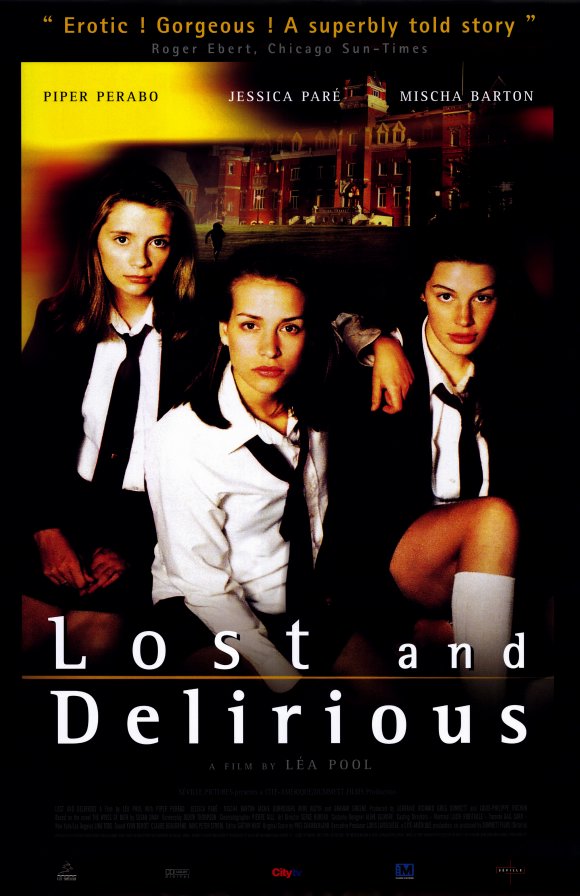
A female-only boarding school. A new pupil still mourning her recently deceased mother. Two roommates who seem especially close. An atmosphere of prejudice and privilege. The attentions of a teenage boy from another, nearby school. Peer pressure. Love rejected and dismissed. An injured falcon. High emotions left unchecked and leading to tragedy. All these and more form the meat of Lost and Delirious, a movie that comes very close to capturing the urgency and intensity of first love, and the spiralling madness that follows in the wake of that first love being rejected out of self-preservation.
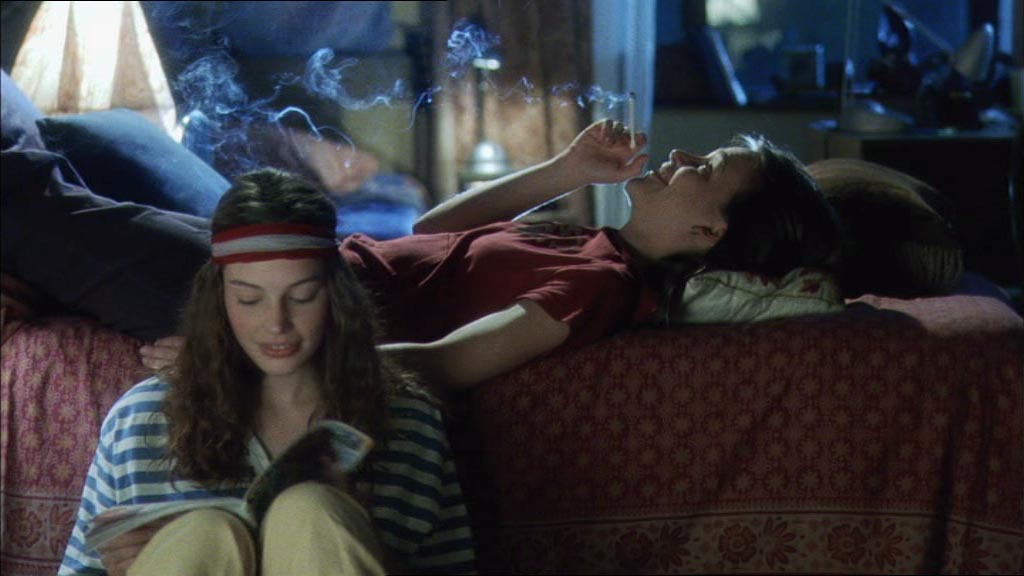
The movie opens with the arrival of fourteen year old Mary (Barton) at a semi-remote all-girls boarding school somewhere in Ontario, Canada. She’s shy and hesitant, so obviously a naïf that she might as well have it written across her forehead. Fortunately, the headmistress, Miss Vaughn (Burroughs), places her with Paulie (Perabo) and Tori (Paré), two older girls who take her under their combined protection and help her adjust to being away from home. It isn’t long though before Paulie and Tori’s relationship becomes much clearer: they’re lovers, but only Mary knows.
Of the two, Paulie is the more rebellious, challenging authority at (almost) every turn, and behaving with a reckless abandon. Tori is more studious, less willing to antagonise the teachers in the way that Paulie does, and their differences seem to have brought them closer together. As time goes by they drop any pretence around Mary that they’re not a couple, and she becomes a confidant to their affair. But as with all breathless (and secret) love affairs in such an environment, exposure isn’t too far away, and one morning Tori’s younger sister, Allison (VanCamp), with some of her friends burst into their room and find Tori and Paulie naked in Tori’s bed.
It proves a turning point for their relationship. Tori is unwilling to admit her feelings, or that she and Paulie are more than friends, and she tells her sister very forcefully that she isn’t a lesbian, and that she didn’t even know Paulie had got into her bed with her the night before. Allison accepts Tori’s explanation and agrees not to mention it to anyone, and especially their father who Tori knows is staunchly homophobic. Her withdrawal from Paulie though has the effect of driving Paulie to ever more extreme actions, including declaring her love for Tori in front of the other students. Embarrassed and afraid of being disowned by her family, Tori maintains her rejection of Paulie, and ever more desperate to win her back, the increasingly disturbed Paulie resorts to her most extreme actions yet.
Fans of all-girl boarding school stories will no doubt be expecting some melo- to go with their drama, and while Lost and Delirious certainly has its moments it’s a much better example of the genre that starts off quietly, taking care to establish its trio of leading characters and affording time to provide a (mostly) convincing backdrop for the action that unfolds. Adapted by Judith Thompson from the novel by Susan Swan, the movie’s isolated locale and sense of modulated behaviours is given potent expression through Mary’s initial feelings of abandonment by her newly remarried father. Seeing her wide-eyed dismay at the enormity of both the school and the task of fitting in that lies ahead of her, Mary’s story is likely to be the movie’s focus, the classic tale of the young girl who seeks acceptance but is rebuffed at every turn. But instead Mary is the young girl who finds herself caught up in someone else’s story, and learns a heartfelt lesson because of it.
By subverting our expectations in this way, the movie shows it’s not afraid to take risks, even if those risks incur some narrative wobbles later on. As Paulie and Tori’s relationship becomes the movie’s true focus, and Mary becomes their “accomplice”, the screenplay becomes playful and carefree, celebrating the girls’ love for each other, and paying no heed to any possible downfall that may be around the corner. It’s during this period that Lost and Delirious is at its most tolerant, placing Paulie and Tori in a perfect bubble of acceptance and indulging itself in their happiness. But from the moment that Allison bursts into their room and shatters that perfect bubble of acceptance, there’s nowhere else their relationship can go but downhill, and with terrible consequences.
But again, the movie wrong foots the viewer. Instead of Paulie and Tori finding sufficient strength from their relationship to allow them to overcome any prejudice or homophobic resentment towards them, Tori folds under the pressure of family ties and the loss of the life she’s used to. On the surface it seems a cowardly, awful thing to do, to deny your love for someone, but Tori is a product of her privileged background and she has no more choice in the matter than Paulie does in how she reacts. Torn by her sense of duty to her father and her feelings for Paulie, it’s the insidious nature of a “traditional” upbringing that is the villain, and Tori doesn’t have the strength to fight against it.
So it’s left to Paulie to fight against the injustice of losing the one person she loves with all her being. But she’s a tragic figure with a tragic future waiting just ahead for her. The script does nothing to allay our fears on this matter, letting Paulie’s unhappiness shred any remaining inhibitions or emotional restraints until the only outcome that’s possible is one that will have repercussions for all that witness it. As this event draws ever closer, and Paulie’s actions become ever more desperate, it becomes all the more awful to see her floundering in her search for a way to ease the pain she’s feeling.
As Paulie, Perabo is excellent, putting in the kind of performance that is both affecting and heart-rending at the same time. This came after Coyote Ugly (2000), and while that movie brought Perabo to everyone’s attention, this is the movie that should have cemented her reputation. As it is, it’s possibly her very finest role, one that’s tinged with melancholy, vulnerability, despair, longing, fearlessness, and above all, the joy that only true love can bring. It’s a fierce, impassioned performance, poignant and sincere, and the movie exploits it at every opportunity. Paré is somewhat sidelined by Tori’s self-imposed split from Paulie, but she does a good job in showing the pain Tori herself feels at giving up her own true love. She’s also asked to deny her love for Paulie once or twice too often for narrative comfort, which some viewers may find distracting as well as repetitive. But like Perabo, Paré is equally good at displaying the elation of first love, and their early scenes together are full of the exuberance that comes with loving unconditionally.
Tying all this together neatly and with a studied panache, Pool illustrates the various pressures and required conformities of single sex school life with a greater attention to detail than is at first apparent (this is definitely a movie that delivers more from a second viewing). She focuses on the girls’ emotions to very good effect, and shows a confident grasp of the sexual politics inherent in such an environment, while also displaying a keen eye (and ear) for the other exigencies that come with it. If she has slightly more trouble explaining how Paulie can be consistently rude to Miss Vaughn and her teachers, or that her increasingly disturbed behaviour can go equally unchallenged, then it’s a small price to pay for the quality achieved elsewhere.
Rating: 8/10 – a modest coming-of-age drama that succeeds in elevating itself by virtue of a superb central performance and careful attention to detail, Lost and Delirious is deserving of being “rediscovered” by a wider audience; with an emotional thrust that is both honest and credible, it’s a movie that resonates long after its tragic yet powerful ending.
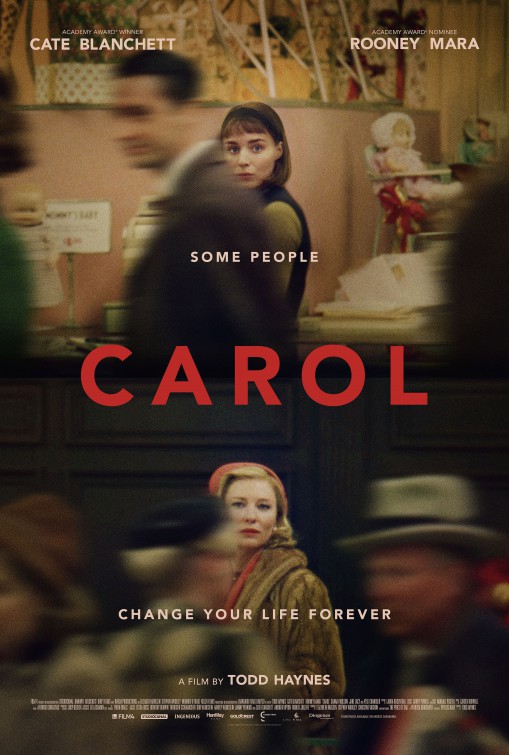
Cast: Cate Blanchett, Rooney Mara, Kyle Chandler, Sarah Paulson, Jake Lacy, Nik Pajic, John Magaro, Cory Michael Smith, Carrie Brownstein
Therese (pronounced Ter-rez) Belivet (Mara) is young, has a devoted boyfriend, Richard (Lacy), works in a department store, but is unsure of her future. One day a female customer in the store engages her in conversation, and even though the customer makes mention of being married with a young child, it’s clear to Therese that there’s a mutual attraction. When the woman leaves her gloves behind, Therese goes to the effort of finding the woman’s address and sending them to her. This act of kindness leads to the woman, whose name is Carol Aird (Blanchett), inviting Therese to lunch. They meet, and a friendship begins, one that starts to cause problems between Therese and Richard, as she begins to lose interest in a planned trip to Europe with him, and spends more time with Carol.
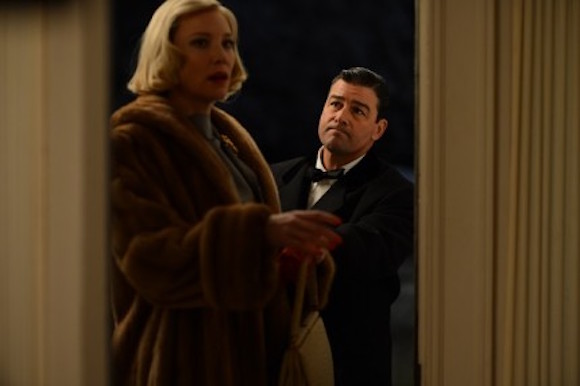
Unbeknownst to Therese, Carol and her husband, Harge (Chandler) have separated due to his awareness that his wife has had an affair with her best friend, Abby (Paulson). Willing to overlook this “indiscretion” if she stays with him, Harge warns her that if she doesn’t then he’ll seek sole custody of their little girl, Rindy. With Xmas approaching, he takes Rindy to his parents for the holiday period; Carol decides to invite Therese to come stay with her. Although nothing happens, Harge returns home unexpectedly and sees them together. Fearing that Carol is embarking on another lesbian relationship, he files for divorce and sole custody of Rindy. Unable to see her child until the custody hearing, which will take two or three months to happen, Carol invites Therese on a road trip, where they can spend some time together, and where Harge can’t find them.
They stay in a succession of motel rooms, at first staying in separate rooms. At one particular motel they stay in the Presidential suite; the next morning, Therese gets to talking with a travelling salesman called Tommy (Smith). Although he tries to sell them something from his sales kit, he has no joy, though Therese wishes him well in the future. At the next motel, she and Carol finally make love. But a telegram Carol receives the next morning reveals Harge’s awareness of where she is, and the fact that she and Therese are now lovers. Unable to risk the now serious possibility of losing the custody hearing, Carol decides she has to return home to face Harge, and sends Abby in her place to see Therese gets home safely. But for both women, returning to their old lives proves unsatisfactory…
There’s a moment in Todd Haynes’ beautifully crafted Carol, an adaptation of Patricia Highsmith’s novel The Price of Salt, when it looks certain that the title character and Therese will make love for the first time. It’s a moment that the movie is clearly heading toward, and it’s a moment that audiences will be expecting, but Haynes, along with screenwriter Patricia Nagy, holds off from that first time and maintains the sense of anticipation that both characters (and viewers) must be feeling. For the audience, it’s also a moment – among many others – that shows just how much control Haynes has over both the material and its emotional centre, and how finely calibrated it all is, for Carol is without a doubt, one of 2015’s finest movies.
Of course, with previous projects such as Far from Heaven (2002) and the TV version of Mildred Pierce (2011), Haynes has already shown an affinity for what used to be termed “women’s pictures”, but here his immersion in a time – the 1950’s – when lesbianism was still something to be kept hidden, and where male attitudes towards the issue were still highly aggressive, feels also like a snapshot of an era where female empowerment was beginning to gain the upper hand, despite the so-called Lavender Scare that was prevalent at the time. Through Carol’s determination not to be defined by her sexuality, we get to see an example of what, in historical terms, was a turning of the tide, and also a love story that is simply that: a love story.
This simplicity is at the heart of Haynes’ confident handling of the story, and it shows in every scene, with every look and every gesture, and in the way that he brings Carol and Therese together within the frame – these moments where they’re “close but not touching” are so charged with pent-up emotion and increasing desire that the idea that they might be kept apart by Harge’s machinations becomes intolerable. These scenes are so expertly handled, with repressed longing so forcefully expressed, that the viewer is swept along with the characters’ desire to live freely and without sanction. Haynes makes great use of the era’s sense of propriety, using it as a touchstone against which Carol and Therese’s affair can be measured in both intensity and necessity. Therese quizzes Richard about same sex relationships but he has no point of reference, and has no understanding of why they occur; he loves her unequivocally but can’t see that two women – or two men for that matter – might feel the same way about each other as he does about Therese. It’s another of those moments where the audience can see just how difficult it was to live a life outside the (perceived) norm.
With the historical and social background of the story firmly in place, and with Nagy’s script making it clear that lesbians were expected to pretend to be happy in heterosexual relationships or face the social consequences, the movie paints an honest portrait of two women, both of whom gain increased confidence in themselves through their relationship, who come together at a point in both their lives where they’re looking for a way to find future happiness. That they find it in each other, if only briefly, and with such passion, gives value to the idea that any relationship is worth pursuing or fighting for. And even though Carol leaves Therese to fight for custody of her child, it’s not the end of their affair, but rather an interruption (albeit for Therese an unexpected one), and even though the younger woman is upset by it, her feelings remain, and though the movie tries for an air of ambiguity in its final scene, viewers won’t be fooled at where Carol and Therese’s relationship is likely to find itself.
The difference in ages might feel like it should be an issue but it’s left unexplored, and with good reason: it doesn’t matter. Love is love, and though an argument could be made that Therese is looking for a guide or a mentor first and foremost, it’s not the role Carol adopts in their relationship. As the “older woman”, Blanchett gives yet another astonishing, awards-worthy performance, striking the right balance between heartfelt longing for an honest life and acknowledging the difficulties that longing entails. Her brittle, striking features show the pain of Carol’s situation without too much need of more overt playing, but in those moments when overt emotion is required, Carol’s fears and hopes are etched indelibly on those striking features. It’s a magnificent performance, sincere, heartbreaking at times, and riveting.
She’s matched by Mara, whose portrayal of the unmoored, ingenuous Therese is so finely tuned that watching her blossom, however slowly, into a stronger, more confident young woman is like watching a flower grow out of the shadows to its full height. There are moments where the camera focuses on her smooth, unlined features and the only expression is there in the eyes, but Mara uses this approach to such good effect that the viewer is never in doubt as to what Therese is thinking or feeling. And as the movie progresses, Mara subtly shifts the weight of Therese’s longing for love so that it becomes a part of her, and not the whole, leaving her a character as strong in her own right as Carol is in hers.
With two such commanding performances, it would be a shame if the supporting cast were overshadowed, but Chandler, in what is superficially the “villain” role, brings out Harge’s pain and sense of loss over Carol with such force that his actions are less stereotypical than expected and driven more by his own deep love for her. In the same way that society says Carol can’t have Therese (in public at least), it also says that Harge can’t have Carol because of her “sexual impropriety”. Both characters are in danger of losing what they want most, and both are suffering as a result. Chandler is unexpectedly moving in the role, and his scenes with Blanchett are so emotionally charged it’s like an intense version of force majeure. Meanwhile, Paulson comes late to matters as Abby, but gives a brief but potent performance as Carol’s longtime friend, confidant and ex-lover, filling in the gaps of Therese’s knowledge about Carol, and providing further context for Carol’s emotional and sexual desires.
It’s all beautifully filmed by Edward Lachman, with lots of bright primary colours mixed in with rich earthy tones, making the period seem so alive as to be almost intoxicating, and acting as a dynamic background to the impassioned nature of Carol and Therese’s relationship. There’s some equally impressive attention to historical detail, and Haynes makes the era come alive as a result; this is a fully realised world, even if it does appear at first to be bathed in nostalgia (the scenes in the department store appear right out of a Fifities child’s fantasy of what such a store should look like), but in many ways it was a simpler time, and the script reflects this with aplomb. And the whole thing is embraced by a smoothly nonchalant yet spirited score by Carter Burwell that complements the on-screen proceedings with well orchestrated brio.
Rating: 9/10 – a firm contender for Movie of the Year, Carol is a masterpiece of mood and repressed emotional yearning, with two outstanding performances, and a director on the absolute top of his form; a model of period movie making, and rewarding in every department you can possibly think of, this is a movie that should go to the top of everyone’s must-see list.










 thedullwoodexperiment