• 10 Reasons to Remember…
  • A Brief Word About…
  • About
  • For One Week Only
  • Happy Birthday
  • Monthly Roundup
  • Old-Time Crime
  • Other Posts
  • Poster of the Week
  • Question of the Week
  • Reviews
  • Trailers

thedullwoodexperiment

~ Viewing movies in a different light

thedullwoodexperiment

Tag Archives: New Zealand

Hunt for the Wilderpeople (2016)

06 Thursday Oct 2016

Posted by dullwood68 in Movies

≈ 3 Comments

Tags

Barry Crump, Child services, Comedy, Drama, Julian Dennison, Literary adaptation, New Zealand, Rachel House, Review, Rima Te Wiata, Sam Neill, Taika Waititi, The Bush, Wild Pork and Watercress

hunt-for-the-wilderpeople

D: Taika Waititi / 101m

Cast: Sam Neill, Julian Dennison, Rima Te Wiata, Rachel House, Tioreore Ngatai-Melbourne, Oscar Kightley, Stan Walker, Mike Minogue, Cohen Holloway, Rhys Darby

Ricky Baker (Dennison) is a problem child. He’s in the care system, and has a reputation for disobedience, stealing, spitting, running away, throwing rocks, kicking stuff, defacing stuff, burning stuff, loitering, and graffiti-ing (and that’s just the stuff Child Services knows about). In short, he’s a real bad egg. But he’s been given one last chance: to be looked after by Bella Faulkner (Te Wiata) and her grouchy husband Hec (Neill) on their farm. Bella is endlessly upbeat despite a tendency for inappropriate comments (“Whoo! You’re a big fella. Who ate the guy who ate all the pies, eh?”), but her heart’s in the right place and she more than compensates for Hec’s less than welcoming behaviour. Ricky runs away the first night, but doesn’t get very far, and soon he’s running away each night – but he’s always back in time for breakfast.

Responding to Bella’s ministrations, Ricky soon settles in and begins to take an interest in the farm and Hec’s role. Hec teaches Ricky to shoot, and they begin to form a bond. When Ricky’s birthday comes around, the Faulkners get him a dog, which he names Tupac. But tragedy strikes, and Ricky is required to go back into the care system. Refusing to go he heads off into the Bush, and determines to remain in hiding. Hec soon finds him, and they begin the return journey home when Hec breaks his ankle. Forced to stay in the Bush while his ankle heals, six weeks pass, during which Child Services, in the form of would-be Agatha Trunchbull, Paula Hall (House), and the police, search for the missing pair. An encounter at a lodge with a trio of hunters who are looking for Ricky and Hec leads to Hec being regarded as a pervert, and Ricky having been kidnapped.

hftw-scene1

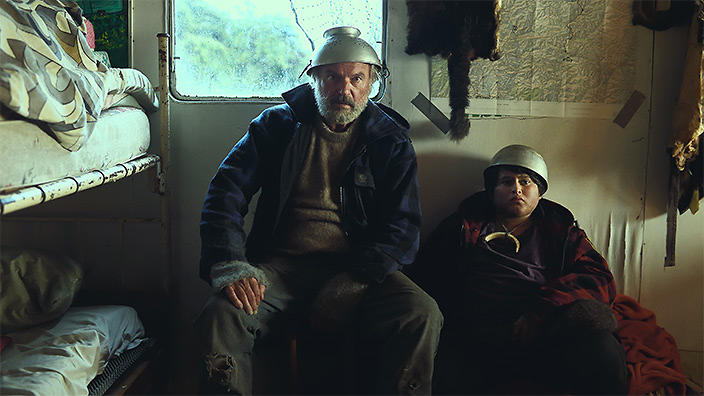
Ricky and Hec go on the run, and decide to hole up in the Bush until the search for them peters out. They survive by catching or foraging for food, use the “Knack” – a kind of semi-mystical knowledge that allows them to avoid being found and to survive in the wilderness – and slowly and surely learn to trust and respect and depend on each other. But the search for them continues unabated, thanks to Paula Hall’s determination that “no child is left behind”, and the occasional help afforded them by strangers such as young girl Kahu (Ngatai-Melbourne), and raving conspiracy theorist Psycho Sam (Darby). But inevitably the pair are tracked down and it only remains to be seen if they go out with a bang or a whimper.

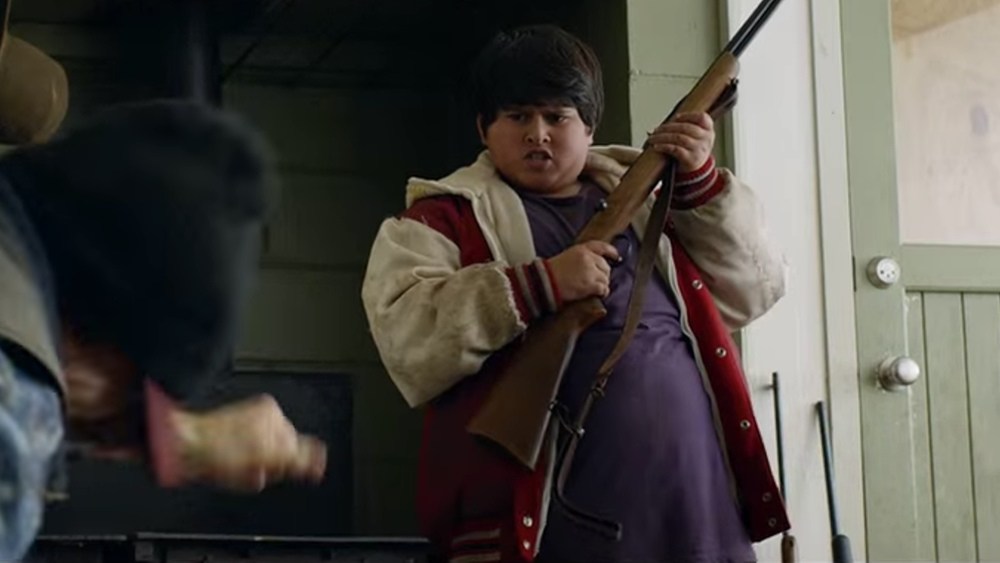
An adaptation of the novel Wild Pork and Watercress by Barry Crump, Hunt for the Wilderpeople is one of the most enjoyable and endearing movies you’re likely to see all year. It has charm by the bucket load, an irresistible central character in Ricky Baker, is peppered with some of the funniest dialogue heard in a very loooong time, and features some absolutely stunning New Zealand scenery. And because it all takes place in New Zealand there’s a fantastic Lord of the Rings joke to round things off. It’s a movie that, thanks to the efforts of writer/director Taika Waititi, provides enough comic indulgence for two movies.
hftw-scene3

It features a quartet of wonderfully bizarre and idiosyncratic performances as well, from Neill’s wonderfully arch turn as a man with all the parental skills of a confirmed malcontent, to Te Wiata’s brief but heartfelt portrayal of a woman for whom the act of caring compensates greatly for the one regret she’s ever had in life, to House’s grotesque Child Services agent, a loud, over-earnest, bullying monster of a woman who won’t be beaten by Ricky at any cost, as evidenced by this brilliant exchange:

Ricky Baker: I’ll never stop running!
Paula: Yeah, and I’ll never stop chasing you – I’m relentless, I’m like the Terminator.
Ricky Baker: I’m more like the Terminator than you!
Paula: I said it first, you’re more like Sarah Connor, and in the first movie too, before she could do chinups.

But when all’s said and done, this is Dennison’s movie. He owns the role of Ricky Baker as if he’s played it all his life, from the constant gangsta/thug life referrals, all the way to the petulant disregard for others he uses as a shield against getting hurt. Dennison is nothing short of superb here, soaking up Waititi’s fluid direction and relaying with disarming simplicity the problems of being in a care system that doesn’t actually care about him. He’s also a great physical comedian, using his size in unexpected ways to draw out several moments of equally unexpected humour. And his timing isn’t too bad, either. Witness the scene where he tries to cajole Hec into looking for a Russian bride online: when Hec looks at him with disdain, Ricky’s deadpan “Too soon?” is served up to perfection.
hftw-scene2

In amongst the humour, Waititi is wise enough to keep the sermonising about the importance of family ties, and just what makes a family, to a minimum, and the demonisation of Child Services via the character of Paula is kept from becoming too silly or ridiculous thanks to Waititi’s assured handling of his own script, and House’s confident awareness of the character’s narrative limitations. She’s a cartoon figure in many respects, and in some ways the Yosemite Sam to Ricky’s Bugs Bunny, but not drawn or portrayed too broadly to be completely obnoxious or hateful. (There’s a sad back story there, no doubt, and one that would be good to know more about.) The relationship between Ricky and Hec is allowed to develop naturally, and is helped by the passage of time. Neill and Dennison work very well together, and the early scenes where they clash adds poignancy later on when it becomes clear to both of them just how much they need each other.

As mentioned before, the whole thing plays out against the backdrop of some spectacular New Zealand scenery – the opening credits sequence as the camera skims the treetops of the Bush sets the tone for the movie’s overall look and feel – and DoP Lachlan Milne captures the rugged beauty of the Bush itself and the surrounding terrain with clarity and precision; it’s a visually splendid movie to watch. And to cap it all off, the soundtrack, with its mix of original compositions and well-chosen songs – Nina Simone’s version of Sinnerman is put to particularly good use – adds an extra layer of finesse to a movie that already has more than enough finesse already.

Rating: 9/10 – a feel-good movie that doesn’t even have to try too hard to make its audience laugh or cry, Hunt for the Wilderpeople is beautifully observed, beautifully constructed, and effortlessly satisfying; Waititi is to be congratulated for taking material that could have been treated with far less care than is shown here and making it feel special, and for making a movie about a fat kid and his grumpy “uncle” that is nothing short of “majestical”.

Share this:

  • Click to share on X (Opens in new window) X
  • Click to share on Facebook (Opens in new window) Facebook
  • More
  • Click to print (Opens in new window) Print
  • Click to email a link to a friend (Opens in new window) Email
Like Loading...

Apron Strings (2008)

04 Tuesday Nov 2014

Posted by dullwood68 in Movies

≈ 1 Comment

Tags

Community, Drama, Estrangement, Homophobia, Indian cuisine, Indian culture, Jennifer Ludlam, Laila Rouass, Leela Patel, Nathan Whitaker, New Zealand, Racism, Review, Scott Wills, Sisters, Vaele Sima Urale

Apron Strings

D: Vaele Sima Urale / 90m

Cast: Laila Rouass, Scott Wills, Jennifer Ludlam, Nathan Whitaker, Leela Patel, Jodie Rimmer, Kate Harcourt, Peter Elliott, Gary Young

Michael (Whitaker) is a young Indian student whose mother, Anita (Rouass) is estranged from her sister, Tara (Patel).  On the pretext of doing a college project, he visits his aunt at the restaurant she runs, while keeping his visit a secret from Anita.  He and Tara hit it off and he visits more often until she offers him a job there.  Anita, meanwhile, is at odds with the producers of the TV cookery programme she hosts: about the content, about the recipes, and about the costumes she’s asked to wear.

One of Tara’s regular customers is Barry (Wills).  He’s a middle-aged man still living at home with his mother, Lorna (Ludlam) and his Nan (Harcourt).  Barry is drifting through life looking for one get-rich-quick scheme to pay off after another, and he sponges off his mother – who runs a cake shop – with unvarying results: the money is always wasted.  Lorna’s attempts at tough love are undermined by her soft-hearted nature, even when Barry gets into debt through his attempts to get local baker Minh (Young) to buy out his mother’s business.

As Michael gets to know his aunt, and the family history, he begins to pull away from his mother.  This only adds to the anger she feels over her cookery programme, and their relationship suffers even further.  Michael spends more time at Tara’s restaurant until, suspicious of what her son has been doing, Anita follows him there.  Meanwhile, Lorna also has to deal with the return of her daughter, Virginia (Rimmer), several months pregnant and refusing to take on her mother’s ideas of conformity.  With passions running high in both families, each member has to look at themselves before they can make peace with each other.  But can they?

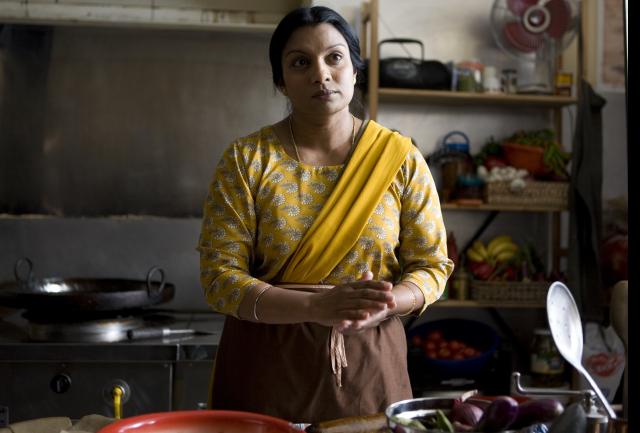
MCDAPST EC005

A subtly ambitious tale that takes in themes of racism, community, homophobia – Michael is gay – injured pride, personal responsibility and motherhood, Apron Strings is a small-scale drama that tells its various stories with simple precision throughout.  Both main stories involve mothers who have become distant from their sons, and who no longer understand them.  The blame for this seems squarely laid at the doors of Anita and Lorna, but it’s offset by their unswerving love for their children, as both women strive to ensure their children are happy.  The movie shows how difficult it can be to be both supportive and unsupportive depending on the situation, and how walking such a tightrope can backfire on the mother.

The movie also shows us how striking out on their own can undermine the best intentions of the two sons.  Michael aims to reunite Anita and Tara but he’s unprepared for the emotions that learning about his aunt and his mother’s fractured relationship are awakened in him.  He finds it difficult to reconcile the image he has of his mother with that of the proud young woman who made a difficult choice in her youth and has fought hard not to let that decision define her.  With Michael so sure of his racial identity, and having such a strong sense of family, that his mother has turned her back on all that, proves too much of a shock.  And yet, by being gay, he runs the risk of his own community rejecting him, making his own need to make a decision about his future all the more important.

Alternately, Barry is a lazy conniver, a wastrel who thinks being rich will solve all his problems, and the problems he perceives his mother has.  He’s the classic underachiever who thinks he’ll make his mother proud by hitting the jackpot, but he fails to recognise that she loves him all the same, and would do even if he was working at a mundane nine-to-five job, and as long as he was content.  But Barry is restless, with no chance of getting a job, or beginning a relationship, and with no pride in his appearance.  He struggles with himself and rebels against his mother’s hopes for him, failing time after time and never learning from the experience.

As the two mothers trying hard to connect with their sons, Rouass and Ludlam both turn in polished performances that make the audience waver in their sympathies for them, as each woman is allowed to appear strong and determined and yet flawed at the same time.  Rouass is at her best when railing against the constraints Anita believes her cultural background have placed on her, and she simmers with an anger that clearly has deep-seated roots.  It’s an impressive performance, a precise, detailed characterisation that is at once charming and distressing in its emotional candour.  Ludlam is equally good, Lorna’s tired efforts to rein in her best intentions and play the hard line blunted continually by what she sees as the need to be a caring, though accommodating mother.  She too is suffused with anger, but it’s an anger that has been compromised over time and it no longer carries the emotional weight that would enable Lorna to overcome the inadequacies she feels in dealing with her son (and her daughter).

Apron Strings - scene2

With two such strong, committed performances, it’s reassuring that under the equally strong and committed direction of Urale – making her feature film debut – the other performances aren’t overwhelmed in the process.  Wills plays Barry as a sad, desperate individual with few redeeming qualities but who is strangely sympathetic as well, a neat trick given the levels of perfidy that Barry will stoop to.  Patel provides the cultural and racial grounding that informs the audience, and paints a moving portrait of a woman whose sense of family obligation has paved the way for her own happiness and sense of purpose in life.  And Michael’s sense of confusion and anger over what he perceives is his mother’s betrayal of her heritage is neatly handled by Whitaker, as well as his conflicted emotions.

Each of these performances wouldn’t be quite so good if it wasn’t for the carefully constructed and multi-layered screenplay by Shuchi Kothari.  Her only feature length screenplay to date, it contains – and maintains – a level of detail that makes it easy for Urale to deliver an affecting, quietly moving piece that looks at the generational divide evident in today’s society, and which does its best to show that bridges can be built when the willingness is there on both sides.

Rating: 8/10 – a moving portrait of two families struggling to deal with the emotional fallout from unfulfilled dreams and desires, Apron Strings is a finely tuned drama that deserves a wider audience; and the scenes of Indian food being prepared are as mouth-watering as you’d expect.

Share this:

  • Click to share on X (Opens in new window) X
  • Click to share on Facebook (Opens in new window) Facebook
  • More
  • Click to print (Opens in new window) Print
  • Click to email a link to a friend (Opens in new window) Email
Like Loading...

My Top 10 Movies – Part Six

25 Saturday Jan 2014

Posted by dullwood68 in Movies

≈ Leave a comment

Tags

Elijah Wood, Frodo Baggins, Gandalf, Gollum, Helm's Deep, Hobbits, Ian McKellen, J.R.R. Tolkien, Literary adaptation, Middle Earth, New Zealand, Peter Jackson, Ralph Bakshi, Review, Sam Gamgee, Sauron, Sean Astin, The Hobbit, The Lord of the Rings, The Silmarillion, Viggo Mortensen

The Lord of the Rings (2001-2003)

Lord of the Rings Trilogy, The

D: Peter Jackson / 558 mins

Cast: Elijah Wood, Ian McKellen, Viggo Mortensen, Sean Astin, Billy Boyd, Dominic Monaghan, Orlando Bloom, John Rhys-Davies, Sean Bean, Liv Tyler, Christopher Lee, Cate Blanchett, Hugo Weaving, Andy Serkis, Karl Urban, John Noble, David Wenham, Miranda Otto, Bernard Hill, Brad Dourif, Ian Holm

I know, I know, this is a bit of a cheat, three movies for the price of one and all that, but how can you possibly separate the greatest trilogy ever made?

There have been enough superlatives heaped on Peter Jackson’s finest hour(s), and while I’m tempted to add to the pile, I’m going to restrain myself and keep to the personal aspect that makes these movies mean so much to me.  And besides, everyone already knows how brilliant they are (sorry, couldn’t help it).

My first encounter with J.R.R. Tolkien wasn’t via The Lord of the Rings or even The Hobbit.  It was through a friend of mine who was into fantasy art; at his home one day he showed me a picture he’d drawn of a wizard (you can guess which one).  He told me the wizard was one of the main characters in a book he’d read.  He handed me a battered copy of The Hobbit and advised me that if I was going to read it I ought to be prepared for it to be a bit child-oriented.  And me, being a 14-year-old with ideas of being older in my outlook, declined his kind offer and went home instead with the first issue of a new sci-fi magazine called Starburst.

A year later, Ralph Bakshi’s version of The Lord of the Rings was released but I didn’t see it.  My friend the artist did and he thought it was quite good but he also mentioned it wasn’t the whole story.  I thought, “what’s the point of that?” (not knowing then of Bakshi’s plan to finish the tale in a second movie).

And then, in 1981, two things happened that brought me into the fold, so to speak.  My girlfriend at the time was reading The Lord of the Rings and would spend whole evenings working through it; she thought it was “the best book” she’d ever read.  She asked me to read it but I was still hesitant (I was working my way through Dickens at the time and fantasy fiction wasn’t high on my (slightly pretentious) list of genres to  read).  And then on March 8 (a Sunday) the BBC began broadcasting a radio adaptation of Tolkien’s novel in thirty minute episodes that had me glued to my stereo every Sunday for the next twenty-five weeks.  I read the book in between episodes, keeping up with the adaptation.  By the time the broadcasts ended on 30 August I was a Tolkien fanatic.  Now I read The Hobbit, and The Silmarillion.  I raved about the books to anyone who might listen, and later tracked down Bakshi’s movie on video (not as bad as I thought it was going to be; the live-action based animation is actually quite visually arresting).

I re-read the books, revisited the radio adaptation when it was re-broadcast in hour-long episodes in 1982, and generally looked upon the whole mythology that Tolkien had created as being one of the most incredible literary works I’d (eventually) come across.

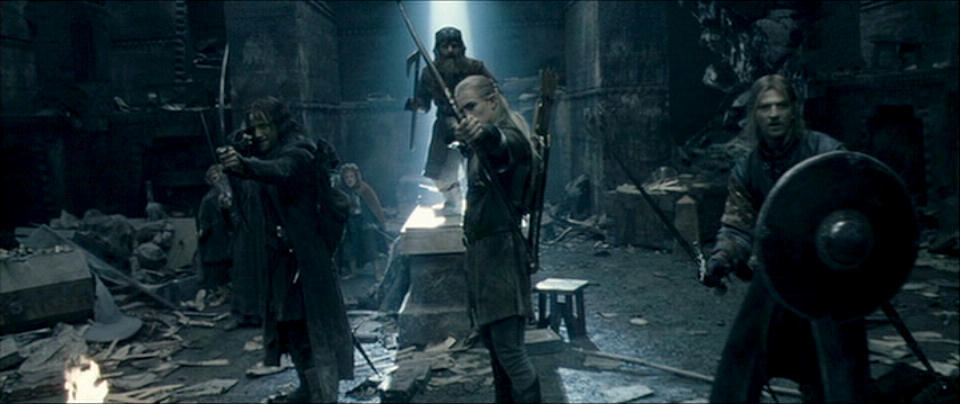
Lord of the Rings Trilogy, The - scene

When it became clear in the late Nineties that a large-budget adaptation of The Lord of the Rings was being planned, with Peter Jackson at the helm, I felt a mixture of anticipation and trepidation.  First of all, it was going to be a live action adaptation, and even though Jackson’s Heavenly Creatures (1994) had proved he could direct something with a bit more depth than say, Braindead (1992), I still had my doubts.  As the scope of the project became known, the more I wondered if, and how, Jackson was going to pull it off.  And over three movies!

Now, thirteen years on, and with Jackson giving us The Hobbit as well, we all know I needn’t have worried.  The Fellowship of the Ring was like the best Xmas present anyone could have.  Its mix of the intimate and the grandeur of Middle Earth, and the level of detail, along with the sheer excitement of the action sequences made for one of the most rewarding cinematic experiences of my whole movie-going life.  In the first two weeks of its release in the UK I saw the movie three times.  When The Two Towers was released a year later, I was itching to see it, especially after watching Fellowship‘s extended version the day before (Jackson’s idea to give us longer versions of each movie on home video was a stroke of genius).  I came out of seeing The Two Towers overwhelmed and buoyed up by the emotional depth that infused the movie, and by the sheer spectacle of the Battle of Helm’s Deep (I couldn’t see how the Battle of the Pelennor Fields could be any better or more exciting; what did I know?).  The following year passed too slowly, waiting for The Return of the King to be released.  When it finally did, I can remember hearing the opening music and feeling a shiver run through me.  Please, Mr Jackson, please, I remember thinking, please have got this right.  And did he.  The Return of the King was an incredible achievement, a massive undertaking in its own right, and the culmination of a saga that had built to this monumental, emotionally-charged conclusion with barely a (hobbit) foot out of step along the way.  (And to those people who feel the movie should have ended with the coronation of Aragorn, the movies have always been about the characters and their journeys; to not see them make their farewells and re-take up their lives would have been a disservice to both them and the audience.)

The Lord of the Rings trilogy remains a phenomenal achievement, with stand-out performances – who can forget Gollum’s schizophrenic argument with himself in The Two Towers? – stunning location photography; a script that never lost sight of the emotional cores of its characters; confident, breathtaking direction from Peter Jackson; special effects that served the story and didn’t overwhelm things; and most of all, the creation of a wholly believable world where all this could happen.  But again, it’s the emotional element that makes the trilogy work, that keeps all of us who fell in love with the movies coming back time and time again, to revisit Middle Earth in all its glory and grandeur.  For many years, a friend and myself would take a day out to watch the extended versions right through, revelling in being able to spend time again with old friends such as Samwise Gamgee and Gimli, son of Glóin.  This trend has (sadly) lapsed in the last few years, but as an added memory to the original, wonderful experience of seeing the trilogy unfold over three magical Xmas’s, it’s easily the next best thing.  Going back to Middle Earth is, in its own way, a little bit like going back home after a long journey away…and what would Frodo and Sam say to that?

Rating: 9/10 – a stupendously impressive piece of filmmaking, bold, inventive, gripping, and with an emotional intensity few fantasy movies ever manage; just as there is only One Ring, Jackson’s enduring achievement means there is only One Trilogy.

Share this:

  • Click to share on X (Opens in new window) X
  • Click to share on Facebook (Opens in new window) Facebook
  • More
  • Click to print (Opens in new window) Print
  • Click to email a link to a friend (Opens in new window) Email
Like Loading...

Blog Stats

  • 486,528 hits

Recent Posts

  • 10 Reasons to Remember Bibi Andersson (1935-2019)
  • Fantasia (1940)
  • Dances With Wolves (1990) – The Special Edition
  • Kiss of the Spider Woman (1985)
  • The Three Musketeers (1973)

Top Posts & Pages

  • Lost for Life (2013) - Another Look
    Lost for Life (2013) - Another Look
  • Lost for Life (2013)
    Lost for Life (2013)
  • About
    About
  • Mr. Topaze (1961)
    Mr. Topaze (1961)
  • Winter's Tale (2014)
    Winter's Tale (2014)
  • Billy Lynn's Long Halftime Walk (2016)
    Billy Lynn's Long Halftime Walk (2016)
  • The Hitman's Bodyguard (2017)
    The Hitman's Bodyguard (2017)
  • Shock and Awe (2017)
    Shock and Awe (2017)
  • 5 Famous Movie Roles That Nearly Went to Someone Else
    5 Famous Movie Roles That Nearly Went to Someone Else
  • The Layover (2017)
    The Layover (2017)
Follow thedullwoodexperiment on WordPress.com

Blogs I Follow

  • Rubbish Talk
  • Film 4 Fan
  • Fast Film Reviews
  • The Film Blog
  • All Things Movies UK
  • Interpreting the Stars
  • Let's Go To The Movies
  • Movie Reviews 101
  • TMI News
  • Dan the Man's Movie Reviews
  • Film History
  • Jordan and Eddie (The Movie Guys)

Archives

  • April 2019 (13)
  • March 2019 (28)
  • February 2019 (28)
  • January 2019 (32)
  • December 2018 (28)
  • November 2018 (30)
  • October 2018 (29)
  • September 2018 (29)
  • August 2018 (29)
  • July 2018 (30)
  • June 2018 (28)
  • May 2018 (24)
  • April 2018 (21)
  • March 2018 (31)
  • February 2018 (25)
  • January 2018 (30)
  • December 2017 (30)
  • November 2017 (27)
  • October 2017 (27)
  • September 2017 (26)
  • August 2017 (32)
  • July 2017 (32)
  • June 2017 (30)
  • May 2017 (29)
  • April 2017 (29)
  • March 2017 (30)
  • February 2017 (27)
  • January 2017 (32)
  • December 2016 (30)
  • November 2016 (28)
  • October 2016 (30)
  • September 2016 (27)
  • August 2016 (30)
  • July 2016 (30)
  • June 2016 (31)
  • May 2016 (34)
  • April 2016 (30)
  • March 2016 (30)
  • February 2016 (28)
  • January 2016 (35)
  • December 2015 (34)
  • November 2015 (31)
  • October 2015 (31)
  • September 2015 (34)
  • August 2015 (31)
  • July 2015 (33)
  • June 2015 (12)
  • May 2015 (31)
  • April 2015 (32)
  • March 2015 (30)
  • February 2015 (37)
  • January 2015 (39)
  • December 2014 (34)
  • November 2014 (34)
  • October 2014 (36)
  • September 2014 (25)
  • August 2014 (29)
  • July 2014 (29)
  • June 2014 (28)
  • May 2014 (23)
  • April 2014 (21)
  • March 2014 (42)
  • February 2014 (38)
  • January 2014 (29)
  • December 2013 (28)
  • November 2013 (34)
  • October 2013 (4)

Blog at WordPress.com.

Rubbish Talk

Film 4 Fan

A Movie Blog

Fast Film Reviews

The Film Blog

The official blog of everything in film

All Things Movies UK

Movie Reviews and Original Articles

Interpreting the Stars

Dave Examines Movies

Let's Go To The Movies

Film and Theatre Lover!

Movie Reviews 101

Daily Movie Reviews

TMI News

Latest weather, crime and breaking news

Dan the Man's Movie Reviews

All my aimless thoughts, ideas, and ramblings, all packed into one site!

Film History

Telling the story of film

Jordan and Eddie (The Movie Guys)

Movie Reviews & Ramblings from an Australian Based Film Fan

Privacy & Cookies: This site uses cookies. By continuing to use this website, you agree to their use.
To find out more, including how to control cookies, see here: Cookie Policy
  • Subscribe Subscribed
    • thedullwoodexperiment
    • Join 481 other subscribers
    • Already have a WordPress.com account? Log in now.
    • thedullwoodexperiment
    • Subscribe Subscribed
    • Sign up
    • Log in
    • Report this content
    • View site in Reader
    • Manage subscriptions
    • Collapse this bar
 

Loading Comments...
 

    %d