• 10 Reasons to Remember…
  • A Brief Word About…
  • About
  • For One Week Only
  • Happy Birthday
  • Monthly Roundup
  • Old-Time Crime
  • Other Posts
  • Poster of the Week
  • Question of the Week
  • Reviews
  • Trailers

thedullwoodexperiment

~ Viewing movies in a different light

thedullwoodexperiment

Tag Archives: Philip Seymour Hoffman

Jack Goes Boating (2010)

11 Tuesday Jul 2017

Posted by dullwood68 in Movies

≈ Leave a comment

Tags

Amy Ryan, Catch Up movie, Comedy, Daphne Rubin-Vega, Drama, John Ortiz, Limo driver, Philip Seymour Hoffman, Review, Romance
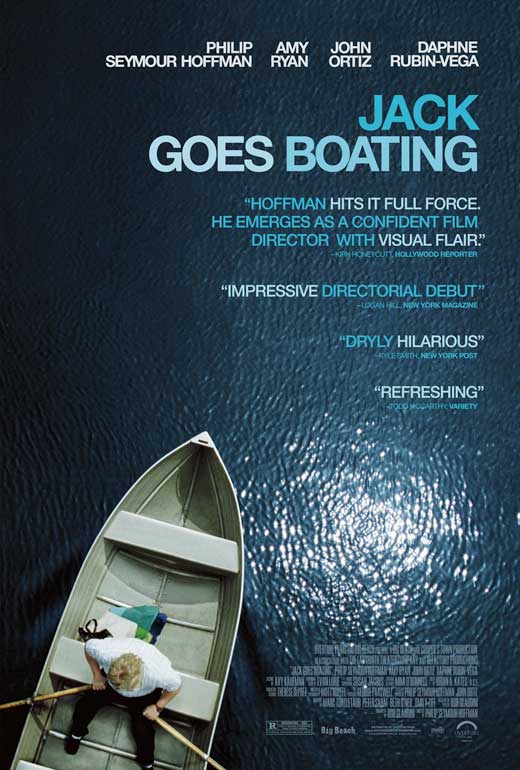
D: Philip Seymour Hoffman / 91m

Cast: Philip Seymour Hoffman, Amy Ryan, John Ortiz, Daphne Rubin-Vega, Tom McCarthy, Salvatore Inzerillo

When actors make the transition from appearing in front of the cameras to working behind them as directors, their first attempts at building a secondary career have a tendency to be remarkable debuts. Think Charles Laughton and The Night of the Hunter (1955), or Kevin Costner and Dances With Wolves (1990), or Sarah Polley and Away from Her (2006) (just to name a few). Well, you can add Philip Seymour Hoffman and Jack Goes Boating to the list. A movie that clearly shows that Hoffman could have had an equally lustrous career as a director as well as an actor (this was his only outing as a director), Jack Goes Boating sees him deftly handling comedy, drama, and romance in his screen version of the play by Robert Glaudini. It’s an unsurprising choice as Hoffman, along with Ortiz and Rubin-Vega, appeared in the original Off-Broadway production in 2007. The main cast’s familiarity with the material – similar to that with Fences (2016) – helps tremendously, but Hoffman is astute enough to transpose the action so that at no point does it feel stage-y or contrived.

The movie is terrifically understated from the start, with Hoffman’s shy, reticent Jack working as a limo driver for his uncle. He works with his best friend, Clyde (Ortiz), and the two have an easy going relationship that is affectionate and endearing. Clyde is married to Lucy (Rubin-Vega), but their relationship is on rocky ground, though they both help set up Jack with one of Lucy’s co-workers, Connie (Ryan). Connie is similar to Jack in that she’s shy and diffident; she also has some intimacy issues. Their first meeting goes well, and by the end of it they’re talking about doing something during the summer, such as boating. Neither of them have done anything like this before, and Jack is especially worried as he can’t swim. Clyde agrees to teach him, and in the process, Jack learns about positive visualisation, which helps him have the confidence to overcome his fears.

An incident involving Connie leads to Jack agreeing to make dinner for her, something nobody – aside from her mother – has ever done before. Clyde helps out again by giving Jack the name of a chef nicknamed The Cannoli (Inzerillo), who’ll show him how to cook a meal. But there’s more to The Cannoli than Jack is initially aware of, and as the night of the meal for Connie draws nearer, Jack learns more about his friends’ marriage than he was ever prepared for, while his own relationship with Connie grows stronger. On the night of the meal, the various stresses and strains affecting Clyde and Lucy come to the fore, and the evening descends into chaos, one that has repercussions for Clyde and Lucy, and has a profound effect on Jack and Connie…

What’s immediately apparent from Jack Goes Boating is the surety that Hoffman shows in guiding the material from its opening scenes where the script’s dry humour is given room to breathe, through the middle section where Jack and Connie’s romance takes centre stage, and then on into the final stretch where it becomes a stinging drama. Hoffman handles each stage of the movie with due care and attention to the characters and, more importantly, their inner lives. As a director, Hoffman is incredibly generous to his cast, giving them the room to explore their roles and instill them with small details that enhance both their performances and the movie at the same time. What this means for the viewer is a movie that delights and captivates in equal measure, and has the ability to leave said viewer wearing a happy grin for most of the movie. Hoffman and Ryan in particular do more with a look and a glance than some actors can do with a four-hour movie and two hundred pages of expository dialogue.
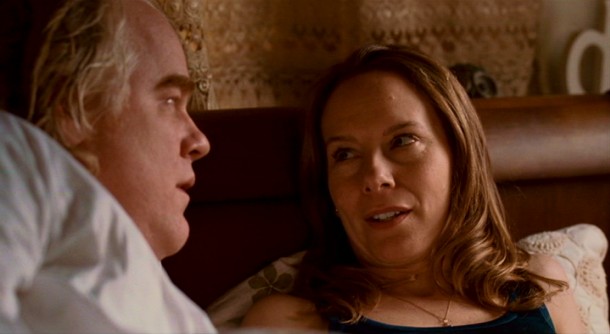
The romance between Jack and Connie is handled with a great deal of finesse, as the pair gingerly and carefully get to know each other, and try to overcome their lack of confidence in being part of a couple. Opening up to each other and trusting each other, the pair behave in a winsome manner that sees them warily circling around the idea of being together while at the same time, being eager to move forward as quickly as possible – as long as they’re both okay with that. In contrast, Clyde and Lucy are at the kind of loggerhead where intimacy is painful and recriminations for past misdeeds are just a breath away. Clyde grows to be jealous of his best friend’s good fortune in finding Connie, and his unhappiness threatens to ruin the meal. Lucy too is unhappy, and like Clyde, is dealing with her feelings in a way that’s detrimental to the possibility of their staying together. Lucy’s unhappiness also threatens to ruin the meal, and when things do begin to unravel, it’s Lucy whose anger finds its full expression in an excoriating attack on Clyde. As the warring couple, Ortiz and Rubin-Vega give outstanding performances, each imbuing their character with a potent mix of pained acceptance (that things are unalterably wrong between them), and a desperate need to wipe the slate clean (which they’ve tried and failed to achieve).

While there’s little here that’s new or hasn’t been covered before – Marty (1955) is an obvious forerunner – it’s the way in which Hoffman and his very talented cast handle the material that makes Jack Goes Boating so emotionally vivid and deceptively compelling. Jack and Connie are characters you can’t help but like, and you can’t help but root for them all the way through. And though they’re at odds with each other, Hoffman ensures that Clyde and Lucy deserve our sympathy as well. It’s all supplemented by a wonderfully expressive soundtrack that mixes an often poignant score by Grizzly Bear, and a handful of Fleet Foxes songs that contribute greatly to the movie’s overall tone and mood.

Rating: 9/10 – Hoffman’s death in 2014 robbed us of an inspired actor and director, and after viewing Jack Goes Boating, that sense of loss is more keenly felt than ever; beautifully observed and endlessly affecting, the movie is funny, romantic, tragic, and a terrific showcase for all concerned. (11/31)

Share this:

  • Click to share on X (Opens in new window) X
  • Click to share on Facebook (Opens in new window) Facebook
  • More
  • Click to print (Opens in new window) Print
  • Click to email a link to a friend (Opens in new window) Email
Like Loading...

The Hunger Games: Mockingjay Part 2 (2015)

20 Friday Nov 2015

Posted by dullwood68 in Movies

≈ Leave a comment

Tags

District 13, Donald Sutherland, Drama, Francis Lawrence, Jennifer Lawrence, Josh Hutcherson, Julianne Moore, Katniss Everdeen, Liam Hemsworth, Literary adaptation, Panem, Philip Seymour Hoffman, President Snow, Review, Sci-fi, Sequel, Suzanne Collins, The Capitol, Thriller, Woody Harrelson

Mockingjay Part 2

D: Francis Lawrence / 137m

Cast: Jennifer Lawrence, Josh Hutcherson, Liam Hemsworth, Donald Sutherland, Julianne Moore, Woody Harrelson, Philip Seymour Hoffman, Willow Shields, Sam Claflin, Elizabeth Banks, Mahershala Ali, Jena Malone, Jeffrey Wright, Natalie Dormer, Evan Ross, Elden Henson, Wes Chatham, Michelle Forbes, Patina Miller, Stanley Tucci

Picking up after Peeta’s failed attempt to kill Katniss, the final instalment in The Hunger Games series begins with a problem for both the makers and the audience to consider: should the movie launch straight into the rebels’ expected attack on the Capitol, or should it hold back and spend some time reiterating the relationships between Katniss and Peeta and Gale, and begin to explore the similar machinations of President Snow and his potential successor, Alma Coin? The answer is the latter, and while this decision allows for further layers to be added to Katniss’s ever-present self-doubt (and sets up the ending), it also has the effect of reminding the viewer that we’ve been here before – and in each of the three previous movies.

One of the series’ strengths has always been the way in which Katniss appears to be a stranger to herself while everyone around her finds her actions entirely predictable. It’s an idea that continues here, with the Mockingjay being used at every turn, even when she acts independently. But it’s in danger of becoming as unwieldy a plot device as the idea that President Snow has a camera in every home in Panem (as well as in every shop, and on every street corner… you get the idea). We get it. And if the decision to split Mockingjay the novel into two parts was so that the final movie could be all about the rebels’ final push on the Capitol, then why are we still going over old ground?

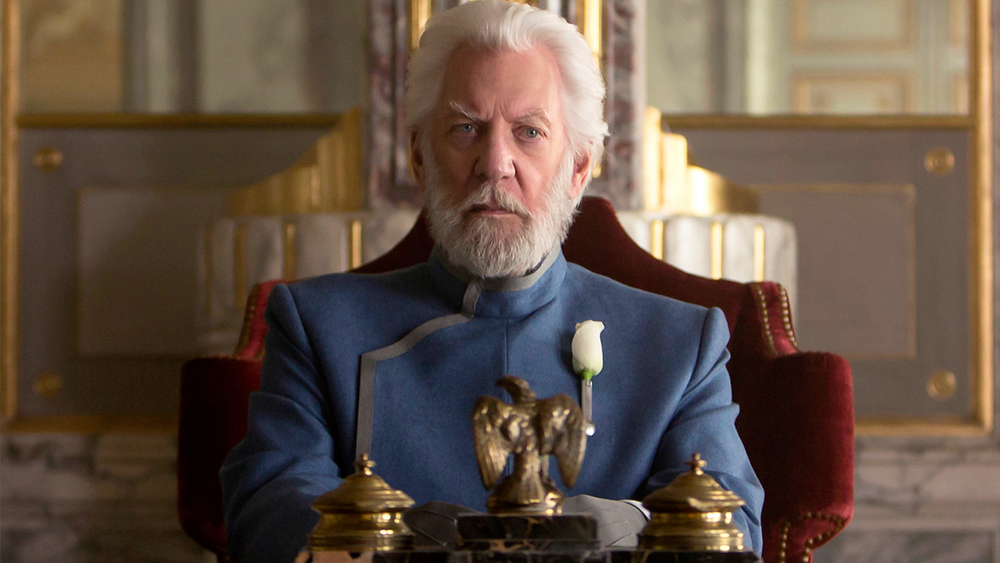
Mockingjay Part 2 - scene1

To be fair, it’s the price the movie makes for being faithful to Suzanne Collins’ source material. But what it also does is to make The Hunger Games: Mockingjay Part 2 longer than it needed to be, and curiously sapped of urgency once Katniss et al begin their progress toward the Capitol. There are too many scenes where characters stop to muse on their individual plights, and Peeta tries to sort out if his memories are real or lies constructed by his torturers in the Capitol. At first glance it’s all meaningful, and yet another indication of how careful the makers have been in grounding the action, but do you know what? It’s Part Four – we already care about these characters. All we want now is for Katniss to come face to face with President Snow, and for the promise of all those booby traps we’ve seen in the trailer to give us a thrilling, rousing, edge-of-the-seat kick-ass end to everything.

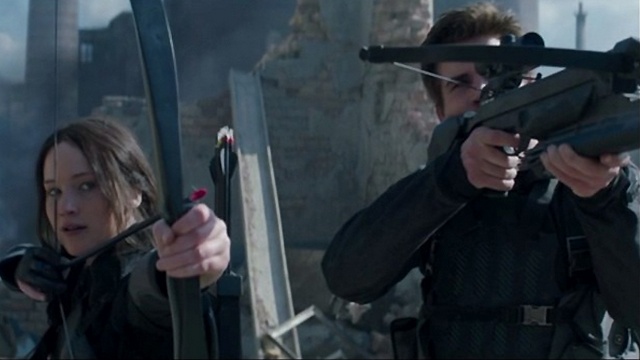
What we’re looking for is the kind of series’ ending we got with Harry Potter and the Deathly Hallows Part 2 (2011), but the action sequences, though expertly staged and choreographed – and which winnow out the surplus characters – just… don’t… bring it. It’s a strange awareness to have, to realise that the best action scenes have all appeared in the earlier movies, but there it is: even the underground fight against the Capitol Mutts suffers from over-familiarity as Katniss shows off the same bow skills we’ve seen before from Legolas and Hawkeye. And as mentioned before, there’s a distinct lack of urgency to it all, as the movie’s rhythm is maintained at such a steady pace that even when Katniss and her comrades are out-running a booby-trap at full pelt, you can sense the editing team of Alan Edward Bell and Mark Yoshikawa making sure it’s not shown at too full a pelt or their hard work elsewhere might be jeopardised.

Mockingjay Part 2 - scene2

And yet, somehow – somehow – the movie overcomes these drawbacks and proves to be a fitting end to the saga. It’s still an intelligent, and intelligently made, movie, and the effort in maintaining the good work achieved in the previous movies is clear to see, with returning director Lawrence once again steering things to tremendous effect. He’s aided by a returning cast who all clearly want to be there, and who are committed to ending the series as best they can. And for the most part, they succeed. Lawrence doesn’t put a foot wrong as Katniss, miring her in doubt and misplaced guilt, and keeping her insecurities to the fore in a performance that becomes all the more impressive for having been sustained across four movies. Hutcherson impresses the most (four words I didn’t think I’d ever write), his PTSD Peeta being a difficult role to pull off, but he makes short work of it, and in doing so, makes Peeta the most sympathetic character in the whole series.

Completing the “romantic threesome” is Hemsworth as Gale. Four movies in and he’s still the series’ one weak link, an actor so stiff he could throw himself at the enemy instead of shooting them, and still score a death. (Now if Sam Claflin had played Gale, then the often tepid romance with Katniss might have been more compelling.) Sutherland continues to play Snow with effortless malice; without his silky venom to play against, the rebellion would have appeared less than necessary. As his rival for power, Moore strikes a more strident note as Coin, and as Coin’s true nature becomes more and more clear, the actress withstands the temptation to become the series’ answer to Cruella de Ville (the clue’s in the hair).

Mockingjay Part 2 - scene3

Further down the cast list, Harrelson is sidelined early on; the late, great Philip Seymour Hoffman has a few scenes that hint at a bigger, if obviously curtailed role; Claflin brings his trademark smirk to playing Finnick Odair, as well as a much needed sense of fun; Banks hangs around on the periphery of things as Effie; and Tucci is shoehorned in as Caesar Flickerman in a TV segment that goes against an earlier scene where Snow (very severely) chastises an underling. Everyone is present and correct, and director Lawrence coaxes good performances from everyone, making it incredibly easy for the audience to continue rooting for their favourite characters.

Whatever your feelings about The Hunger Games franchise – and there are plenty of nay-sayers out there – this has been one of the most surprisingly intelligent and well produced projects of the last ten years. Jennifer Lawrence has proved to be an inspired choice as Katniss Everdeen, and the world of the Districts has been so convincingly constructed that the plight of their inhabitants has been echoed by events taking place in the real world even now. And even though Suzanne Collins originally wrote her novels for the YA market, these are remarkably adult movies, with a strong sense of moral culpability and responsibility. A triumph then, and when all is said and done, one that few of us could have seen coming.

Rating: 8/10 – narrative hiccoughs aside, The Hunger Games: Mockingjay Part 2 is still head and shoulders above any other dystopian YA sci-fi series out there, and is a great showcase for what can be achieved if the intention is not to soft pedal any serious themes inherent in the material; thrilling (just) and chock-full of great performances, this is a fitting swansong to a series that has surprised and entertained audiences for four years and this despite getting increasingly bleaker as it’s gone along.

Share this:

  • Click to share on X (Opens in new window) X
  • Click to share on Facebook (Opens in new window) Facebook
  • More
  • Click to print (Opens in new window) Print
  • Click to email a link to a friend (Opens in new window) Email
Like Loading...

The Hunger Games: Mockingjay Part 1 (2014)

28 Friday Nov 2014

Posted by dullwood68 in Movies

≈ 1 Comment

Tags

Action, District 13, Donald Sutherland, Drama, Francis Lawrence, Jennifer Lawrence, Josh Hutcherson, Julianne Moore, Katniss Everdeen, Liam Hemsworth, Literary adaptation, Mockingjay, Panem, Philip Seymour Hoffman, President Snow, Review, Sci-fi, Suzanne Collins, Woody Harrelson

Hunger Games Mockingjay Part 1, The

D: Francis Lawrence / 123m

Cast: Jennifer Lawrence, Josh Hutcherson, Liam Hemsworth, Woody Harrelson, Julianne Moore, Philip Seymour Hoffman, Donald Sutherland, Elizabeth Banks, Sam Claflin, Jeffrey Wright, Mahershala Ali, Willow Shields, Natalie Dormer, Stanley Tucci

Having been rescued from the Quarter Quell Hunger Games, Katniss Everdeen (Lawrence), Finnick Odair (Claflin), and Beetee (Wright) find themselves in the underground fortress that is the new District 13, and which has been built beneath the ruins of the old District 13. While Finnick despairs the loss of his lover, Annie Cresta, and Beetee sets about helping the district leaders with their plans to take the fight to the Capitol, Katniss is asked to become the Mockingjay, the symbol of the resistance. She refuses, blaming the District 13 leaders – headed by President Alma Coin (Moore) and ex-gamemaker Plutarch Heavensbee (Hoffman) – for not trying to save Peeta Mellark (Hutcherson), Annie, and Johanna Mason who are all prisoners in the Capitol.

Heavensbee decides it would be better to convince Katniss another way, and he arranges for her to visit the ruins of District 12. There she sees the devastation and the remains of her people and is visibly shocked by what’s happened. She agrees to become the Mockingjay but on the condition that the captured Victors are rescued and granted full pardons. Coin agrees and Katniss becomes a part of the rebel propaganda campaign, appearing in videos that are broadcast across the districts and eventually, into the Capitol. These videos lead to uprisings in some of the other districts, including the destruction of the dam that provides the bulk of the Capitol’s electrical power.

An attack on District 13 follows but the underground fortress isn’t breached. Coin sends a team led by security chief Boggs (Ali) and Gale (Hemsworth) to rescue the captured Victors. They find their way in with ease, helped immeasurably by Beetee’s jamming of the Capitol’s security signals. But when Beetee’s transmissions are interrupted, and President Snow himself reveals his awareness of the rescue attempt, the safety of Gale and Boggs and the rest of the team hangs in the balance.

Hunger Games Mockingjay Part 1, The - scene

It’s a rare movie in any franchise that opens with two scenes showing characters in utter despair, but The Hunger Games: Mockingjay Part 1 is so confident in its set up, and what it needs to do in this necessarily darker episode, that these two scenes act both as a brief summation of where the story has been and where it is now. It’s also exposition given added weight by an emotional heft that exposition generally doesn’t carry, and gives notice that the writers – Danny Strong and Peter Craig – aren’t going to take the easy route in adapting the first part of Suzanne Collins’ final book in the Hunger Games trilogy.

In fact, this is an even more carefully assembled, and thought out, screenplay than the one that made The Hunger Games: Catching Fire (2013) so effective. Here, the political machinations are more exposed, the betrayals and compromises crueller than ever, and Katniss’ sense of being alone (even with Prim (Shields) and her mother, and Gale to support her) heightened even more. It’s a movie that looks at the loss of hope and the suspension of faith, and emphasises the way in which personal sacrifice almost always comes at a cost. It’s a bleaker, more anxiety-ridden movie, and in being true to the original source, furthers the series’ own integrity.

The introduction of President Snow’s District 13 counterpart, Alma Coin, is handled incredibly well, with Moore proving an excellent choice in the role. Fans of the book will know where the narrative takes President Coin, but for now the script provides very subtle clues as to the nature of that direction, and Moore gives a clever, finely tuned performance that provides a perfect foil for Sutherland’s spider-like turn as the malevolent Panem president. (It’s a shame that the best verbal sparring is reserved for Snow and Katniss – seeing Coin and Snow exchanging words would be an intense and fascinating encounter.) Moore isn’t on screen a lot but when she is, Coin is an enticingly vivid presence.

But the focus is, of course, on Katniss, and the way in which she deals with this new direction in her life. Lawrence is an intelligent, perceptive actress and she handles the demands of the role – again – with a fierce determination that matches the character and the journey she’s making. Katniss may not be the most emotionally stable young woman you’re ever likely to meet, but she has an inner strength that Lawrence brings to the fore with accomplished ease. Watching her reaction to the horrors of a devastated District 12 shows just why it’s now so difficult to imagine anyone else in the role, so completely does she inhabit the part.

The rest of the characters share varying amounts of screen time, with Gale having a larger part to play this time round, and Effie Trinket (Banks) also benefitting from an expanded role (that wasn’t in the novel; Banks’ previous performances convinced Collins the character needed to be more involved in the final two movies). A newly sober Haymitch (Harrelson) proves less effective as a character, but the actor rises to the challenge of providing the same (required) turn in each movie. Heavensbee reveals himself to be a clever, thoughtful manipulator, and Hoffman has fun with the role, a genial smirk never too far from his features. The relationship between Katniss and Prim continues in the same fashion as before, with their mother still given a background role, and Katniss’ affection for Gale is barely mentioned, leaving her (presumed) love for Peeta to take centre stage. This dynamic, always in doubt during the previous two movies, begins to coalesce into something more tangible here, and leads to one of the most heart-rending, and shocking, scenes in the series so far.

Returning to the director’s chair, Lawrence continues to be a wise choice for the hot seat, and keeps the focus on the characters and their relationships to each other, emphasising the emotional ups and downs that Katniss has to overcome, and the difficult path she has to take as the rebels’ figurehead. Lawrence also keeps the action on point, each sequence plotted and designed for maximum effect, and he brings the other featured districts to life with a well thought out economy. There’s another stirring score courtesy of James Newton Howard, and Jo Willems’ photography maintains the visual style of the previous movie while adding a grittier sheen to things.

Rating: 9/10 – with one more movie to go, The Hunger Games: Mockingjay Part 1 is a memorable, thrilling addition to the series, and perfectly sets up Part 2; with a handful of superb performances, and a director firmly in control of the material, this instalment stands as a perfect example of how to make a bridging chapter relevant and exciting in equal measure.

Share this:

  • Click to share on X (Opens in new window) X
  • Click to share on Facebook (Opens in new window) Facebook
  • More
  • Click to print (Opens in new window) Print
  • Click to email a link to a friend (Opens in new window) Email
Like Loading...

A Most Wanted Man (2014)

27 Thursday Nov 2014

Posted by dullwood68 in Movies

≈ Leave a comment

Tags

Anton Corbijn, Daniel Brühl, Drama, Espionage, Hamburg, John le Carré, Literary adaptation, Nina Hoss, Philip Seymour Hoffman, Rachel McAdams, Review, Terrorism, Thriller, Willem Dafoe

Most Wanted Man, A

D: Anton Corbijn / 122m

Cast: Philip Seymour Hoffman, Rachel McAdams, Willem Dafoe, Grigoriy Dobrygin, Nina Hoss, Robin Wright, Homayoun Ershadi, Daniel Brühl, Mehdi Dehbi, Rainer Bock

Chechnyan refugee Issa Karpov (Dobrygin) arrives in Hamburg illegally. Spied on CCTV by the German intelligence network, Karpov is of particular interest to the team led by Günther Bachmann (Hoffman). With their specific focus on the Muslim community, Karpov’s appearance raises questions, especially as the Russians believe he could be an extremist bent on committing a terrorist attack. With another German intelligence agency led by Dieter Mohr (Bock) wanting to arrest Karpov immediately, Bachmann gains seventy-two hours in which to identify Karpov’s motives. At the same time, Bachmann is also looking into the financial dealings of local Muslim philanthropist Dr Abdullah (Ershadi), suspecting him of siphoning charity donations to terrorist organisations.

However, Karpov has come to claim an inheritance. He enlists the help of immigration lawyer Annabel Richter (McAdams), asking her to make contact with banker Tommy Brue (Dafoe). Karpov’s inheritance is held at Brue’s bank, and while Brue needs proof of Karpov’s identity and his claim, Bachmann recruits Brue as part of a plan that has wider implications than whether or not the Chechnyan is in Hamburg for suspicious reasons. With Brue on board, Bachmann begins to piece together more and more information relating to Karpov’s past and his reasons for being there. When Richter begins to feel she and Karpov are being watched she manages to get him to a safe house, but Bachmann abducts her, and persuades her to help him in getting Karpov’s money to him.

In the meantime, US diplomatic attache Martha Sullivan (Wright), ostensibly an observer, helps Bachmann with his investigation, and uses her position to keep Mohr off Bachmann’s back. With Brue and Richter both on board, Bachmann’s wider plan to entrap Dr Abdullah begins to come together. Karpov, unaware of what’s happening, or that he’s been under constant surveillance, is persuaded to sign over his inheritance. But when Abdullah presents a list of charities to receive funds from Karpov’s unwanted legacy, and it doesn’t contain the name of the charity that Bachmann and his team suspect is being used by Abdullah to divert monies to terrorists, it looks as if all their intelligence gathering and surveillance work has been for nothing.

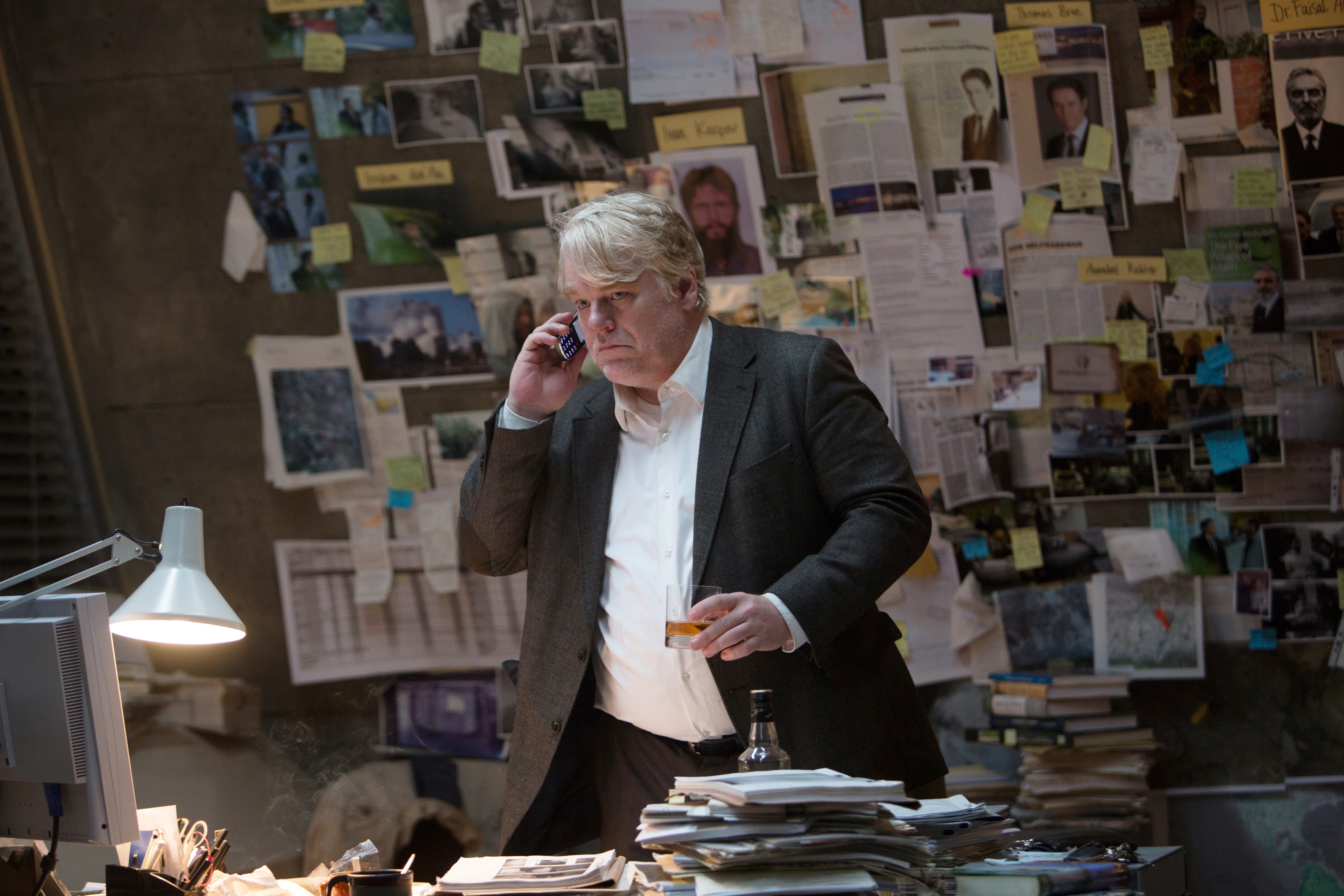
Most Wanted Man, A - scene

A sharply detailed look at the behind the scenes work needed to apprehend or “turn” a terrorist suspect, A Most Wanted Man is a dour triumph that succeeds because Andrew Bovell’s measured and skilful adaptation of the novel by John le Carré takes its time introducing and maintaining the various subterfuges that pepper the narrative. This is an espionage thriller that eschews gunplay and car chases, and instead focuses on the mind games used in manipulating people into “keeping the world safe”.

A Most Wanted Man is an absorbing, slow burn movie that takes a somewhat familiar plot – does a person of interest have good or bad motives? – and thanks to a commanding central performance from Hoffman, Bovell’s polished script, and Corbijn’s exacting direction, is as sure-footed in its design and execution as any other le Carré adaptation (it does seem that the author’s works lend themselves well to being adapted for the screen). Holding it all together is another superb performance from Hoffman, his German accent making him sound completely different, and his somewhat slovenly appearance belying the intellect that keeps him several steps ahead of his quarry (and often, his team). This was Hoffman’s last lead role before his death, and as an unexpected swan song, shows once again why he was one of the finest actors of his generation. There’s not one moment where the artifice slips and the viewer becomes aware that they’re watching an actor – Hoffman inhabits the role so completely, it wouldn’t surprise anyone if they bumped into Günther Bachmann in real life.

Hoffman is ably supported by his co-stars, particularly McAdams who takes a largely conventional role and gives it a depth that is surprising for the character (but not for the actress). Dafoe is equally good as the compromised banker, Brue, and Hoss’ fatalistic second-in-command adds a layer of melancholy to the movie that reflects the sombre approach to the material. As the tortured, subdued refugee, Dobrygin is terrific in his English language debut, mournful and emotionally reticent, but with a deep-rooted sincerity that fits the character perfectly. But while the main cast all excel, spare a thought for Brühl, whose character is reduced to contributing the odd line and who stays firmly in the background.

With the political background given due relevance, and the inner workings of German intelligence – whether correctly detailed or not – explored in surprising detail, A Most Wanted Man remains a captivating, quietly meticulous thriller that benefits from an austere, gloomy production design by Sebastian Krawinkel that in turn is matched by Sabine Engelberg’s precisely detailed art direction. Keeping all these elements in tune, and creating a wholly believable milieu, Corbijn – whose previous feature The American (2010) was not as disciplined as his efforts here – makes it easy for the viewer to understand what’s going on at each twist and turn, and ratchets up the tension with a confidence that some more experienced directors never attain no matter how many movies they make. In the end, it all hinges on a signature, the kind of moment that few thrillers rely on, but here, Corbijn has the viewer on the edge of their seat and holding their breath. And then with victory assured, he and Le Carré pull off something so unexpected that the viewer’s breath is taken away altogether. It’s an audacious feat, and all the more impressive in the way it’s carried out.

Rating: 8/10 – with an eerily compelling score by Herbert Grönemeyer, the only negative that can be said about A Most Wanted Man is that, even with le Carré’s source material at its heart, some parts of the story and plotting are predictable; that said, it’s still a complex, engrossing thriller featuring effortless performances and is an intelligent, thought-provoking piece that rewards throughout.

Share this:

  • Click to share on X (Opens in new window) X
  • Click to share on Facebook (Opens in new window) Facebook
  • More
  • Click to print (Opens in new window) Print
  • Click to email a link to a friend (Opens in new window) Email
Like Loading...

10 Reasons to Remember Philip Seymour Hoffman (1967-2014)

02 Sunday Feb 2014

Posted by dullwood68 in Movies

≈ 1 Comment

Tags

Actor, Capote, Career, Movies, Philip Seymour Hoffman

Philip Seymour Hoffman (23 July 1967 – 2 February 2014)

Obit Hoffman

Easily one of the finest actors of his generation, Philip Seymour Hoffman was one of those actors who was able to inhabit a role and make you forget there was an actor playing a part. From his earliest performances, Hoffman often made all the difference in a movie, keeping things from becoming bland or entirely disappointing.

My first encounter with Hoffman, like so many other people’s I guess, was in his breakthrough movie, Scent of a Woman (1992). As the conflicted George Willis Jr he brought an intelligence and a conviction to a role that could have been just another supporting role given passing attention by most other actors. Other supporting roles followed – the free-spirited Dusty in Twister (1996), the lovelorn Scotty in Boogie Nights (1997), Brandt, the other Jeffrey Lebowski’s assistant in The Big Lebowski (1998), the sympathetic male nurse, Phil in Magnolia (1999), the resolute Freddie Miles in The Talented Mr. Ripley (1999), revered music journalist Lester Bangs in Almost Famous (2000) (a personal favourite), the slimy Freddy Lounds in Red Dragon (2002) – and it seemed that he would always remain the underused, scene-stealing actor everybody liked but who was never given the chance to headline a major movie and show what he could really do.

That all changed, of course, in 2005 with Capote. Hoffman won an Oscar for his performance, and if anyone had had any doubts about his ability to carry a movie, and to deliver a really powerful performance, they were banished right there and then. I saw an actor who had proved time and time again he could deliver terrific performances, but who was stepping up to a whole other level. If you haven’t seen Capote, you’re missing Hoffman’s finest hour; there’s a level of detail there that is just astonishing.

Hoffman followed Capote with what for many may have appeared a strange choice: the villain in Mission: Impossible III (2006), and yet, once again he was mesmerising, acting Tom Cruise off the screen and proving yet again that he could elevate even the weakest of material. But Hoffman had said, “I love a good payday and I’ll do films for fun.” Ultimately though his goal was to do good work, and in that regard he never failed either himself, or us, his audience.

The sad circumstances of his death, coming after his admission in May 2013 that he’d attended a substance abuse centre, is a reminder that even the most talented actors can have their demons. For me, I will always remember him as the main reason for watching several films I might not otherwise have taken a look at, in particular Before the Devil Knows You’re Dead (2007) and A Late Quartet (2012). A great talent, and one that will be sorely missed.

PSH - SOAW

1 – Scent of a Woman (1992)

2 – Twister (1996)

3 – Boogie Nights (1997)

4 – Magnolia (1999)

5 – Almost Famous (2000)

6 – Capote (2005)

7 – Synecdoche, New York (2008)

8 – Doubt (2008)

9 – The Master (2012)

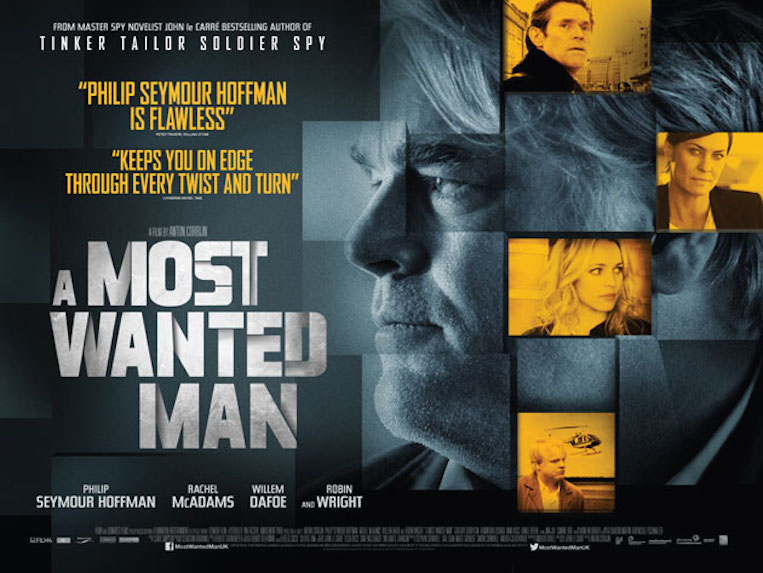
10 – A Most Wanted Man (2014)

PSH - AMWM

Share this:

  • Click to share on X (Opens in new window) X
  • Click to share on Facebook (Opens in new window) Facebook
  • More
  • Click to print (Opens in new window) Print
  • Click to email a link to a friend (Opens in new window) Email
Like Loading...

The Hunger Games: Catching Fire (2013)

10 Tuesday Dec 2013

Posted by dullwood68 in Movies

≈ 3 Comments

Tags

Action, District 12, Donald Sutherland, Drama, Francis Lawrence, Gale, Haymitch, Jennifer Lawrence, Josh Hutcherson, Katniss Everdeen, Mockingjay, Peeta, Philip Seymour Hoffman, President Snow, Review, Sci-fi, Suzanne Collins, Woody Harrelson

Hunger Games Catching Fire, The

D: Francis Lawrence / 146m

Cast: Jennifer Lawrence, Josh Hutcherson, Liam Hemsworth, Woody Harrelson, Donald Sutherland, Philip Seymour Hoffman, Elizabeth Banks, Stanley Tucci, Lenny Kravitz, Jeffrey Wright, Amanda Plummer, Sam Claflin, Toby Jones, Jena Malone, Willow Shields

Picking up from the end of The Hunger Games, part two of the franchise – Mockingjay is being adapted into two parts, due in 2014 and 2015 respectively – sees Katniss Everdeen (Lawrence) trying to fit in to a post-Games world where she is now seen as a symbol of hope for the beleaguered districts.  Becoming increasingly aware of the social injustice around her, Katniss tries her best to balance protecting her family from the less-than-veiled threats of President Snow (Sutherland) against the increasing demands made of her to be the symbol that promotes the resistance.  With things made even more difficult by her mixed feelings for Peeta (Hutcherson), and the attentions of Gale (Hemsworth), Katniss finds herself struggling to find her way in a world that is changing rapidly both around her, and because of her.

Aware of her increasing importance to the resistance movement, President Snow plots to destroy her with the help of new Games Master Plutarch Heavensbee (Hoffman).  In order to do this the next Hunger Games is designed to pit Katniss against the remaining winners in a kind of Best of the Best tournament.  She also has to contend with Peeta taking part as well and trying to keep him safe.  For his part, Peeta wants to keep Katniss safe in order for her to remain a beacon of hope.  With both of them striking deals with Haymitch (Harrelson) to protect the other, Katniss is unaware that their are deeper political manoeuvrings going on behind the scenes, manoeuvrings that will have a greater effect on her life than she could ever imagine.

As that awkward beast, the middle part of a trilogy, Catching Fire builds on the first movie’s strengths and benefits immensely from an even more assured and commanding turn from Lawrence.  She dominates proceedings from start to finish, eclipsing her co-stars with ease – no mean feat given the calibre of actors such as Hoffman and Sutherland – and gives such a layered, intelligent performance that it almost threatens to overwhelm the rest of the movie.  Full marks to director Lawrence and screenwriters Simon Beaufoy and Michael Arndt then for making Catching Fire such an exciting, dramatic episode that grips throughout, and successfully juggles the widening story arc with more intimate moments and the kind of cutting-edge visuals we’ve come to expect from big-budget sci-fi movies.

Hunger Games Catching Fire, The - scene

With the movie in such assured hands, Catching Fire is free to impress on even further levels: the gritty realism of District 12 contrasted with the spectacular opulence of the Capitol, both triumphs of art direction and production design; the costumes courtesy of  Trish Summerville (her costumes for Effie Trinket (Banks) are even more outlandish than those of the first movie); the score by James Newton Howard, by turns austere,  stirring and richly evocative from scene to scene, supporting effortlessly the emotional and physical elements; and the superb photography by Jo Willems, a feast for the eyes and even more impressive when seen at an IMAX cinema – the Hunger Games tournament is played out in the full IMAX format; it adds a whole new dimension to the movie, and the scale is suitably impressive: the lagoon seems impossibly huge and the forest thickly impenetrable.

But the scale of the movie is nothing without the characters that inhabit it, and here the cast display a greater confidence in their roles, while newcomers such as Hoffman, Claflin and Malone fit in with ease.  As already noted, Lawrence is excellent, while Hutcherson and Hemsworth overcome the limitations of the source material to forge much stronger characters than you’d expect.  Sutherland is as icy as the President’s name implies, and Hoffman creates a devious sadist in Heavensbee: all self-satisfied smiles and preening behaviour.  Tucci excels (as always) as the overly coiffed broadcaster Caesar Flickerman, Wright and Plummer have small but important roles as fellow Victors Beetee and Wiress, and once again, as Haymitch, Harrelson proves what a versatile actor he is by nearly stealing the movie out from under Lawrence – but only nearly.

With two more films to come, the producers have given themselves a hard task to overcome.  Catching Fire, in terms of the novels, was the point at which author Suzanne Collins began to lose her grip on the overall storyline.  Where Katniss and Peeta and Gale go from here is already known by millions; the trick will be to turn what was a largely disappointing resolution to Katniss’s story into something as exhilarating as this adaptation.  It will be interesting to see if they manage it.

Rating: 9/10 – a bold adaptation that retains all the strengths of the novel, and manages to jettison all the aspects that marred it; a rare sequel that stands on its own and towers over its predecessor.

Share this:

  • Click to share on X (Opens in new window) X
  • Click to share on Facebook (Opens in new window) Facebook
  • More
  • Click to print (Opens in new window) Print
  • Click to email a link to a friend (Opens in new window) Email
Like Loading...

Blog Stats

  • 486,827 hits

Recent Posts

  • 10 Reasons to Remember Bibi Andersson (1935-2019)
  • Fantasia (1940)
  • Dances With Wolves (1990) – The Special Edition
  • Kiss of the Spider Woman (1985)
  • The Three Musketeers (1973)

Top Posts & Pages

  • Lost for Life (2013) - Another Look
    Lost for Life (2013) - Another Look
  • Lost for Life (2013)
    Lost for Life (2013)
  • About
    About
  • A Brief Word About La La Land (2016)
    A Brief Word About La La Land (2016)
  • Exposed (2016)
    Exposed (2016)
  • Cardboard Boxer (2016)
    Cardboard Boxer (2016)
  • The Monuments Men (2014)
    The Monuments Men (2014)
  • Irrational Man (2015)
    Irrational Man (2015)
  • BFI London Film Festival 2015
    BFI London Film Festival 2015
  • A Brief Word About Netflix Original Comedies
    A Brief Word About Netflix Original Comedies
Follow thedullwoodexperiment on WordPress.com

Blogs I Follow

  • Rubbish Talk
  • Film 4 Fan
  • Fast Film Reviews
  • The Film Blog
  • All Things Movies UK
  • Interpreting the Stars
  • Let's Go To The Movies
  • Movie Reviews 101
  • TMI News
  • Dan the Man's Movie Reviews
  • Film History
  • Jordan and Eddie (The Movie Guys)

Archives

  • April 2019 (13)
  • March 2019 (28)
  • February 2019 (28)
  • January 2019 (32)
  • December 2018 (28)
  • November 2018 (30)
  • October 2018 (29)
  • September 2018 (29)
  • August 2018 (29)
  • July 2018 (30)
  • June 2018 (28)
  • May 2018 (24)
  • April 2018 (21)
  • March 2018 (31)
  • February 2018 (25)
  • January 2018 (30)
  • December 2017 (30)
  • November 2017 (27)
  • October 2017 (27)
  • September 2017 (26)
  • August 2017 (32)
  • July 2017 (32)
  • June 2017 (30)
  • May 2017 (29)
  • April 2017 (29)
  • March 2017 (30)
  • February 2017 (27)
  • January 2017 (32)
  • December 2016 (30)
  • November 2016 (28)
  • October 2016 (30)
  • September 2016 (27)
  • August 2016 (30)
  • July 2016 (30)
  • June 2016 (31)
  • May 2016 (34)
  • April 2016 (30)
  • March 2016 (30)
  • February 2016 (28)
  • January 2016 (35)
  • December 2015 (34)
  • November 2015 (31)
  • October 2015 (31)
  • September 2015 (34)
  • August 2015 (31)
  • July 2015 (33)
  • June 2015 (12)
  • May 2015 (31)
  • April 2015 (32)
  • March 2015 (30)
  • February 2015 (37)
  • January 2015 (39)
  • December 2014 (34)
  • November 2014 (34)
  • October 2014 (36)
  • September 2014 (25)
  • August 2014 (29)
  • July 2014 (29)
  • June 2014 (28)
  • May 2014 (23)
  • April 2014 (21)
  • March 2014 (42)
  • February 2014 (38)
  • January 2014 (29)
  • December 2013 (28)
  • November 2013 (34)
  • October 2013 (4)

Create a free website or blog at WordPress.com.

Rubbish Talk

Film 4 Fan

A Movie Blog

Fast Film Reviews

The Film Blog

The official blog of everything in film

All Things Movies UK

Movie Reviews and Original Articles

Interpreting the Stars

Dave Examines Movies

Let's Go To The Movies

Film and Theatre Lover!

Movie Reviews 101

Daily Movie Reviews

TMI News

Latest weather, crime and breaking news

Dan the Man's Movie Reviews

All my aimless thoughts, ideas, and ramblings, all packed into one site!

Film History

Telling the story of film

Jordan and Eddie (The Movie Guys)

Movie Reviews & Ramblings from an Australian Based Film Fan

Privacy & Cookies: This site uses cookies. By continuing to use this website, you agree to their use.
To find out more, including how to control cookies, see here: Cookie Policy
  • Subscribe Subscribed
    • thedullwoodexperiment
    • Join 481 other subscribers
    • Already have a WordPress.com account? Log in now.
    • thedullwoodexperiment
    • Subscribe Subscribed
    • Sign up
    • Log in
    • Report this content
    • View site in Reader
    • Manage subscriptions
    • Collapse this bar
 

Loading Comments...
 

    %d