• 10 Reasons to Remember…
  • A Brief Word About…
  • About
  • For One Week Only
  • Happy Birthday
  • Monthly Roundup
  • Old-Time Crime
  • Other Posts
  • Poster of the Week
  • Question of the Week
  • Reviews
  • Trailers

thedullwoodexperiment

~ Viewing movies in a different light

thedullwoodexperiment

Tag Archives: Rooney Mara

A Ghost Story (2017)

12 Thursday Oct 2017

Posted by dullwood68 in Movies

≈ Leave a comment

Tags

Casey Affleck, David Lowery, Death, Drama, Grief, Review, Rooney Mara, Time
D: David Lowery / 92m

Cast: Casey Affleck, Rooney Mara, Liz Cardenas Franke, Sonia Acevedo, Will Oldham

There’s a saying that death comes to us all, and for some of us it means the end of life altogether, while for others it means the beginning of a new journey into an afterlife that may or may not prove to be better than the life we’ve lived. David Lowery’s latest movie takes that idea, but then adds a twist to it, and asks the question, what if there is an afterlife, but we were delayed in taking that journey onward? What if we found ourselves trapped between our old life and the next one? What would that be like? How would it feel? And how would someone cope in such a situation? Could someone cope in that situation? These are all intriguing ideas, and Lowery does his best to answer all of those questions, including what could sustain us through such an experience, and how much would it change us?

The ghost of the title is at first just a man, a musician called C (Affleck) who is married to M (Mara). They live in a small tract house, and seem to get along okay, but there are shifts and challenges in their relationship that show themselves from time to time. But their time together is coming to an end. C is killed in a car crash outside their home. M is asked to identify his body at a hospital mortuary. He lies on a table covered by a large white sheet, and after she has seen him and left, he sits up. He walks slowly through the hospital, unseen by staff, patients and visitors, until he comes to a wall. The wall opens to reveal a portal full of swirling light. The invitation is clear, but C doesn’t take it. Instead he makes his way back to his home, where a grieving M has no idea of his presence. He watches her as she begins to rebuild her life, and then one day he sees her write something down on a slip of paper, and then put the slip of paper in a small gap in the wall. She paints over the gap, sealing it. C decides to retrieve the slip of paper but the sheet makes it awkward to remove the paint. As he picks away at the paint, time appears to race on and he finds an Hispanic single mother (Acevedo) and her two children have moved into the house.

Having established a secondary reason for C’s remaining at the property, Lowery soon shows how this affects C and increases the sense of separation that he’s experiencing. As with everyone else, this new family go about their days oblivious to his presence, just as M did, but now it’s more pronounced. This family is living in his home, and M isn’t among them; she isn’t coming back and now he’s stranded there, amongst strangers. He learns how to move things, how to have a corporeal effect despite being a non-corporeal form. Eventually they leave, frightened by the violent behaviour he’s able to display. But it proves to be a transient victory. Soon he’s surrounded by people, as the next owners of the house throw a party. And then time passes more quickly, folding over and into itself, forging ahead in great leaps, and leaving the house behind as a distant memory, much as C has become a distant memory in the minds of those who knew him.

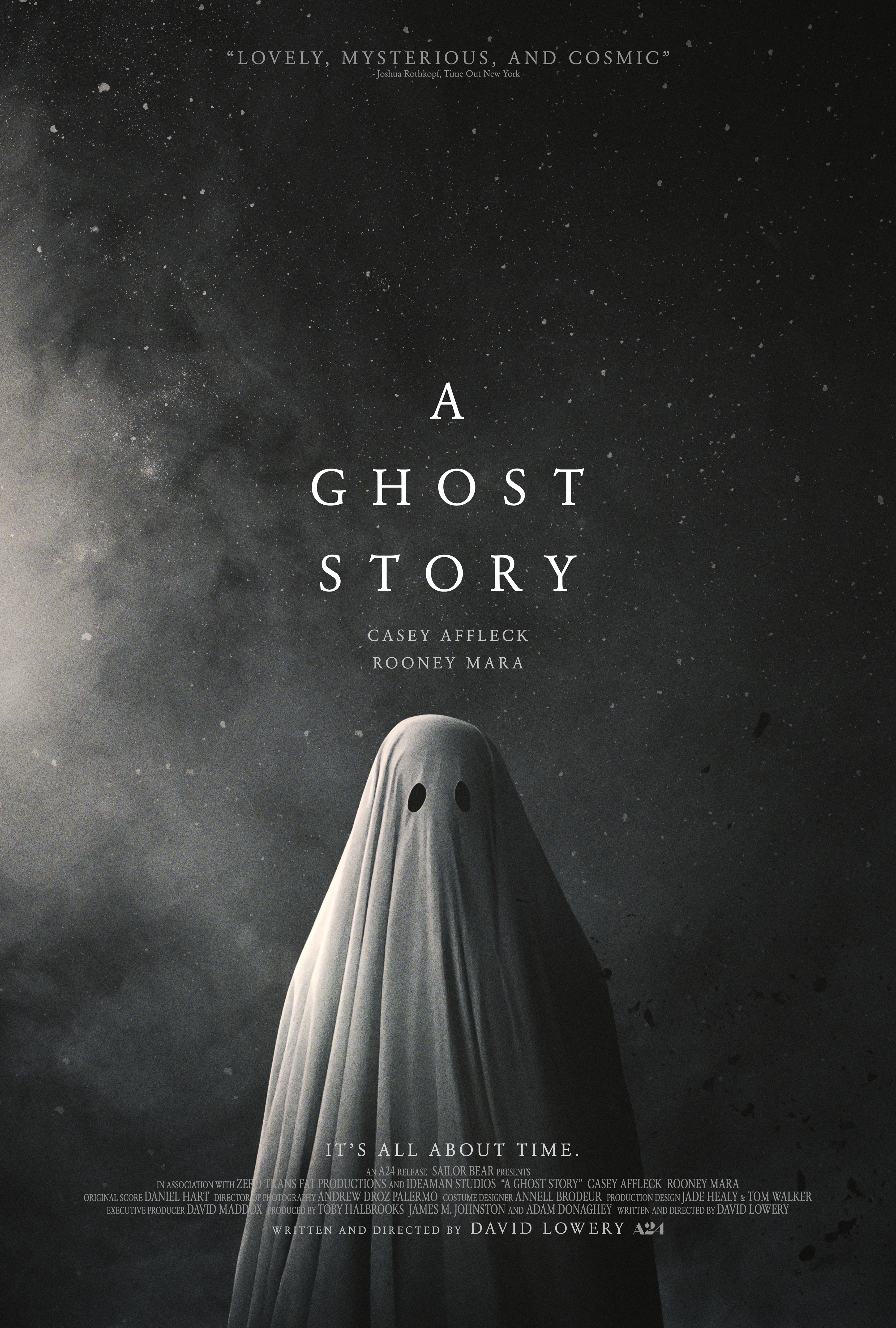
It’s at this point in the movie that Lowery effectively makes C’s existence the stuff of existential horror. As if things haven’t been bad enough, events transpire that keep C even more isolated and becalmed by his death. He’s forced to bear witness to changes and developments that he couldn’t have foreseen and Time becomes an implacable foe, thoughtless and cruel. He becomes even more stranded despite his never moving from the site of his home, and soon he’s nothing more than a shell, just existing in a vague approximation of Life. Lowery and Affleck find the sadness and the intense loneliness in this, and C becomes an even more tragic figure, the black eye holes of the sheet expressing longing, regret, anguish, melancholy, and the overwhelming grief that C is feeling. Affleck uses slow, measured movements to show just how C’s emotions are ebbing and flowing, and despite the sheet (or maybe because of it), there’s not one moment in the movie where C’s sensitivity to his situation isn’t easy to grasp. It’s a performance that is so detailed and so subtle that it makes the movie much more emotional and affecting than it looks.

Of course, what’s really clever and exceptional about A Ghost Story, is that Lowery has taken such an iconic image – perhaps the most simple ghost “costume” – and used it as a metaphor for the pain that grief can cause us, and its potentially unyielding nature. The enormity of C’s situation is horrifying, to remain trapped in a place that offers less and less reason to be there, and which only serves to highlight and increase the amount of pain C is experiencing as each and every day passes by. How crushing must that be? That Lowery is able to get this message across so effectively – and so chillingly – is a tribute to the clarity of his artistic vision, and the work of Affleck and Mara, and a very talented crew. Working with cinematographer Andrew Droz Palermo, and production designers Jade Healy and Tom Walker, Lowery has put together a movie whose distinct visual look includes a high number of static shots where the camera remains resolutely fixed in position, to careful framing of C as he watches and waits in the same location even as it changes all around him. This is as much about the space that he exists in, as it is his own existence within it.

What all this gives us is a movie that is by turns poetic, sad, poignant, humorous (yes), engrossing, and endlessly thought-provoking. It seeks to address and confront aspects of our existence that we don’t give regular consideration to, such as what it is to be truly alone, and our very reason for being, both physically and spiritually. But it’s not a “heavy” movie, and nor is it one to avoid because of the challenging ideas it explores. Rather it’s a movie that celebrates life and many of the complexities that make it worth living, and which we might continue to explore after death (if an afterlife is what awaits us). C has the opportunity to “move on” but he chooses to remain, to be with his wife and in his home, because – and as corny as it sounds – he loves them both and doesn’t want to lose them. What better reason could there be for spending an eternity covered in a sheet?

Rating: 9/10 – not for all tastes, but nevertheless one of the most audacious and moving movies of recent years, A Ghost Story is a powerful meditation on the forces of grief and love, and what they can make us do – and endure; a superb, necessarily understated performance by Affleck provides much of the movie’s emotional depth, but this is also intelligent and shrewd in its approach to what could have been a much weightier, and less focused story.

Share this:

  • Click to share on X (Opens in new window) X
  • Click to share on Facebook (Opens in new window) Facebook
  • More
  • Click to print (Opens in new window) Print
  • Click to email a link to a friend (Opens in new window) Email
Like Loading...

Una (2016)

13 Sunday Aug 2017

Posted by dullwood68 in Movies

≈ Leave a comment

Tags

Ben Mendelsohn, Benedict Andrews, Blackbird, Child abuse, David Harrower, Drama, Review, Riz Ahmed, Rooney Mara, Theatrical adaptation

D: Benedict Andrews / 90m

Cast: Rooney Mara, Ben Mendelsohn, Riz Ahmed, Ruby Stokes, Tara Fitzgerald, Natasha Little, Tobias Menzies

Very occasionally a movie comes along that makes you question why it was made, or maybe what message it was trying to get across. Such a movie makes the viewer question the validity or the purpose of its existence. Sometimes it’s because the movie is lacking in several important areas, such as acting, or being competently directed. At other times it could be down to the script, or the way the movie has been shot; it could even be all four reasons at once. If it’s an adaptation of an existing novel or play or television series, or something similar, then sometimes it’s all about whether or not the movie is faithful to the original, or whether the adaptation works on its own merits.  And sometimes it’s purely because the movie itself is just plain bad, on every level.

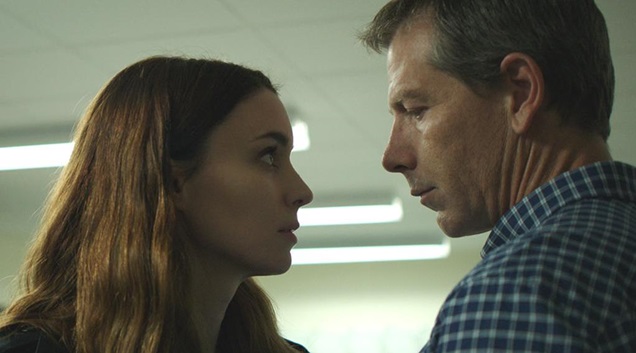
Una isn’t bad on every level, but it is a movie that makes the viewer question why they’re watching it, while they’re watching it. Adapted from the stage play, Blackbird by David Harrower, Una is about the titular character (Mara) and her ex-neighbour, Ray (Mendelsohn), who seduced her when she was thirteen. It’s about the consequences and the ramifications of that illicit, and illegal, relationship, and the ways that it has affected both characters in the fifteen years since. Una has remained single, and still lives in her childhood home with her mother (Fitzgerald). We learn little about her except that she has sex with men she doesn’t know in night clubs, and that her relationship with her mother is fragile, partly because her mother isn’t well, and partly because of what happened fifteen years ago. One day she skips work and heads to a large warehouse where she asks to see Ray. Ray, it turns out, is now called Pete, and is a manager at the warehouse. He steers Una into a break room, and clearly unnerved by her arrival, asks her what she wants.

What Una wants, we discover, is very simple: she wants to know why he left her all those years ago, when they were on the verge of eloping to Europe. The answer proves not to be as clear-cut as we, or Una, might expect, but before we learn what that answer is, Ray’s attendance at a meeting leads to uproar amongst the workforce, and Ray having to hide from everyone. He and Una stay one step ahead of everyone else, including Scott (Ahmed), one of Ray’s co-workers, and senior management honcho, Mark (Menzies). As Ray waits for everyone to leave, he and Una talk about their relationship, what it meant for both of them at the time, and what it means for them now. Ray served four years in jail, and has since gotten married, and found a stable way of living his life. Una has no such stability, only the same house she’s lived in her whole life, and in a neighbourhood where everyone knows her and knows what happened to her.

What follows should be absorbing and fascinating at the same time, as both Una and Ray reflect on events from their past, and the feelings they each had at the time. Inevitably, it takes their combined memories to provide the truth of what happened at the end for both of them; whether this will be enough for Una is a different matter. Suffice it to say, it isn’t, and the movie insists on making the same points in slightly different ways, until it heads off into the night with no clearer idea of where it’s going than Una has of what she’s going to do next. What she does do next depends entirely on the kindness of Scott, and leads to a contrived ending that takes the movie out of the realm of psychological drama and into the realm of unvarnished melodrama. But while the last third of the movie is unsatisfying and unrewarding, and relies on the good will of Harrower’s screenplay to move its characters from Point A to Point B, the cracks in said screenplay start appearing much earlier on.

Whatever the merits of the stage production (and it did win the Laurence Olivier Award for Best New Play in 2007), this new screen adaptation somehow manages to highlight a number of faults with the overall scenario that perhaps aren’t as noticeable under the proscenium arch. The reason for Una being at the warehouse, ostensibly to ask Ray why he left her, lacks conviction precisely because of the period of time that has elapsed. Harrower’s script never seeks to answer the question why this is still so important to her. Does she want to pick up where they left off? Does she still love Ray? Is her visit less about slaying the demons from her past, and more about breathing new life into them? These questions remain unexplored as the movie clatters along spewing out platitudes and clichés on both sides, with Ray bemoaning his time in prison, and Una blaming her father’s death on Ray’s predatory sexual behaviour. It also tries to show Una as being complicit in their affair, as if this is some kind of mitigating circumstance for what happened. The aim here may have been to make the issue more complex, but a paedophile is a paedophile, and what happened remains inexcusable.

Alas, very little of what is brought up is relatable or convincing, and with Una’s motives remaining obscure and possibly ill-considered throughout, the movie struggles to make us care what happened to her (which is concerning in itself). Mara gives a very good performance as the emotionally disturbed Una, but remains a figure we can’t relate to very well. Mendelsohn, however, is better served by the script, and makes Ray an untrustworthy character from the start. He lies to everyone, and probably about everything, and he’s good at it. Mendelsohn makes Ray self-serving and arrogant, and he rarely says anything important without thinking about it first. Ray may now be called Pete, and he may have a new life, but he’s still Ray, and with all that that entails. In bringing Una to the screen, theatre director Andrews makes his feature debut, but rarely seems comfortable in exploring the medium effectively. Within the warehouse, its crisp, clean lines and polished surfaces act as a stringent counterpoint to the raw emotions being mauled over in the break room (and a store cupboard and the ladies’ – of course), while the ending, which seems designed to leave the audience feeling appalled and shocked, plays out awkwardly and with scant regard for its backdrop.

Rating: 6/10 – a psychological drama that’s been given an arthouse makeover by its director, Una looks and feels austere, and lacks the passion to be truly effective as a movie about the lingering effects of child abuse; Mara and Mendelsohn make a good pairing but are unable to compensate for the wayward structure imposed on the material, and the script’s attempts at complexity inhibit the material even further, making it feel sterile rather than impassioned.

Share this:

  • Click to share on X (Opens in new window) X
  • Click to share on Facebook (Opens in new window) Facebook
  • More
  • Click to print (Opens in new window) Print
  • Click to email a link to a friend (Opens in new window) Email
Like Loading...

Lion (2016)

19 Sunday Feb 2017

Posted by dullwood68 in Movies

≈ 3 Comments

Tags

Adoption, Australia, Biography, Dev Patel, Drama, Garth Davis, Google Earth, India, Literary adaptation, Nicole Kidman, Review, Rooney Mara, Saroo Brierley, True story

lion-movie-poster-01-1594x2362

D: Garth Davis / 115m

Cast: Dev Patel, Rooney Mara, Nicole Kidman, David Wenham, Sunny Pawar, Abhishek Bharate, Priyanka Bose, Divian Ladwa, Deepti Naval, Tannishtha Chatterjee, Nawazuddin Siddiqui

If you watch enough movies you soon learn that the world is full of inspiring true life stories where people from all walks of life overcome seemingly insurmountable odds in order to achieve a particular personal or professional goal. In 2016, movies based on true stories included the likes of Hacksaw Ridge, The Finest Hours, The Infiltrator, and Sully. And then there’s Lion, the story of a young Indian boy, Saroo (Pawar), who finds himself lost and alone in a part of India he doesn’t know, and who ends up being adopted by an Australian couple, the Brierleys (Kidman, Wenham). Twenty years later, Saroo (Patel) decides to go in search of his birth family: his older brother Guddu, his mother Kamla, and younger sister Shekila.

As expected, Lion is a movie of two halves. In the first we meet Saroo and Guddu (Bharate), brothers who steal coal from trains that they then sell on so as to be able to afford groceries. On one such mission they travel to a train station, where they end up separated. Saroo boards a train in the hope of finding Guddu, but he falls asleep. When he wakes the train is moving and he’s unable to get off until it arrives at its destination: Calcutta. Though he’s taken in by a kindly young woman, Noor (Chatterjee), Saroo flees from her home when a man she knows, Rama (Siddiqui), appears set on selling Saroo into the sex trade. Eventually, he finds himself in the care of the authorities and lodging in a children’s home. Some time later, Mrs Sood (Naval), from the Indian Society for Sponsorship and Adoption, tells him that an Australian couple want to adopt him. Saroo travels to Hobart, Tasmania, where he meets his adoptive parents, John and Sue Brierley. He settles in, and the Brierleys also adopt another orphaned Indian boy, Mantosh.

https-blueprint-api-production-s3-amazonaws-com-uploads-card-image-281971-sunny_pawar

This first half is compelling stuff, due largely to Pawar’s winning presence, and the sympathy his plight elicits. From the moment Saroo falls asleep on a platform bench, and despite his brother’s instruction to stay there, it’s obvious that it’s all going to go wrong (there wouldn’t be much of a movie otherwise). But this awareness in the viewer is what makes it work so well. Watching Saroo calling for his brother – and knowing he won’t appear or answer – adds to the sense of isolation that Saroo will soon begin to feel, and it’s one of those situations we can all appreciate. And when he falls asleep on the train that will take him far away from home, it’s especially heartbreaking. As the young Saroo, Pawar’s performance is pitch perfect, his natural way in front of the camera making it easy to identify with Saroo and hope that he doesn’t come to any harm. Pawar plays him as a cheeky, happy-go-lucky child at first, but when things become more serious, he’s more than able to display the sadness and dismay inherent in Saroo’s situation.

In the second half, Saroo is now studying hotel management in Melbourne, and begins a relationship with fellow student, Lucy (Mara). At a party with friends, Saroo experiences a flashback to his childhood, and it proves to be the first of many. Lucy and his friends suggest he uses Google Earth to try and find his hometown in India. But the town name he remembers doesn’t exist, and the only memory he has of the station where he last saw Guddu is that there was a rain tower there, something not uncommon at Indian railway stations. As his search continues, and with less and less luck or progress as time goes by, Saroo’s relationship with Lucy begins to suffer. Eventually, Saroo finds a clue on Google Earth that points him in the right direction, and brings the prospect of finding his Indian family even closer.

lion3

With the movie’s first half proving so compelling and so emotionally effective, it becomes something of a surprise when the second half appears to be doing its best to undo all the good work of the first. As an adult, Saroo’s floppy-haired, well-liked personality soon gives way to miserable, semi-tortured whinger as his efforts to find his birth family fail to provide the results he wants, and his disappointment causes him to treat Lucy like a stranger, and his adopted brother Mantosh (Ladwa) with callous disregard. It’s this transition that doesn’t make sense dramatically, and it’s an issue that Luke Davies’ otherwise exemplary script never addresses satisfactorily. The why of Saroo’s change in behaviour may well be due to accrued frustration, but why he should deliberately jeopardise his relationships with those closest to him remains a mystery, one greater than if he’ll succeed in his search. Not even Patel, normally a perceptive and thoughtful actor, can’t make anything of this turnaround, and for a long stretch any sympathy for the character that the viewer has, is in danger of being lost for good.

The second half is also where the script trots out too many subplots that don’t always add up to a coherent whole. Mantosh is seen as having issues surrounding his role in the Brierley family, but the reasons for these are never explained, while the reason for the Brierleys having adopted two Indian boys instead of having their own children is given at a point where Sue’s health is precarious. Sue’s health issues, though, are left hanging so that Saroo can head off to India with her encouragement and blessing, but not with anything resembling a backward glance. The whole pace of the second half is off as a result of these narrative fumbles, and some scenes feel as if they should have been excised in favour of a shorter, yet more dramatically sound approach. When you lose interest in the main character’s search or journey because of how he behaves, then you know the movie’s doing something wrong.

maxresdefault

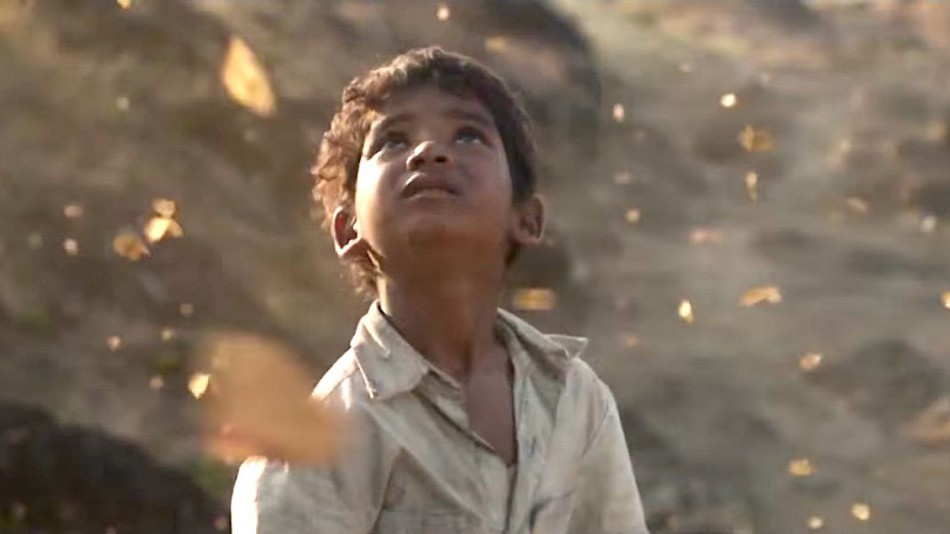
Making his feature debut, Garth Davis makes the most of the Indian settings, painting a portrait of life as seen through the eyes of the young Saroo – a world full of wonder (a kaleidoscope of butterflies, the taste of a cold fizzy drink), and a world full of danger (predatory sex traffickers). Davis is on solid ground here, depicting Saroo’s journey with heart and compassion, and making it clear just how lucky Saroo was to be adopted. Many of the scenes in Calcutta show Saroo surrounded quite literally by the rush and press of its populace, but Davis is quick to show just how isolated he is at the same time. And he follows through with this idea with the adult Saroo, but instead of Saroo becoming isolated through the vagaries of Fate, this time he becomes isolated because of what he does. It reinforces the idea of Saroo not being settled in terms of his heritage and the connection he has with his past; he doesn’t want to continue being adrift.

Visually, Lion is often impressive to watch, alternating between the brooding, teeming city life of Calcutta, and the bright open spaces of Melbourne. Greig Fraser’s cinematography catches the mood precisely, his use of close ups in particular adding to the resonance of the story. Of course, those close ups wouldn’t be entirely as effective if it weren’t for the quality of the acting. As mentioned above, Patel has problems making Saroo credible in terms of his behaviour, but does a good job nevertheless. Mara makes a minimal impression because, one scene aside, her character is the standard girlfriend seen in too many other movies. As the Brierleys, Wenham is sidelined in favour of Kidman’s sterling performance, one that sees her regain some of the critical favour she’s lost in recent years. But if the movie “belongs” to anyone in the cast, it’s young Pawar, whose sweet, angelic features are difficult to resist, and even harder to ignore. Without him, Lion would not be as powerful as it is, or as rewarding.

Rating: 7/10 – let down by a second half that isn’t as focused as its first, Lion is still worth watching, but not as much as its various awards nominations – and wins – would have you believe; a true story that at least doesn’t preach to its audience, its tale is a remarkable one but in this version, not one that will necessarily linger too long in the memory.

Share this:

  • Click to share on X (Opens in new window) X
  • Click to share on Facebook (Opens in new window) Facebook
  • More
  • Click to print (Opens in new window) Print
  • Click to email a link to a friend (Opens in new window) Email
Like Loading...

Pan (2015) or: One More Unnecessary Origin Movie

16 Wednesday Dec 2015

Posted by dullwood68 in Movies

≈ 1 Comment

Tags

Amanda Seyfried, Blackbeard, Captain Hook, Drama, Fairies, Fantasy, Garrett Hedlund, Hugh Jackman, J.M. Barrie, Joe Wright, Lambert Home for Boys, Levi Miller, Neverland, Peter Pan, Pirates, Review, Rooney Mara, Tiger Lily, World War II

Pan

D: Joe Wright / 111m

Cast: Hugh Jackman, Levi Miller, Garrett Hedlund, Rooney Mara, Amanda Seyfried, Adeel Akhtar, Nonso Anozie, Kathy Burke, Lewis MacDougall, Cara Delevingne

Let’s cut to the chase: Pan, by itself, is a disappointment, an uneven children’s fantasy movie that is disjointed, awkwardly humorous, suffers from production overkill, and makes very little sense throughout. But unfortunately, Pan isn’t just a movie by itself, it’s an origin story for a beloved children’s tale that didn’t need it in the first place.

In recent years, Hollywood has given us origin story after origin story in an attempt to expand franchises and add “depth” to existing stories. Last year we had Maleficent, a movie that tried to rewrite the Sleeping Beauty story to make its Wicked Queen a more sympathetic character, as if somebody somewhere had decided that a Wicked Queen couldn’t just be a Wicked Queen; no, there had to be a good reason why she was a Wicked Queen. And now we get to see how a foundling called Peter became the high-flying leader of the Lost Boys, Peter Pan. But did we need to? Perhaps there’s a clue in the fact that J.M. Barrie, who created Peter Pan, never felt the need to go back and provide an origin story for him. And if he didn’t feel the need to, do we really need to know either?

Pan - scene2

But Hollywood knows better (or so they like to think), and now we have an origin story anyway, but one that’s been given so little thought it’s frightening given all the talent involved in making it. You only have to watch the first five minutes of Pan to know that the makers have got it completely, spectacularly wrong. The scene is London, between the two World Wars. An unidentified young woman, clearly scared and frightened that she’s being followed, carries an infant with her until she reaches the doorstep of the Lambert Home for Boys. There she leaves him but not before she’s told him that they’ll meet again, in this world or another. Already there’s a problem: why does the woman abandon her son so recklessly (it’s not the most pleasant-looking of orphanages) and if he’s in as much danger as she seems to think, why take the risk of leaving him in such an awful place?

We fast forward twelve years and find the infant has grown up to be Peter (Miller), and he’s still at the orphanage (surprise, surprise), and he’s a bright, confident child who has no problem challenging authority, in this case Kathy Burke’s snarling, growling, thoroughly unpleasant Sister Barnabas. At this point the movie introduces a superfluous subplot involving Sister Barnabas hoarding goods before Peter and some of the orphans are kidnapped by pirates who descend through the skylights on bungee cords (the dormitory is located conveniently in the roofspace). Now correct me if I’m wrong, but this now makes the woman’s decision to leave Peter there a tad careless, as she’s placed him in the very place that her adversary – who we learn is the pirate Blackbeard (Jackman) – is stealing children from. (What it is to be undone by unforeseen coincidence…)

Pan - scene3

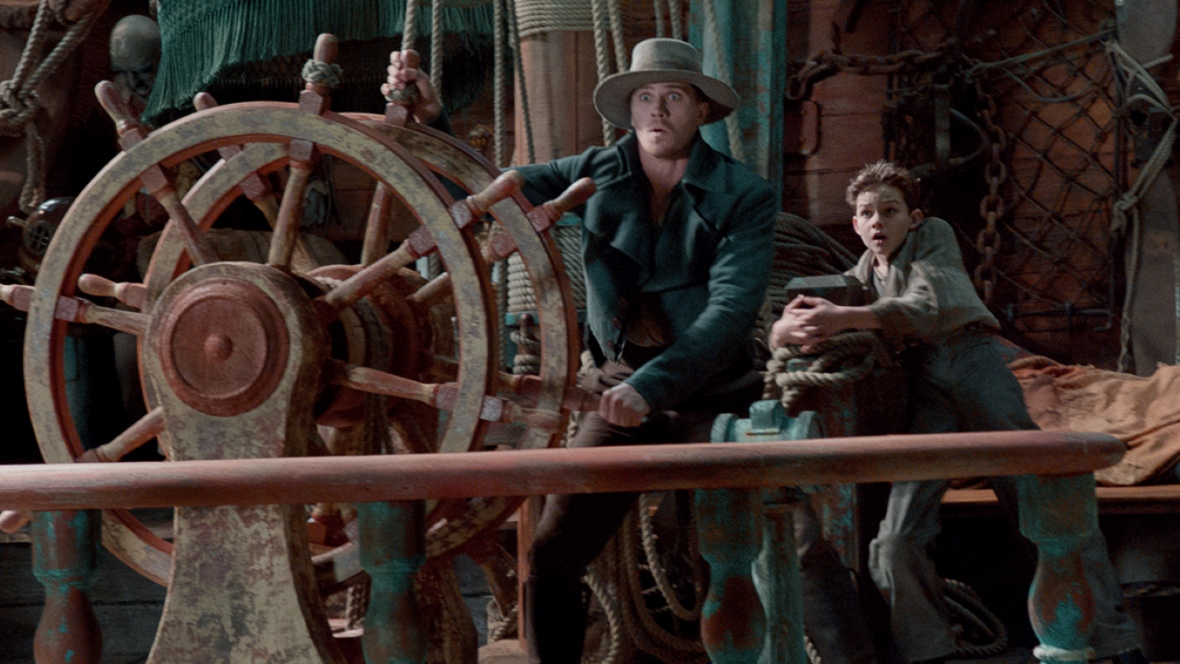
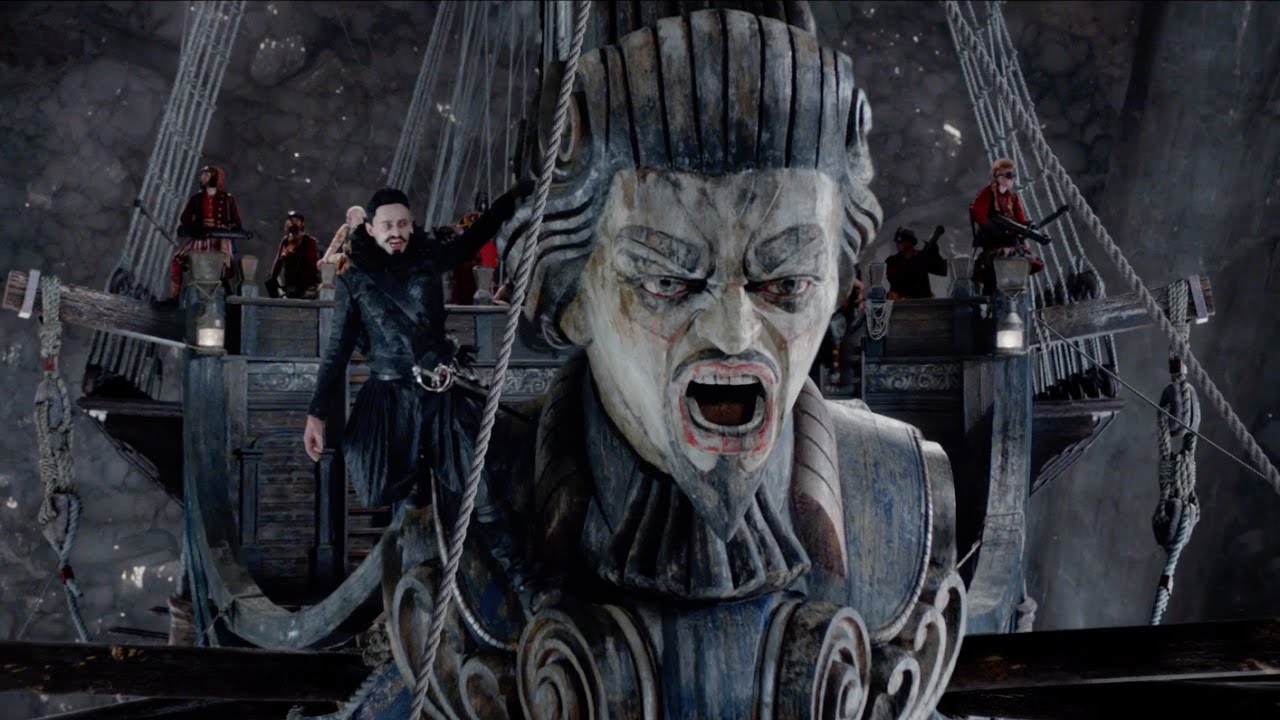
Once in Neverland, the movie takes a left turn by introducing Blackbeard and his merry band of pirates, and what looks like thousands of Lost Boys, as they indulge in a  bit of a sing-song. The song in question turns out to be Nirvana’s Smells Like Teen Spirit, an anachronistic choice that serves only to remind viewers just how well this sort of thing was done in A Knight’s Tale (2001) (and begs the question, does Blackbeard time travel as well for his Lost Boys?). From then on, and despite the introduction of James Hook (Hedlund) (also trapped by Blackbeard), and Tiger Lily (Mara), the princess of the natives, and a plot involving Blackbeard’s determined efforts to wipe out all the fairies (don’t ask why – the movie doesn’t), Pan becomes the Hugh Jackman larger-than-life performance movie as he struts and rampages and roars his way through things with all the gusto of a pantomime villain. It’s not a bad performance per se, it’s just in the wrong movie.

As you’d expect, Neverland is beautifully, stunningly realised, and is a triumph of art direction, set construction, costume design, and special effects, but ultimately it all makes for a hollow confection, an empty shell that the narrative flits and jumps around without any clear idea of where it’s going or why. With the fairies hidden from Blackbeard’s grasp, and of course with Peter as his unwitting accomplice in getting to them, it comes as no surprise that the script shows the fairies completely able to defend themselves from Blackbeard and his men, thus ending any idea that the pirate’s intentions were in any way a threat. It’s not the first time in the movie that the  viewer is likely to be wondering why something is happening, or if it’s likely to be explained (usually not).

Pan - scene1

Pan is a movie that should be included in the ever-growing number of movies that come under the heading, Just Because You Can, Doesn’t Mean You Should. Joe Wright’s direction is focused largely on the cast, and while he’s obviously let Jackman do his own thing, he does allow Mara to give a decent performance, and Miller is suitably stout-hearted as Peter, even if he does take everything in his stride a little too easily. And Hedlund acts more by smiling roguishly than actually emoting, but it’s still a likeable portrayal. The only trouble is, Hook is a character who lacks for development, and remains the same from beginning to end.

Pan‘s terrible performance at the box office – so far it’s only grossed $125m against a budget of $150m – will hopefully discourage other studios/production companies from messing with other established, classic stories. These stories are so well-regarded for a reason: they work independently of any others and in many cases are archetypal and don’t need further embellishment or expansion. Such is the case with Barrie’s tale of the boy who never grew up, and Pan serves only to reinforce what a foolhardy idea it is to try.

Rating: 4/10 – lacking a true sense of childlike wonder, or focus in the story it’s telling, Pan is the movie equivalent of pudding: rich, stolid, and if you’ve had too much, weighing too heavily for comfort; another unsatisfactory, unnecessary origin story that shows just how difficult it is to get these things right, and especially when there’s no real need to.

Share this:

  • Click to share on X (Opens in new window) X
  • Click to share on Facebook (Opens in new window) Facebook
  • More
  • Click to print (Opens in new window) Print
  • Click to email a link to a friend (Opens in new window) Email
Like Loading...

Carol (2015)

16 Friday Oct 2015

Posted by dullwood68 in Movies

≈ Leave a comment

Tags

1950's, Cate Blanchett, Custody battle, Drama, Kyle Chandler, Lesbianism, Literary adaptation, Love, Patricia Highsmith, Review, Road trip, Rooney Mara, The Price of Salt, Todd Haynes

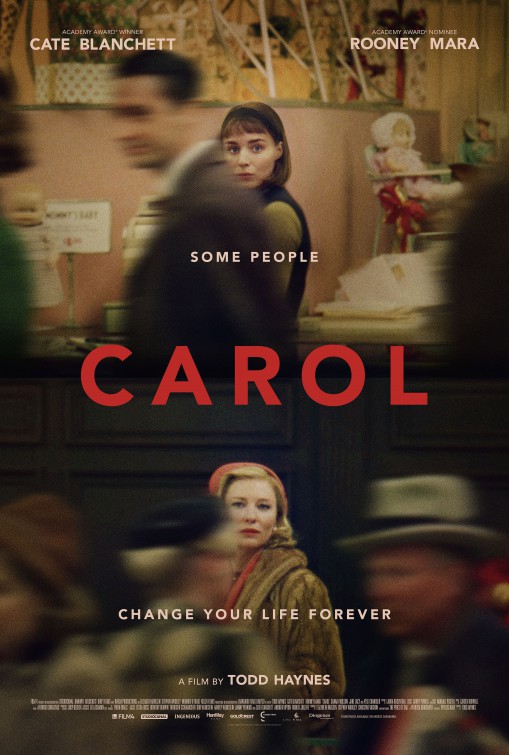
Carol

D: Todd Haynes / 118m

Cast: Cate Blanchett, Rooney Mara, Kyle Chandler, Sarah Paulson, Jake Lacy, Nik Pajic, John Magaro, Cory Michael Smith, Carrie Brownstein

Therese (pronounced Ter-rez) Belivet (Mara) is young, has a devoted boyfriend, Richard (Lacy), works in a department store, but is unsure of her future. One day a female customer in the store engages her in conversation, and even though the customer makes mention of being married with a young child, it’s clear to Therese that there’s a mutual attraction. When the woman leaves her gloves behind, Therese goes to the effort of finding the woman’s address and sending them to her. This act of kindness leads to the woman, whose name is Carol Aird (Blanchett), inviting Therese to lunch. They meet, and a friendship begins, one that starts to cause problems between Therese and Richard, as she begins to lose interest in a planned trip to Europe with him, and spends more time with Carol.

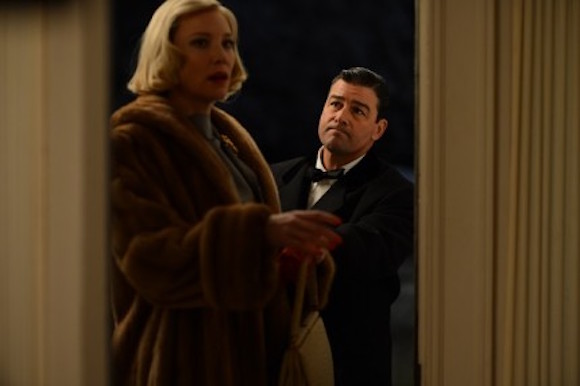
Unbeknownst to Therese, Carol and her husband, Harge (Chandler) have separated due to his awareness that his wife has had an affair with her best friend, Abby (Paulson). Willing to overlook this “indiscretion” if she stays with him, Harge warns her that if she doesn’t then he’ll seek sole custody of their little girl, Rindy. With Xmas approaching, he takes Rindy to his parents for the holiday period; Carol decides to invite Therese to come stay with her. Although nothing happens, Harge returns home unexpectedly and sees them together. Fearing that Carol is embarking on another lesbian relationship, he files for divorce and sole custody of Rindy. Unable to see her child until the custody hearing, which will take two or three months to happen, Carol invites Therese on a road trip, where they can spend some time together, and where Harge can’t find them.

They stay in a succession of motel rooms, at first staying in separate rooms. At one particular motel they stay in the Presidential suite; the next morning, Therese gets to talking with a travelling salesman called Tommy (Smith). Although he tries to sell them something from his sales kit, he has no joy, though Therese wishes him well in the future. At the next motel, she and Carol finally make love. But a telegram Carol receives the next morning reveals Harge’s awareness of where she is, and the fact that she and Therese are now lovers. Unable to risk the now serious possibility of losing the custody hearing, Carol decides she has to return home to face Harge, and sends Abby in her place to see Therese gets home safely. But for both women, returning to their old lives proves unsatisfactory…

Carol - scene

There’s a moment in Todd Haynes’ beautifully crafted Carol, an adaptation of Patricia Highsmith’s novel The Price of Salt, when it looks certain that the title character and Therese will make love for the first time. It’s a moment that the movie is clearly heading toward, and it’s a moment that audiences will be expecting, but Haynes, along with screenwriter Patricia Nagy, holds off from that first time and maintains the sense of anticipation that both characters (and viewers) must be feeling. For the audience, it’s also a moment – among many others – that shows just how much control Haynes has over both the material and its emotional centre, and how finely calibrated it all is, for Carol is without a doubt, one of 2015’s finest movies.

Of course, with previous projects such as Far from Heaven (2002) and the TV version of Mildred Pierce (2011), Haynes has already shown an affinity for what used to be termed “women’s pictures”, but here his immersion in a time – the 1950’s – when lesbianism was still something to be kept hidden, and where male attitudes towards the issue were still highly aggressive, feels also like a snapshot of an era where female empowerment was beginning to gain the upper hand, despite the so-called Lavender Scare that was prevalent at the time. Through Carol’s determination not to be defined by her sexuality, we get to see an example of what, in historical terms, was a turning of the tide, and also a love story that is simply that: a love story.

This simplicity is at the heart of Haynes’ confident handling of the story, and it shows in every scene, with every look and every gesture, and in the way that he brings Carol and Therese together within the frame – these moments where they’re “close but not touching” are so charged with pent-up emotion and increasing desire that the idea that they might be kept apart by Harge’s machinations becomes intolerable. These scenes are so expertly handled, with repressed longing so forcefully expressed, that the viewer is swept along with the characters’ desire to live freely and without sanction. Haynes makes great use of the era’s sense of propriety, using it as a touchstone against which Carol and Therese’s affair can be measured in both intensity and necessity. Therese quizzes Richard about same sex relationships but he has no point of reference, and has no understanding of why they occur; he loves her unequivocally but can’t see that two women – or two men for that matter – might feel the same way about each other as he does about Therese. It’s another of those moments where the audience can see just how difficult it was to live a life outside the (perceived) norm.

With the historical and social background of the story firmly in place, and with Nagy’s script making it clear that lesbians were expected to pretend to be happy in heterosexual relationships or face the social consequences, the movie paints an honest portrait of two women, both of whom gain increased confidence in themselves through their relationship, who come together at a point in both their lives where they’re looking for a way to find future happiness. That they find it in each other, if only briefly, and with such passion, gives value to the idea that any relationship is worth pursuing or fighting for. And even though Carol leaves Therese to fight for custody of her child, it’s not the end of their affair, but rather an interruption (albeit for Therese an unexpected one), and even though the younger woman is upset by it, her feelings remain, and though the movie tries for an air of ambiguity in its final scene, viewers won’t be fooled at where Carol and Therese’s relationship is likely to find itself.

Carol -scene3

The difference in ages might feel like it should be an issue but it’s left unexplored, and with good reason: it doesn’t matter. Love is love, and though an argument could be made that Therese is looking for a guide or a mentor first and foremost, it’s not the role Carol adopts in their relationship. As the “older woman”, Blanchett gives yet another astonishing, awards-worthy performance, striking the right balance between heartfelt longing for an honest life and acknowledging the difficulties that longing entails. Her brittle, striking features show the pain of Carol’s situation without too much need of more overt playing, but in those moments when overt emotion is required, Carol’s fears and hopes are etched indelibly on those striking features. It’s a magnificent performance, sincere, heartbreaking at times, and riveting.

She’s matched by Mara, whose portrayal of the unmoored, ingenuous Therese is so finely tuned that watching her blossom, however slowly, into a stronger, more confident young woman is like watching a flower grow out of the shadows to its full height. There are moments where the camera focuses on her smooth, unlined features and the only expression is there in the eyes, but Mara uses this approach to such good effect that the viewer is never in doubt as to what Therese is thinking or feeling. And as the movie progresses, Mara subtly shifts the weight of Therese’s longing for love so that it becomes a part of her, and not the whole, leaving her a character as strong in her own right as Carol is in hers.

With two such commanding performances, it would be a shame if the supporting cast were overshadowed, but Chandler, in what is superficially the “villain” role, brings out Harge’s pain and sense of loss over Carol with such force that his actions are less stereotypical than expected and driven more by his own deep love for her. In the same way that society says Carol can’t have Therese (in public at least), it also says that Harge can’t have Carol because of her “sexual impropriety”. Both characters are in danger of losing what they want most, and both are suffering as a result. Chandler is unexpectedly moving in the role, and his scenes with Blanchett are so emotionally charged it’s like an intense version of force majeure. Meanwhile, Paulson comes late to matters as Abby, but gives a brief but potent performance as Carol’s longtime friend, confidant and ex-lover, filling in the gaps of Therese’s knowledge about Carol, and providing further context for Carol’s emotional and sexual desires.

Carol - scene2

It’s all beautifully filmed by Edward Lachman, with lots of bright primary colours mixed in with rich earthy tones, making the period seem so alive as to be almost intoxicating, and acting as a dynamic background to the impassioned nature of Carol and Therese’s relationship. There’s some equally impressive attention to historical detail, and Haynes makes the era come alive as a result; this is a fully realised world, even if it does appear at first to be bathed in nostalgia (the scenes in the department store appear right out of a Fifities child’s fantasy of what such a store should look like), but in many ways it was a simpler time, and the script reflects this with aplomb. And the whole thing is embraced by a smoothly nonchalant yet spirited score by Carter Burwell that complements the on-screen proceedings with well orchestrated brio.

Rating: 9/10 – a firm contender for Movie of the Year, Carol is a masterpiece of mood and repressed emotional yearning, with two outstanding performances, and a director on the absolute top of his form; a model of period movie making, and rewarding in every department you can possibly think of, this is a movie that should go to the top of everyone’s must-see list.

Share this:

  • Click to share on X (Opens in new window) X
  • Click to share on Facebook (Opens in new window) Facebook
  • More
  • Click to print (Opens in new window) Print
  • Click to email a link to a friend (Opens in new window) Email
Like Loading...

Blog Stats

  • 486,528 hits

Recent Posts

  • 10 Reasons to Remember Bibi Andersson (1935-2019)
  • Fantasia (1940)
  • Dances With Wolves (1990) – The Special Edition
  • Kiss of the Spider Woman (1985)
  • The Three Musketeers (1973)

Top Posts & Pages

  • Lost for Life (2013) - Another Look
    Lost for Life (2013) - Another Look
  • Lost for Life (2013)
    Lost for Life (2013)
  • About
    About
  • Mr. Topaze (1961)
    Mr. Topaze (1961)
  • Winter's Tale (2014)
    Winter's Tale (2014)
  • Billy Lynn's Long Halftime Walk (2016)
    Billy Lynn's Long Halftime Walk (2016)
  • The Hitman's Bodyguard (2017)
    The Hitman's Bodyguard (2017)
  • Shock and Awe (2017)
    Shock and Awe (2017)
  • 5 Famous Movie Roles That Nearly Went to Someone Else
    5 Famous Movie Roles That Nearly Went to Someone Else
  • The Layover (2017)
    The Layover (2017)
Follow thedullwoodexperiment on WordPress.com

Blogs I Follow

  • Rubbish Talk
  • Film 4 Fan
  • Fast Film Reviews
  • The Film Blog
  • All Things Movies UK
  • Interpreting the Stars
  • Let's Go To The Movies
  • Movie Reviews 101
  • TMI News
  • Dan the Man's Movie Reviews
  • Film History
  • Jordan and Eddie (The Movie Guys)

Archives

  • April 2019 (13)
  • March 2019 (28)
  • February 2019 (28)
  • January 2019 (32)
  • December 2018 (28)
  • November 2018 (30)
  • October 2018 (29)
  • September 2018 (29)
  • August 2018 (29)
  • July 2018 (30)
  • June 2018 (28)
  • May 2018 (24)
  • April 2018 (21)
  • March 2018 (31)
  • February 2018 (25)
  • January 2018 (30)
  • December 2017 (30)
  • November 2017 (27)
  • October 2017 (27)
  • September 2017 (26)
  • August 2017 (32)
  • July 2017 (32)
  • June 2017 (30)
  • May 2017 (29)
  • April 2017 (29)
  • March 2017 (30)
  • February 2017 (27)
  • January 2017 (32)
  • December 2016 (30)
  • November 2016 (28)
  • October 2016 (30)
  • September 2016 (27)
  • August 2016 (30)
  • July 2016 (30)
  • June 2016 (31)
  • May 2016 (34)
  • April 2016 (30)
  • March 2016 (30)
  • February 2016 (28)
  • January 2016 (35)
  • December 2015 (34)
  • November 2015 (31)
  • October 2015 (31)
  • September 2015 (34)
  • August 2015 (31)
  • July 2015 (33)
  • June 2015 (12)
  • May 2015 (31)
  • April 2015 (32)
  • March 2015 (30)
  • February 2015 (37)
  • January 2015 (39)
  • December 2014 (34)
  • November 2014 (34)
  • October 2014 (36)
  • September 2014 (25)
  • August 2014 (29)
  • July 2014 (29)
  • June 2014 (28)
  • May 2014 (23)
  • April 2014 (21)
  • March 2014 (42)
  • February 2014 (38)
  • January 2014 (29)
  • December 2013 (28)
  • November 2013 (34)
  • October 2013 (4)

Blog at WordPress.com.

Rubbish Talk

Film 4 Fan

A Movie Blog

Fast Film Reviews

The Film Blog

The official blog of everything in film

All Things Movies UK

Movie Reviews and Original Articles

Interpreting the Stars

Dave Examines Movies

Let's Go To The Movies

Film and Theatre Lover!

Movie Reviews 101

Daily Movie Reviews

TMI News

Latest weather, crime and breaking news

Dan the Man's Movie Reviews

All my aimless thoughts, ideas, and ramblings, all packed into one site!

Film History

Telling the story of film

Jordan and Eddie (The Movie Guys)

Movie Reviews & Ramblings from an Australian Based Film Fan

Privacy & Cookies: This site uses cookies. By continuing to use this website, you agree to their use.
To find out more, including how to control cookies, see here: Cookie Policy
  • Subscribe Subscribed
    • thedullwoodexperiment
    • Join 481 other subscribers
    • Already have a WordPress.com account? Log in now.
    • thedullwoodexperiment
    • Subscribe Subscribed
    • Sign up
    • Log in
    • Report this content
    • View site in Reader
    • Manage subscriptions
    • Collapse this bar
 

Loading Comments...
 

    %d