• 10 Reasons to Remember…
  • A Brief Word About…
  • About
  • For One Week Only
  • Happy Birthday
  • Monthly Roundup
  • Old-Time Crime
  • Other Posts
  • Poster of the Week
  • Question of the Week
  • Reviews
  • Trailers

thedullwoodexperiment

~ Viewing movies in a different light

thedullwoodexperiment

Tag Archives: Thriller

Mandrake, the Magician (1939) – Chapter 6: The Fatal Crash

10 Tuesday Feb 2015

Posted by dullwood68 in Movies

≈ Leave a comment

Tags

Al Kikume, Columbia, Dorgan, Doris Weston, Drama, Ironworks, Lothar, Magician, Mandrake, Norman Deming, Plane crash, Platinite, Professor Houston, Radium machine, Review, Sam Nelson, Serial, The Wasp, Thriller, Warren Hull

Mandrake, the Magician

D: Sam Nelson, Norman Deming / 14m

Cast: Warren Hull, Doris Weston, Al Kikume, Rex Downing, Edward Earle, Forbes Murray, Kenneth MacDonald, Don Beddoe, John Tyrrell

Escaping from the Interstate Power House just as it starts collapsing around them, Mandrake and Lothar head for their car. Spotted by the Wasp’s henchmen, a struggle ensues during which Mandrake manages to acquire a distinctive knife from one of the henchmen. Back at Professor Houston’s he tells, Betty, Tommy, Dr. Bennett, Webster and Raymond that he should be able to find out where the knife was purchased. But two of the Wasp’s men are listening outside and when no one is looking, they steal back the knife.

Meanwhile, Professor Houston manages to outwit one of his guards and get a radio message to Mandrake, telling him that he’s about to be moved to an ironworks in a place called Dorgan. With Betty’s help, Mandrake learns that Dorgan is fifty miles away, so he decides to fly there in his plane. The Wasp learns of this and arranges for another plane to intercept Mandrake’s. The magician reaches Dorgan only for the pilot of the other plane to shoot at him. Houston attempts to slip away while the Wasp’s men watch as Mandrake’s plane is hit and it crashes into the ground.

vlcsnap-00006

It’s the halfway stage, and Mandrake, the Magician is proving to be a serial with a keen sense of its own absurdity and a great deal of vigour. It’s formulaic to be sure, but every now and then it throws in something unexpected, as with this episode and Mandrake’s taking a brief time out from sleuthing to show off a magic trick to Betty and Tommy. And with the brief running time (which still includes the same title sequence as every other chapter, a recap of the previous episode, plus a look ahead to the next chapter), there’s no chance to indulge in a car chase, and only a very short bout of fisticuffs. Instead, the focus drifts away from Mandrake for most of the episode, leading to a scene where the Wasp punishes one of his men, and more time with Professor Houston.

The fast pace and devil-may-care approach to the material – the Wasp remains as supernaturally omniscient as always, now the radio transmitter has been found the Wasp’s men take to eavesdropping at windows – help make the serial fun to watch, and Chapter 6: The Fatal Crash (which we all know isn’t true) is a good case in point. The writers clearly know their stuff, and make this episode – and despite its short amount of new material – a pleasing addition to the series, bringing all the main characters together and through Professor Houston, showing that Mandrake isn’t the only proactive character. And yes, as you can see above, the makers have seen fit to include lightning bolts to indicate an electric shock – does it get any better than that?

Rating: 6/10 – the whole section with the knife is all filler and to be honest, heavily redundant, but there’s enough incident in Chapter 6: The Fatal Crash to make this one of the more enjoyable episodes; surprisingly improved by having less Mandrake in it, the serial maintains the energy of previous entries and makes the next episode look even more exciting.

Share this:

  • Click to share on X (Opens in new window) X
  • Click to share on Facebook (Opens in new window) Facebook
  • More
  • Click to print (Opens in new window) Print
  • Click to email a link to a friend (Opens in new window) Email
Like Loading...

Kingsman: The Secret Service (2014)

08 Sunday Feb 2015

Posted by dullwood68 in Movies

≈ 1 Comment

Tags

Action, Colin Firth, Drama, Eggsy, Mark Strong, Matthew Vaughn, Michael Caine, Review, Samuel L. Jackson, SIM cards, Spies, Taron Egerton, Thriller, Valentine

Kingsman The Secret Service

D: Matthew Vaughn / 129m

Cast: Colin Firth, Samuel L. Jackson, Taron Egerton, Mark Strong, Michael Caine, Sofia Boutella, Sophie Cookson, Edward Holcroft, Mark Hamill, Samantha Womack, Geoff Bell, Jack Davenport

1997. While on a mission in the Middle East, Kingsman secret agent Harry Hart (code named Galahad) (Firth) makes a mistake that costs the life of his protege. He visits the man’s wife, Michelle (Womack), and their young son, who is known as ‘Eggsy’. He gives Eggsy a medal and tells him if ever he needs a favour, to ring the number on the back of the medal and say the phrase, “Oxfords not brogues”.

Eight years later, one of Harry’s fellow agents, Lancelot (Davenport) is killed while trying to rescue a kidnapped professor (Hamill). As the membership of Kingsman demands a continuous number of agents, Hart and his remaining colleagues are tasked by the service’s head, Arthur (Caine), with finding a replacement for him. Meanwhile, Eggsy’s home life hasn’t improved. His mother is in an abusive relationship with Dean (Bell), and he and his friends are bullied by Dean’s gang. When Eggsy steals  one of the gang’s car he ends up being arrested. Remembering the medal, Eggsy calls the number and repeats the phrase. Soon after he is released and finds himself in the company of Harry.

While all this is going on, the kidnapper of the professor, tech-billionaire and radical environmentalist Richmond Valentine (Jackson) is blackmailing or kidnapping important world figures in order to support his scheme to reduce the world population through the free dispersal of SIM cards adapted for use in any mobile phone. With Kingsman becoming aware of his activities, Eggsy agrees to undergo the training required to become a Kingsman agent. While he competes against the other candidates, including Roxy (Cookson) and Charlie (Holcroft), Harry pays Valentine a visit to find out more about his plans and eventually discovers that the billionaire is planning a test of his SIM cards at a church in the Deep South.

Eggsy does well enough in his training to reach the final stage where it’s between him and Roxy for the position of the new Lancelot. But his confidence and commitment is rocked by the task required of him, and in the Deep South, Harry’s infiltration of the congregation leads to an unexpected and shocking development…

Kingsman The Secret Service - scene

If Matthew Vaughn only ever made comic book adaptations from now until the end of time, it would be a wonderful outcome for movie lovers everywhere. Following on from Kick-Ass (2010) and X-Men: First Class (2011), Kingsman: The Secret Service is a razor-sharp, highly entertaining spy spoof that retains enough drama to give it the edge it almost doesn’t need. It’s a movie that is both self-referential and iconic, and shows just how this sort of material should be handled: with obvious love and affection.

Adapting Mark Millar and Dave Gibbons’ comic book The Secret Service, Vaughn and screenwriter Jane Goldman have created a world where the notion of a “gentleman spy” is still very highly regarded – by the spies themselves, and by the villain of the piece – and where a certain level of style is a necessity. It’s an Old Boys network, run as an elitist organisation that works so far behind the scenes no one’s ever heard of them. With its agents named after characters from Arthurian legend, and its adoption of high-tech weapons to back up each agent’s physical prowess, the Secret Service is a potent mix of the old and the new. From its bulletproof umbrellas to its poisoned knife tipped shoes to its underground hangar full of jets and helicopters and APC’s, this is an organisation that is serious about what it does, but also knows how to have fun while doing it.

The plot is straight out of the Sixties, with a megalomaniac threatening to destroy the world unless his demands are met, his ultra-dangerous sidekick – here Boutella’s artificial limbed killing machine, Gazelle – a variety of ingenious gadgets and some of the sharpest outfits this side of a Milan catwalk. As befits a Bondian villain, Valentine has a mountain lair with enough rough-hewn corridors for Eggsy to kill dozens of his henchmen, and he has a turncoat (or two) within the Kingsman organisation. It’s all presented with a splendid amount of panache (and above all, style), and Vaughn never loses sight of how important these aspects are in the grand scheme of things.

The director is more than ably supported by a first-rate cast that sees Firth cast entirely against type (but boy is he a great choice for the role), Jackson use a lisp to underline the absurdity of his character’s ambitions, Egerton grab the opportunity of a lifetime with both hands, Strong reinforce his status as one of the finest actors around (even if his Scottish accent wavers a bit), Caine provide gravitas and just a pinch of arrogance, and in a minor role as a kidnapped Scandinavian princess, Hanna Alström almost steals the movie with an offer Eggsy can’t refuse.

But what Kingsman: The Secret Service is most likely to be remembered for is the scene at the church, a technically impressive, devastatingly violent, gratuitously vicious, and brutally in-your-face sequence where the full effects of Valentine’s plan are felt. The camera swoops in and out and around the action, keeping its focus on Harry and never once letting up on the audience, as every blow and gunshot and stabbing movement is choreographed to furious perfection. It makes the night club sequence in John Wick (2014) look anaemic by comparison, and is all the more startling and effective by being almost balletic in its blood-soaked aesthetic.

Kingsman The Secret Service - scene2

Of course, while the violence is as bone-crunching and quasi-sadistic as you might expect from Vaughn, there’s also a great deal of humour, along with the underlying theme of finding your place in the world. It’s a rich mixture of pointed comedy and heightened violence, and as with Kick-Ass, Vaughn succeeds in ensuring neither element overwhelms the other, leaving the movie to find its own level throughout and proving an exhilarating mix of both. He’s further supported by dazzling cinematography by George Richmond, and there’s a terrific score by Henry Jackman and Matthew Margetson that uses various motifs from other spy movies and still sounds fresh. And of course, special mention must be made of the costumes by Arianne Phillips, her bespoke suits and accessories all now available for the gentleman spy in your life.

Rating: 8/10 – a little too long, with the final showdown in Valentine’s lair proving an unnecessarily two-part affair, Kingsman: The Secret Service is still a stylish, uncompromising action thriller that delights at every turn; Firth is simply superb, and Egerton is a rising star with bags of ability – and then some.

Share this:

  • Click to share on X (Opens in new window) X
  • Click to share on Facebook (Opens in new window) Facebook
  • More
  • Click to print (Opens in new window) Print
  • Click to email a link to a friend (Opens in new window) Email
Like Loading...

The World Made Straight (2015)

06 Friday Feb 2015

Posted by dullwood68 in Movies

≈ 1 Comment

Tags

Adelaide Clemens, American Civil War, David Burris, Drama, Drugs, Jeremy Irvine, Minka Kelly, Noah Wyle, North Carolina, Review, Shelton Laurel Massacre, Steve Earle, Thriller

World Made Straight, The

D: David Burris / 119m

Cast: Noah Wyle, Jeremy Irvine, Minka Kelly, Adelaide Clemens, Steve Earle, Marcus Hester, Haley Joel Osment, Alex Van, Robin Mullins

North Carolina, the early Seventies. Travis Shelton (Irvine) is seventeen and without much of a future ahead of him. He’s a high school dropout, can’t hold down a job, and spends most of his time hanging out with his friends. When he discovers some marijuana plants growing in back of a property in the woods, he takes a few and sells them to local small-time drug dealer, Leonard Shuler (Wyle). When he goes back to get some more he steps into a bear trap and passes out. When he comes to he finds himself confronted by Carlton Toomey (Earle) and his son Hubert (Hester), the owners of the marijuana plants and the area’s most prominent – and feared – drug dealers. Toomey strikes a bargain with Travis: in return for his silence about the plants, they’ll take him to the nearest hospital. Travis agrees.

While he recovers at the hospital Travis meets Lori (Clemens), a nurse he was in school with. They begin a tentative relationship that continues once he’s allowed home… which proves to be out of bounds, due to an argument Travis had with his father (Van) before his accident. With nowhere else to go, Travis persuades Leonard to let him stay with him for a while. His stay isn’t appreciated by Leonard’s girlfriend, Dena (Kelly), but he and Leonard form an unlikely friendship, with Leonard’s interest in local Civil War history, in particular the Shelton Laurel massacre, piquing Travis’s enthusiasm. As he delves deeper into what happened during the massacre he learns that several of his ancestors were killed there, including a thirteen year old called David Shelton.

He and Leonard visit the site and discover a pair of glasses that might have belonged to David. Dena becomes increasingly annoyed at Travis’s presence; one night while they’re all at a carnival, she disappears. Later on at Leonard’s she returns, accompanied by Toomey, to collect her things. Much later, Travis and two of his friends go to Toomey’s to score some drugs; there he discovers that Dena has been forced into letting men have sex with her to settle a debt Toomey says he owes her. Travis returns to free her, and he takes her to Leonard. Knowing that Toomey will come looking for her, he tells them to make a run for it. And sure enough, shortly after they leave, Toomey arrives looking for restitution.

World Made Straight, The - scene

The second screen adaptation of a novel by author Ron Rash in four months – the other being Serena (2014) – The World Made Straight is a meditation on the prolonged effects of the past on the present. It highlights the ways in which past events can influence the behaviour of people even a hundred years after they’ve happened, and emphasises the toll such an influence can have.

In Travis we have a main character who – surprisingly, given the nature of his Appalachian heritage – is unaware of the massacre and his family’s unfortunate involvement. But this is a journey of discovery, one that takes Travis away from his cloistered home life and into a world where he struggles even further to make any headway. His unexpected friendship with Leonard (who helps him pass his GED test) and his romance with Lori both point to a brighter future, but his increasing obsession with the massacre and his family’s history keeps holding him back, his need to know what happened there and why stopping him from moving forward. Irvine plays him with a swagger he hasn’t earned yet, and keeps Travis from becoming too irritating because of the mistakes he makes. It’s a rough and ready performance, in keeping with the character, and allows for a depth of feeling that pays off when Travis and Leonard visit the massacres site.

He’s not the only one haunted by the past, though. Leonard is a small-time drug dealer who was once a schoolteacher. He lost his job when a student he’d caught cheating on a test and failed, hid some drugs in his car. There’s an irony in his current “career path” and it’s not lost on him. His fascination with the past is seen as a by-product of this turn of events, as if by seeking answers to the events of the past he can find answers to his own predicament. Through Travis, Leonard is hoping to make some small amends for the way in which his life has taken a wrong turn, and for the way in which he let it happen. Wyle gives a quietly compelling performance, making Leonard’s sadness with his life all the more effective due to the losses he’s suffered. He has some difficult choices to make at the end, and while one of them seems designed more to provoke the eventual denouement, he still makes it work – just.

Sadly, while Travis and Leonard are characters given the room to live and breathe within the movie’s narrative, the same can’t be said for Dena and Lori. Dena’s drug addiction makes her manipulative and self-absorbed, almost a caricature, particularly when she attempts to seduce Travis. Lori is the wholesome alternative to Dena, her fresh-faced appearance and blonde locks the opposite of Dena’s sallow complexion and lifeless hair. Kelly struggles to make more of Dena than the script will allow, and Clemens is hamstrung by Lori’s less than consistent presence in the narrative (she’s a glimpse of what Travis could have, but little more). However, the movie does have one performance that is authoritative and commanding, and that’s provided by the singer Steve Earle, whose portrayal of Toomey is soft spoken, low-key and infinitely more menacing as a result.

Shane Danielsen’s script leaves some plot lines dangling – at one point, Dena tells Travis that Leonard is his kin even though he has a different name and family background – and just why Travis becomes so enthralled by the massacre and its connection to his family is never really explained (or explored). Also, the relationship between Leonard and Dena creates its own problem as it’s difficult to work out why he’d be with her. And the ending, while not entirely unexpected, is arrived at by a series of convoluted changes of character but remains surprisingly satisfying.

World Made Straight, The -scene2

Making his feature debut, Burris directs things with one eye on the performances and one eye on the beautiful North Carolina countryside. Thanks to some stunning compositions, Burris and DoP Tim Orr make the movie a pleasure to watch, even if there’s an often wintry feel to the locations used, and there are several shots of a river that acts as a metaphor for the passage of time. It all makes the movie look more impressive than it is, but it’s not for want of trying. Burris has a good feel for the subject matter but can’t overcome the deficiencies in Danielsen’s script, and while the sense of history weighing down on the present is occasionally overdone, it doesn’t detract from the fact that, as debuts go, this is a pretty good start.

Rating: 7/10 – slow paced and not fully realised, The World Made Straight is still an auspicious debut from Burris, and lingers in the memory; worth seeing for Earle’s cobra-like performance and an atmosphere that builds to a conclusion that is both febrile and understated.

Share this:

  • Click to share on X (Opens in new window) X
  • Click to share on Facebook (Opens in new window) Facebook
  • More
  • Click to print (Opens in new window) Print
  • Click to email a link to a friend (Opens in new window) Email
Like Loading...

Mandrake, the Magician (1939) – Chapter 5: The Devil’s Playmate

03 Tuesday Feb 2015

Posted by dullwood68 in Movies

≈ Leave a comment

Tags

Al Kikume, Columbia, Doris Weston, Drama, Interstate Power House, Lothar, Magician, Mandrake, Norman Deming, Platinite, Professor Houston, Radium machine, Regan, Review, Sam Nelson, Serial, The Wasp, Thriller, Warren Hull

Mandrake, the Magician

D: Sam Nelson, Norman Deming / 14m

Cast: Warren Hull, Doris Weston, Al Kikume, Rex Downing, Edward Earle, Forbes Murray, Kenneth MacDonald, Don Beddoe, John Tyrrell

With Mandrake unconscious on the mill wheel, and facing certain death, luck intervenes as the wheel rotates down into the cellar below and the magician falls from the wheel onto the floor. Regaining consciousness he exits the Mill River Inn where he finds Lothar fighting some of the Wasp’s men. Together they escape. Back at the home of Professor Houston, Mandrake muses on how the Wasp could have known he was going to the Inn. He suspects there is a listening device hidden somewhere in the house and with Betty’s help he not only finds it, but he also sets a trap for some of the Wasp’s men by telling her that the formula for platinite is in a safety deposit box at his bank.

The next morning, Mandrake baits the trap and manages to capture one of the Wasp’s men. The man tells Mandrake about the Wasp’s plan to destroy the Interstate Power House; Mandrake and Lothar rush there to try and stop it from happening. Somehow, the Wasp finds out about Mandrake’s imminent arrival at the power station and his men there are alerted. When Mandrake and Lothar get there they are both overpowered by the Wasp’s men: Mandrake is tied to a generator while Lothar is knocked unconscious. Just as the Wasp aims the radium machine at the building, Mandrake frees himself. Grabbing Lothar he lurches towards the exit, but then the room begins to collapse around them.

vlcsnap-00004

With Mandrake again taking the fight to the Wasp, Chapter 5: The Devil’s Playmate inherits the mantle of shortest entry from Chapter 4: The Secret Passage, and also continues the trend of having a title that doesn’t relate to anything that happens during the episode. But this is an episode that crams a lot in and speeds along with gusto, the writers’ decision to make Mandrake even more proactive proving a good choice indeed. He’s not getting any nearer to finding Professor Houston or his radium machine, and he still isn’t any nearer to discovering the Wasp’s real identity, but at least he’s trying, and at last he’s found the hidden radio transmitter (go Mandrake).

This time around there are the usual punch ups and car chases (one of which ends with the Wasp’s men veering round Mandrake’s car so they can end up in the river), and the bizarre sight of Mandrake swinging from an upper balcony of the bank in order to take out three of the Wasp’s henchmen. Tommy is present for a minute or so before being sent to bed, Raymond shakes Betty’s hand then holds onto it for a very long time indeed, and as Mandrake makes to grab Lothar he stops to pick up his hat and put it on (he must really like that hat). As noted above, the Wasp somehow learns of Mandrake’s last-minute trip to the Power House, but unless he’s telepathic it’s impossible for him to know (we know he’s someone working with Mandrake but this is stretching his omniscience a bit too far). And it’s a shame that the cliffhanger ending is much the same as the destruction of the radio building at the end of Chapter 3: A City of Terror. But again, this is an episode that flies by, and it retains the series’ charm.

Rating: 5/10 – shorter than previous entries, but in some ways better, Chapter 5: The Devil’s Playmate has an energy about it that makes it all the more enjoyable; much more rewarding than the previous chapter, this bodes well for the development of the rest of the serial.

Share this:

  • Click to share on X (Opens in new window) X
  • Click to share on Facebook (Opens in new window) Facebook
  • More
  • Click to print (Opens in new window) Print
  • Click to email a link to a friend (Opens in new window) Email
Like Loading...

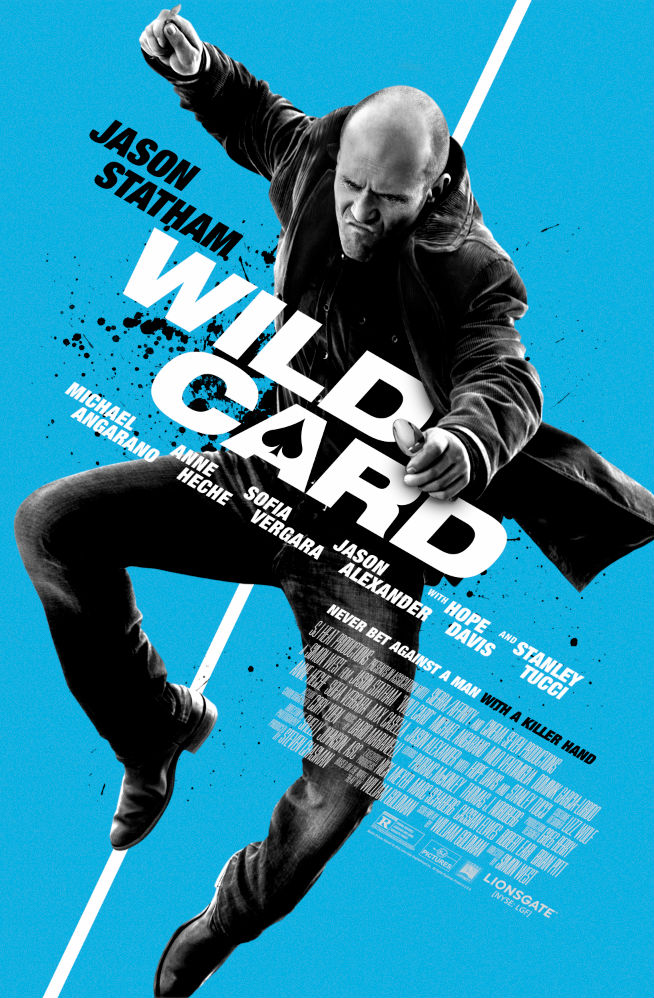
Wild Card (2015)

02 Monday Feb 2015

Posted by dullwood68 in Movies

≈ 1 Comment

Tags

Action, Casino, Domink Garcia-Lorido, Gambling, Jason Statham, Las Vegas, Michael Angarano, Milo Ventimiglia, Review, Security consultant, Simon West, Stanley Tucci, The Golden Nugget, Thriller

Wild Card

D: Simon West / 92m

Cast: Jason Statham, Michael Angarano, Milo Ventimiglia, Dominik Garcia-Lorido, Hope Davis, Stanley Tucci, Max Casella, Sofia Vergara, Jason Alexander, Anne Heche

Nick Wild (Statham) is a security consultant living and working in Las Vegas. He’s also a gambler with a dream: win $500,000 and spend five years living the life he’s always wanted, starting with a year sailing around the Mediterranean. He takes a job protecting a young man named Cyrus Kinnick (Angarano) while he plays at the casinos. At the same time he receives a message from a friend called Holly (Garcia-Lorido), asking him to visit her. When he does he finds she’s been raped and beaten up by three men she met at the Golden Nugget. She tells Nick she wants to find out who they are so she can sue them.

Nick soon discovers the three men were local gangster Danny DeMarco (Ventimiglia) and two of his men. He’s warned not to go anywhere near them, but when he tries to tell Holly he couldn’t find out who the men were, she realises he’s lying and reminds him of a debt he owes her. Knowing it will cause trouble for him, Nick pays a visit to DeMarco at his suite. He disables DeMarco and his men, giving Holly – who’s never intended to sue them – a chance to exact her revenge on the gangster. She threatens to cut off his penis, and even nicks the side of it; he cries and pleads for forgiveness. Relenting, Holly takes $50,000 from him and splits it with Nick before leaving town.

Nick takes Cyrus to a casino, and while Cyrus plays at a craps table, Nick takes his half of DeMarco’s money and begins to gamble. He’s soon on a winning streak that culminates in his winning $506,000, enough for him to leave Las Vegas. He’s about to cash in his chips when he’s struck by an anxiety attack. He tells Cyrus that he’s been fooling himself: the money isn’t enough for him to avoid having to come back to Vegas after his five years are up. Telling himself he needs a bigger pot of money he stakes all his winnings on a single bet… and loses it all. Afterwards, he’s attacked by DeMarco’s men but manages to defeat them. But this leads to Nick being summoned to see Baby (Tucci), the boss of organised crime in Las Vegas. DeMarco has come to him with a story that Nick came to his suite, beat him up and shot his men, and stole the money to gamble with. Now Nick has to prove to Baby that DeMarco is lying, or his life will be forfeit…

Wild Card - scene

A remake of the Burt Reynolds’ movie Heat (1986), Wild Card is a project that Statham has been trying to get made for around five years. It’s also an adaptation by William Goldman of his own novel and a reworking of his script for Heat. A crime drama that features another of Statham’s occasional forays into character acting, the movie doesn’t offer anything new (hardly possible given the material’s history), but it does make for an entertaining, if occasionally risible, trip through the underbelly of life in Las Vegas.

It’s a milieu that’s been explored many, many times before, but here there’s a sense of  ennui that drifts alongside the narrative, making the characters’ desperation and need for self-improvement all the more affecting. Cyrus is a twenty-three year old self-made multi-millionaire who wants to know what it’s like not to be afraid, and to have the self-confidence to “be a man”. Holly is an escort who, like Nick, wants a better life where she’s not always at the mercy of others. And Nick himself is afraid that he’ll spend the rest of his life in Vegas, scratching a living and ending up alone. A lot of this is underplayed, a smart move by Goldman, and it gives the movie an edge that comes as a bit of a surprise.

With Las Vegas providing a more than suitable backdrop, Wild Card keeps its themes of redemption and avarice well to the fore. Nick’s return to the table after winning the money he’s always dreamed about is both inevitable and startling, and gives Statham the chance to show that he can be a better actor than a lot of people give him credit for. Sure he can pull off an action scene without breaking sweat or getting out of breath, but here he’s stretched on more than a few occasions – lying to Holly, appearing to kowtow to DeMarco, going back to the tables, looking bereft after he’s lost – and while he still maintains an aloof, taciturn presence, it’s a more rounded performance than usual.

But this being a Jason Statham movie, and one directed by Simon West – they also collaborated on The Mechanic (2011) – there’s room for a clutch of exhilarating, superbly choreographed fight scenes. Fans won’t be disappointed by the brutally inventive ways in which Nick dispatches various henchmen – one close up of a nose being broken is particularly impressive – and if these sequences still prove to be the main highlights of a movie that does its best not to be “just” an action movie, then it’s unfortunate but not entirely surprising.

The rest of the cast provide adequate support, though some are reduced almost to cameos or appear to have done only a day’s filming. Angarano and Ventimiglia have more than most to do but have a job with characters who remain cyphers throughout, with Ventimiglia in particular struggling to make more of DeMarco than the preening, psychotic gangster he appears. Garcia-Lorido brings an emotional intensity to her role that bodes well for her future, while Tucci phones in one of his patented “man with excess mannerisms” performances as Las Vegas’s capo di tutti capi. But with the likes of Davis, Heche and Vergara reduced almost to walk-on roles, the movie ends up feeling a little misogynistic.

All in all, West directs with his usual visual flair and helps Statham give one of his best performances. Goldman’s script is peppered with some less than quotable lines of dialogue – “He goes crazy and he shoots maybe my best two friends in the whole world” – but the structure is solid and Nick’s love/hate relationship with Sin City is woven into the storyline in a way that is meaningful and instructive of Nick’s personality. There’s a pleasingly claustrophobic feel to the casino scenes, and Shelly Johnson’s cinematography captures the glitz and the glamour of Las Vegas alongside its less attractive features.

Rating: 7/10 – worth seeing as a movie where Statham stretches his abilities as an actor, and for a couple of outstanding fight sequences, Wild Card is the kind of action movie that starts slow and builds to a (vicious) climax; unpretentious, and occasionally solemn, one can only hope that Statham and West get a chance to team up again soon.

Share this:

  • Click to share on X (Opens in new window) X
  • Click to share on Facebook (Opens in new window) Facebook
  • More
  • Click to print (Opens in new window) Print
  • Click to email a link to a friend (Opens in new window) Email
Like Loading...

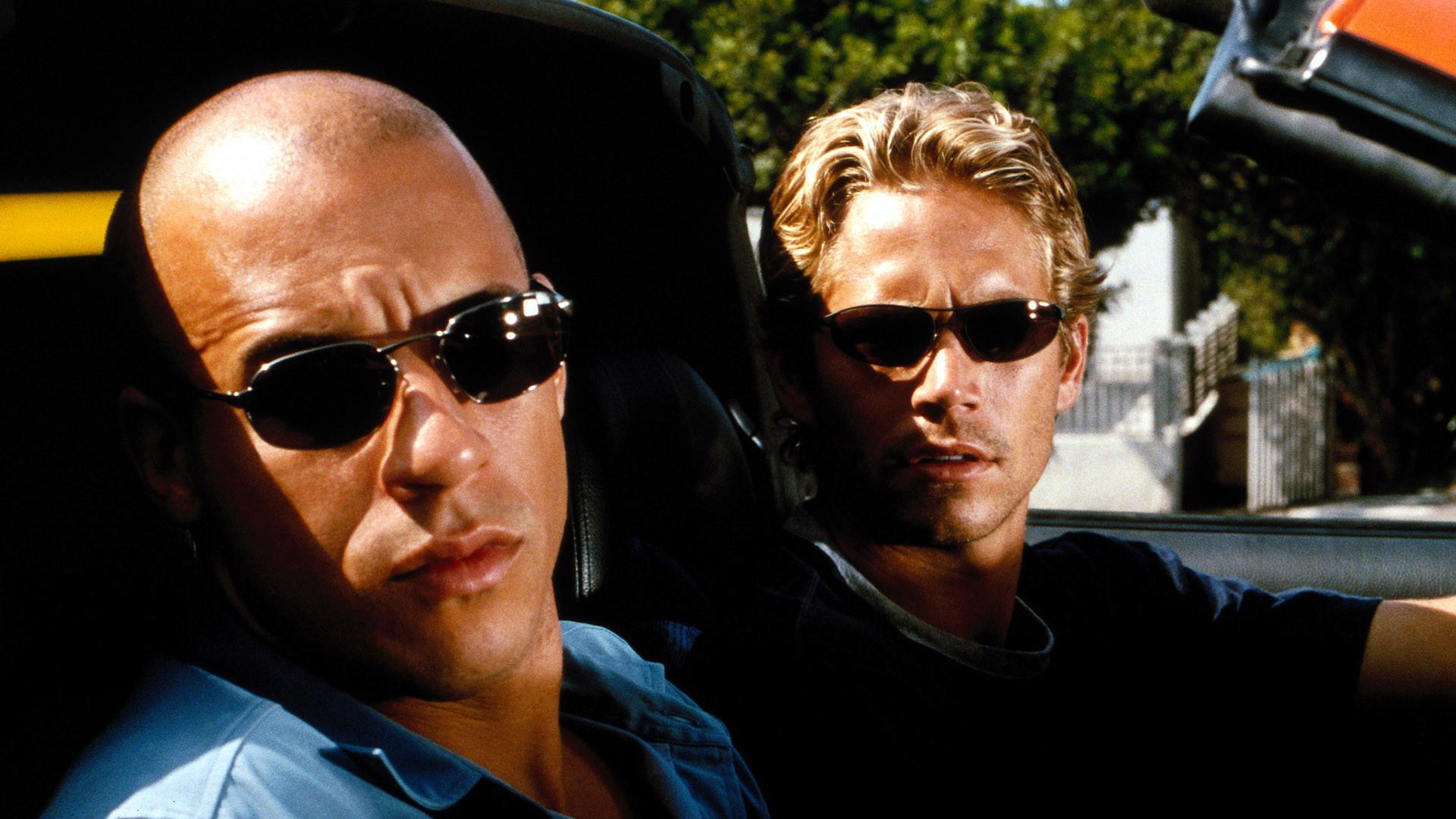
The Fast and the Furious (2001)

31 Saturday Jan 2015

Posted by dullwood68 in Movies

≈ Leave a comment

Tags

Action, Brian O'Conner, Crime, Dominic Toretto, Drama, Hijackings, Jordana Brewster, Michelle Rodriguez, Paul Walker, Race Wars, Review, Rob Cohen, Street racing, Thriller, Undercover cop, Vin Diesel

Fast and the Furious, The

D: Rob Cohen / 106m

Cast: Vin Diesel, Paul Walker, Michelle Rodriguez, Jordana Brewster, Rick Yune, Chad Lindberg, Johnny Strong, Matt Schulze, Ted Levine, Ja Rule, Vyto Ruginis, Noel Gugliemi, Reggie Lee

In Los Angeles, a gang of thieves are hijacking trucks using heavily modified Honda Civics. Sent undercover to find out who is behind the thefts, cop Brian O’Conner (Walker) infiltrates the street racing scene, making a particular impression at Toretto’s Market where he flirts with Mia Toretto (Brewster). This angers Vince (Schulze) who is attracted to Mia and is part of Dominic Toretto (Diesel)’s crew (Dominic is the focus of Brian’s investigation). Vince and Brian fight but Dominic breaks it up. Later, Brian turns up at a street race and bets his car’s pink slip that he can beat Dominic, but he loses. The police arrive to break up the event and Brian sees a chance to get into Dominic’s good books: he helps him get away.

They find themselves in territory controlled by Dominic’s old rival, Johnny Tran (Yune) and his cousin Lance (Lee). Johnny blows up Brian’s car, leaving him to find a “ten-second car” for Dominic. He finds a wrecked Toyota Supra and brings it to Dominic’s garage where he starts to restore it; he also begins dating Mia. Evidence points toward Tran being responsible for the hijackings, but a raid on Tran’s property reveals the goods Brian has seen there to have been legally purchased. With Tran no longer a suspect, Brian begins to believe that Dominic and his crew are responsible.

A street racing event, Race Wars, sees Dominic’s friend, Jesse (Lindberg) lose a race with Tran. Jesse flees with the car he should have handed over. Tran demands Dominic find the car and bring it to him, but Dominic is less than accommodating. Instead of looking for Jesse, Dominic and his team (who are the thieves), attempt a heist in order to help get Jesse out of Tran’s debt. But the heist goes wrong, and when Vince is badly injured, Brian breaks his cover to get him help.

Brian later attempts to arrest Dominic but he’s interrupted by the return of Jesse, who is killed by Tran and Lance in a drive-by shooting. Dominic and Brian both go after them, and it leads to a desperate chase through the streets and Brian making the toughest decision of his police career.

Fast and the Furious, The - scene

Back in 2001, the idea that this modest, straight-shooting actioner would spawn six sequels, and that they would be increasingly successful – so much so that the fifth sequel in the series, Fast & Furious 6 (2013) would gross over $750 million worldwide – seemed an unlikely one. The cast weren’t exactly household names, the director had made a modest success of Dragon: The Bruce Lee Story (1993) but again wasn’t very well known, and the concept of street racing as a backdrop for criminal activity involving high-speed cars didn’t sound that exciting.

And yet the movie was – and remains – a pleasant surprise, not quite as high-octane as some of its successors, but (if it’s at all possible) more grounded and less reliant on being over the top. The car chases and vehicular action sequences are all well-staged and expertly choreographed, but there’s a lot of attention paid to the characters, and their milieu is entirely credible. With the groundwork providing a solid basis for the action, the movie is free to examine notions of brotherhood, loyalty, respect, and most of all, family, with Dominic in the role of pater familias.

All this offsets some of the sillier aspects of the script – Brian’s superiors behave like they’ve had a collective tyre iron shoved somewhere uncomfortable, and make noises like spoilt children; the final heist is attempted on one of those long American roads that no one else travels along – and helps make the movie more than just a collection of scenes that car fetishists will replay over and over again. The cars are spectacular, and the street racing scenes do have a raw energy to them, but it’s the growing bromance between Dominic and Brian that takes centre stage and proves the most enjoyable element, as the gruff, laconic mechanic-cum-street-racer-cum-hijacker takes the foolhardy policeman under his wing and welcomes him into a world he barely knew existed. It’s a little too neat that Brian keeps Dominic out of jail and places his own career in jeopardy, and Brian’s reasons for doing so are never adequately explained, but within the confines of the movie it still, somehow, works.

As ever, Diesel does brooding with his usual menacing insouciance, while Walker is all tousled curls and winning smile, but not quite the fully formed character the movie needs (though this is due more to the script by Gary Scott Thompson, Erik Bergquist and David Ayer than Walker’s actual performance). On the distaff side, Rodriguez is as ballsy as you’d expect, and Brewster provides a softer contrast, though in most respects their characters serve as eye candy with dialogue (again a problem with the script). Of the supporting cast, only Schulze makes any real impression, and it soon becomes clear that none of the rest are going to return in later instalments.

Similarities to Point Break (1991) are pretty obvious, but The Fast and the Furious is still its own thing, a turbo-charged action movie that Cohen has fun with, changing gears with gusto and setting up several moments where the audience can say “wow!” and not feel embarrassed immediately afterward. There’s a terrific score by BT that fuses industrial, hip-hop and electronica and perfectly suits the movie’s mise en scene, as well as providing a propulsive background to some of the car sequences. And if not all the car stunts seem likely, it’s worth bearing in mind the physics-defying absurdity of some of the movies that followed.

Rating: 7/10 – a solid, unpretentious beginning to the franchise, The Fast and the Furious is one of those guilty pleasures guaranteed to put a smile on your face – every time; fast moving and tense, the movie aims for thrills and spills and doesn’t disappoint.

Share this:

  • Click to share on X (Opens in new window) X
  • Click to share on Facebook (Opens in new window) Facebook
  • More
  • Click to print (Opens in new window) Print
  • Click to email a link to a friend (Opens in new window) Email
Like Loading...

Ex Machina (2015)

30 Friday Jan 2015

Posted by dullwood68 in Movies

≈ 1 Comment

Tags

Alex Garland, Alicia Vikander, Artificial intelligence, Domhnall Gleeson, Drama, Oscar Isaac, Review, Robots, Sci-fi, The Turing Test, Thriller

Ex Machina

D: Alex Garland / 108m

Cast: Domhnall Gleeson, Alicia Vikander, Oscar Isaac, Sonoya Mizuno

Caleb (Gleeson) is a computer coder who works for a large corporation owned by Nathan (Isaac). He wins a company raffle that involves spending a week at Nathan’s home, which is located in the midst of a vast countryside estate. On arrival he is given a key pass by an automated door system, and finds Nathan inside working out. Nathan soon reveals that he has been working on an experiment and that Caleb is there to conduct the Turing test on a robot with artificial intelligence called Ava (Vikander). Caleb’s job is to determine whether or not Ava could pass for human.

That night Caleb discovers that the TV in his room is actually a monitor that allows him to view Ava in her room. There is a power failure and Caleb is unable, temporarily, to leave his room; when he does he finds Nathan has been drinking and not in the best frame of mind. The next morning, Caleb is awakened by a Japanese girl called Kyoko (Mizuno); she doesn’t speak English, a benefit for Nathan as he can speak freely about his work. Caleb spends time with Ava and as they begin to get to know each other it becomes clear she is flirting with him. During another power failure Ava warns Caleb not to trust Nathan, and that he has been lying to him. As Ava begins to make herself more attractive to Caleb, he begins to wonder if Nathan has made this part of her programming all along.

Nathan lets Caleb see his laboratory, where he made Ava and mapped out her brain function. He insists Ava’s responses must be genuine, and reminds Caleb that if they are then the results of the Turing test must be positive. Later, Nathan gets completely drunk and when Caleb takes him to his room, he spies some cupboards and what looks like an “observation” room. When Caleb asks what will happen if Ava fails the test, Nathan is blunt: she will be updated and her memory will be erased. Caleb is upset by this prospect, and when Nathan gets drunk a second time, Caleb uses Nathan’s key pass to enter the observation room. There he sees footage that shows Nathan has been building robots like Ava for some time. He also looks in the cupboards and finds the discarded robots hanging up like old suits. When Caleb has his next meeting with Ava he tells her he has a plan for both of them to escape, and asks for her help. She agrees, and the next night they put the plan into operation.

Ex Machina - scene

Working from an original script, writer/director Garland has fashioned an intriguing sci-fi thriller that asks the question, can an artificial being truly possess human qualities, particularly real emotions. In asking that question, Ex Machina quickly becomes a guessing game for the audience, or as an old advert used to put it: is it live or is it Memorex? The answer, despite some wrong-footing and a few twists and turns in the narrative, is no, but with a caveat: there’s no answer to the further question of how Ava comes to fake the emotions she does display.

It’s unfortunate for what is otherwise a skilfully constructed and intelligent science fiction drama that when we first meet Ava she’s as self-assured and poised as she is at the movie’s end. This leaves the audience feeling that she’s been playing Caleb all along, and that the whole notion of the Turing test is irrelevant; if Nathan is as brilliant as he seems to be, he’d know already how far her development has taken her. And why go to the trouble of getting Caleb to visit him (the raffle is rigged) when it’s also clear that as clinical trials go, the parameters are so loose? In the end it boils down to who is the most manipulative – Nathan or Ava.

This conundrum aside, Garland shows a keen appreciation for his subject matter, creating a robot concept in Ava that makes physical as well as an aesthetic sense, and which allows the viewer to be reminded that she is, ultimately, a construct, not real and not able to function in the same way as humans, and even if latex skin is applied where and when necessary. This keeps the audience at a distance from her, while making Caleb all the more curious about the possibilities should she pass the Turing test. It’s a neat balancing act, and one that Garland keeps up throughout, even if he’s forced by his own script to step down from it by the expected denouement.

The look and feel of the movie is very Seventies, the austere, below level laboratory complex a maze of plain walls and functional furniture. Only Nathan’s own personal living quarters look and feel like part of the “real” world. In the end, the coldness of the laboratory area reflects Ava’s personality, and at the same time acts as a catalyst for her and Caleb’s escape – in such drab surroundings and being so confined, is it any wonder she wants to leave?

The motivations of all three main characters remain constant throughout, with Caleb’s naive, white knight demeanour expertly exploited by both Ava and Nathan, while creator and created share an antipathy toward each other that borders on hatred (on Ava’s part) and disdain (on Nathan’s part). All three actors give excellent performances, with Vikander warranting particular merit for the fine line she treads as Ava, making her both remote and alluring at the same time. Gleeson handles a role that could have been completely vanilla in comparison, but his pale features generate a mass of conflicting feelings and thoughts throughout. Isaac is the blunt force object of the trio, his stocky, powerful frame proving as muscular as his mind. As with Ava it’s a shame that Nathan operates at the same level for the duration of the movie, but it’s a compelling performance nevertheless.

Ex Machina - scene2

Garland proves to be a confident, accomplished director, gauging the performances with aplomb, and staging each scene with an economy of style and movement that greatly enhances the somewhat stoic pace and increasing tension. He’s aided greatly by cinematographer Rob Hardy and production designer Mark Digby, creating a futuristic environment for the science fiction aspects along side the wider marvels of the outside world Ava is so keen to see. There is the occasional narrative stumble – at one point, Caleb becomes convinced he’s like Ava and takes a slightly extreme approach to finding out one way or the other; Ava’s need to recharge her batteries would seem to preclude a proper escape – but on the whole, the script avoids the usual pitfalls such material engenders and has enough sense not to push things too far in terms of what Ava can do. That she is recognisably human by the movie’s end (at least to look at) is the movie’s ultimate triumph, reminding us that how we look on the outside is not as important as how we feel on the inside.

Rating: 8/10 – a sci-fi drama fused with metaphysical elements, Ex Machina is the first time in ages where science fiction themes have been treated with respect and intelligence; still, it’s not for everyone due to its pace and lack of perceived action, but on an emotional level it’s definitely punching above its weight.

Share this:

  • Click to share on X (Opens in new window) X
  • Click to share on Facebook (Opens in new window) Facebook
  • More
  • Click to print (Opens in new window) Print
  • Click to email a link to a friend (Opens in new window) Email
Like Loading...

Mandrake, the Magician (1939) – Chapter 4: The Secret Passage

27 Tuesday Jan 2015

Posted by dullwood68 in Movies

≈ Leave a comment

Tags

Al Kikume, Columbia, Doris Weston, Drama, Lothar, Magician, Mandrake, Mill River Inn, Norman Deming, Platinite, Professor Houston, Radium machine, Regan, Review, Rex Downing, Sam Nelson, Serial, The Wasp, Thriller, Warren Hull

Mandrake, the Magician

D: Sam Nelson, Norman Deming / 17m

Cast: Warren Hull, Doris Weston, Al Kikume, Rex Downing, Edward Earle, Forbes Murray, Kenneth MacDonald, Don Beddoe, John Tyrrell, Sam Ash

Narrowly escaping from the collapsing radio station (and without a scuff mark between them), Mandrake and Betty return to her home. With Dr Bennett and Webster present he lets them know that he’s going to focus his investigation on finding Regan, the man who impersonated Professor Leland. He heads over to his friend Raymond’s magic store to see if he has any information but Raymond draws a blank. Coincidentally, Tommy Houston is there for a junior magician’s meeting, and is met by Betty. After Mandrake has left they overhear two of the Wasp’s gang in the store talking about Regan. Tommy hides in the boot of their car and learns Regan’s whereabouts.

He manages to jump out of the car without being seen and makes it back to Mandrake’s apartment where he tells Mandrake where he can find Regan, a place called the Mill River Inn. Mandrake and Lothar head there straight away and ambush Regan just as he’s about to go on stage. While Lothar ties up Regan and takes him back to their car, Mandrake disguises himself as Regan and performs his act. But the Wasp’s henchmen find out about Mandrake’s presence at the inn and arrive to take Regan away. Megan escapes from Lothar and Mandrake is attacked by the Wasp’s men. They corner him at the top of a staircase and force him over the railing and down on to a mill wheel that rotates downward with Mandrake unconscious on it.

vlcsnap-00005

With a bit more purpose about it, Chapter 4: The Secret Passage has the shortest running time so far (and the first three minutes are a recap of Chapter 3), but it at least shows Mandrake being a bit more proactive than in the last episode. It’s still heavily reliant on coincidence and people overhearing other people in order to propel things forward – if the Wasp’s henchmen weren’t such blabbermouths Mandrake wouldn’t find out anything – and contains a couple of obligatory fight scenes (Mandrake takes on three goons in his apartment and only thinks to involve the police when he’s caught two of them). And it gives Downing, as Tommy, a chance to get involved as well, after spending the first three episodes largely in the background (and looking bored).

At the Mill River Inn, Mandrake’s magic act involves a tablecloth that deposits a lot of cutlery on the floor, a basket of flowers that appear from under it as well, and a variation on the Indian rope trick (which is strangely ineffectual). It’s a reminder of the character’s background, or day job, but the tricks shown are more in line with Tommy’s junior magician group than someone who’s meant to be the world’s greatest magician. It’s the first episode where the Wasp doesn’t make an appearance on the big TV screen in his gang’s hideout and instead, literally, phones in his orders, and there’s no car chase in the countryside. And while it’s Mandrake in peril at the end this time, it’s probably a fair bet that he’ll wake up just in time to save himself.

Rating: 5/10 – another solid entry that, briefly, gives Mandrake the upper hand, Chapter 4: The Secret Passage doesn’t feature a secret passage, and doesn’t give any further clues to the Wasp’s real identity (though the word “moustache” might give it away); still ticking over, the serial meanders ever onwards in search of a more exciting series of events to satisfy its audience.

Share this:

  • Click to share on X (Opens in new window) X
  • Click to share on Facebook (Opens in new window) Facebook
  • More
  • Click to print (Opens in new window) Print
  • Click to email a link to a friend (Opens in new window) Email
Like Loading...

Mini-Review: The Calling (2014)

23 Friday Jan 2015

Posted by dullwood68 in Movies

≈ Leave a comment

Tags

Canada, Crime, Donald Sutherland, Drama, Ellen Burstyn, Fort Dundas, Gil Bellows, Jason Stone, Literary adaptation, Murder, Religion, Review, Serial killer, Susan Sarandon, Thriller, Topher Grace

Calling, The

D: Jason Stone / 108m

Cast: Susan Sarandon, Gil Bellows, Ellen Burstyn, Topher Grace, Christopher Heyerdahl, Donald Sutherland, Kristin Booth, Ella Ballentine, Jane Moffat

Asked to look in on an old woman as a courtesy, Fort Dundas police inspector Hazel Micallef (Sarandon) finds the woman has been murdered, her throat cut and her mouth manipulated to make it look like she’s screaming. With help from fellow detective Ray Green (Bellows) she begins to investigate the murder but when another victim is discovered in similar circumstances, she begins to suspect a serial killer is responsible. She asks for help on the case and is sent Ben Wingate (Grace), an officer from Toronto; he’s a bit wet behind the ears but eager to help.

As previous victims are identified, Hazel discovers a religious aspect to the murders. She consults with Father Price (Sutherland) who tells her of a biblical portent that relates to the belief in the resurrection of the dead through the sacrifice of twelve willing individuals. Further murders occur but clues lead to a man named Simon (Heyerdahl); they also show the trail he appears to be taking across the country and the way in which he chooses his victims. Armed with this knowledge, Hazel takes a risk and sends Wingate to the home of Simon’s next intended victim…

Calling, The - scene

Pitched somewhere between Fargo (1996) and Se7en (1995), The Calling is a serial killer movie that, like many others before it, takes a biblical angle and makes it sound preposterous. It’s always difficult to provide a religious-minded serial killer with an entirely plausible reason for their actions, but this movie, with its otherwise cleverly constructed script by Scott Abramovitch (based on Inger Ash Wolfe’s novel), has a hard time making Simon’s motive credible, and fares even less well when it comes to the sacrificial elements – why does his victims have to be killed so horribly? It’s all too confusing and muddled to work properly and hampers a movie that goes about its business with a moody, unrelenting seriousness.

There’s a sterling performance from Sarandon as a detective with a drink problem, but even she can’t avoid comparisons with Frances McDormand in Fargo – though her level of world-weariness is more pronounced. Bellows and Grace offer solid support, as does Burstyn as Hazel’s over-protective mother, but it’s Heyerdahl who makes the most impact, his portrayal of Simon both unnerving and chilling in its quiet intensity. One scene with the daughter of a waitress is so unsettling it’ll stay with you long after the rest of the movie has faded from your memory. Stone directs with the eagerness of someone making their first feature (which he is), but reigns in the desire to show off and throw in everything including the kitchen sink. He has a pleasingly straightforward approach to framing and composition, and isn’t afraid to embrace some of the more awkward plot developments (basically, anything involving Sutherland). It’s a confident outing for Stone, but sadly, it only gets him so far.

Rating: 5/10 – an interesting premise that’s let down by its own explanation, The Calling is left feeling overcooked and underwhelming; fans of this sort of thing will see the final scene coming from a mile off, while anyone else will have lost any initial enthusiasm once Hazel consults with Father Price.

Share this:

  • Click to share on X (Opens in new window) X
  • Click to share on Facebook (Opens in new window) Facebook
  • More
  • Click to print (Opens in new window) Print
  • Click to email a link to a friend (Opens in new window) Email
Like Loading...

Mandrake, the Magician (1939) – Chapter 3: A City of Terror

20 Tuesday Jan 2015

Posted by dullwood68 in Movies

≈ Leave a comment

Tags

Al Kikume, Columbia, Doris Weston, Drama, Lothar, Magician, Mandrake, Norman Deming, Platinite, Professor Houston, Radium machine, RBS Radio Station, Review, Sam Nelson, Serial, The Wasp, Thriller, Warren Hull

Mandrake, the Magician

D: Sam Nelson, Norman Deming / 19m

Cast: Warren Hull, Doris Weston, Al Kikume, Rex Downing, Edward Earle, Forbes Murray, Kenneth MacDonald, Don Beddoe, John Tyrrell, Sam Ash

With Betty in a lift that’s hurtling out of control, and Mandrake and Lothar left to face a room filling up with steam, it looks as if the Wasp has finally won. But Mandrake turns off the steam and the lift’s automatic brake kicks in. The man who tried to abduct Betty is captured and Mandrake takes him back to his apartment where he holds him captive. He returns to the home of Professor Houston where he tells Webster and Dr Bennett that he plans to interrogate the man the next morning; the Wasp’s men, led by Dirk (Tyrrell), learn of his plan via the transmitter they have placed at Houston’s home.

The next morning, Mandrake begins to interrogate the Wasp’s henchman with the use of some of his stage props, frightening the man into talking. But as he does he’s killed by a blowdart fired through the window by another of the Wasp’s gang. The Wasp then devises a plan to kidnap Mandrake by arranging for a man called Regan (Ash) to impersonate the famous stage hypnotist Professor Leland. He calls on Mandrake and hypnotises him. But Mandrake is aware of the deception and only pretends to be under  Regan’s influence. Through this he learns that Betty has been given news that if she goes to the RBS radio station control room she’ll gain some information about her father. It’s a trap, though, with the Wasp intending to use the radium machine to blow up the station.

Mandrake escapes from Regan with the aid of Lothar and they rush to the station. The magician makes it to the control room just as the Wasp targets it. As the building collapses around them, Mandrake and Betty are trapped in the control room with no way out.

vlcsnap-00003

With three chapters down and nine more to go it’s obvious that the writers are going to be content to keep things ticking over, and that it’s likely to be some time before the storyline is advanced any further from where it is now. It seems that as long as Mandrake gets into at least a couple of punch-ups, and there’s a car chase that takes place outside the city on predictably deserted roads then all’s well and good. And yet, in a strange way, it is good. Already, watching each chapter is like catching up with a friend you haven’t seen for a while. And Hull has a deceptive charm about him that makes Mandrake’s cock-sure sincerity as pleasing to watch as it must have been to play.

There are some strange moments to be found, though. The main one is the Wasp’s decision to lure Betty to the radio station in order to kill her. There’s no attempt by the Wasp to put pressure on her father by threatening to do all this – the Wasp just does it (and with no preamble). And having the man with the blowdart clambering around on the ledge outside  Mandrake’s upper-storey apartment proves laughable rather than thrilling (and lucky for him that Mandrake always keeps a window open). Other questions remain: how long will it be before the transmitter is found, and when Betty and Mandrake escape from the collapsing radio station, will it be with barely a scuff mark between them? Stay tuned, folks, to find out!

Rating: 5/10 – a little more encouraging, though still keeping things in a holding pattern, Chapter 3: A City of Terror is another engaging episode full of unlikely twists and turns and crazy developments; worth watching if only for the “brilliant” scene where Mandrake outlines his plans to his male associates, while the lone woman (Betty) says nothing and is left to play with a pencil.

Share this:

  • Click to share on X (Opens in new window) X
  • Click to share on Facebook (Opens in new window) Facebook
  • More
  • Click to print (Opens in new window) Print
  • Click to email a link to a friend (Opens in new window) Email
Like Loading...

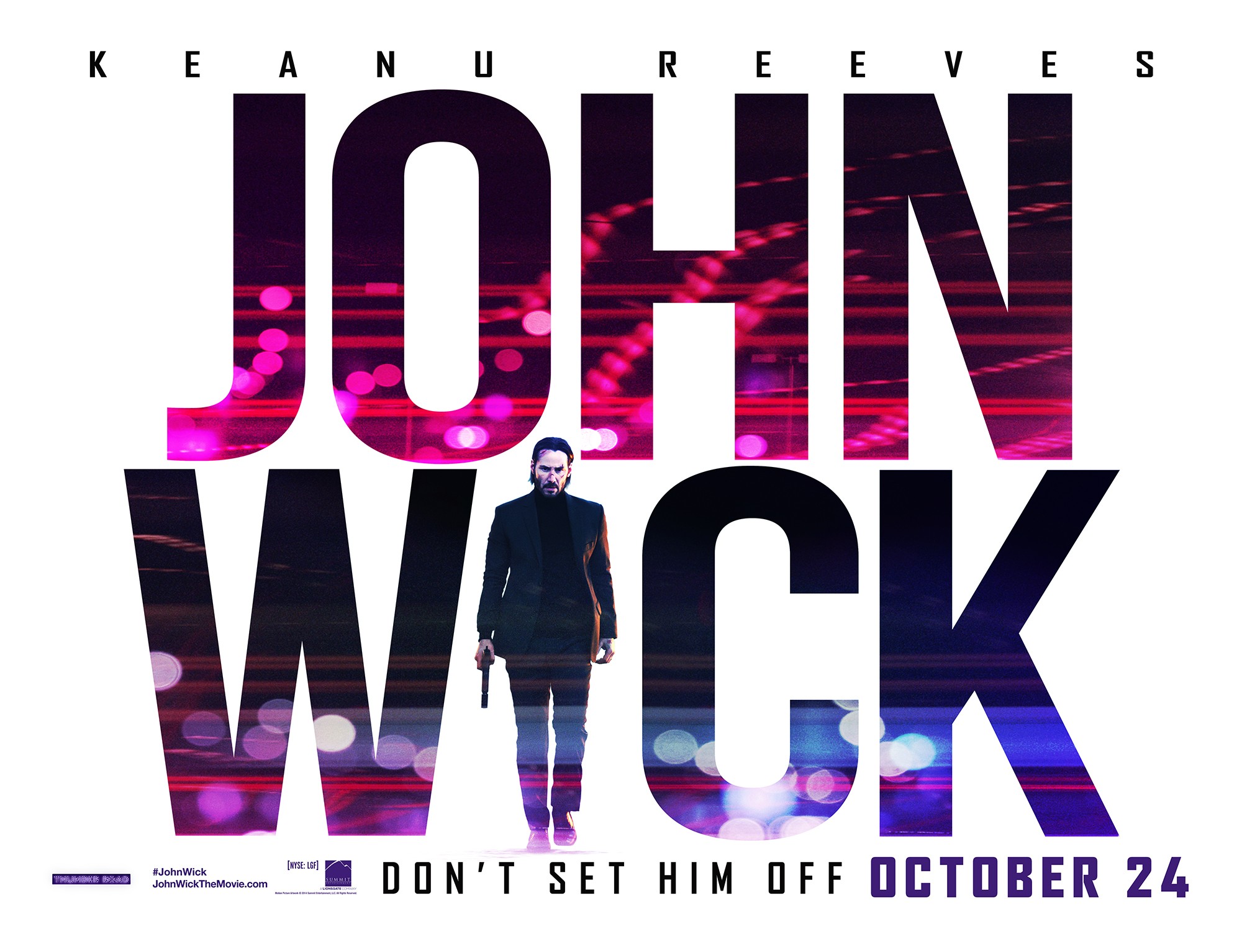
John Wick (2014)

15 Thursday Jan 2015

Posted by dullwood68 in Movies

≈ 7 Comments

Tags

Action, Adrianne Palicki, Assassin, Chad Stahelski, David Leitch, Dead wife, Drama, Keanu Reeves, Michael Nyqvist, Revenge, Review, Russian Mafia, Thriller, Willem Dafoe

John Wick

D: Chad Stahelski, David Leitch / 101m

Cast: Keanu Reeves, Michael Nyqvist, Alfie Allen, Willem Dafoe, Dean Winters, Adrianne Palicki, Toby Leonard Moore, Daniel Bernhardt, Omer Barnea, Lance Reddick, Ian McShane, John Leguizamo, Bridget Moynahan

Having lost his wife, Helen (Moynahan), to an unexpected illness, retired assassin John Wick (Reeves) receives a posthumous gift from her: a puppy called Daisy. They begin to bond, and Wick takes her with him when he travels anywhere. At a gas station one day, Wick encounters a trio of Russian gang members; their leader, Iosef (Allen) asks to buy his car but Wick rebuffs him. Later that night, the trio break into Wick’s home, beat him up, kill Daisy, and make off with his car. While he recovers, Iosef takes the car to a chop shop run by Aurelio (Leguizamo) but he refuses to have anything to do with Iosef or the car. Wick visits Aurelio and learns that Iosef is the son of his former boss, Viggo Tarasov (Nyqvist). When Viggo finds out what his son has done, he’s less than happy; he tells Iosef that Wick was the best hitman in the business, not the boogeyman, but the man you sent to kill the boogeyman.

Viggo attempts to placate Wick but has no luck. He sends a hit squad to kill Wick at his home but Wick despatches them all. Viggo then puts out an open contract for $2 million on Wick, and approaches Marcus (Dafoe), Wick’s mentor, directly; Marcus agrees to take the job. Meanwhile, Wick checks in to the Continental, a hotel run by Winston (McShane) that caters to assassins. Wick learns that Iosef is being protected at a nightclub called Red Circle. He goes there but is stopped from killing Iosef by the intervention of Viggo’s enforcer Kirill (Bernhardt). Wounded, he returns to the hotel where he is attacked by fellow assassin Ms Perkins (Palicki). Overpowering her, he forces her to tell him where Viggo keeps both his private papers and the bulk of his personal cash.

The papers and cash are in a church vault; Wick burns it all. When Viggo arrives, Wick ambushes him and his men, but Kirill uses an SUV to knock Wick unconscious. Taken to an abandoned warehouse and tied up, Viggo remonstrates with Wick over his idea that he could ever lead a normal life. He leaves Wick to be killed by Kirill, but things don’t turn out as he expects.

John Wick - scene

A revenge movie with a distinctive visual style, John Wick is a huge breath of fresh air in a genre that often feels stodgy and underwhelming, and which often relies on rapid cross-cutting and headache-inducing editing tricks to give energy to its action scenes. This definitely isn’t the case here, with directors Stahelski and Leitch’s background as stunt coordinators bringing an impressive edge to the fight sequences, as they bring a whole new meaning to the phrase “gun-fu”.

Even more impressive than the action is the world created by the directors and writer Derek Kolstad. It’s at such a remove from our own world that it seems to operate independently, with its own rules and hierarchies. The Continental is a case in point, an establishment that allows no “business” on its premises, and inflicts the severest of penalties if that rule is ignored. It’s a world where respect and a person’s reputation carry as much caché as money, and where John Wick has the most respect of anyone. It’s also a world that appears bleached of positive feeling, where people hide behind polite, expressionless façades but are quick to display fear, anger and mistrust. And it’s a criminal underworld that mixes old-fashioned codes of conduct with a modern disregard for them when necessary. Against this, Wick acts like an old time vigilante, dismantling Viggo’s business and men with grim determination and no shortage of inner rage. And even though he’s not as invulnerable as he once was, he’s still the ne plus ultra of assassins.

With the world he inhabits so clearly defined, Wick strides through it like a colossus, giving Reeves his most commanding role for years. After non-starters Generation Um… (2012), Man of Tai Chi (2013) and 47 Ronin (2013), it’s good to see Reeves back on form, playing Wick with a taciturn, single-minded demeanour that suits him perfectly as an actor. His brief scenes with Moynahan also show convincingly the other John Wick, the loving husband and all-round “normal” guy. It’s a great performance, and one that’s given more than adequate support by the likes of Nyqvist, Dafoe and Palicki, all relishing their roles and the wonderfully expressive dialogue Kolstad has provided them with. The cast are obviously having a great time with the material, and it’s not surprising that this helps boost the audience’s enjoyment as a result. The interplay between Wick and Viggo is particularly effective, operating on several levels at once, and imparting more emotion than would normally be expected.

As for the action scenes these are tremendously shot and edited, full of fluid tracking shots, and with Reeves in the thick of it all, punching, kicking and blasting away with vicious, yet detached intent, and shooting more people in the head than probably any other hitman in movie history. One extended sequence, at the Red Circle nightclub, is as inventive and as thrilling as any action sequence in recent memory. Using their experience as stunt co-ordinators, Stahelski and Leitch (who thanks to the Directors Guild of America isn’t credited on the movie), keep the fight scenes breathtaking and immersive, and there’s not one moment during any of them where the viewer isn’t fully aware of what’s happening and who’s doing what to whom (something that Taken 3, for example, avoids doing throughout its disheartening running time).

In keeping with the overall mise en scene, the production design by Dan Leigh helps to reinforce the idea of a separate world where all this takes place, and is gloriously lensed by Jonathan Sela. The action is complemented by a pulsing, propulsive score by Tyler Bates and Joel J. Richard, and at times feels like it could be another of Wick’s opponents.

Rating: 8/10 – a modern day noir thriller that doesn’t pull its punches and has an emotional core that resonates throughout, John Wick is a wonderful surprise; with not an ounce of fat on it, and one of the tightest scripts of recent years, this is an action movie that constantly surprises and rewards in equal measure.

Share this:

  • Click to share on X (Opens in new window) X
  • Click to share on Facebook (Opens in new window) Facebook
  • More
  • Click to print (Opens in new window) Print
  • Click to email a link to a friend (Opens in new window) Email
Like Loading...

Mini-Review: Taken 3 (2014)

13 Tuesday Jan 2015

Posted by dullwood68 in Movies

≈ 1 Comment

Tags

Action, Dougray Scott, Famke Janssen, Forest Whitaker, Liam Neeson, Maggie Grace, Murder, Olivier Megaton, Review, Sequel, Thriller

Taken 3

D: Olivier Megaton / 109m

Cast: Liam Neeson, Forest Whitaker, Maggie Grace, Famke Janssen, Dougray Scott, Sam Spruell, Leland Orser, Jon Gries, David Warshofsky, Don Harvey, Dylan Bruno, Andrew Howard, Jonny Weston

When Bryan Mills (Neeson) receives a visit from his ex-wife Lenore, it’s because she wants to let him know she still has feelings for him, and that her marriage – to Stuart St John (Scott) – is on the rocks. Bryan tells her that they can’t be together while she’s still married. Stuart pays him visit as well and asks Bryan to stay away from Lenore while they try to sort out their marriage; Bryan tells him he will.

The next day, Lenore asks to meet Bryan at his place. When he gets there he finds she’s been murdered. The police arrive and try to arrest him but he escapes. He tells his daughter, Kim (Grace) what’s happened and vows to find Lenore’s killer. The police, led by Inspector Franck Dotzler (Whitaker), pursue Bryan while he tries to figure out the reason for Lenore’s death. He learns that Stuart has hired personal bodyguards and, fearing Kim is in danger from Lenore’s killer and Stuart is somehow involved, he abducts Stuart and learns that he owes a lot of money to a Russian gangster named Oleg Malankov (Spruell), and that Lenore’s death was probably to make Stuart pay up. With the help of his ex-CIA colleagues (Orser, Gries, Warshofsky), Bryan goes after Malankov, intending to kill him.

Taken 3 - scene

And so, the law of diminishing returns rears its predictable head and helps bury yet another action franchise. It shouldn’t really be a surprise, as this was a movie that wouldn’t have been made if 20th Century Fox hadn’t wanted it in the first place. With that decision made, and with Neeson unwilling to star unless no one was actually “taken”, you can see how the project was doomed from the start. As it is, no one could have been prepared for just how little effort was going to be put in by all concerned. From the lazy, credibility-free script by Luc Besson and Robert Mark Kamen, to the wayward, unfocused direction by Megaton, to the headache-inducing, rapid cross-cutting of the action scenes, to the (mobile) phoned-in performances from a cast that should know better.

Just how bad is it? Two examples: Lenore is killed by having her throat cut, but when Stuart has to identify her at the morgue she clearly has a scar where the cut should be. And despite being “trapped” in an underground car park full of police, Bryan escapes with ease by driving through them all and exiting the car park – which the police haven’t thought to cordon off or block. There are plenty of other moments where the unfortunate viewer will be shaking their head in disbelief, and plenty of other moments where they’ll be wondering if it can get any worse – the answer is yes, it can.

Rating: 3/10 – a sad conclusion to an otherwise entertaining if always far-fetched action franchise, Taken 3 is a spectacular misfire that often defies explanation; if there is to be a fourth movie – and Neeson appears to be keen on the idea – then maybe the tag line will be It Really Does End Here… Probably.

Share this:

  • Click to share on X (Opens in new window) X
  • Click to share on Facebook (Opens in new window) Facebook
  • More
  • Click to print (Opens in new window) Print
  • Click to email a link to a friend (Opens in new window) Email
Like Loading...

Mandrake, the Magician (1939) – Chapter 2: Trap of the Wasp

13 Tuesday Jan 2015

Posted by dullwood68 in Movies

≈ Leave a comment

Tags

Al Kikume, Columbia, Doris Weston, Drama, Lothar, Magician, Mandrake, Norman Deming, Platinite, Professor Houston, Radium machine, Sam Nelson, Serial, The Wasp, Thriller, Trap of the Wasp, Warren Hull

Mandrake, the Magician

D: Sam Nelson, Norman Deming / 20m

Cast: Warren Hull, Doris Weston, Al Kikume, Rex Downing, Edward Earle, Forbes Murray, Kenneth MacDonald, Don Beddoe

Fighting one of the Wasp’s henchmen at the home of Professor Houston, Mandrake narrowly escapes death when the radium machine ignites a hydrogen tank. As he recovers, the henchman makes off with the radium machine. He and Lothar go after them in their car but it breaks down, sabotaged by the Wasp’s men using part of a magician’s trick. Mandrake has the sale of such an item traced – by his friend Frank Raymond (Beddoe) – to an Egyptian-looking man, and learns his address. But the Wasp is aware of Mandrake’s progress and sets a trap for him.

At the Egyptian man’s home, Mandrake is ambushed but manages to escape using a tear gas bomb. The Wasp’s gang, knowing he’ll be heading back to the home of Professor Houston, try to listen in using the radio transmitter they’ve hidden there, but it’s not working. One of the gang is sent to fix it. Shortly after he arrives, and while hidden, Mandrake reveals he has a small amount of platinite that he plans to place in his private bank vault later that night. Knowing the Wasp’s man is there, he also gives details of the route he’ll take.

Expecting to be intercepted, Mandrake allows himself to be captured. Followed to a building in the city by Lothar and Professor Houston’s daughter, Betty, he’s tied up and held in the basement. He frees himself and a fight ensues, one that Lothar joins while Betty waits in the lift that has brought them down to the basement. As the fight continues, one of the gang tries to abduct Betty in the lift, but when a power board is damaged it sends the lift hurtling upwards out of control.

vlcsnap-00001

Chapter two in the series can be fairly accurately described as filler. With Professor Houston and his radium machine having been taken, Mandrake has the flimsiest of clues to follow and both encounters with the Wasp’s men leads to a fight – with all the usual flailing fists and poorly executed rough and tumble. It’s the first chapter where Kikume gets involved in the fisticuffs, or rather his very obvious stunt “double” does; it’s fun to see Lothar transform from portly middle-aged man to a youthful, slimmer version with more physical dexterity.

There’s a brief car chase that was obviously filmed on a deserted studio lot, and the Wasp continues to give his orders via a giant TV screen, relaying information that points suspiciously to his identity being one of three people involved in helping Mandrake. It’s already easy to guess who it is, but that’s part of the fun, and keeps things interesting, seeing how long it will be before the Wasp’s true identity will be revealed. What the casual viewer might also be waiting for is the point at which Betty and her brother Tommy show any real concern about their father’s abduction, instead of being blithely reassured by Mandrake that he’ll be all right.

Rating: 5/10 – while not advancing the storyline in any way, and dialling down the peril, Chapter 2: Trap of the Wasp still has plenty of energy and vigour; a stepping stone then to the next chapter, which from the advanced trail, looks much more exciting.

Share this:

  • Click to share on X (Opens in new window) X
  • Click to share on Facebook (Opens in new window) Facebook
  • More
  • Click to print (Opens in new window) Print
  • Click to email a link to a friend (Opens in new window) Email
Like Loading...

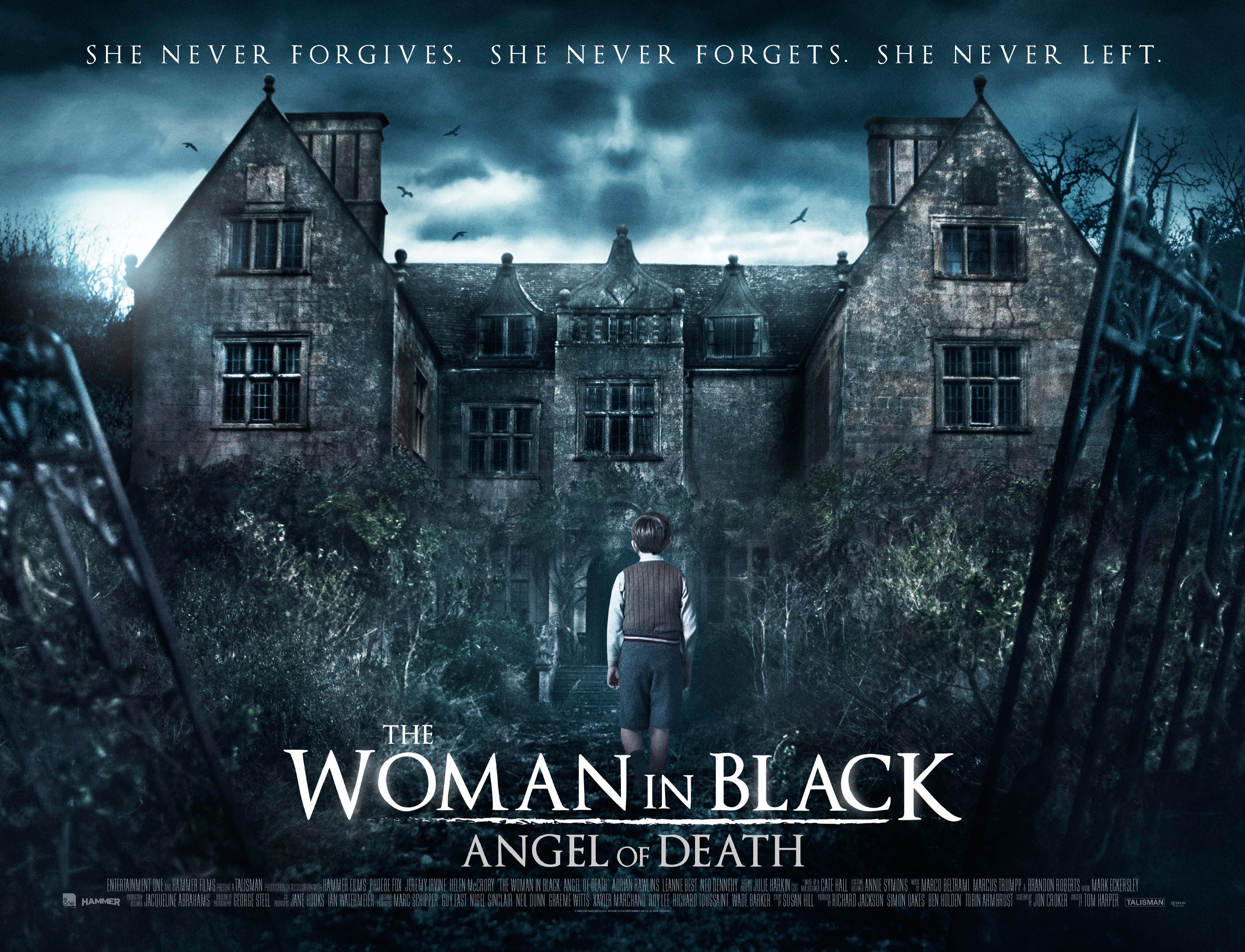
The Woman in Black: Angel of Death (2014)

07 Wednesday Jan 2015

Posted by dullwood68 in Movies

≈ 1 Comment

Tags

Crythin Gifford, Drama, Eel Marsh House, Evacuees, Haunting, Helen McCrory, Horror, Jennet Humpfrye, Jeremy Irvine, Review, Sequel, Susan Hill, Thriller, Tom Harper, World War II

Woman in Black Angel of Death, The

D: Tom Harper / 98m

Cast: Phoebe Fox, Jeremy Irvine, Helen McCrory, Oaklee Prendergast, Adrian Rawlins, Ned Dennehy, Amelia Crouch, Amelia Pidgeon, Casper Allpress, Pip Pearce, Leilah de Meza, Jude Wright, Alfie Simmons, Leanne Best

London, 1941. The Blitz has caused the evacuation of several schoolchildren along with their headmistress, Jean Hogg (McCrory) and their teacher, Eve Parkins (Fox). As they take the train to their destination of Crythin Gifford, Eve shares a compartment with RAF pilot Harry Burnstow who is on his way to a new posting at a nearby airfield. Met by local air raid warden Dr Rhodes (Rawlins), he takes them through the now deserted village where the bus has a puncture. While it’s repaired, Eve encounters a blind man, Jacob (Dennehy) who warns her that she and the children will never escape “her”.

At Eel Marsh House, the two women and their charges settle in. Eve has a bad dream that leads to her seeing a woman dressed all in black (Best). The figure vanishes, but the next day, one of the children, Edward (Prendergast), who has been mute since the death of his parents in an air raid, is locked in the nursery by two other children, and sees the woman in black. Afterwards, Edward carries a tattered doll around with him. That night, one of the boys who locked him in the nursery is led from the house by the woman in black; the next morning he’s found dead.

Another sighting of the woman in black in a graveyard leads Eve to discover her identity and the sad history of her child, Nathaniel. With Eve becoming even more convinced that they are all in danger, she battles to convince Jean that they should all leave as soon as possible. An air raid sees the woman in black claim another victim, and with the aid of Harry, they head for the airfield where he’s based. While they wait for the morning to come, Edward is spirited away back to Eel Marsh House. Eve refuses to leave him behind and makes her way back to rescue him.

Woman in Black Angel of Death, The - scene

Set forty years after the events of The Woman in Black (2012), this unnecessary sequel fails to match the quality and all-round scariness of its predecessor, and thanks to a badly constructed screenplay by Jon Croker, almost reduces its titular character to making little more than a cameo appearance.

The success of the original always meant there would be a sequel, and with the decision to set the new story during World War II it seemed as if the makers had come up with an idea that would avoid the usual horror sequel inanity that most follow ups suffer from. Alas, the wartime setting is the only good idea the makers have come up with, and the rest of the movie is as turgid and predictable and run-of-the-mill as any other horror sequel.

With the woman in black’s story told in the first movie, its resurrection here feels like padding in a movie that repeats various shots and sequences in an attempt to promote a sense of menace that never really pays off. Eve has the same nightmare over and over, and while it replays with different outcomes (including a bone-wearying appearance from you-know-who on one occasion), and serves to provide Eve with a back story of her own, the script’s intention for it to be as scary as what’s happening in Eel Marsh House never pans out. Likewise, the oft-repeated shot looking upward at the hole in the ceiling above Edward’s bed – will we glimpse the woman in black there? – is played over and over and becomes tiresome in the extreme.

That a potential franchise has run out of steam so soon may not be surprising to some, but the strength of the original in comparison to this outing is too evident for any other analysis. As a main character, Eve is too blandly presented to have much of an impact, and the viewer has a tough time sympathising with her or her predicament, even when mad, blind Jacob has her temporarily imprisoned. The same goes for the character of Jean, the rationalist who denies the supernatural until it’s literally staring her in the face (and then is all nice and apologetic). Both Fox and McCrory are more than capable actresses, but even with their talents they’re unable to raise their performances above the level of perfunctory. Worse still is Harry, a character so unimaginatively drawn that Irvine is unable to add any colour or flesh him out to an extent that would make him more interesting.

As for Jennet Humpfrye herself, the movie places her firmly in the background, giving her less exposure and as a result, making her less menacing. As a supposedly single-minded, revenge-oriented character she’s remarkably relaxed in her efforts to kill the children placed so conveniently in her home (especially after forty years). And with the change in actress – Best taking over from Liz White – the look and design of the woman in black has been altered somewhat, with Jennet looking younger and less intimidating behind her veil. It’s a sign that not all’s well, that the movie’s primary source of scares and shocks is not as effectively rendered as before (and perhaps this is why we see so little of her, the makers realising how tame her appearance looks in comparison).

To make matters worse the interiors of Eel Marsh House are gloomily lit and make it difficult to see what’s going on when the action takes place at night, while the exteriors are equally bleak and forlorn. It’s all done for the sake of atmosphere but makes the movie an unappealing viewing experience nevertheless. Orchestrating it all, Harper forgets to imbue the movie with a sense of credible peril, and one jump scare aside, defaults on the terror as well. It all leads to an ending that is rushed and dramatically unsatisfactory, and reinforces the feeling that the makers could have done a whole lot better.

Rating: 4/10 – a movie that plays at being scary but doesn’t deliver, The Woman in Black: Angel of Death aims high but succeeds only in being mediocre; a poor effort by all concerned, and one that (hopefully) will discourage a further movie from being made.

Share this:

  • Click to share on X (Opens in new window) X
  • Click to share on Facebook (Opens in new window) Facebook
  • More
  • Click to print (Opens in new window) Print
  • Click to email a link to a friend (Opens in new window) Email
Like Loading...

Mandrake, the Magician (1939) – Chapter 1: Shadow on the Wall

06 Tuesday Jan 2015

Posted by dullwood68 in Movies

≈ 2 Comments

Tags

Al Kikume, Columbia, Doris Weston, Drama, Lothar, Magician, Mandrake, Norman Deming, Platinite, Professor Houston, Radium machine, Review, Sam Nelson, Serial, The Wasp, Thriller, Warren Hull

Mandrake, the Magician

D: Sam Nelson, Norman Deming / 30m

Cast: Warren Hull, Doris Weston, Al Kikume, Rex Downing, Edward Earle, Forbes Murray, Kenneth MacDonald, Don Beddoe

Travelling back from the Orient aboard the S.S. Mohawk, Mandrake the Magician (Hull) receives a telegram from the daughter of Professor Houston (Murray). She’s worried due to his work on a radium machine that will be a huge benefit to humanity but which also has the capacity to be used for evil. Mandrake has been in Nepal searching for a rare metal called platinite that Houston needs for his invention; during his act, an attempt is made on his life by two henchmen of the master criminal known as the Wasp.

Reaching the US, Mandrake travels to Professor Houston’s California home by single seater plane (and survives a further attempt on his life when it’s tampered with). He meets up with Betty (Weston), the professor’s daughter. Meanwhile, the professor receives a threat from the Wasp. A demonstration of the radium machine reveals its potential for mass destruction, but Houston is encouraged to continue with his work. At the request of a friend of Mandrake’s, Dr Andre Bennett (Earle), Houston agrees to demonstrate the machine to a group of Bennett’s fellow physicians. However, when the time comes, Houston is kidnapped by the Wasp’s henchmen, and one of them takes Houston’s place. Mandrake realises this and a fight ensues, one that leads to the magician being in the firing line of the radium machine.

Mandrake the Magician - scene1

As an example of the kind of cliffhanger serial that studios big and small churned out through the Thirties, Forties and Fifties, Mandrake, the Magician is a fun, efficiently presented melodrama that features peril at every turn, poorly choreographed fisticuffs, and the kind of dialogue that’s one part exposition to two parts repetition to three parts baloney. It’s all done with a knowing sense of its own ridiculousness, but in many ways it’s all the better for it. Putting Mandrake in danger at least three times in the first episode sets the tone for the serial, and allows writers Joseph F. Poland, Basil Dickey and Ned Dandy (great names all) to indulge in all manner of unbelievable  scenarios, including a magic act that features an extended cup and balls routine (this from the world’s greatest magician), and the sight of Professor Houston donning protective clothing to demonstrate his machine while Mandrake and others merely take a step back.

Performance-wise, Hull is as debonair as a man who wears a top hat can be, while Weston has little to do other than look decorative. Kikume is kept in the background, Earle appears too late in the episode to make much of an impression, while MacDonald, as electronics expert Webster, takes an early lead in the who-is-the-Wasp-really? sweepstakes. Nelson and Deming direct with a flair that makes the episode fly by, and the sheer gung-ho spirit of the narrative makes for an enjoyable, leave-your-brain-at-the-door outing that promises much more of the same in the remaining eleven chapters.

Rating: 5/10 – rickety sets and a villain who remains masked while wearing a hat give Mandrake, the Magician a hokey, old-time feel that provokes good-natured amusement instead of disappointment; stirring stuff, and a reminder of when movie making was a lot more innocent and a lot less complicated.

NOTE: In keeping with its original presentation in 1939, the remaining chapters will be reviewed each in turn over the next eleven weeks.

Share this:

  • Click to share on X (Opens in new window) X
  • Click to share on Facebook (Opens in new window) Facebook
  • More
  • Click to print (Opens in new window) Print
  • Click to email a link to a friend (Opens in new window) Email
Like Loading...

Housebound (2014)

03 Saturday Jan 2015

Posted by dullwood68 in Movies

≈ Leave a comment

Tags

Comedy, Gerard Johnstone, Glen-Paul Waru, Haunted house, Horror, Morgana O'Reilly, Mystery, Review, Rima Te Wiata, Thriller, Unsolved murder

HB POSTER FINAL_BLEED_3

D: Gerard Johnstone / 107m

Cast: Morgana O’Reilly, Rima Te Wiata, Glen-Paul Waru, Cameron Rhodes, Ross Harper, Ryan Lampp, Mick Innes

After an attempted robbery of an ATM goes wrong, Kylie Bucknell (O’Reilly) is sentenced to eight months house arrest and forced to move back in with her mother, Miriam (Te Wiata) and father Graeme (Harper). Not getting on with them in the first place, Kylie’s disdain is increased by Miriam’s insistence that the house is haunted. Dismissive of her mother’s claims, Kylie keeps to herself and refuses to help out, but soon she too begins to experience strange happenings.

One such happening leads to her ankle tag being activated and the involvement of security operative Amos (Waru). When he’s not being a security operative, Amos is a paranormal investigator. He begins an investigation but it’s an encounter with a stuffed toy bear that convinces Kylie something sinister might be taking place. While she comes to terms with the possibility that her mother has been right all along, she has to put up with visits from court appointed counsellor Dennis McRandle (Rhodes). But it’s the discovery of a box of personal effects belonging to a teenage girl that deepens the mystery of what’s happening in the house.

Kylie learns that the house was originally a halfway house, and that a young girl was murdered there sixteen years before. Her killer was never caught, and Kylie begins to suspect that her ghost is causing all the strange disturbances. During a visit, Dennis is attacked and injured, but the police believe Kylie is responsible and dismiss her claims of a malevolent spirit. She tries to run away but is stopped by Amos, who persuades her to return and get to the bottom of things.

Another strange occurrence leads to the discovery of a clue to the young girl’s murder: a denture left behind by the murderer. The evidence points toward their neighbour, Mr Kraglund (Innes). Kylie breaks into Kraglund’s home in an attempt to steal his current denture for comparison but her plan backfires. But when Amos returns by himself, Kraglund tells him a story that changes everything.

Housebound - scene

A horror-comedy-mystery-thriller from New Zealand, Housebound is a wonderfully barmy breath of fresh air that mixes its various components with skill and confidence. Making his feature debut, writer/director Johnstone has fashioned a movie that pleases on so many different levels that it works as an object lesson in how to balance several genres all at once.

Beginning with a botched attempt at stealing an ATM where Kylie’s accomplice is knocked out by his own sledgehammer, the humour in Housebound is laugh-out-loud funny and as sharp as a scalpel. Throughout the movie, Johnstone throws in hilarious one-liners – “He’s a cabbage in a polo fleece” – priceless visual gags – Amos taking the knife from the killer – and absurd props such as a three-quarter size Jesus. The humour complements perfectly the mystery elements and the increasing physical horror of the movie’s final third, providing an amusing tone that never tires and offers often clever distractions and highlights.

Johnstone’s script segues from sitcom to supernatural chiller with aplomb, and helps draw in the viewer, painting a picture of domestic disharmony with broad, effective strokes that introduce the characters and sets up the ensuing disturbances with both charm and a refreshing conviction. Kylie’s relationship with her mother is deftly handled, while the awkwardness of her relationship with her father is shown best in a basement scene where he tries to have a proper conversation with her.

The central mystery – who killed the young girl? – is another example of how cleverly Johnstone’s script is constructed, its introduction around the forty-minute mark providing a reason for the supernatural happenings and paving the way for the movie’s transition from ghost story to whodunnit. (The structure of the movie is such that it moves from one genre to another with polished ease, and does justice to each one, making the whole experience so enjoyable it’s difficult to separate one particular genre from the rest as being the best served.)

Once the mystery is solved and a highly relevant character is introduced, Housebound switches tone and genre once more to become a violent thriller, with peril introduced at every turn (but still shot through with enough comedy to off-set the often vicious nature of the violence). Johnstone handles this transition with invention and panache, and makes a virtue of what amounts to a home invasion approach to the material, using the house and its internal environs to good effect.

Johnstone is well served by his cast, with O’Reilly making a tremendous impression as the sulky, standoffish Kylie, her surly looks and waspish remarks wonderfully rendered; it’s a captivating performance, mordantly funny and surprisingly emotive. She’s matched by Te Wiata as Miriam, her blasé reactions and dotty demeanour dovetailing neatly with Kylie’s antipathy, creating a mother-daughter relationship that is entirely credible. Waru is similarly effective as the trusting Amos, his faith in the supernatural played so amusingly he provides most of the comic relief (he also gets the best line in the movie: in response to Kylie’s assertion that she’ll “smash” any hostile spirits “in the face”, he mutters plaintively, “You can’t punch ectoplasm”.)

Rating: 8/10 – funny, thrilling, violent and hugely enjoyable, Housebound is the kind of movie that comes along every once in a while, but rarely reaches a wider audience than genre fans and festival audiences; one of the best feature debuts of recent years and one that marks out Johnstone as a talent to keep an eye out for.

Share this:

  • Click to share on X (Opens in new window) X
  • Click to share on Facebook (Opens in new window) Facebook
  • More
  • Click to print (Opens in new window) Print
  • Click to email a link to a friend (Opens in new window) Email
Like Loading...

Mini-Review: Left Behind (2014)

02 Friday Jan 2015

Posted by dullwood68 in Movies

≈ 1 Comment

Tags

Cassi Thomson, Chad Michael Murray, Drama, Lea Thompson, Literary adaptation, Nicky Whelan, Nicolas Cage, Pilot, Review, The Rapture, Thriller, Transatlantic flight, Vic Armstrong

Left Behind

D: Vic Armstrong / 110m

Cast: Nicolas Cage, Chad Michael Murray, Cassi Thomson, Nicky Whelan, Jordin Sparks, Lea Thompson, Martin Klebba, Gary Grubbs, Alec Rayme, Georgina Rawlings

Rayford Steele (Cage) is a transatlantic pilot planning an affair with stewardess Hattie Durham (Whelan) when they reach London. Caught off guard by his daughter, Chloe (Thomson), coming to see him at the airport, he sidesteps her suspicions while at the same time reassuring her that his relationship with Chloe’s mother, Irene (Thompson) is all okay, and despite her recently becoming a Christian believer. Chloe goes home but has a dispute with her mother over her Christian beliefs, and she takes her younger brother to the mall. While there, he vanishes into thin air, leaving only his clothing behind. At the same time, on Rayford’s flight, all the children and some of the adults – including his co-pilot – disappear in the same way.

It soon becomes apparent that this is a worldwide event. In the air, a collision with another flight leaves Rayford’s fuel line damaged. He makes the decision to turn back to New York but with the radio down he can’t alert anyone. Meanwhile, Chloe discovers her mother has disappeared also, and her local pastor can only tell her it’s God’s will. Believing her father to be dead as well, she decides to kill herself. With the help of a passenger, journalist Buck Williams (Murray), Rayford manages to call Chloe on her mobile phone; he tells her he’s running out of fuel and needs to land as an emergency… but the airport’s aren’t an option.

Left Behind - scene

Yes folks, it’s the Rapture again, all tricked out with the barest of explanations and tagged onto an airplane disaster scenario that even Airplane! (1980) couldn’t spoof as well as Left Behind does. It’s absurdist stuff, chock-full of crushingly awful dialogue, wooden performances, absentee direction from famed stunt coordinator Armstrong, special effects that are one step up from those in a SyFy movie, and further proof (if any were needed) that Cage will commit to anything these days, no matter how bad it is.

To be fair, the movie’s first half hour isn’t so bad, as each character is introduced, and the basic premise is set up. But once Cage and co are in the air, it’s full speed ahead to Disasterville. When Chloe’s brother, and others, disappear at the mall, looting starts up right away (obviously this is a natural response to hundreds of people just vanishing). On the flight, one woman whose daughter has disappeared, pulls out a GUN and accuses the other passengers of being in cahoots with her ex-husband, who’s obviously trying to snatch her. And Chloe decides to climb to the top of a suspension bridge to kill herself – but really so that Buck’s mobile call will reach her (the networks are predictably scrambled). There are other faux pas made by Paul Lalonde and Jerry Patus’s dreadful script, and no attempt is made to justify any of them.

Rating: 2/10 – appalling stuff, and incredibly insulting to Christians (its target audience), Left Behind is a travesty of Biblical proportions; inept on pretty much every level, the prospect of two further movies to come will make viewers pray that a real Rapture comes around before they do.

Share this:

  • Click to share on X (Opens in new window) X
  • Click to share on Facebook (Opens in new window) Facebook
  • More
  • Click to print (Opens in new window) Print
  • Click to email a link to a friend (Opens in new window) Email
Like Loading...

The Drop (2014)

29 Monday Dec 2014

Posted by dullwood68 in Movies

≈ Leave a comment

Tags

Chechen mob, Dennis Lehane, Drama, James Gandolfini, Literary adaptation, Matthias Schoenaerts, Michaël R. Roskam, Murder, Noomi Rapace, Review, Robbery, Thriller, Tom Hardy

Drop, The

D: Michaël R. Roskam / 106m

Cast: Tom Hardy, Noomi Rapace, James Gandolfini, Matthias Schoenaerts, John Ortiz, Elizabeth Rodriguez, Michael Aronov, Ann Dowd, James Frecheville, Tobias Segal

Cousin Marv’s is a bar managed by Marv (Gandolfini). It serves as a “drop bar” for money owed to the Chechen mob (who own the bar). Helping Marv is long-time friend Bob Saginowski (Hardy), a quiet, brooding man who appears somewhat slow-witted. While on his way home one day, Bob discovers an injured dog that’s been dumped in a trash can. As he rescues it, Nadia (Rapace), whose trash can it is, sees him and though wary of Bob at first, helps him with the dog.

The bar is robbed one night by two masked gunmen. They get away with just the money from the till, but it’s the Chechen mob’s money, and Marv will need to get it back. Meanwhile, a local hoodlum, Eric Deeds (Schoenaerts) begins following Bob around. Eventually he visits Bob at his home and tells him he’s the dog’s owner and can prove it, but he makes only veiled threats about going to the police if Bob causes any trouble over it. Deeds is suspected of killing a man named Richie Whelan ten years before, and has a reputation for being unpredictable and violent. It also turns out that he and Nadia (whom Bob is slowly getting closer to) were in a relationship once.

Later on, Bob and Marv find a trash bag that contains the severed arm of one of the gunmen and the money they stole. Bob disposes of the arm, cleans the money of the blood on it, and gives it to the Chechen mob’s enforcer Chovka (Aronov). In return, Chovka tells Bob and Marv that the bar will be the “drop bar” on the upcoming Super Bowl night.

Deeds tells Bob that he wants $10,000 or he’ll go to the police about the dog. He arranges to meet Bob at his home to collect the money but he doesn’t show. Instead he goes to Nadia’s house and tells her they’ll be going away together that night; Nadia is too intimidated to do otherwise. That night, the night of the Super Bowl, they go to the bar where it becomes clear to Bob that Eric is looking to steal the money being dropped off for the mob.

Drop, The - scene

Adapted by Dennis Lehane from his short story, Animal Rescue, The Drop is a quietly impressive, deliberately paced crime drama that features strong performances from its four leads, intelligent direction, and a slow build up in tension that benefits the movie greatly. There’s not a lot that’s new here, but The Drop is a movie where there’s just enough misdirection and plot-tweaking to keep the audience guessing at what’s going to happen next.

A big part of this is due to the character of Bob, as mentioned above, a quiet, brooding man who leads a simple life but lacks certain social skills (his budding romance with Nadia is awkward yet sweet, and proceeds at a hesitant pace that suits them both). As the movie progresses it’s revealed that he and Marv were part of a crew before the Chechens came along, and thanks to Lehane’s well-constructed screenplay and Hardy’s compelling performance, the viewer begins to get a sense that there’s more to Bob than meets the eye. In his dealings with Deeds, Bob is taciturn and compliant but there’s a definite hint of repressed menace there; part of the energy of these scenes is derived from waiting to see if Bob will respond with violence or not.

The threat of violence is palpable throughout, and when it does happen it has an almost cathartic effect, releasing the tension so effectively constructed by Lehane and director Roskam. This is a movie where so much is on the line, and so much is dependent on people doing what’s expected of them that it becomes unnerving when things come to a head. But through it all, Bob treats each new development in such a matter-of-fact way it’s like he’s just an observer. He’s the rock around which the movie is built, and in a role that would defeat a lot of actors, Hardy brings a subtlety and a quiet grace to the role.

In support, Gandolfini reminds us of just how gifted an actor he was, imbuing Marv with a melancholic bitterness that reflects his dismay at being ousted by the Chechens. He’s a man who hasn’t been able to move on, forced to live with his sister (Dowd), and always harking back to the days when he had respect in the neighbourhood. It’s an intense performance, full of the brio we’ve come to expect from Gandolfini, and as his last released movie, a fitting end to his career. As Nadia, Rapace is, somewhat predictably, reduced to playing the girlfriend who becomes a pawn in the game that Deeds plays with Bob. It’s a role that needs a bit more depth given to it in the screenplay, but Rapace uses her curious looks to good effect, and her scenes with Hardy are refreshingly appealing. It falls to Schoenaerts to provide the main thread of menace, and he does so by making Deeds unpleasant to watch at all times, his eyes showing a lack of amenity and concern for others that is often disturbing. It could have been a much showier performance, but Schoenaerts gets it just right, keeping the viewer on edge throughout.

All this is orchestrated with aplomb by director Roskam making his English language debut after the success of Bullhead (2011). He’s a director with a clear, precise style of movie making, and he frames his scenes with a refreshing lack of artifice, keeping things simple and without recourse to odd camera angles or visual trickery. He’s aided in this by DoP Nicholas Karakatsanis and editor Christopher Tellefsen; together the trio’s efforts make for a surprisingly low-key but effective viewing experience. Roskam also keeps the various sub-plots, particularly the one involving the murder of Richie Whelan, as relevant as they need to be, and as potent.

Rating: 8/10 – a riveting crime drama that sports four terrific performances, The Drop is a confident, compelling movie that offsets familiarity with attention to detail; a slow burn movie that yields a plethora of riches and features a killer pay-off line.

Share this:

  • Click to share on X (Opens in new window) X
  • Click to share on Facebook (Opens in new window) Facebook
  • More
  • Click to print (Opens in new window) Print
  • Click to email a link to a friend (Opens in new window) Email
Like Loading...

Jessabelle (2014)

27 Saturday Dec 2014

Posted by dullwood68 in Movies

≈ 1 Comment

Tags

Ghost, Horror, Joelle Carter, Kevin Greutert, Louisiana, Mark Webber, Review, Sarah Snook, Tarot cards, Thriller, Wheelchair bound

Jessabelle

D: Kevin Greutert / 90m

Cast: Sarah Snook, Joelle Carter, Mark Webber, David Andrews, Ana de la Reguera, Amber Stevens, Chris Ellis

Following a car accident that kills her fiancé and leaves her paralysed from the waist down, Jessie (Snook) goes to recuperate at what was her parents’ house but is now just her dad’s, her mother (Carter) having died from cancer when Jessie was very young. She’s given her mother’s room, and settles in, but her dad (Andrews) is distant and not very supportive. One day, Jessie discovers a number of old video tapes in a box labelled “Jessabelle”. When she plays one she finds herself watching her mother playing with a deck of Tarot cards and talking to “Jessabelle”. Jessie thinks her mother means her, but some of what she says doesn’t relate to Jessie at all. When her dad finds out about the tape he gets angry and destroys it; he also throws her wheelchair into the nearby lake.

The next day he apologises and gives Jessie her mother’s old wheelchair so that she can still get about. When he goes out she watches another tape; on it her mother mentions a man named Moses. On the next day, Jessie is helped into a bath by a physiotherapist. She falls asleep, and the bath begins to fill with blood. When Jessie wakes she finds the ghost of a girl a few years younger than her in the bath with her. The ghost (Stevens) attacks Jessie but when she screams and her dad bursts in, the ghost disappears, as if it was all an hallucination. Her dad finds the other tape and tries to burn both of them but he gets locked in his shed and burns to death.

At her dad’s funeral, Jessie is reunited with an old flame, Preston (Webber). She confides in him about the tapes, and although he’s married he promises to help her as much as he can. Jessie later finds more tapes, one of which contains her mother telling “Jessabelle” that she’s already dead. Things take a strange turn when Jessie and Preston discover an infant’s grave in the bayou, an infant named Jessabelle. They alert the police and the remains are taken away to be examined. Jessie and Preston also discover a shrine to the man known as Moses but are warned away from it. Echoes of the past begin to reveal themselves, and soon Jessie learns the truth about Jessabelle and her parents, and a terrible crime that was committed before she was born.

JESSABELLE, Sarah Snook (right), 2014. ©Lions Gate/Courtesy Everett Collection

While Jessabelle attempts to bring something new to the sins of the past sub-genre of horror movies, regular viewers of this sort of thing will find it commendably low-key and sadly unambitious at the same time. The source of most viewers’ consternation will be Robert Ben Garant’s screenplay, his first proper outing in the horror field (he also wrote Hell Baby (2013) but that was more of a horror-comedy hybrid – and didn’t work in either department). Garant is better known as the writer/creator of the Night at the Museum movies, as well as being an actor, but on this occasion his enthusiasm for trying to tell a ghost story that isn’t as derivative as all the rest, is the one thing that actually gets him – and the movie – into trouble.

From the moment Jessie arrives at her childhood home it’s clear that her dad’s behaviour towards her is borne out of guilt over something he’s done in the past, and while this type of relationship isn’t exactly unusual in horror movies, here it’s more awkward than usual thanks to the script’s refusal to portray him as anything other than angry and scornful – which in light of what we discover he’s done, actually makes him appear self-deluded and cruel; it also makes the viewer wonder why Jessabelle’s vengeful spirit hasn’t killed him already. The mother’s appearance is problematic as well, her graduation from early video blogger to phantom presence in the movie’s final quarter being needed not to provide any unexpected scares but to explain the plot amid a welter of artless exposition.

The answer to the mystery of Jessabelle and the tapes Jessie’s mother recorded, when it comes, is as underwhelming as the relationship between Jessie and Preston, an attempt at romance that even stops the plot long enough for them to end up between the sheets. The clues that lead to the discovery of Jessabelle’s identity are so heavily signposted it’s like playing connect-the-dots (and there’s only three dots to be connected). Again, Garant’s script wants to appear more clever than it is, but lets itself down time after time with weak scares and even weaker plot developments (experienced viewers will have worked out what’s going on long before Jessabelle shows up in the bath).

Things aren’t helped by Greutert’s disinterested direction, nor Michael Fimognari’s pedestrian camerawork, reducing the beautiful North Carolina locations to gloomy backdrops. The performances aren’t that convincing either, with only Snook offering anything like a commitment to her character, making Jessie far more sympathetic than she has any right to be (she’s the most likeable character in a movie that makes it extra hard to root for anyone). And with an ending that is as predictable as it is entirely derivative, Jessabelle winds up disappointing far more than it entertains.

Rating: 3/10 – stupid is as stupid does – a phrase that applies to so many horror movies that it’s embarrassing, and Jessabelle does nothing to avoid being added to the list; despite Garant’s efforts this is dispiriting stuff indeed, and with only Snook’s performance to warrant a viewing, can be consigned to the so-bad-it’s-bad list of recent horror movies without a moment’s hesitation.

Share this:

  • Click to share on X (Opens in new window) X
  • Click to share on Facebook (Opens in new window) Facebook
  • More
  • Click to print (Opens in new window) Print
  • Click to email a link to a friend (Opens in new window) Email
Like Loading...

Mini-Review: 7500 (2014)

27 Saturday Dec 2014

Posted by dullwood68 in Movies

≈ Leave a comment

Tags

Amy Smart, Drama, Flight 7500, Horror, Jamie Chung, Leslie Bibb, Review, Ryan Kwanten, Takashi Shimizu, Thriller

7500

D: Takashi Shimizu / 97m

Cast: Leslie Bibb, Jamie Chung, Ryan Kwanten, Amy Smart, Jerry Ferrara, Scout Taylor-Compton, Nicky Whelan, Alex Frost, Christian Serratos, Rick Kelly, Johnathan Schaech

Vista Pacific Flight 7500 is an overnight flight from Los Angeles to Tokyo. While the take off is routine, a bout of severe turbulence leads to a passenger (Kelly) having a seizure; despite the best efforts of travelling paramedic Brad (Kwanten) and stewardesses Laura (Bibb) and Suzy (Chung), he dies. With no immediate reason to turn back, the flight continues on but the passengers and crew encounter ever stranger events, including a life-threatening cabin depressurisation, the disappearance of the dead passenger’s body, and the lack of radio contact with Tokyo air control. As a supernatural explanation for things seems to be the most likely, Brad, his wife Pia (Smart), Laura, Suzy, and newlyweds Rick (Ferrara) and Liz (Whelan), with occasional help from fellow passenger Jacinta (Taylor-Compton), come to believe it’s all connected to the dead man, and look through his belongings for an answer. But what they find is even stranger still…

7500 - scene

At first glance, this latest offering from the director of The Grudge movies (Japanese and American) has all the hallmarks of an intriguing mystery thriller, with its characters trapped in a confined space, supernatural elements, strange occurrences, and growing sense of menace. But as so often happens with this type of movie, the script is unable to support its own premise and soon gets bogged down in one unexplained phenomena after another, making several attempts to increase the tension and heighten the dread the passengers and crew are experiencing, but falling short each time.

Further problems arise from the characters themselves, with perfunctory back stories for all that resist any depth being added, and wallow in cliché: the stewardesses with relationship problems (are there any stewardesses in the movies that don’t have relationship problems?), the couple splitting up who re-commit through being put in peril, the “wild child” who just happens to have the explanation for what’s happening, and the new wife whose OCD traits are jettisoned at the first opportunity. With so little to work with, the more than capable cast are left adrift, with Shimizu opting to focus on poorly lit visuals and less than satisfying “scares”.

By the movie’s end, 7500 has descended into a collection of disjointed and there-for-the-sake-of-it scenes that fracture the narrative beyond any possibility of recovery, and it concludes with a scene so derivative and redundant it beggars belief. (It shouldn’t be surprising then that the movie was filmed back in 2012 and has only now found a release via home video.)

Rating: 3/10 – with its cast doing just enough to achieve lacklustre performances, and Shimizu matching them with his direction, 7500 soon plummets into mediocrity; this is definitely one flight that can be missed in favour of the next one.

Share this:

  • Click to share on X (Opens in new window) X
  • Click to share on Facebook (Opens in new window) Facebook
  • More
  • Click to print (Opens in new window) Print
  • Click to email a link to a friend (Opens in new window) Email
Like Loading...

The Hand That Rocks the Cradle (1992)

26 Friday Dec 2014

Posted by dullwood68 in Movies

≈ 1 Comment

Tags

Annabella Sciorra, Curtis Hanson, Drama, Greenhouse, Julianne Moore, Matt McCoy, Murder, Nanny, Rebecca De Mornay, Revenge, Review, Thriller

Hand That Rocks the Cradle, The

D: Curtis Hanson / 110m

Cast: Annabella Sciorra, Rebecca De Mornay, Matt McCoy, Ernie Hudson, Madeline Zima, Julianne Moore, John de Lancie

Pregnant with her second child, Claire Bartel (Sciorra) attends a routine check up and finds she has a new obstetrician, Dr Mott (de Lancie). During the examination he sexually molests her; later she reports him to the police. Further women come forward and to avoid being brought to trial, Mott kills himself. His pregnant widow (De Mornay) loses her child as a result, and while she recuperates in hospital, she learns of Claire’s involvement in her husband’s problems.

Six months pass. Claire has given birth to a baby boy, Joey. With her husband, Michael (McCoy) and young daughter Emma (Zima) they make for a happy family, but it becomes clear that Claire can’t juggle the needs of looking after their home and children as well as the part-time work she does at a garden centre. They decide to hire a nanny, and soon after, Mott’s widow, posing as Peyton Flanders, gets the job. She moves in and soon begins to undermine the Bartels’ stability: she breast feeds Joey at odd hours so that he won’t feed from Claire; she persuades Emma to keep secrets from Claire; and she intimidates Solomon (Hudson), a mentally challenged man from a local charity home who does odd jobs around the Bartels’ garden.

Peyton does her best to make Claire seem like a bad mother, and tries to upset her relationship with Michael. When Peyton suggests to Michael that they organise a surprise party for Claire, and include their friend Marlene (Moore) in the planning of it, it leads to Claire believing that Michael and Marlene are having an affair. She accuses him on the evening of the party, unaware that Marlene and the rest of their guests are in the next room. Later, Claire tells Michael that she is beginning to have her suspicions about Peyton; this leads to Peyton booby-trapping Claire’s greenhouse in an attempt to kill her. However, the next day Claire goes out instead. Meanwhile, Marlene discovers Peyton’s true identity and rushes over to tell Claire what she’s found out, but Peyton tricks her into going into the greenhouse. The booby-trap works and Marlene is killed. When Claire finds her it triggers an asthma attack that sees her hospitalised.

When she returns home Claire decides to find out why Marlene was at the house that day. She discovers the same truth about Peyton that Marlene did, and tells Michael. They confront her and she leaves… but not for long.

Hand That Rocks the Cradle, The - scene

While there have been plenty of variations on the “home invasion/cuckoo in the nest” storyline prior to the release of The Hand That Rocks the Cradle – Pacific Heights (1990) for example – and a whole shedload of further imitations and variations since its release – Trespass (2011) anyone? – the strength of this particular movie is in its confident direction courtesy of a debuting Hanson, a career best performance from De Mornay, and one of the most impressive (and crowd-pleasing) punches in cinema history.

The basic premise is as old as the hills, but in the hands of Hanson and screenwriter Amanda Silver, it receives a jolt in the arm that elevates the material beyond the type of hokey predictability we’re used to seeing nowadays. The “examination” Claire endures at the hands of Dr Mott is still one of the most uncomfortable scenes you’re ever likely to encounter in a mainstream thriller, a testament to the staging of the scene by Hanson and de Lancie’s disturbing performance. It’s matched by the moment when Peyton stands over Joey’s crib with a cushion in her hands, the viewer unsure if she’ll really smother him. And even though we all know it’s been planted there, the discovery by Claire of a pair of Emma’s panties in Solomon’s toolbox carries a frisson that is somehow all the more effective because of what it will mean for Solomon (though the script, conveniently, lets him off rather lightly considering the allusion being made).

There are other scenes that, while not carrying such dramatic weight, still manage to hook the audience and not let go. Peyton’s machinations are well-constructed and thought out, De Mornay’s icy beauty a perfect match for the character’s psychotic nature; even when she smiles it’s unnerving. Every time she sees an opportunity to further her plans for vengeance, Hanson ratchets up the tension and keeps it there until the inevitable payoff. As the Bartels continue to find their lives falling apart around them, it’s De Mornay who remains the focus, her unsettling malevolence waiting for yet another dastardly manoeuvre to present itself. She’s a hypnotic presence, alluring yet callous (to Solomon: “Are you a retard?”), outwardly supportive yet inwardly seething, and too dangerous to live. De Mornay is impressive from start to finish, playing Peyton as a calculating whirlwind of anger and violence whose path can lead to only one outcome.

As Peyton’s main protagonist, Claire, Sciorra matches De Mornay for intensity but faces an uphill struggle in trying to keep Claire entirely likeable. The script needs her to be too susceptible at times: Peyton only has to mention that she feels something is wrong and Claire will believe her, which, while it helps to drive the narrative forward, leaves the viewer wondering when she’ll stand back and see what’s really happening. Hampered by this too convenient character trait, Sciorra nevertheless succeeds in making Claire sympathetic, and when she unleashes that punch, any doubts the viewer has had about her will evaporate there and then.

With two such compelling performances from its female leads – plus an unsurprisingly strong supporting turn from Moore – it’s a shame then that the male characters suffer in comparison. Michael is a bit of a damp squib, easily sidelined by Peyton at the crunch, and played with a degree of reticence by McCoy, as if he’d realised the character’s shortcomings at an early script reading and decided to play the role accordingly. But it’s Solomon who really drags things down, a slow-witted simpleton intelligent enough to make jokes at the Bartels’ expense, but not so intelligent as to deny an accusation of inappropriate behaviour with a child. It’s not so much a terrible performance, but a terrible and unnecessary characterisation, and the kind that nowadays would be booed or jeered off the screen.

Played out against a background of white and brightly lit interiors, The Hand That Rocks the Cradle is buoyed up by a great original score by Graeme Revell, well-lit and sometimes unnerving photography by Robert Elswit, and in the last fifteen minutes, an effectively staged showdown that benefits greatly from the editing skills of John F. Link. But above it all, Hanson directs with all the skill and confidence of somebody making their tenth movie and not their first. Whether he’s using a Louma crane to follow Peyton from the house to the greenhouse, or employing a close up when she attacks Michael, Hanson makes the right choice of shot every time, and shows an economy of style that benefits the movie throughout.

8/10 – some minor issues aside – why don’t the Bartels check Peyton’s reference?, why isn’t anyone questioned about Marlene’s death? – The Hand That Rocks the Cradle is a classy, confidently crafted thriller that touches on themes of motherhood and sacrifice while rightly focusing on Peyton’s thirst for revenge; hard-edged and nail-biting in a way that has been watered down by repetition ever since, this is a thriller that deserves to be remembered for its transgressive moments as well as its formidable performance by De Mornay.

Share this:

  • Click to share on X (Opens in new window) X
  • Click to share on Facebook (Opens in new window) Facebook
  • More
  • Click to print (Opens in new window) Print
  • Click to email a link to a friend (Opens in new window) Email
Like Loading...

The Maze Runner (2014)

20 Saturday Dec 2014

Posted by dullwood68 in Movies

≈ Leave a comment

Tags

Action, Drama, Dylan O'Brien, Grievers, James Dashner, Literary adaptation, Review, Sci-fi, The glade, Thomas Brodie-Sangster, Thriller, Wes Ball, Will Poulter

Maze Runner, The

D: Wes Ball / 113m

Cast: Dylan O’Brien, Aml Ameen, Ki Hong Lee, Blake Cooper, Thomas Brodie-Sangster, Will Poulter, Kaya Scodelario, Dexter Darden, Chris Sheffield, Patricia Clarkson

Thomas (O’Brien) wakes in a rapidly ascending elevator that deposits him in a glade inhabited by other boys of a similar age to himself. He has no idea why he’s there, and he can’t remember anything that happened before waking. Scared, he attempts to run but soon discovers the glade is surrounded on all sides by a huge wall. The group’s leader, Alby (Ameen) explains their situation: no one knows why they’re there, a new member arrives each month with supplies, and the wall opens each day to reveal a maze that may or may not provide a way out of the glade altogether.

Thomas is given a job to do like everyone else, but he keeps looking to the maze and has thoughts of escaping. He wants to be a maze runner, someone who goes into the maze each day and maps its twists and turns. When one of the group, Ben (Sheffield), is stung by a creature known as a Griever (and which lives in the maze), he becomes violent and attacks Thomas. With no cure available, he’s forced into the maze at sunset; in effect it’s a death sentence as no runner still in the maze when it closes at the end of the day has ever returned.

Alby decides to enter the maze the next day and find out what happened to Ben. He enters with lead runner Minho (Lee) but they don’t reappear until just as the wall closes, and Alby is injured, having been stung by a Griever. Thomas rushes in to help them and the wall closes behind him, leaving the three of them trapped. Night falls and they find themselves hunted by a Griever, a huge spider-like creature. Thomas succeeds in killing it, and they return to the glade. While Alby remains unconscious, the elevator returns. In it is a girl, Teresa (Scodelario); she carries a note that states “She’s the last one ever.”

Another glader, Gally (Poulter) calls for Thomas to be punished as he’s brought danger to the group. But Newt (Brodie-Sangster), Alby’s second-in-command sees merit in Thomas’s actions and makes him a runner. The next day Thomas, Minho and some of the other boys go into the maze where they discover the corpse of the Griever contains an electronic device with a display showing the number 7. Minho explains that the maze consists of different sections and when the Griever attacked them, number 7 was open. With this knowledge, Minho believes they can use the device to help them escape the maze. A further trip inside the maze reveals a sewer opening that leads to the outside but time runs out before it can be opened and they return to the glade where Teresa is now awake. She and Thomas share brief memories of their lives before the glade, and she reveals she has two syringes. They use one on Alby and he recovers. And then the wall opens and Grievers come spilling out…

THE MAZE RUNNER

Along with superhero movies, and Paranormal Activity-style shockers, the current trend for dystopian teen sci-fi seems unlikely to abate any time soon, and with The Maze Runner another (potentially) long-running movie series is born – a sequel, Maze Runner: Scorch Trials, will be with us in 2015, and as of 2016 there will be three further novels that could be adapted. On the one hand, Hollywood’s commitment to literary adaptations is to be applauded, but on the other, is yet another foray into a world where specially chosen teens are the central protagonists really what audiences are looking for?

Well, as it turns out, the answer is yes, and particularly in the case of The Maze Runner. Outperforming its two main rivals, Divergent and The Giver at this year’s box office, the movie has garnered a strong following allied with mostly positive reviews. With the future of the franchise seemingly secured, the question still remains: is this a story compelling enough to warrant our commitment over the next few years?

Predictably, the answer is yes and no. Where The Maze Runner scores highly is in its look and feel, a mix of the pastoral and the mechanical that keeps the movie visually interesting throughout. It’s a combination that works most effectively when the Grievers invade the glade, their rapacious presence exposing the frailty of the society the boys have built up. It’s also highly transgressive, the lurking threat made all too real, despite what the boys believe they know already. As a set piece, it’s incredibly effective, and solidifies the danger the boys face in trying to escape.

And the movie needs the Grievers because without them, this would be The Lord of the Flies without the angst or the grim brutality. There’s also problems with the basic set up, as the script asks us to accept that a group of teenage boys, stranded in a glade for up to three years, will all agree to cooperate with each other and create a benevolent social order. It’s an unlikely, and not entirely convincing conceit, and one that is compounded by the need for the wall to open at all. While there is a reason for the boys to have access to the maze, viewers may be wondering why that’s the case if the boys have established such a utopian existence. That something is going on outside the glade is obvious, but even when the why for everything is (partially) revealed at the movie’s end it still doesn’t make sense.

With the plot suffering from a case of constructus awkwardus, The Maze Runner also isn’t helped by its perfunctory characterisations – Thomas is the rebel, Alby the patrician leader, Gally the blinkered thug, Teresa the aloof female – and some trite dialogue (“Be careful. Don’t die.”). But the maze itself is an impressive creation, and the movie picks up every time the boys venture inside it, its crushing walls and huge metal plates that can trap and isolate working like a device dreamt up by a crazed Heath Robinson.

The cast provide serviceable performances, held back as they are by the lack of fully rounded characters, and even Poulter can’t do much with his role, leaving it difficult to root for anyone in particular. Clarkson pops up in a role that’s similar to those played elsewhere by the likes of Meryl Streep, Julianne Moore and Kate Winslet, but isn’t given enough to make more than a fleeting impact. Behind the camera, Ball directs competently enough but without displaying too much in the way of flair, and relies heavily on Enrique Chediak’s cinematography and Marc Fisichella’s production design.

Rating: 6/10 – unable to overcome the shortcomings of the source material (or in some cases, even address them), The Maze Runner falls short of reaching its full potential; uneven but visually arresting, it’s dystopian sci-fi with plenty of ideas but none that resonate too far beyond the movie’s own environs.

Share this:

  • Click to share on X (Opens in new window) X
  • Click to share on Facebook (Opens in new window) Facebook
  • More
  • Click to print (Opens in new window) Print
  • Click to email a link to a friend (Opens in new window) Email
Like Loading...

Taken (2008)

17 Wednesday Dec 2014

Posted by dullwood68 in Movies

≈ 1 Comment

Tags

Action, Albanians, Drama, Famke Janssen, Human trafficking, Kidnapping, Liam Neeson, Luc Besson, Maggie Grace, Paris, Pierre Morel, Review, Thriller

Taken

D: Pierre Morel / 93m

Cast: Liam Neeson, Maggie Grace, Famke Janssen, Olivier Rabourdin, Leland Orser, Jon Gries, David Warshofsky, Holly Valance, Katie Cassidy, Gérard Watkins, Xander Berkeley

Retired government agent (or “preventer”) Bryan Mills (Neeson) is divorced from his wife Lenore (Janssen) and struggling to re-connect with his daughter, Kim (Grace). He’s over-protective, which works against him, and never more so when, shortly after her eighteenth birthday, Kim tells him she’s been invited to stay in Paris during the summer. He’s against the idea at first, but eventually gives his permission for her to go. Travelling with her friend, Amanda (Cassidy), Kim arrives in Paris and they settle into the apartment where they’re staying. But on the first night, intruders break in to the apartment, and Kim, who’s on the phone to her father, watches as she sees them grab Amanda, and then come looking for her.

Bryan learns that her abductors are Albanians who specialise in human trafficking, kidnapping young female tourists to be sold as sex slaves to the highest bidder. He travels to Paris, and with the help of old friend, Jean-Claude (Rabourdin), devises a plan to find Kim and get her back. He learns about a construction site where there is a problem with “new merchandise”, but Kim isn’t there; instead he finds a woman who has Kim’s jacket. He leaves with her and holes up in a hotel room where she tells him about a house in the Rue de Paradis. The house proves to be where the Albanians have their base. Bryan kills all but one of them, whom he tortures for more information.

The Albanian tells Bryan about a man called Saint Clair (Watkins), who hosts parties that act as cover for the buying and selling of any kidnapped women. Brian sees Kim there, but before he can rescue her, he’s knocked unconscious. When he comes to, Saint Clair and his henchmen have Bryan tied up, and are about to kill him…

Taken - scene

Back in 2008, the idea of Liam Neeson playing a full-on action role was regarded as a bit unusual, partly because few of his previous roles had been in the action genre, and partly because of his age (he was fifty-six at the time). But despite the preposterous, gung-ho approach taken by writers Luc Besson and Robert Mark Kamen, Neeson’s über-serious portrayal of Mills somehow offset the movie’s cocksure silliness, and made Taken a huge success at the box office (the movie took around $225 million worldwide).

The idea of a man with “a special set of skills” running riot in Paris with a flagrant disregard for the law or due process, while not exactly new, benefits hugely from Neeson’s performance. His single-minded pursuit of his daughter’s kidnappers grounds the movie so effectively that even when Mills is directly in the line of fire of a man with a semi-automatic weapon and he doesn’t receive so much as a scratch, it’s almost like an entitlement; he’s a father, and what he’s doing is right (godammit).

This leads to a lot of indiscriminate killing, and in one sequence casual maiming, as Mills sense of justice borders on the psychopathic (he shoots one Albanian in the back, something our cinematic heroes are very rarely seen to do). This unapologetic violence is what gives the movie its edge, as Mills’ unfettered brutality keeps the audience wondering just how far he will go to rescue his daughter. Neeson is completely focused and convincing, and when you realise just how committed he is, you almost begin to feel sorry for the bad guys – they really don’t stand a chance (even with the nature of the script and the storyline, they really don’t stand a chance).

Away from the continual bloodshed, the earlier scenes where we first meet Bryan and Kim are more compulsory than enthralling, while the idea that Bryan sees his daughter as being younger than she is and in need of more “protection” is never fully developed (when he tells Lenore Kim’s been abducted you half expect him to say, “I told you so”). This is less a kind of over-developed fatherly concern and more of a deep-rooted paranoia, which might have had a more effective pay-off if Kim had been kidnapped because of something he did in the past. As it is, it still leaves Bryan Mills as one seriously screwed-up ex-government agent, and his morally dubious approach to “working” makes him more interesting than most armed avengers.

This extra-added depth to the main character, allied with Neeson’s compelling performance, makes Taken a bit of a guilty pleasure. Benson and Kamen’s script does its best to plug up any plot holes when they crop up, but it doesn’t always succeed – Bryan’s friend, Sam (Orser), identifies the kidnapper Bryan speaks to over the phone with only two words to go on (that’s some voice recognition software they’ve got there!) – and outside of Bryan, Kim and Lenore, characterisations are kept to a minimum, with broad brush strokes used throughout. As the bad guys, the Albanians could have been Russian or Croatian or any other Eastern European ethnic minority, and lack an identity as a result: they’re just there to be despatched as quickly as possible.

The fight scenes are cleverly constructed and choreographed to make Neeson look like he’s doing most of his own stunts (though when he’s not it’s a little too obvious), and it all looks appropriately bone-crunching and painful (the sound effects guys must have a field day on these kinds of movies). And as if to pour scorn on the idea that French stunt drivers aren’t the best in the world, there’s a short sequence involving Bryan chasing a boat that is as brazenly exciting and well edited as any in, say, The Transporter movies, or Ronin (1998). Having cut his teeth on The Transporter (2005), Morel directs with confidence and knows enough to let Neeson take the reins and do what he does best, while injecting a fierce intensity into the action scenes. Janssen and Grace provide adequate support (though Grace does overdo the squeals of delight when Kim gets something she wants), while a sub-plot involving a pop star (Valance) comes and goes so quickly that you wonder why it was included.

Rating: 8/10 – a thudding, crunching, pumped-up action movie shot mostly at night for maximum atmosphere, Taken is a supremely confident addition to the lone avenger sub-genre of action movies; with a commanding central performance by Neeson that re-energised his career, this should be filed under “Gratuitous Violence – for the enjoyment of”.

Share this:

  • Click to share on X (Opens in new window) X
  • Click to share on Facebook (Opens in new window) Facebook
  • More
  • Click to print (Opens in new window) Print
  • Click to email a link to a friend (Opens in new window) Email
Like Loading...

Tusk (2014)

13 Saturday Dec 2014

Posted by dullwood68 in Movies

≈ 1 Comment

Tags

Drama, Genesis Rodriguez, Haley Joel Osment, Horror, Howard Howe, Justin Long, Kevin Smith, Manitoba, Michael Parks, Mr Tusk, Podcast, Review, Thriller, Transformation, Walrus

Tusk

D: Kevin Smith / 102m

Cast: Michael Parks, Justin Long, Haley Joel Osment, Genesis Rodriguez, Guy Lapointe

Popular podcast hosts Wallace Bryton (Long) and Teddy Craft (Osment) have built up their following by finding videos of people doing stupid and/or humiliating things and re-broadcasting them. When they find a video of a young Canadian whose swordplay proves disastrous, Wallace determines to follow it up by meeting him. His girlfriend, Ally (Rodriguez), wants to go with him but he dissuades her. When Wallace arrives in Manitoba, though, he finds the story is a dead end. Later that night in a bar, he comes across a flyer from someone offering free lodging in return for listening to a lifetime of interesting stories. Intrigued, Wallace calls the man, Howard Howe (Parks) and arranges to meet him where he lives.

Their initial meeting goes well. Howe does indeed have some remarkable stories to tell, and Wallace is fascinated by them. Howe’s home is also full of mementoes and keepsakes from his travels. But as he begins to tell Wallace about the time he was stranded on a small Russian island with only a walrus for company, the podcaster begins to feel tired. Soon he passes out. When he comes to he finds himself in a wheelchair and very groggy. Howe explains that Wallace was bitten by a poisonous spider – which caused him to pass out – but he’s been seen by a doctor, though in order to stop the poison from spreading, Wallace’s left leg has been removed below the knee.

Wallace soon learns that the story of the spider is untrue, and that Howe has plans for Wallace that involve transforming him into a walrus. Wallace manages to call both Ally and Teddy but his calls go to voicemail. Howe finds out what he’s doing, and so speeds up his plan. The next morning, Ally and Teddy find Wallace’s calls and head for Manitoba. When they get there they find there is little evidence to go on, but the local police put them in touch with an ex-detective of the Sûreté du Québec, Guy Lapointe. Lapointe has been chasing a serial killer who’s been responsible for dismembering and mutilating young men for years, twenty-three in total. Together, he, Ally and Teddy trace Wallace’s journey from Manitoba to Howe’s home. But will they be in time to save Wallace from an awful fate?

Tusk - scene

The last few years have seen writer/director Kevin Smith broaden his cinematic horizons away from his New Jersey roots – and the dialogue heavy movies he made there – to incorporate ideas and places far removed from the kind of movies we’ve become used to. Cop Out (2010) was a serious misstep, working from someone else’s script and having no real feel for the material; in many ways it looked like a movie made by someone who didn’t give a toss (it also has one of the most embarrassing tag lines ever: “Rock out with your Glock out”). Red State (2011) was a better choice of material but was too unsure of what it wanted to be to be entirely successful. Now, with Tusk, Smith returns with a more focused, more accessible movie, but one which also has its fair share of needless longueurs.

Using Long and Osment as on screen versions of himself and long-time producer/friend Scott Mosier, Smith opens the movie with a podcast that recreates the vibe of his own podcasts: funny, irreverent, and with a healthy disdain for “holding back” (the video they show is both predictable and yet shocking at the same time). It sets up Wallace as a bit of a horrible jerk, something that is confirmed later on when we learn that he doesn’t want Ally to go on trips with him because it cuts down on his opportunities to get some “road head”. He’s not a likeable guy, but as he tells Ally, he’s the new Wallace, whereas the old, pre-podcast Wallace was a loser. It’s a neat trick on Smith’s part, that the object of a painful physical transformation has already undergone a mental one, and it’s this that will (hopefully) see him through his ordeal. Long makes Wallace objectionable and crass in his dealings with others, but this makes it difficult for the audience to fully sympathise with him when Howe’s plan swings into action. It’s a measure of Smith’s confidence as a director, and Long’s performance, that this hesitancy doesn’t undercut the movie’s effectiveness, and instead, adds to the tension.

However, with the introduction of Lapointe, Smith scuppers both the momentum he’s built up up to that point, and a large portion of the goodwill the movie needs to keep the audience with it (it’s a far-fetched tale requiring a healthy dose of acceptance, especially in the later stages). Lapointe is played by a very well known actor who is simply credited as Guy Lapointe, but it’s a mannered caricature of a performance that stops the movie cold and ruins the tone completely. Lapointe is in many ways the comic relief, but it’s an extended turn that doesn’t work and includes an awkward flashback that adds little to the movie other than the chance to see Parks play old and bordering on senile (as opposed to old and way past disturbed).

Parks is on fine form, his verbose dialogue made into polite expressions of personal experience in his opening scenes with Long, and then given a more florid, cod-Shakespearean approach once his plan is under way. It’s an operatic performance in many ways, and leans toward tragedy by the end, but Parks is quietly, authoritatively magnificent in a role that could so easily have descended into high farce (especially when Smith’s script skirts it quite often). In support, Osment has a subdued role that doesn’t allow him to stretch as an actor, while Rodriguez gets to emote to camera but with very little reason for her to be doing so.

Tusk is an odd little movie that will likely divide audiences, and in certain quarters will find itself the object of unintentional laughter, but the nature of the story is such that this is unavoidable. Like many of Smith’s movies it’s not the most visually compelling of projects to watch, and the score by Christopher Drake doesn’t highlight the drama as well as it could have done, often feeling perfunctory rather than part of the movie’s fabric. However, in the editor’s chair, Smith really shows his strengths – the sequence with Guy Lapointe in the diner aside – and he makes good use of long shots to evoke menace (Howe walking the length of the dining table to see to Wallace’s cries for help is a great example).

Rating: 7/10 – with often superb dialogue that any actor would relish delivering, and a sense of the truly macabre that most horror movies can’t even fake properly, Tusk sees Smith on fine form; this may well turn out to be a future cult movie, while its scenes of Cronenberg-style body horror are grim and uncompromising to watch.

Share this:

  • Click to share on X (Opens in new window) X
  • Click to share on Facebook (Opens in new window) Facebook
  • More
  • Click to print (Opens in new window) Print
  • Click to email a link to a friend (Opens in new window) Email
Like Loading...

Columbus Circle (2012)

12 Friday Dec 2014

Posted by dullwood68 in Movies

≈ Leave a comment

Tags

Agoraphobia, Amy Smart, Beau Bridges, Crime, Drama, George Gallo, Jason Lee, MIssing person, Murder, Penthouse, Review, Selma Blair, Thriller

Columbus Circle

D: George Gallo / 82m

Cast: Selma Blair, Amy Smart, Jason Lee, Beau Bridges, Kevin Pollak, Giovanni Ribisi, Jason Antoon, Robert Guillaume

Abigail Clayton (Blair) lives alone in her penthouse apartment overlooking Columbus Circle, and has done so for nearly twenty years. She communicates with only two people: in person with her physician and long-time family friend Raymond Fontaine (Bridges), and by note with concierge Klandermann (Pollak). Her quiet, ordered life is disrupted following the death of her neighbour. The investigating detective, Frank Giardello (Ribisi), isn’t convinced it’s the accidental death it looks like. He speaks to Abigail (much to her dislike); she in turn alerts Fontaine who reassures her that Giardello’s talking to her was just routine.

Abigail attempts to buy her neighbour’s apartment to further maintain her privacy but to her dismay a couple move in shortly afterward. Charles (Lee) and Lillian (Smart) seem like a young, prosperous, happy couple but one night, Abigail overhears an argument the couple have in the corridor. The argument becomes violent and Lillian is hit by her husband. Lillian’s cries for help prompt Abigail to do something she would never have thought possible: help the injured woman. Once inside Abigail’s apartment, Lillian makes excuses for Charles’s behaviour before she falls asleep. The next morning she thanks Abigail for her help and the beginnings of a friendship are established.

Meanwhile, Giardello’s investigation reveals a link between Abigail’s neighbour and Fontaine. When Giardello visits him, Fontaine lets slip that he knows Abigail as well. The detective begins to suspect that Abigail isn’t who she seems to be, and is probably wealthy heiress Justine Waters, who disappeared on her eighteenth birthday and hasn’t been seen since.

Abigail and Lillian grow closer, while Charles becomes more and more aggressive in his behaviour. One evening, he and Klandermann are in the elevator together when the concierge remarks that Charles is familiar to him but he can’t place where they might have met. Charles thinks it unlikely but Klandermann is convinced that he’ll remember. When he does, it brings to light a conspiracy that involves the search for a missing heiress…

Columbus Circle - scene

Making out like a Hitchcockian thriller, Columbus Circle has a basic plot that seems clever at the outset but which quickly abandons plausibility in favour of a more tired and derivative approach, and wraps things up so awkwardly that it makes you wonder if co-scripters Pollak and Gallo really had an ending in the first place. With any thriller there’s an accepted – indeed, expected – amount of suspension of disbelief, and Columbus Circle is no different in this respect, but sometimes it’s a matter of how many times that suspension is required that defeats everything. No matter how much good will a movie generates during its running time, sometimes it’s never enough. And so it proves here.

Abigail’s reclusive lifestyle is explained via a mix of flashbacks and exposition, and is used as the basis for her helping Lillian. So far, so good. But when we see Lillian playing amateur therapist and helping Abigail down the corridor in an attempt to conquer her fear of leaving her apartment, then things begin to tumble downhill with ever increasing speed. And even later still, when the movie requires Abigail to leave the safety of her apartment altogether, she does so without a backward glance. It’s moments like these that prompt the question, why make Abigail a recluse in the first place? For ultimately it doesn’t matter. Nor does the issue of whether or not she’s really a missing heiress (something the movie gives up quite early on). What Columbus Circle does, and with a clumsiness that does itself no favours, is to take a fairly run-of-the-mill scenario and then try to make it more intriguing by having its lead character driven by a deep-rooted phobia – which it then ignores/drops/abandons in order to provide the movie with a “satisfying” ending.

Long-time mystery fans will spot the mechanics of what’s happening from a mile off, while even newcomers shouldn’t have too many problems spotting the bad guys. It all leaves the movie appearing less effective than it should be given the calibre of the cast involved. Blair is a perfect choice for Abigail, her injured looks and awkward physicality providing more character development than her dialogue, but the rest of the cast struggle to make more of their characters than is on the page or the script allows. As a result, generic performances abound, particularly from Pollak who you’d be forgiven for thinking would have given himself a better role. Ribisi takes a secondary role and employs his trademark blank-faced stare to minimal effect, and Bridges (sadly) reminds us once again why his brother gets all the good roles. Worst of all, Lee and Smart fail to convince as Charles and Lillian, displaying a lack of chemistry that hurts the movie whenever they’re on screen together.

Organising it all, Gallo starts off strong but fumbles things almost from the moment Giardello talks to Abigail. Their encounter is stiff and unfriendly and it sets the tone for many of the scenes that follow, even amongst other characters. As the mystery unfolds and the movie heads into unashamed thriller territory, Gallo loses his grip completely, leading to a final fifteen minutes that defies the movie’s own logic and screams “convenience” at the top of its lungs. The movie also looks like it was made for TV, with Anastasia Michos’ photography battling against an incredibly bland lighting design. Add an equally bland score by Brian Tyler and you have a movie that seems content to settle for second best in its endeavours.

Rating: 4/10 – of passing interest only, Columbus Circle undermines itself by dispensing with its mystery elements early on, leaving any tension or drama feeling forced and artless; the only puzzle here is why Gallo and Pollak thought this would pass muster as either a mystery or a thriller.


//ws-eu.amazon-adsystem.com/widgets/q?ServiceVersion=20070822&OneJS=1&Operation=GetAdHtml&MarketPlace=GB&source=ss&ref=as_ss_li_til&ad_type=product_link&tracking_id=thedullwoodex-21&marketplace=amazon&region=GB&placement=B01N5OPW1E&asins=B01N5OPW1E&linkId=9aa194befe76589f95d1ee291eb5ad5e&show_border=true&link_opens_in_new_window=true

Share this:

  • Click to share on X (Opens in new window) X
  • Click to share on Facebook (Opens in new window) Facebook
  • More
  • Click to print (Opens in new window) Print
  • Click to email a link to a friend (Opens in new window) Email
Like Loading...

Mini-Review: Kite (2014)

05 Friday Dec 2014

Posted by dullwood68 in Movies

≈ 3 Comments

Tags

Action, Amp, Anime, Callan McAuliffe, India Eisley, Murdered parents, Ralph Ziman, Remake, Revenge, Review, Samuel L. Jackson, The Emir, Thriller

Kite

D: Ralph Ziman / 90m

Cast: India Eisley, Samuel L. Jackson, Callan McAuliffe, Carl Beukes, Deon Lotz, Zane Meas

Some time after the death of her parents, Sawa (Eisley) starts killing members of the criminal organisation headed by the Emir (Meas), the man held responsible for her parents’ deaths. Sawa is helped by Karl Aker (Jackson), a detective who was her father’s partner. As she kills the Emir’s people, she gets closer and closer to him, but her dependency on a drug called Amp causes her to begin making mistakes, and soon her identity is in danger of being revealed.

While Aker covers up any evidence she leaves behind, Sawa is also helped by a young man named Oburi (McAuliffe). He says he knows her from before her parents’ death, and that they were friends, but thanks to Amp, Sawa’s memories of him are hazy and indistinct (along with most of her past). When a hit sees her being chased by some of the Emir’s people, Oburi helps her escape and, with no access to Amp, her withdrawal symptoms begin to help her remember exactly what happened when her parents were killed. And when she finally comes face to face with the Emir, the encounter leaves her with more questions than answers.

Kite - scene

A live action version of Yasuomi Umetsu’s A kaito (1998), Kite was probably hoping that arriving so long after the original might mean any comparisons would be kept to a minimum. Sadly for the makers of this version, the gap in time isn’t an advantage, and the decision to “go live” has led to yet another dystopian vision of the future where street gangs dominate, crime appears to be the only growth industry, and the police are so jaded as to be little more than bystanders. We’ve seen this kind of movie so often now that it’s hard to get any kind of enjoyment out of it; the viewer can only sit back and watch as Kite ticks the boxes it so resolutely refuses to think outside of.

In the end, it’s all about the action, but despite some well choreographed moments of mayhem, including a bathroom shootout that’s reminiscent of the one in True Lies (1994), there’s nothing here that has any real impact. The characters are bland and/or one-dimensional, and nothing the cast does elevates the material in any way (not even Jackson, not exactly a stranger to crass or unconvincing dialogue, can do anything with lines that include “I can’t do this anymore”). As a result, there’s no one to care about, not even Sawa herself, and as the plot staggers towards the inevitable “twist” (that can be seen coming before the movie even starts), the sense of despair rises accordingly.

Rating: 3/10 – looking and feeling like a compendium of scenes and locations from every other ghetto-based action movie made in the last few years, Kite suffers from leaden direction and a script that fosters complacency all round; tiring and dispiriting, with missed opportunities galore, potential viewers should skip this altogether.

Share this:

  • Click to share on X (Opens in new window) X
  • Click to share on Facebook (Opens in new window) Facebook
  • More
  • Click to print (Opens in new window) Print
  • Click to email a link to a friend (Opens in new window) Email
Like Loading...

The Babadook (2014)

30 Sunday Nov 2014

Posted by dullwood68 in Movies

≈ 5 Comments

Tags

Australian movie, Creature, Dead husband, Drama, Essie Davis, Grief, Horror, Jennifer Kent, Mother/son relationship, Noah Wiseman, Possession, Review, Thriller

Babadook, The

D: Jennifer Kent / 93m

Cast: Essie Davis, Noah Wiseman, Hayley McElhinney, Daniel Henshall, Barbara West, Benjamin Winspear, Tim Purcell

Six-year-old Samuel (Wiseman) has a deep-rooted fear of monsters. Each night he makes sure his mother, Amelia (Davis) checks under the bed and inside his wardrobe to ensure nothing lurks in his room. Most nights, though, Samuel’s fear leads to his sleeping with his mother; this in turn leads to Amelia being constantly tired. With his fear of monsters becoming obsessive – Samuel is convinced they’re real and constructs weapons to kill them – his behaviour begins to have an isolating effect. His school doesn’t know how to deal with him, and Amelia’s sister, Claire (McElhinney) is sufficiently worried to want to keep her daughter away from him.

One night, Samuel chooses a book for Amelia to read to him at bedtime. The book is called The Babadook, and shows a menacing creature trying to prey on a young child; strangely, the last few pages are blank. Amelia is disturbed by the book, but not as much as Samuel. His behaviour worsens as he refers to the Babadook as being real. Unable to cope at work, and struggling with Samuel’s “acting up”, Amelia rips the book into pieces and throws it into the trash. Soon after, there is a loud knocking at the front door. Amelia finds the book on the doorstep, its pages reassembled, and with the last few pages now depicting her murdering their dog, and then Samuel before taking her own life. Horrified, this time she burns the book.

Amelia also starts to receive phone calls where a voice chants “ba-BA-ba Dook! Dook! Dook!” Then one night she sees the creature in her room. Terrified, but unsure of what to do, Amelia attempts to carry on as usual but Samuel becomes increasingly wary of her. When he has a fit in the back of their car, she keeps him off school, but her attempts to look after him are hampered by sudden mood swings and angry outbursts. Samuel becomes convinced she’s been possessed by the Babadook, and tells her so. And soon, the book’s added illustrations start to come true…

Babadook, The - scene

Expanded from Kent’s debut short, Monster (2005), The Babadook is an occasionally chilling examination of childhood terror and adult paranoia. It opens with the accident that claims the life of Oskar (Winspear), Amelia’s husband. This pivotal moment is at the heart of Amelia’s troubles, her unresolved grief keeping her from moving on with her life and hindering her from properly dealing with Samuel’s fear of monsters. Of the two, she is the more susceptible to the attentions of the Babadook, and so it proves, the creature targeting the weaker inhabitant of the house. It’s a frightening scenario for any child: to see their parent turning into the very creature they’re most afraid of, and it’s this very real terror that the movie exploits so effectively.

However, the concept of the Babadook itself is less successful. As the latest boogeyman to hit our screens, its look a combination of German Expressionism and Freddy Krueger’s favourite manicure, the creature is kept hidden for the most part, Kent preferring to use Oskar as its more user-friendly incarnation. This decision is a wise one on the writer/director’s part, as when the Babadook does appear in the flesh, the nightmarish quality of the book’s rendering of it is undermined, and there’s just too much of a resemblance to Conrad Veidt in The Cabinet of Dr. Caligari (1920). (There’s also a moment when the Babadook, hidden in the darkness of Amelia’s bedroom, extends its arms in a wing-like effect; it’s meant to be terrifying but instead is puzzling as there’s no follow up.) Used largely as a shock effect, the Babadook isn’t quite as scary as might be expected, and Kent doesn’t do full justice to the opportunities the creature could have afforded.

The Babadook is more effective, however, as a study of one woman’s extreme mental breakdown. Taking the death of her husband as a starting point, Amelia’s inability to cope is more understandable. There’s a scene with her sister where Amelia admits she doesn’t talk about Oskar’s death but it’s still a source of pain; it’s clear from this that she’s never properly dealt with the feelings and emotions that have developed over the years since he died (there is an added level of heartache to Oskar’s death: he was driving Amelia to the hospital so she could give birth to Samuel when the accident happened). With Samuel’s seventh birthday fast approaching, and his insistence on the reality of monsters – in particular the Babadook – Amelia’s descent into murderous psychosis is a credible alternative to the idea of a creature in the shadows. To back this up, Amelia is shown in various fugue states, and her mood swings revolve around items belonging to Oskar, or Samuel’s own need for reassurance and comfort. As she clings to the past and deflects the concerns of the present, her grip on reality loosens to the point where her mania is all-encompassing, and where any lucid moments are short-lived.

In this context, the Babadook is an obvious extension of Amelia’s mania, but the script calls for a more traditional showdown, though even here Kent can’t resist throwing a twist into the mix, and the movie ends by creating a fresh mystery (viewers can decide for themselves just what it all means in relation to what’s gone before). With its drab, murky interiors and deep shadows, Amelia and Samuel’s home is yet another movie location where the lighting is largely ineffectual (or never used), and there’s a conveniently placed kitchen window that allows Amelia to view the Babadook in their neighbour’s home (and which violates the creature’s own mythology for the sake of a cheap scare). Unable to resist the inclusion of some standard horror tropes – bumps in the night, the wardrobe door that was shut and is later mysteriously open – Kent’s script also offers up some very minor subplots that aren’t developed fully, and keeps its secondary characters firmly in the background. Away from the script, Kent directs with a confidence that stands her in good stead when the focus is on the relationship between Amelia and Samuel, but less so when she’s trying to inject some terror into the proceedings.

Babadook, The - scene2

If you’re someone who rarely watches horror movies, and really this is more of a domestic drama with horror themes attached, then it’s likely you’ll find The Babadook quite disturbing. However, fans of the genre will find less to celebrate, and may well feel let down by all the hype that’s surrounded the movie since its release. Kent has done a proficient job of expanding her original short film (which is well worth checking out), but the main problem in that version remains here: just what does the Babadook represent, and why?

Rating: 6/10 – uneven, and with too many longueurs holding up the action, The Babadook never quite lives up to its potential; only occasionally scary, and with performances from Davis and Wiseman that don’t resonate or impress as much as they should, this is yet another reminder of how difficult it is nowadays to create a truly terrifying horror movie.

Share this:

  • Click to share on X (Opens in new window) X
  • Click to share on Facebook (Opens in new window) Facebook
  • More
  • Click to print (Opens in new window) Print
  • Click to email a link to a friend (Opens in new window) Email
Like Loading...

Predestination (2014)

29 Saturday Nov 2014

Posted by dullwood68 in Movies

≈ 3 Comments

Tags

Drama, Ethan Hawke, Fizzle Bomber, Noah Taylor, Review, Sarah Snook, Sci-fi, Spacecorp, The Spierig Brothers, Thriller, Time travel

Predestination

D: The Spierig Brothers / 97m

Cast: Ethan Hawke, Sarah Snook, Noah Taylor, Christopher Kirby, Cate Wolfe, Ben Prendergast, Freya Stafford

A man enters a building and heads for the basement where the boiler is housed. There he finds an explosive device that’s counting down to its detonation. Just as he is about to stop the bomb from detonating he is shot at and injured. He makes one last attempt to save the building and the people inside it, but is badly burnt in the process. In desperation, he reaches for what looks like a violin case, but it’s just out of reach. Then someone pushes it closer, the man is able to push some buttons on the case… and he vanishes. When he wakes up he’s in a hospital recovering from severe burns to his face and throat. So bad were the man’s injuries, the doctors have had to carry out extensive reconstructive surgery, and he’s advised that the pitch of his voice will be very different than before.

The man (Hawke) is a temporal agent, able to travel back and forth in time within fifty-three years of 1981, the year in which time travel is achieved. Working for a secret organisation, his task – as before – is to track down and eliminate the so-called Fizzle Bomber, a terrorist responsible for several arson attacks in the Sixties and Seventies, but whose greatest “achievement” was the murder of 11,000 people in a massive explosion in New York City in 1975. Accepting one last chance to stop the Fizzle Bomber, the agent travels back from 1985 to 1978 and finds work in a bar. One night a young man comes in who reveals himself to be a writer of true confessions stories. The agent challenges him to tell the best story he knows.

The young man begins by telling the agent that when he was a girl he was abandoned by his parents on the steps of an orphanage when he was just a baby; he was named Jane. Growing up healthy and fit, and with a fierce intellect, he was precocious and headstrong. As a teenager he tried to join an organisation called Spacecorp which trained future astronauts but an anomaly discovered during a physical meant he had to leave the programme. At a night class, he met a man and fell pregnant. The child, a girl,  was born by Caesarean, and afterwards one of his doctors (Pendergast) explained to him that his internal organs were both male and female, and that they’d made the decision to remove the female organs and set him on the path to becoming a man. And if that wasn’t enough to deal with, his child was abducted a few days later and never seen again. Eventually moving to New York City, he found he had a knack for writing true confessions-style magazine articles, and now here he is. The agent is unimpressed however, and reveals that he’s known who the man is all along. The man believes he’s being scammed, but when the agent tells him that he can help him kill the man who got him pregnant (and presumably stole their child), the man is sufficiently intrigued to agree to whatever the agent has in mind.

Predestination - scene

With such a lengthy back story, Predestination has the look and feel of a convoluted soap opera, its abandoned/stolen babies and sex change protagonist the kind of thing that is so open to parody and ridicule it risks losing its audience’s involvement from the moment the writer mentions being born a girl. But the premise is played out in such a straight, deliberate fashion that what might be loosely termed “a tall story” soon proves to have more depth than is readily obvious. As the writer embarks on his quest for revenge he finds himself drawn into a world of time travel, unexpected twists and turns, temporal paradoxes, and the mystery of the Fizzle Bomber.

What happens before the scene in the bar is repeated later in the movie, while what happens after the scene in the bar sees the agent and the writer separating and converging in ways that neither they nor (hopefully) the audience are able to predict. Adapted from the short story All You Zombies by Robert A. Heinlein – a copy of his novel Stranger in a Strange Land can be seen on the writer’s desk at one point – Predestination is a mostly faithful retelling of Heinlein’s tale, and keeps the time travel paradox that unites the main characters. Outwardly complex and confusing, the movie isn’t actually that difficult to follow, but it does its best to obscure matters (mostly by having the agent make several seemingly unconnected “jumps” in the final third), and creators the Spierig Brothers (Michael and Peter) have fun providing just enough misdirection to complicate matters when necessary. But while it all adds up to an occasionally challenging viewing experience, and it holds the attention for most of its running time, sadly the movie doesn’t quite become more than the sum of its parts.

Part of this is due to the central time travel paradox, a clever conceit on paper, but not so reasonable when portrayed on film. That it breaks one of the biggest taboos ever regarding time travel is at first impressive, but then as the plot unfolds and things fall into place, the movie takes that taboo and pretty much tramples all over it. It’s actually hard to work out if Heinlein’s original concept was as well thought out as it might have been, or if the Spierigs have taken the idea a step too far (certainly the ending is modified from the original). In either case the movie begins to stumble over itself in the final third as it seeks a satisfactory conclusion. What it comes up with, though bold in itself, is not as dramatically rewarding as was perhaps intended, and some viewers may feel short changed by the nihilism employed.

With the story losing its way, the cast have a greater struggle on their hands than just remembering where they are in any given scene. There are emotional arcs here that need to be maintained, and character motivations that need to be reliably and consistently adhered to, and thanks to decisive performances from Hawke and Snook, this is largely the case, but even they are unable to offset the emphasis on overly clever plotting that hampers the last thirty minutes. Taylor has a more shadowy role as the head of the time travel agency, and while he maintains an air of inscrutability throughout, his appearances are too few to provide any real answers as to what is going on.

The various time frames and locations are kept to a generic minimum, with only costume changes and/or cars to herald the period the characters find themselves in, and the score and song choices are integrated into these scenes with aplomb. The look and style of the movie is fairly gloomy, and the camerawork by Ben Nott isn’t as fluid as perhaps was needed, though the Spierigs show a knack for effective medium shots that contain a lot of visual information for the viewer to ponder on. It’s not an attractive movie to watch for the most part, but the look of the movie is consistent, and it certainly fits the mood of the piece.

Rating: 7/10 – an intriguing idea given a progressively rougher handling than necessary, Predestination is still a valiant attempt at an intelligent science fiction story, and for that reason, shouldn’t be overlooked; a movie that sees Hawke and Snook on fine form, this also has a great sense of its own tragedy, and bravely takes its time in setting up the main storyline.

Share this:

  • Click to share on X (Opens in new window) X
  • Click to share on Facebook (Opens in new window) Facebook
  • More
  • Click to print (Opens in new window) Print
  • Click to email a link to a friend (Opens in new window) Email
Like Loading...

A Most Wanted Man (2014)

27 Thursday Nov 2014

Posted by dullwood68 in Movies

≈ Leave a comment

Tags

Anton Corbijn, Daniel Brühl, Drama, Espionage, Hamburg, John le Carré, Literary adaptation, Nina Hoss, Philip Seymour Hoffman, Rachel McAdams, Review, Terrorism, Thriller, Willem Dafoe

Most Wanted Man, A

D: Anton Corbijn / 122m

Cast: Philip Seymour Hoffman, Rachel McAdams, Willem Dafoe, Grigoriy Dobrygin, Nina Hoss, Robin Wright, Homayoun Ershadi, Daniel Brühl, Mehdi Dehbi, Rainer Bock

Chechnyan refugee Issa Karpov (Dobrygin) arrives in Hamburg illegally. Spied on CCTV by the German intelligence network, Karpov is of particular interest to the team led by Günther Bachmann (Hoffman). With their specific focus on the Muslim community, Karpov’s appearance raises questions, especially as the Russians believe he could be an extremist bent on committing a terrorist attack. With another German intelligence agency led by Dieter Mohr (Bock) wanting to arrest Karpov immediately, Bachmann gains seventy-two hours in which to identify Karpov’s motives. At the same time, Bachmann is also looking into the financial dealings of local Muslim philanthropist Dr Abdullah (Ershadi), suspecting him of siphoning charity donations to terrorist organisations.

However, Karpov has come to claim an inheritance. He enlists the help of immigration lawyer Annabel Richter (McAdams), asking her to make contact with banker Tommy Brue (Dafoe). Karpov’s inheritance is held at Brue’s bank, and while Brue needs proof of Karpov’s identity and his claim, Bachmann recruits Brue as part of a plan that has wider implications than whether or not the Chechnyan is in Hamburg for suspicious reasons. With Brue on board, Bachmann begins to piece together more and more information relating to Karpov’s past and his reasons for being there. When Richter begins to feel she and Karpov are being watched she manages to get him to a safe house, but Bachmann abducts her, and persuades her to help him in getting Karpov’s money to him.

In the meantime, US diplomatic attache Martha Sullivan (Wright), ostensibly an observer, helps Bachmann with his investigation, and uses her position to keep Mohr off Bachmann’s back. With Brue and Richter both on board, Bachmann’s wider plan to entrap Dr Abdullah begins to come together. Karpov, unaware of what’s happening, or that he’s been under constant surveillance, is persuaded to sign over his inheritance. But when Abdullah presents a list of charities to receive funds from Karpov’s unwanted legacy, and it doesn’t contain the name of the charity that Bachmann and his team suspect is being used by Abdullah to divert monies to terrorists, it looks as if all their intelligence gathering and surveillance work has been for nothing.

Most Wanted Man, A - scene

A sharply detailed look at the behind the scenes work needed to apprehend or “turn” a terrorist suspect, A Most Wanted Man is a dour triumph that succeeds because Andrew Bovell’s measured and skilful adaptation of the novel by John le Carré takes its time introducing and maintaining the various subterfuges that pepper the narrative. This is an espionage thriller that eschews gunplay and car chases, and instead focuses on the mind games used in manipulating people into “keeping the world safe”.

A Most Wanted Man is an absorbing, slow burn movie that takes a somewhat familiar plot – does a person of interest have good or bad motives? – and thanks to a commanding central performance from Hoffman, Bovell’s polished script, and Corbijn’s exacting direction, is as sure-footed in its design and execution as any other le Carré adaptation (it does seem that the author’s works lend themselves well to being adapted for the screen). Holding it all together is another superb performance from Hoffman, his German accent making him sound completely different, and his somewhat slovenly appearance belying the intellect that keeps him several steps ahead of his quarry (and often, his team). This was Hoffman’s last lead role before his death, and as an unexpected swan song, shows once again why he was one of the finest actors of his generation. There’s not one moment where the artifice slips and the viewer becomes aware that they’re watching an actor – Hoffman inhabits the role so completely, it wouldn’t surprise anyone if they bumped into Günther Bachmann in real life.

Hoffman is ably supported by his co-stars, particularly McAdams who takes a largely conventional role and gives it a depth that is surprising for the character (but not for the actress). Dafoe is equally good as the compromised banker, Brue, and Hoss’ fatalistic second-in-command adds a layer of melancholy to the movie that reflects the sombre approach to the material. As the tortured, subdued refugee, Dobrygin is terrific in his English language debut, mournful and emotionally reticent, but with a deep-rooted sincerity that fits the character perfectly. But while the main cast all excel, spare a thought for Brühl, whose character is reduced to contributing the odd line and who stays firmly in the background.

With the political background given due relevance, and the inner workings of German intelligence – whether correctly detailed or not – explored in surprising detail, A Most Wanted Man remains a captivating, quietly meticulous thriller that benefits from an austere, gloomy production design by Sebastian Krawinkel that in turn is matched by Sabine Engelberg’s precisely detailed art direction. Keeping all these elements in tune, and creating a wholly believable milieu, Corbijn – whose previous feature The American (2010) was not as disciplined as his efforts here – makes it easy for the viewer to understand what’s going on at each twist and turn, and ratchets up the tension with a confidence that some more experienced directors never attain no matter how many movies they make. In the end, it all hinges on a signature, the kind of moment that few thrillers rely on, but here, Corbijn has the viewer on the edge of their seat and holding their breath. And then with victory assured, he and Le Carré pull off something so unexpected that the viewer’s breath is taken away altogether. It’s an audacious feat, and all the more impressive in the way it’s carried out.

Rating: 8/10 – with an eerily compelling score by Herbert Grönemeyer, the only negative that can be said about A Most Wanted Man is that, even with le Carré’s source material at its heart, some parts of the story and plotting are predictable; that said, it’s still a complex, engrossing thriller featuring effortless performances and is an intelligent, thought-provoking piece that rewards throughout.

Share this:

  • Click to share on X (Opens in new window) X
  • Click to share on Facebook (Opens in new window) Facebook
  • More
  • Click to print (Opens in new window) Print
  • Click to email a link to a friend (Opens in new window) Email
Like Loading...

Lethal Weapon 4 (1998)

20 Thursday Nov 2014

Posted by dullwood68 in Movies

≈ Leave a comment

Tags

Action, Chris Rock, Counterfeit money, Danny Glover, Human trafficking, Jet Li, Joe Pesci, Martin Riggs, Mel Gibson, Police, Rene Russo, Review, Richard Donner, Roger Murtaugh, Sequel, Thriller, Triads

Lethal Weapon 4

D: Richard Donner / 127m

Cast: Mel Gibson, Danny Glover, Joe Pesci, Rene Russo, Chris Rock, Jet Li, Steve Kahan, Kim Chan, Darlene Love, Traci Wolfe, Eddy Ko

An incident involving an iron-suited, flamethrower-wielding criminal leads to two revelations: that Roger Murtaugh (Glover) is going to be a grandfather, and that Martin Riggs (Gibson) is going to be a father. Nine months later the two men are looking forward to the imminent births. Out one night on Roger’s boat, and accompanied by Leo Getz (Pesci), they find themselves nearly struck by a cargo freighter. When the freighter’s crew opens fire on them, Riggs takes the fight to them and boards the vessel. The ship eventually runs aground and the cargo hold reveals a group of Chinese illegal immigrants.

Later, Murtaugh discovers a family hiding in one of the lifeboats. Instead of letting INS know, he allows them to come home with him (but he doesn’t tell Riggs; he also doesn’t tell the investigating officer, Butters (Rock), who is secretly the father of Roger’s grandchild). In Chinatown, triad boss Uncle Benny (Chan) has a visitor in the form of Triad negotiator Wah Sing Ku (Li). Wah has been expecting the family Roger has discovered, as they are an important part of his plan to free four Triad overlords (including one who is his brother) from the clutches of a corrupt Chinese general. The head of the family, Hong (Ko), has an uncle who is a master engraver; Wah aims to buy the overlords’ freedom with counterfeit money.

Riggs and Murtaugh are given promotions to captain, and they start to help Butters with his investigation. A visit to Uncle Benny sees them meet Wah but they don’t find out who he is. Leaving Leo to trail Uncle Benny, Riggs and Murtaugh are unaware of just how close they’re getting, but it’s close enough for Wah to find out where the family are hiding and to abduct them – and then to put Riggs, his partner Lorna (Russo), Murtaugh and his wife (Love) and pregnant daughter (Wolfe) in danger of being burned alive. They all manage to escape unharmed, and with Butters in tow, Riggs and Murtaugh track down Uncle Benny at his dentist’s. With the use of some nitrous oxide, they get Uncle Benny to reveal the plot involving the Four Fathers (the triad overlords). When they liaise with other detectives who work the Chinatown beat, the three men learn about the corrupt Chinese general and where the exchange is likely to take place. Interrupting the meet, they spill the beans about the money, and a vicious firefight breaks, along with a three-way showdown between Riggs, Murtaugh and Wah.

Lethal Weapon 4 - scene

The last in the series, Lethal Weapon 4 could, and perhaps should, have been a whole lot worse, but it’s a measure of the likeability of the characters, and the directorial flair of Richard Donner that, while it may still be the least in the series, it’s also an entertaining ride that will put a smile on fans’ faces. The familiarity of the material and the verbal sparring between Riggs and Murtaugh (however predictable), along with the extended action sequences and the often slapstick comedy, makes this the celluloid equivalent of being wrapped up in a nice, warm blanket on a cold winter’s evening. It’s a huge comfort to know that everything you could want from a Lethal Weapon movie is all present and correct.

With all the series’ highlights in place, the movie does meander in places, mostly when it’s trying to acknowledge the fact that its characters are getting on a bit and are “getting too old for this shit”. Given that this is the fourth in the series, and also given that there’s been a clear decision to end the franchise before it gets too derivative and stale, this acknowledgment is a welcome development. It makes for a satisfactory conclusion to the series, but all the angst and drama of the first two movies – already lessened in Lethal Weapon 3 (1992) – has now been left behind completely. Riggs’ journey from near-suicidal nut job to devoted family man is complete, while Murtaugh is a proud grandfather whose anxiety about the loss of material things (usually his car, this time round his boat) and whatever can go wrong actually doing so, is more accepting of what Fate throws at him. These are now very settled men, and while it’s heartening to see them take on the bad guys one last time, this is a movie that – fortunately – realises it’s time to call it a day.

As lighthearted – and lightweight – as it is, Lethal Weapon 4 still does its best to deliver where it matters most: in the action sequences. The opener, with its exploding tanker and fiery devastation, is as preposterous as it sounds, but is still an impressive start to the movie and at least reassures the viewer that it’s going to be business as usual. There’s the obligatory car chase with its detour aboard a trailer, a foot chase that ends with Riggs dangling from a roof, a well choreographed fight at the Murtaugh home that showcases Li’s martial arts skills, and a climactic shootout that evolves into the three-way showdown mentioned above. All are expertly shot and cut together, and all are exciting to watch, but the familiarity they bring with them makes them less than memorable. It’s a shame, but draws attention to the fact that familiarity doesn’t always breed originality.

It’s difficult as well to bring anything new to the table with such well established characters, and while Gibson and Glover are still as enjoyable to watch as always, there’s more than a hint of tiredness in their banter, as they rework old lines and try to maintain the jokiness of previous outings. This leads to some awkward dialogue being exchanged – mostly around Murtaugh’s belief that Butters is attracted to him – and a sense that all the in-jokes and series’ references were included at the expense of more original material. It’s a trade-off, no doubt willingly made by Donner and the producers, but leaves the movie feeling a little jaded and occasionally lacklustre.

On the performance side, everyone acquits themselves well, particularly Pesci who’s given a completely out of character monologue towards the movie’s end that is surprisingly effective, and Li who provides Riggs and Murtaugh with the series’ first truly formidable adversary. Two scenes aside, Russo is reduced to hovering in the background, while Rock plays Butters as an earnest, slightly duller version of the man Murtaugh may have been when he was younger. Behind the camera, Donner plays ringmaster with his usual skill and expertise, while Andrzej Bartkowiak does a great job in making even the static shots interesting to watch. And no Lethal Weapon movie would be complete without the musical collaboration of Eric Clapton and Michael Kamen, here adding another familiar element with their jazz-infused score.

Rating: 7/10 – the tag line reads “The gang’s all here” and they are, along with all the other “best bits” of the series, in a movie that could have been called Lethal Weapon’s Greatest Hits; fun, if a tad too long thanks to its need to wrap things up, Lethal Weapon 4 is still an enjoyable diversion and provides an admirable send off for its two aging heroes.

Share this:

  • Click to share on X (Opens in new window) X
  • Click to share on Facebook (Opens in new window) Facebook
  • More
  • Click to print (Opens in new window) Print
  • Click to email a link to a friend (Opens in new window) Email
Like Loading...

The Brain That Wouldn’t Die (1962)

18 Tuesday Nov 2014

Posted by dullwood68 in Movies

≈ 2 Comments

Tags

Creature, Eddie Carmel, Exploitation, Horror, Jason Evers, Joseph Green, Review, Strippers, Thriller, Transplants, Virginia Leith

Brain That Wouldn't Die, The

D: Joseph Green / 82m

Cast: Herb Evers, Virginia Leith, Leslie Daniel, Adele Lamont, Bonnie Sharie, Paula Maurice, Bruce Brighton

Dr Bill Cortner (Evers) is assisting his father (Brighton) in an operation on a man whose life is slipping away. Cortner Sr is prepared to accept the man’s passing, but Bill persuades his father to let him try something experimental. By a combination of heart massage and brain cortex manipulation, Bill’s efforts prove successful and the man’s life is saved. Afterwards, Bill tells his father about the experiments he’s been carrying out, experiments that involve limb and organ transplants from deceased patients. Cortner Sr voices his concerns but his son remains adamant that his experiments will lead to a time when illness and disease can be conquered by the use of transplanted organs and tissue.

The Cortners are joined by Bill’s fianceé, Jan Compton (Leith). They have a weekend trip planned to the Cortners’ country house (also where Bill has been conducting his research). An urgent call from the house sees Bill rushing to get there, and in the process, causing the car to go off the road. The ensuing crash sees Bill thrown clear but Jan is decapitated and killed. However, Bill flees the scene and heads for the house – with Jan’s head wrapped in his jacket. At the house he’s met by his assistant, Kurt (Daniel), and he quickly arranges Jan’s head in a tray of rejuvenating serum that he’s developed. Once Jan’s consciousness is revived, Bill tells Kurt his plan next is to find a body he can attach Jan’s head to.

Kurt manages to tell Bill about the reason for the urgent call: one of Bill’s experiments in limb transplantation has gone awry, and the “patient” is currently locked away in a room in the cellar where Bill works. Bill dismisses Kurt’s fears and goes in search of a “donor” body for Jan. While he’s gone, Jan wakes up and is horrified at what’s happened to her; she also finds she can communicate with Bill’s previous “patient”. Determined to make Bill pay for what he’s done to her, Jan plans her revenge. Meanwhile, Bill’s search for a woman with an appropriately attractive body proves unsuccessful. He returns to the house to find Kurt even more anxious than before and Jan threatening to stop him. He continues to ignore any warnings, and leaves again to find a suitable woman. Through an old flame he’s reminded of someone they used to know who’s suffered a facial disfigurement. Bill visits the woman, Doris Powell (Lamont), and on the pretext of correcting her scarring, convinces her to come with him to the house. But when they get there, not everything is as Bill left it…

Brain That Wouldn't Die, The - scene

Confusingly (or mistakenly) titled The Head That Wouldn’t Die at the very end of the movie, The Brain That Wouldn’t Die is a semi-exploitation movie that surprisingly spends several occasions questioning the lengths to which medical science should go in order to save lives. This philosophical and ethical approach serves to ground the movie more effectively than the standard mad-scientist-playing-at-God scenario it otherwise plays with. That Bill Cortner experiments with dead tissue in his efforts to perfect his transplants – a predictable nod to Frankenstein – it’s ironic that if he’d used live tissue (however unethically), he’d likely be regarded as a true saviour of people’s lives (he even mentions the “recent eye cornea transplants” that have been carried out). Ironic, but not quite as lurid as required.

Scientific discussions aside, there’s a marked prurience on display here, with Bill’s first search for a donor body taking him to a strip club. Cue a scene where a blonde “exotic” dancer (Sharie) moves around with all the flair of a barely animated mannequin, and a follow-on scene where another stripper (Maurice) removes her dress for no other reason than because the script requires her to. And as if that wasn’t enough for early Sixties audiences, there’s a swimsuit contest, and Bill’s eventual intended victim, Doris, is shown in her part-time role as a photographer’s model, dressed only in a bikini. It’s all quaint enough by today’s standards but back then would have been considered quite racy, and in terms of the narrative it’s probably as lurid as the producers could get away with.

As with most “creature features” from the Fifties and Sixties, the movie holds off on revealing its monster until the end. Usually the build-up is more impressive than the actual monster itself, but here that’s not the case. Played by Eddie Carmel, who was 7′ 6¾” tall and suffered from acromegaly, the make-up applied to his face and head is suitably horrific, even if it is reminiscent of The Monster from Hammer’s The Curse of Frankenstein (1957). When he’s first seen it’s a real jolt, and even afterwards, he commands the viewer’s attention, despite whatever else is going on in the frame.

As the increasingly megalomaniacal Bill, Evers is a poor choice for the committed doctor, his acting skills ranging from cursory to absent, often within the same scene. It’s a struggle to listen to him expound on Bill’s medical theories; even he doesn’t sound that convinced by them. Forced to act with her head through a table for most of the movie, Leith is at least able to provide two separate characterisations for Jan. First, and briefly, there’s the happy-go-lucky bride-to-be, and then there’s the embittered head in a tray. She’s asked to laugh and cackle a little too much but her performance is still the nearest to satisfactory that the movie manages to achieve. Daniel gives the impression that the conversations he has with Jan are all happening in his head, and chews so much of the scenery it’s amazing there’s any left by the movie’s end.

The script, written by Green, is unnecessarily padded out by both its dissertations on medical ethics (they could have been gone over in half the time), and Bill’s tour of places filled with scantily clad females. Once it enters the last ten minutes the movie picks up speed, but the final shot prompts more questions than it can answer. The production values are predictably low – Bill apparently has the use of just a table and a few tubes and beakers for his experiments – and Stephen Hajnal’s camerawork is particularly awkward when asked to provide something more than a standard medium shot. Green directs competently enough but doesn’t have the experience – this was his first movie – to make it visually interesting (despite all the heaving bosoms) and to avoid things becoming too melodramatic. And the uncredited score is as derivative as they come for this type of movie, and in that era.

Rating: 4/10 – filmed in 1959, and regarded by some as a cult classic, The Brain That Wouldn’t Die is only occasionally diverting, and only occasionally satisfying; with the look and feel of a movie assembled from rehearsal footage, this is still worth seeking out, if only to see just how badly an exploitation movie can turn out when there’s so little exploitation actually included.

Share this:

  • Click to share on X (Opens in new window) X
  • Click to share on Facebook (Opens in new window) Facebook
  • More
  • Click to print (Opens in new window) Print
  • Click to email a link to a friend (Opens in new window) Email
Like Loading...

The Town That Dreaded Sundown (2014)

17 Monday Nov 2014

Posted by dullwood68 in Movies

≈ Leave a comment

Tags

1946, Addison Timlin, Charles B. Pierce, Gary Cole, Horror, Murders, Review, Sequel, Texarkana, The Phantom Killer, Thriller, True story, Veronica Cartwright

Town That Dreaded Sundown, The (2014)

D: Alfonso Gomez-Rejon / 86m

Cast: Addison Timlin, Veronica Cartwright, Gary Cole, Edward Herrmann, Travis Tope, Joshua Leonard, Anthony Anderson, Ed Lauter, Denis O’Hare, Spencer Treat Clark

Texarkana, October 2013. At an outdoor screening of The Town That Dreaded Sundown, the movie made in 1976 about the murders that took place in the town during the spring of 1946, Corey (Clark) realises that his girlfriend Jami (Timlin) isn’t enjoying the movie. They leave, and find somewhere else to park up. They soon find they’re not alone: a man with a burlap sack over his head and eyeholes cut out is standing in front of their car with a gun in his hand. He forces them out of the car. The man makes Corey lie face down on the ground before killing him with a knife. Jami escapes but not before the man tells her that he’s doing this for “Mary, and so that the town won’t forget her”.

In the days that follow, Jami tries to discover what the killer meant about “Mary”, and goes to the town’s newspaper archives to learn more about the murders in 1946. She meets Nick (Tope) who helps her find the material she’s looking for. She finds a suspect at the time whose son might be responsible for the new crimes and takes her findings to the police. Led by Texas Ranger, Captain J.D. Morales (Anderson), the investigating team – which also includes Chief Deputy Tillman (Cole), Sheriff Underwood (Lauter), and Deputy Foster (Leonard) – allow Jami to explain her theory but reveal that they’ve already explored that avenue and it leads to a dead end.

A double murder occurs and it becomes clear that the killer is replicating the original murders. Jami continues her own investigation and discovers that there was a death in 1946 that was considered to be a suicide but which may have been the Phantom Killer’s final victim. When she also discovers that the man’s wife was called Mary, she begins to piece together enough evidence to suggest that the man’s grandson is very likely the killer. Meanwhile, the murders continue, and Jami finds herself targeted once again, as she and Nick edge ever nearer to revealing the killer’s identity.

Town That Dreaded Sundown, The (2014) - scene

Less a remake of the original movie than a belated sequel – though it has elements of the former – The Town That Dreaded Sundown is an initially interesting, apparently well constructed movie that riffs on the events of 1946 while adding a modern day twist to proceedings that appears cleverer than it actually is.

The movie begins with a voiceover reminiscent of the 1976 movie, and offers a recap of the Phantom Killer’s exploits. It then states that the following events happened in Texarkana in 2013. With such an unnecessary claim made right from the start, the movie’s attempts at creating a companion piece to Charles B. Pierce’s cult classic are seriously hindered, as the credibility needed to make the movie work on the same level is quickly abandoned. It’s a shame, as the meta-movie that was intended shines through from time to time, dispelling the fug of contemporary horror movie clichés that the movie trots out with wearying persistence.

As a result the killings are less intense, eschewing the febrile pitch of the original for a more blood-soaked approach; it’s as if the makers didn’t trust their audience to remain interested unless they threw in a gory moment or two every ten minutes. This leads to unnecessarily silly moments such as when a woman jumps out of a motel room window and breaks her leg (you get a close-up shot of the bone sticking out) – and then makes it to a car and tries to get it started. To make matters worse, when the killer catches up with her and stabs her to death in the car, the windows are treated to the kind of blood spray that looks like it was achieved by ejecting it from a cannon.

Where the movie does score points for originality is when Jami and Nick focus on the original movie and the idea that, in putting his movie together, Charles B. Pierce may have come across evidence that he wasn’t able to either incorporate into his movie, or prove was relevant to the murders. With Pierce having passed away in 2010, they turn their attention to his son – also Charles – who still lives in Texarkana. Alas, this twist in the story is ruined by having Pierce Jr behave like an obsessive backwoods loon, rather than someone who’s just interested in what is a very beguiling mystery (he’s played by Denis O’Hare, but the real Pierce can be seen in the background of the bar where Tillman meets up with a local prostitute).

With the script by Roberto Aguirre-Sacasa proving so uneven despite a plethora of good intentions, and with Gomez-Rejon unable to raise the material above the level of a slasher movie, this dispenses with character development early on – Anderson’s laid-back Morales remains that way whatever happens – and reveals the killer’s identity in such a WTF? moment (as well as being lifted from another horror franchise) that the viewer will probably be picking their jaw up off the floor. The cast add little to the proceedings, with Timlin unable to dial down Jami’s insipid nature, or provide any energy in a role that the likes of Jamie Lee Curtis would have made their own in the first couple of scenes. Cole is wasted, as is Leonard and Cartwright (as Jami’s grandmother), while Lauter gets the odd line here and there, and Herrmann has a puzzling role as the local clergyman who’s dispensed with – by the plot, at least – halfway through.

As noted above, there are plenty of good intentions here but almost none of them are organised into a coherent, plausible whole. The accent on gore is a misstep, the whole revenge plot is never given the depth or sense of injustice it needs, and the whole scene at the gas station throws what little credibility the movie has managed to retain to the four winds and beyond. As a belated sequel it barely works, but as an example of a potentially clever remake it fails completely.

Rating: 4/10 – a clever premise undermined by sloppy plotting, weak characters and a lack of directorial control, The Town That Dreaded Sundown is one of the less appealing horror movies of 2014; if watched on a double bill with the original, this should definitely be viewed first.

Share this:

  • Click to share on X (Opens in new window) X
  • Click to share on Facebook (Opens in new window) Facebook
  • More
  • Click to print (Opens in new window) Print
  • Click to email a link to a friend (Opens in new window) Email
Like Loading...

The Town That Dreaded Sundown (1976)

17 Monday Nov 2014

Posted by dullwood68 in Movies

≈ 1 Comment

Tags

1946, Andrew Prine, Ben Johnson, Charles B. Pierce, Drama, Horror, Murders, Review, Texarkana, The Phantom Killer, Thriller, True story

Town That Dreaded Sundown, The (1976)

D: Charles B. Pierce / 89m

Cast: Ben Johnson, Andrew Prine, Dawn Wells, Jimmy Clem, Jim Citty, Charles B. Pierce, Robert Aquino, Cindy Butler, Christine Ellsworth, Earl E. Smith, Bud Davis

Texarkana, February 1946. As the inhabitants of the town continue to put the war behind them, a couple park up along the local lovers’ lane. They hear a noise outside the car and find themselves confronted by a man wearing a burlap sack over his head with eyeholes cut out (Davis). He rips out some of the engine wiring before shattering the driver’s window and dragging the man out of the car. He batters the man before turning his attention to the woman whom he assaults before leaving both of them for dead. They survive the attack but with so little to go on the police – led by Chief Sullivan (Citty) – are unable to make any headway in the case.

Three weeks later, another couple are attacked in their car. This time, their attacker shoots the man dead and assaults the woman before killing her too. A police officer, Deputy Ramsey (Prine), almost catches the killer but he makes good his escape. Yet again the police have no clues to help them catch the man, and with the citizens of Texarkana becoming ever more fearful, they call in the help of the Texas Rangers. Led by legendary Ranger Captain J.D. Morales (Johnson), the investigation falls under his purview and he arranges for more police cars to patrol the streets, a curfew after dark, and a news blackout.

However, following a junior and high schools prom, a young couple park up in one of the town’s parks but nod off. When they wake they’re attacked by the man now known as the Phantom Killer. The man is shot and killed, while the woman (a trombonist in the high school band) is tied to a tree and murdered when the killer ties his knife to the end of her trombone and repeatedly stabs her as he “plays” it. With still no clues or evidence to reveal the killer’s identity, Morales becomes less sure they’ll catch him. When he kills a man by shooting him in the head through a window and tries to kill the man’s wife (who succeeds in getting to safety), it seems as if the trail will run cold yet again. However, a car fitting the description of the one that Ramsey saw the night of the first murders is reported abandoned. Morales and Ramsey follow a nearby path to an old quarry, and there they find the Phantom Killer…

Town That Dreaded Sundown, The (1976) - scene

Based on real events that took place in Texarkana between February and May 1946, and dubbed the Moonlight Murders, The Town That Dreaded Sundown owes much to the drive-in features of the late Fifties and the Sixties, its independent, low budget feel so reminiscent of the movies from – and for – that period that it’s comforting to revisit such a lively era. With its ominous, scene-setting narration, effective recreation of post-war Texarkana, and silent killer, the movie has a quiet power in its killing scenes that makes them quite uncomfortable to watch. The sequence involving the trombone is the best example: in other hands, this could have been unintentionally funny, but Pierce focuses on the horror of the situation and keeps the Phantom Killer’s murderous intent at the forefront of things, his muffled breathing acting as a chilling counterpoint to the pleas of his victim.

All the attacks have an intensity about them that is hard to forget, and these often prolonged sequences are the movie’s strong suit; the movie also makes each successive event as terrifying as the one before. The decision to keep the killer from speaking is a wise one, and with his eyes staring out from his hood, the Phantom Killer’s implacable nature is never in doubt. He’s an early boogeyman, a proto-Michael Myers without the supernatural background. Never caught in real life, the movie posits its own (fictional) account of what might have happened, but it’s as credible as the idea that the police force would employ an officer as inept as patrolman Benson (Pierce).

For while The Town That Dreaded Sundown is incredibly gripping when the Phantom Killer is on screen, when he’s not we’re left with too many unsubtle, almost slapstick encounters with Benson and his inability to follow even the simplest of orders (and which leads to a Dukes of Hazzard-style car accident that feels like it was air-lifted in specially from the series). The character is very much a throwback to the type of comic relief that was prevalent in drive-in movies only a decade before, the kind of witless nincompoop who screws up continually but somehow retains his job and the goodwill of the people around him. Pierce is actually pretty good in the role, but it’s a jarring, unnecessary character, and while Benson may be there to lessen the horror of the murders, he’s on screen too often to be anything other than annoying.

Johnson is his usual gruff self, Morales’ increasing frustration at not being able to catch the killer tempered by his experience. It’s a great performance from Johnson, relaxed and yet coiled like a spring at the same time. The same, alas, can’t be said for Prine, who acts with all the stiffness of several planks of wood, and manages one or two decent line readings late on in the movie (just wait for any exchange over the police radio to see just how bad he is). The supporting cast are all fine without distinguishing themselves, though special mention should go to Davis, whose imposing presence precludes any hint of mercy that the killer may be susceptible to.

Pierce, a native of Texarkana, assembles the material with a fine eye for detail and as mentioned above, makes each attack so intense even the casual viewer will be transfixed. The script, by Earl E. Smith (who also appears as Dr Kress, the shrink who attempts to explain the killer’s motives), is mostly faithful to events as they happened, but anyone familiar with what really happened back then will be able to spot the necessary artistic licence used by Smith to tell the story in such a short running time. There’s some eerily atmospheric photography, especially at night, courtesy of James W. Roberson, and a robust score by Jaime Mendoza-Nava that underscores events with surprising panache. And anyone worried that the movie might be excessively gory will be pleasantly surprised as Pierce keeps the bloodletting to an onscreen minimum, choosing instead to focus on the fear and terror of the victims.

Rating: 7/10 – rough and uneven, but with a clear sense of the horror involved in the attacks/murders, The Town That Dreaded Sundown has a ferocity that acts like a slap to the viewer’s face; a minor true crime classic, and since 2003, shown in Texarkana each year as part of a “Movies in the Park” mini-festival.

Share this:

  • Click to share on X (Opens in new window) X
  • Click to share on Facebook (Opens in new window) Facebook
  • More
  • Click to print (Opens in new window) Print
  • Click to email a link to a friend (Opens in new window) Email
Like Loading...

The November Man (2014)

15 Saturday Nov 2014

Posted by dullwood68 in Movies

≈ Leave a comment

Tags

Action, Belgrade, Bill Smitrovich, Chechnya, Drama, Luke Bracey, Moscow, Olga Kurylenko, Pierce Brosnan, Review, Roger Donaldson, Spies, Thriller, War criminal

November Man, The

D: Roger Donaldson / 108m

Cast: Pierce Brosnan, Luke Bracey, Olga Kurylenko, Bill Smitrovich, Lazar Ristovski, Eliza Taylor, Caterina Scorsone, Will Patton, Mediha Musliovic, Amila Terzimehic, Patrick Kennedy

Montenegro, 2008. CIA agent Peter Devereaux (Brosnan) and his protegé David Mason (Bracey) are on an assignment to stop the assassination of a visiting dignitary. Devereaux takes the man’s place and while they identify and kill the would-be assassin, it comes at a price: Mason’s lack of experience causes the death of a young boy.

Lausanne, 2013. Devereaux is now retired and owns a small lakeside cafe. One day he’s approached by his old handler, Hanley (Smitrovich), with a job. Devereaux’s ex-lover, Natalia (Musliovic) is in trouble. She is in Moscow working undercover as an aide to Russian President-elect Arkady Federov (Ristovski). Natalia has uncovered intelligence that she says will destroy Federov’s chances of becoming president, but won’t reveal any details unless she’s extracted. Devereaux agrees to get her out. On the day of the extraction, Natalia obtains the evidence she needs against Federov but her actions are discovered. With her position compromised, and with Federov’s men chasing her, she evades capture long enough for Devereaux to find her. However, Hanley’s superior, Weinstein (Patton) gives an order that leads the extraction team – led by Mason – to kill her.

Devereaux kills the rest of Mason’s team but leaves him alive. While Mason is tasked with tracking down his mentor – Weinstein believes Devereaux and Hanley are in collusion, but doesn’t know why – Devereaux seeks to find out just what was going on in Moscow and why Natalia was killed. Using the evidence she gathered and was able to give him before she died, Devereaux tries to find a young woman named Mira Filipova; she is the only witness to war crimes Federov committed in Chechnya, and he will stop at nothing to silence her. With the only clue to her whereabouts being her association with a Belgrade women’s aid centre, Devereaux – and an assassin (Terzimehic) sent by Federov – attempts to find out more from centre worker Alice Fournier (Kurylenko). They go on the run together, chased by both Federov’s assassin and Mason, but managing to stay one step ahead of both. Along the way Devereaux tests Mason’s resolve, learns the truth about Federov’s involvement in a bombing that started the Chechnya war, and finds his twelve year old daughter, Lucy, put in harm’s way.

_LAS9652.NEF

An old-fashioned spy thriller where the Russians are – ostensibly – the bad guys, and the CIA is equally corrupt, this adaptation of the novel There Are No Spies by Bill Granger (and the seventh in a series of novels featuring Devereaux) has a simple, retro feel to it, but the now over-familiar Belgrade locations and haphazard plotting, as well as some disastrous attempts at characterisation, leave the movie looking and feeling disjointed and ill-conceived. From its opening sequence, The November Man makes a valiant attempt to bring the viewer on board but then keeps them at a distance thanks to its unfailing ability to jettison credibility at every turn.

Despite the retro feel – at one point Devereaux picks a lock the old-fashioned way – The November Man makes the occasional attempt to appear and feel relevant, but making Devereaux seem like an ageing Jason Bourne merely highlights the scarcity of original thought on display. The script, by Michael Finch and Karl Gajdusek, is littered with ill-considered and poorly written scenes that fail to advance the plot, and which give the impression that, rather than adapting Granger’s novel, they were making things up as they went along. There’s one very disturbing, completely out of left field scene where Devereaux cuts the femoral artery of Mason’s neighbour, Sarah (Taylor), leaving her to die unless Mason saves her (and doesn’t pursue his mentor). It’s an incredibly stupid scene, badly written and directed, and serves only to show how determined the movie is to get it wrong.

The basic plot is sound if unoriginal – someone in the CIA colluded with Federov to instigate the war in Chechnya, but who? – but somewhere along the way the need to add in as many convoluted twists and turns as possible has distorted the movie’s focus and made it more ludicrous than convincing. There’s also some wildly absurd action beats that defy logic, such as when Mason drives at full speed into a wall in order to kill the agent he’s riding with (don’t ask!); seconds later, Mason’s running away from the crash as if nothing’s happened.

Against all this, not even Brosnan can rescue things, even when running along alleyways and hotel corridors like he did in his Bond days. He’s also tasked with constantly looking aggrieved (and judging by how badly the movie’s turned out, he probably knew something was up during filming), but it’s the continual change back and forth between cold-blooded killer and sensitive family man that fails to have any impact. Thanks to the script, Brosnan is effectively playing two different Devereauxs, but they don’t fit together (not even once), leaving the actor struggling to combine the two into one recognisable character. It’s no surprise then that the rest of the cast fare equally badly, though Bracey deserves special mention for the woodenness of his expressions and the awkwardness of his line readings. Kurylenko has a little more to do than be the female lead who gets to “stand-next-to-the-star-and-look-pretty”, and Smitrovich does aggressive even when the script doesn’t call for it.

In the end, The November Man is a soggy mess of a movie that does just enough to hold the attention but without putting in too much effort. Donaldson directs as if he’s only seen every other page of the script, and the location photography by Romain Lacourbas is perfunctory, leaving the backdrop of the movie looking less than interesting. And John Gilbert’s editing lacks the necessary punch and energy to make the action scenes anything more than humdrum and predictably constructed.

Rating: 4/10 – weak in almost every department, The November Man is a dire attempt at replicating the kind of spy thrillers that popped up every other month throughout the Eighties; it doesn’t work here, and hasn’t done in any of the three hundred similar movies that Steven Seagal has made in the last ten years either.

Share this:

  • Click to share on X (Opens in new window) X
  • Click to share on Facebook (Opens in new window) Facebook
  • More
  • Click to print (Opens in new window) Print
  • Click to email a link to a friend (Opens in new window) Email
Like Loading...

Mini-Review: Bipolar (2014)

02 Sunday Nov 2014

Posted by dullwood68 in Movies

≈ Leave a comment

Tags

AltaVista, Andrew Howard, Andrew J. West, Beatrice Rosen, Bipolar disorder, Drama, Emma Bell, Harry/Edward, Jean Veber, Jekyll & Hyde, Review, Thriller

Bipolar

D: Jean Veber / 80m

Cast: Andrew J. West, Emma Bell, Beatrice Rosen, Andrew Howard, Lenny Jacobson, Taylor Nichols

At the AltaVista clinic, Dr Lanyon (Howard) is embarking on a series of trials to determine if a new drug is of any benefit to sufferers of bipolar disorder.  One of the volunteers, a young man named Harry Poole (West) is nervous, fidgety and lacks self-confidence.  He stays at the clinic for the trials where he’s assigned a nurse, Anna (Bell), to oversee his treatment.  He soon becomes attracted to Anna and as the trials continue, the new drug prompts a change in Harry’s outlook and his demeanour.  He is more confident, he looks and acts differently, but when the drug he’s taking begins to wear off he becomes aggressive.

Dr Lanyon calls a halt to the trials when similar reactions occur in other volunteers.  Unable to accept this, Harry’s new, more confident alter-ego, Edward Grey, takes over and steals a supply of the drug.  Back at his brother John’s (Jacobson) house, Harry/Edward begins treating his brother badly, as well as his friend Ivy (Rosen) who visits often, and Anna, who is attracted to Harry but finds herself dealing more and more with Edward.  As Edward’s personality dominates Harry’s, Edward’s violent tendencies also come to the fore, until he decides to confront Dr Lanyon when his meds run out.  Lanyon goes to Harry’s home but by now, Edward is in full control… or likes to think he is.

Bipolar - scene

Although the mood swings associated with bipolar disorder can provoke violent reactions and/or outbursts, the illness depicted in Bipolar is more akin to split personality disorder (or at least the movie version of it).  With its premise owing more to the story of Jekyll & Hyde than any accurate medical diagnoses, the movie opts for a found-footage style that is awkward and inconsistent (the two cameras Harry uses at home are moved around to accommodate the action on too many occasions for their use to remain credible), and a denouement that is plucked from the bucket marked “crazy and ridiculous”.  (And if the viewer doesn’t “get” the central conceit, there are two scenes from John Barrymore’s 1920 version of Dr. Jekyll and Mr. Hyde shown to reinforce the idea.)

As Harry and Edward, West is either pale and sweaty (Harry) or suave and distant (Edward).  Playing bad for the most part, West never really convinces in either role, and when called upon to release Edward’s evil nature, appears more petulant than frightening.  Bell and Rosen struggle to make much of an impact due to the script’s need for them to be victims (albeit for different reasons), while Howard does “man on LSD” as if he’s only heard rumours about it.  Behind the camera, Veber directs with all the certainty of someone who hasn’t made a movie in eleven years and hammers out any subtleties his script might have had in the first place.

Rating: 3/10 – scattershot and unconvincing, Bipolar is too intent on making Edward a sexist, murderous thug to worry if it makes sense (which it doesn’t); with annoying performances and a script that keeps the viewer at a distance, this is one Jekyll & Hyde variation that is both tedious and uninventive.

Share this:

  • Click to share on X (Opens in new window) X
  • Click to share on Facebook (Opens in new window) Facebook
  • More
  • Click to print (Opens in new window) Print
  • Click to email a link to a friend (Opens in new window) Email
Like Loading...

The Canal (2014)

31 Friday Oct 2014

Posted by dullwood68 in Movies

≈ Leave a comment

Tags

Antonia Campbell-Hughes, Drama, Horror, Ivan Kavanagh, Murder, Review, Rupert Evans, Thriller

Canal, The

D: Ivan Kavanagh / 92m

Cast: Rupert Evans, Antonia Campbell-Hughes, Hannah Hoekstra, Steve Oram, Kelly Byrne, Calum Heath, Carl Shaaban

Film archivist David, his wife, Alice (Hoekstra), and young son Billy (Heath) move into an old house near a canal.  There are marital tensions: David suspects Alice of having an affair, and their lovemaking is perfunctory and passionless.  While they get used to living in their new home, David’s colleague Claire (Campbell-Hughes) asks him to look through some old crime scene footage sent to the archive by the police.  When he does, he discovers that the house was the site of a murder in 1902.  The discovery has a profound effect on David who starts to imagine he can hear voices in the walls, and he begins to catch glimpses of a man in the house.  He also has nightmares in which he sees the man kill his wife and then dump her body in the canal.

One day, Alice tells David she’ll be working late.  He waits outside the place where she works and sees her leave with a man (Shaaban).  He follows them along the canal to the man’s home.  He finds his way inside and sees them having sex.  David comes away upset and feverish.  He heads back along the canal but becomes nauseous and stops in a disused public toilet to throw up.  There he has what may be an hallucination involving the man he’s glimpsed at the house, and sees Alice at the side of the canal being attacked by the same man.

The next morning, David discovers that Alice hasn’t come home.  He reports her as missing, and the case is investigated by Inspector McNamara (Oram).  David continues to fixate on the house’s history and he learns more about the murder in 1902 and how it fits into a wider pattern of child abduction and ritual sacrifice.  When Alice’s body is found in the canal it’s deemed an accidental death but David’s visions increase and so too his sense of paranoia.  David tells Claire that he suspects the ghost of the man who killed his wife has killed Alice and is trying to kill Billy as well, but Claire doesn’t believe him.  With the help of babysitter Sophie (Byrne) he tries to keep Billy safe, while attempting to find proof of the supernatural events happening around the house.  But when McNamara returns with news that David was seen at the canal the night Alice died, David has no choice but to take Billy with him in a final chance to escape the dead man’s clutches.

Canal, The - scene

Featuring one of the creepiest set ups of recent years, The Canal has enough chilling moments to make it one of the most effective scary movies of recent years.  It’s a refreshing change to watch a horror movie where the nightmarish qualities of the script are brought so potently to life.  Filmed in Ireland, The Canal is a dark, eerie, disturbing movie that uses well set up scares and shocks to keep the viewer on the edge of their seat.  The depictions of past events are often shocking, but are used sparingly, their execution and careful inclusion adding to the tension and the horror.

The mystery of the murder in 1902 and its connection to the canal is the spine of the movie, making David’s growing paranoia and sense of mounting terror its meat.  As the beleaguered archivist, Evans paints a convincing portrait of a man searching for a meaning to the strange phenomena happening around him, while also trying to maintain his sanity.  It’s a standard characterisation seen in many other horror movies but here Evans’ performance lends a credibility to David’s reactions and motivations that isn’t that prevalent elsewhere.  Evans’ sweaty, desperate turn anchors the movie throughout, and his early likeable, nervous approach makes David a sympathetic character the viewer can relate to.  As events become darker and more intense, Evans never loses focus on the character and he helps ground the more lurid developments, so that David’s mounting terror is rendered with complete conviction.

Evans’ performance is one of the main reasons the movie is as good as it is.  Another is the well constructed screenplay by writer/director Kavanagh, with its cleverly realised flashbacks, archival footage and photographs showing what really happened in 1902.  Kavanagh also makes a virtue of the kind of choppy editing style that usually makes things more difficult to process, but here adds to the disjointed, off-kilter and unnerving sequences involving the dead husband and the children who watched him kill their mother before being meeting an even worse fate.  These sequences carry a distinctive power that elevates the material and makes it all the more impressive in its visual styling.

The various scares – the man passing by open doorways, the sequence in the public toilet where blackened fingers appear over the top of a cubicle door, David’s vision of the murder in 1902 – are confidently presented and completely gripping.  It’s occasionally uncompromising, rarely dull or distracting, and a tour-de-force of low budget inventiveness and emphatic editing.  Ceiri Torjussen’s perturbing score adds a layer of menace to the proceedings and there’s sterling work from production designer Stephanie Clerkin that makes the house and its environs look unearthly even in  daylight.

Rating: 8/10 – a genuinely scary movie that deserves a wider audience, The Canal is often a tough watch, but is bolstered by a cast and writer/director who know exactly what they’re doing; moody and demanding, this is entirely worthwhile and not for the faint-hearted.

Share this:

  • Click to share on X (Opens in new window) X
  • Click to share on Facebook (Opens in new window) Facebook
  • More
  • Click to print (Opens in new window) Print
  • Click to email a link to a friend (Opens in new window) Email
Like Loading...

The Anomaly (2014)

30 Thursday Oct 2014

Posted by dullwood68 in Movies

≈ Leave a comment

Tags

9 minutes 47 seconds, Alexis Knapp, Brian Cox, Drama, Ian Somerhalder, Kidnapping, Luke Hemsworth, Mind control, Murder, Noel Clarke, Review, Sci-fi, Thriller

Anomaly, The

D: Noel Clarke / 97m

Cast: Noel Clarke, Ian Somerhalder, Alexis Knapp, Luke Hemsworth, Brian Cox, Ali Cook, Art Parkinson, Niall Greig Fulton, Michael Bisping

When Ryan (Clarke) wakes up in the back of a moving van and finds a young boy called Alex (Parkinson) shacked to the dividing wall, he puts aside the strangeness of the situation and helps the boy escape when the van comes to a halt.  Chased by two men into a cemetery, Ryan learns that Alex’s mother has been killed by the men chasing them.  He uses military training to incapacitate one of the men before a third man shows up who seems to know he is.  Before he can find out any more, he finds himself in an office but older now and with a beard.  Further changes in time and location happen to him and he learns that this will happen every nine minutes and forty-seven seconds.

Not knowing why this is happening to him, or why he can’t remember anything before he woke up in the van, Ryan sets about finding the truth.  The mystery third man turns out to be Harkin (Somerhalder), a colleague Ryan’s host body works with.  Ryan’s consciousness is being manipulated by a Dr Langham (Cox), but solar flares are interfering with the satellite link that aids Langham in controlling him; this allows Ryan his nine minutes and forty-seven seconds of autonomy.  As Ryan begins to piece together the conspiracy his host body is involved in, he finds himself aided by a prostitute called Dana (Knapp).  She believes his story, and his further persuaded to help him by his attempts to get her away from her pimp, Sergio (Bisping).

Harkin is attempting to sell the mind control technology to the highest bidder, while supporting a scientist (Fulton) whose DNA work has led to the discovery of a virus that will cause hideous mutations if made airborne.  Both these projects can be linked in such a way that it will be possible for one man to control everyone in the world.  Intent on finding Alex and rescuing him – he’s the scientist’s son – Ryan uses the knowledge he learns about the mind control programme to stay one step ahead of Harkin and two US agents (Hemsworth, Cook) who are trying to acquire the technology for their own government.

Anomaly, The - scene

Set sometime in the future – London and Times Square are given a bit of a makeover – The Anomaly takes its sci-fi premise seriously and never lets up on the drama and the potential horror of worldwide mind control.  The movie sets a grim tone early on and never really lets the viewer forget just what’s at stake, making Ryan’s search for answers and then a solution all the more dramatic.  However, the movie’s structure, where Ryan moves from one seemingly disparate time and location to another every ten minutes or so, soon becomes tiresome and seems more of a concept that was committed to early on, but which wasn’t fully thought out.

Linking the various locations and characters proves to be a hit-and-miss affair, with Ryan and Dana meeting up when the script demands it rather than in any organic, credible way, and the same can be said for Harkin’s interventions as well.  There’s a thread of plausibility somewhere in the movie but it’s lost amid the slo-mo action sequences – fine once but then just repetitive pieces of violent choreography that make Clarke and myriad stuntmen look clumsy – and the need to continually establish what’s going on every time Ryan’s on/off switch gets triggered.  It’s a frustrating experience, peppered with the kind of dire exposition that makes it look as if the cast are having to remind themselves of what scene they’re in.

Both behind and in front of the camera, Clarke wears his usual slightly baffled look (as well he might with the material), and fails to assemble the various plot threads with any real confidence that it will all make sense by the movie’s end.  He also shows a knack of putting the camera in entirely the wrong place during the action scenes (which adds to the notion that he and the stuntmen look clumsy).  Clarke is a talented actor and director – he also contributed to Simon Lewis’s convoluted screenplay – but here the material defeats him, and he never shows that he has a firm grasp of how to present things.

The rest of the cast fare either badly or worse, with Somerhalder annoyingly diffident for most of the movie and then going all cruel, sadistic villain in the last ten minutes, a sea change that again seems arranged more out of necessity than as a real piece of character development.  Knapp does fearful in little or no clothing, while Hemsworth’s “old school” agent is the nearest the movie comes to providing any levity.  It’s Cox you have to feel sorry for, though: he’s strapped inside a perspex box with electrodes stuck to his head and no lines.

With little wit or originality on display, The Anomaly is a sci-fi action thriller that plods along, convinced of its own relevance, and yet has nothing to say beyond be careful what scientists get up to in their labs.  It’s not a complete waste of time, but it will test the average viewer’s patience.  And a good answer to the movie poster’s tag line, If you only had 9 minutes, 47 seconds what would you do? would be: see if I can fast forward the whole movie in that time.

Rating: 4/10 – Clarke and sci-fi prove to be unsatisfactory bedfellows in a movie where the highlight is Clarke being blasted with a fire extinguisher; The Anomaly is low budget nonsense that is rarely coherent, and “viewer discretion” should be used throughout.

Share this:

  • Click to share on X (Opens in new window) X
  • Click to share on Facebook (Opens in new window) Facebook
  • More
  • Click to print (Opens in new window) Print
  • Click to email a link to a friend (Opens in new window) Email
Like Loading...

A Good Marriage (2014)

29 Wednesday Oct 2014

Posted by dullwood68 in Movies

≈ Leave a comment

Tags

Anthony LaPaglia, Beadie, Drama, Joan Allen, Literary adaptation, Marriage, Murder, Peter Askin, Review, Serial killer, Stephen King, Stephen Lang, Thriller

Good Marriage, A

D: Peter Askin / 101m

Cast: Joan Allen, Anthony LaPaglia, Stephen Lang, Cara Buono, Kristen Connolly, Theo Stockman

Darcy and Bob Anderson (Allen, LaPaglia) are the perfect couple: loving, considerate, still attracted to each other, and with two bright, well-adjusted children, Petra (Connolly) and Donnie (Stockman). Everyone says what a good marriage they have. On their twenty-fifth wedding anniversary, Bob gives Darcy a pair of earrings that represent her birth sign of Pisces. Darcy is delighted by them.  In return she offers to purchase a coin that avid collector Bob has been looking for but he tells her he’d rather wait for it to turn up in some change.  Both happy in their affection for each other, their lives continue as normal, with Darcy running a mail order business that sells rare coins, and Bob working as an accountant who often has to travel away.

In the news is a serial killer called Beadie who has just claimed his tenth victim, a woman named Marjorie Duvall.  Beadie kidnaps and tortures his victims before killing them and dumping their bodies; later he sends any I.D. cards they had to the police with a note taunting them for not being able to catch him.

One night, while Bob is away on a trip, the TV remote won’t work and Darcy goes out to the garage where the spare batteries are kept.  While looking for them she dislodges a box under a bench.  She sees some magazines inside the box and pulls them out, as some of them are ones she’s been looking for.  She also finds an S&M magazine that shows pictures of women being bound and humiliated.  And at the very back underneath the bench is a hole in the wall that contains a box that Petra made for Bob when she was younger – a box that contains Marjorie Duvall’s I.D.

Shocked and horrified, Darcy can’t believe what she’s found.  She Googles Beadie and his killings, and becomes completely convinced that Bob is Beadie when she sees a picture of Marjorie Duvall wearing the same earrings Bob got her for their anniversary. And then Bob comes home early from his trip, and the truth about Beadie is revealed. But now Darcy has an even bigger dilemma…

Good Marriage, A - scene

Adapted by King from his novella of the same name (and which can be found in his short story collection Full Dark, No Stars), A Good Marriage is a slow-burn thriller that lights the blue touch paper very early on but which, sadly, never really bursts into flame at any point.  As with the original novella, King focuses on the little details and inherent rhythms of the Andersons’ life together, leaving the thriller elements to (almost) fend for themselves.  They’re only brought in when King needs to drive the story forwards, but otherwise they seem of secondary importance, whereas the relationship between Darcy and Bob takes centre stage.  To some degree this is entirely necessary, but it also stops the movie from being as dramatic as it could have been.

Part of the problem with A Good Marriage is Darcy’s reaction – and subsequent actions – when Bob arrives home and she learns all about Beadie.  For some viewers it will appear unconvincing and contrived (it will help if you’ve read the novella), while others will find it completely unbelievable.  Even if the viewer gives Darcy some considerable leeway for her behaviour, it still hurts the movie to see her behaving in the way that she does.  Even Allen, an actress with more smarts than most, can’t quite pull it off, and the movie’s middle section slows down even further, making a movie that is already moving at a slow, steady pace now almost glacial.

While the audience waits for things to pick up, and Beadie to claim another victim, King and director Askin throw in an unexpected twist that turns the movie on its head and proves to be A Good Marriage‘s standout, bravura moment, a quintessential King literary moment made uncomfortable flesh, and which is reminiscent of that scene in Hitchcock’s Torn Curtain (1966).  With that moment out of the way, it’s time to properly introduce Lang’s supporting character, a retired detective who thinks he knows who Beadie is, and have him provide quite a bit of extraneous exposition.  It all leads to a final scene that – on screen at least – appears entirely superfluous and adds nothing to what’s gone before.

As Darcy and Bob, Allen and LaPaglia at least share a degree of chemistry, and their early scenes together are well played and playful at the same time.  As the movie darkens, Allen becomes more distant as Darcy, while if anything, LaPaglia takes the opposite approach and makes Bob seem like he’s permanently on a cheerful streak.  If this sounds awkward to watch, and difficult to believe, then it is, but King is too clever a writer to make it appear too incredible, and it suits the mood of the movie as the viewer waits to see what’s going to happen next.  Both stars put in good performances on the whole, though it must be said, Allen – who doesn’t always look like herself from certain angles – has the harder job, and she doesn’t always nail it in the way she would normally.

The supporting cast aren’t given much to do – this would work well as a two-hander on stage – and Lang’s detective aside, are interchangeable in terms of their importance to the story.  Buono’s saucy neighbour is a potential victim for all of a minute, while Connolly and Stockman fail to make much of an impact, and are sidelined at the halfway mark.  Askin, along with DoP Frank G. DeMarco keeps things visually subdued as befits the material, and while the pace of the movie is kept deliberately slow, Colleen Sharp’s astute editing makes each scene, individually at least, interesting to watch.  However, the score, by Saunder Juriaans and Danny Bensi is too generic to add much to the proceedings.

Rating: 5/10 – while it’s very faithful to the original novella, A Good Marriage still isn’t the best example of a Stephen King adaptation, even if it is penned by the man himself; some parts are extraneous, while others are meant to increase the tension but fail to do so making the movie – on the whole – a bit of a disappointment.

Share this:

  • Click to share on X (Opens in new window) X
  • Click to share on Facebook (Opens in new window) Facebook
  • More
  • Click to print (Opens in new window) Print
  • Click to email a link to a friend (Opens in new window) Email
Like Loading...

Son of a Gun (2014)

25 Saturday Oct 2014

Posted by dullwood68 in Movies

≈ 1 Comment

Tags

Alicia Vikander, Brenton Thwaites, Crime, Double cross, Drama, Ewan McGregor, Gold robbery, Julius Avery, Prison escape, Review, Thriller, Western Australia

Son of a Gun

aka Guns & Gold

D: Julius Avery / 108m

Cast: Ewan McGregor, Brenton Thwaites, Alicia Vikander, Matt Nable, Jacek Koman, Tom Budge, Eddie Baroo, Nash Edgerton

Sent to prison for a minor crime, JR (Thwaites) soon learns that being “connected” is the only way to survive.  Through a shared interest in chess, JR is taken under the wing of notorious bank robber Brendan Lynch (McGregor).  When JR is threatened by another inmate, Lynch and his accomplices, Sterlo (Nable) and Merv (Baroo), step in and save him.  Owing his life to Lynch, JR finds himself part of the robber’s plan to attempt a breakout.  When JR is released some months later he goes to see Lynch’s associate, Sam (Koman).  Set up in a beautiful beachfront home, JR meets Tasha (Vikander), a hostess in one of Sam’s clubs; she acts as a go-between JR and Sam, and he quickly becomes smitten with her.  Despite his attempts to get to know her better, Tasha remains at a distance from him.

After some weeks of waiting, JR is finally given the details of the breakout.  He hijacks a helicopter and uses it to effect a daring “rescue”.  Once on the outside, Lynch is soon offered the chance to carry out a gold heist, not from a bank but from the smelting plant where gold ingots are made.  Lynch agrees to take part in Sam’s plan (along with JR and Sterlo), and while the details of the heist are worked out, JR finds himself making some head way with Tasha, and a romance between them begins to emerge.  With the heist about to go ahead, Lynch is forced to take along Sam’s unstable son, Josh (Budge).  Josh proves to be the liability Lynch thought he would be when he shoots one of the plant workers.  A faster response by the police adds to their problems and their getaway is complicated by Sterlo’s being shot.  They manage to rendezvous with Sam and they hand over the gold for him to sell and give them their cut later.

Sam, however, double crosses them, especially as he’s discovered that Tasha and JR are planning to go away together once JR receives his money from the heist.  With Tasha in tow, JR and Lynch lay low while avoiding both the police and Sam’s men.  Lynch comes up with a plan to get the gold back and take his revenge on Sam, but as JR becomes increasingly concerned about Lynch’s reliability, he realises he needs his own plan if he and Tasha are to have the future they’ve been planning.

Son of a Gun - scene

Aussie crime dramas seem to be coming thick and fast at the moment, and while home audiences appear to be less than enthralled – Son of a Gun has proven a modest success Down Under – Avery’s feature debut has much to recommend it, despite being rough around the edges.  It’s sharpest in its opening twenty minutes, with JR finding his feet in prison and a mentor in Lynch.  There’s a palpable sense of menace in these scenes, both from Lynch and from the inmate who’s threatening JR and while the outcome is never in doubt, Avery uses some clever framing to add to the tension.

Once on the outside, the movie switches from intense prison drama to heist thriller and ups the pace, giving McGregor a chance to show Lynch’s more deceptive, amoral nature, and Thwaites the opportunity to make JR more self-confident and less of a bystander.  Avery use this section of the movie to more clearly define the characters but it has the effect of making the movie’s ensuing twists more easy to predict.  This doesn’t mean that Son of a Gun is any less engaging, but it does make it more of a movie where the viewer can tick off in advance each ensuing incident with complete confidence.

That said, Avery does obtain a trio of substantial performances from his lead actors, with Vikander making an impact as the pessimistic, emotionally withdrawn Tasha.  McGregor has the harder task, Lynch’s hardened attitude belying a softer, more considerate side to the character.  McGregor makes this dichotomy work though (and where some other actors might not have), and puts in one of his freshest performances for quite some time.  As the initially naïve JR, Thwaites turns in a performance that cements his position as a rising star, and has the viewer rooting for JR from the outset.

While Son of a Gun may not be completely satisfying – the prison breakout betrays the scene’s budgetary limitations, the movie’s denouement isn’t entirely convincing, some of the minor characters conform to genre stereotypes a little too much – there’s more than enough to hold the viewer’s attention and reward them at the same time.  The natural beauty of Western Australia is dialled down to reflect the cheerless nature of events, and there’s an emphasis on the casual brutality that sees several characters removed from the story without a backward glance.  Avery shows an intelligent awareness of where to place the camera, and he keeps scenes moving fluidly throughout, aided by some equally astute editing by Jack Hutchings.  A word too for the score by Jed Kurzel, that skilfully weaves genre motifs with a more propulsive approach and which complements the movie without becoming overbearing.

Rating: 8/10 – leaving aside some problems caused by the low budget, Son of a Gun is a largely impressive feature debut by Avery, and bodes well for future projects; coarse,  violent, and unexpectedly poignant in places, this is well played out and another welcome addition to the list of worthwhile Aussie crime dramas.

Share this:

  • Click to share on X (Opens in new window) X
  • Click to share on Facebook (Opens in new window) Facebook
  • More
  • Click to print (Opens in new window) Print
  • Click to email a link to a friend (Opens in new window) Email
Like Loading...

The Judge (2014)

20 Monday Oct 2014

Posted by dullwood68 in Movies

≈ Leave a comment

Tags

Billy Bob Thornton, Carlinville, Courtroom drama, David Dobkin, Drama, Guilty, Manslaughter, Murder, Not guilty, Review, Robert Downey Jr, Robert Duvall, Thriller, Vera Farmiga

Judge, The

D: David Dobkin / 141m

Cast: Robert Downey Jr, Robert Duvall, Vera Farmiga, Vincent D’Onofrio, Jeremy Strong, Billy Bob Thornton, Dax Shepard, Leighton Meester, Ken Howard, Emma Tremblay, Balthazar Getty, David Krumholtz, Grace Zabriskie, Denis O’Hare

Defence attorney Hank Palmer (Downey Jr) has made a name for himself by getting acquittals for some of the guiltiest defendants ever brought before the bench.  When his mother dies unexpectedly it means his returning home after twenty years and dealing with his estranged father, Joseph (Duvall), who’s the local judge.  On the day of the funeral, Hank is reunited with his high school sweetheart, Samantha (Farmiga) but he remains unable to bridge the gap that keeps himself and his father at a distance from each other.  Later that night, Joseph takes a drive to a nearby gas station to get some groceries.  When Hank gets ready to leave the next morning, he notices that Joseph’s car is damaged, as if it’s hit something.

Before his flight can take off, Hank hears from his older brother Glen (D’Onofrio) that the police are investigating a fatal hit and run from the night before and are talking to Joseph at the station.  Against his better judgment, Hank gets off his flight and heads to the station where he learns that the man who died was someone the judge had let off years ago only for the man to kill the girl he’d been stalking.  When blood is found on Joseph’s car that matches the dead man’s, the police arrest him.  Family tensions increase when Joseph decides to appoint local lawyer, inexperienced C.P. Kennedy (Shepard) to represent him instead of Hank.  But at his arraignment, where he’s committed for trial, the judge realises his mistake and asks Hank to take over his defence.

It emerges that Joseph has increasing memory problems and he can’t remember anything after he left the gas station and had to make a detour due to a flooded road.  As Hank begins to build his case, Joseph proves unhelpful and the two clash repeatedly.  At the same time, Hank learns that Samantha has a daughter, Carla (Meester), and that he might be the father.  With family issues coming to the boil over events that happened twenty years ago, along with a special prosecutor (Thornton) being appointed to try the case, Hank finds himself under growing pressure to find a way to meet all the demands being made of him, and solve the puzzle of what happened the night his father went for groceries.

Judge, The - scene

A family drama wrapped up in a courtroom drama, The Judge is the kind of movie that looks glossy, feels important (on its own level), and sounds impressive but is actually none of those things, being instead a kind of kitchen sink drama where so much is thrown in and very little is as compelling as it first appears.  Take, for example, the case of Hank’s brother Glen, who was a promising baseball player until an accident caused by Hank ended his career before it began.  It’s an issue that Joseph brings up a few times and is one of the sources of their estrangement, but neither of them have ever thought to ask Glen how he feels about it all (he’s actually made his peace with it but we don’t find this out until the end).

Likewise, the issue of whether or not Joseph deliberately killed the ex-offender is of secondary importance in comparison to the movie’s need to have him and Hank reconcile – and which takes place in the courtroom, and with everyone sitting back and letting them show that they really do care about each other etc. etc.  But will the audience care by this point, having already sat through over two hours of undercooked “woe is me” dramatics?  Because therein lies the movie’s biggest problem: Hank is too much the aggrieved party.  His marriage is heading for divorce, his colleagues across the courtroom floor have no time for him, he can’t make his relationship with Samantha work, he doesn’t understand his father at all, and he believes too much in his own talent to have an inkling of what humility is all about.  In short, he’s an arrogant prick, and even though he’s presented as charming and a bit of a “good” bad boy, and all this is meant to be attractive, especially with Downey Jr in the role, it’s a character we’ve seen too many times before to end up rooting for.

The judge’s motives remain muddled throughout, as he wavers between wanting to be honest and upstanding, and maintaining his legacy after forty-two years on the bench. Hank is a chip off the old block and all the arrogance can be seen in the way in which Joseph conducts himself, cleaving to his own idea of what’s right and wrong, and to hell with anyone else’s opinion.  The phrase, “two peas in a pod”, is perfect for them, but it doesn’t make for affecting drama, and there’s no tension at all.  We know what’s going to happen from the outset with these two and it involves re-found mutual respect and admiration, and a shared understanding of past events.  The movie is one big therapy session and it struggles to rise above the level of a predictable TV Movie of the Week.

Against this, Downey Jr and Duvall put in credible enough performances but fail to energise the material, and spar off each other so predictably it’s like filming by numbers.  Farmiga and D’Onofrio fare better but then their roles are smaller and they have less focus on them.  Thornton’s role is a step above a cameo but he makes the most of it even if it is a reprise of so many other roles where he’s had to be both smug and menacing.

Dobkin assembles things with a nod to almost every other small-town, local-boy-makes-good-then-comes-back-to-confront-the-issues-that-drove-him-away drama we’ve ever seen, and signposts pretty much every plot development with the excitement of someone who can’t wait to show off his next scene.  Carlinville is a pretty town, shot beautifully by Janusz Kaminski, but what we see of it is mostly restricted to the judge’s house, the courtroom and Samantha’s diner.  It’s a slightly claustrophobic effect and is rarely betrayed by a long shot.  Thomas Newman’s score provides standard support for the proceedings, but like so many other aspects of the movie, is never compelling enough to elevate matters.

Rating: 5/10 – competently made but lacking on so many levels – emotionally, dramatically, as a thriller – The Judge is one of those ideas that sounds great on paper but proves largely underwhelming once it’s transferred to the screen; if you’ve got actors of this calibre in front of the lens and they can’t make it work, then maybe it’s a movie that should’ve remained as just a great idea.

Share this:

  • Click to share on X (Opens in new window) X
  • Click to share on Facebook (Opens in new window) Facebook
  • More
  • Click to print (Opens in new window) Print
  • Click to email a link to a friend (Opens in new window) Email
Like Loading...

Kill Me Three Times (2014)

19 Sunday Oct 2014

Posted by dullwood68 in Movies

≈ 1 Comment

Tags

Alice Braga, Australia, Black comedy, Blackmail, Bryan Brown, Crime, Drama, Eagle's Nest, Insurance fraud, Kriv Stenders, Murder, Review, Simon Pegg, Sullivan Stapleton, Teresa Palmer, Thriller

Kill Me Three Times

D: Kriv Stenders / 90m

Cast: Simon Pegg, Sullivan Stapleton, Alice Braga, Teresa Palmer, Callan Mulvey, Bryan Brown, Luke Hemsworth

In the small Western Australian town of Eagle’s Nest, bar owner Jack (Mulvey) suspects his wife, Alice (Braga), is having an affair.  He’s a jealous man, and hires a “consultant”, Charlie Wolfe (Pegg), to find out if his suspicions are true.  Meanwhile, Alice has been chosen by dentist Nathan Webb (Stapleton) and his wife Lucy (Palmer) to be the substitute corpse in their plan to fake Lucy’s death and claim on her life insurance (Nathan has huge gambling debts that he needs to clear as quickly as possible).  When Wolfe provides proof of Alice’s infidelity – with garage owner Dylan (Hemsworth) who she plans to run away with – Jack wants her dead and asks Wolfe to take care of it.

Alice books an appointment with Nathan for later that day, and the Webbs decide it’s the perfect opportunity to put their plan into action.  When Alice arrives, she’s drugged  and put into the boot of Nathan’s car.  Lucy drives Alice’s car to a nearby quarry while Nathan heads there in his car, though he has to stop off at Dylan’s garage for some petrol first.  At the quarry, a mishap with Alice’s car sees it still end up in the water as planned, and the Webbs head back to the main road where, despite an attempt by Alice to get away, they put her in Lucy’s car, douse it in petrol and set light to it, and send it over the cliff edge.

Unknown to the Webbs, Wolfe has been following and taking photos of them.  When they reach a local beach house where the owners are away travelling (and where Lucy will hide out until the insurance money comes through), Wolfe sends Nathan an e-mail containing some of the photos he’s taken and demanding $250,000.  As if that wasn’t bad enough, local bent cop Bruce Jones (Brown), having seen Lucy’s car in flames at the bottom of the cliff has put two and two together and believes Nathan has actually killed her for the insurance money.  He blackmails Nathan for half the insurance money.

Back at the bar, Wolfe tells Jack that Alice is dead (though he keeps quiet about the details) and asks for his money.  It’s now that Jack discovers Alice has robbed him over three hundred thousand dollars he had in his safe.  He manages to put off paying Wolfe until the next day, but finds himself in even more trouble when Dylan turns up demanding to know where Alice is and what he’s done to her.  And while all that’s happening, Nathan agrees to meet Wolfe at the quarry to pay the blackmail demand…

Kill Me Three Times - scene

What follows on is an increasingly maze-like series of twists and turns and counter-twists that make Kill Me Three Times a hugely enjoyable and darkly comic thriller that picks up momentum after a slow start, and gleefully begins killing off its cast in ever more violent ways.  It’s a fine balancing act, mixing traditional thriller elements with a more extravagant comic sensibility, but without letting either ingredient overwhelm the other.  It’s the kind of off-kilter movie the Australians do so well and here, under the auspices of director Stenders, proves that they’re still more than capable of making this kind of movie and instilling it with originality and verve.

The movie’s chief asset is the script by first-timer James McFarland.  Structured in three parts – part one focuses on Alice’s murder by the Webbs, part two on the various back stories and how things move forward following Alice’s death, while part three ties things up neatly and in a nice big bloodstained bow – Kill Me Three Times avoids any potential pitfalls in its narrative by making its characters’ motivations quite clearcut and even relatable (whether you like them or not).  With such an investment made in the characters, the story is that much easier to accept and go along with, and despite an opening half hour where everything is established (and is necessarily slower than the rest of the movie), once all that is dispensed with, the movie becomes faster, funnier and more engrossing.

Behind the camera, Stenders – who made the criminally under seen Red Dog (2011) – shows a keen understanding and appreciation for the impulses driving the characters and elicits great performances from all concerned.  He’s also got a great eye for composition, highlighting the natural beauty of the Western Australia landscape and shoreline, and framing each shot with skill and conviction.  As a result the movie is often stunning to look at, his collaboration with very talented DoP Geoffrey Simpson paying off in dividends.

As the amoral psychopath Charlie Wolfe, Pegg is on fine form, inhabiting him with a carefree exuberance and just the right amount of bemused mirth.  As the observer of all the machinations and double-crosses and manipulations and blackmail going on, Wolfe is our eyes and ears, allowing us to see just how awful these people are – Alice and Dylan aside, though they’re not entirely innocent.  In a sense, his lack of artifice and straightforward approach to matters makes him seem less “evil” and more of an anti-hero.  Whichever way you view it, it’s still one of Pegg’s more enjoyable performances (and he gets the movie’s best line).

In support, Stapleton is great as the nervous, weak-minded Nathan (a million miles away from his turn as Themistocles in this year’s 300: Rise of an Empire), Palmer is suitably abrasive as his Lady Macbeth-like wife, and Braga earns the audience’s sympathy and support by virtue of being entirely likeable as the put-upon Alice.  Brown does glib menace with aplomb, Hemsworth makes dumb seem appealing, and Mulvey broods as if Jack’s life depends on it (which, actually, it does).  It’s a great ensemble cast, and you can see the fun everyone had making the movie coming out in the spirited and enthusiastic performances.

Kill Me Three Times won’t change anyone’s life, or inspire people to go on to do great things, but it is an entertaining and rewarding way to spend an hour and a half, and if it does so by shamelessly drawing in the viewer and keeping them hooked on what’s going to happen next, then that’s no bad thing, even if things do get (very) nasty and violent.

Rating: 8/10 – a hugely enjoyable romp that takes itself just seriously enough to make the thriller elements bitingly effective, Kill Me Three Times is at times happily “wrong” in all the right ways; with beautiful locations and a great cast clearly having a blast, this is strong, confident stuff that’s definitely worth seeking out.

Share this:

  • Click to share on X (Opens in new window) X
  • Click to share on Facebook (Opens in new window) Facebook
  • More
  • Click to print (Opens in new window) Print
  • Click to email a link to a friend (Opens in new window) Email
Like Loading...

Dracula Untold (2014)

16 Thursday Oct 2014

Posted by dullwood68 in Movies

≈ Leave a comment

Tags

Charles Dance, Dominic Cooper, Gary Shore, History, Horror, Luke Evans, Reboot, Review, Sarah Gadon, Thriller, Transylvania, Vampire, Vlad Tepes

Dracula Untold

D: Gary Shore / 92m

Cast: Luke Evans, Dominic Cooper, Sarah Gadon, Art Parkinson, Charles Dance, Diarmaid Murtagh, Paul Kaye

Set in the Middle Ages in Eastern Europe, fealty to the Sultan of Turkey is observed by the giving of a thousand boys to be trained in his army.  Such is the early fate of Vlad Tepes (Evans), who grows up to be a fierce warrior and friend of the subsequent Turkish ruler, Mehmet (Cooper).  Turning his back on war, Vlad returns home to rule his people.  He marries Mirena (Gadon) and has a son, Ingeras (Parkinson).  After years of peace, Vlad is alerted to the presence of Turkish scouts in his homeland.  He tracks them to Broken Tooth Mountain, where in a cave that reveals itself as a slaughterhouse, Vlad comes face to face with a monster (Dance).  He escapes, but not before two of his men have been claimed by the creature.  Returning home, Father Lucien (Kaye) advises Vlad of the creature’s origins, and its vampiric nature.  They decide to keep their knowledge a secret between them.

A Turkish envoy, come to collect his master’s tribute, tells Vlad the Sultan wants a thousand boys for his army.  Vlad wavers over doing his duty to the Sultan and doing what’s best for his people.  When the Sultan’s envoy adds that Mehmet wants a thousand and one boys, and the extra boy should be Ingeras, Vlad is even further torn.  But at the point of giving his son to the envoy, Vlad makes a fateful decision: no boys will go to the Sultan.  War is inevitable, but Vlad seeks a way to avoid his people being decimated by the Turkish hordes.  He returns to Broken Tooth Mountain where he confronts the vampire and asks to share in his power.  The creature agrees but stipulates that if Vlad is to drink any human blood in the next three days then he will be cursed as a vampire forever, and unable to be fully human again.

When the Turks march on Castle Dracula, Vlad goes out to meet them alone… and he decimates their forces.  With a greater army on the way, headed by Mehmet himself, Vlad orders his people to move to a monastery high up in the mountains, somewhere it will be difficult for the Turks to attack directly.  A surprise attack leaves Mirena and Ingeras in peril, but Vlad saves them using his newfound powers.  The next day, at the monastery, suspicions over Vlad’s new powers leads to him being attacked by his own people.  He survives to rebuke them, telling them that what he has done is because of them, and that they should be concentrating on Mehmet’s approaching army.

Arriving just before dawn, the Turkish forces are met by Vlad but they prove to be a decoy for a smaller force that gains entry to the monastery and targets Mirena and Ingeras.  With their fates intertwined with his, Vlad is forced to make a decision that will affect all their lives, and bring him face to face with his boyhood friend.

Dracula Untold - scene

Dracula Untold is yet another reboot of an established and well-defined character that seeks to make them look less like a monster and more like someone who has to be bad in order to do good (this year’s Maleficent is another example).  It’s a strange phenomenon in the movies these days, almost as if moviemakers feel they have to apologise for these characters’ behaviour.  It also ends up rendering them relatively anaemic (excuse the pun) in comparison to their original incarnation.  And so it proves with this reimagining of the Dracula story.

While the initial idea is sound – show how Vlad Tepes, Transylvanian prince and hero to his people became Dracula, bloodthirsty monster feared by all – the movie fumbles its way through its attempts to create an origin story partly based on historical fact and partly on romantic fiction.  Vlad is shown as a peaceful man reigning in a vicious, cruel capacity for violence but even though we see the the results of his warlike nature – the infamous impalings on the battlefield – it’s hard to associate the two differing temperaments.  As played by a suitably brooding Evans, Vlad is a bit of a wimp in the opening scenes, browbeaten by the Turkish envoy and then dismissed by Mehmet in a scene where Vlad pleads for clemency in relation to the thousand boys.  Vlad doesn’t appear the proud leader of men he’s meant to be, but more an easily cowed man with no stomach for a fight.  It’s only when he saves his son and kills some of Mehmet’s men that he shows some mettle.

It’s here that Dracula Untold finally becomes a vampire movie, reintroducing Dance’s withered creature, and setting up a future storyline if the movie is as successful at the box office as Universal hope it will be (they have a modern Monsters Cinematic Universe in mind).  The bargain is made, allowing the inevitable tragedy of such a bargain to begin playing out.  Vlad tries to deny his thirst for blood while Mirena marvels at the disappearance of his battle scars.  And in a scene of limited ferocity and actual bloodshed, Vlad takes on a thousand Turks and kills them all.  But it’s all done at a remove, with the intensity of the situation dialled down a notch or two, and Vlad’s predicament reduced to the level of suffering occasional stomach cramps.  From here, the movie picks up the pace but it’s at the expense of time-related logic and dramatic credibility.

With Vlad needing to defeat Mehmet and his army within three days, the Turks’ ability to travel huge distances in such a short space of time goes unquestioned, while Vlad creates a vampire horde of his own to take them on (would a ruler who truly cares for his people do such a thing even if they were on the verge of dying?).  And the script tries for an ironic twist – Vlad’s fate is sealed by the one person he loves most – that feels hackneyed and short on originality.

Muddled though the movie is for the most part, it’s stronger in its performances.  Evans brings a brutish physicality to the role that suits the warrior Vlad, and he dominates scenes just by being present.  He’s a more thoughtful actor than you might expect from his resumé, and he does his best to offset some of the more florid dialogue in the script, as well as making Vlad a more rounded character.  Gadon also gives a good performance, matching Evans for intensity in their scenes together and making Mirena slightly more than the wife who waits anxiously at home while her man goes off to battle.  Dance radiates a cold disdain as the trapped “master vampire” though his voice retains too much of its recognisable charm to make that disdain truly chilling.  Parkinson proves an adequate match for the demands of a role that could so easily have been more stereotypically presented, while Kaye as Father Lucien has a small but pivotal role that he acquits himself well in (even if some audience members will be saying to themselves, “but that’s Dennis Pennis”).  The only disappointment is Cooper, once again confirming his limited range as an actor, and making Mehmet look and sound like an arrogant jerk.

Dracula Untold - scene2

In the director’s chair, Shore (making his feature debut) uses his experience working in   high-end commercials to provide some impressive visuals – one shot shows Vlad taking on the Turks as reflected in the blade of a sword – and shows a confidence that bodes well for the future if it’s combined with a better script.  He’s clearly comfortable directing actors as well, and the performances are as much to his credit as to theirs.  The photography by John Schwartzman is predictably gloomy, though it avoids the steely gray-blue aesthetic of the Underworld series, and there’s a dramatic if occasionally intrusive score courtesy of Ramin Djawadi that is used to good effect throughout.

Ultimately, Dracula Untold is a bit of a mixed bag, its historical pretensions never fully reconciled with its need to reinvent its title character.  The script – by Matt Sazama and Burk Sharpless – remains jumbled throughout and it’s this lack of focus that hampers things the most.  As an entreé into the revamped (excuse the pun) world of Universal’s collection of classic monsters it’s maybe not quite the start the company were looking for, but it’s also not as bad as it could have been.

Rating: 5/10 – despite some occasionally severe deficiencies in the script, Dracula Untold is a solid, unpretentious reintroduction to the world’s most (in)famous vampire; a good mix of the epic and the intimate also helps but the characters remain at too much of a remove to make us truly care what happens to them.

Share this:

  • Click to share on X (Opens in new window) X
  • Click to share on Facebook (Opens in new window) Facebook
  • More
  • Click to print (Opens in new window) Print
  • Click to email a link to a friend (Opens in new window) Email
Like Loading...

Good People (2014)

12 Sunday Oct 2014

Posted by dullwood68 in Movies

≈ Leave a comment

Tags

Crime, Drama, Henrik Ruben Genz, Hidden money, Jack Witkowski, James Franco, Kate Hudson, Liquid heroin, Review, Thriller, Tom Wilkinson

Good People

D: Henrik Ruben Genz / 90m

Cast: James Franco, Kate Hudson, Tom Wilkinson, Sam Spruell, Omar Sy, Anna Friel, Diarmaid Murtaugh, Michael Jibson, Oliver Dimsdale, Francis Magee

Tom Wright (Franco) and his wife Anna (Hudson) have moved from America to London to make a fresh start, and to renovate the house left to Tom by his grandmother.  Where they’re living, they rent the basement to a man named Ben Tuttle (Magee).  When they find Tuttle dead from an apparent overdose, the police investigation brings them into contact with DI Halden (Wilkinson).  Although Tuttle had a criminal background, Halden is after bigger fish: Jack Witkowski (Spruell), a vicious gangster whom Tuttle had recently helped steal a consignment of liquid heroin from French drug dealer, Khan (Sy).  Later on, while clearing the basement, Tom finds a hidden bag of money with over £300,000 in it.  With bills mounting and his grandmother’s house costing more to put right than he’d expected, Tom suggests they keep the money hidden and when the time is right, begin to use it to settle their debts and get ahead.

Anna reluctantly agrees to Tom’s plan, but both use the money in small ways, and it comes to Halden’s attention.  Tuttle’s whereabouts, meanwhile, have come to the attention of Witkowski, who has been looking for him since the theft of the liquid heroin.  Tuttle had double-crossed him and taken both the money and the heroin, as well as contributing to the death of Witkowski’s younger brother.  Witkowski visits the basement flat and finds the heroin but not the money.

Tom is then approached by Khan who is looking for revenge on Witkowksi and his drugs and money back.  He impresses on Tom the importance of being a team player, leaving no doubt that he and Anna will suffer if they don’t help him.  Things get worse when Witkowski returns to their home, attacks Tom and demands the money.  Anna arrives home and bargains for their lives, stalling long enough until, by good fortune, Halden appears and Witkowski leaves.  The Wrights come clean about the money, though Halden tells them they’re not out of the woods yet.  He suggests setting a trap for Witkowski and they organise a rendezvous in a park to drop off the money.  The trap goes wrong and Halden is shot, leaving Tom and Anna to negotiate another meeting… but this time at Tom’s grandmother’s house.

Good People - scene

By most standards, Good People is – and let’s make this perfectly clear from the outset – a shockingly bad movie.  It labours under the misapprehension that it’s a thriller and it’s almost entirely a case of what you see is what you get – there’s little or no depth here, and even less that’s credible or convincing.  Based on the novel by Marcus Sakey, the movie stumbles and staggers its way from disjointed scene to disjointed scene with barely a moment to pause and consider where it’s going or how it’s going to get there.  There are problems literally everywhere, from the police’s inability to trace any of Tuttle’s relatives (while Witkowski finds a cousin at the drop of a hat), to Halden’s vigilante-style approach to police work, to Tom’s attempts at action man heroics, to a number of undeveloped subplots, and the extended showdown at the end that seems to be de rigueur these days (and stretches the boundaries of human physical endurance).

Matters aren’t helped by muted performances from the two leads – unsurprising in Hudson’s case as she’s off screen more than she’s on – and Wilkinson overdoing the weary policeman routine to the point where it wouldn’t surprise anyone if he fell asleep during a scene and started snoring.  And he delivers his lines with a kind of bored, indifferent approach that begs the question as to why he took on the role in the first place (surely he’s still not making mortgage payments?).  Spruell exudes an icy menace (one of the few positives the movie manages to provide), while Sy comes across as less a disgruntled gangster and more like a petulant catalogue model made to wear a jacket with an ugly stain on it.  And Friel, as Anna’s friend Sarah, has a priceless moment where, after being held hostage with her baby by Witkowski, escapes the house at the end and promptly runs off without a backward glance.

There really isn’t much to recommend about Good People.  Kelly Masterson’s screenplay gives new meaning to the phrase “all over the place”, and is a major step down from his adaptation of Snowpiercer (2013), while in the director’s chair, newbie Genz displays a liking for odd camera angles that add little to the proceedings other than to leave the audience trying to work out what they’re looking at.  The cinematography by Jørgen Johansson makes London look interminably grim and depressing, and there’s an unfortunate emphasis on subdued lighting that adds to the movie’s too-sombre look.  There are also issues with the continuity within individual scenes that haven’t been addressed in the editing suite.

Rating: 3/10 – unappealing, contrived and as wearying to watch as Tom Wilkinson’s equally weary performance, Good People is dispiriting fare that never really knows what to do with its basic plot; one for Franco or Hudson completists only, or fans of pedestrian thrillers that leave out the thrills.

Share this:

  • Click to share on X (Opens in new window) X
  • Click to share on Facebook (Opens in new window) Facebook
  • More
  • Click to print (Opens in new window) Print
  • Click to email a link to a friend (Opens in new window) Email
Like Loading...

Gone Girl (2014)

09 Thursday Oct 2014

Posted by dullwood68 in Movies

≈ 1 Comment

Tags

Amazing Amy, Ben Affleck, David Fincher, Drama, Gillian Flynn, Literary adaptation, Marital problems, Murder, Neil Patrick Harris, Relationships, Review, Rosamund Pike, Thriller, Unhappy marriage

Gone Girl

D: David Fincher / 149m

Cast: Ben Affleck, Rosamund Pike, Neil Patrick Harris, Tyler Perry, Carrie Coon, Kim Dickens, Patrick Fugit, David Clennon, Lisa Banes, Missi Pyle, Emily Ratajkowski, Casey Wilson, Lola Kirke, Boyd Holbrook, Sela Ward, Scoot McNairy

One morning in July, Nick Dunne (Affleck) comes home to find signs of a violent struggle and his wife, Amy (Pike), missing.  He calls the police and when they arrive, Detective Boney (Dickens) and Officer Gilpin (Fugit), soon find further evidence that something bad has happened.  Soon, Amy’s face is everywhere, and while it’s assumed at first that she’s been abducted, Nick’s behaviour doesn’t ring true and he becomes a suspect in what may be his wife’s death.  With evidence building up against him, Nick and his sister Margo (Coon) try to figure out what’s going on, but they’re stumped at every turn.  It’s only when they make a startling discovery in a woodshed on Margo’s property that they begin to realise what’s really happening.

At this point in the movie, as well as in Gillian Flynn’s original novel, there is a major plot twist, and both incarnations of the story begin to move in a new direction, opening out what is a fairly claustrophobic small-town mystery into something that strains credulity and begins to founder under the weight of its attempts to be cleverer than it needs to be.  There are many, many problems with the plot against Nick Dunne, not least Nick’s conveniently inappropriate responses in front of the police and the media, but also the introduction of Amy’s diary.  This offers a disjointed view of Nick and Amy’s marriage that’s meant to put doubts in the minds of the audience as to Nick’s innocence, but which has its effectiveness rendered null and void by the aforementioned plot twist.

It’s not unusual to watch a thriller and find yourself questioning the logic of what’s happening, but with Gone Girl it’s a constant process.  There’s little doubt that Flynn’s tale of marital discord has a degree of cultural relevancy, and her examination of the hidden duplicities and feelings within a marriage is sharper than expected, but ultimately, what we’re talking about here is an above averagely presented potboiler that marries trenchant observations on the media and modern marriage with more traditional thriller elements, and which muddles its way through to an ending which can be seen as either depressingly nihilistic or just desserts for a character – Nick – who has been outclassed from the beginning (though it seems at first glance that it’s all happening because the person doing it all really holds a grudge).
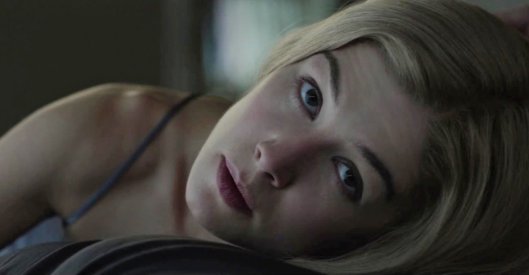
Gone Girl - scene

What happens in the movie’s second half, as Nick attempts to regain control of his life, and defend himself from the police and the media, is confidently arranged and presented by Fincher, but with what the audience knows is happening elsewhere, the movie maintains its measured, effective pacing but at the expense of the tension that’s been built up before.  It’s not the movie’s fault; it is, after all a very faithful adaptation by Flynn of her own novel, and Fincher seems happy to go along with the twists and turns and her reliance on dramatic licence to steer her characters through.  The weaknesses that plague the second half of the novel are present in the movie, and have the same effect: they make everything too unbelievable, and lead to a denouement that will either have audiences who haven’t read the novel shaking their heads in disbelief and asking, “Is that it?”, or audiences who have read the novel shaking their heads in disbelief and asking, “Is that still it?”

So – is Gone Girl then a bad movie?  The answer is very definitely No.  In Fincher’s hands, Gone Girl overcomes it’s cod-psychological thriller origins to become a dark, unsettling movie that picks at the conventional notions of love and marriage and finds murky, troubled waters flowing just below the surface.  As an examination of how two people can fall out of love with each other so easily, and be so ready to hurt each other in the process, the movie scores on all counts.  Nick and Amy, once so right for each other, are now adversaries, both looking to come out on top.  It’s an unfair fight; after all, if Nick was a box-cutter, he’d be the last one you’d use to open up something (he’s just not that sharp).  But Amy is sharp, smart as a whip in fact.  She’s Amazing Amy, the ultimate version of herself that her parents created when she was a little girl, a prodigy who always excels, who always ends up the winner, just because she’s Amazing Amy.  (Amy has always been in competition with her literary alter-ego, but the movie only mentions it in passing, while the novel explores the idea in greater, and more rewarding, depth.  It’s important to take in, though.)

Fincher excels at fleshing out the characters.  Nick is smug and stupid and reckless and self-satisfied and callow and foolish, and he has no idea how idiotically he behaves.  He’s like Bambi in a hunter’s sights, a prize just waiting to be claimed.  Affleck gives perhaps his best performance in years, earning our initial sympathy then dashing it to the ground in one superbly orchestrated scene that pulls the rug out from under the audience with undisguised pleasure.  Nick is twitchy, nervous, anxious, panicky – all the things you’d expect when someone is increasingly viewed as having killed their wife, but Affleck never puts a foot – or an inappropriate grin – wrong, imbuing Nick with an easy-to-warm-to naïveté that hardens as the movie plays out, his nervous energy transformed into a need for redemption in the public’s eye.  As mentioned before, Nick is a frustratingly obtuse character, but Affleck makes it a positive.  Even when Nick is doing or saying something witless, like posing with a woman for a selfie, it’s witless because it’s part of his nature, his way of dealing with people.  He’s like a puppy: he just wants to be loved.
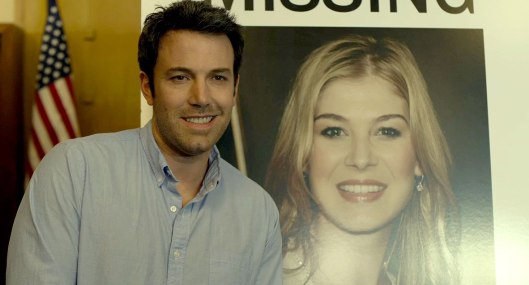
Gone Girl - scene2

Conversely, Amy has always been loved, her parents’ books about her excelling alter-ego having made her treasured by default.  But that affection comes with an expectation that everyone around Amy will feel the same way about her, and if she’s in a relationship then it’s all or nothing, her way or no way.  Pike is a revelation here: as we learn more and more about Amy, she reveals more and more of the fractured person Amy really is.  It’s a role that would test any actress, but Pike – who probably wasn’t most people’s first choice for the part – claims the role as her own and pulls off a devastating performance.  She’s an actress who shows everything with her eyes; watch those and you’ll know everything her character is thinking and feeling, and some things you might not want to know.  She complements Affleck’s performance superbly, and she even manages to make some of Flynn’s more tortured dialogue sound appropriate and convincing.

In support, Dickens is excellent as the detective who never feels entirely satisfied with the way things keep happening, her experience telling her that there’s more going on than meets the eye.  As one of Amy’s old boyfriends, Desi Collings, Harris is awkwardly emotional and manipulative at the same time, the kind of creepy paramour most women would run a mile from.  Coon offers solid support as Nick’s sister but the role is  stereotypically rendered: she believes in him no matter what, even when he does something really stupid.  And Perry – as Nick’s lawyer, Tanner Bolt – has fun with a role that could have done with a bit more bluster, and he provides some much needed levity from the seriousness of the situation.

Marshalling the production into something much greater than its origins, though, is Fincher, a director able to elevate any material he’s given – save Alien³ (1992) – and make it riveting to watch.  In hand with cinematographer Jeff Cronenweth, Fincher makes Gone Girl an impressively visual experience, with shots and images that linger in the memory, and never so cleverly as with Nick and Amy’s home, a large, airy property that serves to highlight how far apart from each other they actually are.  Fincher also takes the more outlandish aspects of Flynn’s story and makes them more credible (though even he’s powerless to override the flimsy psychology that underpins the ending), and he makes the audience want to know what happens next, even if it might be obvious.  With two commanding central performances as well, Gone Girl cements Fincher’s reputation even further, and if at some point down the road Flynn decides to revisit Nick and Amy’s marriage, there shouldn’t be any question as to who should direct the movie version.

While it may divide some audiences – especially those who like their endings to be unequivocal (although this is, in its way) – Gone Girl is nonetheless superior movie-making, and should be regarded as such.  Fincher shows a complete understanding of the characters and their motivations, and delivers one of the most unexpectedly energised movies of the year.  It’s a thriller, yes, but at its heart it’s a movie about the expectations of love and the slow decay of a relationship, where passion turns to pain and love turns to hate.  And it’s relentless.

Rating: 8/10 – the script’s deficiencies knock this one down a point, but this is still very impressive stuff indeed; a taut, engrossing thriller that impresses with every scene, Gone Girl is that rare movie that grips the audience despite its faults and becomes a movie that everyone will want to talk about afterwards.

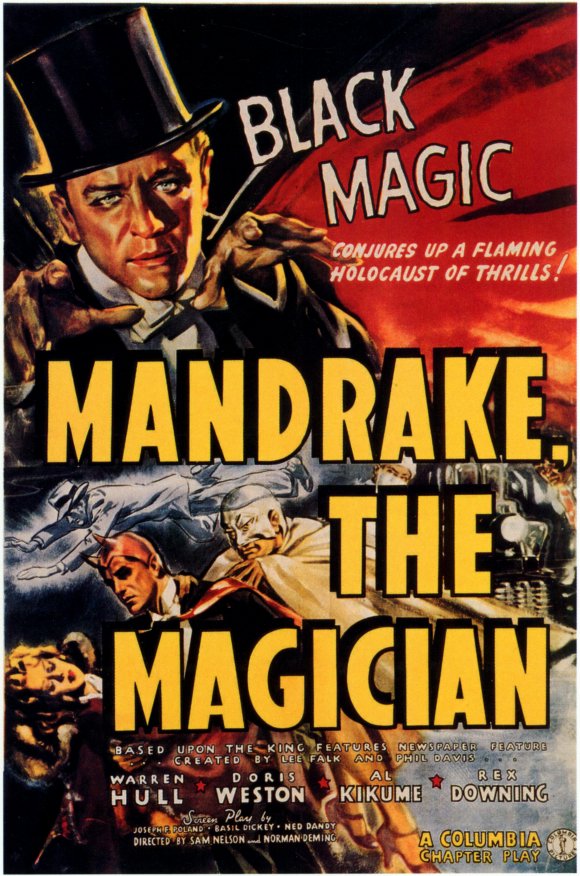
Share this:

  • Click to share on X (Opens in new window) X
  • Click to share on Facebook (Opens in new window) Facebook
  • More
  • Click to print (Opens in new window) Print
  • Click to email a link to a friend (Opens in new window) Email
Like Loading...

Horns (2013)

07 Tuesday Oct 2014

Posted by dullwood68 in Movies

≈ Leave a comment

Tags

Alexandre Aja, Black comedy, Daniel Radcliffe, Drama, Fantasy, Horror, Ig Parrish, Joe Anderson, Joe Hill, Juno Temple, Literary adaptation, Max Minghella, Murder, Review, Snakes, Thriller, Whodunnit

Horns

D: Alexandre Aja / 120m

Cast: Daniel Radcliffe, Max Minghella, Joe Anderson, Juno Temple, Kelli Garner, James Remar, Kathleen Quinlan, David Morse, Heather Graham

Ig Perrish (Radcliffe) has earned the enmity of the small town he lives in.  His longtime girlfriend, Merrin Williams (Temple) has been brutally killed in nearby woods, and everyone thinks Ig killed her.  With the townsfolk threatening him at every turn, and news crews following him wherever he goes, Ig protests his innocence but is continually ignored.  Even his friends and family suspect or believe he did it; only his best friend, Lee (Minghella), a lawyer, believes he’s innocent.

When a candlelit vigil is held at the place where Merrin was murdered, a drunken Ig rages against a God who could allow her to die.  The next morning he awakes to find two tiny horns growing out of his forehead.  Horrified, he goes to his doctor where he becomes aware of a startling side effect that the horns have brought with them: the people he encounters are compelled to tell him their darkest thoughts and desires once they’ve seen the horns.  He also learns that he can persuade them to act on these desires.  Using this ability he begins to visit people who knew Merrin in the hope of finding clues as to her killer’s identity – or even find them in person.  Everyone reveals something about themselves that is otherwise hidden except for Lee who doesn’t see any horns at all.

Ig suffers a setback when he learns a witness has come forward to say that they saw him leave a diner with Merrin on the night she was killed.  Ig knows this isn’t true, but at first he can’t think how to make the witness withdraw their statement.  The arrival of a bed of snakes that he can control solves the issue but brings him no nearer to finding Merrin’s killer.  It’s only when he confronts his brother, Terry (Anderson), that he begins to discover what exactly happened that night, including a fateful meeting at the diner that he had with Merrin, and which he’d forgotten.

As the clues mount up and Ig gets nearer the truth, an unexpected revelation leads to an attempt on his life.  Surviving the attempt, Ig sets a trap for the killer, and in the process, learns the tragic truth about his beloved Merrin.

Horns -scene

There’s a moment in Horns when Ig suggests that a couple of TV news reporters should “beat the shit out of each other” with an exclusive interview as the prize for the winner.  What follows is a free-for-all brawl between news teams that is both funny and ferocious at the same time.  It’s a perfect example of the tone of the movie, a delightfully perverse adaptation of Joe Hill’s novel that offers a mix of very dark humour and fantasy alongside a very traditional whodunnit.  It’s a bold, audacious movie, encompassing romantic drama, horror, broad comedy, and childhood flashbacks to often dizzying effect.  It’s also a great deal of fun.

Under the auspices of Aja, Horns is never less than riveting, its structure so cleverly constructed by screenwriter Keith Bunin that a few minor plot stumbles aside – the presence of the snakes (never properly explained), the killer’s apparent amnesia when confronted a second time by Ig – the movie grabs the attention from the outset, thrusting the viewer into Ig’s predicament with economy and style.  Its greatest trick is not to make Ig instantly likeable, and while it’s no stretch to believe he’s entirely innocent, his behaviour is self-destructive and aggressive, leaving just that sliver of doubt that maybe, just maybe, he might have killed Merrin.  And with a major motive introduced two thirds in, the movie still manages to throws doubts at the viewer with deliberate glee.

Radcliffe – building a quietly diverse and impressive career for himself post-Hogwarts – is the movie’s trump card, giving a well-rounded, nuanced performance that requires a lot from him as an actor.  He’s more than up to the task though, and is simply mesmerising throughout, justifying entirely the decision to cast him.  It’s a rich, deceptively detailed portrayal, much more resonant than we’re used to in what is ultimately a horror fantasy.  There’s a scene towards the end where Ig reads a letter written to him by Merrin.  The pain and anguish Radcliffe evinces, along with Temple’s perfect reading of the letter, makes the scene achingly sad to watch (and also the movie’s standout moment).

The supporting cast offer sterling support, from Garner’s turn as Ig’s would-be girlfriend Glenna, to Morse as Merrin’s heartbroken father.  If there’s a weak link it’s Minghella, an actor whose features lend themselves well to looking perturbed or querulous, but who regularly struggles to persuade audiences when more convincing emotions are required.  Temple continues to impress, her role in flashback as Merrin giving her another chance to shine (along with Radcliffe, she’s carving out a very interesting career for herself), and there’s a pivotal role for the underused Graham that reminds the viewer – however briefly – just how good she is.

The fantasy elements are effective, with a final transformation for Ig that is impressively handled, and the striking British Columbia locations are lensed to subtly remarkable effect by DoP (and David Lynch alumni) Frederick Elmes.  Aja keeps the focus on Ig and Merrin, the true heart of the movie, and holds back on the bloodshed to a level that, while it may annoy some horror fans, is in keeping with the overall tone of the movie (that said, he can’t resist including one splatter moment).  With a denouement that ups the pace and provides a satisfying conclusion to events, Horns succeeds on so many levels that it’s a very jaded viewer who will be disappointed by what the movie has to offer.

Rating: 8/10 – an above average fantasy thriller with dark comedic overtones, Horns is another daring outing from the very talented Aja; with a deep well of emotion for it to draw on, the movie succeeds in marrying a variety of disparate elements into a rewarding and gratifying whole.

Share this:

  • Click to share on X (Opens in new window) X
  • Click to share on Facebook (Opens in new window) Facebook
  • More
  • Click to print (Opens in new window) Print
  • Click to email a link to a friend (Opens in new window) Email
Like Loading...

A Walk Among the Tombstones (2014)

06 Monday Oct 2014

Posted by dullwood68 in Movies

≈ Leave a comment

Tags

Crime, Dan Stevens, David Harbour, DEA, Drama, Kidnapping, Lawrence Block, Liam Neeson, Literary adaptation, Matt Scudder, Murder, Ransom, Review, Scott Frank, Thriller

Walk Among the Tombstones, A

D: Scott Frank / 114m

Cast: Liam Neeson, Dan Stevens, David Harbour, Boyd Holbrook, Brian ‘Astro’ Bradley, Ólafur Darri Ólafsson, Adam David Thompson, Mark Consuelos, Sebastian Roché

New York, 1991.  Matt Scudder (Neeson) is a cop with a drink problem.  When armed robbers hold up the bar he’s in, he chases them outside and shoots all three of them, fatally.

Eight years later, Scudder is an unlicensed private detective, still working in New York, and a recovering alcoholic.  When a fellow AA member, Peter (Holbrook) tells him his brother, Kenny (Stevens) wants to offer him a job, Scudder isn’t really interested at first, but he decides to see what the job is about.  Kenny offers him $20,000 to find the men who kidnapped and killed his wife.  Kenny’s reluctance to involve the police tips off Scudder that he’s a drug dealer, and he declines the offer.  When Scudder returns to his apartment later, he finds Kenny waiting for him.  Kenny tells him about the kidnapping, and how he was left to find his wife dismembered in the trunk of a car.  He also leaves a tape recording the kidnappers made of them torturing his wife.  Scudder decides to take the case.

Sensing that Kenny’s wife may not have been the kidnappers first victim, Scudder visits the library to go through the newspaper records.  He strikes up a conversation with a young boy, TJ (Bradley), and together they discover two other murder victims where abduction and subsequent dismemberment have occurred.  Scudder visits the cemetery where the second victim’s body was discovered, and talks to one of the groundskeepers, Jonas (Ólafsson).  Jonas behaves suspiciously, and when he leaves work, Scudder follows him to his apartment.  While there he discovers that the partner of the second victim lives in the building opposite.  Beginning to see a connection, Scudder goes up onto the roof of Jonas’s building and finds a shed that contains evidence of Jonas’ involvement in her kidnapping and murder.  When Jonas returns, he gives Scudder a name – Ray – then jumps off the roof to his death.

Later, Scudder learns that the first victim was a DEA agent, and that the kidnappers may be rogue or ex-DEA agents themselves, as the second victim and Kenny’s wife were both linked to drug dealers.  When they kidnap a fourth victim, the daughter of a Russian drug dealer, Yuri (Roché), he calls on Kenny and Scudder’s help.  Scudder negotiates a ransom drop in the same cemetery where he met Jonas, but the drop goes badly, and the kidnappers get away… with TJ hiding in their van.

Walk Among the Tombstones, A - scene

Adapted from the tenth book in the series of Matt Scudder novels written by Lawrence Block, A Walk Among the Tombstones is a grim, atmospheric crime thriller that features a brooding, melancholy performance from Neeson, and suitably gloomy New York locations.  It’s a look at the darker, seedier side of Life that is impressively realised by writer/director Frank, and draws the viewer in from its opening shootout (which has tragic consequences), to its blood-soaked denouement in the basement of the kidnappers’ house.  Brief moments of levity do occur but they’re few and far between in a movie that anchors itself so effectively in the underbelly of criminal life that some viewers may be put off by its downbeat, distressing approach to the source material.

Carrying the movie like a well-worn overcoat is Neeson, his battered visage telling the audience all they need to know about Scudder and the kind of life he’s lived.  The scenes where he’s attending various AA meetings, while appearing as no more than standard character development, are instead chances for Neeson to show a more reflective, considered approach to the character.  These add subtly to the overall performance, grounding Scudder while the other characters aren’t quite so well fleshed out.  Neeson is a strong, credible actor, and when he’s the focus of a movie (as he is here), then the audience will follow him anywhere, even in something as nonsensical as Non-Stop (2014).

And it helps, because while A Walk Among the Tombstones is determinedly dour, this is a movie that does itself no favours when addressing its bad guys and what they do.  It’s dark, edgy stuff, and made all the more potent by the performances of Harbour and Thompson, who make Ray and his accomplice Albert two of the nastiest villains seen for a while, with the more garrulous Harbour making some truly horrifying dialogue sound even worse by virtue of Ray’s emotional and moral detachment.  These guys are evil, pure and simple, and as the black heart of the movie, are incredibly effective and completely justify Jonas’s decision to jump off the roof.

With a strong, capable hero and two loathsome villains in place, it’s disappointing that the remaining characters don’t quite resonate as much.  As Kenny, Stevens is oddly distant, his anger at his wife’s murder coming across as what’s expected of him rather than a real emotion (even after he’s gone through what happened).  TJ is the annoying would-be sidekick with a poignant back story that threatens to derail the movie – isn’t it enough that Scudder is looking to personally redeem himself, without the added responsibility of a homeless child as well (and one who, when hospitalised, isn’t handed over to social services)?  That said, Bradley does have a screen presence, and he makes the most of a potentially irritating character.

Morally complex it may be, and with drug dealers painted more sympathetically than usual, nevertheless the movie is a crime thriller, and as it ramps up the violence towards the end, the slow deliberate pace of the first half is ramped up as well, and gives the audience another chance to see Neeson in action hero mode (watch though for the table that breaks before it’s landed on).  There’s a satisfying conclusion, and if another Matt Scudder movie doesn’t get made, Frank’s polished, considered outing will stand on its own as an above average entry in the private eye genre.

Rating: 8/10 – stronger and more powerful than the average crime flick, this benefits from a committed turn by Neeson and has a funereal approach that works far better than perhaps it should; confident, absorbing and persuasive, A Walk Among the Tombstones is stirring stuff and shouldn’t be missed.


Share this:

  • Click to share on X (Opens in new window) X
  • Click to share on Facebook (Opens in new window) Facebook
  • More
  • Click to print (Opens in new window) Print
  • Click to email a link to a friend (Opens in new window) Email
Like Loading...

The Equalizer (2014)

30 Tuesday Sep 2014

Posted by dullwood68 in Movies

≈ Leave a comment

Tags

Action, Antoine Fuqua, Corrupt cops, Denzel Washington, Drama, Prostitute, Review, Robert McCall, Russian mob, Thriller, TV show

EQ_DOM_1SHT_RAIN.indd

D: Antoine Fuqua / 131m

Cast: Denzel Washington, Marton Csokas, Chloë Grace Moretz, David Harbour, Haley Bennett, Bill Pullman, Melissa Leo, David Meunier, Johnny Skourtis

Robert McCall (Washington) is a quiet, reserved man who works at a hardware store in Boston and is generally well liked by his colleagues.  At home he lives a somewhat monastic, ordered lifestyle, and the only time he appears to go out is when he goes to a local diner and reads his latest book.  As a regular he gets to know Terri (Moretz), a teen prostitute with ambitions to be a singer.  When McCall witnesses her being mistreated by her pimp, Slavi (Meunier), and then she ends up in the hospital, badly beaten up, he decides to do something about it.  He pays Slavi a visit, and when negotiations don’t go as he’d hoped, he kills Slavi and four of his men.

What McCall doesn’t know is that Slavi was part of the East Coast Russian mob, and he’s singlehandedly taken out the Boston hub of that organisation.  The mob sends a fixer, Teddy (Csokas), to find the person responsible, but it takes a while, during which time McCall gets on with helping others who are experiencing crime-related problems.  When Teddy finally tracks him down, McCall decides to turn the tables on him and become the hunter instead of the hunted.  Striking at the mob’s operation while staying one step ahead of Teddy’s efforts to find and kill him, McCall reveals further aspects of a past that no one knows about, and which he keeps hidden.

When Teddy discovers a potential weakness in McCall’s character, his friendships with the people he works with, he holds them hostage and gives McCall an ultimatum: either give himself up or they all die.  But McCall has other ideas…

Equalizer, The - scene

Adapted from the US TV show that ran from 1985-1989 and starred Edward Woodward, The Equalizer is a big screen reboot that trades that series’ subtlety and clever plotting for a more direct, impactful approach, despite its slow burn opening and attempts at deft character work.  It’s a long while before McCall’s visit to Slavi, and during that time we get to see him at home, at work, at the diner, leading a normal life of sorts, but obviously lonely rather than a loner.  We learn that he’s a widower, and that he’s working his way through a list of books his wife was aiming to read before she died.  He helps a co-worker, Ralphie (Skourtis), prepare for a security guard exam, jokes with other co-workers that he was once one of Gladys Knight’s Pips, and encourages Terri to change her life and follow her dream of being a singer.  He’s kind, attentive, supportive, fair, but still a bit of an enigma.

It’s all “good stuff” and gives Washington a chance to show off his acting chops (which are considerable), and serves to introduce McCall as just more than the violent avenger he’s soon to become.  But the drawback is that once McCall faces off against Slavi and his men, all that character build-up is jettisoned in favour of a more traditional action thriller style movie, and Washington stops being Mr Average and becomes an invincible righter of wrongs.  In many ways this is unavoidable, the nature of the story giving the director and his star little option but to revert to the tried and trusted approach of blowing shit up and killing a whole bunch of stuntmen.  But thankfully, and despite the increasingly derivative nature of the narrative, Fuqua’s distinctive visual style and Washington’s reliable acting skills hold the viewer’s attention, and offset some of the more ludicrous moments (McCall walks away from a series of huge, multiple explosions at such an insanely slow pace it’s less a case of a cool looking moment than a clue that Denzel can’t run that fast anymore).

In the end, The Equalizer reveals itself as an origin story, prepping the way for potential sequels (though Washington has yet to make one).  On this evidence, any further outings will need to address the issue of how much McCall’s character will be focused on, and whether or not aspects such as his borderline OCD is dealt with (it’s featured, but isn’t developed, the same as his use of a stopwatch to time certain moments and incidents).  The storylines will need to be a bit more impressive as well, and a more serious adversary to give a much needed sense of threat; Teddy is certainly psychotic but McCall outwits and dispatches him too easily, leaving any possibility of tension or doubt about the outcome so far behind it’s practically invisible.

As a vehicle for Washington, The Equalizer is a good fit, and he’s ably supported by Csokas, Moretz and Harbour, while Pullman and Leo appear as old friends of McCall who know his history.  Richard Wenk’s script works best when focusing on McCall as Mr Average, and his relationships with Terri and Ralphie are skilfully drawn.  The action scenes are expertly choreographed (though a fight between McCall and one of Teddy’s men is scrappily edited: blows are landed but who’s being hit is mostly a mystery), and Mauro Fiore’s cinematography adds a vitality that helps counter the familiarity that builds once Slavi bites the dust.

Rating: 7/10 – although it eventually proves an entertaining introduction to Robert McCall and his “set of skills”, The Equalizer is too formulaic to have much of a genuine impact; a good vehicle for Washington but not a movie to stay in the memory for too long despite the positives (that the movie then squanders).

Share this:

  • Click to share on X (Opens in new window) X
  • Click to share on Facebook (Opens in new window) Facebook
  • More
  • Click to print (Opens in new window) Print
  • Click to email a link to a friend (Opens in new window) Email
Like Loading...

The Guest (2014)

21 Sunday Sep 2014

Posted by dullwood68 in Movies

≈ Leave a comment

Tags

Adam Wingard, Brendan Meyer, Cuckoo in the nest, Dan Stevens, Dead son, Drama, Leland Orser, Maika Monroe, Military, Murder, Psychopath, Review, Sheila Kelley, Simon Barrett, Thriller

Guest, The

D: Adam Wingard / 99m

Cast: Dan Stevens, Maika Monroe, Brendan Meyer, Leland Orser, Sheila Kelley, Lance Reddick, Chase Williamson, Joel David Moore, Ethan Embry, Tabatha Shaun

Shortly after the death of her son Caleb while he was in Afghanistan, Laura Peterson (Kelley) receives an unexpected visit from a young man who served with Caleb and has come to honour a promise he made.  David (Stevens) is welcomed into the Peterson household and despite initially unsure reactions from dad Spencer (Orser), daughter Anna (Monroe) and younger son Luke (Meyer), he soon wins their trust.

But when strange incidents begin to happen around town – Spencer’s boss is killed in mysterious circumstances, Anna’s boyfriend is implicated in a murder – incidents that in some way benefit the Peterson family, Anna starts to wonder if David is everything that he says he is, even down to his having served with Caleb.  While Anna’s suspicions grow, Luke overhears David talking to a plastic surgeon on the phone (though he doesn’t tell anyone).  When Anna calls the military base that David said he was last stationed at before he was discharged, their response is to send an armed unit, led by Major Carver (Reddick) to apprehend him.

With David needing to move on sooner than he’d planned, it becomes clear that he has no intention of letting anyone he’s met in the last few days be left behind for the military (or anyone else) to talk to.  He sets about killing the Peterson’s and anyone else he feels is a liability.  With Carver in hot pursuit, David tracks Anna and Luke to their local high school, and an inevitable showdown.

Guest, The - scene

After the less than sophisticated home invasion story depicted in You’re Next (2011), director Wingard and writer Simon Barrett turn their attention to a more subtle variation on the same theme, with a cuckoo in the nest approach that reaps dividends thanks to a more controlled script, and strong performances from Stevens, Monroe, Kelley et al.

Thanks to Barrett’s more credible set up, The Guest draws the viewer in, allaying any initial fears the audience may have that this will turn out to be as predictable as, say, The Stepfather (1987).  But, while it’s a fair assumption to make – David is handsome, charming and polite, there are family tensions that mark out the Petersons as easily dividable – the way in which David’s more dubious undertakings are carried out have a disturbing frisson to them that obscures their obvious wrongdoing (and makes them partly acceptable for the audience).  Laura’s need for secondary contact with her son via David is understandable, and her vulnerability is well played by Kelley; there’s a quiet desperation to her scenes with Stevens that is often more touching than expected.

Spencer is a man at a standstill, attempting to make sense of his life through railing at what he sees as its inequalities, and yet, when he learns of his boss’s demise, and the promotion it means for him, his sense of place is so disturbed he can’t fathom how to react.  Orser (a much underrated actor) excels in what is an unsung role, and it’s great to see him in a movie where he’s not there to make up the numbers as in the Taken trilogy.

As their troubled offspring, Monroe and Meyer have larger roles but they’re a little too generic, with Anna’s doubtful behaviour and Luke’s need for an older brother substitute feeling more tired than dramatically necessary, and despite good performances from both, they can’t elevate their characters above the limitations set within the script.

With so much attention given to the Peterson family dynamic, it’s reassuring to find that David is much more complex than you might expect, and Stevens relishes the opportunity to take a trip to the dark side, making David attractive and dangerous at the same time, his military “training” having created a monster whose sense of morality is fleeting and impersonal.  That he chooses to help the Petersons in the way that he does is never fully explained (and is one of the ways in which the movie often feels more contrived than it needs to be).  Stevens is riveting as David, dispelling any memories of his role in TV’s Downton Abbey, and proving a superb choice in the title role, alternately charismatic and treacherous, and showing no contrition for his actions.

Beautifully filmed on location in New Mexico by Robby Baumgartner, The Guest benefits from a great cast and is smartly directed by Wingard who is improving with each movie he makes.  The movie’s midpoint sees some pacing issues and the Eighties style slasher finale at Anna and Luke’s high school is a little out of place – and makes the viewer wonder just what the school’s budget was to have created such a Halloween inspired maze/dancefloor/entrance etc.  And there’s a final shot that both echoes that Eighties conclusion and undermines it all at the same time.  It’s an understandable move by Wingard and Barrett but a bad one nevertheless, and is the cinematic version of leaving a sour taste in the mouth.

Rating: 7/10 – its unexpectedly derivative ending aside, The Guest is a welcome addition to the psycho thriller genre; gripping for most of its running time, it features a terrific performance from Stevens and shows no problem in being seductively cruel throughout.

Share this:

  • Click to share on X (Opens in new window) X
  • Click to share on Facebook (Opens in new window) Facebook
  • More
  • Click to print (Opens in new window) Print
  • Click to email a link to a friend (Opens in new window) Email
Like Loading...

Mini-Review: Not Safe for Work (2014)

19 Friday Sep 2014

Posted by dullwood68 in Movies

≈ 2 Comments

Tags

Arson, Court cases, Eloise Mumford, JJ Field, Joe Johnston, Law firm, Max Minghella, Murder, Review, Thriller

Not Safe for Work

D: Joe Johnston / 74m

Cast: Max Minghella, JJ Feild, Eloise Mumford, Christian Clemenson, Tom Gallop, Molly Hagan

Tom Miller (Minghella) is a junior lawyer at the firm of Rosen, Byres and Emmerich.  In his attempts to get ahead he manages to antagonise one of the firm’s senior partners, and is fired.  As he leaves the building along with everyone else, he sees an exchange of briefcases that raises his suspicions.  He goes back up to where RB&E have their offices, and sees the man (Feild) who took the briefcase tampering with some of the electrics for that floor.  When the man is disturbed by Janine (Hagan), an RB&E employee, he cold-bloodedly shoots her.

Tom tries to raise the alarm but the telephones are dead and his mobile phone signal is blocked.  With only Roger (Gallop), an ex-colleague, and Emmerich (Clemenson), the partner who fired him, still working in the offices, Tom tries to stay one step ahead as he tries to figure out why the man is there.  With two high profile cases about to go to court, Tom has to find out which one the man is there to hinder, and who sent him.  A cat and mouse game develops when the man discovers Tom’s presence, a game that leads to further danger when the man tricks Anna (Mumford) (one of the firm’s secretaries and Tom’s secret girlfriend) into returning to the building.  Tom has to find a way of keep Anna safe from harm, while foiling the man and his attempt to set off an incendiary device in the firm’s file room.

Not Safe for Work - scene

Filmed in 2012 but only now gaining an audience, Not Safe for Work is a tepid, low budget thriller that hides a plethora of plot holes beneath its glossy surface, and emerges as a solid, if slightly pretentious thriller that coasts along on the back of its own improbability.  It’s a movie that’s hard to dislike despite its faults, and while Johnston does his best to create tension and a modicum of thrills, he’s powerless to overcome the ludicrous nature of Adam Mason and Simon  Boyes’ script, which plays like a first draft that was never rewritten.

Minghella is an unlikely hero, while Feild aims for urbane hitman, but misses the target by a mile, creating an arch, self-conscious performance that invites hilarity even more than it does menace.  With a twist that – of course – can be seen coming from as far off as Omar Sharif in Lawrence of Arabia (1962), in the end, the movie works hard at what it does, but winds up being largely unremarkable.

Rating: 4/10 – there’s a neat premise at the heart of Not Safe for Work, but it’s one that’s buried beneath layers of unnecessary artifice; the brief running time is a bonus, though.

Share this:

  • Click to share on X (Opens in new window) X
  • Click to share on Facebook (Opens in new window) Facebook
  • More
  • Click to print (Opens in new window) Print
  • Click to email a link to a friend (Opens in new window) Email
Like Loading...

The Trials of Cate McCall (2013)

14 Sunday Sep 2014

Posted by dullwood68 in Movies

≈ 1 Comment

Tags

Alcoholism, Anna Anissimova, Appeal case, Courtroom drama, Custody battle, James Cromwell, Karen Moncrieff, Kate Beckinsale, Lawyer, Murder, Nick Nolte, Review, Thriller

Trials of Cate McCall, The

D: Karen Moncrieff / 89m

Cast: Kate Beckinsale, Nick Nolte, James Cromwell, Mark Pellegrino, Anna Anissimova, Taye Diggs, Kathy Baker, Clancy Brown, Brendan Sexton III, David Lyons, Ava Kolker, Isaiah Washington, Dale Dickey, Amanda Aday

Cate McCall (Beckinsale) has her fair share of problems.  Despite being a talented lawyer, she has a serious drink problem that has resulted in her being put on probation and assigned to work in a small law office.  She’s also trying to retain custody of her daughter Augie (Kolker) following the break up of her marriage to Josh (Lyons).  As she fights to regain control of her life, Cate is assigned an appeal case involving Lacey Stubbs (Anissimova).  Lacey has been convicted of murder, but claims she was set up by the lead detective on the case, Welch (Pellegrino).  She also alleges that, while in prison, she was raped by a guard.

With the help of her mentor, Bridges (Nolte), Cate begins to look into the case and finds quickly that some of the witness testimonies don’t match up, and that there are problems with the police evidence.  Lacey maintains her innocence, while Welch proves evasive and aggressive when Cate talks to him.  As Cate begins to suspect a miscarriage of justice has taken place, the pressure of trying to deal with both the case and spending time with Augie begins to affect her ability to maintain her sobriety.

The appeal hearing sees Lacey’s case upheld, but Cate’s success is short-lived.  No sooner is the hearing over than she begins to uncover further evidence that Lacey has been lying all along.  But can she trust this new evidence?  Now Cate has to find out whether or not she was used by Lacey, and in the process, decide if being a part of Augie’s life is appropriate for her daughter while she still has a drink problem.

Trials of Cate McCall, The - scene

From the outset, The Trials of Cate McCall tries hard to be different from all the other courtroom-based dramas out there, and in terms of its title character, it certainly succeeds.  Cate McCall is, frankly, a bit of a mess, and while the reason for her drinking problem is adequately explained, the movie’s determination to make things difficult for her at almost every turn borders on the sadistic.  It’s only within the confines of the courtroom that she’s allowed to hold it together and have any success; outside, and she makes mistake after mistake, sometimes deliberately.  There is an element of masochism as well in these moments, as if Cate is punishing herself, and while on a psychological level this is all completely understandable, it makes for a somewhat frustrating viewing experience.  It’s not long into the movie before the viewer will be wondering, just how much more can this character take before she puts her head in the oven?

But Cate’s work keeps her going, even while she screws up everything else in her life.  The two worlds she inhabits, her professional and private lives, are addressed with equal gravitas, and thanks to Beckinsale’s committed, earnest portrayal, the movie is on solid ground when Cate tries to deal with the responsibilities of both (even if she fails more often than not).  It’s an unselfish performance from Beckinsale, an actress who can do a lot more than wear tight-fitting black leather and make fangs look sexy, and she’s at her best when the script piles on the setbacks (she even ends up in jail at one point, that’s how bad things get for her).  Beckinsale is also clever enough to ensure that Cate isn’t entirely sympathetic, and this helps make the character more credible.

She’s ably supported by the likes of Nolte (grizzled, understanding), Cromwell (sanguine, duplicitous), Anissimova (nervy, put-upon), and Pellegrino (arrogant, shady), and there’s a winning performance from six year old Kolker as Cate’s troubled daughter (Augie though – really?).  With such a good cast – and one that can find room for actors such as Brown and Baker in minor roles – the movie’s mix of domestic drama and courtroom machinations is handled well by writer/director Moncrieff, even if there are moments where plausibility is stretched so thin it’s practically see-through (the prosecution’s withholding of exculpatory evidence is a case in point; the ease with which Cate and Welch bury their differences is another).

But all in all, the movie is a worthwhile watch though it plays flat through certain stretches – the repetitive bickering between Cate and Josh, the subplot involving Cromwell’s lecherous judge – and the issue of Lacey’s guilt can be guessed from the beginning, but away from the courtroom there’s enough to keep an audience engaged and wanting to find out what happens next.  Ultimately though, and aside from the reliability of its cast, the material isn’t solid enough to withstand close scrutiny (or cross-examination), and while it’s entirely respectable in its aims and intentions, it doesn’t quite hit the mark.

Rating: 6/10 – with alcoholism, murder and a custody battle occupying the time of its main character, The Trials of Cate McCall is actually less intriguing than it thinks it is; Beckinsale is the movie’s major asset, and while there’s nothing to suggest this might be the beginning of a series, another visit with Cate could still be something to look forward to.

Share this:

  • Click to share on X (Opens in new window) X
  • Click to share on Facebook (Opens in new window) Facebook
  • More
  • Click to print (Opens in new window) Print
  • Click to email a link to a friend (Opens in new window) Email
Like Loading...
← Older posts
Newer posts →

Blog Stats

  • 492,381 hits

Recent Posts

  • 10 Reasons to Remember Bibi Andersson (1935-2019)
  • Fantasia (1940)
  • Dances With Wolves (1990) – The Special Edition
  • Kiss of the Spider Woman (1985)
  • The Three Musketeers (1973)

Top Posts & Pages

  • Cardboard Boxer (2016)
    Cardboard Boxer (2016)
  • Table 19 (2017)
    Table 19 (2017)
  • Lost for Life (2013)
    Lost for Life (2013)
  • "Science or no science, a girl's got to get her hair done" - 10 Female-centric Sci-fi Quotes from the 1950's
    "Science or no science, a girl's got to get her hair done" - 10 Female-centric Sci-fi Quotes from the 1950's
  • Poster of the Week - Werewolf of London (1935)
    Poster of the Week - Werewolf of London (1935)
  • Mini-Review: Kill Your Darlings (2013)
    Mini-Review: Kill Your Darlings (2013)
  • Stray Bullet (2010)
    Stray Bullet (2010)
  • For One (Stretched) Week Only: Australian Cinema - Part V
    For One (Stretched) Week Only: Australian Cinema - Part V
  • Carrie (2013)
    Carrie (2013)
  • M.F.A. (2017)
    M.F.A. (2017)
Follow thedullwoodexperiment on WordPress.com

Blogs I Follow

  • Rubbish Talk
  • Film 4 Fan
  • Fast Film Reviews
  • The Film Blog
  • All Things Movies UK
  • Interpreting the Stars
  • Let's Go To The Movies
  • Movie Reviews 101
  • TMI News
  • Dan the Man's Movie Reviews
  • Film History
  • Jordan and Eddie (The Movie Guys)

Archives

  • April 2019 (13)
  • March 2019 (28)
  • February 2019 (28)
  • January 2019 (32)
  • December 2018 (28)
  • November 2018 (30)
  • October 2018 (29)
  • September 2018 (29)
  • August 2018 (29)
  • July 2018 (30)
  • June 2018 (28)
  • May 2018 (24)
  • April 2018 (21)
  • March 2018 (31)
  • February 2018 (25)
  • January 2018 (30)
  • December 2017 (30)
  • November 2017 (27)
  • October 2017 (27)
  • September 2017 (26)
  • August 2017 (32)
  • July 2017 (32)
  • June 2017 (30)
  • May 2017 (29)
  • April 2017 (29)
  • March 2017 (30)
  • February 2017 (27)
  • January 2017 (32)
  • December 2016 (30)
  • November 2016 (28)
  • October 2016 (30)
  • September 2016 (27)
  • August 2016 (30)
  • July 2016 (30)
  • June 2016 (31)
  • May 2016 (34)
  • April 2016 (30)
  • March 2016 (30)
  • February 2016 (28)
  • January 2016 (35)
  • December 2015 (34)
  • November 2015 (31)
  • October 2015 (31)
  • September 2015 (34)
  • August 2015 (31)
  • July 2015 (33)
  • June 2015 (12)
  • May 2015 (31)
  • April 2015 (32)
  • March 2015 (30)
  • February 2015 (37)
  • January 2015 (39)
  • December 2014 (34)
  • November 2014 (34)
  • October 2014 (36)
  • September 2014 (25)
  • August 2014 (29)
  • July 2014 (29)
  • June 2014 (28)
  • May 2014 (23)
  • April 2014 (21)
  • March 2014 (42)
  • February 2014 (38)
  • January 2014 (29)
  • December 2013 (28)
  • November 2013 (34)
  • October 2013 (4)

Blog at WordPress.com.

Rubbish Talk

Film 4 Fan

A Movie Blog

Fast Film Reviews

The Film Blog

The official blog of everything in film

All Things Movies UK

Movie Reviews and Original Articles

Interpreting the Stars

Dave Examines Movies

Let's Go To The Movies

Film and Theatre Lover!

Movie Reviews 101

Daily Movie Reviews

TMI News

Latest weather, crime and breaking news

Dan the Man's Movie Reviews

All my aimless thoughts, ideas, and ramblings, all packed into one site!

Film History

Telling the story of film

Jordan and Eddie (The Movie Guys)

Movie Reviews & Ramblings from an Australian Based Film Fan

Privacy & Cookies: This site uses cookies. By continuing to use this website, you agree to their use.
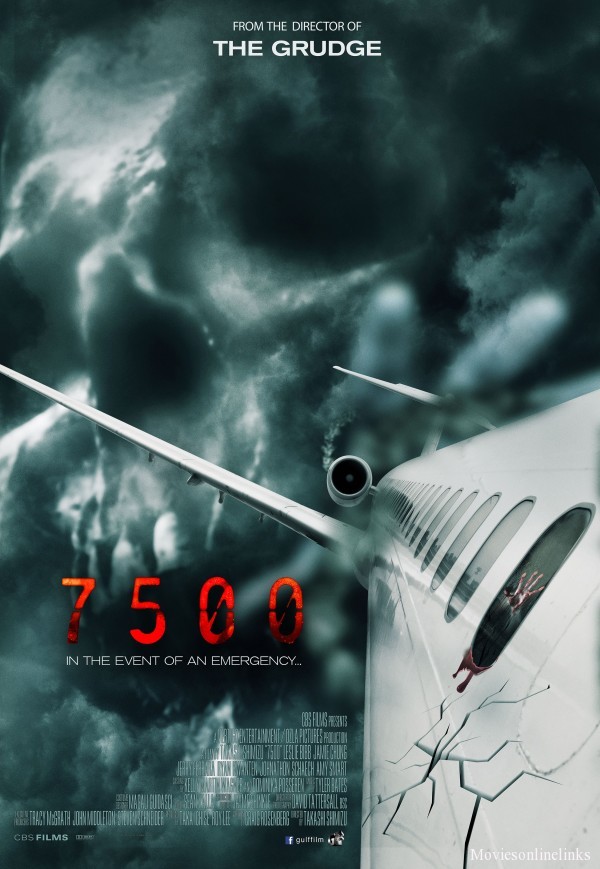
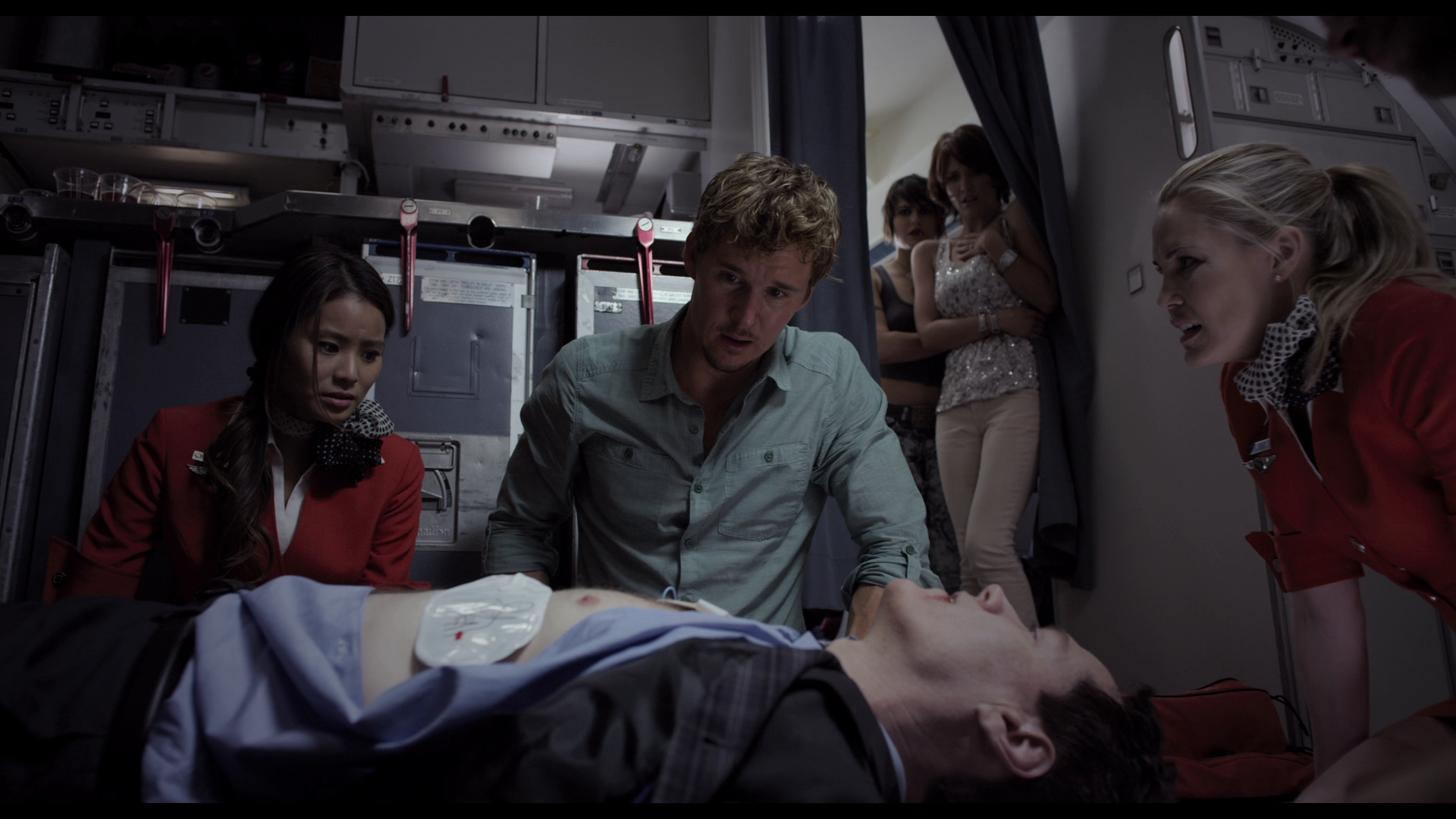
To find out more, including how to control cookies, see here: Cookie Policy
  • Subscribe Subscribed
    • thedullwoodexperiment
    • Join 481 other subscribers
    • Already have a WordPress.com account? Log in now.
    • thedullwoodexperiment
    • Subscribe Subscribed
    • Sign up
    • Log in
    • Report this content
    • View site in Reader
    • Manage subscriptions
    • Collapse this bar
 

Loading Comments...
 

    %d