• 10 Reasons to Remember…
  • A Brief Word About…
  • About
  • For One Week Only
  • Happy Birthday
  • Monthly Roundup
  • Old-Time Crime
  • Other Posts
  • Poster of the Week
  • Question of the Week
  • Reviews
  • Trailers

thedullwoodexperiment

~ Viewing movies in a different light

thedullwoodexperiment

Tag Archives: Tommy Lee Jones

Shock and Awe (2017)

04 Saturday Aug 2018

Posted by dullwood68 in Movies

≈ 3 Comments

Tags

Drama, Iraq War, James Marsden, Jessica Biel, Journalism, Knight Ridder, Mainstream media, Milla Jovovich, Rob Reiner, Tommy Lee Jones, True story, US government, Woody Harrelson

D: Rob Reiner / 90m

Cast: Woody Harrelson, James Marsden, Rob Reiner, Tommy Lee Jones, Jessica Biel, Milla Jovovich, Richard Schiff, Luke Tennie

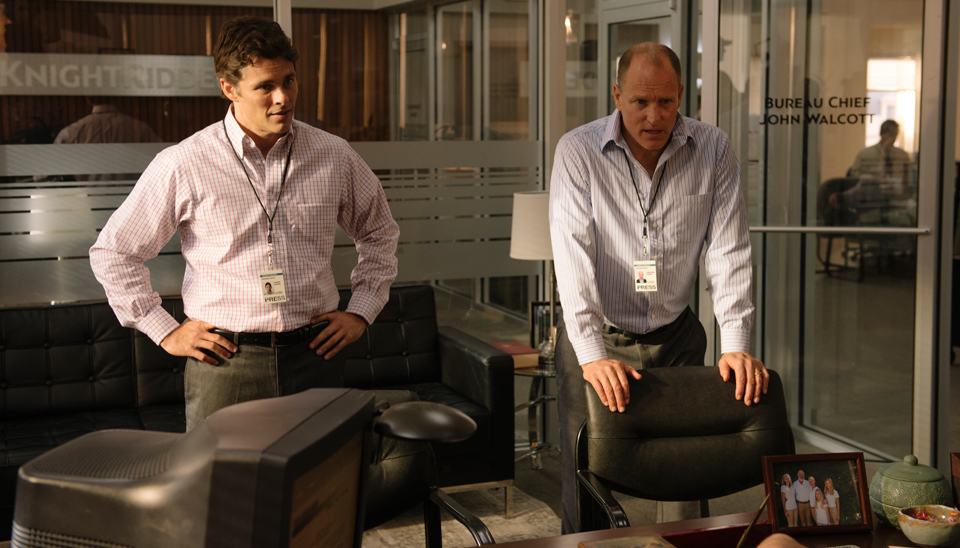
In the wake of the 9/11 terrorist attacks on the Pentagon and the World Trade Center, the US government began asserting that Al-Qaeda and Osama Bin Laden had been aided by Iragi leader Saddam Hussein. This was at odds with the perceived wisdom that Bin Laden was operating out of Afghanistan, and despite an on-going mission to bomb him and the country “back to the Stone Age”. With most of the mainstream media, including publishing giants such as The New York Times and The Washington Post accepting the government’s “shoddy intelligence” as fact, it was only the likes of independent news service Knight Ridder journalists Jonathan Landay (Harrelson) and Warren Strobel (Marsden) who challenged the government’s stance, and did their best to expose the neo-con conspiracy that wanted to manufacture a war with Iraq. Supported by their editor, John Walcott (Reiner), Landay and Strobel strove to find evidence to contradict the government’s assertions that Hussein had weapons of mass destruction, and that this was the excuse being used to support the call for war, a call that had no basis in fact…
Recently, the journalist Carl Bernstein tweeted, “This is worse than Watergate, because the system worked in Watergate.” Of course he’s referring to the current situation with Donald Trump as President, but his remark could equally apply to the state of play following 9/11. After Watergate, the Republicans began managing the mainstream news media in a way that can still be seen today, and the post-9/11 watershed in political reporting is a perfect example of how government manipulation of the truth – or outright lying, if you prefer – was aided and abetted by the news corporations. But if you’re looking for a savage indictment of this kind of behaviour then Shock and Awe is not the place to find it. Instead, the movie flits between scenes of rote exposition and misjudged solemnity as it tries to exploit a situation where one group of journalists were outmanoeuvred by the Bush Administration, and their message was undermined by not getting it out to the public in as wide a manner as was needed. So what we have is a movie that deals with failure but not in an outraged, we-demand-justice kind of way, but in a poor-naïve-us kind of way that just isn’t attractive.

It also tries to be more than it has to be by including a distaff side to things through the paranoid (yet correct) assertions of Landay’s Yugoslavian wife Vlatka (Jovovich), and an awkward, should-have-been-jettisoned-from-the-get-go boy-meets-girl scenario involving Strobel and his neighbour, Lisa Mayr (Biel) (the scene where she recounts a potted version of fourteen hundred years of Iraqi history has to be seen to be believed). These episodes sit uneasily between scenes of Landay failing to charm various sources, and Strobel continually doubting if what they’re discovering is right. Added to this is a clumsy sub-plot involving The Philadelphia Enquirer not running any of Knight Ridder’s stories when they contradict the government, and the inclusion of veteran war reporter turned State Department official Joe Galloway (Jones), whose sole purpose seems to be to provide pithy comments about the duplicitous nature of his bosses. It’s all a huge, uninspired, unworthy, and unrelentingly mediocre movie with no fire or energy, and which uses a disabled soldier (Tennie) to make a thumpingly obvious point about the waste of men and resources once the US got to Iraq. Harrelson and Marsden are unlikely reporters, and Reiner overdoes his serious, flinty editor role, but it makes no difference as there’s not one relatable character in the whole movie. Is there any shock and awe? Yes, but only at how bad it all is.

Rating: 4/10 – you know your movie’s in trouble when its best performance is given by George W. Bush in archive footage, but that’s just one of the dilemmas that Shock and Awe fails to overcome; with no sense of outrage to build on or to, and by telling a story that’s too little too late, the movie lacks a purpose or a workable design, something that should have been spotted right from the start.

Share this:

  • Click to share on X (Opens in new window) X
  • Click to share on Facebook (Opens in new window) Facebook
  • More
  • Click to print (Opens in new window) Print
  • Click to email a link to a friend (Opens in new window) Email
Like Loading...

Mechanic: Resurrection (2016)

31 Wednesday Aug 2016

Posted by dullwood68 in Movies

≈ 4 Comments

Tags

Action, Arms dealers, Australia, Crime, Dennis Gansel, Drama, Hitman, Jason Statham, Jessica Alba, Malaysia, Michelle Yeoh, Review, Sequel, Thailand, Thriller, Tommy Lee Jones

Mechanic Resurrection

D: Dennis Gansel / 99m

Cast: Jason Statham, Jessica Alba, Tommy Lee Jones, Michelle Yeoh, Sam Hazeldine, John Cenatiempo, Toby Eddington, Femi Elufowoju Jr, Anteo Quintavalle

Meh.

Rating: 3/10 – a terrible sequel that lies dead on the screen, Mechanic: Resurrection features some of the worst green screen work ever (the opening fight in Buenos Aires), a plot that makes absolutely no sense at all, and performances from all concerned that border almost on perfunctory – if only they could have made that much effort; action movies don’t have to tie up every loose end or narrative loophole, but this has a script that just doesn’t know when to give up and go home, making it one of the worst experiences you’re likely to have at the cinema all year.

Share this:

  • Click to share on X (Opens in new window) X
  • Click to share on Facebook (Opens in new window) Facebook
  • More
  • Click to print (Opens in new window) Print
  • Click to email a link to a friend (Opens in new window) Email
Like Loading...

Jason Bourne (2016)

20 Saturday Aug 2016

Posted by dullwood68 in Movies

≈ 1 Comment

Tags

Action, Alicia Vikander, Asset, Athens, Berlin, Black ops, CIA, Drama, Iron Hand, Las Vegas, London, Matt Damon, Paul Greengrass, Review, Sequel, Thriller, Tommy Lee Jones, Vincent Cassel

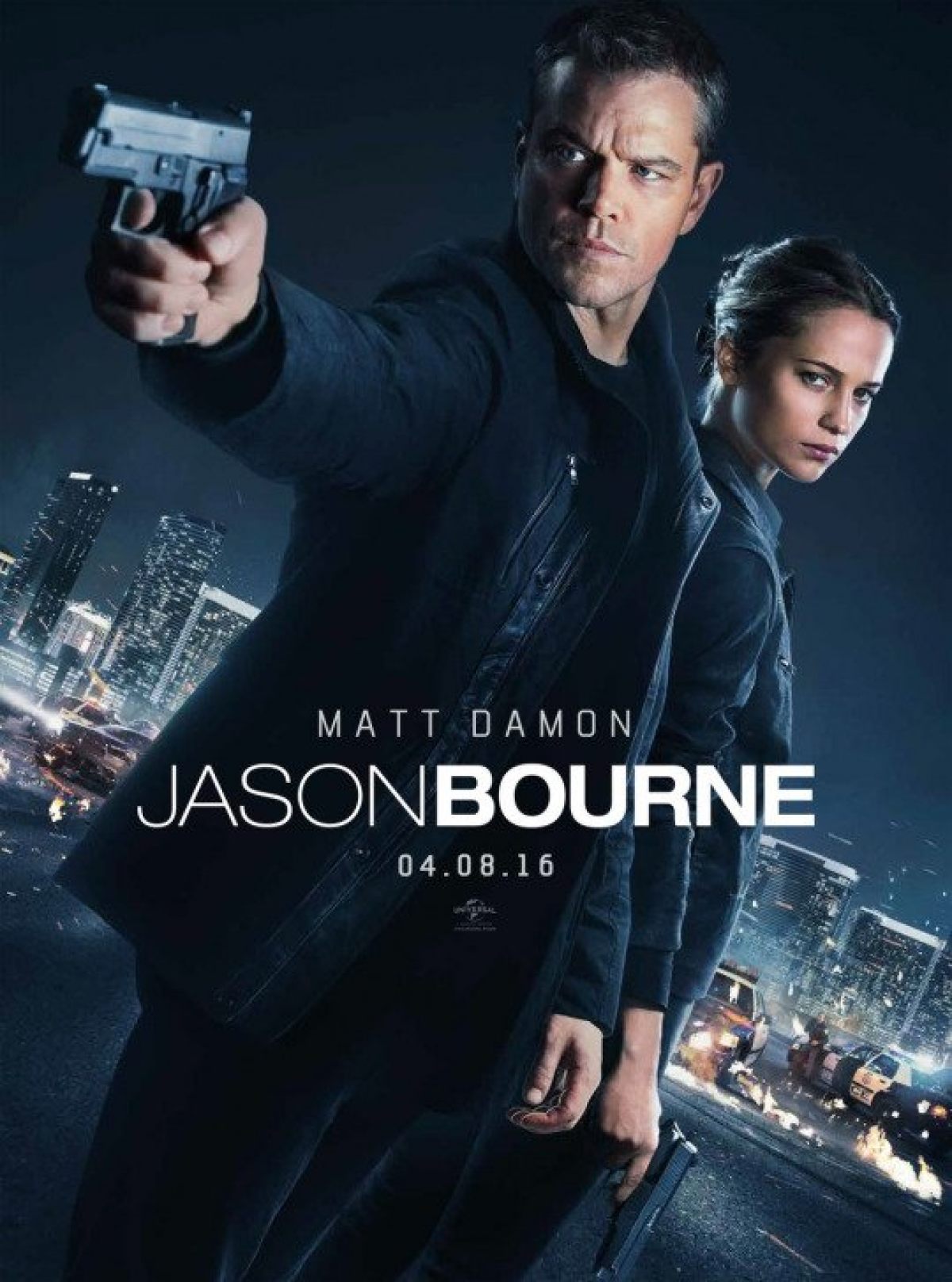
Jason Bourne

D: Paul Greengrass / 123m

Cast: Matt Damon, Tommy Lee Jones, Alicia Vikander, Vincent Cassel, Julia Stiles, Riz Ahmed, Ato Essandoh, Scott Shepherd, Bill Camp, Vinzenz Kiefer, Stephen Kunken, Gregg Henry

The original Bourne movie trilogy was smart, inventive, thrilling, and a massive boost for the ailing spy genre. It made an action hero of Matt Damon, featured action sequences that were fresh and exciting, and had an emotionally complex through-line that bolstered the already intense plotting. At the end of The Bourne Ultimatum, David Webb had gained the answers to questions that had plagued him ever since he’d been saved from a watery grave by the crew of a fishing boat.

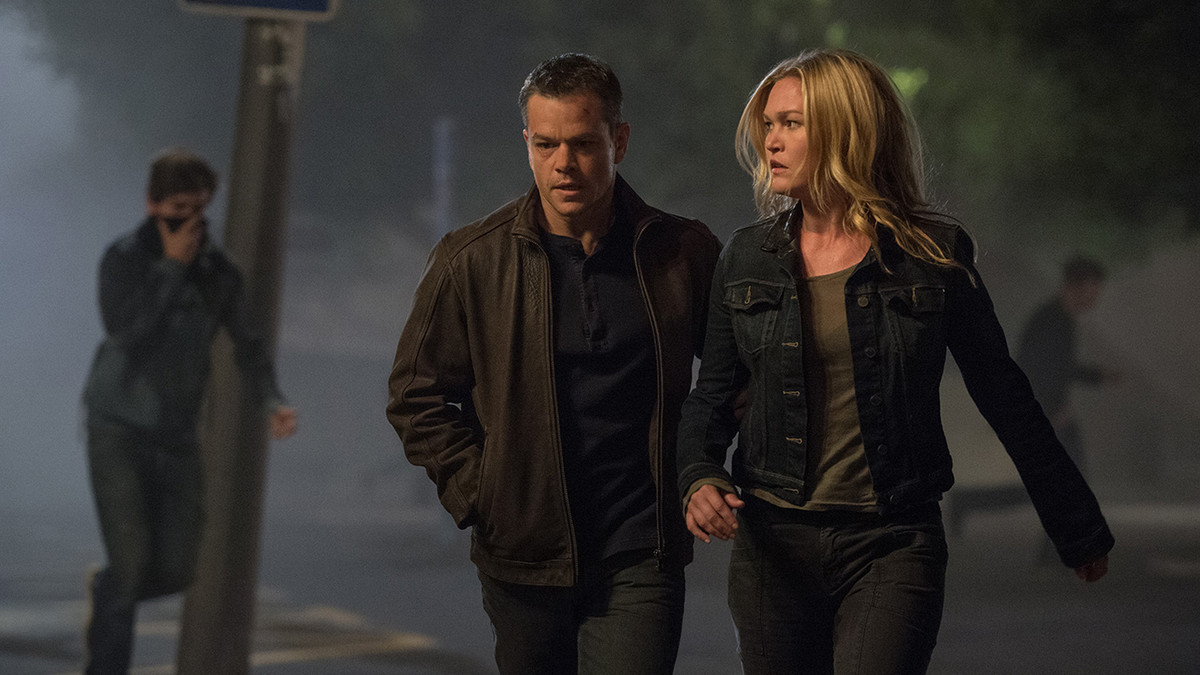
Except… he hasn’t, not really. The closing lines from The Bourne Ultimatum – “I remember. I remember everything.” – are repeated here at the movie’s beginning, and are followed by a montage of scenes from the original trilogy (as far as this movie is concerned, The Bourne Legacy (2012) never happened). But in amongst these memories are flashes of scenes we haven’t seen before. And when Jason Bourne snaps out of his reverie, we find him in the back of a truck and heading for an illegal fight ground in Greece. Clearly the years since he took down Treadstone and Blackbriar haven’t been good to him: despite his fighting prowess he still looks lost. And the bad dreams, or reveries, he’s experiencing aren’t helping. For someone who “remembers everything”, he’s having some of the most spectacularly disturbing and disorienting dreams ever. And he can’t make sense of them, especially the ones that involve his father, Richard Webb (Henry).

Jason Bourne - scene1

Help comes in the familiar but unexpected form of ex-CIA analyst Nicky Parsons (Stiles). Having hacked into the CIA mainframe, she’s done so with the aim of helping Bourne learn more about his past, and has discovered that his father had a greater role in the Treadstone programme than Bourne has been led to believe. But in hacking the CIA, Nicky has become a target and her contacting Bourne in Athens leads to his getting “back in the game”. With CIA operatives on their trail, as well as an Asset (Cassel), Bourne gains access to the information Nicky hacked, and once he becomes aware of his father’s involvement, he finds his enrolment in the Treadstone program wasn’t as clear cut as he thought. But as before, his reappearance has senior members of the CIA, including Director Robert Dewey (Jones), unwilling to let Bourne expose their Black Ops programs. Using a combination of the Asset and the head of the Cyber Crimes Division, Heather Lee (Vikander), to track down Bourne and eliminate him once and for all, Dewey plots to keep the CIA’s secrets as hidden as ever.

Fans of the Bourne Trilogy are generally dismissive of The Bourne Legacy, the Jeremy Renner starring addition to the series that failed to add anything new to the mix, and which felt like an uninspired retread of everything that had gone before. Matt Damon famously turned down the chance to cameo in Legacy, and made it clear that he wouldn’t return to the franchise unless Paul Greengrass was back on board as well. Well, Damon got his wish, and Greengrass is back as the movie’s director. But perhaps Damon should have made another stipulation: that Greengrass didn’t write the script.

Jason Bourne has many of the same attributes that The Bourne Supremacy and The Bourne Ultimatum share. There’s the generous use of “shaky cam”, Christopher Rouse’s exemplary editing, excellent location work, and a series of intense and very well-staged action sequences (one of the series major strengths). But there’s one aspect that’s missing this time round, and aside from Greengrass’s muscular directorial style, it’s perhaps the series’ most important component: the contribution of Tony Gilroy. As screenwriter of the first two movies, and co-screenwriter of the third (though his input was drastically reduced), as well as Legacy‘s writer/director, Gilroy helped guide the series from its inauspicious beginnings to a position of critical and commercial success worldwide. His scripts had intelligence, depth and subtlety, and his villains were drawn with a vividness and care that made them worthy adversaries.

Jason Bourne - scene3

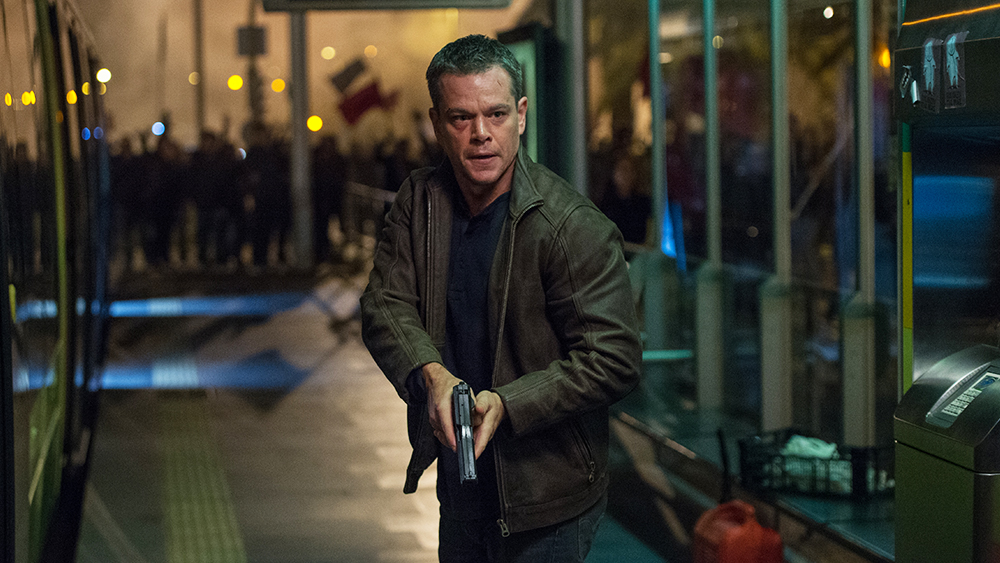
But without Gilroy (no doubt a casualty of The Bourne Legacy‘s poor reception), Jason Bourne proves just as disappointing as its unacknowledged predecessor. Nearly ten years on from the events of Ultimatum, Bourne is still an emotional mess, haunted by memory fragments that cause him pain and regret. He looks awful, and Damon plays him like a man besieged. For a man who found all the answers he needed, Bourne looks even more tormented than when he was in the dark. The movie never really attempts to explain why this is the case, preferring instead to give audiences a tortured Bourne without expanding on his back story. As a result, his decision to jump back in, prompted by some spurious nonsense involving his father, seems perfunctory instead of necessary.

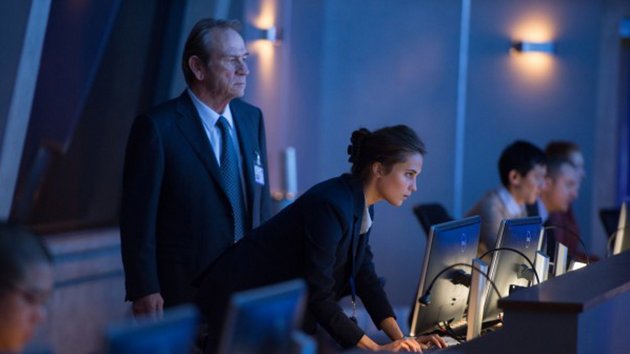
With Bourne himself treated in such a cavalier fashion – he’s really just a one-man wrecking crew here – the other characters fare just as badly. Dewey is a stock villain, one step removed from twirling an invisible moustache and muttering “mwah-ha-ha!” whenever the script has him do something nefarious. Jones has no chance with the role, and there are times when his awareness of this comes through loud and clear; just watch his scenes with Vikander, and ask yourself if he looks committed. Cassel’s Asset is fuelled by revenge for the torture he suffered through Bourne’s exposure of the Blackbriar program, but as the character spends an inordinate amount of time running around chasing Bourne without actually catching him, his anger (and his back story) gets shoved to the side. And then there’s Heather Lee, the Cyber Crimes head who acts as this movie’s Pamela Landy. There’s supposed to be some mystery as to which side she’s on (she helps Bourne in various ways while pushing a separate CIA agenda), but thanks to Greengrass’s less than subtle direction, Vikander never looks anything other than extremely distrustful.

Film Title: Jason Bourne

And then there’s the small but important matter of how Bourne gets about. From Greece he travels to Berlin, then to London. He does so on his own, without any help from anyone, and manages to elude detection at every turn (a facet of the series that was usually, and very cleverly explained away – but not here). And yet when he travels from London to Las Vegas he does so by commercial aircraft, and though he receives assistance from Lee in getting through US Customs, it still begs the question how UK Customs didn’t flag him up in the first place. (Also, it seems that outside of Athens and Las Vegas there’s not the CCTV infrastructure to allow the CIA to track Bourne efficiently anywhere else.) And stop and think about this: in Las Vegas, at an expo for a communications platform that Dewey wants to appropriate – don’t ask – Bourne picks up various conveniently placed bugging devices that he uses to get to Dewey, all of which begs the question, what plan did he have originally (as he couldn’t have known they were there beforehand)?

Gaping plot holes like these only add to the realisation that Jason Bourne is a less than rewarding, less than necessary sequel to four previous movies (three of which had already told the story effectively and with impressive style), that throws in a handful of rousing action sequences, makes Bourne indestructible, has a subplot involving a communications platform – actually, still don’t ask – and features some of the blandest characters in the whole series. Greengrass is a mercurial director, with a great visual style, but he’s not as good a screenwriter as he might think, and along with Rouse, he makes things too simplistic for the movie’s own good. The end result? A movie that only takes off when it’s throwing punches or chasing SWAT vehicles.

Rating: 5/10 – a missed opportunity to enhance and expand on the series, Jason Bourne trades on nostalgia instead of bringing something new to the franchise; Bourne looks tired throughout, as does Jones, and by the movie’s end the viewer will feel exactly the same way.

Share this:

  • Click to share on X (Opens in new window) X
  • Click to share on Facebook (Opens in new window) Facebook
  • More
  • Click to print (Opens in new window) Print
  • Click to email a link to a friend (Opens in new window) Email
Like Loading...

Criminal (2016)

12 Tuesday Jul 2016

Posted by dullwood68 in Movies

≈ 1 Comment

Tags

Action, Ariel Vroman, CIA, Drama, Gal Gadot, Gary Oldman, Jordi Mollà, Kevin Costner, Memory transplant, Review, Ryan Reynolds, Sci-fi, Sociopath, The Dutchman, Thriller, Tommy Lee Jones, Wormhole program

Criminal

D: Ariel Vromen / 108m

Cast: Kevin Costner, Gary Oldman, Tommy Lee Jones, Gal Gadot, Ryan Reynolds, Alice Eve, Michael Pitt, Jordi Mollà, Antje Traue, Amaury Nolasco, Scott Adkins, Lara Decaro

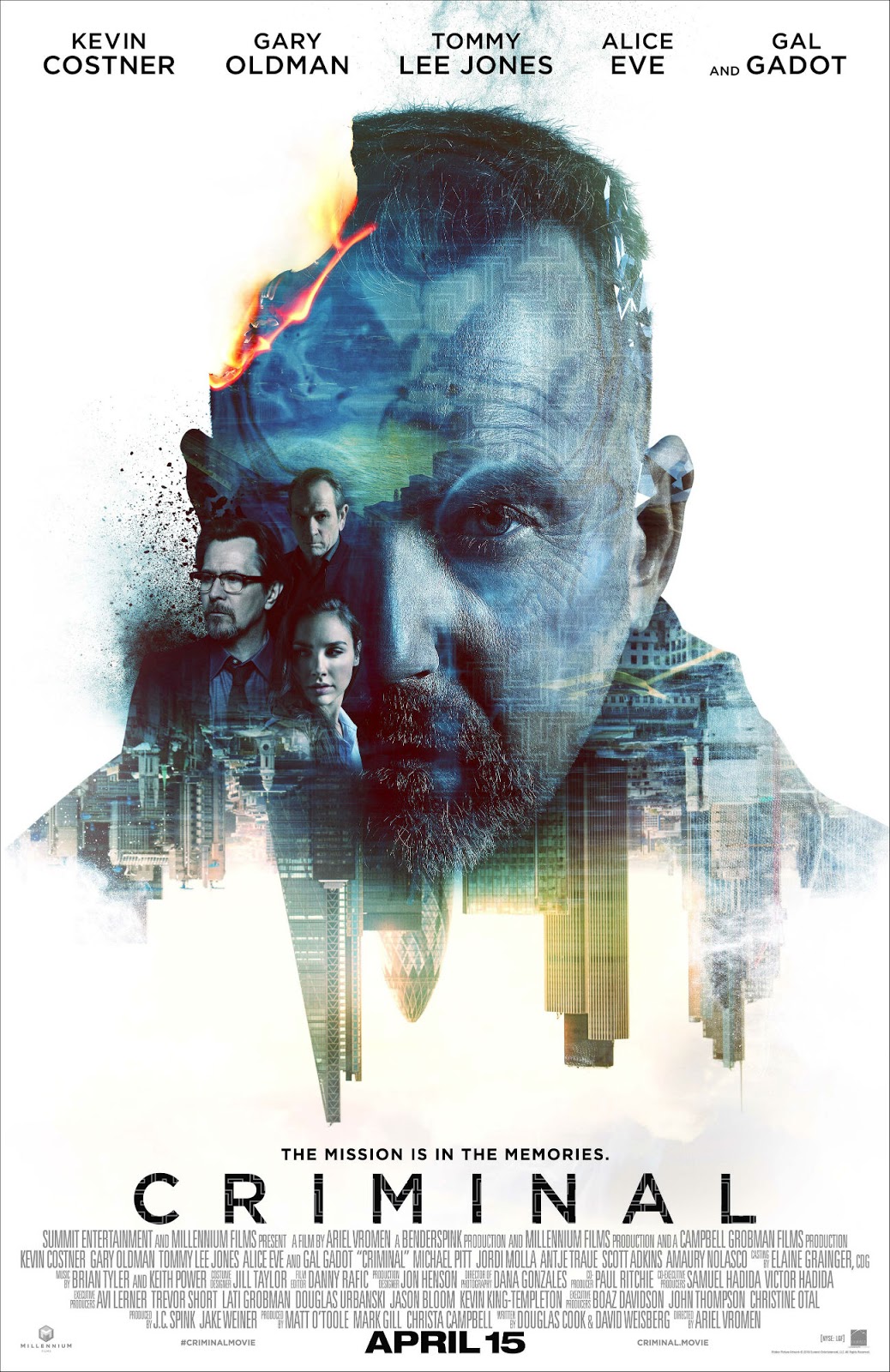
Emotionless career criminal and sociopath Jericho Stewart (Costner) has a motto: “You hurt me… I hurt you worse.” It’s tempting to rephrase said motto so that it reflects Criminal‘s effect on its audience: “You trust the movie… and it gets worse.” For the movie is an unappealing mix of action movie, paranoid thriller and sentimental drama, and it tries to be all these things at once, with varied results.

It begins with London-based CIA agent Bill Pope (Reynolds) being followed by a bunch of bad guys led by Elsa Mueller (Traue). He has a holdall full of money, but he manages to hide it. When he’s tricked into making an “escape” to a cement works, he finds himself under fire and eventually captured by terrorist nutjob Xavier Heimdahl (Mollà). Heimdahl (he’s Spanish but his Scandinavian surname elicits no comment from anyone) wants a flash drive that’s also in the holdall; on it is a wormhole program that will give him complete access and control over the US’s weapons and defence system. But Bill keeps schtum and is beaten to death.

But this is the movies and being dead doesn’t always mean being dead. In Criminal, the twist is that Bill’s memories can be accessed and transferred into the mind of another person; in theory, that is. Pioneer scientist Dr Mahal Franks (Jones) has been trying to get permission for human trial for five years, but with the CIA’s London overseer, Quaker Wells (Oldman), desperate to find the program’s creator, a hacker called Jan Stroop aka The Dutchman (Pitt) before he can sell it to the highest bidder (which was Bill before he was killed), he sees no option but to allow Franks to test his theory that transference of memories is possible in humans. But there’s a catch (isn’t there always?).

Criminal - scene2

Franks’ best candidate to receive Bill’s memories is the aforementioned emotionless career criminal and sociopath Jericho Stewart. Currently in prison, he’s dragged from his cell in the US and shoved on a plane to the UK where Franks operates on him. When he comes to, Wells conveniently fills him in on what’s at stake and his part in it all, but Jericho pretends he doesn’t have any of Bill’s memories. Thinking he’s of no further use, Wells instructs two of his men to take Jericho out into the British countryside somewhere and kill him. But Jericho has other ideas, ideas that centre around a holdall full of money…

Criminal is a movie that offers three storylines for the price of one, and while each one would have made a respectable enough impact as a single movie, Douglas Cook and David Weisberg’s script gets so carried away with itself that the storylines tend to trip each other up and get entangled. Storyline one is a standard world-in-peril scenario that gives Gary Oldman the chance to run around and shout a lot about how much peril the world is in, while storyline two concerns Jericho Stewart’s coming to terms with having Bill’s feelings and emotions, two things he’s had no previous use for. And then there’s storyline three, the (very) unlikely relationship that develops between Jericho and Bill’s wife, Jill (Gadot).

Criminal - scene3

It’s this last storyline that’s the most problematic, and not just because on their first meeting, Jericho uses duct tape to tie Jill to her bed before making off with her jewellery. No, it’s the alacrity with which she lets him stay the night when he returns the next time, albeit wounded and showing clear signs that her husband is in his head somewhere. And while Jan Stroop demonstrates his control over the US’s weapons and defence system by firing a nuclear warhead from a submarine in the atlantic, Jericho and Jill (now there’s a name for a spin-off TV series) share chicken and waffles with her daughter, Emma (Decaro). This is the point in the movie where storylines two and three ride roughshod over storyline one – it literally grinds to a halt – and any pretense of Criminal being an action thriller is forgotten.

The movie rights itself, though – thankfully – and Jericho is soon back to letting out his inner rage, and on one singular occasion, in a way that’s uncomfortably, misogynistically non-PC (and he gloats about it too). Unfortunately it’s a moment that not even Costner can rescue, which is a shame as he’s just about the only consistently good thing in the whole movie. From his first appearance as a fuzzy-wigged prisoner in chains, all animal instincts and snarling antagonism – when he’s shot with a tranquiliser dart he merely grunts and says, “You’re gonna need another one” – Costner gives a terrific performance that holds the movie together; when he’s on screen you can’t take your eyes off him, and when he isn’t, you can’t wait until he’s back. As Jericho begins to deal with the onslaught of Bill’s memories and feelings, Costner articulates the pain he feels with conviction and sincerity – and this despite having to deal with some truly lame dialogue.

Criminal - scene1

Elsewhere, Oldman and Jones pop up at various points to push along the basic plot to its unsurprising conclusion, Reynolds contributes what amounts to an extended cameo that anyone could have played, Eve is completely wasted in a role that amounts to approximately five minutes of screen time and a handful of lines, Mollà never gets a grip on his character’s motivations, Pitt has the same problem, Adkins has a supporting role that doesn’t require him to go up against anyone (not even Costner), and Gadot struggles with a role that most actresses would have had trouble with.

Doing his best to make all this fit together in a halfway credible sense is Vromen, whose last movie was the gripping character study The Iceman (2013). He does his best, and the action sequences, despite offering little in the way of original thrills and spills, have a kinetic energy to them that ensures they stand out from the often plodding nature of the rest of the movie… but it’s the generic nature of the thriller elements that defeats him. Danny Rafic’s editing tries to make the movie feel more vigorous than it actually is, and there’s an appropriately dramatic score by Keith Power and Brian Tyler that provides a degree of ad hoc excitement but like so much of the movie, never fully encapsulates the sense of imminent peril Oldman continually shouts about.

Rating: 5/10 – another high-concept idea gets a lukewarm treatment, leaving Criminal feeling undercooked and dragging its heels when it should be embracing its race against time plotting; fans of Costner won’t be disappointed but otherwise this is an action/thriller/sci-fi/drama hybrid that lets its cast, and the audience, down way too often for its own good.

Share this:

  • Click to share on X (Opens in new window) X
  • Click to share on Facebook (Opens in new window) Facebook
  • More
  • Click to print (Opens in new window) Print
  • Click to email a link to a friend (Opens in new window) Email
Like Loading...

The Homesman (2014)

25 Wednesday Mar 2015

Posted by dullwood68 in Movies

≈ 1 Comment

Tags

1850's, Action, Drama, Hilary Swank, History, John Lithgow, Literary adaptation, Madness, Mary Bee Cuddy, Meryl Streep, Nebraska Territory, Review, Tommy Lee Jones, Western

Homesman, The

D: Tommy Lee Jones / 122m

Cast: Tommy Lee Jones, Hilary Swank, Grace Gummer, Miranda Otto, Sonja Richter, Jo Harvey Allen, Barry Corbin, David Dencik, William Fichtner, Evan Jones, Caroline Lagerfelt, John Lithgow, Tim Blake Nelson, Jesse Plemons, James Spader, Hailee Steinfeld, Meryl Streep

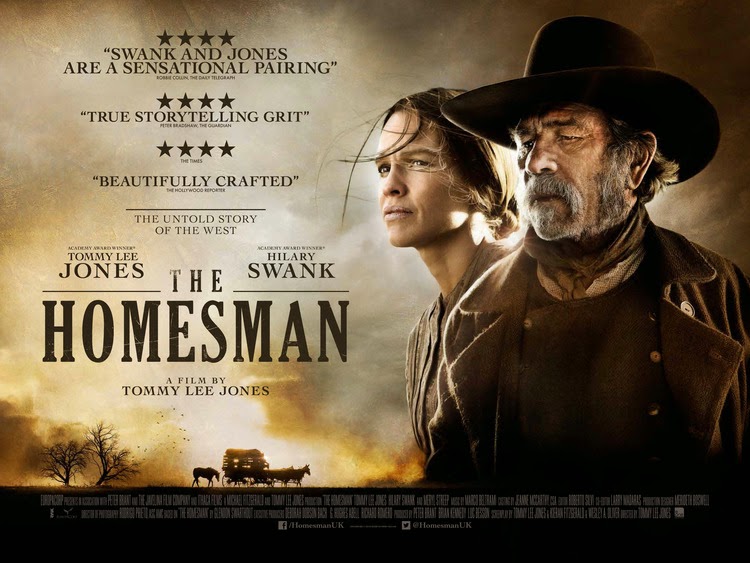
In the Nebraska Territory in the 1850’s, three women – Arabella Sours (Gummer), Theoline Belknap (Otto), and Gro Svendsen (Richter) – fall victim to madness after enduring various hardships. Their pastor, Reverend Dowd (Lithgow), calls upon one of their husbands to take them to Hebron, Iowa where there is a church that will take care of them. With one refusing to do it at all, and the other two proving less than ideal, spinster and homesteader Mary Bee Cuddy (Swank) accepts the task, hoping that the “adventure” will help with her own feelings of isolation and depression.

Buddy encounters George Briggs (Jones), and saves him from being hanged for using another man’s home. She persuades him to accompany her and promises him $300 if they make it to Hebron. Briggs agrees but makes for surly company, and challenges Cuddy at every opportunity. However, they come to a mutual understanding, and Briggs’ experience proves invaluable when problems arise, such as one of the women wandering off and being found by a man (Nelson) who wants her for his own, and when they find themselves being watched by Indians.

However, when they find the desecrated grave of an eleven year old girl, Cuddy elects to restore it while Briggs continues on with the women. But Cuddy loses her way and finds herself back at the child’s grave. When she finally catches up with Briggs, she suggests to him that they should marry, but he rejects her offer, telling her – like som many other men before him – that she is too plain and too bossy. Later, she comes to him naked and they have sex. The next morning, Briggs makes a terrible discovery, one that changes the whole nature of the trek to Hebron.

Homesman, The - scene

Achingly stark yet beautiful at the same time, Jones’ adaptation of the novel by Glendon Swarthout, The Homesman, is a melancholic, richly detailed portrait of the hardships of frontier life in the 1850’s, and the different ways in which loneliness can affect even the strongest and most determined of people. Through the journey that Cuddy, Briggs and the three women make, the movie delves into notions of longing, despair, loss and, more curiously, faith (though to a lesser degree than the others). It’s a confident, expertly constructed and devised movie, and it features a handful of strong, finely detailed performances – from Jones, Swank, Streep and Lithgow – and also features some stunning photography courtesy of Rodrigo Prieto, but ultimately it’s a movie that plays too much to convention.

Part of the problem lies in the relationship between Briggs and Cuddy, two people for whom loneliness has become their lives. But where Briggs is comfortable in being alone, Cuddy isn’t, and strives to match herself with someone (at the beginning of the movie it’s another homesteader (Evan Jones), but her desperation is alienating). When she and Briggs meet it’s inevitable that she will offer him the same proposal of marriage it seems she’s made to everyone else. That Briggs will refuse her is another inevitability, and one that robs the moment of any dramatic tension; it also makes Cuddy’s willingness to strip naked and sleep with him too desperate (that Briggs would agree to this approach is unsurprising). What follows is robbed of any potency by Jones’ not allowing any build up to it – it’s presented so matter-of-factly that it makes Cuddy’s importance to the narrative seem irrelevant.

And so the focus remains on Briggs, a curmudgeonly old fox who lacks several degrees of decency, and who develops an unlikely sense of responsibility to the three madwomen (and purely, it seems, because they’ll follow him wherever he goes, a development that’s never really explained). He’s otherwise a selfish, mean-spirited man with no measure of social conscience, but who seems to gain said social conscience without a second thought, and who tries to echo Cuddy’s desperate need to fit in and be accepted by making a similar (uncomfortable) proposal to Steinfeld’s waitress. In Jones’s hands, he’s meant to be a sympathetic character overall, but his personality and way with others is too wayward to afford consistency, and Briggs’ initial roguishness gives way to behaving in whichever way the script needs him to.

With Jones the actor hamstrung by Jones the co-writer – along with Kieran Fitzgerald and Wesley A. Oliver – it’s left to Jones the director to save the day. If there’s one aspect that he’s very, very good at, it’s in the look of his movies. As in The Three Burials of Melquiades Estrada (2005), Jones’ mastery of the frame is simply superb, each shot crafted with a care and attention to light and shade and detail that is consistently impressive. His use of perspective is also finely attuned, the various landscape shots peppered throughout the movie displaying a level of natural beauty married to the width and depth of the image that is often breathtaking. And it’s no different in medium or close up shots: Jones displays such a sure knowledge of what’s he doing and how he’s presenting it that each scene has a rare quality to it, one that few other directors would be able to reproduce.

The movie moves along at a measured pace that gives the cast adequate time to make an impression, and which shows Jones to be generous when sharing the screen with someone else. He gives supporting actors such as Spader, Fichtner and Steinfeld plenty of room to impress, and stands well back to let them do their thing. Though the script gives them little to do except stare off into the distance, Gummer, Otto and Richter, are effective as the three women driven mad by circumstance and hardship (particularly Richter, who has a chilling and very disturbing scene with a sowing needle). They don’t quite achieve the prominence the story allows them at the beginning, but all three characters are convincingly portrayed throughout.

There are casual nods to the sexism of the times, and the grim nature of trying to survive in what was an often harsh, unforgiving environment is well depicted. The final twenty minutes serve more as a coda than a final act, and some viewers may feel this section is a little off-centre as a result, as the three madwomen arrive at their destination and Streep’s affable pastor’s wife takes centre stage (her performance is a reminder, if any were needed, of just how good an actress she is). And the final scene itself ends the movie on an awkward, offhand note that smacks of contrivance rather than a satisfying end to the story.

Rating: 7/10 – absorbing if uneven, The Homesman scores highly because of Jones’ ability as a director and his often glorious use of the camera; with its story often straying off into some unwanted dead ends, this journey is only occasionally involving, and only occasionally matches the commitment made by its cast.

Share this:

  • Click to share on X (Opens in new window) X
  • Click to share on Facebook (Opens in new window) Facebook
  • More
  • Click to print (Opens in new window) Print
  • Click to email a link to a friend (Opens in new window) Email
Like Loading...

The Family (2013)

08 Sunday Dec 2013

Posted by dullwood68 in Movies

≈ Leave a comment

Tags

Action, Comedy, Drama, Hitman, Luc Besson, Michelle Pfeiffer, Normandy, Review, Robert DeNiro, the Mob, Tommy Lee Jones, Witness Protection

Family, The

D: Luc Besson / 111m

Cast: Robert De Niro, Michelle Pfeiffer, Tommy Lee Jones, Dianna Agron, John D’Leo, Jimmy Palumbo, Domenick Lombardozzi, Stan Carp, Vincent Pastore, Jon Freda

Having ratted on his bosses in the Mob, Giovanni Manzoni (De Niro) and his family – wife Maggie (Pfeiffer), daughter Belle (Agron) and son Warren (D’Leo) – are living in France under the Witness Protection Program.  Following an incident at their placement on the Riviera, the Manzonis are moved to a quiet Normandy town where their handler, CIA agent Robert Stansfield (Jones), hopes they’ll settle down and stay out of trouble. While the Manzonis (now the Blakes) try to fit in, a hitman (Freda) is trying to track them down.

Each member of the family does their best to adapt to their new surroundings but with varied results.  Giovanni begins writing his memoirs, Maggie takes an interest in a nearby church, Belle fends off the advances of the local teenage boys and falls in love with a mature student, while Warren takes over the various rackets at their school.  They all encounter problems along the way, and each deals with these problems in their own way: Giovanni with violence, Belle with violence, Warren with violence, and Maggie with violence but then followed by her making confession.  It’s their inability to fit in without reverting to their Mob ways that causes Stansfield to threaten them with yet another relocation, especially after he reads Giovanni’s memoirs and realises how dangerous they could be if anyone outside the family were to read them.  But then the hitman and his gang find them, and everyone has to pull together to keep the Manzonis alive.

Family, The - scene

Ostensibly a comedy, The Family is ultimately a bit of a mixed bag.  Besson, directing from a script co-written with Michael Caleo, adds drama, romance, action, a lot of casual violence, a wonderful moment for De Niro at a film screening, and a soupçon of domestic troubles.  The main characters are well-drawn: Giovanni is both naturally aggressive and yet also quite melancholy and thoughtful, while Maggie appears lonely and struggling to adjust; she’s a mother whose role is no longer as clearly defined as it was back in New York.  Belle is sophisticated and yet naïve at the same time: she misunderstands the situation with the mature student, and takes too much for granted.  And Warren finds he’s not quite the clever gangster he thought he was.  All four actors are on top form, De Niro providing a world-weary performance that belies the uncompromising mobster he’ll always be at heart; he’s a joy to watch.  Pfeiffer revisits her character from Married to the Mob (1987), and gives a shaded turn where her unhappiness at her family’s situation is offset by her obvious pride and love for them.  As the children, Agron (from TV’s Glee) is confident, poised and vulnerable, and D’Leo plays Warren with an equal confidence that is impressive for his age.

What spoils the movie though is the continuing shifts in tone.  Beginning with a hit on a family (and providing Freda with a great entrance) that is horribly violent, the movie shifts uneasily between moments of light humour – there are no really laugh-out-loud moments in the movie – and more and more extreme bouts of violence: Belle taking a tennis racket to a teenage boy’s face, Giovanni fantasising about pushing a man’s face onto a barbecue grill.  These episodes, meant to remind the audience perhaps that these people, after all, were part of the Mob and have done some horrible things in the past, serve only to show that, Giovanni’s writing aside, the experience of being in the Witness Protection Program hasn’t changed them at all; if anything, they are using their unique skill-sets to dominate their community just as they used to do.  It’s this lack of personal improvement or growth that undermines the characters and makes them appear close to stereotypes.  There’s also an unpleasant whiff of institutionalised racism that runs throughout the movie, with the Manzonis the target of some unvarnished cultural attacks (“they eat hamburgers morning, noon and night”); the family’s only response is to have a barbecue for their neighbours where they serve only American food, and of course, the French all go away very happy.

The movie also isn’t quite as funny as it thinks it is, and shifts in tone aside, fails to hit the mark too often.  It’s largely predictable and while this isn’t necessarily a bad thing with this type of movie, with the cast involved you’d hope for something a little richer, and with more surprises.  The final shootout is well-staged and shows Besson is still more than adept at shooting action scenes.  The preceding set-up is equally well-staged and quite gripping.  If only the previous hour and a half had been the same.  That said, Thierry Arbogast’s photography is deceptively fluid and gives certain scenes an almost painterly finish, and the score by Sacha and Evgueni Galperine subtly enhances things throughout.

Rating: 6/10 – only fitfully entertaining, and saved by strong performances; The Family won’t change your life, but then it hasn’t changed theirs either.

Share this:

  • Click to share on X (Opens in new window) X
  • Click to share on Facebook (Opens in new window) Facebook
  • More
  • Click to print (Opens in new window) Print
  • Click to email a link to a friend (Opens in new window) Email
Like Loading...

Blog Stats

  • 491,745 hits

Recent Posts

  • 10 Reasons to Remember Bibi Andersson (1935-2019)
  • Fantasia (1940)
  • Dances With Wolves (1990) – The Special Edition
  • Kiss of the Spider Woman (1985)
  • The Three Musketeers (1973)

Top Posts & Pages

  • The Tip of the Iceberg (2016)
    The Tip of the Iceberg (2016)
  • Cardboard Boxer (2016)
    Cardboard Boxer (2016)
  • The Black Panther (1977)
    The Black Panther (1977)
  • The Corpse of Anna Fritz (2015)
    The Corpse of Anna Fritz (2015)
  • Lost for Life (2013)
    Lost for Life (2013)
  • Death in High Heels (1947)
    Death in High Heels (1947)
  • Groundhog Day (1993)
    Groundhog Day (1993)
  • Happy Birthday - Jamie Lee Curtis
    Happy Birthday - Jamie Lee Curtis
  • Cake (2014)
    Cake (2014)
  • Dawn of the Planet of the Apes (2014)
    Dawn of the Planet of the Apes (2014)
Follow thedullwoodexperiment on WordPress.com

Blogs I Follow

  • Rubbish Talk
  • Film 4 Fan
  • Fast Film Reviews
  • The Film Blog
  • All Things Movies UK
  • Interpreting the Stars
  • Let's Go To The Movies
  • Movie Reviews 101
  • TMI News
  • Dan the Man's Movie Reviews
  • Film History
  • Jordan and Eddie (The Movie Guys)

Archives

  • April 2019 (13)
  • March 2019 (28)
  • February 2019 (28)
  • January 2019 (32)
  • December 2018 (28)
  • November 2018 (30)
  • October 2018 (29)
  • September 2018 (29)
  • August 2018 (29)
  • July 2018 (30)
  • June 2018 (28)
  • May 2018 (24)
  • April 2018 (21)
  • March 2018 (31)
  • February 2018 (25)
  • January 2018 (30)
  • December 2017 (30)
  • November 2017 (27)
  • October 2017 (27)
  • September 2017 (26)
  • August 2017 (32)
  • July 2017 (32)
  • June 2017 (30)
  • May 2017 (29)
  • April 2017 (29)
  • March 2017 (30)
  • February 2017 (27)
  • January 2017 (32)
  • December 2016 (30)
  • November 2016 (28)
  • October 2016 (30)
  • September 2016 (27)
  • August 2016 (30)
  • July 2016 (30)
  • June 2016 (31)
  • May 2016 (34)
  • April 2016 (30)
  • March 2016 (30)
  • February 2016 (28)
  • January 2016 (35)
  • December 2015 (34)
  • November 2015 (31)
  • October 2015 (31)
  • September 2015 (34)
  • August 2015 (31)
  • July 2015 (33)
  • June 2015 (12)
  • May 2015 (31)
  • April 2015 (32)
  • March 2015 (30)
  • February 2015 (37)
  • January 2015 (39)
  • December 2014 (34)
  • November 2014 (34)
  • October 2014 (36)
  • September 2014 (25)
  • August 2014 (29)
  • July 2014 (29)
  • June 2014 (28)
  • May 2014 (23)
  • April 2014 (21)
  • March 2014 (42)
  • February 2014 (38)
  • January 2014 (29)
  • December 2013 (28)
  • November 2013 (34)
  • October 2013 (4)

Blog at WordPress.com.

Rubbish Talk

Film 4 Fan

A Movie Blog

Fast Film Reviews

The Film Blog

The official blog of everything in film

All Things Movies UK

Movie Reviews and Original Articles

Interpreting the Stars

Dave Examines Movies

Let's Go To The Movies

Film and Theatre Lover!

Movie Reviews 101

Daily Movie Reviews

TMI News

Latest weather, crime and breaking news

Dan the Man's Movie Reviews

All my aimless thoughts, ideas, and ramblings, all packed into one site!

Film History

Telling the story of film

Jordan and Eddie (The Movie Guys)

Movie Reviews & Ramblings from an Australian Based Film Fan

Privacy & Cookies: This site uses cookies. By continuing to use this website, you agree to their use.
To find out more, including how to control cookies, see here: Cookie Policy
  • Subscribe Subscribed
    • thedullwoodexperiment
    • Join 481 other subscribers
    • Already have a WordPress.com account? Log in now.
    • thedullwoodexperiment
    • Subscribe Subscribed
    • Sign up
    • Log in
    • Report this content
    • View site in Reader
    • Manage subscriptions
    • Collapse this bar
 

Loading Comments...
 

    %d