• 10 Reasons to Remember…
  • A Brief Word About…
  • About
  • For One Week Only
  • Happy Birthday
  • Monthly Roundup
  • Old-Time Crime
  • Other Posts
  • Poster of the Week
  • Question of the Week
  • Reviews
  • Trailers

thedullwoodexperiment

~ Viewing movies in a different light

thedullwoodexperiment

Tag Archives: Tracy Letts

Lady Bird (2017)

31 Sunday Dec 2017

Posted by dullwood68 in Movies

≈ 2 Comments

Tags

Comedy, Drama, Greta Gerwig, High School, Laurie Metcalf, Lucas Hedges, Mother/daughter relationship, Review, Sacramento, Saoirse Ronan, Timothée Chalamet, Tracy Letts

D: Greta Gerwig / 93m

Cast: Saoirse Ronan, Laurie Metcalf, Tracy Letts, Lucas Hedges, Timothée Chalamet, Beanie Feldstein, Lois Smith, Stephen McKinley Henderson, Odeya Rush, Jordan Rodrigues, Marielle Scott

Warm and inviting, actress Greta Gerwig’s debut as a writer/director is a coming of age tale that involves Christine McPherson (Ronan), a seventeen year old high schooler who lives in Sacramento with her parents, Marion (Metcalf) and Larry (Letts), her adopted older brother Miguel (Rodrigues) and his girlfriend, Shelly (Scott), and who prefers to be known by her given name (as in given to her by herself) of Lady Bird. Lady Bird is a senior student who is looking to swap what she views as the culturally barren West Coast for the more eclectic and intellectual East Coast when she graduates and heads off to college. Currently attending a Catholic high school, she feels and acts like an outsider, and aside from having one friend, Julie (Feldstein), doesn’t do much to combat this. When she and Julie decide to audition for the upcoming school musical though, she meets Danny (Hedges), and they begin dating.

But while she navigates the uncharted waters of her first romantic relationship, Lady Bird has other problems to deal with. Her father is in danger of losing his job, and increasing financial difficulties have left the family living – literally – on the wrong side of the tracks. Also, Lady Bird’s relationship with her mother is an adversarial one, with the two of them constantly arguing and battling against each other. Marion is painfully honest about her belief in Lady Bird’s ability to get into a good college, and rarely ever compliments her. Her father is more supportive, and between them, he and Lady Bird endeavour to get her on to a college Wait List. While she waits for a response, Lady Bird’s relationship with Danny stalls due to an unexpected development, and she drops Julie in favour of Jenna (Rush), a more popular girl in school. At the same time she meets Kyle (Chalamet), who’s a musician in a band. But Lady Bird soon finds that dropping one small set of friends for another doesn’t solve any of her self-perceived problems, and her fractious home life doesn’t improve either. In fact, events lead to it being quite the opposite…

The idea of actors or actresses deciding to step behind the camera is far from unusual, but writing and directing as a first choice, and on the first occasion, is a little rarer. It’s a tribute to Greta Gerwig’s efforts that Lady Bird is not only an accomplished first feature, but a movie that will bear up under repeated viewings. Coming of age movies are ten a penny these days, and the highs and lows of being a teenager have been the subject of so many movies that you could be forgiven for wondering if there is anything new to be said. And while this does remain the case, what Gerwig does that makes her movie so effective, and so good, is write convincing dialogue. There’s not one line that feels false or contrived or sounds clichéd, and with this so ably taken care of, the cast have no problem in sounding like real people, and the various interactions their characters have all have an air of authenticity, as if Gerwig has eavesdropped on actual conversations and recorded them verbatim. This also gives the movie a rhythm and a flow that allows the viewer to be drawn along in the characters’ wake, something that adds immeasurably to the enjoyment the movie provides. And with that enjoyment comes a hopefulness that everything will eventually work out well for everyone concerned.

Lady Bird herself is a terrific character, challenging and challenged at almost every turn, and behaving in contradictory fashion throughout, just as a regular teenager would be who was trying to work out their place in the world. She wants to be her own individual, independent and assured despite having only limited experience of relationships and the wider world – everything happening with her father comes as a surprise to her – and trying to do her best as long as she benefits most. Gerwig focuses on Lady Bird’s selfish behaviour with a precision that if it isn’t autobiographical then it means that she’s very, very observant. There are moments where sympathy for the character is deliberately withdrawn by Gerwig, but there are also moments that follow on where Lady Bird shows more self-awareness than before, and sympathy is restored accordingly. It’s all played out with great skill and directorial acumen, and Gerwig accurately captures the confusion and longing that goes with being seventeen and wanting to be loved by family, friends, and/or the opposite sex.

She’s aided by a tremendously assured performance from Ronan, an actress who seems to be getting better and better with every role. Ronan brings a versatility and an understanding of the character that is impressive for the consistency that she achieves in maintaining Lady Bird’s obdurate character. It’s an appealing, generous performance and has a sincerity about it that allows the viewer to overlook much of Lady Bird’s poor behaviour. As Lady Bird’s mother, Metcalf is also on tremendous form, channelling the pain and frustration Marion feels at where Life has brought her, and the additional pain that comes of finding herself unable to do anything about the emotional discord between herself and her daughter (though the reason why is perfectly encapsulated in a single line of dialogue). In support, Letts is tender and more approachable, Hedges is a flawed Prince Charming, Chalamet is the pretentious rebound boyfriend, and Feldstein shines as the best friend who’s kicked to the kerb out of social expediency.

For the most part, Lady Bird is a keenly observed drama, but Gerwig is able to infuse her tale with an abundance of humour that acts as a necessary counterpoint to the emotional trials and tribulations that her heroine faces. The humour is varied from scene to scene, but like the majority of Gerwig’s script is only included when it suits or supports the material; there are no easy laughs here. Gerwig also shows that she has a keen sense of the spaces that her characters inhabit. Lady Bird and Marion are often shot in close proximity to each other so as to highlight the closeness of their relationship, while her other relationships – the ones that aren’t so emotionally acute – are allowed greater room in which to play out. DoP Sam Levy does a terrific job in allowing Sacramento (with which Lady Bird has a love-hate relationship) to become a secondary character all its own, while Nick Huoy’s editing is perfectly in sync with the tempo of Gerwig’s screenplay and directing style. As first features go, Gerwig has made a formidable debut. If she has any other ideas for a movie, then let’s hope we get to see them real soon, because on this evidence, her career as an actress doesn’t have to be her only one.

Rating: 9/10 – modest in scope and presentation, but perfectly realised for all that, Lady Bird is a movie with a big heart, grander ambitions than expected, and the courage to attain them all; in making this movie so completely irresistible, Gerwig has put her indie colleagues on notice: there’s a new movie maker in town and worst of all, she knows exactly what she’s doing.
Share this:

  • Click to share on X (Opens in new window) X
  • Click to share on Facebook (Opens in new window) Facebook
  • More
  • Click to print (Opens in new window) Print
  • Click to email a link to a friend (Opens in new window) Email
Like Loading...

Christine (2016)

20 Thursday Apr 2017

Posted by dullwood68 in Movies

≈ 1 Comment

Tags

1974, Antonio Campos, Biography, Christine Chubbuck, Drama, Michael C. Hall, Rebecca Hall, Review, Sarasota, Tracy Letts, True story, TV News, WXLT

D: Antonio Campos / 119m

Cast: Rebecca Hall, Michael C. Hall, Tracy Letts, Maria Dizzia, J. Smith-Cameron, Timothy Simons, Kim Shaw, John Cullum

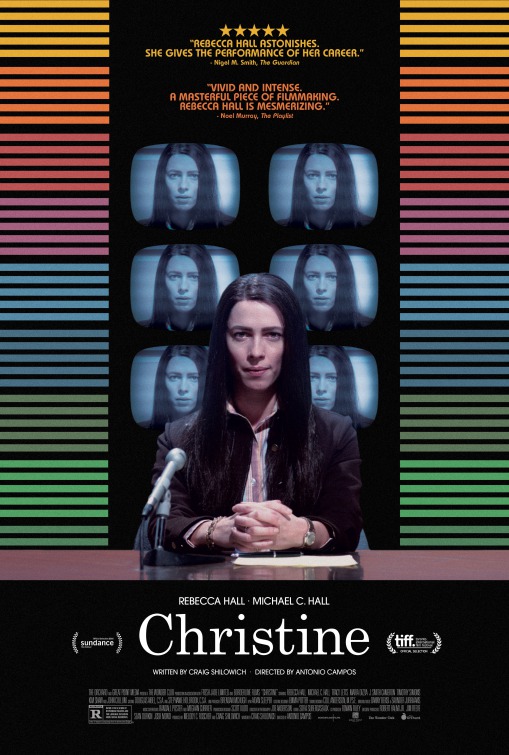
In the Spring of 1974, Christine Chubbuck (Hall) was a twenty-nine year old news reporter working for Channel WXLT in Sarasota, Florida. She was single, she lived with her mother, Peg (Smith-Cameron), and she had been given her own talk show on WXLT called Suncoast Digest, in which she would focus on local people and community activities. But Christine also suffered from depression, and could be up one moment and down the next (nowadays she would likely be diagnosed as having bi-polar disorder). Her depression could lead to extreme mood swings, and she would often push people away even though the few friendships she had were very important to her. And she regularly complained that the news stories she, and the station, were covering weren’t interesting enough, and that the station should focus more on regular people’s lives and what those lives were really like.

This kept her at odds with news director Mike Simmons (Letts), and the two would have regular run-ins as Christine tried to emphasise the various ways she felt the station wasn’t living up to its potential. Simmons wanted “juicier” stories about murder and other crimes; Christine felt the station should focus more on local people and the drama inherent in their lives. Simmons didn’t. Also at this time, the owner of WXLT, Bob Anderson (Cullum), was looking for two of the news team to transfer to Baltimore to a new station he’d recently purchased. Lead anchor George Peter Ryan (Hall) was a likely candidate, but Christine felt that she could be the other person Anderson was looking for.

Christine’s determination to be that other person led her to make some questionable decisions in relation to her work, and she came close to alienating Simmons for good. When she discovered that she wouldn’t be going to Baltimore (even after speaking directly to Anderson), Christine’s depression seemed to be under control. Her mood swings disappeared, she was more agreeable to her fellow co-workers, and she apologised to Simmons. She also asked to helm a Suncoast Digest piece direct to camera, something she’d never done before. Simmons agreed, and on the morning of 15 July 1974, Christine became a news story herself…

In telling the last few months in the life of Christine Chubbuck, Antonio Campos and screenwriter Craig Shilowich have fashioned the kind of Seventies-based journalistic enquiry that wouldn’t look out of place when compared to similar movies made at the time. With its drab Seventies decor and often drabber costume design (brown was definitely the colour back then), Christine pays homage to an era when news reporting in the US was heavily community-based – parochial even – and sensationalism was just beginning to take hold (when one of Christine’s reports is bumped in favour of a murder outside their area, she’s informed it’s because it’s what the viewers want to see). The movie eloquently and confidently recreates the period (in all its dreary glory), and provides a perfect backdrop for its tale of a real-life news reporter who could never understand why her work wasn’t as well-regarded as she expected.

Christine’s issues at work were exacerbated by her mental health issues, and the movie spends a lot of time reinforcing the idea that she was unwell. There are references to a previous “episode” that occurred before she and her mother moved to Sarasota; Christine herself acknowledges at times her own inability to connect with the people around her (she seems more confident with strangers, something that’s noted but not examined too closely); and her continual on-again, off-again reactions to her colleagues speak effectively of someone struggling to make sense of her place in the harried world of news journalism.

That Christine Chubbuck suffered from a variety of mental health issues is clear from Shilowich’s sympathetic and engrossing screenplay, and Hall gives a bravura performance, imbuing the troubled newswoman’s lack of social skills, and her off-kilter idea of professional balance with a scary, aggressive approach that initially makes her a hard character to like. But with the knowledge that she is ill, the movie is able to provide a sympathetic hook for the audience to hold on to, even when Christine is being manipulative and horrible to her mother, berating Simmons for treating her badly, or when she mistreats her best friend and colleague, Jean (Dizzia).Through all this and more, Hall never loses sight of the woman who is trapped behind the cold veneer of mental illness, and whose sense of self-worth is only as strong as the approbation she receives from the people around her (and which she then refutes). It’s an often distressing performance, and one that’s tempered by a refusal to soften the blow of certain scenes and images (it also makes you wonder how on earth Meryl Streep could have received an Oscar nomination for Florence Foster Jenkins when Hall’s portrayal is on another level entirely).

Other aspects of Christine’s personality, character and history are explored, such as the work she did with children with intellectual disabilities, adopting a puppet show approach to teaching them life skills. The movie uses these shows to explore the depth of Christine’s own feelings about various topics, and they retain an added poignancy thanks to the knowledge that though Christine is passing on sound advice, the viewer is aware that it’s advice she herself won’t be able to follow. In a scene where Ryan takes her to a trancendental analysis meeting, Christine expresses all the things that are wrong with her life, including the lack of a partner and/or children. This is the crux of the matter: she doesn’t want to be alone anymore. She’s fast approaching thirty, is to all intents and purposes alone in her life, can’t see a way forward, and decides on a course of action that will deal with everything that contributes to her being depressed.

Anyone aware of Christine Chubbuck and what she did that baleful July morning in 1974, will already know the movie’s outcome, but what’s remarkable about the period before that day, and the way that both Shilowich and Campos treat it, is that it’s not until the last ten or twelve minutes that Christine’s fate is sealed. There are a couple of foreshadowings that viewers who are “in the dark” may well pick up on, but as well as its self-destructive mental health theme, this is the story of a woman fighting for recognition in an industry that was inherently sexist, and which was on the verge of becoming less conventional and more exploitative. This subplot is given enough screen time that it adds to the sense of Christine being beleaguered from all sides, and her efforts to break free and get to Baltimore all the more understandable. But it’s also Christine’s last chance to salvage something from her time at WXLT, and it’s only then that her “solution” presents itself. With both her personal and professional lives coming to a standstill, her decision has an inevitability about it that the movie has avoided delving into up until then.

Throughout, Campos’ direction is solid, sympathetic and invigorating. He wisely keeps the focus on Hall, while giving the likes of Letts and Michael C. Hall plenty of room to flesh out their characters and make them as credible as they can (in reality, neither Ryan nor Simmons had as much involvement in Christine’s life as they do here, and sometimes it shows). The hustle and bustle of the newsroom is downplayed in favour of effective character beats, while Joe Anderson’s muted yet moody cinematography is a perfect match for the emotional troubles Christine experiences. There’s a whole lot of heart and craft here, and as an examination of one person’s bitter disappointment with the hand Life has dealt her, it’s also painfully affecting.

Rating: 8/10 – with a mesmerising and compelling performance from Hall (a career best in fact), and a wealth of sincerity and compassion when it comes to its central character, Christine is a remarkable movie let down only by its lack of back story, and some repetition in Christine’s dealings with Simmons; absorbing and vivid, and with a sly streak of humour running throughout, it’s also a movie that refuses to pass judgment on her, and which does its best to honour her memory without sensationalising it, something she would most likely have approved of.

Share this:

  • Click to share on X (Opens in new window) X
  • Click to share on Facebook (Opens in new window) Facebook
  • More
  • Click to print (Opens in new window) Print
  • Click to email a link to a friend (Opens in new window) Email
Like Loading...

Imperium (2016)

22 Wednesday Feb 2017

Posted by dullwood68 in Movies

≈ 1 Comment

Tags

Daniel Radcliffe, Daniel Ragussis, Drama, FBI, Review, Terrorism, Thriller, Toni Collette, Tracy Letts, Undercover, White supremacy

imperium-poster

D: Daniel Ragussis / 109m

Cast: Daniel Radcliffe, Toni Collette, Tracy Letts, Sam Trammell, Nestor Carbonell, Chris Sullivan, Seth Numrich, Pawel Szajda, Devin Druid, Burn Gorman

At the start of Imperium, relatively inexperienced FBI agent Nate Foster (Radcliffe) helps foil a terrorist bombing on US soil. His intuitive interrogation skills attract the attention of senior agent Angela Zampano (Collette). When a truck illegally carrying quantities of Caesium-137 – a chemical used in radiation treatments – crashes and six of the manifested containers are found to be missing, the FBI immediately assume that the chemical has been appropriated by Muslim terrorists. However, Zampano believes that the perpetrators are much closer to home, specifically within the white supremacy movement. She approaches Nate and convinces him that he would be an ideal choice to go undercover and infiltrate said movement and discover the whereabouts of the Caesium-137.

Connecting with a group of neo-Nazis led by Vincent (Szajda), Nate quickly earns their trust, and sets about making himself useful to them. Through Vincent, Nate is introduced to Aryan Alliance leader Andrew Blackwell (Sullivan), and other members of the movement, including atypical supremacist Gerry Conway (Trammell) who espouses supremacy ideals but leads an otherwise quiet suburban life. In turn, Nate’s attendance at a Unity Conference allows him to meet Zampano’s main target, an ultra-right-wing radio talk show host called Dallas Wolf (Letts). Wolf has ties and contacts to most of the organisations within the white supremacy movement, and Zampano is certain that he will know of any “action” that any of them may be planning. Nate gives Wolf the impression that he can help him boost the circulation of his radio show, in exchange for knowledge of any imminent “action” that Wolf may be aware of.

maxresdefault

At a rally, a fight breaks out and Blackwell is injured. Nate helps him get away, and later receives an invitation to the Aryan Alliance’s new compound (which the FBI is unaware of). There he sees plans relating to the water network for Washington D.C., and fears that the Caesium-137 will be used to poison the water supply. Needing confirmation from Wolf, he pushes the talk show host, but Wolf refuses both the money offered to help expand his circulation, and to have anything further to do with Nate. At the same time, Blackwell is dismissed as a potential threat by the FBI. With his undercover work seemingly at an end, Nate makes one last visit to see Conway. Still “in character”, Nate relates how much he wants to make a difference to the world as it is now. And to his surprise, Conway reveals that he has the Caesium-137, and that Nate can make a difference to the world…

Imperium does two things that are dramatically unexpected: first, it makes it appear incredibly easy to infiltrate a white supremacist organisation, and second, it makes it appear equally incredibly easy to divert suspicion when an agent’s identity is called into question. There are two main occasions when it looks as if the game is up, and Daniel Radcliffe’s wide-eyed right-wing ingénue is in danger of being exposed, but apparently the trick is just to get angry, accuse others of duplicity or stupidity – or both, and treat the accusation with complete disdain. As for providing proof, don’t worry; due diligence isn’t exactly high on a white supremacist’s list of priorities. They may be paranoid, but they’re not stu- Oh, hang on. Sadly, it’s this unconvincing approach to the material that undermines much of director Daniel Ragussis’s screenplay, leaving the movie itself to struggle from scene to scene in maintaining the viewer’s interest.

imperium-2016

It’s not so much that Imperium is a bad movie per se, but it is a movie that never grabs the viewer’s attention completely, making it an exercise that’s more frustrating than engaging or compelling. Also, there are problems with the character of Nate that Ragussis never seems to find solutions for. His initial naïvete and inexperience in field work (let alone being undercover) – illustrated by his being told to keep his weapon holstered in the movie’s opening sting operation – is highlighted in almost every scene until he’s facing Vincent across a table in a diner and making out he’s a disgruntled ex-Marine who doesn’t know why he was in Iraq. Nate gives an assured, confident performance that is completely at odds with his real, somewhat nerdy personality. He’s Serpico in suspect Levi jeans, and has an answer for everything. And despite the occasional protest to an uninterested Zampano, that’s how he remains.

This leaves the movie lacking in tension, as Nate goes about his task of infiltrating the white supremacy movement catching lucky break after lucky break and fending off any concerns about his being less than “racially superior”. And even though he’s been chosen for his empathy for others, where you might think that would lead to a kind of Stockholm Syndrome scenario, instead Nate appears largely unaffected by the hatred he encounters, and emerges from his undercover work psychologically unscathed. It’s this lack of depth, or any consequences to his involvement with such ideologically extreme people, that hurts the movie the most, as the script moves him from scene to scene, gathering intel but never being affected by what he sees and hears. This leaves Radcliffe, normally more than capable of inhabiting a role, somewhat stranded and unable to pull together a cohesive performance.

Imperium (2016) - Toni Collette and Tracy Letts

Inevitably, and despite the idea of there being a deadly chemical out there that could be used in a dirty bomb with the potential to kill thousands, it’s not a threat that anyone watching Imperium could take seriously. The various white supremacy protagonists are shown to be less than organised, preferring to squabble among themselves rather than combine their efforts and really make a difference (for which we should all be grateful), and their lack of guile and sophistication makes them a less than worrying “villain”. Only Gerry seems to be properly motivated, but in a very real sense he comes across as a left-wing idea of how a white supremacist should talk and behave; then they’d be more approachable, a notion that doesn’t make any sense at all.

With such tonal and narrative problems at the heart of the movie’s premise, Ragussis has assembled a movie that only fitfully engages the viewer, and which doesn’t seem to know just how effectively white supremacist groups are operating currently in the US, and just how much of a threat they really are (again, on this showing, not very much at all). There’s a good, thought-provoking movie to be made from the issue, but this isn’t it, and though the likes of Collette, Letts and Druid as a young neo-Nazi rise above the material for the most part, spare a thought for Radcliffe, stuck with carrying the movie for most of the running time, and whose director couldn’t get him to stop looking so scared and wide-eyed in scenes where he had no need to look scared and wide-eyed.

Rating: 5/10 – not quite a disaster, but certainly not as impressive as you might expect, Imperium is a sluggish, uncertain, and poorly assembled movie that never does itself justice; hampered by a script that feels under-developed in large stretches, this is passable stuff that requires patience and forgiveness in order to reap the few rewards it has to offer.

Share this:

  • Click to share on X (Opens in new window) X
  • Click to share on Facebook (Opens in new window) Facebook
  • More
  • Click to print (Opens in new window) Print
  • Click to email a link to a friend (Opens in new window) Email
Like Loading...

Indignation (2016)

03 Tuesday Jan 2017

Posted by dullwood68 in Movies

≈ Leave a comment

Tags

Drama, James Schamus, Korean War, Literary adaptation, Logan Lerman, Philip Roth, Religion, Review, Romance, Sarah Gadon, Tracy Letts, Winesburg

indignation

D: James Schamus / 111m

Cast: Logan Lerman, Sarah Gadon, Tracy Letts, Linda Emond, Danny Burstein, Philip Ettinger, Ben Rosenfield, Pico Alexander, Noah Robbins

In New Jersey in the early Fifties, Marcus Messner (Lerman), the son of a local butcher, has been awarded a scholarship to attend Winesburg College in Ohio. His father (Burstein) is over-protective and fearful that something will happen to Marcus when he’s there, but Marcus is having none of it; he can’t wait to get away. At Winesburg he finds himself boarding with two other Jewish students, Ron Foxman (Ettinger) and Bertram Flusser (Rosenfield). He throws himself into his studies, takes on a job at the college library, and generally keeps himself to himself. He doesn’t socialise, and when he’s offered a chance to join a largely Jewish fraternity, he refuses.

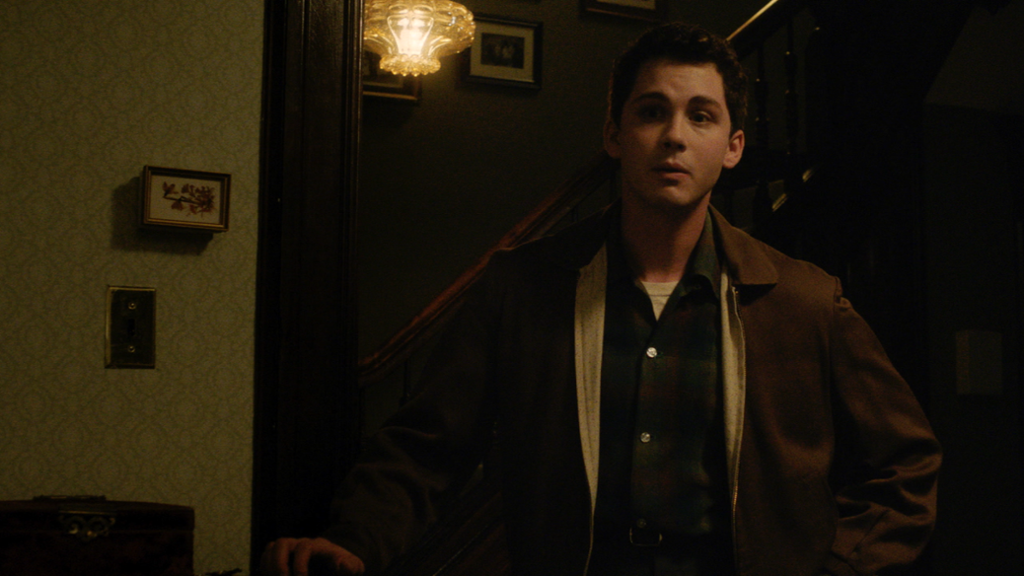
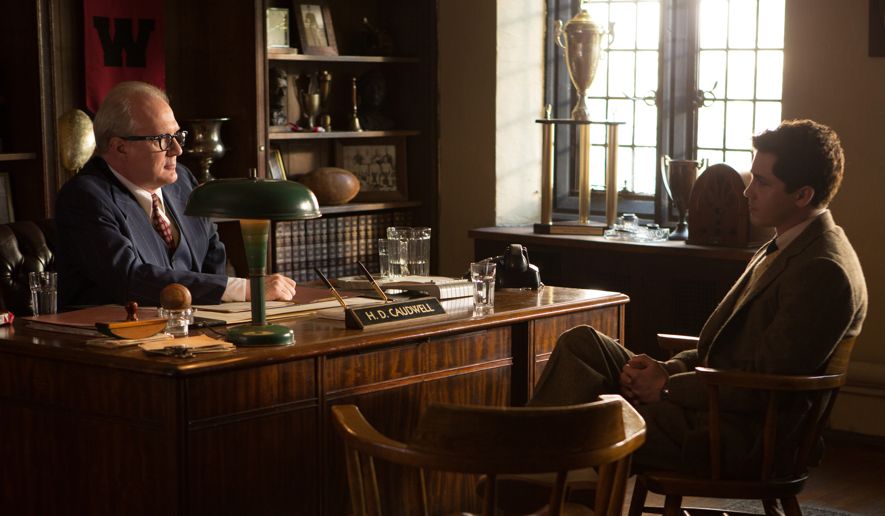
Marcus is drawn out of his self-contained world by the presence of Olivia Hutton (Gadon), an elegant fellow student he’s immediately attracted to. He plucks up the courage to ask her out on a date; at the evening’s end, Olivia surprises him by doing something so unexpected that he doesn’t know what to think of Olivia, or how to assimilate what happened within his limited experience of girls. He decides to avoid Olivia while he comes to a decision about how he feels, but this has the consequence of Olivia believing he doesn’t like her. Simmering tensions with his roommates come to a head in the meantime, and his decision to find alternative lodging within the college brings him to the attention of the dean, Hawes D. Caudwell (Letts). During a meeting between them, the conversation becomes heated, with Marcus decrying some of Winesburg’s traditions, including the mandatory attendance of chapel each week, especially as Marcus regards himself as an atheist. As he attempts to leave, he collapses and ends up in hospital thanks to a ruptured appendix.

41333076-jpg

Olivia makes several visits, and their relationship develops further. She reveals a secret about herself, one that complicates matters when he receives a visit from his mother (Emond) as well. The two women are introduced to each other, which makes an initially nervous Marcus quite happy. But his mother warns him that he should have nothing further to do with Olivia, a piece of advice that he ignores once he’s allowed out of the hospital. But his pursuit of Olivia, and his making a foolish decision in relation to attending chapel, leads to another encounter with the Dean, one that will have far-reaching consequences.

Adaptations of novels by Philip Roth have proven a mixed bunch in recent years, with the likes of Elegy (2008) and The Humbling (2014) receiving a lukewarm welcome with critics and audiences alike. And at first, Indignation seems as if it’s going to buck the trend of its predecessors. It opens with a sequence set during the Korean War, with Korean soldiers attempting to kill a US soldier. The soldier appears to avoid being killed, and we’re then transported to Newark and the funeral of a young Jewish soldier. We meet Marcus, fresh-faced, and anxious to get away from the stifling attention of his father. He’s well-liked in the neighbourhood, obviously bright, and will be the first Messner to attend college. It’s a neat, concise set up, and writer-director Schamus introduces us to the Messners and their milieu with a minimum of effort and a maximum of probity.

rs-indignation-e4f64d10-c97c-4acc-94a4-3dce010ece85

Once at Winesburg, though, and Schamus’s efforts begin to unravel. Marcus becomes a withdrawn, mirthless individual, and not without a degree of arrogance about his manner. This change of character is disturbing, as it challenges the viewer’s ability to feel sympathy for Marcus as the movie unfolds. His interaction with his fellow roommates borders on petulant, while he pursues Olivia with an eagerness that borders on obsession (he’s won over by the sight of her bare leg dangling over the arm of a chair). Only his inexperience with girls and obvious social naïvete spares him from being regarded as a jerk, but it’s a close run thing. His dismay at Olivia’s behaviour only adds to the impression of Marcus as a bemused but intolerant, shallow young man, and Schamus doesn’t do enough to offset that belief with anything more convincing or conclusive.

The encounter between Marcus and Dean Caudwell is the movie’s highlight, a near-fifteen minute masterclass in screen acting and writing that eclipses everything that comes before and after it. It’s somewhat of a shame that the scene is that good, because it exposes Marcus’s contempt for the college, and his disaffection with everything around him. This is where the “indignation” of the title is supposed to be revealed, from Marcus being made to do things that he doesn’t like or want to do (like join a fraternity), and railing against them. But Marcus’s indignation is misplaced and misappropriated; he’s an angry young man fighting for what he believes is just and right, but based on too little experience of life and the demands it can make on a person. He’s the classic angry young man/anti-authority figure, cocksure and heading for a fall.

indig_c0-10-3000-1759_s885x516

And so it plays out, with Schamus guiding Marcus – and the viewer – to an inevitable downfall, one where Roth, via Schamus, reveals the truth behind Marcus’s animosity: that he’s the victim of his own poor choices, and has no one else to blame but himself. There’s a wider argument: that when we make decisions we do so mostly without giving those decisions proper consideration, and Marcus’s story is a perfect example. But in adapting Roth’s novel, Schamus – known as a screenwriter and making his directorial debut here – pares back the drama so that there are long stretches where Marcus’s search for recognition (of his needs in others) occupies too much screen time. The tentative romance between Marcus and Olivia is also an issue, as Olivia’s dialogue is almost entirely given over to evasive, tissue-thin comments about relationships, and sidestepping questions about herself. And there’s a grim inevitability to it all that Schamus isn’t able to hide or exploit, despite the tragedy that surrounds her.

Thankfully, Schamus is well-served by his cast. Lerman, who despite appearances in movies such as Noah (2014) and Fury (2014), still carries the aura of being Percy Jackson with him, here embraces Marcus’s faults and growing cynicism with such confidence that it’s perhaps his most intuitive and perceptive performance to date. He’s not able to engender too much sympathy as Marcus, but perhaps that’s the point, that Marcus shouldn’t be too likeable, because if he was, his attitude and displeasure with college life (and much else) wouldn’t be as strident. In support, Gadon is radiant, her blonde hair, marbled skin and ruby red lips – such perfection – covering a damaged soul whose emotional needs are unlikely to ever be met. And then there’s Letts, his stern yet worryingly blank features proving the perfect foil for Lerman’s anguished expressions in their mid-movie encounter, his stillness and slightly menacing approach to his dialogue adding unexpected layers to the performance.

While Indignation does touch on elements and notions of anti-semitism, sexual mores, and the wider political and social worries of the time, including the shadow of the Korean War, at its heart it’s the story of a broken romance. Marcus and Olivia are a good match, one of them with too little experience of the world, one with too much; one of them has yet to make any real, life-changing decisions in their life, the other has made one too many. Again, as Roth says, it all comes down to choices, and when we make them, how we respond when they don’t work out. The consequence for Marcus can be seen at the movie’s end, and if there’s a degree of justice in that consequence, then should we be surprised?

Rating: 7/10 – with too many of its source novel’s subtleties and nuances jettisoned in favour of a more straightforward retelling, Indignation doesn’t have the impact that it should, and as a result, it only delivers emotionally and/or dramatically on a few, isolated occasions; bolstered by a trio of very good performances, and a feel for the period that helps ground the narrative, the movie struggles to make you care about Marcus or his “indignation”, and is only gripping when Marcus and the Dean go toe to toe.

Share this:

  • Click to share on X (Opens in new window) X
  • Click to share on Facebook (Opens in new window) Facebook
  • More
  • Click to print (Opens in new window) Print
  • Click to email a link to a friend (Opens in new window) Email
Like Loading...

Blog Stats

  • 486,797 hits

Recent Posts

  • 10 Reasons to Remember Bibi Andersson (1935-2019)
  • Fantasia (1940)
  • Dances With Wolves (1990) – The Special Edition
  • Kiss of the Spider Woman (1985)
  • The Three Musketeers (1973)

Top Posts & Pages

  • Lost for Life (2013) - Another Look
    Lost for Life (2013) - Another Look
  • Lost for Life (2013)
    Lost for Life (2013)
  • About
    About
  • A Brief Word About La La Land (2016)
    A Brief Word About La La Land (2016)
  • Exposed (2016)
    Exposed (2016)
  • Cardboard Boxer (2016)
    Cardboard Boxer (2016)
  • My Top 10 Guilty Pleasures
    My Top 10 Guilty Pleasures
  • The Monuments Men (2014)
    The Monuments Men (2014)
  • BFI London Film Festival 2015
    BFI London Film Festival 2015
  • A Brief Word About Netflix Original Comedies
    A Brief Word About Netflix Original Comedies
Follow thedullwoodexperiment on WordPress.com

Blogs I Follow

  • Rubbish Talk
  • Film 4 Fan
  • Fast Film Reviews
  • The Film Blog
  • All Things Movies UK
  • Interpreting the Stars
  • Let's Go To The Movies
  • Movie Reviews 101
  • TMI News
  • Dan the Man's Movie Reviews
  • Film History
  • Jordan and Eddie (The Movie Guys)

Archives

  • April 2019 (13)
  • March 2019 (28)
  • February 2019 (28)
  • January 2019 (32)
  • December 2018 (28)
  • November 2018 (30)
  • October 2018 (29)
  • September 2018 (29)
  • August 2018 (29)
  • July 2018 (30)
  • June 2018 (28)
  • May 2018 (24)
  • April 2018 (21)
  • March 2018 (31)
  • February 2018 (25)
  • January 2018 (30)
  • December 2017 (30)
  • November 2017 (27)
  • October 2017 (27)
  • September 2017 (26)
  • August 2017 (32)
  • July 2017 (32)
  • June 2017 (30)
  • May 2017 (29)
  • April 2017 (29)
  • March 2017 (30)
  • February 2017 (27)
  • January 2017 (32)
  • December 2016 (30)
  • November 2016 (28)
  • October 2016 (30)
  • September 2016 (27)
  • August 2016 (30)
  • July 2016 (30)
  • June 2016 (31)
  • May 2016 (34)
  • April 2016 (30)
  • March 2016 (30)
  • February 2016 (28)
  • January 2016 (35)
  • December 2015 (34)
  • November 2015 (31)
  • October 2015 (31)
  • September 2015 (34)
  • August 2015 (31)
  • July 2015 (33)
  • June 2015 (12)
  • May 2015 (31)
  • April 2015 (32)
  • March 2015 (30)
  • February 2015 (37)
  • January 2015 (39)
  • December 2014 (34)
  • November 2014 (34)
  • October 2014 (36)
  • September 2014 (25)
  • August 2014 (29)
  • July 2014 (29)
  • June 2014 (28)
  • May 2014 (23)
  • April 2014 (21)
  • March 2014 (42)
  • February 2014 (38)
  • January 2014 (29)
  • December 2013 (28)
  • November 2013 (34)
  • October 2013 (4)

Blog at WordPress.com.

Rubbish Talk

Film 4 Fan

A Movie Blog

Fast Film Reviews

The Film Blog

The official blog of everything in film

All Things Movies UK

Movie Reviews and Original Articles

Interpreting the Stars

Dave Examines Movies

Let's Go To The Movies

Film and Theatre Lover!

Movie Reviews 101

Daily Movie Reviews

TMI News

Latest weather, crime and breaking news

Dan the Man's Movie Reviews

All my aimless thoughts, ideas, and ramblings, all packed into one site!

Film History

Telling the story of film

Jordan and Eddie (The Movie Guys)

Movie Reviews & Ramblings from an Australian Based Film Fan

Privacy & Cookies: This site uses cookies. By continuing to use this website, you agree to their use.
To find out more, including how to control cookies, see here: Cookie Policy
  • Subscribe Subscribed
    • thedullwoodexperiment
    • Join 481 other subscribers
    • Already have a WordPress.com account? Log in now.
    • thedullwoodexperiment
    • Subscribe Subscribed
    • Sign up
    • Log in
    • Report this content
    • View site in Reader
    • Manage subscriptions
    • Collapse this bar
 

Loading Comments...
 

    %d