• 10 Reasons to Remember…
  • A Brief Word About…
  • About
  • For One Week Only
  • Happy Birthday
  • Monthly Roundup
  • Old-Time Crime
  • Other Posts
  • Poster of the Week
  • Question of the Week
  • Reviews
  • Trailers

thedullwoodexperiment

~ Viewing movies in a different light

thedullwoodexperiment

Tag Archives: Alfred Hitchcock

Memory of the Camps (1945/1984)

27 Tuesday Jan 2015

Posted by dullwood68 in Movies

≈ Leave a comment

Tags

Alfred Hitchcock, Atrocities, Auschwitz, Belsen-Bergen, Dachau, Documentary, Holocaust, Mass graves, Review, SHAEF, Sidney Bernstein, Trevor Howard, True story, World War II

Memory of the Camps

Original title: German Concentration Camps Factual Survey

No director / 58m

Narrator: Trevor Howard

Compiled from footage shot by combat and newsreel cameramen, Memory of the Camps was meant to be shown to German prisoners of war as a caustic reminder of the atrocities committed by the Nazis. Thanks to problems connected with post-war shortages and international cooperation, the movie’s assembly foundered and with two other, completed, documentaries released in the meantime – along with a change in policy that led to the authorities feeling such a project was now inappropriate – it’s only screening was in rough cut form in September 1945 (and without a working title).

Plans to revisit the movie in 1946 failed to happen and in 1952 the footage was “inherited” by London’s Imperial War Museum. It wasn’t until the early Eighties that anyone looked at the various reels and realised the importance of the material. As a result the five reel rough cut was shown at the 1984 Berlin Film Festival – with the added title Memory of the Camps – and then in 1985 on the PBS Network in the US with Howard’s narration added. (In 2015 an expanded, restored version with additional modern day footage titled Night Will Fall was shown as part of the Holocaust remembrance events surrounding 27 January, the date when Auschwitz was liberated by the Russians.)

The movie is a straightforward, no-holds-barred piece of cinema verité, unflinching in its depiction of the depravity carried out at fourteen locations (ten camps and four sites of atrocity) and beginning with Belsen-Bergen. The film that was shot then and the images that were recorded are heartbreaking, with hundreds of sick and emaciated internees struggling to comprehend the change in their fortunes or too far gone to understand it at all. Inevitably, there are the bodies, thousands of them everywhere, unattended, cadavers made of skin and bone, their faces like stretched parchment. The sheer scope and number of the deceased is difficult to comprehend, each pile of bodies looking like the worst example you’ll see… until the next one.

The Allies – mostly the British – are shown providing much-needed aid and comfort, but the bodies are the greater problem, their decomposition providing a fertile breeding ground for typhus and delaying the dispersal of the internees from the camps. In an ironic (and possibly contemptuous) turn of events, the Allies made the camp guards do most of the disposal work, getting them to handle the corpses and fill the mass graves with them. Shot so dispassionately at the time, this particular footage is harrowing to watch, as decomposing body after decomposing body is carried, or in some cases dragged along, to the pits that will be their final resting places.

Memory of the Camps - scene

The movie stays at Bergen-Belsen for some time, relaying the extent of the horror perpetrated there and the wretched conditions the inmates endured. It shows us the gas ovens, the infrastructure that made it all happen, and the survivors venting their anger on the guards and lackeys who had so recently tormented them. By the time the movie leaves Belsen-Bergen the viewer is so shell-shocked there’s a danger that footage from the rest of the camps – including Dachau, Buchenwald, Auschwitz and Majdanek – won’t be as distressing, but nothing could be further from the truth. Each camp throws up its own unique horrors, and each visit adds to the mounting, inescapable conclusion that the Nazis’ Final Solution should never be downplayed or allowed to fade from memory.

Overseen by producer Sidney Bernstein, Memory of the Camps was meant to be the movie to be shown to German POW’s after the war. It was a prestige production, with Bernstein calling on the likes of Alfred Hitchcock to assist on the project – Hitchcock gave advice on how the footage should be assembled – as well as future British cabinet minister Richard Crossman to work on the commentary. Despite the setbacks it suffered, and even in its rough cut form, the movie is still incredibly powerful even today, and carries a horrible weight that reinforces the importance of its content. There are dozens of close ups of the faces of the unknown dead, each one a sad reminder of the millions of people who not only lost their lives but who will never be remembered.

Howard’s narration is a masterpiece of studied melancholy, his normally rich tones subdued by the details he has to recite. There are moments where he pauses for a second or two, not so much for deliberate effect (the movie doesn’t need any help in that department) but more out of a recognition that what he’s saying is almost beyond belief. The movie also includes long stretches where Howard remains silent and the images speak for themselves. When these silent passages occur, leaving the viewer alone with the horrors on screen and their own thoughts, it’s almost a relief when Howard resumes his narrative.

Good as Howard’s voice over is however, it’s still the visuals that carry the most weight, acting like random gut punches and leaving the viewer overwhelmed by their barbarity and callousness. With more recent acts of genocide having appeared on our TV screens it’s disturbing that the shameful acts carried out by the Nazis can still have such an effect on people over seventy years on. But in a strange way, that’s a good thing…

Rating: 9/10 – even in its incomplete form, Memory of the Camps is a gruelling, crushing reminder of how callously and deliberately the Nazis exterminated an astonishing eighteen million people; traumatic to watch, but if it wasn’t then its message would be lost completely, and that would be as unacceptable as the camps themselves.

For all the nameless victims who should never be forgotten.
Share this:

  • Click to share on X (Opens in new window) X
  • Click to share on Facebook (Opens in new window) Facebook
  • More
  • Click to print (Opens in new window) Print
  • Click to email a link to a friend (Opens in new window) Email
Like Loading...

Poster of the Week – Psycho (1960)

08 Monday Sep 2014

Posted by dullwood68 in Movies

≈ 2 Comments

Tags

Alfred Hitchcock, Movie poster, Poster of the week, UK poster

Psycho (1960)

Psycho (1960)

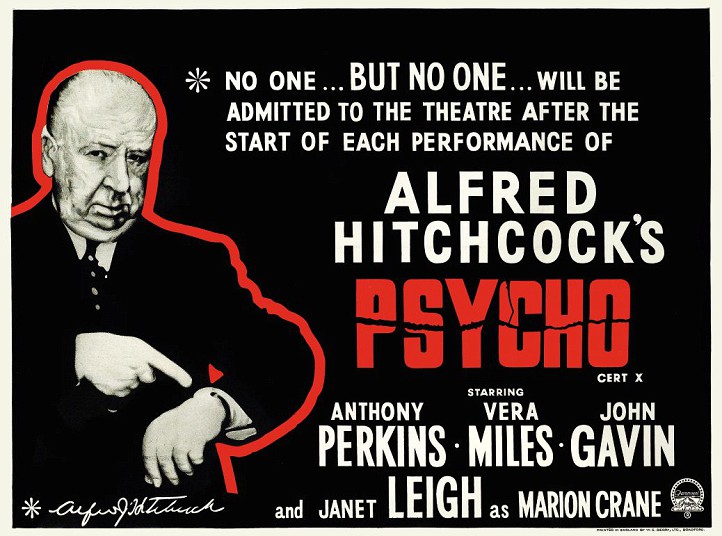
Made for a very specific purpose – as you can see – this has a very interesting design, a spare, unapologetic approach that gets straight to the point, and isn’t interested in frills or embellishments to make it look more attractive.  It is arresting, however, and is possibly one of the most effective pieces of movie advertising ever created.

It also features the only time Alfred Hitchcock appeared in a poster for one of his movies.  This particular version (there were others with the title in green and with slightly different wording) was created for the UK market, and was used to impress upon audiences the notion that Psycho was not to be missed at all, not any part of it.  It’s a brilliant conceit, to admonish prospective audiences before they’ve even seen the movie, but Hitchcock was as shrewd at marketing his movies as he was making them. With viewers almost corralled into seeing the movie, Psycho had a distinct advantage over other movies on release at the time: viewers wouldn’t want to feel left out of seeing it.

The visual effect of the poster can’t be underestimated either.  The appearance of the director, his image outlined in red (almost like a grisly version of a chalk outline) draws the eye first, then the very pointed indicating of his watch, his features almost saying, “You’re going to be late, aren’t you?”  The potential viewer suitably chided, their gaze is drawn to the right and the reason for Hitchcock’s appearance, the warning that is unequivocal and to the point.  And with no exceptions.

The rest is standard stuff, contractually obliged inclusions of the stars’ names, with special mention going to Janet Leigh whose character name is mentioned, giving the impression that she is the star of the movie and that Marion Crane will be the focus of the action (though, as we all know now, not for long).  (Too subtle perhaps, but never underestimate Hitchcock’s ability to manipulate his audiences, both on and off screen.)

A superb example, then, of the way in which an already hotly anticipated movie can be made to appear as an absolute must-see movie.  Simply brilliant.

Agree?  Disagree?  Feel free to let me know.

Share this:

  • Click to share on X (Opens in new window) X
  • Click to share on Facebook (Opens in new window) Facebook
  • More
  • Click to print (Opens in new window) Print
  • Click to email a link to a friend (Opens in new window) Email
Like Loading...

My Top 10 Movies – Part Seven

03 Monday Feb 2014

Posted by dullwood68 in Movies

≈ Leave a comment

Tags

Alfred Hitchcock, Apartment block, Broken leg, Cornell Woolrich, Drama, Grace Kelly, James Stewart, John Michael Hayes, Raymond Burr, Rear Window (1954), Review, Suspected murder, Thriller, Voyeurism

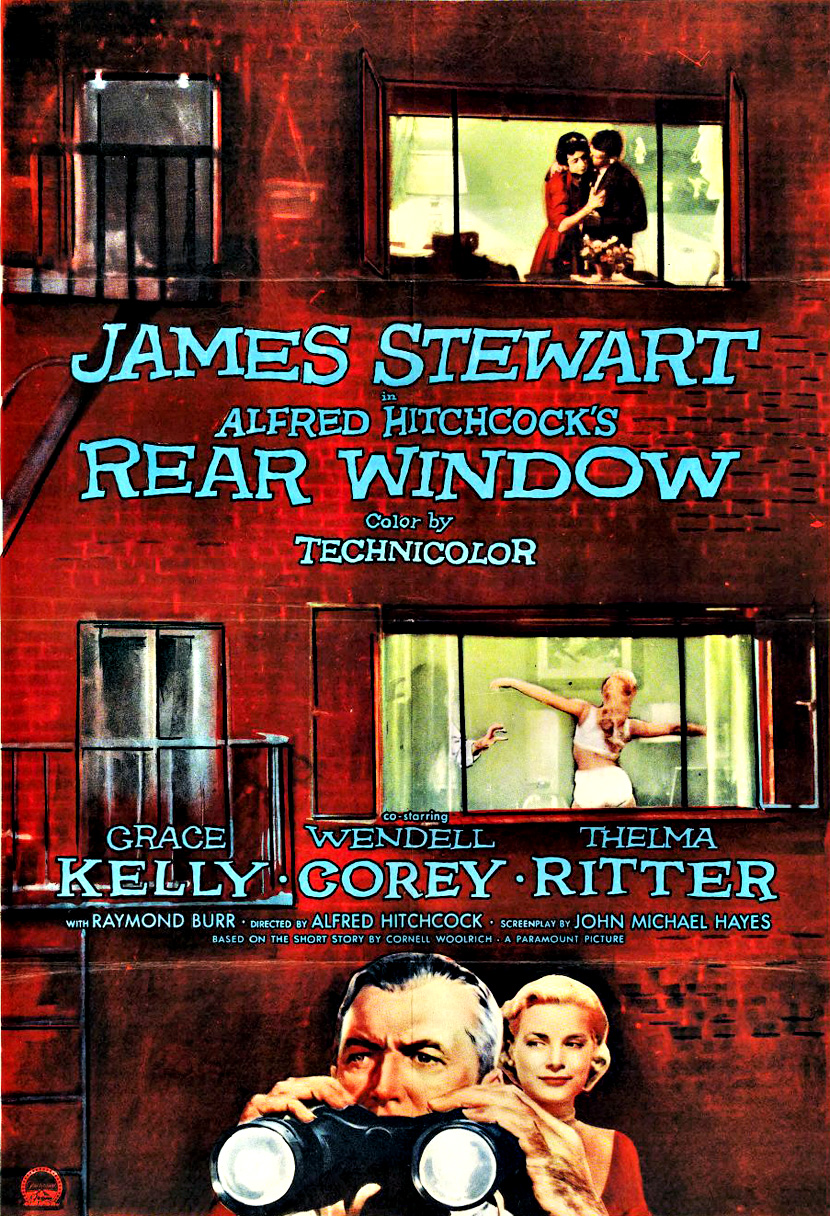
Rear Window (1954)

Rear Window

D: Alfred Hitchcock / 112m

Cast: James Stewart, Grace Kelly, Wendell Corey, Thelma Ritter, Raymond Burr, Judith Evelyn

I guess it was inevitable that there’d be a Hitchcock movie in my Top 10, but while the likes of Psycho (1960) and Vertigo (1958) are more highly regarded, for me it’s Rear Window any time and all the time.

I first saw Rear Window in the early Nineties.  It was shown on TV, and while I was more than familiar with Hitchcock – and by this time had seen most of his sound features – this particular movie, along with Torn Curtain (1967) and The Trouble With Harry (1955), had evaded me until then.  My favourite Hitchcock movie at that stage was Foreign Correspondent (1942), followed very closely by Strangers on a Train (1951).  I was looking forward to seeing what Hitchcock would do with the “has he or hasn’t he?” style plot, and how Kelly would be treated, being the first of his blonde heroines (with all that that entailed).

I must admit to having a mixed reaction at first.  The movie’s opening, with its slow, voyeuristic peering into the apartments and lives of L.B. Jefferies (Stewart)’s neighbours seemed like an extended piece of scene setting, audacious in its camera moves but serving no discernible purpose (bear in mind I had only a faint idea of the movie’s plot).  As each neighbour was introduced I couldn’t help but wonder how much of what we were seeing was relevant to the plot, and which characters were going to prove more important than the others.  It seemed obvious Miss Lonelyhearts (Evelyn) would be given a fair bit of screen time, as well as the creepy salesman Thorwald (Burr) with the nagging wife, but how these characters would interact I really didn’t have a clue.  (I should admit at this point that I watch a lot of movies where I don’t have any idea of what’s going to happen or what the movie is about; I’m looking for the movie to surprise me.)

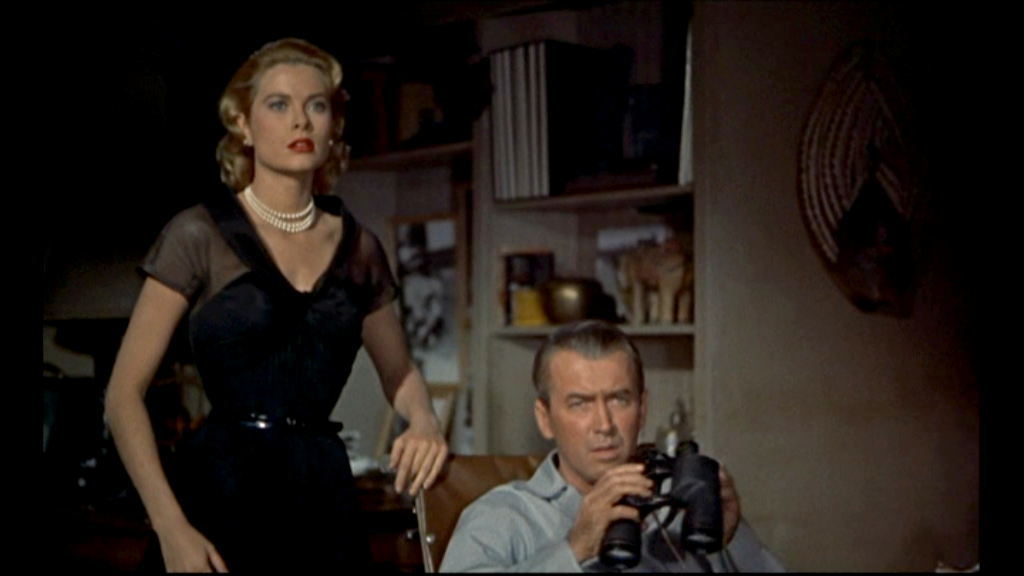
Rear Window - scene

Now, this being a Hitchcock movie, I knew there must be some kind of skullduggery about to be committed, and I knew that James Stewart’s character would likely be the hero, and Grace Kelly his romantic interest, but what I wasn’t prepared for, at all, was the movie’s master stroke: that up until the final scene, the whole movie doesn’t stray from Jefferies’ apartment.  Everything you see of his neighbours’ activities, and his girlfriend Lisa’s sleuthing, is seen from Jefferies’ perspective.  As it dawned on me that Hitchcock wasn’t going to take the camera any further than Jefferies’ window, it also dawned on me that, far from being a cinematic parlour trick, this was one of the cleverest set ups I’d ever seen.  Like Jefferies, the audience was confined to that small apartment, and again like Jefferies we too were helpless bystanders (he’s in a hip cast the whole time), involved in the action but removed from it at the same time.

This realisation made so much difference that I found myself agonising over what was happening as much as Jefferies.  When he was unable to convince his friend Doyle (Corey) of the likelihood of Thorwald’s guilty behaviour, I was there urging Doyle to see the sense in what Jefferies was saying.  And when Lisa appeared in Thorwald’s apartment, I was on the edge of my seat, knowing with a sick feeling in the pit of my stomach that Thorwald was bound to return home and find her.  And then, the worst moment of all, when Thorwald turns and sees…

Rear Window was the first thriller that gripped me, both physically and emotionally, and left me feeling wrung out to dry at its end (where Jefferies suffers a fitting punishment for his “professional” voyeurism).  Other movies have had a similar effect since – most recently, Captain Phillips (2013) – but I guess you never forget your first time.  The simplicity of the set up was terrific, and full marks should go to John Michael Hayes for building such a mousetrap from Cornell Woolrich’s short story (if you’ve never read Woolrich you’re missing out; his prose leaves you breathless).  Between them, Hayes and Hitchcock constructed a movie where watching other people’s lives becomes a litmus test for our own happiness, and where one man’s rescinded involvement provides an unwitting source of redemption for both himself and those he spies on.

I always get the feeling that Hitchcock is regarded as just a purveyor of thrills, and that people miss the psychological elements in his films.  Those elements are there in the majority of his movies, but when you mention Hitchcock most people are likely to remember scenes such as the shower murder in Psycho, or the crop duster attack in North by Northwest (1959), or Tippi Hedren under attack in a phone booth in The Birds (1963).  But for me, it’s the darker elements that make watching a Hitchcock movie so rewarding.  And if you want darker, then watch Rear Window, and see just how much Jefferies is put through the wringer; it’s torture, pure and simple.  And that’s just where Hitchcock wants us, and puts us.  And for myself, I was glad to be there.

Rating: 9/10 – one of the most memorable thrillers ever filmed and a testament to Hitchcock’s genius and creativity; excellent performances added to a perfectly coiled script and a wonderfully threatening score by Franz Waxman all go together to make Rear Window an absolute masterpiece.

Share this:

  • Click to share on X (Opens in new window) X
  • Click to share on Facebook (Opens in new window) Facebook
  • More
  • Click to print (Opens in new window) Print
  • Click to email a link to a friend (Opens in new window) Email
Like Loading...

Blog Stats

  • 486,544 hits

Recent Posts

  • 10 Reasons to Remember Bibi Andersson (1935-2019)
  • Fantasia (1940)
  • Dances With Wolves (1990) – The Special Edition
  • Kiss of the Spider Woman (1985)
  • The Three Musketeers (1973)

Top Posts & Pages

  • Lost for Life (2013) - Another Look
    Lost for Life (2013) - Another Look
  • Lost for Life (2013)
    Lost for Life (2013)
  • About
    About
  • Mr. Topaze (1961)
    Mr. Topaze (1961)
  • Shock and Awe (2017)
    Shock and Awe (2017)
  • Billy Lynn's Long Halftime Walk (2016)
    Billy Lynn's Long Halftime Walk (2016)
  • Winter's Tale (2014)
    Winter's Tale (2014)
  • Hunt for the Wilderpeople (2016)
    Hunt for the Wilderpeople (2016)
  • Spider-Man: Homecoming (2017)
    Spider-Man: Homecoming (2017)
  • BFI London Film Festival 2015
    BFI London Film Festival 2015
Follow thedullwoodexperiment on WordPress.com

Blogs I Follow

  • Rubbish Talk
  • Film 4 Fan
  • Fast Film Reviews
  • The Film Blog
  • All Things Movies UK
  • Interpreting the Stars
  • Let's Go To The Movies
  • Movie Reviews 101
  • TMI News
  • Dan the Man's Movie Reviews
  • Film History
  • Jordan and Eddie (The Movie Guys)

Archives

  • April 2019 (13)
  • March 2019 (28)
  • February 2019 (28)
  • January 2019 (32)
  • December 2018 (28)
  • November 2018 (30)
  • October 2018 (29)
  • September 2018 (29)
  • August 2018 (29)
  • July 2018 (30)
  • June 2018 (28)
  • May 2018 (24)
  • April 2018 (21)
  • March 2018 (31)
  • February 2018 (25)
  • January 2018 (30)
  • December 2017 (30)
  • November 2017 (27)
  • October 2017 (27)
  • September 2017 (26)
  • August 2017 (32)
  • July 2017 (32)
  • June 2017 (30)
  • May 2017 (29)
  • April 2017 (29)
  • March 2017 (30)
  • February 2017 (27)
  • January 2017 (32)
  • December 2016 (30)
  • November 2016 (28)
  • October 2016 (30)
  • September 2016 (27)
  • August 2016 (30)
  • July 2016 (30)
  • June 2016 (31)
  • May 2016 (34)
  • April 2016 (30)
  • March 2016 (30)
  • February 2016 (28)
  • January 2016 (35)
  • December 2015 (34)
  • November 2015 (31)
  • October 2015 (31)
  • September 2015 (34)
  • August 2015 (31)
  • July 2015 (33)
  • June 2015 (12)
  • May 2015 (31)
  • April 2015 (32)
  • March 2015 (30)
  • February 2015 (37)
  • January 2015 (39)
  • December 2014 (34)
  • November 2014 (34)
  • October 2014 (36)
  • September 2014 (25)
  • August 2014 (29)
  • July 2014 (29)
  • June 2014 (28)
  • May 2014 (23)
  • April 2014 (21)
  • March 2014 (42)
  • February 2014 (38)
  • January 2014 (29)
  • December 2013 (28)
  • November 2013 (34)
  • October 2013 (4)

Blog at WordPress.com.

Rubbish Talk

Film 4 Fan

A Movie Blog

Fast Film Reviews

The Film Blog

The official blog of everything in film

All Things Movies UK

Movie Reviews and Original Articles

Interpreting the Stars

Dave Examines Movies

Let's Go To The Movies

Film and Theatre Lover!

Movie Reviews 101

Daily Movie Reviews

TMI News

Latest weather, crime and breaking news

Dan the Man's Movie Reviews

All my aimless thoughts, ideas, and ramblings, all packed into one site!

Film History

Telling the story of film

Jordan and Eddie (The Movie Guys)

Movie Reviews & Ramblings from an Australian Based Film Fan

Privacy & Cookies: This site uses cookies. By continuing to use this website, you agree to their use.
To find out more, including how to control cookies, see here: Cookie Policy
  • Subscribe Subscribed
    • thedullwoodexperiment
    • Join 481 other subscribers
    • Already have a WordPress.com account? Log in now.
    • thedullwoodexperiment
    • Subscribe Subscribed
    • Sign up
    • Log in
    • Report this content
    • View site in Reader
    • Manage subscriptions
    • Collapse this bar
 

Loading Comments...
 

    %d