• 10 Reasons to Remember…
  • A Brief Word About…
  • About
  • For One Week Only
  • Happy Birthday
  • Monthly Roundup
  • Old-Time Crime
  • Other Posts
  • Poster of the Week
  • Question of the Week
  • Reviews
  • Trailers

thedullwoodexperiment

~ Viewing movies in a different light

thedullwoodexperiment

Tag Archives: Drama

Mini-Review: No Good Deed (2014)

25 Wednesday Feb 2015

Posted by dullwood68 in Movies

≈ 1 Comment

Tags

Absent husband, Action, Drama, Escaped convict, Home invasion, Idris Elba, Leslie Bibb, Psychopath, Review, Sam Miller, Taraji P. Henson, Thriller

No Good Deed

D: Sam Miller / 84m

Cast: Idris Elba, Taraji P. Henson, Leslie Bibb, Kate del Castillo, Henry Simmons, Mirage Moonschein

Denied parole after serving five years for manslaughter, Colin Evans (Elba) makes his escape from a prison transport vehicle, killing a guard and the driver in the process.

In Atlanta, Terri Granger (Henson) is coping with the demands of a baby and young daughter Ryan (Moonschein). When her husband, Jeffrey (Simmons), comes home early from work and announces he has to leave right away to visit his father, Terri worries about the way he’s behaving (even though he reassures her that he loves her). Her friend, Meg (Bibb), suggests they have a girls night, to which she agrees. Meanwhile, elsewhere in Atlanta, Evans is stalking the woman who was his fiancée, Alexis (del Castillo), before he went to prison. He confronts her at her home with evidence that she’s seeing someone else; when she admits to it, Evans kills her.

With a violent storm raging, Evans crashes his car and seeks help at Terri’s house. He’s respectful and agreeable but when he calls for a tow truck and is told he could have a long wait due to the storm, Terri invites him in and gives him some dry clothes to change into. He mentions that his fiancée has been cheating on him; Terri is sympathetic (if a little unnerved by his telling her this so quickly). Meg arrives with wine and is clearly attracted to Terri’s guest. During a shared smoke break, Evans tries to get Meg to question Terri’s honesty, but when she doesn’t he kills her too. Evans tells Terri that Meg has left but Terri sees Meg’s umbrella is still there; she also discovers that the phone line has been cut. Realising that Evans is dangerous she attempts to leave with her children, but the escaped convict has other ideas.

No Good Deed - scene

A movie that all involved clearly took part in for the pay cheques, No Good Deed should be rechristened No Good Movie. Turgid and lacking in genuine excitement, the movie is a home invasion thriller that defies belief from the moment Evans is referred to as a “malignant narcissist” to one of the final scenes where multiple injuries leave Terri without a mark on her. It’s dull, it’s unimaginative, it’s repetitive, and a complete waste of its stars’ time and efforts. In fact, it’s so bad that a nadir of sorts is reached when Henson has to show fear and desperation to a police officer and succeeds only in looking as if she’s desperate for the toilet.

With Terri alternating between victim and victor (and sometimes in the same scene), and with Elba showing very little sign of the acting talent we know he has, the movie sputters its way through to one of those “Hollywood” showdowns where the attacks keep coming despite painful blows, stabbings, and the kind of injuries that would have ordinary people calling for an ambulance before the first flush of pain fully registered. It’s also a drab movie to watch, and is directed with an eye for awkward framing by Miller who probably got the job off the back of directing Elba in several episodes of the BBC series Luther. But here his lack of moviemaking experience shows and he fails to make much out of Aimee Lagos’s awful, awful script.

Rating: 3/10 – unsurprisingly pushed back for theatrical release on three occasions, No Good Deed squanders any good will by continually insulting the audience’s intelligence; poorly executed and lacking in energy, the movie seems content to undermine itself at every turn.

Share this:

  • Click to share on X (Opens in new window) X
  • Click to share on Facebook (Opens in new window) Facebook
  • More
  • Click to print (Opens in new window) Print
  • Click to email a link to a friend (Opens in new window) Email
Like Loading...

Blackhat (2015)

25 Wednesday Feb 2015

Posted by dullwood68 in Movies

≈ 1 Comment

Tags

Action, Chris Hemsworth, Computer virus, Crime, Drama, Hacker, Hong Kong, Jakarta, Leehom Wang, Michael Mann, Nuclear plant, Remote Access Tool, Review, Thriller, Viola Davis, Wei Tang

Blackhat

D: Michael Mann / 133m

Cast: Chris Hemsworth, Leehom Wang, Wei Tang, Viola Davis, Holt McCallany, Andy On, Ritchie Coster, Christian Borle, John Ortiz, Yorick van Wageningen

When a nuclear plant in Chai Wan, Hong Kong is targeted by a hacker (van Wageningen) and the cooling pumps made to explode and cause a radiation leak, the Chinese authorities hand over the investigation to cyber warfare officer Chen Dawai (Wang). When the same hacker infiltrates Chicago’s Mercantile Trade Exchange, causing soy futures to rise, it becomes clear that he’s using a Remote Access Tool (RAT). Dawai insists that that he be allowed to work with the FBI on a joint investigation, and he travels to the US where he joins forces with Agent Carol Barrett (Davis). Once there he reveals that the original code for the RAT was written by himself and another hacker named Nick Hathaway (Hemsworth). Hathaway is currently in prison for committing computer crimes; Dawai wants him released to help with the investigation.

With Nick on board – though security tagged and accompanied by US Marshal Jessup (McCallany) – and with Dawai’s US based sister, Lien (Tang) helping as well, they discover that the soy futures hack was designed to siphon off nearly $75 million, but they don’t know why. When they discover the hacker has had a mole in the Trade Exchange, Nick and Lien find he’s been killed but was supposed to meet his boss at a restaurant. Nick finds a clue to the hacker’s identity, while the money is traced to a mercenary named Kassar (Coster). An attempt to apprehend him in Hong Kong fails and several of Dawai’s men are killed.

A break in the investigation comes with the retrieval of a data drive from the nuclear plant. Although it’s been corrupted by the radiation leak, Barrett tells Hathaway about a program the NSA uses called Black Widow which assesses corrupt data and is then able to reconstruct it by “filling in the blanks”. Her request to use it is denied however, which prompts Hathaway to use it anyway, hacking into the programme and using it to discover that the hacker’s server is based in Jakarta. At the same time, Lien discovers that the hacker has an interest in a remote site in Perak, Malaysia.

Hathaway’s use of Black Widow is detected, and Barrett is ordered to bring him back to the US. Dawai alerts him about this, and Hathaway and Lien (who have started a relationship) attempt to flee Hong Kong with her brother’s help. But Kassar ambushes them. Hathaway and Lien manage to get away and they travel to Perak to see what is so interesting about the site. It’s there that they discover the hacker’s true motives, and devise a way in which they can stop him.

Blackhat - scene2

It’s always a pleasure to watch a Michael Mann movie. You know going in that it’s going to look beautiful (especially if there are scenes shot at night – and there’s always scenes shot at night), there’ll be a level of machismo that few other directors can attain, some pulse-pounding action sequences, and a storyline that will have been researched for the utmost authenticity. And so it proves with Blackhat, Mann’s first movie since Public Enemies (2009), and a return to the world of modern day criminals for which he has such a proven affinity. However, while Blackhat‘s plot and storyline are drawn from recent events – in this case the Stuxnet computer worm that apparently ruined one fifth of Iran’s nuclear centrifuges in 2010 – and it paints a convincing portrait of cyber crime and how systems can be breached, it badly falls down in its attempts to show just how cyber crime can be detected and defeated.

There are several problems with the overall plot that don’t add up, and it’s these problems that stop the movie from being as effective – or gripping – as Mann intended. The first is the coincidental nature of the relationship between Dawai and Hathaway and they’re having written the RAT code. It’s an unnecessary, and clumsy contrivance that asks the viewer to believe that they wrote this code as a test of their abilities and then they just left it on the Internet, apparently unaware of what it could be potentially used for. The second problem is the idea that a felon, serving time for computer crimes, would be allowed out of the country in order to help with the investigation. Hathaway is even allowed to take part in the attempt to capture Kassar in Hong Kong; how was that allowed to happen? All he needs is a desk and a computer – he doesn’t need to be globe-trotting with everyone else.

The third and most glaring problem is the way in which senior agents such as Barrett and Jessup allow Hathaway so much leeway in his efforts to catch the hacker. At the point where the Black Widow program is introduced, the speed and the ease with which Barrett goes along with Hathaway’s plan to hack into it is breathtaking for the way it undermines any authority she had up to that point. It would have been a better idea for Hathaway to have done it behind her back, thus making the need to bring him in once his hack is detected that much more dramatic, but Morgan Davis Foehl’s script instead takes the opportunity to throw all further attempts at credibility into the trash bin.

And like so many of his colleagues before him, Mann is unable to make looking at computer screens and tapping on keyboards anywhere near exciting. To offset this he focuses on the characters and their reactions to what’s happening on the computer screens, but this is even less exciting, and the viewer is subjected to endless reaction shots that are meant to convey various emotions but ultimately mean nothing as most reactions are ones of surprise or moments when a light bulb goes on over someone’s head.

Against all this, the cast do their best but Hemsworth is miscast, his performance only convincing when he’s required to physically go up against the bad guys. Wang and Tang both give earnest performances, but struggle with the script’s insistence on making their characters crime movie stereotypes: he the diligent cop battling professional prejudice, she the hero’s girlfriend (despite being independent and having a mind of her own the script still requires her to “stand by her man” when the going gets tough). Davis flits in and out of the narrative, while you could be forgiven for forgetting that McCallany was there at all, his character’s job to babysit Hathaway at all times conveniently ignored when the script requires it.

As with any Michael Mann movie, Blackhat does at least look impressive, DoP Stuart Dryburgh providing the kind of hyper-stylised, glossy feel to the night-time exteriors that we’ve come to expect from Mann’s movies. The scenes set in Hong Kong have a wonderfully organic, shiny aspect to them that makes the backgrounds and the locations the most effectively shot for a Mann movie since Collateral (2004), while the lighting throughout offers enough mood and intensity for a dozen other thrillers. But, ultimately, it’s not enough to rescue a movie that is let down by a poorly constructed script and its sympathy-free characters. (In fact, the movie has been so badly received that one of its distributors, Universal Pictures International, has decided not to release it theatrically in Australia at all.)

Rating: 4/10 – while Mann is a clever and experienced enough director to keep things moving, there are too many cracks to paper over no matter how quickly he does so; a major disappointment, Blackhat is a reminder that even the most talented of directors don’t always get it right (sadly).

Share this:

  • Click to share on X (Opens in new window) X
  • Click to share on Facebook (Opens in new window) Facebook
  • More
  • Click to print (Opens in new window) Print
  • Click to email a link to a friend (Opens in new window) Email
Like Loading...

Mandrake, the Magician (1939) – Chapter 8: Across the Deadline

24 Tuesday Feb 2015

Posted by dullwood68 in Movies

≈ Leave a comment

Tags

Al Kikume, Columbia, Doris Weston, Drama, Lothar, Magician, Mandrake, Norman Deming, Platinite, Professor Houston, Radium machine, Review, Sam Nelson, Serial, The Wasp, Thriller, Warren Hull

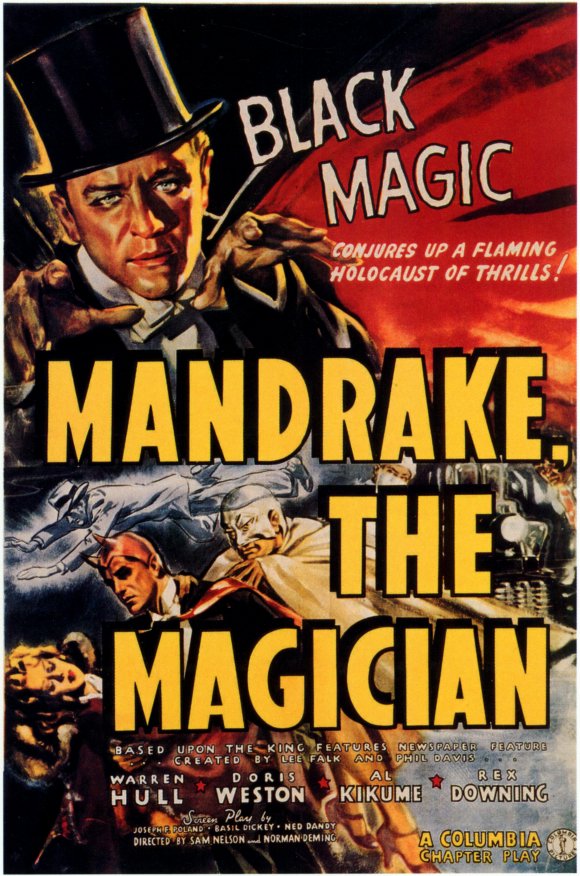
Mandrake, the Magician

D: Sam Nelson, Norman Deming / 17m

Cast: Warren Hull, Doris Weston, Al Kikume, Rex Downing, Edward Earle, Forbes Murray, Kenneth MacDonald, Don Beddoe, John Tyrrell, Dick Curtis

Climbing up to the overhead wire just as the hook holding up the trestle car straightens out completely, and sends the car plummeting to the canyon floor below, Mandrake rejoins Lothar and Webster as they fight off the Wasp’s men. The henchmen flee in their car, with Mandrake et al. in quick pursuit. The Wasp’s men hide out at a gas station, leaving the famous magician to return home; their leader informs Dirk of what has happened, and he tells them to pose as telephone repair men in order to plant a dictaphone in Mandrake’s home. When they get there, Betty and Tommy let in two of the Wasp’s men.

Mandrake returns home and immediately realises the two men are phony. He has a fight with them but they both escape. Meanwhile, the Wasp has Dirk and another of his men, Dorgan (Curtis) set up Professor Houston’s radium machine so that he can use it to destroy a dam. Still needing some more platinite to complete Houston’s new machine, Mandrake and Lothar return to the canyon where Webster has been mining some more of the precious metal. While Webster leaves to get a magnetic test kit, Dorgan takes a flag marker out to the dam and places it as a target for the Wasp to use with the radium machine. At the canyon, some of the Wasp’s men confront Mandrake and Lothar and a fight ensues. The Wasp destroys the dam, and the waters flood the canyon, causing massive destruction and into which both Mandrake and his loyal assistant fall to their deaths.

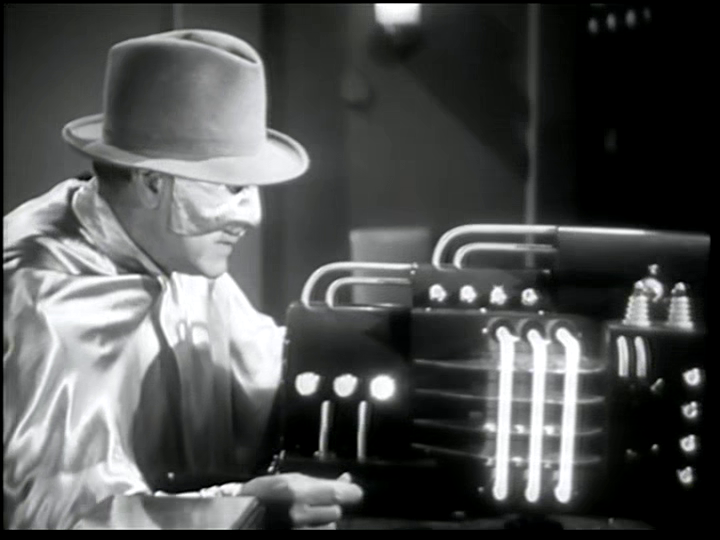
Mandrake 8

Three fist fights, a car chase, the Wasp getting out from behind his desk, Betty having even less to do than Tommy, Mandrake running in from another room (and at quite a distance) while the Wasp’s men shoot into one of his magic tricks (a cage he’s obviously disappeared into), Webster panhandling for platinite that’s already been mined – see Chapter 7: Gamble for Life – and the worst exploding dam effect seen in many a year, Chapter 8: Across the Deadline scrambles from one scene to the next with all the energy and vigour of a small child with ADD. This is another filler episode, adding nothing to the serial’s overall plot, and lacking in sense throughout.

And yet it still retains the serial’s rude charm, and provides the usual amount of unintentional laughs in amongst the seriously played theatrics. There’s little that can be said when the Wasp’s men are able to escape by holing up at a random gas station in the middle of nowhere, or by having Dirk and Dorgan test the radium machine on a lump of concrete, as by now the writers have abandoned what little plot development had been gained in the previous episode and decided to throw in the first idea that came to them – whether it works or not.

Rating: 4/10 – not the best of episodes and spurious in its plotting, Chapter 8: Across the Deadline becomes an episode to be endured on the way to the finale; at least it’s fast-paced, and the sight of Mandrake and Lothar congratulating themselves for having avoided a landslide is guaranteed to raise a chuckle.

Share this:

  • Click to share on X (Opens in new window) X
  • Click to share on Facebook (Opens in new window) Facebook
  • More
  • Click to print (Opens in new window) Print
  • Click to email a link to a friend (Opens in new window) Email
Like Loading...

Two Days, One Night (2014)

22 Sunday Feb 2015

Posted by dullwood68 in Movies

≈ Leave a comment

Tags

Belgium, Colleagues, Depression, Drama, Fabrizio Rongione, French movie, Jean-Pierre Dardenne, Luc Dardenne, Marion Cotillard, Review, Secret ballot, Seraing, The Dardenne Brothers, Weekend

Two Days, One Night

Original title: Deux jours, une nuit

D: Jean-Pierre Dardenne, Luc Dardenne / 95m

Cast: Marion Cotillard, Fabrizio Rongione, Catherine Salée, Batiste Sornin, Simon Caudry, Alain Eloy, Myriem Akeddiou, Fabienne Sciascia, Timur Magomedgadzhiev, Hicham Slaoui, Philippe Jeusette, Yohan Zimmer, Christelle Cornil, Laurent Caron, Serge Koto, Morgan Marinne, Gianni La Rocca, Ben Hamidou, Carl Jadot, Olivier Gourmet

In Seraing, a small Belgian industrial town, Sandra (Cotillard) works at a solar panel factory. The workforce consists of seventeen people, but Sandra has recently been off sick due to a bout of depression. During her absence, her boss, Monsieur Dumont (Sornin) has realised that the work can be done just as well by sixteen people instead of seventeen. As a result, she has fallen foul of machinations orchestrated by her foreman, Jean-Marc (Gourmet), and Dumont has given the rest of the staff a choice: they can have a €1000 bonus or keep Sandra in her job. Thanks to Jean-Marc’s scare tactics and bullying, the staff have voted for the bonus. Sandra has all but given up on her job when her co-worker Juliette (Salée) calls to say Dumont has agreed to meet with them. He agrees to a secret ballot, to be held on the Monday morning (it’s currently Friday afternoon).

All Sandra has to do is visit the rest of her colleagues over the weekend, explain about Jean-Marc’s role in things, and ask if they will vote for her to keep her job at the secret ballot. But Sandra hasn’t fully recovered from her illness, and her confidence is at such a low that she just wants to curl up in bed and ignore everything going on around her. Urged on by her husband, Manu (Rongione), and furnished with a list of addresses by Juliette, she sets out on Saturday morning by public transport to persuade her colleagues to vote for her. Some agree readily, others inform her that the money will ease their own problems. She manages to change the minds of a few, but by the end of the day she’s only halfway to getting the numbers she needs.

Driven round by her husband, she continues on Sunday but although she makes further headway, by the afternoon the whole thing begins to look even bleaker when she suffers a setback. Filled with despair, she takes a whole bottle of Xanax but when a colleague changes her mind and visits Sandra to tell her, her hope returns. With the pills flushed out of her system at the hospital, Sandra resumes her visits to her remaining colleagues. But by the time of the secret ballot on Monday morning, it’s too close to call and she has an agonising wait to hear the result.

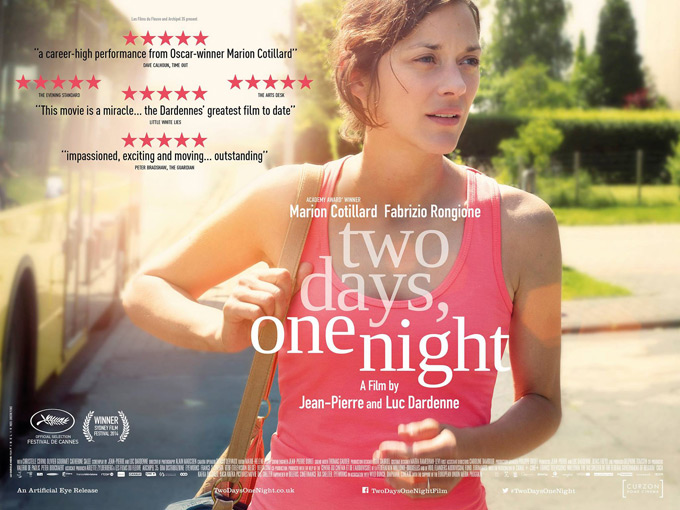
Two Days, One Night - scene

The latest from the Dardenne Brothers, after their wonderfully simple and affecting The Kid With a Bike (2011), Two Days, One Night is another simply told, emotionally honest drama that features a strong central performance, and tells its story with a minimum of artifice and a maximum amount of intelligence.

Its tale of a woman fighting to retain both her job and what little self-confidence she’s managed to keep following her illness, Two Days, One Night takes a straightforward storyline and imbues it with such emotional depth, and makes such an impact, that it lingers in the memory long after it’s ended. This is due in no small part to Cotillard’s superb portrayal of Sandra, a role that she inhabits so completely and so effortlessly that if you started watching the movie from just two minutes in, you could be forgiven for thinking you were watching a documentary. As the movie progresses, Cotillard’s beautifully shows the depth of despair and terror that Sandra is feeling about her situation, and the way in which she clings to each small victory with undeniable relief. By the time Monday morning arrives, she’s still nervous and she’s still unsure how the vote will go, but she’s gained so much confidence in herself, and so much more courage than she had on the Friday that you’re praying the ballot will go her way.

Cotillard gives such a brilliant performance that it’s a testament to the abilities of the Dardenne Brothers that she doesn’t dominate the movie to the point where the other characters and their stories are overwhelmed. Each of her colleagues has their own story to tell and each is indelibly presented, with special mention going to Cornil as a woman with an abusive husband (and who tips the balance when Sandra takes her overdose), and Magomedgadzhiev as a male colleague who doesn’t react in anything like the way Sandra expects when she catches up with him.

The Dardennes show a clear appreciation for the rhythms and symmetries of daily life, with Sandra’s home and family life and their importance for her naturally presented. It’s contrasted with the homes of her colleagues, none of which she sees except from the doorstep. Even when someone is home she’s never invited inside, as if she were an outsider, and this unspoken rejection adds to Sandra’s struggle, as she has to go further almost every time in tracking someone down (at one point she bumps into one of her colleagues by accident). It all adds to her sense of impending failure and shows just how difficult such a simple “exercise” can become when so much rides on it. The Dardennes capture every high and low of Sandra’s journey and by setting it in such a familiar, provincial environment, they reinforce how perilous ordinary life can be when something unexpected happens.

Alain Marcoen’s exquisite photography breathes added life into the movie’s mise en scène, and is complemented and enhanced by Marie-Hélène Dozo’s confident, precise editing (some scenes were filmed in a single take, adding to the verisimilitude). With the Dardenne Brothers free to weave their magic on the material, the movie becomes a spirited, uplifting look at one woman’s dark journey to personal redemption.

Rating: 9/10 – a quietly effective, quietly rousing tale of an underdog finding strength in the unlikeliest of circumstances, Two Days, One Night is a triumph for the Dardennes and a delight for the viewer; Cotillard is superb, and confirms her place as one of the finest actresses working in movies today (as if we needed reminding).

Share this:

  • Click to share on X (Opens in new window) X
  • Click to share on Facebook (Opens in new window) Facebook
  • More
  • Click to print (Opens in new window) Print
  • Click to email a link to a friend (Opens in new window) Email
Like Loading...

Mr. Turner (2014)

21 Saturday Feb 2015

Posted by dullwood68 in Movies

≈ Leave a comment

Tags

Biography, Dorothy Atkinson, Drama, History, JMW Turner, Marion Bailey, Mike Leigh, Painting, Paul Jesson, Relationships, Review, Royal Academy of Arts, Timothy Spall

Mr. Turner

D: Mike Leigh / 150m

Cast: Timothy Spall, Dorothy Atkinson, Marion Bailey, Paul Jesson, Karl Johnson, Ruth Sheen, Lesley Manville, Martin Savage, David Horovitch, Joshua McGuire, Kate O’Flynn, Leo Bill

Eminent painter Joseph Mallord William Turner is famous for his land- and seascapes. He lives in a big house in London with his father, William (Jesson) (who acts as his assistant), and his devoted housekeeper, Hannah (Atkinson). He has children he’s estranged from: two daughters from a relationship with Hannah’s aunt Sarah (Sheen). He rejects their attempts to procure financial support from him, even when they visit with his first grandchild. When he’s not at home, Turner travels the country (and sometimes abroad) making sketches that he can expand into paintings when he’s home.

He also visits members of the aristocracy and valued patrons. On one such visit he’s accosted by the struggling artist Benjamin Haydon (Savage), who asks him for the sum of £100 to help him avoid ruin. Haydon’s entreaties lead to Turner promising to lend him £50 instead, which Haydon accepts. When his father dies, Turner becomes depressed but the need to draw and paint is stronger than his despair. Shortly after, Turner visits Margate where he finds lodging with Mrs Booth (Bailey) and her husband (Johnson). He stays there awhile and finds himself enjoying the couple’s company. When he returns a second time he learns that Mrs Booth’s husband has passed away.

In the meantime his anarchic behaviour at the Royal Academy of Arts beguiles and amuses some of his fellow artists, and angers and upsets others, such as Constable. He appears to deface one of his own seascapes with a splotch of red, then removes himself. His associates are appalled and discomfited at this, until he returns and shapes the splotch until it resembles a buoy. At this their respect is renewed, and Turner’s notoriety is upheld, along with the acceptance of his genius. Around this time, Haydon, who has had his run-in with the Academy, visits Turner and tries to repay part of his debt. Turner, whose reputation is that of a curmudgeon, relents and waives the debt.

Returning to Margate he begins a relationship with Mrs Booth; they find a place together in Chelsea where Turner spends most of his time. But when the young Queen Victoria voices her disapproval over one of his paintings, his fame and public support begins to diminish. And following an attempt to experience what it feels like to be in the midst of a snowstorm by having himself strapped to the mast of a sailing ship, his health deteriorates as well.

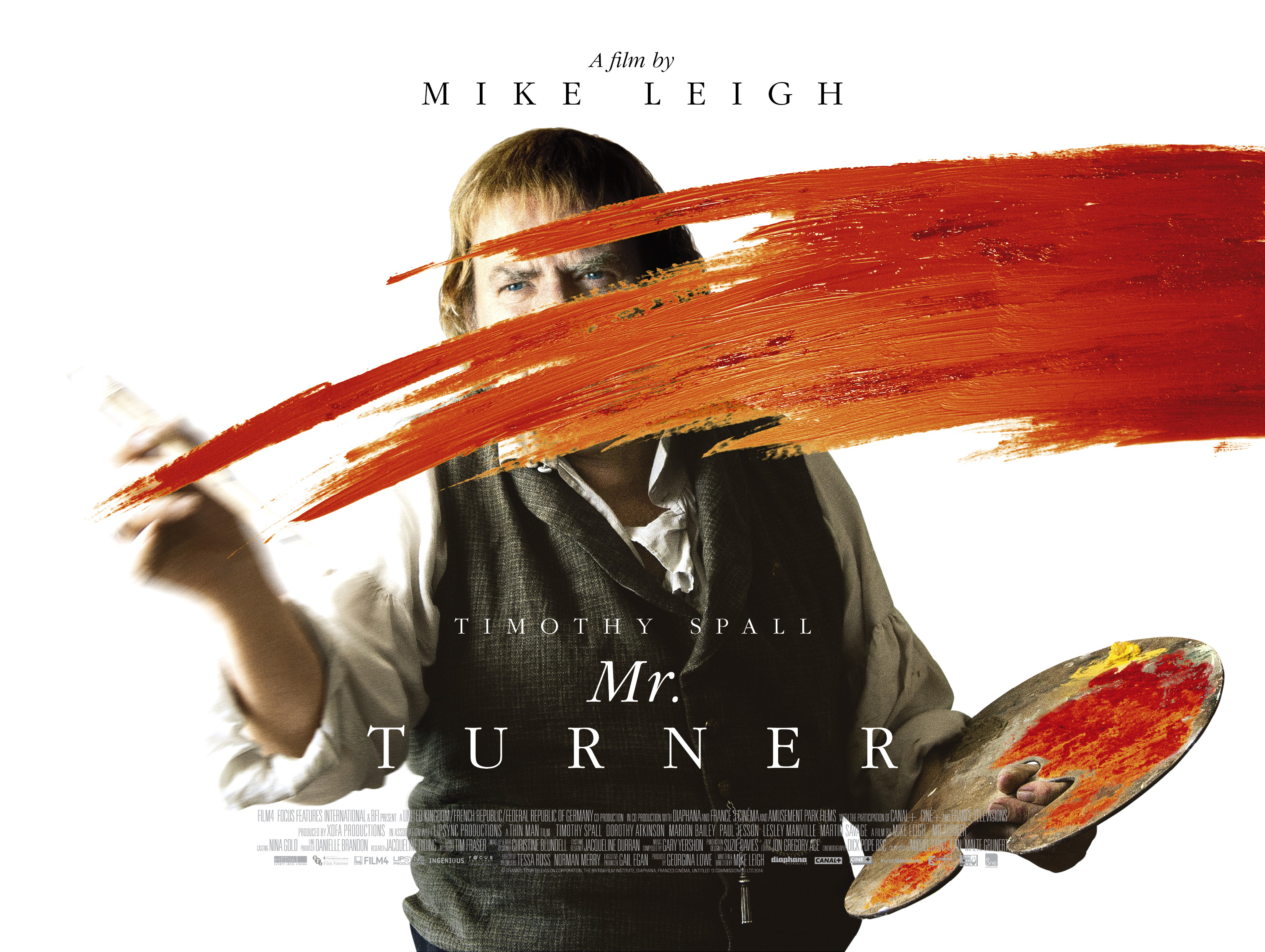
Mr. Turner - scene

Biopics of famous artists usually depend on their having lived eventful, passionate lives away from the canvas, but what is a director to do when their subject lives a fairly hermetic life, and who feels compelled to sketch at every opportunity (even when they’re with a prostitute and still mourning the loss of their father)? Unfortunately, Mike Leigh never really finds an answer to the question, which leaves Mr. Turner somewhat dry and determinedly episodic.

Turner’s life did have a few memorable moments but they largely occurred when he was much younger (the movie covers the last twenty-five years of his life). His younger sister died aged four and his mother was committed to an asylum where she later died. At the age of fourteen he was admitted to the Royal Academy of Arts school, and into the Academy itself a year later (Sir Joshua Reynolds was on the panel that admitted him). Perhaps the movie should have focused on these events, showing us how the “painter of light” earned that sobriquet.

Instead we have a movie that begins with Turner at the height of his powers and fame, and which seeks to concentrate on his private life, but without convincing the viewer that there’s any connection between the two. Despite his reputation for being a social malcontent, the Turner we encounter here is more open and friendly than expected and appears to be acidulous only with people he actively dislikes – there’s a great scene where the art critic John Ruskin (McGuire) reflects disapprovingly on a style of painting he clearly has no understanding of and Turner soundly rebuffs him. But while Leigh may be attempting to separate the man from his reputation, that he proves to be a more rounded individual shouldn’t come as a surprise.

In his relationships with women things vary between interesting and banal, and with his visit to a prostitute having a much different outcome than might be typical, that his emotional life was unconventional is to miss the point. There’s an element of desperation in his exploitation of Hannah that would border on abuse if she wasn’t such a willing accomplice, while his “wooing” of Mrs Booth speaks more of two lost souls finding each other than anything more dramatic. In both relationships however, Turner remains on the outside, receiving comfort when he needs it, and giving little back in return. It’s indicative of the female role in society at the time, 1826-1851, that Turner does all this without a moment’s consideration (or remorse) for his actions, and Hannah and Mrs Booth remain grateful for being part of his life.

Outside of these relationships there’s little else that serves as a way of learning more about Turner’s life, and as a result, the movie adds scene after scene that either reinforces what we already know about him, or adds nothing more to the narrative than the opportunity to show off some more of Leigh’s fastidious period recreation. This is hugely impressive, though, and is one area in which Mr. Turner can’t be faulted. Suzie Davies’ production design coupled with Charlotte Watts’ set decoration and Jacqueline Durran’s costume design, and all lovingly shot by DoP Dick Pope (and all four of them Oscar nominated for their efforts) make the movie a visual treat that is as richly rewarding as the reproductions of Turner’s paintings. It’s heritage moviemaking of the highest order.

Mr. Turner - scene2

Despite problems with the movie’s narrative and structure, Leigh is still able to show why he’s one of the most distinctive and idiosyncratic directors working today, and why any of his future projects will still command attention and respect. Leigh’s work ethic and methods are well-known, as well as his organic approach to the material he and his cast are working on, and with Mr. Turner those methods are all in place, leading to a clutch of excellent performances and some splendid supporting turns. Spall is simply magnificent, grumbling and grunting his way through scenes with a sour face and occasional flashes of charm. It’s a deceptively simple and sympathetic portrayal, and Spall inhabits the character completely, so much so that you forget he’s acting. He’s matched by Atkinson, whose screen time is much less, but who brings an unforgettable sadness and pathos to her role as Turner’s subjugated housekeeper (and for those who might be wondering why Hannah looks so dreadful by the movie’s end, it’s because she suffered from psoriasis). As Hannah’s “competitor” Mrs Booth, Bailey expresses more in one rueful smile than some actresses manage in an entire movie, and her pleasant, amiable approach to the character serves as a telling counterpoint to the gruff demeanour of Turner himself.

A movie then that requires a great deal of perseverance but which is helped immeasurably by its cast and its presentation, Mr. Turner is likely to divide audiences into two camps: those looking for a story to follow, and those who can forgive its absence. With too many longueurs for its own good, the movie struggles to be as effective as it needs to be, but retains just enough energy to help audiences reach the end. It’s a close run thing, though, and with so little explained throughout, will definitely try some viewers’ patience.

Rating: 7/10 – fans of Leigh’s might be tempted to forgive the lack of a recognisable storyline, but without it Mr. Turner suffers accordingly; strong performances and often beautiful compositions and framing can’t prevent the movie from feeling hollow, nor the material from seeming as if it wasn’t quite as fully developed as it should have been.

Share this:

  • Click to share on X (Opens in new window) X
  • Click to share on Facebook (Opens in new window) Facebook
  • More
  • Click to print (Opens in new window) Print
  • Click to email a link to a friend (Opens in new window) Email
Like Loading...

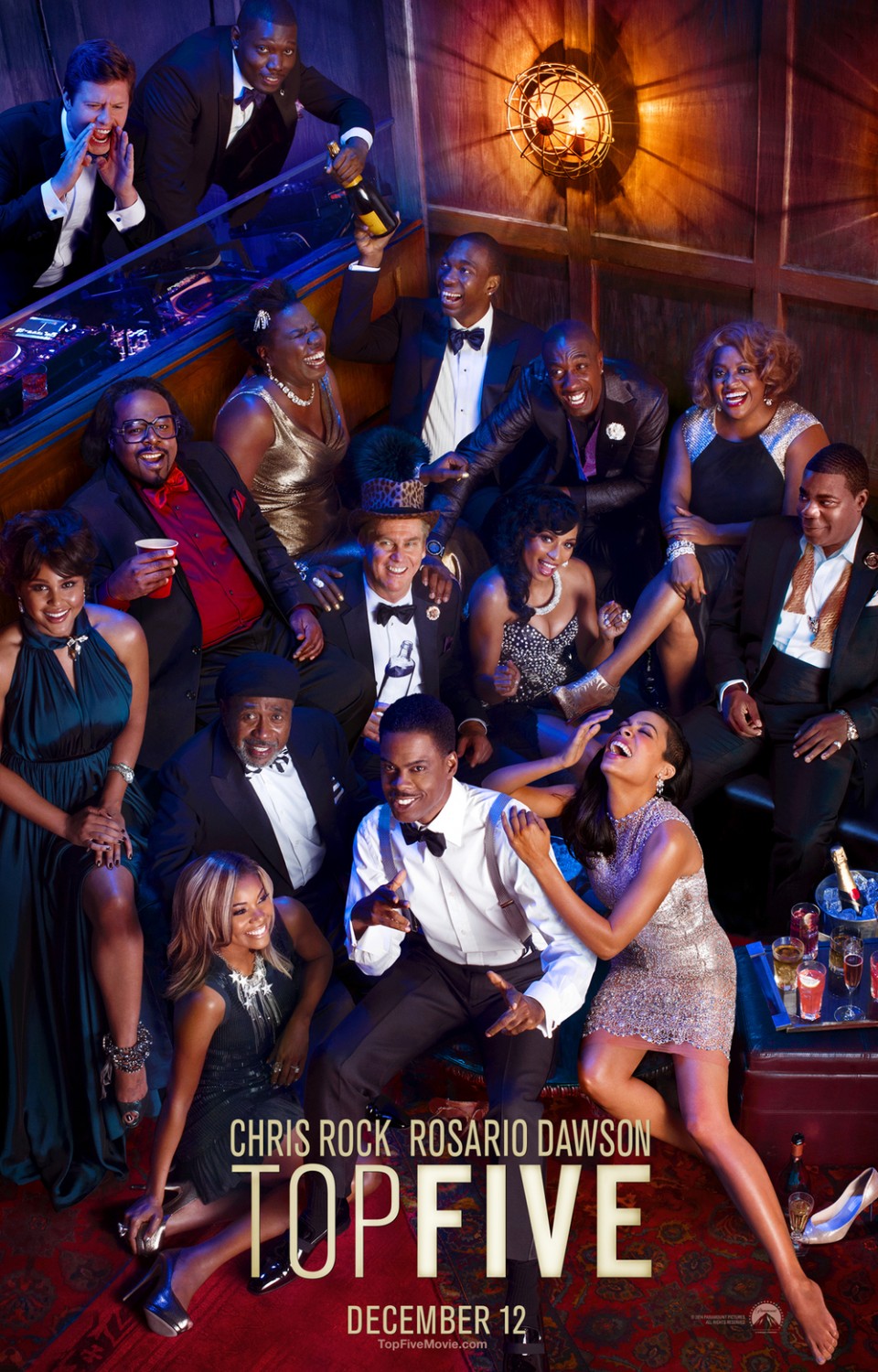
Top Five (2014)

21 Saturday Feb 2015

Posted by dullwood68 in Movies

≈ Leave a comment

Tags

Chris Rock, Comedy, Drama, Film critic, Gabrielle Union, Hammy the Bear, JB Smoove, Reality TV, Review, Romance, Rosario Dawson, Uprize, Wedding

Top Five

D: Chris Rock / 102m

Cast: Chris Rock, Rosario Dawson, JB Smoove, Gabrielle Union, Romany Malco, Cedric the Entertainer, Anders Holm, Tracy Morgan, Leslie Jones, Sherri Shepherd, Jay Pharaoh, Ben Vereen, Kevin Hart, Luis Guzmán, Adam Sandler, Jerry Seinfeld, Whoopi Goldberg, DMX, Taraji P. Henson, Gabourey Sidibe

Andre Allen (Rock) is a stand-up comedian whose move into movies has brought him international fame thanks to the Hammy trilogy where he plays a cop in a bear costume. Wanting to put the Hammy movies behind him and focus on more serious projects – his latest movie, Uprize, is about the slave revolt that began in Haiti in 1791 – Andre is also a recovering alcoholic and about to get married to reality TV star Erica Long (Union).With only a couple of days to go before the wedding, Andre agrees to an interview with the New York Times’ Chelsea Brown (Dawson).

The interview gets off to a poor start when Chelsea asks him a banal question that prompts him to challenge her to ask the questions she really wants to ask. She wants to know when he stopped being funny and why, and about his alcoholism. He tells her about the time he hit bottom, in 2003 on a trip to Houston, where a night of sex and drugs with a couple of prostitutes (and the unexpected involvement of his tour promoter) led to accusations of rape and his being arrested. He also credits Erica with helping him achieve sobriety and stay that way.

As the interview continues, Andre introduces Chelsea to some of his friends. He’s relaxed with them, and they all joke that he’s never been funny and still isn’t. At a press conference for Uprize, Andre is chagrined to hear calls for another Hammy the Bear movie. He and Chelsea stop off at a hotel so she can meet up with her boyfriend, Brad (Holm), whose birthday it is. Unfortunately, she discovers that Brad has been hiding the fact that he’s gay (despite some very obvious clues in their sex life). Upset and angry at being so easily duped, she’s less than happy when Andre expresses his disbelief at how naïve she’s been. They argue, but the argument leads to their kissing and ending up in a club bathroom about to have sex. They manage to stop themselves; Andre asks to borrow Chelsea’s phone to make a call. While he does he discovers that she is actually James Nielson. He confronts her. Chelsea admits to the deception but tries to explain that she does like him and that she regrets not having told him sooner. Andre refuses to accept her explanation and leaves her behind in the club. From there he goes to a convenience store where he gives in to temptation and starts drinking again…

Top Five - scene

A romantic comedy that weaves in some interesting dramatic elements, Top Five is an astute, cleverly constructed movie that shows Rock firing on all cylinders and mixing gross-out comedy with intelligent observations on fame and media exposure, as well as trenchant examinations of modern day relationships and their ups and downs. It’s a confident movie, unafraid to take a few risks, and Rock proves he has a gift for exposing some of the more absurd aspects of his profession, in particular the fame that can be gained from a movie trilogy based around the exploits of a cop in a bear costume (“It’s Hammy time!”).

He’s also more than adroit at creating a romance between Andre and Chelsea that anchors the movie and proves far more affecting than expected. Partly this is due to his script, which for the most part tries hard to avoid becoming standard romantic fare (though it follows an established formula), and the obvious chemistry he has with Dawson. As they travel the streets of New York, challenging each other, debating, laughing, supporting each other, the warmth and growing affection they feel for each other is so charmingly done that you find yourself rooting for them. As it becomes clear that their existing relationships are less than satisfactory, their slow pull towards each other becomes as rewarding for the viewer as it is for them. Dawson is always an appealing presence on screen, and here she proves a great foil for Rock’s often acerbic approach to his own material.

Of course, this being a Chris Rock movie, the focus is as much on the comedy as the romance, and here he succeeds in providing a slew of laugh-out-loud moments, from Cedric the Entertainer’s unexpected “party trick” to Andre and Chelsea’s discussion on the requirements for becoming the next President, to Chelsea’s punishment of Brad’s anal fixation, to Andre’s bodyguard Silk (Smoove) and his penchant for the larger lady (his encounter with Sidibe is brief but wonderful), to Andre’s adding “stank” to a radio promo – Rock maintains a high hit rate throughout. He also infuses several dramatic moments with a level of humour that adds poignancy and pathos to the material, and gives the likes of Union and Shepherd a chance to shine in scenes that hold a lot more weight than is immediately apparent.

While Rock scores highly with his script, and employs a cast who all make the most of their roles (and are clearly having a great deal of fun in the process), he’s not quite as successful in creating a visual palette that elevates or enlivens the material, and certain scenes have a perfunctory feel about them as a result (DoP Manuel Alberto Clara worked on Lars von Trier’s Nymph()maniac Vol. I & Vol. II and there are many similarities in style between those movies and this one). That said, there are some occasional moments – Andre’s impromptu appearance at a comedy club, the scene where Andre trashes the convenience store – where the visual approach works in the movie’s favour.

All in all though, Top Five is a movie that provides much to enjoy and admire, and serves as a reminder that when he puts his mind to it, Rock is one of the more gifted comedians working in movies today (it’s also amazing to think that he’s only recently turned 50; he definitely doesn’t look it). Let’s hope this is just the first of many more similar projects to come.

Rating: 8/10 – a disarmingly enjoyable romantic comedy, Top Five benefits greatly from its charming central romance and Rock’s willingness to offset the comedy with telling moments of drama; a winning return to form after the less than successful I Think I Love My Wife (2007), this has something for everyone and rarely disappoints.

Share this:

  • Click to share on X (Opens in new window) X
  • Click to share on Facebook (Opens in new window) Facebook
  • More
  • Click to print (Opens in new window) Print
  • Click to email a link to a friend (Opens in new window) Email
Like Loading...

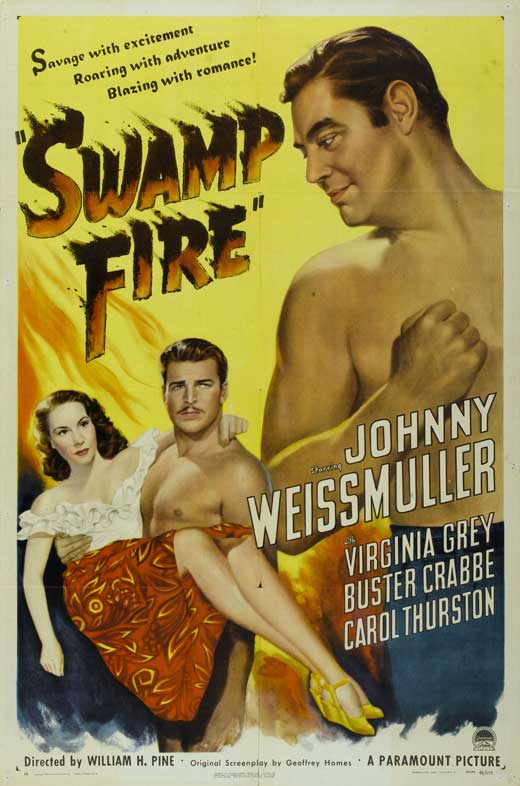
Swamp Fire (1946)

19 Thursday Feb 2015

Posted by dullwood68 in Movies

≈ Leave a comment

Tags

Action, Bar pilots, Buster Crabbe, Carol Thurston, Cypress Point, Drama, Johnny Weissmuller, Louisiana, Mississippi River, Review, Romance, Virginia Grey, William H. Pine

Swamp Fire

D: William H. Pine / 69m

Cast: Johnny Weissmuller, Virginia Grey, Buster Crabbe, Carol Thurston, Pedro de Cordoba, Marcelle Corday, William Edmunds, Edwin Maxwell, Pierre Watkin

Coming home from the war, bar pilot Johnny Duval (Weissmuller) is a veteran whose return is tinged with a bittersweet quality. He lost both his ship and his men during the war and he’s haunted by the event, so much so that he’s lost his confidence as a bar pilot completely. But he does have the love of Toni Rousseau (Thurston) to look forward to, and the welcome of his friends. Travelling through the swamp to his home at Cypress Point, his row boat is side-swiped by a motor boat being driven by Janet Hilton, a wealthy socialite who lives at nearby Delta Island. With her motor boat run aground, Johnny offers to take her to Cypress Point where she can rent another boat. Once there, she wastes no time in alienating Johnny’s friends, including Toni, before leaving.

Johnny goes back to work for the Coast Guard but he takes a junior role, until one night the bar pilot on his ship feigns an illness that leads to Johnny taking over and seeing another boat through the river’s perilous sand bars. The boat belongs to Janet’s father; she’s also on the boat and makes advances towards him, but even with that and other distractions such as an hallucination from the war, he guides the boat safely through the waters, and regains his confidence. Quickly promoted to a lieutenant in the Coast Guard, Johnny resumes his usual work as a bar pilot. In the meantime, Janet continues to pursue him, much to the annoyance of Toni, and to the satisfaction of Mike Kalavich (Crabbe), a trapper who wants Toni for himself. Johnny decides to marry Toni and the date is set, but the night before, he finds himself persuaded to guide a ship through dangerous fog. There is a collision with another boat, one that leads to the death of Toni’s grandfather (de Cordoba).

Unable to cope with the guilt of what he’s done, Johnny goes away on leave and bar hops until he’s so drunk he stumbles into the path of a truck and is knocked down. He ends up in hospital and is there for two weeks before anyone discovers who he is. The news makes the papers and Toni and Johnny’s boss, Captain Moise (Maxwell), head to the hospital to bring him home. But when they get there they find Johnny has already left – in the care of Janet Hilton. At the Hiltons’, Janet tells them – falsely – that Johnny doesn’t want to see them, or anybody, from Cypress Point. Janet takes further steps to stop Johnny and Toni from contacting each other. With both believing the worst of the other, Johnny and Toni’s relationship falters then fails, until the capture of one of Kalavich’s comrades in poaching leads to Janet’s duplicity being revealed. But while Johnny tries to find Toni, Kalavich, enraged by this turn of events, decides to set fire to the swampland, putting them all in danger.

Swamp Fire - scene

The first of two movies uniting former Olympic swimming champions Weissmuller and Crabbe – the second would be the Jungle Jim adventure Captive Girl (1950) – Swamp Fire is an absorbing, though pedestrian drama that unfolds at a steady, if sometimes soporific pace, and which offers both actors a chance to spread their wings in roles they wouldn’t normally have played. Weissmuller, though as wooden as usual, does his best as the taciturn, PTSD-suffering Johnny, and makes a decent fist of his love scenes with Thurston (he certainly kisses her with gusto). Crabbe has the greater challenge, playing a disgruntled bad guy with a dodgy Cajun accent and a pencil-thin moustache, but it’s a more natural performance, and he seems more at ease in the role than Weissmuller does as Johnny, and the movie gains a noticeable energy whenever he’s on screen.

They’re kept apart for most of the movie, however, leaving room for Weissmuller to romance both Grey and Thurston in equal measure, and to show that his muscular frame still looks good in a T-shirt (he doesn’t go bare chested in this movie, perhaps because of the extra weight he’d put on at the time). The twin romances are agreeable, if not entirely believable. Grey’s character is so stuck up and manipulative that when Toni ends up in the river and at the mercy of an alligator, it’s likely the viewer will be wishing it was Janet in the water. The character vacillates between arrogant, passive and flirtatious (sometimes in the same scene), and Grey doesn’t always know when to move from one aspect to another. Thurston plays Toni as if she were more of a tomboy than a young woman with eyes for only one man, but she’s consistent in her approach to the character and makes slightly more of things than the script – by Daniel Mainwaring (credited as Geoffrey Homes) – would appear to allow. There’s an argument that both roles are underwritten, but the truth is they’re quite stereotypical for both the time the movie was made and its milieu.

In the hot seat, Pine – noted for being a producer more than a director – shows a sure hand in moving the camera around and elicits good performances from the supporting cast, including Edmunds as the local bar owner, and Maxwell as Johnny’s suppportive superior. The Louisiana locations are well chosen for their beautiful scenery, and make for splendid backdrops to the (occasionally) overheated emotions of the main characters (though the amount of rear projection work going on almost negates their effect). As well as being involved in several river collisions, Weissmuller gets to wrestle and kill an alligator – the danger of which he brushes off with manly stoicism – and there’s a catfight between Grey and Thurston that is, sadly, over almost as soon as it’s started. The fiery climax doesn’t look as impressive in the long shots as it does close up, but the emotional undercurrent is brought to the fore, making the denouement unexpectedly compelling, and satisfying as well.

Rating: 5/10 – like a lot of low-budget, modest post-War productions, Swamp Fire is borderline forgettable, but despite its faults, is a pleasant enough diversion for sixty-nine minutes; Weissmuller and Crabbe make for great adversaries, and the plot isn’t as banal as it seems, making this a notch above other, similar movies from the period.

Share this:

  • Click to share on X (Opens in new window) X
  • Click to share on Facebook (Opens in new window) Facebook
  • More
  • Click to print (Opens in new window) Print
  • Click to email a link to a friend (Opens in new window) Email
Like Loading...

Mini-Review: Life’s a Breeze (2013)

19 Thursday Feb 2015

Posted by dullwood68 in Movies

≈ Leave a comment

Tags

Comedy, Drama, Eva Birthistle, Fionnula Flanagan, Hidden money, Ireland, Kelly Thornton, Lance Daly, Mattress, One million Euros, Pat Shortt, Review

Life's a Breeze

D: Lance Daly / 80m

Cast: Fionnula Flanagan, Pat Shortt, Kelly Thornton, Eva Birthistle, Gerry McCann, Lesley Conroy, Willie Higgins

Thirteen year old Emma (Thornton) is tasked with visiting her Nan (Flanagan) twice a day to make sure she’s okay. Nan lives in a big old house with lots of clutter and her layabout son Colm (Shortt). They’re part of an extended family that includes Colm’s brother Des (McCann), his sister Annie (Conroy), Kelly’s mother Margaret (Birthistle) and their various spouses. Everyone has a fondness for Nan but are too busy with their own lives to pay her much attention. One day, Colm asks Emma to take Nan out for the day so that the family can surprise her by giving her home a makeover. When they get back, the clutter has vanished, there’s a new sofa, new kitchen appliances, and a new bed been installed. But Nan has only one question: where’s the mattress from the bed?

She asks because she kept all her life savings inside it, a sum that amounts to almost a million Euros. At first, the family doesn’t believe her but, unsure that she’s not telling the truth, they track down Arthur (Higgins), the man who took all the rubbish away. He tells them it’s gone to landfill, but when they visit the site they’re unable to find it. Nan thinks Arthur’s been lying and they follow him out of town to a place at the side of the road where he dumped everything, but the mattress isn’t there. Then Colm makes the mistake of going on a radio show and alerting everyone to the mattress’s disappearance and the money inside it. What began as a small-scale “search and rescue” mission now develops into a country-wide search for the mattress and the million Euros, and the family in danger of losing everything.

Life's a Breeze - scene

An Irish/Swedish co-production – with some scenes filmed in Sweden – Life’s a Breeze is the type of modest, low-key production that often succeeds just by being modest and low-key. However, while it’s moderately funny and it has a spirited cast who could do this sort of thing blindfolded and with their hands tied behind their backs, the short running time is an indication of how slight the material actually is. It’s also a simple tale, and while it skirts around issues relating to the elderly, personal dignity and avarice, it does so with such a lightness of touch that these attempts at adding some depth don’t always pay off.

That said, it is mildly diverting, and Daly handles it all with a confidence that helps make up for the less than attractive visual design and the often uncoordinated cinematography (Daly again, but uncredited). Ultimately though, the movie’s strengths are its cast and its score. Flanagan portrays Nan with a quiet sense of despair at the “idjit” antics of her family, Shortt does panic like it’s a daily occurrence for Colm, and Thornton displays a maturity that makes Emma the most interesting character of all. And the score – by Daly and Declan and Eugene Quinn – is jaunty and upbeat, and provides a suitably catchy counterpoint to the action.

Rating: 6/10 – with a little bit less going on than meets the eye, Life’s a Breeze is pleasant enough but isn’t likely to remain in the memory for long; boosted by an impressive first-time performance by Thornton, the movie is amusing, moderately charming, and doesn’t outstay its welcome.

Share this:

  • Click to share on X (Opens in new window) X
  • Click to share on Facebook (Opens in new window) Facebook
  • More
  • Click to print (Opens in new window) Print
  • Click to email a link to a friend (Opens in new window) Email
Like Loading...

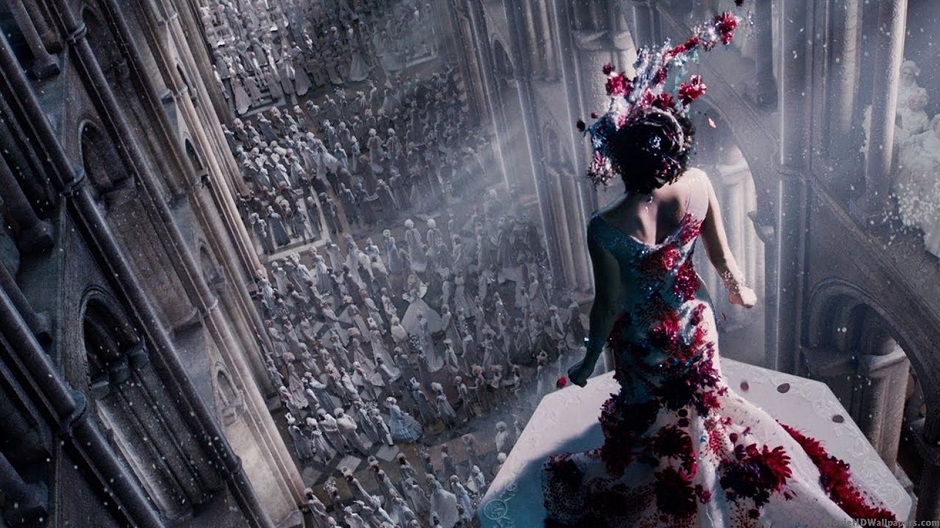
Jupiter Ascending (2015)

18 Wednesday Feb 2015

Posted by dullwood68 in Movies

≈ 1 Comment

Tags

Abrasax Family, Action, Andy Wachowski, Caine Wise, Channing Tatum, Douglas Booth, Drama, Eddie Redmayne, Genetic reincarnation, Jupiter, Jupiter Jones, Lana Wachowski, Mila Kunis, Review, Sci-fi, Sean Bean, The Aegis, Thriller, Youth serum

Jupiter Ascending

D: Andy Wachowski, Lana Wachowski / 127m

Cast: Channing Tatum, Mila Kunis, Sean Bean, Eddie Redmayne, Douglas Booth, Tuppence Middleton, Nikki Amuka-Bird, Christina Cole, Nicholas A. Newman, Maria Doyle Kennedy, Gugu Mbatha-Raw, Jeremy Swift, Kick Gurry, James D’Arcy

Jupiter Jones (Kunis) works as a cleaner with her mother, Aleksa (Kennedy), and her aunt. She has no prospects, no will to succeed, and no man in her life. Shackled to her mother’s Russian family, she is unaware that she is the genetic reincarnation of the matriarch of the Abrasax family. The Abrasax family are part of an alien race whose business is that of seeding planets and harvesting the inhabitants once they reach a certain physical maturity. The Abrasax matriarch had Earth as part of her portfolio, and its importance as a source of youth-giving serum is not lost on her offspring, Balem (Redmayne), Kalique (Middleton) and Titus (Booth). Each of them is trying to acquire Earth for themselves, and when they learn of Jupiter’s existence, they initiate plans to either manipulate her or kill her (or both).

Jupiter can claim her genetic forebear’s titles and properties but if she does it will freeze out Balem and his siblings. His response is to send agents to Earth to kill her, but Titus sends a genetically engineered hunter called Caine Wise (Tatum) to protect her and bring her to him. Wise enlists aid of fellow hunter Stinger Apini (Bean) but a group of mercenaries manage to capture Jupiter and take her to a planet owned by Kalique. Kalique informs Jupiter that the conditions of her mother’s will were such that Earth would belong to her genetic reincarnation should one come forward. All Jupiter has to do is to claim her inheritance and her brothers’ plans will be thwarted.

Aided by Stinger and the Aegis, an intergalactic police force, Caine rescues Jupiter from Kalique and takes her to the planet where she can begin to claim her inheritance. Titus appears on the scene and tells Jupiter he plans to uphold his mother’s wish that Earth not be harvested, and that if she marries him it will ensure both Earth’s safety and an end to Balem and Kalique’s scheming. Titus isolates Caine from Jupiter and reveals his real plan which is to marry her and then have her killed, thus inheriting Earth by default. He has Caine expelled from an air lock, while Jupiter agrees to marry Titus…

Jupiter Ascending - scene

Originally set for release on 25 July 2014, Jupiter Ascending finally arrives on our screens and… is… well… just… terrible. It’s not quite as bad as, say, Teenage Mutant Ninja Turtles (2014) – that would be difficult – but it is shockingly, depressingly bad in ways that are completely surprising given the calibre of the directors, the cast and the crew. Already a box office bomb, with very little chance of its $176,000,000 budget being recouped any time soon, Jupiter Ascending is a classic example of what happens when you ask two feted filmmakers to come up with “an original intellectual property and franchise” – take a bow, Jeff Robinov (Warner Bros. president). The result? A movie that makes no sense at any point during its entire running time.

It’s a spectacular movie, true, but this is yet another sci-fi movie that is a triumph of style over substance. If there had been half as much effort put into the script as there has been into the special effects and the design of the movie then we might be talking about the movie in terms of it being a modern classic. But so successfully have the Wachowskis sabotaged their own script – sorry, “intellectual property” – that instead we have to talk about the movie in terms of it being an (almost) unmitigated disaster. Take the notion that only the human race can produce the serum that keeps the Abrasax family so youthful. So far, so good. But if this is the case, and the Abrasax family have “seeded” Earth in order to produce this serum, why haven’t they done it on other planets? Surely that would make sound business sense (not to mention keep them eternally young)? (It seems not.)

There are plenty of other elements within the script that don’t make sense, such as the whole idea that Jupiter is the genetic reincarnation of the Abrasax’ matriarch. How or why this should even happen in the first place is skipped over by the Wachowski’s, and it hovers over the movie like a particularly stinky McGuffin. And the speed with which Bean’s character changes sides (and is forgiven) has all the dramatic intensity of someone changing their washing powder instead of their allegiance. It’s all in service of a script that careens from one unlikely scene to another while ramping up the visual spectacle to such a pitch that the characters appear incidental to the vast spaceships and the vast sets inside them (though the Wachowskis have seen fit to ensure that no room is too small that Caine can’t pitch and hover around it with ease).

The cast look uncomfortable throughout, with Tatum doing his best not to appear confused (or wishing he was making another movie entirely), and Kunis unable to make Jupiter less irritating than she’s written. Bean appears to be apologising for each line he has to utter – his rhapsodising about bees is a highlight – while Booth mistakes petulance for silky menace, and Middleton is saddled with the weight of too much exposition (and wrinkles). And then there’s Redmayne, soft-spoken for most of the movie and evidencing Balem’s more psychotic tendencies by shouting loudly whenever he’s annoyed. By the end it’s become the movie’s most flamboyant performance, but it would have been better utilised in a pantomime than a science fiction movie trying to take itself seriously.

The action scenes are suitably large-scale and ambitious but still rely heavily on the bad guys being terrible shots, and Wise being able to get off a kill shot from any angle. The Renaissance feel to many of the sets and the overall design is, however, impressive, but the production facility on Jupiter is too overblown, and seems designed more to be destroyed (as it eventually is) than anything else. And therein lies another problem, the Zack Snyder Equation™, which posits that if there is a chance to provide mass destruction on a monumental level then it should be grasped with every gigabyte possible. It seems movie makers still haven’t caught on to the fact that while this may make for an arresting visual sequence, we’ve still seen it way too often now for it to have any meaningful effect.

Rating: 4/10 – with stumbling, forlorn attempts at comedy thrown in here and there – “I love dogs”, Jupiter’s Russian family, any time Famulus (Mbatha-Raw) makes an appearance – Jupiter Ascending succeeds in undermining its own credibility at nearly every turn; a space opera masquerading as something more (though exactly what is hard to determine), this sees the Wachowskis reprising themes from The Matrix to less than impressive effect.

Share this:

  • Click to share on X (Opens in new window) X
  • Click to share on Facebook (Opens in new window) Facebook
  • More
  • Click to print (Opens in new window) Print
  • Click to email a link to a friend (Opens in new window) Email
Like Loading...

Mandrake, the Magician (1939) – Chapter 7: Gamble for Life

17 Tuesday Feb 2015

Posted by dullwood68 in Movies

≈ Leave a comment

Tags

Al Kikume, Columbia, Doris Weston, Drama, Lothar, Magician, Mandrake, Norman Deming, Platinite, Professor Houston, Radium machine, Review, Sam Nelson, Serial, Suburban Telephone Company, The Wasp, Thriller, Warren Hull

Mandrake, the Magician

D: Sam Nelson, Norman Deming / 16m

Cast: Warren Hull, Doris Weston, Al Kikume, Rex Downing, Edward Earle, Forbes Murray, Kenneth MacDonald, Don Beddoe, John Tyrrell

Escaping (of course) from his crashing plane, Mandrake parachutes to the ground in time to aid Professor Houston in getting away from the Wasp’s men at the ironworks in Dorgan. Unfortunately he has to leave his radium machine behind. The Wasp alerts his men to watch Mandrake’s country home. While they keep watch, Webster arrives. Mandrake needs him to help retrieve some platinite to help the professor build another radium machine. Tapping into Mandrake’s phone line, the Wasp’s men learn that he needs to collect some parts from Houston’s home. They get there first and ambush the magician but Lothar intervenes and they get away – but without the parts.

The platinite can be found in a canyon where the Suburban Telephone Company have a base of operations. Mandrake, Lothar and Webster travel there. At the same time, the Wasp’s lieutenant, Dirk, continues to implement his boss’s plans to sabotage all the local communication networks by sending them to the same site. As they arrive, Mandrake and Webster decide they have enough platinite and start to head back to their car. Alerted to the presence of the Wasp’s men by the site foreman, Mandrake and Webster tackle them. One of the men climbs a gantry and heads across the canyon in a trestle car. Mandrake jumps on and the two fight but the hook the car is hanging from is slowly straightening out. The Wasp’s man falls over the side, and as Mandrake watches him fall, the hook straightens entirely, sending the trestle car crashing down into the canyon.

Mandrake, the Magician Chapter 7

One of the more amusing episodes (and probably not for the right reasons), Chapter 7: Gamble for Life sees more things happen by chance than by any logical design. The Wasp instructs his men to watch Mandrake’s country home when he can’t know that’s where he’ll go, and instead of telling his men to go the canyon (because that’s where Mandrake and the platinite will be) they get there under their own steam – what a coincidence! Other amusing moments: Mandrake parachuting to the ground sans chapeau, and then rushing to Houston’s aid with hat firmly back on his head; telling Houston to “Buck up, man” when the professor claims he can’t make it; a gate telephone that drops down out of nowhere; and Kikume’s stunt double wearing an ill-fitting wig to make him look more like the real thing (not happening).

For all the poorly choreographed fight scenes and glaring lapses in logic and common sense, the series continues to be highly enjoyable, and often because it is rough and ready around the edges. Hull is still a somewhat smug Mandrake, everyone else has to stand in line to wait their turn in front of the camera, and the fisticuffs to narrative ratio is still approximately four to one. It’s good to see Webster, a character who otherwise pops in and out of the material, given a bit more to do, and the showdown at the canyon is one of the better set ups so far. Of course, there’s five chapters to go, so the writers have got a lot to do to wind this up, and judging by the preview for Chapter 8, they’re still not in any hurry.

Rating: 6/10 – as fast-paced and entertaining as ever, Chapter 7: Gamble for Life maintains the devil-may-care approach to the material already established and at last shows Mandrake getting one over on the Wasp by rescuing Professor Houston; it’s all thrilling stuff and it’s still a pleasure to come back to each week.

Share this:

  • Click to share on X (Opens in new window) X
  • Click to share on Facebook (Opens in new window) Facebook
  • More
  • Click to print (Opens in new window) Print
  • Click to email a link to a friend (Opens in new window) Email
Like Loading...

Late Phases (2014)

15 Sunday Feb 2015

Posted by dullwood68 in Movies

≈ 1 Comment

Tags

Adrián García Bogliano, Blind war veteran, Crescent Bay, Drama, Ethan Embry, Full moon, Horror, Lance Guest, Nick Damici, Review, Silver bullets, Tom Noonan, Werewolf

Late Phases

D: Adrián García Bogliano / 96m

Cast: Nick Damici, Ethan Embry, Lance Guest, Erin Cummings, Tom Noonan, Tina Louise, Rutanya Alda, Caitlin O’Heaney, Karen Lynn Gorney, Larry Fessenden, Dana Ashbrook

Blind Vietnam war veteran Ambrose McKinley (Damici) moves into a gated community called Crescent Bay with his dog Shadow. He has an antagonistic nature, and a poor relationship with his son, Will (Embry). He meets his neighbour, Delores (Gorney), but aims to pretty much keep himself to himself. That first night, Delores is attacked by someone or something; Ambrose hears the commotion and tries to work out what’s happening. Delores’s attacker then turns their attention to Ambrose. Shadow defends Ambrose and the attacker flees, leaving Shadow fatally wounded.

Ambrose is found the next day and the police arrive to investigate. He learns that this isn’t the first time someone in Crescent Bay has been attacked, and that the community is always finding its dogs killed by some animal. When it’s also mentioned that the attacks happen regularly each month (and around the time of the full moon), Ambrose begins to suspect that his and Delores’ attacker is a werewolf. He keeps his suspicions to himself but begins to plan and prepare for the next month’s full moon, aiming to kill the creature and put an end to all the attacks and dog killings.

He’s persuaded to attend the local Sunday church group, where he meets Father Roger (Noonan). He suspects the priest of being the werewolf as he talks about people’s dark sides and how he keeps his own dark side under control. Ambrose also runs afoul of the other Crescent Bay residents by using a shovel as a walking cane, and by his continued aggressive attitude. He has silver bullets made, and ensures he has several guns hidden about his property. But as the next full moon approaches, the person who is the werewolf realises what Ambrose is up to, and begins making their own preparations…

Late Phases - scene

With werewolf movies becoming more prevalent in recent years, Late Phases arrives with a modicum of expectation based around the involvement of Bogliano, an Argentinian director whose movies have a unique brand of intensity about them, and its fairly unusual setting, a gated retirement community. It’s a broadly entertaining movie that is confident enough to show its monster within the first fifteen minutes, but like so many other horror movies that start off promisingly, Eric Stolze’s script soon opts for implausibility instead of being more carefully thought out.

It’s a shame as the movie gets quite a few things right. The main character of Ambrose is a refreshing change from the usual screaming teen queen, his curt, uncompromising nature and abrupt manner maintained (almost) throughout. Damici proves a great choice for the role, his glowering features and sardonic scowl completely in tune with Ambrose’s determined animosity. He’s a practical man and he approaches the idea of a werewolf being on the loose in a practical manner, with no room for doubt or hesitation. He doesn’t try to convince anyone there’s a werewolf carrying out the attacks and he doesn’t try to enlist anyone’s aid on the night. He just gets on with it.

His talks with Father Roger combine musings on the duality of man with notions of honour and personal belief, and though they do include dialogue that is cliché driven, it’s good to see a horror movie take time out to examine pertinent themes, and in some depth (it’s also good to see Noonan back in a movie after several years on various TV shows and making shorts). Alas, the same can’t be said for Ambrose’s relationship with his son, which hinges on his inability to show emotion, and which has a predictable resolution. Damici and Embry manage to make these scenes more effective than as written, but they’re still pretty perfunctory.

Another plus is the decision not to use the “w” word. At one point, Ambrose asks the question “What do silver bullets make you think of?” The reply? “The Lone Ranger.” It’s a lovely moment, played completely straight, and underlines the confident nature of much of the script. However, this is a horror movie and certain illogicalities have to be adhered to (or so it seems). While pacing out steps in one of the rooms in his property, Ambrose turns on a couple of lamps – would a blind man need to do that? He finds a claw embedded in the wall of his new home (within about a minute of his going inside) – as an early warning of what’s to come it’s great, but wouldn’t a realtor (or someone) have spotted that long before he moved in? And the police are woefully inadequate in dealing with attacks that go back twenty-five years but are on the ball when some of Ambrose’s neighbours complain about his behaviour. (And let’s not mention the gate security guard who seems to work 24/7.)

The movie reveals the identity of the werewolf approximately two thirds in and while most viewers won’t be surprised by the revelation, they probably will be surprised by the fact that this werewolf can bite people and pass on the curse while in human form. This leads to a risible showdown between Ambrose and several werewolves that features possibly cinema’s first ever example of “were-fu”. It also reveals that werewolves are unable to move out of the way when a blind man points a gun at them, and have to stand in the line of fire for around twenty seconds bellowing before attacking Ambrose one at a time. And there’s a minor subplot involving a headstone that amounts to a bad joke when it’s finally brought into play.

Late Phases - scene2

There’s a transformation scene that’s not too bad given the budget, and a pleasing amount of gore to keep genre fans happy, and there’s an emphasis on keeping the special effects practical rather than enhanced by CGI that works in the movie’s favour, but while Bogliano adds some much needed energy to things in the two big setpieces that bookend the movie, there are still too many occasions where the viewer will be shaking their head and asking themselves, did I really just see or hear that? The rest of the cast provide adequate support, and there’s some effectively framed scenes and shots courtesy of DoP Ernesto Herrera. Wojciech Golczewski’s score can be a little intrusive at times, though it does provide some atmospheric support during the quieter scenes, and the movie thankfully avoids the temptation to set up a potential sequel.

Rating: 6/10 – with a bit more care and attention paid to the script, Bogliano’s first English language movie could have been a much more robust and compelling movie; as it is, Late Phases is worth seeking out as an attempt at doing something a little different within an already crowded genre.

Share this:

  • Click to share on X (Opens in new window) X
  • Click to share on Facebook (Opens in new window) Facebook
  • More
  • Click to print (Opens in new window) Print
  • Click to email a link to a friend (Opens in new window) Email
Like Loading...

The Two Faces of January (2014)

14 Saturday Feb 2015

Posted by dullwood68 in Movies

≈ Leave a comment

Tags

Athens, Drama, Fraud, Hossein Amini, Istanbul, Kirsten Dunst, Oscar Isaac, Patricia Highsmith, Review, Thriller, Tour guide, Viggo Mortensen

Two Faces of January, The

D: Hossein Amini / 96m

Cast: Viggo Mortensen, Kirsten Dunst, Oscar Isaac, David Warshofsky, Daisy Bevan, Omiros Poulakis

Athens, 1962. Rydal Keener is an American working as a tour guide. He meets an American couple on holiday there, Chester and Colette McFarland (Mortensen, Dunst). They invite him to dinner and he accepts, mainly because he’s attracted to Colette. Later, after dropping them off at their hotel, Rydal discovers Colette has left a bracelet behind in the taxi. He decides to return it. Meanwhile, the McFarland’s have another visitor, a private detective named Vittorio (Warshofsky). It transpires that Chester has defrauded several people in an investment scam, and it’s this money that is allowing the McFarlands to travel around Europe. Vittorio and Chester scuffle and the private detective is killed. As he attempts to get Vittorio back to his own room in the hotel, he’s discovered by Rydal. Chester convinces Rydal that the man is merely out cold from drinking too much, and together they get him into his room.

Chester convinces Rydal that he and Colette need to leave Athens as soon as possible, but their passports are being kept by the hotel. Seeing a way of scamming some money out of Chester, Rydal agrees to help them; it also gives him a chance to be nearer to Colette. He arranges for new passports to be given to them in Crete, where they all travel to next. Without identification papers they’re forced to wait on the quayside for the next day’s bus to Chania. While they are there, Colette visits Rydal in his room while Chester is sleeping. Back on the bus, Colette panics when she sees photos of her and Chester in a newspaper and thinks they’ve been spotted. At a rest stop, Colette gets off the bus and the two men chase after her. They walk on and eventually reach the ruins of Knossos.

Rain causes them to seek shelter in the ruins. Chester lures Rydal down into the lower levels and knocks him unconscious. When Colette realises what he’s done they argue and she falls to her death from some steps. Chester flees, leaving Rydal to come to the next morning and be seen by a group of schoolgirls and their teacher as he leaves. Rydal hurries to catch up with Chester, who has collected the new passports and is heading back to Athens on a ship. There is a confrontation between the two where each tries to outwit and out-threaten the other, but both come to realise that they are bound together by their actions over the past couple of days, and would find it easy to implicate the other if either informed the police. But when they get to Athens airport, Rydal finds that Chester has one more trick up his sleeve.

Two Faces of January, The -scene

Adapted from the novel by Patricia Highsmith, The Two Faces of January is a ponderous, though well acted drama that never quite gets off the ground, despite an intriguing storyline and some glorious location photography. As written and directed by Amini – something he’d been working on for around fifteen years – there is a distance between the audience and the main characters that stops them from ever becoming likeable or sympathetic. We never get to really know them either. Chester is a cheat but it’s just accepted that he’s a cheat; there’s no back story to explain why. Colette is aware of his duplicity and has obviously chosen to stay with him but we never find out why either. It’s confusing as well when their previous happiness is so quickly overturned by the arrival of Rydal in their lives: does she really love Chester or is she too a fraud? And Rydal’s past, with his father issues and need for independence, is also glossed over, with the questions, “Why Athens?” and “Why a tour guide?” completely unanswered.

There is one clear motivation that drives them all however: escape. But it’s clumsily used as a device to keep the narrative and the characters moving, and while Amini uses it to show how each is trying to escape themselves (and more so than the authorities), this is also clumsily done. What we’re left with as a result is a mini-travelogue where it seems that the characters are constantly outwitting each other – or appear to be – but in actuality aren’t doing anything of the sort. Chester imagines all sorts of deviousness in Rydal’s behaviour (and Isaac’s performance goes a long way to suggesting this, even though it’s not true), and he’s continually on his guard for some new twist. But ultimately he’s the author of his own downfall, and has no one to blame but himself for what happens.

Amini never reconciles Rydal’s willingness to keep in with the McFarlands, even after he knows what they’ve done, and while his attraction for Colette is an understandable reason in itself, there are moments where he’s making decisions about carrying on but we never find out what his reasons are. It ends up being a problem for the narrative when it just feels that if he didn’t, the plot (and the movie) would grind to a halt.

In adapting Highsmith’s novel, Amini has jettisoned the homo-erotic subplot between Chester and Rydal in favour of a more conventional love triangle approach, and in doing so he robs the movie of a potential, and valuable, source of tension. For otherwise, the movie plods along looking good but feeling empty, its characters relying heavily on plot contrivances such as Rydal just happening to know someone who can provide forged passports, and Colette getting so easily frightened and leaving the bus.

As Chester, Mortensen puts in a good performance but even he can’t reconcile the character’s initial fearfulness and vulnerability with the more callous character he becomes. Dunst has a couple of emotional scenes that show off her skills as an actress, but again she can’t reconcile Colette’s initial happiness with her husband with the antipathy she shows toward him once they leave Athens (she already knows they’re on the run, why should this make her feel any different? And this is before she learns of Vittorio’s death). Rounding off the trio, Isaac portrays Rydal as a conspiring victim, unsure of himself as he gets in deeper and looking for a way out, even though he can’t see one. It’s a confident performance, not as conflicted as Mortensen and Dunst’s, but unfortunately, still a little shy of being satisfactory.

Two Faces of January, The - scene2

With the scenery providing a welcome (and thankful) distraction from the unwieldy and undercooked melodramatics, the movie adds a particularly awkward scene at a customs hall where Chester and Rydal act so suspiciously it’s a wonder they aren’t picked out of their respective queues sooner. And the denouement, included to add some much needed excitement, is so poorly edited that any sense of vitality is diminished quite rapidly. There’s a great movie to be had from Highsmith’s novel, but alas, this isn’t it, and for that, Amini is the only one to blame.

Rating: 5/10 – with its cast unable to elevate the material or make up for Amini’s lack of directorial control, The Two Faces of January fails to provide any tension or mystery; plodding, and with a weak resolution, the movie looks great throughout but offers little that’s arresting to occupy the viewer’s time.

Share this:

  • Click to share on X (Opens in new window) X
  • Click to share on Facebook (Opens in new window) Facebook
  • More
  • Click to print (Opens in new window) Print
  • Click to email a link to a friend (Opens in new window) Email
Like Loading...

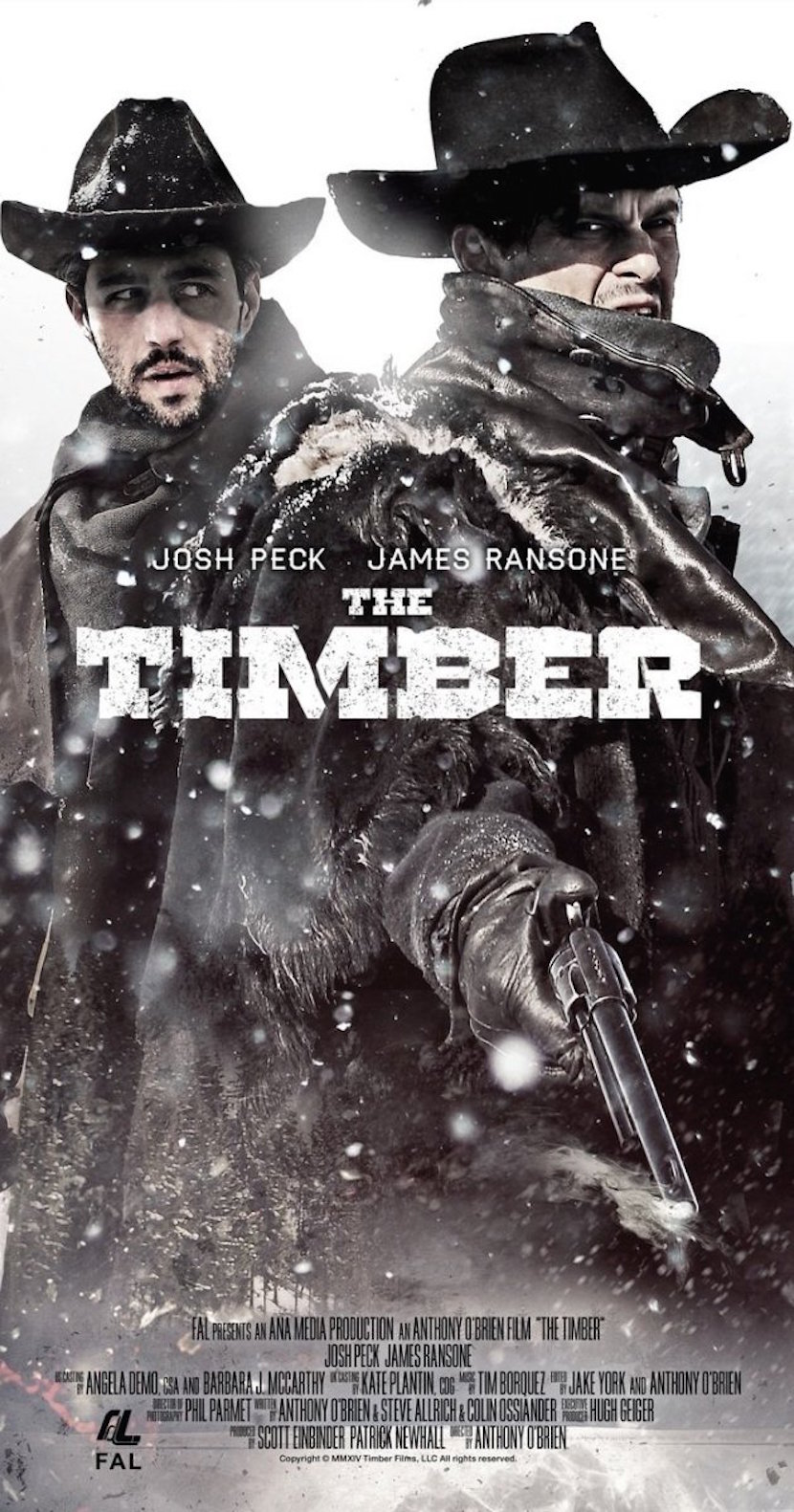
The Timber (2015)

13 Friday Feb 2015

Posted by dullwood68 in Movies

≈ Leave a comment

Tags

Action, Anthony O'Brien, Drama, Elisa Lasowski, Foreclosure, Gold mine, James Ransone, Josh Peck, Julian Glover, Manhunt, Review, Western, Yukon Territory

Timber, The

D: Anthony O’Brien / 82m

Cast: Josh Peck, James Ransone, David Bailie, Elisa Lasowski, Maria Doyle Kennedy, Julian Glover, Mark Caven, Shaun O’Hagan, William Gaunt, Attila Arpa

1898, the Yukon Territory. Brothers Wyatt (Ransone) and Samuel (Peck), along with their mother Maggie (Kennedy) and Samuel’s wife, Lisa (Lasowski) and their newborn son, are struggling to keep their property from being foreclosed by local businessman and bank owner George Howell (Glover). When Howell tells Wyatt that their debt will be paid if he tracks down and captures the brothers’ father, Jebediah (Gaunt), he has no choice but to accept. Samuel goes with him, much to the dismay of Lisa who is fearful they won’t return.

As they set out, Howell insists they’re accompanied by Colonel Rupert Thomas (Caven), a seasoned army man who knows the area they’re travelling into, the Timber. As they make their way up into the mountains to the mining camp where their father was last known to be, the town sheriff, Snow (Bailie) visits Maggie and Lisa to make sure they’re alright. While he’s there, two of Howell’s men arrive to begin assessing the property, but before it’s legal to do so; Snow runs them off.

Heading deeper into the Timber, an accident with their horses and wagon leaves the three men having to travel on on foot. The next morning they’re attacked by a couple of mountain men and Thomas is killed. Wyatt and Samuel press on, struggling against the harsh elements and a further assault that sees Samuel captured and taken to a cave where his left hand is badly injured. Wyatt rescues him and they continue on up the mountain until they reach the mining camp. But madness has overtaken the men working there, and the foreman, Jim Broadswell (O’Hagan) has them locked up. When some of the workers use dynamite to blow up the camp, the brothers manage to escape, taking Broadswell with them.

Their father, however, intercepts them, killing Broadswell and wounding Wyatt. Unable to do anything, Samuel passes out and he and his brother are taken to a small Indian encampment where Samuel wakes to find that Jebediah has amputated his injured hand. With their father clearly out of his mind and intending to murder Wyatt, Samuel has to find the strength to save his brother, while back at their home, Howell and three of his men arrive to take the property by force if they have to.

Timber, The - scene

Shot in the stunningly beautiful Carpathian Mountains, The Timber is a Western that features an odd editing style, and the kind of elliptical narrative that could well alienate audiences expecting a more straightforward plot or storyline. It’s a bold move on the makers’ part and while it does add to the overall, nightmarish quality of the brothers’ journey, there are also times when it proves frustrating. Scenes appear disjointed, and the movie is peppered with flashbacks and Samuel’s musings on the events that take place and his own mental state. It’s not a conventional approach by any means, but in the hands of screenwriters O’Brien, Steve Allrich and Colin Ossiander, it does make for an absorbing, though unpredictable viewing experience.

That said, there are enough genre conventions to help the wary viewer along. Howell is the devious land baron, Samuel’s wife Lisa is the plucky frontierswoman with a mind of her own, and the brothers are the traditional good men trying to stay that way. These staples help the movie immensely when its non-linear approach kicks in, its deliberately steady pace allowing for more detail than expected, and for the themes of betrayal, greed, revenge and madness to work their way through the narrative more effectively. It’s a considered, more thoughtful Western, and it retains a moral compass that anchors the characters.

Samuel and Wyatt appear to be opposites, with the younger brother, Samuel, seeming to be less experienced and less mature, but as the movie progresses he proves to be his brother’s equal, and by the movie’s end he’s passed through what might be termed an adult rite of passage. Wyatt is more confident, firm in his beliefs and unafraid of doing the difficult thing, but he proves just as unprepared for what happens on the journey as Samuel. In a way, it’s his over-confidence that determines how much trouble they’ll both face, and whether or not they’ll survive the ordeal.

On the distaff side, Lisa and Maggie are the type of dependable women who seem used to being left by their men, and who harbour a mainly unspoken resentment of it. Maggie is fearful for her sons’ return because she’s already lost her husband to the Timber; she doesn’t want to lose them in the same way. Lisa is fearful because of her newborn child and being left alone, and sees the brothers’ quest as being irresponsible. When they leave she makes her feelings clear by avoiding a kiss from Samuel, then adopts his role by guarding the property while they’re gone. She’s a practical woman because she has to be.

Peck and Ransone make a good pairing, their physicality and dramatic intensity proving an apt fit for the material, while Lasowski offers grit and determination to spare. Kennedy uses Maggie’s loss to present a woman living in both the past and the present, and Bailie gets the chance to reveal a greater depth to the sheriff’s character than is at first apparent. As the underhanded Howell, Glover exudes a cold nonchalance that befits his character’s greed, and for those of you who may be wondering, yes it is the same William Gaunt who appeared in the cult Sixties’ TV series The  Champions who plays Jebediah (though you’d be hard pressed to recognise him).

Timber, The - scene2

With the Carpathians standing in for Canada’s Yukon territory, and what must have been a difficult shoot due to the conditions – there are plenty of moments where Samuel and Wyatt are wading through knee-deep snow – The Timber is a movie full of arresting visuals and stunning scenery. O’Brien directs with a reliance on close-ups to add a measure of unnerving claustrophobia to the wide open spaces, and keeps the madness – or mountain sickness – from being too over the top. At a trim eighty-two minutes, the movie doesn’t outstay its welcome, and while as mentioned before, it provides enough genre staples to keep most Western fans happy, it’s still likely to divide audiences at the end of the trail.

Rating: 7/10 – a solid, no frills Western with a psychological core, The Timber is a well-intentioned, idiosyncratic movie that impresses as often as it hesitates; there’s much to appreciate here, but it may depend on your frame of mind when watching it as to just how much appreciation it’ll receive.

Share this:

  • Click to share on X (Opens in new window) X
  • Click to share on Facebook (Opens in new window) Facebook
  • More
  • Click to print (Opens in new window) Print
  • Click to email a link to a friend (Opens in new window) Email
Like Loading...

Mini-Review: Buddy Hutchins (2015)

11 Wednesday Feb 2015

Posted by dullwood68 in Movies

≈ 1 Comment

Tags

Chainsaw, Divorce, Drama, Dry cleaning business, Jamie Kennedy, Jared Cohn, Low budget, Murder, Review, Sally Kirkland, Sara Malakul Lane, Steve Hanks, Thriller

Buddy Hutchins

D: Jared Cohn / 98m

Cast: Jamie Kennedy, Sally Kirkland, Sara Malakul Lane, Steve Hanks, David Gere, Demetrius Stear, Richard Switzer, Milana Lev, Hiram A. Murray, Nicole Alexandra Shipley, HenRii Coleman, Harwood Gordon

Recovering alcoholic Buddy Hutchins (Kennedy) has a wife, Evelyn (Lane) and two kids, Joel (Switzer) and Molly (Lev). Thanks to the time when he was an alcoholic he has a dry cleaning business that’s on the verge of failing, his son hates him, his ex-wife (Shipley) is chasing him for unpaid alimony, and his relationship with his brother, Troy (Hanks) is on rocky ground. Only his daughter, his mother, Bertha (Kirkland), and his remaining employee, Ryan (Stear) actually like him. When Buddy discovers that his wife, who is a teacher, is having an affair with one of the other staff, Don (Gere), it’s the first in a long line of injustices and reversals of fortune that end up tipping him over the edge into murderous rage.

Along the way he’s locked out of his own house, forced to stay with his mother, see his dry cleaning business seized by the bank, he’s threatened by his ex-wife’s new boyfriend (Coleman), ends up in jail for harassment, loses custody of his children in divorce proceedings, has to deal with his mother’s hospital bill when she has a heart attack, learns his father whom he thought was dead is actually alive and is really his uncle (his uncle is actually his father), and loads more beside. He starts drinking again and decides that it’s time to take back control of his life… by killing anyone he feels has contributed to the mess his life has become. In possession of a gun and a chainsaw, Buddy begins to take his revenge, leading to a standoff with the police.

vlcsnap-00007

A low budget drama-cum-thriller-cum-occasional black comedy (with a budget so low that some of it was filmed in the director’s own home), Buddy Hutchins is a movie that must have looked and sounded good on paper, but which in reality is so ragged and unconvincing that the average viewer will be wondering why anyone bothered. The movie seeks to make Buddy a sympathetic character who is just so incredibly hard done by by virtually everyone around him, but trips up from the start by making him an unlikeable, arrogant jerk who blames everyone but himself for his troubles. With Kennedy unable to salvage the character (though he tries), the movie staggers as drunkenly as Buddy from one poorly shot, flatly directed scene to another.

Against a script by Cohn that abandons all credibility long before it gets to the point where Buddy is pursued in his van for hours by three lone police cars and then evades them just… like… that (or when he’s at Don’s house and he goes straight to the one cutlery drawer that has a gun in it), the movie offers little more than a succession of disasters that are piled on with no discernible reason other than that they’re meant to be humorous somehow. With characters behaving meanly and selfishly for no other reason than the script requires them to, Buddy Hutchins becomes quickly swamped by increasingly unlikely scenarios, and branches into gore territory once Buddy starts using his chainsaw.

Rating: 3/10 – as the movie adds to Buddy’s agony, so too does it add to the viewer’s, making Buddy Hutchins a movie that satisfies on only a couple of unexpected occasions; Kennedy does his best to keep it interesting but the material defeats him, and to make matters worse – if that was possible – Cohn’s direction is largely AWOL.

Share this:

  • Click to share on X (Opens in new window) X
  • Click to share on Facebook (Opens in new window) Facebook
  • More
  • Click to print (Opens in new window) Print
  • Click to email a link to a friend (Opens in new window) Email
Like Loading...

The Voices (2014)

11 Wednesday Feb 2015

Posted by dullwood68 in Movies

≈ 1 Comment

Tags

Anna Kendrick, Black comedy, Drama, Gemma Arterton, Jacki Weaver, Marjane Satrapi, Murder, Review, Ryan Reynolds, Schizophrenia


Voices, The

D: Marjane Satrapi / 103m

Cast: Ryan Reynolds, Gemma Arterton, Anna Kendrick, Jacki Weaver, Ella Smith, Paul Chahidi, Stanley Townsend, Adi Shankar, Sam Spruell

Jerry Hickfang (Reynolds) has a problem. Actually, he has quite a few problems, but the main one is that his cat, Mr Whiskers, and his dog, Bosco, talk to him. Mr Whiskers  wants Jerry to behave in all sorts of horrible ways and takes a caustic view of him when he refuses to listen. Bosch is more supportive of Jerry and tells him that he’s a better person than the one Mr Whiskers wants him to be. Jerry does his best to ignore both of them, but therein lies another problem: the reason he can hear them is because he’s not taking his medication… and anti-psychotic medication at that.

Jerry works in the shipping department at a bathtub factory. He gets on well with his fellow workers and is regarded highly by his supervisor Dennis (Chahidi). He has a crush on one of the accounts staff, Fiona (Arterton) and musters up the nerve to ask her out, remaining blissfully unaware that Lisa (Kendrick) (who works with Fiona) has a crush on him as well. However, Fiona stands him up and goes out with Lisa and Allison (Smith), another accounts clerk. When she tries to go home her car won’t start. Jerry happens to pass by and offers Fiona a lift. They decide to go for a drink together but on the way a deer hits the car. The deer tells Jerry that it’s too injured to survive and that he should kill it. Jerry takes out a knife and cuts its throat. Fiona freaks out and runs from the car into the woods. Jerry chases after her and when he catches up with her he stabs her… accidentally at first and then repeatedly.

He leaves the body there but Mr Whiskers persuades him to go back the next day and retrieve it. He takes it home, cuts it up into little pieces and puts Fiona’s head in his fridge. She’s not happy about being alone in the fridge and tries to persuade Jerry to find someone she can have as company. Jerry resists though and to try and improve things, resumes taking his medication. He and Lisa start to see each other, but when she decides to surprise Jerry at his place she sees what he’s been doing, and it leads to Fiona getting her wish after all. When Allison goes missing as well (after finding out about Jerry’s past), two of his workmates, John (Shankar) and Dave (Spruell), grow suspicious of Jerry and visit his home. What they find there leads them to call the police…

Voices, The - scene

First shown at the Sundance Festival back in January 2014, The Voices finally arrives in cinemas and on VoD but, despite several festival awards under its belt, with very little fanfare. Part of this may be to do with the movie’s content. If you watch the trailer it keeps things light and funny (you could even be forgiven for thinking it’s a serial killer rom-com with an emphasis on the com), but what the movie does in reality  is try to offset moments of goofy humour with darker insights into the mind of a seriously disturbed individual. But in doing so, The Voices proves to be as schizophrenic as its main character.

With the tone of the movie veering between whimsical and malicious, and with detours that take in quirky, creepy and absurd, it doesn’t take long for the viewer to realise that the material is going to be uneven and, as a result, not entirely convincing. Yes, Jerry is mentally ill, psychotic even, and yes, the way in which his two states of mind – on drugs, off drugs – are cleverly dramatised by the state of his apartment – gleaming and clean when off his meds, gnarly and grim when he’s on them – but there’s still not enough glue to hold all the pieces together. Part of the problem is that the script (by Michael R. Perry) gives the impression that once all the ideas for the movie were gone through the decision was made to include them all, whether they worked or not.

Off the back of this, Satrapi has fashioned a movie that works well in spurts but drags in others while meandering in-between times. It makes for a frustrating watch and while Reynolds gives an atypical performance that works well with the material (though his doofus smile makes him look mentally challenged rather than mentally ill), the feeling that a firmer hand was needed persists throughout. Reynolds certainly understands the character, and he makes Jerry entirely sympathetic. All Jerry wants to be is happy; it’s just the way he goes about it that’s inappropriate. And he makes it clear when the script doesn’t that Jerry has a degree of self-awareness about his illness and what it makes him do, but a couple of token instances of resistance aside, he can’t quite pull off the ease with which Jerry goes about killing people.

As for Mr Whiskers and Bosco, it’s clear that they’re meant to be the source of much of the movie’s humour, but once you’ve heard Mr Whiskers’ Scottish-sounding, foul-mouthed attempts at coercion the first time, it soon becomes a played-out plot device; he needs to be less aggressive and more insinuating. The same is true of Bosco, his down-home Southern drawl humorous at first but proving more of a vocal stunt as the movie progresses (Reynolds provides both voices, adding to the conceit that Jerry is hearing their voices inside his own head and they’re not really talking to him). Otherwise, the humour relies on severed heads proving peevish about their situation, awkward comments that Jerry makes to his co-workers, and a few cartoon-style moments that we’ve all seen before.

The rest of the cast cope well enough with largely under-developed characters, with Arterton and Kendrick reduced to window dressing, though Weaver (as Jerry’s court-appointed psychiatrist) acts like she’s in a farce and not something trying to be a little darker. Maxime Alexandre’s cinematography and Udo Kramer’s production design combine to make Berlin look like the US, and the movie is full of garish little touches, such as the work clothes Jerry and his co-workers have to wear. And at the end there’s a musical number that concludes things with one final (unnecessary) flourish.

Rating: 6/10 – while not as clever or as funny as it thinks it is, The Voices does have a (still beating) heart that helps the viewer wade through some of the more uneven aspects; better as well thanks to Reynolds’ involvement, it’s a movie that will probably gain cult credibility in the future but its delay in hitting cinemas should act as a warning as to its real quality.

Share this:

  • Click to share on X (Opens in new window) X
  • Click to share on Facebook (Opens in new window) Facebook
  • More
  • Click to print (Opens in new window) Print
  • Click to email a link to a friend (Opens in new window) Email
Like Loading...

Selma (2014)

10 Tuesday Feb 2015

Posted by dullwood68 in Movies

≈ 2 Comments

Tags

Alabama, André Holland, Ava DuVernay, Carmen Ejogo, David Oyelowo, Drama, Edmund Pettus Bridge, Lyndon B. Johnson, Martin Luther King Jr, Racial equality, Review, Tim Roth, Tom Wilkinson, True story, Violence, Voting rights

Selma

D: Ava DuVernay / 128m

Cast: David Oyelowo, Tom Wilkinson, Carmen Ejogo, André Holland, Stephan James, Common, Lorraine Toussaint, Giovanni Ribisi, Tim Roth, Wendell Pierce, Alessandro Nivola, Stephen Root, Oprah Winfrey, Dylan Baker, Cuba Gooding Jr, Martin Sheen

1964. Martin Luther King Jr (Oyelowo) receives the Nobel Peace Prize, mere weeks after the deaths of four children in an explosion at the 16th Street Baptist Church in Birmingham, Alabama. Also in Alabama, Annie Lee Cooper (Winfrey) tries to register to vote but has her application denied. King visits President Lyndon B. Johnson (Wilkinson) at the White House to ask for federal legislation that will allow black citizens to register without being impeded. Johnson tells him that, while he agrees with  King about the issue, it’s not one that he’ll be focusing on any time soon. Having already decided to march on the courthouse in Selma, Alabama if the President refuses to help, King sets things in motion.

Joined by members of the Southern Christian Leadership Conference (SCLC) and the Student Nonviolent Coordinating Committee (SNCC), King and his followers march on the courthouse where they’re confronted by the town sheriff and his men. A brawl ensues during which Clark is assaulted by Annie Lee Cooper and King and several others are jailed. Alabama’s governor, George Wallace (Roth) is angered by the protest, and when a night march in Marion is planned, he takes steps to have it dispersed. The march ends in violence and leads to the death of a young protester, shot while trying to avoid trouble in a restaurant. Following this, King receives criticism for his beliefs but he continues to insist that people should be fighting for their rights.

Another march is planned, this time from Selma to the state capital, Montgomery, a distance of fifty miles. Leaving Selma, the march crosses the Edmund Pettus Bridge where it is met by state troopers who instruct everyone to disperse. When they don’t, the troopers put on gas masks and start hurling tear gas into the crowd; they also attack the march using clubs and other weapons, as well as riding people down. It’s all witnessed by TV news crews and broadcast live across the nation, leaving Johnson angry at Wallace’s actions. He sends John Doar (Nivola), the Assistant Attorney General for Civil Rights to try and persuade King to call off the next attempt at marching to Montgomery, while he personally attempts to coerce Wallace into resolving the issue of registration and the use of state troopers if the march goes ahead.

White Americans who support King’s cause and civil rights in general, arrive to take part in the march. Again they cross the bridge, but this time King is leading. When they see the state troopers, they’re surprised to see them step aside. King kneels and prays for a few minutes, then heads back into Selma, effectively cancelling the march. More political manoeuvrings go on, including Johnson asking Congress for the quick passing of a bill to eliminate restrictions on registering, and the march to Montgomery finally goes ahead.

Selma - scene

For America, the Sixties were a turbulent decade, one that saw a variety of freedoms and rights enshrined in law, and the beginning of a transition from the kind of post-War conservatism that saw danger in any type of change, to a more free-minded liberalism that challenged the old order on almost every front. Racial issues were high on the agenda, if not for the politicians, then certainly for black people, and not just in the South. It was a time when people from all walks of life began to stand up and say, “enough is enough” (or to paraphrase Howard Beale in Network (1976): “We’re mad as hell, and we’re not going to take it anymore!”). But as ever, the battle was an uphill one, and there were plenty of people, equally, who were prepared to see it fail.

The determination and the will to succeed that existed in Martin Luther King Jr is shown here as forceful and impassioned, but there’s a measure of self-doubt as well, and it’s this rounding of the man that helps make the movie as commanding as it is. Avoiding any attempts at mythologising King, Selma gives us a portrait of a man fully aware of his mission in life and confident enough to second-guess himself when needed. It’s a balance that could have been lost on several occasions during the course of the movie, not least in its depiction of his troubled marriage, where the script so neatly sidesteps any possibility of descending into soap opera that it makes for a refreshing change. And the complexities of the organisations involved and how they all interact with King, are also well handled, showing the figurehead but not the leader. The movie shows King making decisions based both on his own ideas and those of others, and if his opponents – such as Wallace – appear too one-dimensional in comparison, well, maybe that’s because they just were.

King is played with tremendous gravitas and skill by Oyelowo, imbuing King with a pride and a sensitivity that never seem at odds with each other. It’s an impressive achievement, sharply detailed, perfectly pitched, and one of the finest acting performances you’re likely to see in a long while. It helps that he has a passing resemblance to King, but it’s the voice that he captures so well, that distinctive, low cadence that could rise to a crescendo so effortlessly in the middle of a sentence. It’s not far from the truth to say that Oyelowo inhabits the man rather than impersonates or mimics him (listen to the speech the real King made when the march reached Montgomery, and then listen to Oyelowo’s version and see how close he is), and he’s just as effective in the movie’s more pensive moments as he is when called upon to be the fiery orator.

Good as Oyelowo’s performance – and it is very good – he wouldn’t have been anywhere near as imposing if it weren’t for an extremely well-structured and heavily nuanced script, courtesy of Paul Webb (his first). He makes the politics easy to understand, the characters easy to empathise with or condemn (as necessary), and he doesn’t rein in on the complexities of the issues concerned. It’s a great screenplay, and the rest of the cast, aided and abetted by DuVernay’s strong, sanguine direction, relish every scene and line at their disposal. (If there is one area, though, where Webb fails to convince, it’s in Johnson’s refusal to address the issue of voting registration; his arguments are spurious at best, though they may have been so at the time – it’s hard to tell.)

DuVernay, making only her third feature, emphasises the various relationships that develop between the different factions, and never loses sight of the human factor in amongst all the politicking. She uses the camera with aplomb, particularly with medium shots, imparting a level of detail some more experienced directors fail to achieve ever. And there’s a richness about the movie that speaks of carefully considered choices made ahead of filming, of everyone involved knowing exactly what’s required and everyone involved having the conviction to carry it off. The mood of the times, and the look of the times, are tellingly rendered, and the atmosphere surrounding the planning of each march is palpable, taking the movie – unwittingly perhaps – into thriller territory. But the drama remains throughout, and by the movie’s end, the audience is rejoicing almost as much as the characters are.

Rating: 9/10 – a rewarding look at a particular place and time in American history, Selma takes a flashpoint that resonates far beyond its happening, and makes it as compelling and vital as if it were happening today; a triumph for all concerned and buoyed by Oyelowo’s superb performance, DuVernay’s apposite approach to the material, and Webb’s rewarding screenplay.

Share this:

  • Click to share on X (Opens in new window) X
  • Click to share on Facebook (Opens in new window) Facebook
  • More
  • Click to print (Opens in new window) Print
  • Click to email a link to a friend (Opens in new window) Email
Like Loading...

Mandrake, the Magician (1939) – Chapter 6: The Fatal Crash

10 Tuesday Feb 2015

Posted by dullwood68 in Movies

≈ Leave a comment

Tags

Al Kikume, Columbia, Dorgan, Doris Weston, Drama, Ironworks, Lothar, Magician, Mandrake, Norman Deming, Plane crash, Platinite, Professor Houston, Radium machine, Review, Sam Nelson, Serial, The Wasp, Thriller, Warren Hull

Mandrake, the Magician

D: Sam Nelson, Norman Deming / 14m

Cast: Warren Hull, Doris Weston, Al Kikume, Rex Downing, Edward Earle, Forbes Murray, Kenneth MacDonald, Don Beddoe, John Tyrrell

Escaping from the Interstate Power House just as it starts collapsing around them, Mandrake and Lothar head for their car. Spotted by the Wasp’s henchmen, a struggle ensues during which Mandrake manages to acquire a distinctive knife from one of the henchmen. Back at Professor Houston’s he tells, Betty, Tommy, Dr. Bennett, Webster and Raymond that he should be able to find out where the knife was purchased. But two of the Wasp’s men are listening outside and when no one is looking, they steal back the knife.

Meanwhile, Professor Houston manages to outwit one of his guards and get a radio message to Mandrake, telling him that he’s about to be moved to an ironworks in a place called Dorgan. With Betty’s help, Mandrake learns that Dorgan is fifty miles away, so he decides to fly there in his plane. The Wasp learns of this and arranges for another plane to intercept Mandrake’s. The magician reaches Dorgan only for the pilot of the other plane to shoot at him. Houston attempts to slip away while the Wasp’s men watch as Mandrake’s plane is hit and it crashes into the ground.

vlcsnap-00006

It’s the halfway stage, and Mandrake, the Magician is proving to be a serial with a keen sense of its own absurdity and a great deal of vigour. It’s formulaic to be sure, but every now and then it throws in something unexpected, as with this episode and Mandrake’s taking a brief time out from sleuthing to show off a magic trick to Betty and Tommy. And with the brief running time (which still includes the same title sequence as every other chapter, a recap of the previous episode, plus a look ahead to the next chapter), there’s no chance to indulge in a car chase, and only a very short bout of fisticuffs. Instead, the focus drifts away from Mandrake for most of the episode, leading to a scene where the Wasp punishes one of his men, and more time with Professor Houston.

The fast pace and devil-may-care approach to the material – the Wasp remains as supernaturally omniscient as always, now the radio transmitter has been found the Wasp’s men take to eavesdropping at windows – help make the serial fun to watch, and Chapter 6: The Fatal Crash (which we all know isn’t true) is a good case in point. The writers clearly know their stuff, and make this episode – and despite its short amount of new material – a pleasing addition to the series, bringing all the main characters together and through Professor Houston, showing that Mandrake isn’t the only proactive character. And yes, as you can see above, the makers have seen fit to include lightning bolts to indicate an electric shock – does it get any better than that?

Rating: 6/10 – the whole section with the knife is all filler and to be honest, heavily redundant, but there’s enough incident in Chapter 6: The Fatal Crash to make this one of the more enjoyable episodes; surprisingly improved by having less Mandrake in it, the serial maintains the energy of previous entries and makes the next episode look even more exciting.

Share this:

  • Click to share on X (Opens in new window) X
  • Click to share on Facebook (Opens in new window) Facebook
  • More
  • Click to print (Opens in new window) Print
  • Click to email a link to a friend (Opens in new window) Email
Like Loading...

Ida (2013)

08 Sunday Feb 2015

Posted by dullwood68 in Movies

≈ 1 Comment

Tags

Agata Kulesza, Agata Trzebuchowska, Convent, Drama, Novitiate, Pawel Pawlikowski, Poland, Polish Jews, Review, World War II

MCDIDAA EC008

D: Pawel Pawlikowski / 82m

Cast: Agata Kulesza, Agata Trzebuchowska, Dawid Ogrodnik, Jerzy Trela, Adam Szyszkowski, Halina Skoczynska

Poland, the early Sixties. Anna (Trzebuchowska) is a novitiate nun at a convent in the countryside. She has an aunt, Wanda Gruz (Kulesza), who is her only living relative; before Anna takes her vows, the Mother Superior (Skoczynska) advises her that she should visit her. She goes to the city where she finds her aunt is well off through her work as a judge (she’s also an alcoholic who enjoys one night stands). She isn’t there very long when Wanda tells Anna that she’s Jewish and her real name is Ida; also that her parents are killed during the war. At first, Anna doesn’t believe her, but Wanda shows her some photos, including those of a little boy, and tells her that her mother was very artistic.

Anna wants to visit their graves but Wanda tells her that no one knows where they are buried. Anna persists in wanting to find them. She and her aunt travel to her parents’ home in order to begin their search. There, Wanda speaks to the current owner, Feliks (Szyszkowski), looking for the whereabouts of the man’s father, Szymon (Trela), who lived there during the war, and who was sheltering Anna’s parents. Szymon is in hospital, so Wanda and Anna travel to see him. Along the way they pick up a hitchhiker, Lis (Ogrodnik), a sax player heading to play a gig in the same town; there is an immediate attraction between him and Anna. When they visit Szymon he tells them nothing.

However, Feliks turns up at their hotel room and promises to show them where the bodies are buried, but only if Anna signs away all rights to the house and the land. She agrees. He takes them straight to a wooded area where he begins to dig until bones start to appear. There are three bodies in all: Anna’s parents and the little boy from the photos who proves to be Wanda’s son. Feliks confesses to having killed them all, but leaving Anna at a local church as she could pass for Christian. Anna and Wanda take the bones and bury them in a nearby Jewish cemetery.

Anna decides to return to the convent, but her exposure to the outside world has filled her with doubts about becoming a nun. She leaves again and heads back to the city, partly to test her faith and partly to attend an unexpected funeral.

Ida - scene

An austere, rigorously shot movie in starkly beautiful black and white, Ida is one of the most powerful movies of recent years. There is a tangible layer of history that seeps through the narrative, colouring the actions of Wanda, and making its effects known at all times. Poland lost a fifth of its population during World War II – including three million Jews – and this terrible statistic is hinted at in the fate of Anna’s parents, their remains recovered but unlike so many buried in unmarked graves across the country. Using this as a backdrop to the main storyline, Pawlikowski and co-screenwriter Rebecca Lenkiewicz, have fashioned a compelling, disturbing movie whose emotional undertones are never far from the surface, and when they do break through, have a devastating effect.

The movie also maintains a strict, religious overtone, Anna’s faith tested on several levels but always giving her the strength to carry on. Trzebuchowska (a devout atheist in real life) gives a magnificent performance as Anna, her pale gaze appearing like a blank canvas with nothing to reveal, but it’s her eyes that always tell you how she’s feeling, seeming at times to be looking at something far away and yet as close to her as to be touching. It’s a quiet, well-modulated performance, the movie’s backbone and its source of inquiry as well, as Anna’s exposure to the horrors of the past and the pleasures of the present help inform the audience of the wider issues the movie deals with.

She’s matched by Kulesza’s angry, demoralised Wanda, a cog in the wheel of the state system who once prosecuted Poles who resisted the Nazis, and now finds herself leading a solitary, unfulfilling life accompanied by the lingering loss of her son. Wanda’s reluctance at first to help Anna find her parents is understandable given that she already knows what she’ll find. It also makes her anger and lack of compassion for others all the more reasonable, and Kulesza treads a very careful path between Wanda being unlikeable and sympathetic, making her a credible mixture of both. As both women make their journey into the past, it becomes all too clear that Wanda’s strength and determination are all too hollow.

Those viewers with a penchant for European arthouse compositions will be enthralled by Ida, its sense of space highlighted by the many scenes where the characters are anchored firmly to the bottom of the screen, or pressed into one corner, while vast expanses tower over them. Anyone familiar with Polish movies from the early Sixties will be impressed by the way that Pawlikowski and cinematographers Łukasz Żal and Ryszard Lenczewski have emulated the filming style of that time, and the way in which scenes are shot in such a way as to prove a little intimidating or uncomfortable. This, combined with the often spartan quality of the black and white images, makes the movie a constant joy to engage with, although the casual viewer might not be aware of the design and its planned execution.

In throwing some light on events that happened in Poland over seventy years ago, and how its legacy was still being felt nearly twenty years on, Pawlikowski has put together a movie that is breathtaking in its simplicity and timeless in its subject matter. It’s a welcome return to form after the serious misstep that was The Woman in the Fifth (2011), and is an impressive reminder that the Polish movie maker is one of the most innovative and compelling directors working today.

Rating: 9/10 – beneath its bleak yet elegant exterior, Ida is an emotionally charged masterpiece that is enthralling, bold and intensely complex; with two powerful central performances, it’s a triumph for Pawlikowski, and is without doubt one of the finest movies of 2013.

Share this:

  • Click to share on X (Opens in new window) X
  • Click to share on Facebook (Opens in new window) Facebook
  • More
  • Click to print (Opens in new window) Print
  • Click to email a link to a friend (Opens in new window) Email
Like Loading...

Kingsman: The Secret Service (2014)

08 Sunday Feb 2015

Posted by dullwood68 in Movies

≈ 1 Comment

Tags

Action, Colin Firth, Drama, Eggsy, Mark Strong, Matthew Vaughn, Michael Caine, Review, Samuel L. Jackson, SIM cards, Spies, Taron Egerton, Thriller, Valentine

Kingsman The Secret Service

D: Matthew Vaughn / 129m

Cast: Colin Firth, Samuel L. Jackson, Taron Egerton, Mark Strong, Michael Caine, Sofia Boutella, Sophie Cookson, Edward Holcroft, Mark Hamill, Samantha Womack, Geoff Bell, Jack Davenport

1997. While on a mission in the Middle East, Kingsman secret agent Harry Hart (code named Galahad) (Firth) makes a mistake that costs the life of his protege. He visits the man’s wife, Michelle (Womack), and their young son, who is known as ‘Eggsy’. He gives Eggsy a medal and tells him if ever he needs a favour, to ring the number on the back of the medal and say the phrase, “Oxfords not brogues”.

Eight years later, one of Harry’s fellow agents, Lancelot (Davenport) is killed while trying to rescue a kidnapped professor (Hamill). As the membership of Kingsman demands a continuous number of agents, Hart and his remaining colleagues are tasked by the service’s head, Arthur (Caine), with finding a replacement for him. Meanwhile, Eggsy’s home life hasn’t improved. His mother is in an abusive relationship with Dean (Bell), and he and his friends are bullied by Dean’s gang. When Eggsy steals  one of the gang’s car he ends up being arrested. Remembering the medal, Eggsy calls the number and repeats the phrase. Soon after he is released and finds himself in the company of Harry.

While all this is going on, the kidnapper of the professor, tech-billionaire and radical environmentalist Richmond Valentine (Jackson) is blackmailing or kidnapping important world figures in order to support his scheme to reduce the world population through the free dispersal of SIM cards adapted for use in any mobile phone. With Kingsman becoming aware of his activities, Eggsy agrees to undergo the training required to become a Kingsman agent. While he competes against the other candidates, including Roxy (Cookson) and Charlie (Holcroft), Harry pays Valentine a visit to find out more about his plans and eventually discovers that the billionaire is planning a test of his SIM cards at a church in the Deep South.

Eggsy does well enough in his training to reach the final stage where it’s between him and Roxy for the position of the new Lancelot. But his confidence and commitment is rocked by the task required of him, and in the Deep South, Harry’s infiltration of the congregation leads to an unexpected and shocking development…

Kingsman The Secret Service - scene

If Matthew Vaughn only ever made comic book adaptations from now until the end of time, it would be a wonderful outcome for movie lovers everywhere. Following on from Kick-Ass (2010) and X-Men: First Class (2011), Kingsman: The Secret Service is a razor-sharp, highly entertaining spy spoof that retains enough drama to give it the edge it almost doesn’t need. It’s a movie that is both self-referential and iconic, and shows just how this sort of material should be handled: with obvious love and affection.

Adapting Mark Millar and Dave Gibbons’ comic book The Secret Service, Vaughn and screenwriter Jane Goldman have created a world where the notion of a “gentleman spy” is still very highly regarded – by the spies themselves, and by the villain of the piece – and where a certain level of style is a necessity. It’s an Old Boys network, run as an elitist organisation that works so far behind the scenes no one’s ever heard of them. With its agents named after characters from Arthurian legend, and its adoption of high-tech weapons to back up each agent’s physical prowess, the Secret Service is a potent mix of the old and the new. From its bulletproof umbrellas to its poisoned knife tipped shoes to its underground hangar full of jets and helicopters and APC’s, this is an organisation that is serious about what it does, but also knows how to have fun while doing it.

The plot is straight out of the Sixties, with a megalomaniac threatening to destroy the world unless his demands are met, his ultra-dangerous sidekick – here Boutella’s artificial limbed killing machine, Gazelle – a variety of ingenious gadgets and some of the sharpest outfits this side of a Milan catwalk. As befits a Bondian villain, Valentine has a mountain lair with enough rough-hewn corridors for Eggsy to kill dozens of his henchmen, and he has a turncoat (or two) within the Kingsman organisation. It’s all presented with a splendid amount of panache (and above all, style), and Vaughn never loses sight of how important these aspects are in the grand scheme of things.

The director is more than ably supported by a first-rate cast that sees Firth cast entirely against type (but boy is he a great choice for the role), Jackson use a lisp to underline the absurdity of his character’s ambitions, Egerton grab the opportunity of a lifetime with both hands, Strong reinforce his status as one of the finest actors around (even if his Scottish accent wavers a bit), Caine provide gravitas and just a pinch of arrogance, and in a minor role as a kidnapped Scandinavian princess, Hanna Alström almost steals the movie with an offer Eggsy can’t refuse.

But what Kingsman: The Secret Service is most likely to be remembered for is the scene at the church, a technically impressive, devastatingly violent, gratuitously vicious, and brutally in-your-face sequence where the full effects of Valentine’s plan are felt. The camera swoops in and out and around the action, keeping its focus on Harry and never once letting up on the audience, as every blow and gunshot and stabbing movement is choreographed to furious perfection. It makes the night club sequence in John Wick (2014) look anaemic by comparison, and is all the more startling and effective by being almost balletic in its blood-soaked aesthetic.

Kingsman The Secret Service - scene2

Of course, while the violence is as bone-crunching and quasi-sadistic as you might expect from Vaughn, there’s also a great deal of humour, along with the underlying theme of finding your place in the world. It’s a rich mixture of pointed comedy and heightened violence, and as with Kick-Ass, Vaughn succeeds in ensuring neither element overwhelms the other, leaving the movie to find its own level throughout and proving an exhilarating mix of both. He’s further supported by dazzling cinematography by George Richmond, and there’s a terrific score by Henry Jackman and Matthew Margetson that uses various motifs from other spy movies and still sounds fresh. And of course, special mention must be made of the costumes by Arianne Phillips, her bespoke suits and accessories all now available for the gentleman spy in your life.

Rating: 8/10 – a little too long, with the final showdown in Valentine’s lair proving an unnecessarily two-part affair, Kingsman: The Secret Service is still a stylish, uncompromising action thriller that delights at every turn; Firth is simply superb, and Egerton is a rising star with bags of ability – and then some.

Share this:

  • Click to share on X (Opens in new window) X
  • Click to share on Facebook (Opens in new window) Facebook
  • More
  • Click to print (Opens in new window) Print
  • Click to email a link to a friend (Opens in new window) Email
Like Loading...

The World Made Straight (2015)

06 Friday Feb 2015

Posted by dullwood68 in Movies

≈ 1 Comment

Tags

Adelaide Clemens, American Civil War, David Burris, Drama, Drugs, Jeremy Irvine, Minka Kelly, Noah Wyle, North Carolina, Review, Shelton Laurel Massacre, Steve Earle, Thriller

World Made Straight, The

D: David Burris / 119m

Cast: Noah Wyle, Jeremy Irvine, Minka Kelly, Adelaide Clemens, Steve Earle, Marcus Hester, Haley Joel Osment, Alex Van, Robin Mullins

North Carolina, the early Seventies. Travis Shelton (Irvine) is seventeen and without much of a future ahead of him. He’s a high school dropout, can’t hold down a job, and spends most of his time hanging out with his friends. When he discovers some marijuana plants growing in back of a property in the woods, he takes a few and sells them to local small-time drug dealer, Leonard Shuler (Wyle). When he goes back to get some more he steps into a bear trap and passes out. When he comes to he finds himself confronted by Carlton Toomey (Earle) and his son Hubert (Hester), the owners of the marijuana plants and the area’s most prominent – and feared – drug dealers. Toomey strikes a bargain with Travis: in return for his silence about the plants, they’ll take him to the nearest hospital. Travis agrees.

While he recovers at the hospital Travis meets Lori (Clemens), a nurse he was in school with. They begin a tentative relationship that continues once he’s allowed home… which proves to be out of bounds, due to an argument Travis had with his father (Van) before his accident. With nowhere else to go, Travis persuades Leonard to let him stay with him for a while. His stay isn’t appreciated by Leonard’s girlfriend, Dena (Kelly), but he and Leonard form an unlikely friendship, with Leonard’s interest in local Civil War history, in particular the Shelton Laurel massacre, piquing Travis’s enthusiasm. As he delves deeper into what happened during the massacre he learns that several of his ancestors were killed there, including a thirteen year old called David Shelton.

He and Leonard visit the site and discover a pair of glasses that might have belonged to David. Dena becomes increasingly annoyed at Travis’s presence; one night while they’re all at a carnival, she disappears. Later on at Leonard’s she returns, accompanied by Toomey, to collect her things. Much later, Travis and two of his friends go to Toomey’s to score some drugs; there he discovers that Dena has been forced into letting men have sex with her to settle a debt Toomey says he owes her. Travis returns to free her, and he takes her to Leonard. Knowing that Toomey will come looking for her, he tells them to make a run for it. And sure enough, shortly after they leave, Toomey arrives looking for restitution.

World Made Straight, The - scene

The second screen adaptation of a novel by author Ron Rash in four months – the other being Serena (2014) – The World Made Straight is a meditation on the prolonged effects of the past on the present. It highlights the ways in which past events can influence the behaviour of people even a hundred years after they’ve happened, and emphasises the toll such an influence can have.

In Travis we have a main character who – surprisingly, given the nature of his Appalachian heritage – is unaware of the massacre and his family’s unfortunate involvement. But this is a journey of discovery, one that takes Travis away from his cloistered home life and into a world where he struggles even further to make any headway. His unexpected friendship with Leonard (who helps him pass his GED test) and his romance with Lori both point to a brighter future, but his increasing obsession with the massacre and his family’s history keeps holding him back, his need to know what happened there and why stopping him from moving forward. Irvine plays him with a swagger he hasn’t earned yet, and keeps Travis from becoming too irritating because of the mistakes he makes. It’s a rough and ready performance, in keeping with the character, and allows for a depth of feeling that pays off when Travis and Leonard visit the massacres site.

He’s not the only one haunted by the past, though. Leonard is a small-time drug dealer who was once a schoolteacher. He lost his job when a student he’d caught cheating on a test and failed, hid some drugs in his car. There’s an irony in his current “career path” and it’s not lost on him. His fascination with the past is seen as a by-product of this turn of events, as if by seeking answers to the events of the past he can find answers to his own predicament. Through Travis, Leonard is hoping to make some small amends for the way in which his life has taken a wrong turn, and for the way in which he let it happen. Wyle gives a quietly compelling performance, making Leonard’s sadness with his life all the more effective due to the losses he’s suffered. He has some difficult choices to make at the end, and while one of them seems designed more to provoke the eventual denouement, he still makes it work – just.

Sadly, while Travis and Leonard are characters given the room to live and breathe within the movie’s narrative, the same can’t be said for Dena and Lori. Dena’s drug addiction makes her manipulative and self-absorbed, almost a caricature, particularly when she attempts to seduce Travis. Lori is the wholesome alternative to Dena, her fresh-faced appearance and blonde locks the opposite of Dena’s sallow complexion and lifeless hair. Kelly struggles to make more of Dena than the script will allow, and Clemens is hamstrung by Lori’s less than consistent presence in the narrative (she’s a glimpse of what Travis could have, but little more). However, the movie does have one performance that is authoritative and commanding, and that’s provided by the singer Steve Earle, whose portrayal of Toomey is soft spoken, low-key and infinitely more menacing as a result.

Shane Danielsen’s script leaves some plot lines dangling – at one point, Dena tells Travis that Leonard is his kin even though he has a different name and family background – and just why Travis becomes so enthralled by the massacre and its connection to his family is never really explained (or explored). Also, the relationship between Leonard and Dena creates its own problem as it’s difficult to work out why he’d be with her. And the ending, while not entirely unexpected, is arrived at by a series of convoluted changes of character but remains surprisingly satisfying.

World Made Straight, The -scene2

Making his feature debut, Burris directs things with one eye on the performances and one eye on the beautiful North Carolina countryside. Thanks to some stunning compositions, Burris and DoP Tim Orr make the movie a pleasure to watch, even if there’s an often wintry feel to the locations used, and there are several shots of a river that acts as a metaphor for the passage of time. It all makes the movie look more impressive than it is, but it’s not for want of trying. Burris has a good feel for the subject matter but can’t overcome the deficiencies in Danielsen’s script, and while the sense of history weighing down on the present is occasionally overdone, it doesn’t detract from the fact that, as debuts go, this is a pretty good start.

Rating: 7/10 – slow paced and not fully realised, The World Made Straight is still an auspicious debut from Burris, and lingers in the memory; worth seeing for Earle’s cobra-like performance and an atmosphere that builds to a conclusion that is both febrile and understated.

Share this:

  • Click to share on X (Opens in new window) X
  • Click to share on Facebook (Opens in new window) Facebook
  • More
  • Click to print (Opens in new window) Print
  • Click to email a link to a friend (Opens in new window) Email
Like Loading...

The Theory of Everything (2014)

05 Thursday Feb 2015

Posted by dullwood68 in Movies

≈ 1 Comment

Tags

A Brief History of Time, Biography, David Thewlis, Drama, Eddie Redmayne, Felicity Jones, James Marsh, Jane Hawking, Literary adaptation, Motor neurone disease, Physics, Review, Stephen Hawking, Time, True story

Theory of Everything, The

D: James Marsh / 123m

Cast: Eddie Redmayne, Felicity Jones, Charlie Cox, Simon McBurney, Emily Watson, David Thewlis, Maxine Peake, Harry Lloyd

Cambridge, 1963. Stephen Hawking (Redmayne) is an astrophysics student with a brilliant mind and a bright future. At a party he meets Jane Wilde (Jones), who is studying Spanish Romantic poetry. As their romance blossoms so too does Stephen’s clumsiness and lack of coordination. A bad fall leads to a diagnosis of motor neurone disease and a prognosis that gives him only two more years to live. Stephen hides himself away, even from Jane, but she refuses to give up on him. Despite reservations from both their families, the pair marry and soon have their first child.

Stephen achieves his doctorate but his illness is progressing rapidly. He becomes reliant on a wheelchair for getting about and his speech deteriorates. He and Jane have a second child, and the burden on her becomes plain, but her sense of loyalty and commitment stop her from seeking help. At her mother’s suggestion she joins a local choir. Jane and the choir master, Jonathan (Cox) become friends and he begins to help her at home, looking after the children and Stephen as well. Their relationship becomes more serious; when Stephen and Jane have a third child, Jane’s mother asks if the baby is Jonathan’s. He overhears this and while he admits he has feelings for her – and she for him – he decides to stay away for a while. Stephen, however, persuades him to continue helping his family.

An invitation for Stephen to attend a concert in Bordeaux allows Jane and Jonathan to take the children camping there as well. While at the concert, Stephen becomes unwell and is taken to hospital. There a doctor advises Jane that Stephen will need a tracheotomy and that, as a result he’ll never speak again; she tells them to go ahead. Before they return to England, she and Jonathan agree not to see each other any more. Back home, Jane hires a helper, Elaine (Peake), who works with Stephen as a personal assistant. He also receives a computer which has a built-in voice synthesizer that allows him to communicate with people. It also spurs him to write a book, A Brief History of Time. When he’s invited to America to accept an award he tells Jane that he’ll be taking Elaine with him, and not her. Their marriage effectively over, Jane and Jonathan reconnect, while Stephen’s worldwide fame increases, culminating in his meeting the Queen.

Theory of Everything, The - scene2

Anyone preparing to see The Theory of Everything and expecting to be overwhelmed by long stretches involving discussions related to quantum physics and black hole information paradoxes will be both relieved and pleasantly surprised. For this isn’t a biography of Stephen Hawking the noted physicist, but Stephen Hawking the individual. Eschewing his work in favour of his home life, the movie shows how his illness proved unable to diminish his spirit. As the disease that threatens his life leaves him more and more cut off from the world around him, Stephen’s determination and will to survive rises to the fore. It’s gladdening to see his personality and character still able to shine through, the spark of his mental state undimmed. Once he’s overcome his initial bout of self-pity and he marries Jane, there’s not one moment where he even comes close to contemplating giving in. And when his relationship with Elaine leads to the dissolution of his marriage, the emotion and the regret are all there in his eyes.

Stephen’s courage by itself would make for an uplifting, inspirational story, but what makes the movie even more effective is its detailing of the struggles undertaken – willingly it must be said – by his wife, Jane. As Stephen becomes increasingly disabled, the strain she feels grows and grows, and while her devotion to him is admirable, it’s clear that her need for a normal life is becoming more and more important to her. She snatches brief moments of happiness with Jonathan, a widower looking for someone to ease his own sense of loss; they’re kindred spirits, but Jane’s sense of propriety keeps them apart. This is the other tragedy the movie portrays so well: the emotional despair that comes with realising you have no more left to give, and that it’s only a solemn commitment to someone you once loved that keeps you from leaving.

Based on Jane Wilde Hawking’s memoir Travelling to Infinity: My Life with Stephen, the movie is an emotional roller coaster ride, charting the rise and fall of their relationship over thirty years. It’s a movie that’s expertly crafted by Marsh and features an incisive, sharply defined script by Anthony McCarten. Together, they’ve created a movie that throws a spotlight onto one of the most poignant and touching of relationships and shows how mutual affection and reliance aren’t always enough. Using a surprising lightness of touch that complements the underlying humour displayed by Stephen throughout, Marsh directs with passion and perspicacity, getting to the heart of each scene with ease and coaxing tremendous performances from his two leads. It’s also a tremendous movie to look at, with Benoît Delhomme’s photography proving almost sumptuous at times, beautifully lit and offering compositions that are lush and redolent of the time in which they’re set.

But of course the main draw – or draws, if you prefer – are the performances by Redmayne and Jones. Redmayne is nothing short of excellent as Stephen, whether portraying the gauche young man with a bright future ahead of him, or the crippled, contorted genius his illness failed to stop him becoming. Redmayne’s performance is all the more impressive for having been shot out of sequence, challenging the actor to keep track of Stephen’s physical decline and adapt it to the production schedule. Even toward the end of the movie, when he’s unable to communicate except with his eyes, Redmayne ensures every feeling and every emotion is clearly written in his gaze. It’s a towering achievement, impressive both physically and for its humanity.

But in many ways, this is Jones’s movie, the actress proving mesmerising to watch, her performance one of such singular intensity and skill that it’s almost impossible to believe she’s acting, so completely does she inhabit Jane’s character and personality. Her scenes with Cox are a masterclass of understated longing and repressed emotion – when Jane declares she has feelings for Jonathan it’s such a heartbreaking moment and so powerfully realised that the viewer can only marvel at the depths being plumbed to realise such a moment in so compelling a fashion. But what Jones does best is to externalise each little instant where Jane’s love for Stephen is eroded just that little bit more, and just a little bit more, until she’s forced to admit that she did love him once. The audience can see that moment coming, and the inevitability of it, but when it does come, Jones makes it almost unbearable to watch.

Theory of Everything, The - scene3

There’s more than able support from the likes of Thewlis as Stephen’s college professor, McBurney as his father, and Watson as Jane’s mother, while Cox’s diffident manner as Jonathan is so appealing it’s no wonder Jane falls in love with him (they’re still together today). The Cambridge locations are well chosen and there’s a tremendously evocative score by Jóhann Jóhannsson that is like a musical equation (if such a thing exists). And if anyone’s not sure, yes that is the real Stephen Hawking’s synthesised voice used in the final half hour, relied upon as the makers couldn’t reproduce its unique sound.

Rating: 9/10 – a superb biography of two people in a marriage where nothing is assured except the slow deterioration of their love for each other, The Theory of Everything is one of the most remarkable movies of 2014; with two justly lauded performances at its forefront, it’s a movie that dispenses its main protagonist’s passion for science in bite-size pieces and keeps the focus rightly on his successes and failures as “just another” fallible human being.

Share this:

  • Click to share on X (Opens in new window) X
  • Click to share on Facebook (Opens in new window) Facebook
  • More
  • Click to print (Opens in new window) Print
  • Click to email a link to a friend (Opens in new window) Email
Like Loading...

Mandrake, the Magician (1939) – Chapter 5: The Devil’s Playmate

03 Tuesday Feb 2015

Posted by dullwood68 in Movies

≈ Leave a comment

Tags

Al Kikume, Columbia, Doris Weston, Drama, Interstate Power House, Lothar, Magician, Mandrake, Norman Deming, Platinite, Professor Houston, Radium machine, Regan, Review, Sam Nelson, Serial, The Wasp, Thriller, Warren Hull

Mandrake, the Magician

D: Sam Nelson, Norman Deming / 14m

Cast: Warren Hull, Doris Weston, Al Kikume, Rex Downing, Edward Earle, Forbes Murray, Kenneth MacDonald, Don Beddoe, John Tyrrell

With Mandrake unconscious on the mill wheel, and facing certain death, luck intervenes as the wheel rotates down into the cellar below and the magician falls from the wheel onto the floor. Regaining consciousness he exits the Mill River Inn where he finds Lothar fighting some of the Wasp’s men. Together they escape. Back at the home of Professor Houston, Mandrake muses on how the Wasp could have known he was going to the Inn. He suspects there is a listening device hidden somewhere in the house and with Betty’s help he not only finds it, but he also sets a trap for some of the Wasp’s men by telling her that the formula for platinite is in a safety deposit box at his bank.

The next morning, Mandrake baits the trap and manages to capture one of the Wasp’s men. The man tells Mandrake about the Wasp’s plan to destroy the Interstate Power House; Mandrake and Lothar rush there to try and stop it from happening. Somehow, the Wasp finds out about Mandrake’s imminent arrival at the power station and his men there are alerted. When Mandrake and Lothar get there they are both overpowered by the Wasp’s men: Mandrake is tied to a generator while Lothar is knocked unconscious. Just as the Wasp aims the radium machine at the building, Mandrake frees himself. Grabbing Lothar he lurches towards the exit, but then the room begins to collapse around them.

vlcsnap-00004

With Mandrake again taking the fight to the Wasp, Chapter 5: The Devil’s Playmate inherits the mantle of shortest entry from Chapter 4: The Secret Passage, and also continues the trend of having a title that doesn’t relate to anything that happens during the episode. But this is an episode that crams a lot in and speeds along with gusto, the writers’ decision to make Mandrake even more proactive proving a good choice indeed. He’s not getting any nearer to finding Professor Houston or his radium machine, and he still isn’t any nearer to discovering the Wasp’s real identity, but at least he’s trying, and at last he’s found the hidden radio transmitter (go Mandrake).

This time around there are the usual punch ups and car chases (one of which ends with the Wasp’s men veering round Mandrake’s car so they can end up in the river), and the bizarre sight of Mandrake swinging from an upper balcony of the bank in order to take out three of the Wasp’s henchmen. Tommy is present for a minute or so before being sent to bed, Raymond shakes Betty’s hand then holds onto it for a very long time indeed, and as Mandrake makes to grab Lothar he stops to pick up his hat and put it on (he must really like that hat). As noted above, the Wasp somehow learns of Mandrake’s last-minute trip to the Power House, but unless he’s telepathic it’s impossible for him to know (we know he’s someone working with Mandrake but this is stretching his omniscience a bit too far). And it’s a shame that the cliffhanger ending is much the same as the destruction of the radio building at the end of Chapter 3: A City of Terror. But again, this is an episode that flies by, and it retains the series’ charm.

Rating: 5/10 – shorter than previous entries, but in some ways better, Chapter 5: The Devil’s Playmate has an energy about it that makes it all the more enjoyable; much more rewarding than the previous chapter, this bodes well for the development of the rest of the serial.

Share this:

  • Click to share on X (Opens in new window) X
  • Click to share on Facebook (Opens in new window) Facebook
  • More
  • Click to print (Opens in new window) Print
  • Click to email a link to a friend (Opens in new window) Email
Like Loading...

Love Is Strange (2014)

01 Sunday Feb 2015

Posted by dullwood68 in Movies

≈ Leave a comment

Tags

Alfred Molina, Drama, Gay couple, Homelessness, Ira Sachs, John Lithgow, Marisa Tomei, Music teacher, Painter, Relationships, Review, Same sex marriage

Love Is Strange

D: Ira Sachs / 94m

Cast: John Lithgow, Alfred Molina, Marisa Tomei, Darren Burrows, Charlie Tahan, Eric Tabach, Christina Kirk, Christian Coulson

Ben (Lithgow) and George (Molina) are a gay couple who, after nearly forty years together, decide to get married. They have a wonderful day surrounded by friends and Ben’s family, but their happiness is short-lived. George works as a music teacher at a Catholic school; when the archdiocese finds out he’s now married, he’s dismissed. Unable to afford the upkeep on their apartment, they’re forced to sell it and seek somewhere else to live. They round up their friends and Ben’s family and ask them to put them up until they can find somewhere. Ben goes to live with his nephew, Elliot (Burrows), his wife Kate (Tomei) and their teenage son Joey (Tahan). Meanwhile George moves in with their friends and neighbours, Ted and Roberto.

At his nephew’s Ben finds himself sharing a room with Joey, a situation that is uncomfortable for both of them. Kate, a writer working on her latest book, soon tires of Ben’s presence as he interrupts her work. Elliot, a music producer, works long hours and doesn’t always see the upheaval Ben’s being there entails. Issues surrounding Joey’s friendship with another boy called Vlad (Tabach) begin to cause arguments between Elliot and Kate, and Ben does his best to remain neutral but he’s clearly affected by the atmosphere in their home.

George also encounters problems at Ted and Roberto’s. They have a large group of friends that are always visiting. George’s sense of isolation begins to increase, and the frustration of not finding work straight away, or being able to find a new place to live, soon wears him down. He finds solace by visiting Ben as often as he can, and the two of them rekindle their life together. One day, Ben has a bad fall and his injuries leave him with his right arm in a sling. As he recovers, Joey and Vlad are discovered to have been stealing books from their school library. This leads to a confrontation between Elliot and Kate that results in her feelings about Ben being made apparent. And then George has a chance meeting with Brit Ian (Coulson), one that could mean he and Ben have somewhere new to live.

Film Set - 'Love Is Strange'

A measured, emotionally gratifying movie about long-term commitment and mutual dependence, Love Is Strange features the kind of performances that seem effortless, a script that is both poignant and relevant (and would remain so whatever the nature of the main relationship), direction that is carefully nuanced, and a set up with consequences that are entirely convincing. It’s a modern day chamber piece, a look at the lives of a couple whose near forty year relationship is threatened by the vicissitudes of contemporary living. It’s also one of the most emotionally honest movies made in recent years.

The relationship between retired painter Ben and music teacher George is one based on a love of the arts, but more importantly it’s the love they have for each other that the movie focuses on. Their artistic backgrounds inspire their life together; without each other they stumble and – literally in Ben’s case – fall. Once they reconnect with each other, they become re-energised, their adoration for each other so genuine that the viewer can’t help but be moved by it. After some time apart, George has had enough. He hurries to see Ben, and when he gets to him he collapses, sobbing with relief, in Ben’s arms. It’s a powerful, heart-rending moment, but where most writers would end the scene there, co-scripters Sachs and Mauricio Zacharias let the scene play on to include Elliot and Kate and their reactions. Both are made ill at ease by George’s emotional outburst, and walk away, their discomfort magnified by the lack of such a devotion in their own marriage (there’s an unresolved subplot that hints at Elliot having an affair; Kate is distant toward him as a result). It’s a brilliant moment, quietly yet impressively shot, and with such a visceral impact it’s almost shocking.

As the beleaguered duo, Lithgow and Molina are superb, investing both characters with  charm, honesty, intelligence, depth of feeling, and pathos. There’s very little that’s sentimental or saccharine about their performances either; they play each emotion and feeling with a refreshing lack of embellishment, unafraid to play it straight. It’s a joy to watch them, two experienced actors taking the material laid down by Sachs and Zacharias and making it sing. It’s a testament to both men that, although the focus is more on Ben than George, it always seems that they’re sharing the same amount of screen time, that the audience is investing the same amount of energy in following their individual trials and tribulations. Lithgow essays Ben’s increasing frailty with authority, while Molina conveys George’s sadness at his predicament with practiced ease. There’s not a false note from either of them throughout.

The same can be said for Tomei, whose portrayal of Kate continues to show her at the top of her game; the moment when she responds to Elliot’s accusation of being too soft with Joey is so vivid and so powerful it’s alarming. Tahan and Burrows offer solid support, and the narrative is beautifully endorsed by several pieces by Chopin, their melancholy refrains providing a moving counterpoint to Ben and George’s travails. A special mention as well for editors Affonso Gonçalves and Michael Taylor, who keep the rhythm of the movie at such a steady, effective pace throughout that it’s almost like “watching” a piece of music. But overall, this is Sachs’s triumph, a balanced, emotive, wonderfully constructed and delivered movie that rewards on every level.

Rating: 9/10 – with the feel and style of a European arthouse movie, but married to an American indie movie sensibility, Love Is Strange is simply, a pleasure; Lithgow and Molina make a great team, and Sachs throws his hat in the ring as someone whose next movie should definitely be sought out.

Share this:

  • Click to share on X (Opens in new window) X
  • Click to share on Facebook (Opens in new window) Facebook
  • More
  • Click to print (Opens in new window) Print
  • Click to email a link to a friend (Opens in new window) Email
Like Loading...

The Fast and the Furious (2001)

31 Saturday Jan 2015

Posted by dullwood68 in Movies

≈ Leave a comment

Tags

Action, Brian O'Conner, Crime, Dominic Toretto, Drama, Hijackings, Jordana Brewster, Michelle Rodriguez, Paul Walker, Race Wars, Review, Rob Cohen, Street racing, Thriller, Undercover cop, Vin Diesel

Fast and the Furious, The

D: Rob Cohen / 106m

Cast: Vin Diesel, Paul Walker, Michelle Rodriguez, Jordana Brewster, Rick Yune, Chad Lindberg, Johnny Strong, Matt Schulze, Ted Levine, Ja Rule, Vyto Ruginis, Noel Gugliemi, Reggie Lee

In Los Angeles, a gang of thieves are hijacking trucks using heavily modified Honda Civics. Sent undercover to find out who is behind the thefts, cop Brian O’Conner (Walker) infiltrates the street racing scene, making a particular impression at Toretto’s Market where he flirts with Mia Toretto (Brewster). This angers Vince (Schulze) who is attracted to Mia and is part of Dominic Toretto (Diesel)’s crew (Dominic is the focus of Brian’s investigation). Vince and Brian fight but Dominic breaks it up. Later, Brian turns up at a street race and bets his car’s pink slip that he can beat Dominic, but he loses. The police arrive to break up the event and Brian sees a chance to get into Dominic’s good books: he helps him get away.

They find themselves in territory controlled by Dominic’s old rival, Johnny Tran (Yune) and his cousin Lance (Lee). Johnny blows up Brian’s car, leaving him to find a “ten-second car” for Dominic. He finds a wrecked Toyota Supra and brings it to Dominic’s garage where he starts to restore it; he also begins dating Mia. Evidence points toward Tran being responsible for the hijackings, but a raid on Tran’s property reveals the goods Brian has seen there to have been legally purchased. With Tran no longer a suspect, Brian begins to believe that Dominic and his crew are responsible.

A street racing event, Race Wars, sees Dominic’s friend, Jesse (Lindberg) lose a race with Tran. Jesse flees with the car he should have handed over. Tran demands Dominic find the car and bring it to him, but Dominic is less than accommodating. Instead of looking for Jesse, Dominic and his team (who are the thieves), attempt a heist in order to help get Jesse out of Tran’s debt. But the heist goes wrong, and when Vince is badly injured, Brian breaks his cover to get him help.

Brian later attempts to arrest Dominic but he’s interrupted by the return of Jesse, who is killed by Tran and Lance in a drive-by shooting. Dominic and Brian both go after them, and it leads to a desperate chase through the streets and Brian making the toughest decision of his police career.

Fast and the Furious, The - scene

Back in 2001, the idea that this modest, straight-shooting actioner would spawn six sequels, and that they would be increasingly successful – so much so that the fifth sequel in the series, Fast & Furious 6 (2013) would gross over $750 million worldwide – seemed an unlikely one. The cast weren’t exactly household names, the director had made a modest success of Dragon: The Bruce Lee Story (1993) but again wasn’t very well known, and the concept of street racing as a backdrop for criminal activity involving high-speed cars didn’t sound that exciting.

And yet the movie was – and remains – a pleasant surprise, not quite as high-octane as some of its successors, but (if it’s at all possible) more grounded and less reliant on being over the top. The car chases and vehicular action sequences are all well-staged and expertly choreographed, but there’s a lot of attention paid to the characters, and their milieu is entirely credible. With the groundwork providing a solid basis for the action, the movie is free to examine notions of brotherhood, loyalty, respect, and most of all, family, with Dominic in the role of pater familias.

All this offsets some of the sillier aspects of the script – Brian’s superiors behave like they’ve had a collective tyre iron shoved somewhere uncomfortable, and make noises like spoilt children; the final heist is attempted on one of those long American roads that no one else travels along – and helps make the movie more than just a collection of scenes that car fetishists will replay over and over again. The cars are spectacular, and the street racing scenes do have a raw energy to them, but it’s the growing bromance between Dominic and Brian that takes centre stage and proves the most enjoyable element, as the gruff, laconic mechanic-cum-street-racer-cum-hijacker takes the foolhardy policeman under his wing and welcomes him into a world he barely knew existed. It’s a little too neat that Brian keeps Dominic out of jail and places his own career in jeopardy, and Brian’s reasons for doing so are never adequately explained, but within the confines of the movie it still, somehow, works.

As ever, Diesel does brooding with his usual menacing insouciance, while Walker is all tousled curls and winning smile, but not quite the fully formed character the movie needs (though this is due more to the script by Gary Scott Thompson, Erik Bergquist and David Ayer than Walker’s actual performance). On the distaff side, Rodriguez is as ballsy as you’d expect, and Brewster provides a softer contrast, though in most respects their characters serve as eye candy with dialogue (again a problem with the script). Of the supporting cast, only Schulze makes any real impression, and it soon becomes clear that none of the rest are going to return in later instalments.

Similarities to Point Break (1991) are pretty obvious, but The Fast and the Furious is still its own thing, a turbo-charged action movie that Cohen has fun with, changing gears with gusto and setting up several moments where the audience can say “wow!” and not feel embarrassed immediately afterward. There’s a terrific score by BT that fuses industrial, hip-hop and electronica and perfectly suits the movie’s mise en scene, as well as providing a propulsive background to some of the car sequences. And if not all the car stunts seem likely, it’s worth bearing in mind the physics-defying absurdity of some of the movies that followed.

Rating: 7/10 – a solid, unpretentious beginning to the franchise, The Fast and the Furious is one of those guilty pleasures guaranteed to put a smile on your face – every time; fast moving and tense, the movie aims for thrills and spills and doesn’t disappoint.

Share this:

  • Click to share on X (Opens in new window) X
  • Click to share on Facebook (Opens in new window) Facebook
  • More
  • Click to print (Opens in new window) Print
  • Click to email a link to a friend (Opens in new window) Email
Like Loading...

Ex Machina (2015)

30 Friday Jan 2015

Posted by dullwood68 in Movies

≈ 1 Comment

Tags

Alex Garland, Alicia Vikander, Artificial intelligence, Domhnall Gleeson, Drama, Oscar Isaac, Review, Robots, Sci-fi, The Turing Test, Thriller

Ex Machina

D: Alex Garland / 108m

Cast: Domhnall Gleeson, Alicia Vikander, Oscar Isaac, Sonoya Mizuno

Caleb (Gleeson) is a computer coder who works for a large corporation owned by Nathan (Isaac). He wins a company raffle that involves spending a week at Nathan’s home, which is located in the midst of a vast countryside estate. On arrival he is given a key pass by an automated door system, and finds Nathan inside working out. Nathan soon reveals that he has been working on an experiment and that Caleb is there to conduct the Turing test on a robot with artificial intelligence called Ava (Vikander). Caleb’s job is to determine whether or not Ava could pass for human.

That night Caleb discovers that the TV in his room is actually a monitor that allows him to view Ava in her room. There is a power failure and Caleb is unable, temporarily, to leave his room; when he does he finds Nathan has been drinking and not in the best frame of mind. The next morning, Caleb is awakened by a Japanese girl called Kyoko (Mizuno); she doesn’t speak English, a benefit for Nathan as he can speak freely about his work. Caleb spends time with Ava and as they begin to get to know each other it becomes clear she is flirting with him. During another power failure Ava warns Caleb not to trust Nathan, and that he has been lying to him. As Ava begins to make herself more attractive to Caleb, he begins to wonder if Nathan has made this part of her programming all along.

Nathan lets Caleb see his laboratory, where he made Ava and mapped out her brain function. He insists Ava’s responses must be genuine, and reminds Caleb that if they are then the results of the Turing test must be positive. Later, Nathan gets completely drunk and when Caleb takes him to his room, he spies some cupboards and what looks like an “observation” room. When Caleb asks what will happen if Ava fails the test, Nathan is blunt: she will be updated and her memory will be erased. Caleb is upset by this prospect, and when Nathan gets drunk a second time, Caleb uses Nathan’s key pass to enter the observation room. There he sees footage that shows Nathan has been building robots like Ava for some time. He also looks in the cupboards and finds the discarded robots hanging up like old suits. When Caleb has his next meeting with Ava he tells her he has a plan for both of them to escape, and asks for her help. She agrees, and the next night they put the plan into operation.

Ex Machina - scene

Working from an original script, writer/director Garland has fashioned an intriguing sci-fi thriller that asks the question, can an artificial being truly possess human qualities, particularly real emotions. In asking that question, Ex Machina quickly becomes a guessing game for the audience, or as an old advert used to put it: is it live or is it Memorex? The answer, despite some wrong-footing and a few twists and turns in the narrative, is no, but with a caveat: there’s no answer to the further question of how Ava comes to fake the emotions she does display.

It’s unfortunate for what is otherwise a skilfully constructed and intelligent science fiction drama that when we first meet Ava she’s as self-assured and poised as she is at the movie’s end. This leaves the audience feeling that she’s been playing Caleb all along, and that the whole notion of the Turing test is irrelevant; if Nathan is as brilliant as he seems to be, he’d know already how far her development has taken her. And why go to the trouble of getting Caleb to visit him (the raffle is rigged) when it’s also clear that as clinical trials go, the parameters are so loose? In the end it boils down to who is the most manipulative – Nathan or Ava.

This conundrum aside, Garland shows a keen appreciation for his subject matter, creating a robot concept in Ava that makes physical as well as an aesthetic sense, and which allows the viewer to be reminded that she is, ultimately, a construct, not real and not able to function in the same way as humans, and even if latex skin is applied where and when necessary. This keeps the audience at a distance from her, while making Caleb all the more curious about the possibilities should she pass the Turing test. It’s a neat balancing act, and one that Garland keeps up throughout, even if he’s forced by his own script to step down from it by the expected denouement.

The look and feel of the movie is very Seventies, the austere, below level laboratory complex a maze of plain walls and functional furniture. Only Nathan’s own personal living quarters look and feel like part of the “real” world. In the end, the coldness of the laboratory area reflects Ava’s personality, and at the same time acts as a catalyst for her and Caleb’s escape – in such drab surroundings and being so confined, is it any wonder she wants to leave?

The motivations of all three main characters remain constant throughout, with Caleb’s naive, white knight demeanour expertly exploited by both Ava and Nathan, while creator and created share an antipathy toward each other that borders on hatred (on Ava’s part) and disdain (on Nathan’s part). All three actors give excellent performances, with Vikander warranting particular merit for the fine line she treads as Ava, making her both remote and alluring at the same time. Gleeson handles a role that could have been completely vanilla in comparison, but his pale features generate a mass of conflicting feelings and thoughts throughout. Isaac is the blunt force object of the trio, his stocky, powerful frame proving as muscular as his mind. As with Ava it’s a shame that Nathan operates at the same level for the duration of the movie, but it’s a compelling performance nevertheless.

Ex Machina - scene2

Garland proves to be a confident, accomplished director, gauging the performances with aplomb, and staging each scene with an economy of style and movement that greatly enhances the somewhat stoic pace and increasing tension. He’s aided greatly by cinematographer Rob Hardy and production designer Mark Digby, creating a futuristic environment for the science fiction aspects along side the wider marvels of the outside world Ava is so keen to see. There is the occasional narrative stumble – at one point, Caleb becomes convinced he’s like Ava and takes a slightly extreme approach to finding out one way or the other; Ava’s need to recharge her batteries would seem to preclude a proper escape – but on the whole, the script avoids the usual pitfalls such material engenders and has enough sense not to push things too far in terms of what Ava can do. That she is recognisably human by the movie’s end (at least to look at) is the movie’s ultimate triumph, reminding us that how we look on the outside is not as important as how we feel on the inside.

Rating: 8/10 – a sci-fi drama fused with metaphysical elements, Ex Machina is the first time in ages where science fiction themes have been treated with respect and intelligence; still, it’s not for everyone due to its pace and lack of perceived action, but on an emotional level it’s definitely punching above its weight.

Share this:

  • Click to share on X (Opens in new window) X
  • Click to share on Facebook (Opens in new window) Facebook
  • More
  • Click to print (Opens in new window) Print
  • Click to email a link to a friend (Opens in new window) Email
Like Loading...

All Relative (2014)

29 Thursday Jan 2015

Posted by dullwood68 in Movies

≈ Leave a comment

Tags

Affair, Comedy, Connie Nielsen, Drama, J.C. Khoury, Jonathan Sadowski, Marital problems, Relationships, Review, Romance, Sara Paxton, Weekend fling

All Relative

D: J.C. Khoury / 85m

Cast: Connie Nielsen, Jonathan Sadowski, Sara Paxton, David Aaron Baker, Al Thompson, Erin Wilhelmi, Liz Fye

Harry (Sadowski) is still getting over the break up with his fiancée – after a year has gone by. He’s continually encouraged to meet new women by his best friend, Jared (Thompson), but he’s afraid to take the plunge. One night, while out bowling with Jared, Harry meets Grace (Paxton); they hit it off but when he walks her home she reveals she’s seeing someone. They part as friends. Later that evening, Harry is in a hotel bar having a drink when he meets Maren (Nielsen). She’s in New York for the weekend and interested in “having fun”. They have sex in her room, but agree that it’s all purely physical. Over the course of the weekend, Harry tells Maren about Grace and she encourages him to call her. Harry and Grace meet up but she still treats him like a friend. When Harry is next with Maren, Grace texts him urgently and he goes to her, but not before Maren has made clear her disappointment with Harry’s reaction.

A month later, Harry and Grace are on their way to meet her parents. He’s nervous as Grace’s father, Phil (Baker), owns the architectural firm where he’s applied for a job. But his nervousness turns to outright dismay when Grace’s mother turns out to be Maren. With cracks in Maren and Phil’s marriage apparent from the beginning, and both Harry and Maren worried that one of them will tell Grace about their weekend together, the visit becomes bogged down by arguments and misunderstandings. When Harry is persuaded to stay over he finds himself giving marital advice to both Maren and Phil in which he preaches the values of listening and honesty – two things he’s not doing with Grace. When he finally decides to tell Grace about his time with her mother, Maren pre-empts him and sends Grace a text from his phone that ends their relationship but without mentioning their affair.

Unaware of what Maren has done, Harry is told by her as well that Grace no longer believes in his commitment to their relationship and she has ended it. Harry goes back to New York City, but doesn’t give up on Grace, or their relationship, and does his best to win her back.

All Relative - scene

There’s a point about two thirds into All Relative where Maren and Phil sit down and discuss their marriage and where it’s all gone wrong. It’s a long scene, well acted by Nielsen and Baker, but not as dramatic as it’s meant to be, and it’s a good example of the movie’s inability to make the serious parts of the script really dramatic, and to make the humorous parts really comedic. It’s an awkward mix, made more awkward by the movie’s frankly unbelievable sequence of events once Maren and Grace’s relationship is revealed. Suspension of disbelief is one thing, but writer/director Khoury clearly hasn’t worked out how to make Harry’s predicament even remotely credible. And with a conclusion that feels more like a compromise than a realistic outcome, All Relative deprives the viewer of a fully rewarding experience.

Which is a shame as the movie could have been a lot sharper and a lot wittier. The initial scenes between Harry and Jared are handled with a pleasant whimsicality that bodes well for the rest of the movie, and Harry’s bashful approaches to Grace are cute without being overly cringeworthy. It’s all pointing to an enjoyable rom-com with an indie slant, and with the introduction of Maren, an indie rom-com with a slight hint of danger: will Harry have to choose between the two new women in his life?  Alas, any edge is pushed to the kerb as the movie enters farce territory with Maren’s reaction to Harry’s arrival. Nielsen’s performance teeters on the overblown at this point (and is a good indicator as to why this is her first “comedy”), but the script, on its way to being completely schizophrenic in tone, helps her out by reining in her outlandish attitude, but only by making her a relative figure of sympathy. As the movie progresses, Maren veers between being cunning and manipulative, and sensitive and thoughtful, but this inconsistency hurts both the character and the movie.

However, Maren’s uncertain personality is nothing compared to Harry’s unnecessary insistence on being truthful. Only in the movies would someone take another person at their word if they said, let’s be completely honest about everything. Harry’s need to reveal all about his fling with Maren often feels like the character can’t get by without the occasional bit of self-flagellation; here, his need provides the movie with what little real drama it can muster, but it feels forced purely by virtue of its repetition. It also leaves Harry sounding like an emotional misanthrope, as if by being completely honest he’ll be better than everyone around him (even if he doesn’t say this outright). Sadowski looks uncomfortable throughout, as if he’s realised that Harry is a bit of a dumbass and he’s decided to act accordingly (to be fair, the script does paint him that way).

With only Grace and Phil given anything remotely reminiscent of a believable personality or character, All Relative falls back too many contrivances and there-for-the-sake-of-it moments to make it all work. Khoury relies heavily on his cast to make the material more effective but alas they can’t, and while Paxton and Baker come out of things with their reputations intact, sadly, Nielsen and Sadowski give mannered, uneven performances that are often uncomfortable to watch. The movie is also quite bland in its look and feel and there’s no appreciable zing to proceedings, events and occurrences happening with what appears to be a frightening lack of consideration or interest on Khoury’s part (and that’s without taking the viewer into account).

Rating: 4/10 – let down by a script that can’t decide what kind of movie it wants to be, All Relative staggers along without making the audience care about its characters or what happens to them; too awkward to work effectively, the movie runs aground with indecent haste and never recovers its forward momentum.

Share this:

  • Click to share on X (Opens in new window) X
  • Click to share on Facebook (Opens in new window) Facebook
  • More
  • Click to print (Opens in new window) Print
  • Click to email a link to a friend (Opens in new window) Email
Like Loading...

Mandrake, the Magician (1939) – Chapter 4: The Secret Passage

27 Tuesday Jan 2015

Posted by dullwood68 in Movies

≈ Leave a comment

Tags

Al Kikume, Columbia, Doris Weston, Drama, Lothar, Magician, Mandrake, Mill River Inn, Norman Deming, Platinite, Professor Houston, Radium machine, Regan, Review, Rex Downing, Sam Nelson, Serial, The Wasp, Thriller, Warren Hull

Mandrake, the Magician

D: Sam Nelson, Norman Deming / 17m

Cast: Warren Hull, Doris Weston, Al Kikume, Rex Downing, Edward Earle, Forbes Murray, Kenneth MacDonald, Don Beddoe, John Tyrrell, Sam Ash

Narrowly escaping from the collapsing radio station (and without a scuff mark between them), Mandrake and Betty return to her home. With Dr Bennett and Webster present he lets them know that he’s going to focus his investigation on finding Regan, the man who impersonated Professor Leland. He heads over to his friend Raymond’s magic store to see if he has any information but Raymond draws a blank. Coincidentally, Tommy Houston is there for a junior magician’s meeting, and is met by Betty. After Mandrake has left they overhear two of the Wasp’s gang in the store talking about Regan. Tommy hides in the boot of their car and learns Regan’s whereabouts.

He manages to jump out of the car without being seen and makes it back to Mandrake’s apartment where he tells Mandrake where he can find Regan, a place called the Mill River Inn. Mandrake and Lothar head there straight away and ambush Regan just as he’s about to go on stage. While Lothar ties up Regan and takes him back to their car, Mandrake disguises himself as Regan and performs his act. But the Wasp’s henchmen find out about Mandrake’s presence at the inn and arrive to take Regan away. Megan escapes from Lothar and Mandrake is attacked by the Wasp’s men. They corner him at the top of a staircase and force him over the railing and down on to a mill wheel that rotates downward with Mandrake unconscious on it.

vlcsnap-00005

With a bit more purpose about it, Chapter 4: The Secret Passage has the shortest running time so far (and the first three minutes are a recap of Chapter 3), but it at least shows Mandrake being a bit more proactive than in the last episode. It’s still heavily reliant on coincidence and people overhearing other people in order to propel things forward – if the Wasp’s henchmen weren’t such blabbermouths Mandrake wouldn’t find out anything – and contains a couple of obligatory fight scenes (Mandrake takes on three goons in his apartment and only thinks to involve the police when he’s caught two of them). And it gives Downing, as Tommy, a chance to get involved as well, after spending the first three episodes largely in the background (and looking bored).

At the Mill River Inn, Mandrake’s magic act involves a tablecloth that deposits a lot of cutlery on the floor, a basket of flowers that appear from under it as well, and a variation on the Indian rope trick (which is strangely ineffectual). It’s a reminder of the character’s background, or day job, but the tricks shown are more in line with Tommy’s junior magician group than someone who’s meant to be the world’s greatest magician. It’s the first episode where the Wasp doesn’t make an appearance on the big TV screen in his gang’s hideout and instead, literally, phones in his orders, and there’s no car chase in the countryside. And while it’s Mandrake in peril at the end this time, it’s probably a fair bet that he’ll wake up just in time to save himself.

Rating: 5/10 – another solid entry that, briefly, gives Mandrake the upper hand, Chapter 4: The Secret Passage doesn’t feature a secret passage, and doesn’t give any further clues to the Wasp’s real identity (though the word “moustache” might give it away); still ticking over, the serial meanders ever onwards in search of a more exciting series of events to satisfy its audience.

Share this:

  • Click to share on X (Opens in new window) X
  • Click to share on Facebook (Opens in new window) Facebook
  • More
  • Click to print (Opens in new window) Print
  • Click to email a link to a friend (Opens in new window) Email
Like Loading...

Ninja Scroll (1993)

26 Monday Jan 2015

Posted by dullwood68 in Movies

≈ Leave a comment

Tags

Action, Anime, Dakuan, Devils of Kimon, Drama, Emi Shinohara, Feudal Japan, Futaro Yamada, Genma, Jubei Kibagami, Kôichi Yamadera, Kogera, Review, Samurai, Shogun of the Dark, Stolen gold, Takuan Sōhō, Yoshiaki Kawajiri

Ninja Scroll

Original title: Jûbê ninpûchô

aka Jubei Ninpucho: The Wind Ninja Chronicles; Jubei the Wind Ninja

D: Yoshiaki Kawajiri / 94m

Cast: Kôichi Yamadera, Emi Shinohara, Takeshi Aono, Daisuke Gôri, Toshihiko Seki, Masako Katsuki, Shûichirô Moriyama, Ryûzaburô Ôtomo

In feudal Japan the village of Shimoda is wiped out by a mysterious plague. A team of Mochizuki ninja are sent by their chamberlain, Sakaki Hyobu (Moriyama) to investigate but are ambushed by a giant whose body is made of stone. He kills them all except for Kagero (Shinohara), the only female in the team. The giant, Tessai (Ôtomo), intends to use her for sex but is interrupted by a lone samurai called Jubei (Yamadera). Jubei Blinds Tessai in one eye and he and Kagero escape. She continues with her mission to discover the reason for the plague at Shimoda village, while Jubei finds himself pursued by Tessai; they fight a second time and Jubei is able to defeat him.

Afterwards, Jubei meets Dakuan (Aono), an old monk working for the government who  tells him that Tessai was one of the Devils of Kimon, seven supernatural entities under the control of Genma Himura (Gôri). Jubei is shocked as he had killed Genma five years before. Jubei was part of a ninja team led by Genma, and he was betrayed by him when Genma attempted to steal a horde of gold from his Lord; Jubei is shocked because Genma was beheaded. Dakuan informs him Genma now has the ability to reanimate himself, no matter how he’s killed. He also tells Jubei that with the death of Tessai the remaining Devils will seek him out to exact their revenge. Dakuan tries to hire Jubei to help him but he refuses; unwilling to accept his answer, Dakuan then poisons Jubei with the promise that if he assists the monk he’ll be given the antidote and a hundred pieces of gold.

True to the old monk’s warning, the remaining devils attack Jubei in turn. He defeats them, and as he does he learns that the gold that Genma tried to steal was on a ship that was sunk in a storm on the coast near to Shimoda village. He and the devils are in the process of recovering the gold. Jubei is rejoined by Kogera and also learns that she has a special gift: as her master’s poison expert her body is so full of toxins that she is immune to them; if anyone gets too close to her they run the risk of being poisoned themselves. Together, and only occasionally aided by Dakuan (who is using them as a distraction), they track the devils to Kishima Harbour where the gold is being loaded on to another ship. Once on board, they plan to sink the ship, but Genma and a remaining devil have other ideas.

Ninja Scroll - scene

Viewed over twenty years on from its debut, Ninja Scroll is still an exciting, vividly hand drawn (no CGI here) animated movie that stands head and shoulders above the majority of similar movies that have followed in its wake. It’s violent, unafraid to throw in some sexual activity (one scene is a little uncomfortable to watch), has a thin streak of malicious humour, and has some of the best choreographed fight scenes witnessed in an anime movie.

The storyline is almost classical in its simplicity, although the feudal politics might have some viewers reaching for the pause button if watching at home (good luck if you’re in the cinema). With its background of warring shogunates and treacherous clan retainers and double crosses, the history surrounding the gold and its whereabouts can be a mite confusing. But Kawajiri keeps it all brief enough to be ignored if the viewer wants to go that way, and concentrates on the clashes between Jubei and the devils, and his awkward romance with Kogera. Each of the showdowns features a devil with a particular way of fighting, from Tessai and his stone-like body to Yurimaru (Seki) and his command of electricity, and each makes for a continually compelling (and dangerous) series of foes for Jubei to defeat. It’s to Kawajiri’s credit that these encounters go such a long way to making the movie as successful as it is. The romance between Jubei and Kagero is equally well constructed and played out, its unrequited nature having a greater emotional depth than is usual, and the two characters’ scenes together add an extra punch to proceedings and benefit immeasurably from the voice talents of Yamadera and Shinohara.

The lone samurai figure is a staple of Japanese feudal fiction, and while Ninja Scroll is an homage to Futaro Yamada’s Ninpōchō novels, there’s much here that resonates beyond the source material. The themes of betrayal, honour, sacrifice, revenge and greed lie heavily on the narrative, but are complemented and enhanced further by aspects of love, duty, loyalty and compassion. All these add up to a storyline that is rich in potential, and which is used by Kawajiri to extremely impressive effect. He’s aided by an equally impressive voice cast, with Yamadera and Shinohara being superbly abetted by Aono (in a role that’s a homage to the famous Japanese monk Takuan Sōhō), Seki as the most debonair of the devils, and Gôri as the malignant sounding Genma.

The animation in Ninja Scroll is often stunning to look at, even if some of the imagery doesn’t always maintain the high standard set by surrounding scenes or shots – the hornets controlled by the devil Mushizo spring to mind – but this is a minor gripe in a movie that offers arresting image after arresting image (it’s a rare movie that can boast a death caused by head-butting). Again, Kawajiri assembles and orchestrates the material with undisguised skill, and is ably supported by Hitoshi Yamaguchi’s redolent cinematography, and the editing expertise of Yukiko Ito and Harutoshi Ogata.

Rating: 8/10 – an iconic anime that has stood the test of time (and what seems like a million and one imitators), Ninja Scroll has all the ingredients of a rousing samurai drama – and then some; bold, inventive, and endlessly enjoyable, it’s one animated movie that you just know will never be bettered by a live-action version.

Share this:

  • Click to share on X (Opens in new window) X
  • Click to share on Facebook (Opens in new window) Facebook
  • More
  • Click to print (Opens in new window) Print
  • Click to email a link to a friend (Opens in new window) Email
Like Loading...

Birdman or (the Unexpected Virtue of Ignorance) (2014)

24 Saturday Jan 2015

Posted by dullwood68 in Movies

≈ 1 Comment

Tags

Alejandro González Iñárritu, Birdman, Comeback, Drama, Edward Norton, Emma Stone, Michael Keaton, Movie star, Naomi Watts, Play, Raymond Carver, Review, Riggan Thompson, Superhero, Theatre production, Zach Galifianakis

Birdman

aka: Birdman

D: Alejandro González Iñárritu / 119m

Cast: Michael Keaton, Zach Galifianakis, Edward Norton, Emma Stone, Naomi Watts, Andrea Riseborough, Amy Ryan, Lindsay Duncan, Bill Camp

Desperately needing a comeback to boost his flagging, almost moribund career, actor Riggan Thompson (Keaton) is attempting to trade movie stardom (as the action superhero Birdman) for theatrical respect by adapting a story by Raymond Carver for the stage. Thompson is director, writer and star of the production, and as the first of three previews approaches he finds himself without a second male lead. One of his cast, Lesley (Watts), says she can get legendary Broadway actor Mike Shiner (Norton) to take over the role. When he does, Thompson finds himself challenged constantly by Shiner’s view of the piece. Stuck with him, Thompson also has to deal with his best friend and lawyer Jake (Galifianakis), his girlfriend Laura (Riseborough) (who’s also in the cast), and his daughter, Sam (Stone), a recovering drug addict who’s working as his assistant.

Through all this, Thompson is tormented by the voice of his movie alter-ego, Birdman. The voice is disparaging and keeps urging him to give up the stage production and make another Birdman movie. During the first preview, Shiner takes method acting to the extreme and drinks alcohol on stage so he can be really drunk when his character should be; Thompson hides it but Shiner stops the performance and castigates Thompson in front of the audience. Afterwards, they go for a drink together and Shiner continues to undermine Thompson’s confidence. Returning to the theatre, he has a row with Sam that further upsets him. The next night’s preview goes well, though this time Shiner criticises Thompson’s decision to use a prop gun in the final scene, and says it’s not convincing enough; afterwards, Shiner and Sam run into each other on the theatre rooftop.

Thompson’s mental state deteriorates over the next twenty-four hours, as Birdman’s comments become more aggressive. Thompson runs into famed (and feared) theatre critic Tabitha Dickinson (Duncan) who makes it clear she hates “Hollywood celebrities” who think they can act, and promises to “kill” his production. He gets locked out of the theatre and has to walk through Times Square in his underwear. And on the day of the final preview he has an hallucination where he flies through the streets of New York City. That night he takes a real gun on stage with him for the final scene.

Birdman - scene

Lauded for its complex, single take tracking shots (all cleverly done but tiresome to watch after a while), Birdman or (the Unexpected Virtue of Ignorance) is a bold, enthralling look at one man’s last, desperate chance to regain some semblance of pride and meaning in his life. It mixes (literal) flights of fantasy with a gloomy kitchen sink drama, injects pitch black humour when you least expect it, and gives Michael Keaton his best role since – unbelievably – Jackie Brown (1997). It also has a razor sharp script with some great dialogue – “When I dreamed of Broadway, I never pictured the elk antlers.” – inspired direction from Iñárritu, a claustrophobic backstage setting that increases the notion of characters trapped by their fears and insecurities, and superb performances from all concerned.

And yet… it’s not quite the all-round triumph that it appears to be. Despite the script’s inventiveness and shrewd construction, there’s something askew about Thompson’s predicament and the way in which he deals with it (or doesn’t, depending on your view of things). He can’t connect with his daughter, and while this may not be a surprise, it’s yet another example of the child being wiser than the adult, something we’ve seen so many times before even Iñárritu can’t add anything new to it. His relationship with Shiner is based on desperate need but grows into admiration, even when Shiner gives a poorly considered interview to the press. His girlfriend, Laura, tells him she’s pregnant, but he reacts as if she’s just told him something banal and uninteresting. The only real emotion he can display is anger, demonstrated in the tirade he subjects Tabitha Dickinson to, and the trashing of his dressing room. Thompson is otherwise at a remove from everyone and everything around him, failing to engage except on a superficial level, and clinging on to a shred of self-belief. He’s a man who wants to go back to old glories but knows that he’ll lose even more of himself; the play is his last chance for personal redemption.

By having him indulge his superhero fantasies though, Iñárritu’s script offers Thompson a way out that seems designed to give the movie an element of magical realism, but also takes it in a somewhat predictable direction. As a result, the final shot is a disappointment, supporting as it does Thompson’s increasing psychosis and jettisoning any attempt at making the movie a more considered and thought-provoking look at an actor in the midst of having a breakdown. Keaton is nothing short of astonishing in the role, his constantly beleaguered expression and downtrodden body language giving full articulation to Thompson’s state of mind, and every numb or painful feeling and emotion registering on his face so, so clearly. (It’s tempting to define Keaton’s performance as a comeback, but it’s so much more than that; and roles like this don’t come along very often.)

The rest of the cast, with the exception of Norton, have their moments but aren’t really called upon by the script to match, or even come near, Keaton’s acting masterclass. Stone plays Sam as a young woman trying her best to pull her own life together and without taking on her father’s problems in the process, and succeeds in making her both tough and still assailable. Watts and Riseborough share an intimate moment that comes out of left field, but are otherwise kept in the background, along with Ryan who appears twice to remind Thompson of what he’s lost. And Galifianakis, looking thinner than usual, plays Jake like a needy best friend, his conscience having been removed at some point to allow him to deal with Thompson on a necessarily abusive level. All give terrific portrayals, but with Iñárritu’s script so focused on Thompson’s troubles, it’s almost as if they have walk-on roles. Only Norton makes an equivalent impression to Keaton’s, Shiner proving to be the kind of narcissistic monster  whose arrogance overrides all and sundry. His scenes with Keaton are nothing short of breathtaking.

Iñárritu directs with undeniable flair, and makes each scene detailed and immersive, layering the narrative with precise emotional undercurrents and orchestrating the camera movement with élan. If the subtleties of the script occasionally get lost amidst the barely disguised symbolism, and some of the dialogue is a little too florid at times – or pretentious: “Popularity is the slutty little cousin of prestige.” – then it’s in keeping with the theatrical setting. As mentioned above the use of long tracking shots stitched together to make the movie seem like one continuous take, while inventive, becomes distracting and then tedious very quickly, and is sabotaged by the events of the movie taking place over several days, making the aimed-for continuity an impossible achievement. Still, Emmanuel Lubezki’s cinematography is first class and there’s a percussive jazz score by Antonio Sanchez that is likely to divide audiences into thinking it’s either hugely complementary to both the action and Thompson’s mental state, or hugely intrusive and overbearing (this reviewer holds to the former).

Rating: 8/10 – excellent work from Keaton and Norton, and a bravura production combine to make Birdman or (the Unexpected Virtue of Ignorance) one of the most fascinating movies of recent years; sadly, the decision to include some unnecessary fantasy sequences, and a handful of under-developed supporting characters, holds the movie back and alters the movie’s raison d’être to no good advantage.

Share this:

  • Click to share on X (Opens in new window) X
  • Click to share on Facebook (Opens in new window) Facebook
  • More
  • Click to print (Opens in new window) Print
  • Click to email a link to a friend (Opens in new window) Email
Like Loading...

The Hundred-Foot Journey (2014)

24 Saturday Jan 2015

Posted by dullwood68 in Movies

≈ Leave a comment

Tags

Charlotte Le Bon, Drama, France, French cuisine, Helen Mirren, Indian cuisine, Lasse Hallström, Le Saule Pleureur, Maison Mumbai, Manish Dayal, Om Puri, Review, Romance

Hundred-Foot Journey, The

D: Lasse Hallström / 122m

Cast: Helen Mirren, Om Puri, Manish Dayal, Charlotte Le Bon, Amit Shah, Farzana Dua Elahe, Dillon Mitra, Aria Pandya, Michel Blanc, Clément Sibony

Fleeing Mumbai after the loss of their restaurant in a fire that also claimed the life of their matriarch, the Kadam family – Papa (Puri), sons Mansur (Shah), Hassan (Dayal), and Mukhtar (Mitra), and daughters Mahira (Elahe) and Aisha (Panda) – first seek asylum in England but find their new home unsuitable for running a restaurant. They head for Europe, and while travelling through Europe, find themselves stranded in a small French village, Saint-Antonin-Noble-Val, when their van breaks down. Helped by Marguerite (Le Bon), one of the locals, they spend the night there. In the morning, Papa notices an abandoned building that’s up for sale. A quick look at the premises reveals the perfect site for a restaurant.

However, the site is directly opposite Le Saule Pieureur (the Weeping Willow), a Michelin star restaurant owned and run by Madame Mallory (Mirren). She is less than happy to see the Kadam’s open their own restaurant, and does all she can to sabotage their efforts to make Maison Mumbai a success, including buying all their menu’s main ingredients at the local market. This leads to a culinary war of attrition between Madame Mallory and Papa as they try to outdo each other. But Maison Mumbai flourishes, thanks to Hassan who has the makings of a great chef. He begins a romance with Marguerite and starts to learn how to cook French cuisine, albeit with infusions of spices and different flavours.

One night, Maison Mumbai has graffiti sprayed on its outer wall and its interior is fire-bombed. Hassan chases off the culprits but suffers burns to his hands and legs. Madame Mallory fires her chef (who was responsible for the attack) and voluntarily cleans the graffiti; this leads to a rapprochement between her and Papa. Hassan sees a chance to put his culinary skills to the test and “auditions” for Madame Mallory by getting her to make an omelette under his instruction (Hassan has learnt from Marguerite that this is the way Madame Mallory tests any potential new chefs). She recognises his skill and he accepts a job in her kitchen. Papa is dismayed by this turn of events, but not as much as Marguerite, who cools toward Hassan and their relationship becomes more adversarial than romantic. Hassan’s food is a success and with it comes the possibility that, thirty years after gaining her Michelin star, Madame Mallory will attain her second.

THE HUNDRED-FOOT JOURNEY

Adapted by Steven Knight – writer/director of Locke (2013) and Hummingbird (2013) – from the novel by Richard C. Morais, The Hundred-Foot Journey is a feelgood movie that ticks all the boxes on its way to a predictably life-affirming finale, but which remains entirely likeable thanks to the breeziness of its set up, a handful of pleasing performances, and the sure hand of Hallström at the tiller. It’s not a movie to change the way anyone sees the world (though it might inspire some budding chefs out there), but rather is the cinematic equivalent of a comforting three-course meal.

Movies about the importance of food and how it can bring people together occupy a distinct dramatic sub-genre, and The Hundred-Foot Journey (the distance between both restaurants) is just as aware of its responsibilities to the audience as any other culinary-based drama. So we have lots of lovingly filmed shots of food being prepared, tasted and eaten, along with satisfied grins and knowing smiles (though thankfully no one actually rubs or pats their belly). This movie’s own particular hook, the fusion of French and Indian cuisines, isn’t focused on as much as you might expect. It’s a bit of a one-way street, with French dishes being given the upgrade treatment, as if they’re on the way to becoming moribund. At one point, Hassan adds spices to a recipe that’s two hundred years old and when Madame Mallory challenges him, his reply is to imply that perhaps it’s about time the recipe should be changed. And yet there’s no attempt to take Indian cuisine and introduce any French influences. (It’s a brave movie that is willing to say that classic French cuisine needs shaking up.)

The various relationships are handled with an appropriately genial approach, the initial animosity between Madame Mallory and Papa leading to mutual respect which in turn leads to their dancing together (and we all know what that leads to). Mirren is haughty and imperious, and pulls off a passable French accent, though it’s like watching her as the Queen but in charge of a restaurant instead of a country. Puri is as curmudgeonly as ever, but with a big heart beneath all the business bluster; it’s a softer version of his role in East Is East (1999), and like Mirren he goes along with the tried-and-trusted nature of the material. As the ever-experimenting Hassan, Dayal imbues the character with an earnest, willing-to-please demeanour that doesn’t quite gel with his desire to succeed. It’s an agreeable performance that again meets the needs of the movie, but could have been beefed up (excuse the pun). Le Bon at least gets the chance to act against expectations, Marguerite’s antipathy towards Hassan’s success being the only example of a character not behaving as anticipated.

Hallström assembles all the various ingredients with his usual lightness of touch and keeps things from becoming too sentimental (though there’s a liberal amount of sugar sprinkled throughout). The drama is affected as a result – Hassan’s burnt hands and his quick, virtually pain-free recovery become almost incidental to what follows, the clash of cultures barely resonates – and remains superficial from start to finish, the various setbacks and problems the characters have to deal with proving too easy to overcome on every occasion. The movie is beautifully lensed by Linus Sandgren (though some of the matte effects are a little too obvious for comfort), and the French locations provide the perfect backdrop for the action (viewers with a good memory will recognise Saint-Antonin-Noble-Val from 2001’s Charlotte Gray). And A.R. Rahman’s score adds energy to the proceedings, but isn’t enough to offset the dependable nature of the story.

Rating: 5/10 – there are other, better culinary dramas out there – Babette’s Feast (1987), The Secret of the Grain (2007) – but The Hundred-Foot Journey doesn’t aim as high as those movies and treads a more predictable, well-worn path instead; everyone does just enough to make it entertaining but by the end you’ll be wanting more than it’s menu is able to provide.

Share this:

  • Click to share on X (Opens in new window) X
  • Click to share on Facebook (Opens in new window) Facebook
  • More
  • Click to print (Opens in new window) Print
  • Click to email a link to a friend (Opens in new window) Email
Like Loading...

Mini-Review: The Calling (2014)

23 Friday Jan 2015

Posted by dullwood68 in Movies

≈ Leave a comment

Tags

Canada, Crime, Donald Sutherland, Drama, Ellen Burstyn, Fort Dundas, Gil Bellows, Jason Stone, Literary adaptation, Murder, Religion, Review, Serial killer, Susan Sarandon, Thriller, Topher Grace

Calling, The

D: Jason Stone / 108m

Cast: Susan Sarandon, Gil Bellows, Ellen Burstyn, Topher Grace, Christopher Heyerdahl, Donald Sutherland, Kristin Booth, Ella Ballentine, Jane Moffat

Asked to look in on an old woman as a courtesy, Fort Dundas police inspector Hazel Micallef (Sarandon) finds the woman has been murdered, her throat cut and her mouth manipulated to make it look like she’s screaming. With help from fellow detective Ray Green (Bellows) she begins to investigate the murder but when another victim is discovered in similar circumstances, she begins to suspect a serial killer is responsible. She asks for help on the case and is sent Ben Wingate (Grace), an officer from Toronto; he’s a bit wet behind the ears but eager to help.

As previous victims are identified, Hazel discovers a religious aspect to the murders. She consults with Father Price (Sutherland) who tells her of a biblical portent that relates to the belief in the resurrection of the dead through the sacrifice of twelve willing individuals. Further murders occur but clues lead to a man named Simon (Heyerdahl); they also show the trail he appears to be taking across the country and the way in which he chooses his victims. Armed with this knowledge, Hazel takes a risk and sends Wingate to the home of Simon’s next intended victim…

Calling, The - scene

Pitched somewhere between Fargo (1996) and Se7en (1995), The Calling is a serial killer movie that, like many others before it, takes a biblical angle and makes it sound preposterous. It’s always difficult to provide a religious-minded serial killer with an entirely plausible reason for their actions, but this movie, with its otherwise cleverly constructed script by Scott Abramovitch (based on Inger Ash Wolfe’s novel), has a hard time making Simon’s motive credible, and fares even less well when it comes to the sacrificial elements – why does his victims have to be killed so horribly? It’s all too confusing and muddled to work properly and hampers a movie that goes about its business with a moody, unrelenting seriousness.

There’s a sterling performance from Sarandon as a detective with a drink problem, but even she can’t avoid comparisons with Frances McDormand in Fargo – though her level of world-weariness is more pronounced. Bellows and Grace offer solid support, as does Burstyn as Hazel’s over-protective mother, but it’s Heyerdahl who makes the most impact, his portrayal of Simon both unnerving and chilling in its quiet intensity. One scene with the daughter of a waitress is so unsettling it’ll stay with you long after the rest of the movie has faded from your memory. Stone directs with the eagerness of someone making their first feature (which he is), but reigns in the desire to show off and throw in everything including the kitchen sink. He has a pleasingly straightforward approach to framing and composition, and isn’t afraid to embrace some of the more awkward plot developments (basically, anything involving Sutherland). It’s a confident outing for Stone, but sadly, it only gets him so far.

Rating: 5/10 – an interesting premise that’s let down by its own explanation, The Calling is left feeling overcooked and underwhelming; fans of this sort of thing will see the final scene coming from a mile off, while anyone else will have lost any initial enthusiasm once Hazel consults with Father Price.

Share this:

  • Click to share on X (Opens in new window) X
  • Click to share on Facebook (Opens in new window) Facebook
  • More
  • Click to print (Opens in new window) Print
  • Click to email a link to a friend (Opens in new window) Email
Like Loading...

Wild (2014)

22 Thursday Jan 2015

Posted by dullwood68 in Movies

≈ 1 Comment

Tags

1100 miles, Cheryl Strayed, Drama, Hiking, Jean-Marc Vallée, Laura Dern, Literary adaptation, Pacific Crest Trail, Reese Witherspoon, Review, True story

Wild

D: Jean-Marc Vallée / 115m

Cast: Reese Witherspoon, Laura Dern, Thomas Sadoski, Keene McRae, Michiel Huisman, W. Earl Brown, Gaby Hoffmann, Kevin Rankin, Brian Van Holt, Cliff De Young, Mo McRae

While resting at the top of a hill and seeing to an injured toe, Cheryl Strayed (Witherspoon) sees one of her boots tumble to the bottom of the hill. Angry at this unfortunate event, she picks up her other boot and throws it after the first one. From there we flashback to her arrival at a motel and her preparations for the beginning of the 1,100 mile walk that is the Pacific Crest Trail. Setting out alone as a way of healing herself following the end of her marriage to Paul (Sadoski), the death of her mother, Bobbi (Dern), and years of promiscuous, drug-related behaviour, Cheryl’s pack is too heavy, and she needs a ride to the start of the trail, which she finds at a gas station. Once on the trail she begins to relive memories of her childhood, her mother, and her adult life, all jumbled together in a way that confuses her or makes her sad.

Along the trail she meets a variety of people, all of whom help her in some way, either by passing on good advice – fellow hiker Greg (Rankin) – by helping to lighten her pack – Ed (De Young) – or by giving her food – Frank (Brown) and Annette (Hoag). As she tries to make sense of her memories, and the events that have led her to walking the trail, Cheryl becomes more and more proficient at hiking, and more and more aware of how much her life has seemed to lack control. She remembers precious times with her mother, a free spirit who remained positive despite an abusive marriage. And she begins to remember the illness that caused her mother’s death and the effects it had on her, and her brother, Leif (Keene McRae).

The hike throws up some obstacles and encounters that Cheryl has to overcome. A detour due to heavy snowfall proves to be just as awkward as the actual trail, while an encounter with two hunters leads to an uncomfortably tense confrontation with one of them, and the loss of her boots leads to her walking fifty miles in sandals wrapped in duct tape. The hike also throws up emotional problems surrounding the period after her mother’s death, and her marriage, as well as the events that led to her deciding to walk the trail in the hope of putting her life back together.

Wild - scene

At first glance, Wild is a collection of disjointed, disconnected, randomly assembled scenes that fail to resonate with each other, and which appear to have been put together by someone whose idea of editing is to chuck each scene up in the air, see where they all land, and then connect them by virtue of which one is closest to another. But to presume that is to miss out on the virtues of one the best edited movies of 2014 – or any year – and which creates its own rhythm, a steady rise and fall that takes each stretch of the trail and cleverly complements Cheryl’s progress on the journey with the progress she makes in dealing with the issues that have brought her there.

It’s a breathtaking accomplishment, with Cheryl the touchstone connecting it all, as her initially frayed and jumbled thoughts gradually straighten themselves out and she – along with the audience – begins to understand the motives and emotions that saw her life crumble and shatter and become self-destructive. As she comes to terms with all the emotional baggage she’s carrying with her (and on top of her “monster” of a rucksack), Cheryl gains an inner strength she’s never had before, and an inner resolve that will ensure she reaches the end of the trail, and a new beginning. In the hands of screenwriter Nick Hornby, this is powerful stuff, with few punches pulled and fewer trite explanations given for Cheryl’s behaviour after Bobbi’s death.

Witherspoon is on fine form here, portraying Cheryl in a way that’s moving and sensitive throughout, imbuing pre- and post-hike Cheryl with two distinct personalities, the first of which is best summed up as unwittingly hostile in her scenes with Bobbi, and self-deprecating in her scenes with Jonathan (Huisman), who she has a one night stand with at the end of the trail (it’s almost like she’s giving herself a reward). As well as an impressive emotional performance, Witherspoon also puts in a tremendous physical performance, making it seem as if she really has walked 1,100 miles in search of the answers to Cheryl’s problems. Witherspoon is a seriously underrated actress, despite her Oscar win for Walk the Line (2004), but here she shows just how effective she can be, juggling grief, sorrow, pain, frustration, regret and anger with a studied intelligence that is quite remarkable.

Making Wild after the success of Dallas Buyers Club (2013), Vallée takes the linear narrative rulebook and throws it out of the window, creating a rich, evocative tapestry of scenes that dovetail and flex around each other with a precision and accuracy that few other directors would attempt, let alone succeed in pulling off. It’s virtuoso stuff, ambitious and bold in its construction, and it makes watching the movie like putting together a jigsaw puzzle: at times frustrating because some of the pieces won’t fit, but when they finally do, everything is that much clearer and precise. Vallée also draws a superb performance from Dern, another actress who has become underrated in recent years, but who plays Bobbi with passion, subtlety and a sound understanding of her failings as a wife and a mother.

The Pacific Coast Trail itself is beautifully filmed by Yves Bélanger, the California, Oregon and Washington locations providing a vivid background to Cheryl Strayed’s trek, and as mentioned before, the whole thing is edited with incredible exactitude by John Mac McMurphy and Martin Pensa. Vallée orchestrates everything with skill, and a visual dexterity that makes Cheryl’s journey so mesmerising to watch.

Rating: 8/10 – Witherspoon and Dern are superb, and the construction of the movie, and its visual splendour, make Wild a fantastic achievement; heartfelt, and demanding of the viewer’s close attention, it’s a movie that weaves its hypnotic spell in scene after scene and proves completely rewarding.

Share this:

  • Click to share on X (Opens in new window) X
  • Click to share on Facebook (Opens in new window) Facebook
  • More
  • Click to print (Opens in new window) Print
  • Click to email a link to a friend (Opens in new window) Email
Like Loading...

Mandrake, the Magician (1939) – Chapter 3: A City of Terror

20 Tuesday Jan 2015

Posted by dullwood68 in Movies

≈ Leave a comment

Tags

Al Kikume, Columbia, Doris Weston, Drama, Lothar, Magician, Mandrake, Norman Deming, Platinite, Professor Houston, Radium machine, RBS Radio Station, Review, Sam Nelson, Serial, The Wasp, Thriller, Warren Hull

Mandrake, the Magician

D: Sam Nelson, Norman Deming / 19m

Cast: Warren Hull, Doris Weston, Al Kikume, Rex Downing, Edward Earle, Forbes Murray, Kenneth MacDonald, Don Beddoe, John Tyrrell, Sam Ash

With Betty in a lift that’s hurtling out of control, and Mandrake and Lothar left to face a room filling up with steam, it looks as if the Wasp has finally won. But Mandrake turns off the steam and the lift’s automatic brake kicks in. The man who tried to abduct Betty is captured and Mandrake takes him back to his apartment where he holds him captive. He returns to the home of Professor Houston where he tells Webster and Dr Bennett that he plans to interrogate the man the next morning; the Wasp’s men, led by Dirk (Tyrrell), learn of his plan via the transmitter they have placed at Houston’s home.

The next morning, Mandrake begins to interrogate the Wasp’s henchman with the use of some of his stage props, frightening the man into talking. But as he does he’s killed by a blowdart fired through the window by another of the Wasp’s gang. The Wasp then devises a plan to kidnap Mandrake by arranging for a man called Regan (Ash) to impersonate the famous stage hypnotist Professor Leland. He calls on Mandrake and hypnotises him. But Mandrake is aware of the deception and only pretends to be under  Regan’s influence. Through this he learns that Betty has been given news that if she goes to the RBS radio station control room she’ll gain some information about her father. It’s a trap, though, with the Wasp intending to use the radium machine to blow up the station.

Mandrake escapes from Regan with the aid of Lothar and they rush to the station. The magician makes it to the control room just as the Wasp targets it. As the building collapses around them, Mandrake and Betty are trapped in the control room with no way out.

vlcsnap-00003

With three chapters down and nine more to go it’s obvious that the writers are going to be content to keep things ticking over, and that it’s likely to be some time before the storyline is advanced any further from where it is now. It seems that as long as Mandrake gets into at least a couple of punch-ups, and there’s a car chase that takes place outside the city on predictably deserted roads then all’s well and good. And yet, in a strange way, it is good. Already, watching each chapter is like catching up with a friend you haven’t seen for a while. And Hull has a deceptive charm about him that makes Mandrake’s cock-sure sincerity as pleasing to watch as it must have been to play.

There are some strange moments to be found, though. The main one is the Wasp’s decision to lure Betty to the radio station in order to kill her. There’s no attempt by the Wasp to put pressure on her father by threatening to do all this – the Wasp just does it (and with no preamble). And having the man with the blowdart clambering around on the ledge outside  Mandrake’s upper-storey apartment proves laughable rather than thrilling (and lucky for him that Mandrake always keeps a window open). Other questions remain: how long will it be before the transmitter is found, and when Betty and Mandrake escape from the collapsing radio station, will it be with barely a scuff mark between them? Stay tuned, folks, to find out!

Rating: 5/10 – a little more encouraging, though still keeping things in a holding pattern, Chapter 3: A City of Terror is another engaging episode full of unlikely twists and turns and crazy developments; worth watching if only for the “brilliant” scene where Mandrake outlines his plans to his male associates, while the lone woman (Betty) says nothing and is left to play with a pencil.

Share this:

  • Click to share on X (Opens in new window) X
  • Click to share on Facebook (Opens in new window) Facebook
  • More
  • Click to print (Opens in new window) Print
  • Click to email a link to a friend (Opens in new window) Email
Like Loading...

Foxcatcher (2014)

19 Monday Jan 2015

Posted by dullwood68 in Movies

≈ Leave a comment

Tags

1984 Olympics, 1988 Olympics, Bennett Miller, Channing Tatum, Dave Schultz, Drama, Foxcatcher Farm, John E. du Pont, Mark Ruffalo, Mark Schultz, Review, Steve Carell, True story, Wrestling

Foxcatcher

D: Bennett Miller / 130m

Cast: Steve Carell, Channing Tatum, Mark Ruffalo, Sienna Miller, Vanessa Redgrave, Anthony Michael Hall, Guy Boyd

Brothers Mark and Dave Schultz (Tatum, Ruffalo) are both wrestlers who have won gold at the 1984 Olympics. Despite his achievements, Mark lives in the shadow of his brother, and also lives alone while Dave has a wife (Miller) and two children. When Mark is approached by John E. du Pont (Carell), heir to the du Pont family fortune, and offered the opportunity to train at du Pont’s estate as part of a wrestling team called “Team Foxcatcher” (after the estate’s name), he accepts. Du Pont urges Mark to enlist his brother as well, but Dave declines the offer, wanting to keep his family where they are.

Mark begins his training, and in the process he and du Pont become friends. At the 1987 World Wrestling Championships, Mark wins gold. Shortly afterwards, du Pont coaxes Mark into taking cocaine. As Mark begins to take it more and more, du Pont becomes more open about his relationship with his mother (Redgrave), which is adversarial; she believes that wrestling is a “low” sport and doesn’t want him involved with it. But with this new openness comes a gradual change in du Pont’s attitude towards Mark, and when Mark and the team take a morning off from training to watch MMA (Mixed Martial Arts), du Pont is hostile and tells Mark that he’ll enlist Dave any way he can.

Du Pont succeeds and Dave and his family move onto the estate. Mark takes it badly and keeps to himself, pushing everyone away. At the preliminaries for the 1988 Olympics, Mark fares badly and loses his first match. He reacts by trashing his hotel room and going on an eating binge. Dave finds him and gets Mark exercising frantically to remove the excess weight; du Pont tries to help but Dave doesn’t let him. Mark manages to make the Olympic team but by then du Pont has left, having learnt that his mother has died. When Mark returns to du Pont’s estate after finishing in sixth place at the Olympics, he makes the decision to leave. Dave and his family remain, however, Mark’s brother having negotiated a deal with du Pont that allows him to train and still enter competitions.

Eight years pass. Mark becomes a teacher, while Dave continues to live on du Pont’s estate. Du Pont watches an old promotional video he had made that includes a glowing endorsement from Mark. He decides to pay Dave a visit, but what happens when he gets there proves to be as shocking as it is unexpected.

FOXCATCHER

There are several moments in Foxcatcher where the viewer sees John E. du Pont sitting – usually in profile so as to show off the impressive prosthetic nose Carell sports – staring at nothing we can see with his heavy-lidded gaze, and giving the impression of a man wrestling with his own problems. These are metaphorical moments that prove to be literal, and taken as grim foreshadowings of what happened in 1996, are all the more effective. But these moments are also indicative of the problems that beset Foxcatcher‘s script – by E. Max Frye and Dan Futterman – from the outset: how do you link someone’s behaviour from one time period to another (even if the gap is less than ten years), and how do you show a causal link between the two?

If the movie never really resolves the issue then it’s not through want of trying. The story of the Schultz brothers and their involvement with John E. du Pont is like a modern day fairy tale, with Mark Schultz as an unwitting Little Red Riding Hood and du Pont in granny clothing as the Wolf. Mark is shown as a little backward, certainly aloof, and so clearly in need of approbation that his decision to accept du Pont’s offer is a foregone conclusion. He’s a man who sees a new comfort zone open up to him, but is so enamoured he doesn’t see the potential downfall of such an arrangement. His trust in du Pont’s philanthropic nature is touching but naive, and by accepting his hospitality he’ll lose what little sense of himself he has. It isn’t even about being impressed; it’s about being acknowledged.

Tatum, in his most challenging role to date, plays Mark like a wounded child, somehow bereft of feeling but yearning to be better at his life. It’s a role you might not consider him as being the first choice for, and while he does come perilously close to Lenny from Of Mice and Men territory at times, he reins in that impulse to provide a carefully considered and subtle portrayal of a man struggling to deal with newfound impulses and a relationship that deforms from friendship into abuse. His hurt features, like those of a child told off for something but not knowing what it is he’s actually done, are often heart-rending because of how confused Mark is feeling.

As du Pont, Carell is excellent, portraying him with a detachment that makes his attempts at friendship doomed to failure at every turn. He can impress, and he can persuade, and he can maintain a polite façade, but inside he’s empty, unable to connect to other people in a way that’s meaningful or rewarding. He’s on the outside looking in, but with no clear desire to go inside; it’s as if he purposely keeps himself apart from people so as not to have to deal with such messy problems as feelings and emotions. Carell holds all that in but you can see it in his eyes, the inability to empathise with other people, even his mother, and most importantly, the pain it causes him (even if he would never admit it). It’s a virtuoso performance, restrained, drained of surface emotion and terrifying.

There is equally fine work from Ruffalo as Dave. He’s the normal guy, the guy with a wife and two kids and a steady job. It’s not surprising that du Pont doesn’t understand him, or that he can’t reconcile his feelings about him. Ruffalo, sporting a receding hairline that surprisingly suits him, is the movie’s most relatable character, and he uses Dave’s quietness and good sense as a counterweight to the instability shown by Mark and du Pont. It’s a confident, almost effortless performance, and one that acts as a touchstone for the audience; he’s a welcome relief from the psychodrama going on elsewhere.

It’s a good thing that the performances are so good, because otherwise Foxcatcher would play out at a pace even more stately than it does already. At times it’s a painfully slow movie to watch, with Miller adopting a painstaking, but also despair-inducing approach to scenes that numbs the mind and has the viewer wishing he’d get a move on. The more measured the scene, the more likely it is to feel twice as long as it really is, and with the script barely moving out of first gear on most occasions, Miller seems unable to inject any sense of urgency into things (with the exception of Mark’s need to rapidly lose weight at the preliminaries – then it’s practically a thriller by comparison with the rest of the movie). It may well be a deliberate choice on Miller’s part, but it hurts the movie in ways that will leave some viewers cold.

Rating: 8/10 – a rewarding movie ultimately, Foxcatcher risks a lot in its (true) tale of a multimillionaire and a wrestler and their unlikely relationship; hard-going, but with a trio of knockout performances, the movie serves as a timely reminder that gift horses are not always what they seem.

Share this:

  • Click to share on X (Opens in new window) X
  • Click to share on Facebook (Opens in new window) Facebook
  • More
  • Click to print (Opens in new window) Print
  • Click to email a link to a friend (Opens in new window) Email
Like Loading...

Big Eyes (2014)

18 Sunday Jan 2015

Posted by dullwood68 in Movies

≈ 2 Comments

Tags

Amy Adams, Art, Christoph Waltz, Drama, Keane, Margaret Keane, Paintings, Review, The Waifs, Tim Burton, True story, Walter Keane

Big Eyes

D: Tim Burton / 106m

Cast: Amy Adams, Christoph Waltz, Danny Huston, Krysten Ritter, Jon Polito, Jason Schwartzman, Terence Stamp, Delaney Raye, Madeleine Arthur

In 1958, Margaret Ulbrich (Adams) leaves her husband and moves to San Francisco with her nine year old daughter, Jane (Raye). She is an artist, and paints portraits of young children with enlarged eyes; her work is original but not successful. She has a stand at a street market for artists, and it’s there that she meets fellow artist Walter Keane (Waltz). Walter paints street scenes set in Paris but is as unsuccessful as she is. They begin seeing each other and Margaret discovers that Walter is actually a realtor and not a full-time artist. When Margaret’s ex-husband tries to sue for custody of Jane by arguing that Margaret is unable to support her properly, Walter suggests they get married. Grateful, but already falling in love with him, Margaret agrees.

With Margaret still painting her waifs (as she calls them) and Walter trying to sell his own paintings, neither is making any headway until Walter hits on the idea of renting some wall space at a jazz club owned by Enrico Banducci (Polito). When a woman shows an interest in one of Margaret’s paintings instead of one of his own, Walter accepts an offer for it. A fight with Banducci over being situated by the toilets makes the papers and leads to increased demand for Margaret’s waifs. Soon, sales are soaring, but Walter takes credit for Margaret’s work, telling her “lady art” doesn’t sell and that people already think he painted the waifs anyway (because he’s not tried to clarify matters).

Margaret goes along with Walter’s fraudulent selling of her paintings, and they become richer and richer, eventually opening their own gallery. When sales slow, Walter hits on the idea of mass printing the paintings as posters, and their fortune increases even more. But Margaret becomes increasingly uneasy about the deception she’s a part of, and the ease with which Walter seems able to hoodwink everyone. Even when she changes her style and paints new pieces, Walter insists she carry on painting the waifs, but with the proviso that she never tells anyone that he’s not the artist; even Jane isn’t to know. Again, she goes along with Walter’s wishes.

In 1964, an altercation with a drunken Walter results in Margaret leaving him and taking Jane (now played by Arthur) to Hawaii. She begins to rebuild her life, and becomes a Jehovah’s Witness. Through their teachings she reviews her life with Walter and determines to finally tell the truth about her paintings and Walter’s role in their success. She reveals everything on a radio show, and when Walter finds out he opts to hit back via the press, arguing that Margaret is of unsound mind. Margaret sues him for slander and takes him to court, where Walter ends up having to defend himself. At stake is credit once and for all for her artwork.

Big Eyes - scene

An odd combination of drama and low-key whimsy, Big Eyes takes the true story of Margaret and Walter Keane and their rapid rise to fame and fortune on the back of her talent for painting and his talent for promotion, and makes it a largely enjoyable – if occasionally unbelievable – tale of manipulation and deceit. Making his most straightforward movie yet, Burton dials back on his usual fantastical approach – except for one fantasy sequence set in a supermarket – and allows the script by Scott Alexander and Larry Karaszewski to unfold at a deliberately sedate pace that keeps the audience involved but proves repetitive in terms of how often Walter intimidates or bullies Margaret into continuing to paint her waifs.

It’s a problem the movie never properly overcomes. Margaret acts as an accomplice for too long for it to be credible, and if it wasn’t for the fact that this is a true story, her reticence and complicity would appear too unlikely for comfort. As it is, the script focuses instead on Walter’s gift for self-betterment, and shows just how easy it was for him to popularise Margaret’s work. Trapped in a relationship that she feels there’s no way out from, it’s not until she discovers that Walter can’t paint at all that she begins to find her footing, and her empowerment drives the movie’s last half hour.

It also leads to one of the most bizarrely staged court cases in movie history. It’s at this point that Burton loses control of Waltz’s performance, and the movie goes all out to provide as farcical a conclusion as you’re likely to see all year (or any other). Up til now Waltz has mugged and grinned his way through the movie in an effort to showcase Walter’s charm and public good nature. But it’s so off-putting the viewer becomes glad when he’s not on screen. It also makes the viewer wonder if anyone was ever paying attention to Waltz’s interpretation, so completely off the wall is it. Next to him, Adams opts for pained disappointment and resigned looks, and imbues Margaret with a vagueness of character that she never fully shrugs off or replaces.

The script for Big Eyes tries its best to make Margaret’s art more relevant than it actually is – only art critic John Canaday (Stamp) is allowed to offer a voice of reason – but this is about one woman’s decision to be recognised and not kept in the shadows by her domineering husband. As a result, some scenes lack focus, while others seem included as padding rather than as a way to bolster the narrative. Burton directs as if he hasn’t quite connected with the material (which is strange as he commissioned the real Margaret Keane to paint a portrait of his ex-wife Lisa Marie), and while the movie is boosted by some beautifully framed and lit camerawork by Bruno Delbonnel, it’s effectiveness is undercut by some choppy editing and a score by Danny Elfman that doesn’t quite enhance the drama.

Rating: 6/10 – a mixed bag of a movie with a memorable performance (for all the wrong reasons) by Waltz, Big Eyes takes a true story and downplays the seriousness of what was, basically, a massive fraud perpetrated on the American public; drily humorous in part, but also dramatically undercooked, this unusual tale would probably have worked better as a documentary.

Share this:

  • Click to share on X (Opens in new window) X
  • Click to share on Facebook (Opens in new window) Facebook
  • More
  • Click to print (Opens in new window) Print
  • Click to email a link to a friend (Opens in new window) Email
Like Loading...

The White Haired Witch of Lunar Kingdom (2014)

17 Saturday Jan 2015

Posted by dullwood68 in Movies

≈ Leave a comment

Tags

China, Chuan-Shan, Drama, Fan Bingbing, Fort Luna, Huang Xiaoming, Jacob Cheung Chi-Leung, Jade Rakshasa, Literary adaptation, Martial arts, Review, Vincent Zhao, Wudang, Wuxia

White Haired Witch of Lunar Kingdom, The

Original title: Báifà mónǚ zhuàn zhī míngyuè tiānguó

D: Jacob Cheung Chi-Leung / 104m

Cast: Fan Bingbing, Huang Xiaoming, Vincent Zhao, Wang Xuebing, Ni Dahong, Tong Yao, Shera Lee, Cecilia Yip, Yan Yikuan

China, 1620. The Ming dynasty is drawing to a close and corruption is rife in the Imperial Palace. Zhuo Yihang (Xiaoming) is appointed leader of the Wudang clan and travels to the Imperial Palace to pay tribute to the Emperor and present him with two red pills as a sign of his fealty. On his way, he discovers a cave where he encounters a mysterious young woman without a name (Bingbing). He tells her that when next they meet he will have a name for her. At the same time, the Chuan-Shan army, led by General Jin (Zhao) are busy suppressing the peasants, most of whom are starving. When the Emperor dies, supposedly poisoned by the red pills, his heir is too young to rule, leaving his chief advisor, Wei Zhongxian (Dahong) in control.

Following the new Emperor’s coronation, a team of specially trained soldiers called the Secret Squad are sent to capture a notorious bandit called Jade Raksasha (Bingbing) who, with her gang, is based at a hilltop fortress called Fort Luna. The fortress is also the target of Huang Taiji (Yikuan) who knows its strategic importance; he needs to capture it before he can march on the Palace. At Chuan-Shan the Governor discovers that several dozen of his people have died from typhoid. Jade and her sister, Coral (Lee) attack the Governor (who also happens to be Yihang’s grandfather) and warn him not to continuing oppressing his people, but in the meleé, Jin takes adsvnatage of the situation and kills him, blaming it on Jade. Coral is captured though Jade rescues her with the help of Yihang. At Fort Luna, the typhoid takes hold but Yihang finds a cure. He also realises that Jade is the young woman he met in the cave;  true to his word he gives her a name: Lian Nishang (Silk Fairy).

With the aid of three masters from the Wudang clan, the Secret Squad infiltrate Fort Luna and demand Yihang returns with them to face charges of poisoning the previous Emperor. To avoid unnecessary bloodshed he agrees but not before he’s promised Lian that he’ll return one day, and that she need have no fear because she is his woman. At the Palace, Yihang is persuaded to help Zhongxian by taking the head of a rebel leader to his army as an example of what will happen if they side with Jin. The Wudang masters are outraged and refuse to acknowledge him any more. Word reaches Lian of what Yihang is doing, and that when he returns to the Palace he is to marry Zhongxian’s daughter Tingting (Yao). She goes to the Palace and confronts him but Yihang rebuffs her. The Palace guards try to capture her while she deals with the shock of Yihang’s betrayal and her hair turns white, but Tingting intervenes and she and Yihang are allowed to leave.

When they return to Fort Luna, Lian’s illness is such that she needs a special remedy from the Infernal Cave; Yihang makes the attempt to get it. He proves successful, but with Huang Taiji’s army fast approaching, a deal is made with General Jin’s forces, without anyone realising that Jin has already made a deal with Taiji and is set to betray them.

vlcsnap-00002

The fourth big screen adaptation for Liang Yusheng’s wuxia novel, Baifa Monü Zhuan – the previous three are Story of the White-haired Demon Girl (1959), White Hair Devil Lady (1980), and The Bride With White Hair (1993) – The White Haired Witch of Lunar Kingdom is a flat, mostly perfunctory retelling of the classic story, and a movie that struggles to make its central romance as compelling as it should be. Partly, the problem is that Bingbing and Xiaoming, while obviously a lovely couple, lack the kind of chemistry that would make their characters’ passion for each other so believable. As it is, they circle round each other like predators rather than ardent lovers, and their initial meeting in the cave appears redundant when placed next to Lian’s usual daily routine of rescuing abused peasants and beating up Chuan-Shan soldiers.

The convoluted politics of the time are another barrier to the average viewer’s enjoyment of the movie, with alliances and political bartering leading to various changes of allegiance and casually arranged alliances. It’s not a complicated set up, but it does feel forced at times, as if the makers felt they needed to add several twists and turns to keep things fresh (Yihang’s betrothal to Tingting is one such “twist”, and one that makes no sense at all). The fact that five screenwriters worked on the script isn’t exactly a good sign, and once the basic premise is set up, the movie’s middle section slows things down interminably as all the various elements are either sidelined in favour of the aforementioned underwhelming romance or are played out at a pace that promotes an unfortunate ennui in the viewer.

With the plot and storylines proving so dreary and lacklustre, Chi-Leung is unable to boost things to a level where continued interest is guaranteed, or the performances rise above the bland or uninspired level they operate at throughout. Bingbing and Xiaoming’s lack of chemistry aside, they deliver portrayals that lack consistency and depth, while Zhao as the villainous Jin is more of a double-dealing bureaucrat than a brutal general, and can’t even manage a decent condescending sneer when needed. Of the rest of the cast, perhaps the best performance comes from Yao as Tingting; she plays the part with just the right combination of apparent fragility and heartbreaking misfortune.

As for the action scenes they’re effectively choreographed, but rely too much on CGI and old-fashioned wire work to be truly spectacular. Some Western viewers may be upset by the treatment that a number of horses are subjected to in these scenes, and there are moments where the movie is unexpectedly gory (though there’s nothing that’s too disturbing). With the usual amount of panoramic vistas and sweeping camerawork mixed in with appropriately dust-blown peasant holdings, the look of the movie benefits from Lin Guohua’s often exquisite photography, and the overall recreation of 17th Century China is one of the few areas where the movie, thankfully, gets it right.

Rating: 5/10 – irritating and humdrum, The White Haired Witch of Lunar Kingdom is a movie where only “just enough” is done to keep the audience interested; somewhere between well-mounted and tedious, it aims for epic but achieves only a fraction of that, and never feels like it’s going to amount to much more than being an also-ran in the history of wuxia movies.

Share this:

  • Click to share on X (Opens in new window) X
  • Click to share on Facebook (Opens in new window) Facebook
  • More
  • Click to print (Opens in new window) Print
  • Click to email a link to a friend (Opens in new window) Email
Like Loading...

Whiplash (2014)

17 Saturday Jan 2015

Posted by dullwood68 in Movies

≈ 3 Comments

Tags

Andrew Neiman, Core drummer, Damien Chazelle, Drama, Drumming, J.K. Simmons, Jazz, Melissa Benoist, Miles Teller, Music, Paul Reiser, Review, Shaffer Conservatory, Terence Fletcher

Whiplash

D: Damien Chazelle / 107m

Cast: Miles Teller, J.K. Simmons, Paul Reiser, Melissa Benoist, Austin Stowell, Nate Long, Chris Mulkey, Damon Gupton, Suanne Smoke

At the prestigious Shaffer Conservatory of Music, nineteen year old Andrew Neiman (Teller) is an aspiring jazz drummer who wants to be the best in the world, as good if not better than Buddy Rich, his idol. He attracts the attention of tyrannical conductor Terence Fletcher (Simmons) who is looking for a drum alternate for his band. At a concert where the band is performing, the core drummer loses his sheet music and is unable to play the next piece from memory. Andrew steps in and, to his mind, becomes the new core drummer as a result.

Andrew subsequently begins a relationship with Nicole (Benoist), but after a handful of dates he takes the view that their relationship won’t work because he has to dedicate all his time to perfecting his drumming, and she will eventually become resentful of this. He tells her this quite bluntly and they break up. Meanwhile, much to Andrew’s surprise, Fletcher replaces him with another drummer, Ryan (Stowell). A few days later, Fletcher becomes emotional in class when referring to an old pupil of his who has passed away. This display of emotion is unexpected, but Fletcher soon reverts to his usual aggressive ways when he introduces a new piece and neither Andrew, Ryan or the original band drummer can maintain the right tempo. Eventually, Andrew gets it right and retains his role as core drummer ahead of an upcoming concert.

On the day of the concert, Andrew is late to the rehearsal because his bus breaks down and he has to hire a rental car to get him there. He’s also left his drumsticks at the rental office; he retrieves them but on his way back his car is hit by a truck. Despite suffering a head injury and a broken left hand, he makes it to the concert in time to take part but is unable to play properly. Fletcher calls a halt and tells Andrew he’s done. In a fit of rage, Andrew attacks him in full view of everyone there.

A few weeks pass. Andrew has been expelled. He learns that the pupil who passed away actually killed himself, and his family are blaming Fletcher, saying that his abusive behaviour caused their son’s depression and subsequent suicide. Andrew agrees to anonymously testify for them and Fletcher is dismissed. Months later, Andrew runs into Fletcher at a bar. Fletcher explains his reasons for behaving the way he did and says it was because he wanted to help his students be the best. Before they part, Fletcher invites Andrew to sit in for the drummer in his band at a festival concert. Andrew agrees, but just before the concert begins and with Andrew sitting behind his drum kit, Fletcher tells him he knows Andrew testified, and Andrew realises the first song is one he doesn’t know and doesn’t have the sheet music for.

tn_gnp_et_1011_whiplash

Based on writer/director Chazelle’s own experiences in high school, Whiplash paints a compelling portrait of intense dedication and monstrous manipulation. It’s an elemental battle of wills, with neither Andrew nor Fletcher giving any quarter, nor expecting any. The irony of it all is that both characters are as “bad” in their own way as each other: arrogant, overly self-confident, uncompromising, narcissistic, unfeeling, and committed to pushing each other as far as they can. It’s a dance, one with domination as the ultimate achievement, and they spar and fight with undisguised aggression. (If this is what band practice is really like, then best take a stab jacket and helmet.)

If Andrew learns to behave like Fletcher then the potential has been there all along, and rather than retain a spark of humanity against the onslaught of Fletcher’s callous teaching methods, by the time of the second concert he’s become an even darker version of Fletcher, dismissive of his rivals’ talents and so arrogant that he believes no one else can match him. It’s all credit to Chazelle that at this point in the movie it’s Andrew who’s clearly the monster, and not Fletcher (the clues have been there from the beginning, from the way he treats his family and Nicole). Pulling such a switch is an audacious move on Chazelle’s part but it works magnificently; instead of being appalled at Fletcher’s angry reaction to Andrew’s being late, the viewer is appalled by the degree of Andrew’s arrogance.

From there, however, the movie has a problem it never really recovers from. With both men removed from the confines of the conservatory the movie bleeds tension with every passing minute, and the urgency and drama of the first hour are replaced with a less involving period where Andrew tries to move on with his life before he and Fletcher meet up again. Then it’s on to the crowd-pleasing finale that we’ve all been waiting for (and it is well worth the wait). Chazelle redeems himself here and with editor Tom Cross, assembles one of the most exciting and breathtaking musical sequences ever committed to film.

Much has already been made of the performances, and justly so. Teller displays a maturity and confidence that removes any idea that he’s only good for rom-coms, and nails the various turbulent emotions that Andrew experiences in his efforts to be the best. It’s a breakthrough performance, riveting and compelling, and Teller is nothing short of brilliant. The same is true of Simmons, making Fletcher repellent and vicious and uncaring and horrible, and sounding like the long-lost cousin of Gunnery Sergeant Hartman in Full Metal Jacket (1987). It’s a mesmerising performance, and Simmons inhabits the role with a reptilian intensity that is both shocking and dismayingly funny (“I can still fucking see you, Mini-Me!”). Both actors are at the top of their game, and Chazelle capitalises on their efforts to the full, knowing just when to keep the camera on either one of them, and showing a judicious use of close-ups.

The musical scenes are shot with a close attention to the physical detail of the performances, with each cymbal crash or high note or trombone thrust highlighted by the editing, making each song a visual experience as well as an aural one. Sharone Meir’s detail-rich photography is almost a character by itself, and captures every bead of sweat and drop of blood that Andrew loses. But in a movie where the music is such an integral part of the story and plot, it’s the two compositions, “Whiplash” by Hank Levy, and “Caravan” by Juan Tizol, that stand out, two perfect choices to show how much Teller achieved through practicing four hours a day for two months, and which are fantastic compositions all by themselves.

Rating: 8/10 – with both Andrew and Fletcher removed from the conservatory, Whiplash grinds to an unexpected halt and takes too long to recover (but when it does it’s as impressive as in its first hour); with two stunning central performances, and a visceral ferocity to the drumming sequences, this is a powerful, gripping movie that plays like a sports movie and displays just as much unfettered testosterone (and that’s a good thing).

Share this:

  • Click to share on X (Opens in new window) X
  • Click to share on Facebook (Opens in new window) Facebook
  • More
  • Click to print (Opens in new window) Print
  • Click to email a link to a friend (Opens in new window) Email
Like Loading...

The Whip and the Flesh (1963)

17 Saturday Jan 2015

Posted by dullwood68 in Movies

≈ Leave a comment

Tags

Christopher Lee, Dagger, Daliah Lavi, Drama, Horror, Italian movie, Kurt Menliff, Mario Bava, Murder, Review, Sado-masochism, Tony Kendall, Whipping

Whip and the Flesh, The

Original title: La frusta e il corpo

aka: Night Is the Phantom; What; The Whip and the Body

D: Mario Bava / 91m

Cast: Daliah Lavi, Christopher Lee, Tony Kendall, Ida Galli, Harriet Medin, Gustavo De Nardo, Luciano Pigozzi

Returning home after a period away due to his involvement in the death of a servant girl, Kurt Menliff (Lee) receives a less than warm welcome from his father, Count Menliff (De Nardo), his younger brother Cristiano (Kendall) and his wife Nevenka (Dali), nor from their servant Giorgia (Medin) whose daughter, Tania, was the servant girl who died. Despite this, Kurt intends to reclaim his title, as well as to rekindle the sadomasochistic relationship he had with Nevenka (they were originally to be married before the scandal with the servant girl forced Kurt to leave). One evening, while Nevenka takes a stroll on the beach, Kurt intercepts her. He whips her as a prelude to sex; afterwards, Nevenka realises she is still in love with him. When she doesn’t return from her walk on the beach, Cristiano instigates a search for her and she is found on the beach, but unconscious. Meanwhile, Kurt has returned to the castle unaware of what’s happening, but while in his room, is killed with the same dagger that Tania committed suicide with.

Following Kurt’s death, Nevenka begins to have visions of him. He visits her in her room and once more flogs her. She becomes ever more fearful, and ever more convinced that he’s alive. Then, the Count is found dead, killed by the same weapon as Kurt and Tania. Nevenka tells Cristiano that Kurt has come back from the dead and is seeking revenge on all of them. With the appearance of muddy footprints leading from Kurt’s tomb to inside the castle, and Nevenka’s increasingly unstable behaviour, the possibility that Kurt has returned from the grave becomes more certain, until Cristiano determines to open Kurt’s coffin.

Whip and the Flesh, The - scene

One of Bava’s most effective movies, The Whip and the Flesh has bags of atmosphere, a deceptively simple plot, great performances from all concerned (bearing in mind the melodrama inherent in the story), and a visual style that makes great use of half light and shadows. It’s also a deliberately paced movie that allows the horror to build to a crescendo, giving Bava the opportunity to create a fever dream that’s both delirious and oppressive.

Locating the action in and around a lonely castle on a cliff next to the sea, the script – by Ernesto Gastaldi, Ugo Guerra and Luciano Martino – adds a sense of isolation to proceedings that in turn makes each development in the story that much more forbidding and grim. It’s as if the characters were all trapped, doomed in a way to remain there until their fate is decided. Kurt’s death, so surprising both for how soon it occurs and because he’s played by Lee, the second lead, is unsettling because there is no human involvement in it (at least none that the audience sees). And even though his death is attributed to another character at the end, it makes better sense that this is another example of revenge from beyond the grave, and that Tania’s ghost is responsible. Unfortunately, the script doesn’t take this approach, but with Kurt’s death the movie does become a potent mix of ghost story, whodunnit and psychosexual drama.

Making Nevenka the focus of each strange event that follows gives Bava the chance to indulge in some creepy set pieces, such as Kurt’s first visit to Nevenka’s bedroom, a chilling, drawn out sequence that combines the sound of approaching footsteps, the ominous turn of a door handle, and the sight of muddy boots appearing out of the shadows. It’s a sequence that’s so moodily effective that it has the effect of putting the viewer on the edge of their seat, and just as anxious as Nevenka to see what’s going to happen next. What we see next is perhaps the movie’s most horrifying moment of all, as Kurt’s ghost stands by her bed, his figure in silhouette for a second or two before revealing he has a whip. On the page it may not sound so frightening, but in the movie it’s shocking, as much for the effect of seeing the whip revealed, but also for the implications that come with it. Just that sequence alone is a masterpiece of direction and editing.

With Bava so firmly in control of the material, it gives him the opportunity to coax some better than average performances from his cast. Lavi, an actress employed usually for her decorative appeal rather than her acting ability, here makes an indelible impression as a woman whose masochistic tendencies lead to fear and paranoia, and self-induced erotic imaginings. It’s a performance that’s more controlled than it appears, and anchors the movie to great effect. As the cold and sadistic Kurt, Lee imparts more in a look than some actors can convey in a five-minute monologue. Always an imposing presence, he commands attention in every scene he’s in, and though his appearance diminishes as the movie progresses, he leaves an indelible mark on the movie that adds to the cloying atmosphere of the movie’s final third (it’s sad that his lines, even in English, were dubbed by another actor). Kendall, making only his second movie, downplays the usual melodramatic heroics expected of his role, and makes Cristiano as wretched in his own way as all the other characters. And as his true love, Katia, Galli is not as vapid or as wishy-washy as virtuous love interests often prove to be, but makes the character sympathetic without being tiresome.

There are some flaws, though, with certain scenes feeling truncated or not fully developed. One such scene involves the discovery of the dagger in Katia’s room by Giorgia; it could have been a tense, dramatic moment that introduced an element of doubt about the character, but it’s over before it can go anywhere. And it’s never explained as to why the dagger is kept in a glass cage with Tania’s blood still on the blade. But these are minor caveats in a movie that makes great use of its castle setting, with its rooms and corridors proiving wonderfully creepy in the way that only old castles can be, and supported by a lush, romantic score courtesy of Carlo Rustichelli that shouldn’t complement the action but in a strange way, is entirely appropriate.

Rating: 8/10 – for many, Bava is a director who can do no wrong, and on this evidence they’re absolutely right; tense, unnerving and making no apologies in its depiction of what would have been ascribed as aberrant behaviour, The Whip and the Flesh is a stylish horror that remains as effective now as it was over fifty years ago.

Share this:

  • Click to share on X (Opens in new window) X
  • Click to share on Facebook (Opens in new window) Facebook
  • More
  • Click to print (Opens in new window) Print
  • Click to email a link to a friend (Opens in new window) Email
Like Loading...

John Wick (2014)

15 Thursday Jan 2015

Posted by dullwood68 in Movies

≈ 7 Comments

Tags

Action, Adrianne Palicki, Assassin, Chad Stahelski, David Leitch, Dead wife, Drama, Keanu Reeves, Michael Nyqvist, Revenge, Review, Russian Mafia, Thriller, Willem Dafoe

John Wick

D: Chad Stahelski, David Leitch / 101m

Cast: Keanu Reeves, Michael Nyqvist, Alfie Allen, Willem Dafoe, Dean Winters, Adrianne Palicki, Toby Leonard Moore, Daniel Bernhardt, Omer Barnea, Lance Reddick, Ian McShane, John Leguizamo, Bridget Moynahan

Having lost his wife, Helen (Moynahan), to an unexpected illness, retired assassin John Wick (Reeves) receives a posthumous gift from her: a puppy called Daisy. They begin to bond, and Wick takes her with him when he travels anywhere. At a gas station one day, Wick encounters a trio of Russian gang members; their leader, Iosef (Allen) asks to buy his car but Wick rebuffs him. Later that night, the trio break into Wick’s home, beat him up, kill Daisy, and make off with his car. While he recovers, Iosef takes the car to a chop shop run by Aurelio (Leguizamo) but he refuses to have anything to do with Iosef or the car. Wick visits Aurelio and learns that Iosef is the son of his former boss, Viggo Tarasov (Nyqvist). When Viggo finds out what his son has done, he’s less than happy; he tells Iosef that Wick was the best hitman in the business, not the boogeyman, but the man you sent to kill the boogeyman.

Viggo attempts to placate Wick but has no luck. He sends a hit squad to kill Wick at his home but Wick despatches them all. Viggo then puts out an open contract for $2 million on Wick, and approaches Marcus (Dafoe), Wick’s mentor, directly; Marcus agrees to take the job. Meanwhile, Wick checks in to the Continental, a hotel run by Winston (McShane) that caters to assassins. Wick learns that Iosef is being protected at a nightclub called Red Circle. He goes there but is stopped from killing Iosef by the intervention of Viggo’s enforcer Kirill (Bernhardt). Wounded, he returns to the hotel where he is attacked by fellow assassin Ms Perkins (Palicki). Overpowering her, he forces her to tell him where Viggo keeps both his private papers and the bulk of his personal cash.

The papers and cash are in a church vault; Wick burns it all. When Viggo arrives, Wick ambushes him and his men, but Kirill uses an SUV to knock Wick unconscious. Taken to an abandoned warehouse and tied up, Viggo remonstrates with Wick over his idea that he could ever lead a normal life. He leaves Wick to be killed by Kirill, but things don’t turn out as he expects.

John Wick - scene

A revenge movie with a distinctive visual style, John Wick is a huge breath of fresh air in a genre that often feels stodgy and underwhelming, and which often relies on rapid cross-cutting and headache-inducing editing tricks to give energy to its action scenes. This definitely isn’t the case here, with directors Stahelski and Leitch’s background as stunt coordinators bringing an impressive edge to the fight sequences, as they bring a whole new meaning to the phrase “gun-fu”.

Even more impressive than the action is the world created by the directors and writer Derek Kolstad. It’s at such a remove from our own world that it seems to operate independently, with its own rules and hierarchies. The Continental is a case in point, an establishment that allows no “business” on its premises, and inflicts the severest of penalties if that rule is ignored. It’s a world where respect and a person’s reputation carry as much caché as money, and where John Wick has the most respect of anyone. It’s also a world that appears bleached of positive feeling, where people hide behind polite, expressionless façades but are quick to display fear, anger and mistrust. And it’s a criminal underworld that mixes old-fashioned codes of conduct with a modern disregard for them when necessary. Against this, Wick acts like an old time vigilante, dismantling Viggo’s business and men with grim determination and no shortage of inner rage. And even though he’s not as invulnerable as he once was, he’s still the ne plus ultra of assassins.

With the world he inhabits so clearly defined, Wick strides through it like a colossus, giving Reeves his most commanding role for years. After non-starters Generation Um… (2012), Man of Tai Chi (2013) and 47 Ronin (2013), it’s good to see Reeves back on form, playing Wick with a taciturn, single-minded demeanour that suits him perfectly as an actor. His brief scenes with Moynahan also show convincingly the other John Wick, the loving husband and all-round “normal” guy. It’s a great performance, and one that’s given more than adequate support by the likes of Nyqvist, Dafoe and Palicki, all relishing their roles and the wonderfully expressive dialogue Kolstad has provided them with. The cast are obviously having a great time with the material, and it’s not surprising that this helps boost the audience’s enjoyment as a result. The interplay between Wick and Viggo is particularly effective, operating on several levels at once, and imparting more emotion than would normally be expected.

As for the action scenes these are tremendously shot and edited, full of fluid tracking shots, and with Reeves in the thick of it all, punching, kicking and blasting away with vicious, yet detached intent, and shooting more people in the head than probably any other hitman in movie history. One extended sequence, at the Red Circle nightclub, is as inventive and as thrilling as any action sequence in recent memory. Using their experience as stunt co-ordinators, Stahelski and Leitch (who thanks to the Directors Guild of America isn’t credited on the movie), keep the fight scenes breathtaking and immersive, and there’s not one moment during any of them where the viewer isn’t fully aware of what’s happening and who’s doing what to whom (something that Taken 3, for example, avoids doing throughout its disheartening running time).

In keeping with the overall mise en scene, the production design by Dan Leigh helps to reinforce the idea of a separate world where all this takes place, and is gloriously lensed by Jonathan Sela. The action is complemented by a pulsing, propulsive score by Tyler Bates and Joel J. Richard, and at times feels like it could be another of Wick’s opponents.

Rating: 8/10 – a modern day noir thriller that doesn’t pull its punches and has an emotional core that resonates throughout, John Wick is a wonderful surprise; with not an ounce of fat on it, and one of the tightest scripts of recent years, this is an action movie that constantly surprises and rewards in equal measure.

Share this:

  • Click to share on X (Opens in new window) X
  • Click to share on Facebook (Opens in new window) Facebook
  • More
  • Click to print (Opens in new window) Print
  • Click to email a link to a friend (Opens in new window) Email
Like Loading...

Night at the Museum: Secret of the Tomb (2014)

14 Wednesday Jan 2015

Posted by dullwood68 in Movies

≈ Leave a comment

Tags

Akhmenrah, Ben Stiller, British Museum, Drama, Fantasy, Father/son relationship, Golden tablet, History, Lancelot, Owen Wilson, Review, Robin Williams, Sequel, Shawn Levy, Steve Coogan

Night at the Museum Secret of the Tomb

D: Shawn Levy / 98m

Cast: Ben Stiller, Robin Williams, Owen Wilson, Steve Coogan, Ricky Gervais, Dan Stevens, Rebel Wilson, Skyler Gisondo, Rami Malek, Patrick Gallagher, Mizuo Peck, Ben Kingsley, Dick Van Dyke, Mickey Rooney, Bill Cobbs

Egypt, 1938. A team of archaeologists discover the tomb of Akhmenrah (Malek). They also find a golden tablet, but are warned that “the end will come” if the tablet is removed.

New York, present day. The Museum of Natural History is having an evening gala. Night security guard Larry Daley (Stiller) has arranged for some of the exhibits, including Teddy Roosevelt (Williams), Attila the Hun (Gallagher), and Sacagawea (Peck), to take part. Aware that the golden tablet that brings them all to life is showing signs of corrosion, Larry is unprepared for how it affects the exhibits during the gala; they run amok and the event is a disaster. Larry learns that the prophecy, that “the end will come”, means an end to the magic that brings the exhibits to life, and that the only way to stop it is to take the tablet to the British Museum in London. The museum holds the bodies of Akhmenrah’s parents, and it’s his father, Merenkahre (Kingsley), who can stop the tablet from losing its magic.

Larry arranges for the tablet and Akhmenrah to be shipped to the British Museum and takes his son, Nick (Gisondo), along with him. When they reach the museum they find that Teddy, Attila and Sacagawea have stowed away on the journey, along with Dexter the monkey, Jedediah (Wilson), Octavius (Coogan), and Laa (Stiller), a neanderthal who looks like Larry. As the museum’s exhibits start to come to life, they head for the Egyptian exhibition, but find themselves attacked by the skeleton of a triceratops. Luckily, they’re saved by Sir Lancelot (Stevens) who agrees to help them. An encounter with a nine-headed Xiangliu statue provides some unwanted danger, but eventually they reach Akhmenrah’s parents, where Merenkahre reveals that the tablet needs to be exposed to moonlight to restore its powers. However, believing it to be the Holy Grail, Lancelot steals the tablet and flees the museum in search of Camelot. Larry et al chase after him, but the tablet is close to losing its power altogether.

Night at the Museum Secret of the Tomb - scene

And so, the law of diminishing returns rears its predictable head and helps bury yet another fantasy franchise. While no one would say that the Night at the Museum movies are anything other than pleasantly diverting, what this second sequel lacks is the manic energy of the first two, and a script that makes the barest attempt at providing a credible storyline. Hardly any of it makes sense, from the idea that “the end will come” if the tablet is removed from the Akhmenrah family tomb in the first place, to the idea that Larry would take his son along with him to London (they’re having “issues”), to the conceit that the British Museum has only the one guard (who is stationed in a gatehouse and not inside the actual building), to the notion that Lancelot would mistake the tablet for the Holy Grail, to the judgment that everyone can get back to New York before the sun rises – from London… in the middle of the night… It’s like someone chucked a whole sticky mess of ideas at a wall and these were the ones that didn’t slip to the floor.

With the script having gone AWOL from the beginning, it’s left to director Shawn Levy to make the most of a bad set up, but for the most part he’s AWOL as well. The opening sequence in Egypt has a sub-Raiders of the Lost Ark feel that makes it the most interesting part of the movie, but it’s probably because it doesn’t take place inside a museum. Still, it has an intensity that’s missing from the rest of the movie, and Levy at least ensures a minimal sense of wonder at the tomb’s discovery. From then on it’s business as usual, with Gervais’ museum head acting all prissy, Coogan highlighting Octavius’s homosexual leanings, Dexter getting to urinate on someone (this time Jedediah and Octavius), Williams dispensing kind words and wisdom as if Roosevelt was the sagest exhibit of them all, the Easter Island head saying “dum-dum” as if that was still funny by itself, and a set of dinosaur bones that just want to play if given the right encouragement. It’s lazy with a capital L-A-Z-Y.

The same is true of the performances. It would be foolish to expect the cast of a second sequel to bring their ‘A’ game to things, but watching some of them going through the motions is not only dispiriting, but embarrassing as well. Stiller all but sleepwalks through his role as Larry, bringing not one new quirk or character trait to the table, and mugging for all he’s worth as Laa, the comedy neanderthal. In support it’s business as usual for all concerned, with Williams smiling from beneath his moustache at every opportunity, Gallagher playing Attila as a great big softie, Peck kept on the sidelines as Sacagawea, Wilson and Coogan reprising their “good buddy” relationship (and which sorely needs some antagonism added back into it), and Malek remaining as bland as ever. Even Crystal the Monkey is subdued this time around, as if even she can’t be bothered. Only Stevens rises above the paucity of the material, his preening, carefree Lancelot proving an unexpected treat. (As for Rebel Wilson’s in-all-ways frustrated security guard, well, the less said the better.)

A bittersweet farewell to Teddy Roosevelt aside – and would that even be true if it weren’t for the sad death of Robin Williams last year? – Night at the Museum: Secret of the Tomb scampers along like a young child wanting to be noticed but not really knowing how to go about it. Lacking in anything resembling a “wow” factor, even the special effects don’t have the same impact as before. But thanks to some splendid cinematography by Guillermo Navarro, the movie does look good, which is something at least.

Rating: 3/10 – poorly executed, and as devoid of life as the exhibits it animates, Night at the Museum: Secret of the Tomb is yet another unnecessary sequel that tries too hard to make up for its deficiencies; when the level of humour is to have an Egyptian pharaoh ask someone to “kiss my staff” then it’s time to let the golden tablet corrode for good.

Share this:

  • Click to share on X (Opens in new window) X
  • Click to share on Facebook (Opens in new window) Facebook
  • More
  • Click to print (Opens in new window) Print
  • Click to email a link to a friend (Opens in new window) Email
Like Loading...

Mandrake, the Magician (1939) – Chapter 2: Trap of the Wasp

13 Tuesday Jan 2015

Posted by dullwood68 in Movies

≈ Leave a comment

Tags

Al Kikume, Columbia, Doris Weston, Drama, Lothar, Magician, Mandrake, Norman Deming, Platinite, Professor Houston, Radium machine, Sam Nelson, Serial, The Wasp, Thriller, Trap of the Wasp, Warren Hull

Mandrake, the Magician

D: Sam Nelson, Norman Deming / 20m

Cast: Warren Hull, Doris Weston, Al Kikume, Rex Downing, Edward Earle, Forbes Murray, Kenneth MacDonald, Don Beddoe

Fighting one of the Wasp’s henchmen at the home of Professor Houston, Mandrake narrowly escapes death when the radium machine ignites a hydrogen tank. As he recovers, the henchman makes off with the radium machine. He and Lothar go after them in their car but it breaks down, sabotaged by the Wasp’s men using part of a magician’s trick. Mandrake has the sale of such an item traced – by his friend Frank Raymond (Beddoe) – to an Egyptian-looking man, and learns his address. But the Wasp is aware of Mandrake’s progress and sets a trap for him.

At the Egyptian man’s home, Mandrake is ambushed but manages to escape using a tear gas bomb. The Wasp’s gang, knowing he’ll be heading back to the home of Professor Houston, try to listen in using the radio transmitter they’ve hidden there, but it’s not working. One of the gang is sent to fix it. Shortly after he arrives, and while hidden, Mandrake reveals he has a small amount of platinite that he plans to place in his private bank vault later that night. Knowing the Wasp’s man is there, he also gives details of the route he’ll take.

Expecting to be intercepted, Mandrake allows himself to be captured. Followed to a building in the city by Lothar and Professor Houston’s daughter, Betty, he’s tied up and held in the basement. He frees himself and a fight ensues, one that Lothar joins while Betty waits in the lift that has brought them down to the basement. As the fight continues, one of the gang tries to abduct Betty in the lift, but when a power board is damaged it sends the lift hurtling upwards out of control.

vlcsnap-00001

Chapter two in the series can be fairly accurately described as filler. With Professor Houston and his radium machine having been taken, Mandrake has the flimsiest of clues to follow and both encounters with the Wasp’s men leads to a fight – with all the usual flailing fists and poorly executed rough and tumble. It’s the first chapter where Kikume gets involved in the fisticuffs, or rather his very obvious stunt “double” does; it’s fun to see Lothar transform from portly middle-aged man to a youthful, slimmer version with more physical dexterity.

There’s a brief car chase that was obviously filmed on a deserted studio lot, and the Wasp continues to give his orders via a giant TV screen, relaying information that points suspiciously to his identity being one of three people involved in helping Mandrake. It’s already easy to guess who it is, but that’s part of the fun, and keeps things interesting, seeing how long it will be before the Wasp’s true identity will be revealed. What the casual viewer might also be waiting for is the point at which Betty and her brother Tommy show any real concern about their father’s abduction, instead of being blithely reassured by Mandrake that he’ll be all right.

Rating: 5/10 – while not advancing the storyline in any way, and dialling down the peril, Chapter 2: Trap of the Wasp still has plenty of energy and vigour; a stepping stone then to the next chapter, which from the advanced trail, looks much more exciting.

Share this:

  • Click to share on X (Opens in new window) X
  • Click to share on Facebook (Opens in new window) Facebook
  • More
  • Click to print (Opens in new window) Print
  • Click to email a link to a friend (Opens in new window) Email
Like Loading...

Into the Woods (2014)

12 Monday Jan 2015

Posted by dullwood68 in Movies

≈ 1 Comment

Tags

Anna Kendrick, Cinderella, Drama, Emily Blunt, Fairy tales, Jack and the Beanstalk, James Corden, Johnny Depp, Little Red Riding Hood, Meryl Streep, Musical, Prince Charming, Rapunzel, Review, Rob Marshall, Stephen Sondheim, Witch

Into the Woods

D: Rob Marshall / 125m

Cast: Meryl Streep, Emily Blunt, James Corden, Anna Kendrick, Chris Pine, Lilla Crawford, Daniel Huttlestone, Tracey Ullman, Johnny Depp, Christine Baranski, Tammy Blanchard, Lucy Punch, Mackenzie Mauzy, Billy Magnussen, Simon Russell Beale, Joanna Riding

In a fairy tale world, a baker (Corden) and his wife (Blunt) are longing for a child, while Cinderella (Kendrick) wishes she could find a way out of the endless drudgery that constitutes living with her wicked stepmother (Baranski) and her two horrible daughters, Florinda (Blanchard) and Lucinda (Punch). Nearby, Jack (Huttlestone) and his mother (Ullman) wish for their fortunes to improve, and Rapunzel (Mauzy) spends time with her prince (Magnussen) against the wishes of her “mother”. All these characters wish for better lives, and all of them find ways to achieve what they want – but not in the ways they expect.

The baker and his wife are informed by their neighbour, a witch (Streep), that she placed a curse on his family line after his father stole from her garden (including some beans). But if they can find a cow as white as milk, a cape as red as blood, hair as yellow as corn, and a slipper as pure as gold then the curse can be lifted in three nights’ time when there is a blue moon. They meet Jack who is on his way to market to sell his cow and buy it from him for a handful of beans the baker has found in his father’s coat. Meanwhile, Little Red Riding Hood (Crawford) encounters the Wolf (Depp) who takes her grandmother’s place. The baker saves her and as a reward, gives him her cape.

Jack returns home with the beans but his mother is angry with him and throws the beans on the ground. Cinderella attends the Festival at the castle of the Prince (Pine) and he becomes besotted by her. She leaves at midnight and meets the baker’s wife, but the baker’s wife doesn’t realise until too late about Cinderella’s golden shoes. The next day, a giant beanstalk has grown in Jack’s garden; he climbs it and returns with five gold coins that he uses to buy back his cow. But the baker’s wife has lost it in the woods. However, she overhears the two princes talking about the women they love and she learns about Rapunzel and her golden hair. She takes some of the hair and by chance she and her husband find the cow. That night she tries to wrest a shoe from Cinderella as she flees the castle again but fails. The next day, a giant descends the beanstalk after Jack steals a golden harp from him; Jack chops down the beanstalk and the giant falls to his death.

With just the one item to procure, the baker’s wife intercepts Cinderella on her return from the castle. She offers her a bean in return for a shoe but Cinderella declines the offer and the bean is discarded on the ground. Instead the baker’s wife offers her own shoes as trade, and Cinderella’s shoe is hers. With all four items collected, and after a couple of minor problems are solved, the witch removes the curse. The baker’s wife falls pregnant, and Cinderella and her Prince are finally united. But on the day of their marriage, their happy-ever-after future is shattered by the arrival of the giant’s wife who has travelled down the second beanstalk and means to destroy everything unless the person who killed her husband is handed over.

INTO THE WOODS

A conflation of well-known fairy tales blended together in a wraparound story that allows them to occur concurrently, Into the Woods is, superficially at least, a cleverly devised adaptation of Stephen Sondheim and James Lapine’s original musical. With a screenplay by Lapine, and with changes and song omissions fully sanctioned by Sondheim himself, you could be forgiven for thinking that the movie is in safe hands. It has a great cast – most of whom have a proven track record with musicals – an Oscar-winning director at the helm (along with an Oscar-winning cinematographer, costume designer, and production designer), and a high recognition factor to boot. It’s well-staged, has a great deal of charm, and is often knowingly funny. But with all that, Into the Woods is a disappointing adaptation that badly loses its way once the curse is lifted and Cinderella marries her prince.

The movie’s problems are threefold. The first is that it’s curiously uninvolving, with none of the characters really making much of an impact. The witch (played with gusto by Streep) is too sympathetic to be truly threatening or frightening, while the baker and his wife appear at odds with each other on too many occasions for the viewer to be convinced they’d make good parents in the first place (at least the baker realises this about himself). Cinderella keeps running away from her prince, but without the usual stipulation of her magical transformation expiring at midnight, she loses all credibility for her actions. Little Red Riding Hood is the kind of precocious brat you hope does get eaten by the Wolf, Jack doesn’t appear to have two brain cells to rub together (‘magic” beans for a cow – even in the original story, really?), the Wolf is more creepy uncle than woodland predator, and the Prince is shallower than a puddle (though he is self-aware: as he tells the baker’s wife, “I was made to be charming, not sincere”).

The second problem is that with so much to fit in, the movie becomes more and more congested and strangely repetitive at the same time. The baker and his wife have the same argument at least twice, as does the baker and Jack, as does Jack and his mother. The same encounters happen in the woods over and over, but mostly to drive the narrative forward to the next musical interlude or the acquisition of the next object. Nothing seems to happen organically; it’s like a fairy tale greatest hits movie with songs. As a result of all this cramming, some storylines and characters are given less screen time than others, particularly Rapunzel who’s only in the movie to provide one of the minor problems mentioned when the curse is lifted (and whose hair grows back remarkably quickly after the baker’s wife cuts it off).

And lastly there’s the whole structure and content of the movie’s second half, with the notion of “happily ever after” quashed completely. After a first half that was at least intriguing to see how all the stories would intertwine, Into the Woods becomes a different movie altogether as the implications of past decisions make themselves felt, and a huge helping of regret all round is the order of the day. It’s a darker half to be sure, and it shows some characters making some uncharacteristic decisions and acting on impulses that previously weren’t part of their make up. Whatever the reason for this darker, gloomier conclusion it doesn’t work, and the songs reflect this, becoming more introspective and melancholic. And what few attempts there are to leaven the gloom with humour, fall flat on their respective faces. It’s a struggle to get through, and any viewer who does should reward themselves at the end of it.

At the helm, Marshall shows a distinctly uncertain approach to the material, his usual sure-footedness missing here and leading to scenes that don’t have the impact they should have, and songs that lose their way in the staging. It’s a movie that struggles to find its own identity, and despite the obvious talent involved, rarely hits the mark. Of the cast, Streep and Crawford come off best, though Ullman runs them a close third (and seems to understand the requirements of the material better than most). Pine is miscast, while Corden seems to be taking part in another movie altogether, and Kendrick looks embarrassed throughout. Depp plays the Wolf like a character from a Tex Avery cartoon, Blunt is earnest and bland, and Huttlestone dashes about to little effect. It’s a cast that’s pulling in different directions and rarely meeting in the middle.

The look of the movie is heavily stylised, which leads to the forest scenes becoming an awkward mix of location photography and interiors, and the Prince’s castle looking like two thirds of it has been created (and with a cursory attention to detail) in a computer. And there’s an incredibly strange moment when Little Red Riding Hood, having been eaten by the Wolf, finds herself in his stomach, a stomach that is represented as a room overrun by drapes (even on the floor). Why? Who knows. But it sums up the movie completely: unfocused and with too many questions left unanswered.

Rating: 4/10 – a movie that proves that pedigree is no guarantee of excellence – or even mediocrity at times – Into the Woods is a mish-mash of familiar fairy tales and post-modern deconstruction that never gels; sporadically entertaining, marginally successful, it’s a movie that’s difficult to take seriously, especially when the characters end up being menaced by Miss Jones from Rising Damp.

Share this:

  • Click to share on X (Opens in new window) X
  • Click to share on Facebook (Opens in new window) Facebook
  • More
  • Click to print (Opens in new window) Print
  • Click to email a link to a friend (Opens in new window) Email
Like Loading...

The Imitation Game (2014)

11 Sunday Jan 2015

Posted by dullwood68 in Movies

≈ 1 Comment

Tags

Alan Turing, Benedict Cumberbatch, Bletchley Park, Christopher, Code breaking, Drama, Enigma, History, Homosexuality, Joan Clarke, Keira Knightley, Matthew Goode, Morten Tyldum, Review, True story, World War II

Imitation Game, The

D: Morten Tyldum / 114m

Cast: Benedict Cumberbatch, Keira Knightley, Matthew Goode, Rory Kinnear, Allen Leech, Matthew Beard, Charles Dance, Mark Strong, James Northcote, Tom Goodman-Hill, Steven Waddington, Alex Lawther, Jack Bannon, Tuppence Middleton

Manchester, 1951. A robbery at the home of maths professor Alan Turing (Cumberbatch) leads to the police, particularly Detective Robert Nock (Kinnear), having suspicions that he is hiding something.

1939. Turing arrives for a job interview at Bletchley Park. He is aloof, humourless, arrogant, and quickly stirs the ire of his interviewer, Naval Commander Denniston (Dance). On the verge of being thrown out because of his behaviour, Turing mentions Enigma, the “unbreakable” encryption device being used by the Germans; if it can be cracked, it will turn the tide of the war in Britain’s favour. Impressed, but still against his better judgment, Denniston hires Turing. He becomes part of a team that is headed by chess prodigy Hugh Alexander (Goode), and includes cryptographers John Cairncross (Leech) and Peter Hilton (Beard), though there is friction from the start as Turing prefers to work alone; instead of trying to decipher the hundreds of messages they intercept each day in the hope of breaking the code, Turing works at constructing a machine that will be able to analyse and decode the 159 million million million possible settings the Enigma machine uses.

Denied the funds to build his machine by Alexander, Turing approaches Denniston but is rebuffed. He gets a letter to Winston Churchill via MI6 overseer Stewart Menzies (Strong) and ends up in charge of the programme at Bletchley Park. He fires part of the team but then realises they need more staff. He has a difficult crossword puzzle published in the newspapers; anyone who solves it is asked to attend a further test/interview at Bletchley. Through this he meets Joan Clarke (Knightley), who proves to be a match for him intellectually, and despite some resistance from her parents, he arranges for her to work on the project.

1951. Nock gains a copy of Turing’s military file, only to find there’s nothing in it. He tells his superior, Superintendent Smith (Waddington) that he believes Turing could be a Communist spy. Smith allows Nock to investigate further.

1940. Turing arrives at the hut the team uses to find Denniston and some MPs going through his desk. Apparently there is a spy at Bletchley, but the search reveals nothing out of the ordinary, though Denniston makes it clear his suspicions lie firmly with Turing. Tensions between the group are heightened as Turing spends more and more time building his machine and isolating himself. Joan tells him he needs to be more friendly otherwise he won’t get the help he needs. He does so, and a little while later receives a suggestion from Alexander that is beneficial. A confrontation between Turing and Denniston leads to the rest of the team backing him and his machine (against the threat of being fired); Denniston tells them they have a month to prove it works.

With the month nearly up and no progress made with the machine (named Christopher after Turing’s schoolboy friend), Turing finds himself talking to Helen (Middleton), one of Joan’s friends, and someone who intercepts the German messages. She reveals that her German counterpart always uses the same phrase in their messages. It proves to be the breakthrough Turing and the team have needed. Now, instead of searching through all the possible settings, Christopher only has to search for ones that contain words that they know will be in the messages. They test their theory… and it works. But that isn’t the end of it, and a terrible decision has to be made. And in 1951, Nock discovers that what Turing is trying to hide isn’t that he’s a Communist spy, but that he’s a homosexual.
Imitation Game, The - scene1

There are two things that can be said about Alan Turing: that without him the Germans could well have won the war, and the circumstances of his post-war life led to a terrible tragedy. It’s to The Imitation Game‘s credit that it explores these aspects of his life with both candour and a lack of sentimentality. Exploring for the most part his work at Bletchley Park, the movie doesn’t ignore his formative years, nor the events that led to his untimely death in 1954, but its the way in which each part of his life is integrated that makes the movie so effective. The different periods dovetail with precision, Graham Moore’s intelligent, well-constructed screenplay – albeit one that contains a great deal of invention (the character of Nock and his investigation for example) – picking out the highs and lows of Turing’s life with exemplary attention to detail.

The importance of Turing’s work during the war can’t be stressed enough; historians have gauged that breaking the Enigma code shortened the war by at least two years. The size of the problem, the sheer enormity of it all, is given due importance, and the various setbacks add to the tension, but it’s the movie’s focus on Turing and his team that adds immeasurably to the drama. Turing is portrayed as an arrogant boor, dismissive of anyone less intelligent than himself (and that’s most people), and so single-minded in his pursuit of a solution to the Enigma code that his arrogance increases tenfold. His interaction with Alexander is initially antagonistic, but the growing respect they gain for each other is handled with care and sincerity, and brings Turing out of his shell. As well there’s his relationship with Joan, as unlikely a collaboration as could be imagined during the war, but as richly rewarding for each other as it is for the viewer (and beautifully played by Cumberbatch and Knightley).

Turing is brought to life by an amazing performance from Cumberbatch, immersing himself completely in the role and proving mesmerising to watch. Moore’s script allows for a lot of humour in the movie’s early scenes, mostly at the expense of Turing’s humourlessness (and Denniston’s apprehension at his behaviour). Both actors relish their sharp, witty dialogue, and while it all helps to make Turing more sympathetic than he would be otherwise, it also serves to introduce the Enigma project in such a way that the seriousness of the situation, when it becomes more pronounced, doesn’t leave the audience missing the humour. And the drama reaches a peak in a scene where the terrible consequences of cracking the code means a heart-rending decision has to be made that affects Hilton’s brother. It’s a chilling moment, with victory swiftly replaced by despair, and perfectly highlights some of the difficult decisions that have to be made during wartime.

In terms of biographical continuity, the movie flits between 1926, the war and 1951. Turing’s time at Sherborne School, where his friendship with Christopher Morcom leads to the first intimation of his homosexuality, is given weight by the later use of “Christopher” as the name of the code-breaking machine. It also paints a rather amiable picture of boarding school life and shows the younger Turing struggling to come to terms with his own emotions and the love he feels for his friend. These scenes are the equivalent of the kind of rosy childhood memories we all think we experienced but which in actuality were probably worse than we remember, but they serve as a way of showing how disappointment and regret have allowed the older Turing to become so haughty and withdrawn. The post-war sequences, almost entirely invented for the movie, give a passing hint at how Turing may have died but then states at the end that he committed suicide, which was the official cause of death at the time, but which has since been revealed to be not entirely conclusive.

It’s these distortions and fabrications of the historical period that, inevitably, do the most harm to the movie, and while a degree of dramatic licence is to be expected in a drama “based” on true events, the range and number of historical inaccuracies is worrying.  In truth, Turing was not as disliked as the movie shows, and he did have a recognised sense of humour. He didn’t lead the team at Bletchley Park, nor did he write a letter to Churchill asking for funds to build his machine (which in reality had already been designed in 1938 by Marian Rejewski, a Polish cryptographer). Clarke’s involvement was not as pronounced as shown in the movie, and Hilton had no brother, while the character of Helen is entirely fictional too. It’s understandable that these aspects of Moore’s script are there to enhance the drama, but when you have a true story of wartime heroics to tell, the need for such embellishments – or falsehoods if you will – seems unnecessary. And Turing’s homosexuality, while not overplayed, is treated somewhat like an unfortunate character trait, with everyone at Bletchley aware of it but ever so respectful at the same time – one wonders if that would really have been the case.
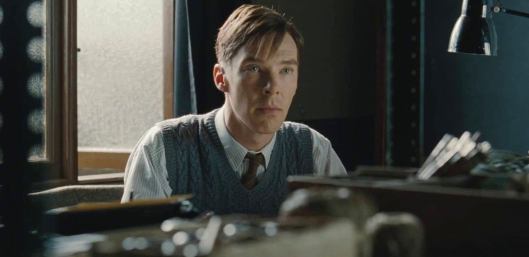
Imitation Game, The - scene3

Despite issues with the script, the cast are uniformly excellent. As mentioned above, Cumberbatch is mesmerising, portraying Turing’s strength of will and sense of purpose with such skill and confidence that the character’s quirks and odd physicality seem entirely natural. He dominates every scene he’s in, causing his co-stars to up their game considerably; as a result The Imitation Game contains a raft of performances that are so good it may well be the best acted movie of 2014. Knightley is appealing as Joan (even if she bears no resemblance to the real Joan Clarke), and plays her with a determination and inner strength that matches Turing’s irascibility and overcomes it. Goode, Leech and Beard, as Turing’s main collaborators, all get their chance to shine but it’s their group scenes and their interaction with each other that work best. Kinnear has an awkward role that he copes well with, as a detective representing our modern approach to the adversity that Turing suffered after the war; it’s the one role that doesn’t entirely convince and seems shoehorned into the movie to make the point about how badly Turing – a war hero – was treated after hostilities ceased. And Dance and Strong, as the twin faces of the Establishment, provide effortless support throughout (as you’d expect).

Fresh from his adaptation of Jo Nesbø’s Headhunters (2011), Tyldum displays an appreciation for recent British history, and handles the complexities of the story in such a way that nothing seems too intellectual to understand. He keeps the action very contained, focusing instead on the characters and their personalities, showing how people from often very different backgrounds could, and did, make such a vital difference in how the war was eventually won. The various periods of Turing’s are recreated with admirable authenticity (some wartime scenes were actually shot at Bletchley Park), and are lensed to very good effect by Oscar Faura. There’s also a subtly evocative score by Alexandre Desplat that enriches each scene it plays over or supports.

Rating: 9/10 – despite taking a huge number of historical liberties, The Imitation Game is gripping, thought-provoking, ambitious movie making, and one of the finest dramas of recent years; with stellar performances from all concerned – including Cumberbatch’s career-defining turn – this (mostly) true story scales new heights in the genre of historical drama, and can’t be recommended highly enough.

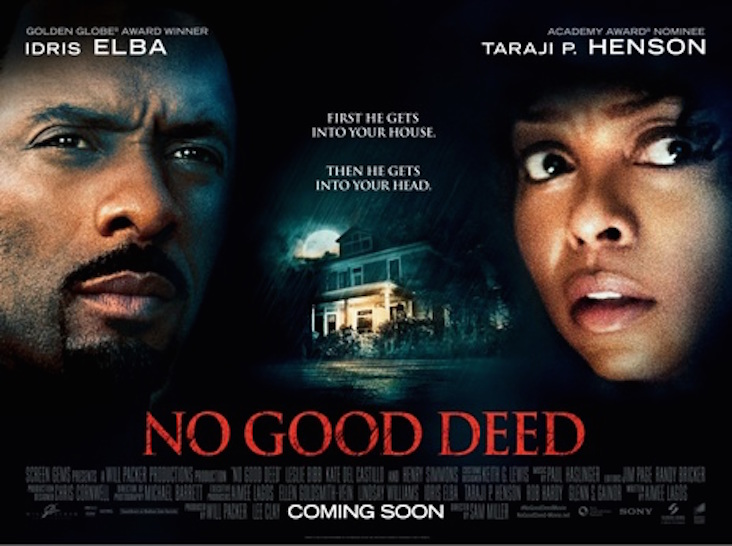
Share this:

  • Click to share on X (Opens in new window) X
  • Click to share on Facebook (Opens in new window) Facebook
  • More
  • Click to print (Opens in new window) Print
  • Click to email a link to a friend (Opens in new window) Email
Like Loading...

The Red Balloon (1956)

10 Saturday Jan 2015

Posted by dullwood68 in Movies

≈ Leave a comment

Tags

Albert Lamorisse, Belleville, Blue balloon, Drama, French movie, Magical realism, Ménilmontant, Paris, Pascal Lamorisse, Red balloon, Review, Short film

Red Balloon, The

Original title: Le ballon rouge

D: Albert Lamorisse / 34m

Cast: Pascal Lamorisse, Georges Sellier, Wladimir Popov, Paul Perey, Sabine Lamorisse, Michel Pezin

On his way to school one morning, a little boy, Pascal (Lamorisse), finds a red balloon tied to a railing. He takes it with him to school where he asks the caretaker to look after it for him until classes are over. The boy then takes the balloon home with him, but his mother releases it out of the window. However, instead of floating away, the balloon (which seems to have a mind of its own) merely hovers outside the window where the boy can see it.

The next morning Pascal calls to the balloon and it follows him as he heads off to school. He makes several attempts to grab the balloon but it keeps itself just out of reach. At school the balloon manages to get into his classroom which causes an uproar and the principal locks Pascal in his office; the balloon meanwhile has floated off. Reunited at the end of the school day, Pascal and the balloon head home, and encounter a little girl (Sabine Lamorisse) who has a blue balloon. The blue balloon reacts in a similar way to the red one, and follows Pascal until he can elude it. But then he encounters a group of boys who, urged on by jealousy, chase Pascal and try to destroy the red balloon.

Red Balloon, The - scene

A simple yet wonderfully filmed piece of magical realism, The Red Balloon is a movie that appeals to the child in all of us. Made in the post-war Belleville area of Paris, the movie serves as a record of the area during the Fifties before it was torn down and redeveloped. As Pascal travels from home to school and back again, the often austere backgrounds serve to highlight the enchanting nature of the story and the unlikely possibility of a red balloon with a mind of its own. It’s a tribute to Lamorisse’s vision though, that the balloon doesn’t feel out of place, even when you can clearly see various Parisians reacting to it with amusement and surprise.

Whimsical it may be, but the movie is also a poignant reminder of the innocence of youth and the power of the imagination. Pascal represents the inner child we all cling on to as adults, his acceptance of the balloon as natural as breathing. Seeing him being followed by the balloon and stopping every now and then to try and catch it is like seeing two friends playing a game together. It’s carefree and irreproachable, a gentle yet effective expression of the simple joys childhood can bring when everything around us excites our curiosity. It’s also no surprise that Pascal’s headmaster doesn’t view it in the same way, punishing him for what he sees as insubordination instead of youthful exuberance. Lamorisse is saying – quite rightly – that we should hold on to as much of that youthful exuberance as we can as adults; otherwise, how terrible will our lives become?

With the introduction of the gang (which leads to the balloon’s ultimate fate), the tale darkens, but necessarily so. Lamorisse is clever enough to realise that the innocence of youth doesn’t always last, and that some children lose it sooner than others. The gang are youth corrupted, their mean-spirited actions and envious behaviour the flipside to Pascal’s purity of mind and heart. They want to destroy the red balloon out of malicious spite, to see Pascal as defrauded of his decency as much as they have been. It’s one of Life’s hard lessons, that not everyone is as nice as you’d like them to be. And for a child like Pascal it’s possibly the hardest lesson to learn.

Lamorisse isn’t prepared to leave Pascal downhearted and dejected, though. As if further proof were needed that there is indeed magic – real magic – in the world, Pascal is given succour in such a wonderful, compassionate way that the movie’s conclusion gives the viewer no option but to grin with shared happiness (and maybe shed a tear or two as well). It’s one of the most uplifting endings to a movie ever, and a perfect finale for a tale that is honest and affecting throughout.
The Red Balloon carries such an emotional charge in its short running time that at times it’s hard to reconcile its faux-documentary presentation with the lyricism it displays at every turn. It’s a fascinating mix, and a spectacular achievement by Lamorisse that is a potent now as it was when it was first released. Belleville is filmed with such a candid eye for the decay of its surroundings that the area is almost a secondary character in itself, and Edmond Séchan’s photography is striking and evocative in equal measure.

Red Balloon, The - scene2

But all this, finally, is underpinned by a sincere, genuine performance by Lamorisse’s son, Pascal. There’s a moment where he’s looking up at the balloon as it floats away from him. His gaze is querulous but unperturbed, as if he can’t quite work out why the balloon is behaving the way it is, but isn’t worried in the least that it won’t return to him. It’s like he’s trying to decipher the inner workings of the balloon’s “mind’ or the mechanics of the game they’re playing. It’s a peaceful moment of natural reflection that Pascal carries off as if he’s not even trying – he’s that good.

Rating: 9/10 – a sublime piece of movie making that warms the heart and reminds us what it is to be young and without a care in the world, The Red Balloon is a jewel to be treasured with every viewing; heartfelt, touching and inspirational, this is a bona fide classic that shouldn’t be missed.

Share this:

  • Click to share on X (Opens in new window) X
  • Click to share on Facebook (Opens in new window) Facebook
  • More
  • Click to print (Opens in new window) Print
  • Click to email a link to a friend (Opens in new window) Email
Like Loading...

The Woman in Black: Angel of Death (2014)

07 Wednesday Jan 2015

Posted by dullwood68 in Movies

≈ 1 Comment

Tags

Crythin Gifford, Drama, Eel Marsh House, Evacuees, Haunting, Helen McCrory, Horror, Jennet Humpfrye, Jeremy Irvine, Review, Sequel, Susan Hill, Thriller, Tom Harper, World War II

Woman in Black Angel of Death, The

D: Tom Harper / 98m

Cast: Phoebe Fox, Jeremy Irvine, Helen McCrory, Oaklee Prendergast, Adrian Rawlins, Ned Dennehy, Amelia Crouch, Amelia Pidgeon, Casper Allpress, Pip Pearce, Leilah de Meza, Jude Wright, Alfie Simmons, Leanne Best

London, 1941. The Blitz has caused the evacuation of several schoolchildren along with their headmistress, Jean Hogg (McCrory) and their teacher, Eve Parkins (Fox). As they take the train to their destination of Crythin Gifford, Eve shares a compartment with RAF pilot Harry Burnstow who is on his way to a new posting at a nearby airfield. Met by local air raid warden Dr Rhodes (Rawlins), he takes them through the now deserted village where the bus has a puncture. While it’s repaired, Eve encounters a blind man, Jacob (Dennehy) who warns her that she and the children will never escape “her”.

At Eel Marsh House, the two women and their charges settle in. Eve has a bad dream that leads to her seeing a woman dressed all in black (Best). The figure vanishes, but the next day, one of the children, Edward (Prendergast), who has been mute since the death of his parents in an air raid, is locked in the nursery by two other children, and sees the woman in black. Afterwards, Edward carries a tattered doll around with him. That night, one of the boys who locked him in the nursery is led from the house by the woman in black; the next morning he’s found dead.

Another sighting of the woman in black in a graveyard leads Eve to discover her identity and the sad history of her child, Nathaniel. With Eve becoming even more convinced that they are all in danger, she battles to convince Jean that they should all leave as soon as possible. An air raid sees the woman in black claim another victim, and with the aid of Harry, they head for the airfield where he’s based. While they wait for the morning to come, Edward is spirited away back to Eel Marsh House. Eve refuses to leave him behind and makes her way back to rescue him.

Woman in Black Angel of Death, The - scene

Set forty years after the events of The Woman in Black (2012), this unnecessary sequel fails to match the quality and all-round scariness of its predecessor, and thanks to a badly constructed screenplay by Jon Croker, almost reduces its titular character to making little more than a cameo appearance.

The success of the original always meant there would be a sequel, and with the decision to set the new story during World War II it seemed as if the makers had come up with an idea that would avoid the usual horror sequel inanity that most follow ups suffer from. Alas, the wartime setting is the only good idea the makers have come up with, and the rest of the movie is as turgid and predictable and run-of-the-mill as any other horror sequel.

With the woman in black’s story told in the first movie, its resurrection here feels like padding in a movie that repeats various shots and sequences in an attempt to promote a sense of menace that never really pays off. Eve has the same nightmare over and over, and while it replays with different outcomes (including a bone-wearying appearance from you-know-who on one occasion), and serves to provide Eve with a back story of her own, the script’s intention for it to be as scary as what’s happening in Eel Marsh House never pans out. Likewise, the oft-repeated shot looking upward at the hole in the ceiling above Edward’s bed – will we glimpse the woman in black there? – is played over and over and becomes tiresome in the extreme.

That a potential franchise has run out of steam so soon may not be surprising to some, but the strength of the original in comparison to this outing is too evident for any other analysis. As a main character, Eve is too blandly presented to have much of an impact, and the viewer has a tough time sympathising with her or her predicament, even when mad, blind Jacob has her temporarily imprisoned. The same goes for the character of Jean, the rationalist who denies the supernatural until it’s literally staring her in the face (and then is all nice and apologetic). Both Fox and McCrory are more than capable actresses, but even with their talents they’re unable to raise their performances above the level of perfunctory. Worse still is Harry, a character so unimaginatively drawn that Irvine is unable to add any colour or flesh him out to an extent that would make him more interesting.

As for Jennet Humpfrye herself, the movie places her firmly in the background, giving her less exposure and as a result, making her less menacing. As a supposedly single-minded, revenge-oriented character she’s remarkably relaxed in her efforts to kill the children placed so conveniently in her home (especially after forty years). And with the change in actress – Best taking over from Liz White – the look and design of the woman in black has been altered somewhat, with Jennet looking younger and less intimidating behind her veil. It’s a sign that not all’s well, that the movie’s primary source of scares and shocks is not as effectively rendered as before (and perhaps this is why we see so little of her, the makers realising how tame her appearance looks in comparison).

To make matters worse the interiors of Eel Marsh House are gloomily lit and make it difficult to see what’s going on when the action takes place at night, while the exteriors are equally bleak and forlorn. It’s all done for the sake of atmosphere but makes the movie an unappealing viewing experience nevertheless. Orchestrating it all, Harper forgets to imbue the movie with a sense of credible peril, and one jump scare aside, defaults on the terror as well. It all leads to an ending that is rushed and dramatically unsatisfactory, and reinforces the feeling that the makers could have done a whole lot better.

Rating: 4/10 – a movie that plays at being scary but doesn’t deliver, The Woman in Black: Angel of Death aims high but succeeds only in being mediocre; a poor effort by all concerned, and one that (hopefully) will discourage a further movie from being made.

Share this:

  • Click to share on X (Opens in new window) X
  • Click to share on Facebook (Opens in new window) Facebook
  • More
  • Click to print (Opens in new window) Print
  • Click to email a link to a friend (Opens in new window) Email
Like Loading...

Mandrake, the Magician (1939) – Chapter 1: Shadow on the Wall

06 Tuesday Jan 2015

Posted by dullwood68 in Movies

≈ 2 Comments

Tags

Al Kikume, Columbia, Doris Weston, Drama, Lothar, Magician, Mandrake, Norman Deming, Platinite, Professor Houston, Radium machine, Review, Sam Nelson, Serial, The Wasp, Thriller, Warren Hull

Mandrake, the Magician

D: Sam Nelson, Norman Deming / 30m

Cast: Warren Hull, Doris Weston, Al Kikume, Rex Downing, Edward Earle, Forbes Murray, Kenneth MacDonald, Don Beddoe

Travelling back from the Orient aboard the S.S. Mohawk, Mandrake the Magician (Hull) receives a telegram from the daughter of Professor Houston (Murray). She’s worried due to his work on a radium machine that will be a huge benefit to humanity but which also has the capacity to be used for evil. Mandrake has been in Nepal searching for a rare metal called platinite that Houston needs for his invention; during his act, an attempt is made on his life by two henchmen of the master criminal known as the Wasp.

Reaching the US, Mandrake travels to Professor Houston’s California home by single seater plane (and survives a further attempt on his life when it’s tampered with). He meets up with Betty (Weston), the professor’s daughter. Meanwhile, the professor receives a threat from the Wasp. A demonstration of the radium machine reveals its potential for mass destruction, but Houston is encouraged to continue with his work. At the request of a friend of Mandrake’s, Dr Andre Bennett (Earle), Houston agrees to demonstrate the machine to a group of Bennett’s fellow physicians. However, when the time comes, Houston is kidnapped by the Wasp’s henchmen, and one of them takes Houston’s place. Mandrake realises this and a fight ensues, one that leads to the magician being in the firing line of the radium machine.

Mandrake the Magician - scene1

As an example of the kind of cliffhanger serial that studios big and small churned out through the Thirties, Forties and Fifties, Mandrake, the Magician is a fun, efficiently presented melodrama that features peril at every turn, poorly choreographed fisticuffs, and the kind of dialogue that’s one part exposition to two parts repetition to three parts baloney. It’s all done with a knowing sense of its own ridiculousness, but in many ways it’s all the better for it. Putting Mandrake in danger at least three times in the first episode sets the tone for the serial, and allows writers Joseph F. Poland, Basil Dickey and Ned Dandy (great names all) to indulge in all manner of unbelievable  scenarios, including a magic act that features an extended cup and balls routine (this from the world’s greatest magician), and the sight of Professor Houston donning protective clothing to demonstrate his machine while Mandrake and others merely take a step back.

Performance-wise, Hull is as debonair as a man who wears a top hat can be, while Weston has little to do other than look decorative. Kikume is kept in the background, Earle appears too late in the episode to make much of an impression, while MacDonald, as electronics expert Webster, takes an early lead in the who-is-the-Wasp-really? sweepstakes. Nelson and Deming direct with a flair that makes the episode fly by, and the sheer gung-ho spirit of the narrative makes for an enjoyable, leave-your-brain-at-the-door outing that promises much more of the same in the remaining eleven chapters.

Rating: 5/10 – rickety sets and a villain who remains masked while wearing a hat give Mandrake, the Magician a hokey, old-time feel that provokes good-natured amusement instead of disappointment; stirring stuff, and a reminder of when movie making was a lot more innocent and a lot less complicated.

NOTE: In keeping with its original presentation in 1939, the remaining chapters will be reviewed each in turn over the next eleven weeks.

Share this:

  • Click to share on X (Opens in new window) X
  • Click to share on Facebook (Opens in new window) Facebook
  • More
  • Click to print (Opens in new window) Print
  • Click to email a link to a friend (Opens in new window) Email
Like Loading...

Still Alice (2014)

05 Monday Jan 2015

Posted by dullwood68 in Movies

≈ Leave a comment

Tags

Alec Baldwin, Alzheimers, Drama, Early onset Alzheimers, Julianne Moore, Kate Bosworth, Kristen Stewart, Lisa Genova, Literary adaptation, Memory loss, Review, Richard Glatzer, Wash Westmoreland

Still Alice

D: Richard Glatzer, Wash Westmoreland / 101m

Cast: Julianne Moore, Alec Baldwin, Kristen Stewart, Kate Bosworth, Hunter Parrish, Shane McRae, Stephen Kunken

Alice Howland (Moore) is a respected linguistics professor at Columbia University. She has a loving husband, John (Baldwin), and three grown up children, Anna (Bosworth), Tom (Parrish), and Lydia (Stewart). Shortly after her fiftieth birthday she gives a lecture and forgets the word ‘lexicon’. She brushes it off but when she’s out running one day she reaches the campus and for one disorientating moment she has no idea where she is. She begins to see a neurologist (Kunken) and undergoes various tests. When it comes, the diagnosis is a shock: she has early onset Alzheimers. Further tests also reveal that it’s familial, and her children are at risk of carrying the recessive gene that causes it.

As expected, the news is a blow to Alice’s family, but she is determined to fight the disease for as long as she can. Her children have different reactions: Anna is tested and is positive; she and her husband, Charlie (McRae), are trying for a baby via an infertility clinic and need to know. Tom tests negative, while Lydia, who is a budding actress living on the West Coast and a bit of a free spirit, decides not to find out. But they and their father all do their best to support Alice as she comes to terms with what her life will become.

But the illness is aggressive, and Alice’s initial coping mechanisms of using her mobile phone to record information, and setting herself little memory tests, lose their effectiveness, and she begins to forget even more. Her awareness of the speed at which her illness is affecting her, leads Alice to record a video message advising her future self to commit suicide by taking a bottle of pills. One day, while she and John are at their beach house, she forgets where the bathroom is and wets herself. As she begins to forget more and more, she receives an invitation to speak at an Alzheimers convention. There she gives a moving description of the ways in which the disease is affecting her but also the ways in which she deals with it.

Alice’s deteriorating mental abilities become more and more obvious. When Lydia performs at a local theatre, Alice forgets her name when they meet up afterwards. And she becomes anxious when John receives an offer to work at the Mayo Clinic, which will mean moving. And then Alice discovers the video message she made earlier…

Still Alice - scene

Adapted from the novel by Lisa Genova, Still Alice is a gloomy, yet also affecting look at the debilitating effects of Alzheimers on an intelligent, academically respected individual, and her immediate family. It’s a straightforward, no frills movie that aims to pull no punches regarding the debilitating aspects of the disease, but can’t quite stop itself from trying to salvage a degree of personal triumph out of Alice’s dilemma. In fact, Still Alice tries so hard to make Alice’s fight against Alzheimers laudatory that it almost misses the tragedy that goes with it hand in hand.

In telling Alice’s story, writer/directors Gratzer and Westmoreland have resorted to charting the gradual effects of the disease by signposting them with often clumsy simplicity. First Alice forgets a word in a lecture, next she forgets where she is, then she forgets someone’s name and their address in a test. As each lapse in memory and example of cognitive impairment is trotted out, their presence in the narrative seems to be crying out, “See? She’s getting worse!”, as if the viewer couldn’t work that out for themselves. And when she’s told that her form of Alzheimers, matched by her intelligence and mental acuity, means that the disease will have a more rapid effect on her, it’s almost like kicking someone when they’re down; not only is Alice already unlucky to be suffering at so young an age, but because she’s so smart it’s another point against her.

This kind of unnecessary melodrama hurts the middle third of the movie so much that it’s only thanks to Moore’s superb performance that it remains so affecting and watchable. Even when the script piles on the pain and anguish she remains utterly believable, painting a sincere, credible portrait of a woman losing her sense of herself, and portraying the terrible ramifications of having her personality destroyed from within. The scene where Alice can’t find the bathroom is a powerful example, as the camera stays with her at waist height as she rushes through the house. When she stops the camera focuses on her face and the evident torment she’s experiencing. The viewer knows exactly what’s happening, from the shame and distress Alice is feeling to the moment where the inevitable happens, and when the camera pans back to reveal the stain down the front of her jogging bottoms it’s nowhere near as effective as the acting masterclass that Moore has honoured us with. Simply put, Moore is astonishing, and when the disease has robbed Alice of nearly all cognisance of the world around her, and her eyes are dulled by incomprehension, it’s heartbreaking.
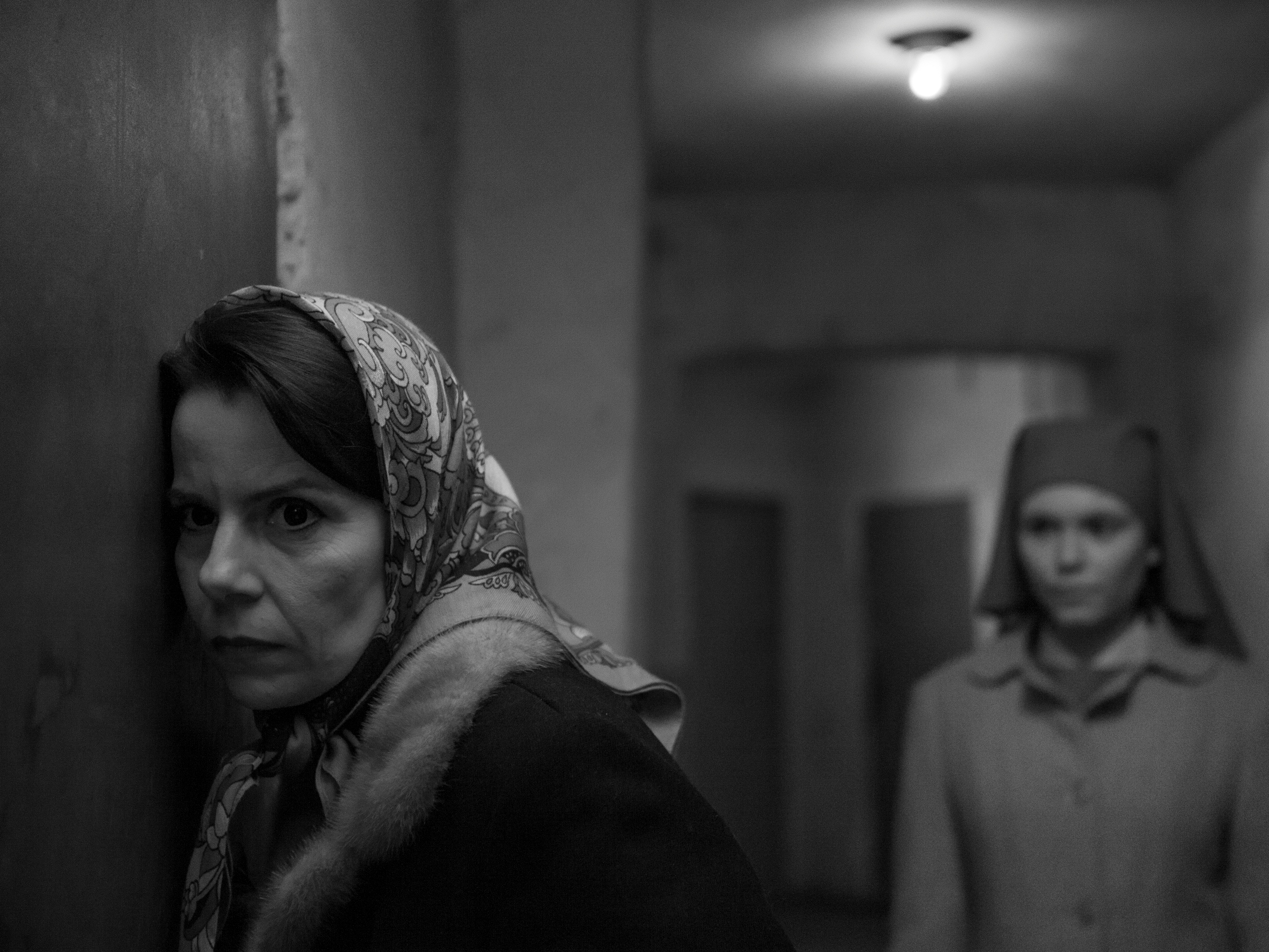
Sadly, Moore is the best thing in a movie that fails to paint convincing portraits of Alice’s family and resorts to their providing implausible levels of support throughout. Not once does any one of them lose their temper, or voice their own distress at what’s happening to her, or display any hesitation in doing what they can. Even when John is offered the job at the Mayo Clinic and Alice states her reluctance of doing so, the scene is set for the kind of antagonism that must surely happen in these situations. But instead, John swallows his disappointment in seconds and the moment passes. It’s an uncomfortable moment because it feels so false, and Baldwin doesn’t pull it off (for once though, we see another character looking as lost as Alice is). But Baldwin isn’t alone. Each of the supporting cast has their “uncomfortable moment”, Stewart early on when Alice and Lydia have one of those awkward mother-daughter conversations about careers that seems to have been cribbed from a thousand and one other similar mother-daughter conversations in the movies, and which leaves Stewart struggling to make her supposedly independent-minded character sound anything other than petulant. In contrast, Bosworth is the waspish eldest daughter, saddled with lines that are largely derogatory of others and with no obvious reason for her being that way. And Parrish is sidelined pretty much throughout as Alice’s son, allowed only a brief moment to shine (but not say much) at the Alzheimers convention.

With Moore’s formidable performance taken out of the equation, Still Alice skirts perilously close to formulaic disease-of-the-week TV movie status. It’s a movie that wants to say something profound about the way in which a disease as awful as Alzheimers can be managed – albeit in its early stages – and while Alice’s address to the conference is genuinely moving, it relies too heavily on her normal mental capability to be completely persuasive. With other dramatic flaws that weigh the movie down, Glatzer and Westmoreland’s efforts remain lumbering and inconsequential. The movie is also curiously bland to watch, with too many neutral colours in the background, and Alice aside, too many characters who evince emotion with restraint. There’s also a mawkish score by Ilan Eshkeri that only occasionally matches the action for poignancy.

Rating: 6/10 – gaining two points because of the sheer brilliance and sensitivity of Moore’s performance, Still Alice is gripping stuff when Moore is onscreen but turgid and lacking validity when she isn’t; if it wasn’t for her this would be one movie that could be so easily forgotten, and without any attendant grief.

Share this:

  • Click to share on X (Opens in new window) X
  • Click to share on Facebook (Opens in new window) Facebook
  • More
  • Click to print (Opens in new window) Print
  • Click to email a link to a friend (Opens in new window) Email
Like Loading...

To Kill a Man (2014)

04 Sunday Jan 2015

Posted by dullwood68 in Movies

≈ 2 Comments

Tags

Alejandra Yañez, Alejandro Fernández Almendras, Chile, Daniel Antivilo, Daniel Candia, Drama, Harassment, Murder, Revenge, Review, Shooting, True story

To Kill a Man

Original title: Matar a un hombre

D: Alejandro Fernández Almendras / 82m

Cast: Daniel Candia, Alejandra Yañez, Daniel Antivilo, Ariel Mateluna, Jennifer Salas, Don Willie, Paula Leoncini

Jorge (Candia) is a quiet family man who works as a caretaker at a forest research site. One night he’s mugged near to his home by a man called Kulale (Antivilo) and some of his gang; they steal his money and his insulin kit. He tells his wife, Marta (Yañez) and Jorgito (Mateluna). Jorgito knows who Kulale is and tells his father that he can get his insulin kit back for 5,000 pesos. Jorge demurs but later that night he realises his son has gone out. He goes to look for him and hears a gunshot from the nearby projects. He finds Jorgito has been shot. As he tends to him, Kulale appears and, weighing up the situation, shoots and wounds himself.

While Jorgito spends three months in hospital recovering, Kulale’s prosecution goes ahead. He contends Jorge and his son attacked and shot him first and he was defending himself when he shot Jorgito, but the court rules against him. To the family’s shock, however, his sentence is restricted to eighteen months due to a technicality. Following the trial, cracks begin to appear in Jorge and Marta’s marriage, and she blames him for Jorgito’s being shot.

Two years pass. Jorge and Marta are now divorced, though he visits his family often. One day at work he receives a call from Kulale who tells him he’s not finished with Jorge and his family and that they have a debt to settle. This proves to be the beginning of a campaign of harassment carried out by Kulale and his gang, which includes abusive phone calls, trapping Jorgito in the back of his truck, throwing rocks at the family home, and assaulting Jorge’s teenage daughter, Nicole (Salas). Each time, Jorge and his family report the incidents but the police and the prosecutor’s office seem unconcerned or unwilling to proceed without any witnesses.

Realising that the chances of anything being done to stop Kulale’s harassment and intimidation of his family are minimal, Jorge decides to take matters into his own hands. One night he lures Kulale out of his home and forces him at gunpoint into the back of Jorgito’s truck. It’s at this point that Jorge must decide if killing Kulale is the right course of action, and if it is, if he can go through with it.

To Kill a Man - scene

A sparse, quietly powerful movie, To Kill a Man is an intense, thought-provoking look at the way in which intimidation and bullying can lead even the most reserved of people to take the law into their own hands, and the subsequent ways in which their lives can be affected, both subtly and obviously. It’s a stark, poetic movie, one that carries a tremendous emotional wallop, and which portrays its central character as a simple man trying to lead a simple life, and struggling when that simplicity of existence is threatened.

The emotional turmoil suffered by Jorge and his family is soberly portrayed, and without recourse to melodrama. Their pain and anger is clearly felt and expressed both through their dealings with authority, and through the deteriorating relationship between Jorge and Marta. Even after they’ve divorced there’s a lingering sense of resentment and disapproval that undermines their ability to communicate with each other. Marta wants Jorge to be more assertive, but it’s not really in his nature; he’s a solitary man, even within his own family. Faced with the problem of Kalule and his aggressive behaviour, Jorge reacts as best he can but it’s not enough for Marta or Jorgito. He deflects their anger at the situation and appears weak in the process.

But all this turmoil is having an effect, and thanks to the combination of Almendras’ impressive script and Candia’s riveting portrayal, Jorge’s eventual decision to “deal” with the problem of Kalule displays an inner strength that abrogates any suggestion that he’s too reserved to cope with it all. Bolstered by an encounter on forest land with a man who pulls a knife on him, Jorge takes confidence from his dealing with that situation and commits to a course of action that tests both his sense of morality and his sense of himself as a man. For the viewer it’s a moment where the feeling of holding one’s breath gives way to a sense of relief at Jorge making such an important, difficult decision.

Candia gives a remarkable performance, Jorge’s withdrawn, taciturn nature given full articulation via the actor’s subtly expressive features. It’s a performance that proves unexpectedly gripping, and while the rest of the cast provide more than adequate support, Candia is the emphatic heart and soul of the movie. Even when he’s alone in a scene there’s little doubt as to how he’s feeling, or what he’s thinking. It’s gripping to watch, and a testament to Almendras’s decision to cast him.

As well as an examination of the morality of taking the law into your own hands, the movie also looks at the effects a shocking event can have the family involved, as well as its legacy. Even when they fight back against Kulale by going to the police there’s no real sense of a family united in their efforts, and Almendras rarely shows all four members spending time together. It’s beyond the movie’s scope but it would be interesting to see their reaction to Jorge’s abduction of Kulale and what happens as a consequence. The Chilean legal system comes in for some considerable criticism (though at present it is undergoing a radical change), and some aspects might seem a little far-fetched – the prosecutor’s home address being given out upon request, for example – but it’s all fuel for the predicament Jorge finds himself trying to cope with.

To Kill a Man - scene2

Visually, the movie is a dour experience in keeping with the material, but there are glimpses of the natural beauty in the forest area where Jorge works, plus some stunning coastal scenery. Almendras keeps things straightforward and direct, dispensing with any frills or unnecessary camera flourishes, and maintaining a tight focus on the characters and placing them in various cramped locations to highlight their sense of being hemmed in at all turns. There’s also an ominous score courtesy of Pablo Vergara that accentuates the drama and cleverly pre-empts the emotional result of Kulale’s abduction.

Rating: 9/10 – a striking, intelligently constructed exploration of one man’s alienation from his family and his attempt at redressing the wrongs done to him, To Kill a Man is a modest drama that succeeds by virtue of a strong central performance and a compelling narrative; apparently based on “real events”, Almendras’s third feature is a triumph of low-budget, independent movie making.

Share this:

  • Click to share on X (Opens in new window) X
  • Click to share on Facebook (Opens in new window) Facebook
  • More
  • Click to print (Opens in new window) Print
  • Click to email a link to a friend (Opens in new window) Email
Like Loading...

Mini-Review: Left Behind (2014)

02 Friday Jan 2015

Posted by dullwood68 in Movies

≈ 1 Comment

Tags

Cassi Thomson, Chad Michael Murray, Drama, Lea Thompson, Literary adaptation, Nicky Whelan, Nicolas Cage, Pilot, Review, The Rapture, Thriller, Transatlantic flight, Vic Armstrong

Left Behind

D: Vic Armstrong / 110m

Cast: Nicolas Cage, Chad Michael Murray, Cassi Thomson, Nicky Whelan, Jordin Sparks, Lea Thompson, Martin Klebba, Gary Grubbs, Alec Rayme, Georgina Rawlings

Rayford Steele (Cage) is a transatlantic pilot planning an affair with stewardess Hattie Durham (Whelan) when they reach London. Caught off guard by his daughter, Chloe (Thomson), coming to see him at the airport, he sidesteps her suspicions while at the same time reassuring her that his relationship with Chloe’s mother, Irene (Thompson) is all okay, and despite her recently becoming a Christian believer. Chloe goes home but has a dispute with her mother over her Christian beliefs, and she takes her younger brother to the mall. While there, he vanishes into thin air, leaving only his clothing behind. At the same time, on Rayford’s flight, all the children and some of the adults – including his co-pilot – disappear in the same way.

It soon becomes apparent that this is a worldwide event. In the air, a collision with another flight leaves Rayford’s fuel line damaged. He makes the decision to turn back to New York but with the radio down he can’t alert anyone. Meanwhile, Chloe discovers her mother has disappeared also, and her local pastor can only tell her it’s God’s will. Believing her father to be dead as well, she decides to kill herself. With the help of a passenger, journalist Buck Williams (Murray), Rayford manages to call Chloe on her mobile phone; he tells her he’s running out of fuel and needs to land as an emergency… but the airport’s aren’t an option.

Left Behind - scene

Yes folks, it’s the Rapture again, all tricked out with the barest of explanations and tagged onto an airplane disaster scenario that even Airplane! (1980) couldn’t spoof as well as Left Behind does. It’s absurdist stuff, chock-full of crushingly awful dialogue, wooden performances, absentee direction from famed stunt coordinator Armstrong, special effects that are one step up from those in a SyFy movie, and further proof (if any were needed) that Cage will commit to anything these days, no matter how bad it is.

To be fair, the movie’s first half hour isn’t so bad, as each character is introduced, and the basic premise is set up. But once Cage and co are in the air, it’s full speed ahead to Disasterville. When Chloe’s brother, and others, disappear at the mall, looting starts up right away (obviously this is a natural response to hundreds of people just vanishing). On the flight, one woman whose daughter has disappeared, pulls out a GUN and accuses the other passengers of being in cahoots with her ex-husband, who’s obviously trying to snatch her. And Chloe decides to climb to the top of a suspension bridge to kill herself – but really so that Buck’s mobile call will reach her (the networks are predictably scrambled). There are other faux pas made by Paul Lalonde and Jerry Patus’s dreadful script, and no attempt is made to justify any of them.

Rating: 2/10 – appalling stuff, and incredibly insulting to Christians (its target audience), Left Behind is a travesty of Biblical proportions; inept on pretty much every level, the prospect of two further movies to come will make viewers pray that a real Rapture comes around before they do.

Share this:

  • Click to share on X (Opens in new window) X
  • Click to share on Facebook (Opens in new window) Facebook
  • More
  • Click to print (Opens in new window) Print
  • Click to email a link to a friend (Opens in new window) Email
Like Loading...

Exodus: Gods and Kings (2014)

01 Thursday Jan 2015

Posted by dullwood68 in Movies

≈ Leave a comment

Tags

Ancient Egypt, Ben Kingsley, Ben Mendelsohn, Burning Bush, Christian Bale, Drama, Hebrews, Historical epic, Joel Edgerton, John Turturro, Memphis, Moses, Ramses, Red Sea, Review, Ridley Scott, Sigourney Weaver

Exodus Gods and Kings

D: Ridley Scott / 150m

Cast: Christian Bale, Joel Edgerton, John Turturro, Aaron Paul, Ben Mendelsohn, María Valverde, Sigourney Weaver, Ben Kingsley, Hiam Abbass, Isaac Andrews, Ewen Bremner, Indira Varma, Golshifteh Farahani, Ghassan Massoud, Tara Fitzgerald

Ancient Egypt, 1300 BC. In the holy city of Memphis, Pharaoh Seti (Turturro) has learnt that the Hittite army is nearby. He sends his two sons, Ramses (Edgerton) and Moses (Bale) to rout them, which they do, but not before Moses saves Ramses’ life on the battlefield, thus fulfilling a prophecy that says one of them will be saved by the other who will become a leader. When they return, Seti orders Ramses to travel to Pithom in order to assess the slaves working there. Moses goes instead and meets the Viceroy, Hegep (Mendelsohn).

Hegep is crooked and treats the slaves poorly. During his visit, Moses meets a man called Nun (Kingsley) who tells him that he is a Hebrew and that the circumstances of his birth are not as he believes. Moses refutes this and returns to Memphis, but the story is overheard and reported to Hegep. Soon after, Seti dies and Ramses becomes Pharaoh. When Hegep comes to Memphis he tells Ramses of Moses’ history; this leads to Moses being sent into exile. He travels to Midian where he settles down as a shepherd and marries Zipporah; they have a son, Gershom. Meanwhile, Ramses marries Nefertari and they too have a son.

Nine years pass. During a storm, Moses pursues some stray lambs onto a nearby mountain. A rock slide renders him unconscious; when he comes to he finds himself confronted by a young boy, Malak (Andrews) who is God’s messenger. He gives Moses a task to do, one that brings him back to Memphis and a meeting with Ramses where he warns the Pharaoh to set the Hebrews free or there will be consequences. Moses prepares the Hebrews for conflict, while Ramses targets them in the hope that Moses will give himself up. But Malak appears to him again and warns him that Moses’ lack of progress means “something is coming”.

“Something” proves to be a series of plagues that wreak havoc on Memphis and the Egyptian people, culminating in a cull of all the Egyptian firstborns, including Ramses’ infant son. Ramses, in despair, tells Moses to take his people and leave. But once they’ve done so he takes four thousand men and pursues them all the way to the Red Sea, with the intention of slaughtering them all.

Exodus Gods and Kings - scene

It could be argued that the need for a re-telling of the Moses story isn’t exactly high on anyone’s agenda at the moment, but nevertheless here it is, and directed by one of the few directors able to orchestrate a movie on such an epic scale. However, while Exodus: Gods and Kings is as visually impressive as you might expect given that Darius Wolski is behind the camera and Ridley Scott is overseeing things, the movie as a whole is a leaden, passion-free exercise in big-budget movie making.

Considering both the material and the cast taking part, the movie struggles to engage the audience from the off, proving largely uninteresting and a frustratingly bland experience. As happens every so often with the projects Scott chooses – 1492: Conquest of Paradise (1992) and Hannibal (2001) are just two examples – Exodus: Gods and Kings is a) too long, and b) too tedious.

With the story of Moses, the ten plagues, and the crossing of the Red Sea being one of the most dramatic Biblical tales, the fact that this incarnation loses its way so quickly (and never recovers) is a little embarrassing. The criticism that Scott focuses too much on the design and look of a movie is upheld here by a range of performances that give new meaning to the word “undercooked”. Bale’s portrayal of Moses lacks the intensity of feeling that the part demands, and his discovery of his roots is reduced to a brief scene that gives way to an even briefer fight scene; it’s as if he’s more irritated than devastated. Edgerton plays Ramses as an indecisive, self-doubting pharaoh who looks like he needs a comforter (or his mommy). As the dramatic foil to Moses, Ramses’ character carries all the weight of a feather duster, and Bale and Edgerton’s scenes together quickly become repetitive in nature: Moses shows his annoyance/anger/disappointment in Ramses, Ramses does his best not to look as if he’s going to cry.

Thus any clash between the two is always going to be heavily weighted in Moses’ favour, but Bale never takes full advantage of the way the script orchestrates these encounters (he’s also able to get to Ramses without being detected, and to leave without being pursued). He and Egerton aren’t bad per se, but they don’t spark off each other. If it weren’t for the fact that both actors are clearly physically present in their scenes together, you could be forgiven for believing that they filmed them separately and were “united” in post-production.

As for the rest of the cast, their roles are generally too small for them to make much of an impression, with the notable exception of Mendelsohn, who takes Hegep and invests him with a surprising mixture of flippancy and menace. It’s the best performance in the whole movie, and when he’s on screen, the discrepancy between his approach and Bale’s (in particular) is all too apparent. In even minor roles, Weaver, Paul, Turturro, Kingsley and Farahani are there to make up the numbers, while Valverde is stranded by the script’s need to tick off the boxes in Moses’ life without providing any depth to it. It’s unfortunate, as well, that Valverde’s appearance is during the film’s middle section, where Moses strives to be a shepherd before his first meeting with Malak (there is a burning bush but with Malak acting as God’s mouthpiece, it just looks superfluous). This stretch of the movie has all the pace of a snail race, and thanks to the indolent editing – courtesy of Billy Rich – seems to go on for much longer than it actually does.

With so many scenes either dragging on or lacking in energy, Exodus: Gods and Kings regularly falls back on its special effects, but even here the spectacular appears commonplace, our familiarity with what CGI can achieve blunting the effect of seeing Memphis from the air, or giant crocodiles attacking ships on the Nile. It also leaves the crossing of the Red Sea, and its fast-approaching ten-storey wave, feeling less impressive and/or intimidating than it should be. Again, Scott and his cast and crew fail to heighten the drama and leave the viewer struggling to work out where everyone is in relation to a constantly changing topography (not to mention a wave that appears to be advancing from at least three directions at once).

Exodus Gods and Kings - scene2

Scott’s ardor seems to have waned recently, with his last two movies – The Counselor (2013) and Prometheus (2012) – showing clear signs of a director unable to spot, or deal with, or overcome, the faults in each movie’s screenplay, and sadly, the same is true here. The script – by Adam Cooper and Bill Collage, with assists from Jeffrey Caine and Steven Zaillian – aims for intimacy amid the spectacle but ends up skirting it instead, and any notions of leadership, duty, fraternal betrayal, faith or destiny, rather than being placed front and centre, are given a passing nod whenever the movie appears to need them.

Rating: 5/10 – visually stunning but dramatically redundant, Exodus: Gods and Kings is a disappointing, mediocre piece that fails to inject any fervour into the story of Moses and his efforts to free the Hebrews from the pharaohs’ tyranny; stilted and dull, this becomes as much an epic of endurance (for the audience) as it does for its characters.

Share this:

  • Click to share on X (Opens in new window) X
  • Click to share on Facebook (Opens in new window) Facebook
  • More
  • Click to print (Opens in new window) Print
  • Click to email a link to a friend (Opens in new window) Email
Like Loading...
← Older posts
Newer posts →

Blog Stats

  • 492,489 hits

Recent Posts

  • 10 Reasons to Remember Bibi Andersson (1935-2019)
  • Fantasia (1940)
  • Dances With Wolves (1990) – The Special Edition
  • Kiss of the Spider Woman (1985)
  • The Three Musketeers (1973)

Top Posts & Pages

  • Cardboard Boxer (2016)
    Cardboard Boxer (2016)
  • Death on the Nile (1978)
    Death on the Nile (1978)
  • Shame the Devil (2013)
    Shame the Devil (2013)
  • Art of Submission (2009)
    Art of Submission (2009)
  • Table 19 (2017)
    Table 19 (2017)
  • Frozen (2013)
    Frozen (2013)
  • For One Week Only
    For One Week Only
  • Bang Gang (A Modern Love Story) (2015)
    Bang Gang (A Modern Love Story) (2015)
  • Grosse Pointe Blank (1997)
    Grosse Pointe Blank (1997)
  • Dances With Wolves (1990) - The Special Edition
    Dances With Wolves (1990) - The Special Edition
Follow thedullwoodexperiment on WordPress.com

Blogs I Follow

  • Rubbish Talk
  • Film 4 Fan
  • Fast Film Reviews
  • The Film Blog
  • All Things Movies UK
  • Interpreting the Stars
  • Let's Go To The Movies
  • Movie Reviews 101
  • TMI News
  • Dan the Man's Movie Reviews
  • Film History
  • Jordan and Eddie (The Movie Guys)

Archives

  • April 2019 (13)
  • March 2019 (28)
  • February 2019 (28)
  • January 2019 (32)
  • December 2018 (28)
  • November 2018 (30)
  • October 2018 (29)
  • September 2018 (29)
  • August 2018 (29)
  • July 2018 (30)
  • June 2018 (28)
  • May 2018 (24)
  • April 2018 (21)
  • March 2018 (31)
  • February 2018 (25)
  • January 2018 (30)
  • December 2017 (30)
  • November 2017 (27)
  • October 2017 (27)
  • September 2017 (26)
  • August 2017 (32)
  • July 2017 (32)
  • June 2017 (30)
  • May 2017 (29)
  • April 2017 (29)
  • March 2017 (30)
  • February 2017 (27)
  • January 2017 (32)
  • December 2016 (30)
  • November 2016 (28)
  • October 2016 (30)
  • September 2016 (27)
  • August 2016 (30)
  • July 2016 (30)
  • June 2016 (31)
  • May 2016 (34)
  • April 2016 (30)
  • March 2016 (30)
  • February 2016 (28)
  • January 2016 (35)
  • December 2015 (34)
  • November 2015 (31)
  • October 2015 (31)
  • September 2015 (34)
  • August 2015 (31)
  • July 2015 (33)
  • June 2015 (12)
  • May 2015 (31)
  • April 2015 (32)
  • March 2015 (30)
  • February 2015 (37)
  • January 2015 (39)
  • December 2014 (34)
  • November 2014 (34)
  • October 2014 (36)
  • September 2014 (25)
  • August 2014 (29)
  • July 2014 (29)
  • June 2014 (28)
  • May 2014 (23)
  • April 2014 (21)
  • March 2014 (42)
  • February 2014 (38)
  • January 2014 (29)
  • December 2013 (28)
  • November 2013 (34)
  • October 2013 (4)

Create a free website or blog at WordPress.com.

Rubbish Talk

Film 4 Fan

A Movie Blog

Fast Film Reviews

The Film Blog

The official blog of everything in film

All Things Movies UK

Movie Reviews and Original Articles

Interpreting the Stars

Dave Examines Movies

Let's Go To The Movies

Film and Theatre Lover!

Movie Reviews 101

Daily Movie Reviews

TMI News

Latest weather, crime and breaking news

Dan the Man's Movie Reviews

All my aimless thoughts, ideas, and ramblings, all packed into one site!

Film History

Telling the story of film

Jordan and Eddie (The Movie Guys)

Movie Reviews & Ramblings from an Australian Based Film Fan

Privacy & Cookies: This site uses cookies. By continuing to use this website, you agree to their use.
To find out more, including how to control cookies, see here: Cookie Policy
  • Subscribe Subscribed
    • thedullwoodexperiment
    • Join 481 other subscribers
    • Already have a WordPress.com account? Log in now.
    • thedullwoodexperiment
    • Subscribe Subscribed
    • Sign up
    • Log in
    • Report this content
    • View site in Reader
    • Manage subscriptions
    • Collapse this bar
 

Loading Comments...
 

    %d