• 10 Reasons to Remember…
  • A Brief Word About…
  • About
  • For One Week Only
  • Happy Birthday
  • Monthly Roundup
  • Old-Time Crime
  • Other Posts
  • Poster of the Week
  • Question of the Week
  • Reviews
  • Trailers

thedullwoodexperiment

~ Viewing movies in a different light

thedullwoodexperiment

Tag Archives: Ian McKellen

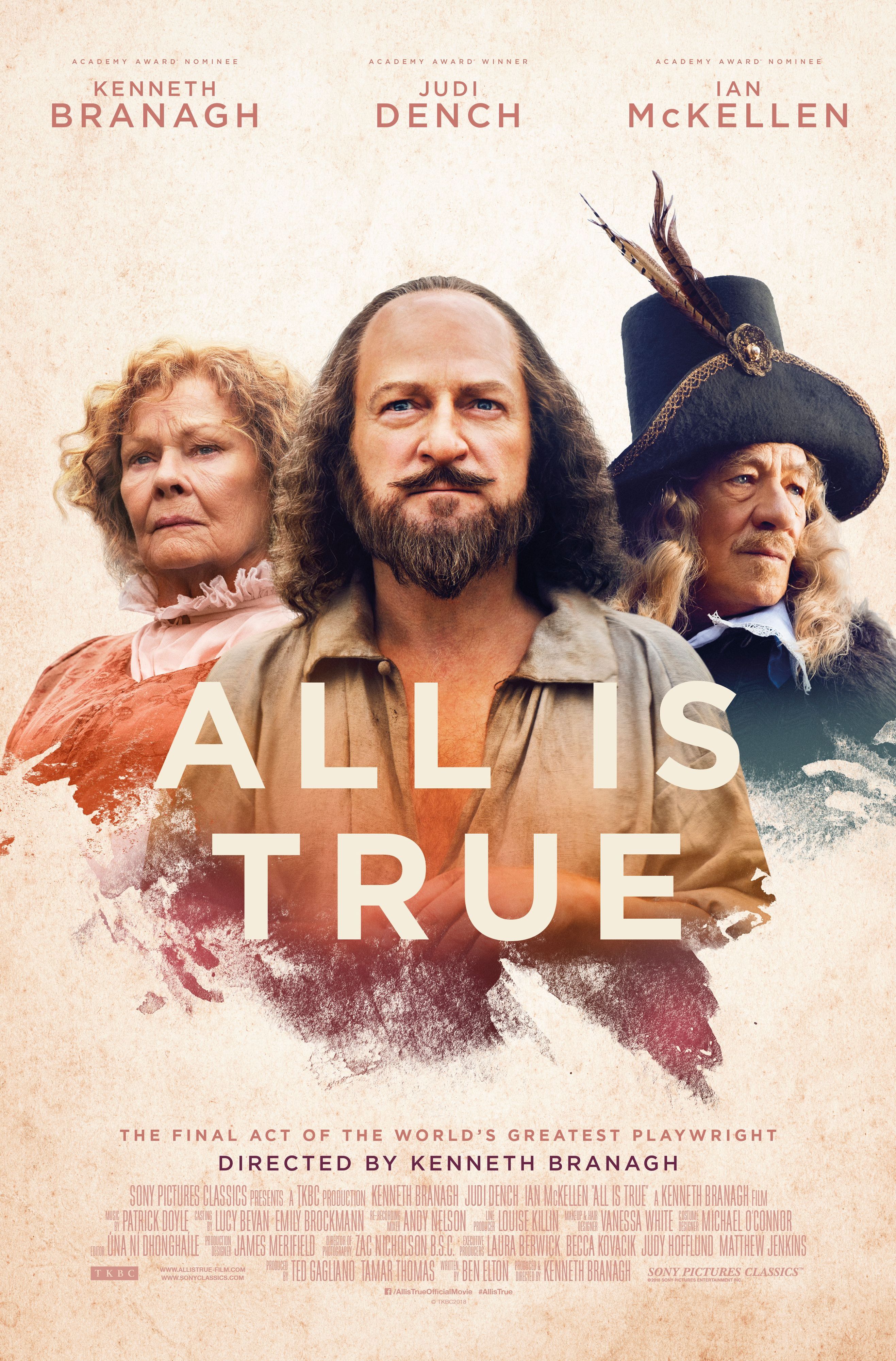
All Is True (2018)

10 Sunday Feb 2019

Posted by dullwood68 in Movies

≈ Leave a comment

Tags

Biography, Drama, Grief, Hamnet, History, Ian McKellen, Judi Dench, Kathryn Wilder, Kenneth Branagh, Review, William Shakespeare

D: Kenneth Branagh / 101m

Cast: Kenneth Branagh, Judi Dench, Kathryn Wilder, Lydia Wilson, Hadley Fraser, Ian McKellen, Jack Colgrave Hirst, Sam Ellis, Gerard Horan

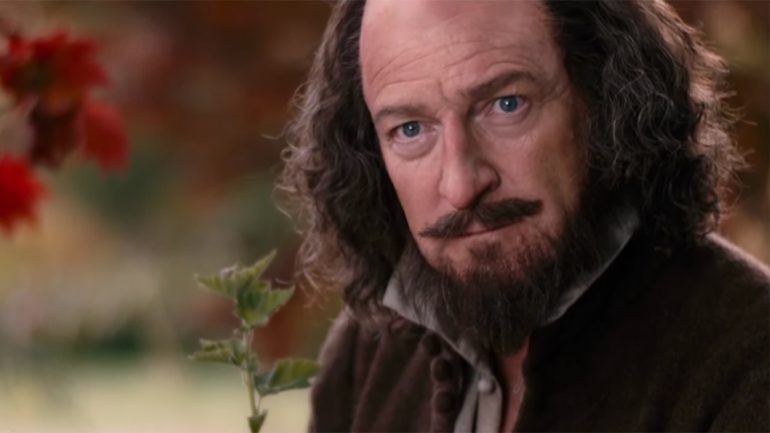
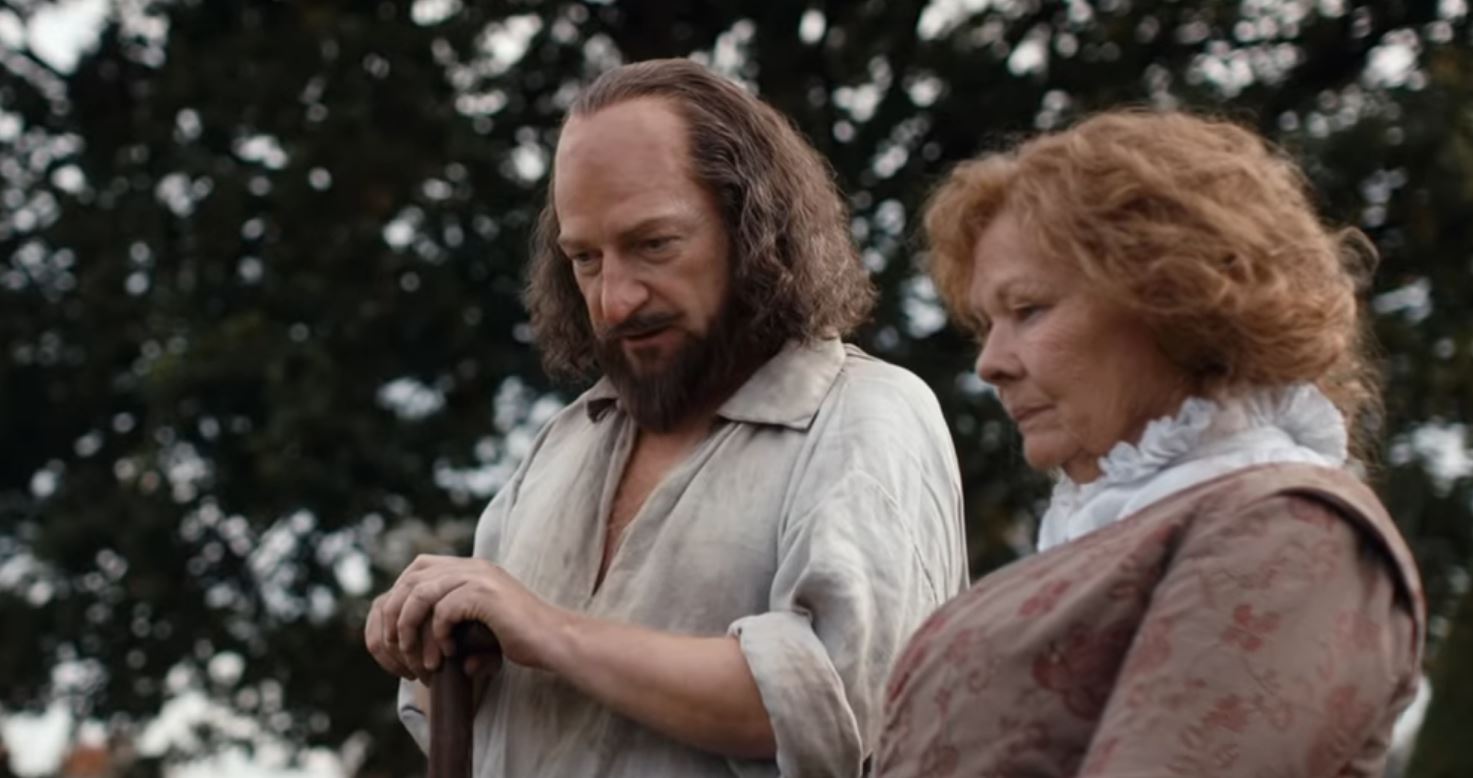
In 1613, following the destruction of the Globe theatre by fire, William Shakespeare (Branagh), having been away from his family for most of the last thirty years, decides to return to his home in Stratford-upon-Avon, and there live out the rest of his life. His arrival isn’t as well received as he would like: his wife, Anne (Dench), treats him as a guest, while his daughter, Judith (Wilder), is angry at his presumption that he can just come home and nothing should be said about it. Shakespeare finds himself finally mourning the death of his son Hamnet seventeen years before, but this brings out an unexpected animosity from Judith (who was Hamnet’s twin). Meanwhile, his eldest daughter, Susanna (Wilson), is trapped in a loveless marriage to Puritan doctor John Hall (Fraser). She has an affair that nearly leads to public ruin, while after several disagreements with her father over what a woman is for, Judith pursues a relationship with local wine merchant, Tom Quiney (Hirst). There is scandal in their relationship as well, but before it can threaten to ruin Judith’s standing in the local community, a revelation about Hamnet causes Shakespeare’s memory of his son to be changed forever…

In using the alternative title for The Famous History of the Life of King Henry the Eighth, All Is True opens itself up for close inspection of its claim, and inevitably, is found wanting. As much as any historical biography can be “true”, Branagh’s take on Shakespeare’s final years (from a script by Ben Elton), labours under the necessity of finding enough material to fill in the blanks of what we know already – which isn’t that much. And so, we have a movie that makes a handful of educated guesses as to the events surrounding Shakespeare’s self-imposed retirement, but can’t quite come up with a reason for it. For the most part, the script is more concerned with the problems affecting his daughters, while the great man himself is reduced to being a secondary character, one seen creating a garden to honour his son’s memory, or indulging in melancholy conversations with the likes of visiting guests the Earl of Southampton (McKellen), and Ben Jonson (Horan). They’re odd scenes to have, as both see Shakespeare downplaying his genius while his visitors do their best to boost him up. And the scene with Southampton is there simply to support the theory that his sonnets were the product of a homosexual infatuation; all very possible but at odds with the tone of the rest of the movie.

Indeed, the overall tone is one of overwhelming grief and sadness as Shakespeare attempts to deal with the loss of Hamnet. Whether seen in moments of contemplation, or through the verses he wrote before his death, Hamnet is the ghost that haunts everyone, and Shakespeare’s grief is tainted by the false recollections he has of him. This allows Branagh the director plenty of opportunities to let Branagh the actor look sad and distant, though mostly it makes him look as if he’s spotted something far off in the distance but can’t quite work out what it is. Still, it’s a good performance from Branagh, and he’s given able support from Dench and the rest of the cast, but in the end, Elton’s script rambles too often from subplot to subplot without ever connecting them in a cohesive, organic fashion. And Shakespeare himself, as a character, is only saved from being a complete dullard by virtue of Branagh’s efforts in front of the camera; there’s more fire and intensity from Wilder’s defiant Judith. A curious mix then of the effective and the banal, and tinged with soap opera moments that are out of place, it’s bolstered by Zac Nicholson’s naturalistic cinematography (all the night-time interiors used candlelight only), and James Merifield’s expressive production design.

Rating: 6/10 – not as definitive as it might have wanted to be, nor as engrossing as the subject matter should have merited, All Is True stumbles too often in its efforts to be intriguing, and features a seemingly endless array of establishing shots that seem designed to pad out the running time for no other reason than that they look pretty; anyone looking for an introduction to Shakespeare the man should look elsewhere, while those who are curious about his later years would do well to treat the movie as an interpretation of events rather than a retelling of them.

Share this:

  • Click to share on X (Opens in new window) X
  • Click to share on Facebook (Opens in new window) Facebook
  • More
  • Click to print (Opens in new window) Print
  • Click to email a link to a friend (Opens in new window) Email
Like Loading...

Mr. Holmes (2015)

07 Tuesday Jul 2015

Posted by dullwood68 in Movies

≈ Leave a comment

Tags

A Slight Trick of the Mind, Bees, Bill Condon, Glass harmonica, Grey glove, Historical drama, Ian McKellen, Japan, Laura Linney, Literary adaptation, Milo Porter, Mystery, Prickly ash, Review, Royal jelly, Sherlock Holmes, Sussex

Mr. Holmes

D: Bill Condon / 104m

Cast: Ian McKellen, Laura Linney, Milo Porter, Hiroyuki Sanada, Hattie Morahan, Patrick Kennedy, Roger Allam, Frances de la Tour, Philip Davis, John Sessions

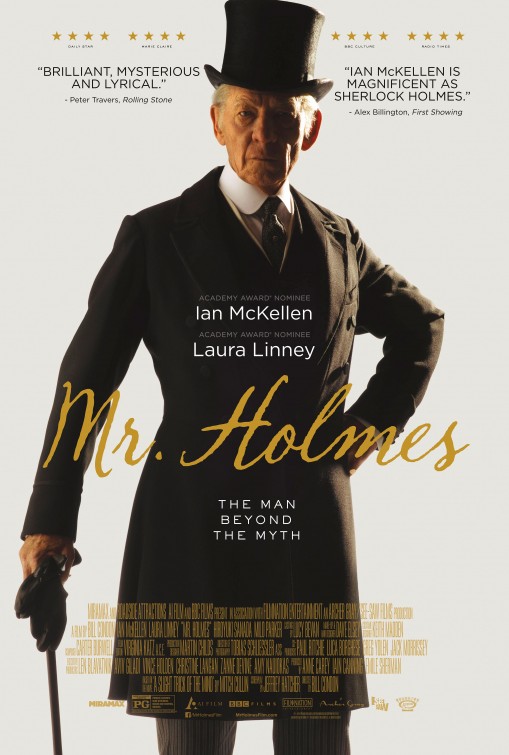
In 1947, Sherlock Holmes (McKellen), now 93, lives in a Sussex farmhouse, and is looked after by his housekeeper, Mrs Munro (Linney), and her young son, Roger (Porter). He keeps bees and uses royal jelly as a means of improving his memory, which has deteriorated in recent years. A recent trip to Japan in search of supplies of prickly ash, a plant also known for improving the memory, has been undertaken with a view to ensuring that Holmes can complete one last project before he becomes unable to: to write a true account of his last case as a detective. Unhappy with the way Dr Watson portrayed those events, Holmes is struggling to remember the details of the case. Urged on by the interest shown by Roger, Holmes renews his efforts to pin them down.

His recollections take him back thirty years, after Watson has gotten married and their partnership has dissolved. He’s visited by Thomas Kelmot (Kennedy), a man worried about the behaviour of his wife, Ann (Morahan). Following two miscarriages, Ann Kelmot has become withdrawn; her husband has advised her to take up a musical hobby but now that has become an obsession, and even though he has forbade her from continuing her lessons with glass harmonica teacher, Madame Schirmer (de la Tour), he has discovered Ann is still visiting her. He suspects the music teacher of some kind of plot and wants Holmes to investigate.

Back in the present, Holmes takes Roger under his wing in and introduces him to his apiary. Roger persists in asking about Holmes’ last case; his enthusiasm prompts Holmes to make more of an effort to remember Ann Kelmot, including following her to Madame Schirmer’s and from there to various places before he approaches her in a public garden. Their conversation becomes confrontational but Holmes reveals the depth of his knowledge about her situation, and the effect the two miscarriages has had on her.

Mrs Munro, meanwhile, informs Holmes that she is planning to move to Portsmouth and work in a hotel; it will mean taking Roger with her. Roger doesn’t want to go, but when Holmes suffers a collapse shortly after, they are forced to stay. While he remains bedridden on the advice of his doctor (Allam), Roger takes care of the bees. He also finds a grey glove in Holmes’ study, a memento from the case of Ann Kelmot that Holmes can’t remember keeping or having. As Holmes remembers more about the case he also recalls the event that led to his retirement as a detective, and the reasons behind Watson’s subsequent involvement. But his remembrance of the past is put into perspective when he finds Roger has been stung by dozens of bees, and the boy’s life is hanging in the balance…

Mr. Holmes - scene

Dealing with themes of sadness and loss and regret, Mr. Holmes presents us with a portrait of a master detective beset by echoes from his past. It’s a richly detailed depiction of times long past, anchored by a superb performance from McKellen, and redolent of a bygone age, with its frock coats and steam trains and pre-suffrage gender politics. Expertly marshalled by Condon – reunited with McKellen for the first time since they collaborated on Gods and Monsters (1998) – the movie is a flawless recreation of two periods in English history that still exert a strong fascination: the post-Victorian era and the years immediately following the cessation of World War II. There’s also Holmes’ trip to Japan and the sight of the devastation wrought on Hiroshima. The historical trappings carry so much weight it’s almost as if the audience has been transported back with Holmes and are experiencing things themselves.

With the period detail proving so effective, it’s the twin mysteries on offer – what really happened during Holmes’ last case, and what is causing the deaths of his beloved bees – that unfortunately stop the movie from becoming even more memorable (an ironic outcome for a movie that deals with the loss and despair in losing one’s own memory). The story of Ann Kelmot has all the initial hallmarks of a classic Holmes tale, with its anxious husband and a heroine seemingly under the influence of a scheming criminal. But the truth, when Holmes finally remembers it, is far more prosaic than that, and while presented with some emotional impact, still doesn’t seem as devastating as Holmes makes out. Maybe it’s seeing it from the perspective of an old man trying to make sense of things that remain just out of reach that leaves the viewer with a sense of detachment: if Holmes can’t access those recollections and connect with them, how are we to do so?

But the movie, even with its handful of slightly underdeveloped storylines, has several aces up its sleeve that mitigate and make up for the paucity of the plot and the general structure. These are the performances from McKellen, Linney, Porter and Morahan. As already mentioned, McKellen is superb as Holmes, fragile, distressed, playful, curmudgeonly, afraid – tuning his portrayal of the master detective to such a fine degree that it’s both an acting and organic masterclass; he’s believable and convincing throughout, particularly when he’s trying to downplay the public misconceptions about him that are thanks to Watson’s writings. As Holmes’ housekeeper, Linney adopts a country dialect with precision and aplomb, and imbues Mrs Munro with a stoic dignity that stops her from expressing her misgivings about the relationship between Holmes and her son. As Roger, Porter gives another of those naturalistic, not-even-trying performances that it seems most child actors can produce at the drop of a hat; his scenes with McKellen are affecting and perfectly modulated. And as the focus of Holmes’ disturbed memories, Morahan is quietly magnificent as the troubled Ann Kelmot, her tear-rimmed eyes a more than adequate depiction of the turmoil her character has fallen prey to.

The movie has an often stately, measured pace, and some viewers may find the early scenes a little hard going, but once Holmes begins to remember events following the arrival of Thomas Kelmot at Baker Street, Condon increases the rate at which things begin to happen, until the final thirty minutes are as engrossing as any modern day thriller. With Martin Childs’ meticulous production design being augmented by often beautiful cinematography from Tobias A. Schliessler, and a delicately evocative score courtesy of Carter Burwell, there’s so much to enjoy here that audiences who stay the course will be rewarded by a movie that quietly steals up behind them and warms their hearts.

Rating: 8/10 – modest in intention and design, Mr. Holmes is a small-scale triumph of historical veracity and emotional honesty, focusing as it does on the melancholic suffering of a man for whom his intellect, now foundering, defined him; full of deceptively powerful performances, this is one historical drama that resonates long after it’s ended.

Share this:

  • Click to share on X (Opens in new window) X
  • Click to share on Facebook (Opens in new window) Facebook
  • More
  • Click to print (Opens in new window) Print
  • Click to email a link to a friend (Opens in new window) Email
Like Loading...

Ten Stars and the Movies You Might Not Realise They Were In

10 Sunday May 2015

Posted by dullwood68 in Movies

≈ Leave a comment

Tags

Actors, Actresses, Amy Adams, Cameos, Cameron Diaz, Colin Firth, Early movies, Ian McKellen, Jason Statham, Jeremy Renner, Julianne Moore, Leonardo DiCaprio, Movie stars, Natalie Portman, Nicolas Cage, Performances, Robert Downey Jr, Stars

Sometimes, watching old movies can provide the occasional surprise, like seeing an actor or actress in an early role – or movie – when you least expect it. This happened to me recently when I saw National Lampoon’s Senior Trip (1995) (I’m a National Lampoon movie completist – what can I say?). Imagine my surprise when I saw Jeremy Renner’s name come up in the title credits. Imagine my further surprise when it turned out he gave one of the best performances in the movie (though not that much of a surprise if you’ve seen it).

It got me thinking about other stars and their early appearances, and what other movies are out there with fledgling – or fleeting – performances from today’s big name actors and actresses. So, a few quick searches on imdb.com later, and voilà!, this post was born. I hope you have some fun with it, and if there are any other examples that you think should have been included, or are worth mentioning, feel free to let me know.

Leonardo DiCaprio – Poison Ivy (1992)

While it’s well-known that DiCaprio’s first movie role was in Critters 3 (1991), what’s perhaps less well-known is his participation in Katt Shea Ruben’s perverse shadow play of teenage sexuality run amok. But before anyone gets too excited, his role in the movie (as ‘Guy”) amounts to a walk-on part where he comes out of a school building and crosses in front of the camera. It’s a blink-and-you’ll-miss-it part, and perhaps best regarded as an example of how good DiCaprio’s agent was back then: out of nothing he got ninth billing.

Robert Downey Jr – Weird Science (1985)

Way back before he became Marvel’s go-to guy for the grounding of their Cinematic Universe, Downey Jr made an appearance in this fondly remembered ode to teenage hormones and the fetishisation of Kelly LeBrock. Cast as “Ian”, Downey Jr plays a bit of a douchebag who acts as a bully to the two main characters. It’s not a particularly memorable role, and there’s nothing to suppose that his career would take off in the way it has – twice – but it’s in keeping with John Hughes’ studied look at teenagers and their idiosyncrasies, and isn’t too embarrassing when looked back on from thirty years later.

Robert Downey Jr

Julianne Moore – The Hand That Rocks the Cradle (1992)

As the realtor who holds the key to the reason for Rebecca De Mornay’s psychotic dismantling of Annabella Sciorra’s life, Moore made only her second movie, and met a memorable end in a booby-trapped greenhouse. Feisty and forthright – almost a template for some of her future roles – the Oscar-winning actress catches the eye but still doesn’t quite give notice of how good an actress she really is. That would be left to Short Cuts (1993), one of her most memorable performances.

Julianne Moore

Colin Firth – The English Patient (1996)

As the movie’s star-crossed lovers, everyone remembers Ralph Fiennes and Kristin Scott Thomas, but when it comes to the actor playing Thomas’s jilted husband, that’s when the mind may well go completely blank. But Firth matches his (then) more illustrious co-stars, and shows that, only a year after playing Mr Darcy in the BBC’s Pride and Prejudice, that he can play a cuckold just as well as a romantic heart-throb.

Colin Firth

Ian McKellen – Last Action Hero (1993)

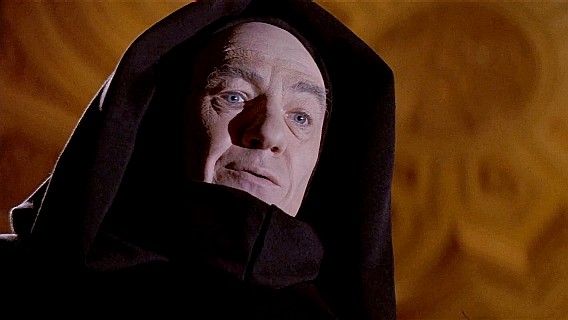
In amongst Last Action Hero‘s gunfire and car chases and explosions, you may remember towards the end of the movie, the character of Death from Ingmar Bergman’s The Seventh Seal (1957) stepping out of the big screen and into the real world. As audacious homages go it’s a great example of what made the movie so uneven, but McKellen brings the necessary gravitas to the role, and even adds a degree of nonchalant amusement.

Ian McKellen

Amy Adams – Talladega Nights: The Ballad of Ricky Bobby (2006)

Though Adams has a track record in comedies before and since Talladega Nights, it’s unlikely that most people would place her as Will Ferrell’s love interest, whatever the circumstances (though the glasses may have helped). But as Susan, Ricky Bobby’s assistant-cum-paramour, Adams more than holds her own amidst all the manic goings-on and provides a welcome distraction from the otherwise testosterone-laden script.

Amy Adams

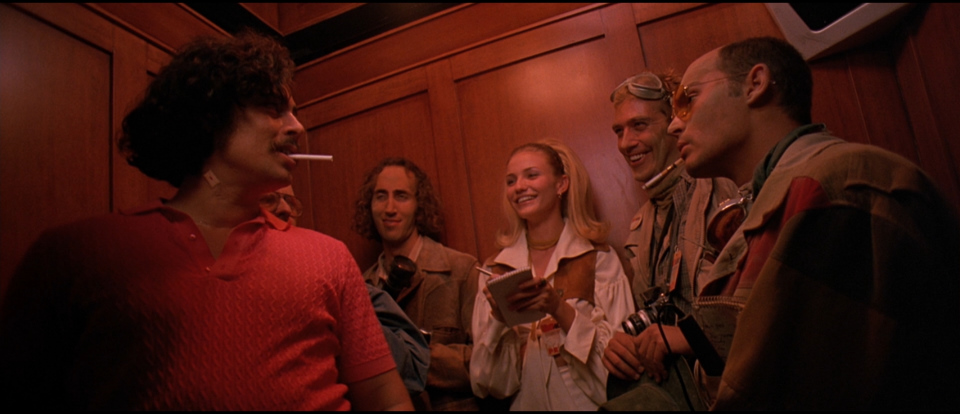
Cameron Diaz – Fear and Loathing in Las Vegas (1998)

One of a number of cameos in Terry Gilliam’s spirited psychedelic imagining of Hunter S. Thompson’s book, Diaz’s appearance as “Blonde TV Reporter” is brief, but a great example of the kind of “roles” that some stars will take either as a favour to the director, or just to be involved in a particular movie project. Plus it’s always fun to see someone pop up unexpectedly in a movie, even if it’s only for a moment.

Cameron Diaz

Nicolas Cage – The Cotton Club (1984)

Working with his uncle, Francis Ford Coppola, Cage’s turn as Richard Gere’s unpredictable, violent brother is another of the actor’s mercurial early roles, and a reminder of the raw, vital talent that has been lost in the welter of tired, mortgage-paying performances Cage has given us in recent years. Taking what could have been a stereotypical role and giving it the kind of spin only he could, it shows Cage acting up a storm and commanding the viewer’s attention.

Nicolas Cage

Jason Statham – Collateral (2004)

Billed as “Airport Man”, Statham has a small but pivotal role in Michael Mann’s L.A.-set thriller, and he more than holds his own in his scene with Tom Cruise. It’s the kind of unexpected appearance that enriches a movie, and lets the audience know that Statham – already an established star in his own right – can still do character work when required… and very effectively.

Jason Statham

Natalie Portman – Mars Attacks! (1996)

Three years before she became Queen Amidala in Star Wars Episode I: The Phantom Menace (1999), Portman took a supporting role as the President’s daughter, Taffy, in Tim Burton’s anarchic alien invasion romp. Sharing scenes with Jack Nicholson and Glenn Close, Portman enters into the spirit of things with gusto, and has one of the best lines in the movie: “Guess it wasn’t the dove.”

Natalie Portman

Share this:

  • Click to share on X (Opens in new window) X
  • Click to share on Facebook (Opens in new window) Facebook
  • More
  • Click to print (Opens in new window) Print
  • Click to email a link to a friend (Opens in new window) Email
Like Loading...

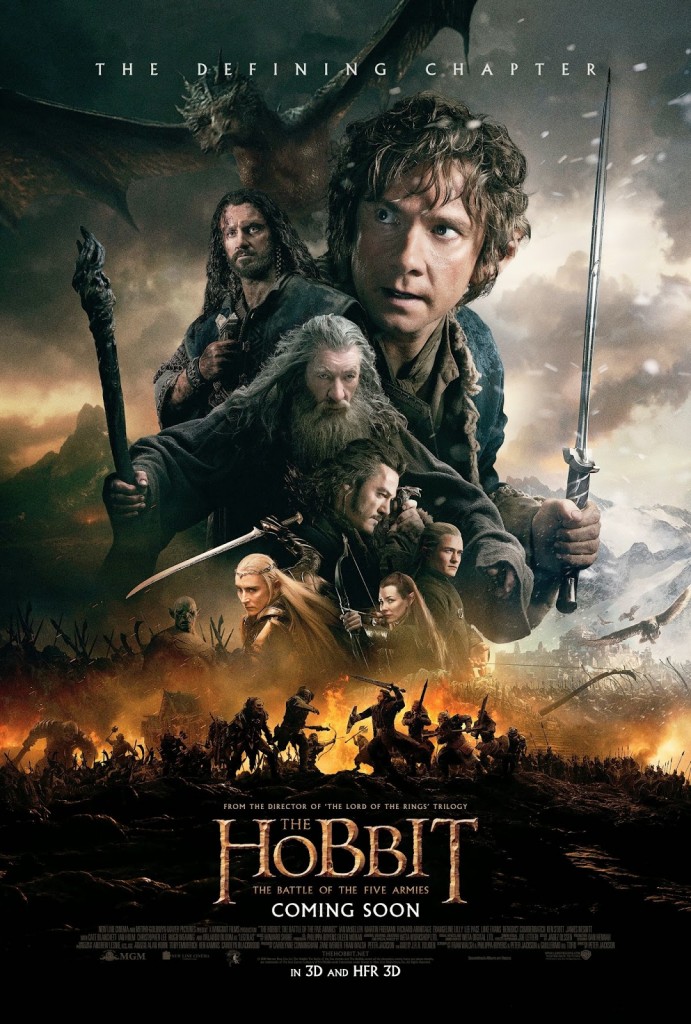
The Hobbit: The Battle of the Five Armies (2014)

23 Tuesday Dec 2014

Posted by dullwood68 in Movies

≈ 1 Comment

Tags

Bard the Bowman, Bilbo Baggins, Cate Blanchett, Erebor, Galadriel, Gandalf, Ian McKellen, J.R.R. Tolkien, Legolas, Literary adaptation, Martin Freeman, Middle Earth, Orlando Bloom, Peter Jackson, Richard Armitage, Sauron, Smaug, Thorin Oakenshield

Hobbit The Battle of the Five Armies, The

D: Peter Jackson / 144m

Cast: Ian McKellen, Martin Freeman, Richard Armitage, Orlando Bloom, Evangeline Lilly, Ken Stott, Lee Pace, Luke Evans, Aidan Turner, Dean O’Gorman, Graham McTavish, Cate Blanchett, Hugo Weaving, Christopher Lee, Sylvester McCoy, Stephen Fry, Ryan Gage, Billy Connolly, James Nesbitt, Ian Holm, John Bell, Mikael Persbrandt, Manu Bennett, John Tui, Benedict Cumberbatch

Angered by the attempt to kill him, Smaug (Cumberbatch) leaves the Lonely Mountain and the dwarf city of Erebor to wreak his vengeance on Laketown and its people. As he lays fiery waste to the doomed town, Bard the Bowman (Evans) seeks a way to defeat the dragon. With the aid of his son, Bain (Bell), Bard succeeds, but the town is in ruins. With winter fast approaching the inhabitants of Laketown look to Erebor and the promise made by Thorin (Armitage) when he was aided by Bard. But Thorin is in the grip of dragon sickness, his mind fixed on protecting the gold in the mountain, and he refuses to give the people of Laketown shelter; instead they are forced to take refuge in the ruined town of Dale.

Inside Erebor, Thorin’s madness worsens with the absence of the Arkenstone, the jewel that ensures his position as king of the dwarves. It transpires that Bilbo (Freeman) was able to take the jewel during his encounter with Smaug, but he fears giving it to Thorin. Meanwhile, the woodland elves, led by Thranduil (Pace), arrive in Dale with supplies for the humans and with the intention of reclaiming some jewels that are owed to him by Thorin’s forebears. Bard attempts to reason with Thorin but the dwarf leader refuses to yield. With an army of Orcs led by Azog the Defiler (Bennett) almost upon them, Gandalf (McKellen) arrives in time to provide support for the human-elf alliance.

Bilbo sneaks out of Erebor and gives the Arkenstone to Thranduil. One last attempt is made to avoid bloodshed but Thorin is adamant he will have war. With the arrival of a dwarf army led by Thorin’s cousin Dain (Connolly), a battle between the dwarves and the elves begins but is interrupted by the arrival of Azog’s forces. The dwarves and the elves and the humans all join forces against the orcs, while in Erebor, Thorin is on the brink of being completely subsumed by madness. And to make matters worse, Legolas (Bloom) and Tauriel (Lilly) discover that there is a second army of orcs heading for Erebor as well.

Hobbit The Battle of the Five Armies, The - scene

And so, in true George Lucas/Star Wars fashion, we come to the end of the journey – in the middle of it. Heralded as the “defining chapter” this is the movie that Jackson needed to get right above all the other Hobbit movies. Everything has been a prelude to this, the linking chapter in a six film series that has come to define fantasy movie-making on an epic, unprecedented scale, while always retaining a true sense of what’s most important: the characters. Whatever your thoughts on the idea that two movies would have been better than three, what can’t be disputed is the care and attention that Jackson and co-scripters Fran Walsh and Philippa Boyens (with additional input from Guillermo del Toro) have taken in their efforts to bring Tolkien’s short novel to the screen.

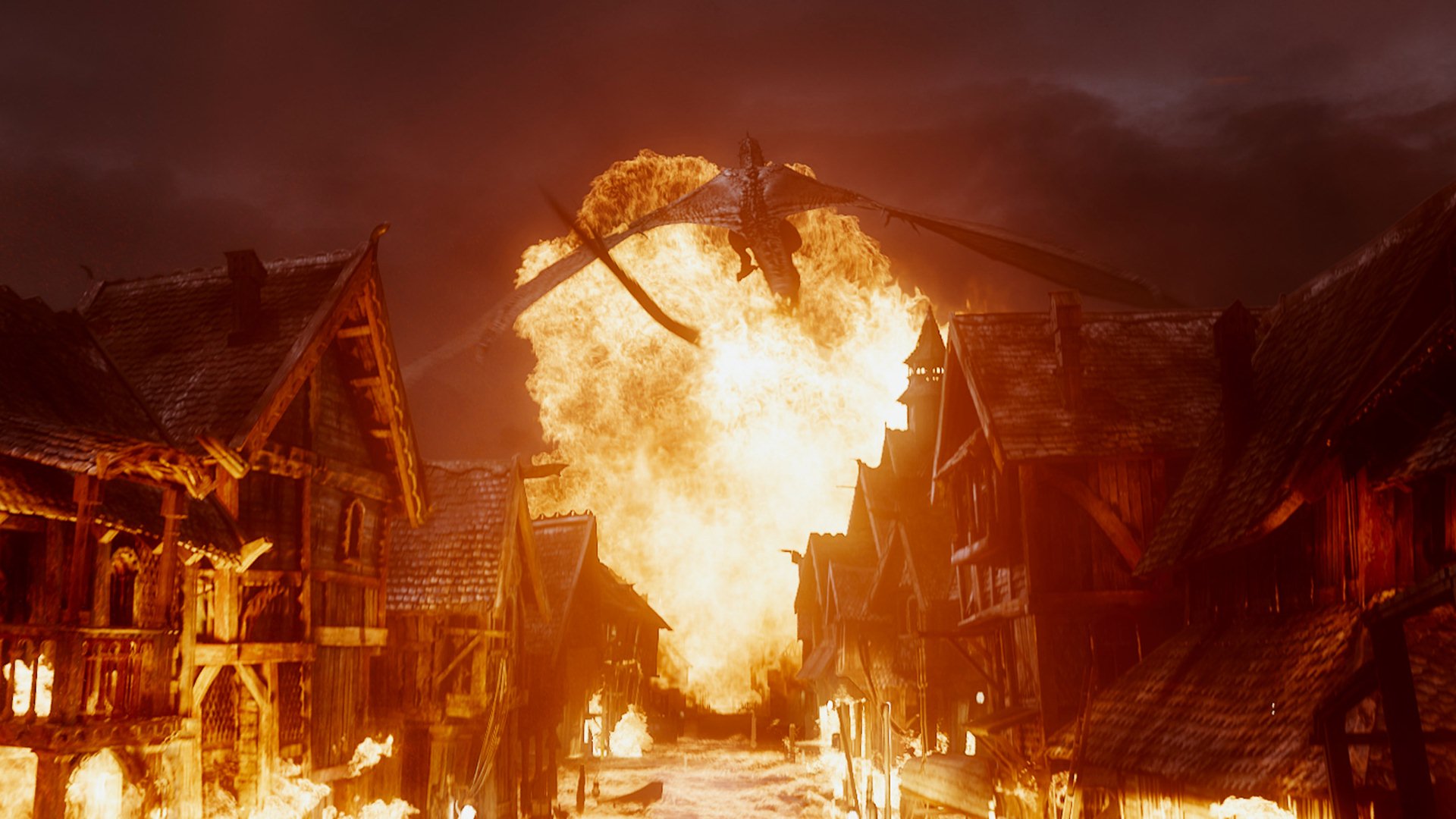
Dispensing with the traditional prologue that shows previous events, The Battle of the Five Armies picks up directly after The Desolation of Smaug and throws us into one of the trilogy’s most exciting action sequences, as the dragon vents its wrath on the unfortunate Laketown. It’s a bravura piece of movie making, each burst and eruption of flame so convincingly rendered it’s hard to believe that most of the action has been created in a computer. With Smaug’s death it’s full speed ahead to the climactic battle that involves dwarfs, men, elves, orcs and eagles. It’s a fast-paced, often relentless movie, tilting headlong from one skirmish to another, barely pausing for breath, and yet able to maintain an emotional intensity that other fantasy movies can’t even begin to come near. It also shows Jackson near the height of his directorial powers – that honour goes to The Lord of the Rings: The Return of the King (2003) – firmly in command of the material and assembling it all in a way that looks far too easy.

Jackson’s decision to make The Battle of the Five Armies the shortest of the Hobbit movies is a wise one, making it a more immediate, thrilling experience, but still with that depth of emotion that we’ve come to know and expect from each trip to Middle Earth. The relationship between Bilbo and Thorin is this movie’s finest flourish, so adroitly handled and acted by Freeman and Armitage that their scenes together are capable of making the viewer hold their breath. The added romance between Tauriel and Kili (Turner) is perhaps more perfunctory but is still touching enough to warrant its inclusion. In truth, the whole cast excel, with McKellen, Armitage and Evans the standouts in a movie with more than its fair share of superb performances. It’s been said before, but Jackson has created such a vivid world that even when he introduces creatures that very closely resemble the worms from Tremors (1990), they still feel a part of Middle Earth. This attention to detail, this “world building”, is what separates these movies from all the rest. And of course, there’s the action, inventive, compelling, and wonderfully choreographed for maximum effect. It’s impressive stuff – as you’d expect – and full of horror, humour, seamless CGI (unless, for some reason, it involves Radagast the Brown), and stirring feats of physicality (Legolas vs Bolg). But best of all, and after all has been said and done, and the battle is over, Jackson treats us to a wordless scene between Bilbo and Gandalf that is perfect in its simplicity.

With an ending that blends effortlessly with the beginning of The Lord of the Rings: The Fellowship of the Ring (2001), the movie also doesn’t outstay its welcome, but mostly because this isn’t the end of an era, but the opening chapter in a much grander tale. As such its shorter running time is to be applauded; though don’t be fooled, the movie packs so much in it’s a masterclass of concise plotting and scripting. Some fans may still complain about the treatment of certain characters – Beorn (Persbrandt) has even less to do here than before – and the similarities between the Battle of the Pelennor Fields and this one are self-apparent, but all in all, Jackson’s adaptation of The Hobbit has been a success. To those who say The Hobbit trilogy is less dramatic or satisfying than The Lord of the Rings trilogy, it should be mentioned that they are very different “beasts”, one originally intended as a children’s novel, its follow-up more for older audiences. What Jackson has done is to keep the essential ingredients of the novels and expanded the material around them to make one long story albeit in two sections and with sixty years between them. It’s still a staggering achievement and worthy of as much high praise as can be doled out.

The same can also be said for the movie’s crew, including director of photography Andrew Lesnie, production designer Dan Hennah, and composer Howard Shore (and not forgetting the sterling work of second unit director Andy Serkis). These and the thousands of other people who have worked on the movies deserve some kind of reward for their efforts.

Rating: 9/10 – a rip-roaring, spectacular action movie to wind up the trilogy, The Hobbit: The Battle of the Five Armies is guaranteed to put a smile on the face of fans, and reassure those doubters that Jackson had made a mistake by manipulating the novel into three movies; but take heart anyone who thinks they’ve seen the last of all things Middle Earth, there’s still an extended edition of the movie to come.

Share this:

  • Click to share on X (Opens in new window) X
  • Click to share on Facebook (Opens in new window) Facebook
  • More
  • Click to print (Opens in new window) Print
  • Click to email a link to a friend (Opens in new window) Email
Like Loading...

X-Men: Days of Future Past (2014)

27 Tuesday May 2014

Posted by dullwood68 in Movies

≈ 1 Comment

Tags

Beast, Bolivar Trask, Bryan Singer, Hugh Jackman, Ian McKellen, James McAvoy, Jennifer Lawrence, Magneto, Marvel, Michael Fassbender, Mutants, Patrick Stewart, Professor X, Quicksilver, Review, Sci-fi, Sentinels, Time travel, Wolverine

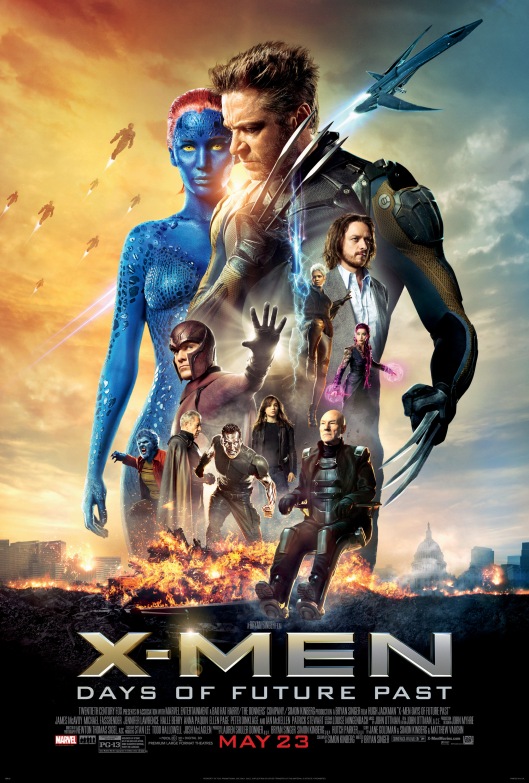
x-men-days-of-future-past_04aaf850

D: Bryan Singer / 131m

Cast: Hugh Jackman, James McAvoy, Michael Fassbender, Jennifer Lawrence, Nicholas Hoult, Patrick Stewart, Ian McKellen, Ellen Page, Peter Dinklage, Halle Berry, Shawn Ashmore, Evan Peters, Omar Sy, Josh Helman, Mark Camacho

With X-Men: The Last Stand (2006) leaving a sour taste in the mouth after the glories of the first two X-Men movies, and with two subsequent Wolverine adventures proving that even a massive fan favourite doesn’t mean an automatically good movie, the future of the X-Men franchise was looking a little doubtful.  With both Patrick Stewart and Ian McKellen “getting on a bit”, the decision to revisit Charles Xavier and Eric Lehnsherr in their younger days in X-Men: First Class (2011) was a positive boon for the franchise and one that revitalised what was otherwise a moribund series.  Now, with the equivalent of a spring in its step, we have a movie that both acknowledges its predecessors and forges a whole new path for its mutant protagonists.

Opening in the near future, with mutants and mankind alike being targeted for extinction by Sentinels, the world is a wasteland.  With the Sentinels able to assimilate whatever mutant powers are pitched against them, a band of mutants including Kitty Pryde (Page), Bishop (Sy) and Iceman (Ashmore) fight a rearguard action against them that sees Professor X’s pupils evade certain death through Kitty’s ability to send a person’s consciousness back in time; this allows the remaining mutants to anticipate a Sentinel attack and flee before it can happen, thus erasing that particular timeline.  With the arrival of Professor X (Stewart), Magneto (McKellen), Logan aka Wolverine (Jackman) and Storm (Berry), a last, desperate decision is made to send Wolverine’s consciousness back into his body in 1973, the year the Sentinels were created by industrialist Bolivar Trask (Dinklage).  Back then, Trask was assassinated by Raven aka Mystique (Lawrence), which led to her capture and the advancement of the Sentinel programme using her DNA (this enables the Sentinels to assimilate other mutants’ powers).  Logan’s mission: to unite the estranged Charles and Erik, track down Raven, and stop her from killing Trask.

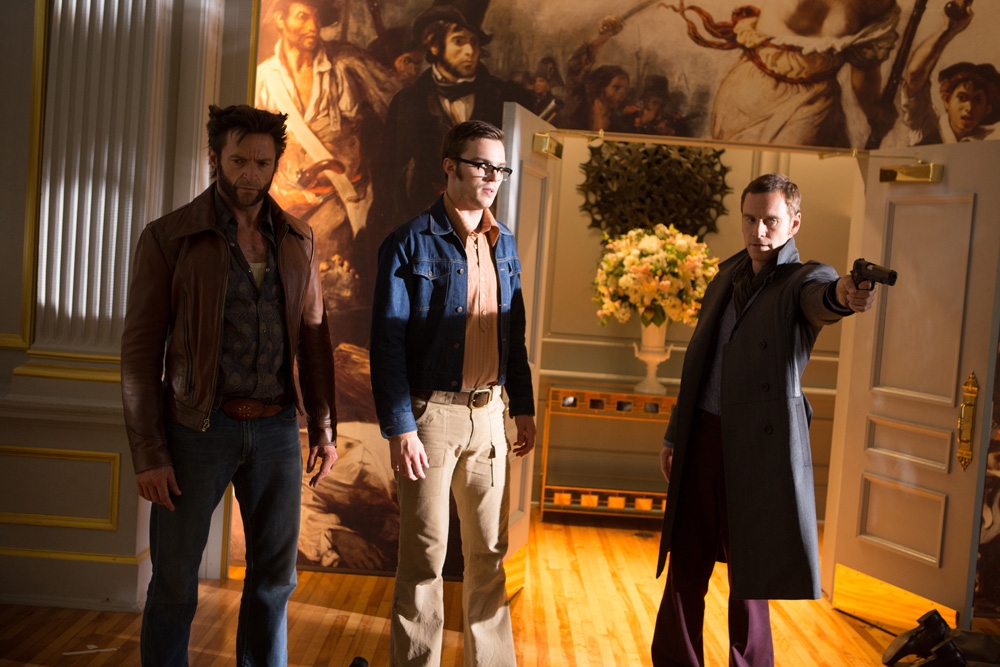
Of course, it’s not easy.  Since the events of X-Men: First Class, Charles has taken to wallowing in self-pity at the loss of Raven, and has lost his powers thanks to a serum created by Hank McCoy aka Beast (Hoult) that allows him to walk.  He agrees to help for Mystique’s sake, though he is unhappy about needing Erik’s help.  With the aid of Quicksilver (Peters), they free Erik from a cell beneath the Pentagon and travel to Paris (where Raven is due to kill Trask at a conference).  Imitating a Vietnamese officer, Raven infiltrates the conference room where Trask plans to sell his Sentinel technology to the highest bidder.  He reveals a hand-held mutant detector that is triggered by Raven’s presence.  Hastily despatching the other attendees – including a young William Stryker (Helman) – Raven is stopped from shooting Trask by the arrival of Logan et al.  Erik disarms her and then turns the gun on her; aware that her DNA will make the Sentinels an unstoppable force he believes it is better for her to die than to let them become so strong.  Raven makes her escape but is wounded in the attempt.  Erik tries to follow her but is stopped by Hank who has morphed into his Beast persona.  All three are caught on film and the “mutant menace” espoused by Trask is taken up by President Nixon (Camacho) who gives the go ahead to the Sentinel programme.

At a press conference in the grounds of the White House set up to reveal the existence of the Sentinels and their purpose, Raven impersonates a Secret Service agent in order to get to Trask.  Now on his own, Erik steals back the helmet that magnifies his powers and uses them to levitate a baseball stadium; he transports it to the press conference and drops it around the White House, effectively sealing it off from the police and everyone else.  Charles is trapped under a piece of fallen scaffolding, while Logan and Hank do battle with one of the Sentinels (which are now under Erik’s control).  In the future, the Sentinels attack the mutant hideout; casualties mount up as Professor X and Magneto wonder if Logan’s mission will be successful in time.  As the future becomes ever bleaker, Erik castigates the President and his staff for their animosity towards mutants, and threatens them with a new world order, with mutants in control.  With Logan and Hank unable to stop the Sentinel, and Raven still intent on killing Trask, and Erik about to dispose of Nixon and his staff, in the future the Sentinels breach the mutant hideout and target Magneto and Professor X…
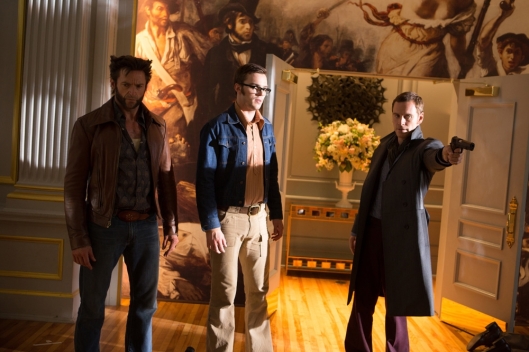
X-Men Days of Future Past - scene

Even at this late stage in the game there’s still more to the story than you’d expect.  X-Men: Days of Future Past is a triumph for all concerned, an exciting, often unpredictable addition to the X-Men saga that more than lives up to expectations but also deepens and enriches the story begun in X-Men: First Class.  With the stakes upped considerably, and the inclusion of more mutants than have been seen since The Last Stand, the movie seems, at first glance, to be overdoing it, adding too much to the mix for it to be as satisfying or rewarding as it should be (by necessity as much as expediency, some characters have more screen time than others).  But thanks to Simon Kinberg’s measured script, the movie glides smoothly along, gaining momentum, adding layer upon layer of meaning, and providing an emotional depth that is missing from most – if not all – other superhero movies.

Largely this is due to the stellar cast, led by McAvoy and Fassbender, two actors who have made their roles their own.  Their adversarial friendship is expanded upon here, both characters’ sense of having been betrayed by the other adding a dangerous edge to their scenes together, adding to the tension that develops as the world heads towards oblivion.  Both actors give tremendous performances (McAvoy is superb in his opening scenes with Jackman), and the support they receive, notably from Hoult and Jackman, is equally impressive, while Dinklage (sporting a wig and a half) invests Trask with an eerie messianic quality that elevates the character from perfunctory villain to unwavering fear monger.  And then there’s Lawrence, endowing Raven/Mystique with a mix of rage, sadness and longed-for redemption that makes her the most intriguing character of all, her dual nature at odds with itself even when fiercely determined to walk her own path.  The real surprise, though, is the inclusion of Quicksilver.  Peters turns in a funny, smart, freewheeling performance that is as charming as it is a real comedic shot in the arm.  His sardonic smile and deadpan glances are perfectly pitched, and his appearance leaves you wanting more (which we’ll get in X-Men: Apocalypse).

Returning to the director’s chair following the departure of Matthew Vaughn, Singer shows a firm grasp of the material and an even firmer grasp on ensuring the human/mutant element isn’t lost amongst all the special effects and impressively mounted carnage.  Even a small scene, such as the one between Professor X and Magneto towards the end of the movie, is more affecting than you might expect, and there are numerous occasions where Singer’s pleasure at being back in the director’s chair couldn’t be more evident if he’d stopped the movie mid-scene and held up a sign saying “I loved making this movie”.  Singer is an expressive director, always willing to try something new, and his staging of the showdown at the White House shows a clear intention to avoid the usual action motifs, making the sequence that much more impressive (it’s also a clever move to reduce Logan’s involvement in the action, especially as he doesn’t have his adamantium skeleton for Erik to play around with).

The early Seventies are recreated with a fine eye for the details of the time, and there’s an astute tweaking on contemporary fashions (though it might have been fun to see Wolverine in bell bottoms), while the inclusion of footage shot as if it were news reports from the time is a clever conceit and works particularly well during Raven’s escape from the conference.  The Sentinels are appropriately scary (and make Terminator 2’s T-1000 look like a skinny prototype), there’s the by-now obligatory post-credits sequence that sets up the next instalment, and there are a number of cameos that will have fans cheering in their seats (two cameos are very welcome indeed).

There are some stumbles.  The opening ten to fifteen minutes, where the plot is established and some new characters introduced, is a bit clunky and muddled, and as mentioned before some of the cast don’t fare as well as others.  Page does little more than sit with her fingers poised either side of Jackman’s temples for most of the movie, while McKellen gets to add the odd line here and there, but it’s Berry who’s almost completely sidelined, so much so that one of the cameo turns has more lines than her.  (And on the subject of screen time, someone should give Anna Paquin’s agent a gold star; she appears for approximately ten dialogue-free seconds but is seventh billed; now that’s impressive.)  Trask’s hand-held mutant detector is a clumsy contrivance that feels like it was added at the last minute, and the movie’s coda owes a little too much to another recent sci-fi franchise reboot (but it’s a welcome development nevertheless).  All in all, though, the movie is too well constructed and executed for any of these (very minor) problems to spoil the overall presentation.

Rating: 8/10 – back on top as the best of the superhero movie franchises thanks to Singer’s return and an intelligent approach to the story (one of the comics’ most well-respected outings), X-Men: Days of Future Past is a treat for fans and non-fans alike; audacious, skilful, thought-provoking and often dazzling, the movie helps erase the debacle that was X-Men: The Last Stand, and is a better alternative universe for it.

Share this:

  • Click to share on X (Opens in new window) X
  • Click to share on Facebook (Opens in new window) Facebook
  • More
  • Click to print (Opens in new window) Print
  • Click to email a link to a friend (Opens in new window) Email
Like Loading...

My Top 10 Movies – Part Six

25 Saturday Jan 2014

Posted by dullwood68 in Movies

≈ Leave a comment

Tags

Elijah Wood, Frodo Baggins, Gandalf, Gollum, Helm's Deep, Hobbits, Ian McKellen, J.R.R. Tolkien, Literary adaptation, Middle Earth, New Zealand, Peter Jackson, Ralph Bakshi, Review, Sam Gamgee, Sauron, Sean Astin, The Hobbit, The Lord of the Rings, The Silmarillion, Viggo Mortensen

The Lord of the Rings (2001-2003)

Lord of the Rings Trilogy, The

D: Peter Jackson / 558 mins

Cast: Elijah Wood, Ian McKellen, Viggo Mortensen, Sean Astin, Billy Boyd, Dominic Monaghan, Orlando Bloom, John Rhys-Davies, Sean Bean, Liv Tyler, Christopher Lee, Cate Blanchett, Hugo Weaving, Andy Serkis, Karl Urban, John Noble, David Wenham, Miranda Otto, Bernard Hill, Brad Dourif, Ian Holm

I know, I know, this is a bit of a cheat, three movies for the price of one and all that, but how can you possibly separate the greatest trilogy ever made?

There have been enough superlatives heaped on Peter Jackson’s finest hour(s), and while I’m tempted to add to the pile, I’m going to restrain myself and keep to the personal aspect that makes these movies mean so much to me.  And besides, everyone already knows how brilliant they are (sorry, couldn’t help it).

My first encounter with J.R.R. Tolkien wasn’t via The Lord of the Rings or even The Hobbit.  It was through a friend of mine who was into fantasy art; at his home one day he showed me a picture he’d drawn of a wizard (you can guess which one).  He told me the wizard was one of the main characters in a book he’d read.  He handed me a battered copy of The Hobbit and advised me that if I was going to read it I ought to be prepared for it to be a bit child-oriented.  And me, being a 14-year-old with ideas of being older in my outlook, declined his kind offer and went home instead with the first issue of a new sci-fi magazine called Starburst.

A year later, Ralph Bakshi’s version of The Lord of the Rings was released but I didn’t see it.  My friend the artist did and he thought it was quite good but he also mentioned it wasn’t the whole story.  I thought, “what’s the point of that?” (not knowing then of Bakshi’s plan to finish the tale in a second movie).

And then, in 1981, two things happened that brought me into the fold, so to speak.  My girlfriend at the time was reading The Lord of the Rings and would spend whole evenings working through it; she thought it was “the best book” she’d ever read.  She asked me to read it but I was still hesitant (I was working my way through Dickens at the time and fantasy fiction wasn’t high on my (slightly pretentious) list of genres to  read).  And then on March 8 (a Sunday) the BBC began broadcasting a radio adaptation of Tolkien’s novel in thirty minute episodes that had me glued to my stereo every Sunday for the next twenty-five weeks.  I read the book in between episodes, keeping up with the adaptation.  By the time the broadcasts ended on 30 August I was a Tolkien fanatic.  Now I read The Hobbit, and The Silmarillion.  I raved about the books to anyone who might listen, and later tracked down Bakshi’s movie on video (not as bad as I thought it was going to be; the live-action based animation is actually quite visually arresting).

I re-read the books, revisited the radio adaptation when it was re-broadcast in hour-long episodes in 1982, and generally looked upon the whole mythology that Tolkien had created as being one of the most incredible literary works I’d (eventually) come across.

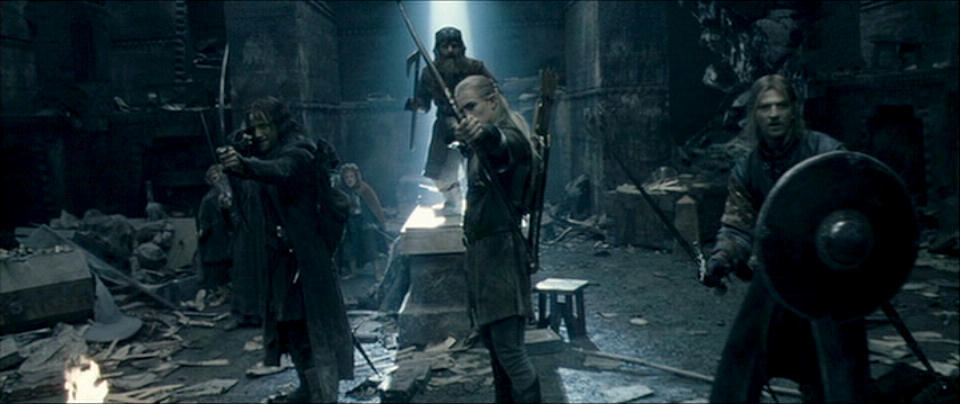
Lord of the Rings Trilogy, The - scene

When it became clear in the late Nineties that a large-budget adaptation of The Lord of the Rings was being planned, with Peter Jackson at the helm, I felt a mixture of anticipation and trepidation.  First of all, it was going to be a live action adaptation, and even though Jackson’s Heavenly Creatures (1994) had proved he could direct something with a bit more depth than say, Braindead (1992), I still had my doubts.  As the scope of the project became known, the more I wondered if, and how, Jackson was going to pull it off.  And over three movies!

Now, thirteen years on, and with Jackson giving us The Hobbit as well, we all know I needn’t have worried.  The Fellowship of the Ring was like the best Xmas present anyone could have.  Its mix of the intimate and the grandeur of Middle Earth, and the level of detail, along with the sheer excitement of the action sequences made for one of the most rewarding cinematic experiences of my whole movie-going life.  In the first two weeks of its release in the UK I saw the movie three times.  When The Two Towers was released a year later, I was itching to see it, especially after watching Fellowship‘s extended version the day before (Jackson’s idea to give us longer versions of each movie on home video was a stroke of genius).  I came out of seeing The Two Towers overwhelmed and buoyed up by the emotional depth that infused the movie, and by the sheer spectacle of the Battle of Helm’s Deep (I couldn’t see how the Battle of the Pelennor Fields could be any better or more exciting; what did I know?).  The following year passed too slowly, waiting for The Return of the King to be released.  When it finally did, I can remember hearing the opening music and feeling a shiver run through me.  Please, Mr Jackson, please, I remember thinking, please have got this right.  And did he.  The Return of the King was an incredible achievement, a massive undertaking in its own right, and the culmination of a saga that had built to this monumental, emotionally-charged conclusion with barely a (hobbit) foot out of step along the way.  (And to those people who feel the movie should have ended with the coronation of Aragorn, the movies have always been about the characters and their journeys; to not see them make their farewells and re-take up their lives would have been a disservice to both them and the audience.)

The Lord of the Rings trilogy remains a phenomenal achievement, with stand-out performances – who can forget Gollum’s schizophrenic argument with himself in The Two Towers? – stunning location photography; a script that never lost sight of the emotional cores of its characters; confident, breathtaking direction from Peter Jackson; special effects that served the story and didn’t overwhelm things; and most of all, the creation of a wholly believable world where all this could happen.  But again, it’s the emotional element that makes the trilogy work, that keeps all of us who fell in love with the movies coming back time and time again, to revisit Middle Earth in all its glory and grandeur.  For many years, a friend and myself would take a day out to watch the extended versions right through, revelling in being able to spend time again with old friends such as Samwise Gamgee and Gimli, son of Glóin.  This trend has (sadly) lapsed in the last few years, but as an added memory to the original, wonderful experience of seeing the trilogy unfold over three magical Xmas’s, it’s easily the next best thing.  Going back to Middle Earth is, in its own way, a little bit like going back home after a long journey away…and what would Frodo and Sam say to that?

Rating: 9/10 – a stupendously impressive piece of filmmaking, bold, inventive, gripping, and with an emotional intensity few fantasy movies ever manage; just as there is only One Ring, Jackson’s enduring achievement means there is only One Trilogy.

Share this:

  • Click to share on X (Opens in new window) X
  • Click to share on Facebook (Opens in new window) Facebook
  • More
  • Click to print (Opens in new window) Print
  • Click to email a link to a friend (Opens in new window) Email
Like Loading...

The Hobbit: The Desolation of Smaug (2013)

23 Monday Dec 2013

Posted by dullwood68 in Movies

≈ 1 Comment

Tags

Benedict Cumberbatch, Bilbo Baggins, Evangeline Lilly, Ian McKellen, J.R.R. Tolkien, Legolas, Literary adaptation, Martin Freeman, Orlando Bloom, Review, Smaug, The Hobbit, The Lord of the Rings

Hobbit The Desolation of Smaug, The

D: Peter Jackson / 161m

Cast: Martin Freeman, Ian McKellen, Richard Armitage, Ken Stott, Benedict Cumberbatch, Orlando Bloom, Evangeline Lilly, Lee Pace, Luke Evans, Stephen Fry, Sylvester McCoy

The Hobbit: An Unexpected Journey (2012) was, in some ways, a difficult movie to appreciate.  As the beginning of what is effectively now a six-film series, the difference in tone and approach threw some viewers who were expecting a match for The Lord of the Rings (2001-3).  Jackson and co-scriptwriters Fran Walsh and Philippa Boyens, and Guillermo del Toro, took the more humorous elements of Tolkien’s novel and weaved them into the story with accomplished ease.  They made several key decisions with the characterisations of the dwarves that left audiences unsure if the comedic aspects were appropriate or in keeping with the overall tone of the trilogy (not to mention the darker trilogy that follows it).  What seemed to be forgotten in the rush to criticise the movie was that it was the first of three: making any kind of criticism at this early stage was actually irrelevant.  As the first two Lord of the Rings movies were largely ignored at the Oscars, only for the third to be so heavily rewarded, so we should wait until all three parts of The Hobbit are released.  Then we can make a proper decision.

What is clear is that with The Hobbit: The Desolation of Smaug, Jackson has hit his stride, and as a result, the trilogy has hit its stride as well.  The exposition of the first movie is largely dismissed with, and the introduction of new characters such as Thranduil (Pace) and Tauriel (Lilly) is handled concisely and with greater attention than before.  There is an even greater focus on action, with the barrel-rolling sequence a highlight, and a greater sense that this movie’s events fit in with, or more appropriately foreshadow, the events of The Lord of the Rings.

Having survived the attack by orcs at the end of the first movie, Bilbo (Freeman), Thorin (Armitage) and the rest of the dwarves set off into Mirkwood where spiders – and not just any spiders – inhabit the forest.  Meanwhile, Gandalf (McKellen) heads off to Dol Guldur to face the rising power of the Necromancer (Cumberbatch).  The dwarf company, or überfellowship, make it out of Mirkwood only to find themselves captured by elves.  With Bilbo’s help, they escape, and are pursued by orcs, Tauriel – who has developed a bit of a crush on dwarf Kili (Adrian Turner) – and Thranduil’s son Legolas (Bloom).  At Dol Guldur, Gandalf meets up with Radagast the Brown (McCoy) and finds that the Necromancer is preparing an orc army to march against the lands of the west.    The dwarves evade the orcs with the help of Bard the Bowman (Evans).  Bard lives in Lake-town, and he takes Thorin and his band there where they can both tend to Kili, who has been hit by a poisoned orc arrow, and plan the next step of their journey to the Lonely Mountain.  The orcs attack again but not before Thorin has left; Bard helps the dwarves that have been left behind and Tauriel and Legolas join the fray as well.  Bilbo finds the way into the Lonely Mountain where he encounters the dragon Smaug (Cumberbatch), and despite their best attempts the dwarves fail to kill him.  Enraged, Smaug breaks free of the mountain and heads to Lake-town to wreak his revenge.

The movie ends there, rather abruptly too, with only Bilbo’s anguished “What have we done?” to see out proceedings.  As might be expected there has been a large amount of criticism of the movie ending this way, but watching The Desolation of Smaug, and with Smaug’s entrance occurring around the two-hour mark, anyone even half aware of the movie’s running time would have known a resolution to the problem of Smaug was always going to be unlikely.  And it means that The Hobbit: The Battle of the Five Armies (2014) is going to have one hell of a start.

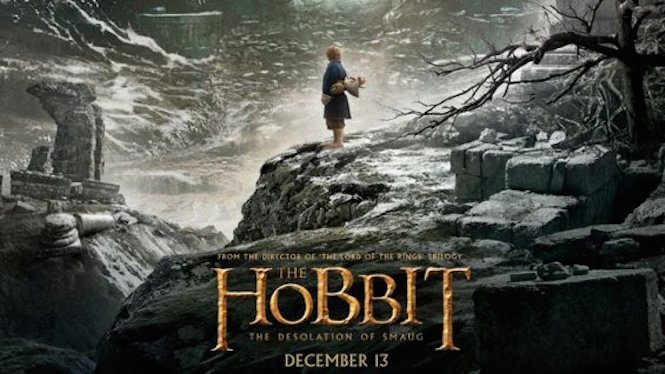
Hobbit The Desolation of Smaug, The - scene

The ending aside, the movie does still suffer from “middle child syndrome”, with too many storylines set up to be resolved in the next one, and the running time feeling a little too long.  Gandalf is sidelined for much of the movie (fairly reflecting the novel), while some of the dwarves are given very little to do indeed – anyone know something specific that Ori or Bifor did?  Radagast gets a cameo this time round (and repeats his bird under the hat trick), Azog (Manu Bennett) cedes his quest for Thorin’s head to Bolg (Lawrence Makoare), and the worst kept secret in town: the identity of the Necromancer, is revealed at last.  Oh, and there’s the weird matter of Legolas sporting contact lenses; it makes him look slightly alien rather than Elvish.

These minor quibbles aside, The Desolation of Smaug is a terrific addition to the complete saga, thrilling, intense, spectacular to look at with even more beautiful New Zealand scenery to devour, a continued line of humour that complements the increasing sombre tone (Legolas’ dismay at seeing a picture of Gloin’s son), the introduction of Lilly as Tauriel (this trilogy’s Arwen), Jackson’s complete mastery of both the material and the visual language needed to present it, a cast that more than matches him for commitment and artistry, and of course, the mighty Smaug, without doubt the most realistic, most impressive dragon ever imagined.  Voiced by Cumberbatch, Smaug is the movie’s highlight: an arrogant, vain, greedy, vicious, preening monster who trades verbal barbs with Bilbo in the movie’s best scenes.  Both Freeman and Cumberbatch are on superb form here, adding layers to their performances that bring out all the subtleties of the dialogue, and keeping the audience riveted as they spar back and forth.

With another year to go before the trilogy’s conclusion, The Hobbit: The Desolation of Smaug is a more than satisfying instalment that works well and impresses on a regular basis.  There’s little doubt that Jackson and co are firing on all cylinders, and if the purists out there are still complaining about the increasing lack of fidelity to the original novel then they’re missing the point: this is an adaptation, and a wonderful one at that.

Rating: 9/10 – a rousing blend of action and spectacle that moves at breakneck pace, The Hobbit: The Desolation of Smaug rarely disappoints; event cinema that we see too little of these days and absolutely best seen in 48hfr on an IMAX screen.

Share this:

  • Click to share on X (Opens in new window) X
  • Click to share on Facebook (Opens in new window) Facebook
  • More
  • Click to print (Opens in new window) Print
  • Click to email a link to a friend (Opens in new window) Email
Like Loading...

Blog Stats

  • 486,559 hits

Recent Posts

  • 10 Reasons to Remember Bibi Andersson (1935-2019)
  • Fantasia (1940)
  • Dances With Wolves (1990) – The Special Edition
  • Kiss of the Spider Woman (1985)
  • The Three Musketeers (1973)

Top Posts & Pages

  • Lost for Life (2013) - Another Look
    Lost for Life (2013) - Another Look
  • Lost for Life (2013)
    Lost for Life (2013)
  • About
    About
  • Mr. Topaze (1961)
    Mr. Topaze (1961)
  • Winter's Tale (2014)
    Winter's Tale (2014)
  • Shock and Awe (2017)
    Shock and Awe (2017)
  • Billy Lynn's Long Halftime Walk (2016)
    Billy Lynn's Long Halftime Walk (2016)
  • Hunt for the Wilderpeople (2016)
    Hunt for the Wilderpeople (2016)
  • 5 Famous Movie Roles That Nearly Went to Someone Else
    5 Famous Movie Roles That Nearly Went to Someone Else
  • The Layover (2017)
    The Layover (2017)
Follow thedullwoodexperiment on WordPress.com

Blogs I Follow

  • Rubbish Talk
  • Film 4 Fan
  • Fast Film Reviews
  • The Film Blog
  • All Things Movies UK
  • Interpreting the Stars
  • Let's Go To The Movies
  • Movie Reviews 101
  • TMI News
  • Dan the Man's Movie Reviews
  • Film History
  • Jordan and Eddie (The Movie Guys)

Archives

  • April 2019 (13)
  • March 2019 (28)
  • February 2019 (28)
  • January 2019 (32)
  • December 2018 (28)
  • November 2018 (30)
  • October 2018 (29)
  • September 2018 (29)
  • August 2018 (29)
  • July 2018 (30)
  • June 2018 (28)
  • May 2018 (24)
  • April 2018 (21)
  • March 2018 (31)
  • February 2018 (25)
  • January 2018 (30)
  • December 2017 (30)
  • November 2017 (27)
  • October 2017 (27)
  • September 2017 (26)
  • August 2017 (32)
  • July 2017 (32)
  • June 2017 (30)
  • May 2017 (29)
  • April 2017 (29)
  • March 2017 (30)
  • February 2017 (27)
  • January 2017 (32)
  • December 2016 (30)
  • November 2016 (28)
  • October 2016 (30)
  • September 2016 (27)
  • August 2016 (30)
  • July 2016 (30)
  • June 2016 (31)
  • May 2016 (34)
  • April 2016 (30)
  • March 2016 (30)
  • February 2016 (28)
  • January 2016 (35)
  • December 2015 (34)
  • November 2015 (31)
  • October 2015 (31)
  • September 2015 (34)
  • August 2015 (31)
  • July 2015 (33)
  • June 2015 (12)
  • May 2015 (31)
  • April 2015 (32)
  • March 2015 (30)
  • February 2015 (37)
  • January 2015 (39)
  • December 2014 (34)
  • November 2014 (34)
  • October 2014 (36)
  • September 2014 (25)
  • August 2014 (29)
  • July 2014 (29)
  • June 2014 (28)
  • May 2014 (23)
  • April 2014 (21)
  • March 2014 (42)
  • February 2014 (38)
  • January 2014 (29)
  • December 2013 (28)
  • November 2013 (34)
  • October 2013 (4)

Create a free website or blog at WordPress.com.

Rubbish Talk

Film 4 Fan

A Movie Blog

Fast Film Reviews

The Film Blog

The official blog of everything in film

All Things Movies UK

Movie Reviews and Original Articles

Interpreting the Stars

Dave Examines Movies

Let's Go To The Movies

Film and Theatre Lover!

Movie Reviews 101

Daily Movie Reviews

TMI News

Latest weather, crime and breaking news

Dan the Man's Movie Reviews

All my aimless thoughts, ideas, and ramblings, all packed into one site!

Film History

Telling the story of film

Jordan and Eddie (The Movie Guys)

Movie Reviews & Ramblings from an Australian Based Film Fan

Privacy & Cookies: This site uses cookies. By continuing to use this website, you agree to their use.
To find out more, including how to control cookies, see here: Cookie Policy
  • Subscribe Subscribed
    • thedullwoodexperiment
    • Join 481 other subscribers
    • Already have a WordPress.com account? Log in now.
    • thedullwoodexperiment
    • Subscribe Subscribed
    • Sign up
    • Log in
    • Report this content
    • View site in Reader
    • Manage subscriptions
    • Collapse this bar
 

Loading Comments...
 

    %d