• 10 Reasons to Remember…
  • A Brief Word About…
  • About
  • For One Week Only
  • Happy Birthday
  • Monthly Roundup
  • Old-Time Crime
  • Other Posts
  • Poster of the Week
  • Question of the Week
  • Reviews
  • Trailers

thedullwoodexperiment

~ Viewing movies in a different light

thedullwoodexperiment

Tag Archives: James Cromwell

Marshall (2017)

13 Saturday Jan 2018

Posted by dullwood68 in Movies

≈ Leave a comment

Tags

Chadwick Boseman, Dan Stevens, Drama, Historical drama, James Cromwell, Josh Gad, Kate Hudson, NAACP, Rape trial, Reginald Hudlin, Review, Sterling K. Brown, True story

D: Reginald Hudlin / 118m

Cast: Chadwick Boseman, Josh Gad, Kate Hudson, Sterling K. Brown, Dan Stevens, James Cromwell, Keesha Sharp, Roger Guenveur Smith, Derrick Baskin, Barrett Doss, Marina Squerciati, John Magaro, Ahna O’Reilly, Jeffrey DeMunn

Thurgood Marshall (Boseman) was a lawyer who worked across the US for the National Association for the Advancement of Coloured People (NAACP) during the Thirties and Forties. During his time with the NAACP he tried cases in front of the US Supreme Court, and won twenty-nine out of thirty-two of them. His most famous case was Brown v Board of Education, Topeka in 1954, in which the the educational segregation of whites and blacks was deemed unconstitutional. It was a landmark case, and a major victory for the Civil Rights Movement. But instead of telling that story, the makers of Marshall have opted to tell the story of The State of Connecticut v Joseph Spell, a lurid rape case that occurred in 1940. The movie, capably directed by Reginald Hudlin from a screenplay by father and son team Michael and Jakob Koskoff, also makes the decision to change things around so that Marshall himself is the focus and not the original trial lawyer, Sam Friedman (Gad). Does this really matter in a movie that’s based on a true story? Let’s answer that with another question: what’s wrong with the true story by itself?

The differences between what actually happened and what occurs in the movie are many (as you might expect), but one aspect that leaves a bitter after taste is the treatment of Sam Friedman. Here he’s Marshall’s flunky, criticised repeatedly, and treated in such a poor way for so long that bullying becomes the only word for it. In a role reversal that would be outrageous if it weren’t so credulous, Marshall treats Friedman as if their racial positions were reversed: Marshall is the master and Friedman is the slave. Friedman was a more than capable lawyer who in 1940 had more trial experience than Marshall, and who was hired by the NAACP to defend Joseph Spell (Brown). Marshall was sent as a consultant, and the legal liberties the movie takes to reduce his presence in court while at the same time making him look like a puppet master pulling Friedman’s strings, is objectionable. While it’s good to see an educated, strong, confident, and positive example of a black man on our screens, did it really have to be at the expense of the white man who actually did all the heavy lifting?
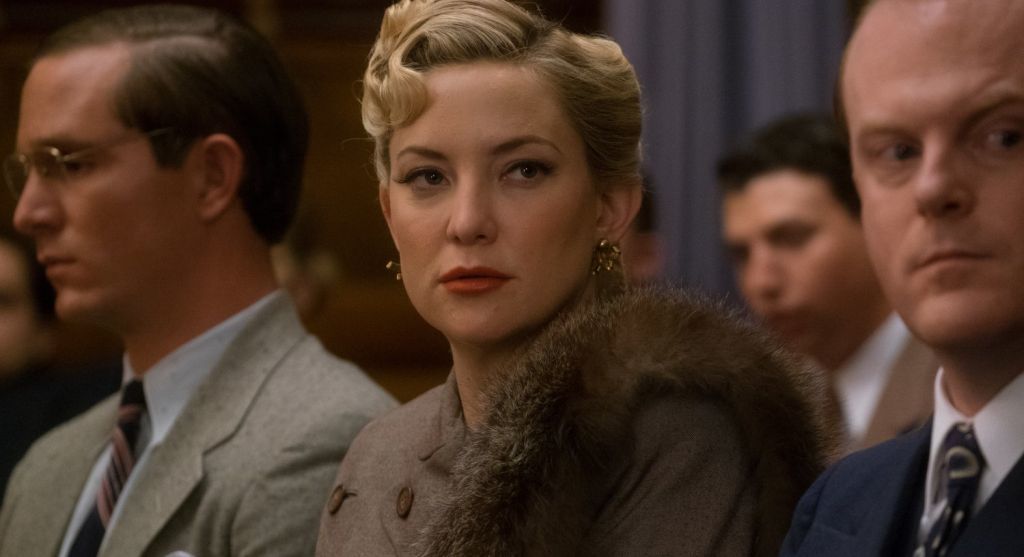
Things aren’t helped by the predictable plotting, and the stereotypical characters, from Stevens’ arrogant prosecution lawyer to Cromwell’s obstructionist, authoritarian judge. The trial scenes have a certain amount of energy to them, as do the flashbacks to the night of the rape (Spell was a chauffeur who was accused by his employer’s wife, Eleanor Strubing (Hudson), of rape and attempted murder), but away from the courtroom, much of the movie is perfunctory, and the visuals are quite drab. It’s also a movie that recounts the more tawdry aspects of the alleged rape with a degree of detachment, and what should be shocking sounds more as if it were unrelated to anyone who’s actually involved in it all. As Marshall, Boseman adds another real-life person to his resumé, and invests the character with a lot of passion and vigour, but as the movie finally gets round to giving Friedman his due, Marshall becomes a secondary character and his impact diminishes. Gad handles the enforced comic aspects of his character with his usual amiable skill, but doesn’t always look comfortable doing so. Hudson brings a degree of ambiguity to her role as Eleanor, and Brown is a solid, dependable presence throughout. In dramatic terms, the verdict is a given, and it’s a mark of the movie’s lacklustre approach, that when that verdict is announced, the response from the viewer is likely to be “Okay” instead of Oh my God!”

Rating: 6/10 – patchy and hesitant in parts, Marshall beefs up its main character’s involvement in a rape trial and spends much of its time reminding the viewer that Thurgood Marshall was a better man than anyone else depicted in the movie; a hagiography then – though not the first – and one that, by adopting such an approach, reinforces that old newspaper saying, “If you can’t print the truth, print the legend”.

Share this:

  • Click to share on X (Opens in new window) X
  • Click to share on Facebook (Opens in new window) Facebook
  • More
  • Click to print (Opens in new window) Print
  • Click to email a link to a friend (Opens in new window) Email
Like Loading...

RKO 281 (1999)

19 Wednesday Jul 2017

Posted by dullwood68 in Movies

≈ Leave a comment

Tags

Benjamin Ross, Catch Up movie, Drama, History, James Cromwell, John Malkovich, Liev Schreiber, Melanie Griffith, Orson Welles, Review, RKO Pictures, True story, William Randolph Hearst

D: Benjamin Ross / 87m

Cast: Liev Schreiber, James Cromwell, Melanie Griffith, John Malkovich, Brenda Blethyn, Roy Scheider, Liam Cunningham, David Suchet, Fiona Shaw, Anastasia Hille

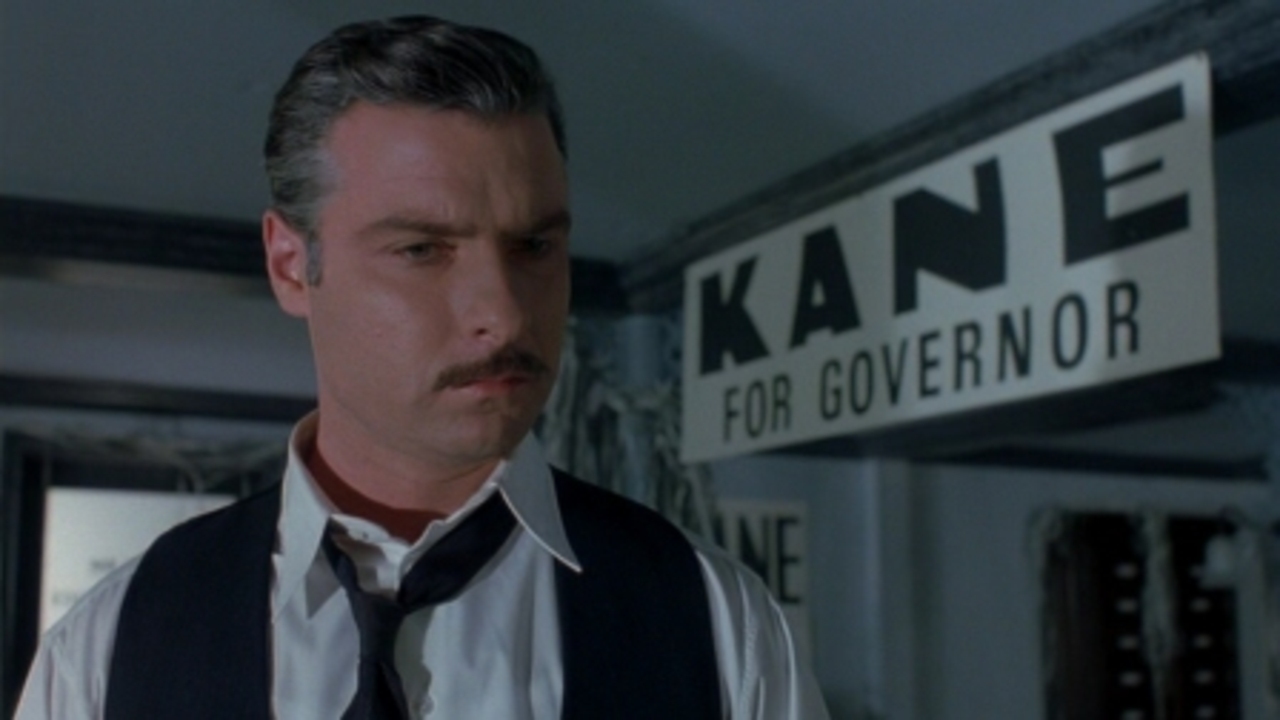
In 1939, Orson Welles (Schreiber), the “boy wonder”, signed a movie contract with RKO Pictures. He was given unprecedented freedom to make whatever movie he wanted (though RKO hoped he would make a movie version of his infamous War of the Worlds radio broadcast). After two attempts at making his first picture, Welles, along with old friend and writer Herman J. Mankiewicz (Malkovich) came up with the idea of making a loosely fictionalised version of the life of publishing magnate William Randolph Hearst (Cromwell). Welles regarded Hearst as a hypocrite and a monster, a man richly deserving of being exposed in much the same way that Hearst’s newspapers had done to others. Welles considered he had nothing to lose by making such a movie, but before long it became something much more personal, and with a great deal of meaning for him. RKO 281 – Citizen Kane‘s production number – shows how the movie came to be made, some of the pitfalls along the way, and the pressure Hearst tried to exert in order to make the movie disappear without the public ever seeing it.

Like many an acknowledged classic, Citizen Kane didn’t just appear out of nowhere. In RKO 281, we see the genesis of both the myth and the legend, and the movie itself. After a year in Hollywood, and with nothing to show for his efforts, Welles was already being looked upon as a failure, a circumstance that didn’t bother him in the slightest, but which would spur him on to make a movie that is generally regarded as the best American movie ever made. Based in part on the documentary The Battle Over Citizen Kane (1996), RKO 281 begins with Welles’ arrival in Hollywood, his fame preceeding him. Persuaded to come out there by RKO head George J. Schaefer (Scheider), Welles attends a dinner held by Hearst and is appalled by the man’s attitude and takes immediate offence. Soon he’s telling Mankiewicz that Hearst is the perfect subject for his first movie. But Mankiewicz isn’t so sure and tries to warn Welles of the trouble he’ll face if he goes ahead with his plan.

Soon, however, they have a screenplay, and though the two men have a falling out over Mankiewicz’s name being removed from the final script, the movie goes ahead and production begins in earnest. But Welles is soon behind, his quest for perfection causing delays and production overspends. The industry, still unaware of the content of Welles’ movie, predicts it will be a disaster. It’s only when news of its focus reaches the ears of Hearst that the possibility of its truly being a disaster becomes more likely. Determined to ensure that the movie, originally titled American, is never shown in cinemas, Hearst brings pressure to bear on the heads of the other studios, partly by playing the race card – that the heads were all Jewish wasn’t widely known or acknowledged – and partly by threatening to expose the immoral activities of their stars. While everyone else around him views Hearst as being entirely capable of destroying Welles’ career, and their own if he so wishes, it’s left to Welles to fight for his movie. Help, though, comes in an unexpected form…

The story behind the making of Citizen Kane is often as fascinating as the actual movie itself, and though RKO 281 uses The Battle Over Citizen Kane as its template for John Logan’s vigorous screenplay, there’s still a sense that this is a movie going over old ground, and without achieving the same effect. Logan certainly hits his mark as it were, and there are some priceless lines of dialogue – Mankiewicz on San Simeon, the massive estate where Hearst lived: “it’s the place God would have built if he had the money” – but once Hearst becomes aware of just how much of his life Welles has appropriated for Citizen Kane, the movie makes an unjustified attempt at becoming a thriller, with Welles’ career on the line versus Hearst’s reputation. And despite a passionate performance by Schreiber, and with the outcome already known in advance, the movie struggles to make Hearst’s threats as worrying as they must have been at the time, and he comes across as a petulant control freak. The same can be said for Welles also, and the movie makes the point several times over that the two men were very similar, but in doing this so often, it lessens the impact of what the movie is trying to say.

Before then, the movie focuses on the making of Citizen Kane, and here the movie is on firmer ground, replicating the ups and downs of the production with a great deal of enthusiasm, and recreating events such as the time that Welles had a massive hole dug in the studio floor to facilitate a particular low-level shot he wanted (apparently he never thought of raising the set instead). His relationship with the cinematographer, Gregg Toland (Cunningham) is also explored, but ultimately it’s his friendship with Mankiewicz that gets the most screen time, and the ways in which Welles exploited his friend’s talent. Both Schreiber and Malkovich relish the dialogue they’re given in their scenes together, and these scenes are some of the best in the movie, with both men sparking and feeding off each other to very good effect. Cromwell injects a little bit of pathos into his portrayal of Hearst, but it’s not enough to offset the idea that here is a man whose monomania – himself – has become a lifestyle choice. As the former silent actress Marion Davies, Griffith gives a sympathetic and sincere performance, while Scheider is equally good as the put-upon studio head who puts his career on the line to ensure Welles succeeds in getting his own off the ground.

The movie is attractively shot and lit by DoP Mike Southon, and there are some well chosen contemporary numbers on the soundtrack, but though the script is good enough to tell the story in a slightly lumbering fashion (there are very few highs and lows to help capture the intensity of the production itself), Ross’s direction is too pedestrian to elevate the material above that of solid and dependable. Too many scenes lack the energy to push the narrative forward with any real conviction, while others are repetitive in nature, as if the audience wouldn’t understand things the first time. And that’s without the scene near the end where the story contrives to have Welles and Hearst alone in an elevator – let the verbal sparring commence! It’s an unnecessary cinematic cliché that’s included in a movie about another movie that was anything but clichéd.

Rating: 7/10 – a mixed bag of a movie, with good performances overcoming several narrative slip-ups, RKO 281 is mostly intriguing if you don’t know the story, and fairly run of the mill if you do; still, it’s a movie that’s largely entertaining despite itself, and as a passive recreation of the making of one of the most influential features of all time, it’s effective without being too demanding. (18/31)

Share this:

  • Click to share on X (Opens in new window) X
  • Click to share on Facebook (Opens in new window) Facebook
  • More
  • Click to print (Opens in new window) Print
  • Click to email a link to a friend (Opens in new window) Email
Like Loading...

The Trials of Cate McCall (2013)

14 Sunday Sep 2014

Posted by dullwood68 in Movies

≈ 1 Comment

Tags

Alcoholism, Anna Anissimova, Appeal case, Courtroom drama, Custody battle, James Cromwell, Karen Moncrieff, Kate Beckinsale, Lawyer, Murder, Nick Nolte, Review, Thriller

Trials of Cate McCall, The

D: Karen Moncrieff / 89m

Cast: Kate Beckinsale, Nick Nolte, James Cromwell, Mark Pellegrino, Anna Anissimova, Taye Diggs, Kathy Baker, Clancy Brown, Brendan Sexton III, David Lyons, Ava Kolker, Isaiah Washington, Dale Dickey, Amanda Aday

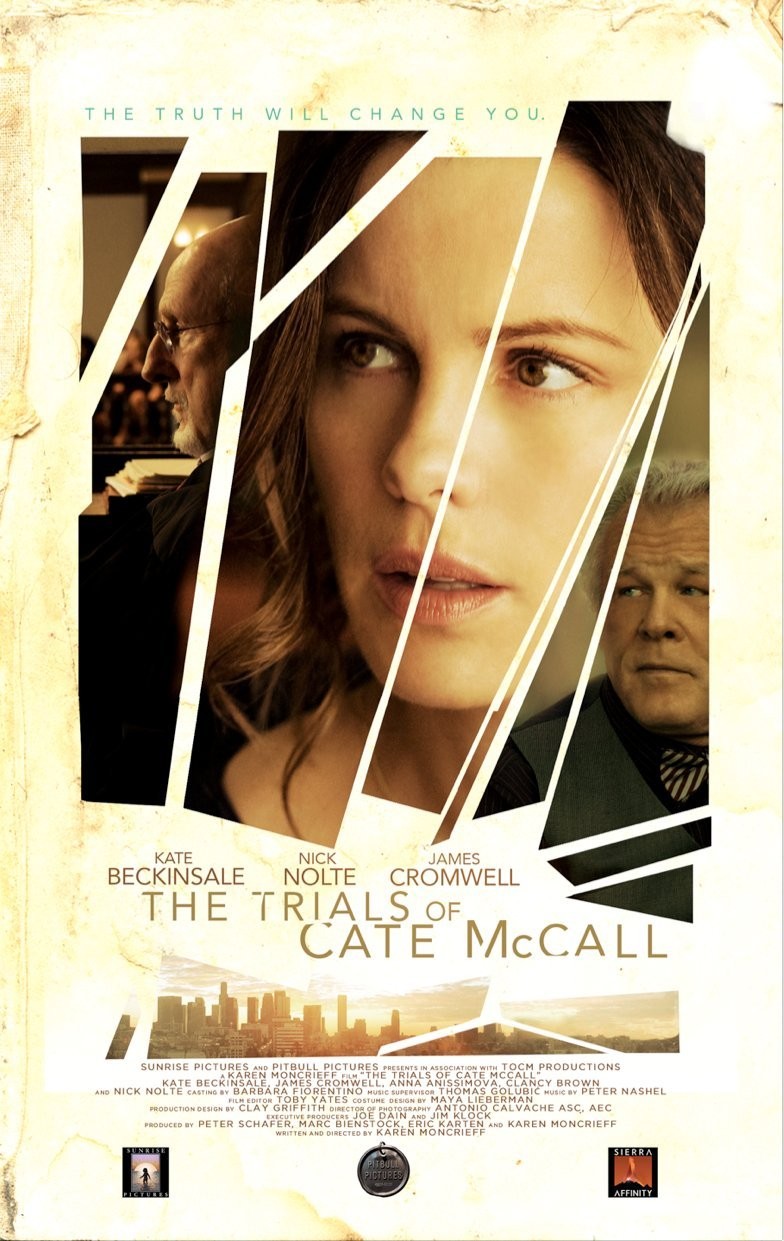
Cate McCall (Beckinsale) has her fair share of problems.  Despite being a talented lawyer, she has a serious drink problem that has resulted in her being put on probation and assigned to work in a small law office.  She’s also trying to retain custody of her daughter Augie (Kolker) following the break up of her marriage to Josh (Lyons).  As she fights to regain control of her life, Cate is assigned an appeal case involving Lacey Stubbs (Anissimova).  Lacey has been convicted of murder, but claims she was set up by the lead detective on the case, Welch (Pellegrino).  She also alleges that, while in prison, she was raped by a guard.

With the help of her mentor, Bridges (Nolte), Cate begins to look into the case and finds quickly that some of the witness testimonies don’t match up, and that there are problems with the police evidence.  Lacey maintains her innocence, while Welch proves evasive and aggressive when Cate talks to him.  As Cate begins to suspect a miscarriage of justice has taken place, the pressure of trying to deal with both the case and spending time with Augie begins to affect her ability to maintain her sobriety.

The appeal hearing sees Lacey’s case upheld, but Cate’s success is short-lived.  No sooner is the hearing over than she begins to uncover further evidence that Lacey has been lying all along.  But can she trust this new evidence?  Now Cate has to find out whether or not she was used by Lacey, and in the process, decide if being a part of Augie’s life is appropriate for her daughter while she still has a drink problem.

Trials of Cate McCall, The - scene

From the outset, The Trials of Cate McCall tries hard to be different from all the other courtroom-based dramas out there, and in terms of its title character, it certainly succeeds.  Cate McCall is, frankly, a bit of a mess, and while the reason for her drinking problem is adequately explained, the movie’s determination to make things difficult for her at almost every turn borders on the sadistic.  It’s only within the confines of the courtroom that she’s allowed to hold it together and have any success; outside, and she makes mistake after mistake, sometimes deliberately.  There is an element of masochism as well in these moments, as if Cate is punishing herself, and while on a psychological level this is all completely understandable, it makes for a somewhat frustrating viewing experience.  It’s not long into the movie before the viewer will be wondering, just how much more can this character take before she puts her head in the oven?

But Cate’s work keeps her going, even while she screws up everything else in her life.  The two worlds she inhabits, her professional and private lives, are addressed with equal gravitas, and thanks to Beckinsale’s committed, earnest portrayal, the movie is on solid ground when Cate tries to deal with the responsibilities of both (even if she fails more often than not).  It’s an unselfish performance from Beckinsale, an actress who can do a lot more than wear tight-fitting black leather and make fangs look sexy, and she’s at her best when the script piles on the setbacks (she even ends up in jail at one point, that’s how bad things get for her).  Beckinsale is also clever enough to ensure that Cate isn’t entirely sympathetic, and this helps make the character more credible.

She’s ably supported by the likes of Nolte (grizzled, understanding), Cromwell (sanguine, duplicitous), Anissimova (nervy, put-upon), and Pellegrino (arrogant, shady), and there’s a winning performance from six year old Kolker as Cate’s troubled daughter (Augie though – really?).  With such a good cast – and one that can find room for actors such as Brown and Baker in minor roles – the movie’s mix of domestic drama and courtroom machinations is handled well by writer/director Moncrieff, even if there are moments where plausibility is stretched so thin it’s practically see-through (the prosecution’s withholding of exculpatory evidence is a case in point; the ease with which Cate and Welch bury their differences is another).

But all in all, the movie is a worthwhile watch though it plays flat through certain stretches – the repetitive bickering between Cate and Josh, the subplot involving Cromwell’s lecherous judge – and the issue of Lacey’s guilt can be guessed from the beginning, but away from the courtroom there’s enough to keep an audience engaged and wanting to find out what happens next.  Ultimately though, and aside from the reliability of its cast, the material isn’t solid enough to withstand close scrutiny (or cross-examination), and while it’s entirely respectable in its aims and intentions, it doesn’t quite hit the mark.

Rating: 6/10 – with alcoholism, murder and a custody battle occupying the time of its main character, The Trials of Cate McCall is actually less intriguing than it thinks it is; Beckinsale is the movie’s major asset, and while there’s nothing to suggest this might be the beginning of a series, another visit with Cate could still be something to look forward to.

Share this:

  • Click to share on X (Opens in new window) X
  • Click to share on Facebook (Opens in new window) Facebook
  • More
  • Click to print (Opens in new window) Print
  • Click to email a link to a friend (Opens in new window) Email
Like Loading...

Soldiers of Fortune (2012)

24 Monday Feb 2014

Posted by dullwood68 in Movies

≈ Leave a comment

Tags

Action, Christian Slater, Colm Meaney, Dominic Monaghan, Freedom fighters, James Cromwell, Maxim Korostyshevsky, Mercenaries, Reality TV, Review, Sean Bean, Televised war games, Ving Rhames

Soldiers of Fortune

D: Maxim Korostyshevsky / 93m

Cast: Christian Slater, Sean Bean, Ving Rhames, Dominic Monaghan, James Cromwell, Charlie Bewley, Oxana Korostyshevsky, Colm Meaney, Freddy Rodriguez, Ryan Donowho

Soldiers of Fortune, even with its impressive cast (who must still be paying off their mortgages), is still the epitome of a silly, war-related action movie. Playing fast and loose with both logic and credibility, Soldiers of Fortune begins with McCenzie (Slater) and Reed (Rodriguez) on a mission in Helmand province in 2008. Reed is disguised as a woman, and wears a full-length blue burqha in order to infiltrate a village hiding a weapons cache. He’s quickly rumbled and it’s up to “never-leave-a-man-behind” McCenzie to invade the village single-handedly and rescue Reed from both the Taliban and ultra-nasty CIA operative Mason (Meaney), and this despite clear orders to the contrary. Fast forward two dishonourable discharges and four years later, and McCenzie and Reed are in need of a big payday. Enter Oxana (Korostyshevsky) and Ernesto (Donowho), freedom fighters from an island off the coast of Eastern Europe. They want McCenzie and Reed to help them overthrow corrupt Colonel Lupo (Gennadi Vengerov), and reclaim their island. (Oh, and ultra-nasty CIA operative Mason who is now Lupo’s chief of security.)

At this point, so far, so predictable. But then the movie throws its one one and only curve ball… and it’s a doozy. The freedom fighters have gained financial backing for their intended coup from five multi-millionaires: metals magnate Dimitov (Bean); video games designer Tommy Sin (Monaghan); arms dealer Grimaud (Rhames); financial whizkid Vanderbeer (Bewley); and ageing tycoon Haussman (Cromwell). As well as providing financing for the intended coup, all five find themselves going along for the ride under the pretence of taking part in a televised war game. It’s down to McCenzie and Reed to keep them safe when the real bullets start flying.

Soldiers of Fortune - scene

It’s this aspect of the script – multi-millionaires in fatigues take on a well-trained guerrilla army – that heightens the absurdity of it all and takes it to new levels. And there is the added bonus of Tommy Sin having a broken leg from the mission’s beginning: initially it’s an obstacle to his getting about but it’s rarely of any consequence or cause of any impedance once the mission is fully under way. In fact, Sin walks and runs just as well as any of the others, even after he’s shot in the same leg later on in the movie.

Of the cast, Rhames and Cromwell fare best, while Slater is required to do little more than scowl a lot and show off his forward rolls. The action sequences are perfunctory, and the direction by first-timer Korostyshevsky is adequate for this kind of thing, although he often clutters the frame in his efforts to cram in all the cast. The locations, however, are beautiful, and if nothing else the cast must have had a wonderful time being there. There are the inevitable personal “showdowns” for each member of the team, and there is one completely WTF? moment when Grimaud produces a rocket launcher from – literally – out of nowhere.

Watching Soldiers of Fortune is akin to viewing the worst bits of a “boys with toys” wish-fulfillment video. The bad guys are always killed by one bullet when one of the team takes three hits before going out in a blaze of glory; Slater’s reputation for never losing anyone on a mission is overturned within minutes of the mission starting; one of the multi-millionaires turns out to be a traitor (gasp!); at boot camp, all five unfit multi-millionaires – even Monaghan – tackle the obstacle course with ease; and all the while the audience is left wondering if the script has been translated into a foreign language and then translated back again… by someone unversed in either language.

Rating: 4/10 – as bad as it looks but in a perverse way, fun too to see so many stars prepared to dumb down for the money; loud, stupid, and awful in equal measure.

Originally posted on thedullwoodexperiment website.

Share this:

  • Click to share on X (Opens in new window) X
  • Click to share on Facebook (Opens in new window) Facebook
  • More
  • Click to print (Opens in new window) Print
  • Click to email a link to a friend (Opens in new window) Email
Like Loading...

Blog Stats

  • 491,294 hits

Recent Posts

  • 10 Reasons to Remember Bibi Andersson (1935-2019)
  • Fantasia (1940)
  • Dances With Wolves (1990) – The Special Edition
  • Kiss of the Spider Woman (1985)
  • The Three Musketeers (1973)

Top Posts & Pages

  • Cardboard Boxer (2016)
    Cardboard Boxer (2016)
  • Speak (2004)
    Speak (2004)
  • Carrie (2013)
    Carrie (2013)
  • Hickey (2016)
    Hickey (2016)
  • The Town That Dreaded Sundown (1976)
    The Town That Dreaded Sundown (1976)
  • Where There's a Prank, There's a Pay Off: Spider (2007) and Family Values (2011)
    Where There's a Prank, There's a Pay Off: Spider (2007) and Family Values (2011)
  • The Hippopotamus (2017)
    The Hippopotamus (2017)
  • A Monster Calls (2016)
    A Monster Calls (2016)
  • 7:19 (2016)
    7:19 (2016)
  • Virginity (1937)
    Virginity (1937)
Follow thedullwoodexperiment on WordPress.com

Blogs I Follow

  • Rubbish Talk
  • Film 4 Fan
  • Fast Film Reviews
  • The Film Blog
  • All Things Movies UK
  • Interpreting the Stars
  • Let's Go To The Movies
  • Movie Reviews 101
  • TMI News
  • Dan the Man's Movie Reviews
  • Film History
  • Jordan and Eddie (The Movie Guys)

Archives

  • April 2019 (13)
  • March 2019 (28)
  • February 2019 (28)
  • January 2019 (32)
  • December 2018 (28)
  • November 2018 (30)
  • October 2018 (29)
  • September 2018 (29)
  • August 2018 (29)
  • July 2018 (30)
  • June 2018 (28)
  • May 2018 (24)
  • April 2018 (21)
  • March 2018 (31)
  • February 2018 (25)
  • January 2018 (30)
  • December 2017 (30)
  • November 2017 (27)
  • October 2017 (27)
  • September 2017 (26)
  • August 2017 (32)
  • July 2017 (32)
  • June 2017 (30)
  • May 2017 (29)
  • April 2017 (29)
  • March 2017 (30)
  • February 2017 (27)
  • January 2017 (32)
  • December 2016 (30)
  • November 2016 (28)
  • October 2016 (30)
  • September 2016 (27)
  • August 2016 (30)
  • July 2016 (30)
  • June 2016 (31)
  • May 2016 (34)
  • April 2016 (30)
  • March 2016 (30)
  • February 2016 (28)
  • January 2016 (35)
  • December 2015 (34)
  • November 2015 (31)
  • October 2015 (31)
  • September 2015 (34)
  • August 2015 (31)
  • July 2015 (33)
  • June 2015 (12)
  • May 2015 (31)
  • April 2015 (32)
  • March 2015 (30)
  • February 2015 (37)
  • January 2015 (39)
  • December 2014 (34)
  • November 2014 (34)
  • October 2014 (36)
  • September 2014 (25)
  • August 2014 (29)
  • July 2014 (29)
  • June 2014 (28)
  • May 2014 (23)
  • April 2014 (21)
  • March 2014 (42)
  • February 2014 (38)
  • January 2014 (29)
  • December 2013 (28)
  • November 2013 (34)
  • October 2013 (4)

Blog at WordPress.com.

Rubbish Talk

Film 4 Fan

A Movie Blog

Fast Film Reviews

The Film Blog

The official blog of everything in film

All Things Movies UK

Movie Reviews and Original Articles

Interpreting the Stars

Dave Examines Movies

Let's Go To The Movies

Film and Theatre Lover!

Movie Reviews 101

Daily Movie Reviews

TMI News

Latest weather, crime and breaking news

Dan the Man's Movie Reviews

All my aimless thoughts, ideas, and ramblings, all packed into one site!

Film History

Telling the story of film

Jordan and Eddie (The Movie Guys)

Movie Reviews & Ramblings from an Australian Based Film Fan

Privacy & Cookies: This site uses cookies. By continuing to use this website, you agree to their use.
To find out more, including how to control cookies, see here: Cookie Policy
  • Subscribe Subscribed
    • thedullwoodexperiment
    • Join 481 other subscribers
    • Already have a WordPress.com account? Log in now.
    • thedullwoodexperiment
    • Subscribe Subscribed
    • Sign up
    • Log in
    • Report this content
    • View site in Reader
    • Manage subscriptions
    • Collapse this bar
 

Loading Comments...
 

    %d