• 10 Reasons to Remember…
  • A Brief Word About…
  • About
  • For One Week Only
  • Happy Birthday
  • Monthly Roundup
  • Old-Time Crime
  • Other Posts
  • Poster of the Week
  • Question of the Week
  • Reviews
  • Trailers

thedullwoodexperiment

~ Viewing movies in a different light

thedullwoodexperiment

Tag Archives: Melanie Lynskey

I Don’t Feel at Home in This World Anymore. (2017)

01 Saturday Sep 2018

Posted by dullwood68 in Movies

≈ 3 Comments

Tags

Burglary, Comedy, David Yow, Devon Graye, Drama, Elijah Wood, Indie movie, Macon Blair, Melanie Lynskey, Review

D: Macon Blair / 93m

Cast: Melanie Lynskey, Elijah Wood, David Yow, Devon Graye, Jane Levy, Gary Anthony Williams, Myron Natwick, Christine Woods, Robert Longstreet

Ruth (Lynskey) is a nursing assistant who is continually annoyed by the thoughtlessness of others. When she comes home from work one day to find that she’s been burgled and the thief has stolen her laptop, grandmother’s silverware and some prescription medication, her day is made even worse when the investigating detective, Bendix (Williams), chides her for leaving her back door unlocked. Later, as she goes door to door to see if anyone saw anything, she meets Tony (Wood) who becomes violently outraged at what has happened. Ruth discovers evidence in her backyard – a conspicuous shoeprint in the mud – and when she uses a phone app to track her laptop, and discovers its location, Bendix is uninterested. Needing someone to go with her to retrieve her laptop, Ruth asks Tony, who’s only too keen to do so. When they get it back, they learn it was bought from a resale shop. There, Ruth discovers her grandmother’s silverware, and as she tries to sneak it out, she also discovers a young man (Graye) at the counter wearing a shoe that’s a match for the print in her garden…
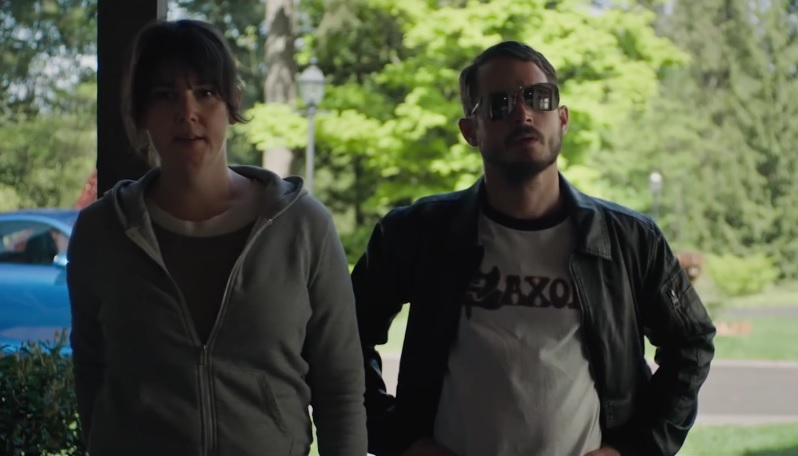
The words ‘quirky’ and ‘unconventional’ seem tailor-made for I Don’t Feel at Home in This World Anymore., Macon Blair’s feature debut as a writer/director. You could add ‘wacky’ and ‘peculiar’, and they wouldn’t be too far off the mark either. But while there are plenty of other low budget indie movies that fit those descriptions quite easily, what Blair has achieved here is something a little more rarefied. In Ruth, there’s a temptation to view this as a “worm has turned” story, but that would be to cast a superficial eye over both the material and Ruth herself. Ruth may be one of Life’s minor victims, and she may appear to be a bystander in her own life, but she has an innate strength of character that just needs the right stimulus to bring her into her own. Being robbed does just that, and by aligning herself with Tony – who has a number of his own issues – Ruth becomes empowered in a way she’s unfamiliar with. It’s a step in the right direction, but Blair is confident enough in his screenplay to ensure that Ruth’s journey doesn’t change her completely. By the end, she’s more positive, but she’s still finding herself.

By making Ruth’s journey one that is affectionately handled and which resonates far more than expected, Blair has gifted Lynskey with yet another terrific role for the actress to make her own. Whether she’s sipping beer from a bottle out of habit, or being instinctively happy when she finds others are reading the same book she is, Ruth is a wonderful creation. Blair is equally on form with the rest of the characters, with Wood’s NWBHM-loving Tony prone to inappropriate violent outbursts, and Graye’s troubled teen burglar, Christian, having a back story that takes the material into unforeseen territory. In amongst the millennial concerns and suburban drama there’s a great deal of comedy, from Ruth’s look when asked the last words of a deceased patient, to a lovely visual gag involving Tony’s dog, Kevin, and the reaction of Christian’s stepmother (Woods) when asked why she’s speaking to two fake cops (that she knows are fake cops). Blair’s ‘quirky’ sensibility ensures the movie is always interesting for what’s going to happen next, and there’s first-rate cinematography from Larkin Seiple that paints Ruth’s particular part of suburbia as a bright yet deceptively unstable place to live.

Rating: 8/10 – another wonderful performance from the always reliable Lynskey anchors I Don’t Feel at Home in This World Anymore., and makes it one of the more enjoyable indie movies of recent years; with such a good meld of drama and comedy, and a cruel streak to keep things ‘unconventional’, Blair’s directorial debut is so good that his next movie can’t come quickly enough.
Share this:

  • Click to share on X (Opens in new window) X
  • Click to share on Facebook (Opens in new window) Facebook
  • More
  • Click to print (Opens in new window) Print
  • Click to email a link to a friend (Opens in new window) Email
Like Loading...

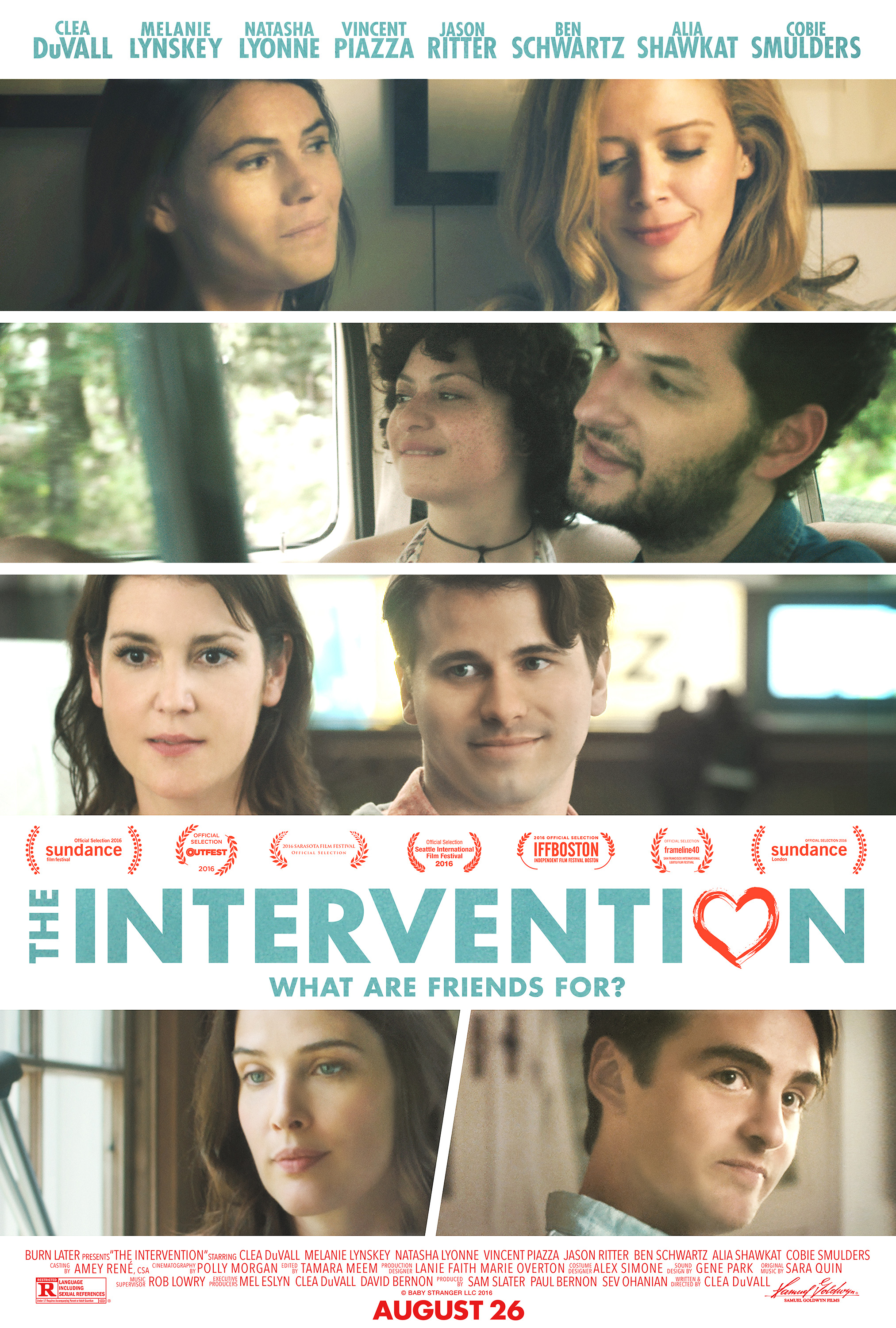
The Intervention (2016)

18 Monday Jun 2018

Posted by dullwood68 in Movies

≈ Leave a comment

Tags

Alia Shawkat, Ben Schwartz, Clea DuVall, Cobie Smulders, Comedy, Drama, Friends, Jason Ritter, Marital problems, Melanie Lynskey, Natasha Lyonne, Relationships, Review, Vincent Piazza

D: Clea DuVall / 89m

Cast: Clea DuVall, Melanie Lynskey, Natasha Lyonne, Vincent Piazza, Jason Ritter, Ben Schwartz, Alia Shawkat, Cobie Smulders

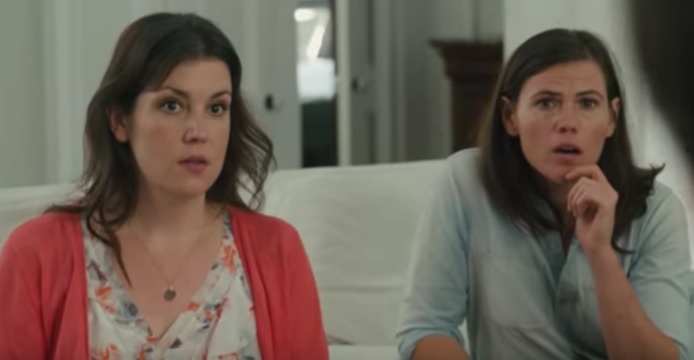
Annie and Matt (Lynskey, Ritter) are travelling to meet up with their friends, Sarah and Jessie (Lyonne, DuVall), Peter and Ruby (Piazza, Smulders), and Jessie’s brother, Jack (Schwartz), for a weekend get together. There is an ulterior motive for the get together: the rest are convinced that Peter and Ruby’s marriage is on the rocks and that an intervention is needed; they intend to suggest the couple divorce for both their sakes. When Jack arrives he brings a new girlfriend with him, Lola (Shawkat), but while this is initially regarded as inappropriate, it’s quickly forgotten with the arrival of Peter and Ruby. The couple bicker and squabble in front of their friends, and though Annie appears to the group’s prime mover, she fumbles a first attempt at confronting Peter and Ruby by getting drunk. Before another attempt can be made, divisions between the other couples are brought to the fore, partly because of Lola’s freewheeling sexuality, but also because of long-buried animosities. And things don’t improve when the intervention finally takes place, and Peter and Ruby react in ways that prove unexpected and which threaten the group’s friendship – perhaps irrevocably…

DuVall’s debut as a writer/director, The Intervention is a broadly optimistic, genial and amusing movie that works surprisingly well despite its largely conventional narrative and collection of characters. The basic premise plays out as you’d expect, adding fault lines in each relationship as the movie progresses, but thankfully not to the point where it looks as if each marriage/partnership needs their own intervention. Instead, DuVall does something that’s a little bit sneaky (maybe even underhanded): she pulls the rug out from under the viewer by revealing said fault lines but without wrapping them up neatly in a nice dramatic bow by the movie’s end. In doing this, she keeps the material fresher than it appears to be at first, and allows the main storyline and its various sub-plots to make much more of an impact than usual. Little betrayals and far from imagined slights have their place, but it’s the characters’ reactions to them – their bemused, uncomprehending reactions – that provide much of the enjoyment to be had from DuVall’s astute observations and the movie’s overall tone. If there’s one caveat, it’s that the drama is often underplayed in favour of the humour, but when it needs to, the script stings deliberately and painfully.

If DuVall’s first outing as a writer isn’t always successful – Lola is too obviously a catalyst for upset, the male characters aren’t as clearly defined as their female counterparts – as a director she’s on firmer ground, orchestrating matters with a great deal of confidence and precision in the way scenes are staged, and knowing when to focus on the appropriate dynamics relating to each couple. She’s aided by a terrific ensemble cast that’s headed by the always reliable Lynskey. As the commitment-phobic Annie, Lynskey invests her character with a pliable sense of responsibility and a survivor’s ignorance of individual culpability. It’s yet another performance that reinforces the fact that she’s one of the best actresses working today. Almost matching her (it’s really close) is Smulders, her portayal of Ruby as melancholy and subdued as you’d suspect in a woman whose marriage is visibly imploding (Smulders broke her leg shortly before shooting began; rather than re-cast, DuVall wrote it into the script). The rest of the cast enter into the spirit of things with gusto, and thanks to DuVall’s actor friendly approach, it’s the performances that prove to be the movie’s main attraction.

Rating: 7/10 – uneven in places, but with a sincerity and a sharpness to the material that keeps it (mostly) fresh and appealing, The Intervention is rewarding in an undemanding yet enjoyable way; bolstered by a raft of good performances, it’s unpretentious stuff that doesn’t outstay its welcome, and which knows not to resolve all its characters’ problems.

Share this:

  • Click to share on X (Opens in new window) X
  • Click to share on Facebook (Opens in new window) Facebook
  • More
  • Click to print (Opens in new window) Print
  • Click to email a link to a friend (Opens in new window) Email
Like Loading...

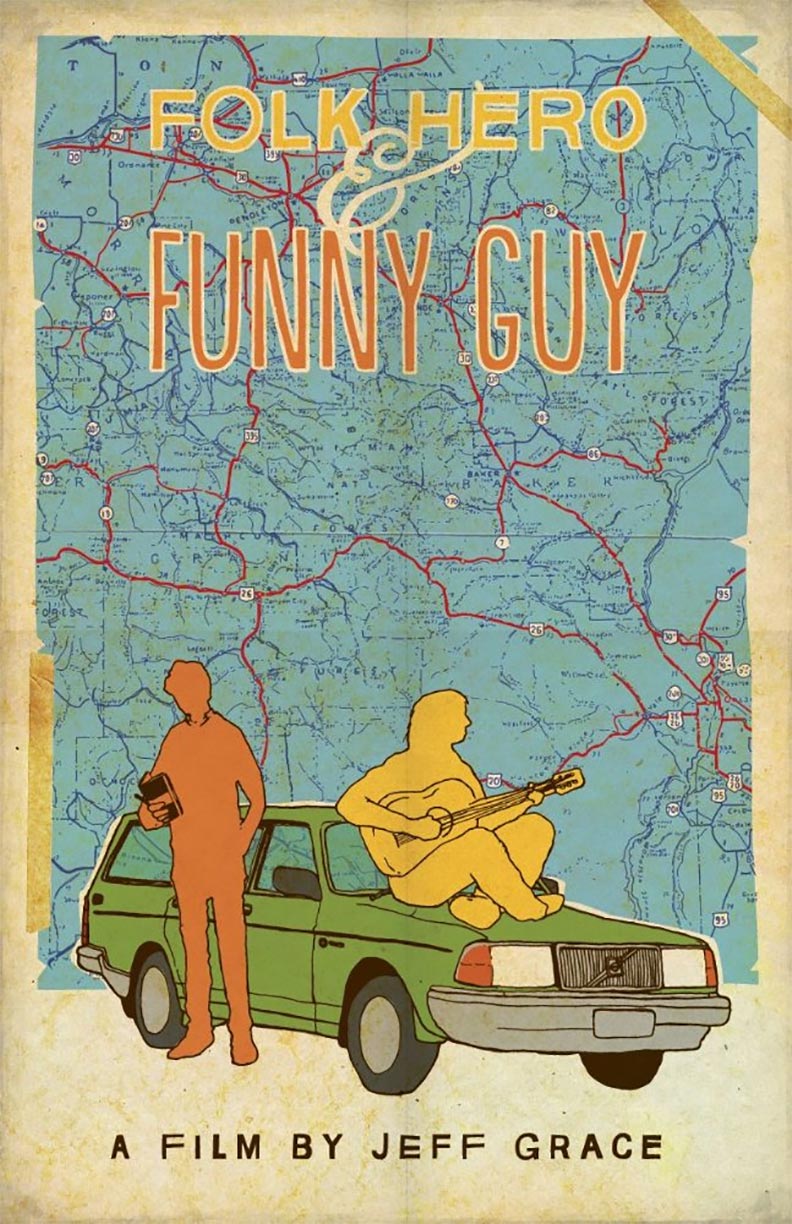
Folk Hero & Funny Guy (2016)

16 Tuesday May 2017

Posted by dullwood68 in Movies

≈ Leave a comment

Tags

Alex Karpovsky, Comedy, Drama, Friendship, Jeff Grace, Melanie Lynskey, Meredith Hagner, Relationships, Review, Road tour, Romance, Wyatt Russell

D: Jeff Grace / 91m

Cast: Alex Karpovsky, Wyatt Russell, Meredith Hagner, Melanie Lynskey, Michael Ian Black, Hannah Simone, Heather Morris, David Cross

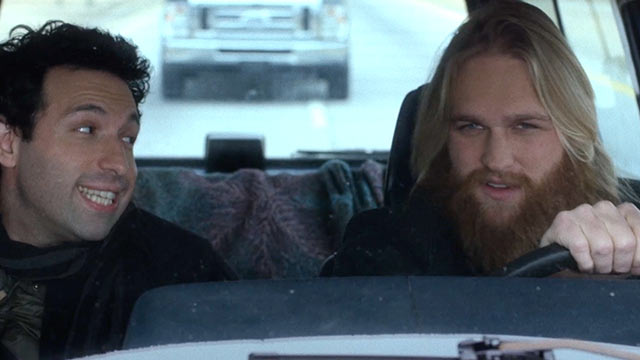
Paul Scott (Karpovsky) used to work in advertising, but he’s given it all up to be a stand-up comedian. His new career has its moments, but it’s still early days and he still has to refer to a notebook on stage for his material. Paul’s best friend since they were children is folk singer Jason Black (Russell). Jason’s career has brought him a degree of fame and popularity, and he’s the kind of carefree, live-for-the-moment guy that’s the complete opposite of Paul’s more grudging, dissatisfied approach to life (it doesn’t help that Paul’s just been dumped by his girlfriend). Seeing that his friend needs a bit of a lift, and some encouragement, Jason suggests Paul open for him on his upcoming solo tour. Paul thinks it might be a bit odd, a comedian opening for a folk singer, but Jason reassures him it’ll all be fine.

They set off in Jason’s battered old Volvo (his regular tour bus is too expensive for just the two of them), and on the first night of their trip they find themselves in a bar in Tom’s River, NJ, that has an open mic night. After hearing a very talented singer called Bryn (Hagner), Jason is cajoled into performing. While he does, Paul strikes up a conversation with Bryn, and they hit it off. The next morning, Paul is surprised to learn that Jason has invited Bryn along with them on the tour, and that she’s the new opening act, with Paul going on second. He’s a little flummoxed by it all, as he thought the tour was a chance for two old friends to spend some time together, but he’s also pleased because he’s attracted to Bryn and wants to get to know her better.

As the tour progresses, Paul and Bryn become good friends, while Jason pursues his usual vices. Bryn’s act goes down well with audiences, but Paul struggles to find the kind of form onstage that he can produce offstage. He begins to have second thoughts about being on the tour, and whether or not he should continue to pursue his dream. He and Bryn become closer still, until the revelation that she and Jason slept together that first night they all met, threatens to sever old and new friendships as Paul finds he’s unable to deal with it all…

Writer/director Jeff Grace – here making his feature debut – is also a stand-up comedian. Adam Ezra, who provides the movie’s original soundtrack, is a musician who it just so happens went on tour with Grace as his opening act. Using this as the basis of his screenplay, Grace has fashioned a perceptive, entertaining movie that has many pertinent things to say about the nature of old friendships, love and romance, and the downside of ambition. It’s a semi-serious comedy that isn’t afraid to show its three main characters in a less than flattering light, and it’s a very funny drama that highlights the difficulties involved in trying to start a relationship when you can’t articulate what you need from that relationship.

Paul is almost a classic underachiever, his personal life littered with regrets and misunderstandings that he can’t get past or overcome, and his new professional life proving to be just as frustrating. Part of the problem in both areas is that Paul doesn’t do enough to make things work in the way that they should. He makes the minimum effort required, and doesn’t see that this intransigence is what’s stopping him from achieving his goal as a stand-up, or committing fully to relationships. Even when he does try to commit, it’s done in such a way that the relationship is bound to founder as a result. Ultimately, Paul doesn’t trust in his own happiness, and he finds ways to sabotage things when they seem to be going well.

Jason is the exact opposite: confident, spontaneous, a risk taker, and someone who doesn’t overthink things. The tour is Jason’s idea of helping Paul regain some of the self-confidence that he had when he worked in advertising. He sees that Paul is down in the dumps, that his negative attitude needs challenging, but in the same way that Paul works against himself and any chance of contentment, Jason has the best of intentions but lacks the skill to reinvigorate his best friend’s life. He tries, but his efforts always backfire because he just can’t put himself in Paul’s shoes. Jason lacks the awareness that what pleases him and keeps him happy, isn’t going to work in the same way with Paul. There are times when you wonder just what it is that has kept them friends for so long, and Grace’s judicious script skirts this issue until the last night of the tour and the inevitable confrontation between the folk hero and the funny guy.

Grace handles the comedic elements with unsurprising aplomb, putting Paul on stage and letting him bomb in the same kamikaze way each time (“What is up with e-vites?”). It’s funny, sad and frustrating all at the same time, because before he gets to that point in his act, he always does so well. But Grace isn’t interested in making things easy for Paul – hell, even Paul isn’t interested in making things easy for himself – and Paul’s pent-up frustration leads to his being properly funny only when he lets things blow. It’s a good indication of the kind of stand-up comedian Paul could or should be, and Grace appears to be leading the audience in this direction when in fact he’s clever enough to steer everyone to a different place altogether. This makes the movie more intriguing than expected, and opens up the possibility that in good old indie movie fashion, things may not turn out so well for everyone at all.

Along the way, Grace gives Karpovsky some great routines to have fun with (until the rot has to kick in), and allows Russell and Hagner the chance to impress on more than one occasion with their soulful singing styles. All three give good performances in the kind of well written roles that only seem to come along in the indie sector these days, and in a brief supporting role, Melanie Lynskey proves yet again why she is one of the best character actresses working today. Grace does extremely well for a first-time director, drawing out the subtleties of his script with a sure hand and managing to avoid making it all look too obvious. If Paul’s intransigence becomes wearing after a while – and it does – then it’s a small price to pay for a movie that deals so effectively in portraying Paul’s downbeat persona, and counter-balancing it with Jason’s more hedonistic approach to everything. It all adds up to a movie brimming with heart and soul, and which never short changes its characters or its audience.

Rating: 8/10 – an appealing and thoughtful movie about the nature of unequal male friendships, Folk Hero & Funny Guy is also an irresistible road movie-romantic comedy-drama; with a great soundtrack and score, it’s a movie that signals Grace as a moviemaker to watch, confirms Russell to be an actor with an engaging, amiable screen presence, and features a screenplay that’s sympathetic and non-judgmental to all three of its main characters.

Share this:

  • Click to share on X (Opens in new window) X
  • Click to share on Facebook (Opens in new window) Facebook
  • More
  • Click to print (Opens in new window) Print
  • Click to email a link to a friend (Opens in new window) Email
Like Loading...

Little Boxes (2016)

19 Wednesday Apr 2017

Posted by dullwood68 in Movies

≈ Leave a comment

Tags

Armani Jackson, Comedy, Drama, Interracial family, Melanie Lynskey, Nelsan Ellis, Racism, Relationships, Review, Rob Meyer, Rome

D: Rob Meyer / 89m

Cast: Melanie Lynskey, Nelsan Ellis, Armani Jackson, Oona Laurence, Miranda McKeon, Christine Taylor, Janeane Garofalo, Nadia Dajani, Veanne Cox, Maliq Johnson

Gina McNulty (Lynskey) and Marcus “Mac” Burns (Ellis) are an interracial couple with a young, pre-teen son, Clark (Jackson). Gina is a photographer, while Mac is trying to come up with an idea for his second novel, his first having been published to moderate acclaim. They live in Brooklyn, have a nice, comfortable middle-class lifestyle, a great social life, and lots of friends with similar backgrounds and life experiences. In short, they’re comfortable. But their lives are about to change when Gina accepts a teaching job at a university in Rome, Washington State. Travelling across the country by road, they arrive at their new home to find the removals truck isn’t there (and won’t be for a while), and that they’ll have to make do until it does. A set of inflatable mattresses and a camping stove later, and they’ve officially moved in.

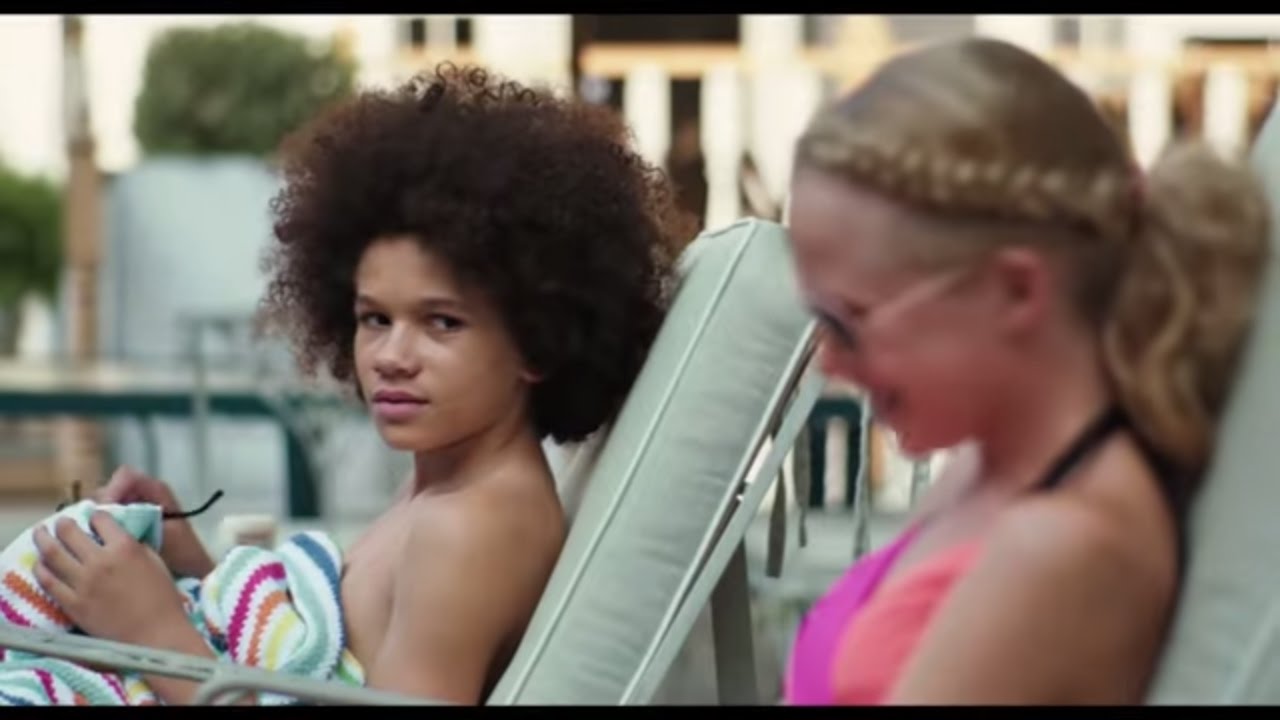
Rome proves to be a predominantly white town, with virtually no other ethnic groups represented there. This reveals itself slowly to the trio, and in different ways. Gina is accepted immediately by some of the female, tenured professors. Mac goes for long walks listening to free-form jazz on his MP3 player and encounters several of the locals who seem overly pleased that he’s moved there. Clark begins spending time with two girls near his own age, Ambrosia (Laurence) and Julie (McKeon). Gina’s acceptance is based on her being artistic and a woman. Mac’s acceptance is based on his being black, and when the local bookseller finds out, a published author. Clark is popular with Ambrosia and Julie because he’s ostensibly black and doesn’t mind being treated like a show-and-tell friend.

But at the same time, their acceptance by the townsfolk of Rome leads to divisions within the family. While Gina goes off to the university, and Clark spends more and more time with his “girlfriends”, Mac stays at home and works on an article for an online food blog. They spend less and less time together. As they adapt to their new surroundings, further cracks begin to appear in what used to be their comfortable lifestyle. Arguments and disagreements ensue, and Clark, determined to live up to Ambrosia and Julie’s expectations of him, begins acting like a surly teenager. When things go a little too far between him and Ambrosia, Gina and Mac begin to feel a sense of isolation, and it’s not long before they’re wondering if moving to Rome was such a good idea in the first place.

Diversity and equality seem to be cinematic buzzwords at the moment. The number of movies addressing issues surrounding racism and racial inclusion/exclusion seems to have increased exponentially in the wake of the OscarsSoWhite controversy in 2016. That most of these movies were in production before last year’s Oscar ceremony seems to point also to some kind of cinematic zeitgeist finally making itself felt. But one thing’s for sure: you won’t find a more low-key, or subtle, examination of middle class racism than in Little Boxes.

It’s a movie that takes reverse (or positive) discrimination and makes it feel just as insidious as direct discrimination. Mac is out walking when one of his neighbours asks if he needs any help. The inference is clear: it’s a white neighbourhood, and Mac shouldn’t be there. But the neighbour quickly realises that Mac should be there, and from then on it’s all okay, and Mac is treated like an old friend. The turnaround is sharply made and hard to dismiss as anything other than tokenism. Mac is initially bemused by this sort of thing, but as time goes on, he begins to like it, even though deep down he also despises it. Meanwhile, Clark is learning that fitting in can mean a loss of identity, but as long as Ambrosia and Julie spend time with him and include him in what they’re doing (mostly dance routines and lounging by the pool), then he seems happy to be the person they think he is: a cool black kid that only they are friends with.

It could be argued that, along with its glacial, racial undertones, Little Boxes is also about maintaining oneself in the context of a new environment. Mac struggles because he lacks a defined purpose. His writing appears stalled, and he’s more concerned about the mould he discovers in the house than anything else. And he’s easily led astray by his neighbour, knocking back uppers and ending up in a bar. For Gina, the path towards fitting in is paved with good intentions and liquid lunches with her colleagues. She does her best to fit in but finds it causes too many problems, problems that she discovers she’s ill-equipped to deal with. Clark’s growing rebelliousness adds to the lack of unity and faith in each other that all three had previously in Brooklyn, and it soon becomes obvious that this is a family that may have made a really bad decision in transporting themselves so far out of their combined comfort zones.

But while the movie examines these themes with candour and no small amount of intelligence thanks to Annie J. Howell’s perceptive script, it doesn’t make the family’s disintegration too believable. Just why their close-knit harmony and commitment to each other should fall apart so easily is never explained, and without this, the movie falls into the trap of presenting the trials and tribulations of a moderately well-to-do middle class family in an indie setting, and expecting the audience to feel sorry for them. Sadly, this doesn’t happen, and not just because these are characters who have attained a certain level of privilege in their lives, but because the trials and tribulations that they face operate on the level of minor farce. There’s nothing here that the average family couldn’t overcome or deal with as soon as it arose. Yes, it’s another movie where the characters say a lot, but aren’t actually talking to each other.

Thankfully, most of this is offset by the quality of the performances. Lynskey is a pleasure to watch – as always – and portrays Gina’s growing insecurities and bafflement with her usual sincerity. Ellis is on equally fine form, ensuring Mac is equally unsure of himself and his current role in life, and displaying Mac’s wounded pride when things he knows he can do, don’t go so well. Jackson, meanwhile, has that knack that most child actors have of not even appearing to be acting, so good is he as Clark, and he acquits himself so well it appears almost effortless. In the director’s seat, Meyer does a fine job on the whole, but can’t find a way to keep the audience sympathetic to the family and their woes (mostly because they’re self-inflicted). It’s not a movie that has a particularly distinctive visual style, and the narrative stops and starts a little too often, but it does have enough substance to keep viewers occupied, even if, in the end, they’ll find it hard to be concerned by what’s happening.

Rating: 6/10 – several nods to small-town inverse racist attitudes and the fragility of the nuclear family can’t save Little Boxes (a metaphorical title if ever there was one) from failing to connect with the viewer; good performances and a waspish sense of humour go some way to making up for the areas where the movie struggles to provide depth or resonance, but most viewers will find themselves disappointed by so much effort yielding a much smaller return than expected.

Share this:

  • Click to share on X (Opens in new window) X
  • Click to share on Facebook (Opens in new window) Facebook
  • More
  • Click to print (Opens in new window) Print
  • Click to email a link to a friend (Opens in new window) Email
Like Loading...

Oh! the Horror! – Train to Busan (2016) and XX (2017)

12 Sunday Mar 2017

Posted by dullwood68 in Movies

≈ Leave a comment

Tags

Annie Clark, Anthology, Christina Kirk, Don't Fall, Drama, Gong Yoo, Her Only Living Son, Horror, Jovanka Vuckovic, Karyn Kusama, Melanie Lynskey, Review, Roxanne Benjamin, South Korea, The Birthday Party, The Box, Thriller, Yeon Sang-ho, Zombies

Train to Busan (2016) / D: Yeon Sang-ho / 118m

aka Busanhaeng

Cast: Gong Yoo, Jung Yu-mi, Kim Su-an, Ma Dong-seok, Kim Eui-sung, Choi Woo-shik, Ahn So-hee, Choi Gwi-hwa, Jung Suk-yong, Ye Soo-jung, Park Myung-sin

Seok-woo (Gong) is a workaholic whose marriage has ended in divorce, and who neglects to spend time with his young daughter, Soo-an (Kim). When she insists he goes with her to Busan to visit her mother, he feels guilty enough to do it. They board the train in Seoul, but just before it departs a young woman gets on who proceeds to have convulsions. One of the train attendants goes to help her, but she’s attacked by the woman, and within moments both have become zombies. The pair attack the rest of the passengers in that section of the train. Seok-woo grabs his daughter, and heads as far down the train as he can, while behind them, more and more passengers become victims. Only the fact that the zombies seem unable to work out how to open the doors between compartments keeps the remaining unharmed travellers from suffering the same fate.

As the train journey continues it soon becomes clear that the zombie outbreak is spreading throughout South Korea. The train eventually stops at Daejeon, which appears deserted. But once they’ve got off the train, the passengers discover that they’re not as safe as they thought. Back on the train, they find themselves separated by several zombie infested compartments. One group, including Seok-woo, fight their way through to the other passengers, only to find the others – under the direction of paranoid businessman Yon-suk (Kim Eui-sung) – barring them from entering the safety of their compartment. When they finally do get in, they’re forced to quarantine themselves in another section. And then the zombies get in as well…

A major success in South Korea (being the first movie from there in 2016 to be seen by over ten million viewers), Train to Busan takes its zombie cues from movies such as 28 Days Later… (2002) and World War Z (2013). Here the afflicted are fast, rapacious, and all kitted out with special contact lenses. The difference between these and any other zombie is their inability to notice any of the living if the living don’t move, or if they’re all in the dark (Seok-woo and co’s efforts to unite with the other passengers relies on the train travelling through several tunnels). There’s a clear sense of peril as the train embarks on its journey, and director Yeon and writer Park Joo-suk do their utmost to ramp up the tension, killing off the cast with a determined frequency, until only a handful are left (though you’ll probably be able to guess just who quite early on).

There are attempts at underscoring it all with a degree of social commentary, but unless you’re familiar with South Korean life, much of it will pass you by. That said, what will be more comforting is the number of stereotypes on display in terms of the characters, from Ma’s tough-on-the-outside, soft-on-the-inside father-to-be, to Kim Eui-sung’s self-serving, Machiavellian businessman. The movie wastes no time on fleshing them out as characters, and instead, focuses on the action, which includes a spectacular train wreck, and several gripping on-board encounters between the unaffected and the (dis)affected. The cast, particularly Jung as Ma’s pregnant wife, and Gong, play their parts with conviction, and the entire mise en scene is given an eerie verisimilitude thanks to Lee Hyung-doek’s crisp, strangely homogensied cinematography.

Rating: 7/10 – an above average entry in the zombie sub-genre of horror movies, Train to Busan has lots of neat directorial flourishes, and isn’t afraid to acknowledge its influences (especially in the final scene); refreshingly direct, and making good use of its largely claustrophobic settings, the movie is solidly made and definitely worth spending two hours in its company.


XX (2017) / D: Jovanka Vuckovic, Annie Clark, Roxanne Benjamin, Karyn Kusama / 81m

Cast: Natalie Brown, Jonathan Watton, Peter DaCunha, Melanie Lynskey, Sheila Vand, Casey Adams, Breeda Wool, Angela Trimbur, Morgan Krantz, Christina Kirk, Kyle Allen, Mike Doyle

A portmanteau of four stories wrapped up in an interstitial animated tale, XX opens with Vuckovic’s The Box, in which a young boy, Danny (DaCunha), is allowed a peek inside the box a man on the subway says is a present, and thereafter refuses to eat. His parents (Brown, Watton) think it’s all just a phase, but then his sister starts refusing to eat as well, followed by the father. Come Xmas and all three are wasting away, but seem happy and resigned about it. Soon, the mother is riding the subway in the hope of finding the man with the box, and learning what was inside it. In Clark’s The Birthday Party, a mother (Lynskey) trying to organise her young daughter’s birthday party finds an obstacle to everything going well in the form of her recently dead husband. She tries to hide the body, but interruptions and other problems get in the way until she comes up with an ingenious, but risky, solution – if only no one looks too closely at the giant panda.

The third tale, Benjamin’s Don’t Fall, sees two couples on a trip to the desert. They find an ancient cave painting that depicts a demon. Later that night, one of them, Gretchen (Wool), is attacked. She turns into a murderous creature, and tries to kill her friends. In the final story, Kusama’s Her Only Living Son, Cora (Kirk) is a single mother who wants nothing to do with the father of her only son, Andy (Allen). But as he approaches eighteen, she begins to find that he’s not exactly the child she thinks he is, and that there are dark forces surrounding him, forces that have an agenda for him that she has either suppressed, or is completely unaware of.

XX is being promoted heavily thanks to its four female directors – five if you count Sofia Carrillo’s animated contributions – but it’s an approach that should have been avoided, because what may have sounded like a good gimmick in the planning stages, soon wears out any promise it held by the end of the first story. Now, that’s not to say that the four women behind the camera aren’t necessarily up to the challenge, it’s just that they’re unable to overcome the limitations inherent in the movie’s format. With each tale running under twenty minutes, they’re over before they’ve barely begun, and  the resulting lack of defined characters, predictable storylines, hurried plot developments, and quickly applied scares/gory moments means that there’s very little substance with which to engage the audience.

Benjamin’s tale suffers the most, having four characters that we never get a chance to even halfway care about before they’re being killed off. Elsewhere, credulity is stretched to breaking point by The Birthday Party‘s central conceit, and the parents in The Box not doing more to seek help for their son apart from making just one trip to the doctor’s. The various tales are also short on atmosphere, or a sense of dread, leaving each one to slip by without meeting many of the viewer’s expectations. It’s an admirable effort, but one that tumbles helplessly and expectedly into the pit of fruitless endeavours. The performances are mostly perfunctory (though Lynskey stands out from the crowd), and the look of each tale only occasionally rises above being bland and uninspired. The idea of women doing horror is a sound one, and shouldn’t be discouraged, but on this occasion, it doesn’t work as well as it could.

Rating: 4/10 – four talented directors, four underwhelming tales, one frustrating movie – XX is all this and more, an idea that needed stronger material than that shown; if there is to be an XX 2, then maybe the directors shouldn’t be the writers as well, and maybe the running time should be expanded on, allowing for a greater emphasis on characterisation, atmosphere and increasing tension.

Share this:

  • Click to share on X (Opens in new window) X
  • Click to share on Facebook (Opens in new window) Facebook
  • More
  • Click to print (Opens in new window) Print
  • Click to email a link to a friend (Opens in new window) Email
Like Loading...

Goodbye to All That (2014)

02 Saturday Jan 2016

Posted by dullwood68 in Movies

≈ Leave a comment

Tags

Angus MacLachlan, Anna Camp, Ashley Hinshaw, Audrey Scott, Comedy, Drama, Heather Graham, Heather Lawless, High school reunion, Marital break-up, Marriage, Melanie Lynskey, Paul Schneider, Relationships, Review, Romance

Goodbye to All That

D: Angus MacLachlan / 87m

Cast: Paul Schneider, Melanie Lynskey, Audrey Scott, Anna Camp, Ashley Hinshaw, Heather Lawless, Heather Graham, Michael Chernus, Amy Sedaris, Celia Weston

For Otto Wall (Schneider), life appears to be ticking along quite nicely. He has a wife, Annie (Lynskey) and a pre-teen daughter, Edie (Scott), a good job, and he wins local running competitions. He’s also quite accident prone, and one day he breaks his foot. One day during his recovery, Annie asks him to meet her at her therapist’s. Unaware of what’s about to happen, he learns that Annie wants a divorce (though the reason why is less than forthcoming). Shocked and confused, Otto struggles with the need to find a new place, and telling the people around him. The only positive is that he can still see Edie, and have her stay over at his new place.

Otto soon learns that Annie has been having an affair. This prompts him to consider dating again. He hooks up with an old girlfriend, Stephanie (Graham), when she contacts him via Facebook, and they have a one night stand that leaves Otto even more confused than before. Using a dating sight he meets Mildred (Hinshaw), who will willingly have sex with Otto, but doesn’t want a relationship. When Edie expresses an interest in going to church, he meets Debbie Spangler (Camp), a young single woman he takes to a cabin for the weekend. They too have sex, but the next morning she freaks out and tells Otto they shouldn’t have done what they did (which makes the journey home a little fraught).

Goodbye to All That - scene2

Otto still sees Annie occasionally, but their meetings are brittle moments of cordiality. When Edie begins to show signs that she doesn’t want to stay over any more, following a break-in, Otto begins to feel as if his life is now in complete freefall. It’s only his high school’s 20th anniversary reunion party that offers any relief: there he sees the girl who got away, Lara (Lawless). They spend time together briefly before she announces she has to leave. Otto gets her number though, and later calls her. He’s delighted to learn that she’s divorced, but surprised to learn that she’s heading to Costa Rica to teach scuba diving. It all leaves Otto with a big decision to make: whether to go with Lara, or stay and be near to Edie.

A gentle comedy of sexual manners married to a relationship drama that lacks depth, Goodbye to All That is a movie that most viewers will watch with the idea that at some point it’ll reveal what it wants to say. But unfortunately, MacLachlan, who wrote and directed the movie, never does reveal what the movie wants to say, or what it’s all about. On the surface – a very cloudy surface, admittedly – it’s about a man coming to terms with being single again after a lengthy time being married, and having no clue as to what to do next. Otto is possibly one of the most aimless, laidback characters seen in recent years, his oblivious manner and clueless expressions the marks of a man with little or no understanding of the people and places around him; it’s like he’s sleepwalked through his entire life so far.

His sexual liaisons with Stephanie, Mildred and Debbie should allow Otto the room and the experience to grow as both a father and an individual, but he’s much the same at the end as he was at the beginning, just less of a man with a puppy dog’s approach to life. Faced with women who are more emotionally and sexually complex than he is, Otto can only marvel at the ways in which relationships have evolved since he started dating Annie. As an observation on life in general, it’s pretty shallow, and as an observation of the female characters in the movie, it’s shallower still. Stephanie is all about self-gratification, Mildred is all about boundaries, and Debbie is all about unrestrained excess (with a side order of post-sexual guilt). Put them all together and they’re still not a complete woman. Instead they’re stereotypes, created to allow Otto to express his confusion about women’s needs.

Goodbye to All That - scene1

It’s this confused state that Otto wanders around in the whole time that makes the movie less than engaging. He doesn’t learn from any of his experiences, and doesn’t realise at any point that his laidback, “everything’s okay, I don’t have to try anymore” attitude is what has prompted Annie to push for a divorce. He can’t connect properly with her, or with the women he sleeps with, and even though he has an epiphany of sorts near the end, by then it’s too late, and the viewer is no longer interested.

What writer/director MacLachlan forgets to include is a scene where Otto behaves sympathetically to any of the women he knows. If he did we might have a degree of sympathy for Otto himself, but his relationship with Edie aside, it’s all about Otto. Schneider plays him as a well-meaning doofus, but it’s a portrayal that wears thin as the movie progresses, and by the end you’re hoping that Lara will bring him down to earth with some well-chosen observations about his behaviour, but instead the script has her supporting him unreservedly. It makes you wonder – still – what on earth the movie’s all about.

Goodbye to All That - scene3

Despite some serious pitfalls and and a less than cohesive story, Goodbye to All That does feature some good performances, with Lynskey and Camp making the biggest impressions. Lynskey is an underrated actress and should be given bigger and better roles, and here she takes what could be the shrew’s role and makes it much more rounded and emotional. Camp has a ball as the sexually expressive Debbie, playing demure one moment and bawdily kittenish the next. Both actresses hold the attention when they’re on screen, and both do more with their characters than the script would necessarily allow. And Scott is a winning screen presence, a moppet with a firm grasp on the mixed emotions Edie feels in the wake of her parents’ splitting up.

In contrast, MacLachlan’s direction is solid but unremarkable, though he does show an enthusiasm for shooting the sex scenes that makes all the other scenes appear like afterthoughts, and he can’t quite stop Otto from looking baffled in each and every scene once Annie (or rather, her therapist) tells him it’s over. Corey Walter’s cinematography is a definite plus, with the autumnal North Carolina locations given an extra lustre, and praise too to editor Jennifer Lilly for making a number of scenes feel more potent than the script did (the scene in the therapist’s, Otto and Mildred’s first time together to name but two).

Rating: 5/10 – uneven, sporadically amusing (for a comedy), lacking in focus, but somehow better than a lot of other, similar movies, Goodbye to All That is perfect for a wet Sunday afternoon after a big lunch; if you can ignore Otto’s unfortunate misogyny then you might be able to reap some enjoyment from the movie, but otherwise it’s a romantic comedy-drama that doesn’t know which one it is at any given moment.

Share this:

  • Click to share on X (Opens in new window) X
  • Click to share on Facebook (Opens in new window) Facebook
  • More
  • Click to print (Opens in new window) Print
  • Click to email a link to a friend (Opens in new window) Email
Like Loading...

Mini-Review: We’ll Never Have Paris (2014)

16 Thursday Jul 2015

Posted by dullwood68 in Movies

≈ 2 Comments

Tags

Comedy, Drama, Florist, Jocelyn Towne, Maggie Grace, Melanie Lynskey, Paris, Relationships, Review, Romantic comedy, Simon Helberg

We'll Never Have Paris

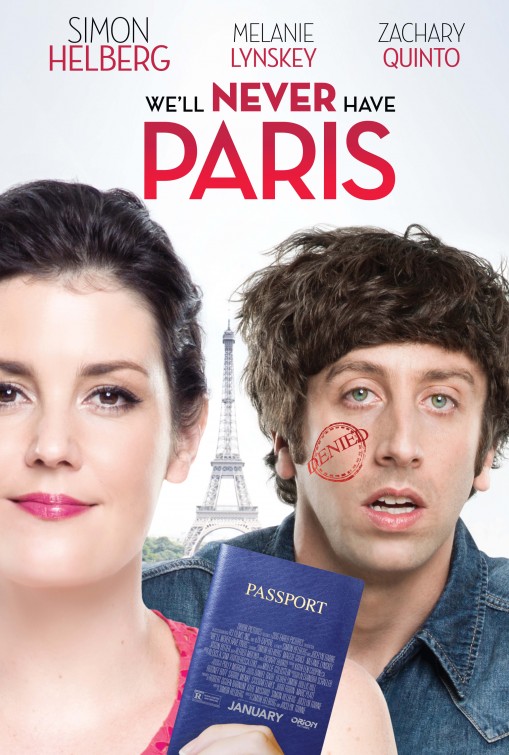
D: Jocelyn Towne, Simon Helberg / 92m

Cast: Simon Helberg, Maggie Grace, Melanie Lynskey, Zachary Quinto, Alfred Molina, Jason Ritter, Fritz Weaver, Dana Ivey, Ebon Moss-Bachrach

Quinn (Helberg) is a florist who’s also a bit of a hypochondriac. He’s also in a long-term relationship with Devon (Lynskey), his high school sweetheart. Encouraged by his optometrist father Terry (Molina), he decides to ask Devon to marry him. But when he announces his intentions to his assistant, Kelsey (Grace), it prompts her to reveal her feelings for him.  Confused by this revelation, Quinn seeks advice from his best friend, Jameson (Quinto), but it all leads to Quinn having second thoughts about matrimony. Devon takes it badly and leaves him. Believing that he needs to explore other relationships, he starts seeing Kelsey, but her behaviour becomes distressing to him and he distances himself from her.

Quinn’s attempts to regain Devon’s trust and forgiveness but it all falls flat. She moves to Paris, and when Quinn finds out – and despite the continued attentions of Kelsey – he decides to pluck up the courage and follow her there in an effort to win her back. When he does he finds Devon has forged a friendship with a Frenchman called Guillaume (Moss-Bacharach), and is planning to spend some time with his family. Quinn follows her there but his visit is a disaster and prompts him to return to the US and put his relationship with Devon behind him. But he learns that it’s not all over…

We'll Never Have Paris - scene

Best known for his role as Howard Wolowitz on The Big Bang Theory, Simon Helberg is to be congratulated for writing, co-directing and starring in a romantic comedy that a) sees him as an object of lust and b) has attracted a good cast. However, somewhere along the way, Simon Helberg the writer seriously undermined Simon Helberg the actor, and in doing so was in cahoots with Simon Helberg the co-director, for Quinn the character is one of the most irritating creations seen in recent years. Quinn is a nebbish, an ineffectual, stuttering idiot who isn’t so much easily led as emotionally vacant. His relationship with Devon is unconvincing – why would she love such a man when he’s so obviously gornisht helfn?

But even if Helberg the writer had given Helberg the actor a better role, he still would have let him down by failing to make his character funny or even halfway amusing. We’ll Never Have Paris is simply not funny – at all. Helberg’s script meanders from one poorly developed scene to the next, with spurious character motivations thrown in at random moments, and supposedly humorous situations allowed to peter out before they can achieve any relevance or resolution. Against this, Grace and Lynskey struggle to make anything of the material, with Lynskey particularly hamstrung by a role that requires her to be continually forgiving in the face of Quinn behaving (repeatedly) like an ass. Only Molina comes out of it all with any dignity intact, popping up at the beginning and again at the end in what is effectively a cameo role, his cheery demeanour and impish behaviour showing how it should be done.

Rating: 3/10 – dreadful, and lacking in anything remotely resembling dramatic or comedic acuity, We’ll Never Have Paris is sluggish, implausible stuff that is a struggle to sit through; Helberg isn’t the writer he thinks he is, and lets himself down too often for this to succeed, leaving the viewer with the feeling that they’ve sat through a movie that was filmed from a first draft.

Share this:

  • Click to share on X (Opens in new window) X
  • Click to share on Facebook (Opens in new window) Facebook
  • More
  • Click to print (Opens in new window) Print
  • Click to email a link to a friend (Opens in new window) Email
Like Loading...

Blog Stats

  • 486,559 hits

Recent Posts

  • 10 Reasons to Remember Bibi Andersson (1935-2019)
  • Fantasia (1940)
  • Dances With Wolves (1990) – The Special Edition
  • Kiss of the Spider Woman (1985)
  • The Three Musketeers (1973)

Top Posts & Pages

  • Lost for Life (2013) - Another Look
    Lost for Life (2013) - Another Look
  • Lost for Life (2013)
    Lost for Life (2013)
  • About
    About
  • Mr. Topaze (1961)
    Mr. Topaze (1961)
  • Winter's Tale (2014)
    Winter's Tale (2014)
  • Hunt for the Wilderpeople (2016)
    Hunt for the Wilderpeople (2016)
  • Shock and Awe (2017)
    Shock and Awe (2017)
  • Billy Lynn's Long Halftime Walk (2016)
    Billy Lynn's Long Halftime Walk (2016)
  • Exposed (2016)
    Exposed (2016)
  • 5 Famous Movie Roles That Nearly Went to Someone Else
    5 Famous Movie Roles That Nearly Went to Someone Else
Follow thedullwoodexperiment on WordPress.com

Blogs I Follow

  • Rubbish Talk
  • Film 4 Fan
  • Fast Film Reviews
  • The Film Blog
  • All Things Movies UK
  • Interpreting the Stars
  • Let's Go To The Movies
  • Movie Reviews 101
  • TMI News
  • Dan the Man's Movie Reviews
  • Film History
  • Jordan and Eddie (The Movie Guys)

Archives

  • April 2019 (13)
  • March 2019 (28)
  • February 2019 (28)
  • January 2019 (32)
  • December 2018 (28)
  • November 2018 (30)
  • October 2018 (29)
  • September 2018 (29)
  • August 2018 (29)
  • July 2018 (30)
  • June 2018 (28)
  • May 2018 (24)
  • April 2018 (21)
  • March 2018 (31)
  • February 2018 (25)
  • January 2018 (30)
  • December 2017 (30)
  • November 2017 (27)
  • October 2017 (27)
  • September 2017 (26)
  • August 2017 (32)
  • July 2017 (32)
  • June 2017 (30)
  • May 2017 (29)
  • April 2017 (29)
  • March 2017 (30)
  • February 2017 (27)
  • January 2017 (32)
  • December 2016 (30)
  • November 2016 (28)
  • October 2016 (30)
  • September 2016 (27)
  • August 2016 (30)
  • July 2016 (30)
  • June 2016 (31)
  • May 2016 (34)
  • April 2016 (30)
  • March 2016 (30)
  • February 2016 (28)
  • January 2016 (35)
  • December 2015 (34)
  • November 2015 (31)
  • October 2015 (31)
  • September 2015 (34)
  • August 2015 (31)
  • July 2015 (33)
  • June 2015 (12)
  • May 2015 (31)
  • April 2015 (32)
  • March 2015 (30)
  • February 2015 (37)
  • January 2015 (39)
  • December 2014 (34)
  • November 2014 (34)
  • October 2014 (36)
  • September 2014 (25)
  • August 2014 (29)
  • July 2014 (29)
  • June 2014 (28)
  • May 2014 (23)
  • April 2014 (21)
  • March 2014 (42)
  • February 2014 (38)
  • January 2014 (29)
  • December 2013 (28)
  • November 2013 (34)
  • October 2013 (4)

Blog at WordPress.com.

Rubbish Talk

Film 4 Fan

A Movie Blog

Fast Film Reviews

The Film Blog

The official blog of everything in film

All Things Movies UK

Movie Reviews and Original Articles

Interpreting the Stars

Dave Examines Movies

Let's Go To The Movies

Film and Theatre Lover!

Movie Reviews 101

Daily Movie Reviews

TMI News

Latest weather, crime and breaking news

Dan the Man's Movie Reviews

All my aimless thoughts, ideas, and ramblings, all packed into one site!

Film History

Telling the story of film

Jordan and Eddie (The Movie Guys)

Movie Reviews & Ramblings from an Australian Based Film Fan

Privacy & Cookies: This site uses cookies. By continuing to use this website, you agree to their use.
To find out more, including how to control cookies, see here: Cookie Policy
  • Subscribe Subscribed
    • thedullwoodexperiment
    • Join 481 other subscribers
    • Already have a WordPress.com account? Log in now.
    • thedullwoodexperiment
    • Subscribe Subscribed
    • Sign up
    • Log in
    • Report this content
    • View site in Reader
    • Manage subscriptions
    • Collapse this bar
 

Loading Comments...
 

    %d