• 10 Reasons to Remember…
  • A Brief Word About…
  • About
  • For One Week Only
  • Happy Birthday
  • Monthly Roundup
  • Old-Time Crime
  • Other Posts
  • Poster of the Week
  • Question of the Week
  • Reviews
  • Trailers

thedullwoodexperiment

~ Viewing movies in a different light

thedullwoodexperiment

Tag Archives: Mike Leigh

Peterloo (2018)

13 Tuesday Nov 2018

Posted by dullwood68 in Movies

≈ Leave a comment

Tags

Drama, History, Manchester, Massacre, Maxine Peake, Mike Leigh, Politics, Radicals, Review, Rory Kinnear, St Peter's Fields, True story

D: Mike Leigh / 154m

Cast: Rory Kinnear, Maxine Peake, Pearce Quigley, Karl Johnson, Neil Bell, Philip Jackson, John-Paul Hurley, Tom Gill, Vincent Franklin, Jeff Rawle, Philip Whitchurch, Martin Savage, Roger Sloman, Sam Troughton, Alastair Mackenzie, Tim McInnerny, Dorothy Duffy, Victoria Moseley

In the wake of Napoléon Bonaparte’s defeat on the Continent in 1815, the working classes in the north of England turn their attention to protesting against the lack of fair political representation, and asking for extended voting rights (one vote per household). Getting wind of this, and viewing it as impending sedition, the British Government – as represented by the Home Secretary, Lord Sidmouth (Johnson) – decides to do all it can to ensure that this new movement is unsuccessful, and preferably crushed before it can begin. While local radicals from the Manchester Observer, including its founder, Joseph Johnson (Gill), organise a great assembly to take place at St Peter’s Fields in Manchester on 9 August 1819, with a speech to be delivered by the great reformist orator Henry Hunt (Kinnear), government spies and local magistrates plot to have Hunt arrested and the crowd dispersed by force if necessary. With a crowd of around 60,000 people attending, the local militia’s attempts to break up the gathering lead to a terrible tragedy…

Beginning on the battlefield in 1815, Mike Leigh’s latest movie features several firsts for the director in terms of action and bloodshed, but Peterloo is also his most fiercely political movie to date. In telling the story of one of Britain’s worst tragedies, Leigh takes us on a vital history lesson, ranging from the semi-rural mill towns of Lancashire and their inhabitants’ clamour for fair political representation, to the richly decorated rooms of the Establishment and their unwillingness to ease the yoke of political oppression, to the austere courtrooms of the local magistrates and their callous disregard for the lives of the working class. In meeting rooms and at outdoor venues, Leigh explores and illuminates the political and social climate of the period, and through the use of lengthy speeches and extended conversations, brings to life a time when liberty was a luxury afforded only to the ruling elite, and the working classes were so beaten down they were constantly in danger of dying from starvation and disease. Leigh brings all this to life, and gives powerful voice to both the ideals of the radicals and their supporters, and the arrogance of the Establishment. By the time the massacre gets under way, the audience knows exactly what is being fought for (albeit peacefully), and why it matters. And why the elite are so determined to impede any progress.

If all this sounds irredeemably dry and didactic, then nothing could be further from the truth. Like Eric Rohmer, whose movies often consist of just two people talking at length but which are still fascinating to watch, Leigh has the same ability to draw in the viewer and make the expression of ideas as compelling as the action that inevitably follows in their wake (though if anything, the massacre itself isn’t as well realised as the rest of the movie, and carries a strangely muted impact, as if Leigh didn’t want to go too far in depicting the violence). There are real emotions on display, however, from the peacock-ish pride of Henry Hunt, to the cautious reticence of Peake’s unconvinced wife and mother, to the fervour and enthusiasm of the leaders of the nascent Manchester Female Reform Society, to the priggish belligerence of the Prince Consort (McInnerny). In this, the cast are uniformly excellent, with special mention going to Bell as radical reformer Samuel Bamford, and Franklin as the vituperative, apoplectic Magistrate Rev Etlhelson. With expressive, beautifully composed cinematography by Dick Pope that further brings the period to life, along with Suzie Davies’ highly impressive production design, this is a gripping account of a despicable act of state-organised domestic terrorism.

Rating: 9/10 – not for all tastes, but a compelling and revealing look at a key moment in 19th century British history nevertheless, Peterloo sees Mike Leigh working at the height of his considerable story-telling powers; absorbing, intelligently handled, and brimming with vitality, this does border on being unashamedly polemical at times, but when the quality of the material is this good, it’s something that can be easily forgiven.
Share this:

  • Click to share on X (Opens in new window) X
  • Click to share on Facebook (Opens in new window) Facebook
  • More
  • Click to print (Opens in new window) Print
  • Click to email a link to a friend (Opens in new window) Email
Like Loading...

Mr. Turner (2014)

21 Saturday Feb 2015

Posted by dullwood68 in Movies

≈ Leave a comment

Tags

Biography, Dorothy Atkinson, Drama, History, JMW Turner, Marion Bailey, Mike Leigh, Painting, Paul Jesson, Relationships, Review, Royal Academy of Arts, Timothy Spall

Mr. Turner

D: Mike Leigh / 150m

Cast: Timothy Spall, Dorothy Atkinson, Marion Bailey, Paul Jesson, Karl Johnson, Ruth Sheen, Lesley Manville, Martin Savage, David Horovitch, Joshua McGuire, Kate O’Flynn, Leo Bill

Eminent painter Joseph Mallord William Turner is famous for his land- and seascapes. He lives in a big house in London with his father, William (Jesson) (who acts as his assistant), and his devoted housekeeper, Hannah (Atkinson). He has children he’s estranged from: two daughters from a relationship with Hannah’s aunt Sarah (Sheen). He rejects their attempts to procure financial support from him, even when they visit with his first grandchild. When he’s not at home, Turner travels the country (and sometimes abroad) making sketches that he can expand into paintings when he’s home.

He also visits members of the aristocracy and valued patrons. On one such visit he’s accosted by the struggling artist Benjamin Haydon (Savage), who asks him for the sum of £100 to help him avoid ruin. Haydon’s entreaties lead to Turner promising to lend him £50 instead, which Haydon accepts. When his father dies, Turner becomes depressed but the need to draw and paint is stronger than his despair. Shortly after, Turner visits Margate where he finds lodging with Mrs Booth (Bailey) and her husband (Johnson). He stays there awhile and finds himself enjoying the couple’s company. When he returns a second time he learns that Mrs Booth’s husband has passed away.

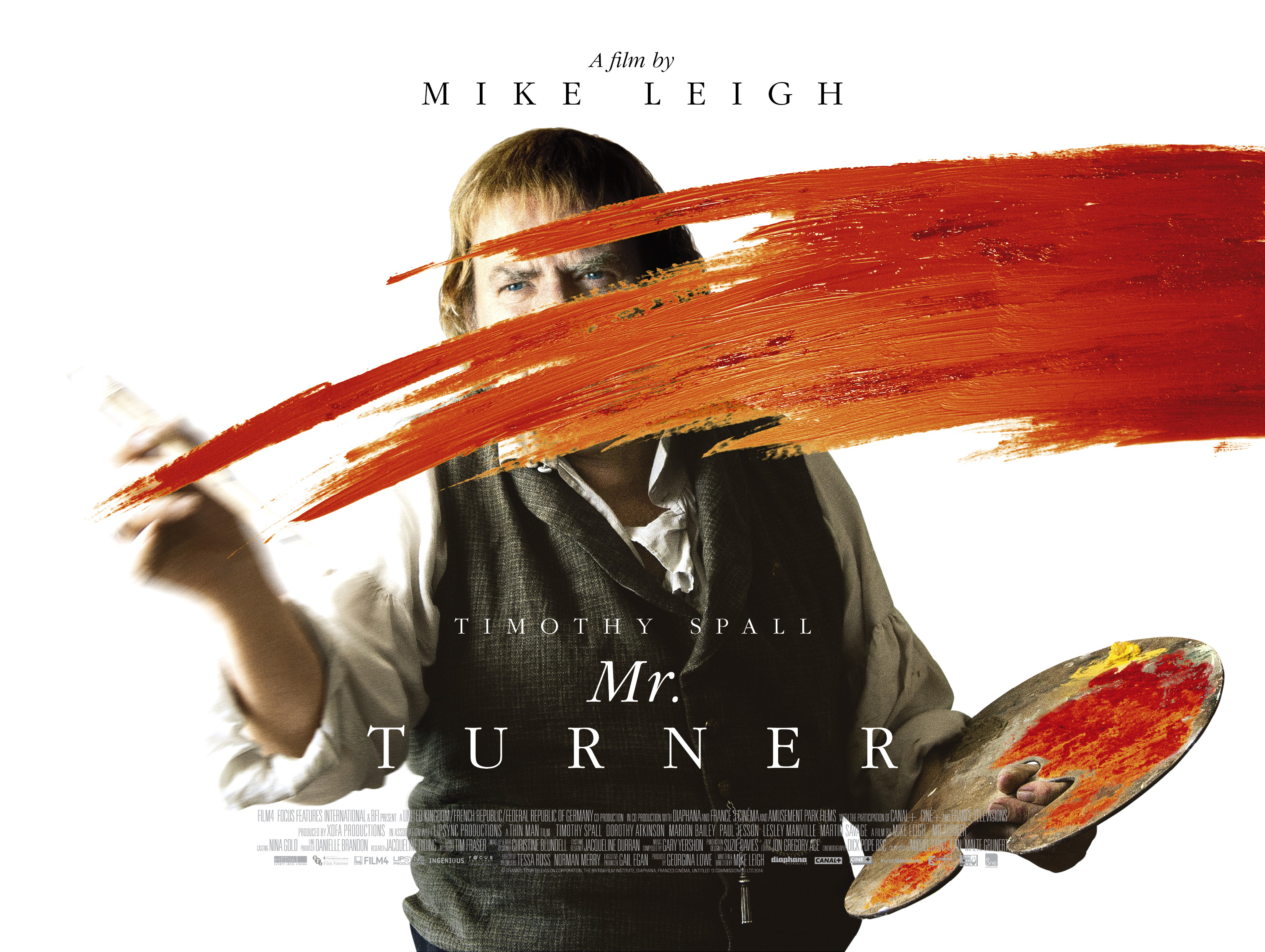
In the meantime his anarchic behaviour at the Royal Academy of Arts beguiles and amuses some of his fellow artists, and angers and upsets others, such as Constable. He appears to deface one of his own seascapes with a splotch of red, then removes himself. His associates are appalled and discomfited at this, until he returns and shapes the splotch until it resembles a buoy. At this their respect is renewed, and Turner’s notoriety is upheld, along with the acceptance of his genius. Around this time, Haydon, who has had his run-in with the Academy, visits Turner and tries to repay part of his debt. Turner, whose reputation is that of a curmudgeon, relents and waives the debt.

Returning to Margate he begins a relationship with Mrs Booth; they find a place together in Chelsea where Turner spends most of his time. But when the young Queen Victoria voices her disapproval over one of his paintings, his fame and public support begins to diminish. And following an attempt to experience what it feels like to be in the midst of a snowstorm by having himself strapped to the mast of a sailing ship, his health deteriorates as well.

Mr. Turner - scene

Biopics of famous artists usually depend on their having lived eventful, passionate lives away from the canvas, but what is a director to do when their subject lives a fairly hermetic life, and who feels compelled to sketch at every opportunity (even when they’re with a prostitute and still mourning the loss of their father)? Unfortunately, Mike Leigh never really finds an answer to the question, which leaves Mr. Turner somewhat dry and determinedly episodic.

Turner’s life did have a few memorable moments but they largely occurred when he was much younger (the movie covers the last twenty-five years of his life). His younger sister died aged four and his mother was committed to an asylum where she later died. At the age of fourteen he was admitted to the Royal Academy of Arts school, and into the Academy itself a year later (Sir Joshua Reynolds was on the panel that admitted him). Perhaps the movie should have focused on these events, showing us how the “painter of light” earned that sobriquet.

Instead we have a movie that begins with Turner at the height of his powers and fame, and which seeks to concentrate on his private life, but without convincing the viewer that there’s any connection between the two. Despite his reputation for being a social malcontent, the Turner we encounter here is more open and friendly than expected and appears to be acidulous only with people he actively dislikes – there’s a great scene where the art critic John Ruskin (McGuire) reflects disapprovingly on a style of painting he clearly has no understanding of and Turner soundly rebuffs him. But while Leigh may be attempting to separate the man from his reputation, that he proves to be a more rounded individual shouldn’t come as a surprise.

In his relationships with women things vary between interesting and banal, and with his visit to a prostitute having a much different outcome than might be typical, that his emotional life was unconventional is to miss the point. There’s an element of desperation in his exploitation of Hannah that would border on abuse if she wasn’t such a willing accomplice, while his “wooing” of Mrs Booth speaks more of two lost souls finding each other than anything more dramatic. In both relationships however, Turner remains on the outside, receiving comfort when he needs it, and giving little back in return. It’s indicative of the female role in society at the time, 1826-1851, that Turner does all this without a moment’s consideration (or remorse) for his actions, and Hannah and Mrs Booth remain grateful for being part of his life.

Outside of these relationships there’s little else that serves as a way of learning more about Turner’s life, and as a result, the movie adds scene after scene that either reinforces what we already know about him, or adds nothing more to the narrative than the opportunity to show off some more of Leigh’s fastidious period recreation. This is hugely impressive, though, and is one area in which Mr. Turner can’t be faulted. Suzie Davies’ production design coupled with Charlotte Watts’ set decoration and Jacqueline Durran’s costume design, and all lovingly shot by DoP Dick Pope (and all four of them Oscar nominated for their efforts) make the movie a visual treat that is as richly rewarding as the reproductions of Turner’s paintings. It’s heritage moviemaking of the highest order.

Mr. Turner - scene2

Despite problems with the movie’s narrative and structure, Leigh is still able to show why he’s one of the most distinctive and idiosyncratic directors working today, and why any of his future projects will still command attention and respect. Leigh’s work ethic and methods are well-known, as well as his organic approach to the material he and his cast are working on, and with Mr. Turner those methods are all in place, leading to a clutch of excellent performances and some splendid supporting turns. Spall is simply magnificent, grumbling and grunting his way through scenes with a sour face and occasional flashes of charm. It’s a deceptively simple and sympathetic portrayal, and Spall inhabits the character completely, so much so that you forget he’s acting. He’s matched by Atkinson, whose screen time is much less, but who brings an unforgettable sadness and pathos to her role as Turner’s subjugated housekeeper (and for those who might be wondering why Hannah looks so dreadful by the movie’s end, it’s because she suffered from psoriasis). As Hannah’s “competitor” Mrs Booth, Bailey expresses more in one rueful smile than some actresses manage in an entire movie, and her pleasant, amiable approach to the character serves as a telling counterpoint to the gruff demeanour of Turner himself.

A movie then that requires a great deal of perseverance but which is helped immeasurably by its cast and its presentation, Mr. Turner is likely to divide audiences into two camps: those looking for a story to follow, and those who can forgive its absence. With too many longueurs for its own good, the movie struggles to be as effective as it needs to be, but retains just enough energy to help audiences reach the end. It’s a close run thing, though, and with so little explained throughout, will definitely try some viewers’ patience.

Rating: 7/10 – fans of Leigh’s might be tempted to forgive the lack of a recognisable storyline, but without it Mr. Turner suffers accordingly; strong performances and often beautiful compositions and framing can’t prevent the movie from feeling hollow, nor the material from seeming as if it wasn’t quite as fully developed as it should have been.

Share this:

  • Click to share on X (Opens in new window) X
  • Click to share on Facebook (Opens in new window) Facebook
  • More
  • Click to print (Opens in new window) Print
  • Click to email a link to a friend (Opens in new window) Email
Like Loading...

Poster of the Week – Vera Drake (2004)

29 Monday Sep 2014

Posted by dullwood68 in Movies

≈ Leave a comment

Tags

Imelda Staunton, Mike Leigh, Movie poster, Poster of the week, Vera Drake

Vera Drake

Vera Drake (2004)

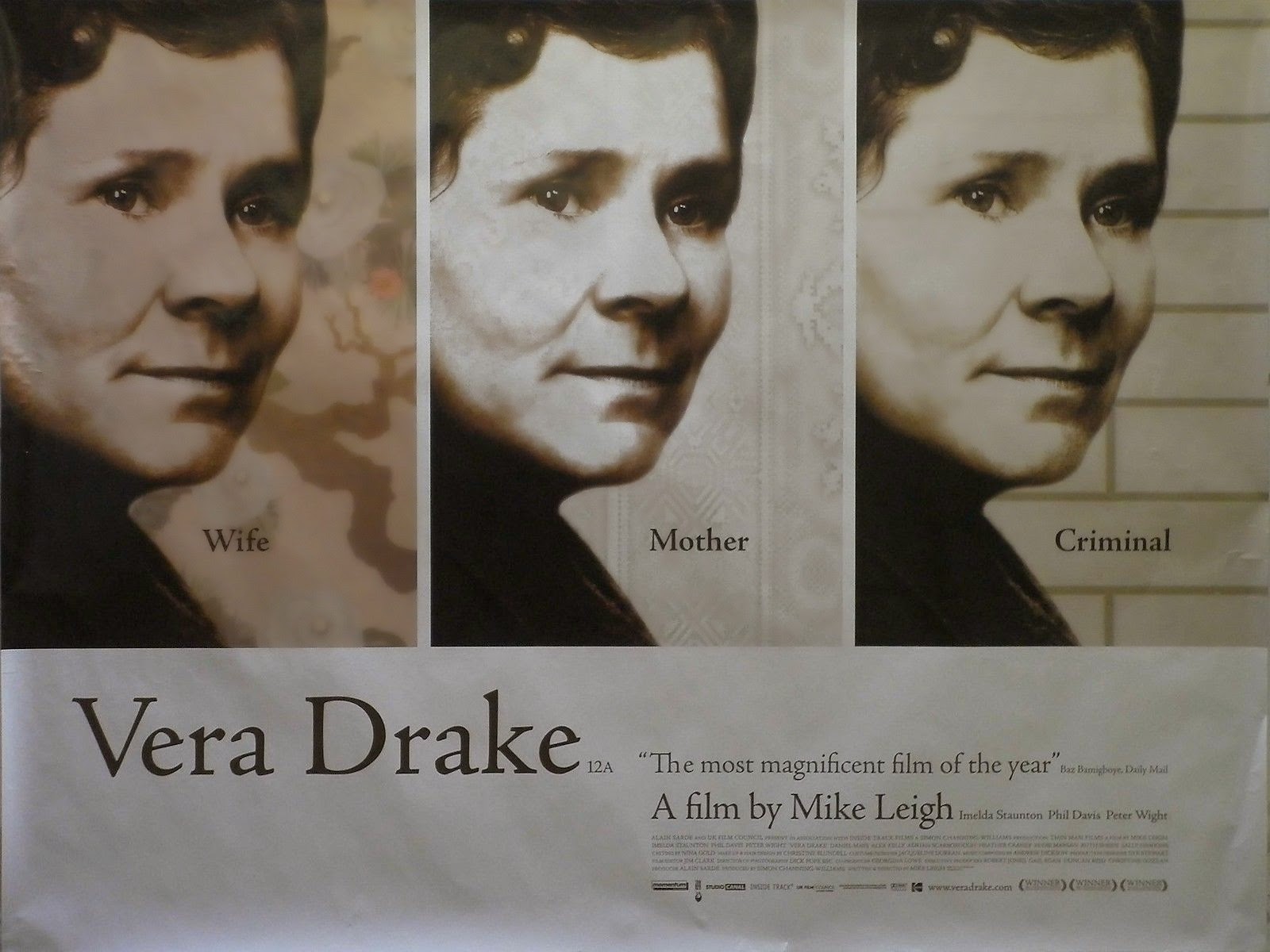
At first glance, this poster for Mike Leigh’s 50’s set drama looks drab and unappealing, its bland colour scheme and triple image of Vera herself (as played by Imelda Staunton) lacking any appreciable vibrancy or vitality.  It’s a poster for a Mike Leigh movie, a dark, often uncompromising look at the life of a woman whose personal sense of morality was at odds with both society and the criminal justice system of the time.  It’s a hard sell, even with Leigh in the driving seat, but whatever your views on the movie itself, the poster is unassuming, yet brilliantly devised.

The main focus is obviously the triptych.  An image of Vera repeated against differing backgrounds that in some way reflect the description given of her in each panel.  In the first, she’s a Wife, and the wallpaper depicts a wild growth of branch and flower, a more sensual, earthy tone that emphasises the carnal nature of marriage.  It’s telling us that Vera is first and foremost a woman (which isn’t so obvious when watching the movie).  In the second panel, she’s a Mother, and the wallpaper is less attractive, more formal, its ordered pattern highlighting the conformity that Vera has taken on by having a child.  Her life is no longer as carefree as it was.

And then there is the final panel, a stark portrayal of Vera as a Criminal, the background a bare brick wall, the kind you might encounter in a prison cell.  It’s a powerful conclusion, reflecting the distance Vera has travelled from that first, happier, image.  Here is one woman’s journey in Life portrayed succinctly and with effortless flair.  This is a tremendously evocative poster – for a tremendously evocative and moving movie – and while the press quote may seem a little grandiose, there’s no denying that, as far as the poster goes, it really is “magnificent”.

Agree?  Disagree?  Feel free to let me know.

Share this:

  • Click to share on X (Opens in new window) X
  • Click to share on Facebook (Opens in new window) Facebook
  • More
  • Click to print (Opens in new window) Print
  • Click to email a link to a friend (Opens in new window) Email
Like Loading...

Blog Stats

  • 486,666 hits

Recent Posts

  • 10 Reasons to Remember Bibi Andersson (1935-2019)
  • Fantasia (1940)
  • Dances With Wolves (1990) – The Special Edition
  • Kiss of the Spider Woman (1985)
  • The Three Musketeers (1973)

Top Posts & Pages

  • Lost for Life (2013) - Another Look
    Lost for Life (2013) - Another Look
  • Lost for Life (2013)
    Lost for Life (2013)
  • About
    About
  • Cardboard Boxer (2016)
    Cardboard Boxer (2016)
  • A Brief Word About La La Land (2016)
    A Brief Word About La La Land (2016)
  • Exposed (2016)
    Exposed (2016)
  • Removal (2010)
    Removal (2010)
  • My Top 10 Guilty Pleasures
    My Top 10 Guilty Pleasures
  • BFI London Film Festival 2015
    BFI London Film Festival 2015
  • A Brief Word About Netflix Original Comedies
    A Brief Word About Netflix Original Comedies
Follow thedullwoodexperiment on WordPress.com

Blogs I Follow

  • Rubbish Talk
  • Film 4 Fan
  • Fast Film Reviews
  • The Film Blog
  • All Things Movies UK
  • Interpreting the Stars
  • Let's Go To The Movies
  • Movie Reviews 101
  • TMI News
  • Dan the Man's Movie Reviews
  • Film History
  • Jordan and Eddie (The Movie Guys)

Archives

  • April 2019 (13)
  • March 2019 (28)
  • February 2019 (28)
  • January 2019 (32)
  • December 2018 (28)
  • November 2018 (30)
  • October 2018 (29)
  • September 2018 (29)
  • August 2018 (29)
  • July 2018 (30)
  • June 2018 (28)
  • May 2018 (24)
  • April 2018 (21)
  • March 2018 (31)
  • February 2018 (25)
  • January 2018 (30)
  • December 2017 (30)
  • November 2017 (27)
  • October 2017 (27)
  • September 2017 (26)
  • August 2017 (32)
  • July 2017 (32)
  • June 2017 (30)
  • May 2017 (29)
  • April 2017 (29)
  • March 2017 (30)
  • February 2017 (27)
  • January 2017 (32)
  • December 2016 (30)
  • November 2016 (28)
  • October 2016 (30)
  • September 2016 (27)
  • August 2016 (30)
  • July 2016 (30)
  • June 2016 (31)
  • May 2016 (34)
  • April 2016 (30)
  • March 2016 (30)
  • February 2016 (28)
  • January 2016 (35)
  • December 2015 (34)
  • November 2015 (31)
  • October 2015 (31)
  • September 2015 (34)
  • August 2015 (31)
  • July 2015 (33)
  • June 2015 (12)
  • May 2015 (31)
  • April 2015 (32)
  • March 2015 (30)
  • February 2015 (37)
  • January 2015 (39)
  • December 2014 (34)
  • November 2014 (34)
  • October 2014 (36)
  • September 2014 (25)
  • August 2014 (29)
  • July 2014 (29)
  • June 2014 (28)
  • May 2014 (23)
  • April 2014 (21)
  • March 2014 (42)
  • February 2014 (38)
  • January 2014 (29)
  • December 2013 (28)
  • November 2013 (34)
  • October 2013 (4)

Blog at WordPress.com.

Rubbish Talk

Film 4 Fan

A Movie Blog

Fast Film Reviews

The Film Blog

The official blog of everything in film

All Things Movies UK

Movie Reviews and Original Articles

Interpreting the Stars

Dave Examines Movies

Let's Go To The Movies

Film and Theatre Lover!

Movie Reviews 101

Daily Movie Reviews

TMI News

Latest weather, crime and breaking news

Dan the Man's Movie Reviews

All my aimless thoughts, ideas, and ramblings, all packed into one site!

Film History

Telling the story of film

Jordan and Eddie (The Movie Guys)

Movie Reviews & Ramblings from an Australian Based Film Fan

Privacy & Cookies: This site uses cookies. By continuing to use this website, you agree to their use.
To find out more, including how to control cookies, see here: Cookie Policy
  • Subscribe Subscribed
    • thedullwoodexperiment
    • Join 481 other subscribers
    • Already have a WordPress.com account? Log in now.
    • thedullwoodexperiment
    • Subscribe Subscribed
    • Sign up
    • Log in
    • Report this content
    • View site in Reader
    • Manage subscriptions
    • Collapse this bar
 

Loading Comments...
 

    %d